Valdez City Council Work Session: Housing Study Update (July 15, 2025)
STREAMING COPY IN PREPARATION — RECORDING AVAILABLE FROM THE ORIGINAL SOURCE
Valdez City Council Work Session: Housing Study Update (July 15, 2025)
This was a work session of the Valdez City Council to review initial findings from the Housing Needs Assessment process, conducted by Agnew Beck Consulting. The session included presentations on community survey results, quantitative housing data, a 10-year housing need forecast, and short-term rental analysis. Council members asked clarifying questions and received updates on next steps.
Discussion Items
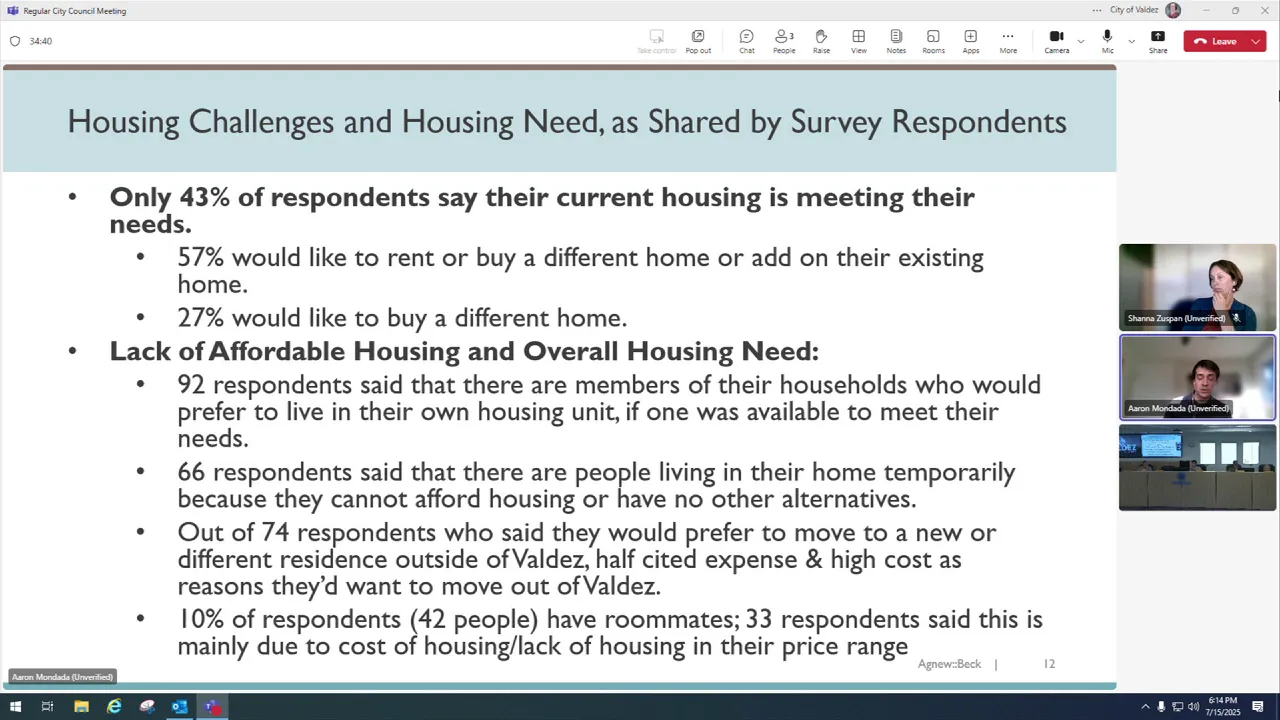
- Survey Results: Agnew Beck reported 455 responses (over 10% of Valdez's population) to a 53-question survey. Key findings include: 43% of respondents felt their current housing meets their needs; aging housing stock (over half built before 1989); high desire for new single-family homeownership opportunities; and a comfortable monthly housing cost range of $1,000–$2,000. Renters indicated a threshold of under $1,250/month, while ownership buyers were willing to pay about $1,750 or more.
- Demographic and Housing Characteristics: Valdez has seen a population decline since 2010 (currently ~3,700). The senior population (80+) is expected to grow from 3% to 9% by 2035. Housing stock is older, with 32% built before 1975, and 25% of units are mobile/manufactured homes. Overcrowding affects 4.3% of households.
- 10-Year Housing Need Forecast: The consultants presented a total need of approximately 545 units over 10 years, broken into: 20 new units from population growth (using state average growth rate), 68 units to address overcrowding, 114 units from expressed community need (pent-up demand from survey), and 343 units as a target for rehabilitation/replacement (based on age, lack of facilities, and mobile home share). Of new units, about 123 are needed for households at or below 80% of Area Median Income (AMI).
- Cost Burden: 13% of owner-occupied and 50% of renter-occupied households are cost-burdened (paying >30% of income on housing). Lower-income households are disproportionately affected.
- Short-Term Rentals: STR inventory has grown ~20% year over year since 2022, peaking at 88 units in summer 2024. Average annual revenue per STR is $39,000. In peak summer, about 5% of Valdez's housing inventory is used for STRs, comparable to Ketchikan and Sitka but lower than Homer and Girdwood. The data source (AirDNA) does not distinguish owner-occupied vs. non-owner-occupied STRs.
- Council Questions: Council member Austin Love asked how the model accounts for vacancy chains when pent-up demand is realized (consultants explained that the expressed need assumes the mover leaves behind an occupied unit) and inquired about obtaining owner-occupancy data for STRs (consultants noted it is not available from current sources but could be collected through permitting).
Key Outcomes
- The council received the preliminary findings and will receive a PDF of the full survey results via email.
- A housing subcommittee meeting is scheduled for the following afternoon (July 16) to begin discussing the data and potential policy directions.
- No formal votes or decisions were made; the session was informational to guide future policy work.
Meeting Transcript
So uh on the line we've got our consultants from Agnew Beck. Uh we're gonna have Kate Huber kind of lead the discussion. Um I guess there's a number of slides and some information. But I think one of the big takeaways for council is uh procedurally make sure we're on the right track, and at the end of the day that the final report has the information that you're looking for. Kate. Thanks, Nate. I will um just do a really brief introduction and then pass it over to the team at Agnew Beck to present to you tonight. Um so this is this is kind of a midway check-in during the housing needs assessment process. So we've been working with the team from AgNubek and uh myself and Nicole Chase in the community development department to um perform a housing needs assessment. This really was born out of discussions that came up around housing during the Title 17 process and as addressing housing has been a top city council priority for a number of years now. And so the goal of this project is to give you all and city staff really good data to make informed decisions. Um we've made a lot of efforts and we came up with some programs to target the housing issues in our community that we knew were things that we could execute quickly and just try to make an impact initially. But what we heard from City Council at the time and have continued to hear is that we want to expand and do additional more targeted programs. So the goal of this project is to really take a good look at the data, get further input from the community, and then provide you with information to make those decisions and help direct um city staff with other program ideas and eventually, you know, an action plan to address the issues. Um I am going to pass it over to Shanna and Aaron and let them introduce themselves and dive right into the project. And then we we've set up the presentation to have plenty of time at the end for questions and discussion. And as um City Manager Deval mentioned, we want to hear from you if there's anything that was missed or areas that you really want us to dive in in the report so that the final report you receive this fall will really reflect what you need. So thank you. Hi, everybody. Erin, do you maybe want to go to the next slide? And great. Okay. I'm Shanna's SPN and I'm here with Aaron Mondata. I am one of the principal and co-owners at AgnewBeck Consulting based here in Anchorage. And when Aaron gets to his slides, I'll let him introduce himself. But he's based in Boise, Idaho. So he's a couple of hours later than our Alaska time zone. And we're excited to present these initial findings to you today. Slide. And I just want to do a check. Can people hear me okay? I know we're looking directly at our slides and not at the group, which is totally oh, there. Okay. Now I feel like I'm talking to you a little better. Thanks. Okay, so our agenda tonight, I know I think we have an hour and we want to save some time for comments. And of course, we have too much too many slides. So we might kind of skip through a few of them as we kind of do our time checks. But after I do the welcome and introductions, and I'm going to give just a like a brief overview of the housing needs assessment process. Um, pass it to Aaron, who's going to start us off by giving some initial findings on the really um well responded community survey that was um done in your community in the spring. And then I'm going to dive into some of the quantitative data and our very initial needs assessment forecast and our approach to doing that work. Um, and then hopefully we'll have time for questions and discussion. I think a lot of folks probably know a little bit about AgniBec. I know we worked worked on other projects in Valdees. Um, just giving you a little bit of a sense of the type of work that we do. Um, we really like to connect the quantitative work to the qualitative work. We're um skilled in survey analysis, demographic analysis. We work a lot in policy areas as well as in community health. Go to the next slide. Okay.
openpublica.com