Valdez City Council Work Session on Valdez Lighthouse Project - June 16, 2026
STREAMING COPY IN PREPARATION — RECORDING AVAILABLE FROM THE ORIGINAL SOURCE
Valdez City Council Work Session on Valdez Lighthouse Project - June 16, 2026
The Valdez City Council held a work session on June 16, 2026, to hear a presentation from Sound Mental Health and the newly formed nonprofit Valdez Lighthouse. The presentation focused on expanding mental health services, building community resilience, and shifting from crisis response to prevention. No formal votes were taken; the session was informational with an invitation for future partnership.
Discussion Items
- Presentation by Matt Wadsworth (Sound Mental Health): Wadsworth provided an update since March 2025, reporting that Sound Mental Health had opened in fall 2024 and achieved credentialing with major insurances by February 2025. He shared statistics for 2025: 2,715 total visits, including 141 intake assessments and 2,574 outpatient visits, plus 38 outreach events (e.g., school presentations, Coast Guard talks, suicide prevention discussions). He emphasized the need to move beyond the "ambulance at the bottom of the cliff" model toward prevention, introducing the Valdez Lighthouse nonprofit to seek grants and fund community mental health work.
- Valdez Lighthouse Board Introductions:
- Colleen Murphy (Treasurer): Shared her deep connection to Valdez and the mission to build "fences" (prevention infrastructure) so the community does not rely solely on crisis care. She read the mission and vision statements, focusing on supporting people before, during, and after crisis.
- Bart Hinkle (Secretary): Described his 26-year career in Valdez law enforcement, highlighting how many calls are rooted in mental health. He gave an example of a man who sought help but could not access residential treatment for six months, later ending up in the criminal justice system. He stressed the need for flexible, timely services.
- Katie Cornell (President): Shared personal experiences with therapy and her work in schools and foster care. She emphasized the impact of suicide in Valdez and the need for suicide prevention training, community education, and stigma reduction.
- Clinical Framework: Presenters outlined two categories: crisis management (connecting people in crisis to clinicians) and crisis prevention (building resilience before crisis). Proposed initiatives included:
- Community Partner Support Services: In-person crisis support, individualized care plans, and care consultation for community members.
- Multidisciplinary Teams (MDTs): Formalizing existing collaboration among agencies (AVV, VNT, schools, housing, food bank, emergency responders) with Lighthouse clinicians chairing meetings to coordinate care and track outcomes.
- Community Presentations and Stigma Reduction: Free monthly training, social media education (e.g., "Valdez gives me mental health" misconception), and events like coffee kindness and Puzzle Wars.
- Suicide Prevention: Training in QPR, Safe Talk, and ASSIST for students, coaches, and trusted adults.
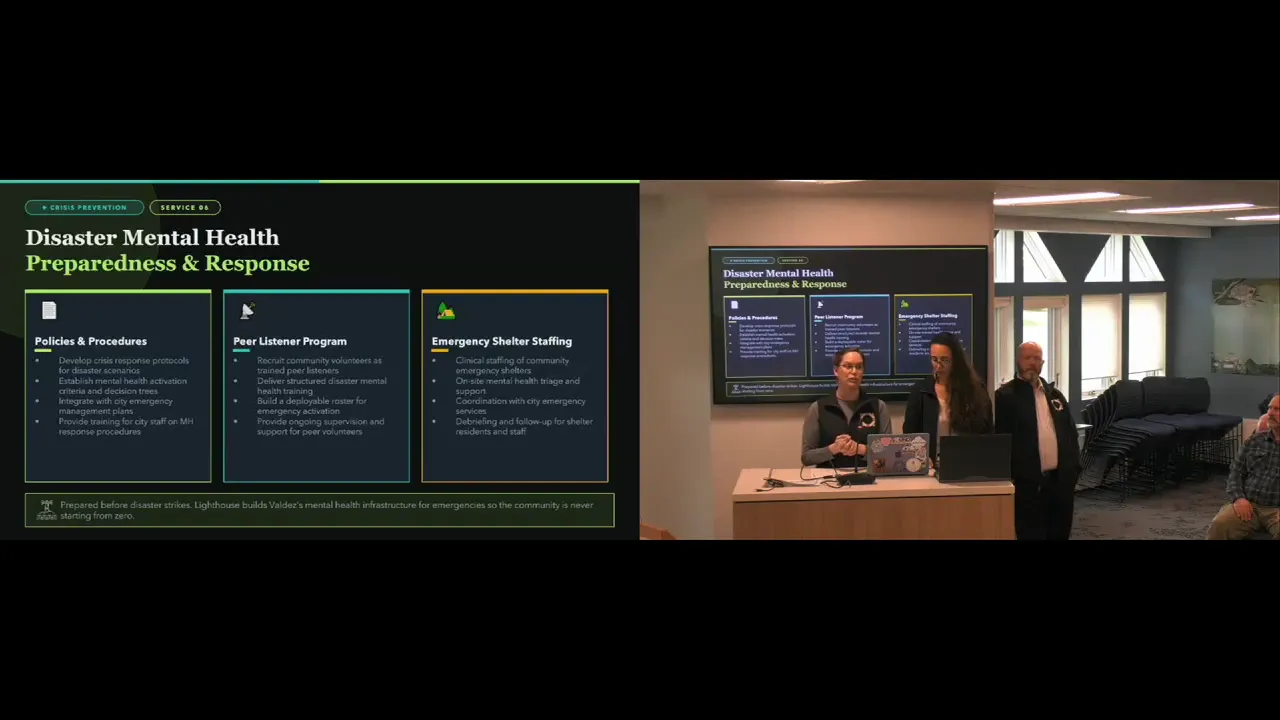
- Disaster Mental Health Preparedness: Proposing a "Pure Listener" program to train community members to provide peer support in emergencies, integrating with existing city, Coast Guard, and school plans. Also ensuring debriefing and follow-up for caregivers.
- Questions from Council:
- Councilmember noted the importance of awareness and communication; Katie Cornell emphasized the need for skills to have hard conversations (e.g., asking about suicide).
- Councilmember Shannon asked about barriers for minors; presenters affirmed they are pursuing grants to reach under-18 populations, including college students living away from home.
- Councilmember Woody asked if Lighthouse would absorb SWAN; presenters clarified they are separate but collaborative, with Lighthouse focusing specifically on mental health prevention and crisis response, while SWAN covers broader wellness.
Key Outcomes
- No formal votes or decisions were taken at the work session.
- The Valdez Lighthouse team stated they are not requesting immediate city funding but are seeking partnership and will continue pursuing grants and building coalitions.
- Council members expressed appreciation for the passion and commitment, with several indicating interest in future collaboration. The council was encouraged to keep the Lighthouse in mind during upcoming budget processes.
Meeting Transcript
The four session to order. This is the Valdez Lighthouse Project Work Session. So we'll leave it. Go ahead and take it away, please. Okay. Well, I my name's Matt. Oh. Can you hear me okay on the microphone? Yep. Okay. So my name is Matt Wadsworth. Um, I work at Sound Mental Health. Um we've created this uh kind of a graphic. Um it's an AI graphic. So apologies, Councilmember Devons. Um we wanted to kind of just show the the changing landscape of mental health. It's just been evolving. Uh we came in March of 2025 to kind of introduce where we're doing, it's continued to evolve since then. So we want to kind of show our journey where we're at and what we think can be helpful. So in the fall of 2024, we opened our doors. Um we began, it was a little bit of a journey getting credential with insurances. Little by little, it took about three months to get most of the commercial insurances. We're credentialed with all the major insurances in town. Uh, Medicaid and Medicare takes a little bit longer. We're able to get that by February of 2025. So we've been able to see just about anyone that's got insurance in town, no barriers in terms of like uh eligible pairs. Um, so we've been providing, been kept pretty busy. I'll show you guys some stats and in just a minute here, uh, where we're at. Of course, all of us have our roots in community mental health. Um, that's where some of our passion is. So, as we've opened our doors, whenever we've had opportunities to be involved in community mental health and doing that kind of work, we've taken advantage of that, um, which is include things like puzzle wars and and cribbage wars, well, cribbage tournaments, they're not wars. It can get turned into a war, but it's not supposed to be like that. Just friendly game with neighbors. Uh, anyhow, uh working on some of those community presentations, um, planting seeds and and trying to work upstream from the work. Yeah, so that takes us to the next part of our map, this mid-realization. We were doing quite a lot, right? We're seeing full caseloads. We went from, huh? I wonder if people are gonna come to oh, everybody's coming. I'm seeing six to seven people a day. For those of you that don't know, that means that I'm sitting down for seven hours straight talking to people about how they're doing, don't want to turn anyone away, and then I'm bebopping over to Cribbage Wars to win, I should add. Yeah, we were like, oh, we're not just at capacity, we're overload, but we still want to help our community. How are we gonna do that? We need to ship something here because if we don't, we're gonna burn out as providers, and then we're not gonna be able to provide care anymore. So we did a little thinking and we shifted. We pivoted just like in that friends episode, right? We realized, okay, uh, if we want to continue to do our intense community mental health outreach, if we want to continue to be able to do lecture services and puzzle wars and do these things that bring people together, right? It's all part of those puzzle pieces of wellness. Um, we needed to be able to fund that somehow, right? So we did this shift, and it felt pretty incredible for us because we are three therapists and we don't know how to do these things.
openpublica.com