OPENPUBLICA · PUBLIC MEETING RECORD
Record of Proceedings
Whitehall City Council Committee Meeting Summary – January 28, 2026
City Council — Wednesday, January 28, 2026
BodyWhitehall, Ohio
SessionCity Council
DateWednesday, January 28, 2026
StatusFILED
Video Record
STREAMING COPY IN PREPARATION — RECORDING AVAILABLE FROM THE ORIGINAL SOURCE
Transcript — Verbatim
Speaker numbers apply only to this recording.
Discussion Breakdown — Share of Meeting
Public Safety21%
Procedural17%
Government Structure17%
Personnel Matters13%
Community Engagement12%
Public Engagement6%
Mental Health Awareness3%
Economic Development3%
Food Security3%
Summary of Proceedings
Whitehall City Council Committee Meeting – January 28, 2026
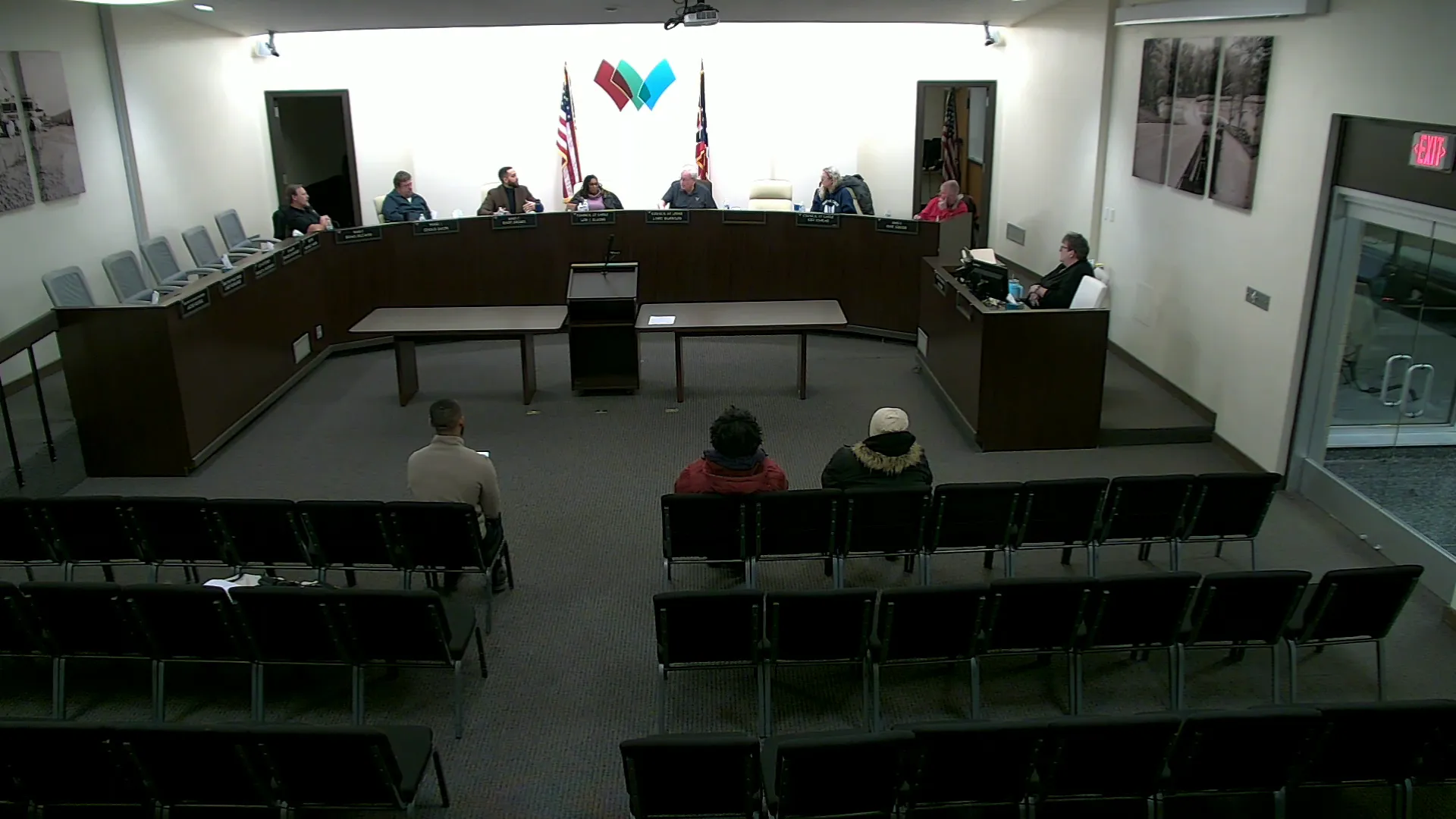
The Whitehall City Council held its committee meeting on Wednesday, January 28, 2026, beginning at 6:30 PM and adjourning at approximately 9:31 PM. The meeting included a public presentation from the local FOP president, a council rules discussion for the 2026–2027 term, introduction of draft appropriations legislation, and reports from all standing committees. No final votes were taken on the draft legislation.
Public Comments & Testimony
- Brian Steele, President of the Fraternal Order of Police (FOP), addressed council before the regular agenda. He said the FOP represents 4,700 law enforcement officers across 29 Central Ohio agencies, and that Whitehall is the only agency where union members have voted no confidence in the chief. He cited a membership survey with about 36 responses from roughly 46 active officers showing low morale, anxiety, anger, and depression at work, and said 46 officers have left the department since Chief Mike Christman arrived, including 29 by resignation as of about a year ago.
- Steele described grievances over alleged ticket and arrest quotas, Fourth Amendment concerns, retaliation against grievance representatives, termination of officers Ortega and Canon, blocked emails from the union to council members and staff, and a pending First Amendment lawsuit. He denied allegations that he exposed an undercover officer, threatened the safety director, or made threats against the chief or his family. He called for a third-party independent investigation and said he remains willing to compromise.
- Council members asked Steele about labor-management meetings, performance measures, campaign donations, and survey validity. Steele responded that prior labor-management meetings have broken down, that eight or nine arbitrations are pending, and that performance expectations in Whitehall function as quotas. He cited one officer who had 16 arrests, 17 reports, 26 citations, and 47 traffic stops in a month yet was still told they were below department averages.
- Several council members also made remarks about Whitehall police history and the need for unity, with some pushing back on Steele's claims and others thanking him for his presentation.
Discussion Items
Council Rules of Procedure for 2026–2027
- Council members reviewed the current rules alongside model rules from Reynoldsburg and Gahanna. They compiled a list of possible changes rather than debating each item in detail.
- Proposed changes included adjusting the order of business, moving agenda request and committee agenda deadlines, adding definitions for ordinance, resolution, and motion, removing the outdated motion to adjourn, clarifying presiding officer language, adding timers for debate, prohibiting cell phones at the dais, limiting public comment time, requiring speakers to identify their city of residence, setting sign size and decorum rules, and allowing a single five-minute public comment period as an alternative to two three-minute periods.
- Members agreed to email their written proposals and arguments to each other and continue the discussion at a future meeting before voting on individual items.
Draft Ordinance No. 008-2026 – Department of Neighborhoods Appropriation
- Councilmember Larry Morrison introduced draft ordinance 008-2026, which would amend the 2026 general fund appropriations to zero out funding for the Department of Neighborhoods, including director, assistant-to-director, training and certification, and technology line items, and declare an emergency.
- Morrison argued the department would cost about $165,000 plus vehicle and other expenses, likely exceeding $200,000, and that the city could provide resident assistance more cost-effectively through existing staff or a part-time position.
- Several council members, including Councilmembers Harcar and Elmore, strongly supported the department, citing the city's roughly 17.2% poverty rate, the complexity of connecting residents to services, and the value of full-time staff focused on resident needs. Councilmember Brown suggested that compromise could include continuing funding with future review rather than an immediate zero-out.
- The measure was introduced and seconded, but no vote was taken at this meeting.
Third Reading – Ordinance No. 133-2025
- Council noted that Mayor Bivens vetoed Ordinance 133-2025 on January 27, 2026. The ordinance, which would amend Title Three of the legislative code to prohibit interference with council communications and declare an emergency, is scheduled for a vote on February 3, 2026. No discussion was held on it at this meeting.
Standing Committee Reports
- Administration and Financial Management (Elmore): No drafts or pending legislation; opened and closed at 9:18 PM.
- Community and Elder Advocacy (Harcar): No drafts. Chair Harcar announced she will reintroduce legislation next week to remove Councilmember Dixon because the prior measure was advanced without the required three readings and without the two-thirds majority needed to suspend the rules. She said the action is about procedure and due process, and would not be needed if Dixon resigned. A brief dispute over decorum and a point of order followed.
- Community Standards and Enforcement (McCann): Ordinance No. 004-2026 received its second reading. It would amend Section 1116.03 and enact Section 1116.04 to standardize accessory dwelling units (ADUs). A Planning Commission meeting is scheduled for February 5, 2026, and a public hearing and third reading are set for February 17, 2026. Council noted the Economic Development Director is working on related rental inspection issues and will present additional ADU information on February 10, 2026.
- Economic Development (Dixon): No drafts or pending legislation; opened and closed at 9:28 PM.
- Infrastructure, Maintenance and Services (Brown): No drafts. Council received an update that three water line projects and a resurfacing project are moving forward. Brown also thanked street crews for snow removal and noted that some water main breaks are the responsibility of the City of Columbus.
- Public Safety (Morrison): No drafts or pending legislation; chair praised safety forces and closed at 9:31 PM.
- Parks and Recreation (Adkins): No drafts or pending legislation; closed at 9:31 PM.
Key Outcomes
- No final votes were taken during the committee meeting.
- Draft Ordinance 008-2026 was introduced and seconded; discussion will continue before a future vote.
- Council rules proposals were compiled for continued discussion; members will send written arguments to each other ahead of the next meeting.
- Councilmember Harcar announced her intent to reintroduce removal legislation for Councilmember Dixon at the next meeting.
- Ordinance 133-2025 will be voted on February 3, 2026.
- Ordinance 004-2026 (ADUs) is scheduled for a public hearing and third reading on February 17, 2026.
- The meeting adjourned at approximately 9:31 PM.
Meeting Transcript
Good evening, everyone. Welcome to the White House City Council Committee meeting agenda Wednesday January 28th, 2026. We have administration uh council on the whole matters. There's one piece of uh draft legislation on the agenda, and then we have uh committee of the whole legislation before we get into the discussion. Uh and this is something we've done in the past uh from time to time. Uh we have a speaker that uh wants to come up and address uh counsel, and we will do that prior to the discussion. That way they won't have to sit through this whole meeting and listen to our new council rule discussion. So if you wish to come up, sir. Thank you, council. Thank you, council members. Brian Steele and President of the Paternal Order of Police. I was here about a year and a half ago. I just uh I've been following counsel lately from talking to members of my FOP, members of your community. I just wanted to address some statements, put some facts on the table, and answer any questions any of you might have. Like most people, I'm dealing with a little crud, so I bought my water. Just give me a second, I'll go through this. I promise I will not take up a lot of your time. I know it's valuable. So this is how we got here. I just want to start from the beginning and just go over the record, not the record, not the rhetoric. The role of the FOP and outlier. Fraternal order police is a labor union. We're an advocacy group, we're a charitable uh organization, but first and foremost, we're a labor union. We represent 4,700 men and women of Central Ohio law enforcement, including 29 different police agencies. This means working with 29 different chiefs, 29 different councils, 29 different mayors, HR managers. The list goes on. The reality is in 28 of those 29 agencies, we have a fabulous working relationship. I won't tell you we always agree. Labor and management shouldn't always agree. There's a reason it's set up the way it is, but we have a good working relationship. Right now, your chief, Chief Mike Christman is the only chief out of 29 that the union members have a no confidence on. About a couple weeks ago, he mentioned Sheriff Baldwin. There was a no confidence on Sheriff Baldwin prior to me becoming the FOP president. I don't like no confidence votes. I say they're kind of like a divorce, but you still have children together. You still have to work together, and sometimes it makes it harder. That's why I did not want to repeat some of the sins of my predecessors. Sheriff Baldwin's no confidence was a group of members, about 10 to 15 angry. As you've seen, sometimes they come in front of you, they come in front of us too, which is why, as a chairman of a board, you must maintain order of your board of the room and Roberts Rules order. And I know that's been a problem here, and I've been through that. So I know the importance of Roberts Rule's order. I know the importance of chairing a board and having that control to help move your agenda. So I didn't want to make the same mistake. I personally called every single rank and file police officer of wealth. Not 10 to 15 angry guys in uh at the FOP meeting. I called every single officer, every single patrol officer voted no confidence. Every single one. Again, not with the chief alleges, just a handful at an FOP meeting. Every single officer.
SUMMARIZED BY OPENPUBLICA AI
TRANSCRIPT VIA PUBLIC VIDEO
openpublica.com
openpublica.com