OPENPUBLICA · PUBLIC MEETING RECORD
Record of Proceedings
Whitehall City Council Committee Meeting - February 24, 2026
City Council — Tuesday, February 24, 2026
BodyWhitehall, Ohio
SessionCity Council
DateTuesday, February 24, 2026
StatusFILED
Video Record
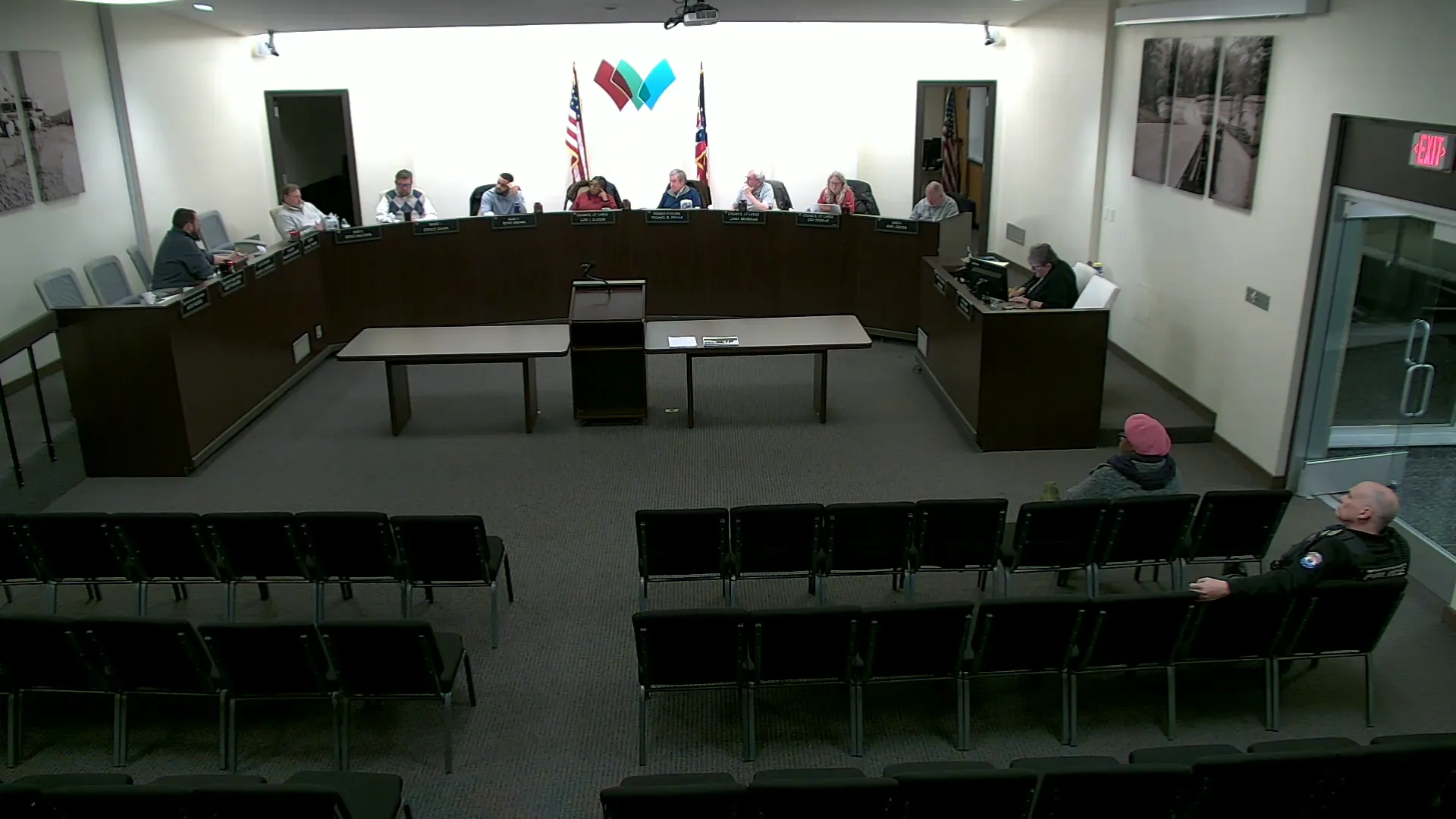
STREAMING COPY IN PREPARATION — RECORDING AVAILABLE FROM THE ORIGINAL SOURCE
Transcript — Verbatim
Speaker numbers apply only to this recording.
Discussion Breakdown — Share of Meeting
Procedural51%
Public Engagement17%
Disability Rights7%
Government Structure7%
Public Safety6%
Community Engagement5%
Budget Equity Analysis5%
Fiscal Sustainability1%
Personnel Matters1%
Summary of Proceedings
Whitehall City Council Committee Meeting - February 24, 2026
The Whitehall City Council Committee met on Tuesday, February 24, 2026, at 6:30 p.m. The agenda included a presentation by Jared Buerger of A Kid Again, ten pieces of draft legislation covering codified ordinances, employee recognitions, appropriations, and fund transfers, and a discussion of proposed changes to the Council Rules of Procedure for the 2026-2027 term. No final votes were taken; all legislative items are scheduled for adoption at the March 3, 2026 council meeting.
Presentation by A Kid Again
- Jared Buerger, Executive Director of the Central Ohio Chapter of A Kid Again, presented on the nonprofit's mission to serve families raising children with life-threatening medical conditions. He reported that A Kid Again currently serves 1,100 families in Franklin County but only five in Whitehall.
- Buerger emphasized the need for a Department of Neighborhoods to better connect residents with human services. He cited statistics: 88% of children enrolled report improved quality of life; 77% of families feel closer; 75% of parents report less depression and sadness. Demand for services has increased 72% since January 2025, and 91% of nonprofit leaders expect operational cost increases by June 2026.
- Council members expressed support for the organization and the concept of a Department of Neighborhoods. Auditor Alexander added that the investment is affordable and necessary.
Legislation Introduced
All legislative items below received first or second readings and will be considered for adoption at the March 3, 2026 council meeting. No votes were taken.
- Ordinance 011-2026 (listed as 3rd reading on agenda): Authorizing adoption of May 2026 replacement pages to the City's codified ordinances, declaring an emergency. Note: The agenda states this is a third reading scheduled for adoption on April 7, 2026, but committee proceedings referred to it as needing three readings, indicating a possible discrepancy. (Introduced by Morrison, seconded by Adkins)
- Resolution 007-2026 (1st reading): Recognizing Dustin Irvin as 2025 Service Employee of the Year with a $350 payment.
- Resolution 008-2026 (1st reading): Recognizing Justin Mooney as 2025 Firefighter/Paramedic Employee of the Year with a $350 payment.
- Resolution 009-2026 (1st reading): Recognizing Jason Kubinski as 2025 Police Officer Employee of the Year with a $350 payment.
- Resolution 010-2026 (1st reading): Recognizing Julie Ogg as 2025 Administrative/Support Employee of the Year with a $350 payment.
- Ordinance 008-2026 (3rd reading): Amending Ordinance 118-2025 to make appropriations from the General Fund for the Department of Neighborhoods, declaring an emergency.
- Ordinance 012-2026 (1st reading): Supplemental appropriation of $203,342.37 from the WIMPITE Fund to the Hamilton/Broad TIF expense account for infrastructure reimbursement.
- Resolution 005-2026 (2nd reading): Approving revisions to the City's investment policy.
- Ordinance 013-2026 (1st reading): Fund transfer of $68,650.42 from the General Fund to the Debt Service Fund for energy upgrade capital lease repayment.
- Ordinance 014-2026 (1st reading): Supplemental appropriation of $4,090 from the Police Department Grant Fund to the Ohio Traffic Safety Office Grant for driver's education classes at Whitehall Yearling High School.
- Ordinance 015-2026 (1st reading): Fund transfer of $30,306 from the Evidence Setaside Fund to the Law Enforcement Trust Fund for distribution of seized narcotics investigation monies.
- Ordinance 016-2026 (1st reading): Fund transfer of $57,920.89 from the General Fund to the Debt Service Fund for repayment of a Franklin County Infrastructure Bank loan for the Woodcliff redevelopment project.
Council Rules of Procedure Discussion
- President Potter led a discussion of proposed changes to the Council Rules for the 2026-2027 term. Council members debated a range of provisions, including presidential succession, agenda deadlines, public speaker time limits (two three-minute sessions or one five-minute session), council debate time limits, executive session conduct, sign restrictions, cell phone use, and decorum. City Attorney Nicodemus provided legal guidance on Robert's Rules of Order and First Amendment considerations.
- No votes were taken; President Potter announced that council members may bring individual motions on specific rule changes at the March 3 meeting, where a simple majority of four votes will be required for approval.
Key Outcomes
- All draft legislation was introduced as first or second readings and is scheduled for adoption at the council meeting on March 3, 2026.
- Employee recognition resolutions are expected to be suspended and adopted on March 3.
- Council members will propose and vote on specific amendments to the Council Rules of Procedure at the March 3 meeting.
- No public comments were received, and no action items were approved during this committee session.
Meeting Transcript
Good evening, everyone, and welcome to the Whitehall City Council Committee meetings of Tuesday, February 24th, 2026. There are 10 pieces of draft legislation, which we'll get to here in a moment. But before we jump into that, we do have a presentation this evening, and Mr. Alexander, if you please lead off with an introduction. Yes, thank you, Mr. President, members of council. I'll have the pleasure of introduction of my friends, Jared Berger. He is the executive director of the Kid Again, which is a nonprofit that serves uh disabled ill, terminally ill uh children here in Central Ohio. They have a small population that they serve in Whitehall that I met Jared maybe three or four years ago and now serve on the board of the Kid again co-chair and finance committee. But we've had plenty of discussions about the work we do with Kid again, the work we do here in Whitehall, and when I mentioned the Department of Neighborhoods and some of the discussions around that, he thought it would impair that he'd come and speak about how he could find some synergies with the organ uh with the department like that with the Kid Again, but also uh health and human services organizations in general and what it looks like from a top-down model from the state, the county, down to municipalities like Whitehall. So thank you for indulging. Uh, he's been informed that you have a lot to discuss tonight, so he'll get through it in 15 minutes or less and entertain any questions. So thank you. And thank you. And on behalf of council and the city, I'd like to welcome you and thank you for coming out this evening. Wonderful. Well, thank you, President Potter, uh, members of council. It's my privilege to be here this evening. My name's Jared Berger. As uh Auditor Alexander said, I'm the executive director for the Akidagan Central Ohio chapter. I also have the pleasure of serving on the public policy committee for the Franklin County Human Service Chamber. Start with some information about Kid Again. A Kid again is a nonprofit organization that serves families raising children with life-threatening medical conditions throughout the Central Ohio region. We're founded 31 years ago in Central Ohio, and we've grown to serve thousands of families throughout our region, raising children with over 400 unique life-threatening medical conditions, giving children and their families an opportunity to get a break from medical settings such as the hospital therapy centers, doctor's offices, and allowing families the opportunity to spend quality time with their loved ones, uh, which is something that is frequently robbed from the families we serve. We do this by hosting annual activities that we call ventures for our families, taking families to places like the zoo, coastside, Zumbeezy Bay, the wilds, giving them a cost-free, carefree opportunity to be in community with their family and loved ones. So families using children with life-threatening medical conditions face a number of barriers that I'm sure many of you are common and well familiar hearing uh citizens of the city of Whitehall experiencing. Those include things like social isolate isolization. A lot of our families think to themselves, I'm the only one. I'm the only one who's experiencing this reality of raising a four-year-old with cancer or raising a child with sickle cell or another very serious medical condition that really does take away a child's uh childhood in many ways and causes these kids to grow up quicker. Time spent apart from the family. I just heard from a family the other day who told me moms at nationwide children's hospital, essentially living at nationwide children's hospital with their daughter, while dad's at home taking care of their two boys. The parents see each other on the weekends if they're lucky. Think about the strain that that puts on marriage, the strain that that puts on the childhood. And this is why it's important to create these experiences for families to be together as a family unit. Financial insecurities, food and housing insecurities. And just an overall sense of depression and uncertainty. What is tomorrow going to look like? So when we think about a department in neighborhoods in the city of Whitehall, a department of neighborhoods can work in a very rapid way alongside organizations like the Kid again and the general population here in Whitehall to address these concerns in a very quick and efficient manner or to at least make sure that as elected officials, as the mayor, as individuals who proudly serve the city that you call home, that you know what are the top level needs that are facing your constituency. Because in Franklin County, a Kittagin serves over 1,100 families, nearly 1,200 families. But in the city of Whitehall, we're currently serving five. One thing that we would do once a department of neighborhoods is stood up is me and my team, we would work directly with that department of neighborhoods to make sure that families throughout the city of Whitehall know how to take advantage of the services that organizations like a Kid Again and other like human service organizations provide that can enhance their quality of life. Like many human service organizations, the work we do is rooted in research and best practice. We go out in the community, we seek corporate and individual dollars, sometimes we even seek public dollars. And when we do that, we want to make sure that we're positioning ourselves in a way that the dollars that come into our organizations is done so in a way that we're serving the interests of those partners that invest in us.
SUMMARIZED BY OPENPUBLICA AI
TRANSCRIPT VIA PUBLIC VIDEO
openpublica.com
openpublica.com