Clean Energy Advisory Committee and MSD Advisory Committee Meeting - July 21, 2022
STREAMING COPY IN PREPARATION — RECORDING AVAILABLE FROM THE ORIGINAL SOURCE
Clean Energy Advisory Committee and MSD Advisory Committee Meeting - July 21, 2022
The meeting opened with the Clean Energy Advisory Committee addressing agenda items including a presentation on a proposed Clean Fuels Coalition, an update on Duke Energy's carbon plan, a review of energy efficiency in municipal buildings, and a comparison of clean energy goals from other cities. Later in the meeting, the MSD Advisory Committee convened to discuss officer elections and the sale of an MSD truck. The meeting was held via Zoom and in-person at an unspecified location.
Presentation on Clean Fuels Coalition
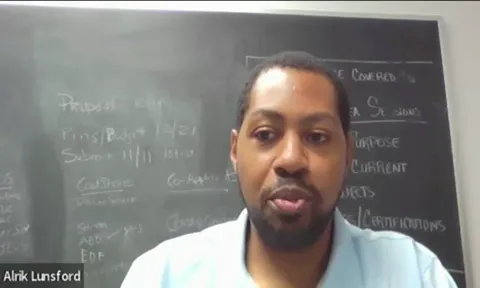
- Alric from the North Carolina Clean Energy Technology Center presented on the formation of a fourth Clean Fuels Coalition to serve rural and underserved areas in eastern, central, and northeastern North Carolina. He noted that the existing three Clean Cities coalitions cover only 20-21 of the state's 100 counties. The coalition would provide technical assistance, education, training, funding opportunities, and vehicle demonstrations. Alric requested that the City of Wilmington join as a stakeholder, stating that city support would help demonstrate the importance of the coalition to the U.S. Department of Energy. Key statistics included: 7.5 billion gallons of petroleum displaced since 2016, 75 coalitions nationwide, and $150 million in upcoming hydrogen studies.
- Committee members raised questions about the coalition's coverage areas, the relationship to existing coalitions, and potential commitments. Evan asked for clarification on whether the city would form its own coalition or join an existing one; Alric confirmed it would be joining the Eastern Central Clean Fuels Coalition. PJ asked about the cost and time commitment; Alric stated there is no cost to join and only quarterly hybrid meetings are required. A motion was made to table the decision until the next meeting to allow for more information gathering, which passed unanimously.
Update on Duke Energy Carbon Plan
- David provided a brief overview of Duke Energy's carbon plan, which outlines pathways to achieve a 70% carbon dioxide emission reduction by 2050, with an interim goal for 2030. He noted that only one of the five pathways meets the 2030 interim goal. The plan relies on coal plant retirements, new natural gas plants, solar, battery storage, and offshore wind. Committee members discussed how the plan aligns with Wilmington's goal of 50% clean energy by 2035. Evan pointed out that the percentages in Duke's plan refer to carbon reduction, not clean energy, so direct comparison is not straightforward. PJ estimated that even the most minimal pathway (Pathway 4) would likely support Wilmington's 50% clean energy goal by 2035, based on the incremental addition of renewable generation (6.4 GW added vs. 6.2 GW retired). David mentioned that a group of cities, including Wilmington, is preparing a comment letter to the North Carolina Utilities Commission on the carbon plan.
Energy Efficiency of Municipal Buildings
- David presented a draft spreadsheet inventorying city facilities with data on square footage, annual energy use, lighting types (LED or conventional), and building automation systems (BAS). He highlighted that police headquarters accounts for 20% of total city energy use, and the top three facilities (police headquarters, convention center, and a park) account for 40%. CJ noted that high energy use per square foot (e.g., over 100 KBTU/sq ft) indicates opportunities for efficiency projects. Committee members discussed potential submetering for parks (e.g., lighting vs. buildings), reviewing rate schedules (police headquarters may be on the wrong rate), and the need for a common BAS platform across all buildings. Dave confirmed that the city is working to integrate BAS systems. Feedback was requested from the committee on prioritizing buildings and strategies. PJ recommended focusing on police headquarters and the convention center first due to their high consumption. Evan suggested that even 24/7 facilities can be optimized by not conditioning all spaces equally.
Comparison of Other Cities' Clean Energy Goals
- David shared a document summarizing clean energy goals and plans from other North Carolina and southeastern cities. He noted that he has relationships with sustainability managers in those cities and can request comparative data (e.g., police headquarters energy use per square foot). The committee expressed interest in using this as a reference for Wilmington's own goals. Some members were surprised that Boone claims 100% renewable energy for municipal operations, likely through hydro and solar from local cooperatives.
Election of Officers and MSD Truck Sale
- The committee discussed officer elections. Clark noted that his term and several others' terms end June 30, 2022. A motion was made to postpone the election until the July meeting, with Tom Davis serving as acting chair, and it passed. The clerk's office was requested to provide a clear list of current members, vacancies, and term statuses. Veronica read out the current members and their term expiration years.
- Regarding the MSD truck sale, Christina reported that the city needs to sell a 2006 Chevy Silverado 1500 (162,000 miles, some damage) purchased for $3,800 at auction, with total cost after upfit of $5,298. She recommended a private sale for $5,000–$6,000, with the funds split evenly between cleanliness and safety accounts as per original funding.
Key Outcomes
- The motion to table the decision on joining the Clean Fuels Coalition passed unanimously, pending more information.
- The Duke Carbon Plan update was informational; no formal action was taken. The city will participate in a multi-city comment letter.
- The energy efficiency spreadsheet will be updated with current Duke data and shared digitally for committee analysis.
- The election of officers was postponed until July 2022, with Tom Davis as acting chair.
- The MSD truck sale will proceed via private sale, with pricing guidance from committee input.
Meeting Transcript
Hey Andrea, thanks for joining. Yep. Good. Hey Sean, thanks for joining in. I know you had uh some some meetings and stuff, so appreciate you joining. Yeah, no problem. It uh got postponed until tomorrow, so it's one o'clock. So we'll call this meeting of the Clean Energy Advisory Committee to order. Um call. Andrew then. Present. Thanks, Evan Folds, Jessica Cannon, Lindsay Hallett, Alan Waxler, PJ Klein, President, Richard Smith, President, John Tullivan, present present. All right. Um first item on the agenda is approval of the minutes. Do I have a motion? I'm gonna have to approve the minutes. I second. Excellent. And because we have people online I can go back through. Okay. Um Andrea Bennett, motion is to approve for anyone online. I think Smith. All right, so um we just wanted to mention that we have you know four other items today. We had like an approximate amount of time that we wanted to focus on them because really item number four is something that we as the advisory committee asked of um Dave David, and so they've worked really hard on putting that together for us and something we need to focus on so we can advise moving forward. Um, but we are gonna have um in just a few minutes to talk with NCL cities. We're gonna just review that carbon plan, I'm sure everyone's heard it all about, and then we'll end this meeting um looking at other cities and their clean energy goals, which is also something that we asked of them. And I'm sure Andrea did a lot of work for that too, but um so with that being said, I will hand the meeting over. Yeah, uh Alric, um we'll go ahead and hand it over to you. Um one quick introduction though, um here. We also have uh John Fortune that is our our fleet manager, so why don't you all have the opportunity to meet him as well. And um yeah, I think he'll be interested in hearing what Alric from Clean Cities Fuel uh has to say as well. So um Alric, yeah, hand it over to you. Thanks very much. Okay, um thank you, David, and uh thank you uh Clean Energy Advisory Committee uh for allowing me the opportunity to do a presentation on the Clean Cities Coalition initiatives uh as well as discuss um some of the opportunities that and some of the technical assistance as well as resources that the North Carolina Clean Energy Technology Center can provide. And so briefly uh I'm gonna start with the background of the whole Clean Cities Coalition uh and then lead into um some of the the uh goals of the coalition uh as we see it um and the formation of a fourth clean fuels coalition and then um touch on how the center can actually be able to help you all out with uh resources uh that would potentially be mutually beneficial. And so um, and given the background of the Clean Cities Coalition, so the Clean Cities Coalition it really uh came into existence about 1988 uh as an effort to really uh try to displace petroleum uh gas consumption and to be able to improve air quality. And then so um with these measures, it was a spinoff to the Energy Policy Act of 1992. And then so clean cities officially became came into existence in 1993. And uh the basis of it is is to be able to uh as I said improve air quality through the reduction of gasoline and uh diesel consumption and displace that with um initiatives for alternative fuel uh vehicle, albeit uh assistance coordination of identifying mutual interests and commonalities, um, and looking at advanced transportation technologies that would be able to improve air quality. And then so uh as of I would say um a few years ago, 2016, the whole Clean Cities effort had reduced about 7.5 billion, and that's with the B gallons of petroleum and diesel consumption. And this is done through having about uh roughly roughly as of present, 75 clean cities chapters. And the clean cities chapters, they are located throughout the country, and uh there are about 75, and there can uh be whole states that are considered a clean cities coalition. There can be um whole counties that are considered clean cities coalitions, but in the the case of uh North Carolina, North Carolina has council of governments or more so metropolitan areas that currently represent Clean Cities chapters, and those only account for 20 or 21 of the hundred counties within the North Carolina system. And so um with the case of the North Carolina Collegiate Technology Center, we are requesting to form an additional fourth clean fuels coalition. And it's a little bit of a difference in distinction between clean cities and clean fuels. And the difference in distinction is that we are forming this additional fourth clean fuels coalition so that we can be able to provide technical assistance, education uh and outreach opportunities, trainings, uh funding opportunities, vehicle demonstrations, uh as well as other components to rural and underserved communities within all of eastern North Carolina, within all of Northeastern North Carolina and all of central North Carolina. And we consider it imperative to be able to uh have these funding opportunities or just uh have these trainings uh in these areas so that we can be able to uh bring to the table into the forefront these type of opportunities that are specifically designated with U.S. Department of Energy initiatives. Um, because without these areas being affiliated with a Clean Cities chapter, um one probably will not have heard of these different funding opportunities, and two, if you cannot, or if you have not heard of them, cannot apply for these funding sources. And so uh we would be the uh the ones that would actually be driving the trainings within these areas, and um as we would be the the um overseers or or as you USDOE actually provided us um the funds, we would allocate those funds to in turn in trainings, um albeit with whatever local stakeholders and local citizens saw that that would be um imperative to their specific region.
openpublica.com