Wilmington Board of Adjustment Meeting – November 17, 2022
STREAMING COPY IN PREPARATION — RECORDING AVAILABLE FROM THE ORIGINAL SOURCE
Wilmington Board of Adjustment Meeting – November 17, 2022
The Wilmington Board of Adjustment held a regular meeting on Thursday, November 17, 2022, beginning at 1:04 p.m. at the Wilmington Convention Center (a temporary location). The meeting was chaired by Patrick Moore and included six board members, with Graham Mitchell serving as alternate. The board considered 14 agenda items, including appeals, variance requests, and continuances, concluding at approximately 6:17 p.m.
Consent Calendar
- Approval of Minutes (October 20, 2022): Approved unanimously (5-0).
Public Comments & Testimony
- Item 7 – 6250 Market Street (Biggers Market appeal): Charles Stanley, a neighbor at 18 Elisha Drive, spoke in opposition, citing parking congestion and safety hazards on his street. Stephanie Jarvis (734 Timberlane) spoke in support, emphasizing the market's role as a small business and community gathering place.
- Item 10 – 3410 Wrightsville Avenue (sign variance): Michael Lee, an adjacent property owner, spoke in favor, noting the narrow lot and limited parking.
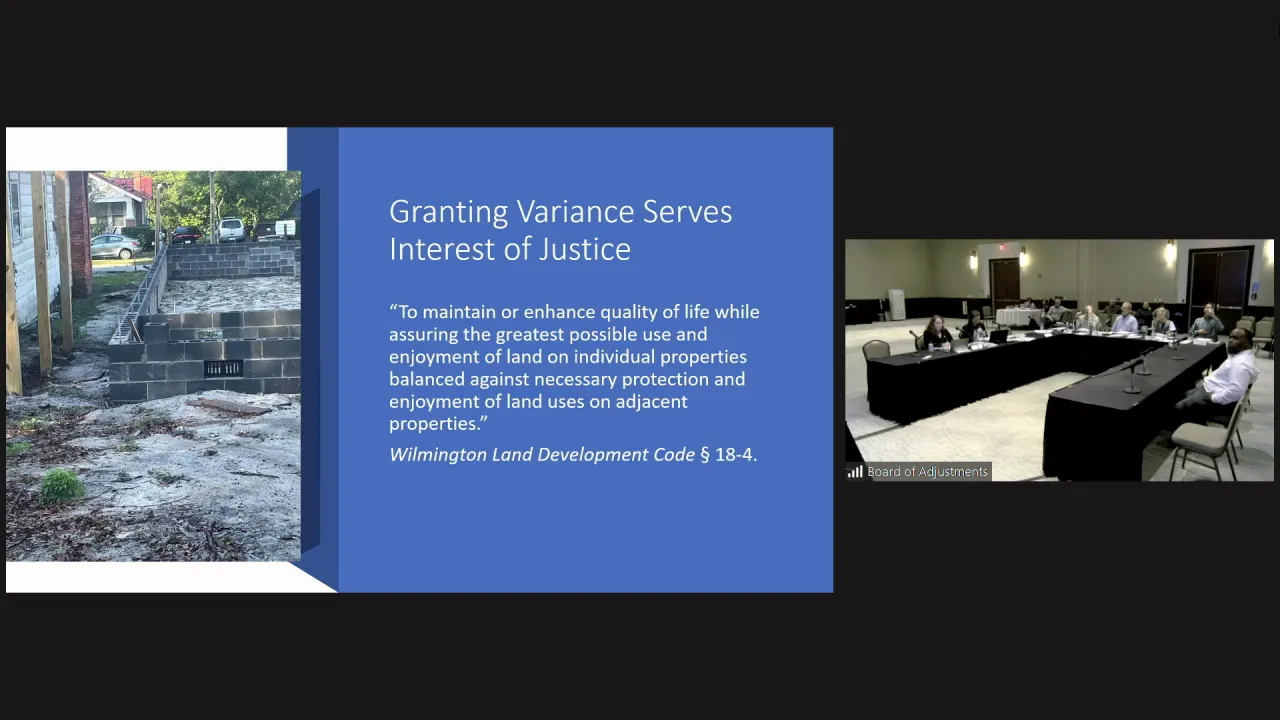
- Item 13 – 1211 South 4th Street (setback variance): Richard Nelson (1213 S 4th St) opposed, alleging the applicant knowingly encroached and that the entire foundation was over the setback line. The applicant, Michael Stallings, rebutted that only a small corner of the porch encroaches and that the survey shows the house is still on his own property.
- No public testimony was offered for other agenda items.
Discussion Items
- Old Business (Items 1–6):
- Item 1 (4202 Peachtree Ave) continued to December 15, 2022.
- Item 2 (2201 Sterling Place) withdrawn by applicant.
- Item 3 (4003 Park Ave – variance for ADU setback): Staff noted the existing shed (circa 1950) is legal non‑conforming; the newer workshop meets setbacks. The applicant (Josh Hodges) self‑reported the conversion and requested a variance of ~4.07 feet to allow the ADU. The board approved with a condition that the non‑conforming shed not be converted into additional living space (5-0).
- Item 4 (4003 Park Ave – appeal) withdrawn after variance approval.
- Item 5 (1541 Eastwood Road – foundation planting variance for Center Pointe): The applicant sought a reduction from 12% to 6% foundation plantings, use of above‑ground planters, and expansion of the calculable area. Approved unanimously (5-0).
- Item 6 (6120 Oleander Drive) continued to December 15, 2022.
- New Business (Items 7–14):
- Item 7 (6250 Market Street – appeal of Notice of Violation): The applicant (Biggers Market) argued that outdoor amplified music was a pre‑existing accessory use under the old code and that the city was improperly applying the new LDC. Staff maintained that the outdoor entertainment area was not approved and required a separate permit. After an evidentiary hearing, the board voted 3-2 to overturn the city’s determination, with Chairman Moore and members Monroe and Johnson in favor; Vice‑Chair Saulnier and member Hovis opposed.
- Item 8 (605 Eastwood Road, 3 & 7 Cardinal Drive – multiple variances for a gas station): The applicant (RaceTrac) requested variances for fuel pump location, specimen tree removal, landscaping, and parking. The board discussed the city’s preference for “buildings forward” design and suggested preserving the 27‑inch live oak. The item was continued to December 15, 2022, to allow the applicant to revise the site plan (5-0).
- Item 9 (3152 S 17th Street – variance to remove eight specimen trees): The applicant (Middleburg Communities) noted that the property was rezoned by City Council in August 2022 and that only eight of 50.17 acres required tree removal, with over 500 new trees planned. Approved unanimously (5-0).
- Item 10 (3410 Wrightsville Avenue – variance for sign height and setback): The bakery owner requested a variance to allow an 8.5‑foot‑tall monument sign located 2 feet from the property line (variance of 2.5 feet in height and 8 feet in setback). The board approved with the condition that the variance apply only to this sign and not future tenants, and that the sign may need to be moved if a sidewalk is installed (5-0).
- Item 11 (621 Decatur Drive – variances for accessory structures and ADU): The applicant built three accessory structures and converted one to an ADU after her husband’s illness. The board approved the variance (5-0) with a condition that if any of the three buildings is damaged beyond 50% of its value, it cannot be reconstructed.
- Item 12 (6818 Parker Farm Drive – variance for drive‑through proximity to residential): The applicant sought to convert a former bank drive‑through to a restaurant drive‑through, which is prohibited within 1,500 feet of residential uses. The board found the site is already heavily buffered by existing development and approved the variance (5-0).
- Item 13 (1211 South 4th Street – variance to side setback of 0.5 feet): The applicant’s foundation was built 2.8 feet from the property line instead of the required 3.3 feet. The board discussed the possibility of modifying the porch to come into compliance. The variance was approved unanimously (4-0) after member Monroe left; the vote was 4-0 (unanimous required with four members).
- Item 14 (851 Sunnyvale Drive – variances for chain‑link fence and sidewalk): The applicant requested to keep an existing chain‑link fence within the front setback and to waive a sidewalk requirement along River Road. The board approved the fence variance but denied the sidewalk variance, requiring the applicant to pay a fee in lieu or install the sidewalk. Approved 4-0 (unanimous).
Key Outcomes
- Approved Variances/Appeals:
- 4003 Park Avenue (ADU variance) – approved with condition.
- 1541 Eastwood Road (foundation planting reduction) – approved.
- 6250 Market Street (appeal) – overturned city’s determination (3-2).
- 3152 S 17th Street (tree removal) – approved.
- 3410 Wrightsville Avenue (sign) – approved with conditions.
- 621 Decatur Drive (accessory structures/ADU) – approved with condition.
- 6818 Parker Farm Drive (drive‑through) – approved.
- 1211 South 4th Street (setback) – approved (4-0).
- 851 Sunnyvale Drive (fence) – approved; (sidewalk) – denied, fee‑in‑lieu required (4-0).
- Continued Items: 4202 Peachtree Avenue, 6120 Oleander Drive, and 605 Eastwood Road (with associated properties) – all continued to the December 15, 2022 meeting.
- Withdrawn Items: 2201 Sterling Place and the appeal for 4003 Park Avenue.
- Next Meeting: Scheduled for Thursday, December 15, 2022, at City Hall (102 North Third Street).
Meeting Transcript
And other members of organizations that have a stake in addressing homelessness. The COC hosts a monthly meeting where we share best practices, educate our local collaborative community on programs and solutions, and network in order to share resources, increasing effectiveness and supporting one another. Anyone is welcome to attend these meetings. And our third emphasis is, of course, on housing. The proven best practice to end homelessness in housing is housing first. This is a philosophy adopted by our local community and a nationwide trend that advocates to offer individuals housing first, meaning that before they have to meet any other requirements, including sobriety, health care, income, etc., they are housed first. The average cost of housing in New Canover County, according to the Washington Post, is 144 a month. This is up 21.8% from 2020. The current monthly Social Security income is $841 per month. In 2023, it will increase to $914 a month. Hearing the difference in these numbers, you can imagine how challenging it is to find affordable housing for persons with low to no income. I would like to highlight some of our COC success stories this year. The housing authority was responsible for issuing emergency housing vouchers through that program this year. We have 27 leased individuals. The COC was responsible for bringing the PATH program back to Wilmington, which is operated by Coastal Horizons, and is operating an effective street outreach program. We use state grant funds to pay for an emergency shelter hosted in a hotel to temporarily shelter COVID-positive persons, and that program is still in operation today. We continue to work with local and state partners to develop a plan to assist homeless persons and families during disaster. These are some of the ways in which we need assistance, bringing all parties and stakeholders together in order to work as one and play on our strengths, investing financially in the centralizing systems of HMIS and coordinated entry to connect a broad range of partners who are working with individuals to reduce or end homelessness. Support and help in local initiatives, including the faith community, as they create grassroots efforts to help unsheltered people. Including the COC on conversations for programs that impact homeless citizens, as I mentioned earlier, the new program rolled out by the county and the city is one example of that collaboration. And seeking education as well as providing education on issues that impact homelessness in our region in order to speak and act in ways that humanize our neighbors who find themselves in crisis. I'm going to turn the floor over now to Reverend Meg McBride, who is going to give you a brief overview. I believe you've gotten some packets that have a diagram of our COC orbit. Uh Meg developed this to give a little bit of clarity to who we are and who is operating within the orbit. There's sometimes some confusion given that our fiscal agent is a future council of governments. So we we would hope to provide a little bit of clarity with this. Thank you. We just put this together today after speaking last night at the county commissioners and decided that this might be a helpful way to understand what the COC does and where it lives. So the COC is governed by its own board. It is housed at the Cape Ford Council of Governments who acts as our fiscal agent, and we are supported by COC staff. The administrative function of our board is actually the administrative function of the COC is divorced from the decision making. And so while our board makes the decisions, uh the COG provides our fiscal oversight. And then orbiting around those basic duties of the COC, which really are data and grants, are these kind of three layers. The first layer you'll see are the COC grant funded agencies. These are agencies that receive federal and state grant money through us. Competitive grant competition that is held two times a year. And they have mandatory participation in the COC. And then orbiting around them are COC members. So any organization can be a member of the COC. I know. I was like, nonprofits, individuals, all court all people that have their own funding or maybe are operating through charging. I'd like to call the November 17th meeting of the board adjustment order, please. But are not members of the COC, but we're in county. Hearings before the board of adjustment are quasi-judicial in nature. Decisions of the board are based on the record of these proceedings. The grant a variance requires a concurrent vote of four fifths of the members of the board. Reverse or modify the determination of an administrative official requires a majority vote of the board. Becomes part of the record. Appeals of board decisions are the superior court and are based on the record. Appeals must be filed within 30 days of the date of the filing of the board's order in the planning division.
openpublica.com