Yakima City Council Regular Meeting - May 19, 2026
STREAMING COPY IN PREPARATION — RECORDING AVAILABLE FROM THE ORIGINAL SOURCE
Yakima City Council Regular Meeting - May 19, 2026
The Yakima City Council held a regular meeting on May 19, 2026, at 5:30 p.m. in City Hall Council Chambers. The meeting included public comments on surveillance cameras and reentry housing, approval of the consent agenda (with one item removed for discussion), a presentation on Opportunity Zones 2.0 nominations, and updates on Franklin Pool repairs and lifeguard training. All votes were unanimous.
Consent Calendar
- Approved minutes from the May 5, 2026 meeting.
- Approved the April 2026 Investment Transaction Report.
- Approved payment of disbursements for April 1–30, 2026.
- Resolution R-2026-073: Authorizing a contract with SCI Industrial Services LLC for Digester Mixer Installation at the Wastewater Treatment Facility.
- Resolution R-2026-074: Authorizing application and acceptance of the Edward Byrne Memorial JAG Grant for FY2025.
- Resolution R-2026-075: Authorizing third amendment to the Commercial Lease Agreement with the Greater Yakima Chamber of Commerce.
- Resolution R-2026-076: Authorizing an Interlocal Agreement with Yakima County and WSDOT for the Naches-Cowiche Confluence Complex project.
- Item 7H (Resolution R-2026-077 with Yakima Youth Golf Association) was removed from the consent agenda for separate discussion and later approved unanimously.
Public Comments & Testimony
- Andreina Rangel (county resident) and Noemi Sanchez (city resident, District 2) urged the Council not to renew Flock camera contracts. They cited concerns about privacy, Fourth Amendment violations, racial profiling via AI, misuse of data, and a $270,000 annual cost that could be redirected to community services. Sanchez noted that six contracts exist, one for over $67,000 expiring June 16, 2026, and that the city faces a $9 million deficit. They argued the cameras create distrust and do not address root causes of harm.
- William Chichenoff (city resident) spoke about the lack of reentry housing and mental health services for individuals released from incarceration. He stated that roughly 50% of people in the local jail are there only because they cannot afford bail, and that police officers are used as tactical responders in crisis situations. He called for investment in stabilization housing tied to the correctional system and asked the Council to leverage Affordable Care Act funding.
Discussion Items
- Item 7H – First Tee Program Agreement: Councilmember Byers requested removal from the consent agenda to clarify that the resolution was a renewal of the existing agreement, not a new lease. Parks and Recreation Manager Ken Wilkinson explained that the First Tee of Yakima uses Fisher Park Golf Course for youth golf and life-skills training at a reduced fee of $3 per child per session (regular rate ~$10). The agreement was approved unanimously.
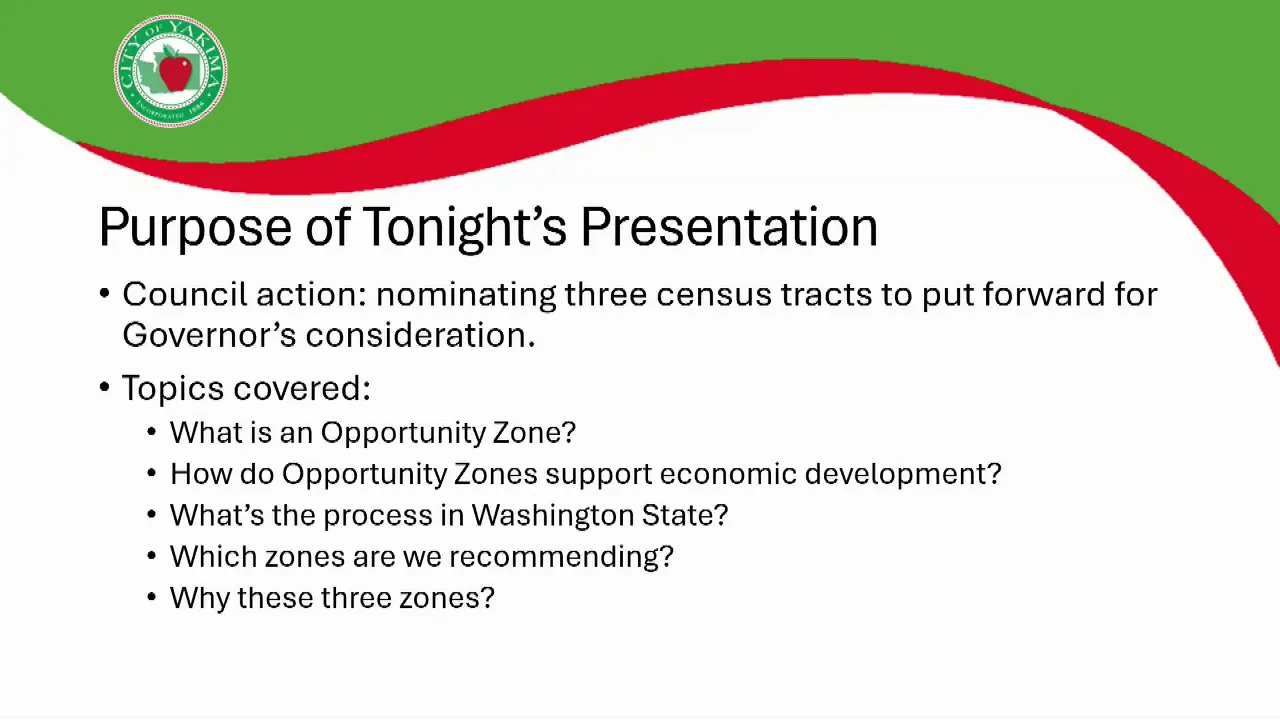
- Opportunity Zones 2.0 (Department Item 9A): Assistant City Manager Gary Ballew presented a resolution to nominate three census tracts for Washington State's Opportunity Zones 2.0 program. The zones are: Downtown Yakima, the Mill Site area, and the 18th Street/Nob Hill Blvd area. He explained that opportunity zones provide a rolling deferral of capital gains taxes to incentivize private investment in low-income communities (median family income below 70% of national average or poverty rate above 20%). The nomination deadline is May 28, 2026; the governor will recommend tracts to the U.S. Treasury by September 30, 2026. Council discussion noted that the Mill Site is not yet development-ready but that the rolling deferral offers a longer window. The resolution passed unanimously.
- City Manager Update: City Manager Vicki Baker acknowledged Public Works employees during Public Works Week. She also recognized lifeguard Emiliano Garcia for caulking Franklin Pool. Ken Wilkinson provided an update on Franklin Pool repairs: two quotes received for the main drain repair and concrete pour; a third quote is awaited. The leak on the deck has been fixed, but the main drain must be opened to assess underground damage. Lifeguard training is underway with two crash-course classes (up to 10 students each) and a recertification class. The proposed schedule would have Franklin Pool open 12:30–4:30 p.m. daily, with morning and evening access at other pools. Wilkinson also noted misinformation on social media about the pool's water loss. Upcoming topics include a grant application for the Airport Terminal Modernization project (June 2) and a report on HB 1406 affordable housing funds (June 9).
- Councilmember Potrykus reported that the Yakima Regional Clean Air Agency board will review its application process for a biodigester project (Pacific Ag Renewables) in Sunnyside. Yakima pays 37% of assessments to the agency, approximately $55,000 annually.
Key Outcomes
- Consent Agenda (excluding Item 7H): Approved unanimously (7-0).
- Resolution R-2026-077 (First Tee of Yakima): Approved unanimously (7-0).
- Resolution R-2026-078 (Opportunity Zones 2.0 nomination): Approved unanimously (7-0).
- Adjournment: Motion carried to adjourn to the next regular meeting on June 2, 2026, at 5:30 p.m. in City Hall Council Chambers. The meeting ended at 6:18 p.m.
Meeting Transcript
Okay, here we go. All right, I call this uh regular uh council meeting to order of uh May nineteenth. Clerk, roll call, please. Here Brown here. Glenn. Here. Gonzalez, present Patrickis. Here. Roy? Here. All right. Join me in a pledge allegiance. One nation under our individual liberty and justice for our event. We have uh interpreter services. All right, next we have public comment. Uh, tonight we have thirty-five minutes allotted for public comment with two and a half minutes per speaker in order to allow as much opportunity as possible for audience participation. Written communication email messages are strongly encouraged. Just a reminder, state law prohibits electioneering at city facilities. During public comment, speakers cannot campaign for or against candidates or support or oppose any ballot measure in any upcoming election. According to the Sunca Daily in November two thousand twenty-five, a skadget county ruling established that flock collected data is subject to state public record laws. There are concerns regarding the lack of security and the possibility of AI misreading plates, leading to wrongful stops and misuse of data. The ACLU has recognized that Flock's AI enables racial profiling through the use of suspicious vehicle algorithms and analyzes driving patterns that can target low-income neighborhoods and communities of color. Diverting $270,000 annually to a flock subscription forces the city to neglect public services like pools, community centers, and local fire and police protection. Flock's widespread and warrantless vehicle tracking is an invasion of privacy and violates the Fourth Amendment. Flock creates a searchable database of vehicle fingerprinting, allowing for daily monitoring of habits without a warrant or probable cause. We're seeing mass surveillance prioritize over community needs as well as concerns over privacy and public data access. Regardless of the intent, adopting automated surveillance creates a digital police state where suspicious activity is defined by discriminating police policing patterns. Remove all flock cameras and stop additional funding towards new contracts and equipment and put the money back into our community. Thank you. Thank you. Thank you. Next is uh Noemi Sanchez. Hi, my name is Noemi. I live in District 2, and I'm here to tell you not to renew the contract with Flock that you have that expires June 16th, which is next month. Through public records requests that we have submitted to the city, we attained copies of the contracts and agreements related to FLOC because we wanted to understand exactly what council signed our community up for. What we found was deeply unsettling. This is not a small camera program, it is a mass surveillance system. These cameras are not just tracking people who are suspected of serious crimes. They are collecting information on everyone who moves through the city. They can track where people work, where they get their coffee in the morning, where they take their kids to school, who they visit, and what neighborhoods they're spending their time in. What it does, it creates a copy and a map of what your daily routine looks like. That is a huge amount of power that the government has over community members who have done nothing wrong. We also know these systems have been used for ICE enforcement and information sharing with outside agencies. In a community like Yakima, we have many immigrants, mixed studies families who already live in fear, and who are the backbone of our community. The flock cameras are creating more distress, more distrust, and makes people less likely to seek help, report harm, and engage with local government. But let's talk about the money, because that's really what you guys care about. The city has entered into multiple agreements related to flock. A total of six contracts exists currently. One of those contracts is a total of over $67,000 for the platform, 22 cameras, and an advanced search software that goes with it. That is the contract that expires June 16th.
openpublica.com