Browse by city
Date range
Search help

Search titles, summaries, topics and stored transcripts together. Keywords may match separately; put the whole query in double quotes for a phrase. Matching follows word analysis, so punctuation is not exact. Both dates are included. Documents are not searched.

SHOWING 31–40 ENTRIES
31
JUL 21, 2026 · MESA, ARIZONA · CITY COUNCIL
Mesa City Council Meeting - July 21, 2026: FBI Task Force, SROs, Tire Shop Zoning

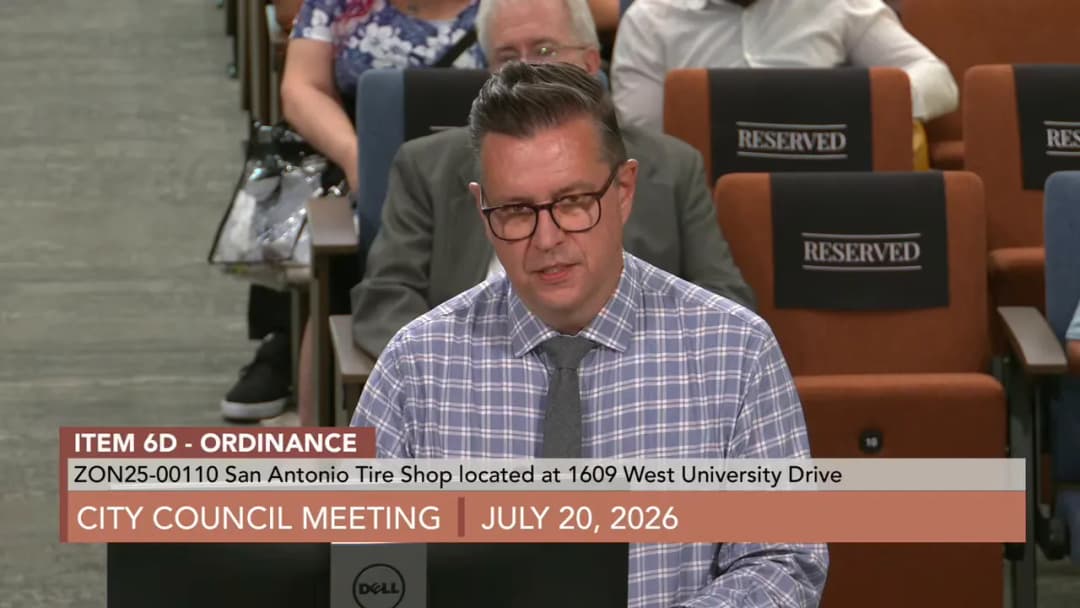
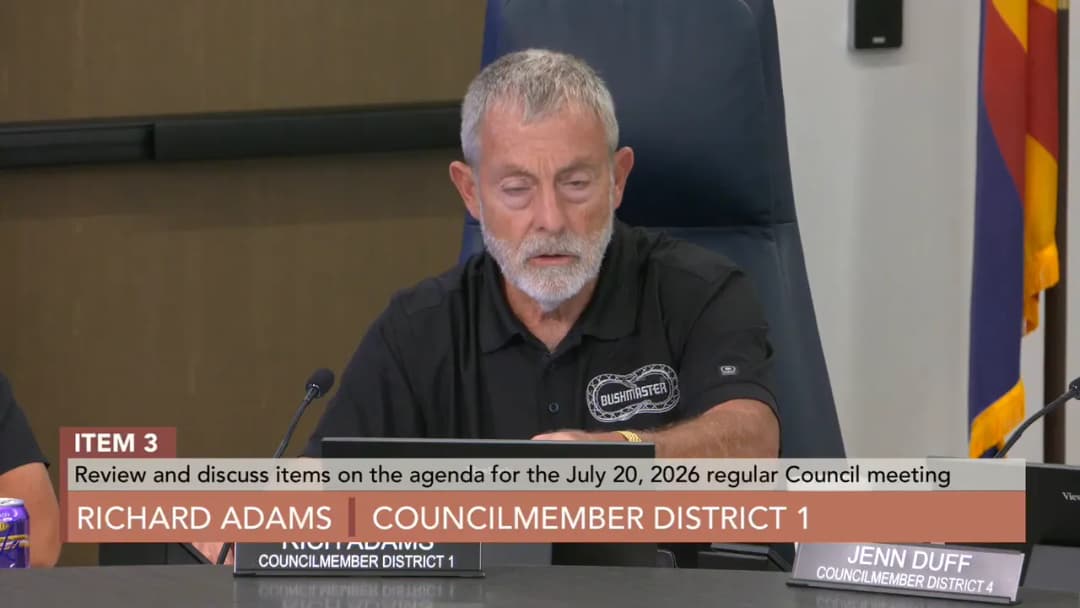
Note: The transcript indicates the meeting occurred on July 20, 2026, but the provided metadata states July 21, 2026. This summary uses the metadata date. The Mesa City Council met with Vice Mayor presiding, as Mayor Freeman and Councilmember Goforth were absent. The meeting included an invocation, Pledge of Allegiance, and a consent agenda. Key items included a memorandum of understanding with the FBI for the Safe Streets Task Force, an intergovernmental agreement for School Resource Officers, and the introduction of a zoning case for a tire shop. Public comments were heard on each item, and all votes passed 5-0. Consent Calendar - Approved unanimously (5-0). Items included approval of minutes, liquor license for Ash & Ale, contracts for pipeline projects, cooperative contracts for equipment and services, property tax levy, intergovernmental agreement for school resource officers (later removed and considered separately), foreign trade zone agreement, and several ordinance introductions (zoning code amendments, speed limit changes, fleet-based services). Items 5B, 5C, and 6D were removed for separate discussion. Public Comments & Testimony - Item 5B – FBI Safe Streets Task Force MOU: Seven speakers opposed the agreement, citing concerns about federal overreach, racial profiling, and comparisons to other cities' task forces. Speakers included Zach White, Samuel Wandler, Rocío Patino, Adam Wenders, Jesse Hernandez, and Rachel Hohenadel Pates. The first speaker, Leanne McKelvey, did not appear. They argued that Mesa already has low crime rates and should invest in social services instead. - Item 5C – School Resource Officer IGA: Jason Smithson spoke, requesting that Brady-listed officers be prohibited from serving as SROs, citing a specific case at Mesa High School. He argued for the highest standards of credibility. - Item 6D – San Antonio Tire Shop Zoning (Introduction): Eleven speakers opposed the proposal, led by Tess Taylor, who presented four reasons: lack of justification, overreaching requests (general plan amendment, reduced parking, 24-hour operations), permanent impacts on the neighborhood, and the city's duty to protect residents. Other speakers included Reed Dunn (92-year-old native), Don Klinkert, Sandy, Carol West (48-year resident), James Adamick, Jarrett Butler, and Nolan West. Some speakers noted that the business currently lists 24-hour operations on Google. Concerns included noise, lighting, traffic, and compatibility with residential character. - Items from Citizens Present: Three speakers addressed non-agenda items. Thomas Eyster criticized the council's decision on the Sun Air Women's Shelter (closing before opening), the sign ban, and what he saw as inconsistent governance and suppression of opposition. Stephanie Vrona raised concerns about data centers (electricity demand, minimal job creation) and advocated for a moratorium. James De La Toso delivered positive news about the Mesa Urban Farm project, which received a Certificate of Commendation from the U.S. House of Representatives for combating food insecurity. Discussion Items - Item 5B – FBI Safe Streets Task Force MOU: Staff explained that the MOU formalizes a 13-year existing relationship, reimburses Mesa for officer time investigating violent crimes (murder, kidnapping, armed robbery), and provides vehicles. Mesa officers operate under Mesa policies, not FBI direction. Councilmember Adam noted it is a cost reimbursement program. Councilmember Duff clarified it is a financial transaction and not related to immigration enforcement. Councilmember Heredia asked about racial profiling safeguards; Commander Reno stated they follow Mesa policies and training. Vice Mayor emphasized that Mesa already diverts behavioral health calls (8,185 since 2023). The motion passed 5-0. - Item 5C – School Resource Officer IGA: Council discussed the proposal to prohibit Brady-listed officers from serving as SROs. Commander Derevan said such officers would not be assigned to schools and that personnel matters are handled administratively. Councilmember Adams questioned the nature of a Brady listing. The city attorney noted that amending the IGA could entangle personnel rules, and the issue can be addressed internally. The motion passed 5-0. - Item 6D – San Antonio Tire Shop Zoning (Introduction Only): Staff (Evan Balmer) clarified that the proposed 24-hour operation is actually emergency roadside assistance after 8 p.m., not full service. The site has operated as a tire shop for two years without incident or complaint. The applicant's representative (Alex Hayes) stated that the business was told the use was permitted by a broker. Councilmember Adams requested data on code violations, police calls, and operational complaints. Councilmember Taylor noted Google reviews mention 24-hour service. The motion to introduce the ordinance passed 5-0, with a final vote scheduled for next week. Key Outcomes - Item 5B: Approved resolution authorizing the city manager to enter into an MOU with the FBI for the Safe Streets Task Force. Vote: 5-0. - Item 5C: Approved resolution authorizing the city manager to enter into an IGA with Mesa Unified School District No. 4 for School Resource Officers, with an administrative commitment to review Brady-listed officer assignment. Vote: 5-0. - Item 6D: Introduced the ordinance for the San Antonio Tire Shop zoning case (first reading). Final adoption scheduled for next meeting. Vote: 5-0. - Consent Agenda: Approved all items as presented (with removal of 5B, 5C, 6D). Vote: 5-0. - Meeting Adjourned: Motion by Councilmember Heredia, second by Councilmember Adams, carried unanimously.
PROCEDURAL 32% · PUBLIC SAFETY 25% · ZONING AND LAND USE 16% · PERSONNEL MATTERS 7%
32
JUL 21, 2026 · MESA, ARIZONA · COUNCIL STUDY SESSIONS
Mesa City Council Study Session - July 21, 2026

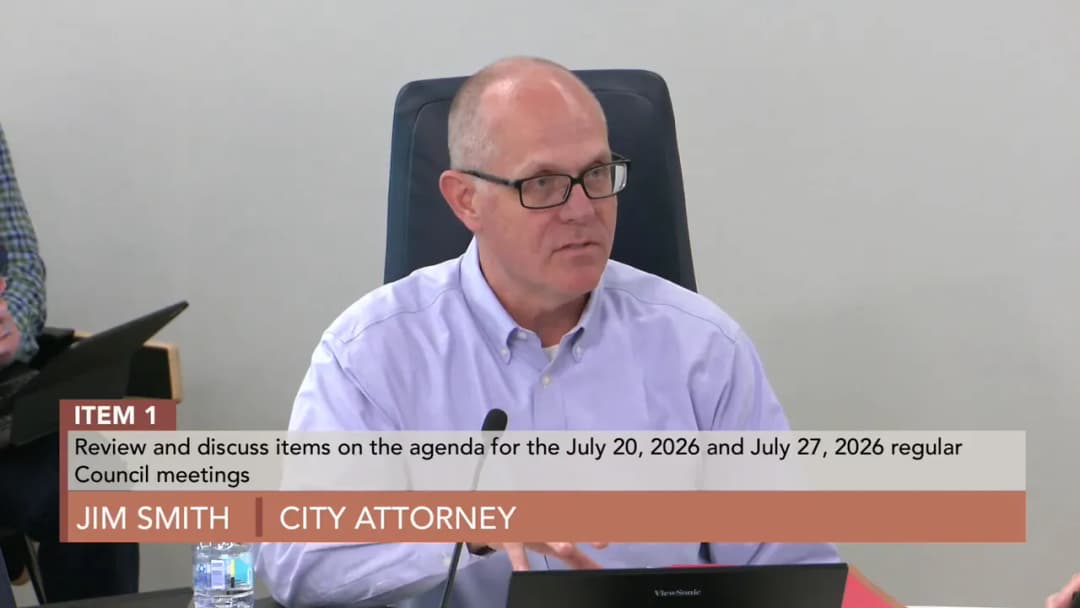
The Mesa City Council held a study session on July 21, 2026, with Vice Mayor presiding. Mayor Freeman and Councilmember Goforth were excused. The council reviewed agenda items for the July 20 and July 27 meetings, including discussions on property tax rates, a memorandum of understanding with the FBI, and impact fees. The session also included unanimous approvals of board appointments and meeting minutes. Note: The transcript indicates the meeting date as July 20, 2026, but the provided timestamp is July 21, 2026. This summary uses the provided date per instructions. Discussion Items - Secondary Property Tax Rate (Item 5A): Councilmember Taylor announced that the city is reducing the secondary property tax rate from 0.8582% to 0.85% due to successful development, spreading the tax burden among more residents and businesses. She clarified that Mesa does not have a primary property tax, and the secondary tax funds capital improvement bonds. - FBI Memorandum of Understanding (Item 5B): The council discussed a proposed MOU with the FBI's Phoenix Field Office for the Safe Streets Task Force. Commander Reno explained that the MOU would allow six gang detectives to be deputized, providing overtime reimbursement, four vehicles, and access to FBI forensics. The MOU builds on a 13-year existing partnership with the FBI for Indian reservation enforcement. Councilmembers emphasized that this involves Mesa police officers, not federal officers, and is distinct from other city task forces. The MOU has no specified end date but can be terminated with 30 days' notice. - Impact Fees (Item 6A): Brian Richel, Director of OMB, explained that the city is sunsetting old public safety impact fees under the 2012 state legislation, as the debt for the public safety building has been paid. The code is being updated to remove the fee schedule, but the city is actively pursuing a new impact fee study to ensure growth pays for growth, with a consultant selection underway. - Planning and Zoning Board: Councilmember Adams noted that recent appointments have resulted in full seven-member votes on planning cases, addressing previous concerns. Key Outcomes - The council unanimously approved appointments to boards and committees (motion by Councilmember Heredia, second by Councilmember Duff). - The council unanimously acknowledged receipt of minutes from various boards and committees (motion by Councilmember Adams, second by Councilmember Heredia). - The council reviewed upcoming agenda items; final votes on items 5A, 5B, and 6A are scheduled for the July 27 meeting. - The study session on July 23 was canceled; the next meeting is July 28 at 5:15 PM.

PUBLIC SAFETY 47% · FISCAL SUSTAINABILITY 23% · PROCEDURAL 22% · PUBLIC ENGAGEMENT 5%
33
JUL 16, 2026 · MESA, ARIZONA · COUNCIL STUDY SESSIONS
Mesa City Council Study Session - July 16, 2026

The Mesa City Council held a study session on July 16, 2026, to review the upcoming July 20 council meeting agenda, discuss zoning amendments for fleet-based services including drones, receive direction on HUD and human services funding, and review a development agreement for the OVO mixed-use project near the Sycamore Light Rail Station. The meeting also included an executive session on Falconfield's airport landing fees, approval of appointments, and acknowledgment of board minutes. Discussion Items - Executive Session: The council convened an executive session regarding Falconfield's airport landing fees, then reconvened the study session with all members present. - Agenda Review for July 20 Council Meeting: Councilmember Taylor raised concerns about item 8B, zoning text amendments for unmanned fleet services (drones) and electric vehicle charging. Staff presented a comprehensive update on the proposed amendments, which create new definitions for light fleet-based services (≤50 vehicles, <10,000 lbs, <10,000 sq ft), heavy fleet-based services, and accessory fleet services. The amendments also address service stations for electric vehicle charging. - Councilmember Taylor's Position: Expressed strong support for the city's proactive approach but raised concerns about drone charging station placement, noise, and the "beehive effect" of constant drone activity. She advocated for larger setbacks (beyond 100 feet) and questioned the allowed height of docking poles (30 feet proposed). - Councilmember Adams' Position: Opposed allowing 27-foot poles for drone docking, preferring ground-based landing pads to avoid visual blight. He questioned why poles must be accepted and suggested limiting height or requiring roof-mounted docking. - Councilmember Duff's Position: Supported poles as a more efficient land use, noting that multiple drones can dock on a single pole and that ground pads waste space. She favored allowing poles in industrial districts and suggested a CUP (conditional use permit) for zones near residences. She also noted that electric vehicles and drones are quieter than traditional fleets. - Legal Counsel (Kirsten Devorchak): Clarified that state legislation (HB 2875) preempts the city from regulating drone operations in the air, but the city can regulate land use uniformly for all fleet services. The city has a window to pass the ordinance before the legislation's effective date (September 2026). - Council Direction: After debate, the council reached consensus to: - Increase the residential setback from 100 feet to 150 feet for all fleet-based services (including charging equipment) to align with the state statute. - Maintain the ability for the planning director to grant exceptions via a sound study. - Consider limiting pole height to 30 feet (as proposed) but further explore options to restrict poles in limited commercial (LC) districts, possibly via a CUP. - Staff will revise the ordinance and bring it back for introduction on Monday, July 20. - Item 7B: Accessory Dwelling Units (ADUs): Councilmember Taylor asked about modifications to standards for detached accessory buildings and ADUs. Staff explained the change aligns with the building code, reducing the fire separation requirement from 6 feet to 5 feet, as mandated by state law. - Item 4A: HUD and Human Services Funding for FY 2027-2028: Staff presented options for allocating federal CDBG, HOME, ESG funds and local Human Services/ABC funds. The recommended approach is to retain federal funds for city-led eligible projects (rather than a competitive nonprofit process) and continue a competitive process for Human Services and ABC. Councilmember Duff expressed concerns about ensuring human services needs are met but supported the new model. Councilmember Heredia wanted to retain partnerships with nonprofits. Council gave direction to proceed with the staff recommendation, with the understanding that council members will work with staff to identify district-specific projects and ensure eligible activities. Staff will provide maps of low-moderate income census tracts and eligible activities. - Item 4B: OVO Development Agreement and GIPLAT: Staff presented a development agreement and government property lease excise tax (GIPLAT) for OVO, a five-story, 191-unit market-rate mixed-use project with 5,700 sq ft of ground-floor commercial at the former Tri-City Mall site (Dobson and Main). The project is already under construction. Key economic impacts: $136 million total economic impact over 10 years, 500 construction jobs, 28 permanent jobs, $5.2 million in direct tax revenue ($920,000 to the city, including a guaranteed $520,000 in construction sales tax). The GIPLAT provides an eight-year property tax abatement, with in-lieu payments to school districts and a $500,000 lump-sum payment to the city for redevelopment (planned for the restaurant incubator basement). The developer will also improve the adjacent transit center (demolish closed restroom, repair sidewalks, improve safety). Council members expressed support for the project, noting its role in activating the Asian District and leveraging the light rail station. The item will return for action on August 17. - Appointments and Board Minutes: The council approved appointments to the Historic Preservation Board, Economic Development Advisory Board, and Board of Adjustment/Design Review Board (motion carried unanimously). The council also acknowledged receipt of board minutes (motion carried unanimously). Key Outcomes - Executive Session: Convened and reconcluded without further action. - Fleet Services Zoning Amendments: Council directed staff to increase the residential setback to 150 feet, explore restricting poles in LC districts, and bring a revised ordinance for introduction on July 20. - HUD Funding: Council directed staff to proceed with reserving federal funds for city-led projects and continue a competitive process for Human Services and ABC, with council members to identify district priorities. - OVO Development Agreement: Council expressed support; the item will be on the August 17 consent agenda for action. - Appointments and Minutes: Approved unanimously. - Future Meetings: Study session on July 20 will review the July 27 agenda (no study session on July 23). The council also noted the record attendance (over 50,000) at the Mesa Celebration of Freedom event.

TECHNOLOGY AND INNOVATION 28% · ZONING AND LAND USE 20% · ECONOMIC DEVELOPMENT 19% · AFFORDABLE HOUSING 10%
34
JUL 15, 2026 · MESA, ARIZONA · PLANNING AND ZONING MEETINGS
City of Mesa Planning and Zoning Board Public Hearing - July 15, 2026

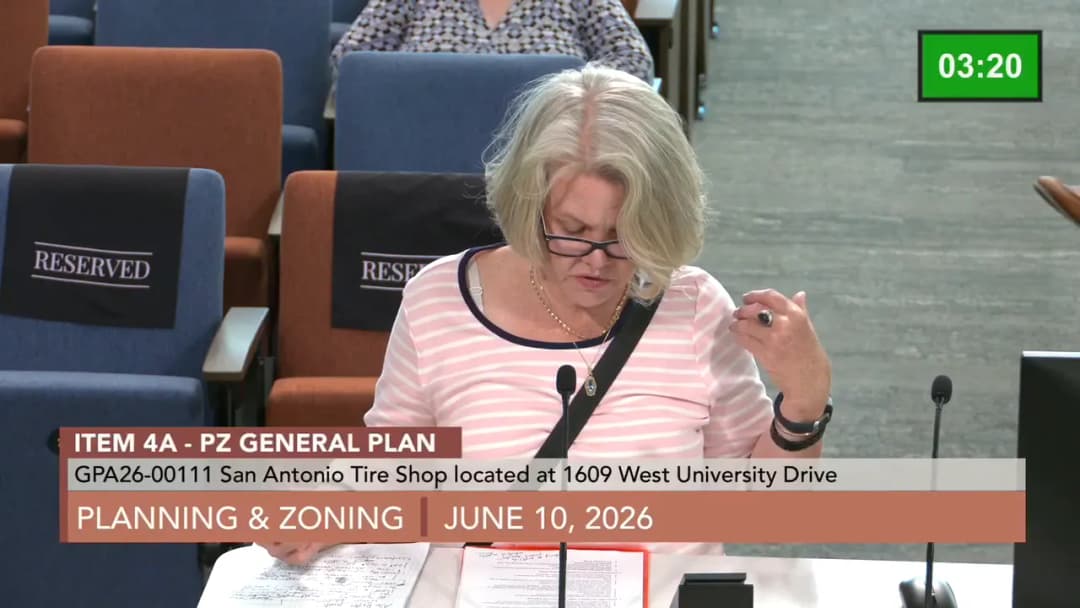
Note: The transcript of the meeting states the date as June 10, 2026, but the official meeting date provided is July 15, 2026. This summary uses the official date. The City of Mesa Planning and Zoning Board held a public hearing on July 15, 2026, to consider a consent agenda and two related items for the San Antonio Tire Shop. The board approved the consent agenda unanimously and voted to recommend approval of both the general plan amendment and the rezoning with conditions, including a future parking solution. Consent Calendar - Approval of Minutes: The board approved the minutes from the May 27, 2026, Planning and Zoning Board meeting. - Item 3A – Faith Christian School: A request for a council use permit and amendment of conditions for a private school at 3761 South Power Road (9.9 acres). Staff recommended approval with conditions. The consent agenda was approved 7-0. Public Comments & Testimony - Reed Doan (466 North Pequet Lane): Expressed concerns about the number of deviations from zoning standards, including parking space reduction (36% of required), drive aisle setbacks, and landscaping. He questioned the neighborhood meeting process. - James Adamick (311 North Henkel): Opposed the general plan amendment, arguing the urban center designation is an outlier in the area, surrounded by urban residential. Noted 15 zoning adjustments under the BIZ overlay, suggesting the site is unsuitable. - Jose Hernandez (1612 West Bedford Street): Opposed due to limited parking (4 spaces) and potential overflow onto residential streets, as well as 24-hour noise from operations. - Wendy Madison (306 North Hankle): Initially supportive of the improvements but doubted the site could accommodate the proposed plan, calling it "false advertisement." Could not attend neighborhood meetings due to work. - Edward Elke (440 North Choy Lane): Opposed the need for a 24-hour tire shop in the neighborhood. - Matt Taylor (second house off University on Henkel): Concerned about attracting riffraff and gatherings at 24-hour operation, adding to existing issues from nearby apartments. - Don K. (1859 West 5th Street): Opposed the project. - Veronica Aaron (1604 West Bedford Street): Raised concerns about exit location, parking, and night activity. Noted other 24-hour shops nearby. - Roxanne Jetson (336 North Hankel): Opposed 24-7 operation, citing existing parking overflow from apartments and Waymo stop. Questioned enforceability of promises. - Tess Taylor (445 North Pon): Provided detailed opposition, arguing the applicant failed to meet burden of proof (no market study, no public need), the site is too small (0.39 acres) for the requested entitlements, rights run with the land, and long-term impacts on the adjacent residential neighborhood. She requested denial. Discussion Items - San Antonio Tire Shop – General Plan Amendment (Item 4A) and Rezoning (Item 4B): - The applicant, represented by Alex Hayes, requested a minor general plan amendment from urban residential to urban center and a rezoning from office commercial (OC) to limited commercial (LC) with a BIZ overlay and site plan review. The property at 1609 West University Drive (0.4 acres) has operated as a tire shop for 1.5 years. Proposed improvements include landscaping, a mural, breeze block screening, and removal of two curb cuts. Parking would be reduced from 11 to 4 spaces via the BIZ overlay. The applicant stated the 24-hour operation is for mobile tire service support, not constant vehicle servicing. - Board members discussed the site's history of non-conforming uses, the track record of no complaints (except a sign violation), and the need for adaptive reuse. Concerns centered on parking adequacy and the 24-hour operation. Vice Chair Peterson and Board Member Pitcher suggested adding a condition to address future parking issues. Board Member Farnsworth proposed defining allowable 24-hour activities (e.g., stocking only). Staff recommended a condition that staff work out a parking solution (e.g., shared parking agreement or alternative compliance) before the case goes to city council. Key Outcomes - Item 4A – General Plan Amendment: Motion to approve GPA 26-00111 (San Antonio Tire Shop, 0.4 acres at 1609 West University Drive) to change place type from urban residential to urban center, with conditions. Passed 7-0. - Item 4B – Rezoning, BIZ Overlay, and Site Plan Review: Motion to approve ZON 25-00110 (same location) to rezone from OC to LC with BIZ overlay and site plan review, with conditions including the added requirement that staff work out a parking solution if the four spaces prove insufficient during operations, before the case goes to city council. Passed 7-0. - The board’s recommendations will be forwarded to the Mesa City Council for final decision.

ZONING AND LAND USE 69% · PROCEDURAL 18% · TRANSPORTATION SAFETY 6% · PUBLIC ENGAGEMENT 5%
35
JUL 15, 2026 · MESA, ARIZONA · PLANNING AND ZONING MEETINGS
City of Mesa Planning and Zoning Public Hearing - July 15, 2026

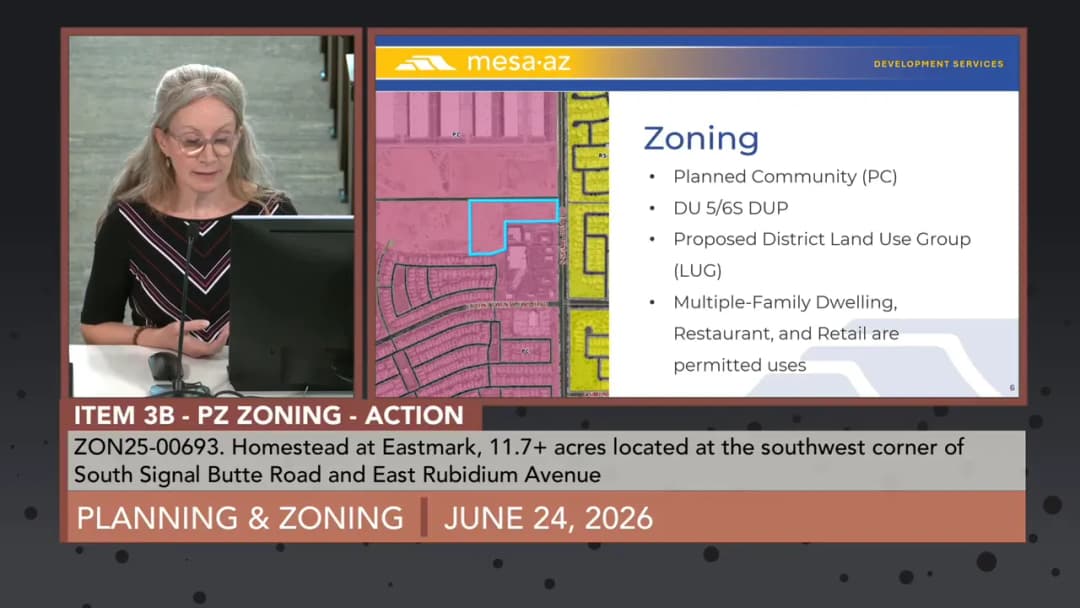
Note: The transcript of this meeting references a date of June 24, 2026, but the official meeting date provided is July 15, 2026. This summary uses the latter date as instructed. The meeting was called to order at approximately 4:23 PM with a quorum present (Chair Ayers, Vice Chair Peterson, Board Members Pitcher, Blakeman, Carpenter, and Farnsworth; Board Member Montes was excused). The board acted on a consent agenda, then heard and voted on a code amendment (Item 4A) and two companion cases (Items 3A and 3B) concerning a proposed development unit plan amendment and a mixed-use project in the Eastmark community. Consent Calendar - Approved unanimously: Item 2A (minutes from June 10, 2026), and Items 4B (amendments to Title 11 regarding electric vehicle and fleet-based services). Items 3A and 3B were removed from consent for individual consideration. Item 4A was initially on consent but was removed to allow a motion with an added condition. Public Comments & Testimony - Rich Ballet, representing approximately five households directly south of the proposed apartment complex, spoke in opposition. He argued that the originally presented development plan promised a 250-300 foot park buffer north of their homes, which was a reason they purchased their lots. He stated that the applicant’s claim of neighborhood agreement is false and asked the board to reject both the zoning amendment and the site plan. He also noted that community meetings felt one-sided ("dictatorship") and that most neighbors chose to attend the public hearing instead. Discussion Items - Item 4A – ZON 26-00155? (Code Amendments): Staff presented proposed amendments to Mesa City Code Title 11, covering entryway monumentation, building materials, employment district standards, pedestrian connections, accessory dwelling units, data center screening, landscaping, signs, and more. The board added a condition to Section 11-30-8, Subsection E to allow alternative designs to a vertical curb for pedestrian/auto separation. The motion passed unanimously. - Items 3A and 3B – DU56 South Plan Amendment & Homestead at Eastmark Site Plan: - Staff Presentation (Jennifer & Evan): Item 3A was a major amendment to the DU56 South Development Unit Plan, affecting 11.7 acres at the southwest corner of Signal Butte Road and Rubidium Avenue. Changes included shifting the DUP boundary north to align with the newly built Rubidium Avenue, expanding the district land use group (LUG) to allow multifamily residential and commercial, and reducing the transition area buffer from 275 feet to an 88-foot landscaped buffer combined with a 26-acre Great Park. Staff noted the amendment is consistent with the General Plan and Eastmark Community Plan, and recommended approval with conditions. Item 3B was a major site plan review for a 261-unit, three-story multifamily development and 10,840 sq ft of commercial (including a Chipotle with a pickup window and retail). The site plan provides 444 parking spaces (488 required), a 2,360 sq ft restaurant, and 99 commercial parking spaces (59 required). Landscaping includes a 50–88 foot buffer along the south edge, originally proposed as parking but changed to open space. Staff recommended approval with conditions. - Applicant Presentation (Lindsay Shubi, Gamage & Burnham): She emphasized that the Eastmark Community Plan was designed for flexibility, and the transition area was always intended to be finalized later based on built conditions. The 26-acre Great Park (expanded from 10 acres) and the mixed-use project together create a strong buffer between single-family homes and the industrial development to the north. She noted that 2,180 properties were notified, only a few citizens attended meetings, and the project meets all General Plan and Community Plan requirements. She offered to add a condition that windows on the southwest building facing the single-family homes are glazed (frosted) for privacy. - Board Discussion: - Board Member Pitcher expressed concern over the loss of the original 275-foot buffer and the height of the three-story building. He indicated he would vote in favor but with reservations. - Vice Chair Peterson and Chair Ayers noted the need for multifamily housing and commercial amenities in the area, and argued that the 88-foot buffer is substantial and compatible with the industrial transition. They also appreciated that the development does not create a vehicular connection to the single-family neighborhood. - The board confirmed with staff that traffic and school capacity have been reviewed and are adequate. Key Outcomes - Item 4A – Code Amendments: Approved unanimously (5-0) with an added condition to Section 11-30-8(E) allowing alternative pedestrian/auto separation designs. - Items 3A and 3B – DU56 Amendment & Homestead at Eastmark: Approved unanimously (5-0) as a recommendation to the City Council, with an added stipulation that the windows on the southwest apartment building facing the existing single-family homes be frosted (glazed) for privacy. The vote was 5-0 (Board Member Farnsworth present). - The meeting adjourned at approximately 5:30 PM.

ZONING AND LAND USE 63% · COMMUNITY ENGAGEMENT 15% · PROCEDURAL 14% · PARKS AND RECREATION 6%
36
JUN 11, 2026 · MESA, ARIZONA · CITY COUNCIL
Mesa City Council Meeting – June 11, 2026

The Mesa City Council met on June 11, 2026, to discuss a consent agenda, two removed items regarding Valley Metro transit services (light rail operations and paratransit/ride choice), and to hear public comments on a proposed data center. The meeting included an invocation, pledge of allegiance, and a brief disruption by a sign-wielding protester who was removed. Key actions included approval of the consent agenda, approval of the light rail operations agreement (5B) with one dissenting vote, and approval of the paratransit agreement (5C). Consent Calendar - Approval of minutes from previous meetings. - Liquor license applications for: Little Drummer, Angry Crab Shack, Tailgate Bar and Grill, Holiday and Express, Boulders on Southern, Oro Brewing Company, Quick Corner, Yal Sua, Sipal Zix, Breakthrough, 711, Faux Bon Me Cafe, and Akoto Sushi (Items 3A–3M). - Contracts and agreements: one-year contract with four-year renewal for electric utility distribution transformers; three-year contract with two-year renewal for hazardous facility support; dollar limit increase for route planning and management solutions; purchase of solar-powered portable traffic signal trailers; design-build contract for Aeropine Park and Whiteman Park playground renovations (funded by CDBG); lease agreement for a downtown restaurant and food business incubator at 11 W. Main St.; fiber access agreement with Apache Junction; foreign trade zone operator agreement with MGC Pure Chemical America; and intergovernmental agreement with the Superior Court for jury administration services (Items 4A–4E, 5A, 5D–5F). All consent items were approved unanimously. Public Comments & Testimony - Noah James Markham spoke on both Items 5B and 5C. On 5B, he supported light rail expansion, emphasizing its importance for homeless individuals and people with disabilities. On 5C, he advocated for paratransit and ride choice, stating it is critical for disabled persons who rely on these services. - David Winstanley (District 6 resident) spoke on Item 5C, questioning the efficiency and cost transparency of Valley Metro’s fixed-route bus service. He noted a 10% increase in direct costs and 7% increase in indirect costs, a 5.3% farebox recovery, and a $13 per boarding subsidy, calling for accountability and independent review. - James Beck (Eastmark resident) spoke during items from citizens present, opposing the proposed NTT data center (a non-agenda item). He cited concerns about water scarcity, strain on infrastructure, lack of community transparency, and the need for a full environmental impact study. He urged the council to slow the process. - Nathan Taylor Taft (Mesa high school student) also opposed the data center, highlighting water consumption (closed-loop systems still use millions of gallons), the speculative AI bubble, and insufficient community outreach (only 91 notifications, two attendees at the neighborhood meeting lasting 20 minutes). - Braden Peters (local resident) opposed the data center, noting Mesa’s high density of data centers (over 15 built/approved/proposed in seven years), rising water and electricity costs, potential health impacts near Lakeside Sports Park (2.8 million annual visitors), and lack of community involvement. He urged the council to reject the project. - During the public comments, a protester holding a sign was removed by police after refusing to lower it, following a warning from the mayor. The mayor stated data centers were not on the agenda. Discussion Items - Item 5B – Valley Metro Light Rail Operations and Maintenance Agreement: The council discussed a request to approve $18.3 million in Mesa taxpayer funds for one year of light rail operations and maintenance ($3.6 million per mile). Councilmember Taylor voiced strong opposition, citing low ridership (less than 1% of Mesa residents), a 95% taxpayer subsidy, unmet fare recovery targets, and contractual lock-in. She argued the agreement was entered into by prior councils without voter approval and called for legal exit options. Councilmembers Adams, Summers, and Duff supported approval, emphasizing the city’s legal obligation under the joint powers agreement and bylaws, risk of lawsuit if defaulted, and the broader benefits of transit (economic development, multimodal city, density, equity). Councilmember Heretti noted voter approval of Prop 479 (60% of Maricopa County voters) and efforts to improve efficiency at Valley Metro. City Attorney Smith explained that withdrawal would require agreement from Tempe and Phoenix or covering costs, and nonpayment would result in loss of voting rights and 12% interest penalties. - Item 5C – Valley Metro Paratransit and Ride Choice Agreement: The council similarly discussed the paratransit subsidy. Councilmember Taylor distinguished this from light rail, expressing support for subsidizing paratransit due to its direct benefit to disabled residents. No other councilmembers spoke against it. The item was approved separately. Key Outcomes - The consent agenda was approved unanimously. - Item 5B (light rail operations) was approved with a roll-call vote. Councilmember Taylor cast the sole dissenting vote; the motion passed. - Item 5C (paratransit/ride choice) was approved unanimously. - No formal action was taken on the data center proposal, as it was not on the agenda. Public comments were heard and will be considered in future proceedings. - Meeting adjourned after no further business.

TRANSPORTATION SAFETY 22% · PUBLIC ENGAGEMENT 15% · PUBLIC TRANSPORTATION 14% · PROCEDURAL 13%
37
JUN 10, 2026 · MESA, ARIZONA · CITY COUNCIL
Mesa City Council Meeting Summary - June 10, 2026

Note: The meeting transcript indicates a date of June 8, 2026, but the provided date is June 10, 2026. This summary uses the provided date as instructed. The meeting was called to order with an invocation by Pastor Richard Cornejo of Outreach Mesa, followed by the Pledge of Allegiance led by Jaden Smith from Troop 54. The Mayor recognized the Turkish national soccer team, which is staying in Mesa for training. The consent agenda was read and approved unanimously. Consent Calendar - Approval of minutes of previous meetings. - Liquor license applications: Little Drummer, Angry Crab Shack, Tailgate Bar and Grill, Holiday and Express, Boulders on Southern, Oro Brewing Company, Quick Corner, Yal Sua, Sipal Zix, Breakthrough, 711, Faux Bon Me Cafe, Akoto Sushi. - Contract for electric utility distribution transformers (one-year term with four-year renewal options). - Contract for hazardous facility operational support (three-year term with two-year renewal options). - Dollar limit increase for route planning and management solutions. - Contract to purchase solar-powered portable traffic signal trailers. - Aeropine Park and Whiteman Park Playground Renovation Design Build contract (funded by CDBG). - Resolution to enter into a lease agreement for a downtown restaurant and food business incubator at 11 West Main Street. - Resolution to approve a fiber access agreement with the City of Apache Junction. - Resolution to enter into a foreign trade zone operator agreement with MGC Pure Chemical America. - Resolution to enter into an intergovernmental agreement with the State of Arizona for jury administration infrastructure. All consent items were approved unanimously. Public Comments & Testimony On Items 5B and 5C (Light Rail and Transit Agreements): - Noah James Markham spoke in favor of the light rail expansion, emphasizing the needs of homeless individuals and people with disabilities. He urged approval of the funding. - David Winstanley (District 6 resident) expressed concerns about the fixed bus transit contract with Valley Metro, citing a 10% increase in direct costs, 7% increase in indirect costs, a 5.3% fare box recovery rate, and a $13 per boarding subsidy. He questioned the value for money and transparency. - Noah James Markham also spoke on Item 5C (paratransit and ride choice), supporting it as a user with a disability and advocating for the needs of disabled individuals. On Data Centers (Items from Citizens Present): - James Beck (Eastmark resident) spoke against a proposed NTT data center campus (seven buildings, 2+ million square feet on 170 acres). He raised concerns about water usage, infrastructure strain, lack of transparency, and called for a detailed environmental impact study and community involvement before approval. - Nathan Taylor Taft (Mesa high school student) opposed the NTT data center, citing water scarcity, the AI bubble risk, low job creation, and inadequate community notification (only 91 people notified, two attendees at the neighborhood meeting). He urged the council to reject the project. - Braden Peters (Mesa resident) also opposed the data center, noting Mesa's high density of data centers, rising water and electricity costs, potential health impacts near Lakeside Sports Park, and lack of community engagement. He asked the council to reject the project. Disruption: During public comment on Item 5B, a protester with a sign was asked to lower it, refused, and was eventually trespassed and removed by officers after repeated warnings. Discussion Items Item 5B – Approval of Resolution for Light Rail Operations and Maintenance (Valley Metro): - Councilmember Taylor expressed strong opposition, citing a $3.6 million per mile cost, $18.3 million annually for Mesa, low ridership (less than 1% of Mesa residents), failure to meet fare recovery targets, and lack of voter approval for perpetual payments. She stated she would vote no. - Councilmember Adams asked the City Attorney to explain the legal consequences of a no vote. City Attorney Smith stated that three agreements (joint powers, bylaws, master agreement) obligate the city to pay, with a 12% penalty for non-payment and loss of voting rights. Withdrawal requires approval from Phoenix and Tempe or covering costs. He concluded that defaulting would likely lead to a lawsuit. - Councilmember Adams argued that the city must honor its contractual obligations and that defaulting would harm credibility. He suggested exploring amendments but not breach. - Another councilmember (unidentified, likely Vice Mayor or similar) agreed that fulfilling the legal obligation is necessary without a proposed alternative plan. - Councilmember Duff spoke in favor of transit, citing subsidies for parks, libraries, and public safety as comparable public goods. She noted that the light rail has spurred $1 billion in development, 1,000 new apartments, and supports multimodal transportation. She emphasized that voters approved Prop 479, which includes transit. - Councilmember (likely Heretti or another) echoed support, noting that 60% of voters approved Prop 479, that Valley Metro is working to save money through RFPs, and that transit provides options for residents who cannot drive. He emphasized the need for efficiency and continued investment. Item 5C – Approval of Resolution for Paratransit and Ride Choice Agreement: - No separate discussion; council moved to a vote separately. Key Outcomes - Consent Agenda: Approved unanimously. - Item 5B (Light Rail Operations and Maintenance): Motion to approve passed. Councilmember Taylor voted no. The motion carried. - Item 5C (Paratransit and Ride Choice): Motion to approve passed unanimously. - Citizen Comments on Data Centers: No council action was taken; the item was for public comment only. The council did not vote on the data center project at this meeting.

PUBLIC TRANSPORTATION 40% · PROCEDURAL 20% · ENVIRONMENTAL PROTECTION 10% · FISCAL SUSTAINABILITY 8%
38
JUN 10, 2026 · MESA, ARIZONA · COUNCIL STUDY SESSIONS
Mesa City Council Study Session – June 10, 2026

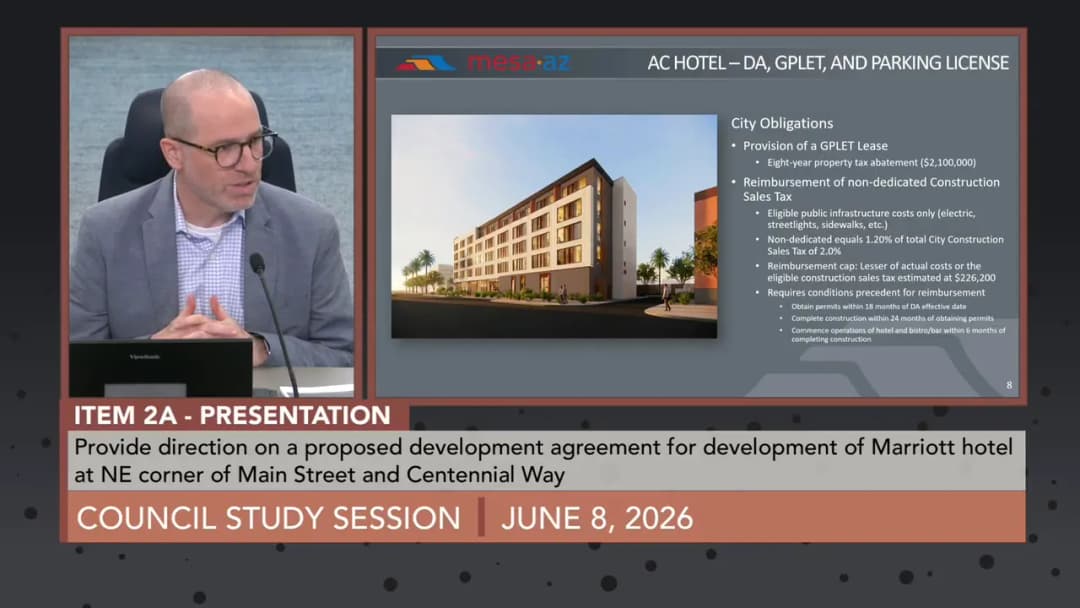
The Mesa City Council held a study session on June 10, 2026, beginning at 5:17 PM. The session included a review of the upcoming council meeting agenda, a detailed presentation on a proposed development agreement for an AC Hotel by Marriott in downtown Mesa, appointments to boards and committees, acknowledgment of minutes, and updates on councilmember activities. The date of the transcript references June 8, 2026, but the meeting is specified as June 10, 2026. Consent Calendar - The council reviewed the agenda for the regular council meeting. Councilmember Riley requested to pull item 5B (funding agreement with Valley Metro) so she could speak on it. Councilmember Taylor spoke in favor of item 4B, a contract renewal for the Household Hazardous Waste (HHW) facility on North Center Street, calling it a "necessary and great asset." Other routine items mentioned included liquor licenses and a foreign trade zone operator agreement. Public Comments & Testimony - No members of the public provided comments or testimony. Discussion Items - Presentation on AC Hotel by Marriott (Item 2A): Staff presented the proposed development. The developer, Breakwell Group (formerly Oakland Capital), plans a five-story, 85,000-square-foot AC Hotel with 150 rooms on a partially vacant lot at Centennial and Main Street. The project includes a bistro, meeting space, and outdoor amenities. The city and developer are finalizing three agreements: a 35-year development agreement, a Governmental Property Lease Excise Tax (GIPLIT) agreement with an eight-year property tax abatement valued at $2.1 million, and a 50-year parking license for 100 spaces in the city's Hibbert Garage. The parking spaces are currently under a license with Sunbelt AN, which will release them. The developer will pay $10 per space per month for the first eight years, then the adopted council rate thereafter, generating an estimated total of $5.2 million over 50 years. The economic analysis projects $4.9 million in direct city benefits (through lease payments, parking revenue, and hotel taxes) during the first eight years and over $138 million in visitor off-site spending over 35 years. Community benefits include streetscape enhancements, a perpetual public utility easement at no cost, dedicated meeting room space, and hotel room blocks for city events. The developer will also pay one-time in-lieu payments totaling approximately $17,000 to local school districts (Mesa Public Schools, Maricopa County Community College District, and EVIT) to offset the eight-year abatement. The city will reimburse the developer up to $226,000 for eligible construction sales tax and will spend about $245,000 on public electrical infrastructure, with $181,000 reimbursed from RDA toolkit funds. Councilmembers expressed strong support: Mayor noted the brand attracts business and leisure travelers and complements the arts and innovation district; Vice Mayor Duff emphasized the connection to the light walk and downtown assets; Councilmember Heredia asked about parking garage capacity and was told the city has excess capacity; Councilmember Adams cited Visit Mesa data showing visitor leakage to neighboring communities, reinforcing demand; Councilmember Taylor linked the hotel to convention center needs, noting a gap of about 400 rooms. No formal vote was taken; staff will return on July 27, 2026, with final agreements. The developer intends to start construction in December 2026 and begin operations in Q2 2028. - Appointments to Boards and Committees (Item 2B): The council approved the appointments via motion. (Specific appointees were not discussed.) - Acknowledgment of Minutes (Item 3): The council acknowledged receipt of various boards and committee minutes via motion. - Current Events and Conferences: Councilmembers shared recent activities. Councilmember Riley attended the Arizona Lodging and Tourism Summit and Salvation Army Donut Day. Councilmember Heredia highlighted the Turkish national soccer team training in Mesa for the FIFA tournament. Councilmember Taylor attended Cockpit Close-Up and a luau at Red Mountain Ranch. Mayor described attending the U.S. Conference of Mayors in Long Beach, where she was elected to the advisory committee. City Manager Butler reminded that council will be on summer break from June 9 to July 15, 2026. Key Outcomes - Council directed staff to finalize the AC Hotel development agreement and related documents for a July 27, 2026, council vote. - Appointments to various boards and committees were approved (motion passed unanimously). - Receipt of boards and committee minutes was acknowledged (motion passed unanimously). - Item 5B (Valley Metro funding agreement) will be pulled for councilmember comment at the regular meeting. - Council adjourned after the study session.

ECONOMIC DEVELOPMENT 56% · PROCEDURAL 19% · PUBLIC TRANSPORTATION 10% · ARTS AND CULTURE 9%
39
JUN 4, 2026 · MESA, ARIZONA · COUNCIL STUDY SESSIONS
Mesa City Council Study Session – June 4, 2026

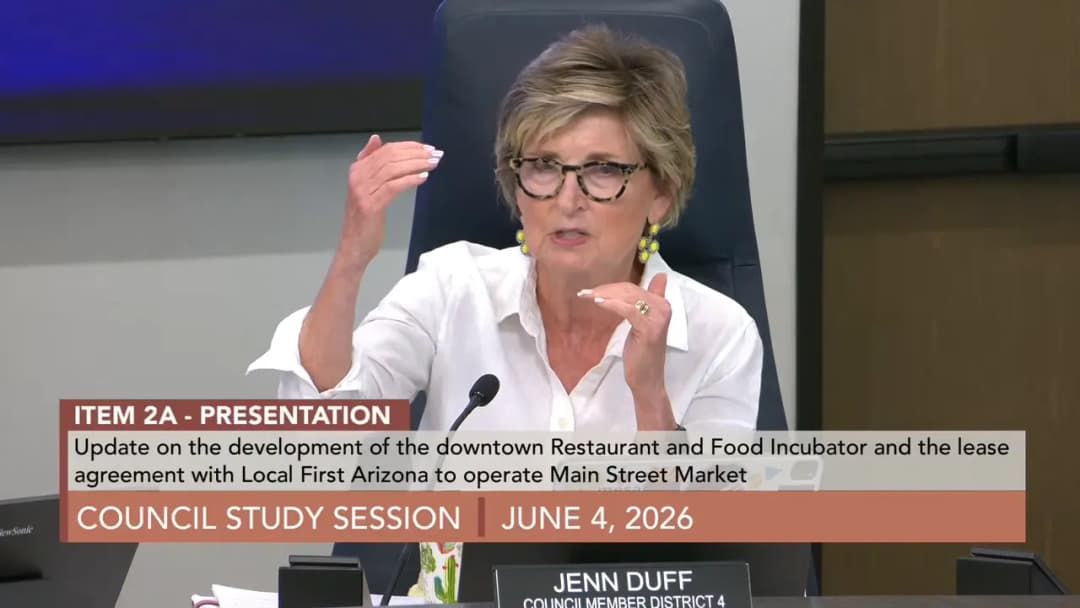
The study session covered four major topics: an upgrade to solid waste vehicle cameras, regional transit funding agreements for light rail and bus service, a downtown restaurant and food business incubator project, and an update on the U.S. Foreign Trade Zone program with a new operator agreement. Councilmembers discussed costs, legal obligations, and potential efficiencies, and directed staff on next steps for the food incubator basement build-out. Consent Calendar - Approval of Minutes – Council unanimously approved the minutes of various boards and committees (Item 3). Discussion Items - Solid Waste Camera System Upgrade – Solid Waste Director Sherry Collins presented a proposal to replace external-facing cameras on 123 vehicles (6–10 years old) with a new cloud‑based system featuring AI‑driven pedestrian collision warnings, blind spot detection, and real‑time driver coaching. The current system costs $120,000 per year; the new system would cost approximately $150,000 per year (an increase of less than $30,000). Early data showed a 50% reduction in alerts after audible alarms were activated. Councilmembers asked about accident history, training protocols, and the value of the subscription service; staff noted that the system would help reduce preventable accidents and potential liability. - Transit Funding Agreements (Light Rail & Bus) – Jody Butler, Assistant City Manager, presented the FY2027 funding agreements. The light rail net cost would increase from $15.6 million to $18.28 million, while the bus service agreement totals $41.1 million ($5.5 million from local funds). The increases are driven by the transition from Proposition 400 to Proposition 479, Valley Metro’s cost reductions, and added security enhancements. Councilmember GoForth and Councilmember Adams highlighted the binding contractual obligations, including a 12% penalty for non‑payment. Councilmember Heredia noted Mesa’s active oversight on the Valley Metro board. Mayor Freeman asked about ridership trends and bus network efficiency; staff explained that a bus network redesign is underway, with implementation expected in October 2027. - Downtown Restaurant & Food Incubator (Main Street Market) – Jeff McBay (Manager of Urban Transformation) and Kimber Lanning (CEO, Local First Arizona) presented the project at 11 West Main Street, funded by ARPA dollars. The $4.5 million construction will create a food hall with seven vendor stalls, a bar, and outdoor seating. The basement is currently a warm shell; completing it with a production kitchen and classroom space would cost $650,000–$1 million. Local First Arizona would lease the building under a 10‑year initial term (with three 5‑year renewal options) at $10,000 per year, escalating to $25,000 per year by the final renewal. The incubation program aims to graduate 5–80 participants annually, with a 78% five‑year success rate. Councilmembers expressed strong support and directed staff to explore funding options to build out the basement now to avoid higher future costs and disruption. - Foreign Trade Zone (FTZ) Update & MGC Pure Operator Agreement – Economic Development Director Jay O’Donnell and FTZ Administrator Chris Molnar explained the FTZ program. Mesa’s FTZ 221, established in 1997, now covers the entire city under an alternative site framework. MGC Pure (a subsidiary of Mitsubishi Gas Chemical) is seeking operator status for its 26‑acre site at Signal Butte and Pecos. The company has 150 employees and plans to add 100 more as it expands its semiconductor‑chemical manufacturing. The FTZ designation would help reduce tariffs and streamline operations. Councilmembers praised the program and noted its importance for high‑wage job growth. Key Outcomes - Solid Waste Camera System – No formal vote; staff will proceed to the June 8 council meeting for approval. - Transit Funding – Council acknowledged the contractual obligations; staff will bring the agreements for a vote on June 8. - Food Incubator – Council directed staff to identify funding sources (e.g., remaining ARPA interest, one‑time economic development funds) to complete the basement build‑out during the current construction phase, with a potential special meeting if needed to meet the timeline. - FTZ Operator Agreement – Council expressed support; the agreement with MGC Pure will be voted on at the June 8 council meeting. - Consent Calendar – Approved unanimously.

ECONOMIC DEVELOPMENT 45% · PUBLIC TRANSPORTATION 18% · TECHNOLOGY AND INNOVATION 8% · PROCEDURAL 5%
40
JUN 2, 2026 · MESA, ARIZONA · CITY COUNCIL
Special Council Meeting on Fiscal Year 2026-27 Budget and Property Tax Levy – June 2, 2026

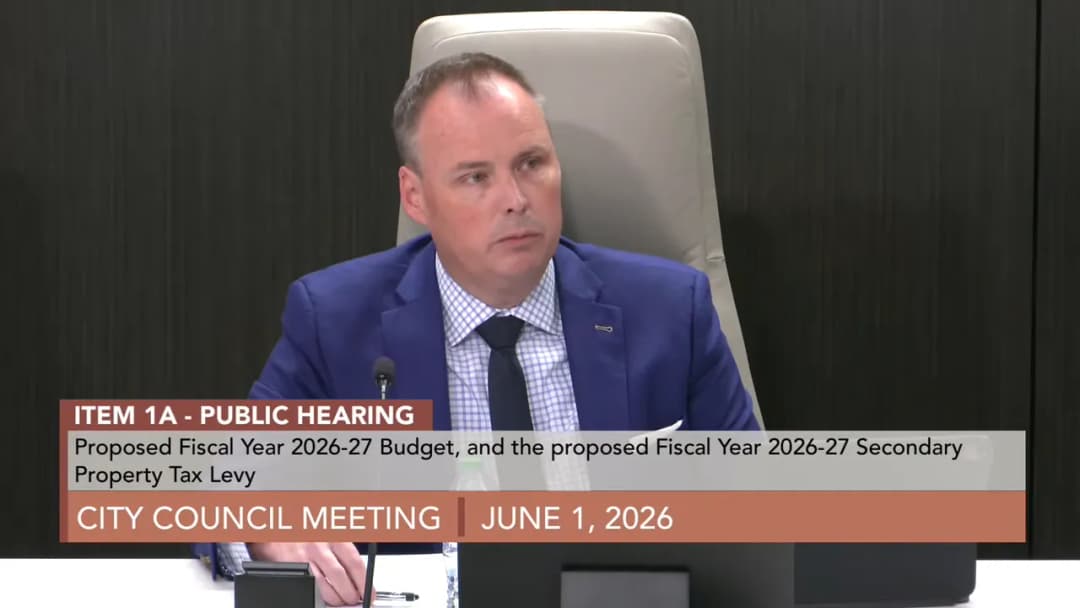
The Mesa City Council held a special meeting on June 2, 2026, to conduct a public hearing on the proposed fiscal year 2026-27 budget and the secondary property tax levy. After hearing public comments and extensive discussion, the council voted to approve the budget. City staff defended the budget as fiscally responsible, while many public speakers raised concerns about structural deficits, pension liabilities, and transparency. Public Comments & Testimony - David Winstanley (District 6 resident) thanked the council for community budget sessions and asked for more scrutiny of transit spending, noting that the fairbox recovery for transit is 5% and each bus rider costs taxpayers $13. - Dennis Miller (40-year Mesa resident) pointed out that apparent cuts in the police budget were offset by a new Public Safety Support department, resulting in a net increase. He asked for a reconciliation showing real cuts versus reshuffling. - Tony McElprane (Mesa resident) focused on the unfunded pension liability of $691 million in public safety retirement funds, noting that the city's payments are insufficient and the debt grows at 7.2% per year. He requested a plan to address it. - Bob Hathcock (District 2 resident) questioned the growth in employee costs (total $763 million) and asked for a target ratio of personnel costs to revenue, a year-over-year staffing comparison, and a plan for the unfunded pension promises. - Scott Webster (District 6 resident) expressed concerns about the impact of multiple data center developments on infrastructure and water/power reliability, asking for assurances that the budget is not affected. The mayor and vice mayor offered to follow up. - Kerry Davis (Mesa resident) urged a no vote on the budget, comparing Mesa's liabilities (2.787 billion, 79% of assets) unfavorably to Chandler and Gilbert. He called for the city to stop relying on utility fund transfers to cover general fund deficits. - Kathy Carlson (District 5 resident) criticized the city for 17 consecutive years of deficit spending and called on council member Goforth to vote no on the budget, noting her voting record showed no fiscal opposition. - Mark Kimball (Mesa resident) referenced the Elevate Mesa framework and asked whether the budget meets its standards of transparency, measurable progress, and fiscal sustainability. He requested a specific year when the general fund will balance without drawing from savings. - Mary Mabineau (District 5 resident) argued that the deficit is due to overspending, not reduced revenue, and that the utility transfer has grown to $157 million. She urged the city to live within its means. Discussion Items - City Manager Scott Butler responded to public comments, stating that the budget deficit was caused by the state legislature cutting revenue sources (e.g., flat tax, rental tax, incorporation). He emphasized that the city has robust reserves and has made $56 million in cuts over three years. He characterized the budget as fiscally conservative and transparent, and noted that the city maintains AAA/AA bond ratings. - Brian Richel (Director of OMB) presented actuals showing that in four of the last five fiscal years, the city ended with a surplus (e.g., $76.6 million in FY2021, $34.7 million in FY2023, $27.8 million in FY2024, $16.8 million in FY2025). He explained that the budget is a maximum expenditure limit required by state law, and that actual spending is often lower (e.g., only $297 million of $700 million budgeted CIP was spent). - Council member Taylor shared her struggle with understanding the budget due to a personal loss and said she would vote but acknowledged she still had gaps in knowledge. She thanked staff for their transparency. - Council member Goforth explained that the budget process is ongoing and that the council governs throughout the year, not just on the final vote. She noted that the budget is a plan and that every major expense comes back for council approval. - Council member Adams supported the budget as a step in the right direction, acknowledging improved communication with the new city manager and noting that the budget moves toward balance faster than previous forecasts. - Council member Duff emphasized the importance of quality-of-life programs (parks, libraries, arts) and warned against draconian cuts. She highlighted that the city has not increased sales tax or utility rates significantly. Key Outcomes - The council approved the Fiscal Year 2026-27 budget and secondary property tax levy (item 1B) on a motion. The vote passed (no specific tally given, but no dissenting votes were noted). - The meeting was adjourned after the vote. Note: The date of the meeting per the transcript is June 1, 2026, but the instruction specifies to use the date 2026-06-02 03:40:55+00:00. The title and summary use June 2, 2026.

BUDGET EQUITY ANALYSIS 63% · FISCAL SUSTAINABILITY 16% · PUBLIC ENGAGEMENT 8% · PUBLIC SAFETY 7%
OPENPUBLICA · PUBLIC MEETING INDEXUPDATED DAILY · openpublica.com