The Mesa City Council held a study session to review the evening's council agenda, discuss proposed LED lighting conversions for ballparks, and the 10-year capital improvement milestone with the Chicago Cubs and Oakland Athletics. Council members also shared updates on recent community events and conferences. Discussion Items - Item 1: Review of Council Agenda – The council discussed agenda items 5D and 5E. - 5D: LED Light Conversion for Ballparks – The request includes an additional $880,000 beyond initial estimates for converting lighting at Ho Cam and Fitch Parks from metal halide to LED. City staff (Mr. Hirschberg) explained the funds come from general capital dollars and that LED bulbs are more energy efficient, have longer lifespans, and reduce maintenance. Councilmember Gilman noted that LED lighting typically cuts electricity by 50–70%, resulting in long-term savings that offset the higher upfront cost. Mayor asked about potential rebates from energy partners like SRP; Mr. Boucher confirmed rebates are available in SRP territory and will include that information in future reports. - 5E: 10-Year Capital Improvement Milestone with Cubs and A's – Mark (city staff) explained the 2013 facility use agreements require a 10-year review to identify capital improvements. Proposed upgrades include LED lighting and scoreboard replacements at Sloan Park and Hohokam Stadium. Councilmember Taylor asked about contract renegotiation frequency (30-year for Cubs, 25-year for A's) and whether the city is obligated to select items every 10 years. Staff clarified the process is collaborative with the teams and considers actual needs; if a scoreboard was recently replaced, it would not be forced. Economic impact of spring training was noted: approximately $2.5 million in additional tax revenue in March, though not all attributable to spring training. Key Outcomes - The council discussed the LED lighting and capital improvement items but did not take a vote; these items will be on the regular council meeting agenda later that evening. - Motion to receive board minutes (Item 2) passed unanimously. - Motion to adjourn the study session passed unanimously. Current Events & Conferences Attended - Councilmembers reported attending spring training games (Cubs and A's first pitches), the opening of the Arizona Baseball Museum at the Mesa Historical Museum, ULI Trends Day, a community conversation on public safety at the main library, the U.S. Conference of Mayors leadership meeting in Los Angeles (focus on immigration and housing), the Mesa Fallen Firefighter Memorial, Ho Cam Park's 75th anniversary, and a speech at Mountain View High School. - City Manager Scott Butler outlined upcoming meetings: regular council meeting at 5:45 PM that evening, and a study session Thursday at 7:30 AM to kick off the budget discussion with the financial forecast.
Public Meetings - Mesa, Arizona
Public Meetings - Mesa, ArizonaThe Mesa City Council held a special meeting on February 24, 2026, to receive presentations and provide direction on three interrelated projects for the downtown Arts and Innovation District: a mixed-use development at 51-55 East Main Street, the conversion of the historic post office into an ASU Creative Technologies building, and a new pedestrian connector called the Light Walk. Staff from the City of Mesa (Jeff McVay, Stephanie Monge, Jay O'Donnell) and Arizona State University (Rick Naymark) presented concepts and requested council direction. Council members discussed the projects, raised questions about financial returns, and ultimately gave unanimous direction to proceed with next steps. Discussion Items - 51-55 East Main Street Development: Staff requested council direction to release an RFQ/RFP for a public-private partnership to develop the city-owned site at 51-55 East Main Street. The conceptual rendering shows an eight-story tower with ground-floor retail and restaurant, Mesa Arts Center food service and pre/post-event functions, city office space, optional ASU space, and Class A office space. Council members expressed support for the concept, with Vice Mayor noting the need to test the market and avoid bearing 100% of the cost. Councilmember Taylor emphasized the desire for lively restaurants and entertainment. Councilmember Adams noted the soft office market but saw the opportunity as a unique asset. Council directed staff to issue the RFQ/RFP within a month, with a 30-60 day response window. - ASU Creative Technologies at the Post Office: ASU and city staff presented a feasibility study for repurposing the existing post office building into a creative technologies facility. The post office would be relocated to a new standalone retail building on the north side of the property. ASU's Rick Naymark reported that the Mix Center has already surpassed its five-year goals: 1,500 students (vs. goal of 750), 65 faculty/staff (vs. 40), and over 300 annual events (vs. 25). The expanded space would allow ASU to add programs in animation, collaborative gaming, and other emerging media, potentially doubling student capacity to about 3,000. Council questioned the return on investment, noting the current post office lease generates $450,000 annually, while the Mix Center lease is $100,000. Staff indicated that ASU would cover interior improvements, similar to the $35 million in FF&E at the Mix. Council gave direction to proceed with negotiations with the U.S. Postal Service for a new retail post office and to develop a lease agreement with ASU, with a target construction start after the current post office lease ends in May 2028. - Light Walk: Staff presented a concept for a pedestrian connector from University Drive to Main Street, linking the amphitheater, convention center, library, Mix Center, and Mesa Arts Center. The Light Walk would include shade, misting, landscaping, and seven program zones with nodes for events, food trucks, and gathering spaces. Staff provided economic impact estimates: 327,000 annual users spending $39 per person, generating $16 million in annual retail/restaurant spending, supporting 137 jobs, and $7.4 million in city sales tax revenue over 20 years. Councilmember Adams requested more detailed data on spending assumptions. Councilmember Taylor noted the lack of water features and raised maintenance concerns. Councilmember Goforth asked about recapturing value from adjacent landowners; staff noted the city owns most of the land along the corridor. Council endorsed the concept and directed staff to proceed with phased design, incorporating private investment opportunities and future coordination with convention center and amphitheater plans. Key Outcomes - Council directed staff to release an RFQ/RFP for the 51-55 East Main Street development, with the goal of selecting a developer and returning with a negotiated agreement. - Council authorized staff to negotiate with the U.S. Postal Service for a new standalone retail post office and to negotiate a lease with ASU for the Creative Technologies building, with further details on financial terms to be brought back for approval. - Council endorsed the Light Walk concept and directed staff to continue design and phasing, emphasizing the need for clear ROI data and private sector participation. - The meeting concluded with a unanimous vote (by voice vote) to adjourn.
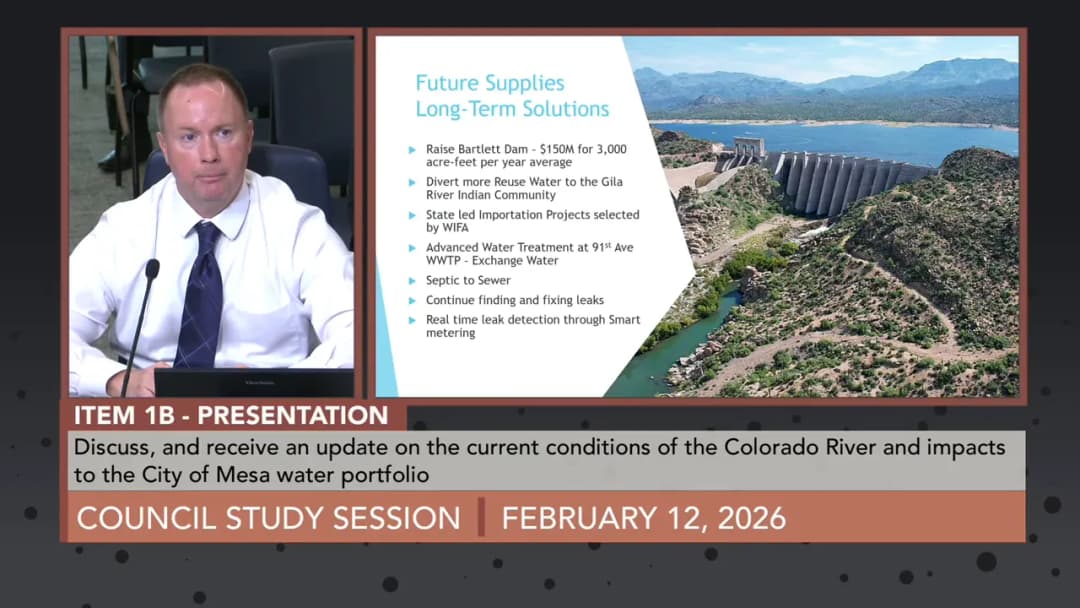
On February 12, 2026, the Mesa City Council held a study session to receive a detailed update on the current conditions of the Colorado River and the impacts on the City of Mesa's water portfolio. The presentation, led by Water Resources Director Chris Hassard and Assistant Director Jesse Haywood, covered Mesa's diverse water supply sources, conservation efforts, and strategies to manage impending cuts to Colorado River water allocations. Vice Mayor Summers and Council Member Adams participated by Zoom. Discussion Items - Colorado River Conditions and CAP Cuts: The 20-year operating guidelines for the Colorado River expire at the end of 2026. Year 26 of a prolonged drought has reduced levels in Lake Mead and Lake Powell. The draft Environmental Impact Statement (EIS) proposes alternatives that include significant cuts to Central Arizona Project (CAP) water, which directly affects Mesa. The public comment period on the draft EIS ends March 2, 2026, with a final EIS expected by summer 2026. Cuts are anticipated to begin in 2027, possibly phased in initially around 20%. - Mesa's Water Portfolio Breakdown: - City Zone (SRP water): 62,000 acre-feet available annually; current demand is 33,000–35,000 acre-feet. SRP has declared shortages in the past, but Mesa has headroom even under cuts. - Eastern and Southern Zones (Colorado River via CAP): Mesa has 53,000 acre-feet (43,500 M&I + tribal leases) plus 8,000 acre-feet from the Gila River Indian Community (GRIC) exchange, totaling 61,000 acre-feet, just above current demand of 58,000 acre-feet. - Additional Water Supplies: - GRIC Water Exchange: Delivers reclaimed water to GRIC and receives Colorado River water at a 5:4 ratio. Current exchange provides 8,000 acre-feet/year at a cost of $85/acre-foot (versus $365/acre-foot for CAP M&I). The Central Mesa Reuse Pipeline, coming online in early 2026, will increase exchange deliveries to 16,000–17,000 acre-feet. The maximum allowable exchange is 23,520 acre-feet. - New Conservation Space (NCS): Created by raising Roosevelt Dam, provides 41,000 acre-feet of storage. Based on hydrologic records, Mesa can sustainably use 12,500 acre-feet/year under its 100-year assured water supply. Current NCS account balance 30,000 acre-feet. - Bartlett Dam Raise: Mesa is a partner in raising Bartlett Dam, expecting to gain an additional 10,000–13,000 acre-feet of storage (sustainable annual yield 3,000 acre-feet). - Groundwater: Annual allowance of 9,965 acre-feet (467,000 acre-feet over 100 years, plus incidental recharge credits of 5,286 acre-feet/year from system leakage). Mesa typically pumps only about half of this to preserve the aquifer. - Long-Term Storage Credits: Mesa holds 557,000 acre-feet of credits, stored primarily in the Roosevelt Water Conservation District and Granite Reef Underground Storage Project. At current CAP demand, this represents about 10 years of backup supply. - Future Supply Options: Advanced water purification at the 91st Avenue plant (feasibility stage), septic-to-sewer conversions (potential 3,500 acre-feet/year), continued water conservation through smart metering (saving over 1 million gallons/day), and system leak detection. - Council Discussion: Council members inquired about the security of GRIC water rights, the impact of cuts on other cities, costs of new supplies, and the role of the state legislature in protecting water regulations. Council Member Adams noted that water portfolio investments are a key driver of utility rate adjustments. Several members praised the team's foresight and management. Key Outcomes - Item 1A (ASU presentation) postponed: The session agreed to reschedule the ASU item to a future date, possibly the February 23 study session. - Motion to acknowledge board minutes passed unanimously: The council voted to receive and file various board minutes. - No votes on water-related items, but the presentation served as foundational for future rate discussions and drought management planning. - Council expressed gratitude to retiring Water Resources Director Chris Hassard for his leadership and expertise. - Upcoming meetings: Strategic planning session on February 19, 2026 (at The Post, 7:30 a.m.); next regular study session and council meeting on February 23, 2026. - Legislative note: Council Member Adams highlighted a bill in the state legislature that would impose a four-year moratorium on municipal utility fee/rate increases, expressing concern over its impact on Mesa's ability to fund water infrastructure.
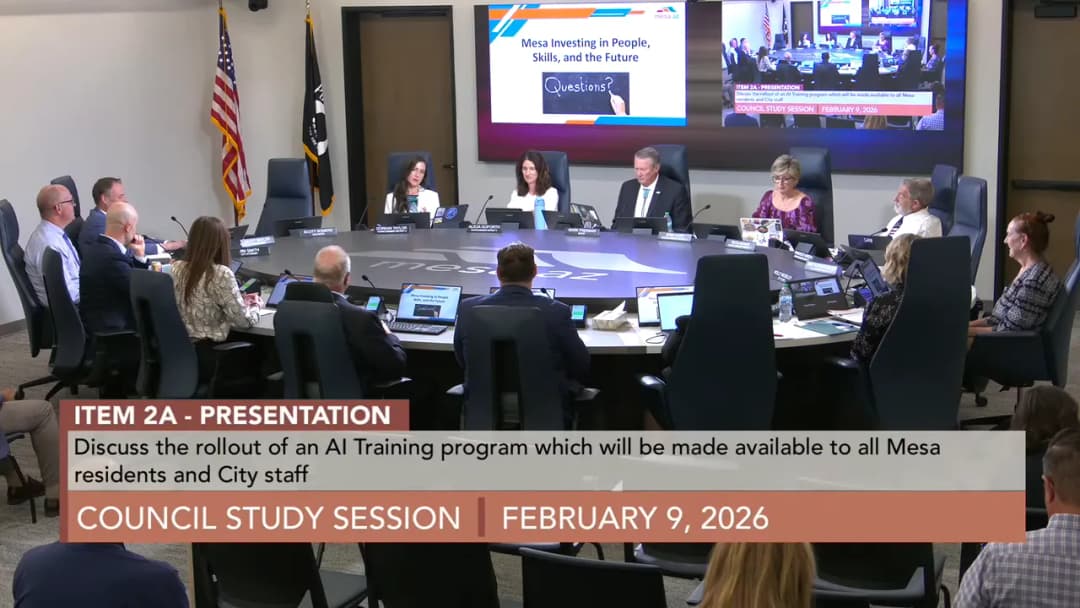
The Mesa City Council held a study session on February 9, 2026, to review the upcoming regular council agenda, discuss a proposed gas line replacement, consider a site modification request, and receive a presentation on a new AI training program for residents and city staff. Councilmembers participated in person and via Zoom. Consent Calendar - Item 8A (adopting titles, schedules, term rates, and fees for non‑residential water utility services) was pulled from consent for a separate vote. The remaining consent items were approved without discussion. Discussion Items - 4A – 12‑inch high‑pressure gas line in the Magma service area Councilmember Taylor inquired about the line serving Pinal County residents, financing, and payback period. Staff (Mr. Hirschberg and Mark) explained that the old 6‑inch line from the 1960s was at end of useful life and being replaced to serve industrial and residential growth. The project cost is $5.598 million, funded by utility revenue obligation bonds, and could pay for itself within one to two years if a new industrial customer comes online. A 2019 Arizona Corporation Commission audit had requested pressure test records from 1965‑1970, which were unavailable; the new line resolves this. Staff confirmed the service territory is in full compliance with the ACC. Vice Mayor Summers added historical context, noting past discussions with Southwest Gas. No formal action was taken; the item was discussed as part of agenda review. - 6A – Sun Devil Auto major site modification Councilmember Goforth proposed postponing action to allow the applicant to present a plan for the entire parcel rather than piecemeal modifications. Council agreed to continue the item to a date uncertain, leaving it on the consent agenda. Staff noted the applicant could request to pull the item before the continuance. - 2A – AI Training Program Rollout CIO Scott Kahn, along with library director Polly Bonnet, deputy CIO Harry Meyer, and innovation head Ian Linson, presented a first‑in‑the‑state program to provide AI literacy training to Mesa residents and city staff at no additional budget cost. Residents will access courses via the Mesa Public Library’s LinkedIn Learning platform (over 1,600 AI courses) with an e‑card; the program will launch in 2‑3 months. Staff training, based on a year‑long internal sandbox, will use the existing iLearn system. Councilmembers discussed tracking, ethics, data security, enterprise use cases (e.g., traffic, crash analysis), and the importance of prompt‑writing skills. The program was well received, with questions answered by staff. - 2B – Appointments to Boards and Committees A motion to approve appointments was made and passed unanimously. - 3 – Acknowledgment of Board Minutes Motion passed unanimously. - Current Events and Conferences Councilmembers shared recent engagements, including the Women Leading Mesa Galantines event, Arizona Music Educators Conference, Asian Festival, a veterans resource center launch, and a tour of the Northwest Water Reclamation Plant. Upcoming events (Mesa Marathon, Fallen Firefighter Memorial) were noted. Key Outcomes - The Sun Devil Auto site modification item was continued to a date uncertain. - Item 8A was pulled from consent for a separate vote (no details of the vote outcome provided). - The AI training program is scheduled to launch in 2–3 months (May 2026) for residents and within one month for city staff. - Appointments to boards and committees were approved. - Board minutes were acknowledged.
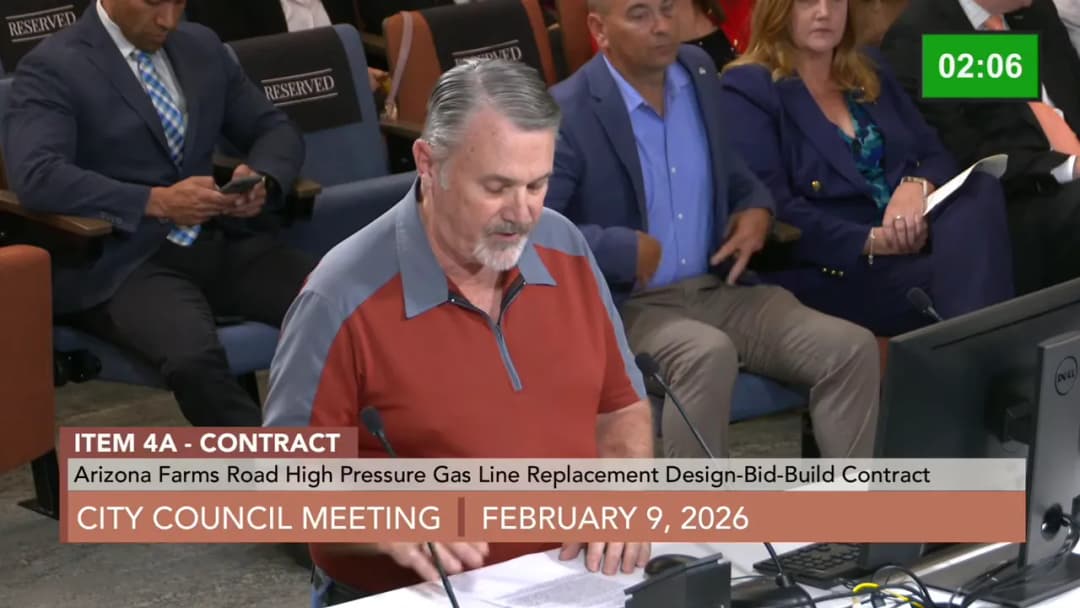
The Mesa City Council met on February 10, 2026, with Vice Mayor Summers and Councilmember Haredi participating by Zoom. The meeting included a consent agenda, discussion and vote on a gas line replacement contract (Item 4A), a water rate ordinance for non-residential services (Item 8A), and public comments regarding the city's 287G agreement with ICE. Consent Calendar - All items listed with an asterisk were considered as a group. Items 4A and 8A were removed from the consent agenda. The remaining items, including approval of previous minutes, a liquor license application, multiple contracts for landscape maintenance, fire department supplies, forensic DNA supplies, highway safety grants, a zoning case for freeway landmark signs, election resolutions, a continuance, and zoning changes for a development known as The Lincoln, were approved unanimously. Public Comments & Testimony - Rohith Chandra Shaker (Chandler resident, employee of Milano Music Center in downtown Mesa) opposed the city's 287G agreement with ICE. He described witnessing ICE operations, harassment, and the disappearance of customers, and called for the agreement to end. He also referenced a July 2025 incident involving Mesa PD and HSI. - Reggie Braun spoke about Christian principles, referenced a 95% slowdown in construction in Kittle County due to fear of travel, and questioned the validity of the ICE agreement. He also commented on a veteran incident involving conflicting commands from law enforcement. - Ryan Jared Birch (District 1 resident) also opposed the 287G agreement, expressing fear for his safety and advising the community to take precautions. He urged the council to end the cooperative agreement. Discussion Items - Item 4A: Arizona Farms Road High Pressure Gas Line Replacement Design Bid and Build – David Winstanley (District 6, self-described gadfly) raised two philosophical questions: whether the city should be in the natural gas business and whether the contract effectively taxes residents by increasing the general fund transfer. Councilmember Butler and other officials clarified that the gas utility operates as a separate enterprise funded by ratepayers, not a tax, and that the city has owned the Magma service area since the 1970s as a strategic growth venture. The council agreed to provide revenue and cost data. The item was approved unanimously. - Item 8A: Ordinance Adopting Non-Residential Water Utility Rates and Fees – Councilmember Duff spoke against the ordinance, noting that a previous reduction in the residential rate increase (from a proposed amount to $0.77 or $1.07 per month) was offset by a 20% increase on businesses (average $9.24/month for 9,000 gallons). She argued this was not business-friendly and voted no. Councilmember Taylor and others stated the measure accelerates parity between residential and commercial rate classes, and that most small businesses use less than 6,000 gallons and are covered by the service fee. The ordinance was approved. Key Outcomes - The consent agenda was approved unanimously. - Item 4A (gas line replacement contract) was approved unanimously. - Item 8A (non-residential water rates) was approved (motion carried; specific vote tally not provided in transcript). - The meeting adjourned.
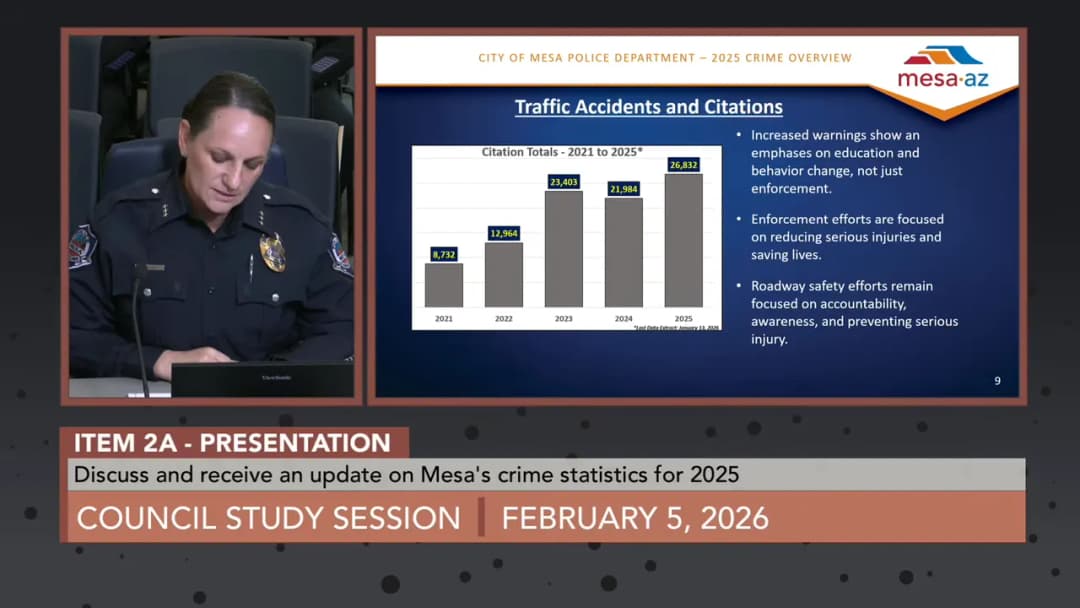
On February 5, 2026, the Mesa City Council held a study session to review the upcoming February 9 regular meeting agenda, receive an update on 2025 crime statistics from the Mesa Police Department, and discuss proposed text amendments to streamline administrative site plan approvals. Councilmember Adams was excused; Vice Mayor Summers participated via Zoom. Discussion Items - Agenda Review (Item 1): Council reviewed the February 9 meeting agenda. Key items included: - A resolution to call the primary election on an expedited schedule due to a pending state law change moving the primary date from August 4 to July 21. The deadline to call the election was moved from February 23 to February 9. - 4A – Arizona Farms Road High-Pressure Gas Lines: Scott Boucher, Energy and Sustainability Director, explained that the project will replace about four miles of 4-inch pipe (installed in the 1960s, without sufficient pressure records) with a 12-inch line. This is needed to serve rapid growth in the Magma service territory (36,000 customers, adding 2,000 per year) and major industrial customers like LG battery plant (first gas end of February) and CMC Steel. The project is funded through capital programs repaid by Magma utility rates. - 5A – Highway Safety Contracts: Vice Mayor Summers asked about potential grants for e-bike safety education and enforcement. Police staff agreed to research and report back. - 5B – Freeway Landmark Monument Signs: Clarified that this is for on-site signage, not billboards like the previously discussed MCC corridor. - 7A – Lincoln Development: Councilmember Taylor discussed landscaping quality with developer Ray Brennan, who indicated such details would be addressed through the design review process. - Non-Residential Rate Changes: Brian Retchell, OMB Director, confirmed that the proposed rate adjustments (e.g., from 19% to 25% for some categories) are the second phase of the notice of intent process. No public feedback had been received. - 6A – Sun Devil Auto: Noted as a separate zoning case from the site plan text amendments. - Crime Statistics Presentation (Item 2A): Chief Dan Butler and Assistant Chief Nesbitt presented 2025 crime data. - Violent crime decreased 14% compared to 2024, with robberies down 14% and aggravated assaults dropping for the first time in five years. Homicides increased slightly but remained within historic norms; 2024 had a 100% clearance rate, with 2025 approaching 90% (national average 50%). - Calls for service increased 5% (population growth), but proactive (officer-initiated) contacts rose 18% (60% since 2021), reflecting a shift to proactive policing. Shots fired calls fell 17%; armed robberies down 36%; subjects with gun down 20%. Juvenile disturbing calls rose 11%. - Motor vehicle crimes: Stolen vehicles down 17% from 2023 peak; vehicle burglaries and thefts of parts down 50% and 70% since 2021. Emerging trend: thefts of e-bikes and motorized scooters. - Traffic collisions increased moderately (national trend). Fatalities remained lower than 2022-2023. Combined citations and warnings rose 20% due to increased enforcement. Six additional traffic officers were added in January. - DUI arrests up 8% (2,200 in 2025); weapons violations and prohibited possessor arrests up 18% (2,036), indicating proactive gun interdiction. - Human trafficking offenses increased from 33 to 61 (85% increase) due to targeted investigations. Vandalism down 15%. - Light rail incidents: 1,500 incidents at stops in 2025 (50% police-initiated) with 1.8 million rides, equating to a 0.08% crime involvement rate. Most common offense: drug paraphernalia. - Mesa is the safest major U.S. city (population 500,000–650,000) based on 2024 FBI UCR data and preliminary 2025 data from the Major City Chiefs Association. - Chief Butler addressed community trust issues: The Mesa Police Department does not enforce federal immigration law, follows state law (ARS 11-1051) only after arrest for a state crime, and does not ask immigration status in the field. Councilmember Duff emphasized differentiation between Mesa PD and federal agents. - Site Plan Administrative Review Text Amendments (Item 2B): Mary Kopas, assistant planning director, and Kirsten Dvorak presented proposed changes to separate legislative from administrative site plan modifications. - Current process: Council approves rezoning with a site plan stipulation. Modifications exceeding 10% or 5,000 sq ft cumulative gross floor area (GFA) are considered major and require council approval. - Under the proposal, a two-pronged test determines if a modification returns to council: (1) significant site plan change (e.g., 15% GFA increase/reduction, adding drive-thru, increasing traffic); and (2) change of use. Only if both are “yes” does it come back. Staff recommended 15% as the threshold for significant change. - Councilmember Go Forth argued that site plans are integral to rezoning decisions and that a lower threshold (10%) best maintains community trust. She opposed removing the requirement for change of use prong. She suggested keeping 10% and eliminating the 5,000 sq ft trigger. - Vice Mayor Summers supported an iterative approach, starting with 10%. Councilmember Taylor questioned the link between site plan modifications and zoning changes and sought clarity that tenant improvements not requiring site plan changes are unaffected. - Staff clarified that the 10% threshold (without the 5,000 sq ft cap) would provide additional flexibility while preserving council’s legislative role. - City Attorney Jim Smith noted that the city has prevailed in a prior lawsuit affirming that modifying a site plan stipulation is a legislative act. The proposal aims to meet state requirements (HB 2447) while striking a balance between streamlining and council oversight. - Council directed staff to proceed with the 10% threshold (removing the 5,000 sq ft trigger) and continue working with the development community on the remaining technical details. Key Outcomes - Board Minutes (Item 3): Motion by Councilmember Taylor, seconded by Councilmember Duff, to acknowledge receipt. Passed unanimously. - Direction on Site Plan Amendments: Council directed staff to use a 10% GFA threshold (instead of 15%) as the “significant change” criterion, and to remove the 5,000 sq ft trigger, for the two-pronged test. Staff will refine the text amendment and return for adoption. - E-bike Safety Grant: Police department will explore applying for state grants to fund e-bike safety education and enforcement. - No formal actions taken on agenda review items; they will be considered at the February 9 regular meeting. - The next council meeting is scheduled for Monday, February 9, 2026, with a study session at 5:00 p.m. and a regular meeting at 5:45 p.m., including a presentation on AI. --- Summary generated from transcript of the Mesa City Council study session on February 5, 2026.
The Mesa Planning and Zoning Board held a public hearing on January 28, 2026, to consider a consent agenda consisting of two routine items. The board approved both items unanimously without discussion. Consent Calendar - Approval of the planning and zoning minutes from the January 14, 2026 meeting. - ZON 25-00378 (Angie's Prime Grill): A request for a major site plan modification on 7 acres located approximately 575 feet east of the southeast corner of South Crisman Road and East Southern Avenue. The proposal is for a 1,692 square foot restaurant with a drive-through facility. Staff recommended approval with conditions. Key Outcomes - The consent agenda was approved unanimously (6-0) by roll call vote (Chair Ayers, Vice Chair Peterson, Board Members Pitcher, Blakeman, Carpenter, Farnsworth all voting yes). - The meeting was adjourned unanimously after no further business or staff updates.
The Mesa City Council met on January 27, 2026, to consider a consent agenda, three items removed from consent, a presentation on the city's annual financial report, and public comments. Key discussion centered on funding agreements for bus and light rail transit services, with extensive public testimony opposing the light rail subsidy. The council approved all items except the light rail funding agreement passed 6-1. Consent Calendar - Items approved unanimously: minutes of previous meetings, liquor license applications for Udon Shin and University Market, contracts for water service valves and vehicle telematics (removed), property sale at 159 North Phyllis, zoning cases for a vehicle repair facility and residential development, utility rate schedules, organization of planning boards, office development, de-annexation, and a boat/RV storage facility. - Items removed from consent: 4A (AVL telematics contract), 5A (communication license agreement), 5C (bus transit agreement), and 5D (light rail funding agreement). Public Comments & Testimony - Item 4A (Telematics): Reggie Braun expressed concern about data privacy, noting that city telematics data could be sold if the vendor goes bankrupt. He suggested keeping data on local servers. No other public comment. - Item 5A (Communication License): No public speakers; item approved unanimously. - Item 5C (Bus Transit Agreement): David Winstanley asked the council to postpone the vote, citing difficulty finding cost data and questioning the value of bus routes with low fare recovery (about 5% of costs). He suggested reviewing Valley Metro's performance. Council and staff responded that the agreement is annual, part of a seven-year contract, and that bus routes serve tens of thousands of riders monthly. Mr. Winstanley later requested staff provide detailed cost data. - Item 5D (Light Rail Funding Agreement): Seven speakers opposed the 15.1 million general fund subsidy: - Bob Hathcock (District 2) called light rail a "massive waste of taxpayer dollars" and asked how long the city will continue funding it. - Reggie Braun (briefly) noted that future generations may not drive and that light rail attracts investment. - Mary Mabineau opposed expansion, citing high costs and crime concentration near stations. - Linda Patrick Hayes linked light rail to a "15-minute city" concept she associated with the Soviet Union. - David Winstanley suggested renegotiating with Valley Metro and exploring other technologies. - Alex Rennie (spoke later on item 5D) urged a no vote, proposing a $5 million cap and innovation. - Kathy Carlson (District 5) described poor rider experience, low fare enforcement, and high crime. Discussion Items - Item 4A (Telematics Contract): Scott Kahn (CIO) explained the contract consolidates six existing AVL systems into one vendor, saving money and improving efficiency. Council approved unanimously. - Item 5C (Bus Transit Agreement): Staff (Jody) detailed the $4,997,487 annual cost for four bus routes and circulators, plus paratransit and ride choice services. The agreement is the first year of a seven-year contract. Council discussed termination clauses (60-90 days), Title VI requirements, and the impact of a no vote (cessation of all bus, paratransit, and ride choice services in Mesa). Councilmember Adams noted the contractual obligation to riders. Approved unanimously. - Item 5D (Light Rail Funding Agreement): The $18,043,000 operating cost with $2.93 million in revenue leaves a $15.1 million general fund impact. City Attorney Smith clarified the city is contractually obligated as a co-owner of Valley Metro Rail. Councilmember Taylor argued the subsidy is unfair and voted no, requesting a cap on exposure and a corridor study. Councilmember Adams voted yes reluctantly, citing integrity of contracts. Councilmember Duff emphasized light rail's role in downtown density and economic development. Councilmember Heredia highlighted $1 billion in private investment and 1.8 million annual riders. The vote was 6-1 (Taylor dissenting). - Item 11A (Annual Comprehensive Financial Report): Jean Dietrich (Clifton Larson Allen) presented a clean audit with no material weaknesses or significant deficiencies. The city adopted GASB 102 for risk disclosures. Council approved unanimously. - Item 12 (Citizens Present): - Jason Smithson proposed a partnership between each council member and a Mesa high school, with annual visits to engage students in civics. - Noah James Markham (Tempe resident) criticized the length of light rail discussion and lack of infrastructure and urged action on disability services. - Bob Hathcock reflected on the past year, noting increased transparency and council independence, and encouraged continued stewardship. Key Outcomes - Consent agenda and all items except 5D approved unanimously. - Item 5D (Light Rail Operating Agreement) approved 6-1, with Councilmember Taylor voting no. - City received an unmodified audit opinion for the 2025 fiscal year. - No formal action taken on citizens' proposals; council thanked speakers and noted the suggestions. - Staff directed to provide additional data on bus and light rail costs to council and residents.
The Mesa City Council held a study session on January 26, 2026, to review the upcoming council meeting agenda, receive board minutes, and hear a presentation on a zoning case. Councilmembers also shared updates on community events and recent activities. Consent Calendar - Items discussed for placement on the consent agenda included: Resolution 7A (declaring proposed titles, schedules, terms, rates, and fees for non-residential water utility services as a public record), Item 5D (approving and authorizing the city manager to enter a funding agreement with Valley Metro Rail for current light rail operations in Mesa), and the ACFA fiscal year report. Councilmember Duff initially requested 7A removed from consent but later left it on consent after clarification. Councilmember Go Forth requested 5D removed to discuss upstairs. Discussion Items - The primary discussion centered on case ZON24525, presented by staff member Evan. The request seeks to rezone a parcel (a city island surrounded by county land) at Main Street and 80th Street from general commercial with a planned area development (PAD) overlay to a new PAD overlay to expand an existing boat and RV storage facility (Phase 3). The parcel is adjacent to the freeway and county property. A development agreement addresses septic use because no city sewer is proximate. The PAD includes deviations carried over from 2017, including zero additional landscaping inside the fenced perimeter (landscaping is provided on the public-facing Main Street side). Staff and the Planning and Zoning Board (6-0 vote) recommend approval with conditions. Councilmember Go Forth asked clarifying questions about the landscaping deviation and expressed a general preference against expanding storage in Mesa but noted this was an expansion of an existing use. He also requested that future staff reports include explicit reasoning for how criteria for conditional use permits are satisfied, rather than restating the criteria. - Councilmember Go Forth also mentioned he would like to see Item 9B (a presentation on the Department of Child Safety of Arizona at University Drive and 80th Street) addressed during the meeting. Key Outcomes - The council acknowledged receipt of board minutes by unanimous voice vote (motion by Vice Mayor Duff). Councilmember Taylor expressed excitement about the St. Vincent DePaul Medical Office and Sprouse projects in District 3. - No formal action was taken on consent items or the zoning case, as this was a study session. The meeting adjourned after scheduling updates: the next study session is Thursday, February 5, 2026, at 7:30 a.m., and the next council meeting is Monday, February 9, 2026. The study session originally planned for January 29, 2026, was canceled. - Councilmembers shared current events: Councilmember Taylor noted over 8,000 volunteer hours (specific figure 8,875) at the Arizona Museum of Natural History volunteer luncheon and participation in the unity walk at Tempe Town Lake. Councilmember Go Forth attended the Mesa Fire Department paramedic program graduation and mentioned a recent fire on Dobson/Pennington. Councilmember Adams joined the SRP watershed tour, seeing Bartlett Lake, Horseshoe Lake, and other reservoirs.
The Mesa City Council held a study session on January 22, 2026, to discuss the sale of two city-owned properties, receive the fiscal year 2025 annual comprehensive financial report (ACFER), acknowledge board minutes, and share updates on community events. The council also reviewed the agenda for the upcoming January 26 council meeting. Discussion Items 1. Review of January 26 Council Meeting Agenda - Councilmember GoForth questioned why the sale of 159 North Phyllis (item 5B) was proposed as a direct sale rather than an auction. Lisa Lance, real estate manager, explained the property was purchased in 1985 due to flooding, demolished, and has been vacant since. An adjacent property owner (Bastion Investments) expressed interest in purchasing it for redevelopment (senior living) and potential secondary access. The property is appraised at $165,000. Councilmember Haredi expressed support for the direct sale, noting the area's mixed zoning and the potential for redevelopment. The council agreed to proceed. - Councilmember Taylor asked about the $34 million bond referenced in item 5C (Proposition 4479/479). Staff clarified it is the countywide transportation tax extension (Prop 479) that funds freeways, transit, and arterial streets, with Mesa receiving a substantial portion. 2. Sale of 10-Acre Parcel at 8130 East Redberry - Lance Webb and Lisa Davis presented a proposal to sell the city-owned parcel (purchased in 2003 for $630,000 as a potential park site, now deemed unnecessary) via online auction. The property is appraised at $1,550,000 and zoned RS-35. The auction would use the EasyBuy platform, with a 30-day website listing, 500-foot (expanded to 1,000-foot) neighbor notification, and a $77,500 deposit. The council discussed septic system requirements (due to lack of sewer), zoning restrictions, and potential redevelopment. Councilmember GoForth and others expressed support for the auction, with direction to proceed. Staff noted proceeds may be reinvested into nearby park enhancements. - Councilmember Adams asked about locking in zoning and future sewer connection costs. The city attorney clarified that binding future councils on zoning is not legally possible, but the development agreement could require dry sewer lines. The council agreed to move forward with the auction. 3. Fiscal Year 2025 Annual Comprehensive Financial Report (ACFER) - Finance Director Irma Ashworth presented the audit results. The city received an unmodified (clean) opinion from independent auditor Clifton Larson Allen, with no findings or material weaknesses. Total revenues remained strong, with governmental activities revenue comparable to FY2024. The city's net position reached $1.3 billion, the strongest in history. Total assets were $6.1 billion, liabilities $4.8 billion. Key highlights included consistent sales tax revenue (despite the elimination of rental tax in January 2025), a two-year lag in state income tax distributions, and a decrease in unfunded pension liabilities (ASRS, PSPRS). The city is making extra contributions to PSPRS, aiming to pay off the unfunded liability by 2042. Councilmember Taylor asked about the audit process, and staff confirmed the third-party audit and internal controls were robust. 4. Acknowledgment of Board Minutes - The council unanimously approved the receipt of board minutes. The motion passed without objection. 5. Nexus Current Events and Conferences Attended - Council members reported on events: MLK Jr. parade and festival (sponsored by the city), the final pipe placement for the Central Mesa Reuse Pipeline (a water exchange with the Gila River Indian Community), Mesa Police Department promotions and awards, the Mesa Historic Homes Tour, and the Park Rangers meeting. Councilmember Summers highlighted ribbon cuttings and groundbreakings in District 6, including Cannon Beach and DSV's regional headquarters. Key Outcomes - Direction to proceed with sale of 159 North Phyllis via direct sale to Bastion Investments at appraised value of $165,000. Staff will bring a formal authorization to a future council meeting. - Direction to proceed with online auction for 8130 East Redberry parcel. Auction expected by end of March 2026, with final sale authorization to come before council. - Acceptance of the FY2025 ACFER with a clean audit opinion. The report will be formally presented at the January 26 council meeting. - Unanimous approval of board minutes. - Next study session: January 26, 2026, at 5:15 PM, followed by a council meeting. The January 29 morning study session was canceled.