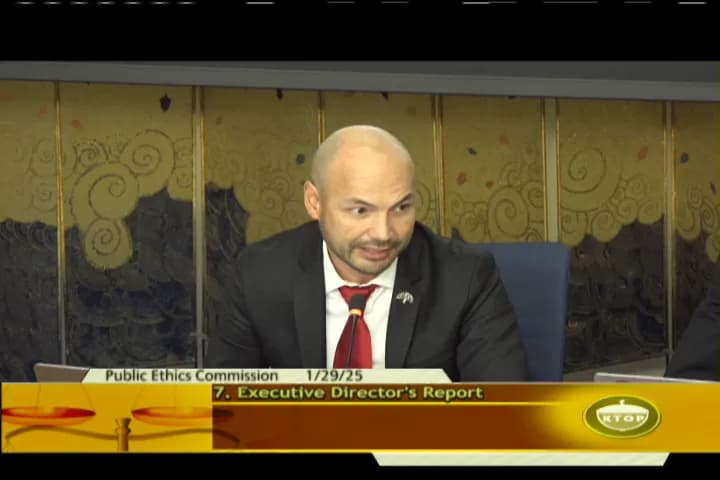
The meeting was called to order at 6:34 p.m. by Chair Ryan Micik. The Commission discussed 2024 accomplishments, enforcement challenges, budget priorities, and approved several administrative adjustments. Vice Chair Francis Upton IV was elected Chair and Commissioner Tanya Bayeva elected Vice Chair for 2025. Consent Calendar - Approval of December 11, 2024, meeting minutes was deferred due to a voting record error; staff will correct and bring back. Public Comments & Testimony - David Shore (California Common Cause) expressed strong support for the Commission’s work, highlighted the BayPEC coalition’s continued commitment to Democracy Dollars, and endorsed exploring a dedicated revenue ballot measure for PEC funding. - Gail Wallace (League of Women Voters of Oakland) affirmed the League’s long-standing collaboration with the PEC, stressed that enforcement and Democracy Dollars are intertwined anti-corruption measures, and urged the Commission to pursue alternative funding mechanisms given the city’s fiscal crisis. Discussion Items - Disclosure and Engagement Report (Item 5): Lead Analyst Alex Van Buskirk reported that for the April 15, 2025 special election, there are 10 qualified candidates for Mayor and 6 for City Council District 2. The PEC finalized a special filing schedule with the FPPC. In 2024, the PEC processed over 1,000 campaign filings covering nearly $5.2 million in contributions through mid-October. Lobbyist compliance: 64 lobbyists registered, reporting 533 contacts. Staff also conducted ethics training for over 400 new city employees and nearly 90 supervisor-level employees. - Enforcement Program Report (Item 6): Executive Director Nicolas Heidorn reviewed 2024 enforcement: the Commission approved $441,658 in penalties across seven cases (the highest in PEC history). New Enforcement Chief Tovah Ackerman was introduced. The unit received 24 formal complaints (12 dismissed, 9 in intake) and 62 informal complaints (47 rejected). The complaint backlog remains high with 141 open matters, largely due to understaffing (one investigator for 100 non-Form 700 cases). Staff estimate needing three investigators and one staff attorney to address the load. - Executive Director’s Report (Item 7): Heidorn highlighted 2024 successes: managing the 2024 election, passing Measure OO (73% voter approval), reinstating the Limited Public Financing Program, and significant enforcement actions. Staffing challenges and Measure W funding uncertainties were emphasized. The City faces an estimated $120 million annual structural deficit, and the PEC’s budget priorities are: (1) maintaining existing staffing, (2) adding one investigator (or more), (3) restoring Democracy Dollars startup funding for a 2028 pilot, and (4) ensuring continued public financing if Democracy Dollars is postponed. Commissioners discussed the need to request additional enforcement staff and explore revenue options. - Appointment to Mayor-Appointed Vacancy (Item 9): The only finalist, Daniel Adler, withdrew for personal reasons; another candidate did not meet the civic organization qualification. The Commission agreed to first ask the interim Mayor’s office if it intends to appoint. If not, staff will do a light-touch recruitment and forward candidates to the Mayor. No Commission appointment will be pursued at this time. - Biennial Adjustment of Campaign Finance Limits (Item 10): Based on a 6.5% CPI increase, staff recommended raising the individual contribution limit from $600 to $650 and the broad-based political committee limit from $1,200 to $1,300. Voluntary spending limits and maximum Democracy Dollars proceeds were also adjusted (e.g., Mayor’s spending limit from $500,000 to $532,500; Mayor’s Democracy Dollars max from $333,333 to $355,000). Unanimously approved. - Adjustment of PEC Meeting Notice Period (Item 11): Staff proposed reducing the 10-day (effectively 12-day) posting requirement to 7 days, citing administrative burden and modern digital notification. The change will be included in a future omnibus cleanup proposal to the City Council. Unanimously endorsed. - Amendment to Penalty Guidelines for Form 700 (Item 12): Staff recommended switching from a contact-based penalty to a time-based one for Form 700 non-filers (1–60 days late: diversion; 61–120 days: $200; 121–180 days: $400). Maximum streamline penalty reduced from $800 to $400. The change aims to simplify enforcement for the large volume of filers. Unanimously approved. - Commissioner Appointment Process (Item 13): Vice Chair Upton presented a proposal to streamline vacancy appointments by maintaining a list of vetted applicants and using a ranked-choice oral voting procedure to select candidates. The proposal will be developed into formal operating procedure amendments. - Subcommittees and Commissioner Assignments (Item 14): Chair Micik presented the termination statement of the Charter Review Subcommittee, noting its success with Measure OO and memorializing unenacted reforms. Two new subcommittees were created: (1) Democracy Dollars Community Engagement Plan (Commissioners Tilak, Bayeva, Gage; Chair: Tilak) to review the engagement plan; (2) PEC Revenue Options (Commissioners Upton, Micik, Gage; Chair: Upton) to develop potential revenue measures for PEC funding, with a target of presenting options by the March meeting. Key Outcomes - Election of Officers (Item 8): Commissioner Francis Upton IV was elected Chair (unanimous) and Commissioner Tanya Bayeva was elected Vice Chair (unanimous) for 2025. Outgoing Chair Ryan Micik was thanked for his two years of service. - Campaign finance limit adjustments approved effective immediately. - Meeting notice period reduction endorsed (proposed to City Council via cleanup bill). - Form 700 penalty guidelines amended to time-based, lower fines, effective 60 days after adoption (unless City Council vetoes). - Revenue Options Subcommittee created to explore ballot measures or other funding sources for Democracy Dollars and enforcement. - Democracy Dollars Engagement Plan Subcommittee created to guide outreach planning. - Commissioner vacancy: Staff directed to contact Mayor’s office; if no interest, staff will recruit candidates for Mayor’s consideration.
Public Meetings - Oakland, California
Public Meetings - Oakland, CaliforniaThis hearing, convened at 6:30 PM and adjourned at 8:39 PM, addressed allegations that respondent Michael Dabney, owner of Rainbow Italian Ice, violated the Government Ethics Act by offering a bribe to a city inspector and then providing false information to the Public Ethics Commission investigator. Hearing Officer Karun Taluk presided over the case, with both parties presenting testimony and evidence. Key Participants - Hearing Officer: Karun Taluk, Commissioner - Complainant: Patrick Bears, Oakland City Attorney's Office (representing the PEC Enforcement Unit) - Respondent: Michael Dabney (self-represented) - Complainant's Witnesses: Moises Campos (Inspector, Special Activities Permit Division), Nancy Marcus (Administrative Analyst, Special Activities Permit Division) - Respondent's Witness: Christopher Williams (co-worker/associate of Dabney) Charges and Penalty Request - Charge 1 (Bribery): Under OMC 2.25.070 – offering something of value in exchange for an official act. Maximum penalty: $5,000. - Charge 2 (False Information): Under OMC 2.25.080(C)(7) – knowingly providing false information during a PEC investigation. Complainant requested $5,000. - Total requested penalty: $10,000. Key Testimony and Evidence Complainant's Case - Moises Campos testified that on August 18, 2023, respondent called him and stated he wanted to discuss business involving paying Campos in cash. Campos stated he immediately refused and hung up, then reported the call to supervisor Greg Minor (email Exhibit E1A). Campos testified he had no personal relationship with respondent, never indicated he could lend money, and had only interacted professionally during enforcement at Lake Merritt. He stated his co-worker Nancy Marcus overheard the call on speaker. - Nancy Marcus testified that she heard respondent say, "I'll give you the money if you give me the permit" (or similar). She stated she did not hear the word "loan" or any request to borrow money, and she heard no background noise suggesting a vehicle or speakerphone. She confirmed that during the COVID period, mobile vending fees were waived, and no payment to Campos would have been needed for a permit. - Complainant introduced text messages (Exhibit E4D) showing respondent texted Campos on a Thursday at 5:33 PM asking to talk, but the purpose was not stated. Previous texts in 2020 were about permit status. Respondent's Case - Michael Dabney testified that on August 18, 2023, while driving with Christopher Williams on speakerphone, he called Campos and asked for a $500 personal loan because of financial hardship. He stated Campos replied "I can't do that" and hung up. He denied offering money or asking for any official act. He claimed he had no need for a mobile vending permit because he primarily operated at special events, not on city streets. He admitted operating without a permit at Lake Merritt during COVID but said that was no longer his main business by 2023. - Christopher Williams testified that he was in the vehicle and heard Dabney ask Campos for $500, and Campos declined. He stated he lived with Dabney (since fall 2023 or earlier) and had worked for him for several years. Under cross-examination, he confirmed he did not hear any mention of a permit or cash offer. - Respondent argued that the city witnesses' accounts are false and that he only sought a loan, not a bribe. Credibility and Contradictions - Complainant pointed out that respondent did not mention Williams as a witness during the initial PEC investigation (conducted by investigator Russell Simon around late 2023 or early 2024); the affidavit from Williams was not produced until months later, after the case escalated. - Both Campos and Marcus testified they believed a bribe was being offered and reported it immediately. Respondent offered no motive for why city staff would lie. - Respondent's contention that he did not need a mobile vending permit was contradicted by city witnesses who stated that any food vending on public property (including Lake Merritt) requires a permit, and no special event permit covered his vending in July 2023. Public Comment No members of the public provided comments. Key Outcomes - The hearing was concluded and taken under submission. Hearing Officer Taluk will issue proposed findings of fact and conclusions within 14 days. - The findings will be submitted to the full Public Ethics Commission at its next meeting (likely March 2025), which may adopt, modify, or reject the findings and impose penalties ranging from dismissal to the maximum $10,000.
The Oakland Public Ethics Commission (PEC) held its regular meeting on December 11, 2024, at 6:30 p.m. in Hearing Room 1 of City Hall. All six commissioners were present, including new Commissioner Tanya Bayeva. The Commission discussed the 2024 Limited Public Financing (LPF) program, compliance and disclosure activities, enforcement challenges, and the 2025 meeting schedule. They also debated filling a mayoral-appointed vacancy and streamlining future commissioner appointments. Consent Calendar - Approval of October 9, 2024, Special Meeting Minutes: Approved 4-0 (Commissioners Steele and Bayeva abstained after being granted permission by the Commission). - Approval of October 9, 2024, Regular Meeting Minutes: Approved 4-0 (Commissioners Steele and Bayeva abstained with permission). Public Comments & Testimony - No oral public comments were made during the meeting. Written public comment from former Enforcement Chief Simon Russell was submitted for Open Forum and acknowledged by the Chair; the Commission encouraged members to read it. Discussion Items - Executive Director’s Report (Moved to after Open Forum) - Budget: The City faces a $142.45 million general fund deficit; the PEC’s budget currently faces no proposed cuts, but further reductions could force elimination of a core service. A potential April 2025 ballot measure to fund oversight agencies (PEC, City Auditor, Community Policing Review Commission) was discussed. Staff emphasized that any funding should also cover enforcement staffing needs (minimum 3 investigators and 1 staff attorney). - Measure W (Democracy Dollars): Contract negotiations with MapLight are ongoing but frozen due to the City’s hiring freeze. User testing by Open Oakland volunteers was successful; feedback highlighted the need for simple language, mobile-first design, and strong community engagement. Staff noted that a full 2026 rollout is unlikely without expedited city processes. - Enforcement Staffing: The Enforcement Chief position has been vacant since October 9, 2024, leaving 141 open cases to one investigator. Interim measures include: reassigning Executive Director and an analyst to preliminary reviews, contracting former ED Whitney Barazoto as a consultant, requesting City Attorney assistance, and referring a time-sensitive complaint to the FPPC. The Commission authorized hiring for the Chief position, pending City Administrator approval. - Measure OO: Passed with 73% voter approval, effective December 17, 2024. Key provisions include: minimum staffing of two investigators by July 2026, new commissioner qualifications, and authority for the PEC to fill mayoral vacancies after 120 days. - 2024 Limited Public Financing (LPF) Program Summary: All 13 certified City Council district candidates opted into the program; 7 qualified after meeting the $7,500 threshold. Total disbursement was $154,999.95 out of $155,000 (99.99% usage). Staff noted that 6 candidates failed to qualify, primarily due to late filing and insufficient fundraising. The debate requirement was met by all participants. The program was authorized for one-time use; staff recommended considering an extension if Democracy Dollars is delayed. - Disclosure and Engagement Report: 100% compliance with pre-election campaign filings. Staff audited 94 statements; 2 were late. Independent expenditure spending was high: over $361,000 by the top committee. The Open Disclosure Oakland platform saw 2,687 active users from August 27 to November 24, 2024. Lobbyist compliance: 54 registered, 100% filed Q3 reports, 50 of 54 completed training. - Enforcement Program Report: Since October, 2 formal, 9 informal, and 1 proactive complaint were received; 3 formal and 3 informal were dismissed. Current caseload: 141 open matters. The Commission discussed the need for a streamlined process for Form 700 enforcement. - 2025 Regular Meeting Schedule: The Commission approved a bi-monthly schedule (6 meetings per year) on Wednesdays at 6:30 p.m. The proposed dates are: January 22, March 12, May 14, July 9, September 10, November 12. The change aims to reduce staff workload during the enforcement rebuilding phase. - Filling the Vacant Commission Seat (Mayoral Appointment): The Commission discussed whether to fill the seat, which has been vacant for nearly two years. After debate, members agreed to contact previous finalists Daniel Adler and the runner-up from Commissioner Tilak’s recruitment (Mr. Karubis) to gauge interest and confirm qualifications. If neither is available, staff will launch a recruitment. The appointment will be voted on at the January 22, 2025, meeting. - Streamlining Commissioner Appointment Process: Vice Chair Upton proposed an annual recruitment process to create a pre-vetted list of candidates for unexpected vacancies, with ranked-choice voting by commissioners. The Commission generally supported the idea but raised concerns about timing and transparency. Staff will draft a formal policy for future meetings. - Subcommittee Reports: The Commissioner Recruitment Subcommittee and the Charter Review Subcommittee were dissolved after successful outcomes (appointment of Tanya Bayeva and passage of Measure OO). A new subcommittee on Democracy Dollars outreach was deferred until funding uncertainties are resolved. Key Outcomes - Approved the October 9, 2024, special and regular meeting minutes (4-0, with two abstentions). - Adopted the 2025 regular meeting schedule (6 meetings, bi-monthly, Wednesdays at 6:30 p.m.). - Directed staff to contact previous finalists for the mayoral-appointed vacancy and, if unavailable, to initiate a recruitment. - Agreed to develop a standardized process for filling commissioner vacancies, with language to be drafted by Vice Chair Upton. - Noted that a special meeting may be called on December 16, 2024, to discuss a potential ballot measure for oversight agency funding. - Dissolved two ad hoc subcommittees (Recruitment and Charter Review).
The Oakland Public Ethics Commission (PEC) held its regular meeting on Wednesday, October 9, 2024, at 6:30 p.m. in Hearing Room 1 of City Hall. The meeting covered a presentation by the Planning and Building Department on public records response, the selection of a new commissioner, a discussion on Democracy Dollars pilot options, and updates on enforcement, disclosure, and other commission activities. Commissioners also addressed public comments, approved minutes, and planned for future work. Public Comments & Testimony - Gene Hazzard criticized the commission for failing to investigate the legal status of the Oakland Promise initiative, stating he has raised the issue since 2019 and the PEC has remained silent. He also questioned the commission's handling of Measure W (Democracy Dollars) and Measure O. - Ralph Kanz complained about inconsistent responses to written comments and the lack of follow-up on a records retention policy change approved by the city council without commission review. He also argued that a dismissal of a complaint about a special meeting violated the Sunshine Ordinance. - Scott Law (during open forum) suggested the commission schedule a future agenda item to discuss the standard for candidate-controlled committees, citing a recent case and offering to forward an FPPC letter on the topic. Discussion Items Planning and Building Department Records Presentation - Assistant Director Albert Merid and Acting Administrative Analyst II Jonathan Arnold presented on the department's public records request process. Key statistics: 2,712 requests in 2021, 2,352 in 2022, 2,265 in 2023, and 2,044 as of October 9, 2024. The department has 9 staff positions (3 currently vacant). Average initial response time is 1.8 days; average completion time is 14 days (84% completed within 20 days, 93% within 30 days). All requests receive a 10-day determination response. - Challenges include delays in obtaining email records through the city's EDDR portal (up to a month), the need for redactions (code enforcement, copyright-protected building plans), and the dependency on off-site storage for paper records. - The department uses NextRequest for tracking and Adobe Pro for redactions. They do not categorize requests by type for reporting. Staff training includes bi-weekly meetings and shadowing. They are working with the city clerk's office on citywide digitization efforts. - Commissioners asked about the large fee (over $6,000) for a 3R report (residential record report), which was based on a fee study. The department noted that the fee reflects the work involved and that a lower-cost option for basic permit information is being considered. - A mediation case (PEC 2024-01) involving the department was discussed; the department committed to follow up on the case number to improve future responsiveness. Selection of New PEC Commissioner - Two finalists, Tanya Bayeva and Daniel Adler, each gave a 4-minute introduction answering preset questions and then responded to commissioner questions. - Tanya Bayeva: Corporate and impact investment attorney with 15+ years of experience; stressed compliance frameworks, internal investigations, and community outreach. She proposed tracking educational methods against compliance rates and exploring AI for complaint intake. - Daniel Adler: Deputy Director for Climate Finance at the state Infrastructure and Economic Development Bank; background in public policy, philanthropy, and nonprofit leadership. He emphasized public trust, transparency, and potential for city-facilitated candidate forums and mailers. - Commissioners praised both candidates. By a 4-0 vote (Commissioner Steele absent), the commission selected Tanya Bayeva to fill both the partial term (through January 21, 2025) and the subsequent full three-year term (starting January 22, 2025). The appointment is effective upon swearing-in. Democracy Dollars Implementation (Pilot Options) - Program Manager Suzanne Doran presented a staff memo outlining eight possible modifications for a scaled-down pilot in 2026 if full funding is not available. Two main options were detailed: a mayoral-only pilot (less cost-effective) and a council district-only pilot (focusing on Districts 2, 4, and 6), which could reduce the Democracy Dollars Fund by over 75%. - Commissioners expressed general consensus around the council district-only approach, but raised concerns about the tipping point where a pilot becomes ineffective (e.g., too few districts, too low voucher value). They emphasized the need for candidate input and a clear strategy for scaling up. - Staff noted that the commission would need a 5-vote majority to make program changes and that long-term funding options would be presented in December. Public comments on this item criticized Measure O and questioned the program's financial sustainability. Disclosure and Engagement Update - Lead Analyst Alex Van Buskirk reported that the NetFile API issue affecting the Open Data portal has been resolved. The first pre-election filing deadline was September 26; staff is screening for late contributions and independent expenditures. So far in September, $57,176 in independent expenditure spending has been reported in three City Council races. - Commissioners asked about tracking of new independent expenditure disclosures (Form 305) and authorization statements. Staff saves materials internally and follows up on missing filings. The online tool Open Disclosure Oakland is updated daily. Enforcement Program Update - Enforcement Chief Simon Russell reported that two formal and five informal complaints were received since the last update; one case was dismissed. The total open caseload is 140. He noted the dismissal of Case 19-23 (regarding a nonprofit's legal status) due to lack of jurisdiction under the Corporations Code. - Commissioners thanked Chief Russell for his eight years of service and emphasized the need for adequate staffing. Chief Russell stated that a minimum of four enforcement staff are needed, while currently only two positions exist (one will be vacant after his departure on October 25). - Public comments again raised the jurisdictional issue and requested a written citation of the statute. Executive Director's Report - Executive Director Nicolas Heidorn reported on the transition following Chief Russell's resignation. The Enforcement Chief recruitment posting opened October 2 and closes October 21. Staff is requesting additional resources (contractor funding, city attorney assistance) during the transition. - He updated on the Ramachandran/Jenkins contribution limit proposal: the amended ordinance (raising limits to $800 general, $1,500 broad-based, with expenditure limits required for 2026) passed first reading on October 1 but second reading was delayed due to lack of quorum on October 7; it will return October 15. - The Limited Public Financing Program (LPF): 7 of 13 candidates who opted in qualified for Phase 2. Available funding per candidate increased to $22,142 (from $11,000). Staff is processing reimbursement claims. - Public comment reiterated concerns about the city's records retention policy not being reviewed by the commission. Subcommittees and Commissioner Assignments - Chair Micik noted the Charter Review and Commissioner Recruitment subcommittees have completed their work. He will hold off on forming a new Democracy Dollars Outreach subcommittee until the next meeting when more commissioners are present. - Vice Chair Upton suggested that the transparency work (department presentations) may warrant a new subcommittee for next steps. Key Outcomes - Approved minutes of the September 16, 2024 Special Meeting (approved 4-0; Commissioner Steele absent) and the July 10, 2024 Regular Meeting (approved unanimously). - Appointed Tanya Bayeva as new commissioner for both the partial term (through January 21, 2025) and the full term (through January 21, 2028) by a 4-0 vote. - Directed staff to pursue a council district-only Democracy Dollars pilot as the preferred option for 2026, with further analysis on candidate input and cost thresholds. - Noted enforcement staffing transition: recruitment underway, with interim responsibilities assumed by the Executive Director and support from the City Attorney's Office for an upcoming administrative hearing. - Set future agenda items: discussion on streamlining commissioner recruitment, potential engagement on candidate-controlled committee guidance, and a presentation from the Information Technology Department on public records systems.
The Public Ethics Commission (PEC) held a special meeting on October 9, 2024, starting at 5:30 p.m., to consider proposed settlement agreements in three enforcement cases involving former Mayor Libby Schaaf and several campaign committees active in the 2018 and 2020 elections. The Commission had previously voted at its September 16, 2024 meeting to send the settlements back to staff with a request for a precise breakdown of how much each individual respondent would pay. The respondents returned with that information, and after discussion and two votes, the Commission approved all three settlement agreements in a single package. Public Comments & Testimony - Ralph Cannes: Expressed concerns that the meeting was scheduled on short notice and that the public’s written questions had not been answered. He argued that the largest penalties were assessed against committees that no longer have funds, effectively letting serious violations go unpunished. He also questioned the lack of efforts to hold treasurers or other individuals responsible. - Mr. Hazard: Raised an issue about the legal status of Oakland Promise (a program associated with Measure AA), arguing that it is an unincorporated association and that staff had failed to investigate this, which he believes is central to the case. He indicated he may file a lawsuit. - Additional written comments: The Chair noted that written comments from Mr. Cannes and two other individuals were available on the PEC website. Discussion Items - Follow-up on Settlement Agreements: Enforcement Chief Simon Russell presented the revised settlement agreements for PEC Cases 22-09.01 (Oaklanders For Responsible Leadership), 20-41.01 (Committee For An Affordable East Bay), and 19-01.01 (Oakland Fund For Measure AA). Each agreement now included Exhibit 2, which specifies the minimum amounts each respondent individually commits to paying from the joint penalties. - Omission of Certain Respondents: The revised agreements no longer include OAKPAC, its president Barbara Leslie, and Robert Zachary Wasserman. Chief Russell explained that OAKPAC’s board could not meet in time to approve changes, but that these respondents will be brought before the Commission at a later meeting (likely December 2024). - Discussion on Penalty Collection: Commissioners questioned the enforceability of penalties against committees that have terminated and have no funds. Chief Russell acknowledged collection difficulties but stressed the importance of having the penalties on the books as precedent for future cases and to demonstrate the seriousness of the violations. He noted that individual respondents (including Mayor Schaaf) are jointly liable and that the minimum amounts are just a floor—respondents remain liable for the full joint penalties if others fail to pay. - Individual Penalty Commitments: According to Exhibit 2, the minimum individual payments are: Libby Schaaf ($21,000), Doug Linney ($5,000), Jonathan Bair ($3,300), Ernest Brown ($3,300), Oaklanders For Responsible Leadership ($94,768), Oakland Police Officers Association ($23,930), and Committee for an Affordable East Bay ($230,860). The Oakland Fund for Measure AA is not listed as a separate payer; Mayor Schaaf will cover that portion. - Concerns About Adequacy: Commissioner Gage expressed that the penalties seemed inadequate and that the structure gave perverse incentives for committees to terminate and avoid payment. She also worried about the absence of counsel for the two largest respondent committees (Oaklanders For Responsible Leadership and Committee for an Affordable East Bay) to provide assurances about payment plans. - Precedent and Deterrence: Chief Russell emphasized that these are some of the largest penalties the PEC has ever levied, that the respondents are admitting to key facts, and that the cases are being watched by other jurisdictions. He argued that approving the settlements now will allow his successor to focus on other serious cases rather than renegotiating or litigating these. - Vote: The first motion to approve failed on a 3–1 vote (Commissioner Gage dissenting) because four votes were needed. After further discussion, a second motion was made and passed unanimously (4–0), with Commissioner Gage changing her vote in favor. Key Outcomes - Approval of Settlements: The Commission approved the three proposed settlement agreements (PEC Cases 22-09.01, 20-41.01, and 19-01.01) as a package, including the breakdown of minimum individual payments specified in Exhibit 2. - Future Action on OAKPAC: The respondents OAKPAC, Barbara Leslie, and Robert Zachary Wasserman will be presented in a separate settlement at a future Commission meeting (likely December 2024). - Payment Deadline: Respondents have 60 calendar days from the date of Commission approval to pay the specified amounts to the City of Oakland general fund, with possible extensions at staff discretion.
The Oakland Public Ethics Commission (PEC) held a special meeting on September 23, 2024, starting at 6:35 PM and continuing past midnight. The agenda included a proposal to increase campaign contribution limits, consideration of five enforcement settlement agreements related to candidate-controlled committees, and routine reports. Public comment was heard on multiple items, with speakers expressing a wide range of opinions on campaign finance and enforcement penalties. Consent Calendar - Approval of July 10, 2024 Minutes: Unanimously approved. - Approval of August 14, 2024 Special Meeting Minutes: Approved 4-0-1 (Commissioner Talak abstained). Public Comments & Testimony - Open Forum: Mr. Law (Treasurer, Alameda County Grand Jury Association) described a ballot title evaluation project, giving Measure OO a score. Gene Hazard criticized the city attorney’s office for misleading ballot titles. Asada Olikbala raised concerns about Measure NN and other ballot initiatives. Ralph Kans criticized the agenda length and delayed posting of public comments. - Item 5 (Contribution Limits): Gene Hazard opposed the increase, calling it ineffective. Gail Wallace (League of Women Voters of Oakland) opposed applying the change to the upcoming election. Tiffany Rose-Napati Laksado supported the proposal as a bridge while Democracy Dollars is unfunded. Asada Olikbala expressed that voters should inform themselves. Ralph Kans called Measure W an unfunded mandate and argued for eliminating candidate limits combined with stronger anti-corruption rules. - Enforcement Items (10-14): Marlene Sachs (complainant) argued settlements were too lenient and that respondents knew the law. Gene Hazard alleged past misconduct and selective enforcement. Jorge Lerma, Jahara, Tiffany Rose, and Michael Wong spoke in support of former Mayor Libby Schaaf, citing her positive record. Asada Olikbala and Ralph Kans criticized the settlements as insufficient and noted conflicts of interest. Discussion Items - Item 4: Approval of Minutes – Approved as noted under Consent Calendar. - Item 5: Proposal to Increase Campaign Contribution Limits – Executive Director Nicholas Hydorn presented staff analysis showing the change from $600 to $900 for individuals and $1,200 to $1,800 for broad-based committees, intended as a temporary bridge until Democracy Dollars is implemented. Councilmembers Janani Ramachandran and Kevin Jenkins spoke in favor, arguing that without Democracy Dollars, candidates are struggling to fund outreach. Commissioners discussed concerns about last-minute rule changes, administrative burden, legal risks, and the need for expenditure limits in 2026. After motions and amendments, the commission voted 5-0 to send a letter to the City Council expressing support for the goals but raising concerns about timing, recommending that higher limits in 2026 be conditioned on accepting expenditure limits, and urging collaboration on avoiding administrative complications such as required refunds. - Item 6: Disclosure and Engagement Report – No action taken. - Item 7: Democracy Dollars Implementation – Report on grant-funded outreach and user interface prototyping. No action. - Item 8: Enforcement Program Update – Chief Simon Russell reported on cases and litigation. Public comment raised allegations of non-investigation. No action. - Item 9: Executive Director’s Report – Noted limited public financing status and staffing discussions. No action. - Items 10-14: Enforcement Settlement Agreements – These five cases (Case 2209, Case 2041, Case 2041.3, Case 1918, and an unnumbered case) involved allegations that former Mayor Libby Schaaf, Doug Linney, Barbara Leslie, Zach Wasserman, OakPAC, and others operated candidate-controlled committees without proper registration, disclosure, and contribution limits. Chief Russell detailed the facts and penalties, stressing that settlements are a compromise. The commission took the following actions: - Item 10 (Case 2209): Motion to approve settlement failed 3-2 (needed 4 votes for enforcement action). Motion to direct staff to renegotiate with individual payment amounts passed 3-2. - Item 11 (Case 2041): Similar outcome: motion to approve failed 3-2; motion to direct staff to renegotiate with individual amounts passed 3-2. - Item 12 (Case 2041.3): After legal counsel for Libby Schaaf withdrew the stipulation, no settlement existed; item concluded without action. - Item 13 (Case 1918, Julian Orton): Settlement for $5,000 (no contest) approved unanimously 5-0. - Item 15: Subcommittee Reports – Chair reported on recruitment of a new commissioner and formation of a Democracy Dollars outreach subcommittee. - Item 16: Future Meeting Business – No specific items proposed. Key Outcomes - Consent Calendar: Approved two sets of minutes (unanimous and 4-0-1). - Contribution Limits (Item 5): Commission voted 5-0 to send a letter to City Council detailing concerns about timing, endorsing expenditure limits for 2026 higher limits, and requesting an impact evaluation. The earlier motion to directly support the proposal had failed due to vote threshold confusion, but the letter motion superseded it. - Enforcement Cases: - Item 10 (Case 2209): Settlement not approved; staff directed to return with specific individual payment amounts (3-2 vote). - Item 11 (Case 2041): Same direction to staff (3-2 vote). - Item 12 (Case 2041.3): Stipulation withdrawn; no action. - Item 13 (Case 1918): Settlement with Julian Orton approved (5-0). - All enforcement votes requiring a final action needed 4 votes; those motions failed, leading to directions to staff.
The Oakland Public Ethics Commission held a special meeting on September 19, 2024, beginning at 6:35 PM and continuing past 9:15 PM. The meeting addressed a proposal to temporarily increase campaign contribution limits, reviewed several complaint investigations, and took action on settlement agreements. Key statistics reported included 36 candidate committees, 3 ballot measure committees, 1 recall committee, and 54 registered lobbyists. Consent Calendar - Approval of Minutes (July 10, 2024): Approved unanimously (5-0). - Approval of Special Meeting Minutes (August 14, 2024): Approved 4-0-1 (Commissioner Talak abstained). Public Comments & Testimony - Open Forum: Multiple speakers addressed ballot measures, including Measure OO (democracy dollars) and Measure N. Mr. Law and Mr. Hazard criticized misleading ballot language and the city attorney's role. Asada Olikbala raised concerns about Measure N's citizen initiative process. Ralph Cannes criticized the agenda length and public comment posting practices. - Item 5 (Contribution Limits): Gail Wallace (League of Women Voters of Oakland) opposed the proposal, especially for the upcoming election. Others supported the increase, citing candidate challenges. Mr. Hazard and others argued it undermines Measure W and democracy dollars. - Enforcement Items (10-12): Marlene Sachs, a complainant in case 2209, argued the penalties were too low and that respondents knew the law. Others, including Jorge Lerma, spoke in support of former Mayor Libby Schaff, citing her contributions to Oakland. Ralph Cannes and Asada Olikbala raised concerns about the adequacy of investigations and penalties. Discussion Items - Proposal to Increase Campaign Contribution Limits (Item 5): The Commission considered a proposal by Councilmembers Ramachandran and Jenkins to temporarily raise limits from $600 to $900 for individuals and from $1,200 to $1,800 for broad-based political committees, with a sunset in 2027 or earlier if democracy dollars are implemented. Executive Director Nicholas Hydorn presented staff analysis, noting concerns about last-minute changes, increased reliance on large donors, and administrative burden. Councilmembers argued the change is needed to bridge the gap because democracy dollars are not funded. After debate, a motion to support the proposal with amendments (including expenditure limits for 2026) failed 3-2. The Commission then voted 5-0 to send a letter to the City Council summarizing the range of opinions, including concerns about timing, the need for expenditure limits in 2026, and the desire to avoid reimbursement-based solutions. - Enforcement Matters (Items 10, 11, 12): The Commission reviewed three proposed settlement agreements related to alleged campaign finance violations by former Mayor Libby Schaff and others. These cases involved failures to register candidate-controlled committees, exceeding contribution limits, and improper earmarking. Enforcement Chief Simon Russell presented the details, noting that respondents admitted to violations but claimed reliance on legal advice. Proposed penalties included joint and several liability. After extensive discussion, motions to approve the settlements for Items 10 and 11 failed 3-2 (four votes required for enforcement actions). The Commission then voted 3-2 to direct staff to renegotiate the settlements to specify individual payment amounts for each respondent. The meeting adjourned before a vote on Item 12 (case 2041.3 involving William Whitty). Key Outcomes - Contribution Limits: The Commission will send a letter to the City Council expressing the discussion points, including concerns about the timing of the change, the need for expenditure limits in 2026, and the desire to avoid a reimbursement-based solution. - Enforcement Settlements: Proposed settlements for Items 10 and 11 were rejected due to insufficient votes. Staff was directed to renegotiate these settlements to clearly state the individual financial responsibility of each respondent. The meeting ended before a decision on Item 12.
This meeting of the Oakland Public Ethics Commission (PEC) focused on enforcement settlements, subcommittee reports, and clarification of voting procedures. Key actions included the withdrawal of a settlement agreement with Mayor Libby Shaf's campaign committee, approval of a settlement with a developer, and updates on commissioner recruitment and new committee formation. Public Comments & Testimony - No public comments were recorded during the meeting. Discussion Items - Settlement with Libby Shaf Committee (Case involving candidate-controlled committee): Enforcement staff recommended a $9,500 settlement ($4,500 for failing to register as a candidate-controlled committee, and $5,000 for accepting a $100,000 contribution from Orton Development while the company was negotiating a city lease). Staff cited a previous similar case (Susan Montauk, $500 penalty) and the respondent's reliance on incorrect legal advice as mitigating factors. Gary Winnick, representing Mayor Libby Shaf, withdrew the stipulated agreement, stating that given the commission's previous actions, the case should be remanded back to enforcement staff. The commission acknowledged that no settlement agreement remained to vote on and closed the item after public comment. - Settlement with Julian Orton / Orton Development (Case 1918): This case involved the developer who made a $100,000 contribution to the Oakland Fund (a candidate-controlled committee). Enforcement staff recommended a $5,000 no-contest settlement, noting that Mr. Orton likely did not know the fund was candidate-controlled. Commissioner Gage asked about criteria for accepting no-contest pleas; Chief Russell explained that no-contest pleas preclude the respondent from using admission as a mitigating factor, increasing the penalty. The motion to approve the settlement passed unanimously (5-0). - Commissioner Recruitment and Selection Subcommittee Report: The subcommittee reported receiving 10 applications for the vacant commissioner seat, narrowing to 6 finalists, with interviews scheduled that week. The goal is to present 2-3 candidates at the October meeting to fill the vacancy through end of 2024 and for the full term starting January 2025. - Charter Review and Outreach Subcommittee Updates: The charter review subcommittee is preparing closing documentation to guide future charter amendments. The outreach subcommittee has been sunset; a new Democracy Dollars outreach committee will be formed to focus on public education for the program. Commissioner Steele and Gage expressed interest in serving, with a third slot open for a new commissioner. - Reopening of Item 5 (Contribution Limits Vote): A commissioner moved to reopen item 5 (a previous vote on a council proposal to raise contribution limits) after questioning whether the vote threshold was correct. Executive Director Hyderan clarified commission rules: Section 2.24.020 requires a majority vote of the commission (4 votes) for any motion or resolution, while policies/procedures require a majority of members present. Since the earlier vote on the contribution limits measure was 3-2, it did not meet the required 4-vote threshold. The motion to reopen was withdrawn. Key Outcomes - The Libby Shaf settlement was withdrawn; the case is remanded to enforcement staff for further proceedings. - The Julian Orton settlement was approved (5-0), with a $5,000 penalty and no admission of liability. - Commissioner recruitment advanced: six finalists will be interviewed, with candidates presented at the October meeting. - A new Democracy Dollars outreach committee will be formed; commissioners to volunteer before the next meeting. - The previous vote on contribution limits (item 5) was not revisited; the 3-2 result was confirmed as insufficient for passage under commission rules.
The Oakland Public Ethics Commission (PEC) held a special meeting on August 14, 2024, to determine the distribution of $155,000 in Limited Public Financing (LPF) funds for the November 2024 City Council district elections and to receive an update on commissioner vacancy recruitment. Four commissioners were present, constituting a quorum. Public comment included criticism of the PEC’s enforcement and a ballot measure. Public Comments & Testimony - Gene Hazard gave oral comments criticizing the PEC for failing to investigate alleged violations related to Oakland Promise and a ballot measure on the ethics commission, and for what he described as selective enforcement. He also corrected staff that LPF eligibility does not include at-large council seats, but noted that three districts (1, 7, and at-large) have extended nomination periods, not just two. - A written comment from Scott and Kathy Law (forwarding Sandy McCabe’s message) pointed out a potential language error in a ballot measure, noting that "biannual" means twice a year while "biennial" means every two years, and urged correction. Discussion Items 1. Limited Public Financing Act (LPF) Program 2024 Executive Director Nicolas Heidorn presented that the fund has $155,000, while there are 12 potentially eligible candidates (from Districts 1, 3, 5, and 7). The maximum per candidate is $45,000 (30% of $150,000 expenditure ceiling), so the fund is insufficient to fully fund all candidates. Staff recommended that the Commission find the fund inadequate and adopt a pro rata distribution: divide $155,000 equally among candidates who opt in by the 14-day deadline, subject to a two-phase approach (Phase I opt-in deadline in late August, Phase II qualification deadline September 20). This method has historically achieved 90%+ fund usage. Commissioners discussed historical data, the timing of the meeting relative to candidate certification, and the legal allowance for "other equitable basis." The Commission voted 4-0 to adopt the staff recommendation. 2. PEC Vacancy Update Staff reported two vacancies on the seven-member commission: one mayoral appointment and one commission-appointed seat (short term ending January 2025 and a full three-year term). The application period opened July 16 and closes September 9. Five applications received so far. Outreach includes email lists, social media, digital ads, flyers, and commissioner attendance at community events. A subcommittee (Chair Micik, Commissioners Gage and Tilak) will review applicants in September and recommend candidates for appointment at the October meeting. Key Outcomes - Vote on LPF Distribution: The Commission unanimously (4-0) determined that the $155,000 Election Campaign Fund is insufficient to provide the maximum $45,000 per candidate and ordered disbursement on a pro rata basis: funds divided equally among candidates who accept participation by the 14-day deadline (August 23 for Districts 3 and 5; August 28 for Districts 1 and 7), with a two-phase reallocation after the September 20 qualification deadline. - Recruitment Process: The Commission continues to accept applications for its commission-appointed seat through September 9, 2024, with an appointment expected at the October regular meeting.
The Oakland Public Ethics Commission (PEC) held its regular meeting on Wednesday, July 10, 2024, at 6:31 p.m. in Hearing Room 1, City Hall. Commissioners present: Ryan Micik (Chair), Francis Upton IV (Vice-Chair), Alea Gage, and Karun Tilak. Commissioner Vincent Steele was absent. Commissioner Charlotte Hill resigned prior to the meeting, creating a vacancy. Staff present included Executive Director Nicolas Heidorn, Enforcement Chief Simon Russell, and Lead Analyst Alex Van Buskirk. The meeting addressed consent calendar, public comments, presentations, enforcement updates, budget impacts, a hearing officer appointment, a case closure, and subcommittee reports. Consent Calendar - Approved the draft minutes from the June 12, 2024 regular meeting (moved by Commissioner Tilak, seconded by Commissioner Gage, passed 4-0). A correction was noted reflecting that Commissioner Gage joined the meeting at 6:35 p.m. Public Comments & Testimony - Ralph Kanz (Open Forum and multiple items): Stated that the City Council violated the Sunshine Ordinance by not providing agenda-related materials in a timely manner; claimed the Fire Department delayed public records requests; urged the Commission to improve the mediation process and impose a 30-day time limit; argued that the Democracy Dollars program lacks a guaranteed funding source given the city's budget deficit. - Gene Hazard (Open Forum and multiple items): Repeatedly alleged that Oakland Promise (a city-affiliated nonprofit) is not a valid 501(c)(3) organization; claimed it owes the city $4 million and that the PEC has failed to investigate; said he would file another formal complaint. Discussion Items - Democracy Dollars Outreach Presentation (Item 5): Trishia Claudine Lim, UC Berkeley Goldman School graduate, presented her capstone report “(Small) Money Talks: Strategies to Implement the Democracy Dollars Program in the City of Oakland.” Key findings: The program distributes four $25 vouchers ($100 total) to every eligible Oakland resident; currently, donors at the maximum contribution level represent less than 1% of the adult population in each neighborhood. Three communities identified as likely to have lower participation without targeted outreach: young voters, non-English speakers, and residents with disabilities. Recommended strategies include school-wide demonstrations in Oakland public high schools (McClymonds, Fremont, Castlemont), usability testing for the program website, and partnerships with transit agencies, libraries, churches, and labor unions. Commissioners discussed cost constraints, the need to prioritize low-cost high-impact activities, and how to avoid appearing to favor one political side. - Disclosure and Engagement Report (Item 6): Staff reported compliance activities: 54 lobbyists registered for 2024; 50 completed mandatory online training; first-quarter lobbyist reports documented 135 contacts with public officials. Campaign finance data from the Open Data portal was restored after the 2023 ransomware attack. - Enforcement Program Report (Item 7): Chief Russell reported: since the last meeting, six formal complaints received (five in intake/review, one dismissed), three informal complaints rejected, six investigations opened, three dismissed. Total open caseload: 135 (including 41 Form 700 non-filer cases). Of these, 42 are on hold due to staffing shortages. Legal actions: 10 subpoena enforcement cases listed, with nine closed via stipulated dismissal; one new action initiated against Oakland United to Recall Sheng Thao. - Executive Director’s Report (Item 8): Heidorn provided updates: - Budget: The adopted mid-cycle budget cut $245,000 from PEC, including $97,790 from Democracy Dollars startup funding and elimination of $50,000 for candidate education. Council restored $155,000 for the Limited Public Financing (LPF) program. Staff’s requests for an additional investigator and full restoration of Democracy Dollars funds were not granted. - Democracy Dollars (Measure W): The PEC is moving forward with preparing an online platform via a contract with MapLight (authorized up to $700,000 over five years). However, due to budget reductions, user testing and automation may be scaled back. A pilot or phased implementation is being considered for 2026, but funding remains uncertain. - Charter Amendment: A ballot measure incorporating several PEC-recommended charter amendments (including adding one enforcement investigator starting July 2026) was placed on the November 2024 ballot, though a provision about mayoral salary-setting was removed. - Mediation Program: Six mediations closed since last meeting; 10 remain open. - Limited Public Financing (LPF) Update (Item 9): Staff confirmed $155,000 allocated for the 2024 LPF program for City Council district candidates. A special meeting in August will determine per-candidate maximum amounts. The updated LPF Guide incorporates a mandatory debate requirement and uniform expenditure limits. Key Outcomes - Motion to select hearing officer for In the Matter of Michael Dabney (PEC 23-28) (Item 10): Approved unanimously (4-0). The motion authorized the Executive Director to appoint a hearing officer from a list of former PEC commissioners who are attorneys, with Commissioner Karun Tilak designated as the backup hearing officer if no outside candidate is secured by early August. - Motion to close case In the Matter of Manuel Altamirano (PEC 20-04) (Item 11): Approved unanimously (4-0). Staff recommended closure in the interests of justice because: key witnesses no longer wish to testify (citing safety concerns), the case is four years old, the respondent is no longer a city employee, the alleged bribe was de minimis ($100 and perfume), and enforcement resources are severely constrained. - Subcommittee Updates (Item 12): - Public Outreach Subcommittee: Reported plans for National Night Out on August 6, 2024, and development of commissioner talking points. The subcommittee will sunset on August 25, 2024. - Charter Review Subcommittee: Held no meetings; the ballot measure approved by Council incorporates some but not all PEC recommendations. The subcommittee will meet once more to finalize a closing statement and post the full recommendation on the PEC website. - Formation of Commissioner Recruitment Subcommittee (Item 12): Chair Micik announced a new ad hoc subcommittee (Commissioners Micik, Gage, Tilak) to lead the recruitment and selection of finalists to fill the vacancy created by Commissioner Hill’s resignation. The recruitment will also cover the upcoming full term. Application period expected mid-July to early September 2024. - Future Meeting Business (Item 13): Enforcement Chief Russell suggested revisiting and clarifying the PEC’s complaint procedures to explicitly allow delegation of hearing officer selection to the Executive Director and to address subpoena enforcement processes. Commissioners agreed to consider these tweaks later in the year. Meeting adjourned at approximately 9:53 p.m.