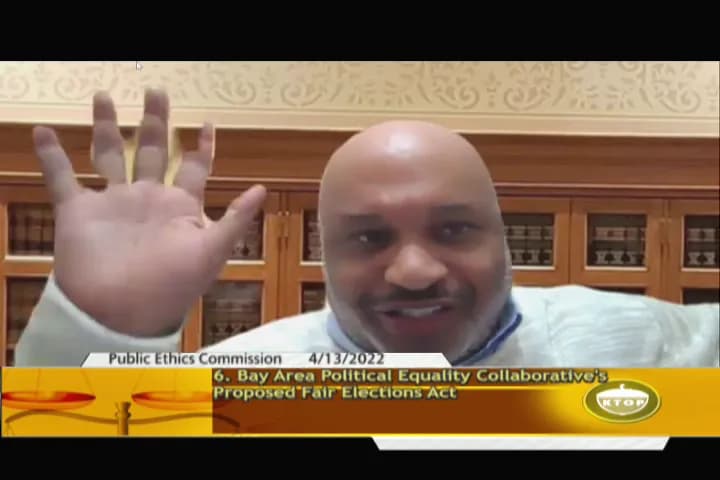
The Oakland Public Ethics Commission (PEC) held its regular meeting on April 13, 2022, via teleconference. The main agenda item was a presentation and discussion of the proposed Oakland Fair Elections Act, a comprehensive campaign finance and public financing reform measure introduced by the Bay Area Political Equality Collaborative (BayPEC). After hearing presentations, public testimony, and commissioner deliberation, the Commission voted 4-1 to support the proposal and to create a subcommittee to work with staff and the coalition on further amendments. The Commission also unanimously renewed Resolution 22-01 to continue virtual meetings under AB 361, approved prior meeting minutes, and received updates on enforcement, disclosure, and the limited public financing program. Consent Calendar - Renewal of Resolution 22-01 (Virtual Meetings): The Commission renewed its determination that in-person meetings pose an imminent health risk due to COVID-19 and elected to continue teleconferencing under AB 361. The resolution passed 5-0 (Commissioner Tuman absent). - Approval of March 9, 2022 Regular Meeting Minutes: The minutes were approved 4-0-1 (Vice Chair MacDonald abstained due to absence; Commissioner Tuman absent). Public Comments & Testimony - Open Forum: A member of the public (Mr. Kanz) alleged that the redistricting commission had violated the Brown Act and argued that PEC staff dismissed a related complaint without the required commission vote. He urged the Commission to take action. - Item 6 – Oakland Fair Elections Act: Numerous speakers expressed support, including: - Council Vice Mayor Rebecca Kaplan (via aide) and Council President Nikki Fortunato Bas (via chief of staff) voiced strong support, citing equity and engagement benefits. - Representatives from the ACLU of Northern California, Asian Law Caucus, Bay Rising, and other coalition members spoke in favor, highlighting the program's potential to increase grassroots participation and diversify candidate and donor pools. - Katie Oakland and Helen Hutchison also expressed support, emphasizing the need to involve low-income and communities of color. - One public speaker (Scott Law) opposed the proposal, arguing that it solves a nonexistent problem, is overly complex, and that installing term limits would be more effective. He also noted the absence of Commissioner Tuman, who has campaign experience. Discussion Items - BayPEC Presentation of the Oakland Fair Elections Act: - Jonathan Mehta Stein (California Common Cause), liz suk (Oakland Rising), and Gail Wallace (League of Women Voters Oakland) presented the proposal. Key elements include: - Replacing the existing Limited Public Financing Act with a Democracy Dollars program providing each voter with four $25 vouchers ($100 total) to donate to certified candidates. - Reducing individual contribution limits from $900 to $400 and small contributor committee limits from $1,800 to $800. - Extending the post-employment lobbying ban for city officers from one year to three years. - Creating a public online repository for independent expenditure communications over $1,000. - Funding: $4 million per cycle for vouchers, $1.25 million per cycle for administration, plus $700,000 in startup costs and four additional PEC staff positions. - Commissioners raised questions about cost, staffing, timeline (targeting 2024 implementation), coordination with the Registrar of Voters, and benchmarks for success. - Renee Lebeau, Seattle Democracy Voucher Program Manager, spoke about Seattle's experience, noting a tiered implementation approach and the importance of community outreach. She confirmed that the timeline is tight but feasible. - PEC Executive Director Whitney Barazoto highlighted the need for adequate funding for administrative costs (including mailing, production, and outreach) and suggested reconsidering the biennial budget structure for staff salaries. - Reports on Subcommittees: - The Enforcement Subcommittee (Chair Perteet, Commissioner Micik) did not meet in March but will meet again in April. - The Public Records Performance Subcommittee (Vice Chair MacDonald, Commissioner Leavitt) met with staff and is awaiting appointment of a third member from the City Auditor's office. Executive Director Barazoto announced that the Auditor had made an appointment, and the new member will be sworn in soon. Key Outcomes - Support for the Oakland Fair Elections Act: The Commission voted 4-1 to support the proposal (Commissioners Hill, Leavitt, Micik, and Vice Chair MacDonald in favor; Chair Perteet opposed, citing financial concerns). The motion also included creating a subcommittee to work with staff and BayPEC on technical amendments and to report back to the full Commission. The subcommittee will be chaired by Commissioner Hill, with Chair Perteet also serving. - Virtual Meeting Resolution Renewed: Resolution 22-01 was renewed unanimously (5-0) for the next month. - Minutes Approved: The March 9, 2022 minutes were approved with one abstention. - Future Meeting: The Commission will hold a retreat on April 21 and 22, 2022 (5:00–8:30 p.m. both days), which will be virtual and open to the public with opportunities for comment.
Public Meetings - Oakland, California
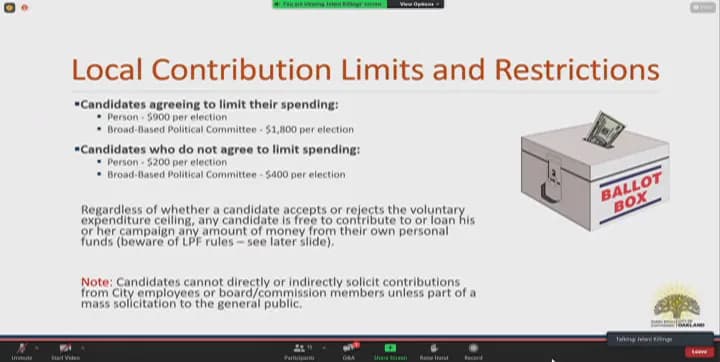
Public Meetings - Oakland, CaliforniaOn March 30, 2022, the City of Oakland's Public Ethics Commission (PEC) jointly with the California Fair Political Practices Commission (FPPC) held a two-hour training for candidates and treasurers. The training covered state campaign finance rules under the Political Reform Act and local rules under the Oakland Campaign Reform Act (OCRA). The session included presentations by FPPC staff (Chloe Hackard and Steven Hernandez) and PEC staff (Jelani Killings and Suzanne). The training aimed to equip candidates and treasurers with knowledge of filing requirements, contribution limits, record keeping, and electronic filing obligations. State Rules Presentation (FPPC) - Campaign Forms and Committees: Overview of Form 501 (candidate intention statement), Form 470 (short form for candidates not raising/spending $2,000+), Form 410 (statement of organization for committees), and the requirement to include candidate last name, office, and election year in the committee name. The Form 410 must be filed within 10 days of reaching the $2,000 threshold, with a $50 fee and a wet signature copy to the Secretary of State. - Bank Accounts: Only one campaign bank account per committee is allowed; no commingling of funds. Personal funds may be used for filing fees without triggering the $2,000 threshold. - Form 700: All candidates must file a Statement of Economic Interests (Form 700) with the local filing officer. - Record Keeping: Maintain records for four years after the election, including names and addresses for contributions of $25+, and occupation/employer for $100+. Both candidate and treasurer share liability. - Contributions: Defined broadly; exceptions include voluntary personal services, member communications, and uncompensated internet activity. Fundraisers at home/office become reportable if total cost exceeds $500. Electronic contributions (e.g., Venmo) must be reported at full value with fees as expenditures. - Restrictions: No contributions of $25+ without name/address; no cash, money order, or cashier's check of $100+; no contributions from foreign governments. Local contribution limits may apply. - Government Code 84308: Applies to appointed officials; prohibits soliciting/accepting contributions of $250+ from entities doing business before their agency. - Major Donor Notifications: Must notify contributors of $5,000+ within two weeks; for $10,000+ within 90 days of election, notice within one week. - Form 460: Detailed instructions for reporting monetary contributions (Schedule A), loans (Schedule B), non-monetary contributions (Schedule C), expenditures (Schedule E), and summary page. Required for committees exceeding $2,000 threshold. - Form 497: 24-hour report required for contributions of $1,000+ from a single source within 90 days of election, including candidate's own loans. - Filing Schedules: For November 8, 2022 general election, 90-day cycle starts August 10, 2022. Two pre-election statements due in September and October 27. After election, semi-annual filing until committee termination. - Advertising Disclosures: Mass mailings (200+ similar pieces in a month) must include "Paid for by" with committee name and address in at least 6-point font. - Post-Election: Successful candidates continue filing and pay $50 annual fee; leftover funds become surplus 90 days after leaving office. Defeated candidates have 90 days after the semi-annual reporting period following each election to redesignate surplus funds. - Resources: FPPC website (fppc.ca.gov), candidate toolkit, and advice phone line (866-275-3772). Local Rules Presentation (Oakland PEC) - Electronic Filing: Mandatory for all campaign statements; must file Form 300 to obtain Netfile account. Initial paper filings (Form 501, Form 410) are still required. - Voluntary Spending Limits: Candidates may accept expenditure ceilings (e.g., $175,000 for District 1 council) to be eligible for higher contribution limits. To accept, file OCRA Form 301 before receiving contributions at the higher limit. - Contribution Limits: Candidates accepting spending limits: $900 per election from persons, $1,800 from broad-based political committees. Candidates rejecting limits: $200 per person, $400 per broad-based committee. Personal loans to own campaign are not subject to these limits. - Definition of Broad-Based Political Committee: Must exist for 6 months, receive contributions from 100+ persons, and make contributions to 5+ candidates. Candidates must verify before accepting higher limits. - Aggregation Rules: Contributions from entities sharing majority of board/officers/ownership are treated as one person. Business owners cannot give both individually and from business account. - Loans and Unpaid Bills: If unpaid for 90 days and $1,500, they become contributions subject to limits. A payment schedule is recommended. - Notice Requirements: All fundraising materials must include a statement about contribution limits and contractor prohibition. - Contractor Prohibition: Persons negotiating contracts with City of Oakland or Oakland Unified School District may not contribute from start of negotiations through 180 days after completion. Applies to CEOs, owners of 20%+ interest, and authorized negotiators. - Enforcement: Late filers are posted online; fines and referral to FPPC for non-filers beyond 45 days. Recent enforcement actions have resulted in hundreds to thousands of dollars in fines. - Limited Public Financing: Available to district city council candidates; $10,000–$25,000 reimbursement. Requirements: personal loans/contributions capped at 10% of expenditure ceiling; must raise and spend 5% of ceiling; attend training in August 2022; submit required forms. - Resources: PEC provides binders with campaign manuals, OCRA guide, and public financing guide. Advice line (phone/email) and electronic filing support. Key Outcomes - The training provided comprehensive guidance on state and local campaign finance rules. - Slide decks will be emailed to all participants, and the recording will be posted on the PEC website. - A follow-up quiz for treasurers will be made available; successful completion will result in listing on the PEC website. - Candidates and treasurers are encouraged to contact the PEC or FPPC with questions and to monitor deadlines.
The Oakland Public Ethics Commission (PEC) held its regular meeting on March 9, 2022, at 6:30 p.m. via teleconference. The meeting was called to order at 6:32 p.m. and adjourned at approximately 8:22 p.m. Commissioners present: Arvon Perteet (Chair), Michael MacDonald (Vice-Chair), Charlotte Hill, Jessica Leavitt, Ryan Micik, and Joseph Tuman. Commissioner MacDonald was absent. The meeting covered renewal of virtual meeting authority, approval of prior minutes, City Council salary adjustment, subcommittee updates, informational reports, and public comment. Consent Calendar - Renewal of Virtual Meetings Resolution (Resolution 22-01): The Commission voted 5-0 to renew the resolution determining that in-person meetings pose imminent health risks and to continue teleconference meetings under AB 361. Commissioner Hill moved, Commissioner Tuman seconded. The vote was 5 ayes (Hill, Leavitt, Tuman, Micik, Perteet); Commissioner MacDonald absent. Public Comments & Testimony - Ralph Kanz (member of the public, former PEC commissioner) commented on two issues: (1) the need to update the 20-year-old Sunshine Ordinance, and (2) the City Attorney’s conflict of interest in representing both the PEC and the Redistricting Commission, advocating for independent counsel for the PEC. - Zinny Abraham (public speaker) spoke during the salary adjustment item, suggesting that the Commission consider a performance-based hold on the raise due to the pandemic’s impact on the city budget and Oaklanders. He also urged the Commission to think about unusual economic conditions. - Ralph Kanz (again) argued that the City Charter provision forcing the PEC to set Council salaries is inappropriate and that the responsibility should be moved to another body. He also noted that the salary increase is mandatory under the charter. - Ralph Kanz (during enforcement discussion) criticized the dismissal of complaint 21-08 against the Redistricting Commission, stating that the failure to post agenda-related materials was a violation of the Sunshine Ordinance and that the City Attorney’s conflict of interest tainted the process. - Ms. Knight and Smith (public speaker) expressed concern that the Redistricting Commission’s failure to properly notice the December 13, 2021, meeting invalidated subsequent actions, including the selection of district maps, which she argued disenfranchised District 7 voters. - Zinny Abraham (again) urged the Commission to refer the matter to the City Council for discussion, rather than dismissing the complaint. Discussion Items - Enforcement Subcommittee Report: Chair Perteet and Commissioner Micik reported that the subcommittee is reviewing enforcement policies and practices by comparing them with sister agencies (e.g., Los Angeles, San Diego). The subcommittee is in the early stages of gathering information and may bring recommendations to the full Commission. Chief Johnson noted that the subcommittee is evaluating different enforcement approaches. - Public Records Performance Subcommittee: Vice-Chair MacDonald reported that the subcommittee is on hold pending appointment of a third commissioner by the City Auditor. - Enforcement Program Update: Chief Kellie Johnson presented the monthly enforcement report, which included the dismissal of Complaint No. 21-08 against the Oakland Redistricting Commission. The complaint alleged failure to provide notice and agenda to email subscribers for the December 13, 2021, special meeting. Chief Johnson explained that while the Redistricting Commission did not send the agenda to subscribers, the Sunshine Ordinance (OMC 2.20.090(D)) provides that such failure does not invalidate actions taken at the meeting, and because the complainant attended the meeting, he had actual notice, barring the complaint under OMC 2.20.070. The Commission also lacks authority to order a “cure and correct.” The dismissal was upheld, but Chief Johnson recommended that the Redistricting Commission request future training on the Sunshine Ordinance. Commissioners discussed the limitations of the current law and the possibility of recommending policy changes at the upcoming retreat. Key Outcomes - Approval of January 12, 2022, Meeting Minutes: Passed 4-0 (Commissioner Hill abstained as she was not yet a commissioner; Commissioner MacDonald absent). - Approval of February 9, 2022, Meeting Minutes: Passed 4-0 (Commissioner Leavitt abstained because she was absent from that meeting; Commissioner MacDonald absent). - City Council Salary Adjustment: The Commission voted 5-0 to adopt staff recommendation for a 6.3% increase in City Councilmember salaries as required by City Charter Section 202, raising the annual salary from $97,480.55 to $103,621.82, effective July 2022. No additional discretionary increase was authorized. The resolution will be transmitted to the City Administrator, HR, and Treasury. - Enforcement Dismissal Upheld: The Commission took no action on the dismissal of Complaint 21-08, effectively accepting the staff’s determination. The matter is closed. - Future Meeting Business: The Commission confirmed its retreat will be held on April 21 and 22, 2022, with a possible hybrid option to accommodate commissioners who cannot attend in person. The regular April 13 meeting may be kept on the calendar to consider a potential ballot measure from the Bay Pact Coalition regarding campaign finance reform. - Commissioner Recruitment: The City Auditor is completing interviews for a vacant commissioner seat; the final appointment is expected soon. Informational Items - Oakland Campaign Reform Act Guide 2022: Staff presented the updated guide, which includes 2022 contribution and spending limits, updated electronic filing processes, and minor clarifying edits. No changes to the law were made. - Disclosure and Engagement Report: Lead Analyst Suzanne Doran reported that mandatory ethics training for Form 700 filers has been migrated to the citywide NEOGOV Learn platform, enabling automated tracking and assignment. The system will now send reminders and track compliance. Staff also completed 25 advice requests in February, trained 61 new employees, and updated the OCRA Guide. - Executive Director’s Report: Whitney Barazoto reported that the Bay Pact Coalition is preparing a ballot measure on campaign finance reform, which may be presented at the April 13 meeting. Staff is also preparing to hire two part-time temporary employees for the 2022 election cycle. The retreat will be facilitated by a consultant for strategic visioning.
The Oakland Public Ethics Commission (PEC) held its regular meeting on Wednesday, February 9, 2022, at 6:30 p.m. via teleconference. Commissioners present: Arvon Perteet (Chair), Michael MacDonald (Vice-Chair), Charlotte Hill, Ryan Micik, and Joseph Tuman. Commissioner Jessica Leavitt was absent. The Commission approved the renewal of virtual meeting authority, adopted the 2021 Annual Report, and approved a proposed City Ticket Policy Ordinance with amendments to be forwarded to the City Council. Several informational reports were presented, and public comment was heard on multiple items. Consent Calendar - Approval of January 12, 2022, Meeting Minutes: The vote was postponed because only three members (Perteet, MacDonald, Micik) who had attended the January meeting were present. Commissioners Hill and Tuman abstained per City Attorney advice, leaving no majority. The item was continued to the next meeting. Public Comments & Testimony - City Ticket Policy Ordinance: A speaker noted that the current policy works well and that tickets often go to disadvantaged families and children. They expressed concern that adding authority to deny requests could subject the ticket administrator to undue pressure. - Redistricting Complaint (Out of Order): A speaker alleged that Councilmember Lauren Taylor improperly influenced the redistricting commission and requested that the PEC investigate. The Chair reminded the speaker that the item was not on the agenda. - Open Disclosure Tool: A speaker praised the PEC’s Open Disclosure tool for campaign finance data but noted the filing interface could be more user-friendly. Discussion Items - Virtual Meetings Resolution (Item 4): The Commission renewed Resolution 22-01, finding that in-person meetings still pose imminent health risks due to COVID-19. The resolution was approved by a 5-0 vote (MacDonald, Hill, Micik, Tuman, Perteet). - Public Ethics Commission Annual Report (Item 6): Staff presented the 2021 Annual Report, highlighting record fines of $365,600, expanded open data releases, and new training programs. Minor corrections were noted (e.g., Espinosa fine amount, updates to lobbyist data). The report was approved unanimously (5-0). - Proposed City Ticket Policy Ordinance (Item 7): Staff presented a draft ordinance to replace the outdated 2009 resolution. The ordinance aligns with 2019 state FPPC regulations, limits ticket use by high-level officials, expands public purposes, and applies citywide. Commissioner MacDonald moved two amendments: (1) reduce the reporting period from 45 to 25 days, and (2) explicitly prohibit the sale of city tickets by public servants. The motion passed (5-0). The ordinance, as amended, will be forwarded to the City Council. - Subcommittee Reports (Item 8): The Enforcement Subcommittee (Perteet, Micik) reported progress on reviewing enforcement practices from other California agencies. The Public Records Performance Subcommittee (MacDonald, Leavitt) has not yet met; a third member will be appointed. Key Outcomes - Approved Resolution 22-01 (virtual meetings) – 5-0 vote. - Approved 2021 Annual Report with corrections – 5-0 vote. - Approved City Ticket Policy Ordinance with amendments (25-day reporting period and prohibition on sale of tickets) – 5-0 vote. The ordinance will be sent to the City Council for adoption. - Postponed approval of January 12, 2022, meeting minutes to the next meeting due to lack of a qualified majority. - Informational Items: The Commission received the 2022 Lobbyist Registration Act Guide, the 2022 campaign contribution and expenditure limits (published by February 1), the monthly Disclosure and Engagement report, the Enforcement Program update (including dismissal of Case No. 22-01), and the Executive Director’s report (including retreat planning and mediation summaries). - Future Meeting Business: The Commission will hold a retreat on April 21 or 22, 2022, to discuss priorities and hear training on enforcement hearings.
The Oakland Public Ethics Commission held its first regular meeting of 2022 via teleconference on January 12, 2022, at 6:30 p.m. The meeting included the renewal of virtual meeting authorization under AB 361, election of new officers for 2022, approval of a stipulated enforcement case against former lobbyist Jason Overman, and approval of proposed amendments to the Limited Public Financing Act. Commissioners also created a new Public Records Performance Subcommittee and heard year-end reports from staff. Public Comments & Testimony - Ralph Kants, a member of the public, commented on issues with the City's redistricting commission, alleging that the December 13, 2021 meeting was not properly noticed (agenda not sent to subscribers) and that a vote was taken without allowing public comment. He stated he filed a complaint with the PEC on December 23, 2021, and expressed frustration that the PEC had not taken action to require the redistricting commission to cure and correct the violation. Chair MacDonald referred him to staff for follow-up. Discussion Items - Virtual Meetings Resolution (Item 4): The Commission reviewed Resolution 22-01, determining that conducting in-person meetings would present imminent health risks due to the ongoing COVID-19 pandemic and the Governor's state of emergency (extended to March 31, 2022). The resolution allows continued teleconference meetings under AB 361. Commissioner MacDonald noted the resolution must be renewed every 30 days. Vote: 5-0 to adopt. - Approval of Meeting Minutes (Item 5): The Commission approved the draft minutes from the December 6, 2021 regular meeting. Vote: 5-0. - Election of Officers (Item 6): Commissioner Arvon Perteet was nominated and elected Chair for 2022 (vote 4-0-1, with Vice Chair Yan abstaining). Commissioner Michael MacDonald was nominated and elected Vice Chair (vote 4-0-1, Vice Chair Yan abstaining). Commissioner Perteet highlighted his investigative, legal, and management background; Commissioner MacDonald expressed support for a leadership change and commitment to outreach. - In the Matter of Jason Overman (Case No. 18-14, Item 7): Enforcement Chief Kellie Johnson presented a stipulation for a total penalty of $2,600 ($500 per count for two counts of violating the contractor contribution ban, plus $1,600 as the amount of unlawful contributions). The violation occurred in 2017 when Overman, a former City Council aide and lobbyist, made $800 contributions to Abel Guillen and Mayor Libby Schaaf while his client UrbanCore was still in the prohibited period under the Oakland Campaign Reform Act. Staff cited mitigating factors including the 2017 amendment expanding the contractor definition and Overman's cooperation. Commissioner Micik questioned whether a lower fine could apply given Overman's claimed lack of awareness; Johnson responded that his experience as a lobbyist and knowledge of the larger ban warranted the $500 per count. Vote: 5-0 to approve the stipulation. - Proposed Amendments to Limited Public Financing Act (Item 8): Executive Director Whitney Barazoto presented two minor amendments from City Auditor recommendations: (1) extending the check deposit deadline for candidates from 3 business days to 30 calendar days; (2) deleting the requirement for mandatory post-election audits of all candidates and replacing it with discretionary audit authority for the City Auditor. Commissioner MacDonald suggested future consideration of lowering the qualification threshold (currently 5% of expenditure ceiling) and using a donor-count approach instead. The amendments were approved. Vote: 5-0. - Subcommittee Reports and Creation (Item 9): Commissioner Perteet reported on the Enforcement Subcommittee's first meeting, which focused on background and will meet monthly. Chair MacDonald announced the creation of a Public Records Performance Subcommittee (renamed from Sunshine Review) to implement recommendations from the Spotlight on Oakland's Public Records System report. Commissioners MacDonald and Leavitt will serve; the third member appointment was deferred until new commissioners join in February/March 2022. MacDonald also suggested creating an Outreach Subcommittee at a future meeting. - Information Items (Items 10-12): Lead Analyst Suzanne Doran presented the Disclosure and Engagement year-end report, noting 77 active campaign committees, over 300 filings processed, 3,531 in late fees, and significant data publication milestones. Enforcement Chief Johnson presented the Enforcement year-end report, highlighting the two largest fines in Commission history (fines against Harbaugh and Espinosa), the first-ever diversion agreements, and a total of 365,600 in penalties imposed in 2021. She noted 44 open cases and 14 closed cases in 2021, with a dip in complaints likely due to the pandemic. Executive Director Barazoto presented her year-end report, covering mediation program statistics (19 new mediations in 2021, 16 closed), fine collections (final payment from Colbruno case, bankruptcy plan for Harbaugh), and a tribute to outgoing Commissioners Jerett Yan and Avi Klein. Commissioner Perteet asked Deputy City Attorney Shafie about conflicts of interest if commissioners witness potential violations at other city meetings; she advised recusal if they become witnesses. Key Outcomes - Adopted Resolution 22-01 to continue virtual meetings under AB 361 (5-0). - Approved the December 6, 2021 meeting minutes (5-0). - Elected Arvon Perteet as Chair and Michael MacDonald as Vice Chair for 2022. - Approved the stipulated penalty of $2,600 in the Jason Overman enforcement case (Case No. 18-14). - Approved the proposed amendments to the Limited Public Financing Act (OMC Chapter 3.13) to be submitted to City Council. - Created a Public Records Performance Subcommittee with Commissioners MacDonald and Leavitt; third member to be appointed later. - Deferred appointment of third member to Enforcement Subcommittee until new commissioners join. - Discussed planning for a Commission retreat in March or April 2022, possibly with a consultant. - Commissioners and staff offered thanks to outgoing Commissioners Jerett Yan and Avi Klein for their service.
The Public Ethics Commission (PEC) held a regular meeting on Monday, December 6, 2021, at 6:30 p.m. via teleconference. The meeting included a guest presentation from the City Auditor on the Limited Public Financing Act audit, the selection of a new commissioner, approval of the 2022 meeting schedule, and action on an enforcement case. All seven commissioners were present. Consent Calendar - Approval of Commission Meeting Draft Minutes: The Commission approved the minutes of the November 1, 2021 Special Meeting and the November 1, 2021 Regular Meeting both by votes of 7-0. Public Comments & Testimony - Open Forum: One member of the public commented on public records request response times, alleging delays by the City Attorney's Office and Planning Department, and raising concerns about accountability and misrepresentations by planning staff. - There was no public testimony on other agenda items, including the audit, new commissioner selection, meeting schedule, or enforcement cases. Discussion Items - Virtual Meetings Resolution (Item 4): The Commission reviewed and renewed Resolution 21-01, determining that conducting in-person meetings would pose imminent risks to attendees’ health due to COVID-19. The resolution was approved 7-0, allowing continued teleconference meetings under AB 361. The resolution must be renewed every 30 days. - Audit of the Limited Public Financing Act (Item 5): City Auditor Courtney Ruby presented the performance audit of the LPFA for the November 2020 election cycle. Key findings: - The City Council appropriated $155,000 to the Election Campaign Fund, with $10,230 carried over; $153,605 was available to participants and $137,485 was claimed. - Of 17 candidates on the ballot, 15 opted into the program; 7 qualified and received public financing, and 1 withdrew and returned funds. Each eligible candidate could receive up to $21,857. - The audit found no instances of candidate non-compliance and concluded that PEC has implemented effective processes. - The Auditor recommended that PEC consider drafting an amendment to eliminate the biennial post-election audit requirement, noting reduced risk since the program switched to reimbursement-only in 2010. Executive Director Barazoto agreed and indicated she may bring cleanup amendments to the Commission in early 2022. - New Commissioner Selection (Item 7): Three finalists (Paxcelli Flores, Charlotte Hill, Maria Rapier) introduced themselves and answered questions. Charlotte Hill, a postdoctoral researcher at UC Berkeley with experience on the San Francisco Elections Commission, was selected by a vote of 7-0 to fill the vacancy for a term starting January 22, 2022, through January 21, 2025. The remaining two applicants were referred to the City Auditor for potential appointment. - 2022 Regular Meeting Schedule (Item 8): The Commission approved the 2022 meeting schedule, moving meetings to the second Wednesday of each month (rather than the first Monday) to avoid holiday conflicts. Approved 7-0. - Enforcement Case: Annie Campbell Washington (Item 9): The Commission approved a stipulation imposing a $1,000 penalty plus $1,171 in late fees, totaling $2,171, for failure to file a Semi-Annual Campaign Statement for the period July 1–December 31, 2018. The stipulation had been signed and payment received. Commissioner Leavitt recused herself due to prior work on the campaign. The motion passed 6-0. - Subcommittee Reports (Item 10): The Enforcement Subcommittee (Perteet, Micik, Yan) reported plans for its first meeting. The Recruitment Subcommittee (MacDonald, Klein, Leavitt) was disbanded following the successful selection of a new commissioner. - Disclosure and Engagement Report (Item 11): Lead Analyst Suzanne Doran presented a preview of a new live data dashboard that tracks public records request performance across City departments. The dashboard, updated every 24 hours, includes metrics on request volume, closure times, and mediations. Staff are developing key performance indicators for a grading system. Commissioners expressed support and suggested that the grading rubric be discussed at a future meeting. - Enforcement Program Report (Item 12): Enforcement Chief Kellie Johnson reported that since November 1, 2021, one new complaint was received, bringing the total open caseload to 43 cases. She noted that the Jason Overman matter (Case No. 18-14) was pulled from the agenda after the agenda was published due to respondent communication, and will be rescheduled. - Executive Director’s Report (Item 13): Barazoto noted that two mediations were closed (M2019-16 and M2020-04) and provided updates on legislative priorities, including the potential to amend the LPFA audit requirement. She also reminded commissioners that the January 2022 meeting will include election of Chair and Vice Chair, and discussed uncertainty around whether AB 361 will be extended, affecting meeting format. - Future Meeting Business (Item 14): Commissioners discussed follow-up on the Housing and Community Development (HCD) Department’s ethics training and systemic improvements. Staff will work with HCD on onboarding processes and report back by the February 2022 meeting, with a potential department presentation in March 2022. Key Outcomes - Virtual Meetings: Renewed Resolution 21-01 for teleconference meetings under AB 361 (7-0). - LPFA Audit: Received and noted; Executive Director will consider legislative amendments to remove the biennial audit requirement. - New Commissioner: Charlotte Hill appointed for a three-year term beginning January 22, 2022 (7-0). - 2022 Meeting Schedule: Approved, moving to second Wednesday of each month (7-0). - Enforcement: Stipulation in Annie Campbell Washington case approved, imposing $2,171 in penalties and late fees (6-0). - Subcommittees: Enforcement Subcommittee active; Recruitment Subcommittee disbanded. - Disclosure Dashboard: Ongoing development; commissioners to discuss grading rubric in early 2022. - HCD Follow-Up: Staff to engage with HCD on ethics training; update to Commission by February 2022 meeting. - Future Meeting: Next regular meeting scheduled for January 12, 2022, subject to format uncertainties (possible hybrid meeting).
The Oakland Public Ethics Commission convened a special meeting at 6:15 p.m., followed by a regular meeting at 6:30 p.m., both via teleconference on November 1, 2021. The special meeting unanimously adopted Resolution 21-01 to continue virtual meetings under AB 361. The regular meeting featured a comprehensive presentation from the Department of Planning and Building on improvements to their public records response process, review of enforcement cases, formation of subcommittees, and a closed session on the executive director’s performance (no reportable action). Public Comments & Testimony - Ralph Kants (Open Forum): Asked about a referral letter to the city auditor from the September meeting. Executive Director Barazoto confirmed the letter would be sent after this meeting and offered to share a copy. - Alexis (During discussion on planning department): Raised concerns about incomplete public records responses, missing RF emission reports, lack of conditions of approval for telecom projects, and broken links on the city’s portal. Stated she could not trust the bureau to provide accurate information. - Ralph Kants (Again during discussion): Criticized the request system for allowing only one department per request, improper redaction of city employee email addresses, and failure to upload records to the city’s document management system. Also questioned the legal basis for not requiring signatures on conditions of approval. Discussion Items - Department of Planning and Building Public Records Process: Department head Bill Gilchrist, records unit supervisor Tiffany Corrado, and staff presented responses to eight questions from the commission. Key points: - The unit now has nine staff members and standard operating procedures developed since January 2020. - Public records requests have increased dramatically: 815 in 2018, 1,700 in 2020, and projected 2,114 in 2021 (52% increase). - Average closure time dropped from over 30 days in 2018 to approximately 8 days currently. - Challenges include high staff turnover, volume of email-based requests (EDDRs), and coordination with IT. - Improvements include cross-training, a two-tier review process (PSR gathers, senior PSR reviews/redacts), and regular team meetings. - Regarding specific mediation cases: The department now retains three copies of RF emissions reports (after 2019 mediation) and confirmed that conditions of approval are binding regardless of applicant signature. A signature provision is administrative, not codified. - No evidence of intentional withholding of records was found. - Enforcement Cases: - Item 6 (Annie Campbell Washington): A stipulation for $2,171 in penalties was signed but payment not received. The item was continued to a future meeting by motion (6-0). - Items 7 & 8: Staff recommended adding treasurers as named respondents in two campaigns. Motions to adopt staff recommendations passed 7-0 each. - Subcommittee Formation: Recruitment subcommittee (Chair MacDonald, Commissioners Klein and Levitt) and Enforcement subcommittee (Commissioners Perteet, Micik, and Vice Chair Yan) were established. Key Outcomes - Special Meeting: RESOLUTION NO. 21-01 (virtual meetings) passed 6-0. - Approval of Minutes: Minutes of September 2 and September 17 special meetings approved 5-0 (Commissioners Levitt and Klein abstained). - Annie Campbell Washington Case: Continued to next meeting pending receipt of penalty payment. - Case 7 (E-Space): Adopted staff recommendation to add treasurers as respondents (7-0). - Case 8 (Matt Hummel): Adopted staff recommendation to add treasurer as respondent (7-0). - Subcommittees: Recruitment and enforcement subcommittees formed with designated members. - Closed Session: No reportable action on executive director’s performance review. Note: The meeting began with a special session at 6:15 p.m. and transitioned to the regular meeting at approximately 6:20 p.m. The closed session occurred after adjournment of the public meeting; no actions were reported.
The Oakland Public Ethics Commission (PEC) held a special meeting on Friday, September 17, 2021, to determine penalties for Thomas Espinosa, a former city building inspector, following administrative hearings on 47 counts of violating the Oakland Government Ethics Act. The commission heard staff updates, discussed due process, and deliberated penalty amounts for each count. After extensive debate, the commission voted on each count individually, imposing fines totaling $311,100. Discussion Items Staff Presentation: Director Barrizzoto reviewed the procedural history of the case, noting that staff had provided extensive notice and opportunities for the respondent to participate. A supplemental report from the hearing officer and a legal memo from the Deputy City Attorney were provided to address commission questions about mental capacity and due process. Respondent’s Claims: The respondent, Thomas Espinosa, did not attend the meeting. At the previous meeting (June 30, 2021), he had claimed health issues, including memory impairment and dementia. The commission discussed whether these claims were substantiated and considered them as a potential mitigating factor for penalties. The commission ultimately concluded that the respondent had not met his burden of proof regarding diminished capacity. Penalty Deliberations: The commission grouped violations by type (bribery, conflict of interest, economic interest disclosure, misuse of city authority, and misuse of public resources) and debated penalty amounts for each count. Key points of contention included: The treatment of a $100,000 payment from Elizabeth Williams to Espinosa, which was classified as income by the hearing officer. The commission debated whether to tie this amount to specific official acts or treat it as a loan. After discussion, the commission agreed to attribute the most recent payment of $6,000 to the violation and imposed a fine of $18,000 (three times the amount) for that count (Count 3) and another $18,000 for a related count (Count 7). For bribery and misuse of authority counts involving coercion and extortion, the commission supported maximum penalties, including treble damages where applicable. The commission voted to adopt the hearing officer’s findings of fact but changed conclusions for counts 30-33 (conflict of interest involving Vivian Tang) to find violations, with penalties of $7,500 each. Voting Procedure: The commission voted on each of the 47 counts individually, with motions made by Commissioner Pertit and seconded by Commissioner Tooman. All votes were unanimous (5-0) with two commissioners absent. Key Outcomes Adoption of Findings of Fact: The commission unanimously adopted the hearing officer’s findings of fact. Modified Conclusions: The commission found that the respondent violated the conflict of interest provisions for counts 30, 31, 32, and 33, reversing the hearing officer’s conclusion. Penalties Imposed: Counts 1-2, 4-6, 8-27, 29, 38-47: $5,000 each (total $225,000). Counts 3, 7: $18,000 each (total $36,000). Count 28: $29,100 (three times the $9,700 unlawful amount). Counts 30-33: $7,500 each (total $30,000). Counts 34-37: $8,625 each (total $34,500). Total Penalty: $311,100. Next Steps: Staff will prepare a final penalty order and pursue collection, including potential litigation if necessary.
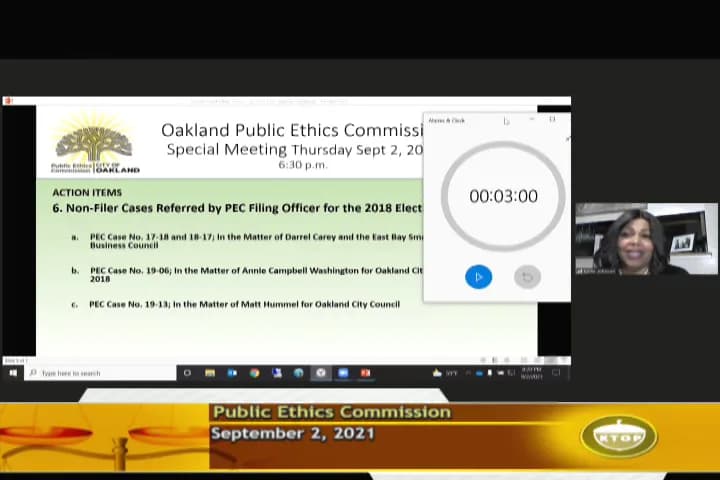
The Oakland Public Ethics Commission (PEC) held a special teleconference meeting on September 5, 2021, at 6:30 p.m. (Note: Agenda and transcript indicate the meeting date as September 2, 2021, per instruction the date provided is used). The meeting included approval of minutes, an informational enforcement report on the Planning and Building Department, and probable cause determinations for three non-filer campaign finance cases. Commissioners also discussed subcommittee formation and upcoming enforcement matters. Consent Calendar - Approval of Minutes: The Commission approved the draft minutes from the June 7, 2021 regular meeting and the June 30, 2021 special meeting by a vote of 5-0 (Commissioner Tuman absent). Public Comments & Testimony - Ralph Kanz (Complainant, Item 5): Kanz, a former PEC commissioner, argued that the Planning and Building Department intentionally withheld records and lied to investigators. He urged the Commission to subpoena records from the applicant and the city, stating that a signed Conditions of Approval (COA) document must exist because the project proceeded. He expressed frustration with the mediation process and recommended amending city law to hold individuals accountable. - Alexis Schroeder (Public): Schroeder, a frequent user of public records requests, supported Kanz's concerns. She stated that the Planning and Building Department frequently produces incomplete records and that unsigned COAs are common. She requested that if Kanz finds the missing document through legal action, the method of discovery be shared to help others. Discussion Items - Item 5: In the Matter of the City of Oakland Planning and Building Department (Case Nos. 18-48 and 16-22M): Enforcement Chief Kellie Johnson presented an informational report finding that the department failed to produce responsive documents related to a 2016 public records request. Investigator Simon Russell described recovering additional emails in 2020 via an IT search that the department had not disclosed. City planner Aubrey Rose could not explain why records were withheld. Johnson recommended closing the case because the PEC cannot impose penalties on city departments and the complainant's remedy is in court. After extensive debate, the Commission voted 4-1 to close the enforcement case while referring the matter to the City Auditor for investigation into the department's practices and inviting the Planning and Building Department Director to a future meeting (by October) to discuss systemic issues. Commissioner Pertit voted no, expressing concern about resources. - Item 6: Non-Filer Cases Referred by PEC Filing Officer for the 2018 Election: Staff presented probable cause reports on three cases of failure to file campaign statements. The Commission separately found probable cause and scheduled each for an administrative hearing. All three motions passed unanimously (5-0). - 6a. Darrel Carey and East Bay Small Business Council (Case Nos. 17-18, 18-17): Failed to file multiple semi-annual and pre-election statements between 2015-2017. - 6b. Annie Campbell Washington for Oakland City Council 2018 (Case No. 19-06): Failed to file a semi-annual statement for July-December 2018; she has since come into compliance. - 6c. Matt Hummel for Oakland City Council (Case No. 19-13): Failed to file a semi-annual statement, an accurate annual statement, and a termination form. Hummel had a prior campaign violation. - Item 7: Reports on Subcommittees and Commissioner Assignments: Commissioners discussed establishing an enforcement subcommittee to review penalty guidelines and procedures. Chair MacDonald suggested forming a recruitment subcommittee to fill a January 2022 vacancy. Formal appointments were deferred to the next meeting. Key Outcomes - The Planning and Building Department enforcement case (Item 5) was closed with a referral to the City Auditor and a directive for staff to invite the department director to the October meeting (or later if scheduling conflicts). - Three non-filer cases (Item 6a, 6b, 6c) were found to have probable cause and referred to administrative hearings. The Commission expressed interest in serving as the hearing body, with timing to be determined based on case developments. - The Commission agreed to form an enforcement subcommittee and a recruitment subcommittee, with appointments anticipated at the next regular meeting. - Staff noted that the enforcement team consists of only one investigator and that a new assistant position will be added in July 2022.
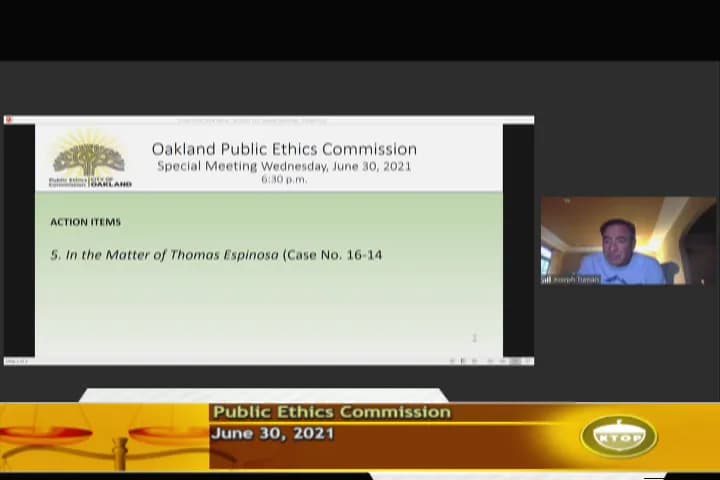
The Oakland Public Ethics Commission (PEC) held a special teleconference meeting on June 30, 2021, beginning with a closed session at 5:30 PM to discuss the Executive Director's performance, followed by a public session at 6:30 PM. The sole public action item was determining the penalty for former building inspector Thomas Espinosa, who was found to have committed 43 violations of the Oakland Government Ethics Act. During the meeting, Espinosa called in and claimed he had no memory of the events due to a stroke, prompting commissioners to express concerns about due process and to continue the item for further investigation into his medical claims. Public Comments & Testimony - Ralph Cantz spoke during Open Forum regarding a separate matter (Case No. 16-22), urging the commission to subpoena records from the Planning Department that he said had been withheld for five years. - Thomas Espinosa, the respondent in the main action item, called in during public comment and stated he had no recollection of working for the City of Oakland or of the alleged violations, citing a stroke and memory impairment. He provided the names of two doctors who had written letters about his condition, though staff noted they had not previously received documentation of a stroke. Espinosa became agitated when asked about waiving medical confidentiality and ended the call. Discussion Items - In the Matter of Thomas Espinosa (Case No. 16-14) – Penalty Determination - The commission reviewed staff memoranda, the Hearing Officer's recommendation, and a spreadsheet of penalty options. The Hearing Officer found 43 violations and recommended a $215,000 penalty ($5,000 per violation). Staff had originally recommended $200,000. Commissioners discussed the possibility of imposing fines up to three times the unlawful amount for certain counts. - The unexpected participation of Thomas Espinosa raised concerns among commissioners. Several commissioners expressed discomfort with proceeding without verifying his medical claims, given that his participation throughout the investigation had been minimal and mediated by his brother-in-law. - Deputy City Attorney Trish Shafie advised that the commission could proceed regardless, as administrative proceedings do not have a competence requirement and due process (notice and opportunity to be heard) had been satisfied. However, commissioners Arvon Perteet, Avi Klein, Ryan Micik, and Joseph Tuman indicated that the medical situation could affect penalty considerations. - The commission debated whether to separate the findings of fact from the penalty, but ultimately decided to continue the entire matter to allow staff to investigate Espinosa's health claims. Key Outcomes - Motion to Continue: Commissioner Klein moved to continue the item at staff's discretion for scheduling, seconded by Commissioner Perteet. The motion passed unanimously (5-0) with all present commissioners voting aye. The item will be discussed at the August 2021 regular meeting, where staff will report on scheduling a potential special meeting in September or returning the item in October. - Staff was directed to: - Investigate Thomas Espinosa's medical condition, including attempting to obtain medical records or a waiver. - Reach out to family members (e.g., the brother-in-law) for more information. - Provide the commission with a timeline of staff's knowledge of Espinosa's health claims and the notices provided. - Clarify whether all penalty factors in the guidelines must be met to impose enhanced fines.