Browse by city
Date range
Search help

Search titles, summaries, topics and stored transcripts together. Keywords may match separately; put the whole query in double quotes for a phrase. Matching follows word analysis, so punctuation is not exact. Both dates are included. Documents are not searched.

SHOWING 281–290 ENTRIES
281
AUG 21, 2020 · OAKLAND, CALIFORNIA · PUBLIC ETHICS COMMISSION
Limited Public Financing Program Training for 2020 Election - August 21, 2020

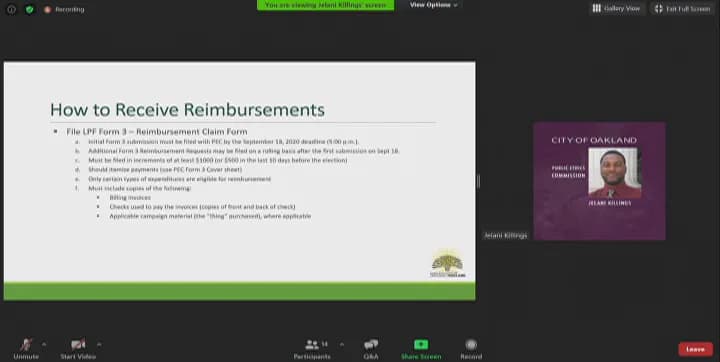
On August 21, 2020, the Oakland Public Ethics Commission held a training session for candidates and campaign staff on the Limited Public Financing (LPF) program for the 2020 election. The training was led by Ethics Analyst Jelani Killings, with support from Administrative Assistant Anna Lara and Executive Director Whitney Barazzotto. The session covered program eligibility, reimbursement procedures, deadlines, and answered participant questions. Program Overview and Eligibility Requirements - The LPF program provides reimbursements for qualified campaign expenditures to district city council candidates in Oakland. Created in 1999 and amended in 2010, it aims to reduce the influence of large contributors, encourage competition, and allow candidates to spend less time fundraising. - For the 2020 election, the total LPF fund is approximately $153,000. Funds are distributed in two phases: Phase 1 divides the total equally among all candidates who opt in by August 27, 2020 (potentially $9,000 per candidate if all 17 certified candidates participate). Phase 2 redistributes unused funds after the September 18, 2020 deadline to candidates who have submitted their first reimbursement claim. - To participate, candidates must: (1) file LPF Form 1 by August 27 to accept participation; (2) file OCR Form 301 accepting voluntary expenditure limits; (3) meet eligibility requirements including raising at least 5% of the expenditure ceiling in contributions from Oakland residents or businesses, making campaign expenditures of at least that amount, limiting personal contributions to 10% of the ceiling, and attending the training. Contributions from a candidate's own funds cannot count toward the 5% threshold (clarified by Whitney Barazzotto). - Eligible expenditures for reimbursement include ballot/candidate fees, voter outreach materials, yard signs, website maintenance, and more. Key Dates and Deadlines - August 27, 2020: Deadline to file LPF Form 1 (opt-in) and OCR Form 301 (accept spending limits). Failure to file constitutes rejection of public financing. - September 18, 2020: Deadline to submit the initial LPF Form 3 reimbursement claim (at least $1,000, or $500 within 10 days of election) to remain eligible for Phase 2 redistribution. - November 2, 2020: Final deadline for reimbursement claims. - January 31, 2021: Deadline to return surplus funds (calculated via LPF Form 4) and file post-election campaign statements. Q&A and Clarifications - Participants asked about the September 18 deadline, the $1,000 minimum reimbursement threshold, and whether personal funds can qualify for the 5% contribution requirement. Whitney Barazzotto clarified that candidate's own funds cannot count toward the 5% threshold. - Questions were answered regarding electronic contributions (e.g., ActBlue): vendors must provide a CSV file directly to the commission for verification. - Data security concerns about check copies were addressed: the commission redacts personal information and follows security protocols. - The LPF Form 2 application and LPF guide will be emailed to participants along with a vendor application (W-9) for payment processing. Key Outcomes - The training fulfilled the mandatory training requirement for program participation. - Candidates were reminded to file LPF Form 1 by August 27, 2020, and to work toward meeting the 5% contribution and expenditure thresholds. - The commission emphasized that they will work with candidates to resolve documentation issues and will notify candidates when reimbursement checks are mailed.

PUBLIC FINANCING 38% · CAMPAIGN FINANCE 28% · ELECTION POLICY 24% · PUBLIC ETHICS 7%
282
AUG 3, 2020 · OAKLAND, CALIFORNIA · PUBLIC ETHICS COMMISSION
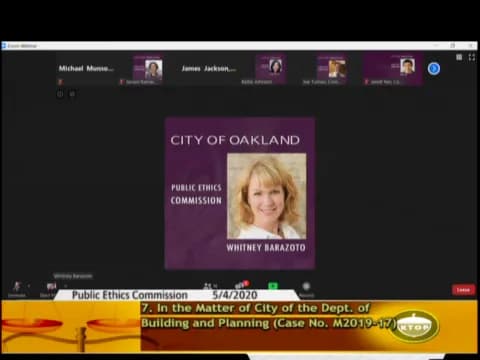
Oakland Public Ethics Commission Meeting - August 3, 2020

The Oakland Public Ethics Commission (PEC) held a regular teleconference meeting on August 3, 2020, at 6:30 p.m. The commission approved prior meeting minutes, elected a new Vice Chair, received a legal overview of Sunshine Ordinance laws during the COVID-19 pandemic, closed a mediation case concerning Councilmember Loren Taylor, and discussed upcoming recruitment and subcommittee work. Public Comments & Testimony - Megan Stefan spoke twice: once during Open Forum asking about the commissioner application process (whether a “yes” answer to questions about campaign involvement would disqualify an applicant) and later expressing concern about persistent delays in public records requests across city departments, urging the commission to address systemic issues. She also supported the commission sending a transparency reminder letter to the City Council. Discussion Items - Election of Vice Chair: Chair Jackson nominated Commissioner Jill Butler for Vice Chair. No other nominations were made. Commissioner Butler was elected unanimously (5-0, with Commissioner Tuman abstaining due to absence from prior meetings). Butler accepted the role and expressed appreciation. - Sunshine Ordinance During COVID-19: Deputy City Attorney Trish Shafie presented an overview of state and local emergency orders, explaining that the Brown Act’s 72‑hour notice requirement for regular meetings remains in effect but teleconference location posting and public access requirements are suspended. The City Council’s July 28, 2020 resolution reinstated 10‑day notice for charter‑created bodies (including PEC) and 48‑hour notice for special meetings, including agenda materials. The commission discussed the importance of transparency and voted unanimously to direct staff to draft a letter to the City Council reminding them of the Sunshine Ordinance’s intent and the need for continued transparency during the pandemic. Commissioners McDonald, Butler, and Ramachandran supported the action; Chair Jackson cautioned against politicizing the commission’s role. - Mediation Case – Councilmember Loren Taylor (M2020‑06): Enforcement Chief Kellie Johnson reported that a public records request for emails regarding the Howard Terminal Ballpark, filed October 16, 2019, went unanswered for months. The request was routed to the Council office but not forwarded to Councilmember Taylor’s staff until July 17, 2020, when responsive documents were uploaded. The requester was displeased by the delay. Staff recommended closing mediation without further action. The commission voted unanimously to adopt the recommendation. - Sunshine Review Subcommittee Report: Commissioner MacDonald (chair) reported the subcommittee is reviewing the Sunshine Ordinance and creating a “report card” on city departments’ compliance with public records transparency, using a statistical sample of requests over 3–5 years. - Commissioner Recruitment Subcommittee: Chair Jackson announced the creation of a recruitment subcommittee to vet applicants for two upcoming vacancies. He, Commissioner MacDonald, and Commissioner Yan will serve. The subcommittee will review applications, conduct interviews, and bring finalists to the full commission in October. Public comment was taken. Key Outcomes - Minutes Approved: The July 6, 2020 regular meeting minutes and July 16, 2020 special meeting minutes were approved unanimously (5‑0; Commissioner Tuman abstained as he was absent for both meetings). - Vice Chair Election: Commissioner Jill Butler elected Vice Chair for the remainder of 2020 (5‑0). - Sunshine Ordinance Action: Motioned by Commissioner McDonald and seconded by Commissioner Tuman, the commission voted unanimously to accept the informational report and direct staff to develop a letter to the City Council emphasizing the importance of transparency under the Sunshine Ordinance during COVID‑19. - Mediation Closure: The commission closed Case M2020‑06 (Councilmember Loren Taylor) without further action (unanimous). - Recruitment Subcommittee: Established with Commissioners Jackson, MacDonald, and Yan; interviews to begin after the August 31, 2020 application deadline. Informational Items - Limited Public Financing Program: Executive Director Whitney Barazoto outlined that approximately $153,000 is available for the 2020 election (Districts 1, 3, 5, 7). With 22 candidates expected, each might receive about $6,900 if all opt in. A special meeting will be scheduled in mid‑August after the City Clerk certifies candidates. - Commissioner Recruitment: The commission is recruiting for two seats (one starting September 2020, one January 2021). Applications are due August 31, 2020. Staff clarified that not having attended a prior PEC meeting is not disqualifying. - Disclosure and Engagement Report: Lead Analyst Suzanne Doran reported 48 candidates filed statements of intent, streamlined electronic filing for campaign and lobbyist reports, and highlighted new OpenDisclosure features (e.g., summary page with contribution source breakdown). - Enforcement Report: Chief Johnson noted 22 new complaints since July 6, 17 of which concerned the June 23‑24 City Council budget meeting. Total enforcement caseload is 64 matters. - Executive Director’s Report: Barazoto highlighted that the City Council’s July 21 budget amendments did not change PEC’s adopted budget, and that a Police Commission ballot measure (November 2020) gives PEC discretion to investigate misconduct by Police Commissioners.

OPEN MEETING LAWS 25% · PROCEDURAL 22% · PUBLIC ENGAGEMENT 18% · PUBLIC FINANCING 7%
283
JUL 21, 2020 · OAKLAND, CALIFORNIA · PUBLIC ETHICS COMMISSION
Oakland Public Ethics Commission Special Meeting on Campaign Finance Reform Report - July 21, 2020

Note: The agenda and minutes list the meeting date as July 16, 2020, but the provided instructions specify July 21, 2020. This summary uses the instructed date. The Oakland Public Ethics Commission (PEC) held a special teleconference meeting on July 21, 2020, at 6:30 p.m. to review and potentially approve the Campaign Public Financing Project Report, a multi-year effort to redesign Oakland's campaign finance system to expand participation and equity. The meeting included presentation of the report, suggested amendments, public comment, and a unanimous vote to accept the report with amendments. Public Comments & Testimony - Scott Law (public commenter): Raised concerns that the report overstates the influence of money on policy outcomes, arguing there is no evidence of a direct causal link. He urged that the nuance of "potentially" in the amended language would be lost in public marketing. He also noted the absence of discussion on term limits. - Jonathan Stein (former PEC Chair, now Executive Director of California Common Cause): Expressed strong support for the report and its findings. He highlighted that 93% of campaign dollars from Oakland residents come from less than 1% of the population, emphasizing the value of building a local democracy that hears all voices. He noted that 2020 is not the right year for legislative action but hoped for progress in 2021–2022. Discussion Items - Campaign Public Financing Project Report – Presented by Executive Director Whitney Barazoto and Vice-Chair Nayeli Maxson Velázquez. The report evaluates Oakland's existing Limited Public Financing (LPF) program, revealing that less than 1% of residents donate to campaigns, contributions are concentrated in wealthier, whiter neighborhoods, and over half of contributions come from outside Oakland. It recommends a new approach modeled on Seattle's Democracy Voucher Program, which provides every voter with $100 in vouchers to give to candidates, along with broader civic engagement infrastructure. Barazoto proposed several amendments to soften language about policy outcomes (e.g., changing "shapes policy outcomes" to "may influence policy outcomes") and to remove a graph that included non-Oakland elected officials. Commissioners discussed the report's findings, with Commissioner MacDonald noting the cost challenges of a voucher system and Commissioner Ramachandran asking about next steps. Vice-Chair Maxson Velázquez shared personal experience as a candidate and highlighted quotes from the report illustrating how the current system disincentivizes candidate engagement with low-income communities and communities of color. Key Outcomes - Motion and Vote: Commissioner Ramachandran moved to accept the report with the amendments suggested by Executive Director Barazoto. Commissioner Maxson Velázquez seconded. The motion passed 6-0 (Ayes: Jackson, Maxson Velázquez, Butler, MacDonald, Ramachandran, Yan; Absent: Tuman). - Next Steps: The report will be published and used as a tool for community dialogue and education. The PEC and partner organizations (e.g., California Common Cause, Bay Area Political Equality Collaborative) will focus on outreach and information gathering in 2020–2021, with potential legislative action as early as late 2021 or 2022. - Acknowledgment: Vice-Chair Maxson Velázquez announced this was her last meeting; commissioners thanked her for her contributions.

CAMPAIGN FINANCE 57% · PROCEDURAL 19% · PUBLIC ENGAGEMENT 11% · PUBLIC COMMENT 6%
284
JUL 6, 2020 · OAKLAND, CALIFORNIA · PUBLIC ETHICS COMMISSION
Oakland Public Ethics Commission Regular Meeting – July 6, 2020

The Oakland Public Ethics Commission (PEC) held its regular teleconference meeting on Monday, July 6, 2020, at 6:30 p.m., chaired by James E.T. Jackson. The meeting included the launch of a new lobbyist e-filing system, approval of a streamlined campaign statement signature process, a settlement in a bribery case, and closures of two public records mediations. Vice Chair Nayeli Maxson Velázquez announced she would be stepping down at the end of July due to a family move. Consent Calendar - Minutes Approval: The Commission unanimously approved the draft minutes of the May 4, 2020 regular meeting (5-0-1, with Commissioner Butler abstaining as she was not present at that meeting). A correction was made to fix two typos noted by staff. Public Comments & Testimony - Alexis Schroeder expressed strong support for granting the PEC greater authority to impose penalties for violations found during investigations, stating that “strong enforcement and meaningful consequences” are needed to hold city departments accountable. - Aseta Olubala criticized the City of Oakland’s implementation of the Brown Act during teleconference meetings, alleging that the City limits public comment to one minute regardless of the number of agenda items and does not allow viewing of individual councilmembers, which she described as an abuse of transparency. - Aseta Olubala also questioned why Dorian Gray was held responsible for bribery while the business associate who sought the permit was not; Enforcement Chief Kellie Johnson responded that no evidence of an agreement or payment between Gray and his associate was found. - Aseta Olubala expressed frustration with the closure of the OPD mediation case, stating that the Oakland Police Department is repeatedly “accommodated to get away with not doing its job” and that the Commission’s action effectively forces the requester to pursue a costly lawsuit. - Alexis Schroeder (on the Building and Planning case) supported closing mediation so that a formal investigation could be opened, and requested that findings be made public and shared with the City Administrator. Discussion Items - Lobbyist Registration Online Filing System (Action Item 5): Lead Analyst Suzanne Doran demonstrated the new electronic filing platform for lobbyists, built in partnership with the City’s IT Department. The system simplifies registration and quarterly reporting, standardizes data entry, and provides a staff dashboard for compliance tracking. Commissioner Michael MacDonald and Commissioner Janani Ramachandran had tested the system. The item was informational; no action was taken. - Campaign Statement Electronic Filing Process (Action Item 6): Staff proposed eliminating the burdensome in-person signature verification process for campaign statements, noting that only four of 70 cities using NetFile require the extra step. The new process will use a simple electronic agreement. The Commission voted unanimously to adopt the changes, effective for the July 31, 2020 filing deadline. - In the Matter of Dorian Gray (Case 18-03): Enforcement Chief Kellie Johnson presented a No Contest stipulated settlement. Gray offered City Councilmember Larry Reid $10,000 and an all-expense-paid trip to Spain for City employee Gregory Minor in exchange for help obtaining a marijuana dispensary permit. The Alameda County District Attorney’s Office also brought criminal bribery charges. The stipulated settlement included an $8,000 administrative penalty ($5,000 for bribery, $3,000 for gift violation). The Commission voted unanimously to approve the settlement. - In the Matter of the Oakland Police Department (Case 16-15): Staff recommended closing mediation after exhausting efforts to obtain responsive documents for Public Records Request No. 14437, which had been outstanding since March 10, 2016. Follow-up revealed that OPD’s records department had undergone leadership changes and that some requests were handled via email rather than the NextRequest system, contributing to delays. The requester is considering court options. The Commission voted unanimously to close the mediation. - In the Matter of the City of Oakland Department of Building and Planning (Case M2019-17): Staff recommended closing mediation and opening a formal investigation into possible violations of the California Public Records Act and the Oakland Sunshine Ordinance. The requester had sought Radio Frequency Emission reports that the department stated it does not maintain. The Commission voted unanimously to close mediation and proceed with enforcement investigation. - Sunshine Review Subcommittee Report: Commissioner Michael MacDonald reported that the subcommittee (members: Jill Butler, Joseph Tuman) held its first meeting on June 17, 2020. The goal is to produce a “report card” style tool to evaluate departmental performance in responding to public records requests, using data from NextRequest and other sources. - Disclosure and Engagement Report: Staff highlighted that 184 advice/assistance requests were received year-to-date, with a significant uptick in June due to inquiries about police misconduct and campaign filing questions. A joint candidate/treasurer training with the FPPC was held on May 28, with 26 attendees. The lobbyist e-filing system was launched. - Enforcement Program Report: Chief Johnson reported a total enforcement caseload of 65 matters (10 in intake, 17 active investigation, 9 post-investigation analysis, 11 in settlement/awaiting hearing, 15 ongoing PRR mediations). Three cases are awaiting administrative hearings. One recent complaint (Case 20-09) alleging Brown Act violations in a City Council closed session was dismissed for lack of evidence and jurisdiction. - Executive Director’s Report: Whitney Barazoto announced that the city budget adopted June 23 included minor cuts to the PEC but preserved salary positions and a $100,000 one-time allocation. A special meeting to discuss the Campaign Finance Project report is set for July 16, 2020. The recruitment process for new commissioners will begin in August instead of September to fill the vacancy from Vice Chair Maxson Velázquez’s departure and a seat opening in January 2021. Key Outcomes - Approved the May 4, 2020 meeting minutes (5-0-1). - Accepted the staff recommendation to adopt streamlined campaign statement signature verification, effective July 31, 2020 (unanimous). - Approved the No Contest Stipulation in the Dorian Gray case, imposing an $8,000 administrative penalty (unanimous). - Closed mediation in the OPD case (Case 16-15) and encouraged the requester to pursue court remedies (unanimous). - Closed mediation in the Building and Planning case (M2019-17) and directed staff to open a formal enforcement investigation (unanimous). - Acknowledged Vice Chair Nayeli Maxson Velázquez’s resignation, effective end of July. - Set a special meeting for July 16, 2020 at 6:30 p.m. to discuss the Campaign Finance Project report and proposed legislation.

PUBLIC RECORDS 26% · PUBLIC ETHICS 19% · ETHICS AND CAMPAIGN FINANCE 13% · TECHNOLOGY AND INNOVATION 11%
285
MAY 28, 2020 · OAKLAND, CALIFORNIA · PUBLIC ETHICS COMMISSION
Oakland Candidate and Treasurer Training – May 28, 2020

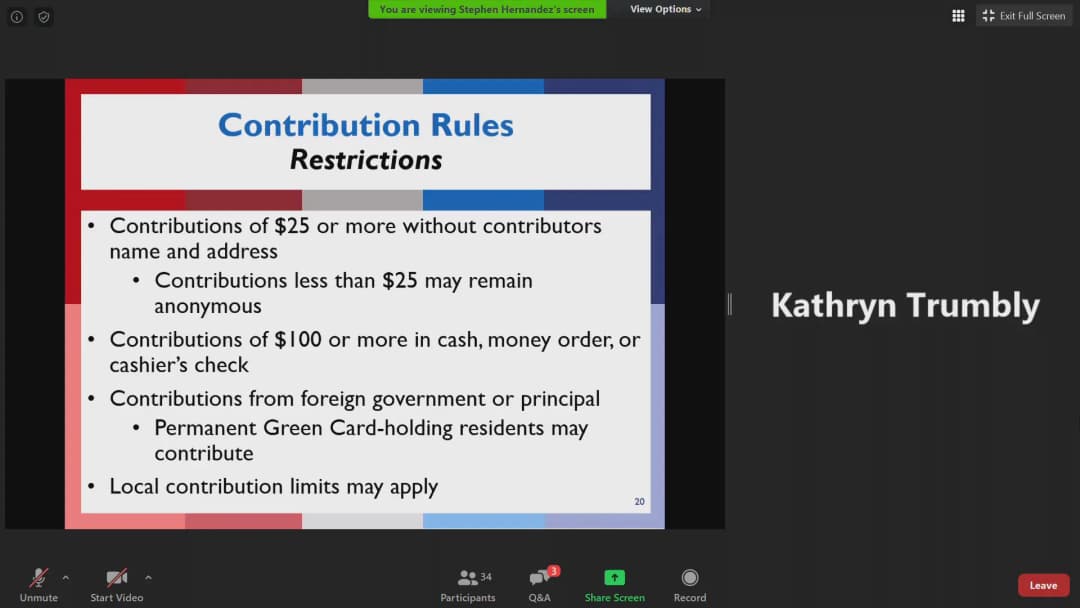
This joint training, hosted by the Oakland Public Ethics Commission (PEC) and the California Fair Political Practices Commission (FPPC), provided detailed guidance on campaign finance rules under the Political Reform Act (state level) and the Oakland Campaign Reform Act (local level). The training was held virtually via webinar and lasted approximately two hours, covering topics such as campaign forms, contribution limits, reporting requirements, and local rules for Oakland candidates. Presenters included Stephen and Katie Trumble from the FPPC, and Jelani Killings, Ethics Analyst from the Oakland PEC. FPPC Presentation – Political Reform Act (State Rules) - Campaign Forms and Bank Accounts: Presenters explained the Form 501 (Candidate Intention Statement), Form 470 (for candidates not raising/spending $2,000 or more), Form 410 (Statement of Organization), and the need for a separate campaign bank account. The Form 410 triggers issuance of a committee ID from the Secretary of State. Candidates must file Form 700 (Statement of Economic Interests) with their declaration of candidacy. - Record Keeping: Contributions of $25 or more require name and address; contributions of $100 or more require occupation and employer. Records must be kept for at least four years. - Contributions: Defined broadly to include money, non-monetary items, loans, and enforceable promises. Exceptions include volunteer personal services and home/office fundraisers under $500. Contributions of $100 or more in cash, money orders, or cashier's checks are prohibited. Foreign nationals (except permanent residents) cannot contribute. A $5,000 contribution triggers a major donor notice. - Form 460 and Schedules: Detailed walkthrough of the Form 460 (Campaign Disclosure Statement), including Schedules A (monetary contributions), B (loans), C (non-monetary contributions), E (expenditures), and the summary page. Presenters emphasized itemizing contributions of $100 or more, reporting loans until paid off, and the need to sub-vendor credit card payments over $500. - Filing Schedules and Post-Election: For the November 3, 2020 election, specific filing deadlines apply. After the election, successful candidates continue filing semi-annual reports; defeated candidates must file reports and pay a $50 fee. Leftover funds become surplus 90 days after leaving office or after the election reporting period. - Advertising Disclosures: Mass mailings must include disclosures, and record keeping requirements apply. Full details are available in the FPPC campaign manual and ad charts on the FPPC website. Q&A During FPPC Presentation - Committee ID and Bank Account: The committee ID is issued by the Secretary of State after filing Form 410; processing time is typically 7–10 business days. Campaigns can use PayPal, but must report full contribution amounts and fees as expenditures. - Loans and Personal Funds: Candidates may loan their campaign, but loans are considered contributions for the $2,000 threshold. Filing fees paid from personal funds are not contributions; reimbursement from the campaign is allowed. - Foreign Contributions: U.S. citizens living abroad may contribute; non-permanent residents (e.g., visa holders) likely cannot. Presenters advised emailing for specific guidance. - Petty Cash: Replenishment of a petty cash fund (under $100) is considered an expenditure, labeled as "petty cash." Oakland Campaign Reform Act (Local Rules) - Electronic Filing: Mandatory for all campaign committees in Oakland using the Netfile system. Signature cards are required; the PEC is working on accommodations for COVID-19. - Voluntary Expenditure Ceilings: Candidates may choose to accept spending limits (set per office based on CPI) to qualify for higher contribution limits, or reject limits (lower contribution limits but no spending cap). The Form 301 (OCRA 301) must be filed before accepting higher contributions. - Contribution Limits: For candidates who accept spending limits: persons/individuals $900 per election; broad-based political committees $1,700 per election. For candidates who do not accept limits: $200 per person per election, $400 per broad-based committee. Candidates may contribute unlimited personal funds, except for those participating in the limited public financing program (max 10% of expenditure ceiling). - Aggregation of Contributions: Contributions from entities sharing majority ownership, officers, or control are treated as from the same person. The $900 limit applies collectively. Spouses' contributions are separate. - Loans and Unpaid Bills: Non-commercial loans are subject to contribution limits. Unpaid bills exceeding $1,500 for more than 90 days become contributions and may violate limits. - Contractor Prohibition: Persons negotiating or holding contracts requiring City Council or School Board approval cannot contribute during negotiations and for 180 days after. The PEC provides a contributor verification card to help identify prohibited donors. - Limited Public Financing Program: Available only to district City Council candidates. Maximum funding is 30% of the expenditure ceiling; approximately $150,000 is available for 2020. Candidates must raise and spend at least 5% of the ceiling, cannot loan themselves more than 10% of the ceiling, and must attend a mandatory training on August 27 or 28, 2020. Key Outcomes - The training recording and slide decks will be made available on the Oakland PEC website and emailed to registered participants. - Candidates and treasurers were encouraged to contact the PEC (ethicscommission@oaklandca.gov or 510-238-3593) for assistance with local rules, and the FPPC (advice@fppc.ca.gov or (866) 275-3772) for state rule questions. - The next mandatory training for the limited public financing program is scheduled for August 27–28, 2020, for candidates who qualify for the ballot. - All campaign disclosure statements must be filed electronically via Netfile; early filing is recommended to avoid last-minute issues.

CAMPAIGN FINANCE 72% · PUBLIC ETHICS 17% · PROCEDURAL 5% · ELECTION POLICY 3%
286
MAY 4, 2020 · OAKLAND, CALIFORNIA · PUBLIC ETHICS COMMISSION
Public Ethics Commission Regular Meeting – May 4, 2020

The Oakland Public Ethics Commission held its regular meeting via teleconference on Monday, May 4, 2020, at 6:30 p.m. due to the COVID-19 shelter-in-place order. Commissioners present were James E.T. Jackson (Chair), Nayeli Maxson Velázquez (Vice-Chair), Michael MacDonald, Janani Ramachandran, Joseph Tuman, and Jerett Yan. Commissioner Jill Butler was absent. The commission considered approval of meeting minutes, the 2019 Annual Report, the 2020 Limited Public Financing Program Guide, two mediation cases, and received reports on disclosure, enforcement, and executive activities. Public Comments & Testimony - Brooke Levin (open forum) addressed the dismissal of her complaints (PEC 20-07 and 20-08) regarding campaign literature FPPC numbers, questioning why the matter was listed as dismissed after she had withdrawn the complaints. She requested clarification on the process. - Alexis Schroeder (on mediation case M2019-17) described her prolonged effort to obtain radio frequency emissions reports from the Building and Planning Department. She expressed concern that the city has not collected post-installation emissions data as required by ordinance, and she urged the commission to pursue enforcement to ensure compliance, citing community worries about cumulative 4G and upcoming 5G exposure. Discussion Items - Approval of March 2, 2020 Regular Meeting Minutes: Executive Director Whitney Barazoto noted two typos (page 2 “Public” and page 3 vote tally). Commissioner MacDonald moved, Ramachandran seconded, and the minutes were approved 5-0 (Maxson Velázquez abstained; Butler absent). - 2019 Public Ethics Commission Annual Report: Barazoto presented the report with several proposed edits, including replacing the committee-type breakdown with total campaign contributions ($600,000 raised, $580,000 spent in 2019), fixing typographical issues, and clarifying enforcement language. Commissioners discussed the value of including training demographic data and the challenges of ensuring Form 700 compliance. After a motion by Maxson Velázquez and second by Tuman, the report was approved unanimously (6-0) with authority for staff to incorporate the edits. - 2020 Limited Public Financing (LPF) Program Guide for City Council District Candidates: Barazoto outlined edits, including moving the eligibility checklist forward, clarifying that candidates must have an opponent, specifying that citywide and at-large candidates are ineligible, and adding a footnote explaining differing expenditure ceilings per district. Commissioners discussed in-kind contributions (not allowed), permissible reimbursement categories (no staff or consultant costs), and the two-phase disbursement timeline. The guide was approved 6-0 on a motion by Tuman, seconded by Maxson Velázquez. - Mediation Case M2019-17 – Department of Building and Planning: Enforcement Chief Kellie Johnson recommended closing the mediation, stating that the planning department had provided all available emissions reports but the building department confirmed it never collected the required post-installation reports. Commissioners McDonald, Ramachandran, and others expressed strong concern about the department’s noncompliance and the requester’s runaround. Public comment from Alexis Schroeder emphasized the need for accountability. After debate on options (subpoena, city administrator involvement, keeping mediation open), the commission voted 6-0 to keep the mediation open and directed staff to explore enforcement tools, including a possible subpoena or letter to the City Administrator, with a subcommittee to refine the approach. - Mediation Case M2020-05 – Economic and Workforce Development Department: Johnson reported that after a three-month delay, the department released documents on March 3, 2020, and confirmed all responsive records were provided. The requester initially believed more existed but the department and a private seller confirmed no further documents. The commission voted 6-0 to close the mediation (motion by MacDonald, second by Maxson Velázquez). - Subcommittee Reports: Vice Chair Maxson Velázquez updated the Limited Public Finance Policy Development Subcommittee, noting ongoing collaboration with the Bay Area Political Equality Collaborative (BayPEC) and the appointment of former PEC Chair Jonathan Stein as new executive director of California Common Cause. - Disclosure and Engagement Report (Lead Analyst Suzanne Doran): Highlights included the April 30 lobbyist quarterly deadline (49 in compliance as of May 4), a pilot online Form 803 for behested payments (received seven filings from the Mayor’s Office totaling $2,724,000 for the Oakland COVID-19 Relief Fund), progress on the lobbyist e-filing app (final testing phase), and the rescheduled candidate/treasurer training for May 28 (10 a.m.–12 p.m.) as a webinar. Staff also noted 57% of advice requests came from campaign filers and 65% were on campaign finance. - Enforcement Program Report (Chief Kellie Johnson): Since March 2, three new complaints were received, bringing the total caseload to 64 matters: 16 in intake, 17 under investigation, 9 in post-investigation analysis, 11 in settlement/hearing, and 10 ongoing public records mediation. She also noted that the unit is developing a process to share a list of open cases with the commission while protecting privacy. - Executive Director’s Report (Whitney Barazoto): Barazoto reported that staff are working remotely with IT support, and the team has pivoted to address ethics issues arising from COVID-19, including an upcoming advisory on solicitation of charitable contributions by city staff. She commended the staff for continued productivity. Key Outcomes - Minutes approved with corrections (5-0, 1 abstention). - 2019 Annual Report approved with staff-directed edits (6-0). - 2020 Limited Public Financing Program Guide approved with edits (6-0). - Mediation M2019-17 kept open for further exploration of enforcement options (6-0). Staff directed to develop a proposal for potential subpoenas and/or a letter to the City Administrator; a subcommittee may be formed. - Mediation M2020-05 closed (6-0). - Candidate/treasurer training rescheduled to May 28, 2020, 10 a.m.–12 p.m. via Zoom. - Staff to issue an advisory on charitable solicitation rules for city employees.

PROCEDURAL 15% · CAMPAIGN FINANCE 15% · PUBLIC RECORDS 13% · ETHICS AND CAMPAIGN FINANCE 12%
287
MAR 2, 2020 · OAKLAND, CALIFORNIA · PUBLIC ETHICS COMMISSION
Oakland Public Ethics Commission Meeting: Harbaugh Probable Cause, Lane Partners Fine, Council Salary Adjustment - March 2, 2020

The Oakland Public Ethics Commission (PEC) held its regular meeting on Monday, March 2, 2020, at 6:30 p.m. in Hearing Room 1 of Oakland City Hall (One Frank Ogawa Plaza). Commissioners present included Chair James E.T. Jackson, Vice-Chair Nayeli Maxson Velázquez (absent), Jill M. Butler, Michael MacDonald, Janani Ramachandran, Joseph Tuman, and Jerett Yan. Executive Director Whitney Barazoto, Enforcement Chief Kellie Johnson, and Deputy City Attorney Trish Shafie were present. The meeting covered enforcement actions, a City Council salary adjustment, and informational reports. Notably, the Commission found probable cause against a building inspector for bribery, imposed a $5,000 fine on Lane Partners for an unlawful contractor contribution, and unanimously approved a 7.1% CPI-based salary increase for City Councilmembers. Agenda Item 7 Pulled - Executive Director Whitney Barazoto announced that Item 7 (In the Matter of the City of Oakland Police Department, Case No. 16-15, mediation summary) was pulled from the agenda and would be brought back the following month. Consent Calendar / Minutes Approval - The Commission approved two sets of minutes unanimously (motion by Commissioner Tuman, seconded by Commissioner Ramachandran): the January 17, 2020 Special Meeting Minutes and the February 3, 2020 Regular Meeting Minutes. Note: The agenda labels the January minutes as "January 17, 2019," but the attachment is dated January 17, 2020 — a discrepancy in the source materials. Public Comments & Testimony - Gene Hazard spoke multiple times during Open Forum and on agenda items, alleging that the PEC and Enforcement Chief were engaging in "selective enforcement." He raised concerns about the Oakland Promise program, claiming it operated illegally inside City Hall for two years without a legal entity status, MOU, lease, or insurance, and received approximately $4 million in city funds. He stated he had filed complaints with the Secretary of State, the District Attorney's office, and the City Clerk, and planned to file a formal cease-and-desist complaint with the California Attorney General. He also alleged the Oakland City Council violated the Brown Act four times since October 2019 by failing to report closed-session votes publicly. - Ms. Olavalu (Love Life) echoed Hazard's concerns about Oakland Promise, stating the mayor and city administrator misused city resources and failed to produce financial statements. She also urged commissioners to vote no on Measure Q and Measure S. - Ralph Kanz discussed the history of the PEC and City Council salary-setting, noting that the Commission was originally created (in part) to provide political cover for council salary increases. He also raised concerns about his own four-year-old public records request involving the Planning Department. - Zach Wasserman, attorney for Andrew Haydel and Lane Partners, answered commissioner questions. He noted that the contribution to the defense fund was arguably in a "gray area" of the ordinance, but his client had instructed him not to make that argument. He also acknowledged the ordinance may need revision regarding consequences for recipients. Discussion Items In the Matter of Anthony Harbaugh (Case No. 18-11) - Enforcement Chief Kellie Johnson presented the case. Harbaugh, a City building inspector hired in 2007, was alleged to have participated in a bribery scheme with another inspector, Thomas Espinosa, between January 2015 and December 2016. The alleged conduct included: soliciting and receiving bribes (approximately $300 per inspection); making or participating in governmental decisions with disqualifying financial interests; misusing City resources; failing to report significant income on Form 700 statements; and intentionally entering false inspection records into the Accela database for properties he never inspected. - The investigation involved properties owned by Elizabeth Williams (857-859 Mead Avenue, 2735 Market Street, 877 27th Street), Bill Charman (4163 Rifle Lane), and Alex Machado (2326 Myrtle Street, 6220 Valley View). Harbaugh allegedly logged false "Pass" results in the City's Accela database, reassigned inspections to himself, and received under-the-table cash payments. - Staff identified 13 counts of alleged violations of the Oakland Government Ethics Act, including bribery, conflict of interest, failure to disclose income, and misuse of public resources. Commissioner MacDonald asked about the dollar amounts involved; Johnson confirmed the total was "well over $5,000" and noted an FBI investigation was ongoing for potential federal prosecution. - Commissioner questions focused on investigative techniques (bank records, text messages, witness testimony), the FBI investigation, and the recommendation to use an outside hearing officer. Commissioner Yan asked about the rationale for an outside entity; Johnson cited the complexity of the case and the need for an independent record given potential appeals. - Votes (both unanimous): The Commission voted to find probable cause (motion by Commissioner Ramachandran, seconded by Commissioner MacDonald) and to refer the matter to an outside hearing (motion by Commissioner Butler, seconded by Commissioner Yan). In the Matter of Andrew Haydel and Lane Partners (Case No. 19-24) - Chief Johnson presented the case. Lane Partners, a commercial real estate firm and City contractor, made a $1,000 contribution to the Lynette Gibson-McElhaney Defense Fund on October 21, 2018, during the contractor contribution blackout period (November 2015 – July 2019) related to the Eastline project at 2100 Telegraph Avenue. The contribution violated Oakland Municipal Code section 3.12.140. - Staff recommended a $2,000 fine (baseline penalty of $1,000 plus the $1,000 unlawful contribution). Mitigating factors included the respondent's self-reporting and lack of prior violations. - Commissioner Tuman raised concerns about the recipient (Councilmember Gibson-McElhaney) facing no consequences, and questioned whether the fine was sufficient to deter future violations. He noted that $2,000 could be seen as a "slap on the wrist" for a major developer. - Commissioner Butler and Commissioner MacDonald expressed views that the contractor was experienced and likely knew the rules, making the violation more serious. - Commissioner Ramachandran initially moved for a $3,000 fine, which was amended to include a warning letter. That motion failed on a 3-3 vote (Yan, Ramachandran, Jackson in favor; Butler, Tuman, MacDonald opposed; one abstention). - A subsequent motion for $4,000 with a warning letter also failed. - Final motion: Commissioner MacDonald moved, and Commissioner Butler seconded, a $5,000 fine plus a warning letter. The motion passed narrowly (final tally: Yan aye, McDonald aye, Ramachandran aye, Jackson aye, Butler aye, Tuman aye — with some initial passes that converted to ayes). Oakland City Council Salary Adjustment - Executive Director Barazoto presented the required bi-annual salary adjustment under Oakland City Charter Section 202. The CPI for the San Francisco-Oakland-San Jose metropolitan area rose 7.1% from December 2017 to December 2019, requiring an increase to $97,480.55 per year (from the current $91,018.25). The resolution authorized only the mandated CPI increase, with no additional discretionary increase. - Commissioner Tuman questioned whether the salary was sufficient to encourage lower-income candidates to run, and whether councilmembers receive additional benefits (health benefits were confirmed). Commissioner MacDonald clarified that the CPI increase is mandatory ("shall"), while any increase beyond CPI is discretionary. - Public comment from Ralph Kanz and Ms. Olavalu raised concerns about the salary-setting process and compared it to other city employees who had to strike for raises. - Vote: The resolution passed unanimously (motion by Commissioner Yan, seconded by Commissioner MacDonald). Key Outcomes - Harbaugh case (18-11): Commission unanimously found probable cause on 13 counts of Oakland Government Ethics Act violations and referred the matter to an outside hearing officer. - Lane Partners case (19-24): Commission approved a $5,000 administrative penalty (up from staff's recommended $2,000) plus a formal warning letter to Lane Partners and Andrew Haydel. - City Council Salary Adjustment: Commission unanimously approved Resolution 20-01, increasing Councilmember salaries by 7.1% (CPI-mandated) to $97,480.55, effective the first payroll period of Fiscal Year 2020-21 (July 2020). Information Items (no action taken) - Disclosure and Engagement: Director Barazoto reported on behalf of Lead Analyst Suzanne Doran. For the March 3, 2020 special election, approximately $300,000 in contributions were reported for Measure Q ($177,000 in support, $94,264 in opposition) plus $205,835 in independent expenditures opposing the measure. Twenty-four candidates declared intention to run for Oakland offices, with nine registered campaign committees reporting $226,856 in contributions. A candidate/treasurer training with the FPPC was scheduled for April 8, 2020. - Enforcement Program: Chief Johnson reported on the status of 55 enforcement and mediation cases (8 in intake, 15 under active investigation, 10 under post-investigation analysis, 13 in settlement or awaiting hearing, 6 public records mediations). Three complaints were dismissed: Police Commissioner Ginale Harris (no evidence of badge misuse), Mayor Libby Schaaf (lack of PEC jurisdiction over State of the City address), and a Public Works employee harassment complaint (lack of jurisdiction). - Executive Director's Report: Barazoto announced the annual retreat scheduled for April 10, 2020 (4-9 p.m.), and noted upcoming work including new commissioner orientation, PEC ordinance amendments going to City Council, midcycle budget responses, and the annual report.

PUBLIC ETHICS 27% · ETHICS AND CAMPAIGN FINANCE 26% · PROCEDURAL 11% · CAMPAIGN FINANCE 11%
288
FEB 3, 2020 · OAKLAND, CALIFORNIA · PUBLIC ETHICS COMMISSION
Oakland Public Ethics Commission Regular Meeting - February 3, 2020

The Oakland Public Ethics Commission (PEC) held its regular meeting on Monday, February 3, 2020, at 6:30 p.m. in Hearing Room 1 at City Hall. The meeting included approval of past minutes, adoption of the 2020 Oakland Campaign Reform Act Guide, amendments to the PEC’s enabling ordinance, and informational updates on campaign finance limits, disclosure and engagement, enforcement, and the Executive Director’s report. Commissioners also heard public comments on ethics and transparency concerns. Consent Calendar - January 6, 2020 Regular Meeting Minutes: Approved 4-0-2 (Commissioners Yan and MacDonald abstained as they were not present). - January 17, 2020 Special Meeting Minutes: Tabled to the next meeting because a quorum of commissioners who attended that meeting was not present. Public Comments & Testimony - Open Forum: Two speakers addressed the commission. The first speaker (Ms. Olabala) raised concerns about a private investigation of a police commissioner costing $50,000 and alleged Brown Act violations by the City Council regarding closed session votes. The second speaker (Mr. Hazard) echoed those concerns and urged the commission to investigate the use of city resources for investigations of volunteers. - On the Oakland Campaign Reform Act Guide: A public commenter questioned the advisory nature of the guide and the cost-of-living adjustment methodology. Another commenter argued the commission focuses too narrowly on campaign finance and neglects broader ethics enforcement as required by Charter Section 603. - On the PEC Ordinance Amendments: A commenter (Mr. Hazard) noted that outgoing commissioners should not vote on new officers, referencing past practice. Another commenter questioned the commission’s independence given appointment and removal powers by the City Council. - On Enforcement Report: Mr. Hazard disputed the dismissal of his complaint (Case 19-19) against the City Council regarding Oakland Promise funding, asserting the complaint targeted the Mayor and Oakland Promise, not the Council. He cited a letter from the California Attorney General stating Oakland Promise never filed for 501(c)(3) status. - Other public comments: Additional speakers addressed aggregation of contributions (related to law firm reimbursements) and the need for broader ethics oversight. Discussion Items - Oakland Campaign Reform Act Guide (Action): Executive Director Whitney Barazoto presented the 2020 guide with minor edits, including updating contribution limits from $800 to $900 (CPI adjustment), adding a new section on solicited contributions by City staff, and changing terminology from "expenditure ceilings" to "spending limits" for clarity. The guide is advisory but bound by the ordinance. Commissioners approved the guide with the proposed edits. - Proposed Amendments to PEC Ordinance (Action): Staff presented draft amendments to align Chapter 2.25 with the 2014 City Charter changes and to codify administrative enforcement and collections procedures. Commissioners discussed whether to change "rules" to "policies" in Section C and whether to strike Section 2.24.040(A) on election of chair and vice-chair, leaving that to operational policies. After debate, the commission agreed to strike the election language and replace "rules" with "policies" throughout. The ordinance was approved with these changes. - Reports on Subcommittees: The only active subcommittee (Limited Public Finance Policy Development) was not reported because its chair (Commissioner Maxson Velázquez) was absent. Information Items - OCRA Contribution Limit and Expenditure Ceiling Adjustment for 2020: Staff published the annual CPI-adjusted limits (e.g., individual contribution limit for candidates accepting spending limits rose to $900). This was informational; no vote taken. - Disclosure and Engagement: Lead Analyst Suzanne Doran reported on campaign finance filing deadlines, lobbyist registration, e-filing system development (OakApps portal), and board/commission ethics training. She noted over 100 attendees at recent trainings and progress on the opendisclosure.io website for the 2020 elections. - Enforcement Program: Enforcement Chief Kellie Johnson updated the caseload (51 cases) and highlighted faster case processing. Specific discussion focused on Case 19-19 (Oakland Promise complaint against City Council), which was dismissed as to the Council members but an ongoing investigation against Mayor Schaff regarding allocation of public resources and use of city property was noted. - Executive Director’s Report: Whitney Barazoto introduced new intern Ryan Sim and noted a presentation to the Alameda County Grand Jury Association. Key Outcomes - Approved the January 6, 2020 regular meeting minutes (4-0-2). - Tabled the January 17, 2020 special meeting minutes to next meeting. - Approved the 2020 Oakland Campaign Reform Act Guide with staff edits (unanimous). - Approved the proposed amendments to PEC Ordinance Chapter 2.25, including: (1) striking Section 2.24.040(A) on chair/vice-chair election, (2) replacing "rules" with "policies" in Section 2.24.020(C), (3) adding "before or after an administrative hearing" to complaint procedures, and (4) adding "including the commission" to sections on remedies and judicial review (unanimous). - No vote on informational items; the Commission took no further action on subcommittee reports. - Ongoing investigation into Mayor Schaff (Case 19-19 related) was confirmed.

CAMPAIGN FINANCE 28% · PROCEDURAL 22% · PUBLIC ETHICS 21% · PUBLIC COMMENT 12%
289
JAN 6, 2020 · OAKLAND, CALIFORNIA · PUBLIC ETHICS COMMISSION
Oakland Public Ethics Commission Regular Meeting Summary - January 6, 2020

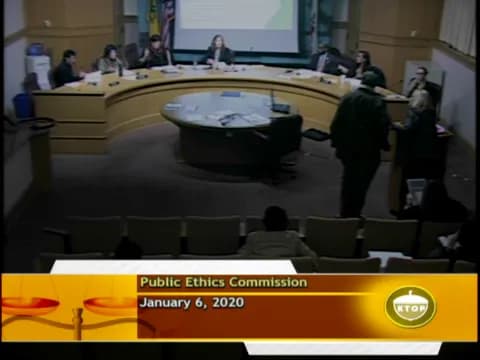
The Oakland Public Ethics Commission (PEC) held its regular meeting on Monday, January 6, 2020, at 6:30 p.m. in Hearing Room 1 of Oakland City Hall. The meeting was called to order at 6:30 p.m. and adjourned at 10:52 p.m. Commissioners present: Jodie Smith (Chair), James E.T. Jackson, Jill M. Butler, Gail Kong, and Jerett Yan. Commissioner Nayeli Maxson Velázquez arrived at 6:40 p.m. Commissioner Joseph Tuman was absent. Staff present: Executive Director Whitney Barazoto, Lead Analyst Suzanne Doran, and Enforcement Chief Kellie Johnson. City Attorney staff: Trish Hynes. Open Forum - Gene Hazard (CleanOaken.com) spoke during Open Forum, questioning the enforcement dismissal process and whether the Commission retains final say on case dispositions when staff dismisses a complaint. He later provided detailed comments during the Enforcement Program report. Action Items Approval of December 2, 2019 Minutes - Commissioner Jackson moved, Commissioner Kong seconded, and the minutes were approved 5-0. Commissioner Yan abstained because he was not present at the December meeting. Election of Officers (Chair and Vice-Chair) for 2020 - Chair Smith nominated Commissioner Jackson for Chair; he accepted. One public speaker (Gene Hazard) objected that outgoing commissioners should not participate in electing officers for the incoming body. City Attorney Trish Hynes clarified that under Operations Policies, election must occur at the first regular meeting each year, and terms end January 21, 2020, with new members taking office January 22, 2020. The motion passed 4-0 (Commissioner Jackson abstained). - Chair Smith nominated Commissioner Maxson Velázquez for Vice-Chair; she accepted. After one public comment, the motion passed 4-0 (Commissioner Maxson Velázquez abstained). New Commissioner Selection - The ad-hoc recruitment subcommittee received 15 applications, interviewed 14 (one disqualified due to City employment), and selected six finalists. Each finalist gave a four-minute introduction and answered Commissioner questions: - Sam Ferguson: Attorney with experience in public financing of elections (Berkeley Fair Elections Coalition); expressed interest in transparency audits. - Rimi Koka: Corporate executive, new U.S. citizen, emphasized underrepresented voices and community engagement. - Michael MacDonald: Assistant City Clerk of Berkeley, filing officer, with experience in campaign finance, ethics, and lobbying registration. - Arvon Perteet: Oakland native, former federal/state prosecutor, emphasized investigation experience and education. - Janani Ramachandran: Third-year law student, public interest background, focused on fighting corruption and campaign finance reform. - Steven Selna: Attorney and former managing partner, emphasized transferable leadership, education, and advocacy skills. - The Commission voted by ballot. Michael MacDonald was selected for the first seat; Janani Ramachandran was selected for the second seat. Commissioner Maxson Velázquez moved to appoint both, seconded by Commissioner Jackson; the motion passed 6-0. Their terms begin January 22, 2020. In the Matter of Michael Colbruno (Case No. 16-01) - Enforcement Chief Kellie Johnson presented the case, recommending a $12,000 administrative penalty for 12 violations of the Lobbyist Registration Act (failure to timely file registration forms and quarterly reports in 2012–2015). - Hearing Officer Commissioner Jackson had issued a proposed decision (Attachment 10) recommending a $5,250 penalty. - Respondent Michael Colbruno and his attorney Clinton Killian argued for a lower penalty, emphasizing prompt correction and no intent to deceive. - Ralph Kanz, the complainant, stated his original complaint concerned solicitation of campaign contributions, which he said was not investigated. - After deliberation, Commissioner Maxson Velázquez moved to adopt the findings and impose a fine of $9,000 (i.e., $750 per violation). The motion failed 3-3. - Commissioner Butler then moved to adopt the hearing officer’s findings of fact and impose a $10,000 fine, seconded by Commissioner Yan. The motion passed 5-1, with Commissioner Jackson voting against. Proposed Amendments to the PEC Ordinance (OMC Chapter 2.25/2.24) - Executive Director Barazoto presented draft amendments to align the enabling ordinance with the 2014 City Charter changes and to codify administrative enforcement and collections procedures. Note: The agenda and minutes reference Chapter 2.25, while the attached staff memorandum and draft ordinance refer to OMC Chapter 2.24; this discrepancy was not discussed in the meeting. - Staff requested additional time for review due to the lengthy agenda. Commissioner Butler moved to reconsider the item at the February meeting, seconded by Commissioner Jackson; the motion passed 6-0. Discussion Items OCRA Limits Adjustment (2020) - Staff provided an informational report on the annual adjustment to Oakland’s campaign contribution and expenditure limits based on the Consumer Price Index (CPI). Final 2020 limits will be calculated and published after the Bureau of Labor Statistics releases 2019 CPI data in January 2020. No Commission action was required. Reports on Subcommittees and Commissioner Assignments - Limited Public Finance Policy Development Subcommittee (Commissioner Maxson Velázquez, Chair): She reported communicating with the coalition working on a potential public financing ballot measure; they may provide an update at the February meeting. - Subcommittee on Partnerships: Chair Smith dissolved the subcommittee (no update). - Commissioner Recruitment Subcommittee: With two new Commissioners selected, Chair Smith dissolved the subcommittee. Information Items Disclosure and Engagement Report - Lead Analyst Suzanne Doran presented a year-end summary, highlighting proactive ethics outreach to elected officials, board/commission compliance assistance, and development of a lobbyist e-filing system. The report noted all 11 elected officials filed Form 700 on time and 100% of boards/commissions now meet online agenda posting requirements. Enforcement Program Report - Enforcement Chief Kellie Johnson reported that all cases initiated in 2014 and 2015 have been closed. The total enforcement caseload is 52 matters. - Gene Hazard, complainant in Case No. 19-19 (Oakland Promise), voiced concerns about the staff dismissal of his complaint, alleging that Oakland Promise is not a recognized nonprofit and that public funds were improperly allocated. He provided documents and requested reconsideration. - Commissioner Maxson Velázquez requested that staff bring the dismissal of Case No. 19-19 back at the next regular meeting for further review. - Commissioner Jackson moved to adjourn the meeting and move the remaining items (Executive Director’s Report and Commissioner Farewell) to the next meeting, seconded by Commissioner Kong; the motion passed 6-0. Key Outcomes - Approved December 2, 2019 minutes (5-0). - Elected Commissioner James E.T. Jackson as Chair and Commissioner Nayeli Maxson Velázquez as Vice-Chair for 2020. - Selected Michael MacDonald and Janani Ramachandran as new Commissioners, effective January 22, 2020. - Imposed a $10,000 administrative penalty on Michael Colbruno for 12 Lobbyist Registration Act violations, adopting the hearing officer’s findings of fact but modifying the penalty. - Moved consideration of PEC Ordinance amendments to the February regular meeting. - Dissolved the Subcommittee on Partnerships and the Commissioner Recruitment Subcommittee. - Directed staff to revisit the dismissal of Case No. 19-19 at the next regular meeting. - Adjourned with remaining agenda items (Executive Director’s Report and Commissioner Farewell) deferred to the next meeting.

PUBLIC ETHICS 27% · CAMPAIGN FINANCE 12% · PROCEDURAL 11% · ECONOMIC INTEREST DISCLOSURE 9%
290
DEC 2, 2019 · OAKLAND, CALIFORNIA · PUBLIC ETHICS COMMISSION
Oakland Public Ethics Commission Meeting – December 2, 2019

The Oakland Public Ethics Commission (PEC) held its regular meeting on Monday, December 2, 2019, at 6:30 p.m. in Hearing Room 1 of City Hall. Chair Jodie Smith presided, with Commissioners James E.T. Jackson (Vice-Chair), Jill M. Butler, Gail Kong, Joseph Tuman, Nayeli Maxson Velázquez, and Jerett Yan (absent). Staff present included Executive Director Whitney Barazoto, Lead Analyst Suzanne Doran, Enforcement Chief Kellie Johnson, and Investigator Simon Russell. Deputy City Attorney Ravi Patel attended in place of Trish Hynes. The meeting covered five action items (including three stipulations and three mediation closures), a discussion on board/commission agenda compliance, subcommittee reports, and informational updates. Consent Calendar - Approval of Minutes (November 4, 2019): The minutes were approved unanimously (5-0, with Commissioner Butler abstaining as she was not present at the prior meeting). No public comment. Public Comments & Testimony - Open Forum (non-agendized items): - Joanne Finney and Alexis Schroeder raised concerns about the Planning Department’s handling of small wireless facility applications. They alleged that the city’s ACELA database restricts public access to application documents (requiring credentials), that public records requests take far longer than the 10-day Sunshine Ordinance target, and that a director’s report (issued August 21, 2019) is not being implemented. They provided a handout showing an incomplete city form for a cell antenna at 399 Grand Avenue, suggesting potential errors in fee collection and missing information. - Mark Howen, a high school student, spoke about inequities in park maintenance and public resources between wealthy and poor neighborhoods in Oakland, urging the Commission to consider how resource allocation affects communities. - Ralph Cannes criticized the Planning Department for what he called a pattern of obstructing public records requests, including a three-year-old complaint filed with the PEC. He alleged that the department destroys emails and uses a credential system that violates the Public Records Act. - During Action Item 5 (Shotspotter): Ralph Cannes commented that the contractor contribution ban (enacted after a 1998 grand jury report) only penalizes contractors, not the officials who solicit contributions, and noted the lack of a contractor database to help campaigns identify prohibited donors. - During Action Item 8 (Mayor Schaff mediation): Ralph Cannes, the requester, stated that the Mayor’s office violated the Public Records Act, destroyed public records (Government Code § 6200), and possibly misused city resources for campaign purposes. He expressed hope that the separate formal complaint would still be investigated. - During Action Item 9 (Planning Department mediation): Ralph Cannes urged the Commission to eliminate the mediation step for public records disputes, citing state-level rejection of mandatory mediation (SB 615). Discussion Items - Boards and Commissions Agenda Posting Compliance: Executive Director Whitney Barazoto presented a staff review. Initially, only 19 of the city’s 31 active boards and commissions were posting agendas online; after staff outreach and direct assistance, all 31 achieved compliance. The report identified three key issues: (1) high liaison turnover and lack of formal training; (2) liaisons’ desire for more support, including a manual; and (3) confusion over the city’s two agenda-posting systems (Granicus and the new website template). Recommendations included quarterly or semi-annual liaison trainings (currently annual), a comprehensive liaison manual, and consistent web-posting guidance. Commissioners supported following up with the City Administrator’s and Mayor’s offices to ensure sustained compliance. - Subcommittee Reports: - Limited Public Finance Policy Development (Commissioner Maxson Velázquez): Held a workshop with the ACLU and Alameda Labor Council; participants expressed newfound interest in campaign finance reform. The policy solution is being crafted independently by the Bay Area Political Equality Coalition. - Partnerships (Commissioner Kong): No update. - Commissioner Recruitment (Chair Smith): 14 applicants were interviewed for two PEC‑appointed vacancies opening January 2020; six finalists will be publicly interviewed at the January 6, 2020 meeting. Key Outcomes - Action Item 5 – Shotspotter, Inc. (Complaint No. 14‑29): The Commission approved a no‑contest stipulation with a $5,000 fine (joint and several) for violations of the Oakland Lobbyist Registration Act and Campaign Reform Act. The violations included unregistered lobbying by executives Ralph Clark and Joe Hawkins to renew and expand ShotSpotter’s contract in 2014–2015, and two $100 contributions to Councilmember Rebecca Kaplan’s ballot measure committee during the contractor contribution blackout period. Commissioner Jackson recused himself. Vote: 5 in favor, 1 abstention (Jackson). The fine incorporated aggravating factors (lack of transparency, pattern of conduct, willfulness) and mitigating factors (no prior record, full cooperation, some interactions were in response to councilmember requests). - Action Item 6 – Jumoke Hinton Hodge (Complaint No. 17‑07): Approved a streamlined stipulation with a $500 fine for failure to file a 2016 semi‑annual campaign statement. Staff had provided extensive assistance before enforcement. Vote: 6‑0. - Action Item 7 – Joseph Betesh (Complaint No. 19‑07): Approved a streamlined stipulation with a $2,000 fine for failure to file a major donor committee statement in 2018 (over $79,000 in expenditures related to Measure AA). Staff noted the respondent left town for months despite promised filings. Vote: 6‑0. - Action Item 8 – Mediation: Mayor Libby Schaff (Case No. M2019‑02): The Commission closed the mediation without further action. The requester sought actual copies of Nextdoor posts (endorsements posted by the Mayor’s office during the 2018 election) but received only a spreadsheet; staff learned the posts were deleted by the Mayor’s Director of Communication and could not be retrieved. Commissioners expressed concern about the underlying ethics issues but acknowledged the mediation’s limited scope. Vote: 6‑0. - Action Item 9 – Mediation: Housing and Community Development Department (M2019‑06): Closed without further action after the department released all responsive documents related to a property at 2451 Ivy Drive. Vote: 6‑0. - Action Item 10 – Mediation: Councilmember Dan Kalb and Department of Transportation (M2019‑11): Closed without further action after all documents (regarding the “Worst Streets Program” paving priorities) were released. Staff noted that the requester’s office had appropriately redirected the request to the cognizant department. Vote: 6‑0.

PUBLIC ENGAGEMENT 20% · PUBLIC ETHICS 20% · PUBLIC RECORDS 17% · CAMPAIGN FINANCE 16%
OPENPUBLICA · PUBLIC MEETING INDEXUPDATED DAILY · openpublica.com