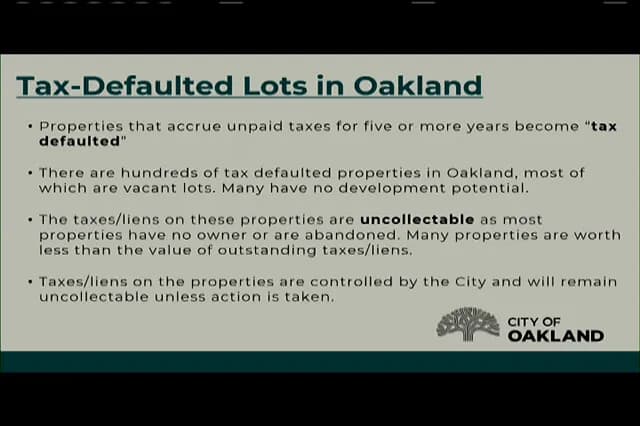
The Community & Economic Development Committee of the Oakland City Council met on July 14, 2026, from 1:30 PM to 3:20 PM to consider several items, including a tax sale authorization for affordable housing, debt forgiveness for the Seminary Point retail project, a code enforcement update, a signage contract, and workforce development funds. The meeting featured extensive public comment on street vendor enforcement and community engagement. Consent Calendar - Approval of Draft Minutes (June 23, 2026): Adopted unanimously (4-0). - Determination of Schedule of Outstanding Committee Items: Adopted unanimously (4-0) after public comment. - Chapter 8 Tax Sale Authorization (Item S3): Unanimously approved (4-0) and forwarded to the July 21, 2026 City Council meeting on consent. The resolution authorizes removal of up to $10 million in delinquent code enforcement and vacant property tax liens on tax-defaulted properties to facilitate affordable housing development via Alameda County’s Chapter 8 tax sale program. - Seminary Point Debt and Rent Forgiveness (Item S4): Unanimously approved (4-0) and forwarded to the July 21, 2026 City Council meeting on consent. The resolution forgives up to $2 million in city loans, $1.5 million in a revolving line of credit, and up to $40,000 in ground lease rent, contingent on sale of the leasehold to a qualified purchaser. - Workforce Development Funds (Item 7): Unanimously approved (4-0) and forwarded to the July 21, 2026 City Council meeting on consent. Authorizes acceptance and appropriation of $4.8 million in WIOA Title I funds and $1.99 million in California Volunteers Youth Service Corps funds for FY 2026-27. Public Comments & Testimony - Item 2 (Schedule of Outstanding Items) & Open Forum: Nine speakers (including Margaret Grimsley, Nita B., Shinobi, Sarah Amir, Aaron Fenias, Deshaun Toller, Joyus Morale, Marco Duncan, and Lisa Zebrack) spoke collectively during both the scheduled item and open forum. They urged the city to shift from punitive enforcement to partnership with street vendors, stop confiscation of property without due process, waive or subsidize permit fees for low-income vendors, include informal vendors in decision-making, and provide amenities like trash bins and portable toilets at vending hubs such as Lake Merritt. Several speakers noted that formal efforts to contact the city had been ignored and that a lawsuit had been filed under the California Public Records Act. - Item S3 (Tax Sale): One speaker (Asada Olabala) questioned the timing of the urgency finding and raised concerns about past tiny home projects being destroyed. - Item S4 (Seminary Point): Two speakers (Asada Olabala and Blair Beekman) expressed support for the project, emphasizing the need for economic opportunities in East Oakland. - Item 5 (Code Enforcement): One speaker (Asada Olabala) asked about collaboration with Alameda County on environmental health code enforcement, citing a recent outbreak of Cyclosporiasis. - Item 6 (Signage Contract): One speaker (Asada Olabala) criticized an existing sign at the parking citation office and questioned the use of an informal bidding process for public funds. - Item 7 (Workforce Funds): Two speakers (Asada Olabala and Blair Beekman) raised equity concerns, asking how many of the 900 residents to be served are citizens vs. non-citizens and whether African Americans would benefit proportionally. Discussion Items - Item S3 – Chapter 8 Tax Sale Authorization: Staff presented that Alameda County leads the process, and the city’s role is to remove liens to enable sale to affordable housing developers. Councilmember Fife praised the long-awaited progress and noted that almost all initial sites are in District 3 and zoned residential. Councilmember Ramachandran asked whether the program could also support safe RV parking or transitional housing; staff responded that further analysis with county counsel would be needed. The committee approved the urgency finding (4-0) and the item. - Item S4 – Seminary Point Debt and Rent Forgiveness: Staff explained that the retail center is at risk of foreclosure, and loan forgiveness is necessary to attract a qualified buyer. Council President Jenkins spoke in strong support, noting that the Black Cultural Zone is interested in taking over the lease. Councilmember Unger expressed concern about multiple loan forgiveness actions this year (over $16 million) and asked for a broader review of the city’s subordinate loan positions. Councilmember Fife inquired about next steps if no buyer is found by April 2027; staff indicated foreclosure may follow but they would negotiate for extensions. The committee approved the urgency finding (4-0) and the item. - Item 5 – FY 2025-26 Q1 & Q2 Code Enforcement Update: Staff reported key achievements: closing more cases than opened (3,905 opened vs. 4,709 closed), blight response time improved 35%, nearly 11,000 inspections completed, and increased fee collections. Chair Brown requested future reports include year-over-year comparisons. Councilmember Unger asked about staffing; staff noted a recent recruitment round had 65 applicants for a principal supervisor position. The committee received and filed the report (4-0). - Item 6 – Professional Services Agreement with Barretto, Co. for Signage and Wayfinding: Staff explained that the $300,000 contract will design and fabricate a comprehensive signage and wayfinding system for the permit center at 250 Frank H. Ogawa Plaza, replacing assets lost in a 2023 ransomware attack. Councilmembers questioned the cost and the small number of firms solicited (nine); staff noted the specialized nature of the work and that funds come from fee revenue, not the general fund. Councilmember Ramachandran urged broader outreach to small businesses. Councilmember Unger voted no, expressing that the cost seemed high for signage. The motion passed 3-1 (Fife, Ramachandran, Brown ayes; Unger no) and was forwarded to the full council on non-consent. - Item 7 – Acceptance and Appropriation of Workforce Development Funds: Staff clarified that this item is separate from the earlier approval of service provider contracts and simply authorizes receipt of funds to implement already-approved programs. Chair Brown asked for a breakdown of rapid response funding. No other questions. Unanimous approval. Key Outcomes - All items except Item 6 were forwarded unanimously to the July 21, 2026 City Council meeting on consent. - Item 6 was forwarded on non-consent due to a 3-1 vote (Unger opposed). - The committee received and filed the code enforcement informational report. - Urgency findings (2/3 majority) were approved for Items S3 and S4. - The Community & Economic Development Committee meeting was adjourned at 2:02 PM and reconvened as a special city council meeting for the remainder of the agenda. The meeting adjourned at 3:20 PM.
Public Meetings - Oakland, California
Public Meetings - Oakland, CaliforniaThe Oakland Redevelopment Successor Agency/City Council held a special concurrent meeting on July 13, 2026, to consider and vote on a second amendment to the sale of the City of Oakland's 50% undivided interest in the Coliseum Complex. The meeting began at 10:37 AM and adjourned at 12:18 PM. Council President Kevin Jenkins presided initially, later relinquishing the chair to Councilmember Janani Ramachandran. Public Comments & Testimony - 14 speakers addressed the Council on the Coliseum sale item, and 3 speakers spoke during Open Forum. - Supporting voices: Several speakers expressed strong support, including members of the African American Sports and Entertainment Group (AASEG) and community advocates. Ray Bobbitt (AASEG) thanked the city negotiating team and highlighted the historic opportunity for black-led development. John Jones III urged approval, noting that prior to AASEG, no one was interested in the Coliseum. Lynn Turner called the deal historic for giving black leadership a seat at the table. Paul Cobb recalled earlier efforts and praised AASEG for buying the Coliseum rather than being a minority subcontractor. Doug Blackshire stressed the national significance of the deal. - Concerns raised: Multiple speakers from the Oakland United coalition (Damien Scott, Delilah Aviles, Vanessa Riles) emphasized the need for a robust community benefits agreement (CBA) that includes community-driven negotiations, especially given that the arena parcel is sold to a private owner without the same affordable housing and community benefit requirements as the stadium parcel. They requested that the arena also be subject to community benefits and that a third-party facilitator be involved. Kathy Eberhardt urged robust community engagement. Damian Rainey questioned why the city is selling an irreplaceable civic asset, whether the operating losses would persist, and why the city is redirecting the operating subsidy to the buyer after closing. - Discrepancy note: The meeting minutes state that Councilmember Carroll Fife was excused and did not vote, but the transcript shows she was present (roll call modified at 10:38 AM) and voted “Aye” on the motion. This discrepancy is noted. Discussion Items - Second Amendment to Coliseum Complex Sale Agreement (Item 26-0905): City staff (Brendan Moriarty, Director of Real Estate; Bradley Johnson, Finance Director) presented the proposed amendment to sell the city's 50% undivided interest in the Coliseum Complex (112 acres, including the arena and stadium parcels) to Oakland Acquisition Company (OAC), a joint venture of AASEG and Loop Capital. Key terms: - Arena parcel: Sold for $50 million lump sum at closing (expected by January 30, 2027, target September 2026). OAC will then transfer title to the Oakview Group. - Stadium parcel: Sold for $60 million via seller financing (installment payments with interest at 5%, title transfers early). Three equal payments tied to development approvals due at years 5, 6, and 7 post-closing. - Revenue sharing: City receives 6% of annual gross ticket sales from events at the arena, stadium, and any future entertainment venues, with no end date (estimated $3 million annually initially). - Affordable housing: At least 25% of any residential units developed on the stadium parcel must be affordable housing. - Community benefits: The city and OAC will negotiate broader benefits (local hiring, workforce training, labor standards, etc.) for the stadium parcel. The arena parcel is not subject to these. - City subsidy savings: The city currently spends $6 million annually on operations; the deal ends this subsidy after January 2027, saving half of the budgeted $6 million for FY 2026-27. - Security: The city holds a deed of trust on the stadium parcel (can foreclose), requires OAC to maintain minimum corporate value, and requires a third-party guarantee or payment bond by January 1, 2027 (penalties for delay). - Use of proceeds: The $50 million from the arena sale was originally proposed to pay down CalPERS pension liability, but a friendly amendment removed that provision from the ordinance; it will be handled via a separate resolution on July 21. - Councilmember comments: Most councilmembers expressed strong support. Council President Jenkins noted the end of the $6 million annual subsidy and the responsible use of one-time funds for pension liability. Councilmember Brown highlighted the 6% ticket revenue sharing and the community benefits commitments. Councilmember Houston emphasized the long-standing community engagement by AEG (previous operator) and secured assurances from arena buyer Mr. Irving for continued scholarships and programs. Councilmember Fife supported the deal but advocated for using ticket surcharge revenue to fund arts and culture citywide. Councilmember Unger and Wong raised questions about risk, interest rate (5% vs. commercial), and foreclosure mechanisms; staff clarified the city is not lending money and multiple guarantees protect the city. Councilmember Gallo was the sole opponent, questioning the appraisal and whether the county and Joint Powers Authority had approved, and expressing skepticism about the process. Key Outcomes - Motion introduced by Councilmember Ken Houston, seconded by Councilmember Carroll Fife, to adopt the ordinance as amended (removing the CalPERS appropriation section). - Vote: 6 in favor (Ramachandran, Unger, Jenkins, Houston, Brown, Wang), 1 opposed (Gallo). The minutes list Councilmember Fife as excused, but the transcript shows she voted “Aye.” The motion carried for introduction. - Final passage: The ordinance will go before the full council for a second reading on July 21, 2026. - Friendly amendment: Approved unanimously to delete Section 3 of the ordinance (which directed the $50 million lump sum payment to CalPERS) and move that provision to a separate resolution on July 21. - Next steps: City staff to continue coordinating with Alameda County (which approved a non-binding term sheet on May 28, 2026) and to finalize the third-party guarantee. Closing targeted for September 2026 but no later than January 30, 2027. Open Forum Three speakers addressed non-agenda items, including questions about health issues related to the Oakland A’s stadium proposal and the importance of retaining civic assets. The mayor and OAC representative Irving briefly thanked the council and reaffirmed their commitment.
The Oakland City Council Rules & Legislation Committee convened on Thursday, July 9, 2026, at 10:31 AM and adjourned at 11:43 AM. Chairperson Kevin Jenkins presided. The committee approved minutes from prior meetings, determined the schedule of outstanding items, and scheduled numerous new agenda items for upcoming council and committee meetings. A special city council meeting was called for Monday, July 13, 2026, at 10:30 AM, and the regularly scheduled July 23, 2026 Rules & Legislation Committee meeting was cancelled. Consent Calendar - Approval of Draft Minutes (May 28, June 18, and June 25, 2026): Approved 4-0. - Determination of Schedule of Outstanding Committee Items: Approved 4-0 as presented. Public Comments & Testimony - Item 3 (New Scheduling): Four speakers addressed the committee. - John Jones expressed support for the Coliseum Complex sale amendment (Item 3.1), noting the complexity of the deal involving six entities and thanking former Councilmember Rebecca Kaplan for prior work. - Asada Olabala objected to the proposed travel reimbursement for the Congressional Black Caucus conference (dais item), questioned the police commission selection process, and criticized the lack of discussion on reparations, gentrification, and impacts on African Americans. He also urged the committee not to approve the new police commissioner slate, arguing that Omar Farmer, a Black candidate, was excluded. - Blair Beekman supported the Coliseum work, urged transparency in Bay Area UASI governance, and expressed hope for the reappointment of a former police commissioner. - Zach Unger made technical comments about bond ETFs, cryptocurrency, and public safety funding. - Item 4 (Review of Draft Agendas): Three speakers. - Asada Olabala demanded reports on several topics including city employee overpayments, sanctuary city impacts, gentrification, reparations, and the waiting list for housing. - Zach Unger criticized housing policy and budget processes. - Blair Beekman urged responsible budget deficit discussions and suggested small payroll cuts to save money. - Item 5 (OMC Chapter 1.10 Report): Four speakers. - Asada Olabala denounced the City Attorney’s Office for past failures in representing councilmembers and commissioners. - Zach Unger challenged various legal complaints and requested appellate review. - Blair Beekman encouraged continued work on equity and statistics. - Derek Barnes withdrew his comment. - Open Forum: Three speakers. Asada Olabala criticized the police commission selection process and the sanctuary city policy’s impact on African Americans. Councilmember Ken Houston (via dais request) expressed frustration that his item on encampment management (presented at the July 7 council meeting) was not fully presented, and he requested a new scheduling item to bring it back before the summer recess. Zach Unger made technical comments about a project. Discussion Items - Item 3.1: Second Amendment to Coliseum Complex Sale Agreement – Staff presented a title change and Rule 24 bypass due to recently reached terms with OAC. The ordinance authorizes simultaneous sale of arena ($50M lump sum) and stadium ($60M seller financing), with 6% of gross ticket sales revenue, affordable housing requirements on the stadium parcel, and a daily stadium subsidy redirection of $16,438.36 until December 31, 2026. Scheduled for the July 13 special council meeting on non-consent. - Item 3.2: 7th Street Design Contract Amendment (Alta Planning) – Title change and urgency finding: staff needs council resolution before summer recess to meet federal funding milestones. Contract increased by $747,288 to a total not-to-exceed $3,955,404, with extension to December 31, 2030. Scheduled for July 14 Public Works & Transportation Committee. - Item 3.3: Chapter 8 Tax Sale Authorization – Title change on second resolution. Urgency finding: Alameda County Board of Supervisors expected to approve a tax sale on July 14; city must release liens to avoid disruptions. Two resolutions authorize removal of code enforcement liens and vacant property tax liens (up to $10M aggregate) to facilitate affordable housing. Scheduled for July 14 Community & Economic Development Committee. - Item 3.4: Seminary Point Debt and Rent Forgiveness – Title change on second ordinance. Urgency finding: property is in forbearance until April 21; delay would hinder sale. Forgiveness of up to $2M loan to Athena MT, $1.5M line of credit, and up to $40,000 in rent for Seminary Point LLC, contingent on sale to qualified purchaser. Scheduled for July 14 CED Committee. - Item 3.5: Resolution in Support of AB 1588 (Sideshow Enhancements) – Rule 24 bypass stated since such resolutions typically go from Rules to Council. Scheduled for July 21 council consent. - Item 3.6: Final Maps for Oak Knoll Parcels 9 and 10 – Rule 24 for urgency: 35-lot and 24-lot subdivisions; delay affects housing delivery; $13M infrastructure guarantees collected. Scheduled for July 21 council consent. - Item 3.7: Bay Area Urban Areas Security Initiative MOU – Rule 24 bypass to avoid forfeiting federal homeland security funds. Scheduled for July 21 council consent. - Items 3.8–3.12: Appointments and Reappointments – All scheduled for July 21 council consent with Rule 24 statements due to quorum challenges or vacancies. - Item 3.13: Resolution in Support of SB 954 (CEQA Exemption) – Councilmember Brown added as co-sponsor. Rule 24: urgency to make city support known before Senate vote. Scheduled for July 21 council consent. - Item 3.14: Amendment to Cultural Affairs Commission Enabling Ordinance – Rule 24 to bypass Life Enrichment Committee due to time sensitivity. Scheduled for July 21 council consent. - Item 3.15: Police Commission Selection Panel Slate – Two options: accept or reject slate of Ricardo Garcia-Acosta and Joey Harrison. Scheduled for July 21 council non-consent. - Item 3.16: 2025-2026 Consolidated Annual Performance and Evaluation Report (CAPER) – Informational report. Rule 24: due to HUD by September 28, 2026. Scheduled for September 15 council public hearing. - Item 3.17: Cooperative Contract with NEOGOV for HRIS – No urgency; scheduled for September 22 Finance & Management Committee. - Dais Item (26-0906): Congressional Black Caucus Legislative Conference Reimbursement – Council President Jenkins and Councilmembers Brown and Houston request reimbursement for travel to Washington, DC, September 16-20, 2026. Rule 24 bypass. Scheduled for July 21 council consent. - Item 4: Review of Draft Agendas and Pending Lists – Approved 3-0 (Jenkins excused). - Item 5: OMC Chapter 1.10 Three-Year Report – Deputy City Attorney C-Maro Penny presented an informational report on the Civil Protection of the People of Oakland Ordinance, noting five lawsuits filed in three years and next steps for equity analysis. The committee received and filed the report 3-0 (Jenkins excused). Key Outcomes - Approved minutes (May 28, June 18, June 25) 4-0. - Approved pending list 4-0. - Approved new scheduling items as amended (including all 3.1-3.17 and the dais item) 4-0. - Approved draft agendas and pending lists 3-0 (Jenkins excused). - Received and filed OMC 1.10 report 3-0 (Jenkins excused). - Special city council meeting called for July 13, 2026 at 10:30 AM to consider the Coliseum sale amendment. - July 23, 2026 Rules & Legislation Committee meeting cancelled. Councilmember Houston indicated he would submit a new scheduling request to bring back the encampment management presentation for the July 21 council meeting.
The Oakland City Council convened a concurrent meeting of the Oakland Redevelopment Successor Agency, City Council, and Geologic Hazard Abatement District Board on Tuesday, July 7, 2026 at 3:41 PM. The meeting lasted until 10:13 PM, with an extension voted after 9:30 PM. Council acted on a packed agenda including the confirmation of an interim city administrator, placement of a real property transfer tax foreclosure loophole measure on the November 2026 ballot, approval of the Leona Quarry and Oakland Area GHAD budgets, adoption of the FY 2026-27 HUD Annual Action Plan, and several public hearings on delinquent taxes, liens, and the General Plan Land Use Framework. Key decisions were made on encampment abatement policies and a temporary street closure aimed at disrupting sex trafficking. Consent Calendar - Minutes: Approved minutes of June 12 and June 16, 2026. - Emergency Declarations: Renewed declarations of local emergency for HIV/AIDS, medical cannabis access, and homelessness. - Planning Code Amendments (Item 6.5): Moved from consent to non-consent and approved as amended on introduction (removing a proposed discontinuance standard for truck-intensive industrial uses). Final passage scheduled for July 21, 2026. - Bike Share Franchise: Approved final passage of an ordinance extending Lyft's bike share franchise agreement to December 31, 2032. - Oakland Ice Center Lease: Approved final passage of a lease and management agreement with Sharks Ice, LLC, including up to $10 million in Measure U bond funds for capital improvements. - Costco Exclusive Negotiation Agreement: Approved a 24-month exclusive negotiation agreement with Costco for development at 101 Admiral Robert Toney Way and 2308 Wake Avenue, with a $300,000 payment. - Sanctuary City Ordinance (Item 6.26): Approved on introduction with amendments. Added robust whereas clauses acknowledging historic harms to Black Oaklanders, and strengthened language prohibiting city employees from assisting in federal immigration enforcement and requiring a citywide review of forms to delete non-required immigration questions. Co-sponsored by Mayor. Final passage on July 21, 2026. - Salary Ordinance Amendments: Approved on introduction adjustments for council members, city attorney, and city auditor per Public Ethics Commission. - Other Consent Items: Approved contracts for street sweeper brooms, asphalt disposal, Mission Linen supply extension, vegetation management (Native Soil, Inc., $4.5 million over 5 years), certification of June 2 election results, and various appointments. Public Comments & Testimony - Interim City Administrator (S5.6): Two speakers expressed confusion about the charter basis for an interim appointment and criticized the rushed process. Councilmember Ramachandran voted no, citing fiduciary concerns based on past actions by the nominee. - AC Transit Budget (5.2): Multiple speakers, including John Jones III and Mrs. Olabala, criticized AC Transit for the negative impacts of the International Boulevard BRT project and questioned the deficit projections. Others urged support to avoid service cuts affecting low-income riders. - Real Property Transfer Tax Measure (S5.7): Nine speakers supported the closure of the foreclosure loophole, highlighting tax equity and potential revenue of $4–13 million annually. Some urged transparency that funds would go to the general fund. The Chamber of Commerce thanked Councilmember Wang for stakeholder engagement. - HUD Annual Action Plan (4.1): Tenants and community organizers called for proactive code enforcement and investment in habitability protections. Speakers from ACCE urged stronger landlord accountability. - Delinquent Business Taxes (4.2): Several property owners appealed the lien process, citing insufficient notice and excessive penalties. Jacob Poland stated his administrative hearing had not yet occurred. Staff noted 648 accounts were removed after outreach. - General Plan Land Use Framework (4.5): Over 20 speakers represented diverse interests. Industrial stakeholders (port, maritime, logistics) urged preservation of industrial zoning and completion of an economic impact study. Youth fellows from Urban Strategies Council presented community engagement findings calling for more parks, maintenance, and a youth seat on the Planning Commission. Others emphasized native plants, libraries, and anti-displacement. - Encampment Abatement Reports (5.4/5.5): Speakers criticized the slow pace of property activation and the lack of shelter options. Councilmember Fife expressed frustration that without resources, moving people from corner to corner does not solve the crisis. Councilmember Houston demanded prioritization of District 7. - Temporary Street Closure (4.6): Nine speakers offered mixed views. Some supported the pilot to disrupt sex trafficking, while others worried about displacement and impacts on local auto shops. Residents and business owners near the proposed closure opposed it, urging focus on exit services for women. - Sanctuary City Ordinance (6.26): Many faith and community leaders spoke in favor, emphasizing that immigrant families need protection from ICE. Some advocates requested even stronger bans on assistance. One speaker criticized the lack of Spanish translation for amendments. - Other Consent Items: Speakers raised concerns about the Laurel Business Improvement District assessment process and supported the Costco development and Oakland School for the Arts street renaming. Discussion Items - Appointment of Elizabeth Lake as Interim City Administrator (S5.6): The item required an urgency finding (7-1, Ramachandran no). Council heard from Mayor Lee, who argued the appointment was essential to avoid a gap in administrative authority and to allow execution of the upcoming Tax and Revenue Anticipation Notes (TRAN) financing, projected to save $750,000. Councilmember Houston questioned the rushed timing and charter basis. The resolution passed 6-2 (Brown, Fife, Gallo, Houston, Unger, Wang aye; Ramachandran, Jenkins no). - AC Transit Budget and Service Update (5.2): AC Transit Board Member Sarah Syed and staff presented the agency's $200 million deficit over four years, potentially leading to a 16% service reduction and 300 job losses if a regional measure fails in November. Councilmember Houston raised concerns about the BRT's impact on East Oakland. The item was received and filed 7-0-1 (Houston abstained). - Real Property Transfer Tax Foreclosure Loophole Measure (S5.7): After an urgency finding (8-0), Councilmember Wang presented the measure to close the foreclosure exemption, with exemptions for small residential transfers, community banks, and affordable housing conversions. Finance Director Johnson estimated annual revenue of $4–13 million. Council adopted amendments: (1) adding council authority to amend exemptions by ordinance, and (2) inserting final ballot language. The resolution passed 7-0-1 (Jenkins excused). The companion advisory measure was removed. - Geologic Hazard Abatement District Budgets (3.1, 3.2): Leona Quarry GHAD budget adopted ($405,670 expenditures, assessment suspended) and Oakland Area GHAD budget adopted ($20,498 expenditures). Both approved with excused absences. Public comments questioned Oak Knoll assessments and the need for expert monitoring. - HUD Annual Action Plan (4.1): The city accepted $14,674,799 in HUD grants for CDBG, HOME, ESG, and HOPWA programs. Funding will support capital improvements, housing rehabilitation, and homelessness services. The resolution passed 8-0 after public hearing. - Delinquent Taxes and Fees (4.2, 4.3, 4.4): The council confirmed liens for delinquent business taxes ($4.4 million), real property transfer taxes ($235,000), and trash fees ($9.1 million). Administrative hearings were conducted; 648 business tax accounts were resolved. All resolutions passed unanimously. - General Plan Update – Draft Land Use Framework (4.5): The council held a study session to receive public input on the draft framework. Staff emphasized the iterative process, with final adoption planned for fall 2027. Councilmembers highlighted the need to balance industrial retention with affordable housing and environmental justice. Youth fellows presented priorities for parks, native plants, and maintenance. The report was received and filed 8-0. - Encampment Abatement Policy – City Property Analysis (5.4) and Management Team Operations (5.5): City staff presented an inventory of 46 city-owned properties: 5 identified as strongest candidates (Tier 1), 9 with potential constraints, and 32 not feasible. Councilmember Houston urged immediate action on the 71st Avenue site, noting a $500,000 investment was wasted. Councilmember Fife demanded honest assessment of lack of shelter capacity. Discussion highlighted dependence on county Measure W funds and the need for operational funding. The EAP implementation begins July 13. Both reports received and filed 8-0. - Temporary Street Closure to Combat Sex Trafficking (4.6): Councilmember Wang proposed a 6-month pilot closing 9th, 10th, and 11th Avenues between International Boulevard and 15th Street to through traffic. The goal is to disrupt trafficking by removing concealed access points. Public comment was divided. Councilmember Gallo favored stronger police action. Councilmember Fife supported the pilot but voiced skepticism. Councilmember Jenkins abstained. The resolution passed 6-1-1 (Ramachandran excused, Jenkins abstained). - 2026 Miscellaneous Planning Code Amendments (6.5): Removed from consent and amended on introduction to delete a provision that would have immediately discontinuing nonconforming truck-intensive uses after 60 days of inactivity. The amendment, offered by Councilmember Unger, preserves the right to continue such uses if actively marketed. Final passage set for July 21. Approved 8-0. Key Outcomes - Interim City Administrator: Elizabeth Lake confirmed as interim city administrator, 6-2. She will execute TRAN financing documents. - Ballot Measure: Voters will decide on November 3, 2026 whether to amend the real property transfer tax to eliminate the foreclosure loophole, raising an estimated $4–13 million annually. (Passed 7-0-1.) - GHAD Budgets: Both Leona Quarry and Oakland Area GHAD budgets adopted without assessment levies. - HUD Grants: $14.67 million in federal grants appropriated for housing and community development programs. - Delinquent Taxes: Liens confirmed for business taxes ($4.4M), transfer taxes ($235K), and trash fees ($9.1M). - General Plan Update: Draft Land Use Framework study session held; further community engagement planned through summer 2026. - Encampment Policy: City property inventory presented; implementation of Encampment Abatement Policy begins July 13, 2026. Additional funding and county partnerships needed. - Street Closure: Pilot temporary street closure for sex trafficking disruption approved for 6 months, installation expected early fall. - Sanctuary City Ordinance: Strengthened ordinance approved on introduction; final adoption on July 21. - Planning Code Amendments: Nonconforming industrial use discontinuance standard revised; final adoption on July 21. - Consent Calendar: All other consent items approved as amended, including contracts, appointments, emergency declarations, and salary adjustments.
The Oakland City Council Rules & Legislation Committee convened on Thursday, June 25, 2026, at 10:31 AM, chaired by Council President Kevin Jenkins. The committee handled scheduling determinations, a proposed ballot measure to amend the real property transfer tax foreclosure exemption, and forwarded numerous items to the July 7 and subsequent City Council and committee meetings. The meeting adjourned at 12:30 PM. Consent Calendar - Determination of Schedule of Outstanding Committee Items (Item 2): Approved as presented. - Reappointment of Alvina Wong to the Board of Port Commissioners (Item 5): Approved and forwarded to the July 7, 2026 City Council agenda on consent. - New Scheduling Items (Item 3) – Consent Portion: The committee approved the scheduling of the following items to the July 7, 2026 City Council agenda on consent: Reappointments to the Oakland Housing Authority (3.1), Reappointment to the Wildfire Prevention Commission (3.2), ITD Cy Pres Tech Grant (3.4), Oakland School for the Arts Commemorative Street Renaming (3.5), OPD BAHC FIFA World Cup Grant (3.6), League of California Cities Conference Reimbursement (3.26), and all recommendations from the June 23 committees (Items 3.29–3.41, 3.44) as noted in the agenda. The Sanctuary City Ordinance (Item 3.44) was forwarded as amended (striking provisions allowing detention and notification cooperation under certain conditions). Public Comments & Testimony - Item S6 – Real Property Transfer Tax Measure: Two speakers commented. Robert Alpadaka, a 40-year Oakland resident and housing development veteran, expressed support for closing the foreclosure tax loophole and stated that homelessness is a top priority. Dan Cobb also urged support, calling the measure a smart way to close a loophole in the existing progressive transfer tax. - Item 3 – New Scheduling Items (General): Two speakers addressed multiple agenda items. Rajni Mandal (District 4) questioned the timeline for implementing the Flock community camera program (approved six months prior), supported the helicopter maintenance contract but urged a long-term replacement strategy for aging city equipment, and backed the proposed technology audit. Blair Beekman praised the sanctuary city ordinance amendments, raised concerns about Flock oversight and the need for public discussion on future video surveillance vendors, and stressed the importance of public participation in hiring a new police chief. - Open Forum: Rajni Mandal commented on public participation, noting that heckling of speakers at recent meetings and safety concerns near City Hall may discourage attendance, and urged continued value for emailed and e-comments. Discussion Items - Item S6 – Resolution to Place Real Property Transfer Tax Amendment on November Ballot: Councilmember Wang presented a measure to end the exemption for foreclosure transactions (deed-in-lieu and short sales) from the city’s real property transfer tax, with proceeds going to the general fund. He proposed amendments: removing a companion advisory spending measure, adding an exemption for transfers converting property to affordable housing, giving the City Council authority to create future exemptions by ordinance, exempting all community banks (not just California-based), and basing the tax on fair market value. Councilmember Fife expressed concerns that the exemptions (especially for community banks and affordable housing) could be exploited, and questioned revenue estimates (the City Administrator’s report projected $400,000–$1 million annually, while Wang’s analysis of 16 recent transactions suggested much higher figures, up to $16.5 million for half of 2026). Councilmember Ramachandran wanted to see the amendments in writing before voting. A motion to forward the item to the July 2 Rules & Legislation Committee for further review passed 3–1 (Fife dissenting). - Item 3.8 – Mayor’s Appointment of Elizabeth Lake as Interim City Administrator: The committee debated whether to schedule the appointment for the July 7 council meeting. Finance Director Bradley Johnson stated that confirming an interim or permanent City Administrator by July 15 is critical to close a bond transaction (temporary revenue anticipation notes) that would save approximately $5.5 million in PERS costs; the City Attorney confirmed that under the charter, only a council-confirmed city administrator can sign the bond documents. Councilmember Ramachandran requested a one-week hold to conduct due diligence, while Councilmembers Brown and Fife argued for moving it forward given the financial urgency. Council President Jenkins noted the tie and stated that no action would be taken, effectively keeping the item in committee for further scheduling consideration. - Item 3.18 – Report on Inventory of City-Owned Properties: Councilmember Houston requested that this informational report, originally scheduled for the July 14 Life Enrichment Committee, be moved to the July 7 City Council non-consent agenda, citing the upcoming encampment abatement policy implementation and the need for immediate action. After discussion, the committee approved the change, and the item will appear on the July 7 council agenda as non-consent. - Other Discussion: Councilmember Fife noted that an informational report on fixed-wing aircraft as a police helicopter replacement, which she sponsored in 2023, will be brought back to the Public Safety Committee. The committee also continued a resolution supporting AB 1588 (sideshow penalties) to the July 2 Rules meeting. Key Outcomes - Item 2 – Pending List: Approved 4-0. - Item 5 – Port Commissioner Reappointment: Approved 4-0 to forward to July 7 council on consent. - Item S6 – Real Property Transfer Tax Ballot Measure: Continued to the July 2, 2026 Rules & Legislation Committee with amendments (vote: 3-1, Fife opposed). - Item 3.8 – Interim City Administrator Appointment: No action taken; item not scheduled. - Item 3.18 – City-Owned Properties Inventory Report: Moved to the July 7, 2026 City Council non-consent agenda (by Rule 24). - Item 3.27 – Resolution Supporting AB 1588: Continued to the July 2 Rules & Legislation Committee. - All other scheduling items under Item 3: Approved as amended (with specific items moved to consent, non-consent, or committee calendars as noted in the minutes). - Item 4 – Draft Agendas and Pending Lists: Approved 4-0. - Open Forum: Heard without action.
The Oakland City Council Public Works and Transportation Committee convened at 11:33 AM on Tuesday, June 23, 2026, with Councilmember Zac Unger (District 1) presiding as Chair. All four committee members were present: Councilmembers Noel Gallo (District 5), Ken Houston (District 7), Charlene Wang (District 2), and Chair Unger. The committee approved several contracts related to street sweeping, asphalt and concrete disposal, and a safety project, and rescheduled one item to a future meeting. Approval of Minutes - Item 1: The committee unanimously approved the draft minutes from the June 9, 2026 meeting (4-0). Determination of Schedule of Outstanding Committee Items - Item 2: The committee approved a motion to withdraw and reschedule Item 6 (Broadway Streetscape Improvements Construction Contract Award) to the July 14, 2026 Public Works and Transportation Committee agenda. Councilmember Gallo requested a future report from the City Administrator on the status of public works vehicles and equipment, citing over 150 vehicles out of service. Councilmember Houston highlighted the recent grand jury report on illegal dumping and urged better management of city property and vehicle maintenance. Public speaker Asada Olabala asked about vehicle maintenance indicators and prevention strategies for illegal dumping. Discussion Items - Item 3: Contracts for Street Sweeper Brooms and Brushes (United Rotary Brush Corp. and Owens Equipment Sales, each up to $750,000 over five years): Richard Battersby, Assistant Director of Oakland Public Works, explained that the contracts cover replacement brooms and brushes for the city's 18 street sweepers, of which only 10–12 are currently operational. Councilmember Houston asked about Oakland-based vendors that did not bid (RS Hughes and Grainger) and requested follow-up. Councilmember Wang noted that street sweeping is a first line of defense against illegal dumping and that the city is acquiring three battery-electric sweepers via an EPA grant. The committee voted unanimously (4-0) to forward the item to the July 7 City Council consent agenda. - Item 4: Asphalt and Concrete Disposal Service Contracts (Argent Materials, Inc. and Bee Green Recycling & Supply, each up to $560,000 per year for three years, with two-year options, total not to exceed $2.8 million over five years): Tony Jones, Interim Operations Manager for DOT Streets and Sidewalk Division, stated that without a contract, the city is stockpiling material at its own yard, running out of space, and spending nearly $2 million on waste management. The new contracts are with Oakland-based companies that hire locally and save money. Councilmember Houston strongly supported the choice of local businesses. The committee voted unanimously (4-0) to forward the item to the July 7 City Council consent agenda. - Item 5: 14th Street Safety Project Construction Contract Award (Gruendl Inc. dba Ray’s Electric, $2,494,685.86): Amit Salvan, Principal Civil Engineer for DOT, described the project—reducing travel lanes, adding pedestrian crossings, and improving lighting on 14th Street from Mandela Parkway to Brush Street in West Oakland—funded by state HSIP, gas tax, and Measure BB. The project has an 83.35% local business participation rate. Councilmember Wang praised the project, and Councilmember Houston expressed frustration with underinvestment in East Oakland, vowing to advocate more strongly. The committee voted unanimously (4-0) to forward the item to the July 7 City Council consent agenda. - Item 6: Broadway Streetscape Improvements Construction Contract Award (withdrawn and rescheduled to July 14, 2026). Public speakers offered comments, including Asada Olabala questioning the emergency use of Rule 28 and raising equity concerns about investments in Chinatown versus other neighborhoods. The item was not voted on. Public Comments & Testimony - Multiple public speakers participated throughout the meeting. Asada Olabala consistently raised concerns about city processes, staffing, equity, and the use of Rule 28 to bypass committee vetting. She also criticized the allocation of resources to Chinatown over African American communities. Kevin Daly supported the 14th Street safety project and suggested progressive ticketing for repeat traffic violators. Blair Beekman asked about the status of the Flock surveillance contract and requested regular community updates. Open Forum - Three speakers addressed open forum. Kevin Daly revisited progressive ticketing. Asada Olabala criticized the lack of action on the police administration building and alleged favoritism in city spending. Blair Beekman asked for updates on the Flock camera system and urged continued community engagement. Key Outcomes - Approved and forwarded to July 7, 2026 City Council consent agenda: Item 3 (street sweeper brushes contracts), Item 4 (asphalt disposal contracts), Item 5 (14th Street safety contract). All votes were 4-0. - Withdrawn and rescheduled: Item 6 (Broadway Streetscape) to the July 14, 2026 Public Works and Transportation Committee meeting. - Directives: Councilmember Gallo requested a future report on public works vehicle and equipment status; Councilmember Houston asked staff to follow up with Oakland-based vendors that did not bid on the sweeper brush contracts.
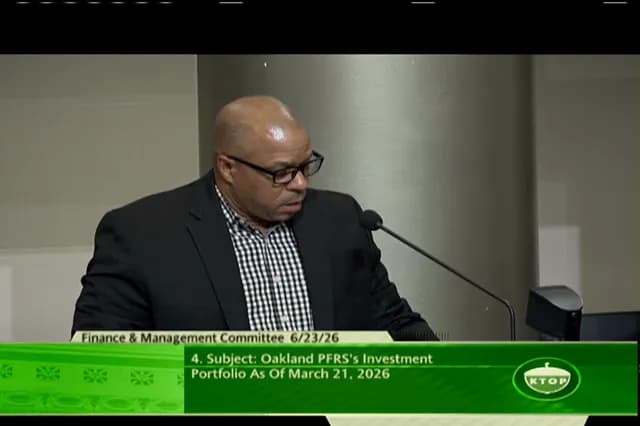
The Oakland City Council Finance and Management Committee convened at 9:30 AM on Tuesday, June 23, 2026, in the City Council Chamber. All four members were present: Councilmembers Rowena Brown, Zac Unger, Charlene Wang, and Chair Janani Ramachandran. The committee approved routine items, heard reports on the Police and Fire Retirement System investment portfolio and a professional services contract, and forwarded several salary ordinance amendments to the full City Council. The meeting adjourned at 10:20 AM. Consent Calendar - Item 1: Approval of Draft Minutes (June 9, 2026) – Approved unanimously (4-0). - Item 2: Determination of Schedule of Outstanding Committee Items – Accepted as presented (4-0). One public speaker commented on the need for fiscal reports on various city investments. Public Comments & Testimony - On Item 2: Asado Olabala requested reports on the fiscal impact of the $700,000 investment in the Oakland Roots facility, the $1.7 million transportation department fund, the equity access ordinance spending ($900,000/year), bilingual premium pay costs, and the merger of departments. - On Item 3: Asado Olabala questioned the rationale for a five-year contract with InnoFin Solutions, noting seven prior short-term contracts since 2016, and asked for evidence of budget process enhancements. Blair Beekman expressed relief at the low contract amount ($200,000 over five years) but urged more open budget conversations amid Oakland’s high deficit. - On Item 4: Asado Olabala asked whether retirees receive individual investment updates and what percentage of retirees live in Oakland (noted 32% of city employees live in Oakland). Blair Beekman discussed San Diego’s budget lessons and suggested city workers consider small pay cuts instead of losing benefits. Kevin Daly noted the funded ratio improved from 95.3% to fully funded. - On Item 5: Three speakers signed up; Asado Olabala and Kevin Daly spoke. Olabala questioned how job priorities were determined and sought clarification on the Exempt Limited Duration Employee (ELDE) classification and loss of bargaining unit coverage. Kevin Daly requested that attached PDF files be made searchable rather than scanned images. (Blair Beekman did not speak on this item.) - On Item 6: Three speakers signed up; Asado Olabala and Blair Beekman spoke. Olabala criticized the council salary increase ($9,520.26 to a new total of $123,763.39) and a city attorney increase of $28,190 to $338,290, noting there is also a ballot measure to raise salaries further; he challenged council members to decline the raise. Beekman proposed small across-the-board pay cuts to save nearly $2 million. (Kevin Daly did not speak on this item.) Councilmember Brown asked for historical data on how often council members have declined such increases over the last six to eight years, and noted that previous councils had done so. - Open Forum: Asado Olabala raised concerns about the Ice Center parking validation and city payments to various business improvement districts (e.g., $62,179.99 to Oakland Museum of California). Blair Beekman discussed future plans for ALPR vendor and strong mayor issues. Discussion Items - Item 3: InnoFin Solutions LLC Professional Services Contract – The committee considered a resolution to waive competitive bidding and award a five-year contract (July 1, 2026 – June 30, 2031) for support of the Oracle Planning and Budgeting Cloud Service (PBCS) at $40,000 per year ($200,000 total). Staff explained the vendor’s long familiarity with the city’s system and the risk of transition. Approved and forwarded to the July 7, 2026 City Council consent agenda (4-0). - Item 4: Oakland PFRS Investment Portfolio as of March 31, 2026 – The committee received an informational report. The portfolio ended the quarter at $495 million, with a 0.12% net return (gross of fees). As of May, the portfolio stood at $512 million with an 11% return year-to-date. The fund is 100% funded, with 573 retirees and beneficiaries. Over 60% of the portfolio is in bonds due to recent de-risking. No contributions from the PTO fund will be made after July 1, 2026. The property tax override rate was previously reduced. Received and filed unanimously (4-0). - Item 5: Amendment to Salary Ordinance for Various Classifications and Exemptions – The committee approved creation of four new classifications: Employee and Labor Relations Technician, Employee and Labor Relations Analyst (Assistant), Employee and Labor Relations Analyst, and Exempt Limited Duration Employee (80-hour). These positions are exempt from civil service and not represented by bargaining units. The committee also approved salary adjustments for Deputy Chief, Assistant Chief, and Fire Marshal (sworn) by incorporating a 15% administrative assignment premium into base salary. Approved and forwarded to July 7 City Council consent agenda (4-0). - Item 6: Amendment to Salary Ordinance for Council Member, City Attorney, and City Auditor – The committee approved charter-mandated salary adjustments as determined by the Public Ethics Commission. Council member salary increases by $9,520.26 to $123,763.39; city attorney salary increases by $28,190 to $338,290; city auditor salary also adjusted (amount not specified in transcript). The increases take effect July 4, 2026. Staff clarified that the ordinance establishes a statutory maximum, not an automatic raise for each individual. Approved and forwarded to July 7 City Council consent agenda (4-0). Key Outcomes - All action items were approved unanimously (4-0) and forwarded to the July 7, 2026 City Council meeting on the consent calendar except Item 4, which was received and filed. - The committee directed staff to research historical data on council members declining salary increases and consider including it in future reports (from Councilmember Brown’s request on Item 6). - The meeting adjourned at 10:20 AM.
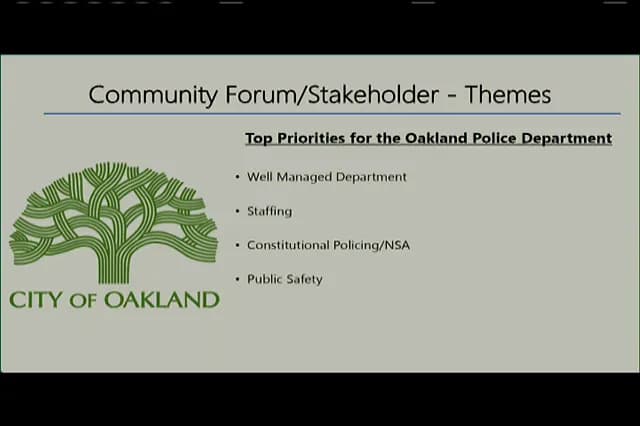
The Public Safety Committee convened at 6:05 PM on June 23, 2026, with Chair Charlene Wang presiding. Members present: Rowena Brown, Ken Houston, and Charlene Wang. Councilmember Carroll Fife was excused. The committee modified the agenda to hear Item 6 (police chief recruitment) before Item 3. The meeting adjourned at 8:36 PM. Key actions included advancing a strengthened "City of Refuge" sanctuary ordinance to the full council and approving a pilot street closure to disrupt sex trafficking. Consent Calendar - Approval of Minutes (June 9, 2026): Approved unanimously (3-0-1). - Determination of Schedule: Approved as amended to withdraw the Sideshow Penalty Ordinance (Item 4) and schedule it to the committee pending list with no date specific (3-0-1). Public Comments & Testimony - Police Chief Recruitment (Item 6): Three speakers commented, including concerns about the lack of public interviews for finalists and questions about the charter process for police chief selection. - Street Closure to Disrupt Sex Trafficking (Item 3): Eleven speakers testified, mostly in support. Residents described the harmful effects of sex trafficking on the neighborhood, including impacts on Franklin Elementary School and community institutions. Some speakers expressed concern that the closures would simply displace the problem, citing the earlier East 15th Street barricades. One speaker noted that the barricades on East 15th successfully eliminated activity on that street but moved it elsewhere. - Sanctuary City Ordinance (Item 5): Thirty-two speakers spoke overwhelmingly in support. Many were from Faith in Action East Bay, St. Augustine Catholic Church, and other community organizations. Speakers argued that the ordinance would provide enforceable protections, allow undocumented residents to access services without fear, and improve public safety by encouraging crime reporting. Several speakers also raised concerns about surveillance technology (Flock cameras) as contradicting sanctuary ideals. One speaker, Asada Olabala, opposed the ordinance, arguing that the city has not done enough to protect African Americans from police brutality. Councilmember Houston expressed frustration that the ordinance did not also address the needs of Black residents, leading to a brief disruption and loss of quorum, which was later restored. - Open Forum: Six speakers addressed topics including Flock cameras, police oversight, and the Skelly hearing process. Discussion Items - Police Chief Recruitment Process (Item 6): Consultant Daniel Hahn from Ralph Anderson and Associates presented an oral report. He described the process: the police commission's ad hoc committee held six community forums and an online survey, received 18 applicants, interviewed 10, and forwarded four finalists to the mayor. Key community priorities included better 911 response times, constitutional policing, staffing, and public safety. Councilmembers asked questions about assessing innovation and diversity in candidates. The item was received and filed. - Temporary Street Closure for Sex Trafficking Disruption (Item 3): Chair Wang presented the proposal to close 9th, 10th, and 11th Avenues between International Boulevard and 15th Street for six months, citing a successful model in Houston. The cost is estimated at $98,000, funded by Councilmember Wang's discretionary funds. OakDOT will collect data on traffic and human trafficking activity. Councilmember Houston expressed support while noting the closure may displace the problem. The committee approved and forwarded to the July 7 City Council meeting as a public hearing. - Sanctuary City / City of Refuge Ordinance (Item 5): Chair Wang and Councilmember Gallo co-sponsored the ordinance to codify Oakland's sanctuary policies into municipal code. The ordinance would: prohibit city employees from assisting federal civil immigration enforcement; ban collection of immigration status data unless required by law; require a judicial warrant for ICE to enter non-public city facilities; and bar OPD from detaining individuals based solely on civil immigration detainers. The committee adopted amendments to strike exceptions that would have allowed OPD to cooperate with ICE for individuals convicted of certain felonies. Councilmember Houston raised concerns about the lack of parallel protections for African American communities, but ultimately voted to advance the ordinance. The motion passed 3-0-1 to forward to the July 7 City Council consent agenda with the amendments. - Sideshow Penalty Ordinance (Item 4): The committee took public testimony (three speakers) and then voted to withdraw the item and schedule it to the pending list with no date specific, per a prior action in the schedule determination. Key Outcomes - Item 1: Approved minutes of June 9, 2026 (3-0-1). - Item 2: Approved schedule as amended to withdraw Item 4 to pending list (3-0-1). - Item 3: Approved street closure resolution and forwarded to July 7 City Council as public hearing (3-0-1). - Item 4: Withdrawn and rescheduled to pending list, no date specific (3-0-1). - Item 5: Approved as amended (striking exceptions to detention and notification provisions) and forwarded to July 7 City Council consent agenda (3-0-1). - Item 6: Received and filed informational report on police chief recruitment (3-0-1).
The Oakland City Council Life Enrichment Committee convened on Tuesday, June 23, 2026, at 4:04 PM in City Hall, with Chair Carroll Fife presiding. The meeting lasted until 4:58 PM. Members present: Noel Gallo (District 5), Charlene Wang (District 2), and Carroll Fife (District 3). Ken Houston (District 7) was excused initially but arrived at 4:07 PM via teleconference due to a flat tire, participating under California Government Code Section 54953.8.3(c)(4) (just cause provision). The committee approved the consent calendar, discussed the Oakland Fund for Children and Youth (OFCY) year-round grants, and heard public comments. All votes were unanimous. Consent Calendar - Approval of Draft Minutes (June 9, 2026): Motion by Noel Gallo, seconded by Charlene Wang, carried 3-0-1 (Houston excused). - Determination of Schedule of Outstanding Committee Items: Motion by Noel Gallo, seconded by Carroll Fife, carried 4-0. Two public speakers addressed this item before the vote. Public Comments & Testimony - Item 2 (Schedule of Outstanding Items): - Missada Olavala spoke against data centers in Oakland, citing concerns about water quality, electricity usage, and noise. She also criticized the city’s sanctuary city ordinance, arguing it negatively impacts housing and jobs for African Americans. She referenced a senior housing issue where the agreement was changed to allow non-seniors. - Blair Beekman thanked Chair Fife for pausing a digital billboard item and expressed hope for open dialogue on the proposed Costco at the former Oakland Army base, noting concerns about land use and food distribution. - Item 3 (OFCY Grants): - Katia Cabrera (in English and Spanish) thanked OFCY for funding the Baby Learning program, emphasizing its positive impact on family quality time and child development. - Candy Lozano (via video) expressed gratitude for OFCY support, saying it strengthens children’s future and community hope. - Yasmin Villalobo (in person) criticized the use of the term “BIPOP” in reports, stating “we are not the same.” She questioned funding for organizations serving Latino youth and noted gender imbalance in Civil Corps (81% men). She opposed funding for Asian Health Services and the Unity Council, arguing they lack cultural competency for African American youth and that African Americans should train their own children. - Christopher Martinez (Executive Director, Spanish Speaking Citizens Foundation) thanked the committee for funding the Libra Independent Living Project, which serves immigrant and newcomer youth. He emphasized the program’s staff are alumni who provide culturally competent support. - Alexander Gutierrez (program participant) thanked OFCY, noting the grant helps students transition to adulthood with mentorship on budgeting, career skills, and self-sufficiency. - Blair Beekman did not appear when called. - Jordan Hernandez and David Gallegos were called but did not unmute. - Open Forum: - Missada Olavala criticized the city’s sanctuary city policy, arguing that 40–46% of undocumented immigrants are overstayed visa holders, and asked the committee to consider those who follow legal immigration processes. - Blair Beekman was not present. Discussion Items - OFCY Year-Round Program Service Term Awards FY 2026–2028 (Item 3): - Robin Love (Children and Youth Services Manager) and Robin Levinson (Program Planner) presented the staff recommendation to adopt a resolution accepting the Planning and Oversight Committee’s recommendation to award OFCY grants totaling $20,677,356 per year for two fiscal years (July 1, 2026 – June 30, 2027 and July 1, 2027 – June 30, 2028), contingent on funding availability and program performance. - The RFP received 333 proposals (a 45% increase from 229 in 2022), with a total request of $62 million (65% increase from $37.8 million in 2022). 175 readers scored proposals using a rubric covering budget, program alignment with geographic equity, and other criteria. 253 individuals signed up to be readers, 175 completed training and scored. Six readers removed for potential conflicts. Over half of proposals scored 85/100 or above. The committee considered additional factors such as geographic distribution, number of proposals per agency, and support for small/emerging agencies. One-third of funded agencies are new to OFCY. - The funding gap is approximately $3.5 million, to be covered by Oakland Children’s First Carry Forward. - Programs are estimated to serve 22,000–23,000 youth annually. Demographics: 41% Hispanic/Latinx, 31% Black/African American, 10% Asian/Asian American/Filipino. Primary council districts served: District 3 (7,642 youth), District 2, and District 7 (3,336 youth, 15% of total). Councilmember Houston requested more detailed data on Black youth served in District 7 and across ages, especially at-risk youth. Staff agreed to provide an informational report in fall 2026. - Councilmember Gallo asked about the attachment documents, clarifying that Attachment A and E list recommended awardees, Attachment B lists non-recommended proposals, Attachment C details outreach, and Attachment D covers summer programs already approved. - Councilmember Wang asked about evaluation criteria (outlined in the RFP) and data on homeless youth. Staff said they would provide specific homeless youth numbers later. Wang noted appreciation for including commercially sexually exploited youth. - Chair Fife asked about the impact of high proposal volume on awards. Staff explained they considered agency capacity and number of proposals submitted; they may explore proposal limits and past performance criteria in future RFPs. - Councilmember Houston emphasized the need for culturally competent services for Black youth and requested demographic breakdowns by district and age. Key Outcomes - Item 3: Motion by Charlene Wang, seconded by Carroll Fife, to approve the staff recommendation and forward the item to the July 7, 2026 City Council meeting on the consent calendar. The motion passed unanimously (4-0). - Consent Calendar Items: Approved unanimously. - Next Steps: Staff will provide an informational report in fall 2026 with detailed demographics of youth served by district and age for the 2025–2026 cycle. The City Council will consider the final resolution on July 7, 2026. Note: The meeting was adjourned at 4:58 PM.
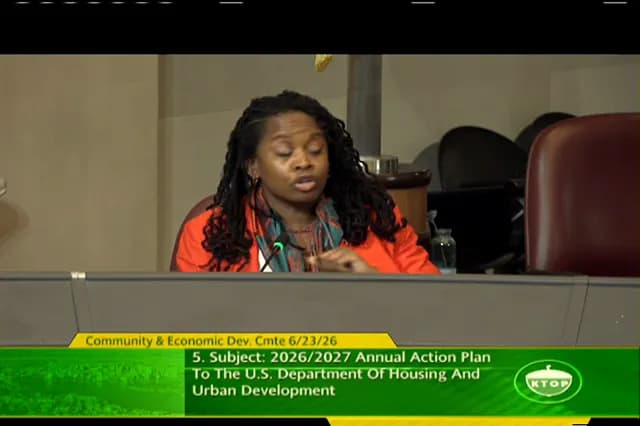
The Community & Economic Development Committee met on June 23, 2026 at 1:35 PM in Oakland City Hall. Chair Rowena Brown presided, with Councilmembers Carroll Fife, Janani Ramachandran (excused for part of the meeting), and Zac Unger present. The committee considered six agenda items and heard extensive public testimony. All items were approved and forwarded to the July 7, 2026 City Council meeting. Consent Calendar - Approval of Draft Minutes (June 9, 2026): Approved unanimously (4-0) without discussion. - Determination of Schedule of Outstanding Committee Items: Approved as presented (4-0) after two public speakers commented on code enforcement and other issues. Public Comments & Testimony - Item 3 (Costco Exclusive Negotiation Agreement): Five speakers addressed the committee. Chris Norn (West Oakland resident) expressed strong support, noting the lack of a supermarket and other resources in West Oakland. Costco representatives (Stephen Labange, Lamar Bell, Christina Tostado) praised the company’s wages, benefits, and community donations (e.g., $1.9 million to Children’s Hospital). One speaker, Sado Olabala, raised concerns about soil contamination at the Army base site and questioned whether jobs would go to Black residents. - Item 4 (BID Annual Reports): Two speakers spoke. Daniel Swafford (executive director of Temescal and Laurel BIDs) thanked the city for collaboration and highlighted cleanup and safety achievements. Sado Olabala criticized the assessment of residential property and questioned city payments to the Oakland Ice Rink. - Item 5 (HUD Annual Action Plan): Seventeen speakers, mostly tenants from Oakland Station and advocates from ACE Oakland and the Oakland Tenants Union, described deplorable living conditions: mold, pests, broken gates, mailroom theft, and a dead dog in a garbage room. They demanded proactive rental inspections and stronger code enforcement. Several speakers called for a timeline for complaint resolution and penalties for non‑compliance. - Item 6 (319 Chester Street): Five speakers spoke. Rochelle Miller and Amber Cox (AWOD board members) supported the conversion to rental housing, explaining years of delays due to founder’s death, COVID, and funding gaps. They noted the project is near completion and that an experienced property manager has been secured. Other speakers (Sado Olabala, Buffalo Sojourn) questioned the high cost per unit and alleged unequal scrutiny of Black developers. - Open Forum: Additional comments addressed sanctuary city policies, concerns about strong‑mayor governance, and petitions from Laurel BID property owners (35th Avenue) seeking removal from the assessment district due to high fees and language barriers. Discussion Items - Item 3 – Costco Exclusive Negotiation Agreement (ENA) Staff (Kelly Kahn, Brendan Moriarty) presented the proposal for a 24‑month ENA with Costco to develop a store on 23 acres at 101 Admiral Robert Toney Way and 2308 Wake Avenue. The ENA requires a $300,000 non‑refundable payment and allows two six‑month extensions at $25,000 each. The city estimates $3 million in annual general fund revenue, approximately 400 high‑quality jobs, and local access to affordable goods. The site has historical contamination from Army base use, which will be evaluated through CEQA during the ENA period. The committee voted 4-0 to approve and forward to the July 7 City Council. - Item 4 – BID Annual Reports and Assessment Payments Eric Samunza (EWD) presented aggregate statistics for eight property‑based BIDs: 2,500 businesses served, 5,100 parcels, 19,000 residents. Highlights included 117 full‑time equivalent staff (40% cleaning), 300 volunteers, and 3.2 million visitors to Oakland via Visit Oakland. Assessment increases ranged from 3% to 5%. The committee voted 4-0 to approve and forward to City Council. - Item 5 – 2026/2027 HUD Annual Action Plan Hannah Batesh (HCD) outlined the plan to accept and appropriate $14,674,799.07 in CDBG, HOME, ESG, and HOPWA funds. Funds are primarily for capital improvements, with some for services and tenant stabilization. The plan aligns with the city’s five‑year consolidated plan. Following public testimony about housing conditions, Chair Brown and Administrator Baker committed to follow‑up inspections at Oakland Station and other code enforcement reforms. The committee voted 3-0 (Ramachandran excused) to approve and forward to the July 7 public hearing. - Item 6 – Sale of 319 Chester Street Trisha Gonzalez and Deputy Director Fay Darmawi (HCD) recommended converting the long‑delayed two‑unit for‑sale project into an affordable rental project. The city will consolidate existing loans ($94,000 seller financing and $400,000 construction loan) and add $1 million from Measure U funds, for a total 55‑year residual receipts loan of $1,494,000. The project is now financially viable due to a strengthened development team. Councilmembers questioned the cost ($500,000 per door) and repayment likelihood. The committee voted 3-0 (Ramachandran excused) to approve and forward to City Council. Key Outcomes - Item 3 (Costco ENA): Approved 4-0, forwarded to July 7 City Council. - Item 4 (BID Reports): Approved 4-0, forwarded to July 7 City Council. - Item 5 (HUD Action Plan): Approved 3-0, forwarded to July 7 City Council as a public hearing. - Item 6 (319 Chester Street): Approved 3-0, forwarded to July 7 City Council. - Directives: The City Administrator was directed to follow up on code enforcement at Oakland Station and other properties raised during public testimony. - Next Steps: All items will be heard by the full City Council on July 7, 2026.