The Disabilities Advisory Commission convened on Wednesday, March 4, 2026 at 5:30 PM at City Hall Complex, 915 I Street, Sacramento. The meeting was called to order by Vice Chair Keith Ellis (in the absence of Chair Sylvia Kramer) and included the swearing-in of new Commissioner Elsie Guerrero. The commission reviewed and commented on three major infrastructure projects—the H Street Bikeway, Sacramento Valley Station updates, and the Stockton Boulevard Safety and Transit Enhancement Project—and addressed consent items, staff reports, and public comments. Consent Calendar - Item 1 (File ID: 2026-00076): Approved the February 4, 2026 meeting minutes. - Item 2 (File ID: 2026-00212): Approved the Disabilities Advisory Commission Follow-Up Log. - Action: Motion by Commissioner Michael Barnbaum, seconded by Commissioner Satty Kaur. Passed unanimously (7 ayes: Barnbaum, Greenbaum, Guerrero, Igwegbe, Kaur, Pullen, and Vice Chair Ellis; 5 absent: Dyson, Napper, Patel, Wilson, and Chair Kramer). Public Comments & Testimony - LR Roberts (Older Women's League, formerly California for Disability Rights) spoke on two issues: (1) difficulty parking downtown for city meetings despite a disabled placard, and (2) criticism of police ticketing a homeless woman with a walker for lying on a bench at City Hall, suggesting the enforcement may be an ADA violation and mischaracterized as homeless services in the budget. Discussion Items - 3. H Street Bikeway (Cecilyn Foote, Associate Civil Engineer): Presented a project on H Street between 5th and 10th Streets to construct a two-way Class IV separated bikeway and Class II bike lanes on 10th Street, improving connectivity to Sacramento Valley Station. Key design elements include ADA-compliant curb ramps, audible pedestrian signals, and a sidewalk-level bikeway near City Hall. Public outreach began February 26, 2026. Preliminary engineering targets end of spring 2026; final design estimated at 12–18 months; construction possible in 2028 pending coordination with Sacramento Regional Transit. Commissioners raised concerns about bicyclist safety at stop signs, the need for accessible public engagement (ASL, large print, braille), and sidewalk clearance widths. Commissioner Pullen urged exceeding ADA minimums. - 4. Sacramento Valley Station Project Update (Greg Taylor, Supervising Architect): Provided an update on multiple TERSIP-funded projects. New pedestrian entrance connecting the existing passenger tunnel to the Central Shops Plaza (construction underway, entertainment venue opening by end 2027). A new pickup/drop-off loop will shorten the walking distance to platforms to 540 feet. A new West Side Access Project (Burkett Street extension) with a cul-de-sac for bus layover and restroom facilities (construction by developer likely next year). Seventeen new regional bus stops downtown with reused canopies from San Francisco’s Transbay Terminal (detailed design 2026–2027, construction 2027–2028). Commissioner Barnbaum asked about coordination with SACRT 2050; Taylor confirmed ongoing collaboration. Commissioner Pullen expressed concerns about Amtrak’s shuttle not accommodating wheelchair users who cannot transfer, and suggested adding seating, lighting, and weather protection along the 540-foot path. Taylor agreed to return with a wayfinding presentation possibly in June. - 5. Stockton Boulevard Safety and Transit Enhancement Project (Jesse Gothan, Supervising Engineer, and Greg Kyle, Kimley Horn): Currently in alternatives analysis (to complete summer 2026). Two BRT route alternatives: Alternative 1 (Route 51 alignment via 7th/8th/9th Streets) and Alternative 2 (Route 51/38 hybrid via T Street, 29th/30th, and J/L Streets). Three complete streets alternatives for segments—ranging from minimal improvements to a reimagined corridor with separated pedestrian/cyclist facilities. Public meeting scheduled April 15, 2026 at Oak Park Community Center. Commissioner Barnbaum voiced strong support for the hybrid alignment (Alternative 2) citing direct access to UC Davis Medical Center and one-seat ride to the station; Vice Chair Ellis echoed that preference. Commissioner Guerrero suggested applying for federal community project funding. No vote was taken (discussion only). Key Outcomes - Consent calendar approved unanimously. - Staff oral report: Annual report approved by the Planning and Public Engagement Committee (February 17, 2026) and forwarded to full City Council for March 24, 2026 meeting. Recommendation for a citywide accessibility coordinator was forwarded to Budget and Audit Committee (target May 5, 2026). Public comment process revision underway to comply with state law (expected by July 2026). - Next meeting: Vice Chair Ellis announced the April 22 meeting is likely cancelled; the next meeting will be May 6, 2026. Formal notice will be provided 10 days prior. - Commissioner announcements: Commissioner Barnbaum detailed Sacramento Regional Transit service disruptions for March–April 2026 due to platform modifications and track work at multiple stations (Marconi Arcade, Arden/Del Paso, Royal Oaks, Watt/I-80). - Public comment noted by staff for future consideration.
Public Meetings - Sacramento, California
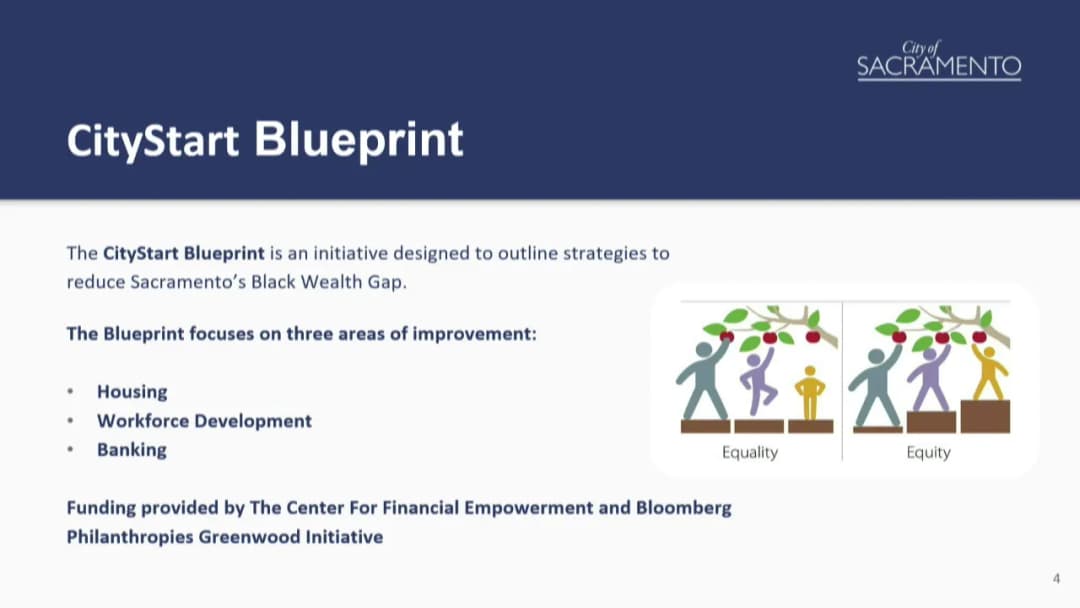
Public Meetings - Sacramento, CaliforniaThe Racial Equity Committee of the City of Sacramento met on Tuesday, March 3, 2026, from 11:02 a.m. to 12:06 p.m. at City Hall. Chair Vang led the meeting, with members Jennings and Talamantes present (Member Guerra absent, Vice Chair Talamantes departed at 12:02 p.m.). The committee addressed two major discussion items: an update on the Sacramento Centered on Racial Equity (SCORE) Initiative and an update on the CityStart Initiative, including forwarding a blueprint to the City Council. Consent Calendar - Item 1 (2026-00544): Approved the Racial Equity Committee Meeting Minutes from January 20, 2026, by a unanimous vote (3-0, with Guerra absent). Public Comments & Testimony - On SCORE Initiative (Item 2): - Will Lambert (public speaker): Criticized the large gap between committee meetings (January to June) as a "recipe for failure" and expressed distrust in the city's commitment to racial equity, warning that terms like "deliberate speed" are delay tactics. He argued that funding is essential and that the city must show action, not just plans. - Cal Yee (Racial Equity Alliance): Urged committee members to affirm their commitment to community partnership and shared power, noting that the Alliance is an active implementation partner. He asked policymakers to clarify their vision and ensure sustained progress, especially through funding for the Office of Diversity and Equity (ODE). - Henry Harry (public speaker): Recalled past discrimination (e.g., Wells Fargo settlements) and emphasized the need for strong leadership (e.g., a video from the mayor) and a citizen committee to step up if budget cuts occur. - On CityStart Initiative (Item 3): - Will Lambert: Criticized the lack of funding for the blueprint and questioned the city's commitment, noting that resistance to DEI existed before the current federal administration. He also objected to retreats and remote work pay raises. - Henry Harry: Stressed the importance of adequate police staffing and stable funding, arguing against an "either-or" choice between police and other programs. He encouraged citizen input on police funding. Discussion Items - Item 2: Update on SCORE Initiative (File ID: 2026-00586) - Presentations: Darnell Grisby and Malachi Seku Amen (California Urban Partnership / Sacramento Racial Equity Alliance) presented findings from a February 24 community forum. Key themes from the forum included: need for a sustainable funding structure, language access, trauma-informed engagement, stronger community accountability, leadership development, and addressing structural barriers (e.g., meeting times, late agenda releases). They advocated for a "both/and" strategy—pursuing external funding while maintaining a city commitment—and for preserving current ODE funding levels. - Staff Update: Aimée Zenzele Barnes (Diversity & Equity Manager) reported on the iterative process of the SCORE Work Plan, highlighting changes made after community input, such as adjusting phases and adding strategies. She noted that the work plan is dynamic and not meant to be static. - Committee Direction: Chair Vang directed staff to produce a response memo addressing the community's learning outcomes (e.g., funding, language access, trauma-informed approaches) and to schedule a special meeting (likely in April) before the budget adoption (June 9) to vote on the work plan. The committee stressed that the work must continue regardless of budget constraints and that the response memo should outline what the city can and cannot do, with alternatives. - Vice Chair Talamantes: Emphasized that the budget deficit ($62 million) requires a focus on what can be kept or done without dollars, not new spending. - Member Jennings: Supported the special meeting and urged it be held as soon as possible, not wait until late April or May. - Item 3: Update on CityStart Initiative and Next Steps (File ID: 2026-00612) - Presentation: Ari Green (Community Engagement Analyst) presented the CityStart Blueprint, developed with a $75,000 grant from the Cities for Financial Empowerment (CFE) Fund (with Bloomberg Philanthropy's Greenwood Initiative). The blueprint is a roadmap to address Sacramento's Black wealth gap, focusing on workforce development, housing, and banking services. Recommendations include expanding guaranteed income programs, supporting local black developers, building philanthropic partnerships (SacLIFT), and engaging youth. A video of the May 2025 release was shown. - Committee Action: Member Jennings moved to forward the CityStart Blueprint to the City Council as an update; Vice Chair Talamantes seconded. The motion passed unanimously (3-0), with the committee acknowledging the work done. Key Outcomes - SCORE Initiative: The committee directed staff to produce a response memo to community feedback from the February 24 forum and to schedule a special meeting (target: April) to review the response and vote on the updated SCORE Work Plan before the June budget adoption. - CityStart Initiative: The committee voted unanimously to forward the CityStart Blueprint to the City Council as an update on the initiative's status. - No further committee comments or public comments on matters not on the agenda. - Meeting adjourned at 12:06 p.m.
The Sacramento City Council held a regular meeting on Tuesday, March 3, 2026, convening at 5:07 p.m. and adjourning at 6:21 p.m. The meeting included a special presentation for National Engineers Week, public hearings on historic preservation and cannabis regulations, a discussion on extending a CORE program dispensary opportunity, and public comments on a proposed microcommunity, a confiscated teepee, and other community concerns. Special Presentation/General Communications - National Engineers Week: Mayor Pro Tem Eric Guerra presented a resolution recognizing National Engineers Week. Two students from Sacramento State's Math Engineering Science Achievement (MESA) program and the Society of Hispanic Professional Engineers were recognized. The students shared their career aspirations. Public Hearings - Item 1 (Orbit Station Landmark): Ordinance listing 2240 Northgate Boulevard as a landmark was continued to March 17, 2026. - Item 2 (Cannabis Land Use Ordinance): Withdrawn. - Item 3 (Cannabis Consumption Lounge Fees): Withdrawn. Discussion Items - Item 4 (CORE Program Dispensary Extension): Staff presented two options regarding the storefront cannabis dispensary opportunity for a CORE program participant whose permit expires April 1, 2026: (1) allow the opportunity to expire and give it to the next highest-scoring RFQ participant, or (2) adopt a resolution extending the opportunity by one year (to April 1, 2027) and also extending the application period for new applicants from five to six years. - Public Testimony: Seven speakers addressed the council. Jarrett Hill, the applicant, described losing his original site to a fire, securing a new location with a CUP, and needing a one-year extension. Other speakers supported the extension, citing the applicant's diligence and the barriers faced by equity applicants. One speaker, Zion Taddis, criticized the CORE program for low success rates (less than 4% of license holders from the equity community). Michael Milton and others expressed general support for cannabis businesses and equity. - Council Deliberation: Councilmember Kaplan moved to adopt a one-year extension (to April 1, 2027) but not to extend the opportunity for new applicants from five to six years. She requested a status update by December 31, 2026. Councilmember Dickinson raised the equity of also allowing the next person on the list to proceed, but after discussion, the council decided to wait for a market study and Title 17 changes expected in April. Councilmember Maple supported the motion, noting the challenges for CORE applicants. - Vote: Motion passed unanimously (9-0; all members present voting aye). City Manager’s Report - City Manager Maraskeshia Smith announced a Pothole Blitz to focus on filling potholes. Councilmembers were asked to compile lists of streets from constituents within two weeks. Public Comments – Matters Not on the Agenda - Eleven speakers addressed the council on various topics: - Microcommunity Proposal (North Natomas): Several residents (Lena Shea, David Weitzel, Rick Locke, Rosie Lair, Gary Fleshman) expressed strong opposition to a proposed microcommunity (tiny homes) at Elk Central Road and Arena Boulevard, citing proximity to schools, parks, lack of transit, lack of indoor bathrooms/kitchens, and concerns about public safety and budget deficits. They requested that an alternative proposal from Councilmember Kaplan be placed on a future agenda. - Confiscated Teepee (Native American Sacred Item): Multiple speakers (Liana, Sierra, Rosa, and others) demanded the return of a teepee seized by Sacramento Police. They argued it was a sacred religious artifact used in ceremonies and labeled as a "tarp" to avoid accountability. They threatened legal action under the Native American Freedom of Religion Act. - Business Break-ins: Ernesto Delgado reported two break-ins at his businesses (Mercado Urbano and Octopus Peru) in two weeks, requesting more police attention. - Public Safety and Policing: LR Roberts complained about inadequate response to threats and thefts, and criticized police for focusing on homeless individuals while ignoring violent threats. Another speaker (Michael Milton) urged the city to build apartments instead of tiny homes. - Protest Encampment: A speaker (Fayo) criticized the city for not returning the teepee and for police harassment of protesters at the ICE facility. Key Outcomes - Adopted Resolution No. 2026-0055 (unanimous): Extending the CORE program storefront dispensary opportunity for one year (new expiration April 1, 2027) for the current applicant (Jarrett Hill). The five-year timeline for new applicants remains unchanged. Staff will report back by December 31, 2026 on progress. - Public Hearing Items: Item 1 continued to March 17, 2026; Items 2 and 3 withdrawn. - Pothole Blitz: City Manager will coordinate with councilmembers to collect pothole locations for a targeted blitz within two weeks.
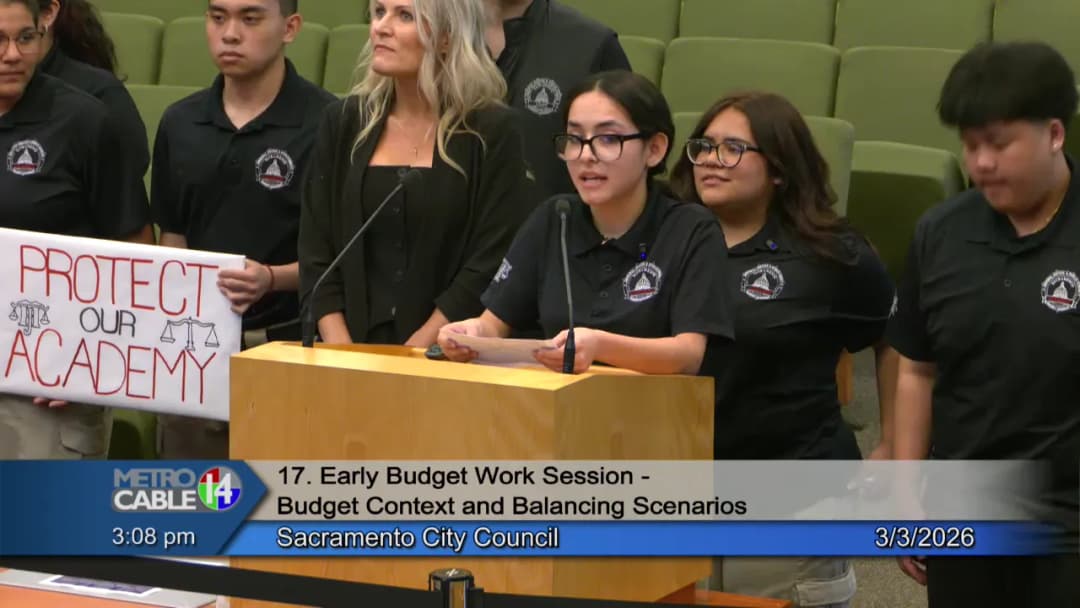
The Sacramento City Council met on Tuesday, March 3, 2026, at 2:03 PM in the City Hall Council Chamber. The meeting was called to order by Vice Mayor Karina Talamantes and adjourned at 4:33 PM. The agenda included a Consent Calendar, two public hearings, and two discussion items, including an early budget work session and a workshop on the 2027 SHRA One-Year Action Plan Federal Programs Allocation Process. Mayor Kevin McCarty was absent for the entire meeting. The council approved all Consent Calendar items unanimously, adopted the public hearing items, and received and filed the budget work session, providing direction for further analysis. Consent Calendar - Item 1: Confirmed Elsie Guerrero to the Disabilities Advisory Commission (Seat D). - Item 2: Established the Shore Vista Way Overcrossing Traffic Signal Project (T15265300) as a new Capital Improvement Project and authorized a $640,000 transfer from the Greenbriar IA1 PAG fund. - Item 3: Received and filed the January 2026 Monthly Investment Transactions Report. - Item 4: Approved the Americans with Disabilities Act (ADA) Public Right-of-Way Prospective Plan for Fiscal Year (FY) 2025/26. - Item 5: Awarded the construction contract for the HSIP-10 Pedestrian Crossings Improvement Project to St. Francis Electric, Inc. for $347,964, and approved a $193,600 budget adjustment. - Item 6: Authorized a supplemental contract with Suburban Motors dba Future Ford of Sacramento for Ford OEM parts and repairs, increasing the contract by $4,800,000 to a total not-to-exceed of $6,000,000, with performance extended through June 25, 2029. - Item 7: Adopted a resolution providing Jarvis Fay LLC access to confidential tax information for litigation support. - Item 8: Authorized a supplemental contract with BM Enterprises Inc. dba California Auto Body for vehicle body repair services, increasing the contract by $1,250,000 to a total not-to-exceed of $2,000,000. - Item 9: Accepted a $16,856 subaward from the Fiscal Year 2024 State Homeland Security Grant Program (SHSGP) and adjusted the operating grant budget. - Item 10: Approved a contract amendment with Heritage Landscape Supply, Inc. for irrigation supplies, increasing the total not-to-exceed amount to $360,000 over three years. - Item 11: Approved a contract amendment with Goodwin-Cole Co., Inc. for shade canopy repair, maintenance, and replacement, extending the contract through June 30, 2027, and increasing the total to $688,126. - Item 12: Authorized a sublease agreement with Der Biergarten Waterfront for the Old Sacramento Waterfront Café (Steamers Building) for an initial one-year term with up to three five-year extensions. - Item 13: Adopted a resolution authorizing the Sacramento Housing and Redevelopment Agency (SHRA) to enter into a Memorandum of Understanding with the County of Sacramento related to a contract with CVR Associates, Inc. for Executive Director services. Public Comments & Testimony - On Item 16 (SHRA Workshop): No public comments were offered. - On Item 17 (Budget Work Session): Eighteen speakers addressed the council. The majority were students and staff from local high school law academies (Hiram Johnson, John F. Kennedy, and Intercom) urging the council to maintain the full-time presence of police officers in their programs, citing mentorship, leadership development, and community connections. One speaker, Lambert, criticized the council's approach to homelessness and called for audits of past contracts. Another speaker, Rose, raised equity concerns about requiring insurance and permits for futsal courts but not for other sports. A parent, Maria Gutierrez, spoke about the positive impact of the law academy on her daughter's college acceptances. Henry Harry, a subsequent speaker, proposed using empty storefronts for homeless services and a volunteer police reserve program. Discussion Items - Item 16: 2027 SHRA One-Year Action Plan Federal Programs Allocation Process Workshop Number One: Staff presented an overview of federal entitlement grants (CDBG, HOME, ESG, HOPWA) with estimated 2027 funding totaling approximately $9.2 million. Councilmembers discussed the need for more homelessness prevention funding, transparency in administration costs, and support for specific projects like the Robla Community Park restrooms and the renter's helpline. Councilmember Dickinson asked for a more detailed breakdown of planning vs. administration costs and expressed interest in maximizing funding for actual projects. Councilmember Kaplan and others emphasized the importance of prevention and data-driven decision-making. The item was received and filed, with direction to staff to bring back more detailed information. - Item 17: Early Budget Work Session - Budget Context and Balancing Scenarios: City Manager Maraskeshia Smith and Finance Director Pete Coletto presented the current fiscal context, including a $66 million structural deficit for FY 2026-27, a $1.7 billion total budget, and a $872.5 million general fund. The presentation outlined three scenarios: (1) zero reductions in priority areas (economic development, homelessness, public safety) requiring 56% cuts elsewhere, (2) proportional 11.6% across-the-board cuts, and (3) a baseline approach using a 15% reduction plan from each department plus citywide strategies. Councilmembers discussed the need to protect core services, minimize employee layoffs, and explore efficiencies such as bringing contracted services in-house, analyzing vacancies, and prioritizing equity. Councilmember Dickinson, as budget chair, emphasized maintaining services, preserving employees, and advocating for state HAP funding restoration. Councilmember Kaplan requested a forensic audit and a two-year budget cycle. Vice Mayor Talamantes noted the $195 million in non-discretionary costs. Councilmember Vang stressed the importance of racial equity and protecting youth and senior services. The item was received and filed, with direction to staff to bring forward more detailed departmental presentations in subsequent weeks. Key Outcomes - Consent Calendar: All 13 items were approved unanimously (8-0, with Mayor McCarty absent). - Item 14 (The Enclave at Airport Road): Approved unanimously (8-0) as a public hearing item. The project includes 32 single-unit dwellings on 2.03 acres, a development agreement, rezoning, PUD amendments, and a tentative subdivision map. - Item 15 (Delta Shores Finance Plan and Development Impact Fee Update): Approved by a two-thirds vote (8-0) after a public hearing. The council adopted a motion to bypass the Law and Legislation Committee, a resolution adopting the updated finance plan, and an ordinance to replace references to "Stone Boswell" with "Stone Beetland." - Item 16: Received and filed; council directed staff to bring back more detailed information on administration costs, homelessness prevention, and project readiness for the next workshop. - Item 17: Received and filed; council provided direction to staff to explore vacancies, contract reviews, equity impacts, and to present specific departmental reduction scenarios in the upcoming March work sessions. The city manager confirmed that the list of potential cuts is a menu of options, not final decisions.
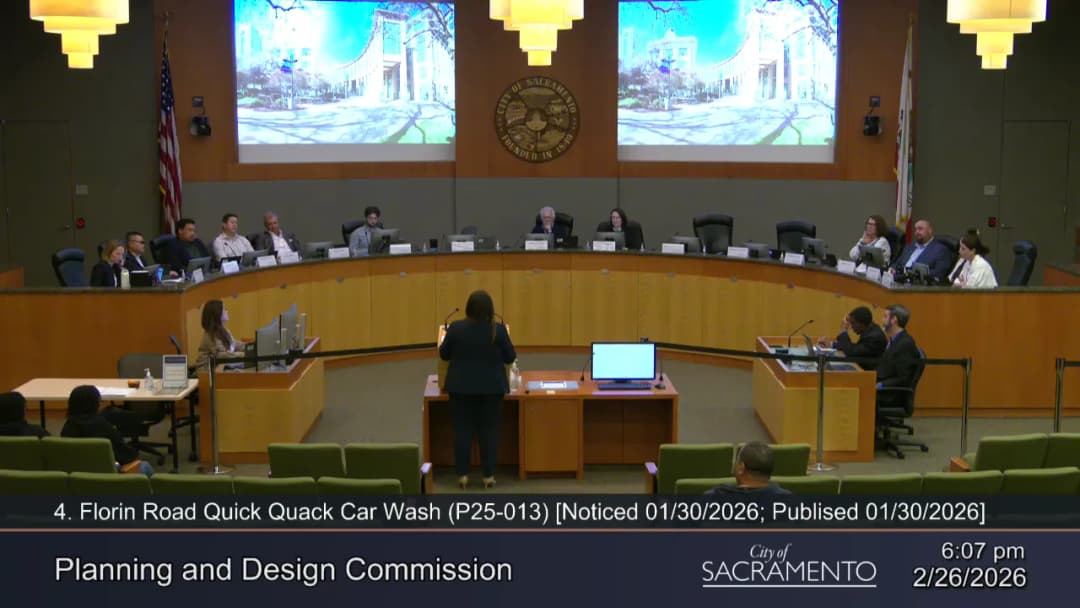
The Sacramento Planning and Design Commission met on February 26, 2026, at 5:30 PM at City Hall to review four agenda items, including a consent calendar item, a continuation, a conditional use permit for alcohol sales, and a conditional use permit and design review for a car wash. The meeting concluded at 7:16 PM. Consent Calendar - Approval of Minutes (File ID: 2026-00140): The Commission unanimously approved the minutes from the January 22, 2026 and February 12, 2026 meetings. The motion passed 10-0-3, with Commissioners Hernandez, Macias Reed, and Yeung absent. Public Hearings - Item 2 – Short-Term Rental Amendments (M25-026): This citywide code amendment was continued to March 12, 2026, with no discussion. - Item 3 – Del Paso Boulevard Alcohol Sales (P25-011): The Commission approved a Conditional Use Permit to allow the sale of distilled spirits (Type-21 license) in addition to existing beer and wine sales at a 1,600-square-foot convenience store at 3560 Del Paso Boulevard. The vote was 10-0-3. Public Comments & Testimony - Item 3 (Alcohol Sales): Several residents and a business owner spoke in support, describing the store owner as a responsible operator who supports the neighborhood. One resident noted the owner helped them quit drinking. A representative from the Hagginwood Community Association submitted a letter of support. - Item 4 – Florin Road Quick Quack Car Wash (P25-013): Multiple community members testified. A local pastor opposed the project, advocating for senior housing instead. A group of students from Luther Burbank High School, members of "Phoenix on the Rise," spoke in favor, citing job opportunities and community partnership. Other residents supported the project for economic benefits and beautification. Discussion Items - Item 4 – Florin Road Quick Quack Car Wash: The applicant proposed a Quick Quack car wash on a 1.15-acre portion of a 14.25-acre vacant parcel at 3815 Florin Road. Staff recommended denial, citing conflict with the General Plan’s vision for transit-oriented development (TOD) on a high-frequency bus corridor, proximity to light rail (approximately 0.75 miles walking distance), four existing nearby car washes, and environmental justice concerns (AB 617 area). The applicant argued the project is consistent with General Plan policies, provides a unique pedestrian amenity, includes right-of-way dedication for future Bus Rapid Transit (BRT), and enjoys community support. Commissioners debated the balance between immediate economic benefit and long-term transit-oriented goals. Commissioner Nybo moved to deny, seconded by Commissioner Lee. Key Outcomes - Item 3 (Alcohol Sales): Motion carried 10-0-3, approving the Conditional Use Permit and environmental exemption. - Item 4 (Car Wash): Motion to deny passed 10-1-2, with Chair Chase dissenting and Commissioners Hernandez, Macias Reed, and Yeung absent. The project was denied based on inconsistency with land use policies for a transit corridor, lack of need for another car wash, and potential public safety impacts.
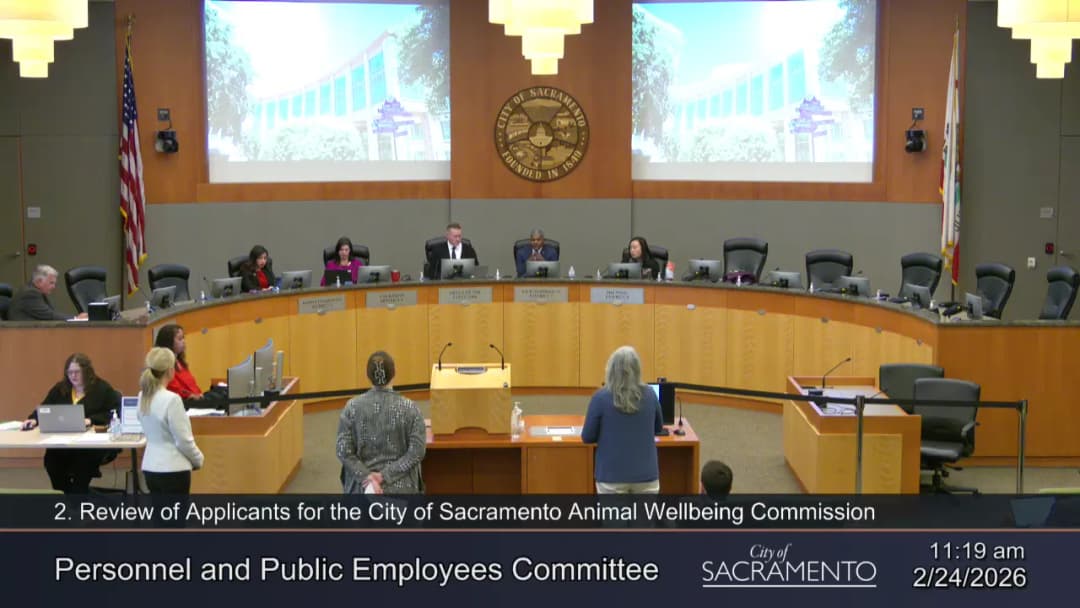
The Personnel and Public Employees Committee of the City of Sacramento met on Tuesday, February 24, 2026, at 11:00 AM in the City Hall Council Chamber. Chair Rick Jennings presided, with members Lisa Kaplan, Karina Talamantes, and Mai Vang present. The meeting, which adjourned at 12:10 PM, focused on reviewing applicants for several city boards and commissions and considering annual reports and workplans from four commissions. Consent Calendar - Approved the meeting minutes from January 27, 2026 (File ID 2026-00533) by a unanimous vote (4-0). Public Comments & Testimony - Animal Wellbeing Commission Seat L: Leia Morris, speaking as a member of the public, expressed support for applicant Shannon Asquith, citing her extensive volunteer work, including spay/neuter events that served about 200 animals per event, and her potential to collaborate with other shelters. Discussion Items - Review of Applicants for Animal Wellbeing Commission (Seat L): Three applicants were interviewed in person (Jane Anise, Shannon Asquith, Morgan Lescotti); one withdrew and one was absent. Councilmember Vang asked all three about measures of success in animal welfare and conflict resolution. The committee recommended Shannon Asquith for appointment to the Mayor and Council (motion by Talamantes, second by Kaplan; unanimous). Chair Jennings noted that those not selected could still pursue appointment through other district vacancies. - Review of Applicants for Housing Code Advisory and Appeals Board (Seat D): Only applicant Barry Boyd (incumbent) was absent due to illness. The committee recommended his reappointment unanimously. - Review of Applicants for Civil Service Board (Seat C): Only applicant Elena Monique Gonzalez-Soto was not present. The committee recommended her appointment unanimously. Member Talamantes noted that District 2 is historically underrepresented on boards. - Review of Applicants for Sacramento Housing and Redevelopment Commission (Seats A and C): Five applicants were considered; Preston Chi Wong appeared in person. The committee recommended Daniyal Hassan for Seat A and Preston Chi Wong for Seat C (motion by Kaplan, second by Vang; unanimous). A brief clarification confirmed that Wong resides within city limits despite an Elk Grove address. - Preservation Commission 2025 Annual Report and 2026 Workplan: Sean de Courcy presented the report, highlighting over a dozen local landmark reviews and ongoing projects (e.g., Hackett House, LGBTQ+ historic context). The committee voted 3-0 (Member Talamantes absent) to forward the report to City Council without changes. - Disabilities Advisory Commission 2025 Annual Report and 2026 Workplan: Vice Chair Keith Ellis emphasized the need to go beyond ADA minimums, citing examples like door buttons in the council chamber. He renewed the call for a citywide ADA coordinator. Vice Chair Kaplan moved to forward the report to Council and also to send the commission's budget requests (including the ADA coordinator position) to the Budget and Audit Committee. The motion passed unanimously. - Animal Wellbeing Commission 2025 Annual Report and 2026 Workplan: Aliyah Morris, former vice chair, presented. Key 2025 accomplishments included new wayfinding at Front Street Shelter, spay/neuter events (about 200 animals in two days), translation of brochures into five languages, and interim shelter safety improvements. The 2026 workplan is pending due to 40% new membership. The committee unanimously forwarded the report to City Council. - Youth Commission 2025 Annual Report and 2026 Workplan: Staff presented on behalf of the Commission, noting that 2025 saw the highest seated youth count since codification (19 seats). Focus areas were Aggie Square, youth mental health, and youth voice. The committee unanimously forwarded the report to City Council. - Status Report of Youth Serving on City Boards and Commissions: City Clerk Mindy Cuppy reported that seven commissions besides the Youth Commission have designated youth seats. Most other commission seats have no age minimum, so councilmembers can appoint youth to any recommendation seat. Some charter-established commissions would require voter approval to add youth seats. Councilmember Vang inquired about onboarding support for youth commissioners; staff described orientation and mentorship practices. The report was received and filed. Key Outcomes - Appointments recommended to Mayor and Council: - Shannon Asquith – Animal Wellbeing Commission (Seat L) – unanimous - Barry Boyd – Housing Code Advisory and Appeals Board (Seat D) – unanimous - Elena Monique Gonzalez-Soto – Civil Service Board (Seat C) – unanimous - Daniyal Hassan – Sacramento Housing and Redevelopment Commission (Seat A) – unanimous - Preston Chi Wong – Sacramento Housing and Redevelopment Commission (Seat C) – unanimous - Annual reports forwarded to City Council: - Preservation Commission (vote 3-0; Talamantes absent) - Disabilities Advisory Commission (unanimous; additionally forwarded budget recommendations to Budget and Audit) - Animal Wellbeing Commission (unanimous) - Youth Commission (unanimous) - Status report on youth serving on boards: Received and filed; direction noted to continue supporting youth onboarding. - Committee comments: Vice Mayor Talamantes proposed developing a formal process to incorporate commission fiscal recommendations into the budget cycle, with follow-up discussion planned.
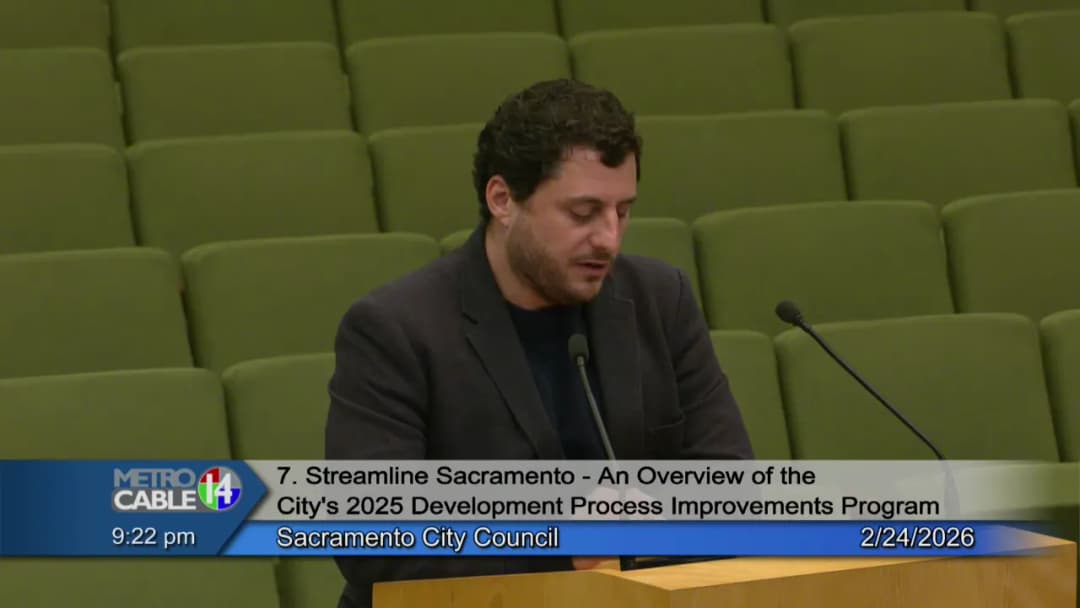
The Sacramento City Council met on Tuesday, February 24, 2026, starting at 5:08 PM in the City Hall Council Chamber. The meeting addressed a range of topics including public hearings, a violent crime reduction strategy, a digital billboard ordinance, an economic development workshop, and a development process improvement program. Several items were continued or withdrawn. The meeting included extensive public testimony and council discussion, and adjourned at 9:47 PM in memory of Phyllis Johnson. Public Hearings - Item 1 – The Enclave at Airport Road (P25-010): The public hearing for this development project at 3600 Airport Road was continued to March 3, 2026, by staff recommendation. - Item 2 – Natomas Basin Habitat Conservation Plan (HCP) Fee – 2026 Adjustment: This item was withdrawn by staff prior to council action. - Item 3 – Resolution Establishing Business Operating Permit Fees for Cannabis Consumption Lounges: The hearing was continued to March 3, 2026. Sacramento Police Department Violent Crime Reduction Strategy (Item 4) Chief Katherine Lester presented a detailed report on the department’s focused, data-driven violence reduction efforts since 2022. Key statistics included: citywide shooting reports declined from 725 (2022) to 476 (2025); shooting victims dropped from 175 to 131 over the same period; gun crime citywide fell 53% from 945 incidents in 2021 to 444 in 2025; and in identified hotspot zones (Del Paso Heights, Oak Park, Meadowview/Valley High), gun violence declined nearly 70% (from 423 to 135 incidents). The department seized over 4,000 firearms (including 800+ ghost guns) over four years. The strategy relies on focused deterrence, data analysis, technology (public safety camera network, license plate readers, real-time information center), and strong partnerships with community-based organizations (CBOs) and the Office of Violence Prevention. A $5 million state grant (CalVIP Cohort 5) was announced to sustain CBO partnerships. Public Comments: Five speakers addressed the item. Barb Ram expressed support for the crime reduction and advocated for fewer police stops and military equipment. Scott Ford (Downtown Sacramento Partnership) praised the Chief’s leadership and the department’s preventive approach. Ernesto Delgado (small business owner) commended the work but reported two recent break-ins. Karen Corbes thanked the department but urged maintaining funding for public safety. Christina Rogers (Land Park Community Association) appreciated the quick police response and asked for continued investment in CBOs. Council Discussion: All council members praised the department’s work and the collaborative approach. Councilmember Vang emphasized the connection between violence and social conditions in impacted neighborhoods, and asked about school district partnerships. Chief Lester and Dr. Clavo outlined existing coordination with Sacramento City Unified and Twin Rivers districts, and the new grant will expand school-based referrals. Councilmember Dickinson highlighted the importance of technology and problem-oriented policing (POP) officers, while also noting that broader societal investments are needed to change the map of concentrated violence. Councilmember Maple requested a future in-depth report on CBO program outcomes. Councilmember Kaplan called for a comprehensive youth violence prevention plan. Councilmember Jennings and Mayor Pro Tem Guerra expressed gratitude and urged continued focus. The item was reviewed and commented on; no formal vote. Digital Billboards Ordinance (Item 5) Matt Sites (Senior Architect) presented amendments to City Code Section 15.148.965 to allow additional digital billboards for outdoor stadiums: reducing minimum stadium capacity from 15,000 to 12,000 seats, increasing maximum billboards from 6 to 7, and setting a maximum of two 1,200 sq ft billboards with others limited to 700 sq ft. The changes are intended to support the Rail Yards development. Public Comments: Seven speakers opposed the ordinance. Kevin Boltz criticized the public subsidy for a luxury project with only 6% affordable housing. Sonia Carabel (Unite Here Local 49) argued the billboards represent a hidden giveaway and urged using the revenue for affordable housing. Pamela Freeman (Wong Center resident) shared safety fears and opposed developer giveaways. Yolanda Villanueva (Wong Center) echoed concerns about insufficient affordable housing. Francisco Garcia (District 2 resident) objected to low affordable housing percentages. Nancy Williams (AJ resident) and Alex Hansen also expressed frustration with the deal and called for renegotiation. Council Discussion: Vice Mayor Talamantes confirmed the amendments are for billboards already approved and directed the City Manager to meet with residents. Councilmember Vang announced she would vote no, citing the lack of clarity on revenue valuation and budget concerns. Councilmember Pluckebaum supported the item as a necessary part of the project. Vote: Motion passed 7-1 (Councilmember Vang opposed; Councilmember Guerra absent). Ordinance No. 2026-0004 was adopted, and CEQA exemption was approved. Economic Development Workshop (Item 6) Assistant City Manager Michael Jasso, along with directors from Convention and Cultural Services, Community Development, and the Office of Innovation and Economic Development, presented a framework for economic development focused on three pillars: investing in people (workforce, childcare, creative economy, financial empowerment), building attractive places (regulatory environment, public investments, corridor plans like Marysville/Del Paso, Stockton Boulevard), and supporting businesses (Business Solutions Center, economic gardening, innovation programs, business retention and attraction). Data points: the city has 25% of regional businesses; office vacancy rate in downtown is improving but still above pre-pandemic; the convention center hosted 269 events with 1.15 million attendees and $158 million economic impact in 2025. Public Comments: Scott Ford (Downtown Sacramento Partnership) emphasized collaboration. Barry Broom (GSEC) noted the region outperforms California in economic equity metrics. Evan Schmidt (Valley Vision) praised the strategic alignment and regional initiative. Danielle Foster (CADA) thanked the city for housing and creative economy partnerships. Zion Tatis (Community Ambassador) urged more equitable distribution of funds to Black communities. Devin LeClewis (small developer) supported the Small Developer Incubator program and requested the city adopt AB 1033 for ADU condominiums. Council Discussion: Vice Mayor Talamantes asked for more data on large projects (Aggie Square, events) and quarterly reporting. Councilmember Maple advocated for a citywide strategic economic development plan, linking downtown revival with neighborhood corridors, housing, transportation, and pedestrian safety; she raised the idea of activating vacant storefronts and exploring the County Executive Airport for drone testing. Councilmember Dickinson emphasized that downtown is the city’s identifier and must be central to the strategy, while noting the need for investment in high-poverty corridors. Councilmember Pluckebaum called for workforce development, career technical education, and a focus on commercial corridors. Councilmember Kaplan stressed the need for data-driven prioritization, revisiting the business operations tax to support small businesses, and creating walkable, transit-oriented neighborhoods. Next Steps: The Council directed staff to develop an economic development strategic plan with a consultant, incorporating stakeholder input and aligning with regional partners. The plan should include one-year, five-year, and ten-year action items. Streamline Sacramento (Item 7) Matt Hertel (Assistant Director, Community Development) provided an overview of the city’s development process improvement program. Key results: 23,000 plan reviews and 72,000 inspections annually, with 98% on-time plan reviews and 97% on-time inspections. The program implemented 72% of 49 identified actions, including shortened plan review timelines, faster address assignments, waived parcel maps for small subdivisions, small business liaison program, self-certification for restaurants, instant permit issuance for minor permits, rescinding the alternate water systems ordinance, waiving fees for ADU zoning review, and launching virtual inspection technology. Sacramento produces the most housing units per capita among the top six producing cities in California. Upcoming actions include further reducing plan review timelines, a 72-hour small project rapid review, and a permitting one-on-one course. Public Comments: Eleven speakers, most expressing strong support. Charles Krafka (engineer) praised city staff for being top-tier. Parker Evans (Mutual Housing California) stated Sacramento is the easiest place in California to build affordable housing, noting no planning commission or council hearings needed for recent projects. Michael Turgeon (House Sacramento YIMBY) commended the initiative for reducing risk and time. Rosario Calvo (Mogavero Architects) highlighted the value of pre-application meetings. Eric Soto (IBEX Ventures) endorsed the systematic changes. Chris Valencia (North State BIA) urged continued focus on single-family detached housing. Craig Houseman (architect) stressed the importance of communication. John Vignocci (broker) called for an evergreen mindset shift and cited a small retail leasing delay. Vince Bonacci (Shutter Electric) shared a seven-month permit delay for a fence. Charles Uzo (Eden Housing) applauded the city’s commitment to continuous improvement. Council Discussion: Mayor McCarty and Councilmember Pluckebaum thanked staff and emphasized the program is ongoing. They requested a one-page summary for community outreach. Councilmember Pluckebaum noted that the complexity of development demands continuous effort. The item was received and commented on. Public Comments – Matters Not on the Agenda Six speakers addressed the Council. Michael Bevins urged safer bicycle infrastructure. Rick Locke called for the city to revisit Resolution 2023-0995 (authorizing the City Manager to write checks up to $5 million without council oversight) and suggested shifting language from “homelessness” to “housing for all.” Joe Barr (Executive Director, Access Sacramento) warned that the Sacramento Metropolitan Cable Television Commission may vote to defund public access media on March 5, 2026, and urged council oversight. John Vignocci argued that the minimum wage cuts off early job opportunities for youth and contributes to violence. Mervyn Brookins shared a story about youth violence prevention through relationship-building and asked the city to support structured youth activities. Council Comments and Adjournment Councilmember Dickinson offered a tribute to Phyllis Johnson, a lifelong labor activist and community leader, and moved to adjourn in her memory. The meeting adjourned at 9:47 PM.
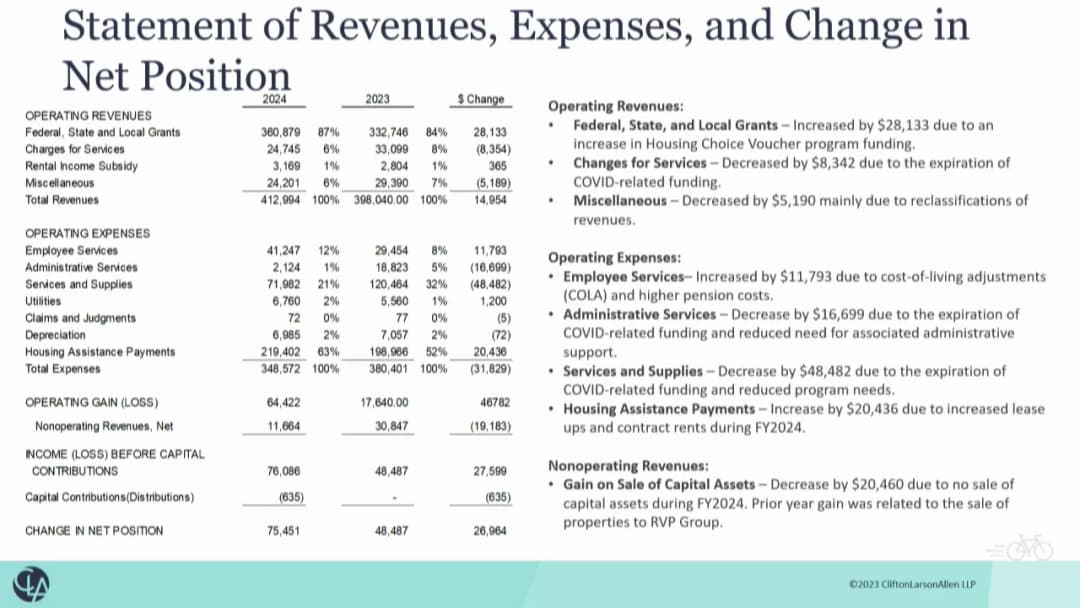
The Sacramento City Council met on Tuesday, February 24, 2026, at 2:03 PM in the City Hall Council Chamber. The meeting was called to order by Mayor Kevin McCarty with a quorum present. Councilmembers Kaplan, Dickinson, Talamantes (until 3:03 PM), Pluckebaum (arrived at 2:06 PM), Maple, Guerra (arrived at 2:06 PM), Jennings, Vang, and Mayor McCarty were in attendance. The meeting adjourned at 3:19 PM. Consent Calendar - All 17 items on the Consent Calendar were approved in one motion, with two no votes recorded for Item 17. Key approvals include: - Item 1: Approval of meeting minutes from January 13 and 27, 2026. - Item 2: Emergency repairs on I Street Bridge railing (not-to-exceed $341,824) with D N B Infrastructure, Inc. - Item 4: Connecting Howe Avenue Safety and Mobility Plan adopted. - Item 5: The Norwood Mobility Plan adopted. - Item 6: Pass for publication of ordinance listing 2240 Northgate Boulevard (Orbit Station) as a landmark. - Item 7: Del Rio Trail Sewer Force Main Rehabilitation Project – contracts and reimbursement agreement totaling $22,392,209. - Item 11: Suspension of competitive bidding (two-thirds vote) for Old Sacramento Wooden Boardwalk Replacement Project. - Item 16: Contract with Antech Laboratories for veterinary lab testing (two-thirds vote, not-to-exceed $550,000). - Item 17: Contract with Harder & Company Community Research for five-year evaluation of Sacramento Children’s Fund (not-to-exceed $749,929) – passed 7-2 (Councilmembers Kaplan and Talamantes voted no). Public Comments & Testimony - Consent Calendar (Item 11): Lambert expressed concerns about suspending competitive bidding, citing potential for favoritism and referencing a previous scandal. - Discussion Item 18 (SHRA Report): Michael Melton stated that homelessness has increased despite $45 million from Kaiser and Blue Cross, and that he has been waiting over a year for housing keys after being accepted into a program. - Discussion Items 19 & 20 (Children’s Fund): Lambert criticized the use of acronyms (CBOT) and argued that high taxes disincentivize cannabis business revenue. He also questioned why funds for youth programs (e.g., Grant High School drum line) are delayed. - Public Comments – Matters Not on Agenda: Eight speakers addressed various issues: - Peter: Criticized the Council for honoring the Hindu American Foundation (HAF), stating HAF lobbied to kill SB 509, a bill that would train police on transnational repression. He claimed HAF is a Hindu nationalist group and that police lack training. - Lambert: Raised a personal issue about erroneous parking tickets and asked for help from the city. - Graham: Accused the city of targeting protesters, referencing the arrest of a speaker by DHS, and criticized Mayor McCarty for not returning calls. - Liana: Accused Sacramento police of violating the American Indian Freedom of Religious Act by desecrating a teepee used for prayers, and demanded return of sacred artifacts. - Sierra: Similarly alleged police violated federal religious protections and stole Native American artifacts (a teepee), calling for its return. - Michael: Asked for help with his RV being towed without notice, and pleaded for housing assistance, noting he has been homeless for over a year. - LRR Roberts: Criticized police for helping ICE violate law, and for using excessive force against homeless individuals. Discussion Items - Item 18: Sacramento Housing and Redevelopment Agency (SHRA) Annual Comprehensive Financial Report for 2024 – Received and filed. - Mandy Merchant (auditor) presented: unmodified opinion on financial statements; qualified opinion on two federal programs (Public and Indian Housing and Housing Choice Voucher) due to material weaknesses. Key findings: - Financial close process required significant adjustments. - Housing Choice Voucher: 23 of 60 eligibility inspections not done timely; 1 of 40 failed inspections not re-inspected timely; one annual inspection not completed since 2022. - Public Housing: 16 of 40 files with exceptions (8 city, 7 county for late annual certifications; one county certification missing since 2022). - Emergency Solutions Grant: 10 of 29 payments to sub-recipients not made within 30 days. - Councilmember Kaplan asked about corrective actions. SHRA staff (Mary Liz Paulson) stated new reports and monthly monitoring are being implemented. The auditor noted findings have decreased from 10 in 2023 to 5 in 2024. - Chris Warren was introduced as interim CEO of SHRA, expressing commitment to improvement. - Item 19: City Auditor’s FY2024/2025 Audited Cannabis Business Operations Tax (CBOT) Amount for Sacramento Children’s Fund – Approved 8-0 (Pluckebaum absent). - Joe Fleming (City Auditor’s office) reported audited CBOT revenue of $22,609,932. The estimated revenue was $23.3 million, so a true-up reduced the Children’s Fund contribution by $280,000 to $9.04 million. - Councilmember Kaplan asked about timing and impact on grants. Finance Director P. Cletter stated that no material impact on first round grants is expected, and options for future funding policies will be brought to Council. - Item 20: City Auditor’s FY2024/2025 Baseline Funding Verification for Sacramento Children’s Fund – Approved 8-0 (Pluckebaum absent). - Joe Fleming presented: verified that the baseline funding amount of $22.9 million was expended in FY2024/2025. The audit relied on management estimates for some allocations. In odd years, only expenditures up to baseline are published; even years will include all youth programs. - Councilmember Vang thanked advocates and noted that baseline will likely be met each year due to rising labor costs. Key Outcomes - Consent Calendar: Approved with 2 no votes on Item 17 (Contract with Harder & Company). - Item 18: Received and filed SHRA Financial Report. - Item 19: Motion passed (8-0-1) approving audited CBOT revenue amount. - Item 20: Motion passed (8-0-1) approving baseline funding verification. - Council Comments: Councilmember Kaplan and Maple reported attending California League of Cities board meeting in Berkeley; discussions included Bradley Burns tax allocation on distribution centers. - City Manager’s Report: None.
On Tuesday, February 24, 2026, at 1:01 PM, the Sacramento City Council convened in closed session (special meeting) at City Hall. The sole agenda item was a conference with labor negotiators (Gov. Code § 54957.6), with designated representatives Shelley Banks-Robinson, Aaron Donato, and Tim Davis, covering multiple employee organizations and unrepresented groups. The meeting adjourned closed session without any public comment or recorded votes. No further details of the discussions or outcomes were disclosed.
The Sacramento Ethics Commission held its first meeting of 2026 on Monday, February 23, 2026, at 5:34 PM at City Hall. Commissioners welcomed two new members, Michael Robert Kelly and Maikhou Thao, and addressed a continued annual report, the selection of officers for 2026, and future priorities including training, outreach, and FPPC audit contract status. Consent Calendar - Approval of Ethics Commission Meeting Minutes (October 27, 2025) – Passed unanimously. - Ethics Commission Complaint Log – Approved unanimously. Discussion Items - Item 3: City of Sacramento Ethics Commission 2025 Annual Report (Continued from October 27, 2025) – Commissioners reviewed the draft report and discussed ongoing issues: the lapsed FPPC audit contract, lack of campaign finance audits, training deficiencies, and the commission's direction. Commissioner Kelly raised concerns about the absence of any auditing and the awkward position of the city attorney handling investigations of the city council. Chair LoFaso proposed continuing the past work plan items on training and outreach, with a focus on internal commissioner training. Commissioner Velasquez requested more time to review the report. The commission voted unanimously (5-0) to continue the item to a future meeting for further discussion and revision. - Item 4: Discussion of Firms the City Attorney May Use to Perform Investigations – Continued to a future meeting (as announced at the start). - Item 5: Selection of Chair and Vice Chair for Calendar Year 2026 – Alan LoFaso was elected Chair (4-1, with Commissioner Velasquez voting no). Nicole Velasquez was elected Vice Chair (4-0-1, with Commissioner Velasquez abstaining). Commissioner Comments – Ideas and Questions - Commissioners discussed future agenda items: an outreach initiative, training (especially on complaint evaluation), and a deeper review of the audit findings and FPPC contract status. City Clerk Mindy Cuppy offered to bring back a staff report on why the FPPC audit contract lapsed (due to inability to secure a not-to-exceed amount). Senior Deputy City Attorney Gary Lindsey agreed to provide an overview for new commissioners on ethics rules and conflicts of interest. Commissioners also shared backgrounds and welcomed new members. Key Outcomes - Motion passed (5-0) to continue the 2025 Annual Report to a future meeting, with staff to revise the report (including removal of a paragraph about training from the former chair’s cover letter) and incorporate commissioner feedback. - Alan LoFaso elected Chair for 2026 (vote: 4-1). - Nicole Velasquez elected Vice Chair for 2026 (vote: 4-0-1, one abstention). - Staff directed to agendize items on outreach, training, and FPPC audit status for upcoming meetings. - No public comments were received on items not on the agenda. Meeting adjourned at 6:31 PM.