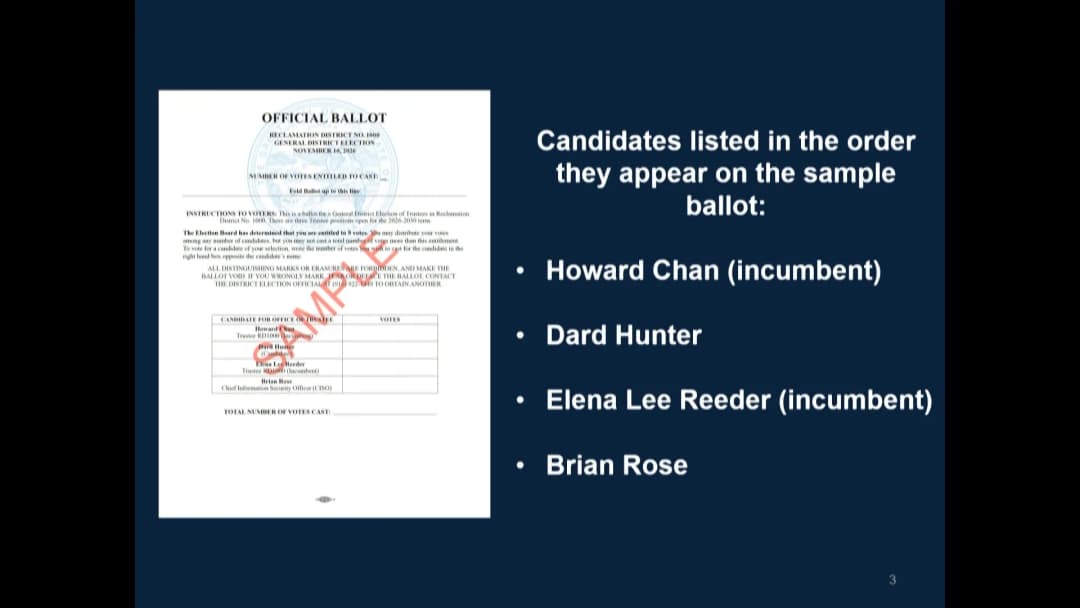
The Sacramento Flood Control Agency (SAFCA) Board of Directors met on 2026-10-21, using the supplied meeting timestamp of 21:05:42 UTC. The board handled a consent calendar, heard an executive director’s report on winter flood preparedness and Folsom Dam funding, approved Reclamation District 1000 ballot-vote directions, and adjourned. Note: the transcript recites “this October 15, 2026 meeting,” which conflicts with the supplied timestamp; this summary follows the supplied timestamp. Consent Calendar - Consent matters, items 1 through 7, were approved by motion and second. No public comment was received, and the board voted in favor with no announced opposition or abstentions. Public Comments & Testimony - No public comments were offered on non-agenda items, consent items, or the Reclamation District 1000 resolution. Discussion Items Convening, Closed Session, and Procedural Matters - The initial roll call established a nine-member quorum; after closed session and reconvening, the board established a ten-member quorum. - The chair noted the meeting was recorded live and would be re-aired Saturday, October 17, at 4 p.m. on Metro 14 Live and SACCounty.gov. Speakers were asked to identify themselves and to limit comments to three minutes. - The board recessed into closed session and, upon reconvening, reported nothing from closed session. Executive Director’s Report - Executive Director Jason Campbell reported that the governor had issued a state-of-emergency proclamation in advance of a Super El Niño event. He described coordination with state, federal, and local partners, including a flood coordination event on October 7 with Sacramento County OES and state partners that included a tabletop exercise on American River operations and Folsom Dam. - Citing NOAA data, Campbell said the projected median rainfall for the Super El Niño water year is about 20 inches, while past extreme water years have produced rainfall in the 30- to 35-inch range. - A further coordination exercise is planned for November, including hydrology, hydraulics, and Folsom reservoir operations. The Lower American River Task Force is also expected to transition into a broader flood preparedness task force, targeted for late November. - On Folsom Dam, Campbell said the contractor’s Gate 8 proof of concept is nearly complete, but the U.S. Army Corps of Engineers has suspended work on the remaining seven gates because the existing contract is running out of funding. He emphasized that the project was fully funded under the Bipartisan Budget Act of 2018 at full federal cost, with no non-federal cost share. Flood operations are not expected to be affected: Gates 7 and 8 may not function this winter, but the other gates on the joint federal project and the other six main-dam gates should remain functional. Reclamation District 1000 Ballot Resolution (Item 8) - Resolution No. 2026-085 directs the executive director to cast SAFCA’s votes in the Reclamation District 1000 Board of Trustees mail-ballot election on November 10, 2026. SAFCA’s owned properties give it 2,594 votes; there are four candidates for three seats, including two incumbents. - Director Kaplan supported splitting the votes evenly between the two incumbents, saying that ensuring the re-election of experienced incumbents is in SAFCA’s best interest. The vice chair noted SAFCA has often cast its votes for incumbents and leaned that way. - Director Avdis (identified as “Davidis” in the transcript) moved to distribute SAFCA’s votes evenly between the two incumbents and to authorize Jason Campbell or Jeremy Goldberg to cast the votes based on their schedules. The motion was seconded. - No public comment was offered. The board approved the motion by voice vote, with no announced opposition or abstentions. Key Outcomes - The consent calendar was approved. - Resolution No. 2026-085 was approved: SAFCA will split its Reclamation District 1000 votes evenly between the two incumbent candidates, and Jason Campbell or Jeremy Goldberg is authorized to cast the votes. - The executive director’s report was received. Next steps include the November flood-coordination exercise, the late-November flood preparedness task force transition, and continued federal advocacy for funding to finish the Folsom Dam gates. - The remaining items were received and filed, and the meeting adjourned.
Public Meetings - Sacramento County, California
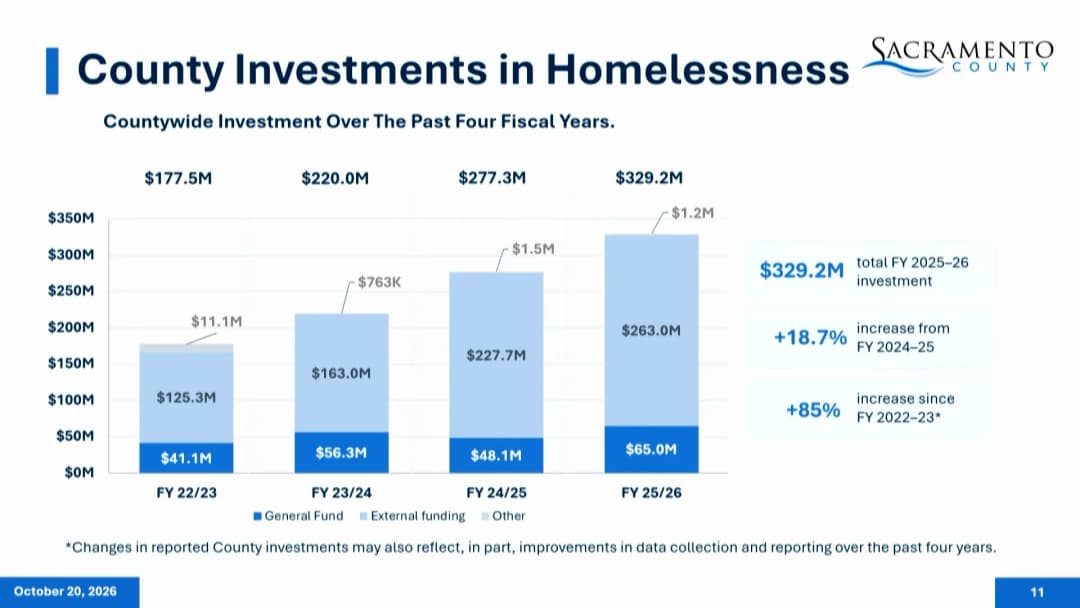
Public Meetings - Sacramento County, CaliforniaOn 2026-10-21, the Sacramento County Board of Supervisors met with a quorum. The transcript's opening identifies the meeting as Tuesday, October 20th, but the supplied meeting timestamp is 2026-10-21; this summary follows the supplied timestamp. No agenda or minutes were available, so this summary is based solely on the raw transcript. The meeting included service recognitions, off-agenda public comments, consent calendar approvals, public hearings, the Sheriff Community Review Commission annual update, and a semi-annual homeless outcomes report. Consent Calendar - Consent calendar items 6 through 39 passed 5-0 with all five supervisors present and voting. - Item 26: Introduction of an ordinance establishing fees for Sacramento County Public Health laboratory services; full reading waived and adoption continued to November 3, 2026. - Item 33: Introduction of a county code chapter prohibiting unlawful possession of detached catalytic converters; full reading waived and adoption continued to November 3, 2026. Supervisor Hume noted he worked with the Sheriff's Office to bring the ordinance forward. - Item 28: Supervisor Hume expressed support for the Sacramento Housing and Redevelopment Agency (SHRA) funding agreement and described the project as critically needed workforce housing at 50% and 80% AMI. - Item 11: Supervisor Serna questioned the increase in the Watt Avenue Behavioral Health Campus architectural services contract from approximately $250,000 to nearly $4 million. DGS Deputy Director Nicholas Lavoy explained the initial amount covered only grant application planning, and the increase funds full project completion, with about a 10% contingency. Supervisor Cerna added that the county accepted a roughly $45.5 million grant for the project. Public Comments & Testimony - Ryan Harris said the county did not provide a telephone call-in number for public comment, despite earlier assurances, and complained that the board does not listen to residents. He asked board members to take public comments seriously. - Brandy Hosak, General Manager of Arcade Creek Recreation and Park District, described worsening erosion and flooding along Arcade Creek between Garfield Avenue and Winding Way. She said the Joe Smith Nature Trail had lost nearly three and a half feet of width during her tenure, and asked the county to designate a lead department or identify a path forward before it becomes a public safety and flood control emergency. Supervisor Desmond asked staff to follow up about a potential county nexus with flood control infrastructure. - Randy Smith, a District 3 resident, supported urgent repairs along Arcade Creek, showing recent photos and warning of flood risk to the Cameron Ranch neighborhood, particularly with an approaching El Niño. - Leah Schenck spoke about domestic violence awareness on behalf of the family of Shelene Thakur. She said her organization had tried for three years to get a response from Supervisor Desmond's office, criticized the lack of official outreach to victims' families, and announced a Saturday "Walk a Mile in Her Shoes" event. - L.R. Roberts, an Oak Park resident, raised concerns about sheriff oversight, trafficking on Stockton Boulevard, and called for release of video of a recent fatal deputy-involved shooting. - Ashley Henderson, an Arcade Creek Recreation and Park District director and Sacramento Parks Foundation board member, spoke about the Joe Smith Trail's conservation legacy and the importance of preserving it, mentioning Effie Yaw and other regional leaders. - Shay Verity asked what happened to the Regional Human Rights and Fair Housing Commission's broader human rights responsibilities after its 2014 discontinuation and requested a county response to her emailed questions. - Lisa Sanchez, a River City Waterway Alliance volunteer, asked the county to help Arcade Creek Recreation and Park District secure grants or funding for erosion prevention on the Joe Smith Trail. - In response to some public comments, Supervisor Serna asked the Clerk of the Board to standardize a brief oral preamble explaining Brown Act limitations on discussing off-agenda matters. The clerk said changes were being prepared for 2027 and could be expedited. Discussion Items - Item 40 – Calvine Road Chevron Public Hearing: County Engineer Michael Meaney presented the request to change the benefit category and levy an increased service charge for the Calvine Road Chevron project in County Service Area No. 1, Zone 1. The existing street/safety light non-residential assessment was stated as 49.16 cents annually; the enhanced category would increase the annual service charge to approximately 205.12 cents. No public speakers testified. The Clerk tabulated one official protest ballot, which was counted as 100% in favor of the change and 0% opposed; staff reported no majority protest. The board passed the item 5-0. - Item 41 – HUD 2027 One-Year Action Plan: Stephanie Green of SHRA presented the plan for CDBG, HOME, and ESG funding. The total estimated available funding is $9.87 million: $6.55 million CDBG, $2.8 million HOME, and $520,000 ESG. Proposed CDBG allocations include $3.366 million for infrastructure and public facilities, $850,000 for public services, $405,000 for housing programs, $913,000 for planning and administration, $750,000 for agreement cities, and $266,000 in capital reserve. She also highlighted 2026 accomplishments, including Meals on Wheels serving approximately 150,000 meals to more than 1,200 seniors and the Mather Community Campus sheltering 400 individuals. Supervisor Serna requested that the next District 1 supervisor receive a map identifying CDBG-eligible unincorporated areas. Supervisor Hume asked about local match requirements; staff answered that ESG requires a 100% match, while CDBG and HOME do not. The plan passed 5-0. - Item 42 – Greenback Lane Underground Utility District: Principal Civil Engineer Melissa Jones presented the designation of an underground utility district on Greenback Lane from Chestnut Avenue to the Folsom city limit. The district would prohibit new overhead poles and wires and allow the county to seek reimbursement from SMUD, AT&T, Comcast, and Fidium. No public speakers testified. The item passed 5-0. - Item 43 – Sheriff Community Review Commission Annual Update: Paul Curtis, outgoing commission chair, and Mike Whiteside, incoming chair, presented the annual update. Topics included the commission's prior recommendation on mental health crisis response, AB 481 military equipment community engagement, halal meals in jails, and the Blue Envelope Program. Curtis said the Sheriff's Office will hold future AB 481 community engagement meetings at its headquarters and will discontinue annual presentations to the commission. Whiteside reported that the Sheriff's Office had declined to adopt the Blue Envelope Program, citing roughly $30,000 startup and $15,000 annual costs, but that several city police departments had formed a coalition to implement it. Several supervisors expressed strong support for the program and urged the Sheriff's Office to seek grant funding or reconsider. The item was receive-and-file with no formal vote. - Item 44 – Semi-Annual Homeless Outcomes Report: Department of Homeless Services and Housing Director Emily Halkin presented the report. She updated the board on the Homeless and Housing Ad Hoc Task Force, which is designing a new governing body to serve as both a countywide policy board and a Continuum of Care board. Final charter documents are scheduled for December, with public approvals in January 2027 and the elected table potentially convening in February 2027. Halkin also presented draft dashboard updates. She reported that permanent housing exits from county programs increased from 27% (930 people) in FY 2023-24 to 43% (2,156 people) in the most recent fiscal year. For August, about 60% of program clients were classified as highly vulnerable, and a similar share had no income. Supervisors offered detailed feedback on dashboard design, including requests for raw numbers, clearer explanations of targets, and more detailed mental health and substance use disorder data. Halkin said the outcome and impact dashboard would go live by November 1 and program snapshots by the end of the calendar year. The report also covered countywide investments in homelessness, which grew from approximately $177 million in FY 2022-23 to $329 million in FY 2025-26, with most growth from external funds. Department presentations included regional parks clearing 1,089 encampments and removing 1,306.5 tons of trash; DHA contributing $76.1 million; DHS reporting $122.9 million in investments, including 70 BHBH-funded bridge housing beds; and DGS describing facility maintenance and construction support. The item was informational; no formal vote was taken. Key Outcomes - Consent calendar items 6-39 approved 5-0. - Item 40 (Calvine Road Chevron service charge) approved 5-0. - Item 41 (HUD 2027 One-Year Action Plan) approved 5-0. - Item 42 (Greenback Lane underground utility district) approved 5-0. - Item 43 was received and filed, with supervisors urging continued follow-up on the Blue Envelope Program. - Item 44 was received as an informational report; staff will revise homeless dashboards based on board feedback and will launch the updated outcome dashboard by November 1, 2026, and program performance snapshots by the end of 2026. - Supervisor Desmond directed staff to follow up with Arcade Creek Recreation and Park District regarding the county's potential role in the Joe Smith Trail erosion issue.
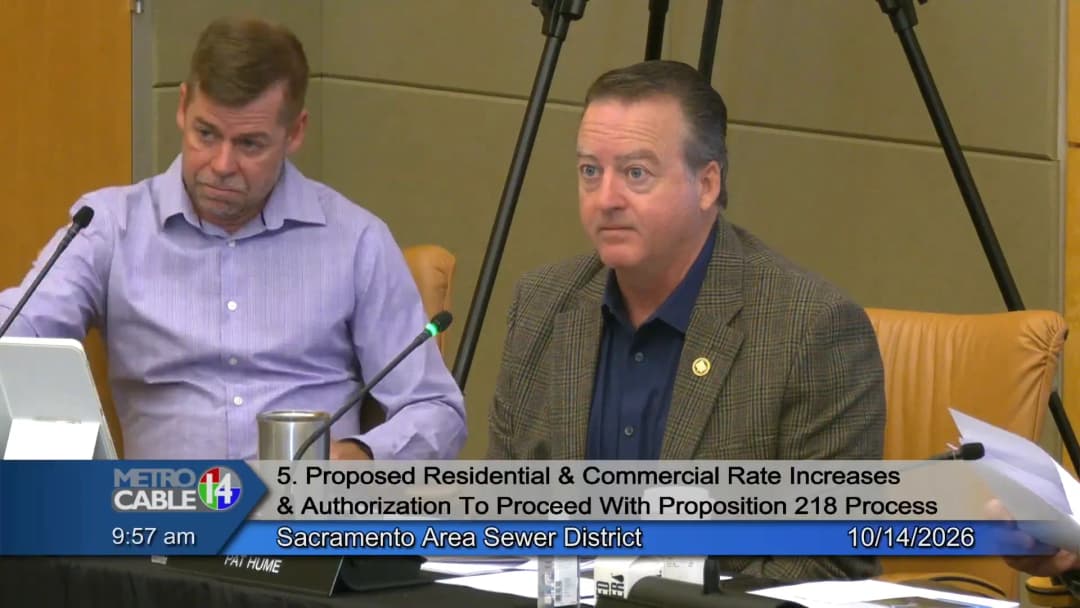
The Sacramento Area Sewer District board of directors met on October 15, 2026, at the district's headquarters in Gait. The meeting began at 16:53 UTC and included approvals, public comment periods, a public hearing on eminent domain, a rate increase authorization for Prop 218, an informational presentation on customer research, approval of compensation for a new Chief People Officer, employee benefit amendments, and an annual report on the Confluence Partnership Program. Directors also discussed staff and retiree concerns regarding the transition from county operations. Consent Calendar - Item 1: Approved unanimously via roll call vote. (No details provided on content beyond routine approval.) Public Comments & Testimony - For off-agenda items, no speakers. - For Item 3 (District Engineer's report), written public comments were received from staff and a retired employee expressing concerns about the transition process. - For Item 4 (eminent domain), a written comment was submitted; no in-person or Zoom speakers. - For Item 5 (rate increases), no speakers in person or on Zoom. - For Item 6 (customer research), no speakers. - For Item 7 (Chief People Officer compensation), a written public comment was submitted. - For Item 8 (benefit amendments), no speakers. - For Item 9 (Confluence report), no in-person speakers; three online attendees listened but did not speak. Discussion Items 1. District Engineer's Report (Item 3): Christoph Dobson announced a canceled meeting on October 28, next meeting on November 18, and a roof replacement causing possible noise. Director Hume raised two letters from staff and a retired employee detailing concerns about the transition from the county and requested an agendized presentation on the transition's status. Chair Cerna agreed. 2. Eminent Domain Resolution (Item 4): Mike Crooks presented a required public hearing for friendly condemnation to acquire easements for on-farm connection assemblies on two parcels with title defects. The parcels are approximately 100 and 150 acres, with easements requiring a small footprint and a pipeline easement along Eschinger Road. The public hearing was opened and closed with no public testimony. The board voted unanimously to authorize the resolutions. 3. Rate Increase Proposal (Item 5): Mike Hewitt proposed residential and commercial rate increases for treatment and resource recovery to address 3% CPI inflation, 6% industry-specific inflation since 2023-24, $15 million per year in temporary biosolids handling costs, and a $440 million capital program for a permanent solids solution. Three options were presented: three-year (staff recommendation), four-year, and five-year. The recommended three-year option would increase rates by $2/month in year one, $1.75 in year two, and $1.75 in year three, for a total of $5.50/month. Directors discussed the impact on ratepayers, the importance of flexibility, and outreach to seniors and non-English speakers. Director Viegas asked about the risk of needing further increases. Director Dickinson moved approval of the staff recommendation. Vote: 12-2 (Directors Dickinson and Orozco opposed). 4. Customer Research Findings (Item 6): Paige Bedigro presented findings from eight virtual focus groups and an online survey of 390+ residential billpayers (statistically significant). Key results: 36% increase in name recognition compared to 2021; 91% of residents said they would call SAC Sewer first before a plumber after learning of service commitments; the acceptable response time has shortened from 8 hours to 2-4 hours; text messaging overtook door hangers as the most effective communication channel; 81% of residents find SAC Sewer an appealing employer. No action was taken. 5. Chief People Officer Compensation (Item 7): Matt Doyle presented a salary recommendation based on a compensation study and validated by an external consultant. The position consolidates HR, risk management, safety, training, administration, and organizational development, resulting in a cost savings by eliminating a higher-level operations director position. Director Hume voted against, stating the salary is too high compared to the County of Sacramento's Director of Personnel Services, which oversees about 12,000 positions. Vote: 13-1 (Hume opposed). 6. Letters of Understanding and Benefit Amendments (Item 8): Matt Doyle recommended approval of LOUs with Stationary Engineers Local 39 to establish a 7.5% shift differential and a 2% certification incentive, and revisions to employee benefits documents for management, executive, and unrepresented groups to clarify supervisor pay eligibility. Vote: unanimous. 7. Confluence Regional Partnership Program Annual Report (Item 9): Carolyn Balaz reported that for the first time, the full annual allocation of $7 million was obligated. Highlights: Sewer Lifeline grants totaled $2.4 million, serving over 12,000 treatment and 11,000 collection customers; 8.3 miles of new pipe installed in community-wide septic conversion projects, connecting 202 properties; economic development grants (50% sewer impact fee discount) created 855 full-time jobs; affordable housing sewer impact fee waivers totaling $1.2 million; and a $540,000 grant to a Holiday Inn. The program received national and state recognition. Directors Vice Chair Orozco and Chair Cerna emphasized the need for more equitable distribution of funds, especially in West Sacramento, and suggested that staff proactively communicate available funding to board members. Grant recipient Henry Chang of Human Bulb presented on a STEM education program funded through the Public Education category. Key Outcomes - Item 1: Consent calendar approved unanimously. - Item 4: Resolution for eminent domain to acquire easements for on-farm connections approved unanimously. - Item 5: Authorized staff to proceed with Prop 218 process for a three-year rate increase option (effectively July 1, 2027). Vote: 12-2. - Item 7: Approved compensation for Chief People Officer position. Vote: 13-1. - Item 8: Approved LOUs and benefit amendments. Vote: unanimous. - Item 9: No action; report received. Directors requested improved communication and more equitable funding distribution, particularly for West Sacramento.
On 2026-10-14, the First 5 Sacramento Commission met in regular session with a quorum present. Chair Cerna presided. The agenda included the executive director's report, advisory committee update, CalWorks Home Visiting amendments, the Empowered Families contract augmentation, the 2027 meeting calendar, the 2027 vice chair appointment, and commission member comments. No agenda or minutes were included in the source material. Note: the raw transcript identifies the meeting as Monday, October 5, 2026, while the provided meeting timestamp is 2026-10-14; this summary uses the provided date. The meeting concluded at 1:17 p.m. Consent Calendar - Approved the August 10, 2026 draft action summary unanimously by the commissioners present. - Appointed Commissioners Liu and Hirota to the First 5 Evaluation Committee, replacing the prior representatives, unanimously. Public Comments & Testimony - No members of the public signed up to speak on off-agenda items. - Crystal, a parent leader and community member from North Highlands, spoke during the Executive Director's Report. She thanked Supervisor Cerna, Desmond, and Rodriguez for sponsoring Celebrate North Highlands on September 26, praised Commissioner Evans for attending on behalf of SETA, and thanked Morgan Brown/Color the Blog for sponsoring the kids zone. She also announced upcoming Parent Leadership Training Institute and partner events, including an October 24 family celebration, an October 18 Natomas walk at 8:30 a.m., applications for a Spanish-language River Delta cohort starting January 9, and media ambassador training on October 28. She expressed gratitude for the commission's support. Discussion Items Executive Director's Report - Staff highlighted the Sunshine Family Bookmobile, one of 23 tier-one equity in action grants of up to $10,000, working in North Highlands to deliver books and early childhood information and partnering with another grantee to provide free haircuts for children ages 0-5. - A planned $467,000 dental services contract with California North State University will not move forward. It was intended to partner with Head Start and bring dental care into communities because only 47 percent of children 0-5 had seen a dentist at least once in the prior year. The university removed its dental leadership, and First 5 halted negotiations after sending an August letter that went unanswered. The funds will remain in the fund balance for future sustainability. - Commissioner Moak asked how the commission would maintain oral health fluency; staff responded that they remain connected through the Medical Dental Advisory Committee and Sacramento County Public Health's oral health program. - Staff announced the Turtle Times exhibit at the Sacramento County Children's Museum, opening September 19, with three free days or evenings for working parents; SCOE and Help Me Grow will be present. - On the airport child care project, staff reported that the Terminal B build-out estimate was about $7 million, with $1.5 million in state funding from Senator Ashby. The earlier space was limited to 48 children and two classrooms. The airports department is planning a new administration building over three to five years, and First 5 is exploring reinvesting funds into planning and architecture for a larger child care center there. - The vice chair proposed exploring co-location with Head Start, noting that many airport workers would qualify and citing child care costs of about $3,200 per month for two children. Commissioner Wesley suggested considering summer programming for school-age children. Chair Cerna suggested exploring a nexus with federal tower appropriations. Staff said they would incorporate the ideas. Advisory Committee Update - Robin Blanks Guster reported that the advisory committee met August 18. Commissioner Guerra attended and reaffirmed his dedication to high-quality child care, continuous family support, and workforce development. - The advisory committee requested a work group to review and recommend bylaw changes on committee membership because several seats tied to other bodies were hard to fill; staff anticipate bringing 10 new member appointments to the December 7 commission meeting. - Presentations covered First 5 California's financial update, the revised stipend policy, the pause on family enrichment funding due to lower-than-projected tobacco tax revenues in 2025-26, and recruitment for the 2026 Parent Leadership Training Institute cohort in the River Delta. Committee Updates with No Meetings - The Evaluation Committee, Financial Planning Committee, and Systems Optimization and Sustainability Committee did not meet; no updates were provided. CalWorks Home Visiting Revenue and Expenditure Agreements - Staff requested approval of amendments after an increased state allocation of $6.9 million. Sacramento County Public Health declined $945,000 for the Nurse-Family Partnership, allowing those funds to be redirected to Birth and Beyond Family Resource Centers. - The first amendment raised the DHA revenue agreement to up to $6.3 million; the second raised the CAPC expenditure agreement to up to $6 million. - Staff also requested a $1,622,574 appropriations adjustment request, fully offset by revenue and with no impact to Prop 10 funds or reserves. - Commissioner Wesley noted that the additional state funding supports home visiting and shifts related funding. Dr. Liu, as Public Health division director, expressed support, calling this the best approach for Sacramento County residents. Commissioner Katari recused herself from the item due to her oversight of DHA. Empowered Families Contract Augmentation with CAPC - Staff requested a $40,000 augmentation to CAPC's contract, raising it to not more than $871,000, to develop CalAIM billing infrastructure. CAPC has served as the Birth and Beyond Collaborative backbone since 2010 and is positioned to become a billing hub for other contractors; the transcript uses CAPC and CAPSE interchangeably. - Commissioner Hirota asked about capacity limits; staff stated that at least five to six agencies have expressed interest in using CAPC as a hub and that capacity is part of the negotiation. 2027 Meeting Calendar and Vice Chair - The commission approved the 2027 meeting calendar, continuing an every-other-month meeting cadence. - The commission appointed Commissioner Guerra as 2027 vice chair. Commission Member Comments - Commissioner Kravitzwartz noted that the City of Sacramento Children's Fund guaranteed income program, funded by Measure L, is accepting applications through the end of October for current and former foster youth ages 16-23. Key Outcomes - Approved the August 10, 2026 action summary unanimously. - Appointed Commissioners Liu and Hirota to the Evaluation Committee unanimously. - Approved the CalWorks Home Visiting revenue amendment with DHA up to $6.3 million, 6-0 with Commissioner Katari recused. - Approved the CalWorks Home Visiting expenditure amendment with CAPC up to $6 million, 6-0 with Commissioner Katari recused. - Approved the $1,622,574 appropriations adjustment request, 6-0 with Commissioner Katari recused. - Approved the $40,000 augmentation to the CAPC Empowered Families contract, with the contract amount not to exceed $871,000, unanimously. - Approved the 2027 meeting calendar unanimously. - Appointed Commissioner Guerra as 2027 vice chair unanimously.
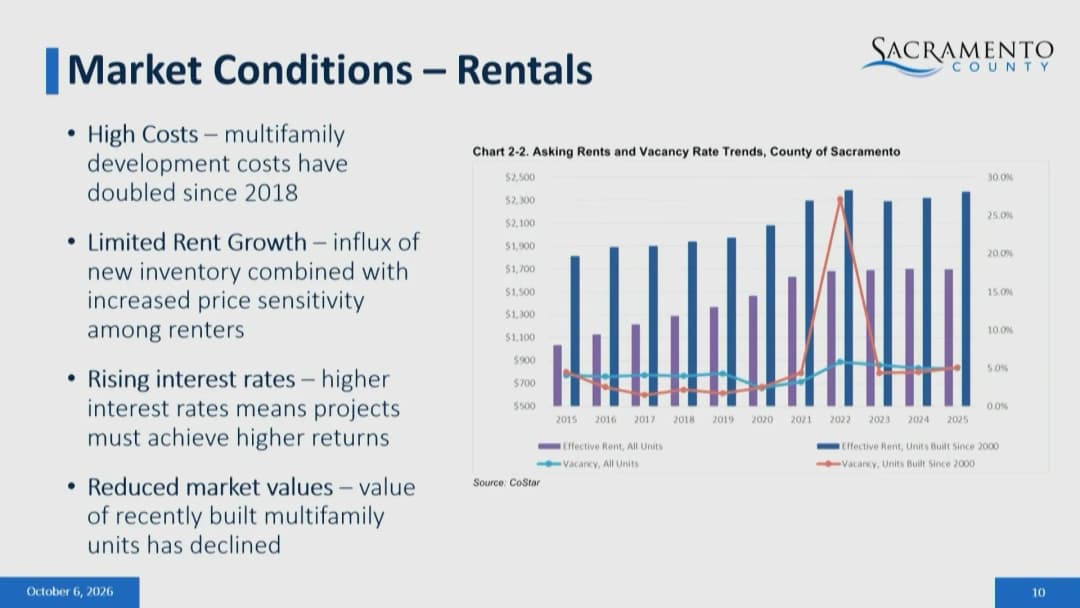
On 2026-10-14, the Sacramento County Board of Supervisors met for a full-day session that included recognitions, off-agenda public comment, the consent calendar, administrative items, a crop and livestock report, a detailed affordable housing ordinance workshop, and appointments. The board adjourned to closed session at 11:05 a.m., resumed in the afternoon, and adjourned at 4:40 p.m. in honor of Brother Dan Morgan. Note: the transcribed roll call references Tuesday, October 6th, but the date specified for this summary is October 14, 2026. Consent Calendar - Approved consent calendar items 5 through 30 by a 5-0 vote with all members present. - Supervisor questions on item 19, a $219 payment to Wilson Dental Lab Inc. for adult correctional health dental services, prompted staff to explain that the payment was retroactive and the Finance Department lacks authority to approve retroactive payments without board action. Staff said they would review the guidelines. Public Comments & Testimony - Off-agenda speakers addressed the fatal police shooting of a man in Carmichael. Fago said video showed the man trying to comply and no gun on him, and demanded justice. Paul Pierce, an El Camino High School alumnus, called for crisis-intervention training and said police violence is endemic. Kevin Boltz criticized police training and questioned the Sheriff Department’s spending on taser-related equipment. County counsel later clarified that profanity is allowed unless it becomes disruptive. - Mark Graham, an Elk Grove resident, demanded the board commit that day to a thorough investigation of the shooting, saying failure to do so would mean the board failed to do its job. He also pressed the county to oppose HR 2289, the American Broadband Deployment Act of 2025. - Deputy County Executive Eric Jones responded by describing the layers of review: the Sheriff’s internal administrative shooting review, the District Attorney’s criminal review, the independent Inspector General review, and the Sheriff’s Community Review Commission review of policies and procedures. The chair reminded speakers of Brown Act limits on board discussion of public comments. Recognitions and Presentations - Annette Bezwar of Sacramento County Animal Care Services presented Theo, a six-month-old mixed-breed puppy available for adoption. Adoption includes spaying/neutering, vaccinations, and microchipping for less than $150. The shelter is at 3839 Bradshaw Road and open at noon. - The board adopted a resolution recognizing the Sacramento Hispanic Chamber of Commerce during Hispanic Heritage Month. The chamber was established in 1972 and has served the region for more than 50 years. Chamber representative Kathy said there are approximately 600,000 Hispanic residents in the greater Sacramento region and highlighted programs such as Emprende Sacramento. Supervisor Rodriguez noted that California’s Latino community is about 40 percent of the state, and Supervisor Cerna was recognized for his final year on the board. - The board also recognized Hispanic Heritage Month with Maria Harrington of the Mexican Cultural Center of Northern California. She said one in four Sacramento County residents is Latino and described programs including Dia de la Bandera, Steps to College with 1,500 students and 60 universities, and at least $10,000 in annual scholarships. Item 31 — Tobacco Securitization Corporation Annual Meeting - The board, acting as the Sacramento County Tobacco Securitization Corporation, approved prior meeting minutes, adopted the fiscal year 2026-27 budget, and received the fiscal year 2025-26 audited financial report. Colin Bettis, county debt officer, said there were no significant budget changes. The item passed 6-0, including board member Betty Williams participating by Zoom. Item 32 — Technology Disruption Policy Amendment - Board Clerk Todd Sturmer presented an amendment allowing meetings to resume immediately when remote access is restored instead of waiting the full one-hour Brown Act disruption period. He cited an August 25 meeting where 18 people were in chambers and two were online. The amendment passed 5-0. Item 33 — Legislative Advocacy Policy and Governance Protocol Workshop - Governmental Relations Officer Alicia De Bord presented options for how board members are selected for legislative advocacy. Chair Rodriguez cited a recent SB 802 advocacy matter where staff went to two supervisors other than the chair and vice chair even though all five board members shared a position; she favored a protocol, including all five supervisors signing when the board has a unified position. - Supervisors Kennedy, Desmond, and Cerna opposed a written policy, favoring the current practice of relying on staff strategy, district lines, relationships, and expertise. Supervisor Cerna also raised First Amendment concerns. The consensus was to retain the status quo rather than adopt a new policy. - During public comment, Mark Graham again urged the county to oppose HR 2289 and referenced the county’s legislative platform language supporting local home rule and opposing preemption. He criticized staff’s response that the county was monitoring the bill through NACo. Item 34 — 2025 Crop and Livestock Report - Agricultural Commissioner Chris Flores presented the 2025 report. Gross production value was approximately $550.3 million, up 3 percent from the prior year. Wine grapes remained the top commodity at about $164 million, followed by processing tomatoes at $52.4 million and market milk. - Wine grape values have declined nearly 20 percent since 2023. Flores also warned about the glassy-winged sharpshooter, an invasive vector of Pierce’s disease, with more than 523 grape-growing properties and over 37,000 acres at risk in Sacramento County and two current infestations in Folsom and South Sacramento. - A new economic analysis by Agricultural Impact Associates estimated agriculture’s total county contribution at about $1.2 billion for 2024. The transcribed breakdown was $536 million in farm production, $296 million in local processing, and $36 million in multiplier effects; the components as transcribed do not sum to the stated total, so the multiplier figure may be incomplete. Agriculture supports about 7,000 full-time-equivalent jobs. The economic diversification index was 0.53 and has remained stable since 2016. - The board received and filed the report. Supervisor Hume asked about solar-conversion farmland and whether its economic value appears in the crop report; staff said it does not. Supervisor Cerna noted this was his final crop report and thanked the department. Item 35 — Affordable Housing Ordinance Workshop - Senior Planner Jacob Daw facilitated the workshop. The county’s current affordable housing ordinance (AHO) is a housing impact fee on new market-rate development, set at $2.50 per square foot in 2014 and now $3.91 per square foot. It replaced the 2004 mandatory inclusionary ordinance. The housing element directed the county to evaluate the AHO and specifically to modify the owner-builder exemption. - Staff evaluation for 2014 through 2024 found AHO-funded projects produced approximately 520 affordable units under the preferred metric, short of the unwritten 10 percent production expectation. AHO funds represented about 9 percent of affordable project funding on average, and combined with other SHRA funds about 25 percent. The average public subsidy per affordable unit was about $50,000 in 2014 and has more than doubled to about $102,000. - Feasibility modeling tested three prototypes in three market areas. Market-rate multifamily rental was infeasible in all modeled scenarios, and large single-family development was broadly infeasible in several market areas. For-sale feasibility used an 8 percent net profit target; rental feasibility used a 6.75 percent return on cost. - Public testimony on the AHO included: - Mike Jaskey of Sacramento ACT said the county cannot achieve its affordable-housing policy goals through a fee on new construction alone and recommended a unified affordable-housing program with regular public reporting. - Rick Eaton of Sacramento ACT recommended a 9 or 10 percent production goal, a tiered per-unit fee to encourage smaller homes, and major changes to the owner-builder exemption. - Chris Noram of North State BIA urged keeping the fee at $3.91, said total fee load is about $110,000 per unit, that about 15 percent of households can afford a new home, and that every additional $1,000 in fees knocks roughly 10,000 to 11,000 people out of the market. He opposed mandatory inclusionary housing and a 50-50 land-dedication split. - Julio Lamas of the Sacramento Housing Alliance noted more than 50,000 low-income renter households lack affordable homes and recommended a 10 to 15 percent production goal, fee alignment with average public subsidy, inclusionary or strategic fees in high-resource areas, and prioritizing extremely low-, very low-, and low-income households. - Michael Turgeon of House Sacramento opposed raising fees specifically on infill projects and suggested revenue-neutral approaches that support infill development. - Board direction from the workshop, captured by Planning Director Todd Smith, included: no increase to the current fee; no alignment of annual fee adjustments to average public subsidy; no inclusionary housing requirement; no mandatory 50-50 land-dedication split but openness to exploring prospective land-dedication mechanisms; no expansion of for-sale subsidies to moderate-income households; and modification of the owner-builder exemption using a 3,000-square-foot cap, a five-year residency/lien requirement, and a nominal processing fee. Supervisor Hume initially suggested a 4,000-square-foot cap, while Supervisor Kennedy proposed 3,000 square feet, which gained consensus. The board also asked staff to inventory other county-controlled fees and costs that affect total housing production costs. - No formal ordinance amendment was approved; staff will use the direction to prepare a residential nexus study and return with a formal amendment next year. Item 36 — CSAC and Urban Counties of California Appointments - The board noted the name change from Urban Counties Caucus to Urban Counties of California. Motions passed 5-0, with Supervisor Desmond continuing as the CSAC representative and Supervisor Hume serving as the Urban Counties of California representative; alternates were also confirmed. County Executive Comments and Supervisor Comments - County Executive staff announced a drought-tolerant demonstration project on the South plaza, with turf being removed and completion expected by the end of the year. - Supervisor Hume requested that a future agenda item be brought back for the county to take a formal opposed position on HR 2289; the chair said she would look into it. - Supervisor Cerna asked staff to return with a plan to sustain the Black Child Legacy Campaign beyond its current multi-year budget commitment. Councilmember Eric Guerra, also vice chair of the First 5 Commission, spoke in support of a multi-agency sustainability strategy. - The chair congratulated Orangevale Dairy Queen on 40 years in business, recognizing Joe and Cynthia Ellering. - Supervisor Cerna memorialized Brother Dan Morgan, FSC, president of LaSalle High School in Yakima, Washington, who passed away September 26. Brother Dan served at Christian Brothers High School in Sacramento and was remembered for his quiet dedication. The board adjourned in his honor at 4:40 p.m. Key Outcomes - Consent calendar approved 5-0. - Tobacco Securitization Corporation items approved 6-0. - Technology disruption policy amendment approved 5-0. - Legislative advocacy workshop ended with consensus to retain the status quo and no written policy. - 2025 Crop and Livestock report received and filed. - Affordable housing ordinance workshop produced non-binding staff direction: keep the fee at $3.91, do not pursue inclusionary housing, explore land-dedication options, modify the owner-builder exemption with a 3,000-square-foot cap and five-year residency requirement, and do not expand moderate-income for-sale subsidies. - CSAC/UCC appointments approved 5-0. - Referred for future action: formal opposition to HR 2289 and a Black Child Legacy Campaign sustainability plan. - Meeting adjourned at 4:40 p.m. in honor of Brother Dan Morgan.
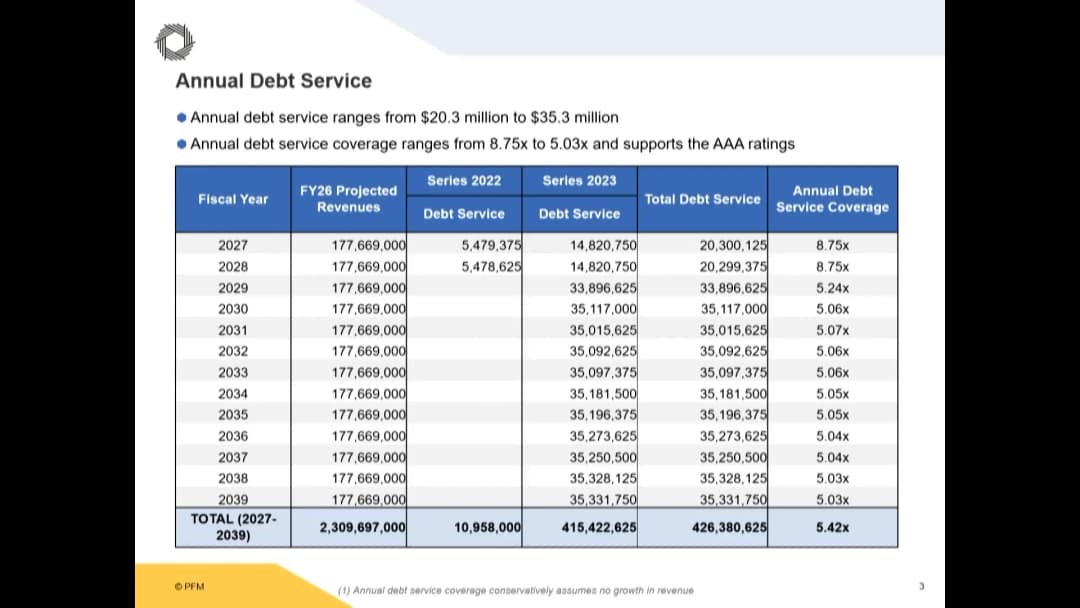
This regular meeting of the Sacramento Transportation Authority (STA) was called to order with a quorum present. The transcript identifies the meeting as the October 8th regular meeting, while the date provided for this summary is October 14, 2026. Board members heard a presentation on SB1 competitive grant nominations, approved those nominations, received the annual debt program presentation, and received the executive director's report. No public comment was offered on the consent calendar or most agenda items, but one comment was made during the executive director's report. Consent Calendar - The consent calendar was moved by Director Talamantes, seconded by Director Sing Allen, with additional seconds from Director Gatewood. It passed unanimously by voice vote, with no public comment. Public Comments & Testimony - No public comments were submitted for non-agenda matters, the consent calendar, Item 8, or Item 9. - Chad Houston, identified as an advisor to the executive director of the California Alliance for Jobs, commented during the executive director's report. He expressed the organization's interest in partnering with the STA's new transportation funding subcommittee on funding priorities, community polling, and evaluation of the current measure. He noted that his colleague Joshua Arce had previously shared polling on area projects and offered the California Alliance for Jobs as a resource for 2028 planning. Discussion Items - SB1 Competitive Grant Nominations (Item 8): Staff presented an overview of SB1 grant applications expected to be submitted in November. Three SB1 competitive programs have approximately $2 billion available biennially: $151 million under the Local Partnership Competitive Program, $550 million under Solutions for Congested Corridors, and $1.3 billion under the Trade Corridor Enhancement Program. Nominations are due in November, with awards expected in June 2027. The Local Partnership Program nomination is the Grant Line Road Safety Improvements Project, consisting of reconstructing 3.6 miles of Grant Line Road between White Rock Road and a location stated as Chrysanthe in the transcript, including a Class I multi-use trail, and leveraging a $25 million RAISE grant match. The Trade Corridor Enhancement Program nomination is the SAC5 managed lanes project on I-5 between US 50 and the Sacramento County/Yolo County line, adding one new high-occupancy toll lane in each direction and requesting $20 million for design funding. For Solutions for Congested Corridors, STA is advancing two nominations: the US 50 Multimodal Corridor Connections project, the highest-scoring SACOG regional priority, with five construction projects totaling $65.7 million along the US 50 corridor in Folsom, Rancho Cordova, Sacramento, and unincorporated Sacramento County; and the Placer Sacramento Gateway Phase 4 project, which includes four projects, including the Auburn Boulevard/Greenback Lane ITS project with Citrus Heights and Blue Line Light Rail Vehicle Replacements for Sacramento RT. The requested action was to authorize the executive director to submit these nominations and any necessary agreements. - Annual Debt Program Presentation (Item 9): Staff presented a receive-and-file update on STA debt. Outstanding principal was reported as $301.76 million, all in fixed-rate debt. The 2022 bonds are expected to be paid off in fiscal year 2028, and the 2023 bonds are callable in 203 as stated in the transcript. Annual debt service currently ranges from about $20 million to a maximum of about $35 million. Debt service coverage ratios are well above the required 2.0x, and all covenants are being met. Staff stated that refinancing today would be financially unfavorable and that rates would need to improve by about 25 basis points, or 0.25%, to reach break-even, but noted the next call date is still about seven years away. A 35-year historical average chart showed current rates significantly above that average. - Executive Director's Report (Item 10): The executive director noted that the SACOG board took action in September on the SB1 regional project prioritization after a delayed quorum, and that all submitted grants are regional priorities. In SACOG's federal funding cycle, about $46.2 million was available in the first System Preservation Program awards; Sacramento County and its cities received about $22.97 million, roughly 50%, after Sacramento County and the City of Sacramento worked together to secure a different allocation option that benefited jurisdictions that otherwise would have received no awards. The executive director also mentioned a new transportation funding subcommittee and said interest was still being accepted. On Measure A transportation awards, there were 12 applications across the five award categories, with the executive director stating that there were 11 applications across two categories and one in one category; the ITOC will meet the following Tuesday to recommend selections, with a report to the SDA board in November. Authority Member Comments - One board member reported that their board approved its budget and that it was the only action item, in reference to Carta. No other member comments were offered. Key Outcomes - The consent calendar passed unanimously. - The board voted unanimously to authorize the executive director to submit the SB1 competitive grant nominations, including the Solutions for Congested Corridors nominations, and to execute any agreements needed to submit the applications. - The debt program presentation was received and filed with no action required. - No additional board action was taken on the executive director's report.
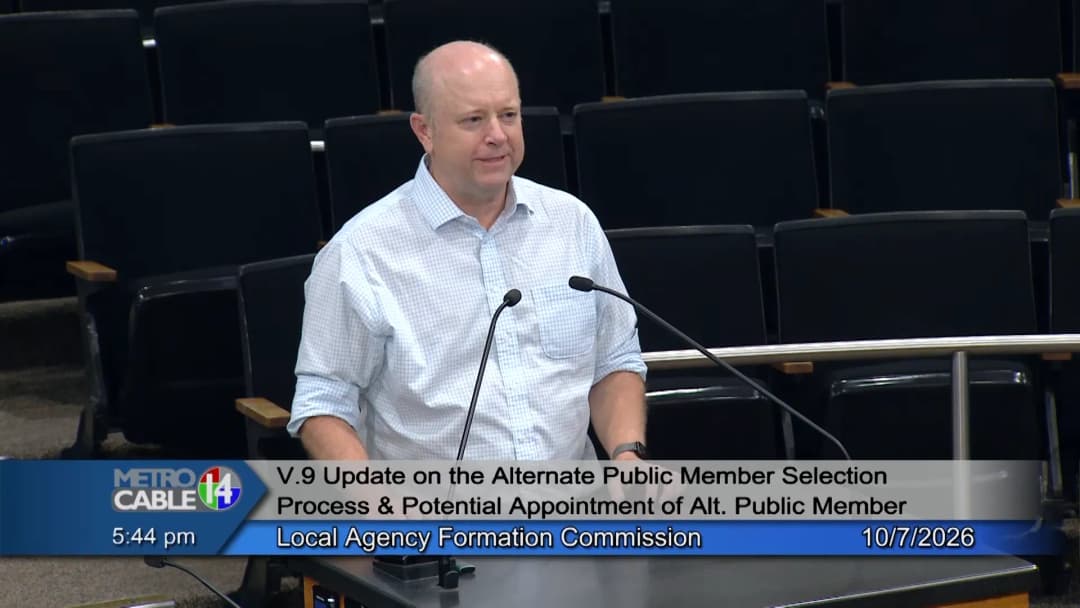
The Sacramento Local Agency Formation Commission (LAFCO) met on October 14, 2026, beginning in open session and adjourning to closed session at 5:56 p.m. The commission approved a consent calendar, approved an accounting services contract, appointed an alternate public member, and directed its Cal LAFCO voting delegates. No public commenters addressed the commission during the open session. Note: The raw transcript identifies the meeting date as October 7, 2026, while the supplied timestamp is 2026-10-14 15:01:37+00:00; this summary uses the supplied date. No agenda or minutes were available. Consent Calendar - The commission unanimously approved the consent calendar, items 2 through 6, by a 4-0 vote. Chair Murphy arrived after the vote and stated he would have voted in favor. Public Comments & Testimony - No speaker slips or in-person comments were received for the non-agenda public comment period, the consent calendar, or any other agenda item. No public comments were made before adjournment to closed session. Discussion Items - Item 7: Commissioner Hume pulled the proposed contract with South Fork for part-time staffing services. The executive officer explained the item was pulled because of new regulations that took effect January 1, requiring additional compliance review with county staff. A commissioner asked whether the issue related to 71J; staff said it did not, but that LAFCO, as a separate agency, needed to ensure full compliance. The item was continued to a date uncertain. - Item 8: The commission considered and approved a contract with Platinum Strategies for CPA/accounting services as part of LAFCO's Phase 1 transition. Josh Byron, a partner at Platinum Strategies, stated the firm serves special districts and LAFCOs, would review and recommend updates to transparency and accounting policies, help establish accounting software and procedures, and work toward GASB and audit compliance. Responding to a commissioner's question about audit protocols, Mr. Byron said the firm would provide more transparent reports, including breaking out consultant costs such as municipal service review expenses. The commission approved the contract unanimously by roll call vote. - Item 9: Staff reported that three applications were received for the alternate public member position, but two were disqualified under Government Code because the applicants were elected or appointed officials or employees of a public agency within the county. Clinton Raman was the sole eligible applicant. Mr. Raman introduced himself as a civil engineer, a 20-year Sacramento resident, originally from rural Sutter County, with experience in land development, infrastructure, and agricultural land use issues. Commissioner Kaplan asked about his work with Parsons on the Delta Conveyance Program; Mr. Raman noted state projects are generally exempt from LAFCO jurisdiction, though ancillary utility service area changes could come before the commission. The commission voted unanimously to appoint Mr. Raman as alternate public member. - Item 10: The executive officer presented a proposed Cal LAFCO bylaw amendment recommended by the Cal LAFCO Board of Directors. The amendment would tighten associate membership rules to prevent a commissioner or staff member of a LAFCO that could be a full member from using an associate membership to attend Cal LAFCO events at a non-member rate. The executive officer recommended approval. A motion directing voting delegates Commissioner Jones and the executive officer to support the amendment passed unanimously. - Item 11: Policy analyst Ms. Graber provided project updates. The Florent Resource Conservation District detachment and dissolution, with the district to be renamed Elk Grove Water, is expected late 2026 or early 2027. The Omo Chimney-Hartnell Water District MSR/SOI and Metro Fire MSR/SOI are expected next month. The Saks Lee Ray annexation is in its final stages, and the City of Sacramento MSR is underway with consultant interviews of city departments in progress. Key Outcomes - Approved the consent calendar (items 2–6): 4-0 unanimously, with Chair Murphy later indicating support. - Approved the Platinum Strategies accounting services contract: unanimous roll call vote. - Appointed Clinton Raman as alternate public member: unanimous. - Directed Cal LAFCO voting delegates to support the proposed bylaw amendment: unanimous. - Continued item 7, the South Fork part-time staffing services contract, to a date uncertain. - Adjourned the open meeting to closed session at 5:56 p.m.
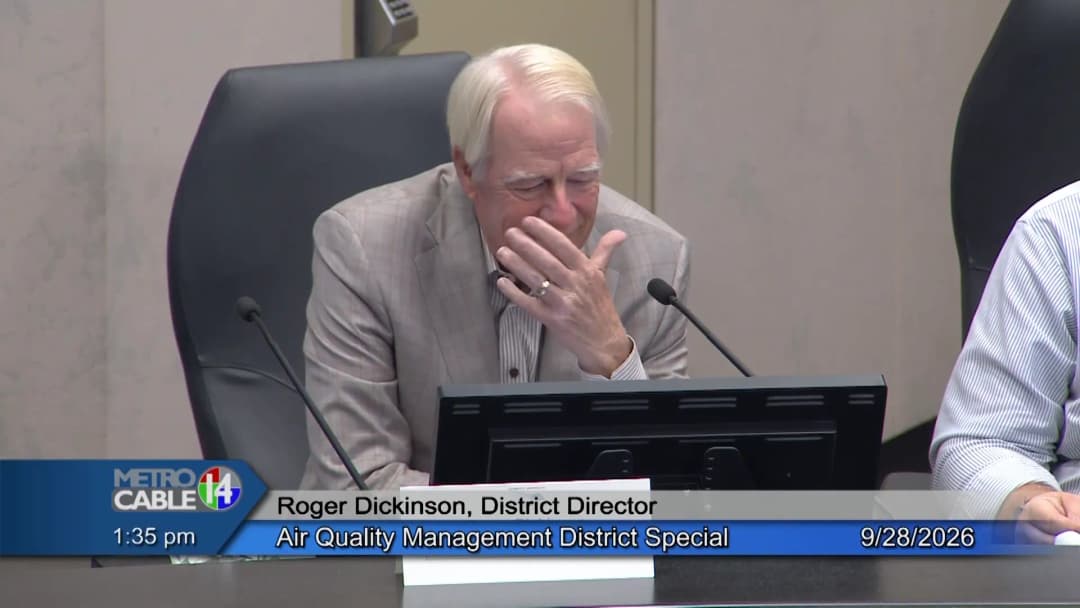
The Sacramento Metropolitan Air Quality Management District held a special meeting to act on its consent calendar and a related contract item. Chair Aquino called the meeting to order, and roll call established a quorum. The provided timestamp dates this meeting as October 1, 2026; however, the raw transcript states the meeting was called for September 28, 2026, and the replay announcement references Wednesday, September 30, 2026. This discrepancy is noted. The board approved the consent calendar in two votes, with Director Dickinson recorded as voting no on item 5.5. No public comments were offered. Consent Calendar - Chair Aquino moved to approve the consent calendar. Director Dickinson raised a question about item 5.5 and asked to be recorded as a no vote rather than pulling the item for a separate discussion. - The board approved items 5.1 through 5.4 and 5.6 by roll-call vote on an amended motion. - Item 5.5, described as an advance contract authorization brought before the RFP process, was approved separately on a motion seconded by Director Sander. Director Dickinson voted no, and the chair announced the item passed. Public Comments & Testimony - None. The board clerk reported no public comments from the chambers or online. Discussion Items - Director Dickinson questioned why item 5.5 sought authority to award and execute a contract before a contractor had been selected through the normal solicitation process. Staff responded that the current contractor's contract ends in early to mid-February, the board does not meet in November and December, and early approval is needed to allow transition time for a new contractor before the season. Director Dickinson stated he understood the explanation but considered the approach unwise and asked that his no vote be recorded. Key Outcomes - Approved consent calendar items 5.1 through 5.4 and 5.6 by roll-call vote. - Approved item 5.5 by roll-call vote, with Director Dickinson as the recorded no vote. - Adjourned at 1:37 p.m.
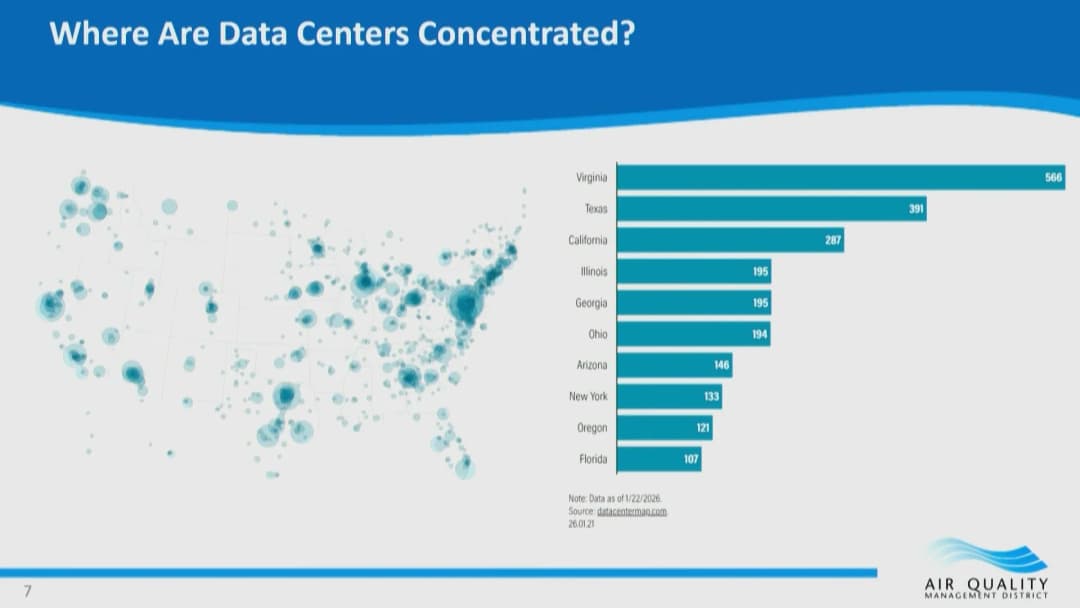
The Sacramento Metropolitan Air Quality Management District (Sac Metro Air District) Board convened on October 1, 2026, for an informational meeting covering the Clean Cars for All program, air quality considerations for data centers, and the Air Pollution Control Officer's report. Note: the provided meeting timestamp is October 1, 2026, although the transcript's roll call states 'September 24th, 2026.' At roll call, Chair Aquino said the board did not have a quorum, and later in the meeting the chair said the board was still one short of a quorum; presentations and public testimony proceeded, but no formal votes were recorded. Consent Calendar - The consent calendar was skipped at the start and returned to later for a grant item. The District plans to apply as lead applicant for a $5 million planning grant from the California Strategic Growth Council to transform Stockton Boulevard, in partnership with Sacramento County and an entity transcribed as 'Valuation.' The state requires a board resolution before applying, and the application is due at the end of the month. - APCO Dr. Ayala confirmed it is a planning grant. Director Dickinson noted the City of Sacramento has already signed on to one planning and two implementation grant applications and asked whether multiple applications could conflict. Because the board lacked a quorum, no action was taken; staff plan to call a special meeting to obtain approval in time. Public Comments & Testimony - Greg Dobbins, general sales manager at Folsom Lake Kia and Folsom Lake Ford, said his dealerships have participated since the program's inception and helped more than 85 individuals. He expressed strong support for Clean Cars for All, saying it removes older, unreliable cars, gives low-income residents access to safer electrified vehicles, generates dealership tax revenue, and helps educate buyers about clean air. - Cynthia Burrows, a Clean Cars for All participant, thanked the District and the program. She said she could not otherwise afford a safe, reliable vehicle; she acquired a Volkswagen ID.4 through a dealer in Elk Grove and praised the low-pressure, easy process. She said she is a senior on a limited budget and would have been without transportation without the program. - Bethel Beas (transcribed in the meeting as 'Beth Lovez'), president of Electric Auto Group and Bia's Auto Sales, said his businesses specialize only in plug-in hybrid and electric vehicles and have partnered with Clean Cars for All since 2020. He supported the program, stressed the importance of education and transparency, and said the program helps people obtain clean vehicles they otherwise could not have imagined. Discussion Items Clean Cars for All Program Update - Paul Philly, program manager in the Transportation and Climate Change Division, presented the update. He said the program launched during the pandemic, expanded countywide in 2024, and has brought about $28 million in funding to Sacramento County. Participants retire an eligible vehicle and receive assistance toward a hybrid, plug-in hybrid, battery-electric, fuel-cell vehicle, e-bike, or transit option. - Program changes include phasing out conventional hybrids (all four-wheel vehicles must now have a plug), lowering the income cap to focus on the highest-need residents, increasing grant awards, and offering accessibility add-ons. There are 74 participating dealers, and SMUD partnerships provide home-charging installation help or off-site charging credits. - Challenges staff have worked to address include retired-vehicle eligibility paperwork, past contractor delays, home-charging installation delays, and messaging about program requirements. The former EVgo/ChargePoint charging card is being replaced by a USIO card usable at a wider range of chargers. Participants who move out of state must repay part of the grant on a prorated basis, and totaled vehicles reduce cost effectiveness. - Statistics presented: about 2,500 grants issued and just over 2,000 vehicles acquired; 46% battery-electric and 44% plug-in hybrid; 538 EV charging cards; nearly three-quarters of a million gallons of gasoline not burned; and the highest-participation zip codes in an AB 617 community. Participant satisfaction on a 0-10 scale was very high. - Funding has been volatile, from a $12 million allocation in 2024 to about $1.5 million for the next year; the Legislature plans to continue $1-1.5 million per year for five years. In response, staff will focus on the oldest and dirtiest vehicles (2004 and older turn-ins) and recommend returning to 2020 pilot-style eligibility targeting disadvantaged, low-income communities. Chair Aquino asked about a solar-powered scooter; Philly said adding pedals to qualify as an e-bike would be the easiest current path. - Director Dickinson asked about Del Paso Heights and North Sacramento outreach. Philly said Del Paso Heights is eligible as a disadvantaged community and has had participation; Dr. Ayala added that the region had identified about ten AB 617 candidate neighborhoods, but state rules require spending within the designated community. Director Jennings asked about including more community-based organizations; staff said they work with trusted partners, attended a Stockton Boulevard Partnership event the prior evening, and will have to pull back broader promotion because the program may soon be oversubscribed. Air Quality Considerations for Data Centers - Steve Masumek, program manager in engineering and compliance, gave a receive-and-file presentation on data centers. He described federal action (White House AI Action Plan, executive orders) accelerating data centers, and both benefits (tax revenue, jobs, digital infrastructure) and concerns (electricity demand, utility rates, noise, water use, diesel backup generators). A 2026 Ugov survey found 69% of residents concerned about fast-tracking data centers without safeguards; Monterey Park, Coachella, and Fresno have banned or limited large data centers. - Locally, 13 data center facilities hold 100 air district permits; there have been no complaints in the past 10 years and generally good compliance. Facilities are mostly in Rancho Cordova, McClellan, and parts of Sacramento, with none in the AB 617 community. Total backup generation capacity is about 180 megawatts, similar to the 160-megawatt SMUD Campbell power plant. Data centers use about 5% of U.S. grid energy, expected to double by 2030. - District permitting requires best available control technology, health risk assessment, public notice for larger projects, inspections, and ongoing oversight. Modern low-emission backup engines cut pollution by 85% compared with older emergency engines; emerging options include linear generators already in commercial use in Sacramento, solar-plus-storage, sodium-ion battery assembly, and hydrogen fuel cells. - Director Kennedy called for a consolidated countywide policy involving SMUD, the Air District, and cities. Dr. Ayala supported a possible countywide data center task force and challenged staff to go beyond baseline clean technology. Director Rodriguez raised the potential for using harvest water and the need for legislative changes because harvest water is currently limited to agricultural use. APCO responded that the District will stay in its air quality lane and provide future updates. Director Dickinson said the Mayor of Sacramento has already convened a task force and city staff would reach out. Air Pollution Control Officer Report and Board Comments - APCO Dr. Ayala reported on the agency's 30th anniversary celebration, an international air quality conference in China, and an upcoming visit from Beijing's environmental protection department. He also described a presentation to SMUD's board comparing emissions per unit of energy from older cars, 2026 cars, and gas turbines; gas turbines were cleaner on NOx, particulate, methane, and CO2 emissions. He said he supports SMUD's zero-carbon plan even if the transition away from gas power plants takes longer. - Director Rodriguez thanked staff and described her personal connection to air quality because of childhood bronchial asthma. No public comments were made on non-agenda items. Key Outcomes - No formal votes were recorded; the board lacked a quorum at the start and later remained one short. - Clean Cars for All and data center presentations were informational. Staff will adjust Clean Cars program eligibility and targeting as funding shrinks and will return later with further data center updates. - Staff will schedule a special board meeting to consider the Stockton Boulevard planning grant resolution before the state application deadline. - The board discussed but did not adopt a countywide data center task force; coordination conversations with SMUD, cities, and the county will continue.
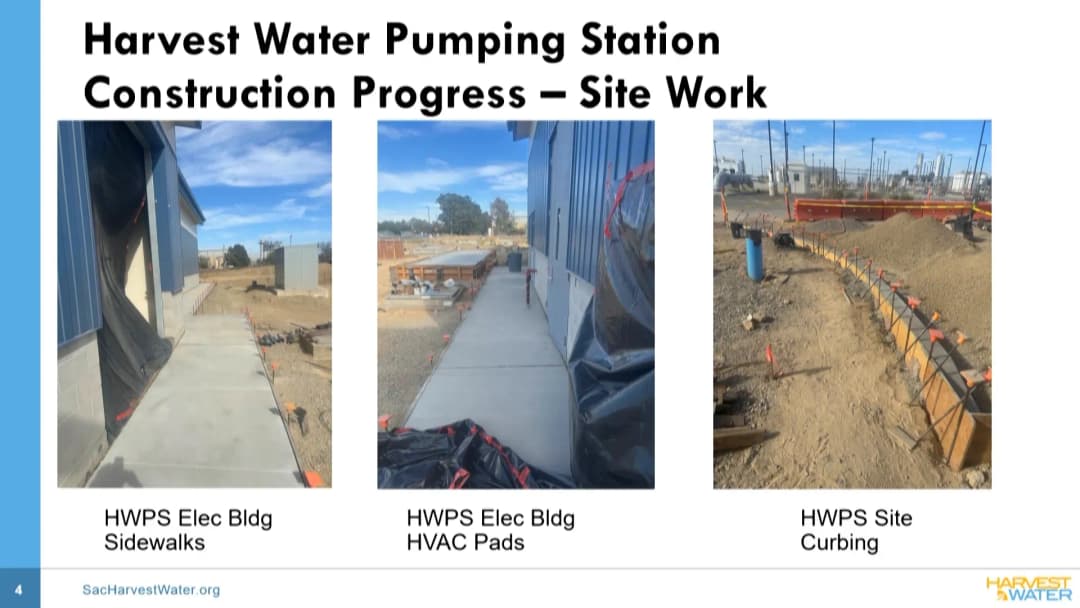
The Sacramento Area Sewer District (SACSEWR) Board held a regular meeting on October 1, 2026, at approximately 9:00 AM. The board approved consent items, a labor agreement, the 2026 long-term financial plan and capital funding projection, and continued an eminent domain resolution. Key presentations included the financial plan update and a quarterly report on the Harvest Water project, with discussion of cybersecurity risks, project cost review processes, and grower recruitment. Consent Calendar - Items 1–8: Approved unanimously with no public comment or items pulled. Discussion Items Item 10 – Miscellaneous District Engineer Matters - Mr. Luddy announced the next board meeting will be held at the Gaiti facility on October 14, 2026. He noted that Item 11 requires a two-thirds vote and moved to continue it to that date. Item 11 – Resolutions of Necessity for Eminent Domain (Harvest Water) - The board unanimously voted to continue this item (motion by Director Hume, second by Rodriguez) to the October 14 agenda. Item 12 – Letter of Understanding with Professional Engineers Association (Scientist Classification Salary Relationships) - Matt Doyle, Internal Services Director, presented the proposed LOU amending Section 3.3 of the MOU to establish salary relationships for scientist classifications: a 10.25% spread between Scientist 1 and Scientist 2, and a 21.75% spread between Scientist 2 and Senior Scientist. The LOU resulted from continued negotiations after the July 2025 MOU. No public comment. Motion by Director Rodriguez, second by Robles, approved. Item 13 – 2026 Long-Term Financial Plan and Capital Funding Projection (FY 2026-27 through 2035-36) - Tepa Banda, Director of Finance, presented the plan. Key points: The district is in strong financial condition with AA+ and AAA ratings. Growth in equivalent single-family dwelling units has averaged 1% annually. The capital program includes $237 million for the collection system (first 5 years $190M) and $1.14 billion for treatment/resource recovery (first 5 years $938M). Major projects include the Rio Linda Relief ($22M), Adam Gord Relief ($29M), North Area Copiad rebuild ($46M), East Rancho Cordova interceptor ($118M), lower central interceptor ($85M), and biosolids projects. The district reduced projected borrowing from over $400M to under $200M due to grants and cost efficiencies. Rate increases are still anticipated but smaller than prior projections. - Board Discussion: Director Dickinson raised concerns about cybersecurity and AI as omitted critical issues. Tepa Banda and Matt Doyle acknowledged the omission and noted ongoing efforts (AI committee, cybersecurity officer). Director Dickinson also asked about the process for reviewing project necessity and cost reduction. Tepa Banda described lifecycle extension, alternative evaluation, vendor competition, and grant-seeking. Director Dickinson suggested future presentations include these steps. Director Hume commended the team for financial management. Director Rodriguez praised the improved cash position and reduced debt. The capital funding projection was approved by motion (Dickinson, second Hume) with no public comment. Item 14 – Harvest Water Quarterly Report (April 1 – June 30, 2026) - Mike Crooks (Capital Program Manager) and Joe Phil Borja (APMO) presented. Pipeline construction is complete; pump station at Echo Water facility is progressing but pump delivery has slipped to February 2027, pushing commissioning to April-May 2027. On-farm connection assemblies: Phase 1 (56 sites) and Phase 2 (35 sites) are under construction by Ranger Pipelines. Construction budget $323M, spent $261M, change order rate holding at 6.6%. Potential additional growers may be added via change order. - Joe Phil Borja covered administrative updates: community outreach, ecological monitoring (vernal pools, CRAM), groundwater well installations (7 new wells in August 2026), and grant funding. Total budget: APMO $120M (spent $20.1M), CPMO $477.2M (spent $328.4M). Grants received include $218.5M from Prop 1/Prop 4, $30M federal WIN grant, $15M state WRFP phase 1, plus others. Funding gap estimated at $113.7M. The project is 80% grant-funded. Demand goal is 39,000 acre-feet per year for summer irrigation (contractual minimum 32,500 AFY), with additional delivery capacity up to 50,000 AFY for winter eco-plan use. - Board Questions: Director Hume asked about the relationship between the 39,000 AFY demand goal and the 50,000 AFY capacity. Joe Phil explained that 39,000 is the peak summer irrigation target, while 50,000 includes winter eco-plan deliveries. Director Rodriguez asked about serving future data centers; Joe Phil stated water rights currently limit use to agriculture. Director Dickinson asked how many more growers are needed to reach 39,000 AFY; Joe Phil estimated 4-5 growers could provide 2,000 AFY each, plus additional smaller growers. No vote required (informational). Key Outcomes - Consent agenda (Items 1-8) approved unanimously. - Item 11 (eminent domain) continued to October 14, 2026, with unanimous vote. - Item 12 (LOU with PEA) approved unanimously. - Item 13 (long-term financial plan and capital funding projection) approved unanimously. - Next board meeting scheduled for October 14, 2026, at the Gaiti facility (location change). Note: No public comments were made for any agenda item.