The Sacramento Regional Transit District board met on December 9, 2016, with a quorum present. The meeting covered a range of topics including the general manager's report, a public hearing on the Sacramento Valley Station area improvements, a controversial streetcar design contract, changes to board meeting procedures, the preliminary FY2017 budget, and a service changes plan for January 2017. Public comment was heard on several items. Consent Calendar - Items 1 through 10 were approved unanimously on a motion by Director Hume, seconded by Director Moran. Public Comments & Testimony - Multiple speakers addressed the board on the streetcar design contract, including Dan Allison, Barbara Stanton (Ridership for the Masses), Maggie Coulter (Sacramento Transit Advocates and Riders, STAR), and others. They expressed concerns about the $10 million expenditure, lack of a financial plan, potential impact on existing transit services, and questioned the timing. - On the service changes plan, speakers included Mike Barnbaum (Ride Downtown 916), Dan Allison, Barbara Stanton, Jeffrey Tardigia, and others. They urged caution about eliminating routes, especially those serving vulnerable populations, and suggested considering frequency increases or alternative adjustments. - Public comment on meeting procedures was provided by Mike Barnbaum and Maggie Coulter, supporting earlier start times and public comment placement. - On the preliminary budget, Jeffrey Tardigia questioned fare increases and budget cuts. - During matters not on the agenda, Mike Barnbaum reported on Connect Card progress, and Jeffrey Tardigia raised issues about fare machines, elevator outages, and construction signage. Discussion Items - General Manager's Report (Item 11): Elaine Masui reported on the CAP to Cap trip, including meetings with the FTA regarding the downtown riverfront streetcar and Buy America waiver. The GM reported on unsuccessful IBEW negotiations for part-time cleaners, and a fallback plan to hire 6 additional service workers and 14 seasonal workers. Tim Bangler updated on the surplus CMO Circle property, which had contamination found; the property will be reappraised and re-bid. Laura Hamm presented on the system-wide improvement initiative: six stations now have paid fare zones, with enforcement beginning; reported a 64% reduction in robberies and thefts year-to-date; and a homeless navigator program with Sacramento Steps Forward. A report on the Sacramento Transportation Authority sales tax measure was given: a 70-30 split between roads and transit, with front-loading of maintenance and accountability measures for RT. The STA board voted 14-2 to advance the measure, with a subcommittee unanimous direction. Board members expressed hope for a November ballot measure. - Public Hearing on Sacramento Valley Station Area Improvements (Item 12): Staff presented the mitigated negative declaration. The 30-day comment period closed on April 29. No public comments were received at the hearing. The board voted to close the hearing and certify the document. - Downtown Riverfront Streetcar Design Services Contract (Item 13): Staff requested authority to award a contract to HDR Inc. for design services, divided into four tasks. Only task one (85% design) had partial funding. Extensive board discussion and public comment raised concerns about lack of governance and operations plans, timing, and use of taxpayer dollars. Board members proposed a substitute motion to approve only task one and require board approval for subsequent tasks after receiving governance and operations information. The substitute motion passed 6-4 (64 votes). Directors voting aye: Hansen, Harris, Natoli, Cerna, Chair Shaneer; nay: Budge, Hume, McGlashan, Morin, Slowey. - Board Meeting Procedures (Item 14): Staff proposed changes to start meetings at 5:30 p.m., move public comment to before consent calendar, and hold closed session at end. Board approved unanimously. - Preliminary FY2017 Operating and Capital Budgets (Item 15): Staff presented a $163.8 million operating budget and $89.2 million capital budget. Highlights included reliance on $1.9 million in sponsorship revenue for Golden 1 Center, $1 million in service cuts, and conservative revenue assumptions. The board authorized release for public hearing on May 23, 2016, with a unanimous vote. - Service Changes Plan for January 2017 (Item 16): Staff presented a list of low-productivity routes totaling $3.3 million in potential savings, but targeting $2 million. Public comment stressed the need for alternatives and equity analysis. Board members requested detailed information on alternatives and impacts. The board will receive a refined proposal on May 23. - Paratransit and San Joaquin Joint Powers Authority Reports (Items 17-18): Directors noted the passing of former Paratransit chair Catherine Kelly Baird. Director Hume updated on high-speed rail developments, including reinstatement of Merced in the initial operating segment. Key Outcomes - Consent Calendar: Approved unanimously. - Public Hearing on Valley Station: Certified the mitigated negative declaration. - Streetcar Design Contract: Approved substitute motion to authorize only task one, with subsequent tasks requiring board approval upon provision of governance and operations plans. Vote: 6-4. - Meeting Procedures: Unanimously approved changes to start time, public comment order, and closed session placement. - Preliminary FY2017 Budget: Authorized release for public hearing; unanimous. - Service Changes Plan: Received as information; further discussion scheduled for May 23. - General Manager's Report: Noted reports on CAP to Cap, IBEW, surplus property, paid fare zones, crime reduction, homeless navigator, and sales tax measure progress.
Public Meetings - Sacramento County, California
Public Meetings - Sacramento County, CaliforniaThe Sacramento Regional Transit District Board of Directors met on December 9, 2016, to address agenda adjustments, consent calendar items, the General Manager's report, and a major discussion on the security guard services contract with G4S. The board heard extensive public testimony and ultimately voted to extend the G4S contract for one year with direction to rebid and explore social responsibility policies for future contracts. Consent Calendar - Items 1 through 9 and Item 11 were approved unanimously. Item 11, regarding Sacramento Valley Station improvements, was moved to the consent calendar. Public commenter Mike Barnbaum (Ride Downtown 916) spoke in support, noting that Sacramento Valley Station is the second busiest station in California and the seventh busiest in the Amtrak system. He also announced a seventh round trip on the San Joaquin route beginning June 2016, providing new connections to Sacramento and the California Zephyr. Public Comments & Testimony - Mike Barnbaum (Ride Downtown 916) expressed strong support for Item 11 and later recommended Option C (rebidding the security contract). - Chayna (paratransit rider) opposed paratransit fare increases, stating they pose financial hardship to riders on SSI. - Rick Hodgkins urged the board not to send tax dollars overseas and highlighted that G4S employees locally do a fine job but the company’s global record is problematic. - Robin Christophe (Physicians for Social Responsibility) recommended Option C, citing human rights concerns and precedents in Portland and UC Davis. - Pam Haney suggested hiring from supported employment agencies for people with disabilities; GM responded that such contracting could trigger a grievance. - Nancy Fleischer argued the legal analysis was based on incomplete information and offered to submit a detailed rebuttal. - Maggie Coulter (SacRide Human) noted G4S has held the contract since 2002, questioned competition, and advocated for in-house security. - Lori Jones criticized the contract length and called for in-house hiring. - Gaith Hassan pointed out misrepresentations in the legal report regarding G4S’s human rights record and urged Option C. - Patricia Doherty submitted a report showing the OECD rejected G4S’s own study, and referenced Portland’s socially responsible investment policy. - John Rieger (Veterans for Peace) urged dropping G4S. - Illanka Slatar asked the board to give someone else a chance. - Edwina White emphasized local jobs and union involvement. - Maria Cornejo Gutierrez (Sacramento Area Peace Action) urged a vote for human rights. - Barry Broad (representing Jewish Federation, not ATU) argued the opposition is rooted in BDS and the Arab boycott of Israel, which is illegal under federal law. - Dean Murakami (Sacramento Central Labor Council) highlighted that G4S workers are excluded from collective bargaining and urged a bid with labor parameters. - Mikos Faverson (retired state worker) requested 30 minutes at a future meeting to formally respond to the legal department’s report. - Fran Eldridge opposed G4S and supported in-house security. - Jamar Jefferson criticized private policing and urged hiring local law enforcement. - Roxanne Bukaria (United Methodist) supported Option C, citing divestment by dozens of institutions. - Russell Rawlings criticized RT’s past decisions and called for an independent audit. - Brigitte Yench asked RT not to side with human rights abusers. - Chris Yutuma (Wellstone Democratic Club) expressed frustration over lack of communication and refuted claims about G4S leaving Israel. - Sandra McDonald (Sierra College professor) encouraged a social justice clause. - Greg DeGeer noted no one defended G4S on its merits and urged rebidding. - Eric Rasmussen (G4S representative) defended the company as a signatory to UN guiding principles, stressed local presence, and noted high wages and performance. Discussion Items - General Manager’s Report: GM reported that IBEW voted 53-45 against hiring part-time cleaners. Staff will instead use seasonal workers for up to four months under existing contract provisions, while longer-term options (more expensive) are being evaluated. Laura Hamm reported 485 applications for 30 transit agent positions, with exams in April. Phase one station improvements at 7th & Capitol, 8th & K, 9th & K, and 8th & Capitol will begin mid-April, featuring new shelters, lighting, and RT-branded pylons. Director Budge questioned the roof design at stations; staff agreed to investigate. - Item 12 – Security Guard Services Procurement: Tim Spangler (legal) presented an issue paper concluding that human rights record cannot be considered under federal and state procurement law as a responsibility criterion, citing risk of protest, litigation, and loss of federal funding. Norm Leong (security) recommended one of three options: A (two-year extension), B (one-year extension), or C (delegate authority to issue RFP). Board members engaged in extensive discussion. Director Moran noted the contract was competitively bid three times over 12 years and warned against risking federal funds. Director Cerna appreciated public input but stressed fiduciary duty and legal exposure. Director Hansen asked about transition difficulty; Leong said training new security staff during transit agent rollout would be taxing. Director Budge prioritized stability for arena opening and praised G4S’s local community involvement. Director Hume expressed reluctance to change midstream, noting BDS targeting G4S. Director Jennings favored a one-year extension (Option B) with direction to develop evaluation criteria and a social responsibility policy. Director Harris made a motion for Option B with a friendly amendment to direct GM and legal to explore social justice contracting policies. The motion was seconded by Chair Shaneer. Key Outcomes - Agenda Adjustments: Item 13 continued to April 25, 2016 meeting; motion passed with 9-5-0 votes (all present in favor). Item 11 moved to consent calendar. Item 14 accepted as receive-and-file. - Consent Calendar: Items 1-9 and 11 approved unanimously. - Security Contract (Item 12): Motion passed to adopt Option B – approve a second amendment to the G4S contract for one year (option year four) – with direction to rebid at the end of that year and to research best practices for incorporating social responsibility into RT’s procurement process. Vote: all ayes (no vocal opposition). - Next Steps: GM to proceed with seasonal worker cleaning plan; report on long-term options due April 25, 2016. Legal and GM to explore social responsibility policy with community input for future contracts.
On December 9, 2016, the Sacramento Regional Transit District (RT) Board met to address a packed agenda, including system improvements, new staff, and a contentious fare increase proposal. After extensive public comment and deliberation, the board approved a phased fare increase for 2016, with modifications to paratransit and student passes, while deferring a second increase pending future reviews. Consent Calendar - Items 1 through 6 were approved unanimously without public comment. Public Comments & Testimony - G4S / Procurement Policy (under General Manager's Report and Items Not on Agenda): Multiple speakers urged RT to adopt human rights criteria in contractor selection, citing G4S abuses. Speakers included Nancy Fleischer, Mikos Faberson, Maria Cornejo, Dr. Harry Wang (representing Physicians for Social Responsibility), Patricia Doherty, Jeffrey Tardigia, Rick Hodgkins, David Mandel, Farris Shields, Tim Stoddard, and Nikki Meta. They argued that RT has authority under existing UN principles and urged socially responsible procurement. - Fare Increase (Item 11): Over 60 speakers opposed the fare increases, particularly impacts on low-income riders, seniors, and people with disabilities. Paratransit users like Scott Levington, Stacey Shaw, Thomas Hopkins, Stephanie Watts, Swami, John Marant, Helen O'Connell, Alice Kimball, Rick Hodgkins, and others testified that the proposed cap of 44 rides would force them to choose between medical appointments, work, and basic needs. Dan Allison (STAR), Maggie Coulter (individual), Delphine Brody, and others proposed alternatives such as 5% increases, transfers, and better cost control. Many speakers also criticized RT management salaries and called for bringing paratransit in-house. Some, such as Mike Barnbaum (Ride Downtown 916) and Chris Yatuma, supported the staff’s revised proposal as a necessary step toward fiscal stability. Discussion Items - General Manager's Report: Mike Wiley reported on state legislative changes and staff Laura Hamm updated on station improvements, homeless outreach, and cooperative union efforts. Chair Shiner provided an update on California Air Resources Board zero-emission bus regulations. Legal counsel Tim Spangler outlined ongoing analysis of human rights criteria in procurement, noting no immediate connection to G4S contract. - Commendation and New Staff: The board commended retiring executive Mike Maddows (14 years of service) and welcomed new Assistant General Manager Henry Lee. - New Job Descriptions (Item 10): Staff presented a cost-neutral plan to hire 25–30 transit agents (fare checkers) and part-time cleaners, funded by savings from G4S and RT police services. The plan was developed cooperatively with ATU and IBEW unions. The board approved the resolution unanimously. - Fare Increase Proposal (Item 11): Staff (Doug Carter, Brent Berniger) presented a revised two-phase fare increase after extensive public outreach (800+ survey responses, five open houses). The original 20% one-time increase was split into 10% in FY2017 and 10% in FY2018, with modifications to paratransit and student discounts. The financial forecast showed a $23 million five-year shortfall without action. The board discussed options, including 5% increases and different paratransit caps. Directors expressed concern about ridership loss (projected 1.3 million boardings) and impacts on vulnerable populations. Key Outcomes - Fare Increase Motion (passed 67 votes to 33): The board approved a modified motion by Director Hansen, seconded by Director Miller, effective July 1, 2016: - 10% increase on most fares (base fare up $0.25; discount single up $0.10). - Paratransit monthly pass increased from $125 to $137.50 (instead of $150) with an option: 60 rides per month OR unlimited fixed-route rides plus 44 paratransit rides. - Student free/reduced lunch pass increased from $12.50 to $15 (instead of $17.50). The board directed staff to work with school districts on a match program to offset further increases. - The second phase (additional 10% in FY2018) was deferred. Staff will report back at the first September 2016 meeting to review financial progress and again at the November 14, 2016 meeting to assess the potential sales tax measure outcome. - New Positions Approved: Item 10 passed, authorizing transit agents (at $16.26/hour) and part-time cleaners, with implementation pending union votes. - Direction to Staff: Staff were asked to return with multiple options (3–5) for paratransit cost reduction, including in-house operation, contracting, and sliding-scale fares based on income. - G4S Contract: No action taken; a separate update on the procurement policy analysis will be presented at a future meeting.
The Sacramento Regional Transit Board of Directors met on December 9, 2016, with Chair Shine presiding. A quorum was present (Directors Budge, Hansen, Harris, Hume, McGlashin, Miller, Natoly, Cerna; Director Jennings absent). The meeting was televised on Metro Cable 14 and streamed online. The consent calendar (items 1-9) was approved after a public speaker request to pull item 5 regarding the G4S contract was redirected to public comment. The board also heard public comments on various issues and received updates on board member requests. Consent Calendar - Approved items 1-9 by a vote of 100 (motion carried). A speaker attempted to pull item 5 (related to G4S contract) but was informed it was not agendized for that meeting; the speaker was directed to public comment. Public Comments & Testimony - Multiple speakers (Michael Manowski, Maggie Coulter, Gaith Hassan, others) urged the board not to renew the contract with G4S, citing human rights concerns and poor business practices. Speakers suggested hiring local youth for security and cleaning jobs instead. - Fran Eldridge raised safety issues at 29th Street light rail station (emergency entrance, bus stop signage). - Lori Jones noted a recurring pothole at 65th Street Light Rail, criticized the fare increase (discount pass rising from $50 to $65, a 30% increase rather than 40%), and opposed elimination of the paratransit monthly pass. - Jamar Jefferson mentioned homeless issues and urged passing fare costs to the business community. - Several speakers presented endorsements from Democratic clubs and organizations supporting a G4S contract cancellation. Discussion Items - General Manager's Report: Chair Shine noted that Mr. Spangler and Mr. Wiley were absent; an update on contracting policies (including the committee created six weeks prior) was requested for the next meeting. Board member Director Cerna requested a future report on art on buses. - Director Budge noted the meeting had been canceled? (Later clarified that item 16 was affected but meeting proceeded.) Key Outcomes - Consent calendar approved. - Board directed staff to provide an update on contracting policies (including G4S-related committee) at the next general manager's report. - Board requested a report on potential art on buses. - No action taken on G4S contract renewal as it was not on the agenda. - Meeting adjourned after public comment.
The Sacramento Regional Transit District (RT) Board of Directors met on December 8, 2016, with a quorum of 95 votes (Director Miller absent). The meeting covered the consent calendar, an Elk Grove service agreement amendment, the General Manager's report including charity presentations and student art contest awards, an informational update on the 7th and K light rail station, and the combined informational items on the 2015 passenger fare survey and a proposed fare change with Title VI equity analysis. The fare proposal drew substantial public testimony, with most speakers opposing the 20% increase and the elimination of the paratransit monthly pass. Board members expressed concerns about the proposal's impact on low-income riders and suggested phased increases and alternative revenue strategies. Consent Calendar - Item 3 (Elk Grove service agreement amendment) was pulled from the consent calendar for separate consideration. - Public comment on the consent calendar: Karina DeLa Torre, Vice President of ATU Local 256 and a 35-year RT employee, spoke on item 5 (delegation of authority to the General Manager to approve job descriptions), expressing concern that delegating job description modifications could bypass the long-standing negotiated process between the district and ATU regarding bargaining unit positions. - The consent calendar (minus item 3) was approved unanimously by voice vote. Discussion Items - Elk Grove Service Agreement Amendment (Item 3): Director Hume described the culmination of work involving legislation changes to determine how Elk Grove's proportional share payments to RT would be calculated, resulting in a savings of just shy of $500,000 for the city of Elk Grove (a revenue loss for RT). He commended RT and ETRAN staff for a new period of cooperation and noted a separate proposal to bifurcate the transit provider contract to separate paratransit services. The resolution was approved unanimously. - General Manager's Report (Item 8): RT presented a check of approximately $1,100-$1,200 and roughly 1,000 pounds of non-perishable food to Eileen Thomas of River City Food Bank from the holiday bus collection. RT employees donated $23,086 to local charities through seven events in 2015, including 140 cases of food to River City Food Bank. Twelve students were recognized as winners of the MLK 365 art and poetry contest (nine present); their artwork and poetry will be displayed on RT buses throughout the year. Laura Ham provided a system-wide improvement initiatives update, including renderings of the 7th and Capitol station going out to bid the next day. Mr. Spangler noted that changes to meeting start time, closed session placement, and public comment order would require amendments to Title III of the administrative code, and staff could develop an issue paper if the board desired. - Appointments to Boards and Commissions (Item 9): Director Hansen stepped down from the retirement board (alternate) due to scheduling conflicts; Director Jennings replaced him. Director Jennings also left the Capitol Corridor committee; Director Miller was placed on it (in his absence), and Director Hume volunteered to fill the second seat, requiring him to leave the streetcar committee. Director Harris was placed on the streetcar committee (contingent on checking for conflicts with a city appointment). The appointments were approved unanimously. - 7th and K Light Rail Station Update (Item 10): Laura Ham presented the operational concerns at the St. Rose of Lima Park 7th and K station, which serves blue, gold, and green line trains. The station is compressed due to track curves, and four-car trains block intersections. The Golden One Center EIR estimates 40% of event attendees (roughly 5,000-7,000 people) will exit at 7th and K. The downtown Sacramento Partnership has formally recommended closing the station; SACOG and the City of Sacramento may issue formal positions. An online survey (November 4-22) received 293 complete responses: 54% used the station frequently or occasionally, 46% did not use it at all. Overall results: 40.96% favored closing the station permanently, 41% favored moving the boarding area north, 15.96% favored closing for major events, and 25.94% favored leaving as is with crowd management. Among regular users, 42% preferred leaving it open. The RT Mobility Advisory Council opposes closure (options 3 and 4). Concerns included safety/security and walking distance for disabled passengers. RT will complete outreach and present a recommendation in January. Public speakers: Jeff Tartigia criticized the lack of a public workshop and systemic assessment; Mr. McKeever (SACOG) emphasized the importance of travel times and system-level guidance, noting SACOG's board included a contingency in federal funds requiring RT to consider eliminating existing stations. - Combined Fare Survey and Fare Change Proposal (Items 11 & 12): James Drake presented the 2015 annual passenger fare survey. Key findings: 95% of fares are used for more than one ride; the monthly pass is a $10 million item (about one-third of fare revenue) with an average fare of $2.52; senior/disabled semi-monthly passes have average fares of $1.04 and $0.71, indicating riders get more than their money's worth; on rail, about one-third of single-ride ticket users make just one ride, with others transferring, making round trips, or handing off tickets; the system is transfer-dependent (about half of rail riders and two-thirds of bus riders transfer). Brent Berniker presented the financial overview: FY17 projected revenue of $162.4 million against expenses of $164.7 million, a $2.4 million shortfall, growing to about $19.6 million over five years absent changes. Consultant Doug Carter (via phone) noted the fare box recovery requirement of 23% under the California Transportation Development Act; fares have been held constant since September 2009, and RT's buying power has declined about 20%. Revenue Manager Mr. Yancey detailed the proposal: a 20% increase for most fares; senior/disabled discount reduced from 50% to 42%; student lunch program discount decreased to 67%; daily pass increased 25% to $7.50; two-hour rail ticket reduced to 90 minutes; elimination of the paratransit monthly pass (saving about $409,000 annually); paratransit single fare raised to $6 (at the FTA limit of double the single ride fare), raising paratransit fare recovery from 12.3% to just over 15%. Estimated impacts: 6% fewer passenger trips, 13% fare revenue increase. Future options include a central city fare, distance-based fares, and penalty fares. The Title VI analysis found no disproportionate impact on minority or low-income populations. A 30-day public review period (February) with public meetings (staff planning five geographically based workshops) will precede a staff recommendation in March. Public Comments & Testimony - On the consent agenda: Karina DeLa Torre (ATU Local 256 VP) expressed concern about delegating job description authority to the General Manager, citing past diminishment of bargaining unit departments. - On the 7th and K station: Jeff Tartigia argued RT should have held a public workshop and should assess all transportation needs systematically; Mr. McKeever (SACOG) encouraged RT to consider travel times and system-level guidance. - On the fare proposal (two minutes per speaker): - Stacy Shaw (President, Autistic Self-Advocacy Network Sacramento) described the impact on people with disabilities on SSI ($889/month), saying elimination of the paratransit monthly pass would force choices between dialysis rides, groceries, and food. - Resmi Singh (VP, ASAD) expressed concern about paratransit pass elimination and fare raises affecting seniors and disabled riders. - Shayana Mendez noted that not all Los Rios students receive discounts and challenged the board to spend a day in the shoes of disabled individuals. - Nick Bryant said people want cheaper fares, not higher. - Linda O'Neill (Capital Chapter, California Council of the Blind) opposed eliminating the monthly pass, citing multiple doctor appointments and working disabled people; recommended keeping the $125 pass. - Kathleen Berman (California Council of the Blind) urged rethinking the pass elimination and the senior monthly increase to $70, noting fare machine accessibility issues. - Barbara Stanton said the group does not support the 20% increase, paratransit pass elimination, or student lunch program raise; noted SSI recipients received only 8.5% total increase since 2009; requested comparison data on senior/disabled/paratransit fares from other major systems (citing Portland's $28 senior/disabled pass). - Roger Blackwell called for a comprehensive audit of RT spending. - Jeff Tartigia said information provided is inaccurate (e.g., Los Angeles pass cost) and urged customer convenience and ridership development. - Ralph Niz (President/Business Agent, ATU Local 256) clarified that union wages were frozen during interest arbitration for two years after 2009, and labor opposes the rate increase. - Steve Munez said the central city fare didn't work before, questioned fare box data methodology, noted light rail is an open system with limited revenue collection, and said the proposed increase is the highest in the nation per KFBK. - Carol Moss noted inflation is up but SSI recipients had no COLA, gas prices are under $2, and questioned why senior/disabled rates were raised more than regular rates. - Lori Jones said a flat increase is disproportionately negative for low-income riders and noted utility rate increases (10% per year for four years) coming at City Hall. - Pam Haney argued the proposal places the heaviest burden on those least able to afford it, erodes discounts for poor children, and removes the paratransit monthly pass without replacement options. - Janelle Smith (Wellspring Women's Center) said the change is not incremental, lacks a low-income provision, and the paratransit pass is a lifeline for community integration. - Chris Jensen (Resources for Independent Living) supported the central city fare but called the fare regressive, suggested a means-tested fare, and cited the issue paper's estimate of 3.5% ridership decrease per 10% price increase. - Fabrizio Sasso (Executive Director, Sacramento Central Labor Council, representing 170,000 union members) asked for smaller incremental increases (5% per year), a ballot proposal for new tax revenue, and implementation of cost-saving measures from Doug Carter's recommendations. - Tammy Dramer (Chair, Organize Sacramento) reported outrage from constituents over the 20% increase and paratransit pass elimination, and called for alternative funding like a regional gas tax. - Arthur Ketterley suggested phasing fare increases and bringing back the central city fare. - Tiffany Finkers (Deputy Executive Director, Paratransit Inc.) noted the state standard for demand-responsive systems is 10% fare box recovery (with a 5% goal for ADA systems), compared to RT's current 12.3%; noted paratransit passengers pay 76% of base fare on average with no fare evasion; and offered to partner with RT on creative solutions. Key Outcomes - Consent calendar (minus item 3) approved unanimously; item 3 (Elk Grove service agreement amendment) approved unanimously. - Board appointments to various boards and commissions approved unanimously with changes (Jennings to retirement board, Miller and Hume to Capitol Corridor, Harris to streetcar contingent on conflict check). - No action taken on the fare proposal (informational item); it will proceed to a 30-day public review with at least five public workshops in February, and a staff recommendation is expected in March. - Board members expressed consensus that the 20% increase is too high and suggested phased increases, a target revenue number, modeling of options, comparison data from other systems, and exploration of alternative revenue sources (including a potential November ballot measure). Director Hansen proposed 5% increases in July and January, contingent on a November ballot initiative. Director McGlashin and Director Budge supported distance-based fares. Chair Shaneer requested a target figure and modeling of different phase-in scenarios with triggers. - Staff will consider board feedback and incorporate options into public outreach materials.
Note: The transcript references a January 2016 setting (e.g., "Happy New Year," Martin Luther King March), while the provided date is December 8, 2016. This discrepancy is noted; the date below follows the instruction to use the given date. The board convened to discuss consent items, the general manager’s report, board officer elections, the 2016 meeting calendar, low‑productivity bus routes, and a policy on contractor responsibility. Public comment was heard on several agenda items, particularly the meeting calendar and the proposal to include human rights criteria in procurement. The board approved consent items, a resolution commending retiring staff, and a revised meeting calendar. It also directed staff to proceed with corrective actions for low‑productivity routes and to research best practices for incorporating social responsibility into contracting. Consent Calendar - Items 1–3 (consent calendar) — Approved unanimously after a speaker questioned the cost of a federal advocacy contract. Staff noted the contract was a new award following a competitive bid and represented a significant cost reduction (from $180,000/year to $100,000/year). Public Comments & Testimony - Meeting Calendar — Multiple speakers opposed moving to one meeting per month, citing longer agendas, reduced access for transit‑dependent riders, and potential for meeting times that make return travel difficult. Some supported the chair’s hybrid proposal of one monthly meeting plus three town halls (Rancho Cordova, Citrus Heights, Elk Grove). One speaker (Mike Barnbaum of Ride Downtown 916) supported the hybrid approach, noting board members’ other commitments. - Low‑Productivity Routes — Speakers raised concerns about specific routes: 75 (Mather area) needed extended hours; 74 (Rancho Cordova) should not be eliminated but reworked; Route 19 (Rio Linda) should have lower priority because it meets weekday standards but suffers from lateness on Sundays. Representatives from Mather Community Campus and Wellspring Women’s Center opposed cuts and urged improved connections instead. - Contractor Responsibility / G4S Policy — A large number of speakers addressed the item. Most urged the board to adopt criteria that would exclude contractors with human rights violations, using G4S as an example. They cited G4S’s record in Israel/Palestine, U.S. prisons, and the UK, and argued the board has legal and moral authority to consider such factors. A few speakers (e.g., Ryan Pace of the Jewish Community Relations Council and Carol Villardi) cautioned that such a policy could be used for discriminatory boycotts (e.g., BDS) and would be legally problematic. Several also advocated for local hiring and union contracts. Discussion Items - General Manager’s Report — GM Mike Wiley announced the 35th annual Martin Luther King March (Monday, January 18, 2016), with grand marshal Mike Wiley. Staff updates included plans for system‑wide station improvements (lighting, security, cleanliness), a new mobile fare app generating $700 in its first week, and the anticipated sale of light‑rail carbon credits (estimated at $1.7 million annually). - Commendation for Rosemary Covington — The board unanimously adopted a resolution commending retiring Deputy General Manager Rosemary Covington for her 8.5 years of service, including leadership on the Green Line project and customer advocacy. - Board Officer Election — Director Shaneer was re‑elected Chair, and Director Andy Morin was elected Vice Chair, effective the next day. Unanimous vote. - 2016 Board Meeting Calendar — Extensive debate on three options: A (two meetings/month), B (one meeting/month), and C (one meeting/month plus three town halls). After hearing public comment and board discussion, a motion by Director Cerna (seconded by Director Harris) passed: keep the current frequency (two meetings/month), permit cancellation when agendas are light, and replace three of those meetings with town‑hall style meetings in Rancho Cordova, Citrus Heights, and Elk Grove during 2016, with an evaluation at year’s end. The motion also included a review of earlier start times. Vote: majority aye, with some opposed. - Low‑Productivity Routes (Item 8) — Staff presented a plan to analyze 13 bus routes and the Green Line, with a timeline leading to potential service changes in January 2017. The board passed a motion by Director Budge (seconded by Director Harris) to adopt the staff recommendation but with flexibility to modify routes (e.g., 74, 75) rather than simply eliminate them, and to bring back options for board action. Carried unanimously. - Contractor Responsibility Criteria (Item 9) — Informational item. Staff and legal counsel outlined current procurement criteria (debarment, financial capacity, past performance, integrity) and legal constraints on adding human‑rights‑based criteria. Public comment was extensive. Board discussion reflected caution about legal liability, civil rights implications, and the risk of becoming a human‑rights tribunal. Chair Shaneer proposed forming an ad‑hoc subcommittee (including Directors Hume, Morin, and possibly Hansen) to research best practices among transit agencies and other public entities and report back. The board concurred without a formal vote. Key Outcomes - Consent calendar approved. - Commendation resolution adopted unanimously. - Board officers re‑elected unanimously. - Meeting calendar: passed (frequency unchanged, three town halls added, future evaluation of start times). - Low‑productivity routes: staff directed to proceed with analysis and bring back options, with flexibility to modify rather than eliminate routes (vote: unanimous). - Contractor responsibility policy: board agreed to form a subcommittee to explore best practices and report back; no formal action taken.
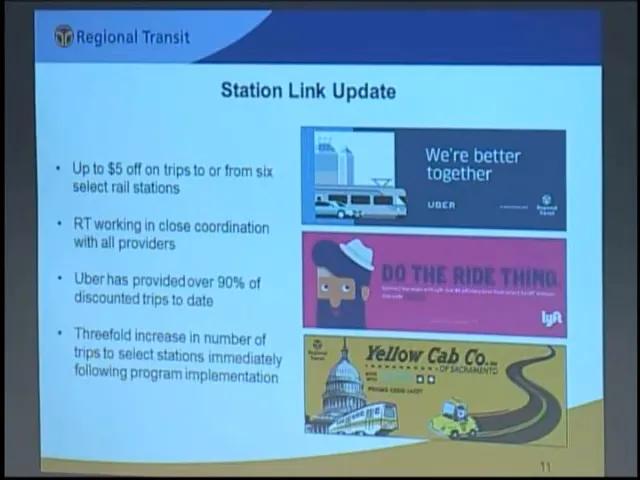
The Sacramento Regional Transit District (RT) Board met on December 8, 2016, to discuss advertising policy, a new juvenile fare evasion ordinance, a general manager's report on ridership and operations, and to receive public comments on security contracting and other matters. Consent Calendar - Items 1 through 8 were approved unanimously, except Item 5 (advertising policy) was pulled for separate discussion. Public Comments & Testimony - Security Contract (Item 5 and general): Multiple speakers urged RT to include social responsibility criteria in the upcoming Request for Proposals for private security, to prioritize local companies, and to consider bringing security in-house. Speakers (Adeeb Alziman, Brigitte Yentch, Fran Eldridge, David Mandel) cited concerns about multinational firm G4S's human rights record, including fines for falsifying psychological tests and abuses in youth prisons. David Mandel argued that public policy permits consideration of a contractor's integrity and compliance with public policy under federal law. - Alcohol Advertising (Item 5): Jeff Tardiguia and Barbara Stanton expressed concerns about insufficient public input and the message alcohol advertising sends to youth. Barbara Stanton reported that in a quick survey, 9 out of 10 riders opposed the idea. David Mandel also raised First Amendment concerns about restricting public service announcements. - Juvenile Fare Evasion (Item 10): Barbara Stanton questioned enforcement if juveniles ignore the citation. Jeff Tardiguia noted that the legislative change driving this ordinance had not been well communicated to the public. - Other Comments: Mike Bernbaum reported on the San Joaquin Joint Powers Authority meeting. Thomas Quinn questioned the closure of St. Rose of Lima station and suggested event tickets for Kings games. Jeff Tardiguia emphasized forming an ad hoc committee for a future transportation tax. Discussion Items - Item 5 – Advertising Policy (Alcohol Advertising): Staff (Deborah Salinas, Henry) and Lamar representative Amy Manim presented the policy change to allow alcohol advertising on RT vehicles and facilities, citing revenue potential and noting many other transit agencies (e.g., San Francisco, Denver, Portland) already do so. Revenue estimates were not provided, but Denver reported 15% of ad revenue from alcohol. Board members expressed mixed views: Directors Natoli, Morgan, and Cerna opposed, citing mixed messages on health and wellness, concerns about subliminal messaging, and the inconsistency with RT’s other health-related ads. Director Hansen supported the change as a responsible way to raise revenue given RT's financial challenges. Director Harris wanted a clearer financial analysis and objected to hard liquor ads but was open to beer/wine. Director McGlashon supported allowing ads for bars/restaurants but not pure alcohol products. The Board decided to refer the matter to a subcommittee (Directors Natoli, Harris, Hansen) to refine the policy and bring back options. - Item 9 – General Manager’s Report: General Manager Henry Li provided updates: - Government affairs: Statewide Democrats retained two-thirds majority; hopes for state transportation funding; highlighted successful transit measures in other regions (e.g., LA Metro's Measure M, a half-cent sales tax raising $12 billion over 40 years). - Rider line activities: GM Li reported riding bus Route 30, noting buses were full between 3-7 p.m., and emphasized the need for more frequency and reduced travel times. - Measure B update: Despite failure, over two dozen groups approached RT to form an ad hoc coalition for a future ballot measure. RT faces $100-$150 million in aging infrastructure needs within two years. - Recognition of Light Rail Department: GM Li introduced the management team (Mike Coleman, Freddy Daringer – recently retired, Lola Espinoza, Rodrigo Hunt, Sharon Hurley) for exceptional service during Golden 1 Center events. The department saved $650,000 year-to-date while implementing new initiatives. - Ridership update: Staff reported that for Golden 1 Center events, an average of 10% of attendees rode RT (3-5% higher than EIR predictions). System-wide ridership was 2.1 million in October, 2.6% below target, with light rail down 9.9% from last October (attributed to fare inspection and deflection) and bus ridership up 1.4% from goal. Park and ride usage up 2.8%. - Station Link pilot: A program offering $5 discounts on rides to/from six light rail stations via Uber, Lyft, and Yellow Cab. Uber trips to selected stations tripled since launch. - Engineering projects: Completed Summers River College pedestrian bridge (322 ft, $1.9 million); completed requested improvements in Citrus Heights (painting, benches, info panels); explored sound wall graffiti abatement (cost $15/foot) and potential partnership with county for alternative sentencing work crews. - Item 10 – Juvenile Fare Evasion Administrative Penalty: Norm Leong presented a proposed ordinance to establish a $35 administrative fine for juveniles found without fare, effective January 1, 2017, due to a state law decriminalizing juvenile fare evasion. RT averages five citations per week. The goal is compliance, not revenue; RT will work with parents and juveniles. The Board requested exploring a community service alternative for those unable to pay. The first reading was waived unanimously. Key Outcomes - Consent Calendar: Approved (items 1-8), with Item 5 removed. - Item 5 (Alcohol Advertising Policy): Referred to a subcommittee of Directors Natoli, Harris, and Hansen to refine the policy and return with recommendations. - Item 10 (Juvenile Fare Evasion Ordinance): Motion to waive first reading passed unanimously (motion by Director Hume, second by Director Harris). Ordinance will come back for final approval with possible community service alternative. - Closed Session: Board recessed to closed session for real estate negotiation regarding property at 8000 Detroit Boulevard.