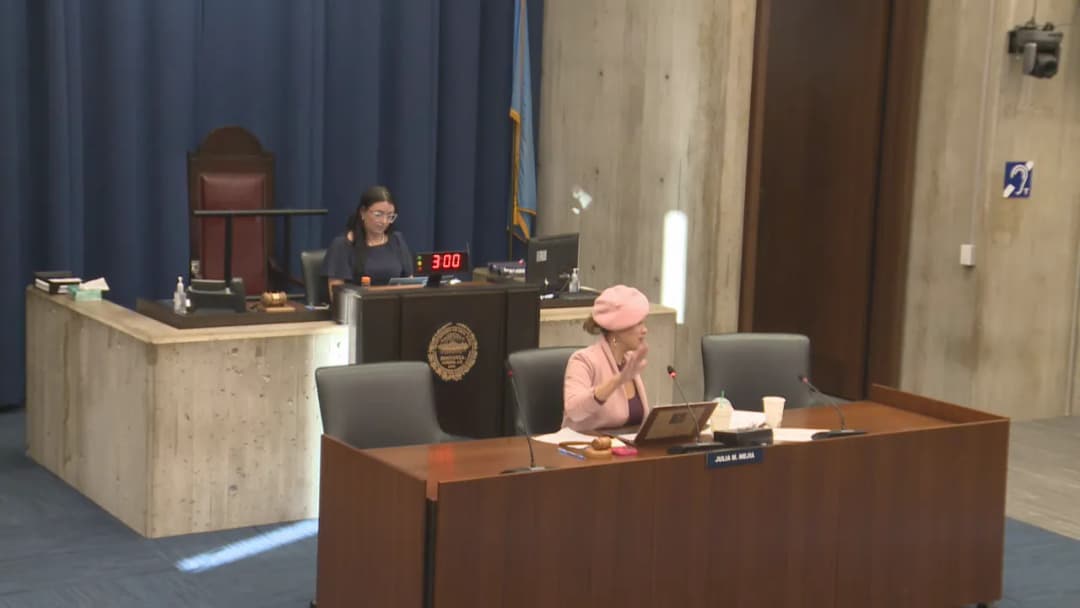
The Boston City Council Education Committee met at 3:03 p.m. on October 20, 2026, for a hearing on Docket 0407, an order to review prevention and response to bullying, sexual harassment, sexual assault, and sexual misconduct in Boston Public Schools. The matter was sponsored by Councilor Julia Mejia and referred to the committee on February 25, 2026. Councilors Murphy, Flynn, Fitzgerald, and Culpepper participated; a letter of absence from Councilor Louise Jeanne was read into the record. The hearing included a community panel, a BPS administration panel, a youth panel, and public testimony, and continued past 6:00 p.m. Public Comments & Testimony - Taisa Santiago, mother of an autistic, non-verbal BPS student, said her son was injured at school. She called for stronger licensing and training requirements for staff working with children with severe disabilities, fair pay for those workers, classroom cameras with privacy safeguards, and the option for parents to use body cameras for children when needed. - Monica Murchison testified that her daughter, Amazing Grace, was raped by a BPS staff member during school. She said BPS did not follow policies: police were not called, a 51A was not filed, and she was not contacted. She described retaliation, including 51A filings and trespass notices, an unfulfilled FERPA request, losing her catering business while homeschooling her children, and her daughter experiencing later bullying at a charter school, a concussion, repeated shoulder dislocations requiring surgery, opioid treatment, and mental-health hospitalizations. She said her daughter remains out of school and denied education and tutoring. - A parent whose eight-year-old daughter had experienced sexual misconduct on a school bus two years in a row, as well as physical assaults and bullying, called for qualified bus monitors, prevention and accountability measures, preservation of video evidence, and real investigations rather than asking the bus driver what happened. - Leon Smith, executive director of Citizens for Juvenile Justice, cited research showing bullying has long-term impacts, including depression, PTSD, and substance use. He said restorative practices are effective when faithfully implemented and are already required under state law, and he criticized DESE data showing Boston reporting zero school-based arrests or referrals to court despite years of contrary tracking. He urged an ordinance to close transparency loopholes. - Tatiana Sofia Bigalt, executive director of MASCOSH, cited 2023 Massachusetts Youth Health Survey data: 45% of middle school students and about 25% of high school students reported bullying or cyberbullying, with nearly 75% of non-binary and other-gender middle school students affected. She also cited one school psychologist per 686 students versus a recommended ratio of one per 500. She called for sustained prevention funding, a 90-day coordinated implementation plan, annual public reporting, and meaningful student and worker participation. - Kia McClay, executive director of the Boston Education Justice Alliance and a BPS alum, cited the federal civil rights investigation of Boston Latin School, 2024 Gardner Pilot Academy allegations, CDC data showing 45.9% of Black high school students experienced racism in schools, and Boston 25 Investigates data showing 131 BPS students disciplined for sexual assault from 2013 to 2022, including 69 Black, 58 Hispanic, and 3 white students. She called for measurable prevention and accountability standards, multilingual and trauma-informed reporting, protection from retaliation, transparent outcomes, and student and family participation. - In formal public testimony, Upurba Fatima of MASCOSH described an anti-bullying curriculum funded by the Department of Public Health and said youth need adults who can recognize and respond to harm with cultural competence. Bria Smith, youth program leader at MASCOSH Teens Lead at Work, said young people should be at the forefront of anti-bullying and restorative-practice policy and praised the youth panel. Students Supreme, Nina Jean-Pierre, and Chanel described the need for more mental-health support and counselors in low-income schools; Chanel said a threat she reported to a teacher was dismissed as just how that student is, leaving her feeling unheard. Discussion Items - Councillor Murphy said she filed a 17F request in December 2023 seeking answers about 1,633 substantial cases of sexual misconduct and bullying, and that 32% of incidents in one school year and 25% in the next were omitted from data. She said BPS must not hide behind student privacy while denying accountability. - Councillor Flynn said data showed over 2,000 reports of student-on-student assaults and sexual misconduct over six years. He called for BPS transparency, a task force, and public release of information without identifying survivors. He later challenged BPS claims of transparency and pressed for an unexecuted Boston Police Department memorandum of understanding that he said has been requested for three years. - Chair Mejia noted that about 18% of students said it was quite or extremely difficult to get help from an adult about bullying. She raised concerns about cases falling through the cracks, accountability for honest investigations, retaliation against parents through 51A filings, and an independent oversight committee. She also asked about the effect of BPS bullying-prevention funding dropping from a $34,000 grant in FY25 to $2,394 in FY26 and FY27. - BPS Chief of Student Support Corey McCarthy described district policy, including immediate reporting, family notification within 24 hours, investigation completion and family notification within five school days, and the criteria of power imbalance, repeated behavior, and intentional, targeted behavior. He said the district is in year three of a five-to-seven-year restorative justice practices implementation, and proposed a 60-day family assurance protocol, expanded prevention beyond classrooms, and stronger student voice. - Senior advisor to the superintendent Christine Travison described the Title IX process, supportive measures and safety plans during investigations, and concurrent code-of-conduct and Boston Police consultation processes. She acknowledged the district has not always communicated well with families. - Deputy Superintendent Dr. Samuel Lupina apologized to families and said BPS is updating its code of conduct, holds staff accountable, and consults with BPD sexual assault and crimes-against-children units. He said an MOU with BPD is signed on BPS end but not by BPD. He said he could not commit to tutoring Monica Murchison’s child but would work on a re-enrollment plan, and Councilor Culpepper said he would monitor the situation. - During the youth panel, students said bullying has serious mental-health impacts, students often do not know about counselors or do not trust them because information may be shared with parents, and reporting is deterred by fear of retaliation and snitch culture. They requested anonymous reporting, multiple trained adults, a text and website-based hotline, prevention of victim blaming and gossip during investigations, and more mental-health resources. Chair Mejia noted that a reporting hotline already exists and said BPS must publicize it better. Key Outcomes - Docket 0407 was kept in committee. - Chair Mejia said she will hold additional working sessions and a possible second hearing and will create a crisis action team or oversight body involving youth, families, community organizations, BPS, and the council. - BPS expressed willingness to work with families and community partners; Chief McCarthy said he is open to an action-oriented committee, and BPS offered restorative justice training to the council. - BPS committed to work with Monica Murchison on a plan for her child’s re-enrollment, with Councilor Culpepper indicating he would monitor follow-through. - Youth recommendations, including a text and website anonymous reporting option, more counselors, publicizing existing hotlines, and anti-retaliation protections, were left as next steps for the working sessions.
The Public Meeting Index
The Public Meeting IndexThe Fort Worth City Council held a work session on October 20, 2026, to discuss agenda items, organizational recognitions, and policy initiatives. The meeting featured two major presentations for upcoming votes, an update on nuisance enforcement, and several requests for future reports from council members. Recognition and Awards - Tarrant County Heart Walk: The City of Fort Worth raised over $22,000 from nearly 500 employees for the Tarrant County Heart Walk. Top fundraising teams included Finance (Heart ACHS) and the City Manager's Office. Top individual fundraisers were Josh Giles, Monique Washington, and Michelle McCullough. - Community Impact Through the Arts Award: The Fort Worth Library Department, represented by Director Midori Clark, received the 2026 Community Impact Through the Arts Award from Texans for the Arts for initiatives including community gallery walls and the rehabilitation of the 512 West Fourth Street building for creative professionals. Discussion Items - Agenda Re-arrangement: The first three informal reports (IRs 026-0143, 0142, and 0145) and the Fire Chief Recruitment Process update were moved to the October 27 meeting. - Fire Chief Recruitment: HR Director Christy Lemon stated that a consultant has been engaged for the fire chief selection process. Details on the selection panel are still being finalized. - Litter Control: Dr. Cody Wittenberg presented the FY26 litter control program summary and a preview of FY27 events. - Zoning Changes: Proposed council-initiated zoning changes for the East Lancaster corridor and text amendments to the Camp Bowie Boulevard Revitalization Code were discussed. Councilmember Martinez thanked staff for the successful open house on the Lancaster corridor changes. Councilmember acknowledged the importance of ongoing dialogue with the Como neighborhood regarding its role in the form-based code, and congratulated Dr. Sandra Stanley for her leadership. - Future Agenda Requests (Councilmembers): - Councilmember Beck requested future presentations on industrial zoning and data centers, downtown height bonuses and office relocation incentives, employee reimbursement timeframes, and payroll audit frequency. - A presentation on state and local laws regarding e-bikes, scooters, and similar devices was requested from the Police Department. - An expedited IR was requested regarding city employee policies for taking time off to vote, given reports of wait times exceeding two hours at early voting locations. Presentations - Flora Brewer Bridge Program (Elderly Homeless Assistance): - Speaker: Tara Perez, Homeless Strategies Unit. - Program Overview: A new program targeting unsheltered homeless individuals aged 55 and older. Named after the late Dr. Flora Brewer, it provides 105 housing vouchers (valued at $1.7 million annually) from Fort Worth Housing Solutions and specialized case management to secure federal benefits and transition to higher levels of care. - Need: Unsheltered homelessness in Fort Worth has increased by 70% since 2020. Over a third of those served by street outreach are over 55. People experiencing homelessness die approximately 30 years earlier than the average person. - Funding: The city's cost at full capacity is estimated at under $350,000 annually. The Flora Fund at the North Texas Community Foundation is matching city spending dollar-for-dollar for up to five years. DRC Solutions will provide case management services. - Impact: The program is estimated to save $12,000–$13,000 per person per year compared to the $35,000 average annual cost of unsheltered homelessness. It is projected to serve over 250 seniors over 10 years. - Timeline: An MNC is scheduled for a vote on October 27, 2026. First housing matches are anticipated for January 2027. - Council Positions: Councilmembers expressed strong support for the program. Councilmember Peoples challenged the city to consider scaling the program beyond the initial 105 vouchers. Councilmember asked about identifying and resolving potential bottlenecks in the outreach-to-housing pipeline. - Economic Development Agreement (Semiconductor Testing Facility): - Speaker: Brianna Brown, Assistant Director of Economic Development. - Project Overview ("Project H Turn Z"): A semiconductor testing facility by King Wan Electronics (KYEC) through its Texas subsidiary A Turn Z. This would be the company's first manufacturing facility in the U.S. - Investment & Jobs: Minimum $1.3 billion capital investment. Creation of at least 630 full-time jobs with a minimum average annual salary of $80,000. - Location: An existing building at 230 W. Everman Parkway in Council District 8, representing the largest investment on the I-35 South Corridor. - Incentives: A proposed 10-year tax abatement with an estimated city incentive value of $50 million (2.8% participation rate). The company is also pursuing state incentives via the Texas Semiconductor Innovation Fund. - Competition: The company is also evaluating one out-of-state site and another site in North Texas. - Action: The economic development agreement is scheduled for a vote at the October 27 council meeting. - Council Positions: Council expressed general support for the project. - NetForce Update (Nuisance Enforcement Task Force): - Speaker: Brian Doherty, Code Compliance Director. - Program Summary: The Nuisance Enforcement Task Force (NetForce) uses a multi-department enforcement initiative targeting negligent property owners. - Pilot Results: Eco Motel saw six buildings declared hazardous, with substantial repairs underway. Southside Food Mart closed operations. Sandy Oaks Apartments corrected over 800 code violations. Central Motel is being demolished to avoid enforcement. - Current Status & Resources: The program expanded capacity with new FY27 budget positions. A live tracking dashboard is operational. Active cases include Cowboy Inn, Ranch Motel, and Central Motel. The department is working on a dedicated demolition fund. Key Outcomes - Items Deferred: Three informal reports, the Fire Chief Recruitment update, the Animal Shelter Bond Program presentation, and the Library 125th Anniversary presentation were deferred to later dates. - Upcoming Votes (October 27, 2026): Council is scheduled to vote on the MNC for the Flora Brewer Bridge Program and the economic development agreement for the semiconductor testing facility. - Council Requests for Future Work: Multiple requests for future presentations and informal reports were formally made by council members, covering industrial zoning and data centers, downtown height and incentive policies, employee reimbursement and payroll audits, e-bike regulations, and employee voting leave policies.
The Jacksonville City Council held a notice committee meeting on October 20, 2026, to discuss the legal feasibility of requiring or incentivizing apprenticeships on city-funded public works projects. The conversation centered around Florida Statute 255.0992 and a recent court ruling from St. Petersburg that struck down apprenticeship mandates. Participants included committee chair Council Member Layas Fout (also representing Smart Local 435 and North Florida Building Construction Trades Council), Council Member Jimmy Peluso (District 7), Office of General Counsel Attorney Shannon McGillis, Council Member Ms. Norris, and others. No public comment was made. Discussion Items - Legal Limitations on Apprenticeship Mandates: Shannon McGillis (OGC) explained that Florida Statute 255.0992 prohibits the city from requiring apprenticeships or controlling staffing on public works projects, as affirmed in the St. Petersburg case. The state's amicus brief made clear that even setting requirements through scoring in a request for proposals could constitute a mandate and violate the statute. - Aspirational Goals Not Mandates: Layas Fout argued that the goal is not a mandate but aspirational targets for apprenticeship use, similar to the city's existing goals for JCBs. He stated, "if the city is going to fund a project, I think the city has every right to ask for goals within a project." He brought up Council Member Mike Gay's bill that adds local business preferences to procurement, suggesting a similar model for apprenticeships. - Incentives as a Pathway Forward: Council Member Jimmy Peluso suggested a resolution declaring it the city's intent to consider apprenticeships in future incentive deals. Ms. Norris noted that the Stand for Service Act uses incentives for hiring veterans and military spouses without imposing a mandate, and that a similar approach could work for apprenticeships. - Scoring and Procurement: The committee discussed whether apprenticeship participation could be factored into bid scoring. McGillis warned that even scoring could be seen as a mandate if it affects bid ranking. Council members expressed interest in exploring this avenue further but acknowledged legal risks. - Private Development Incentives: Phil Peterson clarified that Florida Statute 255.0992 applies only to public works projects on city-owned property. As a result, the city may have more flexibility to attach apprenticeship goals to incentive agreements for private development projects, as demonstrated with the Stand for Service Act. - Restructuring Completion Grants: The committee considered an idea to provide a portion of completion grants upfront if developers commit to apprenticeship targets. While seen as an innovative policy, participants noted it would not require code changes but would be an internal administration decision. Key Outcomes - Agreement to Pursue Incentives: The committee reached a consensus to focus on apprenticeship incentives rather than mandates, modeled after the Stand for Service Act. A formal bill or resolution will likely incorporate incentive language. - Consultation with Procurement and Economic Development: The chair directed members to meet with Chief Procurement Officer Dustin Freeman and Economic Development staff (John Sawyer) to determine how to implement incentives without violating state law. - Outreach to Council Members: Committee members will discuss the proposal with other council members to build a bipartisan coalition. - Next Steps: The committee will gather additional legal guidance and return with specific recommendations at a future meeting.
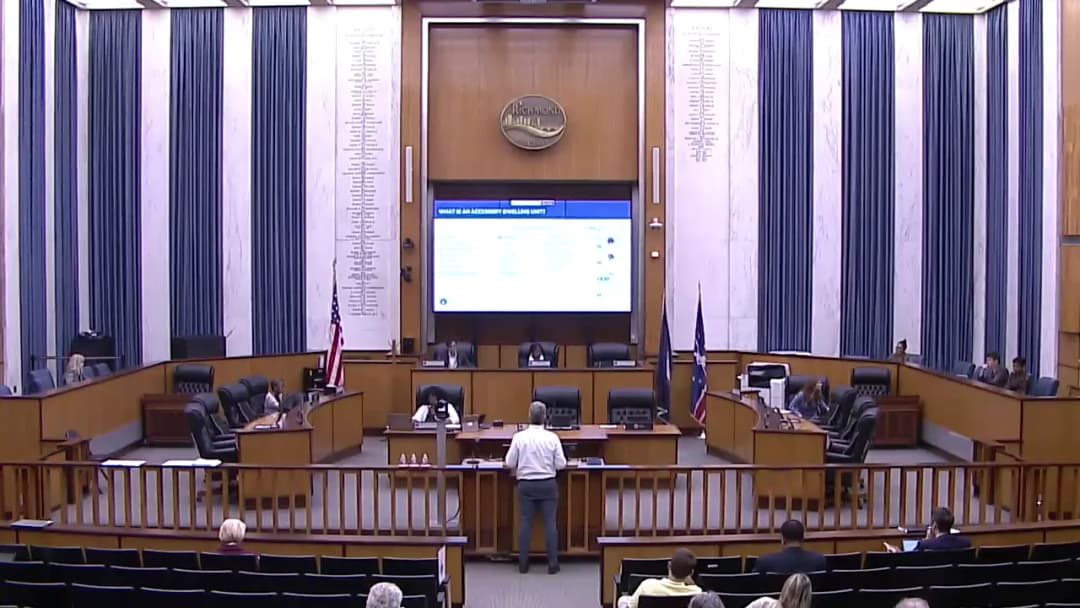
The Land Use, Housing and Transportation Standing Committee met on October 20, 2026 at 3:00 PM in Council Chamber. The committee received a presentation on Accessory Dwelling Unit (ADU) implementation and housing production, considered four ordinances, made appointments to various boards and commissions, and continued one ordinance to the next meeting. Consent Calendar - Approved the minutes from the September 22, 2026 meeting as presented. Public Comments & Testimony - No public comments were made regarding items not on the agenda. - For Item 2 (Cancer Retreat Centers lease expansion), Kristen Harris, Executive Director of Cancer Retreat Centers, spoke in support, noting the organization provides integrative cancer care services at no cost to participants. - For Item 3 (Sampson Paints park lease), Janet Woodcott, President of the Manchester Alliance, spoke in support, highlighting the lack of public parks in Manchester and the need for green space to reduce heat island effects. - For Item 4 (James River Association grant), no public testimony. Presentation: Accessory Dwelling Unit (ADU) Implementation and Housing Production Kevin Vonck, Director of Planning and Development Review, presented an update on ADU regulations and production since the 2023 ordinance update. Key points: - ADUs are small independent dwelling units (internal, attached, or detached) on the same lot as a primary residence. - Current regulations allow one ADU per lot, up to one-third of the primary dwelling's floor area or 500 square feet, whichever is larger, subject to zoning requirements. - Building permit data from 2020-2026: After the 2023 ordinance, there was a noticeable uptick in permits. In 2026, a substantial number of permits were issued. - ADUs are clustered in North Side (Highland Park), Northern Union Hill, and West Manchester/Blackwell. - Proposed Code Refresh changes: increase maximum ADU size to 1,200 square feet, with height limited to 20 feet or the primary dwelling's height (whichever is less), and total footprint of all accessory buildings not to exceed primary building's footprint. - Committee members asked about sizes of built ADUs (typically 500-800 sq ft, some up to 1,100), feasibility (detached most expensive, garage conversion, internal conversion least expensive), and potential city assistance for low-income homeowners (pre-approved plans, design contest, leveraging financial resources). - Clarification on distinction between Accessory Dwelling Unit (ADU) and Affordable Dwelling Unit (ADU same acronym). Affordable Dwelling Units are defined by income/rent restrictions, not size; the city is exploring ways to incentivize affordable ADUs through a future committee. - Staff will work to extract ADU size data from the permit system and report back. Discussion Items - Board Vacancies Report: The committee considered applications for several boards. Key actions: - Affordable Housing Trust Fund Supervisory Board: Recommended Victor McKenzie Jr. for service provider representative. Continued the charitable organization vacancy to allow more applications. - Board of Fire Appeals: Reappointed Matthew Clark. - Commission of Architectural Review: Continued the Citizen at Large vacancy to solicit more applications. - Community Transportation Advisory Committee: Continued to next quarter for more applications. - Plan RVA: Reappointed Priscilla Eatings. - Richmond Redevelopment and Housing Authority (RRHA): Continued to next quarter and will conduct interviews via a special committee meeting. - Safe and Healthy Streets Commission: Recommended Corey Glenn. - Urban Design Committee: Reappointed Keith Van Inwigan. - The committee voted unanimously to forward the slate as recommended. - Ordinance 2026-190 (Affordable Dwelling Unit Advisory Committee): Continued to November 17, 2026 meeting by a vote of 3-0. - Ordinance 2026-291 (Cancer Retreat Centers lease expansion): Approved unanimously (3-0) to allow expansion of leased premises at Blanton House. - Ordinance 2026-298 (Sampson Paints park lease): Approved unanimously (3-0) to facilitate construction of a public park at 311 Bainbridge Street. Councilmember Breton added as co-patron. - Ordinance 2026-299 (James River Association grant): Approved unanimously (3-0) for green infrastructure projects at Belmont and Hull Street library branches. Councilmember Breton added as co-patron. Key Outcomes - Approved minutes, board appointments, and four ordinances (items 2-4) with unanimous votes (all 3-0). Item 1 continued. - Staff directed to schedule RRHA interview special meeting and pull ADU size data. - Next meeting scheduled for November 17, 2026 with two presentations.
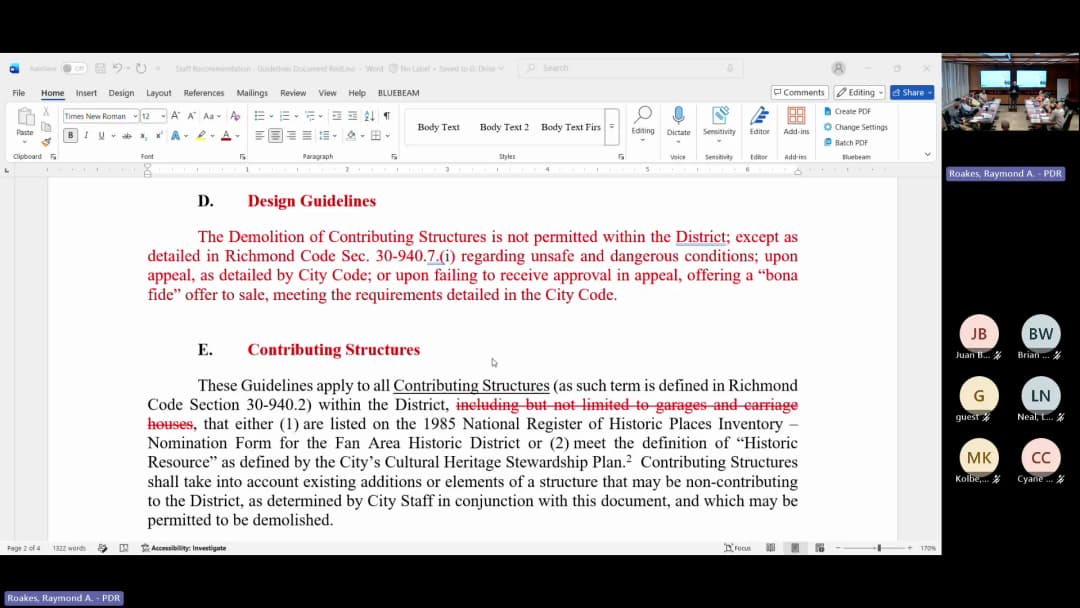
The Richmond Urban Design Committee met on October 20, 2026, to review two major items: a proposed Fan neighborhood demolition-control overlay district and a conceptual plan to pedestrianize parts of Shockoe Bottom with removable bollards. No agenda or minutes were provided with the source materials. The raw transcript opens with October 15, 2026, which conflicts with the supplied meeting timestamp of October 20, 2026; this summary uses the supplied date. Both agenda items received unanimous recommendations of approval. Public Comments & Testimony - Fan overlay: Historic Richmond spoke in support, calling the demolition overlay a great solution for the neighborhood after years of effort. Another online participant, identifying herself as a resident of the proposed district, also supported the overlay. No public opposition was voiced during the meeting, although the property-owner poll recorded 50 no responses. - Shockoe Bottom bollards: Mr. White of the Shockoe Partnership supported the bollards, saying they would free police officers from standing beside patrol cars and allow proactive foot patrols. Cyan Crump of Historic Richmond gave conditional conceptual support, asking for a mock-up and material/installation details, and noted the benefit of moving the closure to 19th and Franklin Street to protect Mason's Hall and the cobblestone pavement. Mr. Braxton, a nightlife/RPD liaison, also supported the plan and asked that nightlife business access be maintained. Discussion: Fan Neighborhood Demolition-Control Overlay (UDC 2026-15) - Planning staff presented the overlay as a community-driven zoning tool requested by the Fan District Association. The proposed boundaries cover most of the Fan, with the applicant clarifying that the eastern boundary is Harrison Street rather than Lombardy, excluding VCU and existing older historic districts within the area. - The overlay would prohibit demolition of contributing structures unless they are unsafe or dangerous as determined by the Building Commissioner, subject to appeal and a bona fide offer of sale requirement. It would protect whole contributing buildings, contributing front porches, stoops, and carriage houses or garages, as well as significant demolition visible from public streets or alleys. It would not cover non-contributing additions, simple garages, or individual features such as windows, doors, and chimneys. - Staff said the definition of contributing structures would use the 1985 National Register inventory, including later amendments, and noted that a 2011 update added roughly eight structures. The city's Cultural Heritage Stewardship Plan definition would apply when a structure is not on the National Register inventory. Staff estimated, very roughly, that about 85% of Fan structures are on the National Register inventory. - The code-required property-owner poll mailed about 2,400 notices and received about 900 responses: 850 in support, 50 opposed, and 3 unsure. After the official count, about 30 additional yeses and 5 additional noes were received. The applicant also cited 94.4% support from the poll and 94% support from an earlier Fan District Association member survey. - Applicant Andrea Quilici, an architect and chair of the Fan District Association Historic Preservation Committee, said the effort had been pursued for 28 years and was driven by concern that redevelopment pressure could demolish historic houses. He said the Fan is on the National Register of Historic Places and the Virginia Landmarks Register, but those designations are honorary and do not prevent demolition. He framed the overlay as a first preservation step rather than a full Old and Historic District. - A council member attending the meeting voiced full support for the proposal. - Committee members raised concerns about clarity and enforceability: defining stoop and front porch, whether unlisted garages and outbuildings would be subject to discretionary staff review, conflicts with by-right accessory dwelling units, notification to future homeowners, and whether historic appeals should go to the Commission of Architectural Review rather than the UDC. Some members said the ordinance should be more black-and-white; others argued the case-by-case appeal process is acceptable. Discussion: Shockoe Bottom Weekend Bollards (UDC 2026-18) - Staff described the project as formalizing existing Friday and Saturday night ad hoc street closures by Richmond Police. It was presented as a conceptual location, character, and extent review, not a final design approval. The project would install removable stainless-steel bollards at five intersections: 17th and Franklin, 17th and Grace, 18th and Main, 18th and Grace, and, as proposed by the applicant, 19th and Franklin instead of 18th and Franklin. Moving the closure to 19th and Franklin was intended to avoid disrupting the cobblestone area and to prevent a difficult dead-end turn near Mason's Hall. - DPW, RPD, and Mayor's Office staff presented the safety rationale: bollards would replace police cars and barricades, allow officers to patrol on foot, reduce the police-state visual environment, and align with crime prevention through environmental design. The project is funded by a Safer Communities grant; materials cost about $99,000. Bollards would be roughly 80 pounds, removable, fitted with reflective tape, and crash-rated to stop vehicles at 20-25 mph. - The recommended staff conditions set street closures between 5 p.m. and 5 a.m. on Friday, Saturday, and Sunday, with allowances for special events and coordination with businesses for deliveries. Current RPD closures are Friday and Saturday from 10 p.m. to 3 a.m. Staff also recommended considering the bollard finish in relation to the historic setting and carefully considering vehicle circulation. - Committee discussion focused on bollard placement relative to crosswalks and ADA curb ramps. One member with emergency-response experience favored placing bollards about 10 feet back from the corner so emergency vehicles could pull off the travel lane; another member preferred keeping bollards outside the crosswalk to protect accessible pedestrian routes. Other topics included durability and handling, reflective versus illuminated bollards, storage, historic character, emergency access, and coordination with ride-share and Google Maps. Key Outcomes - Fan overlay (UDC 2026-15): A committee member moved to recommend approval of the proposed overlay district as modified by staff, with added language defining stoop, exempting outbuildings not listed on the National Register from demolition control with the intent to identify contributing outbuildings later, and including any subsequent amendments to the National Register. The motion was seconded and passed unanimously. The item will go to the Planning Commission next Tuesday as a staff presentation, with a public hearing expected at a later meeting before the ordinance process continues. - Shockoe Bottom bollards (UDC 2026-18): A committee member moved to recommend approval with the staff conditions; the motion was seconded and passed unanimously. The final review is expected to include a detailed depiction of the installed and removed bollard condition, exact bollard locations, final finish and product, emergency access and parking plans, ride-share and Google Maps coordination, and handling and storage details. Staff noted materials could be delivered in about eight weeks, with installation possible in early spring if orders proceed.
The McCana neighborhood association held its October meeting on 2026-10-20, presided over by board member Pat Andrews. The meeting featured presentations from mayoral candidate and City-County Councillor Vop Osley, and Andrea Richter-Gary, Executive Director of the newly formed Indy Economic Development (IDI) organization. Topics ranged from housing affordability and criminal justice reform to economic development tools, data centers, and neighborhood infrastructure. Public Comments & Testimony - Multiple community members expressed distrust of the Department of Metropolitan Development (DMD), stating that the agency does not adequately listen to neighborhoods, specifically regarding the approval of data centers and the decoupling of zoning decisions from incentive package announcements. - A resident raised concerns about 18-wheeler parking on residential streets, which damages infrastructure, and called for stronger code enforcement. - An attendee asked mayoral candidate Vop Osley how he would manage conflicts between community input and the advice of established city power brokers, stressing the need for measurable accountability. - A resident asked about the city's winter plan for people experiencing homelessness. - During Richter-Gary's Q&A, a participant pressed for better feedback mechanisms so neighborhood organizations can learn about non-compliance with incentive agreements. Discussion with Mayoral Candidate Vop Osley - Background and Philosophy: Osley introduced himself as an architect, small business owner, and former City-County Council President, describing his governing philosophy as deeply listening to constituents, a principle he said he learned from the late Congresswoman Julia Carson. - Re-Entry and Economic Equity: Osley stated that his first actions on the council in 2012 included establishing a re-entry policy study commission and removing the criminal history check box from city job applications. He secured $2 million for the city's first micro-loan program for small businesses and $1.5 million for job training targeted at individuals with criminal records. - Housing Affordability: Osley cited data showing that between 2019 and 2024, wages grew by 16 to 19 percent while housing costs escalated by 32 to 33 percent. He proposed bringing the Indianapolis Housing Agency under direct mayoral control to coordinate resources. He committed to building or renovating 5,000 units of housing within his first term, with $10 to $12 million dedicated to a "missing middle" workforce housing fund. - Neighborhood Preservation: Osley took credit for championing the Riverside community's property tax relief pilot program, which capped annual property tax increases at 4%, a policy now expanded to 10 neighborhoods. - Infrastructure: Osley defended the recent decision to raise vehicle registration fees, explaining the state's funding formula disadvantages Marion County. He advocated for bonding the expected $70 million in annual revenue into a $370-375 million fund to accelerate neighborhood road and sidewalk repairs. - Data Centers: Osley stated a firm position that "no data center belongs anywhere near a residential community" and questioned why a municipality should incentivize a "multi-gazillion dollar entity." - Mental Health and Public Safety: Osley pledged to create a Deputy Mayor of Community Wellness to address trauma and mental health, linking it to reducing violent crime, noting a drop from 241 homicides in 2021 to 133 the previous year. - Accountability: When asked how he would weigh community opposition against establishment support for specific projects, Osley pledged to use measurable public goals, stating, "I want to be held accountable. If I say something, if I can get it done, I'm gonna get it done." Discussion with Indy Economic Development Director Andrea Richter-Gary - Role of IDI: Richter-Gary introduced IDI as a 10-person nonprofit contracted by the city to manage the front-end funnel of business attraction and retention, performing due diligence and recommending incentive terms using a scoring matrix. - Demographics and Economic Context: Richter-Gary stated Marion County's median age is 34 but its median household income lags suburban counties. She noted Indianapolis holds a $60 billion tax base, equal to the other seven neighboring counties combined, but its growth rate is slower. - Tax Abatement and Inclusion Plans: She explained the matrix from a 2019 Brookings study. A key requirement is that 5% of tax savings from an abatement must go to an inclusion plan for training, child care, or infrastructure. This is contractually binding. - Data Centers: Richter-Gary confirmed IDI created a dedicated scorecard for data centers. She acknowledged public frustration that incentive terms are not public before zoning votes and expressed support for aligning the two processes. - Process and Transparency: She committed to exploring better ways to share abatement compliance information with neighborhoods and to working with DMD to improve transparency of the project review process. - Governance: Richter-Gary confirmed the IDI board is advisory only and does not vote on deals; the MDC is the final decision-making body for tax abatements. Key Outcomes and Next Steps - McCana announced its November meeting will feature mayoral candidate Senator Andrea Hunley and Lisa Lafflin. - Board member Pat Andrews encouraged attendees to vote on November 3rd and to download sample ballots. - Mayoral candidate Vop Osley directed residents to his campaign website at www.votevop.com. - Andrea Richter-Gary provided IDI's website at indyeconomicdevelopment.com for program details. - McCana provided its email, McCannaIndy@gmail.com, for residents to join its announcement blast list.
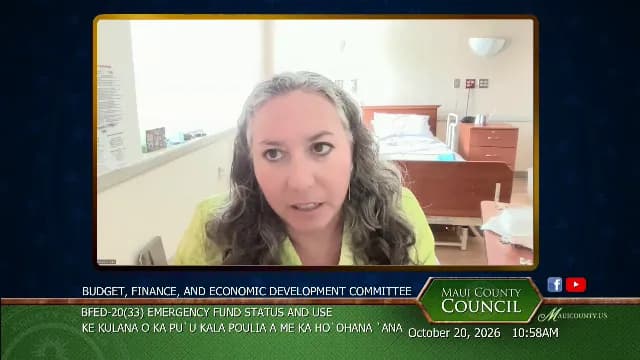
The Budget, Finance, and Economic Development (BFED) Committee of the Maui County Council convened on Tuesday, October 20, 2026, at 9:04 a.m. The committee discussed a new sister-city relationship with Laoag City, Philippines; advanced legislation to streamline the use of monetary donations during emergencies; and conducted a review of the county's Emergency Fund. Public Comments & Testimony - Item 1 (Sister City): Madeline Pasqua and Lawrence of the Maui Filipino Community Council testified in support of the relationship with Laoag City, describing its growing economy, its role as a travel hub, and its deep ancestral ties to Maui's Filipino community. Lawrence stated the population of Laoag is approximately 112,117. - Item 2 (Donations): No oral testimony was provided. - Item 3 (Emergency Fund): Kay Anderson testified, requesting clarification on how the South Maui Community Plan was connected to the discussion. Chair Sugimura clarified it was a reference to a pause in the committee schedule. Discussion Items Sister-City Relationship with Laoag City (Resolution 26-153) The committee discussed the already-adopted Resolution 26-153, which authorizes the Mayor to formalize a sister-city relationship. Mahina Martin, Director of Public Affairs, provided an overview of the county's 62-year-old program, which currently has 28 established sister cities. CJ Anchetta of the Maui Filipino Community Council presented on Laoag City, proposing four pillars of cooperation: tourism and culture, agriculture and sustainability, economic trade, and education and health. Multiple council members expressed strong personal support, with several noting their own Ilocano or Sakada ancestry. Member Batangan volunteered to participate in an ad-hoc committee to explore further initiatives. Mr. Anchetta inquired about seed funding for the program, a topic deferred to the budget cycle and the Sister Cities Foundation. Emergency Monetary Donations Legislation (Bills 142, 131, 132) Chair Alice L. Lee introduced a package of three bills designed to expedite the use of monetary donations during declared emergencies. Bill 142 would allow the Mayor to immediately accept and use disaster monetary donations without prior Council approval for one year following a disaster. Bills 131 and 132 amend the FY27 Budget to support this process. Budget Director Milner and Deputy Director Zelinski confirmed the administration's support for the revised package. An original amendment to change the authorized use language was withdrawn following a recess review that confirmed the existing HRS definitions were sufficiently broad. A CD1 amendment to Bill 131, making quarterly reporting mandatory and correcting a code reference, was adopted. Emergency Fund Status and Use The committee reviewed the Emergency Fund's balance ($78 million) and expenditures. Since March, the Council has authorized $42 million from the fund: $32 million for the Kona Low storms and $10 million for Hurricane Lala. John Smith (Office of Recovery) and Francis Cowell (MEMA) discussed FEMA reimbursements, debris removal logistics, pre-positioned contracts (generators and buses), and long-term mitigation strategies for chronic flooding in areas like Waipuilani and Pülehu. Member Tom Cook highlighted HRS 179D (Dam and Reservoir Safety) as a major legal obstacle to constructing detention basins for flood mitigation and advocated for legislative action. A request was made for a detailed, itemized breakdown of all emergency fund expenditures by disaster. Key Outcomes - Sister City (Laoag): No legislative action was taken. The administration will draft a Memorandum of Agreement with Laoag. Member Batangan volunteered for an ad-hoc committee. - Bill 142 (Disaster Donations): Recommended for passage on first reading. (8 aye, 0 no, 1 excused). - Bill 131 (Budget Provisions): CD1 amendment adopted. Recommended for passage on first reading as amended. (8 aye, 0 no, 1 excused). - Bill 132 (Budget Line Item): Recommended for passage on first reading. (8 aye, 0 no, 1 excused). - Emergency Fund: Information received. A detailed breakdown of expenditures was requested from the Office of Recovery. Next Steps The passage of Bills 142, 131, and 132 will be considered by the full Council. The administration will continue working on the formal agreement with Laoag City.
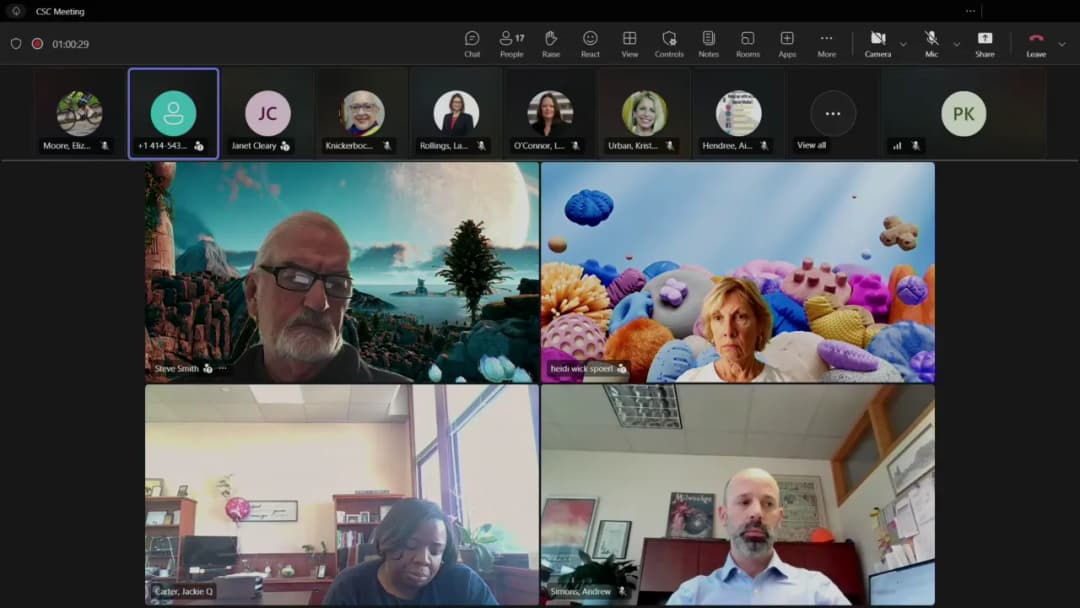
The Board of City Service Commissioners met virtually on October 20, 2026, at 1:30 PM, with President Frank Bock presiding and Commissioners Cleary, Smith, and Wick Spoerl present (Vice President Miller excused). The board unanimously approved a consent calendar of seven temporary appointment extensions, three probationary period extensions, and one position re-exemption. The main substantive discussion concerned a seasonal layoff plan for four bridge operators from the Department of Public Works, which was approved with a modification to create a separate seniority list for maintenance crew members. Consent Calendar - Minutes Approval: The October 6, 2026, meeting minutes were approved as submitted. - Temporary Appointment Extensions (all first extensions, approved unanimously): - Bobby Phillips, Driver Training Instructor (DPW), for 6 months (Oct 19, 2026 – Apr 19, 2027). Per a letter from Tom Langeron, Director of Operations, Mr. Phillips performs critical snowplow and CDL training. - DeAndre Harsch, Jovonta Moody, Cedric Simpson, and Rodolfo Vera Perez, City Laborers (DPW), each for 6 months (various start dates from Nov 8 to Nov 22, 2026, through May 8 or May 22, 2027). The department cited vacancies in labor/equipment operator positions and the need for garbage collection and snow work coverage. - Daovien Thao, Tammy Deau, Veronica Wilson, and Laura Hernandez (DER), each for 3 months (Oct 11, 2026 – Jan 30, 2027), to support the transition to a new personnel information system (Workday). - Probationary Period Extensions (all for 6 months, approved unanimously): - Robert Brown, from Oct 28, 2026 to Apr 24, 2027; Brandon Pryor, from Oct 21, 2026 to Apr 24, 2027; Trinity McKinnie, from Oct 28, 2026 to Apr 24, 2027. All are City Laborers (DPW Infrastructure Services) whose job performance was satisfactory but who had not yet obtained a required Commercial Driver’s License (CDL). - Re-exemption of Position: The Deputy Commissioner of Clinical Services position (pay range 1PX) at the Milwaukee Health Department was re-exempted, based on a request from Health Commissioner Michael Todorovich and a supporting memo from HR Manager Kristen Hennessy Urban, citing the role’s policy leadership and representation duties. Discussion Items Seasonal Layoff Plan for Bridge Operators (File 260912) The Department of Public Works Infrastructure Services Division proposed laying off four bridge operators due to seasonal need: Jacob Hoffer (voluntary layoff out of seniority), David Robinson, Peter Marchese, and Richard Stieghorst. The department requested an efficiency-based layoff plan that would retain two junior employees (hired in 2026) who had been assigned to a maintenance crew, arguing that their training and willingness to perform maintenance work made them more efficient than more senior operators who performed only bridge operations. President Bock raised concerns that the request misapplied the “efficiency” standard in Rule 13, Section 1A of the commission’s rules, which he said was intended to compare relative performance among employees doing the same job, not to distinguish based on different job duties. He proposed an alternative: create a separate seniority list for bridge operators assigned primarily to maintenance, as had been done historically in other city departments for employees with the same title but distinct functions. Andrew Simons, HR Administration Manager for Infrastructure, and Karen Florenza, supervisor, explained that the two workers were the only ones on a new two-person maintenance crew (plus a crew leader position to be filled). They noted that the department was restructuring for 2027 to use crew leaders for maintenance work, but for the current season, retaining these trained workers was critical to avoid costly outside contracting (estimated $15,000 per bridge). Senior operators had been offered the maintenance assignments but declined. The department deferred to the commission’s judgment on the appropriate approach. After discussion, the board agreed to approve the layoff plan with the condition that the department create a second seniority list for bridge operators performing maintenance functions, thereby protecting those two employees from being laid off out of seniority. The department was not required to return for re-approval on this administrative adjustment. Key Outcomes - Consent items (items 3–12 and 14): All approved unanimously (3-0). - Bridge Operator Layoff Plan (item 13): Approved with amendment to use a separate seniority list for maintenance crew bridge operators. Motion carried 3-0. - Next Meeting: The board will meet on Wednesday, November 4, 2026 (rescheduled from Tuesday, November 3 due to the election).
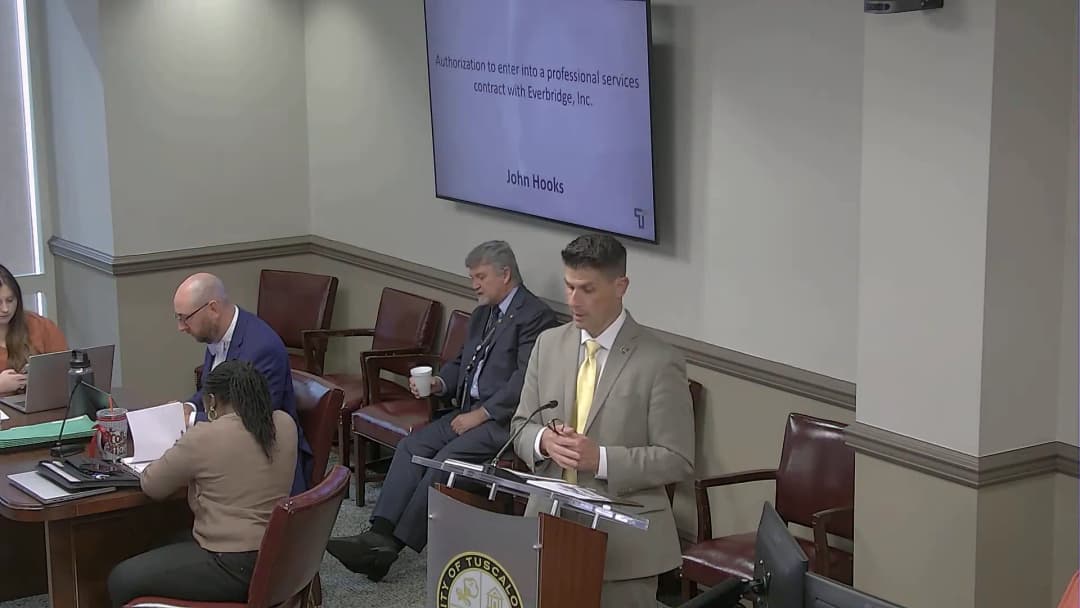
This summary is based solely on the raw transcript because no agenda or minutes were available. The provided meeting timestamp is 19:43:24 UTC on October 20, 2026. The committee reviewed contracts for Everbridge notification software, a minor public works valve replacement, a sewer line cleaning and assessment award, a deductive change order for Bowers Park pickleball courts, and citywide generator maintenance. No public comment period is recorded. Discussion Items Everbridge Inc. Professional Services Contract - John Hooks requested authorization to enter into a one-year professional services contract with Everbridge Inc. for $25,000, funded through IT. He said County EMA originally purchased Everbridge for mass notifications, and city departments later began using two additional Everbridge features: internal communications and a Nixel community notification program. After County EMA canceled its Everbridge contract and switched to RAVE/Rave Guardian for IPAWS emergency mass alerts, Hooks asked to continue Everbridge for the two features the city uses, calling Everbridge "integral and vital" to city communications and operations. - During discussion, Hooks clarified that RAVE/Rave Guardian handles county-level mass alerts such as amber alerts, while the city would continue using Everbridge for internal call-outs, EOC activation notifications, and public safety call-outs. A committee member said the funding appeared to be in the IT maintenance contract. - Outcome: The motion passed by voice vote. Minor Public Works Contract - "Miss Metal and Fabrication" - The committee authorized a minor public works contract with the vendor named in the transcript as "Miss Metal and Fabrication" for a new "tech valve" at the raw sewage pump station at the Water Resource Recovery Facility. The contract amount was $10,100, and the work was expected to take one or two days. - Outcome: The motion passed by voice vote. Sewer Line Cleaning and Assessment Award - Sun Coast Infrastructure - Brian requested authorization to award the project to the lowest bidder, Sun Coast Infrastructure, for sewer line cleaning and assessment. The project covers 1,750 linear feet of a 24-inch sewer line in the area shown on the map. Bids were opened on September 23, with three bidders; Sun Coast was the low bidder. Expected completion time is 75 days, and bypass pumping will be needed to take the line out of service. A companion finance committee item was to establish a project budget. - Brian said the work was triggered by monitoring alerts showing increased flow or surcharging, not by an overflow, and it was not a regularly scheduled cleaning. In response to questions about changing the funding source, he said the project had been in the budget but was originally planned for bond funding; staff decided bond funding was not appropriate because the work is maintenance rather than infrastructure. He described the earlier funding decision as "a bad decision on me." - Outcome: The motion passed by voice vote. Bowers Park Pickleball Courts - Change Order No. 1 with WAR Construction - Jamie requested authorization of Change Order No. 1 with WAR Construction for the Bowers Park pickleball courts project. The change order is a deductive change order of $79,432.32 to close out the project. - Outcome: The motion passed by voice vote. Citywide Generator Preventative Maintenance Contract - The committee authorized a routine preventative maintenance contract for citywide generators, including generators at police department facilities, fire stations, city hall, and other city facilities. The contract amount is $99,970 and covers approximately 88 generators. Funding is shared among water and sewer outside services and facility maintenance contracts, and the expense was included in the budget for predicted routine maintenance. - Outcome: The motion passed by voice vote. Key Outcomes - Approved a one-year Everbridge Inc. contract for $25,000, funded through IT. - Approved a minor public works contract with "Miss Metal and Fabrication" for $10,100. - Approved awarding the sewer line cleaning and assessment project to Sun Coast Infrastructure as low bidder, with funding moved from bond proceeds to a maintenance account. - Approved deductive Change Order No. 1 with WAR Construction for $79,432.32 for Bowers Park pickleball courts. - Approved a generator preventative maintenance contract for $99,970 covering approximately 88 generators. - No roll-call tallies were recorded; all motions in the transcript passed by voice vote. At the end of the meeting, the chair asked if there were further items and said he would entertain a motion to the journal, but no subsequent vote is recorded in the transcript.