This document summarizes the city meeting held on October 20, 2026, at 17:30 UTC. No agenda or meeting minutes were provided for this session. The only available source material is a brief transcript excerpt containing a single, unidentified speaker’s remark. Consequently, no formal agenda items, votes, or decisions can be confirmed. Available Transcript Content - An unidentified speaker stated: "I think that's a good one. I think it's a good thing. I mean, we're going to have to do something." - This remark expresses general approval ("good one," "good thing") and a perceived necessity to take action ("we're going to have to do something"). The subject of the remark is not specified in the transcript. - No other comments, discussion, or procedural actions were recorded in the provided materials. Key Outcomes - No votes, motions, or formal decisions were recorded in the available transcript. - The meeting’s outcome cannot be determined from the provided content.
The Public Meeting Index
The Public Meeting IndexOn Tuesday, October 20, 2026, the Denver City Council's Governance and Intergovernmental Relations Committee met to consider a Denver Downtown Development Authority funding agreement and an Alterra Mountain Company lease at 101 W. Colfax Avenue, to enter an executive session on litigation, and to approve a consent appointment. Minutes list the start time as 10:30 AM and show eight members present (Flynn, Gonzales-Gutierrez, Romero Campbell, Sawyer, Torres, Watson, Alvidrez, Kashmann) with Councilmember Gilmore absent. The agenda was not available. No public comment period is recorded in the minutes or transcript. The raw transcript appears to append unrelated city video content after the executive session motion, so this summary follows the official minutes. Consent Calendar - Council Resolution 26-1507, approving Solicia Lopez's appointment to the Citizen Oversight Board, was approved by consent. Discussion Items - DDA funding agreement (26-1334) and Alterra lease (26-1337): Bill Mosier of the Mayor's Office and Lisa Lumley, Director of Real Estate, presented the two items together. Mosier explained that the DDA funding agreement releases up to $7 million for tenant improvements at 101 W. Colfax, structured as a 12-year, 2% loan repaid monthly, and limited to less than 50% of the approximately $19 million in improvement costs. The assistance was available only for a tenant locating in Upper Downtown east of Arapahoe Street. Mosier said the city's priorities were to keep Alterra in RiNo, then downtown Denver, then Denver, and finally in Colorado. - Incentive package: Denver Economic Development and Opportunity (DEDO) offered up to $485,000 in performance grants over two years, based on maintained or created jobs, plus additional workforce training funds. The state of Colorado offered a package of about $3.9 million, mostly tax credits for new jobs, including a $1 million five-year, no-interest loan passed through the DDA to Alterra. Alterra planned to bring employees back into the office three days a week. - Lease terms: The lease covers 64,654 square feet on most of the seventh and eighth floors. The building contains 297,847 rentable square feet and is currently 32% occupied; adding Alterra would increase occupancy to 54%. The 12-year lease begins at $22 per square foot triple net and increases 50 cents per year. It includes one year of free rent, two years of free parking for 120 general and 10 reserved spaces, an early termination right at year five with a $1.5 million fee, and total projected revenue of $15.7 million over 12 years. Construction is expected through about October 1, 2027, with lease commencement at that point and base rent starting in October 2028. Alterra will pay building expenses, including property taxes through possessory interest. - Committee questions and concerns: Councilmember Darrell Watson said he learned about Alterra's potential move from a report and criticized the lack of communication with his office and affected improvement districts; Bill Mosier apologized and said the DDA should contact the district councilmember in the future. Councilmember Alvidrez asked about building cash flow and how much general fund support would be needed, requested accurate cash-flow statements, and worried that the package sets a precedent for future tenants. Councilmember Gonzales-Gutierrez argued that the no-rent construction period plus one year of free rent totals at least two years of free rent; staff said the construction period is not traditionally counted as free rent. Councilmember Flynn asked whether the state's $1 million counts toward the 50% cap and about lost parking revenue. Councilmember Cashman questioned whether the deal was too generous, citing the loan, free rent, free parking, and a $1.5 million termination fee. Chair Sawyer pressed for safeguards against paying incentives on rehires; DEDO staff said they verify start dates and employee counts through occupational privilege tax records and pay only after verification, though they acknowledged difficulty determining whether a worker is a rehire. - Alterra testimony: Krista Springer, Alterra's chief development officer, said Alterra currently has 275 employees moving downtown and has committed to hiring 106 new employees. She said the decision to leave Zeppelin Station was made in March after the previous CEO stepped down, and although Alterra considered moving out of state, it chose to help revitalize Upper Downtown. She said details of the Zeppelin lease termination are confidential under a non-disclosure agreement. Staff earlier described DEDO incentives as tied to 275 retained jobs and 50 net new jobs; Alterra's stated 106 new hires may reflect a different metric or time frame, and the discrepancy was not resolved. Executive Session - The committee voted 6-0 to enter executive session for the Quarterly Litigation Update (26-1542) under DRMC 2-34A367. No public action was taken. Key Outcomes - The committee voted 6-0 to approve Council Bill 26-1334 and Council Resolution 26-1337 for filing as a block, on a motion by Councilmember Torres seconded by Council President Romero Campbell. Councilmember Gilmore was absent. - The committee approved Council Resolution 26-1507 by consent. - The committee entered executive session for a quarterly litigation update. - Staff agreed to follow up with parking revenue details, lease comparables, and updated city building cash-flow information requested by members. - The committee action advances the items to the full City Council; staff projected lease commencement on October 1, 2027.
The Cook County Audit Committee met at 11:00 AM on October 20, 2026. The chair called the meeting to order, a quorum was established, and a motion to allow remote participation passed unanimously among present members. The committee then heard public comment, approved prior minutes, received an audit report on ARPA behavioral health funding, and approved an amendment to the county audit standards. Roll Call and Remote Participation - Commissioners McCaskill and Vasquez were initially listed as absent, and Commissioner Sean Morrison was excused. Commissioner Vasquez later voted remotely. - A motion by Commissioner Anaya, seconded by Commissioner Miller, to permit remote participation passed with 15 ayes; Commissioner McCaskill was absent and Commissioner Sean Morrison was excused. Public Comments & Testimony - George Blake Moore spoke and expressed strong criticism of the government, the audit process, and the upcoming election. He said the system is broken, called the election a "dog and pony show," and questioned why Black voters would support officials who bring in outside people to use county resources, contracts, and jobs. He indicated he might not vote, then said he would vote. His time expired and he was gaveled out. Discussion Items - Approval of Minutes (Item 26-2608): Commissioner Anaya moved, Commissioner Trevor seconded, and the committee approved the minutes from the September 23, 2026 meeting by voice vote. - ARPA Behavioral Health Support and Expansion Program Review (Item 26-2040): County Auditor Heath Wolf presented the Office of the County Auditor's report dated July 21, 2026. The audit covered December 1, 2023 through November 30, 2024 and evaluated monitoring over the use of ARPA funds. Three observations were cited: - Among 67 files reviewed, there was missing documentation or items that did not reconcile. - Some employees who worked on ARPA programs were not on the provided list, some employees' percentage-of-time forms did not total 100%, and Quarters 3 and 4 forms were missing from the Bureau of Finance's SharePoint site. - Eight subrecipients spent 66% of the fiscal year 2022-2024 ARPA funds for the program but served only 8.45% of program participants. - Dr. Joshi, representing the Cook County Department of Public Health, responded. He thanked the auditor, concurred with some findings, did not concur where documentation existed in GovGrants, and said corrective actions for observation two were completed. He argued that counting unique participants does not capture the intensity, duration, or frequency of services, and he provided examples: Big Brothers Big Sisters Chicago served only 12 participants in 2024 but served 143 youth over the full grant, including 100 African American and 27 Latino youth, expanded into 28 communities, established 26 school partnerships, and 88% of served youth showed growth in positive behaviors. The Asian Health Coalition served 27 people in FY24 but 243 over the grant, developed eight multilingual resource guides, collected 300 survey responses, and reached 96,000 people through media campaigns. - Chair Degnan and Commissioner Daly asked how the county verifies subrecipient outcomes and whether indirect reach can be better documented. Dr. Joshi said the department is in ongoing dialogue with grantees and will conduct a comprehensive evaluation of the program, which will be shared with the committee. - The motion by Commissioner Anaya, seconded by Commissioner Scott, to receive and file the item passed by roll call with 15 ayes; Commissioner McCaskill was absent and Commissioner Sean Morrison was excused. - Audit Standards Amendment (Item 26-2113): Auditor Wolf proposed amending the audit standards ordinance to change the requirement to follow both the Yellow Book (Generally Accepted Government Auditing Standards) and the Red Book (Institute of Internal Auditors Global Internal Audit Standards) to an "or" standard, allowing the county auditor to choose the appropriate standard for each engagement. He explained that following both on every audit is burdensome, that over 70% of audits would fall under the Yellow Book, and that a peer review is planned for calendar year 2027. - The motion by Commissioner Anaya, seconded by Commissioner Britton, to approve the ordinance amendment passed by roll call with 15 ayes; Commissioner McCaskill was absent and Commissioner Sean Morrison was excused. Key Outcomes - Motion to allow remote participation approved. - Minutes from September 23, 2026 approved. - ARPA Behavioral Health Support and Expansion Program Review received and filed. - Audit standards ordinance amendment approved, changing the auditor's required standards from "and" to "or." - Commissioner Vasquez moved to adjourn, Commissioner Gaynor seconded, and the meeting adjourned.
Note: The official minutes list the meeting date as October 19, 2026, but the provided timestamp indicates October 20, 2026. This summary uses the latter date as instructed. The Visalia City Council held a combined work session and regular meeting on October 20, 2026. The work session began at 4:00 p.m. and ended at 6:14 p.m., covering employee introductions, a tourism marketing district report, reserve area planning, temporary parking regulations, and general fund surplus policy. The regular session started at 7:00 p.m., featuring a special presentation of the Haunt the Home winners, public comments, consent calendar approval, and a public hearing on extending an urgency ordinance moratorium on data centers. The meeting adjourned at 7:38 p.m. Consent Calendar - Approved unanimously (5-0) with 12 items, including: authorization to submit V-LINE transit allocation requests ($489,061); traffic signal improvements contract ($610,660); pedestrian bridge construction ($283,382); corporation yard security cameras ($84,530.75); pecan processing agreement; pest control contract ($33,418); irrigation controllers contract ($95,700); building safety plan check extension ($300,000); grant submittal for Eastside Regional Park; and recordation of a final parcel map. Public Comments & Testimony - Work Session – Temporary Parking: Grant Smith, a local business owner, advocated for a consistent, practical policy allowing unpaved overflow parking for special events, churches, and community facilities, citing examples from other cities. Neil Zerlang, board chairman of Grace Bible Church, requested flexibility, noting the high cost of paving ($3,500–$4,000 per stall) and ongoing efforts to acquire adjacent properties. He asked for a phased approach and cooperation with city staff. - Work Session – General Fund Surplus: Mary Millergast (Arts Consortium) and Tracy Polkonico (Arts Visalia) spoke in support of allocating a small percentage of surplus funds to public art and the arts district, emphasizing economic and community benefits. - Regular Session – General Public Comments: Sam Sciacca (Visalia resident) offered to serve on a sidewalk improvement committee and shared a possible grant from San Luis Obispo. Irene Lapin (Visalia) criticized federal policies under the current administration. Jim Reeves (Visalia) reported on the 10th annual Pride festival and thanked the city. Matthew Stoll (Visalia business owner) urged the council to require proof of state licensing before issuing business tax certificates, arguing that current practice legitimizes unlicensed activity. - Regular Session – Urgency Ordinance Extension: Maria Guillen (Visalia resident) urged the council to consider a permanent ban on data centers, citing concerns over water, air quality, and agricultural heritage. Cherie Cabral (on behalf of Western Steel Council and California Construction Labor Management Trust) opposed the extension, arguing that data centers are not new, pose no proven threat, and that the moratorium may not meet legal findings required by Government Code Section 65858. Discussion Items - Visalia Tourism Marketing District Annual Report (Item 2): David Ahern (TMD Chair) and Carrie Groover presented the 2025 report showing $862,000 in assessments, $1.4 million total funds (including reserves), and $1.2 million in expenditures. Occupancy at hotels dropped 2.5% over four years, while transient occupancy tax (TOT) rose 7.5% (hotels) and 33% (short-term rentals). Council inquired about including short-term rentals in TMD assessments; staff noted that would require a TMD request. Motion to receive and file passed 5-0. - Reserve Area Planning Work Session (Item 3): Paul Bernal, Steve Brandt (QK), and Jarred Olsen presented land use, circulation, tier boundaries, and design standards for the 900-acre Reserve Area. Council discussed airport compatibility, high-density housing near the airport approach zone, and architectural standards. Consensus supported the Planning Commission’s recommended land use plan, circulation plan, and Option B (area-wide enhanced design standards with flexibility and cost-effectiveness). Motion to approve as recommended passed 5-0. - Temporary Parking Lot Requirements (Item 4): Jason Huckleberry and Paul Bernal reviewed existing code requiring paved parking, current temporary conditional use permits (180-day max), and city-owned unpaved lots (e.g., Riverway Sports Park, Valley Strong Ballpark, Seven Oaks Dog Park). Council discussed a phased citywide approach, allowing exceptions for special circumstances (e.g., church overflow), and suspending fines during the review period. Staff was directed to evaluate options and return with a plan in early 2027. No formal action taken. - General Fund Surplus Policy (Item 5): Renee Nagel and Amee Swearingen presented the current policy: surplus first funds the emergency reserve (30% of operating expenditures), then the Civic Center Public Safety Reserve Fund. The projected FY 2025/26 surplus is $3–$5 million. Staff recommended continuing the current policy to keep debt manageable for Civic Center Phase 3 (estimated $82 million). Council agreed, motion to continue current surplus policy after funding emergency reserves passed 5-0. - Urgency Ordinance Extension – Data Center Moratorium (Regular Item 1): Paul Bernal reported on the need for additional time to study data center impacts (energy, water, noise, climate) and review seven new state bills. The council considered extending the moratorium (Ordinance No. 2026-12) for 10 months and 15 days. After public hearing, council voted 5-0 to adopt the extension, noting it provides time for a legally defensible permanent decision. Key Outcomes - Approved (5-0) the consent calendar as presented. - Received and filed the Tourism Marketing District Annual Report. - Approved (5-0) the Reserve Area staff recommendations: land use plan, circulation plan, development tier boundaries, and Option B design standards (area-wide enhanced architectural standards emphasizing flexibility and creativity). - Directed staff to return in early 2027 with a phased citywide approach for temporary parking lots, including suspension of fines for non-compliant lots during the study. - Voted (5-0) to maintain the current General Fund surplus policy, directing future surpluses to the emergency reserve and then to the Civic Center Public Safety Reserve Fund. - Adopted (5-0) Ordinance No. 2026-12 extending the data center moratorium for 10 months and 15 days. - The Cal Water presentation was postponed to a future meeting (no date specified). - Next regular Council meeting scheduled for November 2, 2026.
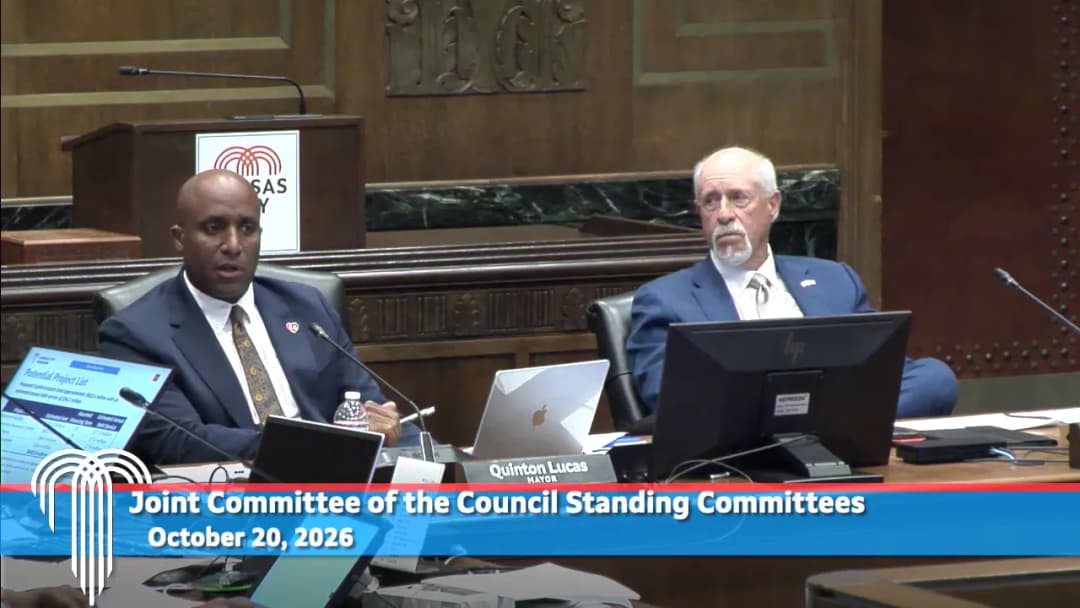
The Joint Committee met on Tuesday, October 20, 2026, at 10:00 AM in the Council Chamber on the 26th floor of 414 E. 12th Street, Kansas City, MO. The meeting focused on Resolution 260886, which sets funding priorities for the Public Safety Sales Tax, and on proposed detention, community resource center, and Central Patrol projects. No meeting minutes were available; this summary is based on the agenda and the raw transcript. Agenda Items - Resolution 260886 – Establishing City Council funding priorities for Public Safety Sales Tax expenditures: (1) completion of a permanent detention and rehabilitation program; (2) development, completion, and operation of a community resource center and a new or rehabilitated Central Patrol Division; and (3) ongoing acquisition, upgrade, and maintenance of essential public safety infrastructure and equipment not otherwise funded from general revenue. - Resolution 260071 – Directing the City Manager to review site, design, and acquisition matters for a Midtown Justice Campus co-locating KCPD’s Central Patrol Division and the Community Resource Center, with a report due to Council within 30 days. It was read, but no separate action appears in the transcript. - Ordinance 260065 – A committee substitute directing the City Manager to create a “KCPD Overage Fund” for police board costs above the 25% annual budget threshold, negotiate Council approval processes for settlements, and appropriate $5,900,000 in FY 2026-2027 for legal settlements. It was listed on the agenda, but the transcript reflects no discussion or action on it. Public Comments & Testimony - No public testimony was submitted for the public safety sales tax resolution; the chair noted there was no public testimony. Discussion Items - Sales tax revenue and ongoing costs: Deputy Director of Finance William Choi presented the fund’s background and forecast. The current tax is a one-quarter cent capital improvement sales tax, renewed April 8, 2025, for a 20-year term, generating approximately $25 million per year. Missouri allows up to one-half cent, so another quarter cent is not currently levied. Ongoing annual expenditures total about $17.5 million, including the Department of Community Safety, KCPD body cameras, emergency management, KCPD IT/facilities, and existing debt service. One-time reimbursements due from prior years include $2 million for KCPD overtime and $500,000 for the police foundation, plus costs for the modular jail and permanent detention facility design. - Project cost gap: Staff estimated the contemplated projects – permanent detention facility, community resource center, Central Patrol, and possible tow-lot relocation – total about $402.6 million, with estimated annual debt service of $34.2 million. Additional future operating needs (jail staffing, maintenance reserves, CRC operations, and a FY28 radio site controller cost of about $700,000 net) are not included in those totals. The fund’s annual operating surplus is roughly $8.5–9 million, which staff said would support about $100 million in debt. A forecast including all projects and operating needs showed an operating loss of about $17.9 million in FY28. - Detention facility redesign: Architect Andy Pitts said the existing Front Street site could be used for a phased “full build-out” of the detention/resource center, maintaining operations of the tow lot and allowing future water expansion. This approach would reduce the detention project cost from about $201 million to $120 million and eliminate the $18.4 million tow-lot relocation. It would add 84 beds, build intake/release, visitation, clinic, kitchen/laundry and infrastructure, and renovate the existing modular facility. Councilman O’Neill requested a line-item breakout of the $120 million cost; staff said only high-level concept estimates were available at this stage. - Community Resource Center: Staff described a target of 50 beds (30 crisis observation chairs and 25 substance use disorder/detox residential beds), an approximately 2.8-acre site, 83,000 square feet, and an estimated project cost of $89 million. Multistudio’s Sean Zotke said the conceptual estimate assumed a two-story building with crisis stabilization, observation, outpatient care, about 140 parking spaces, dining, laundry, and infrastructure, but no detailed line-item breakout was available. - Central Patrol: Major Josh Hine said KCPD completed a programmatic design with the City Architect’s Office that includes Central Patrol, the community engagement division, and special operations division, with options at the current site or on land west of Forest. Councilman O’Neill cited a $94 million cost and asked for a detailed cost breakdown. - Council positions and direction: Councilman Rea argued the Council should not accept the framing that only $100 million is available because the Council decides ongoing expenditures. Councilmember Patterson Hazley said all three projects need equal frugality and value engineering, and warned that moving general fund expenses into the sales tax fund does not reduce total city spending. Councilwoman French requested more detailed, line-item presentations and community engagement, cautioned against repeated scope changes, and said “if you don’t have a jail, you don’t have accountability.” Mayor Lucas asked whether Central Patrol and the Community Resource Center could be delivered together for $100 million; City Architect Roxan Reyes said the overlap of co-located programs had not been studied but could be examined. - Staff options: Staff acknowledged insufficient Public Safety Sales Tax revenue for all proposed projects. Possible options presented were adjusting project scope, shifting expenses to other fund sources, and raising additional revenue by using part of the state-authorized additional quarter cent. Key Outcomes - The committee moved and seconded a motion to report out Resolution 260886 as a committee substitute with a recommendation to “advance new pass.” The motion was approved, and the item was expected to go to the full Council. - No separate recorded action was taken on Resolution 260071 or Ordinance 260065 in the available transcript. - Staff was expected to bring back more detailed cost breakouts and value-engineering scenarios for the Community Resource Center and Central Patrol, along with consideration of co-location, after the Council asked for sharper cost estimates.
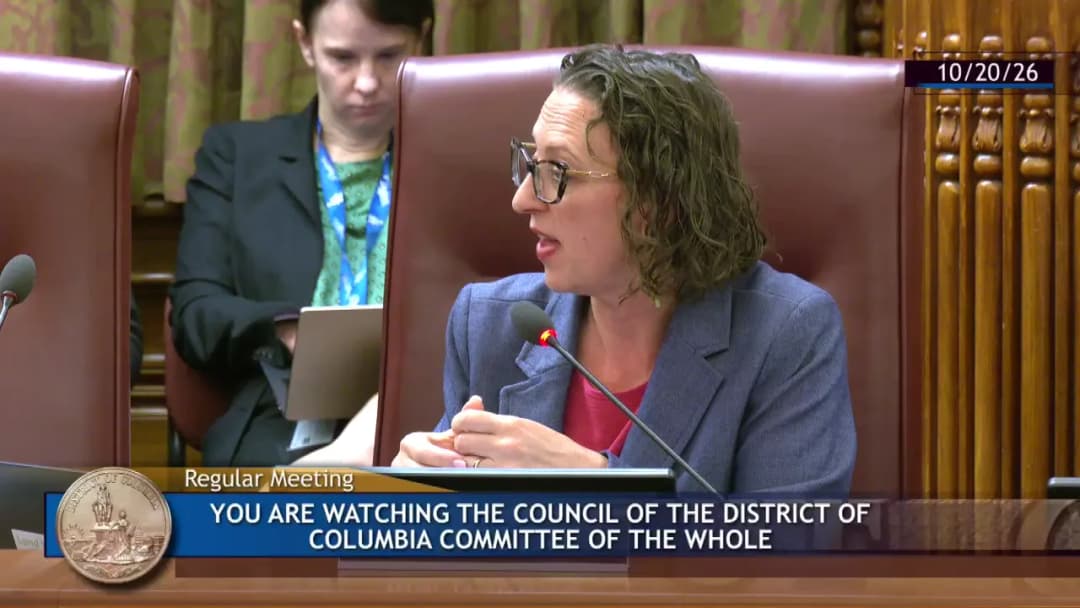
The Committee of the Whole met on Tuesday, October 20, 2026, from 11:53 a.m. to 2:57 p.m. in Room 500 of the John A. Wilson Building. Chair Phil Mendelssohn presided. The committee marked up numerous measures for the subsequent Legislative Meeting, approving most unanimously and placing them on the consent or non-consent agenda. Opening and Administrative Actions - Roll call established a quorum with all 13 members present. - The Council unanimously waived the reading of the Secretary's Report of Committee Filings and the Secretary's Log of Introductions and Referrals. Reappointments and Confirmations - PR 26-808 (Citizen Review Panel): Reappointed Elizabeth Moeller as Vice Chairperson for a three-year term ending April 11, 2029. No hearing was held; no opposition was recorded. Approved unanimously and placed on the consent agenda. - PR 26-717 and PR 26-718 (Commission on Human Rights): Confirmed Naranjan Atakari and Monica Nemeth as commissioners, bringing the commission to a full complement of 15 members. Approved unanimously and placed on the consent agenda. School Designation Bills - Bill 26-12 (Alma W. Thomas Middle School Designation Act): Designates the Ward 1 school at 800 Euclid Street NW as Alma W. Thomas Middle School. Councilmember Nadeau supported the name, describing community engagement; Councilmember Pinto voted no, saying the process was rushed and should be paused for fuller community input. The measure passed with only Pinto opposed and was placed on the non-consent agenda. - Bill 26-624 (Elizabeth M. Goodman Health School Redesignation Act): Renames the C. Melvin Sharp Health School in Ward 4 for educator Elizabeth Goodman. Councilmember Lewis George spoke in support, noting Sharp's opposition to school desegregation. Approved unanimously with a fiscal impact of $100,000 absorbed by DCPS; placed on the consent agenda. - Bill 26-698 (Malcolm X Elementary School Designation Act): Officially names the Ward 8 school at 1500 Mississippi Avenue SE as Malcolm X Elementary School, removing the "at Green" designation. Councilmember White spoke in support; Councilmember Henderson expressed concern about preserving Mildred Green's legacy, and White said he would work on honoring her separately. Approved unanimously with no fiscal impact; placed on the consent agenda. Other Committee Markups - Bill 26-254 (Contractors' Right to Stop Work for Non-Payment): Prohibits contract clauses that bar contractors/subcontractors from stopping work when not paid, with a notice procedure (30 days, then 10-day stop-work notice). Councilmember Felder supported it; Councilmembers Lewis George and Bonds asked clarifying questions. Approved unanimously with no fiscal impact; placed on the consent agenda. - Bill 26-360 (Senior Tax Aggregation Amendment Act): Allows two or more seniors or disabled residents to combine ownership interests to meet the 50% threshold for property tax relief. Councilmember Lewis George introduced it; Councilmembers Bonds and Pinto raised related gaps. Fiscal impact: $119,000 in FY27 and $501,000 over the financial plan. Approved unanimously; placed on the consent agenda. - Bill 26-493 (Strong Homes Amendment Act): Strengthens tenant receivership; removes the $2 million cap on the abatement fund. Councilmember Robert White spoke in support. Approved unanimously with no fiscal impact; placed on the consent agenda. - Bill 26-689 (Alley Closing in Square 785): Closes 261 square feet of unimproved pedestrian alley in Ward 6; no opposition. Approved unanimously; placed on the consent agenda. - Bill 26-772 (Georgetown Boat House Street Closing and Transfer of Jurisdiction): Closes 7,426 square feet of 35th Street NW and transfers about 69,444 square feet from the National Park Service to the District to facilitate a Georgetown University boathouse. Councilmembers Pinto and Lewis George spoke in support. Approved unanimously; placed on the consent agenda. - PR 26-581 (Transfer of Jurisdiction over Reservations 360 and 639): Consolidates jurisdiction over Francis Field recreational facilities. Councilmember Lewis George questioned maintenance funding and dog park support; Councilmember Henderson asked about zoning. Approved unanimously; placed on the consent agenda. Measures from Other Committees - Bill 26-523 (Medicaid Credentialing): Requires DHCF to create a single credentialing application and response timelines. Fiscal impact: $4 million in FY27 and $16 million over the financial plan, split between local and federal funds. Placed on the consent agenda. - Bill 26-588 (Captive Insurance Company Amendment Act): Updates captive insurance standards. Fiscal impact de minimis. Placed on the consent agenda. - Bill 26-707 (Remy/RAT Act): Combines rodent abatement bills; creates a commercial rodent-proof trash receptacle pilot, public rodent dashboard, abatement plans, penalties up to three times costs, and restricts anticoagulant rodenticides to certified applicators. Fiscal impact: $674,000 in FY27 and $2.4 million over the financial plan. Approved unanimously; placed on the consent agenda. Deferred and Postponed Measures - Bill 26-100 (Deferred Retirement Option Program): Not moved because the fiscal impact statement was still pending; the print had been posted online. - Bill 26-369 (Nightlife Noise): Councilmember Nadeau presented a revised approach to nightlife noise enforcement. Members discussed decibel readers, complaint weaponization, and the 15-foot measurement standard. Nadeau agreed to work on amendments and the first reading was postponed to November 10, 2026; placed on the November 10 non-consent agenda. - Bill 26-594 (Contracting and Procurement Reform): Moves the procurement ombudsman to the Office of the City Administrator, consolidates procurement portals, and establishes pay-for-performance standards. Members asked questions about the ombudsman's independence and accountability. A technical amendment was circulated; after approval, it was placed on the non-consent agenda. Key Outcomes - All measures except Bill 26-12 passed unanimously; Councilmember Pinto was the only no vote on Bill 26-12. - Bill 26-12, Bill 26-594, and Bill 26-369 were placed on the non-consent agenda (Bill 26-369 for November 10); all other approved measures were placed on the consent agenda. - Meeting adjourned at 2:57 p.m., with the Legislative Meeting scheduled to begin at 3:10 p.m.
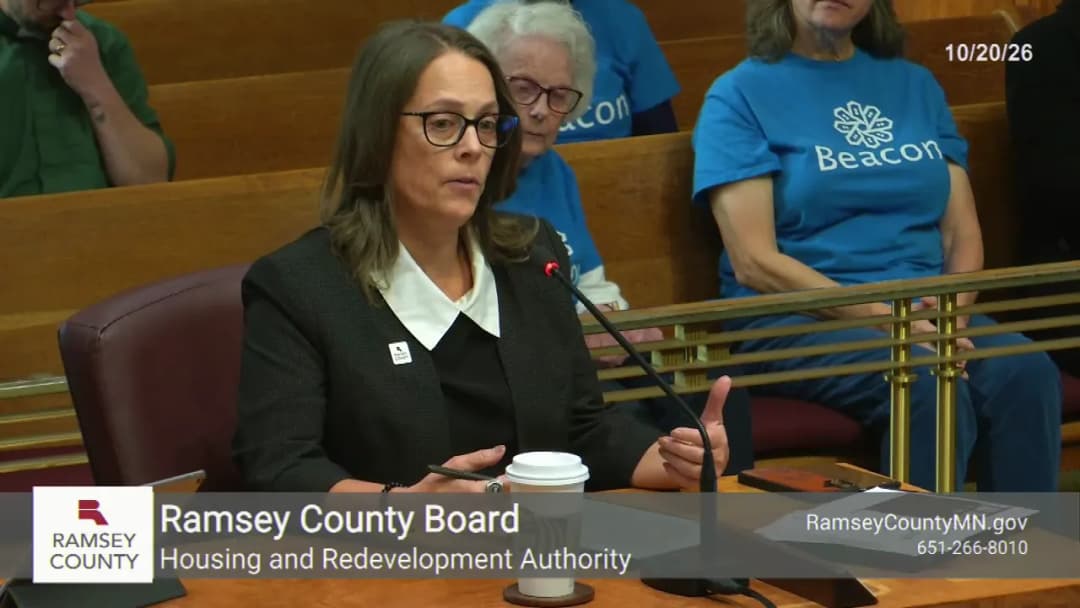
The Ramsey County Housing and Redevelopment Authority (HRA) met on the morning of October 20, 2026. The board unanimously approved routine administrative items before focusing on a presentation and vote on the Fall 2026 obligation of the HRA levy, approving $478,988 in funding for Critical Corridors projects. (Note: The agenda states the meeting began at 10 a.m. CT, while the system metadata records a timestamp of 17:00 UTC for this session). Consent Calendar - Agenda & Minutes: The agenda for October 20, 2026 and the minutes from the September 22, 2026 meeting were approved unanimously. The full text of the September minutes was not included in the provided material. Discussion Items - Fall 2026 Critical Corridors Levy Obligation ($478,988): - Program Presentation: Ella Mitchell, Redevelopment Manager in Community and Economic Development (CED), presented the fifth round of the Critical Corridors program. The program supports efficient land use, dense development, and transit connections. The Commercial Corridor Initiative was expanded this round to include downtown St. Paul. Of 17 applications received, 10 were recommended for funding. - Funding Balance: Commissioner Miller inquired about the funding split between suburban areas and Saint Paul. Ms. Mitchell stated the program aims for a 50/50 balance, but this round leaned more heavily toward Saint Paul due to a higher volume of competitive applications from the city. - Suburban Engagement: Commissioner McMurtry asked about barriers to suburban participation. Ms. Mitchell cited limited staff capacity in smaller cities and highlighted the department's quarterly economic development summit as an outreach mechanism. - Program Support: Commissioner McGuire expressed strong support for the program, commending the City of Little Canada for their successful application for wayfinding funds. Commissioner Jeb Singh noted how data from Urban Three supports investments in mixed-use downtowns like White Bear Lake to increase tax capacity. - Program Details: Commissioner Moran asked what "wayfinding" entails; Ms. Mitchell explained it involves signage and banners to direct people to local businesses. Commissioner Miller asked if cities partially within Ramsey County (e.g., St. Anthony) are eligible; a county official confirmed they are, noting the program's origin in addressing multi-jurisdictional corridor issues. - Future Programming: A question regarding the program's future under the Economic Development Authority was deferred to a planned workshop in November. Key Outcomes - Funding Approved: The board unanimously approved the recommended projects and funding totaling $478,988. - Agreements Authorized: The County Manager was authorized to execute the necessary grant, loan, and other agreements. - Next Steps: Staff will coordinate the downtown St. Paul wayfinding projects with the city. A workshop on the program's integration with the Economic Development Authority is scheduled for November.
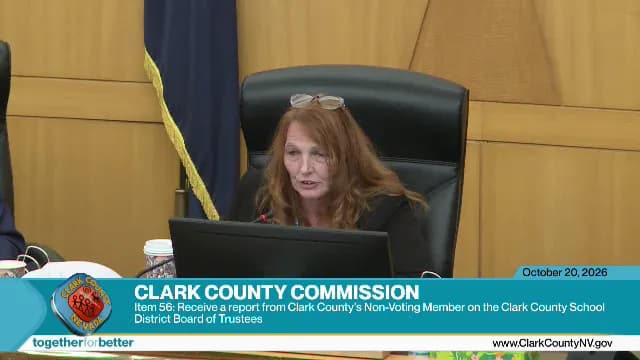
The Clark County Board of Commissioners, sitting jointly with the Redevelopment Agency, Fire Protection Districts, Water Reclamation District, University Medical Center Board, and Liquor and Gaming Licensing Board, convened on Tuesday, October 20, 2026, at 9:00 AM. The meeting featured recognitions for Breast Cancer Awareness Month, the introduction of a highly debated short-term rental ordinance, approval of major bond resolutions, a report on Clark County School District performance, and two robust public comment periods covering topics from campaign finance to airport safety. Recognition & Proclamations - The Board honored numerous breast cancer survivors and advocates for Breast Cancer Awareness Month, including Stephani Getz, Michelle Marie Miller, Dr. Avis Brown Riley, Tammy Moel, Dr. Joshua Goldman, Crystal Galindo, Ashley Van Son, and the Las Vegas Breast Cancer Warriors organization. - A proclamation was presented to Dr. Victoria Farley in recognition of National Latino Physicians Day, joined by UNLV Future Latinos in Medicine students. - Clark County Value Champions Michelle O’Tarrow (Coroner’s Office) and a representative from the Public Guardian’s Office were recognized for their dedication to public service. Public Comments & Testimony (First Session — Agenda Items) - Laura McSwain (Water Fairness Coalition) addressed Item 28 (Septic Conversion Program), questioning the expenditure of public funds for private property improvements, the lack of metrics on water actually recovered, and the failure to exclude properties with private wells from the program. She requested stricter eligibility rules and transparency on the $20,000 septic waiver fee. - Ed Ulin sharply criticized Item 53 (Business Impact Statement for short-term rentals), calling it a “phony” process that failed to meaningfully engage affected parties, arguing the 1,000-foot proximity rule is intended to eliminate the STR industry. - Eric King advocated on several agenda items for planting trees at traffic signal projects, improving stormwater management to capture runoff rather than channeling it directly to Lake Mead, and enhancing ethics oversight. - Shoshana disclosed campaign contributions totaling $56,165.29 from Gary Ackerman, Gaudin Motor Company, and related entities to multiple commissioners in connection with Item 12 (Ford Captive Parts bid). She called for greater transparency in the bidding process. - Liz Diaz expressed support for short-term rentals, arguing they are a convenient scapegoat but not the primary driver of rising housing costs in Southern Nevada. - Jackie Flores (Greater Las Vegas Short-Term Rental Association) acknowledged improvements in the proposed ordinance (elimination of the lottery system, removal of the violation history bar) but strongly opposed reclassifying STRs as a conditional commercial use, arguing it mischaracterizes residential property use and invites further litigation. She cited a court ruling that Clark County has interfered with protected property interests. - A resident from the Ann and Durango area opposed land sales planned in Item 25 and city annexation policies, warning they undermine rural zoning protections and the county’s semi-rural lifestyle. Consent Calendar - The Board approved the minutes of the September 15, 2026, meeting. - The agenda was approved with a correction to Item 28’s staff report (changing “Southern Nevada Water Authority” to “Las Vegas Valley Water District”). - All 37 consent agenda items (Items 7–43) were approved in a single motion. These included contracts for election services, crossing guards, traffic signals, the supplemental animal shelter, mutual aid agreements, the Phase 2 septic system conversion pilot program, UMC clinical engineering services, opioid settlement participation, and various public works and land use approvals. Introduction of Ordinances & Business Impact Statement - Item 45 (STR Ordinance): An ordinance was introduced to amend Clark County Code regarding short-term rental regulations, including reclassifying STRs as a conditional commercial use in specific zoning districts. A public hearing was set for Tuesday, November 3, 2026, at 10:00 AM. - Item 53 (Business Impact Statement): Mike Harwell (Business License) presented the BIS for the STR ordinance. Staff stated it was sent to over 1,000 licensees and applicants, yielding 13 written comments. Based on feedback, an amendment was made allowing applications to be processed in any order unless a proximity conflict exists. The Board approved the statement. Business Items & Reports - Emerging Issues: Commissioner Gibson announced Las Vegas ranked 1 for hosting the largest trade shows in the U.S. (32 of the Gold 100 shows). Commissioner Jones announced the Las Vegas Global Economic Alliance (LVGA) had been renamed the Las Vegas Regional Economic Partnership (LV REP). - Appointments: Demecina Gray (Member At Large), Alexia Chen (Architect, second term), and Kenneth Ruffin (Member At Large, second term) were appointed to the Art Committee. Eric Jeng (Chair) and Monica Gresser (Vice Chair) were appointed to the Community Development Advisory Committee. Ryan Dennett (Attorney) and four lay members (Donald Bordelove, Troy Hildreth, Amy Lahav, Mary Wagner) were appointed to the Air Pollution Control Hearing Board. The County Manager’s execution of a First Amendment to the interlocal agreement with the City of Las Vegas on corporate boundaries was ratified. - Bond Actions (Items 54 & 55): The Board approved resolutions to (1) refinance up to $217,035,000 in General Obligation Bond Bank Refunding Bonds, and (2) issue up to $222,525,000 in general obligations for building and park projects. Both require further action by the Debt Management Commission. - Clark County School District Report (Item 56): Trustee Lisa Satory delivered a quarterly update. Key data: Declining enrollment (kindergarten/first grade hardest hit) is projected to reduce state funding by $100 million. Safety metrics improved: weapons on campus (-29%), fighting (-17%), suspensions (-5%), chronic absenteeism (26.9%, down from 28.2%). Restorative practices usage increased 53.8%. The Facilities Master Plan gathered 90,000+ feedback pieces from 6,102 participants, representing every CCSD school. The district received an overall Level 2 (pilot) rating on the new Nevada District Performance Framework, but a Level 1 rating for the distribution of qualified educators in Title I schools. Commissioners Gibson and Segerblum discussed the COSA program, teacher incentives for Title I schools, and potential school closures. Trustee Satory confirmed the district is not pursuing a new Flock camera MOU. Public Hearing (Item 44) - A public hearing was held for the proposed issuance of $45,770,000 in general obligation (limited tax) hospital improvement bonds for UMC. No members of the public testified on the bond issuance itself. Eric King was ruled out of order when attempting to speak on broader UMC access issues not directly related to the bond. Public Comments & Testimony (Second Session — General Public) - Eric King advocated for slowing stormwater runoff to recharge aquifers and support tree growth rather than rapidly channeling it to Lake Mead. - Shoshana urged the Board to eliminate the invocation from meeting agendas, citing a $20,000 settlement involving religious sermons in the Las Vegas City Jail as a cautionary example of government entanglement with religion. - Mark Altschuler requested the Board’s assistance in reforming NRS 278.02095, arguing that the mobile home age restriction (banning homes over six years old) constitutes economic discrimination and deprives the county of property tax revenue. - Tim Ross raised safety concerns regarding the North Las Vegas Airport expansion, citing an October 18 aborted takeoff incident (Falcon 50 overrunning a fence) and arguing that larger aircraft pose greater risks to surrounding residential and commercial areas. - Randy Gow (realtor) urged the Board to reconsider the 1,000-foot proximity rule in the STR ordinance, warning it could force a flood of sales and crash the housing market. - Ed Ulin reiterated his criticism that the Business Impact Statement process is being weaponized to destroy the short-term rental industry, which he claims injects hundreds of millions of dollars directly into the local economy. Key Outcomes - Consent agenda approved with a staff report correction. - Short-term rental ordinance introduced; public hearing scheduled for November 3, 2026. - Business Impact Statement for STR ordinance approved. - $217M refunding and $222.5M new financing bond resolutions approved. - Multiple board appointments finalized. - CCSD quarterly report received; direction given on COSA program, Title I equity, and health services coordination. - Meeting recessed until Wednesday, October 21, 2026, at 9:00 AM for scheduled zoning matters.
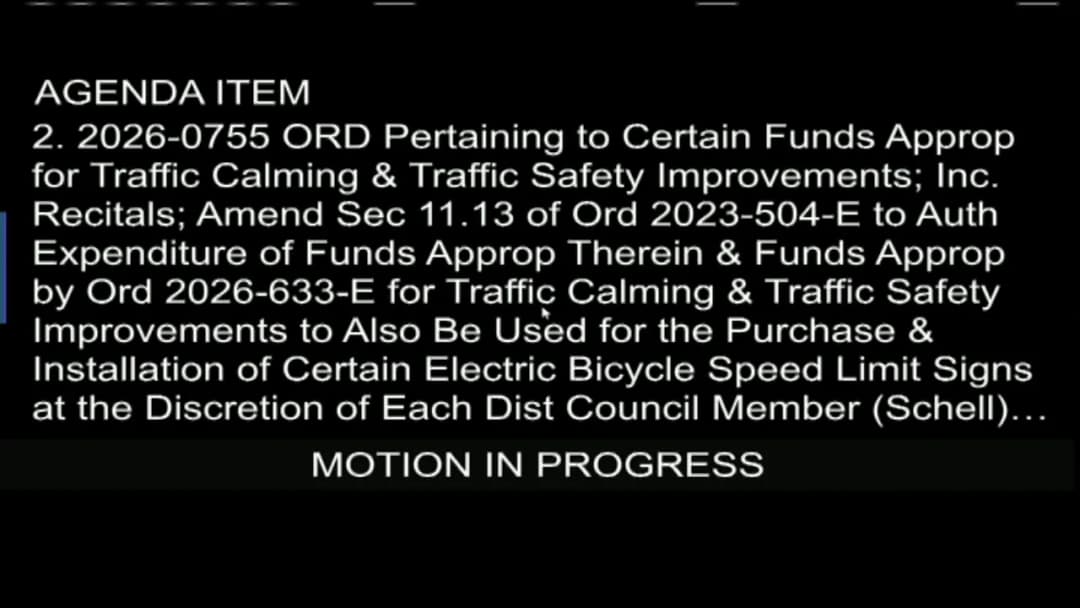
The Transportation, Energy & Utilities Committee (TEU) of the Jacksonville City Council convened on Tuesday, October 20, 2026, at 9:00 AM in the Council Chamber. Chair Ken Amaro presided, with members Raul Arias, Matt Carlucci, Reggie Gaffney Jr., Mone' Holder, and Jimmy Peluso present; Vice Chair Ju'Coby Pittman was excused. Council President Nick Howland and Council Member Miller were also present. The meeting featured a presentation from the University of Florida on the JaxTwin digital platform, actions on ordinances, committee announcements, and public comment. The meeting adjourned at 9:44 AM. Presentation: University of Florida JaxTwin Program Professor Jeff Carney (School of Architecture, Director of the Florida Institute for Built Environment Resilience – FIBER) and Dr. Changjie Chen (Assistant Scientist, FIBER) presented the JaxTwin, a living digital model of Jacksonville integrating data on buildings, infrastructure, environmental systems, and transportation. The project has been under development for three years and is now housed at the UF Jacksonville campus with two full-time staff. Dr. Chen demonstrated several AI-driven tools developed with the Jacksonville Transportation Authority (JTA): - An agentic AI system balancing service to underserved populations with transit on-time performance. - A machine-learning model predicting E. coli concentrations in waterways using proxies like temperature, pH, and salinity, serving as an early warning system. - A generative AI system converting 2D street-view images into 3D building models. - A regionalization tool enabling targeted intervention analyses. - An interactive model of downtown Jacksonville covering approximately 32,000 buildings with attributes such as parcel ID, value, and year built, including the ability to simulate urban heat island effects and building shadows. Professor Carney described the strategic vision for a statewide Florida Digital Twin that integrates AI, IoT sensor networks, geospatial data, and rapid scenario design to "transform Florida from the most at-risk state to the most prepared state." He emphasized that the platform does not itself solve problems but enables specific products, such as the partnership with JTA. A studio course is currently using the twin to reimagine the Skyway system. Future possibilities include modeling what-if scenarios for transportation, housing, costs, flooding, green infrastructure, and heat island effects; incorporating dynamic weather data and real-time updates; and enhancing emergency preparation for hazardous storms. Council Questions and Responses: - Council Member Carlucci confirmed collaboration with the City's Office of Resilience (Anne Coglianese) and emphasized the importance of resilience work, noting the flooding from Hurricanes Matthew and Irma. - Council President Howland asked whether the team assisted JTA with route optimization during its recent financial crisis and fixed-route reductions. Dr. Chen stated they are working with JTA to optimize service and assess impacts on Title VI analysis. Howland noted that critical infrastructure (hospitals, grocery stores, large employers) is not yet included in the model, and expressed hope for the team's involvement in the upcoming transportation optimization process. - Council Member Peluso asked about mapping underground infrastructure with the private sector. Professor Carney said they have not specifically discussed it but would be interested. Dr. Chen noted that there are technical sensors that can detect underground wires and pipes. - Council Member Arias asked whether the platform can track household utility consumption and affordability, and whether council members can access it directly. Professor Carney mentioned a parallel project with JEA funded by a U.S. Department of Energy grant to reduce household energy consumption. Dr. Chen confirmed that login access can be created for individuals. - Chair Amaro asked about the rider mobile app; Professor Carney clarified that it is JTA's app. Consent Calendar - 2026‑0748 – Kings Creek II CDD Contraction: Approved 6‑0. The ordinance contracts the Kings Creek II Community Development District boundaries by 93.24± acres in Council District 8 for future commercial development; the change does not affect the planned 621 residential units. - 2026‑0755 – Traffic Calming Funds for Electric Bicycle Signs: Amended and approved 6‑0. The amendment to Section 11.13 of Ordinance 2023‑504‑E allows traffic-calming funds (including those from Ordinances 2026‑633‑E and 2025‑186‑E) to be used for the purchase and installation of electric bicycle speed limit signs on sidewalks and shared-use paths, at the discretion of each district council member. Discussion Items - 2026‑0777 – Sidewalk Deferral Appeal (Resolution): Deferred. A quasi-judicial public hearing will be held at the next TEU meeting on November 4, 2026. Carla Schell (OGC) will provide committee members with an explanatory memo. - 2026‑0779 – Industrial Parking Requirements (Ordinance): Deferred due to the Planning Commission's schedule. The next hearing is before the Land Use & Zoning (LUZ) Committee on November 4, 2026. - 2026‑0799 – Arbors CDD Expansion (Ordinance, Second Read): Read a second time and rereferred. Public hearings are scheduled for October 27, 2026, and November 10, 2026. - 2026‑0801 – Williamson Lane Right‑of‑Way (Ordinance, Second Read): Read a second time and rereferred. A TEU public hearing is set for November 4, 2026, and a general public hearing for October 27, 2026. - 2026‑0803 – JEA Meeting Transparency (Ordinance, Second Read): Read a second time and rereferred. Public hearings are scheduled for October 27, 2026, and November 24, 2026. Public Comment - Carnell Oliver spoke on Item 2026‑0748, criticizing the city's government structure as outdated and unable to manage population growth. He called for expanding and reducing the size of council districts and voiced frustration with certain districts and officials. Committee Announcements - Council Member Carlucci suggested inviting JEA to a future committee meeting to explain recent rate increases, emphasizing the importance of respecting JEA's independence as an authority while ensuring public understanding. - Council Member Arias supported the suggestion, commending the chair for recent informative meetings. - Council Member Peluso agreed with inviting JEA and announced that he and Council Member Gaffney Jr. are co-introducing an emergency ordinance to provide additional utility assistance, using reserve funds, to help residents during the current economic difficulties. - Council Member Peluso also reminded members that the University of Florida would host the LaVilla Heritage Group of the Downtown Investment Authority at the Ritz Theatre at 5:30 PM that evening to discuss the UF campus and its integration into the LaVilla community. Key Outcomes - Approved: 2026‑0748 (CDD contraction) – 6‑0. - Approved as amended: 2026‑0755 (e-bike signs) – 6‑0. - Deferred: 2026‑0777 (sidewalk appeal) to November 4, 2026; 2026‑0779 (industrial parking) to LUZ on November 4, 2026. - Second-read and rereferred: 2026‑0799 (Arbors CDD expansion), 2026‑0801 (Williamson Lane ROW), 2026‑0803 (JEA transparency). - Next regular TEU meeting: Wednesday, November 4, 2026, at 9:00 AM.
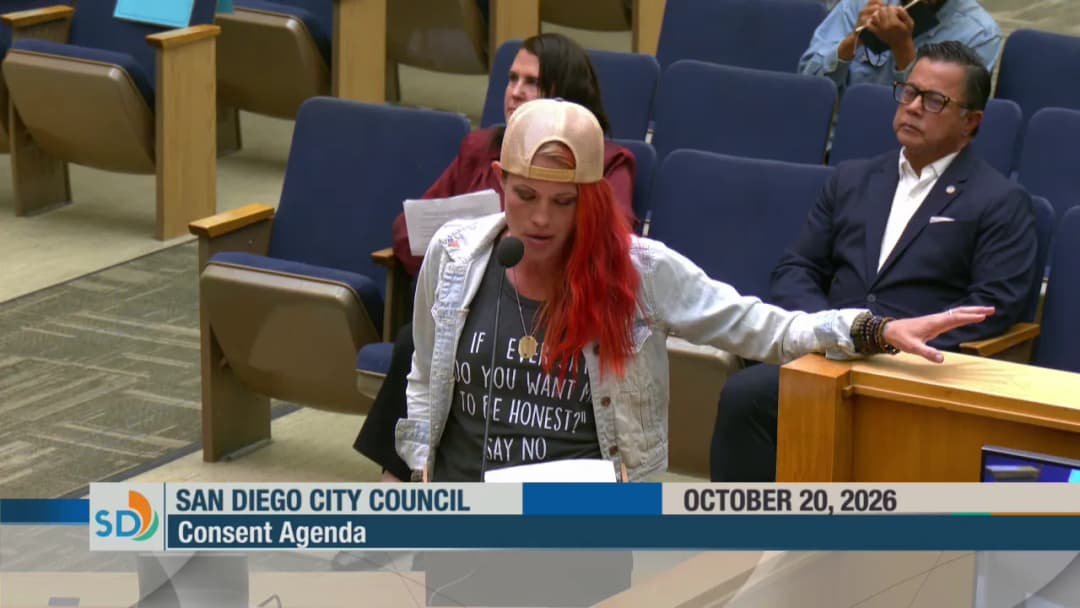
The San Diego City Council convened on Tuesday, October 20, 2026, for a regular meeting. The session opened with a land acknowledgement and the Pledge of Allegiance, followed by the approval of proclamation items and consent agenda items. Public comment was heard on both the proclamations and the consent agenda, and non-agenda public comment covered a range of community issues. All items were passed unanimously. Consent Calendar - Proclamations (Items 30–32, S500, S502, S504): The council approved proclamations recognizing Filipino American History Month, Captain Alberto Leos Day, Dr. Maria Carriero Ceniceros Day, California Flood Preparedness Week, Colonel R. Eric Herman Day, and Bill Walton Tie-Dye Day (November 6, 2026). - Consent Items (Items 10, 60, 100–104, S501, S503): The consent agenda included adoption of a municipal retention schedule, a future budget legislative calendar, conflict-of-interest code amendments, and adoption of the 2025 California Fire Code. Notably, Item S501 established a warning sign requirement for cryptocurrency ATMs. Public Comments & Testimony - Proclamation Public Comment: Speakers offered a mix of support and criticism. Joy Sanyata spoke in favor of the Filipino American and Bill Walton proclamations. Audra criticized the council for spending time on proclamations while ignoring pressing issues such as flood preparedness and police accountability. Others supported the flood preparedness week and the recognition of Captain Leos and Bill Walton. The city’s Filipino American Employees Association also testified in support of the Filipino American History Month proclamation. - Consent Agenda Public Comment: Barry Berman (AARP) and William P. Toom (Senior Affairs Advisory Board) spoke in support of the cryptocurrency ATM warning ordinance, describing it as a practical safeguard for older adults. Blair Beekman and Hector also commented, with Hector expressing skepticism about the council’s agenda and referencing “Gloriaville.” Bob Kazuski questioned the need for renaming the “master records schedule” to “municipal retention schedule,” calling it wasteful. - Non‑Agenda Public Comment: Topics included concerns about the Dreama for Change contract at the OLOT (21 deaths reported), criticism of Flock surveillance cameras and Ubiquita, public safety and wildlife issues at La Jolla Cove (request for consistent ranger presence and enforcement), the proposed county cannabis expansion, the bicycle master plan’s omission of impairment data, youth substance use prevention, and a request to preserve the Ethos Exchange community space in Ocean Beach. Discussion Items - Council members spoke in favor of the proclamations. Councilmember Campillo highlighted flood preparedness and the city’s work to go beyond federal floodplain standards. Councilmember Campbell shared personal memories of Bill Walton and promoted the Bill Walton Classic. Council President Pro Tem Lee and Councilmember Foster celebrated Filipino American contributions. Councilmembers Ilo Rivera and La Cava stressed the importance of the cryptocurrency ATM ordinance. - The council recognized the city clerk’s office for its diligent work and treated public commenters with respect despite occasional hostility. - No substantive debate occurred on consent items; the council accepted them as a block. Key Outcomes - Votes: All proclamation items passed 7–0 (Councilmembers Whitburn and Von Wilpert absent). The consent agenda, including the cryptocurrency ATM warning ordinance and fire code adoption, passed 7–0. - Next Steps: The cryptocurrency ATM warning sign requirement will take effect after passage. The office of the council president will conduct a day of action to inform businesses. The council will not hold its scheduled 2 p.m. session; the meeting was adjourned upon completion of non-agenda public comment. - Notable: Council President La Cava noted that the nomination of Bethany Bzack as Chief Operating Officer was docketed for the council’s consideration on Monday, October 19, 2026, which appears to precede this meeting date; this discrepancy was not resolved in the record.