Browse by city
Date range
Search help

Search titles, summaries, topics and stored transcripts together. Keywords may match separately; put the whole query in double quotes for a phrase. Matching follows word analysis, so punctuation is not exact. Both dates are included. Documents are not searched.

SHOWING 2121–2130 ENTRIES
2121
OCT 15, 2026 · SPARKS, NEVADA · CITY COUNCIL & BOARDS
Civil Service Commission Meeting Postponed – October 15, 2026

The Sparks–Nevada Civil Service Commission convened at 5:41 PM on October 15, 2026. No agenda or minutes were available for this meeting; this summary is based solely on the raw transcript. Roll call established a quorum. Because no public comments were submitted and the scheduled presenter was absent, the commission postponed the meeting and directed the city manager's office to reschedule all agenda items. Public Comments & Testimony - The commission opened the public comment period with a three-minute speaking limit. No public comment cards were submitted and no members of the public were present. Discussion Items - The commission was informed that the scheduled presenter could not attend. Commissioner Wes Duncan proposed postponing the meeting after consulting with the city manager. Commissioner Lou Daria made a motion to postpone the meeting and direct the city manager's office to set a future date for all agenda items. Key Outcomes - The commission accepted the motion to postpone the meeting and reschedule all agenda items to a future date to be determined by the city manager's office. - The meeting was closed at 5:43 PM.

PROCEDURAL 100%
2122
OCT 15, 2026 · NASHUA, NEW HAMPSHIRE · BOARD OF ALDERMEN MEETINGS
Nashua Committee of Infrastructure Meeting – October 15, 2026

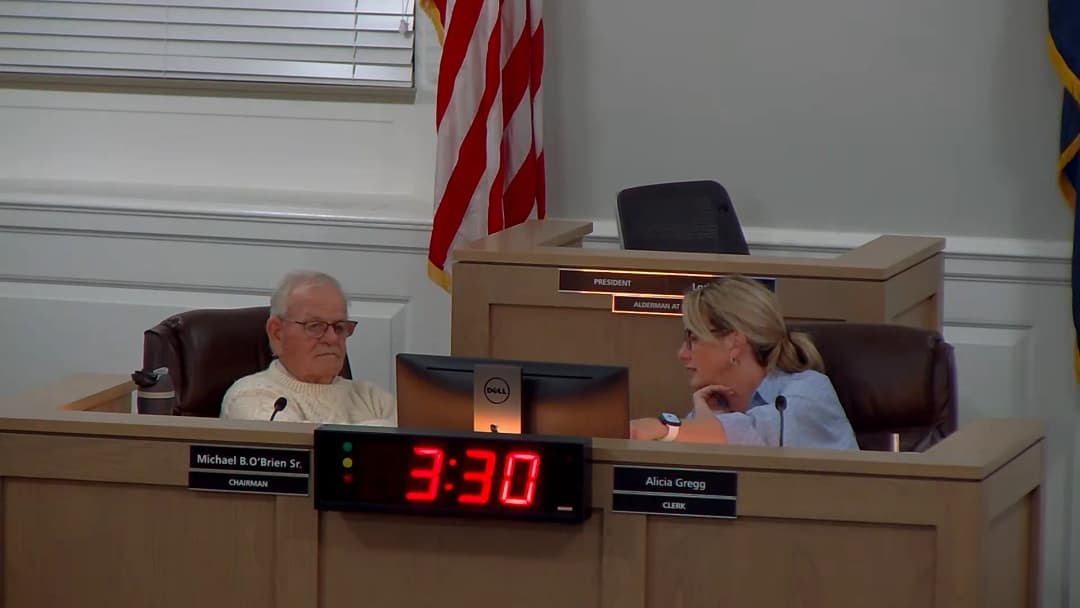
The Nashua Committee of Infrastructure met on October 15, 2026, in the Aldermanic Chamber. The transcript states the meeting was called to order on Wednesday, October 14, 2026, at 7 p.m., but the supplied meeting date is October 15, 2026. No agenda or minutes were supplied; this summary relies on the transcript. Roll call showed Aldermen Paula Johnson, Richard Dowd, Alicia Greg, and Michael O'Brien present, establishing a quorum. Alderwoman Ben Jefflata Smith was initially not present and her status was left open. Alderman Patricia Klee and Administrative Services Director Tim Cummings also attended. Public Hearing: Juliana Avenue Street Acceptance - Attorney Andy Prollman, representing Resident Homes Elite, presented the petition for street acceptance of Juliana Avenue. He said the property was purchased in March 2022, taken through the Planning Board subdivision process, built out, inspected along the way, and given final inspections that summer. He stated the engineering team signed off on street acceptance, the title opinion was signed by attorney Leonard, and the petition was routine. - Asked about property values, Prollman said he could not calculate tax revenue on the spot, but homes sold for approximately $1 million each. The transcript contains an unclear home count: "22 homes. 20 homes. 19 homes." He also noted a separate adjacent subdivision had three additional houses not part of Juliana Avenue. - The committee opened the public hearing for testimony both in favor and in opposition. No one came forward, and the hearing was declared closed at 7:05 p.m. Official Communication - The committee received a communication from Husband, senior traffic engineer for the Division of Public Works, in support of pending legislation O26-024. With no objection, the communication was accepted and placed on file. Discussion: Mohawk Tannery Remediation Update - Director Tim Cummings introduced the Thorndike Development team. Michael Devon, Thorndike project manager for Mohawk Tannery, presented alongside Lloyd Geisinger, member/manager of Blaylock Holdings, and Mike Payonesa, day-to-day project manager. - Devon described the Mohawk Tannery site as a legacy contaminated former tannery and Fimble Dorf factory site along the Nashua River, including lagoons full of carcinogenic sludge in the 100-year floodplain. The site was shut down in 1984. He credited the Board of Aldermen, city staff, state officials, and federal regulators for helping the project reach remediation and redevelopment. - As of a September aerial view, work completed included site mobilization and preparation, tree clearing, road improvements, excavation and relocation of asbestos materials, and the beginning of a secant containment wall that will be capped with an impermeable cap. Perimeter air monitors have been in place since day one, and no monitoring protocols have escalated into an active response. - Near-term work includes demolishing the remainder of the old tannery, completing the containment wall, excavating remaining asbestos and tannery contaminants, and establishing finished grade with a protective cover ready for redevelopment. - Devon acknowledged challenges, including discovery of additional contamination and larger-than-expected amounts of asbestos, which required extensive work plan changes and regulatory review. Asked about the schedule for having material in the coffer dams, he said "three to six months" and expected the site to be cleaned up by the end of next year. - A site plan change is being discussed with city staff due to market conditions. The number of apartments will increase, the payment in lieu will not change, and the change will also mean more affordable homes and a multimodal path. - Devon cited 546 homes planned for the project. He said "we already have 540 allocated for the firefighters" as transcribed, with $4.5 million in projected real estate tax revenue at full build-out and $250 million in private investment. - Public amenities will include a canoe and kayak launch, a river walk, a pedestrian bridge connecting to Mine Falls Park, and passive recreation on the completed containment cell. These amenities are open to the public, not only to future residents. Alderman Klee clarified that the developer will build the pedestrian bridge and the city will reimburse $3 million through the MDA. - Asked about traffic, Devon said extensive traffic studies have been peer-reviewed by city staff and consultants, and the project includes plans for a traffic light vetted by city engineering. - An access road shown in the presentation will open up the landlocked property along Veterans Memorial Parkway; Devon said that property is under contract. The forested southern parcel will be subject to a passive recreation easement for the city, with timing set in the phasing table. - Alderman Dowd requested periodic future updates, and Devon agreed to coordinate with Director Cummings. Alderman Johnson asked about potential leakage; Devon said long-term environmental controls, regular testing, and groundwater monitoring will be required in perpetuity. Finished Business: O26-024 – All-Way Stop at French Street and Abbott Street - Alderman Clay, prime sponsor, explained that one stop sign currently exists at the intersection but the legislation creating it could not be located. The new ordinance would correct that and establish an all-way stop near Mount Pleasant school. Teachers and parents requested the change, and the public works traffic engineer reviewed it. - Alderman Greg supported the measure, saying she had almost been hit by a car while crossing in the area and that drivers fly through the street. - The committee recommended final passage. The voice vote was unanimous in favor, and the motion carried. Petitions: Juliana Avenue Street Acceptance Recommendation - The committee moved to recommend granting the Juliana Avenue street acceptance petition. Alderman Klee noted benefits for residents including city trash pickup and street plowing, and said the public status of the street improves access for nearby residents even though there is no direct opening to Greeley Park. - The motion to recommend granting the petition carried by voice vote. General Discussion and Adjournment - Alderman O'Brien, a former firefighter, said he had feared no developer would touch the Mohawk Tannery property and praised the developer for remediating the site under federal EPA guidelines. He called the project a step in the right direction for Little Florida residents and for affordable housing. - Alderman Klee said the developers listened to neighbors, avoided transporting toxic waste through city streets, and used a deep interlocking containment system. Alderman Johnson recalled past odors and flooding, said she was not enthusiastic about the size of the project, but was glad the site is finally being cleaned up and the toxins contained. - With no further public comment, the committee voted to adjourn at approximately 7:04 p.m. Key Outcomes - Recommended granting the Juliana Avenue street acceptance petition. - Recommended final passage of ordinance O26-024, creating an all-way stop at French Street and Abbott Street. - Accepted and filed the Division of Public Works traffic engineer's communication on O26-024. - The Mohawk Tannery development team agreed to provide periodic updates to the committee through Director Cummings.

ENVIRONMENTAL PROTECTION 51% · PROCEDURAL 18% · TRAFFIC AND PARKING 12% · PUBLIC COMMENT 6%
2123
OCT 15, 2026 · BUTTE SILVER BOW, MONTANA · COUNCIL OF COMMISSIONERS & COMMITTEES
Finance Committee Meeting Delayed for Lack of Quorum on October 15, 2026

The finance and budget committee meeting was called to order on October 15, 2026, but no quorum was present. The presiding official announced that the meeting could not proceed until at least one more commissioner arrived, and indicated that the meeting would be reconvened once a quorum was achieved. Key Outcomes - No formal business was conducted because a quorum was not present. - The meeting was paused pending the arrival of an additional commissioner.

PROCEDURAL 100%
2124
OCT 15, 2026 · COPPELL, TEXAS · CITY COUNCIL & BOARDS
Coppell Planning and Zoning Commission Regular Meeting - October 15, 2026

The Planning and Zoning Commission of Coppell, Texas, met in Regular Called Session on October 15, 2026, beginning with a Work Session at 6:00 PM and the Regular Session at 6:30 PM. The primary agenda item was a public hearing and consideration of a Special Use Permit (SUP-1272-C) for Shammy's Car Wash, a drive-through car wash with self-service vacuums on approximately 1.746 acres on the east side of S. Belt Line Road. A second item regarding the Austin Elementary School addition was withdrawn prior to the meeting. Public Comments & Testimony - No members of the public signed up to speak during Citizens' Appearance or the public hearing on the car wash item. One written comment in opposition was received from the owner of the Bimmer automotive property directly north of the site, citing the existing presence of other car washes within a few miles. Discussion Items - Austin Elementary School Withdrawal: Staff announced that the Austin Elementary School addition item had been withdrawn by the applicant; new public notices will be sent if the item is resubmitted. - SUP-1272-C – Shammy's Car Wash: Senior Planner Mary Paron‑Boswell presented the proposal: a 5,440‑square‑foot car wash tunnel with 24 covered vacuum stations, two drive-through lanes with menu boards, and two driveways on S. Belt Line Road. A southbound left-turn deceleration lane will be installed at the existing median opening. The site has a 15‑foot Pioneer Oil Company easement to be abandoned via replat. Staff recommended approval subject to five conditions, including landscaping revisions. Applicant Clay Christie (Claymore Engineering) confirmed acceptance of staff conditions and addressed traffic-stacking questions. Commissioners discussed potential traffic conflicts with vehicles exiting the northern driveway and attempting U‑turns; the applicant agreed to work with city engineering to install "No U‑Turn" signage at that exit. The applicant also noted the site will include a mutual access easement for a future adjacent parcel. Key Outcomes - Meeting Minutes Approved: The September 17, 2026, meeting minutes were approved unanimously (6‑0). - Special Use Permit Approved: The Commission approved SUP-1272-C for Shammy's Car Wash by a unanimous vote (6‑0), subject to staff's recommended conditions, including: (1) additional reviews during building permit and engineering; (2) required replat; (3) installation of the southbound left-turn deceleration lane prior to certificate of occupancy; (4) abandonment of the 15‑foot Pioneer Oil easement with the replat; and (5) revision of the landscape and tree mitigation plan to comply with the city's landscape ordinance.

ENGINEERING AND INFRASTRUCTURE 56% · PROCEDURAL 16% · TRANSPORTATION SAFETY 14% · COMMUNITY ENGAGEMENT 13%
2125
OCT 15, 2026 · SEATTLE, WASHINGTON · CITY COUNCIL
Select Budget Committee Reviews SPD Budget on October 15, 2026

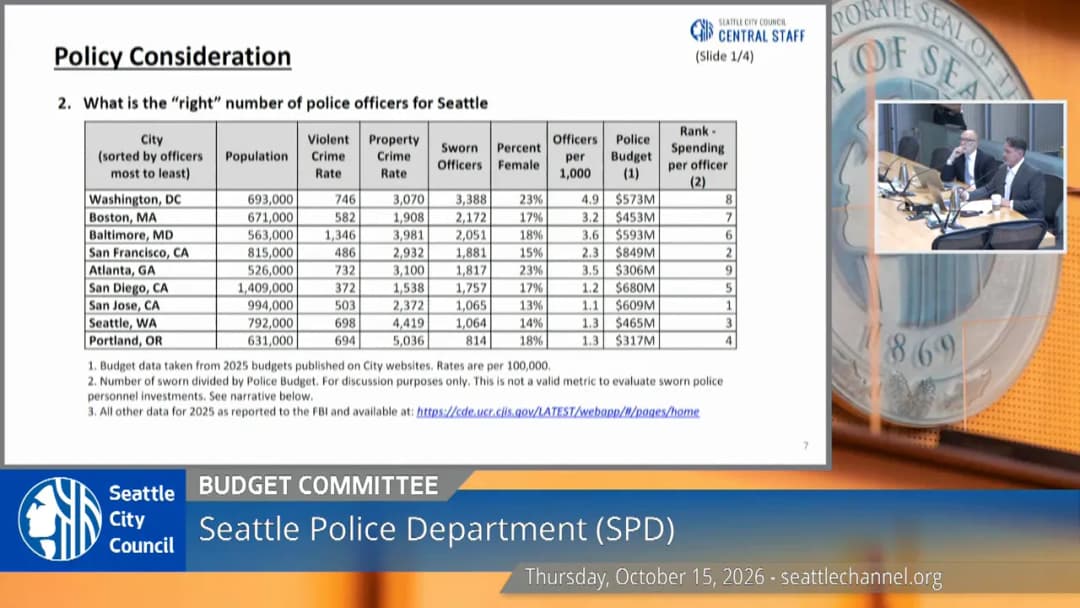
The Seattle City Council Select Budget Committee met on October 15, 2026, from 9:32 a.m. to 5:16 p.m., with a lunch recess from 12:34 p.m. to 1:50 p.m. The committee received Central Staff presentations and policy analysis on the 2027–2028 Proposed Budget for the Seattle Police Department (SPD) in the morning session, followed by similar briefings on the Seattle Fire Department (SFD), Community Assisted Response and Engagement (CARE), Human Services Department (HSD), and United Care Team (UCT) in the afternoon. The meeting also included an earthquake drill at 10:15 a.m. Public Comments & Testimony - Only written public comment was accepted for this meeting; no oral testimony was heard. Discussion Items 1. Seattle Police Department (SPD) Budget (9:32 a.m. – 12:34 p.m.) Central Staff analyst Greg Doss presented a 26-page analysis covering eight policy issues. Key topics included: - Sworn Staffing Plan: The proposed budget increases SPD funding by $68 million (13.9%) over 2026, largely driven by $56 million for bargained salary increases and $12.5 million for sworn salaries. The mayor establishes a funded FTE cap of 1,250, which equates to 1,174 fully trained and 1,125 deployable officers at steady state—well below the 2019 peak of 1,281 deployable officers. The plan projects 43 net new officers in 2027 and sustainment hiring (0 net new) in 2028. Hiring would slow from 12 recruits/month to 7/month by late 2027. - Staffing Options: Central Staff offered options for accelerating hiring: Option B (maintain current recruit hiring) would cost $792,000 in 2027 and $11.6 million in 2028, adding 92 net new officers over the biennium. Option C (maintain current recruit and lateral hiring) would cost $2.1 million in 2027 and $17 million in 2028, adding 125 net new officers. Ongoing costs in 2029 would be $22–29 million. - Recruitment & Retention Cuts: The executive eliminated $2.4 million in hiring bonuses and $3.5 million in media/marketing, arguing the new SPOG contract (highest pay in state) suffices. Council options include restoring funding for bonuses or marketing. - Parking Enforcement Officers (PEOs): SPD has 18 long-term vacancies; the budget cuts half of these positions. PEOs generate $200,000/year in revenue each but cost $115,000. A prior proviso to fund hires went unused. Central Staff recommended a statement of legislative intent rather than re-adding positions. - Real-Time Crime Center (RTCC): The executive defunded 3 of 21 planned civilian positions, though SPD says it can staff 24/7 with the remaining 18. Council could restore the three positions ($511,000/year). - Civilian Investigators: 14 civilian positions added in 2025–26 to assist detectives were partially hired (7 filled); the remaining 7 are eliminated in the proposed budget. Central Staff is still analyzing workload impact. - DEI & 30×30 Positions: The executive eliminated a DEI position and a 30×30 (women in policing) position, each $207,000. SPD has not hired for these roles in the past. Council could add back with proviso, but past provisos have not compelled hiring. - Overtime: SPD is budgeted for 473,000 overtime hours in each year of the biennium, but has consistently spent 500,000 hours. A $2.1 million deficit is projected in 2026; the executive requests a year-end supplemental. Council could proactively add $2.1 million to the 2027 budget. Councilmember Comments & Questions: - Councilmember Kettle (Public Safety Chair) argued the 1,250 FTE number is a “PR number” that will not rebuild staffing to the 1,400+ officer goal. He criticized the slowing of hiring and called the budget an “unfunding of public safety.” - Councilmember Rivera expressed concern about capping hiring at 43 net new over two years, especially given population growth. She noted a 30×30 position she added last year remains unfilled and that the north precinct has 42% of the population but only 25% of officers. - Councilmember Lynn emphasized that SPD is receiving a $68 million increase (13.9%)—more than any other department—while other departments face cuts. He questioned whether the slowdown in hiring is a “cap” or a “limitation.” - Councilmember Saka praised the analysis but disagreed with eliminating hiring incentives, especially for laterals. He highlighted the importance of PEOs and called for addressing the disincentive to hire them. - Councilmember Mercedes-Rinck placed the SPD increase in context of layoffs in five other departments. She questioned the $13 million SPOG overpayment and the lack of alternatives to 30×30 and DEI positions. She noted the Meloria staffing study did not account for CARE alternative response. - Councilmember Foster asked about the “bottleneck” in field training officers (20 students unassigned) and noted that attrition requires hiring 13 officers/month to maintain status quo, but the budget drops to 7/month in 2027. - Chair Strauss raised questions about Harbor Patrol integration with 911 and the impact of a laid-off auto records position on property crime victims. 2. Seattle Fire Department (SFD) (after recess, 1:50 p.m.) - The Information Item (Inf 2986) was heard in committee. No further details provided in the transcript. 3. Community Assisted Response and Engagement (CARE) (after recess) - The Information Item (Inf 2985) was heard in committee. No further details provided in the transcript. 4. Human Services Department (HSD) and United Care Team (UCT) (after recess) - The Information Item (Inf 2987) was heard in committee. No further details provided in the transcript. Key Outcomes - No formal votes were taken. The committee concluded the morning session on SPD and recessed for lunch, then returned to hear briefings on SFD, CARE, HSD, and UCT. Central Staff policy options and councilmember concerns will inform potential amendments to the 2027–2028 budget. The meeting adjourned at 5:16 p.m. - An earthquake drill was conducted at 10:15 a.m., which the Chair noted was an improvement over the real earthquake two weeks prior.

PUBLIC SAFETY 78% · PARKING ENFORCEMENT 6% · BUDGET EQUITY ANALYSIS 3% · PROCEDURAL 2%
2126
OCT 15, 2026 · SAN ANTONIO, TEXAS · CITY COUNCIL
San Antonio City Council Meeting - October 15, 2026: ICE Detention Resolution, Taser Contract, and Economic Development Briefing

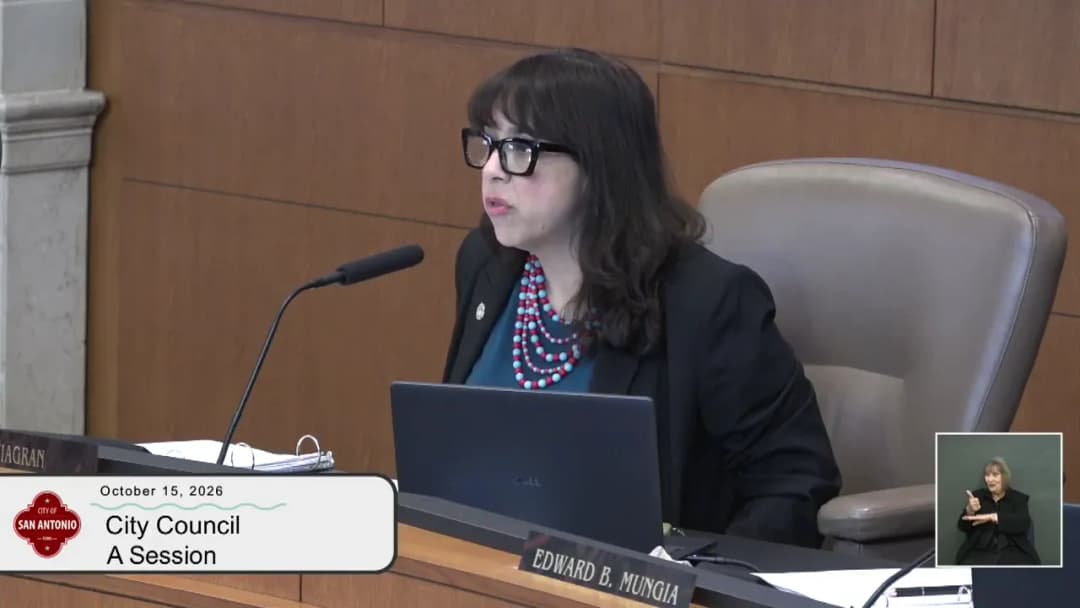
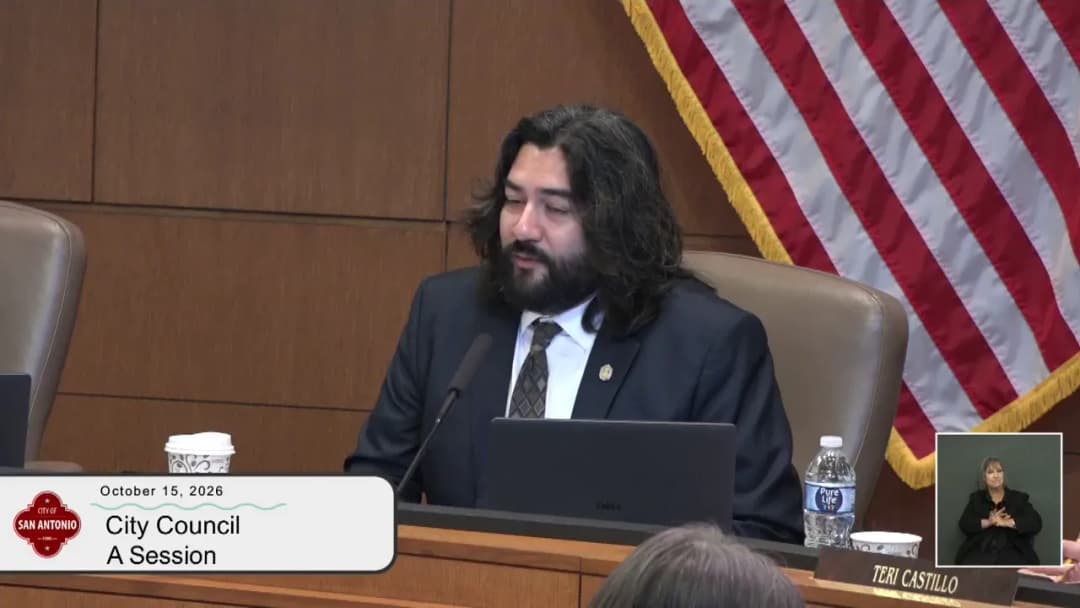
The San Antonio City Council convened at 9:07 AM on October 15, 2026, under Mayor Ron Jones. The meeting featured ceremonial recognitions, public comment, and votes on a resolution opposing an ICE detention facility and a contract to upgrade police Tasers. City Council also received a briefing on the updated economic development strategic framework and proposed incentive guidelines. Consent Calendar - Approved minutes of the previous meeting (motion and second, carried). - Approved the consent agenda (items 8-16) as a group, with item 8 (Axon contract) pulled for separate discussion. Item 16, a affordable housing project with rent restrictions for households at 60% or less of area median income, capped at 30% of income, for 40 years, was highlighted by Councilwoman Villagran as a positive addition. Public comment by Jack Finger opposed the project, calling it "welfare housing." Public Comments & Testimony - Jack Finger spoke against consent agenda item 16, arguing that affordable housing is a burden on taxpayers and disincentivizes self-sufficiency. - On item 5 (ICE resolution), two speakers addressed the council: - Alessandro Carrasco expressed full support for the resolution, condemning ICE's brutality and the proposed detention facility as a "prison camp." He praised the council for taking a stand, regardless of legal outcome. - Jack Finger opposed the resolution, asserting U.S. sovereignty and the need to enforce immigration laws. He characterized the council's efforts as political theater and a waste of resources. Recognitions and Proclamations - The council celebrated the 251st birthday of the United States Navy. Rear Admiral Walter Bradford noted that naval forces make up approximately 15% of active duty forces in the San Antonio area. A cake-cutting ceremony followed. - Councilman White recognized Ellian Solis, a young man who helped neighbors evacuate during house explosions in April 2026, presenting a certificate of appreciation. - Councilwoman Villagran recognized Urban October and the work of Dr. Dyer and communications director Adenelli Moreno Soto in developing a citywide data center survey with over 1,200 responses. - Councilman Korr recognized Chef Seth Snyder and his son Tristan for winning the Pro Chef Division at the Texas Food Championships, representing San Antonio. City Manager's Report - City Manager Eric reported on the Terminal C topping off ceremony at the airport, noting the building will be enclosed by the end of the calendar year. - He highlighted the San Antonio Neighbors Together event, designed to strengthen community-police connections. - A video showcased Andres Torres, a fleet maintenance advisor, emphasizing the importance of preventive maintenance for police vehicles and cost competitiveness. Discussion Items - Item 5 (ICE Detention Facility Resolution): The council considered a resolution directing the city manager and city attorney to take all lawful actions to prevent a large ICE detention facility (1,500 beds) in the urban core. After extensive debate, an amendment offered by Mayor Jones extended the directive to also address newly signed 15-year leases at Brooks that could support ICE operations. Supporters (including Councilmembers McKee Rodriguez, Castillo, Villagran, Alarcon Gavito, Korr, Mesa Gonzalez, and Mungia) argued the facility would harm the community, citing ICE's record and the chilling effect on economic development. Opponents (Councilmembers White and Spears) characterized the effort as political theater and an overreach of local authority. The resolution as amended was approved. - Item 8 (Axon Taser 10 Contract): Councilman McKee Rodriguez pulled the item, raising concerns about the lack of public process (the contract was not competitively bid and was exempt from typical oversight), the cost escalation from $824,000 to over $2 million annually, and the 10-year term. He argued that the city had tied itself to a single vendor (Axon) and called for more scrutiny. In response, the chief of police and city manager defended the upgrade, noting that the Taser 7 is obsolete, the Taser 10 offers increased range (45 feet vs. 25) and reduced voltage for less harm, and the suite of Axon products (body cameras, evidence management) is integrated with the criminal justice system. They also stressed that other major Texas cities have already transitioned to the Taser 10. After discussion, the motion to approve the contract (first-year cost $1,300,077.68, estimated total $22,575,980, with optional bundles up to $31,972,276) carried. - Items 6 & 7 (Economic Development Strategic Framework Update and Incentive Guidelines Briefing): Staff from the Economic Development Department and TIP Strategies presented an update to the 2022 framework and proposed changes to the city’s incentive guidelines. Key highlights included: - Since 2022, over $1 billion was paid to small businesses via the Sabata program (14% increase), $7.5 billion in corporate investment (more than double the prior period), and over 15,000 jobs created. - The framework retains three goals (innovation, global investment, and economic mobility) with new emphasis on placemaking, site readiness, and the "Level Up" implementation task force. - A concept design for the Nelson W. Wolf Stadium redevelopment was presented, featuring mixed-use development (single-family housing under $250,000, medical office, light industrial, retail, community recreation, senior housing) with phased construction from 2029 to 2046. - Proposed incentive guideline revisions include: switching to quarterly census of employment wages (QCEW) for wage data; a fixed 3% annual wage increase (instead of indexing); reducing the minimum job threshold from 50 to 25; lowering the wage requirement (80% of QCEW up from 80% of ACS); creating an Economic Mobility Fund (5% of tax revenue collected instead of 10% direct employee investment); and introducing a transit-oriented development (TOD) incentive (up to 50% abatement for projects over $5M near transit corridors, with 20% enhancement for small business support). - Council members offered varied perspectives: Councilman Galvan expressed strong support for the Wolf Stadium plan; Councilman McKee Rodriguez called for a master plan with clearer ROI metrics; Councilwoman Castillo raised concerns about displacement and economic mobility for justice-involved individuals; Councilwoman Corr advocated for missing middle housing at Wolf Stadium and a combined housing/economic development incentive for TOD; Councilwoman Spears supported the flexibility; Councilman White stressed the need to address issues identified in the TIP report, such as administrative responsiveness and site readiness. No votes were taken; the framework and guidelines are expected to return for adoption on November 5, 2026. Key Outcomes - Approved minutes of previous meeting. - Approved consent agenda (items 9-16) with item 8 pulled. - Approved resolution (item 5) to prevent an ICE detention facility, including a directive to also address similar 15-year leases at Brooks. - Approved item 8, authorizing a 10-year contract with Axon for the Taser 10 upgrade, with first-year cost of $1,300,077.68 and total estimated cost of up to $31,972,276. - Received and filed the briefing on the economic development strategic framework and incentive guidelines; staff to return for formal adoption in November.

ECONOMIC DEVELOPMENT 36% · IMMIGRATION POLICY 14% · PUBLIC SAFETY 13% · PROCEDURAL 7%
2127
OCT 15, 2026 · SAN ANTONIO, TEXAS · CITY COUNCIL
San Antonio City Council Meeting Summary - October 15, 2026

San Antonio City Council Meeting Summary - October 15, 2026\n\nThe San Antonio City Council convened on October 15, 2026, for its regular session A. The meeting included ceremonial recognitions, debate and a vote on a resolution opposing an ICE detention center in the urban core, approval of a new TASER contract for the police department, and informational briefings on the Nelson Wolff Stadium redevelopment and proposed updates to the city's economic development incentive policies.\n\n Opening & Ceremonial Items\n- The council celebrated the 251st anniversary of the U.S. Navy, joined by Admiral Walter Matford, who highlighted the naval community's role in San Antonio and the city's strong support for military members.\n- The council recognized Elion Solís, a young resident of District 10, for his heroic actions during a house explosion and fire on Preston Hollow Drive in April 2026. Solís went door-to-door helping elderly neighbors evacuate.\n- Chef Snyder and his son Tristan were recognized for winning a culinary competition in Corpus Christi, representing San Antonio's status as a UNESCO Creative City of Gastronomy.\n- The council acknowledged Urban October and recognized the sustainability and resilience team for their work.\n\n Consent Calendar\n- The minutes from the city council meetings of September 30 and October 1, 2026, were approved unanimously.\n- The consent agenda was approved with the exception of Item 8 (TASER contract), which was pulled for separate discussion.\n- Item 16 (Affordable Housing): Public speaker Jack Finger spoke against Item 16, characterizing it as establishing "welfare or subsidized housing" for families earning 60% or less of the area median income, with rents restricted to 30% of income for 40 years. He argued that such policies provide no incentive for residents to improve their economic standing. Councilwoman Villagrán expressed strong support for the project, stating it helps people when they need it so they can rise up, and expressed interest in working with Opportunity Home in the future.\n\n Discussion Item: Resolution Against ICE Detention Center (Item 5)\n- Public Testimony: Multiple speakers addressed the council. Alessandra Carrasco characterized ICE detention practices as brutal, describing lack of water and food, and urged the council to stand against the facility. Jack Finger argued the resolution was an attempt to obstruct federal immigration law enforcement and characterized it as a political effort against President Trump's agenda.\n- Council Debate:\n - Support: Councilmembers Villagrán, Maggie Rodríguez, Castillo, Gavito, Mungía, and others supported the resolution. Villagrán framed it as a public safety issue, citing patterns of abuse by ICE, lack of transparency, and the fear created in the city's Latino community (64.6% of the population). Castillo noted ICE has a $10 billion budget and argued the facility would harm local economic development. Maggie Rodríguez stated her office had been working with advocacy groups since February to stop the facility, calling for coordination with other agencies.\n - Opposition: Councilmembers White and Spears opposed the resolution. White called the effort a "waste of time and common sense" and "political theater," arguing it misuses taxpayer dollars against federal law enforcement and urged the council to focus on city services and safety. Spears echoed concerns about spending city funds on federal jurisdiction issues and questioned the rationale behind the environmental study.\n- Amendments and Vote: Councilwoman Maggie Rodríguez proposed an amendment adding a section to explicitly address and work to prevent or delay the 15-year lease at Brooks. After debate on the amendment's scope, it was approved. The main resolution, as amended, directing the City Manager and City Attorney to take actions to prevent the ICE detention center from locating in the urban core and to coordinate community legal efforts, passed.\n\n Discussion Item: TASER 10 Contract Update (Item 8)\n- The council debated a contract modification with Axon Enterprise Inc. to upgrade the police department's TASER 7 program to the TASER 10. The cost for the first year is $1,300,077.68, with a total estimated contract base of $22,075,980 over 10 years. An optional addition for up to 100 TASER 10 packs per year totals $9,396,296, bringing the total potential cost to $31,972,276.\n- Councilmembers Mickey Rodríguez and Corr expressed concerns about the lack of competitive bidding, the significant cost, and vendor lock-in. The Police Chief explained the TASER 10 has greater de-escalation capability (45-foot range, 10 cartridges vs 2), and the contract is essential for interoperability with the Axon evidence system (Evidence.com). Changing vendors would be cost-prohibitive. Councilmember Corr noted the need for better scrutiny of such large expenses in the future. Councilman White supported the operational necessity, citing officer and public safety.\n- The motion to approve the contract as pulled from the consent agenda passed.\n\n Informational Briefings: Strategic Framework & Incentive Policy (Items 6 & 7)\n- Item 6: Nelson Wolff Stadium Redevelopment: Staff presented the conceptual design for the redevelopment of the Nelson Wolff Stadium site, based on a community-led process and market analysis. The plan includes mixed-use development with retail, housing (including senior housing), parks, a community center, and medical offices, with phased development projected from 2026 to 2046. Councilmembers expressed strong support for the project as a transformative investment for the East Side.\n- Item 7: Economic Development Incentive Policy Updates: Staff proposed several key changes to the city's incentive guidelines, scheduled for formal adoption on November 5, 2026:\n 1. Wage Data: Shifting from the 5-year ACS average to the Quarterly Census of Wages (QCW) for more real-time salary data.\n 2. Flexibility: Lowering the job creation threshold for emerging industries (e.g., biotech, cybersecurity) from 50 to 25 jobs.\n 3. Economic Mobility Fund (EMF): Creating a dedicated fund by setting aside 5% of projected tax gains from incentive projects (down from a 10% in-project workforce requirement) for broader council-determined initiatives such as childcare or transportation.\n 4. Transit-Oriented Development (TOD) Incentive: A new tax incentive was proposed for projects near transit corridors, including a 20% bonus for supporting small businesses.\n- Council Feedback: Councilmembers White, Corr, and Mungía discussed the TIP Report's findings on the need to improve administrative responsiveness in permitting and site readiness. Councilwoman Castillo emphasized the need for stronger anti-displacement strategies within the TOD and corridor incentives. Councilman Mungía highlighted the need for incentives in underserved areas like the South Side and Base Road.\n\n Key Outcomes\n- Vote: Approved the consent agenda (excluding Item 8).\n- Vote: Approved the resolution directing the City Manager and City Attorney to take legal and administrative actions to prevent the ICE detention center in the urban core and to coordinate community efforts, including addressing the 15-year lease at Brooks.\n- Vote: Approved the first-year contract modification with Axon to upgrade the police TASER system, with a total potential contract value of $31,972,276 over 10 years.\n- Next Steps: The Nelson Wolff Stadium redevelopment plan and the comprehensive Economic Development Incentive Policy framework, including the new TOD incentive and Economic Mobility Fund, are scheduled for formal council adoption on November 5, 2026.

ECONOMIC DEVELOPMENT 32% · IMMIGRATION POLICY 15% · PUBLIC SAFETY 11% · PUBLIC ENGAGEMENT 8%
2128
OCT 15, 2026 · SAN ANTONIO, TEXAS · CITY COUNCIL
San Antonio City Council Meeting - October 15, 2026: Consent Agenda and Zoning Decisions

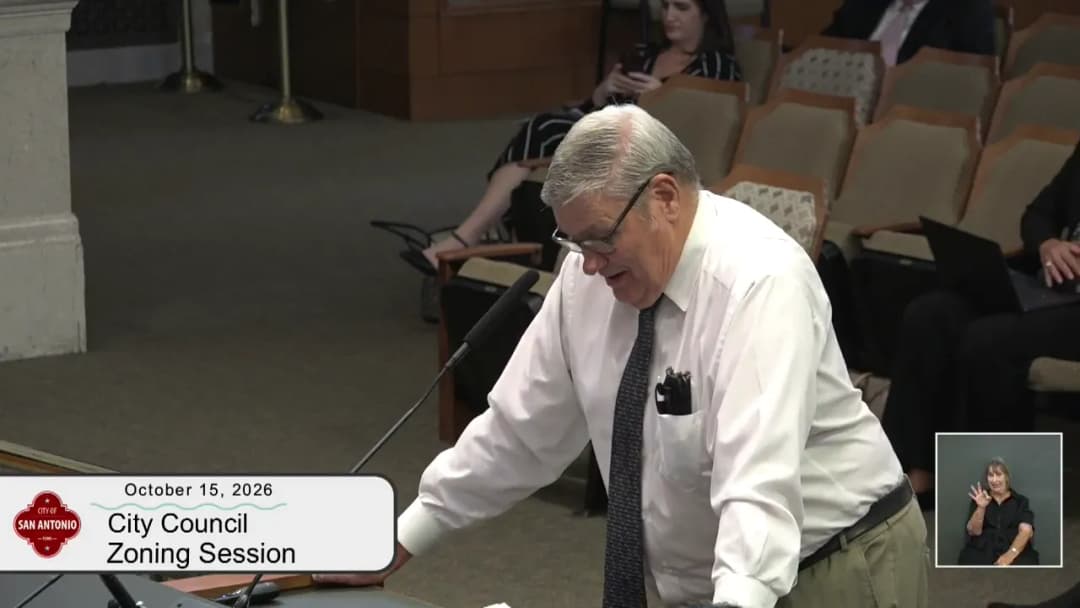
The San Antonio City Council met on October 15, 2026, with Mayor Ron Nirenberg and councilmembers present. After roll call confirming a quorum, the council moved to the consent agenda. Items 13 and 14 were set for individual consideration; the remaining items (1–12 and 15) were considered on consent. The meeting adjourned at 2:15 PM. Consent Calendar - The consent agenda included routine approvals and unanimous actions. Councilmember Corr highlighted two new Transit-Oriented Development (TOD) zones and a new Italian restaurant at the old La Facasha building, welcoming the owner. A motion to approve the balance of the consent agenda (items 1–12 and 15) was made, seconded, and carried. Public Comments & Testimony - Jack Finger spoke on consent agenda items 1, 3, and 4. He opposed item 1, an alcohol variance to allow alcohol sales within 300 feet of Bonham Elementary School, questioning the necessity. He also opposed items 3 and 4, a zoning change from C-2 to C-2 CD for conditional use as a motor vehicle sales lot (used car lot) on Blanco Road, arguing the area already had many such lots. He urged the council to deny these items. - Later, during individual items, Jack Finger again spoke on items 13 and 14, noting that planning and zoning staff and commissions all recommended denial. He stated the proposed auto paint and body repair shop would abut single-family residences without adequate buffers from hazardous emissions, making it incompatible and detrimental. He cited that 15–30% of notified residents opposed the project. Discussion Items - Items 13 and 14 (District 9): A plan amendment from community commercial to regional commercial and rezoning from C-3 to C-3S with specific use authorization for auto paint and body repair, including outside storage screened from view. The property is at 12139 Jones Maltzberger Road. Staff, the Zoning Commission, and the Planning Commission all recommended denial. Notices were mailed: within 200 feet, 7 returned in favor, 2 in opposition; beyond 200 feet, 7 in favor, 1 in opposition. Councilwoman Spears, the district representative, moved to approve, stating she had considered surrounding neighborhood input. The motion was seconded and carried. Key Outcomes - Consent agenda (items 1–12 and 15) approved unanimously. - Items 13 and 14 (plan amendment and zoning change for auto paint/body repair) approved by vote (motion carried). - Meeting adjourned at 2:15 PM.

ZONING AND LAND USE 64% · PROCEDURAL 20% · ALCOHOL REGULATION 9% · TRANSPORTATION INFRASTRUCTURE 7%
2129
OCT 15, 2026 · NEW YORK CITY, NEW YORK · CITY COUNCIL
NYC Council Sanitation Committee Hearing on Waste Equity, October 15, 2026

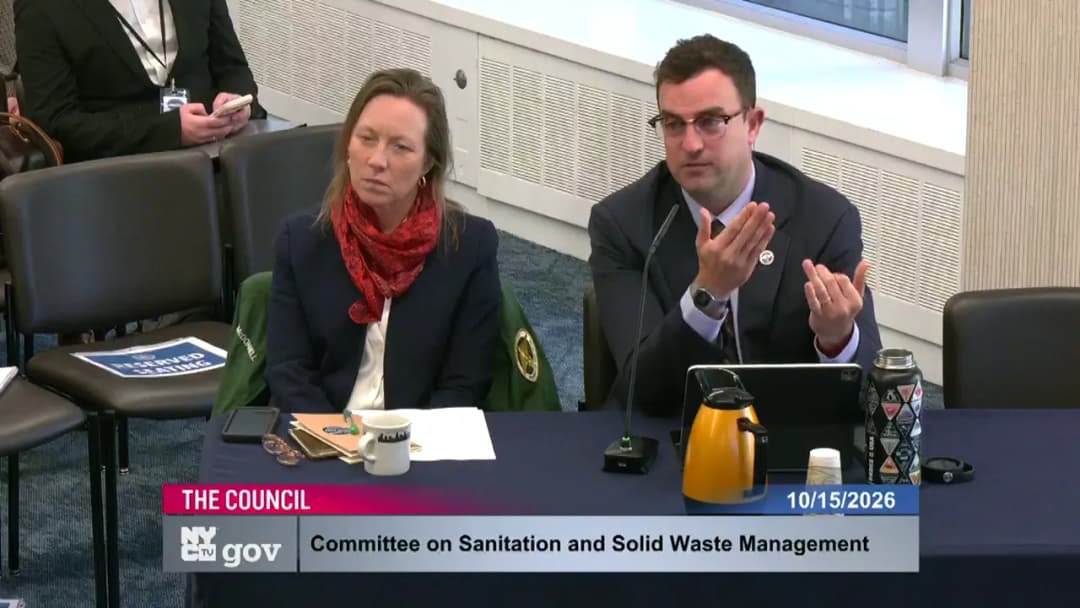
The New York City Council Committee on Sanitation and Solid Waste Management, chaired by Council Member Justin E. Sanchez, met on Thursday, October 15, 2026, at 1:00 PM at 250 Broadway, 8th Floor Hearing Room 1, for an oversight hearing on waste equity and environmental justice and to consider five local law introductions. Members present included Hankerson, Louis, Maloney, Thomas-Henry, Wilson, and Zhuang; Santosuosso and Ung were absent; Hanif and Vernikov were excused on medical leave. Council Members Epstein and Restler also attended. Oversight: Waste Equity and Environmental Justice - Chair Sanchez said the committee has seen a 15% citywide reduction in permitted transfer-station capacity but stated that none of the four community districts designated under Local Law 152 of 2018 had achieved full compliance with the law's required reductions: Brooklyn CD1 was required to cut 50% but is at 35.8%; Queens CD12 and Bronx CDs 1 and 2 were required to cut 33% but are at 23.9%, 14.8%, and 21%, respectively. He also said about 74% of citywide throughput remains concentrated in those four districts. - Chair Sanchez expressed concern that reductions have targeted mostly unused capacity and that two Waste Management stations in Bronx CD1 and Brooklyn CD1 appear to have had no reduction. DSNY Commissioner Gregory Anderson responded that the law has been fully implemented as written and as analyzed in the environmental review, with exemptions under Local Law 152 for demonstrated recycling/organics processing, construction and demolition debris beneficial use, and facilities exporting most waste by rail; he said the two Waste Management facilities export nearly all waste by rail. - DSNY reported that reductions cut not only permitted capacity but also actual throughput and truck traffic, and that the commercial waste zones program under Local Law 199 of 2019 is expected to cut commercial waste truck traffic by 63% and more than 18 million vehicle miles traveled annually when fully implemented. The FY26 Commercial Waste Zones annual report, released two weeks before the hearing, documented six operational zones, 192,000 outreach activities, and 2,581 employee trainings. - DSNY said it will provide the council with records of exemptions and capacity-increase determinations, and will analyze 311 complaint/service-request volume in environmental-justice versus non-environmental-justice communities. - Discussion also covered marine transfer stations, possible commercial waste use of municipal marine transfer stations, enforcement against illegal dumping, and the department's inability to measure actual truck-traffic changes until commercial waste zones are fully implemented. Legislation Considered - Int 0030-2026 (sponsored by Majority Leader Abreu and Council Member Louis) would require a program for city-owned non-residential buildings to use stationary on-street waste containers. DSNY said city agencies are already required to containerize trash, and adding Empire bins at every city facility could divert resources from the residential containerization rollout to 2031, but the department is open to continued talks. - Int 0987-2026 (Abreu and Restler) would allow block associations and nonprofits to request stationary on-street containers. DSNY noted an existing application process for shared Empire bins in Brooklyn CD2 and said it looks forward to further discussions. - Int 0352-2026 (Council Member Nurse) would require DSNY to plan for safe disposal of rechargeable batteries from powered mobility devices. DSNY described existing special waste drop-off sites and safe-disposal events, and said battery manufacturers should bear primary cost; the state's extended producer responsibility program is being expanded to e-mobility batteries, though retailer take-back of those batteries remains voluntary. DSNY said added sites and event collection would require substantial additional funding. - Int 0401-2026 (Restler) would require DSNY to install 25 public organic waste receptacles per community district. DSNY opposed the bill at this time, citing a 42% decline in smart compost bin utilization from FY25 to FY26, the mandatory curbside composting program, and the cost of installing and servicing additional bins. - Int 1041-2026 (Council Member Hankerson) would bar DSNY from removing public litter baskets solely because of illegal dumping, require notification to council members and community boards at least 10 business days before removal, and require reporting. Commissioner Anderson said he has not removed a litter basket since taking office in March 2026, but argued the department should keep removal as a last resort; DSNY recently began updating the litter basket inventory on open data monthly. Public Comments & Testimony - Joyce Bialik, Manhattan Solid Waste Advisory Board Plastic Task Force, testified for WE ACT for Environmental Justice and supported Int 1041. She cited a 2023 study finding East Harlem had 69 litter baskets versus 260 in the Upper East Side, with 17% versus 95% of four-corner intersections having baskets and 51% versus 6% dirty blocks on Madison Avenue, and urged hearings on plastic-related bills. - Alia Sumro, New York League of Conservation Voters, supported Int 0030 and the intent of Int 0352, and said the city should tailor battery legislation to the state's new extended producer responsibility law signed in December 2025. - Damon Gilbert, New York Lawyers for the Public Interest, described Redfern Houses residents in Far Rockaway living across from the Inwood Material Terminal in Nassau County, which processes construction and demolition debris. He supported Int 0367 (not on today's agenda), Int 0987, and Int 0030, and called for sidewalk accessibility in containerization plans. - An Uprose representative from Sunset Park supported the bills before the committee, adding that one barge can replace about 96 long-haul truck trips, and urged passage of Int 0367 and use of marine/rail transfer stations for commercial waste. - Shravanti Kaneka, NYC Environmental Justice Alliance, said 75% of privately managed waste is still trucked through five community districts; she urged full implementation of commercial waste zones, passage of Int 0367, and opposed expanding anaerobic co-digestion at wastewater resource recovery facilities. - Mary Ellen Sullivan, Brooklyn Solid Waste Advisory Board, supported public organic waste receptacles with community composters involved, and urged stationary bins for recyclables and organics as well as trash. - Rhonda Kaiser, Cafeteria Culture, described Harlem students diverting almost one metric ton of cafeteria food scraps to a local composting partner and urged policies that support local, non-truck-based composting. - Christopher Leon Johnson supported Int 0352 and called for stricter enforcement against modified e-bike batteries, including confiscation of dangerous batteries. - Claire Mifflin urged expanding on-street containerization to all waste streams and warned that maintenance-agreement requirements make it difficult for block associations and small buildings to participate. - Eric Goldstein, Natural Resources Defense Council, urged support for Int 0367, expansion of NYCHA composting programs, and action to avoid renewing contracts with the Essex County and Chester incinerators when they expire in 2032. - Haley Miranda, a South Bronx youth organizer, described family experiences with asthma and urged passage of Int 0367, reduced truck traffic, and caution about anaerobic digestion. - M. Blaze Backer, a Fort Greene resident and former BID director, testified that the shared-container maintenance arrangement is a heavy lift for small buildings and recommended including recycling and compost containers. Key Outcomes - The committee filed the oversight item T2026-2585. - Hearings were held on Int 0030-2026, Int 0352-2026, Int 0401-2026, Int 0987-2026, and Int 1041-2026; all five introductions were laid over by the committee without a vote. - DSNY committed to provide exemption data and to follow up on data requests, including an analysis of 311 volumes by environmental-justice status. - The chair asked DSNY to prioritize the remaining environmental-justice community districts in future containerization rollouts; DSNY said it would consider the request and noted that Bronx CD2 is among the next districts scheduled.

SANITATION AND SOLID WASTE MANAGEMENT 70% · ENVIRONMENTAL PROTECTION 17% · RACIAL EQUITY 3% · PUBLIC HEALTH 3%
2130
OCT 15, 2026 · HOUSTON, TEXAS · COMMITTEES AND COMMISSIONS
Houston Planning Commission Meeting Summary - October 15, 2026

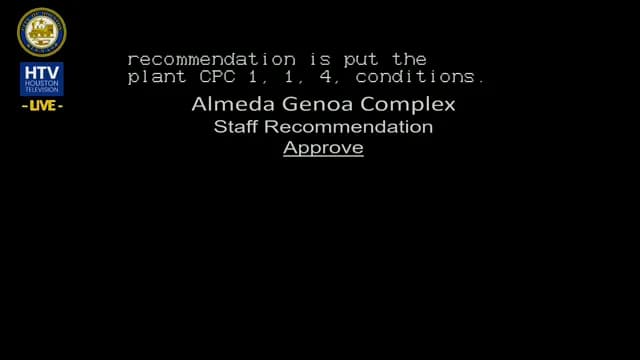
The Houston Planning Commission met in person at the City Hall Annex, 900 Bagby, on Thursday, October 15, 2026, beginning at 2:41 p.m. and adjourning at 3:48 p.m. Vice Chair Sunny Garza presided in the chair's absence. The Commission established quorum, approved routine items, acted on more than two dozen plats and variances, and deferred several contested or incomplete proposals. Director's Report - Von Tran, Planning and Development Department Director, announced a full-day plating workshop next Thursday from 8 a.m. to 4:30 p.m. at the Third Ward Multi-Service Center, 3611 Enus Street. The workshop offers continuing education credits and updates for subdivision plating professionals, with participation from City of Houston, Harris County, and Center Point Energy staff. Consent Calendar - The October 1, 2026 Planning Commission meeting minutes were approved by voice vote with a correction to the attendance record. - The 2027 Planning Commission meeting dates were approved. Meetings will continue on Thursdays at 2:30 p.m. in the City Council Chamber, with schedule adjustments for city holidays. - The 2027 Chapter 26 submittal dates for parking variances and special parking area applications were approved. - Sections A and B: The Commission approved the consent/reply plating agenda as recommended, except for items pulled for separate consideration. Items 1, 72, and 76 were withdrawn. Items 32 and 33 were approved in a separate vote after Commissioner Shepard recused. - Item 76, Reserves at Park Place, was withdrawn and was not considered; the Commission noted that a withdrawn plat cannot return in two weeks and would have to begin the process anew if resubmitted. - Section C replatts approved by voice vote: item 67 Almeda Genoa Complex, item 68 Amplified Properties, item 69 Bar Acre Replat No. 1, item 70 Bayou Glen Partial Replat No. 1 (with variance), item 71 Easter Haven, item 73 Ferrari of Houston, item 74 Highland Crossing Replat, and item 77 Ronson Landing. - Sections G through J: Extensions of approval for items 86 through 89 were approved; there were no items in Sections H, I, or J. Public Comments and Testimony - Joyce Owens, representing the applicant for Nayland Manor (item 52), requested approval and noted a community meeting with the Independence Heights neighborhood was scheduled for the following Tuesday at 1 p.m.; she offered to add a condition for the meeting. - Tanya Wells, Executive Director of the Independence Heights Redevelopment Council, asked the Commission to defer or table items 52 and 53 until developers meet directly with the Independence Heights community. She stressed that Independence Heights is historically significant as Texas' first Black municipality and said the community is not against development but opposes development that excludes residents and erases Black heritage. - A representative of Councilmember Castillo requested deferral of items 52 and 53 for more information and community engagement. - For item 90 (801 McGowan Street), Chris Valdez asked the Commission to pause or delay fuel-station projects near homes, schools, and parks, citing benzene and other health risks; he noted a letter from more than 40 super neighborhoods and civic clubs supporting a 90-day hold on stations within 200 feet of homes. - Giselle Martinez, a Midtown resident and president of Midtown Super Neighborhood No. 62, asked the Commission to deny the variance, stating the property was bought after the walkable places rules took effect and that five gas stations already exist within a quarter mile. - Alexander Spike, Vice President for Businesses and Institutions at the Midtown Super Neighborhood, asked the Commission to deny or defer the variance, arguing there was no physical hardship and that the proposal conflicted with the intent of the walkable places ordinance and raised safety concerns. - Marion Wright opposed placing a gas station at the site and asked the Commission to wait for the city's pending gas station siting ordinance. Discussion Items and Deferrals - Item 52, Nayland Manor, a proposal to subdivide one lot into two, was deferred at the councilmember's request after testimony about community engagement. - Item 53, Parra Estates at Nayland, a proposal to subdivide property into three single-family lots with a 16-foot driveway, was deferred at the councilmember's request. - Item 75, Mill Ridge Village Section 1, was deferred per the applicant's request after staff noted comments from residents concerning drainage, access points, and traffic congestion. - Item 78, Bacher Manor, was deferred per the applicant's request after staff presented a variance request for a five-foot building line and a lot smaller than 3,500 square feet. - Item 79, Bender's Creek General Plan, a 190-acre residential proposal, was approved with two variances: narrow lots with direct vehicular access and no extension of stub streets. Staff added a condition to limit driveway width. - Item 80, Cypress Trails at Bauer Landing Section 2, was deferred per the applicant's request; it involved a variance for two groupings of six lots on a flag staff exceeding the maximum of four lots. - Items 81 through 84, Garden Light City Place General Plan and Sections 1, 2, and 3, were deferred for two weeks per the applicant's request. Staff and Harris County Engineering raised concerns about intersection spacing, fire safety, and utility access. - Item 85, Spring Cypress Warehouses Section 1 Replat No. 1, was approved with a variance allowing a lot containing an existing residence to take access from a 40-foot private access easement. - Item 90, 801 McGowan Street, a proposal for a convenience store, retail building, and gas canopy, was deferred. Staff had recommended deferral because notice signs were posted after the required time; public testimony opposed the project's gas station and variance request. Commissioner Baldwin noted the Commission had never granted this type of variance in a walkable places designated area. - Item 91, 4801 North Main Street, was approved, allowing a six-foot right-of-way dedication in lieu of the required 9.5 feet for the conversion of a single-family residence to an office. - Item 92, 323 Whitecliffe Drive, was approved, allowing a 13-foot garage building line in lieu of the required 20-foot line for a new single-family residence. Key Outcomes - Approved minutes, 2027 meeting dates, and 2027 Chapter 26 submittal dates. - Approved multiple consent and public-hearing plats, replats, and variance requests as listed above. - Deferred items 52, 53, 75, 78, 80, 81, 82, 83, 84, and 90. - Established a public hearing date of November 12, 2026, for Charles Mott Corner, Denton Street Villas, Forest Green Reserve, Haddock Place, Highland Heights Green Partial Replat No. 1, JDS Hope Road Section 5 Partial Replat No. 1, Montrose Residences, and Wheeler Residences. - There were no public comments under Roman 5, and the meeting adjourned at 3:48 p.m.

ZONING AND LAND USE 24% · PROCEDURAL 21% · URBAN PLANNING 19% · HISTORIC PRESERVATION 10%

OPENPUBLICA · PUBLIC MEETING INDEXUPDATED DAILY · openpublica.com