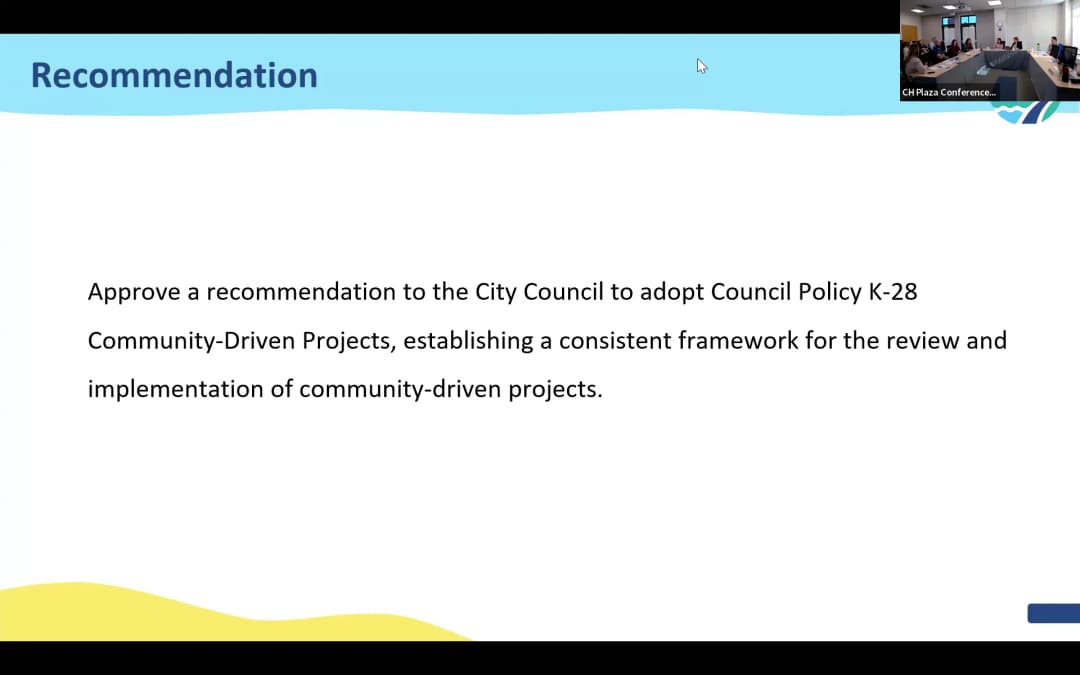
The Council Policy and Procedures Committee (CPPC) met on October 7, 2026, at 9:00 AM in a hybrid format. The committee considered three agenda items: a proposed policy for community-driven projects, an update on council policy modernization, and a work plan update. All actions were approved unanimously, and staff received direction on next steps. Consent Calendar - Approved Minutes: The May 6, 2026 CPPC meeting minutes were approved without modification. Public Comments & Testimony - Item 5.1 – Proposed Council Policy K-28: Paul Donahue (Mountain View resident) expressed overall support for the policy but suggested considering a tier three for new “friends” organizations. Celia Paymara (resident and president of Greenspaces MV, speaking as a resident) noted appreciation for the policy but identified unresolved issues, including high insurance costs for non-501(c)(3) groups, the city’s explicit statement that participants are not city volunteers, and the lack of an umbrella volunteer policy; she urged the city to explore options to address these barriers. - Item 5.2 – Council Policy Update: Paul Donahue spoke in favor of the update efforts, specifically urging prioritization of the Integrated Pest Management policy in light of tree deaths observed around the city. - No public comments were made on non‑agenda items or on item 5.3. Discussion Items - 5.1 – Proposed Council Policy K-28 (Community-Driven Projects): Staff presented a new policy framework for community-initiated projects that fall outside existing city volunteer programs. The policy establishes two review tiers: Tier 1 (streamlined process for smaller, low‑risk projects; estimated 10 business days after initial 15‑day review) and Tier 2 (formal agreement process for larger or higher‑risk projects; approximately 3 months). Projects must provide public benefit, be broadly accessible, and not duplicate city services. Community partners may be non‑501(c)(3) groups but must obtain insurance ($2 million general liability) for Tier 2 projects. The policy explicitly states that participants are not city volunteers and are not entitled to workers’ compensation. Staff conducted benchmarking with seven agencies and outreach to 17 Bay Area organizations. Committee members discussed insurance affordability, support for inexperienced groups (including minors), the importance of a dedicated volunteer coordinator, and the desire for a clear “bucket” system to help residents understand available pathways. Mayor Ramos moved to recommend adoption; the motion was seconded and carried unanimously. The committee gave soft direction to include draft forms, insurance guidance, an infographic or website resource showing different volunteer pathways, and performance metrics in the staff report to council. - 5.2 – Update on Council Policy Modernization: Deputy City Manager Kimberly Thomas reported that of 33 initially reviewed policies, 3 have been updated, 5 were deemed no longer needed, and 5 are recommended for rescission. An additional 10 outdated policies were identified, bringing the update universe to approximately 30 policies. A timeline was set: short‑term (2027), medium‑term (2028), and long‑term (2029+). Staff also noted that the Community Development Department’s conditions of approval template is underway and expected by early 2027. Chair Ramirez moved to approve the staff recommendation; the motion was seconded and passed unanimously. - 5.3 – CPPC Agenda Topics Update: Staff provided a routine informational update on anticipated FY2027 topics, including a tracking chart for council policy work. No action was required or taken. Key Outcomes - Policy K-28 adoption recommended: The committee voted 3‑0 to recommend that the City Council adopt Council Policy K-28. Staff will include draft forms, insurance guidance, and an infographic in the December 15, 2026 council report. - Council policy update effort endorsed: The committee unanimously supported staff’s recommended approach and timeline for updating council policies. - Next steps: Staff will incorporate committee feedback, revise the staff report, and present K-28 to the City Council on December 15, 2026. The policy update work will continue on the established schedule.
The Public Meeting Index
The Public Meeting IndexThe Audit Committee of the San Diego City Council convened on Wednesday, October 7, 2026, at 5:00 PM (17:00 UTC). The meeting was chaired by Council Member Moreno, with Vice Chair Foster, Committee Member Halpern, and Committee Member Mafia present. The primary agenda item was the Office of the City Auditor's Recommendation Follow-up Report, which reviewed the status of 189 open audit recommendations, including 107 past their original implementation dates. The committee discussed implementation progress, revenue opportunities, and challenges across multiple city departments. Consent Calendar - Item 1: Approval of the committee minutes from September 2, 2026 – Approved unanimously (4-0, with one member absent). - Item 2: City Auditor's monthly activity report – Approved as part of the consent agenda. Public Comments & Testimony - Non-Agenda Public Comment: - Maximilian Schmidt described being homeless and targeted by organized persecution, alleging torture and ID theft. He demanded an end to the alleged harassment. - A speaker (name not provided) criticized a $3.1 million fence at the downtown police station (1401 Broadway), questioning the expenditure and urging an audit of the cost. He argued the fence sends a wrong message and that police should not need such protection from the public they serve. - Becky Rapp called for a comprehensive performance audit of the Cannabis Business Division, noting it was identified as a risk area in the FY2023 risk assessment but no audit has been conducted. She questioned the transparency of the city's process for evaluating identified risks. - Joyce Sanyata expressed excitement about the Draft Performance Management Principles and Practices, highlighting principles such as purpose, outcomes, transparency, and adaptive systems. - Madison requested an audit of marijuana edible exposures among children in San Diego County, asking for detailed data on product types, THC concentrations, and packaging to inform prevention efforts. - Blair Beekman spoke about open participatory democracy and the need for public oversight on surveillance technology, advocating for local government leadership in setting best practices. - Consent Agenda Public Comment: - Maximilian Schmidt opposed approval of the minutes, alleging “liberal fascism” and requesting lie detector tests for council members regarding Second Amendment enforcement and occult practices. - Blair Beekman commended the committee’s work and commented on the monthly audit report, noting the complexity of the street light repair program and the importance of tech accountability. - A caller (phone ending 870) thanked Blair and asked questions about the street light audit (surveillance connection), cybersecurity (AI and FBI hack), and SDPD internal affairs (lawsuit and Supreme Court decision). - Discussion Item (Item 3) Public Comment: - Maximilian Schmidt opposed the recommendation follow-up report, calling for city hall to be shut down due to alleged “underground genocide.” - Hector commended the auditor for exposing fraud and suggested hiring convicted white-collar criminals to help recover money. - A caller (phone ending 870) praised the 26 new recommendations and asked why 107 recommendations are past due, what obstacles exist, and expressed concern about the city's operating principles lacking explicit core values. - Blair Beekman stressed the need for better communication between city government and the community. - Tony (phone) criticized the discrepancy between staff-provided information and actual performance, and referenced a San Diego Union-Tribune report on unenforced tenant violations and mismanaged real estate. Discussion Items - Item 3A: Office of the City Auditor's Recommendation Follow-up Report – Section A (Recommendations for Committee Action) - Building Acquisitions Audit (Recommendation 7): The committee discussed the ongoing issue of ensuring city staff provide complete and accurate information to the council. Management declined to implement attestations. The city attorney’s office had added charter section 32.1 to the personnel manual, and HR updated the employee code of conduct. The auditor recommended closing as “partially implemented, no further action,” but committee members expressed concern that the risk was not fully mitigated. Council Member Foster argued that performance evaluations should incorporate accuracy requirements. The motion was modified to keep Recommendation 7 open (not closed) pending further action. - Code Enforcement Audit (Recommendations 2, 7, 8): The department requested consolidation of recommendations 2, 7, and 8 into recommendations 9 and 10, citing budget cuts and staffing losses (50% reduction over two years). The auditor proposed closing them as “will not implement” with the understanding that the underlying risks would be addressed through remaining recommendations. The committee questioned how the department ensures cases needing attention are identified under the current manual process (using Power BI instead of automated reports). The motion passed to close recommendations 2 and 8, but keep recommendation 7 open. - Item 3B: Discussion of Audits Recommended for Committee Discussion (Led by Committee Members Halpern and Mafia) - Real Estate Portfolio Management (Audit 1902): Discussion centered on the lack of a comprehensive Real Property Management Plan (PMP) since 2011. The economic development department reported that a consultant is needed but not resourced. The committee expressed frustration that the city does not know the total value of its real estate portfolio, potentially leaving millions in revenue uncollected. Staff noted a 91% increase in real estate transactions over two years and an internal analysis that an additional $10 million per year could be generated if properly resourced. - Lease Management (Audit 2207): Several priority-one recommendations remain open since 2022. The department reported progress on holdover leases (reduced from 25% to 17.5%) and on centralizing lease management. However, recommendation 9 (oversight of non-competitively priced leases) is tied to the PMP and remains outstanding. - Leased Golf Courses (Audit 2605): The Fairbanks Ranch Country Club lease rent was increased by 41% (from 5% to 7% of revenues) following an appraisal. The IBA review of the appraisal is pending due to focus on other large projects. The committee questioned whether the rate is below market compared to Torrey Pines (9.9%). A new fee for inspections and investigations is being developed, with a target of end of FY2027. - SDPD Body-Worn Cameras (Audit 2301): Six recommendations are past due, all stuck in meet-and-confer with the police union. The audit found officers fail to record body camera video 40% of the time. The recent police union contract did not include this topic. The committee expressed strong disappointment over the delays, noting the issue has been open since July 2022. - SDPD Overtime (Audit 2408): Recommendations on eight-hour between shifts and centralized overtime are also in meet-and-confer. The department has centralized plug-and-play overtime via PD Enterprise, saving $6.8 million in FY26. A new scheduling system is in the RFP process but stalled. - Equity in Recreation Programming (Audit 2205): All 12 recommendations are past due. The Community Recreation Needs Assessment was completed in September 2026 with 10,000 responses. The department plans to present findings to the Community and Neighborhood Services Committee in January 2027 and complete a strategic plan by mid-2027. The committee noted that a $1 million funding request was not approved in FY27 and that a dedicated recreation specialist position was eliminated. - Boat Storage Permits (Audit 2505): Fees have been increased up to 50% through inflation adjustments. A fee update and municipal code amendments for a lottery system will go to committee in October 2026, with full implementation expected by spring 2027. - Stormwater Reinspection Fee (Audit 18023): This recommendation dates to June 2018. The department is reassigning existing staff to develop the fee, now targeting June 2027. The fee could generate $1.45 million to $1.5 million per year. The committee noted that every month of delay costs $100,000–$300,000 in lost revenue. - Fire-Rescue Emergency Medical Response (Audit 2606): The department is developing a dashboard to track turnout times and response times. The standards of coverage study is near completion. A budget request for capital purchases is planned for mid-year or FY28. The department will return in November 2026 with a detailed presentation on dispatch triage tools. Key Outcomes - Consent Agenda: Approved unanimously (4-0). - Section A Motions: - Motion to close Recommendation 7 (Building Acquisitions) as “partially implemented, no further action” was modified to keep Recommendation 7 open (pending further action on incorporating accuracy into performance evaluations). The motion passed (4-0). - Motion to close Recommendations 2 and 8 (Code Enforcement) as “will not implement” passed (4-0). Recommendation 7 from that audit remains open. - Section B Discussion: No formal motions taken; discussion highlighted ongoing challenges and progress. Key follow-ups include: - The IBA is to provide a review of the Fairbanks Ranch lease appraisal. - Fire-Rescue is to present a detailed dispatch and response time analysis at the November 2026 meeting. - Stormwater department is to brief council offices on the reinspection fee in the coming months. - Parks and Recreation will present the Community Recreation Needs Assessment to committee in January 2027. - Public Member Appointment: The IBA reminded the committee that applications are open for a public member position on the audit committee (requirements: 10+ years as CPA, CIA, or equivalent experience). - Next Meeting: Scheduled for Wednesday, November 12, 2026, at 9:00 AM.
The Planning and Zoning Commission met on October 7, 2026, to consider a major conditional use permit for a mobile food unit. The meeting included roll call, correspondence, approval of minutes, and a public hearing. Correspondence and Announcements - City staff (Mr. Gilbert) reported that text amendments for residential care facilities were approved by City Council on September 8, and that voter information packets for the November 3 local election are being distributed. Consent Calendar - The minutes from the previous meeting were approved unanimously. Public Hearing: Major Conditional Use Permit for Mobile Food Unit at 1890 Acoma Boulevard West - Staff presented a request from Macha Bakery to operate a mobile food unit (coffee, cold beverages, prepackaged baked goods) on a church property zoned C2, operating Tuesday-Sunday 7am-5pm. - Commissioner Stevenson raised concerns about the impact on ADA parking spaces, questioning the parking count and relocation of ADA spots. Staff responded that the church’s parking demand is only 10 spaces, and the loss of three spaces for the food unit still leaves ample parking. - No members of the public spoke for or against the item. - Staff outlined conditions including a one-year permit expiring October 7, 2027, restrictions on overnight storage, and requirement to obtain all necessary licenses. Key Outcomes - Motion: To approve Resolution 2608 for the conditional use permit with staff stipulations. - Vote: 6 in favor, 1 opposed. (Passed) - The next meeting on October 21 is canceled; a November 4 meeting is tentative.
The Clark County Commission held a lengthy zoning meeting on October 7, 2026, starting at 5:00 PM (17:00) UTC. The meeting covered a broad range of agenda items, including routine approvals, public hearings on development proposals, and the introduction of ordinances. Key discussions involved a veterans' affordable housing project, expansion of a charter school, and multiple waivers for residential and commercial developments. The meeting included public comments on several items and concluded with the introduction of four ordinances. Consent Calendar - Agenda Approval: The agenda was approved with numerous items held or withdrawn (e.g., items 6, 8, 9, 33, 36, 37, 49, 66-71) to future dates. Motion passed. - Minutes: Minutes of the September 2, 2026, zoning meeting were approved. - Routine Action Items (4-32): Approved as a block with modifications to item 4 (amendment to conditions) and public works conditions deletion. Motion passed. Public Comments & Testimony - Items 45-46 (Legacy Traditional School Expansion): Charles Williams and Carol Williams, residents on West Wigwam Avenue, spoke in opposition, citing severe traffic congestion, lack of infrastructure, and that the school already exceeded its 1,450 student cap (with approximately 1,575 students). They urged denial of the expansion. - Items 60-65 (Patriot Housing – Veterans Affordable Housing): Multiple veterans and advocates spoke in support: - Vincent Paul Mary (Purple Heart recipient, National Director of Suicide Awareness) emphasized housing stability as suicide prevention. - Timothy Smith (VA counselor) highlighted 644 homeless veterans in Clark County and the need for permanent housing. - Levi Schultz (veteran) expressed disappointment that veterans must beg for housing and urged approval. - Chris Casenza (contractor) affirmed project viability. - Christiane Mersh (military chaplain) urged compassion. - Robert Davison criticized Chairman’s remark prefacing public comments (Chairman later apologized). - Steven Hireta and Evelyn Pacheco also spoke in support. - Second Public Comment Period (End of Meeting): - Saiyan Naoum, Keith Markland, and Mark Andrig asked for prevailing wage requirements on the October 1 memorial project. - Lisa Scarot reported a residential property being used as a commercial plumbing business without permits, requesting enforcement. - Al Rojas advocated for an ordinance to abolish A-frame campaign signs and thanked the board for homeless services information; also supported veterans housing. - Archie Walden (training director, veterans) thanked the commission for supporting the veterans housing project and urged prevailing wage on the memorial. Discussion Items - Item 34 (UC 23-0586 – Gas Station/Convenience Store Completion): Applicant Nancy Amundsen requested waivers to finish a partially constructed building. The site had prior approvals but was expunged. Staff and Commissioner McCurdy worked on conditions. Commissioner McCurdy moved to approve with waivers 2-6 (allowing attached sidewalks, wall height adjustment), deny waiver 1 (street landscaping reduction), and add cameras accessible to Metro Police. Motion passed. - Item 35 (UC 26-0524 – Emergency/Urgent Care Facility): Applicant Lexa Green proposed an 8,877 sq ft facility on Warm Springs Road. Added condition: ambulance sirens turned off between Eastern and Pecos. Commissioner Gibson moved approval. Motion passed. - Items 38-40 (Lone Mountain Single-Family Development by Toll Brothers): Applicant Jennifer Lazovich presented waivers for landscaping and off-sites. Added condition to plant 5-gallon bushes in a planter box along Ruffian Road. Lone Mountain Town Board recommended approval. Motion passed. - Items 41-42 (Single-Family Development on El Dorado Lane): Applicant Tony Sless withdrew waivers 1A and 1B, modified waiver 1C to 28 feet setback. Vacated portions of Arville Street for detached sidewalks. Motion passed. - Items 43-44 (Custom Home on Wigwam Avenue): Applicant Robert Cunningham requested vacating easements and additional driveway. Added conditions: maintain on-site turnaround and no encroachment into site visibility zone. Motion passed. - Items 45-46 (Legacy Traditional School Expansion): Applicant Jennifer Lazovich sought waiver of conditions to allow expansion (additional enrollment, square footage) and design review. Neighbors strongly opposed citing traffic. Commissioner Jones noted prior opposition but supported due to county-funded improvements and a novel queuing plan. Added conditions: one-year review of traffic patterns and three years to commence construction. Motion passed. - Item 47 (Warehouse on Park Street): Applicant for Atlas Sign LLC reduced waivers after working with staff. Public speaker Al Rojas supported. Commissioner Sagerbloom moved approval. Motion passed. - Item 48 (Single-Family on Cinnabar Avenue): Applicant not present but Commissioner Sagerbloom moved approval after meeting with applicant. Motion passed. - Item 50 (Office Development Modifications on Giles Street): Applicant Robert Cunningham requested reduced buffer to accommodate drainage easement. Motion passed. - Items 51-52 (Shopping Center – La Jodero Grocery): Applicant Nicholas Stella sought waivers for driveways, landscaping, and loading zone. Neighbor Pamela Herbst expressed concerns about horses and property; applicant assured 8-foot wall and tree retention. Commissioner McCurdy moved to approve with denial of waiver 3 (loading zone reduction) and condition that all changes return to commission. Motion passed. - Item 53 (Single-Family Development on Pyle Avenue): Applicant Stephanie Grown presented revised plan (16 lots, improved curb radius). Motion passed. - Item 54 (Single-Family on Maul Avenue): Applicant Robert Cunningham withdrew waiver 3 for wide driveway. Motion passed. - Items 55-59 (Single-Family Development on Buffalo Drive): Applicant Jennifer Lazovich proposed 16 lots (down from 18) with 10,000 sq ft lots along west boundary. Neighbors opposed citing safety on Buffalo Road. Commissioner Jones supported due to transformation of Buffalo into a major road and RTC bus stop requirement. Motion passed despite 74-87 opposition cards. - Items 60-65 (Patriot Housing – Veterans Affordable Housing): A major item. Applicant Bob Gronauer presented a 348-unit affordable housing development for active military, veterans, and their families, on city-owned land (originally public facility). Extensive conditions read into record including: affordable housing certification within 180 days, proof of LITEC funding, project labor agreement, 50-year deed restriction for veterans and affordability (also with city of Las Vegas), review of development status by June 1, 2027, and agreement to rezone back to public facility if construction does not commence. Commissioner Sagerbloom initially sought a two-story cap but withdrew after discussion. Motion passed with those conditions. - Items 72-74 (Commercial Complex on Lake Mead Boulevard): Applicant requested waivers for landscaping, parking, and loading. Public works had concerns about throat depth. Motion passed subject to public works requirements to determine proper throat depth. - Items 75-77 (Cactus World Nursery – Red Rock): Applicant Jennifer Lazovich sought plan amendment, zone change to agriculture, and waivers to allow nursery to operate open to public. Commissioner Jones disclosed purchasing from Cactus Steve. Motion passed. - Items 78-79 (Good Springs – Garage Before House): Applicant Tom Balinski requested rezoning to RS-20 and a waiver to build garage prior to house. Motion passed. - Items 80-83 (Ordinances for Introduction): Four development agreements (Brovash, Greenbow, IHC Health Services, and a zoning map amendment) were introduced and set for public hearing on October 21, 2026. Key Outcomes - Votes on All Items: Every motion on the record passed unanimously (voice votes or electronic; no dissents recorded). - Notable Conditions Attached: - Item 34: Denial of street landscaping waiver; cameras added. - Item 35: Ambulance sirens off between Eastern and Pecos. - Items 45-46: One-year traffic review, three-year construction commencement. - Items 55-59: Reduced to 16 lots, 10,000 sq ft west lots. - Items 60-65: Multi-condition approval with 50-year deed restrictions, financing proof, and automatic reversion to public facility if not built. - Items 72-74: Throat depth to be determined by public works. - Ordinances Introduced: Four ordinances (ORD 26-900517, 22, 55, and ORD 975) set for public hearing on October 21, 2026. - Public Input: Prevailing wage request on the October 1 memorial will be considered; a code enforcement case was noted for a commercial plumbing operation in a residence.
The Joliet Comprehensive Plan Advisory Committee met on October 7, 2026, at 10:00 AM in City Hall Council Chambers to review the Draft Comprehensive Plan and prepare for Community Workshop 3. Chairman Jim Roolf presided. Ten members were present; Mayor Terry D'Arcy arrived late and Dr. Theresa Rouse departed early. Christopher Parker was noted in the transcript as joining virtually but was officially recorded as absent in the meeting minutes. Consent Calendar - September 2, 2026 Minutes: Approved unanimously via a motion by Hugh O'Hara, seconded by Wendell Martin. All present members voted aye. Public Comments & Testimony - No members of the public provided testimony during the designated periods for agenda or non-agenda items. Discussion Items Project Timeline & Community Workshop 3 - Staff reviewed the remaining schedule, including a City Council update on October 20, final Community Workshop 3 on October 29 (5:00-7:30 PM at Joliet West High School), and anticipated City Council adoption in early 2027. The workshop will feature a "Priority Actions" station instead of a key partners table. - Committee members were asked to volunteer for the workshop, and promotional cards were distributed. Draft Comprehensive Plan Review Consultants led presentations on seven topic areas, followed by committee discussion. Strong Neighborhoods and Housing Stability - Emma Bonanno-Lynch (SB Friedman) presented strategies focused on housing preservation, expanding "missing middle" housing options (e.g., duplexes, triplexes), pre-approved housing designs, and infill development. - Committee Input: Members requested a clear timeline for the comprehensive zoning update. A question arose about the definition of "sober living" environments. A significant discussion was held on Action 3 of Strategy 5 regarding requiring connected subdivisions; concerns were raised about developer feasibility and resident safety versus the benefits of citywide connectivity. Economic Development and Local Investment - Ms. Bonanno-Lynch outlined strategies for economic diversification, a small business resource hub, redevelopment of underutilized sites, and workforce support. - Committee Input: Members expressed strong support for continuing the momentum of the downtown Joliet City Square project. The importance of a physical small business incubator space was emphasized. A member urged the inclusion of healthcare retention in workforce strategies, noting a major local provider is shrinking services. People, Places, and Belonging - Eli Lechter (LJC) presented strategies for a creative fund, historic preservation, public art, inclusive public spaces, and tourism. - Committee Input: Councilman Cesar Cardenas strongly advocated for these items, framing them as "investments, not expenses," critical for quality of life. Members stressed that arts and culture ranked highly in resident surveys and community workshops. A suggestion was made to clarify whether sports organizations are included in the definition of "cultural organizations." The potential for collaborating with Joliet Central High School's art program (which generates $6.4 million annually in art scholarships) was highlighted. Mobility and Access Across the City - Mike Dahm (TWG) and Chris Hamby (Arcadis) presented strategies on roadway safety, multimodal networks, bridges, public transit, and freight management. - Committee Input: Hugh O'Hara asked about best practices for regulating and designing infrastructure for e-bikes. Significant concern was raised over the deteriorating condition of city bridges, specifically the Brandon Road and Ruby Street bridges. The Mayor noted a $1.3 million regional truck traffic study currently underway. The need for potential express passenger rail service to Chicago was mentioned. Environment and Natural Resources - Jessica Norris (Biohabitats) presented strategies on waterways, urban forestry, air quality, building sustainability, and environmental stewardship. - Committee Input: Discussion focused on the city's $800,000 annual budget for tree maintenance (planting, trimming, removal) and the need for a clear maintenance plan for an expanding tree canopy. The downtown levee project was identified as critical for mitigating floodplain issues. A preference was expressed for using natural berms and landscaping over concrete walls for noise mitigation along freight corridors. Utilities and Infrastructure - Ms. Norris presented strategies for a potential public stormwater utility, broadband expansion, renewable energy targets, and green infrastructure incentives. No additional committee comments were recorded. Land Use and Future Development - Mr. Lechter presented strategies on infill, zoning code modernization, subdivision standards, universal design, and growth management. - Committee Input: A member cited the Village of Bolingbrook's ordinance requiring universally accessible (ADA compliant) first-floor residential units as a potential model for Joliet, noting it was achieved without increasing development costs. Table of Future Land Use Map and Character Area Plans - The committee did not have time to review the Future Land Use Map or Character Area Plans. Staff proposed holding a follow-up meeting the following week to cover these items. Key Outcomes - No Formal Vote on Draft Plan: The meeting was a working session; the committee did not take a formal vote on the Draft Plan's content. - Additional Meeting Scheduled: A follow-up meeting will be held the week of October 12, 2026, specifically to review the Future Land Use Map and Character Area Plans. - Workshop Solicitation: Committee members were asked to volunteer for the October 29, 2026, Community Workshop 3 and to distribute promotional materials. - Adjournment: The meeting was adjourned via motion by Damon Zdunich, seconded by Nora Gruenberg, carrying unanimously.
On October 7, 2026, beginning at 16:15 UTC, a meeting in Huntington, New York, was held as a commemorative and informational retrospective on the Suffolk County Sheriff's Office. No agenda or minutes were available, so this summary is based solely on the raw transcript, which contains some apparent transcription errors (for example, Gilgold Peach for Gilgo Beach and Rex Humerman for Rex Heuermann). Current and retired sheriff's office personnel, joined by Riverhead town historian George Case, traced the office's history, described major incidents, and highlighted modern programs and recruitment. No end time was recorded in the transcript. Historical Presentation - The Suffolk County Sheriff's Office was created in 1683 and is described as one of the oldest sheriff's offices in the nation; the word sheriff derives from shire reeve, and Long Island's colonial divisions included the North, West, and East Ridings of Yorkshire. Josiah Hobart was the first appointed sheriff of Suffolk County. - The sheriff's historical duties - keeping the peace, collecting taxes, maintaining jails, arresting fugitives, and serving writs - remain the foundation of the office's work. The presenter emphasized that the sheriff reports directly to citizens and is the highest-ranking law enforcement official in the county by charter, while the county executive oversees the budget. - The first jail was erected in 1727 on Main Street in Riverhead, a compromise after county leaders argued over a North Fork versus South Fork location. Rebuilt in 1784 after British occupation, the jail was later replaced by an octagon facility in 1855 and a new 1911 building designed for 136 inmates. As the population exceeded 200, overflow inmates were sent to Nassau County at $4.50 per inmate per day. In 1966, construction began on a new jail, renamed the Suffolk County Correctional Facility in 1977 under Sheriff Finnerty; the Honor Farm became the minimum security facility, and later expansions added a 200-bed Yapink addition in 1980 and a 300-cell Riverhead expansion. - Thomas Wicks, a Huntington resident and ancestor of the presenter, formed a militia, spied for General Washington, and used his 10-year-old son to smuggle messages about British troop movements. Wicks served two terms as sheriff. Huntington's 1775 Articles of Association were described as a mini declaration of independence. - George Case, Riverhead town historian, identified himself as a descendant of Josiah Reeve, the 16th sheriff of Suffolk County, and noted his father's service as a deputy sheriff. Public Comments & Testimony - Most of the meeting consisted of personal testimony from current and retired sheriff's office personnel rather than formal public comment. - George Case presented family history connecting him to the early sheriff's office. - Several officers shared career recollections: starting in the early 1970s before civil service, being appointed through local political leaders, receiving shields passed down from retirees, and describing low early pay. One officer said he was making three oh seven a month... bi-weekly - the transcript is ambiguous - and recalled his first check as $4,800 a year. - A female officer described being the third woman hired, the federal lawsuit that opened promotional opportunities for women, and her path to becoming the first female sergeant, lieutenant, and captain. She described having to prove herself and using communication and de-escalation to complement physical strength. - Officers described the 1961 Yapink Honor Farm, where incarcerated people grew about 80% of the food for county jails, children's shelters, and the infirmary; one former officer ran the butcher shop and described meat processing, gardening, carpentry, and poultry programs. Domestic Violence and Protective Orders - The transcript states that two women were killed in 1992, and Kathy's murder was the catalyst for the sheriff's office taking over service of orders of protection in August 1992. Previously, Suffolk County residents were often left to serve their own orders, sometimes with deadly consequences. - Speakers expressed pride in protecting domestic violence victims and noted that extreme risk protection orders allow deputies to remove weapons from individuals deemed dangerous pending a hearing. - Multiple speakers said domestic violence has not subsided and that education, law enforcement, and support systems are essential. One officer taught a college course called Women in the Criminal Justice System. A speaker concluded: if you choose to abuse, you will be held accountable. Major Incidents and Emergency Response - The sheriff's office coordinated responses to the 1995 Sunrise wildfires and assisted in search and recovery after the 1996 TWA Flight 800 crash off East Moriches. Officers helped establish a command post, makeshift morgue, sleeping area for Navy SEALs, and helicopter landing pads; inmate work crews later maintained the memorial. - The first CERT (sheriff's emergency response team) class went through in 1997. Earlier extraction tactics were described as a mattress with four people and hand-me-down helmets, with training later provided by Rikers Island personnel. - After the September 11, 2001 attacks, more than 20 deputy sheriffs went to New York City, meeting before sunrise and driving to Manhattan. They transported personnel and equipment to and from ground zero, escorted remains to the medical examiner's office, and worked long shifts. One officer described watching deputy sheriff cruisers pass while serving as a New York City police officer and deciding to join the Suffolk County Sheriff's Office in 2002. - During the 2003 Northeast blackout, deputies helped direct traffic. In 2008, after the county executive removed police highway patrol, Sheriff DeMarco directed deputies to take over highway patrol, a temporary measure that lasted four years and created a rift with the police department. Officers expressed pride in helping motorists, including changing tires. Bail Reform and COVID-19 - A speaker said bail reform in January 2020 reduced the jail population from roughly 14-1500 inmates to about 600 at one point, while also making the remaining population more violent because more serious offenders were not released. This reduced work-release and intervention opportunities. - The COVID-19 pandemic began two months after bail reform. The office used vacant space to reduce housing-unit occupancy from about 20 inmates to seven or eight. Incarcerated women who were seamstresses made approximately 10,000 masks for inmates and public donation. - The office did not lose a single inmate to COVID-19, although two officers died and almost one-fifth of officers were out at one point. Speakers said attendance remained high, visits became virtual, and cleaning regimens were increased. They also noted the office resisted county proposals to close facilities, preserving space needed for distancing. Corrections, Re-Entry, and Specialized Programs - The modern corrections facility uses six large pods that can hold up to 60 incarcerated individuals each. Speakers described this podular housing as safer, more controllable, and better suited to active supervision than older dormitory or linear designs. - A corrections intelligence center is used to share information with the district attorney's office and police department, helping solve crimes while also improving jail safety. - The START Resource Center, unveiled in February 2020, creates Individualized Reentry Plans, provides clothing, about two weeks of non-perishable food and hygiene items, rides to safe locations, and referrals for substance abuse, mental health, employment, and housing. - The sheriff's anti-trafficking initiative, created in 2018, was described as the first jail-based human trafficking unit in the nation; hundreds of traffickers and victims have been identified, and investigative leads aided the Gilgo Beach serial killer case (spelled in the transcript as Gilgold Peach and Rex Humerman). - Speakers highlighted specialized units: a full-time DWI unit ranked number one in the state, a marine unit currently with two boats and four deputy sheriffs on patrol, a community relations unit, canine unit, bike patrol, ATV enforcement, airport patrol, tactical team, aviation unit, drones/DFR, and a full-time wellness unit created in response to rising officer suicides. Key Outcomes - No formal motions, votes, or action items appear in the transcript; the meeting was an informational, commemorative presentation rather than a legislative session. - Speakers repeatedly encouraged viewers to apply to the sheriff's office, describing it as a secure, fulfilling career with opportunity, training, pensions, and benefits. - The recurring message was that the Sheriff's Office is modernizing, engaging with the community, and aiming to serve, protect, and strengthen Suffolk County as it celebrates 250 years since America's independence.
Date: October 7, 2026 Time: 11:05 AM – 12:07 PM Location: Michaelian Office Building, White Plains, NY (hybrid via Webex) Chair Jewel Williams Johnson called the meeting to order at 11:05 AM with a quorum present. Legislator Emiljana Ulaj was absent; Legislator Nancy Barr participated remotely. Opening Remarks: Measles Outbreak Update Chair Williams Johnson provided a public health update on the measles outbreak in New York State. As of October 3, 2026, New York has reported 108 confirmed measles cases in 2026, with 101 outside NYC and 92 since July. The largest concentrations are in Suego, Seneca, and Steuben counties; Rockland County has reported four cases. No confirmed cases have been publicly announced in Westchester County. The Chair emphasized that measles is extraordinarily contagious (up to 90% infection risk among non-immune close contacts) and that the MMR vaccine is the best protection (93% effective with one dose, 97% with two). She urged residents to check vaccination records and to call ahead before visiting healthcare facilities if symptoms develop. Discussion Item: Examining Barriers to Timely, Compassionate, and Effective Treatment for Substance Use Disorders Guests: - Robert DeForde, Senior Program Manager, Shatterproof - Trevor Payne, Director of Drug and Alcohol Services, Westchester County Department of Community Mental Health Robert DeForde presented on Shatterproof’s work to measure and reduce stigma in healthcare settings. Key statistics shared: - 48 million people (17% of U.S. population aged 12+) met diagnostic criteria for SUD in 2024, but 80% received no treatment. - 2024 overdose fatalities dropped to under 80,000 (down from a peak of 122,000), but Black and Brown communities did not see equitable declines. - A 2024 Shatterproof Addiction Stigma Index (SASI) national survey oversampled healthcare providers: 78% agreed MOUD should be more accessible and is effective, but only 43% believed MOUD does not substitute one drug for another, and only 47% would want an MOUD clinic in their neighborhood. - Shatterproof’s Providers Pathway training (asynchronous and in-person) has reached nearly 8,000 healthcare providers; 4,000 received CEUs. A research study with Yale found increased knowledge, decreased stigma, and increased confidence in treating SUD among completers. Trevor Payne described Westchester County’s ongoing efforts: - Using opioid settlement dollars for provider trainings on stigma (through the Center for Practice Innovation platform). - County-funded SUD programs prioritize medication access (MAT) and are monitored monthly. - The county jail introduced addiction medications three years ago; initiations rose from 250 in year one to over 450 by the end of 2025. Alcohol addiction medications were added last year. - A learning collaborative for clinicians (100 enrolled) is using a motivational interviewing chatbot for skills practice and scoring over six months. - County contracts require a co-occurring lens in assessments and treatment, though implementation varies. Discussion and Policy Recommendations Legislators and presenters engaged in a detailed conversation about structural stigma and solutions: - Legislator Barr suggested mandating SUD/stigma training via state-level requirements for medical licensure (similar to existing annual trainings on discrimination/harassment) and leveraging insurance companies to require provider networks to complete training. She offered to discuss with Assembly Health Committee Chair Amy Paulin. - Chair Williams Johnson proposed hosting a mini-training at a future Health Committee meeting by inviting two physicians from each major hospital system (New York Presbyterian/White Plains, Northwell, etc.) to attend a presentation by Shatterproof. - Robert DeForde noted that Shatterproof supports integrating behavioral health into primary care and expressed openness to state-level CME requirements but cautioned against making it a checkbox; he offered to connect Chair Williams Johnson with Shatterproof’s chief policy officer for assistance. - Trevor Payne highlighted difficulty penetrating primary care physician groups due to time constraints and reluctance, despite some individual interest. - Robert DeForde shared that an in-person training with Fidelis Care (insurance) is scheduled for late October and that Shatterproof’s asynchronous training is free on myCME.com (6 CEUs for MDs, DOs, RNs, NPs, PAs, social workers). - Trevor Payne noted increasing cannabis-related emergency room visits and called for better data collection from urgent care centers; legislator Barr suggested requiring urgent care data collection. Key Outcomes - No formal votes or resolutions were passed. The meeting served as an informational and exploratory session. - Chair Williams Johnson will follow up with Shatterproof’s policy team and explore state-level advocacy for mandatory SUD/stigma training in medical licensure. - Trevor Payne will share the free asynchronous training link with county providers. - Robert DeForde invited the committee to organize a joint training with hospital systems, which was positively received. The meeting was adjourned at 12:07 PM.
The Budget Committee of the Saint Paul City Council met on October 7, 2026 at 10:00 AM in Council Chambers. Chair Cheniqua Johnson presided with five members present (Vice Chair Nelsie Yang and Councilmember Rebecca Noecker were excused). The committee reviewed the Mayor's 2027 Supplemental Budget Proposal and the proposed 2027 budgets for the Department of Human Resources and the Department of Emergency Management. Mayor's Supplemental Budget Proposal (SR 26-210) - Budget Manager Madeline Mitchell presented the supplemental proposal, which recognizes additional revenue and cost savings not known at the time of the August proposed budget. Sources include $300,000 in additional franchise fee revenue due to a new agreement with Excel (effective January 1, 2027) and approximately $500,000 in savings from switching to even-year elections (of which $275,000 is used in the proposal). Uses include restoring cuts to parks and library department hours and adding funding for separation ordinance enforcement in the City Attorney's Office. - Councilmember Saura Jost asked whether the franchise fee revenue and election savings are ongoing. Treasurer Neil Younghands confirmed the franchise fee revenue is ongoing but noted the city is being conservative given the new fee structure. Councilmember Anika Bowie raised concerns about the $148,000 lease for Dayton's Bluff Library (part of the library restoration), asking for future council involvement in lease negotiations. Director Mitchell noted the lease amount is set for 2027 and that the library director and mayor's office remain committed to communicating with council about the library's future. - Chair Johnson asked what would happen if an unexpected special election occurred; Mitchell responded that because only $275,000 of the $500,000 savings is used, buffer remains. Department of Human Resources 2027 Budget (SR 26-207) - HR Director Camera Kasim presented the proposed budget, emphasizing the need to strengthen responsiveness, enhance leadership development, advance equity, and modernize systems. The department supports over 4,000 employees across the city. To meet the 4% reduction target ($273,000), the department eliminated an HR Manager 1 (occupied), a Management Assistant 3 (vacated), reduced non-personnel spending by $15,000, repurposed an HR Consultant 4 to a 3, and made a vacant adjustment. New positions proposed: an HR liaison coordinator and a workers' compensation analyst. The total FTE count would go from 47 to 48. A one-time expense of $547,000 is requested for implementing a benefits module system. - Councilmember Jost asked about the $81,000 for external investigations, learning it covers outsourced investigations beyond the capacity of the single investigator FTE. Councilmember Bowie asked whether eliminated positions were vacant or occupied; Kasim confirmed the HR Manager 1 and Management Assistant 3 positions had people in them, and those roles were laid off as part of restructuring. Bowie also asked about workers' compensation costs and transparency; Kasim described monthly roundtable meetings with fire department and plans to expand, and expressed support for data sharing. - Kasim noted that St. Paul's HR staffing (47 FTEs) compares to Minneapolis (62 FTEs for similar employee count) and Ramsey County (80 FTEs). The department's budget-to-actuals have been close year-over-year. Department of Emergency Management 2027 Budget (SR 26-208) - Director Rick Schut presented the proposed general fund budget of $7,075,007, an increase of $289,890 (4.3%) from 2026. Eighty-two percent of the budget is a pass-through for Ramsey County 911 dispatch services. The dispatch increase of $246,280 (4.4%) is driven by county costs, not by increased call volume. The department achieved a $40,000 reduction by moving from full-service siren maintenance to repair-as-needed, retaining $9,432 for repairs; all 36 sirens were serviced in 2025. No changes in staffing (8 FTEs, all now on general fund). - Councilmember HwaJeong Kim asked about the history of the Urban Area Security Initiative (UASI) grant that previously funded positions; Schut explained the grant has been in place since after 9/11 but funding has declined and become uncertain, prompting the council's move to general fund. Kim requested a follow-up on how returned UASI funds from 2025 and 2026 will be invested. Key Outcomes - The committee received all three presentations and held discussions. No votes were taken; the supplemental budget proposal will be considered for inclusion in the council-adopted budget. Follow-up items include: updates on franchise fee revenue budget-to-actuals, more details from the City Attorney's Office on separation ordinance enforcement staffing, and a memo on the use of returned UASI grant funds. The next Budget Committee meeting will cover the Office of Financial Services and other departments.
The City of Annapolis Finance Committee Standing Committee convened on Wednesday, October 7, 2026, at 10:52 AM in the City Council Chambers. The meeting was called to order by Alderman Huntley with Aldermen Thorpe and O'Neill present. The committee favorably recommended a resolution on mobile food vendor fines, a supplemental appropriation for the Police Athletic League (PAL) youth mentoring program, and a fund transfer for public works snow equipment. The committee also received an update from the Department of Finance. Agenda & Minutes Approval The committee approved the agenda with an amendment to place discussion of Resolution R-32-26 earlier in the order. The minutes from the September 24, 2026, special meeting were unanimously approved. Resolution R-32-26: Fines for Mobile Food Service Vendors Planning and Zoning Director Chris Kubiak explained the recommended $1,000 fine level for violations of the mobile food service vendor ordinance (O-25-26) in the Historic District. Director Kubiak stated that the fine is intended primarily as a deterrent to ensure code compliance, rather than a punitive measure or revenue source, as the standard $200 fine was deemed insufficient. The committee voted unanimously to give the resolution a favorable recommendation. Supplemental Appropriation SA-4-27: PAL Youth Mentoring Program Corporal Jamal Davis and Captain Lamore Howard presented a $20,000 grant from the U.S. Department of Justice. The funds support the Police Athletic League (PAL) youth mentoring program, which serves hundreds of youth through boxing, swimming, volleyball, and other mentoring activities. The grant will cover transportation, uniforms, and equipment. Alderman Huntley expressed strong support for the program and requested that the budget process better account for grant funding dependencies to ensure stability. Alderman O'Neill asked about the budget process, confirming the funds were supplemental to the department's existing operations. The committee unanimously recommended approval of the supplemental appropriation. Fund Transfer FT-2-27: Public Works Snow Equipment This item transfers $78,100 from the Department of Public Works (DPW) Street Salaries and Benefits account and $24,150 from the Traffic Control Maintenance Salaries and Benefits account to the Snow R&M Equipment account to purchase replacement snowplow blades. Discussion: Senior Budget Analyst Darren Johnson and Director of Finance Ajayi explained that the budget for snow blade replacement was previously managed within Fleet Operations. Due to the recent centralization of fleet management, the expenditure was not accounted for in the FY27 DPW snow budget, making the transfer necessary to prevent the snow removal account from going negative for salt purchases. Alderman Huntley questioned the choice of funding sources, noting that Fleet Operations had significant funds available. The administration responded that FY27 fleet spending is expected to be higher due to a permanent fleet manager working through a backlog of repairs. Alderman Thorpe expressed concern about the 'fungibility' of the budget and the ease of pulling funds from salary accounts without apparent operational pain. Decision: Despite philosophical budget concerns raised by multiple committee members, the committee voted unanimously (3-0) to favorably recommend the fund transfer, citing the stated urgency of the equipment purchase and the need to maintain a solvent snow removal account. Finance Department Update (ID-7-26) Director of Finance Ajayi reported that the FY26 audit is on schedule. The department is in a 'lockdown' period in October to complete a draft of the financial statements for auditors. Key positions in the Office of Finance have been filled except for the Budget Manager position, which is being reposted. Alderman Thorpe requested a future update on the timeline for the monthly financial close process, which Director Ajayi agreed to provide at the next meeting. The budget timeline will be outlined via council resolution. Key Outcomes - Favorable Recommendations: The committee forwarded three items to the full City Council with unanimous favorable recommendations: 1. Resolution R-32-26 (Mobile Food Vendor Fines). 2. Supplemental Appropriation SA-4-27 (PAL Youth Mentoring Grant). 3. Fund Transfer FT-2-27 (Snow Equipment). - Directives & Next Steps: - Director of Finance to provide a status update on the monthly financial close process at the next Finance Committee meeting. - The committee meeting adjourned at 12:05 PM.
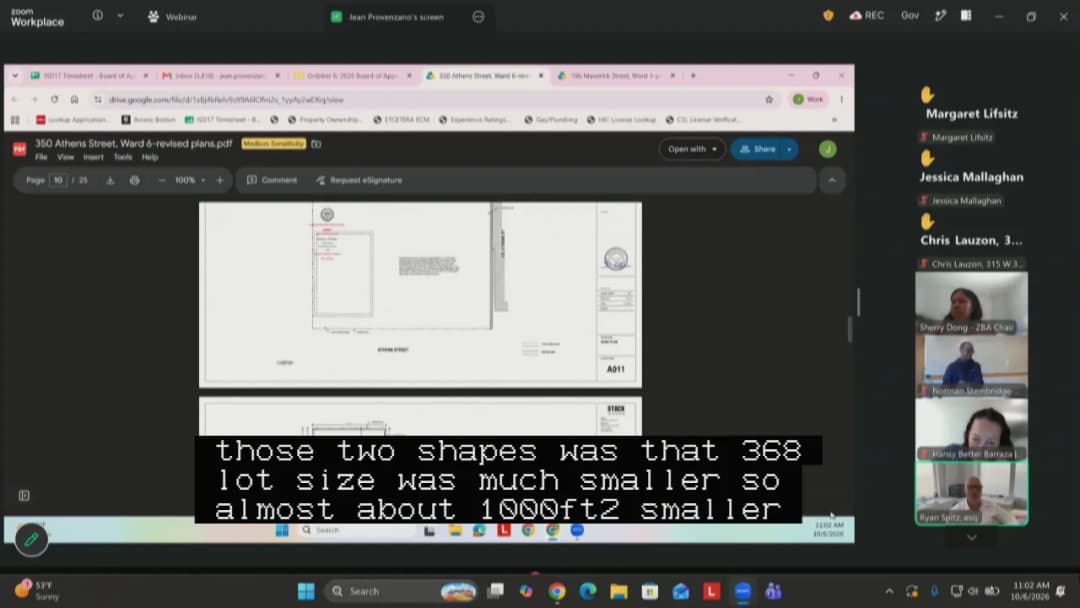
The Zoning Board of Appeal convened on October 7, 2026 at 9:30 AM to consider several appeals for zoning relief, including approvals of minutes, extension requests, and hearings on various development projects across Boston. The board approved multiple items and heard public testimony on several proposals, voting on each case. Consent Calendar - Approval of Minutes: The board unanimously approved hearing minutes from September 17 and September 22, 2026. - Extensions: The board approved five extension requests for cases BOA 773858 (6116 address), BOA 1322135 (25 Henry Street), BOA 1605743 (25 West Hall Street), BOA 1622321 (751–757 W Street), and BOA 1140239 (50 Rogers Street). - Board Final Officer Cases: - 3326–3328 Washington Street (case BOA 104472): Unanimously approved a modification increasing units from 43 to 46 and gross square footage from 40,176 to 43,825 sq ft, with no parking. - 80 & 82 Shawsheen Road, East Boston (cases BOA 1545096 and BOA 15451): Unanimously approved changes converting a homeownership building to all-rental, increasing total affordable units from 57 to 62, with adjusted parking and loading. Public Comments & Testimony - 239–245 Causeway Street: The Mayor’s Office of Neighborhood Services (ONS) deferred to the board; Councilor Sharon Durgan’s office supported the application to remove a special provision for a cafe. - 125 Newbury Street (two companion cases): ONS confirmed community process with non-opposition from Back Bay Neighborhood Association; Councilor Durgan supported removal of provisos for a new restaurant tenant (Joe & the Juice) and takeout restaurant. - 90–94 Revere Street: ONS noted one abutter opposed on grounds conditions were not unique; Beacon Hill Civic Association non-opposed; Councilor Durgan’s office supported the project to reduce units from 8 to 5 and add a roof deck. - 31 Bill Mont Street: ONS deferred after an abutters meeting with no objections; Highland Park Neighborhood Association expressed support. - 5 Long Street: ONS deferred with letter of support from three abutters and Community Alliance of Mission Hill non-opposition. - 269 East Cottage Street (Article 80): ONS reported 63 letters in support, 9 opposed; Columbia Savin Hill Civic Association opposed citing lack of need for hotel, density, and parking concerns. Councilor Santana supported; former councilor Frank Baker supported; several abutters spoke in favor. - 196 Maverick Street: ONS deferred; Boston Groundwater Trust confirmed receipt of G-Card letters; no public opposition voiced. - 350 Athens Street: ONS reported abutters’ significant opposition over scale, shadow, and privacy; six abutters spoke in opposition. Councilor Flynn’s office supported but expressed concerns about parking reduction. Direct abutters opposed. - 44 Granger Street: ONS deferred; Fields Corner Civic Association provided a letter of support; Councilor Flynn’s office supported. - 26 Bird Street: ONS noted abutters had concerns but Ashmont Hill Civic Association voted support; Councilor Flynn’s office supported. Discussion Items - 239–245 Causeway Street: Applicant Jacqueline Dimenez sought removal of a special provision to operate a cafe under a new name without footprint changes. - 125 Newbury Street: Attorney Darryl Quilty presented removal of provisos for a restaurant (36A37) and takeout use to allow replacement tenant Joe & the Juice. - 90–94 Revere Street: Attorney Kevin Butler and architect Guy Grassi presented a proposal to reduce unit density from 8 rental units to 5 condos, adding open space and restoring the historic exterior. Variances sought for FAR (from 4.4 to 4.78) and rear yard setback. - 31 Bill Mont Street: Applicant Andrea Boitz requested a variance for a 7x13 ft wooden pergola within 4 ft of the lot line. - 5 Long Street: Applicant sought variance for excessive FAR (proposed 1.1 vs allowed 1.0) to add living space for an extended family. - 269 East Cottage Street: Attorney Joe Hanley presented a 42-room boutique extended-stay inn with restaurant expansion, 12 bike spaces, and 2 courtesy vehicles. Variances for hotel use, FAR (3.31 vs 1.3 allowed), height (69 ft vs 40 ft), and parking. Project connected to existing mixed-use building at 951–959 Dorchester Avenue. 72 letters received (63 support, 9 opposed). - 196 Maverick Street: Attorney Jeff Drago presented conversion of a 3-unit building to 7 units via full interior renovation, rear addition, and vertical expansion to 4 stories (45 ft height). Variances for groundwater district, roof structure, off-street parking, front/side yards. - 350 Athens Street: Attorney Ryan Spitz presented a 6-unit, 4-story residential building with 6 parking spaces. Revised plans after deferral eliminated FAR and open space violations, reduced side yard violation. Variances for lot area, front yard, side yard, roof structure, and parking. Planning department recommended approval. - 44 Granger Street: Attorney Ethan Ritters presented a 3-family triple-decker on a 2-family zoned lot. Variances for use, lot area, width, frontage, FAR (0.77 vs 0.5), stories (3 vs 2.5), and side yard. - 26 Bird Street: Attorney Ernest Gary and architect Fred Money Guy presented an 8-unit, 2-bedroom building with 8 parking spaces, near Ashmont station. Variances for lot size, side yard, rear yard, FAR, and stories. Key Outcomes - Minutes and Extensions: Approved unanimously (6-0). - Board Final Officer – 3326–3328 Washington St: Approved (6-0). - Board Final Officer – 80 & 82 Shawsheen Road: Approved (6-0). - 239–245 Causeway Street: Approved (6-0). - 125 Newbury Street (both cases): Approved (6-0). - 90–94 Revere Street: Approved (6-0) with proviso that project undergo Beacon Hill Architectural Commission review. - 31 Bill Mont Street: Approved (6-0). - 5 Long Street: Approved (6-0). - 269 East Cottage Street: Approved (6-0). - 196 Maverick Street: Approved (6-0). - 350 Athens Street: Approved (6-0) with proviso that project undergo BPD design review to consider increased setback or windows on blank facade. - 44 Granger Street: Approved (6-0) with provisos: accessible entry and resubmission of revised plot plan showing parking at rear. - 26 Bird Street: Approved (6-0) with proviso that applicant enter into a housing agreement with MOH prior to permit. - Deferrals: Case BOA 1894474 (742 Truman Ave) deferred to November 17, 2026; Case BOA 187 (412 Washington St) deferred to November 10, 2026. - Withdrawal: Case BOA 18579365 (151 Lennon Street) withdrawn.