Browse by city
Date range
Search help

Search titles, summaries, topics and stored transcripts together. Keywords may match separately; put the whole query in double quotes for a phrase. Matching follows word analysis, so punctuation is not exact. Both dates are included. Documents are not searched.

SHOWING 3061–3070 ENTRIES
3061
OCT 7, 2026 · HOUSTON, TEXAS · CITY COUNCIL
Houston City Council Meeting – October 7, 2026

The Houston City Council convened on October 7, 2026, at City Hall. The meeting began with an invocation and the Pledge of Allegiance. Roll call established a quorum, and the minutes of September 29th and 30th were adopted. A major highlight was the introduction of the \"Pathways to Independence\" regional homelessness initiative, featuring a $48 million strategic philanthropic fund. The Council confirmed a new Chief Information Officer, debated the City Controller's certification of funds, and heard extensive public testimony. Consent Calendar - Routine approvals of minutes and items under the Miscellaneous, Purchase and Tabulation of Bids, and Ordinances categories were adopted. Items 4, 5, 13, and 20 were removed for separate consideration. Public Comments & Testimony - Darrell Harper requested an independent examination of the city's development policies, arguing that the lack of comprehensive zoning violates equal protection and due process, allowing industrial activities like scrap metal yards and batch plants to operate in residential neighborhoods. - Cameron Whitfield sought Council assistance in obtaining a police report from HPD and addressing a lack of response to citizen complaints. Councilmember Panzarella offered to facilitate contact with HPD. - Kimberly Walters, a city employee, alleged that the Ernst and Young study is being weaponized by Houston Public Works leadership to retaliate against employees and violate due process. She demanded investigations by the Harris County DA and U.S. Department of Labor, and requested a third-party audit of employment decisions. - Miguel Brieva and Mary Wallace, employees of Envoy Air at Hobby Airport, expressed concern that their employer has not implemented the living wage increase under Executive Order I-64, despite it being implemented at Intercontinental Airport (IAH). The Mayor stated his expectation for vendor compliance with the order. - Latoria Davis testified about a vehicle being towed due to insufficiently lit signage at night. The Mayor directed Public Works to address the issue. - Sereva Page questioned the effectiveness of homeless programs and job access for women in re-entry programs, stating that despite the announced $48 million fund, she faces losing her housing and returning to the streets. - Joe Holson opposed the proposed Landford Groceries development in Midtown, citing a lack of parking and commercial delivery planning that will turn residential streets into loading zones. - Christine King Taylor introduced the Hope Haven Transitional Housing Program for young women aging out of foster care, requesting a city partnership and a proclamation. - Lisa Hunt thanked the Mayor for withdrawing the Model Cities grant application, arguing it would have harmed undocumented residents. - Tara Destori spoke as a survivor of family violence and a pro se litigant, requesting a fair and unbiased hearing regarding her protective order case. Discussion Items - Appointment of Chief Information Officer (Item 1): Mayor Whitmire introduced Kevin Barry as the new Chief Information Officer for the Houston Information Technology Services (HITS). Councilmember Castillo noted Mr. Barry as the first Aggie to hold the role. The appointment was confirmed by a unanimous vote of 16-0. - Pathways to Independence (P2I) Homelessness Initiative: Mayor Whitmire, Mike Nichols, and Serafin Foundation Executive Director Ryan Delaboy announced a $48 million strategic philanthropic fund to support the Pathways to Independence initiative. The initiative aims to resolve homelessness for anyone entering the system within 90 days. Over $34 million has already been raised from foundations including Brown, Cullen, Dovetail Impact, Greenberg, Houston Endowment, Kinder, and MD Anderson. Councilmembers Martinez, Mayor Pro Tem Castict Tatum, and Councilmember Alcorn expressed strong support for this public-private partnership. - Controller Certification Dispute (Item 2 - Car Wash Services): A motion to approve funding for car wash services sparked debate. Councilmember Pollard argued that proceeding without the City Controller's certification sets a dangerous precedent. Mayor Whitmire and the City Attorney countered that the controller had certified the overall budget and the motion was a permissible legal pathway. The motion passed, with Councilmembers Pollard and Panzarella voting in opposition. - Stella Link Affordable Housing (Items 4 & 5): Council approved an ordinance authorizing 144 new single-family homes (89 designated as affordable) on Stella Link. Mayor Pro Tem Castict Tatum and Councilmember Thomas highlighted the collaborative effort required to secure the development, which utilizes CDBG-DR17 funds. - Real Estate Marketing Agreement (Item 20): Council approved a marketing agreement for the sale of 611 Walker and 1200 Travis. Councilmember Pollard questioned a sale versus a ground lease to retain the asset. Director Randy explained that the buildings are in severe disrepair, a ground lease is unlikely for a landmark developer, and the proceeds are needed for the 1600 Smith build-out. He confirmed the agreement does not preclude a future ground lease. Key Outcomes - Kevin Barry confirmed as Chief Information Officer for HITS (Yes: 16, No: 0). - Item 2 (Car Wash Services) approved as a motion despite lack of controller certification. - Items 4, 5, 13, 20 (Ordinances) approved, including the Stella Link housing development and real estate marketing agreement. - Directives: The Airport Director was directed to ensure compliance with Executive Order I-64 for Hobby Airport vendors. Public Works was directed to improve parking signage lighting. Staff were directed to follow up on complaints regarding HPD, housing, and zoning. - Upcoming Events: Housing Fall Community Meeting (Oct 12), Faith and Affordable Housing Summit (Oct 10), Public Safety Committee meeting on the Texas Firefighter Cancer Study (Oct 13).
HOMELESSNESS 13% · COMMUNITY ENGAGEMENT 12% · ZONING AND LAND USE 10% · AFFORDABLE HOUSING 9%
3062
OCT 7, 2026 · NEW YORK CITY, NEW YORK · CITY COUNCIL
Subcommittee on Early Childhood Education Oversight Hearing on 2K – October 7, 2026

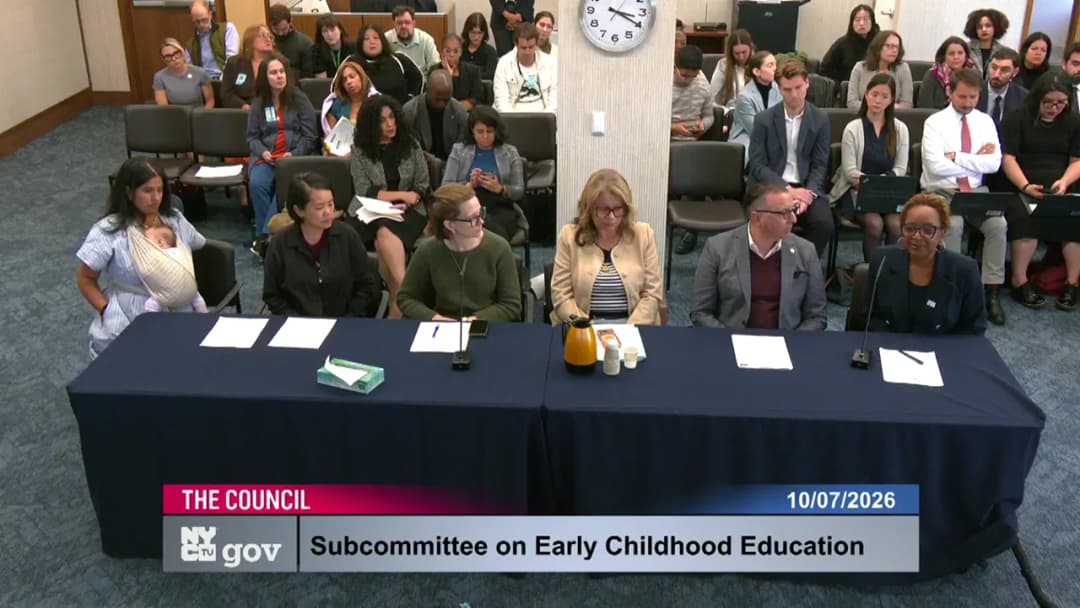
The New York City Council Subcommittee on Early Childhood Education, chaired by Councilmember Jennifer Gutiérrez, held an oversight hearing on Wednesday, October 7, 2026, at 1:00 PM at 250 Broadway – 8th Floor – Hearing Room 1 to examine the implementation and expansion of the 2K program, which provides free child care for two-year-olds. The hearing featured testimony from the Mayor's Office of Childcare and Early Childhood Education, New York City Public Schools (NYCPS), and multiple panels of public witnesses. The program, launched in Fall 2026 with 2,000 seats across five school districts, saves enrolled families up to $26,000 per year per child. Over 5,700 applications were received for the initial 2,000 seats, with 59% of families receiving their top choice, 82% receiving one of their top three choices, and 99% receiving an offer to a program on their application. The hearing focused on lessons from year one, plans to expand to 12,000 seats by Fall 2027 and universal access by 2029, and long-standing systemic challenges including pay inequities, contract and payment delays, and inclusion of home-based providers. Consent Calendar - The oversight resolution (T2026-2552) was filed by committee after the hearing. Public Comments & Testimony Over 15 public witnesses testified in person and via Zoom, representing parent advocacy groups, community-based organizations, family child care networks, and early childhood educators. Key themes included: - Kayleigh Iar (parent leader, New Yorkers United for Childcare) shared her family's struggle to afford child care for her three-month-old daughter, noting that five-day-a-week care would cost at least $36,000/year in her neighborhood. She expressed hope that 2K expansion would allow her family to stay in New York City and save for their daughter's future. - Alison Liu (senior organizer, New Yorkers United for Childcare) testified that before 3K, her family went into debt and forwent health insurance to pay for child care. She reported that one parent leader is now expecting a second child after 2K made the prospect affordable. She urged the city to ensure child care workers receive living wages. - Nora Moran (director of policy and advocacy, United Neighborhood Houses) supported the 2K expansion but stressed the need for pay parity between CBO educators and NYCPS counterparts, adequate NYCPS staffing to process contracts and payments, reimbursement for the true cost of care, and developmentally appropriate professional development for two-year-old educators. - Karen Rogan (director of community programs, Literacy Inc./LINC) highlighted the need for the city to invest in community-based infrastructure to help families navigate enrollment, particularly immigrant and multilingual families, through organizations that already have trusted relationships. - Robert Gordon (CEO, Grand Street Settlement) urged investment in workforce compensation, timely payments, and building 2K through existing CBOs, noting that bureaucratic delays with DOH and FDNY inspections remain a barrier. - Tara Gardner (executive director, Daycare Council of New York) reported that 87% of her members expressed interest in 2K but raised concerns about staffing and payment delays. She called for contracts reflecting true costs, timely advances, and workforce investments. - Lara Kiriyakou (senior director of policy, All Our Kin) noted that only about 20% of family child care programs are part of a DOE network, and many independent providers fear loss of control over their business. She emphasized the importance of continuity of care across age groups rather than single-age programs. - Betty Baez Melo (director of early childhood education, Advocates for Children of New York) called for a comprehensive inclusion strategy for children with disabilities in 2K, including dedicated resources for accommodations, specialized staff, and program models for children with significant needs. - Joy Farina Foscett (representing People's Early Childhood Coalition) stressed that CBO financial instability is a system problem, not a provider problem, and called for structural fixes to contracting and payments before further expansion. - Dr. Zoe B. Sparaza (education director, Kitty Academy of Williamsburg) and Lori Cangiolosi (director, The Playgroup Experience) both testified passionately about pay equity, stating that CBO educators doing the same work as DOE educators should receive comparable compensation, benefits, and retirement security. - Adrian Bond (executive director, Quickstart Daycare Center) described struggling to open her center and keep staff paid despite providing high-quality care with certified educators, pleading for a full partnership and timely payments. - Kamila Faruqi (founder, Manhattan Schoolhouse) warned that providers are

EDUCATION 63% · CHILD CARE 12% · PUBLIC ENGAGEMENT 9% · PROCEDURAL 6%
3063
OCT 7, 2026 · SAN ANTONIO, TEXAS · CITY COUNCIL
San Antonio B Session Briefing on 90th State Legislative Program and Federal Initiatives – October 7, 2026

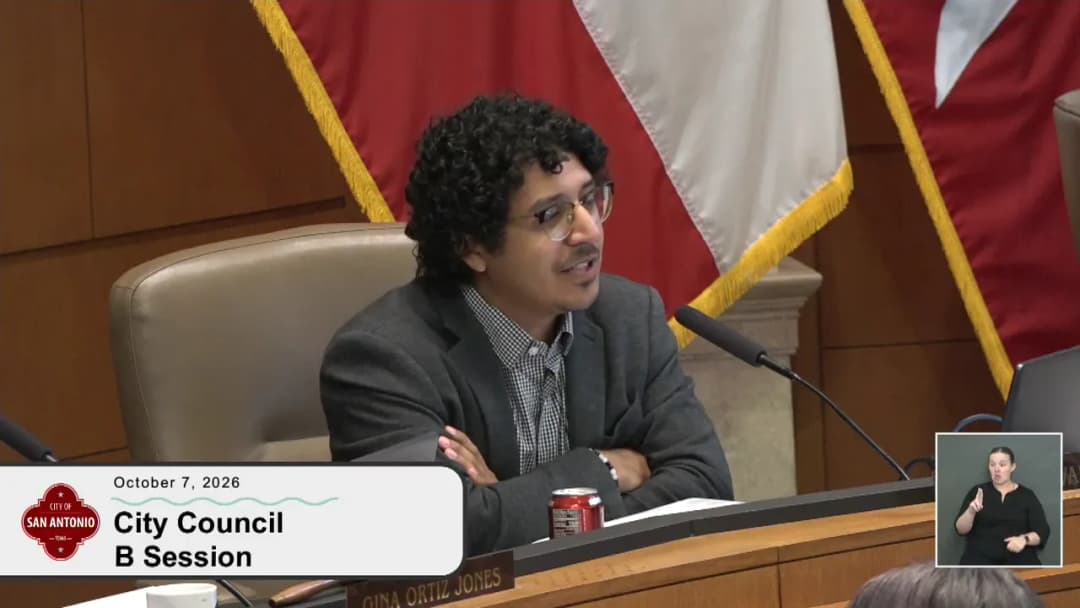
The San Antonio City Council held a B session on October 7, 2026, to receive a briefing from the Government Affairs department on the proposed state legislative program for the 90th Texas legislative session (beginning January 2027) and a preview of the federal initiatives timeline. Sally Basur, Director of Government Affairs, presented the program, which outlines the city's policy and funding priorities for advocacy in Austin. Councilmembers provided feedback and highlighted district-specific concerns. Discussion Items Presentation on Legislative Landscape and Priorities Sally Basur reviewed the upcoming legislative session, noting significant turnover in both chambers, including at least 24 new House members and five new senators. She emphasized that the city's top priorities include protecting municipal authority, opposing unfunded mandates, preserving the municipally owned model for CPS Energy and SAWS, supporting the downtown sports and entertainment district, advancing flood resilience projects, and advocating for increased education funding. New items added for the 90th session include support for local parks and opposition to negative community impacts from data center development. Basur also outlined key legislative dates and the city's process for bill tracking through the Texas Municipal League. Councilmember Comments and Positions - Councilmember Via Gran urged proactive engagement with state and federal initiatives, emphasized flexibility, and stressed the importance of working with school districts through the Bexar County Education Coalition. He supported local control and strategic selection of battles in Austin. - Councilmember Galvan expressed full support for the proposed plan and highlighted the need to preserve local authority over data center regulation, address child care gaps, and resolve cluster mailbox theft issues related to state code conflicts. - Councilmember White requested transparency for taxpayers via a public dashboard tracking supported and opposed bills. He raised concerns about fiscal impact bills that might provide tax relief but reduce city revenue, and asked staff to bring such bills to council for direction. He also asked about potential legislation to restrict vape shops near schools. - Councilmember Mesa Gonzalez emphasized the importance of municipal authority, especially protecting CPS Energy and the military overlay district. She requested consideration of expanding the definition of "schools" to include daycare centers for alcohol sales distance regulations, and monitoring short-term rental issues. She advocated for state funding for the Camp Bullis Bridge project. - Councilmember McKee Rodriguez (IGR Committee Chair) noted the robust agenda and alignment among council. He stressed the need to protect local governance and oppose legislation targeting marginalized groups. He announced plans to schedule meetings with the San Antonio delegation and smaller meetings for councilmembers to build relationships. He emphasized telling San Antonio's story and being flexible. - Councilmember Castillo fully supported the agenda and underscored maintaining local control, protecting CPS Energy, and addressing metal recycler regulations and fence-line air monitoring. She highlighted support for the Center for Healthcare Services, public education, re-entry programs, flood control, and crypto fraud prevention. - Councilmember Corr highlighted infrastructure funding gaps for Vision Zero and climate resilience. She stressed protecting municipally owned utilities, supporting the diversion center and mental health facilities, and tracking housing and transit-oriented development bills. She urged supporting partner priorities as city priorities. - Councilmember Mungia emphasized the South Texas Parkway, public education, CPS Energy's affordability and transmission work, and the need for state funding for flood infrastructure beyond bond capacity. - Mayor Jones requested citywide talking points (e.g., 14 flood projects totaling $411 million) to amplify impact. He emphasized protecting CPS Energy, highlighting its transmission contributions and the value of Port San Antonio and Texas Cyber Command. He requested attention to consumer protection regarding AI, housing for special populations, and ensuring state systems work correctly (maternal mortality reports, Medicaid backlog, voter registration backlog). He specifically asked for support to pursue federal dollars for the summer lunch program and advocate for special education funding. Key Outcomes - The council provided direction and feedback on the proposed legislative program. - The legislative program will be presented for formal approval at the October 29th City Council session. - The Government Affairs team will continue to update the IGR committee and full council on legislative developments, with increased frequency as the session progresses. - A public dashboard tracking the city's support and opposition to bills will be maintained. - The federal legislative program briefings will begin in November 2026, with council approval anticipated in January 2027. - Councilmembers will engage with state delegation members through scheduled meetings and trips to Austin to advocate for the city's priorities.

LEGISLATIVE PROCEDURE 26% · LEGISLATIVE AGENDA 22% · PUBLIC SAFETY 15% · LEGISLATIVE PRIORITIES 14%
3064
OCT 7, 2026 · NEW YORK CITY, NEW YORK · CITY COUNCIL
New York City Council Committee Hearing on Pedicab Regulations – October 7, 2026

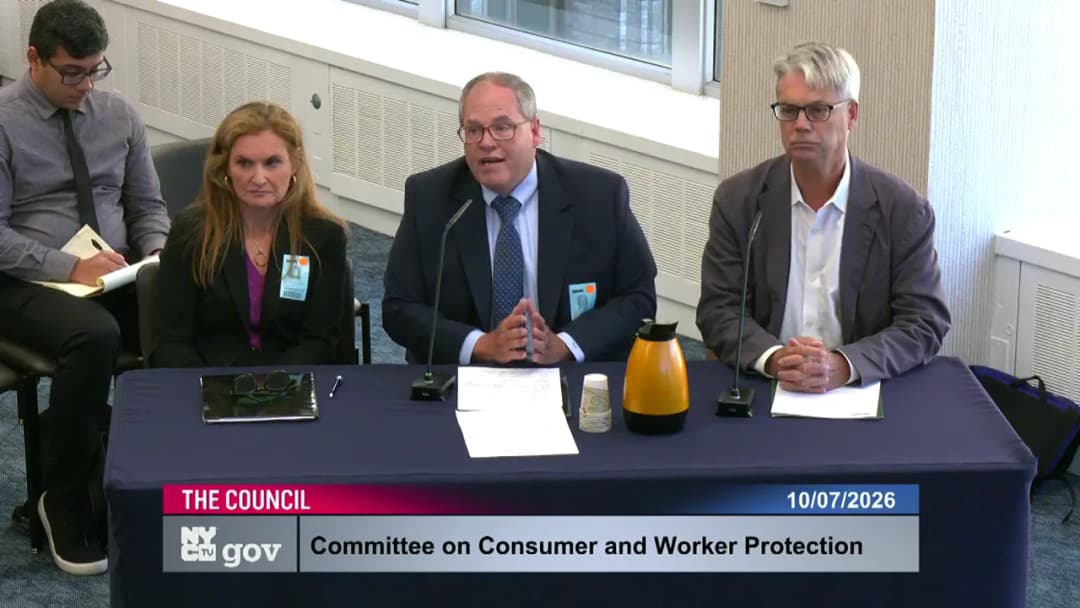
The Committee on Consumer and Worker Protection, chaired by Harvey D. Epstein, held a public hearing on seven proposed local laws (Intros 64, 77, 673, 992, 993, 1026, and 1063) aimed at comprehensive reform of the pedicab industry. The hearing featured testimony from city agencies (Department of Consumer and Worker Protection, Taxi and Limousine Commission), industry representatives, advocacy groups, and members of the public. No votes were taken; all introductions were laid over for future consideration. Public Comments & Testimony - Danielle Mendez (Midtown Community Justice Center) expressed full support for the package of bills, stating they reflect recommendations from a multi-stakeholder roundtable. She argued that shifting oversight from DCWP to TLC would bring necessary licensing and enforcement changes, provided additional resources are allocated. - Makan Camara (President, New York Pedicab Alliance) expressed support for enforcement, transparent pricing, accessible training, and electric assist. He urged that any reforms protect honest drivers and preserve safety standards. He voiced openness to regulatory oversight by TLC but requested more information about its impact. - Kenneth Winter (23-year pedicab driver) expressed support for electric assist, citing physical strain and health issues. He described how unlicensed operators face no real consequences, undermining compliant drivers. - Christine Nicholas (Broadway Association) expressed strong support for Intros 992, 673, and 77 (meters, visible pricing, scannable plates), and Intro 993 (moving oversight to TLC). She urged consolidation of the bills for clarity and stressed the need for enforcement, recommending continued NYPD involvement. - David Saltenstahl (Central Park Conservancy) expressed support for the full package, emphasizing that a well-regulated fleet would protect visitors and honest drivers. He noted that nearly all visitors are aggressively solicited near the park. - Tom Harris (Times Square Alliance) expressed support for treating pedicabs as vehicles for hire, with fixed fares, meters, visible identification, civil penalties, and TLC jurisdiction. He advocated for electric assist and increased TLC staffing. - Justin Garbeit (Fire Island Pedicab) expressed support for holding operators accountable and for distance-based fares. He proposed a pilot program to test regulations before citywide implementation. - Hisham Mahmoud and Adamu Mazaru (pedicab drivers) expressed support for electric assist (In 1063), citing age and physical limitations that make manual pedaling difficult. - Keenan Delancy (pedicab driver) expressed strong support for Intro 1026 (designated curb spaces), arguing it would reduce traffic congestion and pedestrian conflicts. - Amadou Gassimu (pedicab driver) expressed support for electric assist, uniform pricing, and driver training. - Christina Hansen (carriage driver) expressed support for visible, theft-resistant license plates on pedicabs, noting that current plates are easily covered or counterfeited. - Paul Bader (TLC Commissioner, Queens) expressed fiscal concerns about transferring pedicab oversight to TLC, noting that TLC’s budget was cut and it lacks resources. He suggested redirecting unused funds from a previous law enforcement initiative. - Kristen March (ride-hailing app developer) expressed support for allowing software-based metering (on a passenger's phone) as a supplement to bike-mounted meters. Discussion Items - Chair Epstein and Councilmembers Brewer, Hanks, Maloney, Schulman, and Wilson questioned DCWP and TLC representatives about enforcement gaps, low compliance, and the disconnect between licensing and on‑street enforcement. DCWP Deputy Commissioner Carl Ortiz acknowledged that 35% of pedicab summonses are deemed legally insufficient, 25% dismissed in the interest of justice, and 20% not pursued. He stated that of 135 overcharge complaints received in 2025, none resulted in consumer redress. DCWP reported 330 registered pedicabs (out of a cap of 840) and an estimated 1,200–1,500 unlicensed units. - Councilmember Brewer raised the issue of insurance costs, which have risen from $600 to nearly $6,000 per unit per year, and asked about the feasibility of a meter system. DCWP indicated support for meters but concerns about price controls. - Councilmember Maloney questioned TLC’s capacity to take on pedicab enforcement and asked whether TLC peace officers could enforce pedicab laws. TLC’s Ira Goldapper stated that TLC does not have the resources or expertise for pedicabs and that its enforcement is targeted on taxis and FHVs. - Councilmember Hanks asked about electric‑assist concerns; DCWP deferred to NYPD on speed enforcement. Public witnesses argued that pedicabs have a perfect safety record with no fatalities. - Councilmember Schulman asked about noise complaints and whether a scannable code would help consumers. DCWP said they are evaluating costs for scannable plates. - Chair Epstein questioned DCWP about why three‑quarters of pedicabs operate without licenses. DCWP noted that the cost‑benefit analysis favors non‑compliance given weak enforcement. The Chair pressed for alternative enforcement mechanisms beyond ticketing. Key Outcomes - All seven proposed introductions (Intros 64, 77, 673, 992, 993, 1026, and 1063) were laid over by the committee, meaning no vote was taken and the bills remain under consideration. - DCWP and TLC representatives committed to providing additional data on enforcement, complaints, and confiscations to the committee. - Several witnesses and councilmembers urged consolidation of the bills and called for a referred bill package with dedicated resources if oversight is transferred to TLC. - The committee will continue to work with stakeholders and agencies to refine the legislation before any vote.

PUBLIC SAFETY 35% · TRANSPORTATION SAFETY 31% · CONSUMER PROTECTION 23% · PUBLIC TRANSPORTATION 4%
3065
OCT 7, 2026 · NEW YORK CITY, NEW YORK · CITY COUNCIL
Committee on Small Business Meeting: Support Fund for Businesses Affected by Construction (Oct 7, 2026)

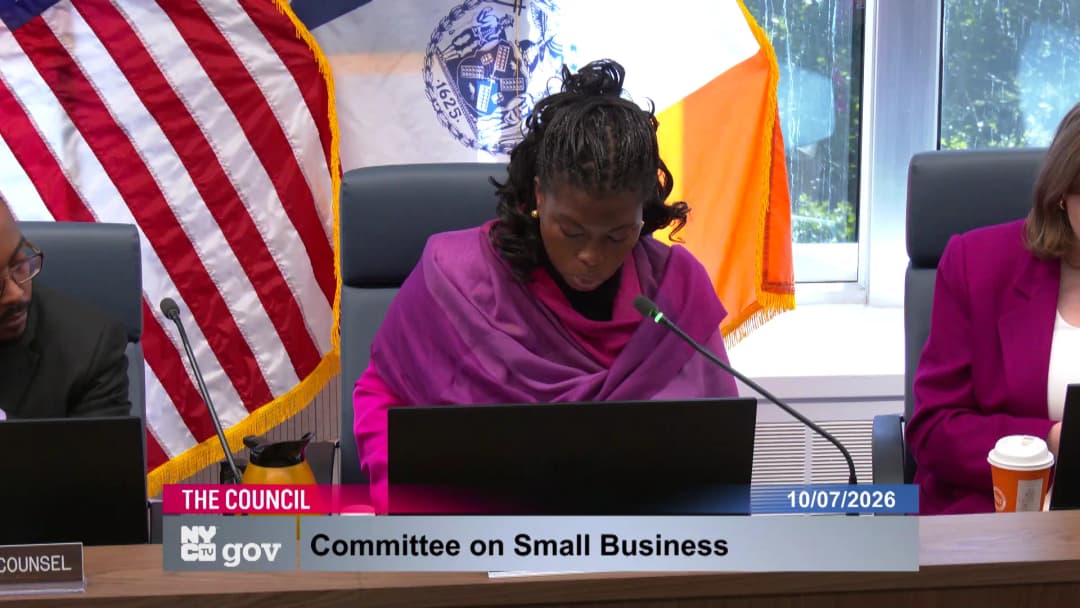
The New York City Council Committee on Small Business, chaired by Councilmember Shanel Thomas-Henry, met on Wednesday, October 7, 2026, at 11:00 AM at 250 Broadway, 8th Floor, Hearing Room 3. The committee voted on two items sponsored by Councilmember Yusef Salaam: a proposed local law (Int. No. 799-A) to establish a support fund for small retail businesses affected by roadway construction, and a resolution (Res. No. 328) calling on the New York State Legislature and Governor to provide a tax credit for businesses negatively impacted by infrastructure construction. All seven members present voted unanimously in favor of both items. Discussion Items - Int. No. 799-A – Small Retail Business Support Fund: Chair Thomas-Henry presented the legislation, which would require the Department of Small Business Services (SBS) to create a grant program for Business Improvement Districts (BIDs) and community-based organizations (CBOs) to support small businesses affected by city construction projects. To qualify, a BID or CBO must demonstrate that businesses within its purview fall within a “qualifying construction project area,” defined as two blocks from a project authorized by a Department of Transportation permit for at least 90 days. Each qualifying project can receive one grant of up to $100,000 for marketing, wayfinding, and other services, and a reimbursement program would allow small businesses near construction to be reimbursed for eligible costs up to $10,000 per business. The program has a three-year sunset. The chair noted that New York City has a record 183,000 small businesses, many dependent on foot traffic, and cited research from the Minnesota Department of Transportation showing independent non-chain businesses are most hurt by construction. She also referenced the Second Avenue Subway construction, where the Manhattan Chamber of Commerce reported that nearly half of businesses between 68th and 95th Streets moved or closed within five years due to declining revenue. - Res. No. 328 – State Tax Credit for Businesses Affected by Infrastructure Construction: This resolution urges the New York State Legislature to pass and the Governor to sign legislation providing a tax credit to businesses negatively affected by infrastructure construction, including state-led projects like MTA work. Chair Thomas-Henry emphasized that the city cannot address such impacts alone. Key Outcomes - Vote on Int. No. 799-A and Res. No. 328: Both items were coupled for a single roll call vote. Councilmembers voted as follows: Chair Thomas-Henry (yes), Brooks-Powers (yes, with an explanation: she congratulated Councilmember Salaam and requested to be added as a co-sponsor of Res. No. 328), Hanif (yes), Salam (yes), Maloney (yes, with an explanation: her district borders the Second Avenue Subway and she expressed gratitude for the legislation), Santosuosso (yes), and Morano (yes). The motion passed with 7 affirmative votes, 0 negative, and 0 abstentions. The items were thereby adopted by the committee.

SMALL BUSINESS 62% · PROCEDURAL 20% · TRANSPORTATION SAFETY 18%
3066
OCT 7, 2026 · NEW YORK CITY, NEW YORK · CITY COUNCIL
NYC Council Education Committee Approves Gifted & Talented Language Access Study, October 7, 2026

On October 7, 2026, at 12:00 PM in Hearing Room 3, 250 Broadway, the Committee on Education, chaired by Councilmember Eric Dinowitz, met to vote on proposed Intro 684-A, a local law requiring a study on how language access needs and geographic location affect access to early elementary gifted and talented programs. The committee approved the legislation by a vote of 12 to 0, with Councilmember Farías not voting. The bill now advances from committee with an amendment. Discussion Items - Chair Dinowitz described the bill as requiring the Mayor's Office of Child Care and Early Childhood Education, working with the Department of Education and community-based early childhood providers, to study how language access and geography affect eligibility, nomination, and enrollment in kindergarten through third-grade gifted and talented programs. The study would evaluate barriers for families with limited English proficiency, review translation, interpretation, and outreach efforts, break down disparities by language group, borough, community district, and community school district, and include recommendations for multilingual households and underserved areas. He said access to an existing public school program should not depend on a family's zip code or English proficiency, and he supported the bill as a co-sponsor. - Councilmember Zhuang, the bill's sponsor, stated that Intro 684 would help identify how language access and location affect who learns about gifted and talented programs and who is admitted. She emphasized that immigrant, low-income, and minority families face barriers that can make these opportunities seem out of reach, and she announced a press conference at the Department of Education the following day to advocate for increased educational access. - Councilmember Brewer expressed support for gifted and talented programs even though that may be a minority view, and voted aye. - Councilmember Narcisse, speaking as a parent of four children who went through the city's public school system, praised the bill and Councilmember Zhuang's work. Key Outcomes - The committee voted on Intro 684-A: 12 affirmative votes (Dinowitz, Brewer, De La Rosa, Gutiérrez, Joseph, Krishnan, Lee, Louis, Narcisse, Schulman, Wong, and Zhuang), 0 negative votes, and 0 abstentions. Councilmember Farías was present but non-voting. - The introduction was amended by the committee and approved by the committee, with a committee report and fiscal impact statement. If enacted, the required study's findings must be publicly posted within one year.

PROCEDURAL 77% · LANGUAGE ACCESS 16% · EDUCATION 7%
3067
OCT 7, 2026 · SAN ANTONIO, TEXAS · COUNCIL COMMITTEES
San Antonio City Audit Committee Meeting - October 7, 2026

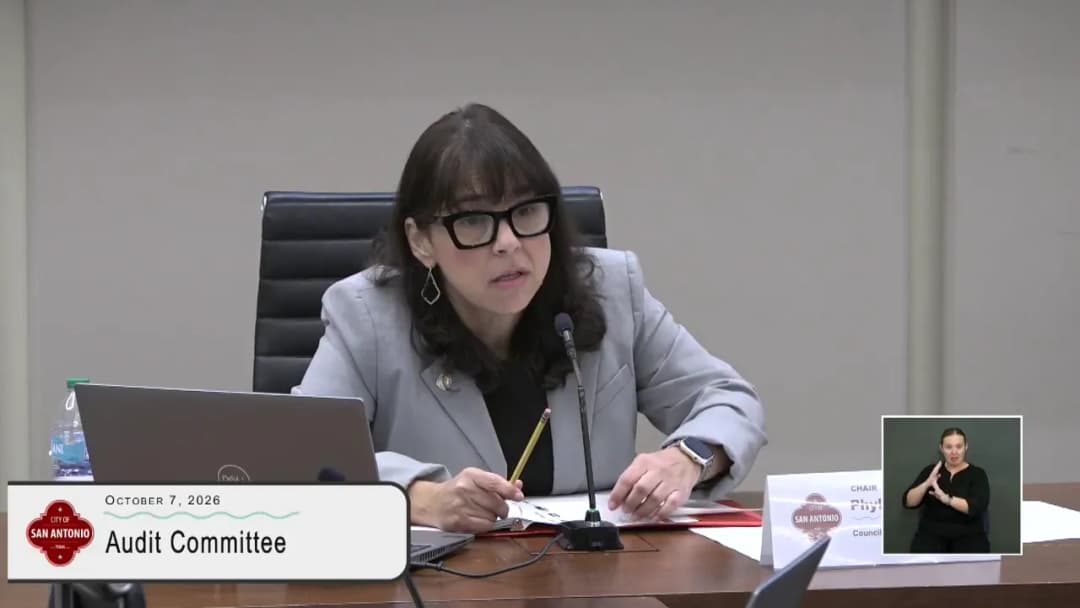
The San Antonio Audit Committee met on October 7, 2026, from 10:05 a.m. to 11:35 a.m. Chair Villagran presided; Councilmembers Mesa Gonzalez and White, Citizen Members Tinal and Pacheco, and Chair Villagran were present, establishing a quorum. The committee took up procurement briefings, contract awards, three final audit reports, and the proposed FY2027 annual audit plan. Public Comments & Testimony - Mary Scott (Katie), with Act for SA, thanked the committee for adding a police overtime audit to the FY2027 plan and asked the auditor to expand it to total compensation, grant management, and contracts; to make findings public; and to repeat the audit every three years, citing the city budget gap. - Christian Nunez, director of organizing at Akron SA, supported the proposed 1,000-hour SAPD overtime audit, noting overtime had not been audited since 2020 and that SAPD spent more than $34 million against a $17.7 million overtime budget in 2024 within a $631 million department. He asked for the audit to cover total compensation, benefit/leave/incentive pay, a SAPD grant management audit, a SAPD contract review, public progress reports, and a recurring audit every three years. Pre-Solicitation Briefings - (Item 2) Custodial and supplemental conversion services for the Alamodome. Staff proposed an annual contract for cleaning, restroom maintenance, trash/recycling disposal, and supplemental labor during event transitions, with an estimated total value of $13.25 million, initial 3-year term and two 1-year renewals, funded by the Alamodome Fund. The current contract expires May 31. Solicitation planned for release Oct. 12, proposals due Nov. 30, and contract start June 1. Outreach included 295 vendors notified and 4 targeted. Evaluation: 30 points experience/qualifications, 40 proposed plan, 20 price, 10 SBE prime; 14% subcontracting requirement. Chair Villagran stressed expectations for in-event cleaners training and customer interaction; staff described real-time issue escalation. This item was briefing only. - (Item 3) Event attendant and supplemental event security services for the Alamodome. Staff proposed a contract for guest guidance, ticket collection/verification, entry screening, restricted-area security, crowd control, and visible security presence. Estimated total value $15 million, initial 3-year term and two 1-year renewals, funded by the Alamodome Fund; current contract expires Sept. 30. Solicitation release planned Oct. 22, proposals due Dec. 8, contract start Oct. 1. Outreach included 362 vendors notified and 3 targeted. Evaluation criteria were the same as item 2, with an 11% subcontracting requirement. Chair Villagran said security must prepare for changing crowds, merchandise lines, photo ops, and family events. A councilmember asked about supplemental event terminology and school district security cost reimbursements; staff said renters/partners reimburse event-related expenses such as security for graduations and UTSA football, and the councilmember asked to see reimbursement data. This item was briefing only. Post-Solicitation Procurement Approvals - (Item 4) Temporary staffing services. Human Resources presented an RFP for citywide temporary staffing, estimated total value $12.5 million, 3 years with two 1-year renewals; current contract expires Dec. 21. Of 156 notified vendors, 58 attended the pre-submittal conference; 60 responded; 33 were deemed non-responsive for failing to meet the 6% subcontracting requirement, and one additional respondent was deemed non-responsive for failing to provide all required documentation, leaving 26 responsive proposals. Staff recommended awarding to the three highest-scoring responsive vendors. Discussion noted current usage of 90 temps citywide (39 DHS, 15 animal care, 6 finance), and a committee member asked for a department/function breakdown and why one vendor lacked SBE prime points. Motion approved. - (Item 5) Fire Station No. 33 construction. Capital Delivery recommended awarding the 2022 bond project at 2935 Castroville Road, District 5, to the top-ranked proposer, with an estimated $10 million contract and roughly 400-day construction period. Twelve bids were received; four were non-responsive, leaving eight scored. The committee discussed the scoring rubric; staff said the evaluation guide defines excellent/good ranges and agreed to provide a follow-up memo explaining the scoring legend. Motion approved to move the contract to City Council. Audit Report: PWD Right-of-Way Permits (Item 6) - The audit (AU 25-033) found effective controls for 311 service requests and documenting denied permits, but identified weaknesses in policies/procedures, permit phase accuracy, fee accuracy, and accounts receivable management. In FY2025, about 19,000 permit applications were submitted and $5.4 million revenue generated. The audit recommended clearer written procedures, monitoring of permit phases, accurate invoicing of emergency excavation fees, parking restrictions, and violations, and adherence to Administrative Directive AD 8.4 for past-due accounts. - Public Works staff accepted the findings, noted staff training and new procedures, and said permits will not be issued to applicants with balances past due 90 days. A committee member asked about the $954,000 outstanding balance; staff said $142,000 had been collected and the rest was being processed for write-off, with some old debts not recoverable. Staff agreed to provide a written collection update at the halfway point. Motion to accept the audit carried. Audit Report: Municipal On-Site Solar Project (Item 7) - The audit (AU 25-035) concluded the department did not have adequate controls to monitor the municipal on-site solar program. A master services agreement with Big Sun was executed in Nov. 2023; the goal is about 13 MW and $1.8 million annual utility savings; as of Feb. 2026, 22 sites were completed and $12 million had been paid. Findings included gaps in contract monitoring of Big Sun and third-party inspector West East, missing documentation for replacement sites and inspection letters, payments made before inspection documentation was received or not approved by fiscal staff, issues with energy savings calculations, and inappropriate user access to PrimeLink. The department agreed and set completion date Aug. 2026. - Chair Villagran thanked the audit team for early review and said solar investment was an important story. A committee member raised concerns about how the city can independently confirm work was complete and suggested pre-implementation audits/cost analysis. Motion to accept the audit carried. Audit Report: Ready to Work Program (Item 8) - The audit (AU 25-036) of the Workforce Development Office Ready to Work program found effective controls overall. Positive results included participant eligibility, prime agency reporting, SBE goals on track, authorized employers, appropriate services, invoicing reviews, insurance monitoring, and advisory board collaboration. Recommendations addressed verifying full-time W-2 status for OJT/IWT participants (13 of 103 trainees not initially verified), monitoring all eight performance measures including one-year retention, and improving user access controls to the Sync platform (3 of 30 non-COSA users had inappropriate access). - Workforce staff said the programs now measure retention internally at 85% against an 80% goal; 63% of participants are placed within six months and 73% within 12 months; all missing documentation was later obtained and an SOP now requires verification before future reimbursement. Motion to accept the audit carried. FY2027 Annual Audit Plan (Item 9) - City Auditor Buddy Vargas presented the proposed FY2027 plan, required by ordinance, with 30 audits, 3 consulting projects, and 1,000 reserved hours for special project requests. He recommended cancelling the standalone accounts receivable audit from the FY2026 plan because current audits already identify AR trends. Priorities include revenue recognition, operations, cost savings, grants compliance, and the requested SAPD overtime audit. The plan is targeted for City Council consideration Oct. 29 and can be modified only with audit committee approval. - Discussion included why some areas had no audit in seven years; staff explained resource allocation and FY2026 carryover IT audits. A committee member asked about the vehicle replacement/renewal fund; staff agreed to consider including it in the fleet operational audit if applicable. Public comments earlier asked for the SAPD audit scope and public reporting. Motion to approve the FY2027 audit plan carried. Key Outcomes - Approved meeting minutes. - Approved HR temporary staffing contracts to proceed to City Council. - Approved Fire Station 33 construction contract to proceed to City Council. - Accepted the three audit reports (Items 6, 7, and 8). - Approved the FY2027 annual audit plan, including cancellation of the standalone accounts receivable audit. - Staff will provide follow-up items: scoring rubric memo; temp staffing departmental usage breakdown; PWD right-of-way collection update; confirmation on vehicle replacement fund in fleet audit scope; and Alamodome security reimbursement data.

AUDIT 43% · PROCUREMENT AND CONTRACTING 21% · ENGINEERING AND INFRASTRUCTURE 7% · WORKFORCE DEVELOPMENT 7%
3068
OCT 6, 2026 · BETHLEHEM, PENNSYLVANIA · COUNCIL MEETINGS
Bethlehem City Council Meeting - October 6, 2026: Data Center Zoning Amendment Adopted

On October 6, 2026, the Bethlehem City Council held a public hearing and regular meeting primarily focused on a proposed zoning text amendment to regulate data centers in the city. After extensive public comment and council discussion, the ordinance was passed unanimously (7-0) on first reading. The council also approved several routine items including budget adjustments, grant applications, and a liquor license transfer. Public Hearing: Data Center Zoning Amendment The council conducted a public hearing to accept comments on a proposed ordinance to add definitions, special exception requirements, dimensional standards, and study requirements for data centers in the industrial zoning district. Planning Director Kathy Fletcher presented the amendment, noting it was recommended 4-0 by the Planning Commission on August 25, 2026, and supported by the Lehigh Valley Planning Commission (LVPC) as a thoughtful response to a complex land use. The administration emphasized state law prevents banning data centers outright, and this ordinance represents the farthest legal reach under the Pennsylvania Municipalities Planning Code. Key provisions include: requiring an environmental impact assessment, water/sewer approvals, energy management plan, emergency response plan, thermal impact mitigation, increased setbacks (up to 1,000 feet near residential or sensitive receptors), and reduced building coverage for larger facilities. Data centers would be a special exception, requiring Zoning Hearing Board approval and additional public comment. Council Questions and Discussion Councilmembers asked about enforcement, monitoring, and the limits of zoning authority. Councilman Callahan expressed opposition to data centers but supported the ordinance as the best legal option. Councilwoman Daniels raised concerns about the lack of quantitative standards for water, energy, decommissioning, and environmental impacts, arguing the ordinance gives too much leeway to developers and needs strengthening. Councilwoman Leon and others stressed that voting against the ordinance would leave data centers unregulated, and that passing it now allows for future amendments. Councilman Laird confirmed that a no vote would maintain current unregulated status, while a yes vote imposes restrictions. The city solicitor noted that fines can reach $500/day, and injunctions are possible for violations. Councilwoman Quetek clarified the building coverage calculation ensures larger buildings require proportionally larger lots. Public Comments Approximately 20 members of the public spoke, almost all urging the council to pass the ordinance as a starting point while calling for stronger future regulations. Key suggestions included requiring independent third-party studies, closed-loop water systems, developer-paid grid upgrades, higher fines, escrow accounts for decommissioning, annual public reporting, and aligning with Governor Shapiro's executive order on data centers. Several speakers highlighted noise, vibration, thermal pollution, chemical contamination (PFAS), and impacts on wildlife. One speaker proposed declaring the current zoning invalid (curative amendment) to gain a 180-day moratorium, but another noted that could delay regulations for months. Many thanked the council for their work and urged continued vigilance. Key Outcomes - Ordinance 9A (Data center zoning amendment): Passed 7-0 on first reading. Sponsored by Leon and Raymond. - Other ordinances and resolutions (all passed 7-0): Budget adjustments (9B, 9C) for COVID fund expirations; pension state aid allocation (10A); Harvest Fest use permit (10B); multiple local share account grant applications (10C-10G) for Southside Community Center, Via of the Lehigh Valley, and New Bethany; $180,000 budget transfer for higher electricity/gas costs (10H); Fire Department fee schedule update (10I); and a certificate of appropriateness for a sign at 306 South New Street (10J). - A public hearing was scheduled for October 20, 2026 on the Edward Byrne Memorial Justice Assistance Grant, and for November 4, 2026 on a liquor license transfer for 413 East Third Street. Next Steps The data center ordinance will have a second reading and potential final vote at a future meeting (likely in November 2026). The specific data center proposal at 2184 Industrial Drive will be heard by the Planning Commission on November 12, 2026. Council and the public expressed intent to continue strengthening the ordinance as more information becomes available and state law evolves.

ZONING AND LAND USE 17% · ENVIRONMENTAL PROTECTION 16% · TECHNOLOGY AND INNOVATION 15% · PLANNING AND ZONING 10%
3069
OCT 6, 2026 · MANHATTAN, KANSAS · CITY COMMISSION
Manhattan City Commission Regular Meeting - October 6, 2026

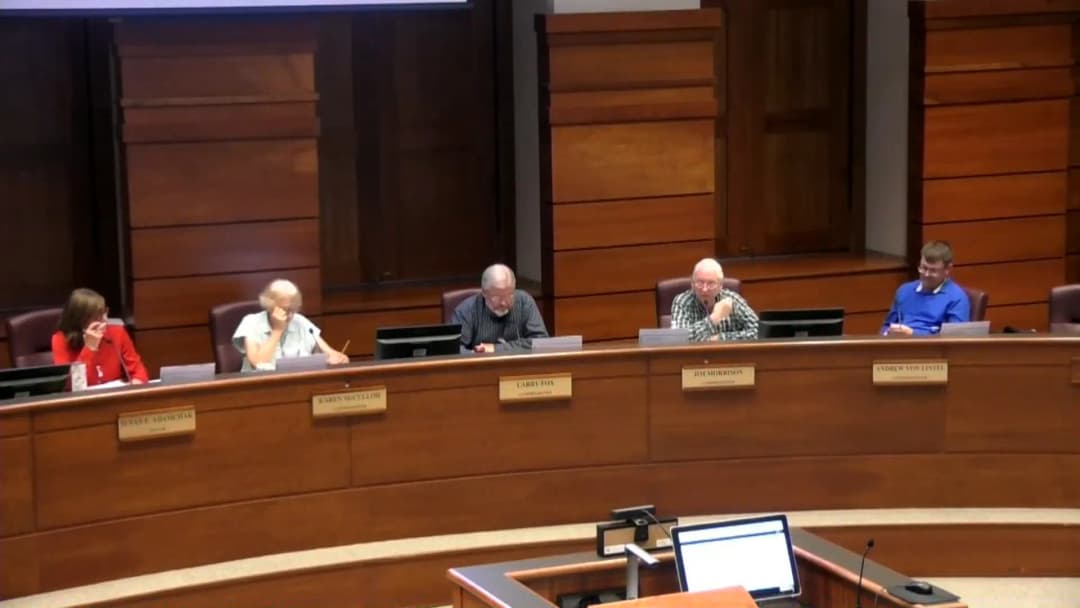
The Manhattan City Commission met on October 6, 2026, at 6:00 PM with all five commissioners present (Mayor Adam Chak, Commissioners McCullough, Fox, Morrison, and Von Lintel). The agenda included four proclamations, public comments on a sales tax initiative, debate on the Edge 3.0 development district, the Historic Preservation Plan, historic nominations, and a traffic signalization project. Proclamations - Library Savings Day: Bree (PR Manager) and Eric Norris (Director) from the Manhattan Public Library celebrated over $700,000 in lifetime savings among nine honorees. The mayor noted over $26,000 in personal savings. - Domestic Violence Awareness Month: Tyshell Jones (Deputy Director, Crisis Center) provided statistics from 2025 including 17,386 services provided, 746 unduplicated clients, 8,703 shelter bed nights, and 489 domestic violence calls handled by the police response advocate program. Events include Purple Thursdays and an October 13th community reception. - Physician Assistant Week: Christine Hazlitt (Clinic Director) noted the K-State PA program has graduated 118 PAs since 2000, with approximately 30% remaining in Kansas. Riley Gagan (VP of RPA Student Society) highlighted local fundraising for the Homestead and a fundraiser at Texas Roadhouse. - VFW Buddy Poppy Day: Clay Rose (Post Commander, VFW Post 1786) promoted the October 17th Buddy Poppy Drive. Funds support a local grant relief fund for veterans in need. Public Comments - Gary Oles: Commented on the upcoming sales tax ballot initiative. He argued the initiative is NOT a "pay-as-you-go" plan and will require bonding for large projects, contrasting it with the Quality of Life sales tax. He cautioned that bonding doubles the total cost of projects and noted the city's current debt burden, asserting the public should understand the sales tax will not immediately pay for all road improvements. - Melbourne: Commented on the replat for 300 North 11th Street (Item D2), noting the East Park neighborhood historic district nomination had been submitted to SHPO and urging caution pending that review. Commissioner Updates & Comments - Commissioner McCullough thanked the streets department for their flood response. - Commissioner Fox stated his understanding that the proposed sales tax is a "pay-as-you-go" model that will not be bonded, in contrast to Gary Oles' interpretation. - Commissioner Von Lintel reported on the Manhattan Free Clinic's relocation, a $100,000 Heritage Trust Fund grant for Black Entrepreneurs of the Flint Hills/Yuma Street Cultural Center, and the completion of a city-wide free Wi-Fi project funded by a nearly $1 million grant managed by WTC. Discussion Items Edge 3.0 Development District (CID, TIF, STAR Bonds) - Action: Setting a public hearing for the Community Improvement District (CID) petition, Tax Increment Finance (TIF) district redevelopment plan, and STAR bond redevelopment plan for the Edge 3.0 development at Kansas State University. - Debate: - Commissioner Morrison expressed strong opposition, citing unfulfilled promises from past projects (e.g., NBAF accreditation), the risk of speculation with taxpayer money, and the dispersal of commercial activity away from downtown and Aggieville. She requested financial assurances and contractual benchmarks. - Commissioner McCullough argued the city must support the university and that commercial development inherently carries risk. He noted negotiations with the foundation were ongoing regarding benchmarks for a development agreement. - Commissioner Fox supported setting the hearing but insisted the development agreement must be finalized and available for review at least two weeks prior to the November 17th hearing date, or he would move to delay. - Outcome: Motion to set the public hearing for November 17, 2026, and accept the CID petition passed 5-0. Sunset Cemetery & Sexton's House Historic Nomination (Item G1) - Action: Authorizing staff to finalize and submit nominations for the Sunset Cemetery Historic District and the Sexton's House to the State and National Register of Historic Places, and authorizing legal action to quiet title on the Sexton's House property. - Debate: - Commissioner Morrison initially attempted to separate the Sexton's House nomination from the vote until the title was established. This motion failed for lack of a second. - Public comment from Mick Charney raised concerns that the nomination form was being prepared solely from an eight-year-old city survey, lacking recent research and omitting key details such as architect Henry Winter. He urged collaboration with the preservation community. The City Manager agreed to facilitate this collaboration. - Outcome: Motion passed 4-1 (Commissioner Morrison dissenting). Historic Preservation Plan - Action: Accepting the Manhattan Historic Preservation Plan. - Debate: - Commissioner Morrison moved to table the plan to the December 8th work session, detailing approximately 30 to 40 concerns regarding potential liabilities, staffing requirements, and specific guardrails in the 233-page document. - Commissioner Fox seconded the motion, stating he needed more information on the plan's implications and responsibilities before adoption. - Commissioner Von Lintel advocated for passing the plan, describing it as a "tool" and "economic development." She cited the 2024 historic preservation annual report showing nearly $700,000 in private improvements and $500,000 in tax credits. She argued the plan commits the city to nothing but provides valuable resources for citizens and staff. - Public comment from Colleen Lynde and Mick Charney urged the commission to pass the plan, emphasizing it is a non-binding resource critical to catching up with national preservation standards. - Outcome: Motion to continue the item to the December 8th work session passed 3-2 (Commissioners Von Lintel, Fox, and Morrison in favor; Mayor Adam Chak and Commissioner McCullough opposed). Casement Road & Hayes Drive Signalization - Action: Authorizing a city-state agreement with KDOT for a traffic signal at Casement Road and Hayes Drive. - Details: Brian Johnson (Director of Public Works) presented the project. The intersection now meets four of eight warranting criteria for a traffic signal. The grant is approximately $500,000 with a 90% federal / 10% local split. The project was paused during levee construction. Benefits include improved pedestrian safety and rerouting semi-truck traffic. KDOT will not pay for pavement replacement on existing pavement, so that will be completed separately. - Outcome: Motion approved 5-0. Key Outcomes - Consent Agenda: Approved (excluding Items E2 and G1) by a vote of 5-0. - Edge 3.0: Public hearing set for November 17, 2026. CID petition accepted. Vote: 5-0. - Historic Nominations: Authorized staff to submit nominations for Sunset Cemetery and Sexton's House, and to petition for quiet title. Vote: 4-1. - Historic Preservation Plan: Tabled to December 8, 2026 work session. Vote: 3-2. - Traffic Signal: City-state agreement with KDOT for Casement & Hayes signalization approved. Vote: 5-0.

HISTORIC PRESERVATION 26% · PROCEDURAL 18% · ECONOMIC DEVELOPMENT 13% · ENGINEERING AND INFRASTRUCTURE 9%
3070
OCT 6, 2026 · BETHLEHEM, PENNSYLVANIA · COUNCIL MEETINGS
Committee of the Whole Meeting – October 6, 2026: 2027-2031 Capital Improvement Program Presentation

On October 6, 2026, the Bethlehem City Council Committee of the Whole met to discuss the proposed 2027–2031 Capital Improvement Program (CIP) for non-utility capital projects. The presentation was led by Planning and Zoning Director Kathy Fletcher, Business Administrator Eric Evans, and Deputy Director of Public Works Dylan Schlauzer. The City Planning Commission unanimously recommended approval of the five-year CIP on September 10, 2026. Discussion Items - CIP Overview: The CIP covers 2027–2031; only the first year (2027) is voted on. It includes a detailed spreadsheet and narrative. Funding sources explained include: capital reserves ($21 million set aside for 2026–2029), potential future bonds, federal and state grants, CDBG annual allocation, liquid fuels, stormwater fees, UGI cost-sharing ($2.5 million from degradation fees), recreation fees, general fund appropriations (including $1.95 million for the homeless shelter), and other sources. Existing bonds have been extinguished. - Public Safety: Annual ambulance replacement (one per year, $350-375k each through 2029), fire apparatus (two engines recently purchased, next order in 2032), police vehicles (five per year with 5% escalator), public safety cameras (funded via capital reserves and county NORCO grants), and a police armored vehicle replacement planned for 2029. - Traffic and Streets: Traffic signal upgrades at isolated intersections, Green Light Go grant (80% reimbursement, installation in 2027), Linden Street 2-to-1 lane conversion (construction in 2027), Center Street two-way conversion (updated cost estimate $3 million), street overlay program (2026 paved 4.51 road miles total), heavy-duty dump truck replacements (2028, 2030), milling machine replacement (2027 with trade-in), asphalt paver replacement (2031), East and West Broad Street Corridor Improvements (design complete, phased construction beginning 2027), complete streets plan implementation, and Stefco Boulevard corridor improvements (concept design in 2026, future grant pursuit). - Storm Sewers: Stefco drainage swale (three-phase project, design 2027, construction phase 1 in 2028), East Boulevard Detention Basin (paused due to Bethlehem Township postponement), Easton Ave to Stefco Boulevard storm sewer upgrades (two options under investigation, construction phase 1 in 2028), East Market Street drainage (construction in 2027), Yellowstrack Drainage Project (construction in 2027), corrugated metal pipe study and replacement, Cidersville Road culverts (future), Johnston Drive basin improvements (future), Chenault Drive basin restoration (future), and Grandview Boulevard/Ritter Street stormwater improvements (hydrologic study in 2027). - Facilities: HVAC upgrades at Ice House, health department second floor register replacement, Easton Ave Fire Station evaluation for reserve apparatus space, underground storage tank removal (near Serenity Gardens, one tree may need removal, coordination with city forester), City Hall ceiling and lighting replacement (future), mechanical room water pump replacements (remaining four of six in 2027), dry sprinkler system in parking garage (phased replacement before 2030 bond), and electrical bureau facility upgrades. - Grounds and Recreation: Standard capital improvements for fields, landscaping, tree removal, sidewalk replacements, and a leaf loader replacement (2027). General pool improvements, ice rink improvements, ice rink sanitary sewer installation (future, tie-in to city main), and parks and recreation master plan projects (upgrades to Bernie Fritz, Madison, and Clearview Parks, construction in 2027). Regarding Sand Island clay courts – they are not in the current plan due to an ongoing study. - Bridges and Other Infrastructure: Bridge repairs on 10 city-owned bridges (no priority one items in 2026), Main Street ramp and Spring Street ramp projects (coordinate with Hill-to-Hill Bridge), 378 lighting replacement (awaiting PennDOT design), Minocasse Way Trail (design complete), South Bethlehem Greenway and Saucon Rail Trail connection (90% design complete, construction 2027), South New Street trail (consultant selected, design 2026, construction hoped for 2027), Gap Street and Geiter Street sidewalk improvements (designs complete, construction 2027 if funding secured), and Sun Inn Courtyard renovation (future, seeking funds). - Community and Economic Development: Non-congregate family shelter (all funding secured, construction 2027), congregate emergency shelter (renovation for 60+ individuals per night, $2 million city investment plus $2.2 million secured from federal/state, design/engineering in 2026), and South Bethlehem Community Center (preferred operator chosen, RFP for design/engineering in 2026 or early 2027, capital campaign to follow). - Council Questions: - Council Vice President Laird asked about coordination for tree removal near Serenity Gardens; administration confirmed one tree may need removal and coordination with the forester for replacement. - Laird asked about Sand Island clay courts; administration stated they are not in the plan due to an ongoing study. - Councilman Quitek asked about the Hill-to-Hill Bridge construction timeline; administration responded that PennDOT’s let date is November 2026, so construction likely will not start until 2027 or later. Key Outcomes - No vote was taken; the presentation was informational for council deliberation. - First reading of the proposed 2027 non-utility capital budget will occur at the November 17, 2026 council meeting, with final reading on December 15, 2026. - Per ordinance, the five-year CIP may be modified by an affirmative vote of five council members. - Administration will continue to identify funding sources for outyear projects (2030–2031) and pursue grants for many listed projects.

PUBLIC WORKS 35% · PROCEDURAL 12% · TRANSPORTATION SAFETY 9% · BUDGET EQUITY ANALYSIS 7%
OPENPUBLICA · PUBLIC MEETING INDEXUPDATED DAILY · openpublica.com