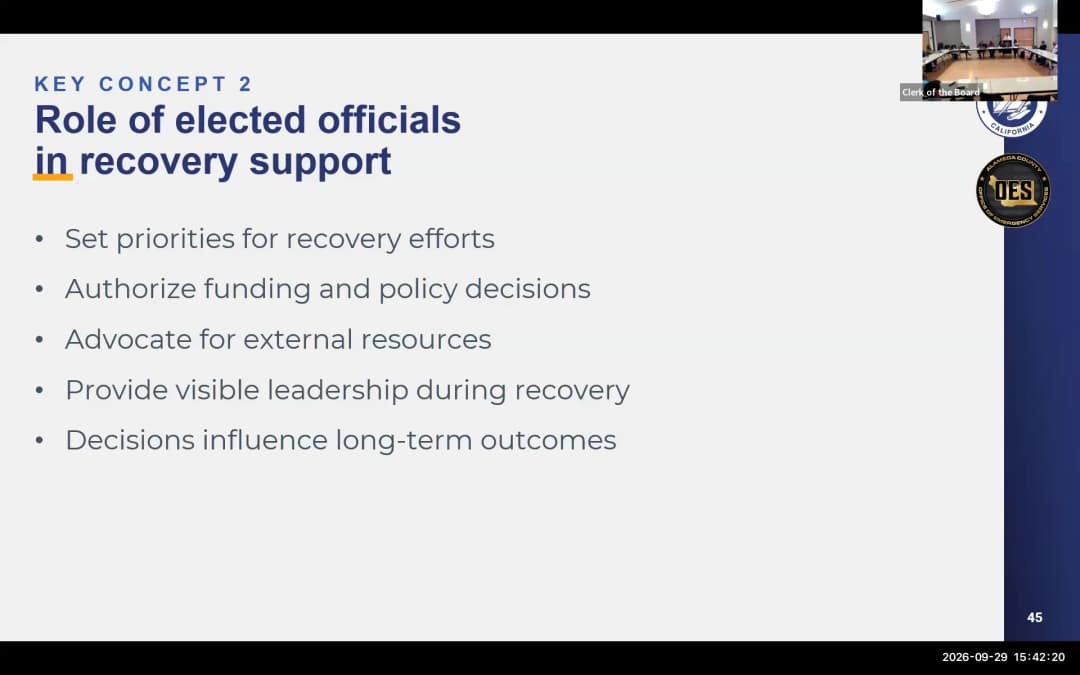
The Alameda County Board of Supervisors convened a special meeting to receive reports on federal/state/county budget and financial conditions, an update on the Home Together and homelessness system, and disaster preparedness training for the Board and department heads. The meeting opened with closed session conferences on labor negotiations, potential and existing litigation, and real property negotiations for the Oakland-Alameda County Coliseum and Arena Complex. No formal votes were taken during open session. Note: the agenda for this meeting is dated Tuesday, September 29, 2026, while the source metadata provided for this summary identifies the meeting date as October 2, 2026. Public Comments & Testimony - One in-person speaker during the homelessness item made largely unintelligible remarks referencing financial donations, property ownership, bankruptcy proceedings, and pending court litigation. - A later public commenter made similarly unclear remarks referencing compliance directives, the SLAPP Act, and what appeared to be references to burial/military standards; the transcript is too garbled to establish a clear position. Discussion Items Federal, State and County Budget/Financial Updates - County staff reported the FY 2026-27 final adopted budget totals approximately $6.7 billion across all funds, a 10% increase over the prior year. - The county closed roughly half of a $185 million maintenance-of-effort funding gap with $93 million in retirement savings and prepayments of pension liabilities. - Budget components include $2.2 billion in salaries and benefits for approximately 10,000 employees; $1.25 billion in community-based organization (CBO) contracts, including $140 million for Alameda Health System contracts; $440 million for housing and homelessness programs; $347 million in Measure W investments; $387 million for direct municipal services; and $477 million in drug-related payments (transcription unclear). - The Federal Reserve raised its benchmark interest rate on September 16, its first increase since July 2023, in an effort to address a surge in oil prices; inflation remains more than a percentage point above the Fed's 2% target. - Nearly 13,000 area layoffs were reported by early September 2026, notably higher than last year; globally, technology layoffs affected more than 76,000 workers as of July 2026. - Housing market data (August): median single-family home price of $1.285 million, up 0.8% from the previous month; home sales down about 14% from last month and down 9% year over year; inventory up about 15% compared to July but down about 12% from a year ago; median time on market of 14 days, down 7% from the previous month; the statewide median time on market was 53 days. - A supervisor reported that a prior committee advanced, for full Board decision: support for the Veterans Affordable Housing Bond Act of 2026; support for Proposition 40, a one-time wealth tax for state-funded health care, education, and food assistance; opposition to Proposition 43, a two-thirds vote requirement for local special tax initiatives; and support for the regional transportation measure. Fourteen statewide ballot propositions are qualified for the November ballot. - A supervisor noted reports that the health care provider identified in the transcript as "ISER" will lay off 147 employees in Pleasanton and Oakland and asked whether other regional providers are affected. - Supervisors requested: CBO employment data; updates on departmental fee increases; an assessment appeals timeline that meets the next lookback period; Measure W revenue overages above the anticipated $170 million once books close; budget-to-actual information for the last fiscal year; a deeper revenue analysis, particularly sales tax tracking; and continued attention to charging back hospital service costs while controlling costs. Update on Board Initiatives: Home Together and Homelessness System - The draft Home Together 2030 plan is out for a 45-day public comment period ending October 1; it will be presented to the Mayors Conference on October 14, with a final draft submitted to the Board for adoption in November and city endorsements to follow. - The plan's five pillars are prevention, access, shelters, housing, and health care, supported by system foundations; headline goals are reducing overall homelessness by one-third and reducing unsheltered homelessness by 50%. - Year-four system data show, for the first time, more people exiting to housing than entering or returning to homelessness; the county also saw improvements in racial equity in returns to homelessness, with most populations at or below the system-wide average. - FY 2024-25 funding proportions were approximately 43% state, 28% local, and 28% federal, prior to the rollout of Measure A investment. - The HUD Continuum of Care application, submitted after more than 100 hours of work by the team over 10 business days following a surprise court ruling, seeks $74 million (up to $10 million more than last year). Roughly $64 million of base annual funding is at risk; $38 million is expected to be renewed; more than $26 million of currently funded grants were ineligible under new policy; and about $19.5 million has no current funding disposition. The county also proposed $26 million in new projects. - Home Together Fund staffing is at 122 total FTE, including 45 funded positions, 36 new positions created over the last fiscal year, and 19-plus positions still under discussion; more than 100 positions are currently filled. - Over the life of the measure, projected impacts include more than 1,400 new subsidies, 1,400 new housing units, and 300 new shelter beds. - Shelter stabilization: the Social Services Agency maintains 813 shelter beds at a rate of $36 per night, unchanged since 2018; the Board approved a one-time $13 million allocation. New rates take effect January 1, 2027; the expanded rates will cost roughly $38 million per year (transcript reads "to fund equally 113 beds"). Contracts will run 18 months with a three-month ramp-up period, a four-person compliance team, and temporary 75% rate withholding for sustained non-compliance, though staff stated shelters would not be closed and residents would not be put back on the street. - Homelessness prevention: since July, more than $8 million annually has been added to housing resource centers for flexible financial assistance, case management, and legal services; a forthcoming prevention hub procurement will create a centralized access point. The goal is $20 million total in prevention investments each year, separate from the $150 million flexible fund for people currently experiencing homelessness. - Approximately 300 behavioral health bridge housing beds, opened with one-time state Care Court funding, are at risk of sunsetting; staff are exploring sustaining a subset. - In District 1 (Tri-Valley), the point-in-time count has increased while the county overall declined; 12% of Home Together Fund investments to date have gone to District 1, double its share of the point-in-time count. Staff are waiting on a proposal from three Tri-Valley cities and emphasized the need for city partnership on siting. - Supervisors raised concerns about: hiring speed and civil service constraints despite the declared housing emergency; enforcement of shelter standards and rules at housing sites (one supervisor warned of a "backlash of support" for Measure W if public safety concerns at program sites are not resolved); the voluntary nature of treatment services; coordination with cities on capital procurement for acquisition, rehab, and conversion of existing properties; capacity building for smaller community-based organizations; vehicular homelessness and safe parking; and the Home Stretch coordinated entry system, which staff described as a matching system for a queue of about 4,000 prioritized individuals, not a source of new housing. Disaster Preparedness Training - The training was led by County Emergency Manager Brent Blazer and introduced by Hayes Stokes; the Board and department heads received an electronic emergency handbook. - Key concepts: elected officials serve a governance role (policy, funding, advocacy, public leadership) distinct from operational command; the Emergency Operations Center is an information management and coordination function; officials should plug into briefings and liaisons rather than self-deploy or direct field operations; and public statements should rely on verified information coordinated with the Public Information Officer. - Emergency proclamations are governance tools tied to resource needs and authorities, generally made within about 10 days of a disaster, with ratification by the Board within up to seven days when urgent; documentation of emergency expenditures is essential for reimbursement. - Recovery transitions should begin as soon as the immediate threat ends; recovery typically spans five to seven years, with public assistance supporting government infrastructure and individual assistance supporting affected residents and businesses. - Scenario discussions covered earthquakes, wildfire season, flooding, public information/media inquiries, offers of donations and volunteers, and disaster service workers. - Supervisors discussed the Urban Shield training program, praising its multidisciplinary value and noting the loss of federal funding after a 3-2 Board vote; the sheriff's office is working to bring back smaller-scale training. - OES staffing: the Board previously approved 14 positions; nine have been hired, five vacancies remain with interviews scheduled in two weeks, and OES now has 10 staff. Nearly 1,300 people have newly signed up for AC Alert as of the day before the meeting. - Supervisors requested a tabletop exercise for the Board and department heads, ongoing training, clearer media protocols for directing press inquiries, and continued coordination with cities on preparedness; all county employees are disaster service workers. Key Outcomes - No formal open-session votes were taken; the agenda items were informational/presentational. - Closed session conferences were held on labor negotiations with all labor organizations and Teamsters Local 856, potential and existing litigation (including Goolsby, Mendoza, and Boyette cases), and Coliseum property negotiations with Oakland Acquisition Company, LLC, Coliseum Way Partners, LLC, and the City of Oakland; County Counsel reported but the transcript does not detail actions. - The final Home Together 2030 plan is expected to go to the Board for adoption in November, following the October 14 Mayors Conference presentation. - New shelter reimbursement rates take effect January 1, 2027, under 18-month contracts. - The HUD Continuum of Care application, seeking $74 million, was to be submitted on the day after the meeting per the presentation. - The County Administrator's Office was asked to return with CBO employment data, budget-to-actual analysis, deeper sales tax/revenue reporting, Measure W overage figures, and prioritized departmental fee studies. - OES will fill five vacancies, pursue a Board tabletop exercise, and continue developing city coordination and public preparedness resources.

The Public Meeting Index
The Public Meeting IndexThe Lake County Technology Committee met on October 2, 2026, at 8:30 a.m. via in-person and remote attendance (Zoom). Chair Hart called the meeting to order with the Pledge of Allegiance. Roll call showed members Altenberg, Cosman (with notice), Roberts (possibly absent), and Forth (Alterberg) absent with prior notice. The meeting covered several resolutions, a broadband update, an ERP system implementation update, and a director’s report. Consent Calendar - Item 8.1: Consent agenda approved unanimously by voice vote (motion by Frank, second by Kasmin). Discussion Items - Item 8.2 – Joint Resolution for Audio-Visual Upgrade in Courtroom 201: Lisa Wolf (Director of Finance for the Courts) and Winnie Weber (Director of Technology) presented a contract with Conference Technologies Inc. of Itasca, Illinois for $39,659 to replace equipment in courtroom 201 that has reached its end of useful life (15–17 years old). The upgrade will remove VHS capabilities and upgrade the monitor in the largest civil division courtroom. Member Frank commended maximizing the useful life. The resolution passed unanimously (motion by Frank, second by Peterson). - Item 8.3 – Joint Resolution Approving a Dig Once Policy: Betsy Brandon (Assistant County Administrator) and Kim Lunt (Digital Equity Coordinator) presented the Dig Once Policy, which standardizes annual coordination among Lake County land departments around five-year underground projects. The policy aims to minimize community disruption, encourage ISP infrastructure alignment, and promote digital equity. It was identified as a strategy in the Broadband and Digital Equity Action Plan adopted in December 2023. Questions from members focused on communication tools (e.g., GIS templates) and ensuring minimum specifications for department processes. The resolution passed unanimously (motion by Kasbin, second by Frank). Chair Hart expressed excitement, noting the policy will improve coordination and reduce repeated digging. - Item 9.1 – Broadband Update: Kate Crandall (Digital Equity Manager) and Kim Lunt provided updates on BEAD funding: Illinois received NTIA approval on August 25, 2025, and a notice of award from NIST on September 22, 2026, initiating a six-month timeline for grant agreements. In Lake County, 1,929 locations will be served: 1,248 by fiber (Strategic Management and Illinois Bell/AT&T) and 502 by satellite (Amazon). Chair Hart expressed disappointment that satellite lacks affordability components and that Amazon received billions without guaranteed discounts for residents. Crandall noted that the change was due to federal “benefit of the bargain” rules, and that competition from local ISPs is increasing. Public Wi-Fi pilot projects in Waukegan and North Chicago (funded by ARPA) have equipment ordered; installation expected by the end of 2026. A video highlighted summer youth employment program: 121 participants received digital skills training and laptops. Metrics from August 2025 to August 2026: over 6,600 residents served, over 6,200 learning sessions, nearly 2,000 devices distributed (cumulative over 2,000), over 5,500 hours of digital navigator instruction, and over 20,000 hours of participant engagement. The Digital Equity Coalition meeting had 47 attendees from 27 organizations; planning meetings for a partner-led continuation are scheduled for October and November. - Item 9.2 – ERP System Implementation Update: CIO Chris Blanding (remote) and Patrice Evans (ERP Program Manager) reported that the project is in parallel testing for payroll, comparing August 2026 legacy payroll to Workday processing. Goal is 95% accuracy in the first three-week period and 99% in the second; results are in the upper 80s to low 90s percent so far, which Strata (the implementer) considers impressive. End-to-end testing is behind schedule but a contingency phase is underway; business-critical tests are being executed with one-on-one guidance. Financial data validation is ongoing. Cutover planning (with 600–700 tasks) has started; data for the gold tenant (production environment) will be built next week. Change management includes newsletters, department meetings, a change champion network, and a dedicated Workday page on the employee portal. Training is targeted for November and December. Go-live is scheduled for December 1, 2026, with phased rollouts to functions. Chair Hart and members praised the thorough approach and emphasized the importance of change management. The project uses ARPA funding and is on time. - Director’s Report: CIO Chris Blanding announced October is Cybersecurity Awareness Month. The annual required security awareness training is delivered via a “Ninjo” video (theme: “don’t make it easy for them”) with John Lovett as a fan favorite. Monthly phishing tests are conducted; employees who fail receive follow-up education. Chair Hart noted the increasing threat of AI voice spoofing and asked about trends; Blanding confirmed tracking and can present quarterly stats. Key Outcomes - Item 8.2 passed unanimously: contract with Conference Technologies Inc. for $39,659. - Item 8.3 passed unanimously: Dig Once Policy approved. - Broadband updates received; committee noted progress and concerns about satellite affordability. - ERP update received; committee expressed support and noted go-live remains on track for December 1, 2026. - Director’s report received; cybersecurity training will be completed by staff within 30 days. - Member remarks: Vice Chair Kasmin thanked Chair Hart for leadership at NACO, presenting resolutions that became national priorities. Chair Hart commended Vice Chair Kasmin for representing the committee at Digital Equity Coalition meetings.
(Note: The transcript indicates the meeting was held on Thursday, October 1, 2026; the provided timestamp is October 2, 2026. The summary uses the provided date as instructed.) The Personnel and Administration Committee of the St. Louis Board of Aldermen met to consider Resolution 125, a committee substitute to formally condemn and reprimand Alderwoman Sharon Tyes (12th Ward) for remarks made on September 14, 2026, at a community meeting at Homer G. Phillips Senior Apartments. During that meeting, Tyes allegedly stated she would "put a bullet in the head" of Alderman Devotee (14th Ward). The committee heard testimony from the resolution's sponsor, President Green, the affected alderman, and public testimony. After discussion, the committee voted unanimously to pass the resolution with a "due pass" recommendation to the full board. Public Comments & Testimony - Precious Jones (Chairwoman of Mamas Against Homicides, resident of 12th Ward): Expressed strong support for accountability, stating that "a bullet is not an analogy" and that Tyes' remarks were harmful to survivors of gun violence. She called on Tyes to apologize and criticized the belittling of a colleague's past employment. She stressed that elected officials must model the behavior expected of youth. Discussion Items - Resolution 125 Committee Substitute: President Green explained the resolution was filed to compel Tyes to apologize for her remarks, and failing that, to enter a formal reprimand by the board. She noted that removing from committees was not applicable since Tyes has not attended committee meetings. - Alderman Devotee (14th Ward) described the background: long-standing issues at Homer G. Phillips senior apartments where Tyes made the remarks. He stated that Tyes expressed disdain for his introduction of a bill to transfer the lease, and during an hour-long video-recorded meeting, she launched personal attacks including stating he "does not belong at the Board of Aldermen" and that she would "put a bullet in my head." He argued such language cannot be tolerated, especially given the board's unanimous passage of a gun violence awareness resolution. He urged support for the resolution and asked to be added as a co-sponsor. - Alderman Devotee (committee member): Commented that accountability must be applied across the board, as other members have been disrespectful. He asked President Green to ensure broader professionalism. President Green committed to working on board rules in the next session to improve discourse. - Alderman Clark Hubbard: Emphasized that words matter, and such speech would be grounds for termination in civil service. Supported the resolution. Key Outcomes - Vote on Resolution 125 Committee Substitute: Motion to pass with a "due pass" recommendation. The committee voted 5-0 in favor (Vice Chair Cohn, Alderman Boyd, Alderman Clark Hubbard, Alderman Aldrich, Alderman Devotee, President Green). Alderman Cohn was excused. - The resolution now proceeds to the full Board of Aldermen for consideration.
The Nashua Planning Board met to take up a conditional use permit, a two-lot subdivision, and a 44-unit townhouse site plan. The transcript opens with the chair calling the October 1, 2026 meeting to order, while the provided meeting metadata date is October 2, 2026; this summary uses the provided metadata date. After roll call established a quorum, the board approved minutes, received staff communications, and then acted on the three applications, with the townhouse site plan requiring a threshold jurisdictional ruling before its merits were heard. Minutes and Communications - The board approved the minutes of the September 17, 2026 meeting on a motion by Mr. McIntyre, seconded by Mr. Hudson, with one abstention. - Staff reported that the site plan application for 181 East Hall Street had been postponed to the October 15, 2026 meeting at the applicant’s request. - Staff noted revised reports for 8 Blue Hill Avenue and 66 Concord Street, additional public correspondence for 8 Merritt Parkway, and a revised tentative agenda, all updated as of 4 p.m. - No committee or liaison reports were given. Conditional Use Permit – 8 Blue Hill Avenue (A26-0194) - Applicant Connor Walsh of Paul Francis Development Group sought a conditional use permit to convert an existing two-family duplex into a two-unit condominium. - The applicant stated there would be no exterior renovations, square footage changes, or added bedrooms or bathrooms; the property had already been renovated and inspected. - The applicant said selling the property as two condominiums would produce a 10 to 15 percent per-square-foot premium, and that the property is connected to city sewer and water, so no septic system condition applied. - In response to a board question, the applicant said condo documents would treat the shared sewer service as common area, with each unit owner responsible for 50 percent of maintenance costs. - No public testimony was offered. The board accepted jurisdiction and approved the conditional use; both votes passed without opposition. Subdivision – 66 Concord Street (A26-0167) - Applicant Crimson Properties LLC, represented by engineer Paul Chisholm and attorney Brad Westgate, proposed a two-lot subdivision of the corner property at 66 Concord Street, which is in the RB zoning district and the historic overlay district. - The existing parcel contains just under 25,000 square feet and includes an 1870 home in need of substantial repair. The plan includes renovation of the existing home, replacement of a carriage house, construction of a new carriage house, and construction of a new single-family home with a detached garage on the newly created lot. - The applicant said both resulting lots meet all dimensional requirements of the RB district and that no variances are needed. The applicant also discussed prior court cases, Victorian Realty Group from 1987 and Gutterman from 2009, while arguing that this proposal is materially different because of nearby comparable lot sizes, abutter support letters, and existing historic district conditions. - The applicant requested two waivers: one from the requirement to survey existing conditions within 1,000 feet of the site, and one related to overhead utilities. - Staff clarified that the staff report was neutral because of the prior case-law history, and that the Historic District Commission would still need to review the new residence before a building permit could be issued. - No members of the public spoke in opposition or in favor during the hearing. - Board members discussed the lot’s compatibility with the neighborhood and the limits of the board’s review. The board granted both waivers and approved the two-lot subdivision subject to staff conditions A through M. The votes were unanimous. Site Plan – 8 Merritt Parkway (A26-0166) – Jurisdictional Determination - The board first considered a Fisher v. Dover issue because the applicant had previously received approval for the same 44-townhome project in 2024, but that approval was appealed and remained in litigation before the Supreme Court. - Staff and the applicant argued that recent state law changes, specifically HB 631 from 2025 and HB 1588 from 2026, amended RSA 674:80 and related statutes to require municipalities to allow multifamily dwelling units on commercially zoned land, eliminating the need for the density, story-height, multifamily-use, and age-restriction relief previously required. - The applicant quoted the earlier Superior Court ruling that the appropriate remedy was legislative in nature, and argued the legislature had since provided that remedy. - Abutter counsel letters, discussed by staff and a public speaker, disputed that the law removed the age-restriction requirement. State Representative Santosh Salvi also argued that the April 2025 Superior Court order reversing the age-restriction variance remains active and that the applicant still lacks legal relief from the elderly-housing restriction. - One resident noted that the Supreme Court had heard the case. The chair limited public testimony at this stage to the jurisdictional question. - The board voted to find that the Fisher v. Dover test was satisfied based on a material change in circumstances, specifically HB 631 and HB 1588, and then voted to accept jurisdiction. Both motions passed. Site Plan – 8 Merritt Parkway (A26-0166) – Merits and Public Testimony - On the merits, the applicant presented a 44-unit townhouse development on a 6.2-acre condominium parcel within an overall 20-acre property, located in the R30 zoning district and the flexible-use overlay district. - The project would consist of 11 buildings with four townhouse units each, a new private roadway, underground utilities, an enhanced landscape buffer, and access through Merritt Parkway from Conant Road or Buckmeadow Road. - The applicant said the alteration of terrain permit had been approved and that water, sewer, and traffic capacity were adequate. - On traffic, the applicant said the development was projected to generate approximately 322 weekday daily trips and 358 Saturday daily trips, below the city’s thresholds. The applicant also cited peak-hour figures of 24.6 trips in the PM peak versus a 75-trip threshold, and 30.8 trips at the development peak versus a 100-trip threshold. - Board questions addressed tree clearing, which the applicant estimated at about 15 percent of the site; avoidance of work in the wetland buffer; the absence of affordable units; the inapplicability of inclusionary zoning because state law preempts density regulation; dark-sky-compliant lighting; and parking at one garage space and one driveway space per unit, supplemented by a shared parking analysis. - Public opposition included: - Gloria McCarthy, a Conservation Commission member and nearby resident, cited wildlife, lighting, chemicals, water quality, traffic, the nearby Wise Owl Academy expansion, and approximately 322 daily trips versus 99 trips from a prior project. She said roughly 250 emails had been sent in opposition and asked the board to deny the application in its current form. - Steve Danworth, president of the Houston Drive condominium association, said the proposed density of about seven units per acre was inconsistent with the master plan’s medium-density vision for the area and incompatible with the neighborhood. - State Representative Santosh Salvi said the neighborhood has fought the project for eight years, raised traffic and intersection safety concerns, argued that the project does not serve HB 631’s affordable-housing intent, and said it would displace the character of a neighborhood that includes elderly residents. - Jessica Taylor of Gilson Road opposed the development due to school traffic, pedestrian safety, loss of nature, and permanent changes to the area. - Raymond Johnkis of Houston Drive raised concerns about parking, guest and delivery vehicles, blasting, vegetation removal, and wildlife. - No one spoke in favor of the site plan. Board Deliberation and Key Outcomes - In deliberation, board members said the new state statutes, particularly RSA 674:80, limited the board’s discretion to specific issues such as road infrastructure, water infrastructure, and sewage infrastructure. Staff warned about a new attorney-fee reimbursement provision for improper denials, and Alderman Clee said she would vote for approval because state law tied the board’s hands. - Some board members noted that a commercial use, including one previously possible on the property, could have generated more traffic and more impact than the proposed townhouses. Mr. Hirsch said he had supported the project in 2024 and considered it a good project, while Mr. Zoller viewed it as consistent with the mixed-use overlay district. - The board granted the requested waiver from section 190-279 EE on a unanimous vote. - The board granted final site plan approval for the 11 four-unit townhome buildings and associated improvements, finding that the site plan meets the approval criteria under NRO section 190-146D and is subject to staff conditions A through M. The vote was by roll call and was unanimous. - The board also determined that no items on the tentative agenda were proposals of regional impact, and then voted to adjourn at 9:44 p.m.
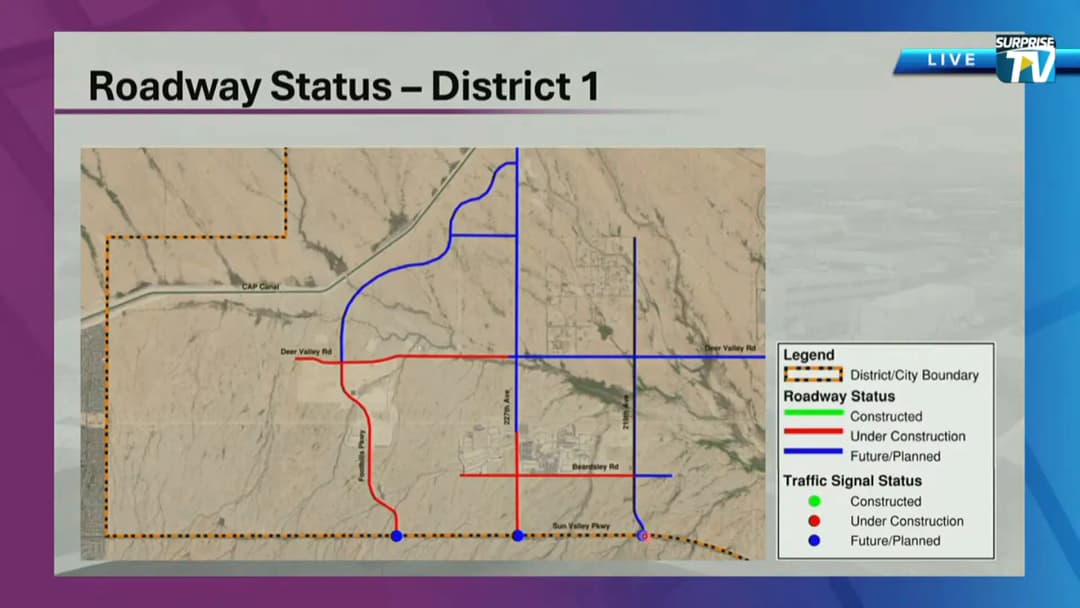
The Planning and Zoning Commission met on October 2, 2026, to receive a comprehensive update on development activity, community development operations, and transportation improvements across the city. The meeting began with staff introductions and the approval of the 2027 meeting calendar. Consent Calendar - The commission unanimously approved the consent agenda (motion carried with six votes in favor). - The commission unanimously approved the 2027 Planning and Zoning Commission meeting calendar (motion carried with six votes in favor). Discussion Items - Staff Introductions: Assistant City Manager introduced new Community Development Director Mindy Davis (28+ years experience in Phoenix) and new Planner I Aiden Murray (a Surprise native, graduate of ASU, previously a code enforcement intern). - Development Activity Update: Trevor Fleetham and other staff presented an overview of planning and zoning activity, noting a decline in cases due to administrative approvals and market conditions. Key statistics for fiscal year 2026 included: - 4 preliminary plats approved covering 992 lots. - 38 final plats (26 residential, 12 commercial) with just under 1,500 platted lots. - Community Development generated approximately $15.9 million in revenue. - Building plan reviews: 14,039 completed with a 99% on-time rate. - Permits issued: 2,020 single-family, 27 multifamily, 180 condominium/townhome, 391 pool, and 255 commercial permits (573,000 sq ft, $65.6 million valuation). - 210 tenant improvement permits ($50.5 million valuation). - 44,533 building safety inspections (avg. 17 per inspector). - Code enforcement opened 6,234 cases, resolved 6,245, completed 15,810 inspections, removed 1,300 illegal signs, and a cleanup event collected nearly 10 tons of trash and 83 tires. - Transportation Improvements: Stephen Chang presented road projects by district, including completed, under construction, and planned roads, as well as new traffic signals. Notable projects: 163rd Avenue extension, Happy Valley Road bond project (60% design), and new signals at multiple intersections. Commissioner Holland raised a safety concern about visibility at Greenway and Saroval due to a fence on a well site; staff noted future road narrowing will improve sight lines. Commissioner Everett asked about making the presentation publicly available; staff confirmed it will be part of the meeting record on the city website. Key Outcomes - Unanimous approval of the consent agenda. - Unanimous approval of the 2027 Planning and Zoning Commission meeting calendar. - No non-agenda public comments or future business items. - Meeting adjourned.
The Board of Park Commissioners met on October 1, 2026, to address several agenda items including land dedication, annual reports from arts and sports organizations, funding disbursements to cultural centers, and approval of a new pavilion design at Reese Park. The meeting concluded with updates on capital projects and a public comment regarding a historical marker. Consent Calendar - Unanimously approved the minutes of the regular meeting from August 6, 2026. Public Comments & Testimony - Michael Givell, Ward Two, commented on the proposed Fansville Pocket Park, advocating for a historical marker and asking about the process for creating such a marker, including public review and accuracy of historical prose. He noted evidence of a Hooverville from the Great Depression on the site. Discussion Items - Previously Approved Council Items (September 2026): Staff reported on several council-approved items including a built environment grant ($598,000 total, $299,000 per year for two years), annual reports for Firehouse Arts Center, Norman Optimist Club, Westwood Golf Maintenance, and others. Also noted $75,000 for median landscaping near Quick Trip, and $360,000 transferred for emergency repairs after July 4 storms. - Retreat at Norman Edition – Park Land / Fee in Lieu: The development at Highway 9 and 12th Avenue SE proposes 190 units of duplexes and apartments. The developer offers 2.05 acres of private park land (above the required amount) with programming (pickleball, picnic areas, dog park). Staff recommended accepting the private park solution, citing proximity to existing public parks and safety concerns about railroad crossings. The board voted unanimously to accept the recommendation. - Annual Report – Norman Arts Council (NAC): Executive Director Leslie Nottingham presented the NAC’s public art activities. Key points: new public art map at normanarts.org (with voiceovers for accessibility), condition reports on the 20-year-old duck sculptures (five may need retirement), a new interactive art piece “Prairie Signal” for University Town Center (first interactive piece for Norman), mural incentive program, and plans for Gray Street barrier wall murals. The NAC’s public art fund start balance was $53,771.08. Board accepted the report and voted to forward to city council. - Annual Report – Norman Youth Soccer Association (NYSA): Executive Director Brian Judge reported on NYSA’s programs (recreational, academy, competitive, adult, TOPS for special needs) and a record 283 teams at the Celtic Cup tournament (812 room nights). Concerns were raised about a $500,000 drop in competitive revenue from 2025 to 2026 in the budget. Judge attributed it to accounting errors from multiple registration platforms. Board voted to postpone forwarding the report to city council until NYSA provides a written explanation of the discrepancy. - Annual Report – Little Axe Youth Sports: Vice President Brandon Smith presented for the small rural league. Approximately 60 athletes (ages up to 10U) participated in 2025. Field drainage issues and sticker weed problems were noted. Staff offered maintenance assistance. Board voted to forward the report to city council. - Annual Report – Healthy Living Norman: No questions from board; staff recommended forwarding to city council. Approved unanimously. - Funding Disbursements for FY2027: Three cultural centers received funding allocations: Moore Lindsay Historical House ($62,500, including $5,500 carryover), Sooner Theater ($109,286), and Performing Arts Studio/Depot ($61,188, including $5,700 carryover). This is the first year under a new process where city council provides a lump sum to the parks board for distribution. Board approved each separately. - Reese Park Open Air Pavilion Design: Students from OU Gibbs College of Architecture presented the “Wing Pavilion” design – an airfoil-inspired roof with mass timber structure, designed for durability, shade, and community use. The pavilion will be built by students at no cost to the city (city pays for materials, $80,000). Board approved the design and recommended the contract with the university. Key Outcomes - Approved the private park decision for Retreat at Norman Edition (unanimous). - Accepted the Norman Arts Council annual report and forwarded to city council. - Postponed forwarding the Norman Youth Soccer Association annual report pending explanation of budget discrepancy (unanimous). - Accepted and forwarded the Little Axe Youth Sports annual report. - Accepted and forwarded the Healthy Living Norman annual report. - Approved three funding disbursement agreements: Moore Lindsay Historical House ($62,500), Sooner Theater ($109,286), and Performing Arts Studio ($61,188) – all passed separately. - Approved the design of the Reese Park open-air pavilion and recommended the contract with OU Gibbs College of Architecture. Updates & Other Business - Norman Forward Update: Projects ongoing (Bluestem Park, Saxon Park, land acquisition near Canadian River). Last play at Reese Park scheduled for October 11; Kids Space groundbreaking October 14. - Division Updates: Maintenance reported on sticker weed treatment at Little Axe, Dr. Pepper water tower painting (completion mid- to late October), and other capital projects. - Public Comment: Michael Givell’s comments were officially noted.
The Wilmington City Council met in regular session on Thursday, October 1, 2026, at 6:32 PM under President Trippy Congo. The meeting included committee reports, a treasurer's report, recognition resolutions, public comment, and legislative action on several ordinances and resolutions related to public safety, housing, fines, and appointments. Consent Calendar - Committee reports from the Community Development and Urban Planning Committee (September 16) and the Public Safety Committee (September 21) were received, recorded, and filed. - Treasurer's report: Total investments $592,915,536.51; cash on hand $19,186,810.96; grand total $612,102,347.47. Received, recorded, and filed. - All non-legislative business was accepted by voice vote. Public Comments & Testimony - Deacon Earl Treings spoke about adults being role models for children. - Kathleen Patterson (Second District) spoke in support of the security deposit and first month's rent assistance pilot program, citing the need to invest in families and prevent homelessness. She noted that many families struggle with upfront housing costs despite having income for rent. Discussion Items - Recognition Resolutions (Hispanic Heritage Month): Councilmember Cabrera recognized Sarah Reyes (CEO, Seeds of Jesus Daycare, 20 years of bilingual childcare), Jasmine Robles (8 years at Merengue House), and the Delaware Art Museum for multicultural programming. Speakers expressed gratitude and emphasized community impact. - International Wrongful Conviction Day: Councilmember Darby recognized October 2, 2026 as International Wrongful Conviction Day. Leah Reynolds (executive director, Innocence Project Delaware) thanked the council and highlighted systemic barriers to justice. - Nataki Oliver Recognition: Councilmember Harley recognized Nataki Oliver for her contributions to visual arts and her appointment to the Delaware State Arts Council. Oliver spoke about supporting local artists and retaining creative talent in Wilmington. - Other Recognitions: Councilmember McCoy recognized the 10th anniversary of the Wilmington Fire Department remembrance ceremony; Councilmember Cabrera recognized Mayor James Sills' 95th birthday; sympathy resolutions were noted for Patrick Cook, Andre Honey, Lynette Archie Snow, and Stephanie Sutton. - Legislative Business (Resolutions): Councilmember Owens presented five resolutions (26-067 through 26-071) authorizing grant applications to the Delaware Prescription Opioid Settlement Distribution Commission, totaling $90,000 for AEDs and NARCAN, $83,200 for a community health liaison, $63,000 for grant compliance, and $4,183 for a victim services specialist. All passed unanimously with discussion on the importance of opioid settlement funds. - Ordinance 26-047: Approved major subdivision plan for 2510 Northeast Boulevard and street dedication. First and second readings were called, no vote recorded. - Ordinance 26-044 (Substitute): Increased fine for blocking parking spaces from $60 to $75. Debate centered on enforcement vs. fine increase; supporters argued it raises awareness, while opponents noted low enforcement. Passed 10-3. - Ordinance 26-045 (Substitute): Increased minimum fine for public alcohol consumption from $100 to $150 within 300 feet of schools, places of worship, community centers, or package stores. After extensive debate on enforcement and equity, the sponsor (Councilmember Oliver) held the legislation. - Ordinance 26-046: Extended insect/rodent control regulations to self-service storage facilities. Passed 13-0. - Resolution 26-072: Authorized funding for a civilian code case investigator and overtime for violent crime reduction. Passed 9 yes, 1 present, 3 absent. - Resolution 26-073: Authorized grant funding for gun locks and biometric boxes to prevent firearm theft. Passed 12 yes, 1 present. - Resolution 26-074: Encouraged high-rise and senior housing providers to ensure air conditioning during heat events. Passed 13-0. - Ordinance 26-035 (Substitute): Created a 24-month pilot program for security deposit and first month's rent assistance (up to $2,000 per household) for low-income Wilmington residents (80% AMI), city employees, and school teachers. Funded from various sources. Passed 13-0. - Resolution 26-075: Appointed Norman Oliver to the Wilmington Parking Authority for a term ending June 30, 2031. Debate focused on transparency in the appointment process and potential conflicts of interest. Passed 8 yes, 2 present, 1 no, 2 absent. Key Outcomes - Five opioid settlement resolutions (26-067–26-071) adopted unanimously (13-0 except 26-071 had 12 yes, 1 absent). - Ordinance 26-044 (parking space blocking fine increase) adopted 10-3 (Darby, McCoy, Spadola opposed). - Ordinance 26-045 (alcohol fine increase) was held by sponsor; no vote. - Ordinance 26-046 (storage facility pest control) adopted 13-0. - Resolution 26-072 adopted 9-1-3 (yes-present-absent). - Resolution 26-073 (gun safety) adopted 12-1 (Darby present). - Resolution 26-074 (senior cooling) adopted 13-0. - Ordinance 26-035 (rental assistance pilot) adopted 13-0. - Resolution 26-075 (Parking Authority appointment) adopted 8-2-1 (Darby present, Johnson present, Spadola no; Oliver and McCoy not recorded but two absent). - Meeting adjourned after announcements including a West Center City town hall on October 6 and a Delmarva rate case public comment on October 21.
The Kenner City Council held its regular meeting on October 1, 2026, at 7:00 p.m. (22:00 UTC). The meeting began with a prayer led by Councilmember Dunn, the Pledge of Allegiance, and announcements from Mayor Glazer and Police Chief Conley. The council unanimously approved the consent agenda, heard a public hearing on the sale of city-owned paper streets, approved rezoning measures, and passed a series of contracts and agreements. Consent Calendar - Approval of Minutes: Regular council meeting of September 18, 2026 – approved 7-0. - Alcoholic Beverage Permit: Resolution granting a permit to Discovery Health Sciences Foundation for an event on November 7-8, 2026 – approved 7-0. - Bingo and Public Gathering Applications: - First Baptist Church of Kenner for a trunk-or-treat on October 31, 2026, 6-8 p.m. – approved 7-0. - Aram Mike MerriGetcheton for an annual Halloween block party on October 31, 2026, 6-10 p.m. at 216 Cotton Bayou Lane – approved 7-0. Public Comments & Testimony - Public Hearing on Sale of City Property (Item 9A): - Brian LeBon, representing Airport Motel LLC (adjacent property owner), opposed the sale, arguing that the streets may be public servitudes rather than owned property, and cited legal concerns and a reversionary statute. He requested the sale be suspended pending title inquiry. - Lee Roussel, representing applicant PNU Patel (MSY Suites LLC), supported the sale, stating the streets are owned by the city, the sale follows proper process, and the development will bring a new hotel, improve Lexington Avenue, and generate tax revenue. He noted the applicant has successfully developed hotels in Kenner. - Councilmember Dunn expressed opposition, stating the street is directly behind an existing hotel and would be used as a parking lot, raising fire access concerns. She argued it is not good business sense and that the adjacent property owner (Vero) had maintained the street for years without being given an opportunity to purchase. - Public Comments on Special Subjects: - Yolanda King (District 1) shared her personal story of alleged neglect by the city, stating she is homeless despite having contributed to the city for 62 years. She requested help and noted she had been asked to return to the council. - Alexis Cavalier (District 1) requested reconsideration of her occupational license for an aesthetics business, stating the zoning at the proposed location does not permit her services, while similar activities (cheerleading) are allowed. She was directed to discuss with the district councilmember. - Wendy Woodsett (District 2) announced a ribbon-cutting event for a bus purchased at a city auction on November 7, 2026, and asked what services are available for homeless individuals like Yolanda King. The administration responded that services are income-qualified and provided contact information. Discussion Items - Sale of City Property (Item 9A): The council discussed the proposed sale of 26,831 sq ft of unimproved 29th Street and 7,500 sq ft of Lexington Avenue to MSY Suites LLC for a hotel development. Director Salvinski presented the staff recommendation, noting an appraisal of $137,326, planning commission approval, and utility access agreements. Councilmember Dunn strongly opposed; Council President Brannigan and others supported the sale, citing economic development, property taxes, and the city receiving a new hotel and improved street. The city attorney confirmed the city owns the property and has authority to sell. - Rezoning of 12th Street Right-of-Way (Item 11A): Public hearing to rezone two 60 ft x 300 ft portions of unimproved 12th Street from multiple districts to SI Special Industrial. Director Salvinski explained the lots were previously sold and had five different zoning districts; the rezoning would allow development. No opposition was heard. Approved 7-0. - Rezoning of Lot 12A (Item 11B): Public hearing to rescind a planned unit development ordinance and rezone lot 12A to SI Special Industrial. The applicant had purchased the lot after the original PUD required further amendment. Staff recommended approval. Approved 7-0. - Contracts and Agreements (Items 15A-15K): The council approved 11 items, including: - Environmental services (ELOS Environmental, $75,000 annually) – 7-0. - Roof replacement at Office of Motor Vehicles (New Works LLC, $64,875) – 7-0. - Planetarium maintenance (Siler Instrument, $50,000 annually) – 7-0. - Microsoft Surface laptops (Shy International, $56,765) – 7-0. - State aid for police (two agreements: $500,000 for body cameras/technology, $3 million for protective gear and facility upgrades) – 7-0. Chief Conley thanked legislators. - Change order for Pontchartrain Center renovations (total $3,659,852.83) – Councilmember Wilmot requested explanation; changes included mold remediation and a new player entrance. Approved 7-0. - Staffing services for game days at Pontchartrain Center (Pelican Events LLC, $300,000 annually) – Councilmember Lahat questioned cost pass-through; administration confirmed costs will be passed to the squadron, calculated based on Birmingham experience. Approved 7-0. - Gorman Rupp pumps (DXP Enterprises, $500,000) – 7-0. - Chassis for fleet (ITA Truck Sales, $95,937.95) – 7-0. - Exterior doors at Rivertown Theater (Reliable Foundations, accepted as complete) – 7-0. - First Reading Ordinances (Items 16A-16J): Ten items were introduced for first reading, including pump repairs, emergency lighting, legal services, portable toilets, engineering services, electrical conduit, fire station planning, labor services for events, parking management, and housekeeping services. No vote was taken. Key Outcomes - Sale of City Property (Item 9A): Approved 6-1 (Councilmember Dunn opposed). The council authorized the sale of the two unimproved street portions to MSY Suites LLC for $137,326. - Rezoning (Item 11A): Approved 7-0. - Rezoning (Item 11B): Approved 7-0. - All Consent Agenda Items: Approved 7-0. - All Items 15A-15K: Approved 7-0. - Public Comments: Council staff provided contact information for homeless services; Councilmember Stagney suggested discussing the zoning issue further with the applicant. - Next Steps: The council will reconvene for future meetings; the October 17 trunk-or-treat, October 25 Food Truck Festival, and October 6 National Night Out were announced.
The Providence City Council met on Thursday, October 1, 2026, with a quorum of 12 members present. The council approved several agenda items, discussed resolutions on off-campus housing reporting and public school stability, and honored former Councilman Thomas F. O'Connor Jr. Discussion Items Item 6 – Off-Campus Housing Reporting Councilwoman Peterson explained that this resolution separates the reporting component from the former student impact fee ordinance to ensure compliance and data on off-campus housing enrollment across neighborhoods. (Item 6 was part of the block of items 4–7, which were approved as a whole.) Item 9 – Providence Public Schools Working Group Councilwoman Davidson introduced a resolution to create a city council working group focused on intergovernmental coordination and communication regarding Providence Public Schools (PPSD), citing recent resignations of senior district leaders and turmoil on the School Board. She called for council support and invited colleagues to participate. Councilwoman Graves supported the intent but cautioned against undermining the School Board's authority and emphasized the need for representation reflective of students. Council Pro Tem Picardo expressed support. Item 10 – Honoring Thomas F. O'Connor Jr. Councilwoman Harris moved the resolution honoring former Councilman Thomas F. O'Connor Jr., who served Ward 11 from 1978 to 1989 and contributed to housing and community development. She noted his work on institution zoning and affordable housing. Council Pro Tem Picardo added personal remarks about O'Connor's impact on the South Side. O'Connor's wife and sister attended. The resolution was read in full and approved. Other Items Item 8 (a ceremonial street renaming event) and items 11–17 were approved with brief discussion and referred to appropriate committees. Key Outcomes - Items 4–7 were approved by voice vote and referred to committees: item 4 to Ordinances, item 5 to Ways & Means, item 6 to HOPE, item 7 to Ways & Means. - Items 8–10 were approved by voice vote. - Item 11 was approved and referred to the Committee on Public Works. - Items 12–15 were approved: item 12 referred to Ordinances, item 13 to Claims & Pending Suits, items 14 and 15 noted as received. - Items 16 and 17 were approved by voice vote; item 17 included a motion to adjourn. - Council President noted that changes to the juvenile hearing board (passed last spring) took effect that week, expanding referrals from 20% to more eligible youth.
The City of Norman's Business Committee Affairs meeting convened on Thursday, October 1, 2026, at 4:00 PM. The meeting focused on two main agenda items: updating the ordinance for the Economic Development Advisory Board (EDAB) and discussing potential conflicts of interest among city-appointed board, commission, and committee members who are parties to litigation against the city or its public trusts. City Attorney's Office representative Miss Walker led both discussions. No formal votes were taken; the committee provided direction for staff to prepare revised language for further consideration. Discussion Items 1. Updating the EDAB Ordinance - Miss Walker presented proposed changes to the EDAB ordinance, which were previously discussed in August. Key changes included: increasing the board size from seven to nine members, making appointments ward-specific (with one at-large member from within Norman city limits), maintaining a majority of members with required expertise (originally 4 of 7, proposed 5 of 9), updating ex-officio membership from NEDC to the Cleveland County Economic Development Coalition, updating quorum requirements, and adding duties related to reviewing economic and risk analyses for proposed TIF projects. - A transition plan was outlined to handle existing members and fill vacancies: current members would not be removed but would be replaced with ward-specific appointees as their terms expire. Miss Walker noted that if the ordinance passes by December, new appointments could begin in January. - Councilmember Steele proposed temporarily expanding the board to 11 members to allow appointments from all currently unrepresented wards (1, 2, 5, and 7) while retaining all current members. The board would then revert to nine in August 2027 when current terms expire. Some councilmembers (e.g., Bruce, Gainsburg) expressed concerns about board effectiveness with 11 members, preferring to keep it at nine and fill wards through natural attrition. - Councilmember Bruce argued that the required expertise majority should be raised to 6 or 7 of 9, saying a 5-of-9 majority was too low for the board's responsibilities. He emphasized needing members with senior-level decision-making backgrounds in economics, business, finance, or law. - Councilmember Kirby and Grant suggested broadening the expertise categories to include small business owners, home occupations, and community development experience, not just traditional roles like economists or bankers. - Councilmember Perry supported 7 of 9 for expertise and agreed on broadening qualifications, noting successful businesspeople without college degrees should be eligible. - Councilmember Gainsburg favored keeping the board at nine members for ward representation and supported 7 of 9 expertise to ensure qualified advice on economic development. - Councilmember Steel agreed with 7 of 9 if broadening requirements, but noted that if the board temporarily went to 11, the expertise requirement should also increase proportionally. - On handling unfilled ward seats, some (e.g., Steele, Gainsburg) suggested leaving a seat vacant if no qualified applicant from that ward applies, to allow future applicants from that ward. - Consensus emerged to: (a) increase the required expertise majority to 7 of 9; (b) expand expertise criteria to explicitly include small business owners and other relevant experience; (c) consider both 9- and 11-member options for the board size; and (d) bring revised language back to the October 27 committee meeting. 2. Conflicts of Interest Among Board/Commission Members in Litigation Against the City - Miss Walker provided an overview of current ethics policies, which require recusal for actual pecuniary conflicts but do not specifically address being a party to litigation against the city. She noted that ad hoc committees are exempt from conflict provisions. - Councilmember Bruce expressed concern about the appearance of impropriety when a board member is a plaintiff or attorney in a lawsuit against the city, even if unrelated to the committee's work. He argued that self-reporting of lawsuits should be required, and for related lawsuits, the member should step aside. - Councilmember Steel worried about First Amendment implications of removing someone solely for suing the city, but Miss Walker clarified that appointment is a privilege and that the city could set qualifications without violating rights. - Councilmember Deck suggested a policy where a member voluntarily steps aside during active litigation but retains their seat, returning after the case is resolved. However, concerns were raised about extended vacancies affecting quorum. - Councilmember Grant noted that in unrelated cases, the conflict is less clear, and she would not want to remove a passionate member serving on a different committee (e.g., a plaintiff in the Overhead policy lawsuit serving on a public safety ad hoc committee). She agreed that related conflicts should require recusal or removal. - Councilmember Bruce emphasized that bringing up litigation in a committee meeting without being on the agenda is a violation, regardless of the lawsuit's relevance. - Councilmember Deck proposed adding language that prohibits discussion of any city litigation in committee meetings unless it is agendized or requested from city staff. - Councilmember Steel supported that idea, adding that if a committee member discusses litigation off-agenda, it could be an ethics violation leading to removal by council vote. - The city clerk noted that historically, complaints about committee behavior have been handled internally through discussion; council removal via majority vote (5 of 9) is possible but rarely used. - It was agreed that staff should be reminded and empowered to keep meetings focused on agendized items. Miss Walker will work on ethics policy and ordinance changes to address these issues and return with proposals. Key Outcomes - EDAB Ordinance Update: The committee provided directional consensus to: raise the required expertise majority to 7 of 9 members; expand expertise criteria to include small business owners and other relevant experience; and prepare both 9-member and 11-member transition options for the board size. Staff will bring revised language to the October 27th study session for further discussion before a formal vote. - Conflicts of Interest: The committee directed staff to develop language for ethics policy and ordinance changes that: (a) add a qualification barring service on boards/commissions if a member is party to litigation against the city that directly relates to the committee's duties; (b) prohibit discussion of unagendized city litigation in committee meetings; and (c) clarify process for removal or recusal. Staff will bring proposals back for consideration. - A reminder was issued to empower committee chairs and city staff to maintain order and relevance in meetings, with the city clerk’s office to coordinate training and handle any complaints.