On October 2, 2026, the Boston City Council Committee on Census, Redistricting, and Elections held a hearing on Docket 0183 (order for a hearing regarding voter accessibility and election preparedness) and Docket 1805 (Resolution in support of Question 4 to establish Election Day Voter Registration in Massachusetts). Chair Ruthzee Louis-Jean presided, joined by Councillors Flynn, President Breedon, Weber, and Mejia. The hearing featured testimony from advocacy groups including Lawyers for Civil Rights, League of Women Voters of Massachusetts, MassVote, ACLU of Massachusetts, and Urban League of Eastern Massachusetts, followed by an administration panel from the Boston Elections Department. Public Comments & Testimony - Alan Tanner, a Boston resident, testified in favor of Docket 1805 (same-day voter registration), arguing it would eliminate bureaucratic hurdles and increase voter turnout. He addressed opposition arguments about election security, noting that similar rhetoric has been used to undermine mail-in voting. - Ed Shoemaker, representing Voter Choice Massachusetts and a Dorchester resident, supported Question 4 and urged the council to resurrect the ranked choice voting home rule petition. He highlighted the frustration of voters who miss the registration deadline on moving day (September 1) and are unable to participate. Discussion Items - Voter Accessibility and Election Preparedness: Tracy Griffith (ACLU of Massachusetts) reported issues from the September 2026 primary, including inadequate signage, inaccessible polling places (especially for ADA compliance) in Roxbury, Dorchester, and Mattapan, and confusion about poll observers. She noted that many locations lacked designated ADA parking, had locked accessible entrances, and had signs that were poorly placed or hard to read. Brooke Simone (Lawyers for Civil Rights) urged the city to promote early and mail voting, train poll workers on laws regarding federal agents at polling places, coordinate with advocacy groups, and communicate voters’ rights. She also emphasized the need to address fears of ICE or armed federal agents near polling locations, which she said would be illegal. - Election Day Registration (Question 4): All advocates expressed strong support. They noted that 23 states and the District of Columbia already have same-day registration with no evidence of fraud or increased administrative burden. The proposed Massachusetts version includes a one-year delay (effective 2028) and requires proof of residency and a sworn affidavit under penalty of felony. Celia Canavan (League of Women Voters) shared her personal experience benefitting from same-day registration in Maine. Cheryl Clyburn Crawford (MassVote) described observing smooth implementation in New Hampshire. Advocates argued that the arbitrary 10-day deadline disenfranchises voters who move, face clerical errors, or become engaged late in the campaign. - Federal Threats to Elections: Speakers expressed concern about potential presence of armed federal agents (ICE, DOJ, FBI) at polling places, calling such actions unlawful and intimidating. They noted that the DOJ sent monitors to the primary and may do so again, but no issues arose. - Municipal Census Decoupling: Several advocates noted that the municipal census (street listing) is a major cause of voters being marked inactive. They cited House Bill 799 and Senate Bill 503 (currently sent to study) as efforts to decouple the census from voter rolls. Councillor Louis-Jean raised this as a city-level concern, and advocates reported that in some other municipalities (e.g., Lawrence) 80% of voters at one precinct were inactive. - Voter Education and Engagement: Suggestions included making Election Day a holiday, using more visible signage (e.g., fluorescent colors), starting civics education in schools, partnering with colleges, providing audiovisual aids for low-literacy voters, and making voting a social event. Brooke Simone also noted that voters have the right to receive assistance at the polls. - Administration Panel: Kerry Jordan (new Executive Director, Boston Elections Department), Paul Chong (Commissioner, City Records), and Sabino Pamonte (Head Assistant Registrar) reported that the department successfully administered the September primary with 79,474 voters, answered 800 calls with an average wait time under 16 seconds, staffed 275 precincts with 1,700 poll workers, and used electronic poll books seamlessly. They acknowledged federal monitors were present but reported no issues. They are preparing for the November election with two weeks of early voting starting October 17, improved signage rebranding, and continued use of electronic poll books. They are still seeking additional poll workers (target 2,000) and will train through November. Sabino explained rigorous quality control for ballot counts to avoid shortages like those in 2024, including multiple sign-offs and pack slips. The department complies with state VRIS system and does not use the federal SAVES database. They also have a student poll worker program (75 participants last November) and conduct voter registration drives in high schools. Kerry Jordan noted that the budget for 2028 presidential primaries will require council support. - Poll Worker Recruitment and Training: Councillor Mejia suggested raising the training stipend (currently $20-30 for 2.5-3 hour in-person training) and holding regional trainings with incentives like pizza. The department noted that some trainings are virtual, and returning poll workers may not need in-person sessions. Sabino mentioned that experienced poll workers can take on leadership roles in training. - Language Access: The department provides ballots in Vietnamese and Chinese based on federal requirements, and also has interpreters and auto-mark machines. The department goes above and beyond requirements. - Police Presence at Polling Sites: Sabino noted that the city ordinance requires a Boston police officer at the checkout table. Councillor Mejia suggested exploring civilian flaggers as an alternative. - Central Tabulation: The process is governed by state law and is open to the public. Key Outcomes - The committee will hold a vote on Docket 1805 (Resolution supporting Question 4) at a future meeting, likely the following Wednesday. - Docket 0183 (voter accessibility and election preparedness) will remain in committee for continued oversight and follow-up. - The committee encouraged the Elections Department to improve signage, address accessibility issues (e.g., ADA compliance), and consider raising poll worker training stipends. - The administration panel committed to implementing election day registration if Question 4 passes, with implementation in 2028. - Councillor Mejia indicated she would file an ordinance to allow police-free poll sites and explore other changes to reduce barriers for poll workers.
The Public Meeting Index
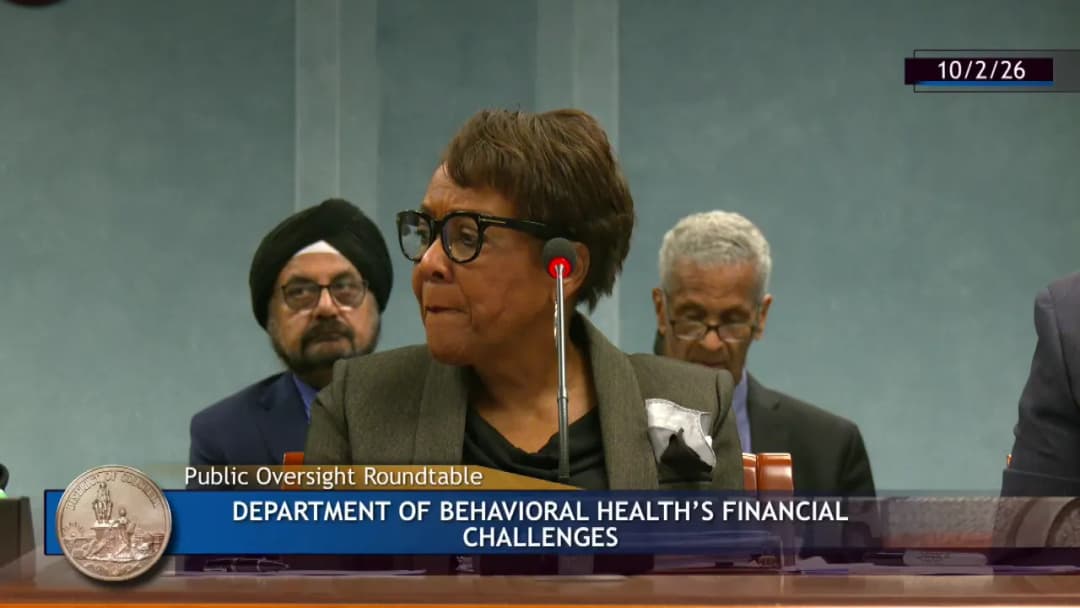
The Public Meeting IndexOn Friday, October 2, 2026, at 9:32 AM, At-Large Councilmember Christina Henderson convened a public oversight roundtable in Room 123 of the John A. Wilson Building to examine the Department of Behavioral Health's (DBH) fiscal year 2026 budget pressures and their effects on residents, providers, and staff. The meeting lasted until 11:06 AM. DBH Director Dr. Barbara J. Bazron, agency fiscal officer Adrian Reid, interim COO Melvin Barry, and St. Elizabeth's Hospital CEO appeared to testify and answer questions. Discussion Items - FY26 Budget Pressure Overview: Dr. Bazron testified that DBH faced a $20.6 million budget pressure by the end of FY26. The primary drivers were a disproportionate use of community support services and higher-than-anticipated recovery support services. The Q1 Financial Review Process (FRP) initially projected a $33 million deficit, which was later reduced by $8.8 million in collective bargaining agreement (CBA) costs that were resolved through the workforce investment account. The narrative of the Q1 FRP had omitted the CBA, causing confusion. The Q3 FRP erroneously stated $16 million would be absorbed from the opioid abatement fund, but the correct amount was $5.7 million, which was ultimately not used. - Fraud and Oversight: Dr. Bazron detailed actions taken, including a hiring freeze (excluding direct care and critical positions), personally approving non-personnel spending, and increasing oversight. As of the hearing, DBH had 12 providers under investigation by the Medicaid Fraud Control Unit, three pending decertifications, four voluntary closures (two under investigation), and three cases at the Office of Administrative Hearings. Councilmember Henderson pressed on the timeline of fraud detection and action, noting that fraudulent billing had been flagged as early as February 2026. - Community Support Services Reduction: Effective late November 2026, DBH will reduce automatic authorization of community support services from 200 units per 180 days (2 hours per week) to 100 units per 100 days (about 1 hour per week), with an additional 50 supplemental units available with approval tied to a DLA-20 functional assessment. The policy was not yet finalized, causing frustration among providers who learned of the change after the budget was submitted to the Council. Dr. Bazron argued that most consumers receive about 105 units on average, and the reduction aligns with the service's original purpose as a non-clinical support. - Recovery Support Services: Expenditures rose from $2.7 million in FY24 to $21.4 million in FY25—an increase the agency described as 88%, though the precise percentage was not clarified. There was a significant increase in the number of people served, but the average service was about 3.5 hours. The state plan amendment currently has no limits on recovery support, and DBH is working with DHCF to address that. - Vacancies and Staffing: DBH has a 20% vacancy rate. Of the 57 mental health providers (out of 74 total providers), oversight is conducted by 25 staff across provider relations (5 staff), certification (9 staff), and data/performance management (11 staff). Vacancies are concentrated in administrative roles, not in grants management. St. Elizabeth's Hospital has approximately 80 vacancies (primarily nursing), with a current average daily census of 270+ patients, mostly forensic. - St. Elizabeth's Hospital Updates: CEO reported that a $6 million HVAC and fire safety upgrade project has begun and will take 18–24 months. Patient transport for off-site dental and specialty services is being finalized; dental will be provided via off-site appointments for all 270+ patients twice a year. Ten additional security staff positions have been created and recruitment is starting. The Councilmember acknowledged that past security concerns had been raised by the hospital but not transmitted to the Council due to the budget process. Key Outcomes - Budget Pressure Resolved: The FY26 budget pressure of $20.6 million was resolved through savings in the Department of Healthcare Finance due to declining enrollment in the Alliance program. No projected pressure for FY27 as of the hearing date. - Policy Changes: DBH will implement a reduction in community support service units (100 units per 100 days plus 50 supplemental) once the regulation is finalized (estimated late November 2026). This policy was baked into the FY27 budget. - Ongoing Fraud Investigations: DBH continues to work with DHCF, the Medicaid Fraud Control Unit, and law enforcement. Cases under investigation or in decertification/closure process. - Next Steps: Council will consider two bills (B26-0799 and B26-0809) at a future markup. Written testimony is accepted through October 16, 2026, at 5 PM via the Council's hearing management system.
The Safety Committee met on October 2, 2026, at 2:30 PM. The meeting covered routine approvals, updates on fire hydrant relocation and a new fire apparatus turnaround, traffic count analysis, introduction of a new committee member, and a resident request for a convex traffic mirror. Key decisions included approving the previous meeting minutes, discussing funding alternatives for the hydrant, and agreeing to reach out to the state regarding the mirror request. Consent Calendar - Approved the minutes from the July 31, 2026 meeting with one abstention (the new member, who was not yet appointed at that time). - No appointments were made; the new member (Vincent) was already appointed previously. Public Comments & Testimony - No public attendees were present during the meeting. Discussion Items - Fire Hydrant Relocation (Legends Drive): Fire Chief reported a quote of $16,000–$18,000 from Central Water to move a hydrant from near the department's driveway into their parking lot for safer training. The current hydrant location is near EverSource's building and has become a traffic hazard. Chief noted the cost is not in the current budget, and they are exploring alternatives including bundling with a future training building project or impact fees. Councilor Smith (absent) provided written comments: he does not support using town funds for this, suggesting the fire department fund it from its own budget if necessary. The board discussed the need and agreed it is not an immediate emergency. - New Fire Apparatus Turnaround (North Candia Road): The Fire Chief described a recurring problem at the end of North Candia Road (a privately maintained dead-end road) where fire apparatus must back out a half-mile to turn around, adding 5–7 minutes to emergency responses. Three options were considered: conservation land, Baybrook State Park, and Manchester Waterworks property. The Manchester Waterworks land appears most feasible, with minimal grading needed (a 3–4 foot swale). Waterworks has been cooperative and willing to supply materials; they also want their loitering signs posted. Councilor Smith suggested contacting the resident near the dead end about using their driveway, but that was deemed infeasible for 40-foot apparatus. Both residents are supportive. The town does not maintain the road, so legal coordination is needed. The cost is expected to be minimal (a machine operator for a day). The Chief will follow up with Waterworks. - Traffic Counts (No-Through Trucking Complaints): The Chief reviewed traffic data provided by the Southern Planning Board. The counts addressed complaints about potential through trucking in a neighborhood. Analysis showed that most vehicles are passenger cars (axle classes 1-2), with very few large trucks. The data does not currently justify a no-through trucking designation. The department will respond to complainants and may revisit next spring if needed. Concerns were raised about the accuracy of counts on Main Street due to placement between two driveways; the Chief will sit down with a councilor to explain the data. The Chief also noted perception of speed can be misleading; radar often shows vehicles are not exceeding limits. - School Drop-Off Fees: A discussion arose from Councilor Smith's previous suggestion about charging parents for dropping off children at school. The committee strongly opposed this idea, noting parents already pay taxes and have the right to choose. It was clarified that this was just an idea and is not being pursued. The Chief noted that drop-off traffic has improved since implementing reminders and designated zones at Memorial and Underhill schools. - Introduction of New Member: Vincent (last name not fully given) was welcomed as a new committee member. He has lived in town for 50 years and was the first to volunteer for the safety committee but the last to be appointed. - Convex Mirror Request (Casey Drive and Whitehall Road): A resident requested a convex traffic mirror at the intersection of Casey Drive and Whitehall Road because a red box truck parked on private property blocks the view of traffic. The Chief noted that the truck owner is within his legal rights to park it there, and the town cannot force him to move it. Since Whitehall Road is a state road, the town may not have jurisdiction to install a mirror; the committee agreed to reach out to the state for guidance. Liability and maintenance concerns were raised (e.g., snow clearing, proper adjustment). The committee will also check with code enforcement regarding unregistered vehicles. Key Outcomes - Approved the July 31, 2026 meeting minutes (with one abstention). - Fire hydrant relocation: No funding decision made; the Fire Department will continue exploring cost-sharing or inclusion in future projects. - Turnaround project: The Chief will obtain a formal agreement/plan from Manchester Waterworks and report back with cost estimates. - Traffic counts: Determined not to pursue no-through trucking at this time; may revisit in spring 2027. - Mirror request: The committee will contact the state regarding jurisdiction and possible installation; also will check with code enforcement about the vehicle. - Next meeting scheduled for November 6, 2026 (was rescheduled); the following meeting is January 8, 2027.
Date: October 2, 2026 (Agenda lists October 9, 2026 – date discrepancy noted) Scheduled Time: 8:30–11:00 a.m. This summary is based solely on the agenda, as no minutes or transcript are available. The meeting was convened with roll call, approval of prior minutes, and then proceeded through the listed items. Public Hearings - Minor Amendments to the Zoning Code: Public hearing and potential recommendation. Staff contact: Bill Dermody. Written testimony deadline was 4:00 p.m. on October 8, 2026. No details on testimony or recommendation are known. Old Business - 2516 Wabash Nonconforming Use & Variance: Proposal to relocate a nonconforming use (changing the angle of an existing billboard) and a variance to add illumination without full code conformance. Staff: Chris Hong. No outcome recorded. New Business - T District Updates: Presented by Valerie Quarles. No details provided. Site Plan Review - List of Current Applications: Staff: David Eide. Upcoming site plan review applications for future hearings were listed. No specifics given. Announcements - Remarks from the Planning Commission Chair and Planning Director. Key Outcomes - No decisions, votes, or directives are recorded. The meeting adjourned as scheduled, but any actions taken (e.g., approval of minutes, recommendations, deferrals) remain unknown due to lack of minutes or transcript.
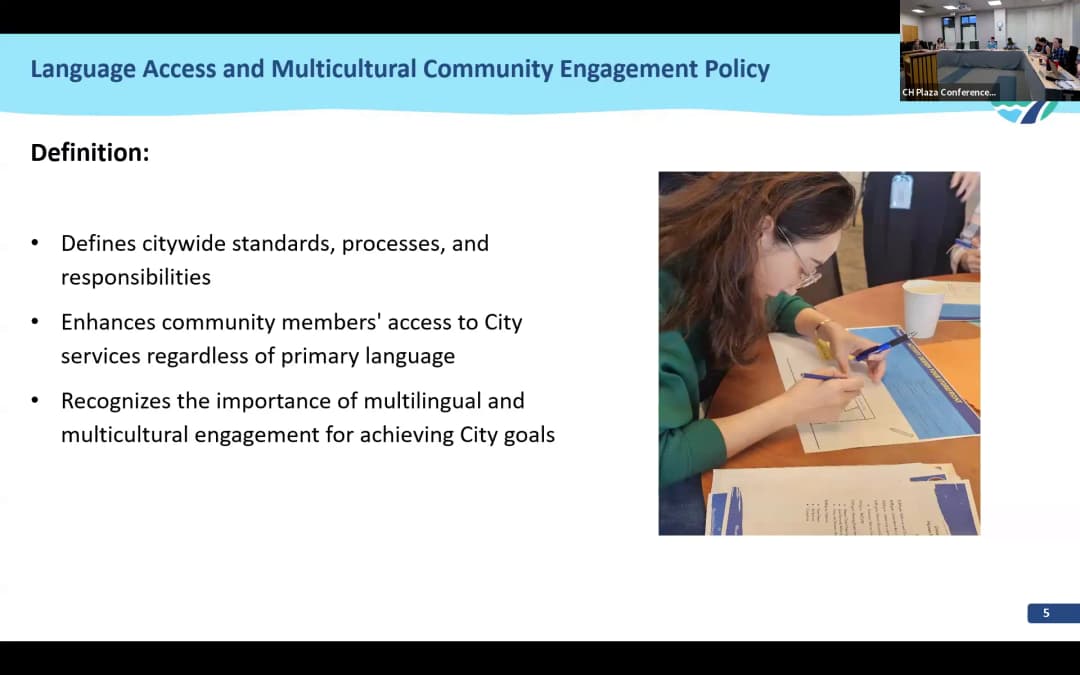
The Mountain View Human Relations Committee (HRC) held a regular meeting on October 2, 2026 (the agenda was originally dated October 1, but the provided timestamp is used per instructions). The committee approved minutes, received updates on LGBTQ+ outreach, Know Your Rights workshops, and the Multicultural Engagement Program (MEP), and made appointments to ad hoc committees for the upcoming fiscal year. Consent Calendar - Approved the minutes from the June 4, 2026 regular meeting. Motion by Commissioner Yan, seconded by Vice Chair Lester. The motion carried by a show of hands. Public Comments & Testimony - No members of the public spoke during Oral Communications or on the MEP presentation. LGBTQ+ Outreach Ad Hoc Committee Update - Commissioners reported tabling at the Mountain View Pride event, which was highly successful in raising awareness of the HRC. The committee plans to organize a future event to support the LGBTQ+ community. Know Your Rights Ad Hoc Committee Update - The committee is working with SALA (Senior Adults Legal Assistance) and the Mountain View Senior Center to host a workshop on senior housing rights and scam prevention, tentatively scheduled for late November 2026. Multicultural Engagement Program (MEP) Informational Update - Community Outreach Coordinator Nancy Duco presented MEP services: in FY 2025-26, the program completed approximately 503 written translations, 120 interpretations, and 31 in-person outreach events. Translation requests were 79 in Spanish, 43 in Chinese, and 4 in Russian. The language access threshold is 1,000 people or 5% of the population speaking English less than very well. MEP contracts with HANA for on-demand phone/video interpretation in 200 languages.A new pilot program uses Wordly AI translation for City Council, Environmental Planning Commission, and Rental Housing Committee meetings, providing real-time translation in 64 languages. Staff are monitoring accuracy and updating glossaries. MEP also operates Chinese and Spanish language academies and community events; the Día de Muertos celebration won a California CAPIO award in 2025. Fiscal Year 2026-27 Work Plan and Ad Hoc Committee Appointments - Staff from the City Manager’s Office presented the carry-forward projects (Civic Participation, Know Your Rights, LGBTQ+ outreach) and new items: an outreach toolkit and community event calendar, a civil discourse workshop with the Dignity Index, a multicultural festival (date moved to May), and attendance at Council Neighborhood Committee (CNC) meetings. A women’s celebration event was deferred. Commissioners volunteered: Vice Chair Lester and Commissioner Yan for the outreach toolkit, Chair Chapman for the civil discourse workshop, and others for the multicultural festival and the October 15 CNC meeting. The Chair will contact absent members about remaining vacancies. Committee/Staff Announcements - Staff announced an updated Board, Commission, and Committee Member Handbook (reduced from 74 pages to a shorter digital version) to be distributed the next day. Commissioner Yan will request a future agenda item to officially note the receipt. Chair reminded about the Día de Muertos celebration (November 7) and the Silicon Valley African Film Festival (October 9 in San Jose). Key Outcomes - Approved June 4, 2026 meeting minutes. - Assigned ad hoc committee members for the outreach toolkit, civil discourse workshop, multicultural festival, and CNC attendance. - Confirmed the Know Your Rights workshop partnership with SALA, targeting late November 2026. - Noted continued monitoring of Wordly AI translation accuracy by MEP staff. - Scheduled the next regular meeting for November 2026 (date not specified).
Note: The timestamp supplied for this summary is 2026-10-02 14:15:00+00:00, while the agenda and transcript text reference a regular meeting on October 5, 2026 at 7:30 PM. This summary uses the supplied date and flags the discrepancy. On October 2, 2026, Lakewood City Council held a regular meeting that included adoption of the Public Art Master Plan, a Hispanic Heritage Month resolution, board and commission appointments, committee and advisory board reports, a liquor permit filing, and public comment. Consent Calendar - Minutes of the September 21, 2026 regular meeting were approved without a reading. - The Committee of the Whole report from September 28, 2026, covering FirstEnergy's infrastructure plans, was received and filed. - The oral Committee of the Whole report reviewing the Public Art Master Plan (described in the transcript as held on October 5, 2026) was received and filed. - The September 2026 Finance Department vendor report, submitted under Lakewood Codified Ordinance 111.03, was received and filed. - The liquor permit for Sourwood Public House at 14810 Detroit Ave. was filed without objection. - Reports from Councilmember Strebig and Councilmember Hamilton Steiner on September boards and commissions were received and filed. Public Comments & Testimony - Chris Carpenter, representing the Cuyahoga County Board of Developmental Disabilities, described services for people with developmental disabilities and the board's mission to help them live, learn, work, and play in the community. He noted that a 3.9-mill levy passed in 2005 had been stretched for an additional ten years, and he urged awareness and support for a 2.25-mill levy on the November ballot, warning that if it fails, services would be reduced drastically or potentially eliminated. Councilmembers expressed strong support for the levy and the board's work. Discussion Items - Hispanic Heritage Month communication and Resolution 2026-48: Councilmember Hamilton Steiner read a communication co-authored with President Kepple that honored Hispanic Heritage Month and condemned targeted immigration enforcement, racial profiling, and what it called "illegal ICE detention." Councilmember Hamilton Steiner added that "no human is illegal" and that "if you're here, you belong here." Councilmember Bixenstine noted Lakewood has upwards of 2,000 Hispanic residents and that nearly one-fifth of the U.S. population is Hispanic/Latino. Councilmember Strebig voiced support. Resolution 2026-48, designating September 15–October 15 as Hispanic Heritage Month in Lakewood, was adopted. Its preamble notes that one in four U.S. children is of Hispanic or Latino origin, Ohio's Hispanic-Latino population has more than doubled since 2000, and Cuyahoga County has the largest Hispanic-Latino population in the state. - Committee of the Whole – FirstEnergy: Council received a report on the September 28, 2026 Committee of the Whole meeting with six FirstEnergy executives. The report described FirstEnergy's "fix it as we go" approach to Lakewood's infrastructure as a failure, said the PUCO's 2026 notice of probable noncompliance is still being negotiated, and noted regulators may compel additional investments over the next seven to nine years. The Lauderdale substation, central to Fourth of July electrical failures, is served by underground cables over 100 years old. The city opposes FirstEnergy's rate increase and will continue seeking restitution for residents; public comments were directed to PUCO case 26-0347-EL AIR. - Public Art Master Plan adoption: Council adopted Resolution 2026-40 after the Committee of the Whole unanimously recommended it. The plan was developed with the Cuyahoga County Planning Commission, and Lakewood was one of four applicants selected for planning services out of ten applicants. It documents more than 100 existing public art pieces and was informed by 800 community survey respondents, approximately 2,038 written comments, and about 120 engaged high school students. The plan includes goals for diverse art forms, strategic placement, equity, and sustainable funding and maintenance processes for the Public Art Advisory Board. - Board and commission vacancies: President Kepple's communication proposed reappointing incumbents and appointing Councilmember Matt Bixenstine as Lakewood Alive's ex-officio board member. Councilmembers praised Marco Oriella and Emily Lindberg. The Public Art Advisory Board vacancy will be advertised with a preference for an architecture or landscape-architecture background. Resolution 2026-42 for that vacancy was deferred pending applicants. Resolutions 2026-43 through 2026-47 were adopted. Reports Received - Councilmember Strebig reported that the Community Recreation & Education Commission discussed summer youth and adult programs, pools, facilities, and fall programming, including new flag football for younger players. The Lakewood Youth Council reviewed applications and will interview candidates to fill six vacancies. - Councilmember Hamilton Steiner reported on the September 16, 2026 Animal Safety & Welfare Advisory Board meeting. The shelter held 23 animals, four of which were available for adoption. LASWAB demonstrated a pet registration feature for reuniting lost pets and scheduled a pet food drive for November 14, 10:00 a.m.–2:00 p.m., at City Center Park (Marc's Plaza), to support 250 Lakewood families in need of monthly pet food assistance. Key Outcomes - Adopted Resolution 2026-48 (Hispanic Heritage Month) by voice vote, no opposition noted. - Adopted Resolution 2026-40 (Public Art Master Plan) by voice vote, no opposition noted. - Deferred Resolution 2026-42 (Public Art Advisory Board appointment) while the city seeks applicants. - Adopted Resolution 2026-43, appointing Councilmember Cindy Strebig as liaison to the Community Recreation & Education Commission for a one-year term beginning January 1, 2027. - Adopted Resolution 2026-44, reappointing Emily Lindberg to the Complete and Active Streets Education & Advisory Board for a three-year term beginning January 1, 2027. - Adopted Resolution 2026-45, reappointing Dawn Ellis and Mariah McGunigle to the Lakewood Heritage Advisory Board for four-year terms beginning January 1, 2027. - Adopted Resolution 2026-46, reappointing Marco Oriella to the Tree Advisory & Education Board for a three-year term beginning January 1, 2027. - Adopted Resolution 2026-47, appointing Councilmember Matt Bixenstine as ex-officio member of Lakewood Alive's Board of Directors for a three-year term beginning January 1, 2027. - Announcements included Spooky Pooch on October 10 at Madison Park, "Welcome to Lakewood" on Thursday, and the fall tree giveaway outcome: 198 of 200 trees claimed, with 12 households on a waitlist.
Mayor Gaskins called the City Council Legislative Meeting to order at 8:32 a.m. on Friday, October 2, 2026, in the Council Chamber at the Del Pepper Community Resource Center in Alexandria, Virginia. The meeting was brief because the docket contained a single substantive item: accepting the resignation of a City Council appointee. The meeting adjourned at 8:35 a.m. Call to Order and Roll Call - Mayor Gaskins called the meeting to order at 8:32 a.m., and the City Clerk called the roll. - According to the meeting minutes, all Council members were present except Councilman Chapman, who was absent. Resignation of the Independent Policing Auditor - Mayor Gaskins announced that Amaratu Kamara had resigned from the position of independent policing auditor, effective October 3, 2026. - Mayor Gaskins thanked Ms. Kamara for her service to the city and expressed appreciation that she stepped in and stepped up to lead the office, especially after the passing of the city’s first independent police auditor. - The City Council accepted the resignation and provided five months’ salary as severance, along with payout of any unused annual leave in accordance with city policy. Key Outcomes - The City Council accepted the resignation of Ameratu Kamara effective October 3, 2026, with no opposition voiced during the roll call vote; Vice Mayor Bagley voted aye. - The approved severance package included five months’ salary and payout of any unused annual leave in accordance with city policy. - The meeting was adjourned at 8:35 a.m.
The Shakopee Economic Development Authority (EDA) met on October 2, 2026, at City Hall, 485 Gorman Street, to consider the 2027 EDA tax levy and budget, adopt related resolutions, approve consent items, and receive the EDA bill list. All votes were unanimous. Note: The agenda and transcript are dated September 1, 2026, and reference a September 15, 2026 city council step, while the meeting timestamp provided for this summary is October 2, 2026; the latter date is used in the title and summary. Call to Order and Agenda - The meeting was called to order and roll call was taken. Commissioner Contreras moved to approve the agenda; the motion was seconded by Commissioner Laura and carried unanimously. Consent Calendar - A motion to approve the EDA meeting minutes was made by Commissioner Lehman, seconded by Commissioner Contreras, and carried unanimously. Discussion Items - 2027 EDA Levy and Budget – Mr. Reinhardt presented the proposed 2027 EDA tax levy of $550,000, unchanged from 2026 and within the 2027 EDA levy cap of nearly $1.6 million. The levy applies to all taxable properties in the city. - Revenue assumptions include a contribution equal to 0.5% of Shakopee Public Utilities Commission revenues, estimated at $341,000; $20,000 from social district licenses and cup sales; and $20,000 from admissions related to the TAP event. For a median-value home, the levy equals about $20 per year, the same as in 2026. - Operating expenses would cover wages and benefits, including the economic development coordinator and 50% of the planning and development director; legal, planning, and professional services; the facade loan program; entrepreneurship programming; Main Street TAP event and marketing; and a recurring $50,000 annual transfer to the city's general fund. - The activity referred to as RCC is accounted for in a separate EDA subfund, with $375,000 in budgeted lease revenues. One tenant has a lease expiring in mid-June, and building maintenance assumes work to prepare the space for re-leasing. - Commissioner Delaney asked why the TAP event admissions line decreased from $24,000 to $20,000; Mr. Reinhardt responded that the estimate was based on last year's actual sales. Reports - EDA Bill List – The EDA bill list was presented. No questions were raised. Key Outcomes - Motion to adopt Resolution E 2026-005 authorizing a special benefit levy under Minnesota Statute Section 469.003, subdivision 6; seconded by Commissioner Delaney; passed unanimously. - Motion to adopt Resolution E 2026-006 adopting the 2027 EDA budget; seconded by Commissioner Lara; passed unanimously. - Commissioner Laura moved to adjourn; the motion was seconded and the meeting adjourned. Note: The transcript alternately renders one commissioner's name as both Laura and Lara; the names above are retained as transcribed.
On October 2, 2026, the Disaster Recovery, International Affairs, and Planning Committee (DRIP) of the Maui County Council reconvened from its September 30 meeting to continue deliberations on Bill 108 (2026), the South Maui Community Plan update. The meeting focused on Section 3 – Growth Framework and specific "areas of change," including Maʻalaea, Central Maui Base Yard, and North Kihei-Māʻalaea. No legislative action was taken on Section 3, but the committee discussed potential amendments to other sections. Written testimony remains open; oral testimony was closed on September 30. Discussion Items - Mapping and Designation Clarifications: Senior Planner Karen Komkowitz and CPAC Chair Rob Weltman explained the conversion of parcel designations from the old Kihei-Makena Community Plan to updated categories. They noted that changes were based on community input and project proponent requests, not purely administrative conversions. The Maʻalaea triangle area was highlighted: the Planning Department initially proposed Transit-Oriented Corridor, but CPAC and the Maui Planning Commission changed it to Small Town Center, which offers more flexibility for mixed-use development. Councilmember Batangan confirmed that no property rights were diminished solely by the conversion. - Central Maui Base Yard Expansion: The committee reviewed a proposed expansion of industrial land by 66 acres within the Maui Island Plan urban growth boundary, changing agriculture to industrial and open space. A 100-foot buffer from Pulehu Gulch was recommended to protect the gulch from industrial runoff, a suggestion supported by both the landowner and CPAC. Councilmember Johnson raised concerns about buffer width depending on land use, and CPAC affirmed that 100 feet was sufficient. - North Kihei-Māʻalaea Area-Specific Policies: Extensive debate centered on policies for this area: - Policy 3.4.1 (Stakeholder Committee): The committee discussed forming a diverse stakeholder committee to guide development, including input from the Department of ʻŌiwi Resources (ʻOEV). - Policy 3.4.2 (Comprehensive Master Plan): CPAC and landowner representative Rory Frampton agreed on a conceptual master plan before development, though Frampton requested adding the word "conceptual" to clarify the level of detail. - Policy 3.4.5 (Connector Road): This policy sparked the most contention. The draft language required a two-lane collector road from East Lipoa Street to Veterans Highway with a separated bike path, built before or concurrent with development. CPAC Chair Weltman argued the road is essential for evacuation and reducing congestion on Piʻilani Highway, citing severe gridlock during a tsunami warning earlier in 2026. Rory Frampton (representing landowners Haleakala Ranch and ʻAoʻao Ranch) warned that requiring the full road upfront could kill the project and proposed phasing improvements per development phase. Councilmember Cook emphasized the road's necessity as an evacuation route for both tsunami and wildfire hazards. Councilmember Sugimura and Uʻu-Hodgins suggested alternatives like roadway easements, phased construction, or a community facilities district (CFD) to fund crossings. Corporation Counsel Michael Hopper advised the council to clarify the timing language to avoid ambiguity. - Gulch and Stream Identification: The committee noted that several sub-areas (e.g., Mākena, Wailea) lacked names for gulches and streams. Members agreed to request information from the Department of ʻŌiwi Resources. Proposed listing Moʻo Kapu and Kīʻawaʻapū beaches as environmentally significant features. Key Outcomes - No votes were taken; the meeting served as a working session to gather information and refine potential amendments. - The committee will reconvene on Monday, October 5, 2026, to continue discussion, with oral testimony reopened. - Staff and councilmembers will research phasing options for the connector road and consider outreach to the Maui MPO for a route study. - Written testimony continues to be accepted, and the public is encouraged to submit comments via eComment or email.
The Redwood City Council met on October 2, 2026, in a hybrid format to discuss a wide-ranging agenda. Key actions included adopting a moderate program for downtown parking, voting to support the regional Connect Bay Area Transit Initiative on the November 2026 ballot, and receiving a comprehensive winter storm readiness plan for an expected strong El Niño. The meeting also featured proclamations for Hispanic Heritage Month and Welcoming Week, recognition of Career Online High School graduates, and a memorial for community member Jerry Pierce. The public comment period included intense debate about a permanent street closure, automated license plate readers (ALPRs), and several instances of hate speech which were disavowed by the council. Consent Calendar - The consent calendar, containing routine items, was approved by a 5-0 vote with Councilmember G and Vice Mayor Aiken absent. Presentations & Proclamations - National Hispanic Heritage Month: Mayor Martinez Saballos proclaimed September 15 through October 15, 2026, as National Hispanic Heritage Month. The Latino Community Council of Redwood City (LCCRC) was recognized for organizing the Fiestas Patrias event, which drew thousands of attendees. Speakers Arnoldo Arreola, Ernie, and Connie Guerrero thanked the city for its partnership and highlighted the community and cultural significance of the event. Next year marks the 20th anniversary of Fiestas Patrias. - Welcoming Week: September 10-19, 2026, was proclaimed Welcoming Week. Elisa Chavez of Redwood City Together accepted the proclamation and highlighted ongoing events celebrating the city's diverse and inclusive community. Redwood City became a welcoming city in 2017, and over 34% of residents are immigrants. - Career Online High School Graduates: Interim Library Director Sarah LaTora recognized five new graduates of the program (Isabel, Steve, Arturo, Christopher, and Javier), which is run in partnership with the Redwood City Library. The program has reached a 10-year milestone with 22 total graduates. Each graduate shared personal stories of overcoming obstacles to earn their diplomas. - Jerry Pierce Memorial: The council read a proclamation honoring the life and legacy of Jerry Pierce, a longtime Redwood City resident, technologist, avid outdoorsman, and husband of former Mayor Barbara Pierce. The city extended its condolences to his family. Public Comments & Testimony - Southgate Street Closure (In-Person): Kate Allison argued the city's pilot program closing Southgate Street at Brewster was a permanent decision avoiding proper hearings, traffic studies, and environmental review. She stated the city does not hold fee title to the land and that over $60,000 has been spent on title and traffic consultants while the city faces a $10.2 million deficit. Ed Connolly submitted 109 petitions from residents demanding the street be reopened, citing a lack of accidents at the intersection and a title report indicating the city does not own the land. - Historic Preservation (In-Person): Glenn Babbitt, Vice Chair of the Historic Resources Advisory Committee (speaking as a resident), urged the council to oppose proposed changes to Section 106 of the National Historic Preservation Act that could diminish the city's voice in federal projects affecting the downtown historic district. He requested the council direct the city manager to draft a letter of opposition to Congress. - Surveillance & ALPRs (Zoom): Amber Garza Washburn and Bill Newell, speaking on behalf of community groups, cited a critical recent San Mateo County Civil Grand Jury report on the city's surveillance camera system. They requested the council pause the current ALPR contract RFP, hold a public hearing to respond to the grand jury, and host community town halls on the issue before proceeding with a new contract. - 9/11 Remembrance (Zoom): Jim Bridger requested the council consider a resolution for a week of remembrance for the September 11 attacks. - Hate Speech (Zoom): Three subsequent Zoom speakers made antisemitic, racist, and transphobic comments. The Mayor and councilmembers repeatedly interrupted the speakers, enforced rules of decorum by muting them, and issued strong statements disavowing the views, stating they do not represent the community or city values. Discussion Items - Downtown Parking Program Update: Engineering Director Tanisha Werner and Parking Manager Christian Hammock presented an update on the downtown parking program, which currently faces a $1.4 million deficit. The program has two zones covering 1,100 on-street spaces, several garages, and shared parking agreements. Staff outlined two possible paths forward: a “Simple” program or a “Moderate” program involving more staffing, data analysis, and technology. Council discussion centered on flipping the pricing model so garages are cheaper than curb spaces to improve turnover, the critical role of enforcement, and the need for robust business outreach before implementing major changes. A public commenter, Dylan Finch, spoke in favor of the moderate program. - Connect Bay Area Transit Initiative: Assistant City Manager Derek Wolfgram presented the half-cent regional transit sales tax measure on the November 2026 ballot. The measure would provide San Mateo County with approximately $700 million over 14 years, distributed among Caltrain, BART, Muni, and SAMTrans. Council discussion included the importance of transit for downtown success and equity. Councilmember Howard clarified that ferry funds will support the South San Francisco service. Councilmember Padilla expressed strong opposition, citing the tax burden on working families (pushing the local sales tax over 10%), the changing nature of ridership post-pandemic, and concerns over transit agency oversight and fiscal responsibility. SAMTrans representatives noted that 94% of their ridership is low-income and that they are implementing cost-cutting measures. - Winter Storm Readiness: Public Works Acting Superintendent Linda Chang presented the city's preparations for the upcoming winter, which has a greater than 90% chance of a strong El Niño event. The presentation covered infrastructure (18 pump stations, the new Bayfront Canal Diversion Project), the Adopt-a-Drain program, CERT preparedness, and the availability of free sandbags at the Public Works yard and a new self-service station at Fair Oaks Community Center. Council discussion focused on outreach to Spanish-speaking residents and mobile home parks, community sandbag-filling events, debris capture in creeks, and improving sidewalk drainage through the sidewalk replacement program. Key Outcomes - Downtown Parking Program: The council voted 5-0 to adopt the Moderate Program approach and approved the staff-recommended automatic increases to on-street meter rates. Staff was directed to complete outreach to downtown businesses and residents before returning with a comprehensive package for further policy directions. - Connect Bay Area Transit Initiative: The council voted 4-1 to adopt an official position of support for the Connect Bay Area Transit Initiative on the November 2026 ballot. Councilmember Padilla cast the dissenting vote. The council requested that Councilmember G, the city’s representative on the SAMTrans board, provide regular updates on the agency’s cost-cutting and efficiency measures. - Winter Readiness (Direction to Staff): Council members gave several directives to staff, including creating multilingual one-page informational flyers, exploring a community sandbag-filling event with partner organizations, coordinating with non-profits for door-to-door outreach in mobile home parks, and investigating curb-cutting and green infrastructure options within the existing sidewalk repair program. - Upcoming Events: A community meeting regarding the potential affordable housing development on Library Lot B is scheduled for the evening of October 6th. The annual Pride & Beautification cleanup is scheduled for October 19th.