The Ports and Harbor Commission met on Monday, September 21, 2026 at 7:00 PM in the Council Chambers in Valdez, Alaska, rescheduled from its usual date due to the holiday. All members were present except Commissioner Kelly, who was excused. The commission reviewed the Waterfront Master Plan, prioritized a five-year Capital Improvement Project (CIP) list for City Council, forwarded a recognition proclamation for Chris Herman, and discussed a 2028 cruise ship head fee increase. Approval of Minutes - October 20, 2025 regular meeting minutes approved unanimously. - March 2, 2026 regular meeting minutes approved unanimously. Public Comments & Testimony - A speaker described an informal working group of other city commissions and asked whether a Ports and Harbor commissioner would join; the idea was characterized as very preliminary. - A second speaker raised concerns about the commission's remote participation policy, which prohibits the public from participating from outside Valdez (including Anchorage and North Pole), stating that those not physically present should not participate, and framed it as a ports and harbor matter. Discussion Items Waterfront Master Plan Review and Five-Year CIP Prioritization Director Jeremy reviewed progress on the Waterfront Master Plan and staff's recommended five-year priorities, noting the City Council requested the CIP list during its strategic planning session. Key discussion points: - The small boat harbor has seen no movement on the Coho Drive realignment. - The boat launch ramps are at 65% design; it is "way past time" to replace the small boat harbor launch, and the city manager directed that the project move forward with or without state funding. - A building condition assessment from 15–20 years ago ranked the armorer's office the lowest; replacement is needed. - Kayak fishing floats should be considered for the CIP to give anglers an alternative to "the middle of everybody's operations"; picnic tables and similar day-use improvements can be handled without a formal project. - The city's waterfront underwater inspection is now 6.5–7 years overdue, so next year's CIP may include additional items. - The city currently relies on a private company ("Connect") for truck scale access; if that arrangement changes, the city may need its own scale at a rough estimated cost (specific figure unclear in transcript). Staff said it would confirm with Connect and report back. - Kelsey Dock was omitted from the original master plan. Temporary bollards are in place, and the ferry operator has reviewed the city's proposal and will respond. Long-term secure moorage at the container dock should rank in the top two priorities. Five-Year CIP Recommendation Staff recommended, and the commission later endorsed, these five priorities for City Council: (1) VCT infrastructure, (2) Kelsey Dock, (3) small boat harbor boat launch, (4) armorer's office, and (5) the airport. Commissioners discussed combining several projects into a single bond within the next 18 months using debt service. On Kelsey Dock, a private partner ("Ryan") declined staff's proposed office upgrades, preferring the existing portable office and a new roof, and stated there is no return on investment for the city; a standalone city effort would require a feasibility study to ensure value. Recognition Proclamation for Chris Herman Commissioners praised Chris Herman for his role in bringing cruise ships to Valdez and keeping them, and for instilling the same work ethic and attention to detail in his team. A motion to forward the proclamation to City Council passed unanimously. 2028 Cruise Ship Head Fee Increase Staff proposed raising the cruise ship head fee for 2028. Discussion noted a mid-range increase of around $6 when averaged across South Central and Southeast Alaska head fees, with a reference to "58 votes this year" (transcription unclear). Staff stated they anticipate no loss of cruise traffic from an increase. One commissioner questioned whether a head tax increase could deter cruise ship landings; another expressed no challenge to an increase but stressed that federal law requires the fee to provide direct benefits to cruise passengers and asked for clarity on how revenue would be spent. Staff noted that replacing current Kelsey Dock infrastructure would cost under $500,000 (with several million already spent on upgrades), while accommodating larger lightering vessels would cost far more. A motion was made to increase the 2028 head fee to $8 per person, reported by Mike; the final vote is not captured in the available transcript. Staff Report & Commission Business - The Ports & Harbors Director's staff report was noted on the agenda; no substantive discussion is captured in the transcript. - No commission business from the floor was raised; the meeting moved to adjourn after the chair called for items. Key Outcomes - October 20, 2025 and March 2, 2026 minutes approved unanimously. - Five CIP priorities (VCT infrastructure, Kelsey Dock, small boat harbor boat launch, armorer's office, airport) forwarded unanimously to City Council for budget consideration. - Chris Herman recognition proclamation forwarded unanimously to City Council. - A motion to set the 2028 cruise ship head fee at $8 per person was made; the adopting vote was not recorded in the available transcript. - Staff was directed to confirm the private truck scale arrangement and bring back additional information requested on head fee spending to the next meeting.

The Public Meeting Index
The Public Meeting IndexA meeting record for September 21, 2026, was provided with no accompanying agenda or minutes. The raw transcription contains only the phrase "Street Fair twenty twenty six," repeated twice. As a result, no detailed deliberation, motions, or formal actions can be identified from the available record. Record Limitations - No agenda or minutes were provided for this meeting. - The raw transcription consists solely of the repeated phrase "Street Fair twenty twenty six," suggesting the meeting may have concerned the Street Fair 2026 event, but no substantive discussion was captured. Key Outcomes - No formal decisions, votes, or directives can be confirmed from the provided transcription. - No public testimony or speaker positions were recorded beyond the repeated "Street Fair twenty twenty six" reference.
The City of La Crosse Board of Public Works met on Monday, September 21, 2026, beginning at 10:05 AM (the meeting minutes record a 10:00 AM start time; the transcript indicates the call to order occurred at 10:05 AM). All five members were present: Matt Gallager, Andrea Trane, Tamra Dickinson, Erin Goggin, and Mayor Shaundel Washington-Spivey. The board considered four agenda items, approved two unanimously and two with one dissenting vote each. Consent Calendar - Approval of Minutes (September 14, 2026): Motion by Dickinson, second by Trane, carried unanimously. - Construction Contract Change Orders (26-0971): Motion by Gallager, second by Dickinson, carried 5-0. Discussion Items - No Parking Zone on the 400 block of 12th Street North (26-0996): Staff (Jacks) explained that the no-parking restriction was previously discussed during street design and the vacation of the Badger West property. The street was built narrower intentionally, similar to Hagar Street. Mayor Washington-Spivey expressed concern that removing parking could push college students into adjacent residential areas, calling it a "never ending battle." Despite her concerns, she voted in favor. Councilmember Goggin voted against. Motion by Dickinson, second by Gallager, carried 4-1. - Policy Proposal on Public Sidewalks near Tree Cells (26-0999): Staff presented a policy to allow narrowing sidewalks from the standard six feet to a minimum of four feet (or three feet in limited cases) immediately around tree cell openings, to give trees the best chance of survival. Questions were raised by the Mayor about tree survival rates and costs, and by Councilmember Goggin about coordination with Forestry and the appropriateness of tree cells in downtown. Staff clarified the policy only addresses sidewalk width flexibility and does not authorize tree placement—that decision remains with the Council. Councilmember Goggin initially requested more time to study, but a motion to approve was made by Gallager, seconded by Dickinson, and carried 4-1 with Goggin voting no. Key Outcomes - 26-0971 (Change Orders): Approved 5-0. - 26-0996 (No Parking Zone): Approved 4-1 (Goggin opposed). - 26-0999 (Sidewalk Policy): Approved 4-1 (Goggin opposed). - The meeting adjourned at 10:17 AM (per minutes; transcript ends with adjournment without timestamp). Note: The minutes record the meeting start at 10:00 AM, but the transcript states the call to order occurred at 10:05 AM due to technical adjustments with a new system.
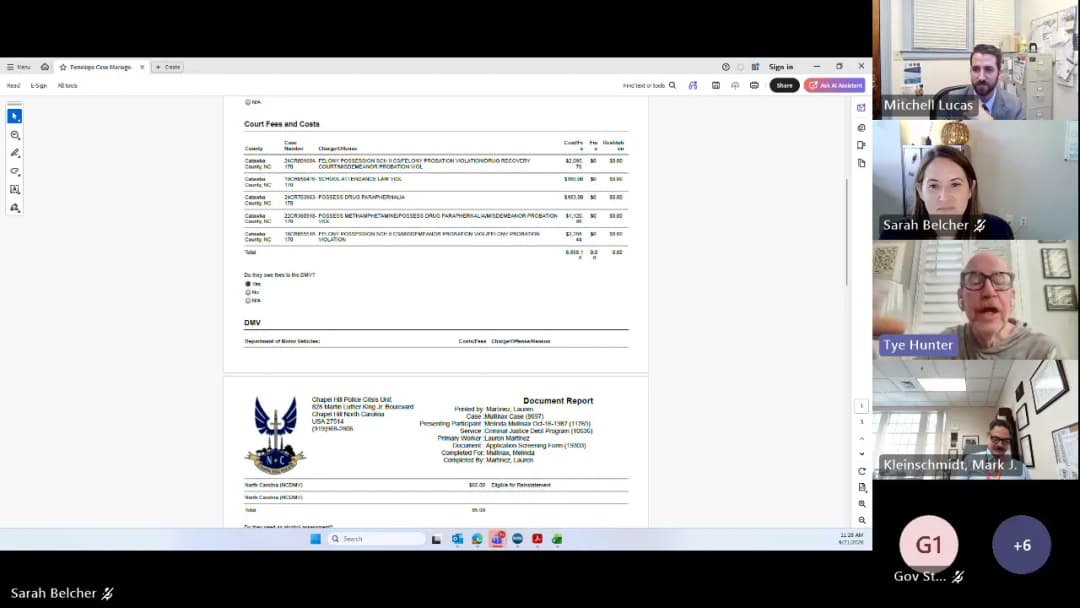
The meeting of the Chapel Hill Funding Board convened at approximately 4:14 PM EDT with six members present, constituting a quorum. Members Mark, Tiffany, Ty, Ruby, and April attended; Donna, Crystal, and Amber were absent. A vacancy exists due to Stephanie's departure. The board approved the agenda, the minutes from the August 17 meeting, and reviewed current funding balances ($22,000 for Chapel Hill, $6,933 for Carborough, $4,859 for Orange County). One applicant from Chapel Hill was considered. Consent Calendar - Agenda Approval: Motion by Mark, seconded by April, approved unanimously (5-0). - Meeting Minutes Approval: Motion by Tiffany, seconded by unnamed, approved unanimously (4-0, as Ty and Crystal were absent from the prior meeting). Discussion Items - Applicant – Melinda Mullinax: A 39‑year‑old white female residing at the We Have a Dream Recovery Home in Chapel Hill. She has been sober for over six months, is engaged in a court‑mandated drug court through Catawba County, works part‑time, and receives food stamps. She owes $6,868.16 in court fees (largest balance $2,095.78 from a probation case) and a $65 DMV restoration fee. Her only driver’s license suspension was an unpaid seatbelt ticket from 2013. The board discussed her eligibility and the nature of the fees. Member Mitch motioned to cover the top three balances (the largest $2,095.78, plus $180 and $183) and the $65 restoration fee, totaling $2,160.78 (subject to interest). The motion was seconded by Ty. Some members briefly explored negotiating with Catawba County, but it was noted that most fees have become civil judgments, making reduction unlikely. Key Outcomes - Vote on Applicant Assistance: Motion passed unanimously (Mark: yes, Tiffany: yes, Ruby: yes, April: yes). The board approved payment of $2,095.78, $180, $183, and $65 (restoration fee) to assist Melinda Mullinax in reinstating her driver’s license and removing barriers to employment and transportation. - Next Meeting: Scheduled for Monday, October 19, 2026. Members were encouraged to join 15 minutes early for technical troubleshooting. - Crystal’s Connectivity: The chair noted Crystal had login issues; she would attempt to join via the public link after the meeting.
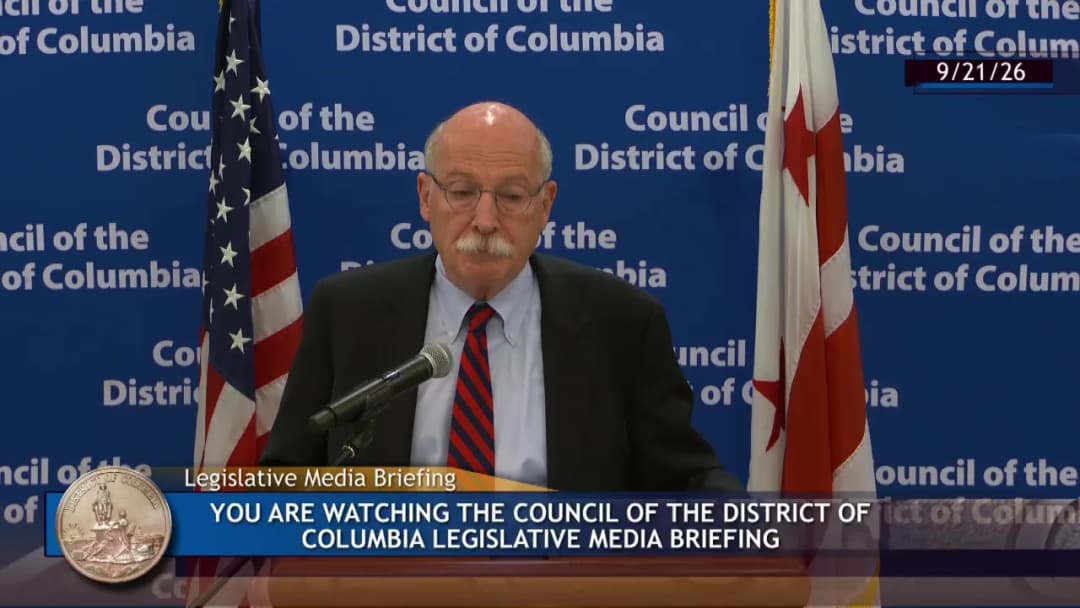
Chairman Phil Mendelson held a press conference on Monday, September 21, 2026, ahead of the Council's legislative meeting scheduled for Tuesday, September 22. He outlined the agenda for the Committee of the Whole (11:00 a.m.) and the legislative meeting (noon), then took questions from reporters on topics ranging from the Treyon White trial to ballot initiative reform, budget sustainability, and a planned October roundtable on revenue. Consent Calendar - In the Committee of the Whole, four bills are being marked up: (1) changing heating/air conditioning dates to October 1 and April 1; (2) permanent property tax exemption for Food and Friends; (3) clarifying real property tax exemption for Archdiocese of Washington parishes; (4) extending dates for the reservoir district tax exemption and clarifying affordable housing requirements. The strategic parking enhancement bill also clears committee. - Two confirmations (Board of Library trustees, Eric's ID amendment for invisible disability symbol) are on the legislative agenda. Media Q&A (Public Comments & Testimony Equivalent) - Treyon White Trial & Reinstatement: Reporters asked about the possibility of reinstating committee assignments for Councilmember White (Ward 8) if he is acquitted. Chairman repeatedly declined to speculate, stating he has not looked at the issue and will not until the trial concludes. When pressed that the Council had already acted on ethics violations (expulsion vote in January 2025), Chairman acknowledged it is possible the Council could act on those grounds independently of the criminal trial, but again declined to speculate. - Control Board Threat: Asked whether a White acquittal combined with election of a new mayor could give Congress pretext to impose a control board, Chairman said he has heard such speculation but considers it uncertain. He noted Congress would need to change the law and is preoccupied with budget and national security items. He has taken steps to improve federal relations, hiring a staff member and a firm to help react. - Ballot Initiative Reform (Councilmember Bonds' Bill): Chairman expressed general support for Bonds' bill, which adds single-subject and other requirements. He argued that the initiative process lacks the deliberative safeguards (hearings, markup, multiple readings) that Council legislation undergoes, making single-subject rules appropriate. He also supports clarifying that initiatives affecting the budget are out of order under the Home Rule Act. - Food and Friends Tax Exemption: Despite the CFO's determination that the organization no longer qualifies for property tax exemption, Chairman defended the Council's emergency approvals, noting that Food and Friends does important work and the exemption comes at no additional cost to the District. He attributed the CFO's position to technicalities about work performed outside the District. - Petition Challenges: In response to questions about two individuals repeatedly challenging candidate petitions, Chairman defended the current system as ensuring candidates demonstrate a baseline of support. He argued that a long ballot with many nonviable candidates confuses voters and depresses turnout. He emphasized that the Board of Elections registrar validates challenges, providing a safeguard against abuse. Discussion Items - Revenue Roundtable (October 16): Chairman announced a roundtable to gather testimony on the pros and cons of various revenue proposals. He strongly criticized Chairman Comer's federal bill that would freeze the District's tax code, calling it "a horrible, horrible piece of legislation" that would prevent tax cuts, business license changes, economic development incentives, and even oversight changes. He stated the roundtable is not about immediate tax increases but about preparing for possible budget pressures in FY28. He confirmed about 40 witnesses will be invited, primarily subject-matter experts and representatives of organizations with tax expertise; everyday citizens are not the target audience for this hearing. - Budget Cuts and Sustainability: Reporter Tom Sherwood pressed Chairman on an 8% cut in school funding and 7% cut in human services in the out-years of the financial plan, calling it "fantasy budgeting." Chairman responded that the cuts originated in the mayor's proposal, which the council adopted, and that two-thirds of the $650 million in one-time spending was the mayor's doing. He acknowledged the financial plan is not truly balanced but noted the council has avoided tax increases for the past two years. He indicated that if revenue growth or a surplus do not materialize, raising revenues next year becomes more likely. - Education Collaboration with New Mayor: Asked about working with a potential Mayor-elect Lewis George, Chairman said he looks forward to collaborating on issues like child care subsidy, pay equity, and the uniform per pupil funding formula. He acknowledged there will be disagreements but is optimistic about working through them. - Technology in Schools Roundtable: Chairman said the purpose is to hear from parents and educators about screen time overuse, inequities in access, and what DCPS and charter LEAs are doing. He does not have preset opinions but noted that Arlington County has imposed restrictions. - Housing Legislation: Regarding the mayor's "Rental Act 2.0," Chairman said it rehashes prior Council work and may not be a priority this fall due to limited time. He supports changes to the eviction process but is unsure if that can be enacted before the end of the council period. - Nationals Park Renovation: Chairman stated the mayor's description of a full renovation is "confused" and that nothing bigger is planned beyond discussions from over a year ago about typical ballpark upgrades. Key Outcomes - No votes were taken at the press conference. The Committee of the Whole will mark up bills on September 22, and the legislative meeting will include final reading of the FY26 supplemental budget temporary act, first reading of the fair initiatives bill, a rules change, and several emergency bills. - Chairman staked clear positions: supports Bonds' initiative reform bill; opposes Comer's federal tax freeze; defends petition challenge system; supports Food and Friends exemption; critical of mayor's budget cuts but acknowledges need to address out-year fiscal gaps. - The October 16 roundtable on revenue will proceed with invited experts; no immediate tax increase is planned.
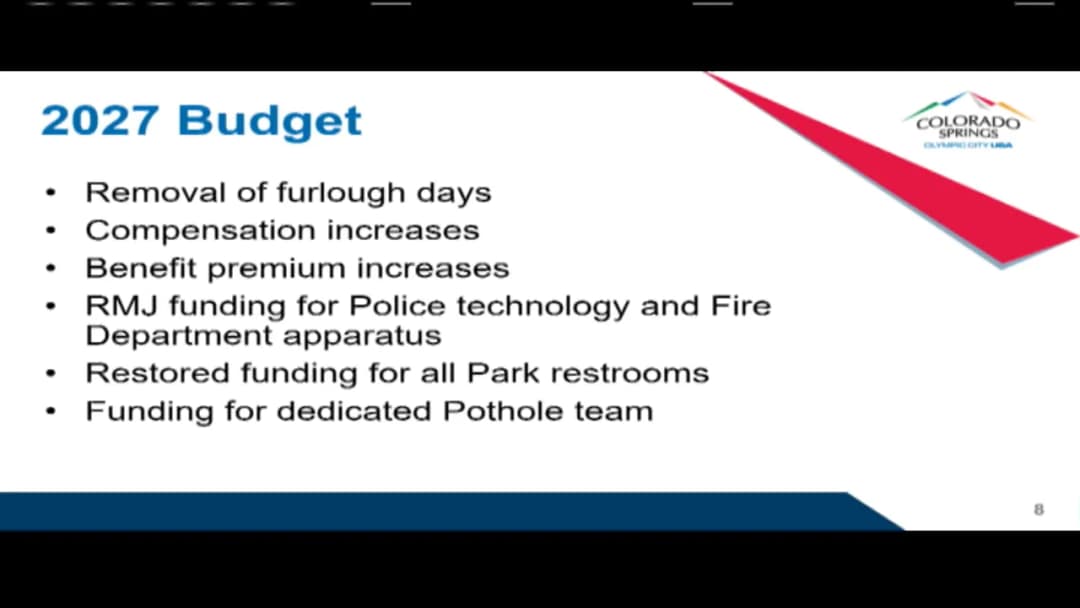
The Colorado Springs City Council held a work session on Monday, September 21, 2026, at 9:00 AM in Council Chambers. President Lynette Crow-Iverson called the meeting to order at 9:01 AM. Eight council members were present (Casey, Crow-Iverson, Donelson, Henjum, Leinweber, Rainey, Risley, Williams) and one was excused (Gold). The meeting covered presentations, financial reports, and introduced several ordinances and resolutions for future adoption, with extensive discussion on city finances, employee retention, utility rate changes, and community partnerships. Consent Calendar - Approval of Previous Meeting Minutes: The minutes of the September 8, 2026 Work Session were approved by consensus. Presentations for General Information - Colorado Springs Chamber and EDC – 2026 Mid-Year LART Update (Item 5.A): Dani Barger, Chief Operating Officer, presented results of the national branding and earned media strategy. She reported 55 national, trade, and local placements reaching 213.8 million unique visitors. A familiarization tour for meeting planners is scheduled for October 27–29, 2026. Councilmember Donelson asked about negative stories (Ms. Barger clarified they are about Colorado as a whole, not Colorado Springs) and media coverage of local events. The Chamber and EDC receives $750,000 from LART. Staff and Appointee Reports - Quarterly Financial Report (Item 6.A): Chief Financial Officer Charae McDaniel presented revenue updates: sales and use tax projected $9.2 million over budget; LART up 3.09% year-to-date; retail marijuana tax fund up 200% over the prior year (not an apples-to-apples comparison). An additional $2.275 million from the El Paso-Teller County 911 Authority is designated for the 911 call center stipend. Employee turnover rates were discussed: 2026 estimated turnover is 13.1% for civilians, 15.7% for police, and 16.6% for fire. Councilmembers noted high attrition and its connection to budget cuts and lack of compensation increases. President Pro Tem Risley observed that 60% of the city workforce has turned over in four years (70% for civilians). Councilmember Henjum expressed support for eliminating furlough days, compensation increases, and restoring park restrooms, and raised concerns about the health insurance carrier change. The 2027 budget includes no furlough days, 2% pay-for-performance increases for civilians, market adjustments for sworn police and fire, benefit premium increases shared 80/20, retail marijuana tax funding for police and fire equipment, restored park restrooms, and a dedicated three-person pothole crew. Agenda Planner Review (Item 6.B): No comments. Discussion Items - Elimination of November 25, 2026 Furlough Day (Item 7.A): Chief of Staff Wayne Williams presented an ordinance to appropriate $330,800 in general funds to eliminate the scheduled furlough day. Employees may use vacation, personal, or unpaid leave if they had already planned the day off. Councilmember Donelson supported the administration's proposal. Councilmember Leinweber suggested giving the day off with pay as a reward for employee sacrifice. President Pro Tem Risley asked about salary savings from vacant positions. Discussion noted that furloughs this year ranged from 5 to 7 days depending on pay range. - Net Metering Rate Case – Electric Rates (Item 7.B) & Utility Rules and Regulations (Item 7.C): Chris Bidlack presented the final documents for adoption. Councilmember Henjum clarified the average bill impact: $33 on a 2025 basis and $38 on a 2027 basis. Tristan Gearhart confirmed a distributed battery storage program will be announced by April 1, 2027. Henjum noted that “net load” and “net consumption” are synonymous. Councilmember Donelson stated the intent is to recover costs of service, noting net metering customers currently do not cover costs. The hearing record was closed on August 25, 2026; no further public comment was taken. Resolutions will be considered at the regular council meeting on September 22. - Civil Service Commission Rules Update (Item 7.D): Danielle Delgado presented updated rules to modernize language and clarify commission vs. department responsibilities. Notable changes include giving chiefs discretion to remove candidates from promotional lists (to be revised after objection from Local 5) and aligning termination procedures with civilian policy (ending paid administrative leave during appeals, with back pay if reinstated). The changes were developed with input from police and fire associations and the Civil Service Commission. Councilmember Rainey confirmed the change only affects termination language. The item is expected to go on consent for the October 13 meeting, pending a special meeting to adjust the promotional list language. - City Auditorium Lease Amendment (Item 7.E): Kim King requested extending the rent abatement period to April 1, 2027, for AVA Presents, LLC, due to detailed studies, hiring local contractors, and delayed revenue. Local contractors include CSNA Architects, HCBA, McShay Partners, and Fred Fleetmeyer Company. Councilmember Risley expressed concern about subsidizing a for-profit business, while Councilmember Donelson strongly supported preserving the historic auditorium. HVAC issues were discussed, with interim solutions for air exchange and heating efficiency. The item will not be on consent. - Valley HI Golf Course Lease to First Tee Southern Colorado (Item 7.F): Kim King presented a resolution finding community benefit in a ground lease to Life Skills Fore the Youth of Colorado Springs d/b/a First Tee Southern Colorado. The 25-year lease (with a 25-year option) is for $1 per year. First Tee will demolish the old pool house and construct a $1.2 million facility for year-round youth programming (ages 3–18). First Tee covers construction, utilities, and maintenance; ownership transfers to the city at lease end. First Tee has already secured all funding and has a policy of never turning away a child due to lack of finances. Councilmember Leinweber inquired about PGA grants (not available at the chapter level for this project). Councilmember Henjum strongly supported the partnership. Councilmember Reports and Open Discussion - Councilmember Rainey highlighted attending the Downtown Breakfast, meeting with the UCCS chancellor about the new Air Force ROTC detachment (enrollment tripled), and the International Association of Firefighters Memorial ceremony (over 6,000 attendees). - Councilmember Donelson honored WWII veteran and former POW Ed Beck (101 years old, passed away), and spoke at the Blodgett Open Space ribbon cutting and Saluting Branches event. He requested that the Project Taurus hearing date be moved to later in April or before the election to avoid the appearance of strategic timing. - Councilmember Henjum shared her experience flying over the city in a Douglas C-47 during media day for the airshow, and attended the Fallen Firefighters Memorial and Saluting Branches event (now the third largest of its kind in the nation, with an estimated $150,000 in in-kind donations). Key Outcomes - Minutes approved: September 8, 2026 Work Session minutes. - Items for future votes: - Ordinance to eliminate the November 25 furlough day (7.A) - Electric rate and URR resolutions (7.B & 7.C) – to be considered September 22. - Civil Service Commission rules (7.D) – to be voted on October 13, with a special meeting to adjust promotional list language. - City Auditorium lease amendment (7.E) – will be presented again in two weeks. - First Tee ground lease (7.F) – to be voted on October 13. - Council direction: Administration will work with employees on leave options for the furlough day. The battery storage program will be announced by April 1, 2027. The Civil Service Commission rules will be revised per union feedback. Councilmember Donelson's request to reschedule the Project Taurus hearing was noted.
The Bloomington Special Fiscal Committee met on September 21, 2026, to review sanitation rate projections and continue its elected-official salary discussion. Public Works Director Adam Wilson and Sanitation Director Sears presented a memo on eliminating General Fund support for the sanitation division, while the salary item was deferred after the committee ran short on time. (Note: The raw transcript opens with a call to order on "September 18th, 8:31"; per the meeting record, this summary uses September 21, 2026.) Public Comments & Testimony - No in-person public comments were made on either the sanitation rates or elected-official salaries. - One chat comment was read aloud, recalling a 1980s article about sanitation costs and tying it to the rate discussion. The public comment period was closed after no other comments. Discussion Items - Sanitation rates and General Fund support: The committee reviewed projections showing General Fund support for sanitation historically averaging $600,000-$1,000,000 per year, with 2026 projected at roughly $1,500,000. Proposed rates remain based on trash cart size, with charts showing projections through 2029. - Operating deficit: Sanitation is running an approximate $40,000-per-month operations deficit. - Cost drivers: Personnel (category one) makes up 58% of the sanitation budget. Officials emphasized that a strong capital replacement fund is the biggest tool for managing future equipment-intensive costs. - Community benefit: General Fund support also covers non-revenue services, including park pickups and pedestrian-area collections, which provide a broader community benefit. - Sticker system history: The city attempted a sticker-based payment system in 2017 and again in 2021 with a different vendor; both attempts were unsuccessful. Cart-reading technology could not reliably distinguish carts placed two to three feet apart, including the example of 301 North Washington, which has three units and multiple carts. - Phasing and ordinance: Council members discussed eliminating General Fund support all at once versus phasing it in, with a three-year phase mentioned. The discussion also touched on a $200,000 figure and whether the city should stick to that amount to avoid mid-year rate adjustments. Public Works Director Wilson said the conversation should not be only about raising revenue, but about the value the city provides compared with the market. - Council sponsorship: A council co-sponsor is needed for the sanitation ordinance; a committee member offered to co-sponsor. The target is to draft and approve the ordinance by the end of 2026 so new rates can take effect in 2027. - Elected-official salaries (deferred): The committee ran out of time. Members noted council pay is roughly comparable to peer cities while department heads appear better paid than counterparts, with one member describing the relationship as "out of whack" and another saying the framework "does need to change." No change is expected this year, but the committee agreed to invite the mayor and clerk to submit a memo on a compensation framework for the future. Key Outcomes - Sanitation ordinance work will move forward, with a committee member offering to co-sponsor; the committee will continue advising on rate structures, including a possible three-year phase. - Target: present the rate ordinance to the full council before year-end for 2027 rates. - The elected-official salary framework discussion was deferred to the next committee meeting in two weeks, after Q3 reports; one member will join via Zoom. - The committee will invite the mayor and clerk to prepare a memo on a future salary framework.
The Richmond City Council held a special meeting on September 21, 2026, beginning at 15:15 UTC. The meeting was called to order with a quorum present, although Councilors Gibson, Jones, Trammell, and Abu Bakr were absent. The primary purpose was to formally introduce new pieces of legislation. Key Outcomes - The clerk announced the emergency evacuation plan and then introduced ordinances numbered 1 through 39, which were presented as read. Copies of the legislation were made available for public inspection and on the city's website by the end of the day. - With no further business, the meeting was adjourned.
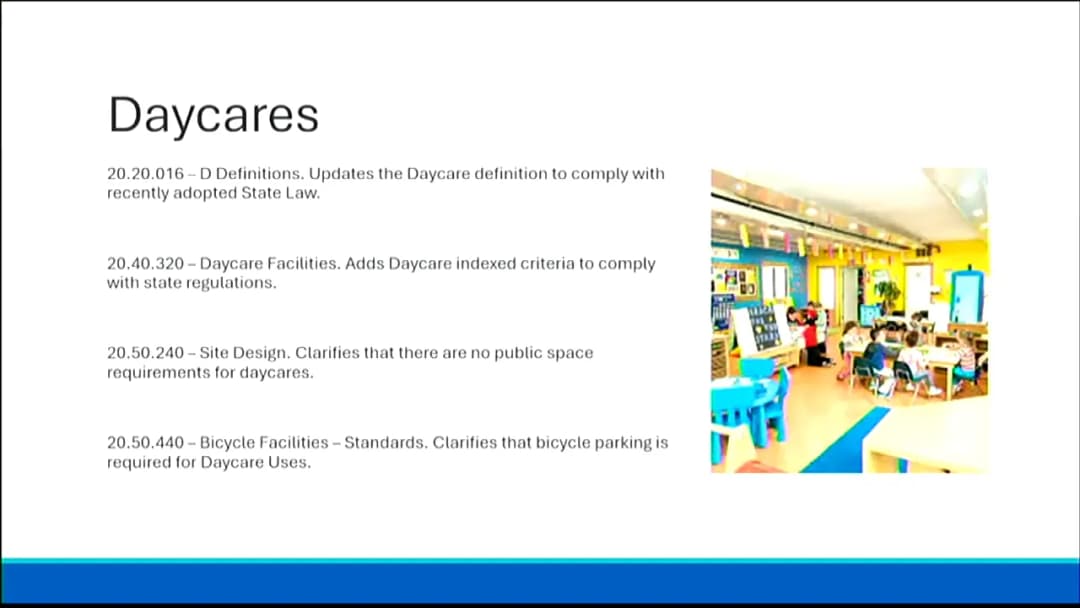
The Shoreline City Council held a regular meeting on Monday, September 21, 2026, at 7:00 p.m. in the Council Chamber at City Hall. Temporary Presiding Officer Snider called the meeting to order. Four councilmembers were present (Snider, Mork, Scully, Roberts); three were excused (Mayor Robertson, Deputy Mayor Pobee, Councilmember Ademasu). The council approved the consent calendar, appointed a new planning commissioner, discussed the 2026 Resident Satisfaction Survey results, and reviewed the 2026 Development Code batch amendments. The meeting adjourned at 8:55 p.m. Consent Calendar - Approval of Regular Meeting Minutes of August 17, 2026: Approved by unanimous consent (4-0). - Authorize the City Manager to Execute a Construction Contract with Clear Excavating, LLC in the Amount of $639,108.30 for the 10th Avenue NE Stormwater Improvements Project: Approved by unanimous consent (4-0). Public Comments & Testimony - Anthony Portugal (Shoreline resident) expressed opposition to the police drone first-response pilot program, warning of civil liberty and privacy violations and potential mission creep. He urged the council to end testing and further investment in drone programs. - Iris Peters (Shoreline resident) recounted witnessing an ICE detention in the Meridian Park neighborhood and urged the council to push back against ICE activities. She praised ordinary citizens who intervened and called for official recognition of their actions. - Lathan Weyne (Shoreline resident) shared that Lieutenant Michael Cooper of the Shoreline Fire Department had passed away. Discussion Items - 2026 Resident Satisfaction Survey Results: Communications Program Manager Eric Bratton introduced Jason Morado, Vice President and Director of Community Research at ETC Institute, who presented the survey findings. The survey received 891 responses (target 800) with a margin of error of ±3.3% at the 95% confidence level. Key findings included: residents have a very positive perception of Shoreline; overall satisfaction with city services is high; satisfaction increased in 57 of 71 areas since 2024 (including 26 areas with increases of 5% or more); the city outperforms national and regional averages in parks, police, stormwater, communications, and leadership; top priorities for the next two years are homelessness response, parks and recreation, human services, and police services. Councilmember Scully suggested adding LGBTQ identity to future surveys and requested searchable data by demographic groups. Mr. Morado confirmed crosstabs are available and a public-facing dashboard will be posted on the city website. Councilmember Roberts noted alignment with anecdotal input and the importance of sidewalk maintenance. Councilmember Mork asked about the survey timing (conducted in April–May) and environmental questions. - Discussion of Ordinance No. 1072 – Amending the Unified Development Code for the 2026 Development Code Batch Amendments: Senior Planner Steve Szafran presented 15 proposed amendments covering daycare uses (aligning with 2025 state law requiring daycare allowed in all zones without special permits), subdivisions (allowing permit extensions tied to active building permits), building and site design (reducing fenestration requirements from 30% to 20%, clarifying that site design features cannot overlap, and specifying parking cannot encroach into side/rear setbacks), traffic-related changes (requiring traffic calming in commercial-to-residential transition areas, shifting traffic impact analysis from vehicle PM peak trips to person-based trips), and use table cleanup. Planning Commission recommended approval. Councilmembers asked clarifying questions about fenestration impacts, traffic impact analysis methodology, and specific code provisions. Staff explained the changes codify current practices and allow mitigation measures to reflect all modes of travel. Councilmembers indicated the amendments made sense and supported moving the item forward on the Consent Calendar. Key Outcomes - Motion to excuse absent councilmembers: Carried 4-0. - Consent Calendar approval: Carried 4-0. - Appointment of Janice Gedlund to the Shoreline Planning Commission: Carried 4-0. She will serve the remainder of Commissioner Lauren Hadley's term through March 31, 2028. - The 2026 Development Code batch amendments (Ordinance No. 1072) will be placed on a future Consent Calendar for formal action. - The 2026 Resident Satisfaction Survey results will be posted on the city website with a public dashboard; staff will consider adding LGBTQ identity options in future surveys and providing further crosstab data.
The Pittsburgh City Council held a virtual-only post-agenda discussion on surveillance technologies on Monday, September 21, 2026, at 10:00 AM. Councilmember Deborah Gross chaired the meeting, which featured invited national experts: Dr. Lorrie Cranor from Carnegie Mellon University, Clarence Okoh from TechTonic Justice, and Councilmember Mike Siegel from Austin, TX. (Sarah Hamid from the Electronic Frontier Foundation was unable to attend due to illness.) The discussion aimed to inform Pittsburgh’s emerging surveillance technology policy, building on a September 2, 2026 report submitted by the city. Presentations - Dr. Lorrie Cranor (Carnegie Mellon University) gave an extensive overview of modern surveillance technologies—including AI-powered facial recognition, license plate readers (ALPRs), mobile phone tracking, smart home devices, and radio frequency sensing—and their privacy implications. She noted that AI face recognition is often inaccurate and can lead to wrongful arrests. She critiqued the City of Pittsburgh’s surveillance technology report for not systematically documenting what data is collected, how long it is retained, who has access, and whether access is logged and audited. She also identified a gap: the report does not cover independent authorities such as the Pittsburgh Parking Authority and Pittsburgh Water and Sewer Authority, which also collect sensitive data. She offered CMU’s privacy engineering program to assist with future analysis. - Clarence Okoh (TechTonic Justice) framed mass surveillance as a civil and human rights crisis, citing examples like a Maryland school district’s AI weapons detection system that misidentified a bag of Doritos as a handgun, leading to a traumatizing police response. He detailed the Pasco County (Florida) predictive policing program, which used secret data sharing agreements and an algorithm to assign risk scores to over 17,000 students (about one in five in the district). The program resulted in higher rates of exclusionary discipline and was designed to pressure families to move or sue—a practice later found to violate the Fourth Amendment. Okoh urged a comprehensive approach: prevent AI injustice by banning inherently harmful technologies, protect rights through testing and impact assessments, and repair harms through accountability mechanisms. He supported creating an AI Bill of Rights and community co-governance models. - Councilmember Mike Siegel (Austin, TX) described Austin’s experience ending its ALPR (Flock and Axon) contracts in June 2025 after discovering that Flock’s contract contained loopholes allowing data to be fed into AI systems despite a stated 7-day retention limit, and that 20% of police searches were non-compliant with city council guidelines. He noted that Austin’s surveillance impact report revealed 126 different technologies subject to their Trust Act. He emphasized that local governments are often not equipped to evaluate these tools and that even well-intentioned uses (e.g., park security cameras) can have unintended surveillance consequences. He advocated for transparency measures (surveillance impact reports) as an intermediate step for communities not ready to cancel contracts, and warned that data held by the city can be requested by state or federal authorities, especially given the current political climate. Discussion Items - Councilmember Kahari Mosley asked the panel for a “playbook” of immediate steps Pittsburgh could take. The panel suggested holding public hearings with citizen comment, conducting audits of existing programs (e.g., ALPRs), reviewing vendor contracts for hidden data-sharing clauses, and establishing an AI Bill of Rights or similar affirmative protections before adopting new technologies. - Councilmember Erica Strasberger emphasized the need for a holistic understanding that includes all city departments and independent authorities, and suggested using the city controller’s office for performance audits. She raised concerns about differentiating beneficial uses (e.g., red-light cameras for safety, cameras solving hit-and-runs) from mass surveillance, and noted Pittsburgh’s limited ability to regulate private companies under state law. She also flagged overlapping issues of AI, data centers, and surveillance technologies. - Councilmember Deborah Gross noted that the city’s current report is just a starting point and does not answer critical questions about data access and usage. She highlighted that residents are concerned about Flock cameras, AI, and data center proliferation. - Mr. Okoh, responding to a question from Councilmember Gross about data brokers, explained that data brokers are private companies that aggregate personal data from many sources (utility bills, social media, etc.) and sell it. They create a loophole around constitutional protections because law enforcement can purchase data instead of obtaining a warrant. This data can also be used for surveillance pricing (e.g., raising flight fares or rent based on personal data) and is especially dangerous in an authoritarian political climate. He noted that local governments can put barriers in place but face jurisdictional limits. Key Outcomes - No formal votes or decisions were taken; the meeting was an informational hearing to build council members’ knowledge and frame future policy. - Several council members expressed interest in adopting a more comprehensive approach similar to Austin’s Trust Act, including surveillance impact reports, audits, and community engagement. - Councilmember Gross indicated that the council would continue the policy conversation and consider expanding the scope of surveillance reports to cover independent authorities and address data access, retention, and logging. - Dr. Cranor offered Carnegie Mellon University’s assistance with analysis, and Mr. Okoh encouraged moratoriums on high-risk AI systems to allow time for thoughtful regulation. - The discussion underscored the need for Pittsburgh to move beyond its initial surveillance technology inventory and toward a robust governance framework that protects civil liberties while allowing beneficial uses.