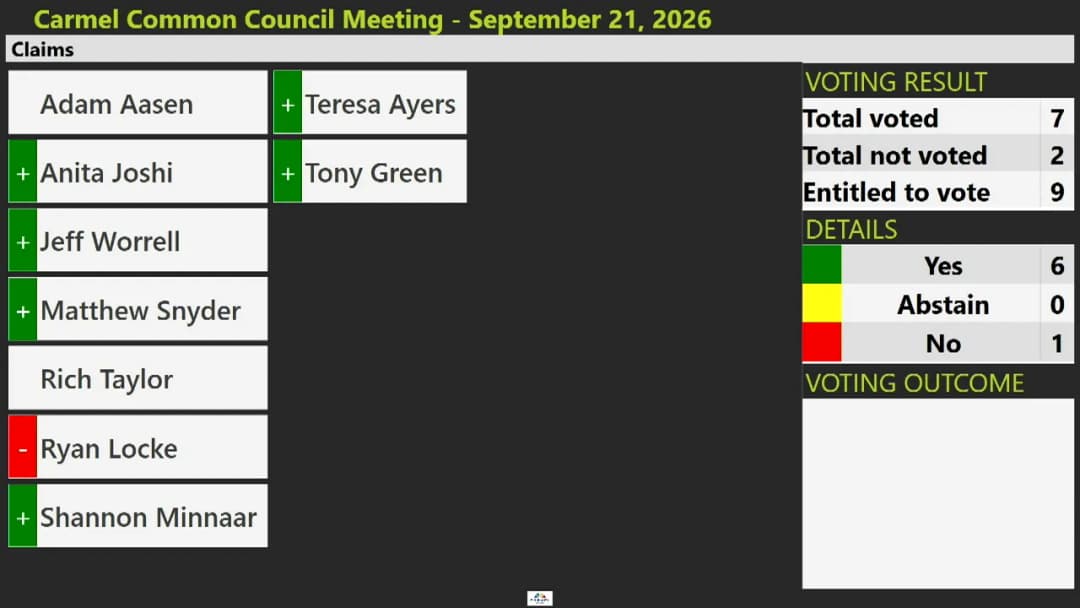
The Carmel Common Council met on Monday, September 21, 2026, at 7:00 PM in City Hall. The meeting included a full agenda with public comments on micromobility and surveillance, a FEMA update on August flood recovery, committee reports on the micromobility ordinance and Hotel Carmichael expansion, and passage of several routine items. Consent Calendar - Approved minutes from August 17 and September 3, 2026, meetings. - Approved claims and payroll: payroll $4,758,240.43; CFD bonus payroll $4,865.46; general claims $2,159,410.66; purchase card $31,590.01; wire transfers $3,219,674.14. - All consent items passed unanimously. Public Comments & Testimony - Jack Feldman (Carmel resident): Praised the 50th anniversary celebration; urged helmet requirements for minors on e-bikes and greater transparency in the budget for Flock camera contracts. - Rocky Griffith (Pendleton resident): Shared experience being pulled over while riding an electric unicycle; asked for clear legal pathways for EUCs and enforcement focused on behavior, not device capability. - Jason Selberg (Carmel resident, 20 years, representing Indianapolis PEV community): Supported micromobility safety goals but opposed relying on wattage or top speed as regulatory cutoffs; noted current ordinance prohibits unicycles on two wheels; urged future-proofing. - Chris Lloyd (Carmel resident, engineer, EUC rider): Explained that higher-wattage EUCs provide safety headroom for balance; argued regulation should target actual speed and behavior, not capability. - Council Carter (former council colleague): Criticized the proposed ordinance as too technical and lacking education; urged sending it back to committee to start with a clean slate and focus on stakeholder education before enforcement. - Bailey Sandlin (EUC rider): Demonstrated a 1,000-watt EUC; said the group no longer comes to Carmel due to restrictive rules; urged policing behavior over devices. - Kelly Nagy (Carmel resident): Advocated for native plant landscaping in city spaces; noted Westfield’s native plantings outpace Carmel; gave council copies of "Nature's Best Hope." - Ollie Dunn (Carmel High School senior, Mayor's Youth Council): Expressed concerns about Flock safety cameras; cited misuse in other cities (2,055 unauthorized searches by an Indiana deputy); called for oversight, transparency, and limits on data sharing. Discussion Items - Agenda Amendment: Council voted to add Item 15 (final disposition of the Chris Cunhamarket investigative report) and reorder the agenda. Motion passed. - Invocation / Yom Kippur Acknowledgment: Pastor Joe Smith led prayer; President Snyder recognized Yom Kippur. - Mayoral Comments (read by Council Minard): Mayor Finkam thanked city employees, partners, and private sector for flood response; recovery and rebuilding continue. - FEMA Presentation (Alan Wren): Outlined survivor road to recovery—file insurance first, then apply to FEMA at disasterassist.gov or 800-621-3362. Inspectors carry badges with registration numbers. FEMA covers lodging, rental, repair, replacement, and other needs; SBA loans up to $500,000 for property owners. - Council Comments: Council thanked Rotary Club for 50th anniversary celebration; recognized Carmel Clay Parks & Recreation’s 35th birthday and upcoming NRPA award. - Committee Reports: - Investigation Report (Council Locke): Moved to accept the Chris Cunhamarket investigative report as final and make it public. Motion passed. - Micromobility (Council Joshi): Provided update on ordinance changes (removed dismount zones, added helmet requirements for e-motos, worked with police). Held due to absence of city attorney and need to address electric unicycles. Council Austin proposed age minimum for e-bikes (e.g., 12+). Council Snyder clarified ordinance will return to committee for further work; no current item before council. - Redevelopment Update (Henry Mestetsky): Reported on Hotel Carmichael expansion—60 new rooms, enlarged ballroom, expanded lounge. City’s ownership share drops to 45% but equity grows by $5 million without new investment; guarantee reduced from $26M to $10.2M. New investor (hotel manager) contributing $2M. Council discussed valuation and potential sale after 2029. Key Outcomes - Ordinance D-2846-26 (Fund Repeals): First reading and immediate passage. Repeals nine defunct funds (e.g., Civic Square construction, lease rental, 2002 COET funds) with small balances moved to general fund. Approved unanimously. - Resolution CC-0921-2601 (Fund Balance Transfers): Transferred $63,244.95 from four funds to general fund. Approved. - Ordinance D-2847-26 (Berkshire Golf Course 2027 Fees): Introduced and referred to Finance and Rules Committee. - Agenda Add-on (Investigation Report): Accepted as final public record. - Micromobility Ordinance: Remains in committee; next land use meeting likely in October after attorney returns. - City Hall Ordinance: Still in committee; ongoing discussion. - Next Meeting: Finance/Rules Committee to meet October 5 at 4:30 PM.
The Public Meeting Index
The Public Meeting IndexThe Alexandria City Council held a public hearing on Saturday, September 19, 2026, beginning at 9:30 AM. The meeting included proclamations, a public discussion period with extensive testimony opposing automated license plate readers (ALPRs), consideration of several special use permits and ordinances, and deferral of a contested development project. Proclamations - Council endorsed a proclamation recognizing Alexandria Library Black Family Reunion Day. - Council endorsed a proclamation recognizing September as National Preparedness Month. - The presentation of a proclamation for Mayor’s Cup Rugby Players Day was deferred to a later date. Public Comments & Testimony - Fifteen speakers during the initial public discussion period, plus additional speakers later, overwhelmingly opposed the use of Flock cameras and automated license plate readers (ALPRs) in Alexandria. Speakers argued that ALPRs violate privacy and Fourth Amendment rights, disproportionately target communities of color and low-income neighborhoods, and pose risks of data sharing with federal agencies like ICE. Many urged the city to turn off and remove all ALPR cameras and to ban their future use. - One speaker (Marta Schantz, chair of the Environmental Policy Commission) provided an update on the commission’s summer work and upcoming priorities, including legislative advocacy on climate equity, resilience, and utility regulation. - One speaker (Nicole Radshaw) discussed pedestrian and bicycle safety, citing a crash report with 23 incidents, including a fatal crash on Van Dorn Street. She called for improved street engineering, not just enforcement. - One speaker (Melissa Kuennen) criticized proposed changes to the council’s public hearing procedure that would formalize rebuttal time for developers, arguing it would dismiss resident input. Discussion Items - Item 9 – Special Use Permit 2026-00022 (911 C & D Pendleton Street): Council discussed the conversion of a nonresidential building to residential use, with concerns about potential parking impacts and precedent for similar conversions. The item was approved in a separate motion. - Item 10 – Development Special Use Permit 2026-10007 (724-728 North Patrick Street): Council debated the proposed construction of five townhouses on a commercially zoned parcel. Councilman Chapman expressed concern about losing neighborhood-serving retail, noting the barbershop and other small businesses. Vice Mayor Bagley highlighted that the parcel has by-right residential uses, so denial may not preserve commercial uses. After discussion, Councilman Chapman successfully motioned to defer the item to the October 17, 2026 public hearing to allow further conversation with the property owner about potential mixed-use options. - Items 13 & 14 – Right-of-Way Vacations (Kent Place): Council held public hearings and approved ordinances to vacate portions of public right-of-way adjacent to 2702 Russell Road and 2800 Russell Road. - Item 15 – Address Renumbering Appeal (3600/½ Russell Road): Council deferred consideration of this appeal to the October 17, 2026 public hearing. - Items 16 & 17 were presented for council information only. Consent Calendar - Items 7, 8, 11, and 12 were approved on a roll-call vote as part of the consent calendar (with items 9 and 10 pulled). These included: - SUP 2026-00024 for outdoor live entertainment at 1913 Mount Vernon Avenue. - SUP 2026-00032 for redevelopment of a single-unit dwelling at 1 East Custis Avenue. - Ordinance amending Section 3-2-301 of the City Code regarding fees for bad checks (ORD. NO. 5648). - Ordinance amending Section 3-2-230 regarding personal property tax due dates for furloughed federal employees (ORD. NO. 5649). - Item 9 was approved separately. - Item 10 was deferred. Key Outcomes - Votes: - Consent items (7,8,11,12) approved 7-0. - Item 9 approved 7-0. - Item 10 deferred to October 17, 2026 (vote: 5-2 in favor of deferral; Mayor Gaskins and Vice Mayor Bagley voted nay). - Item 13 (2702 Russell Road vacation) approved 7-0. - Item 14 (2800 Russell Road vacation) approved 6-1 (Councilwoman Green voted nay). - Deferrals: Item 10 (North Patrick Street townhouses) and Item 15 (address renumbering appeal) were deferred to the October 17, 2026 public hearing. - Next Steps: Staff to provide clarity on ALPR definitions and data retention for speed/red-light cameras; council to continue discussion on proposed rules of procedure on October 6 legislative meeting. Note: The meeting adjourned at 11:47 AM.
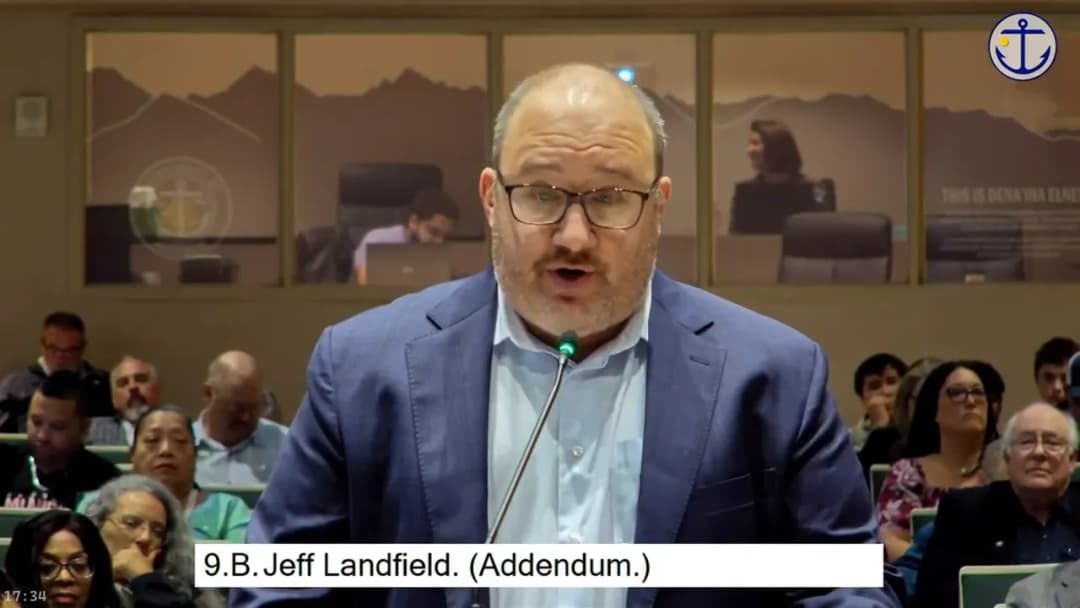
The Anchorage Assembly met for a regular business meeting that included recognition resolutions, youth representative swearing-in, and public hearings on housing tax incentives, surveillance technology, and the Missing Middle Housing Opportunity (MHOP) ordinance. The transcript repeatedly identifies the meeting date as Tuesday, September 15, 2026; the supplied metadata date is 2026-09-19, which is used here as instructed. The meeting was extended and ran until just before midnight, with several items postponed to future meetings. Consent Calendar - The consent agenda was approved minus items pulled by members. Pulled items were considered individually. - Recognition resolutions adopted unanimously: - AR 2026-264 recognizing September 15–October 15, 2026 as Hispanic and Latino Heritage Month. - AR 2026-265 honoring the Board of Equalization, which received a record 1,990 property tax assessment appeals in 2026 and completed 118 hearings compared to an average of 63. - AR 2026-266 recognizing September 25, 2026 as Dolly Day, honoring Dolly Parton and Anchorage Imagination Library’s more than 6,000 children served and 73,000 books distributed annually. - AR 2026-273 honoring the life and legacy of Dick Trainey, five-time Assembly chair and longest-serving member. - AM 586-2026, a cooperative purchase for two chip-topper distributor trucks and one chip spreader for Maintenance and Operations, was approved 11-0 with a not-to-exceed amount of $1,151,774. Public Comments & Testimony - Reverend Emily Carroll announced the October 1 opening of Three Elements Educare, a licensed child care center with capacity for 10 infants, 12 toddlers, 20 preschoolers, and 40 school-age children. She thanked the Assembly for Anchorage Child Care and Early Education funding in 2025 and 2026. - Jeff Landfield, publisher of Alaska Landmine, described an APD-initiated copyright strike that removed his Facebook video critical of Chief Sean Case. The video was later restored after APD concluded the use was likely fair use. Municipal Manager Falsey called it a “well-intentioned but mistaken call” and said it was not directed from leadership. Public Hearing: First-Time Homebuyer Tax Incentive (AO 2026-89) - Supporters included Bill Taylor (Colony Builders / Anchorage Home Builders Association), Skylar Quinn (Anchorage Home Builders Association president), and builder Kurosh Porto, who said the incentive would help younger families enter the housing market. - Opponents included Francis Seder, Josh McCose (Alaska Libertarian Party), Carol Howarth, Sean Williams, Scott Anderson, and others. They argued the tax burden would shift to existing property owners and renters, that the price threshold was too high, and that it would subsidize demand rather than supply. - The Assembly debated a substitute version tied to price and income. A motion to postpone to October 20 failed 5-7. The item was then postponed indefinitely on an 11-1 vote. Public Hearing: Mixed-Use Multi-Unit Housing Tax Incentive (AO 2026-93) - Public testifiers largely supported the substitute version, describing it as an efficient way to reuse vacant or underutilized space and grow the tax base. Concerns were raised by Carol Howarth and Josh McCose about permitting and regulatory barriers. - Assembly members questioned why the incentive applied only to owner-occupied units and noted a gap between four- and eight-unit projects. A motion to postpone to October 20 passed 11-1. Public Hearing: Surveillance Technology (AO 2026-108) - Eric Glatt (ACLU of Alaska) raised concerns about the S and S1 versions’ narrowed definition of surveillance technology and the 45-day cure period before a private right of action. - Josh McCose (Alaska Libertarian Party) opposed the substitute, saying it lacked retention limits and did not cover traffic cameras, facial recognition access, or data sharing through vendors. - Other community members, including representatives of the North Star Community Council, raised concerns about ALPRs, vendor data security, government accountability, and the speed of technology deployment. - Some testifiers, including Adrian Canino, supported codifying oversight but said they would prefer to remove automatic license plate readers entirely. Mike McConaughey opposed the ordinance, saying APD should be allowed to use investigatory tools. - After debate, the item was postponed to October 20 on a 12-0 vote. Discussion Item: Drone Report (AIM 139-2026) - Member McCormick said the annual drone report was incomplete and that a constituent’s police report showed a drone flight not listed in the report. APD acknowledged the omission was likely due to a spreadsheet glitch. - The municipal attorney explained that redacted records involved an open criminal investigation. - The administration requested indefinite postponement to prepare a revised report. A motion to postpone to October 6 passed 8-3, with the underlying motion to postpone indefinitely remaining on the item. Public Hearing: Missing Middle Housing Opportunity Overlay (AO 2026-85) - The hearing opened with extensive public testimony. - Supporters included Bill Taylor, Jason Norris (Huffman/O’Malley Community Council), Anchorage Housing Club organizers, and many young residents who described difficulty finding affordable housing. They cited the need for more housing supply, smaller homes, and growth along transit corridors. - Opponents and concerned residents, including members of the Anchorage Housing Work Group and several community councils, urged amendments to remove R1/R2 zones, exclude seismic hazard zones 4 and 5, keep 30-foot height limits, reduce lot coverage from 70% to 50%, and restore public notice. - The hearing was continued to October 6 because the meeting reached the midnight charter deadline; no vote was taken on the ordinance. Key Outcomes - An unnumbered ordinance updating Anchorage Bowl Comprehensive Plan and land-use density minimums was introduced; public hearing set for October 6. - Three youth representatives were sworn in: Rikik Ali, Malachi Cochran, and Rebecca McCullough. - AO 2026-89 was postponed indefinitely (11-1). - AO 2026-93 was postponed to October 20 (11-1). - AO 2026-108 was postponed to October 20 (12-0). - AIM 139-2026 was postponed to October 6 (8-3). - AO 2026-85 public hearing was continued to October 6, with remaining public hearing items 14B–14F carried over.
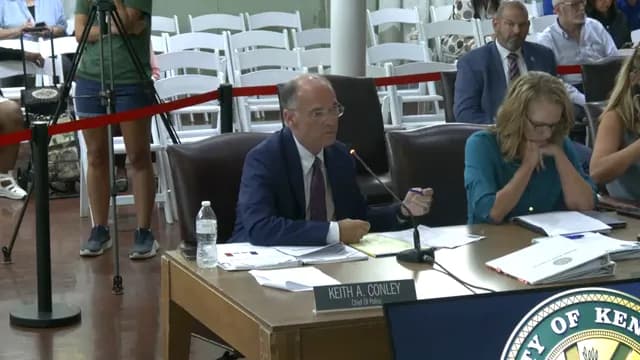
The Kenner City Council held its regular meeting on September 18, 2026. The agenda included proclamations honoring local hunger-relief and railroad-safety efforts, consent agenda actions, a moved agenda item on affordable housing, discussions of the state vehicle-inspection ("break tag") repeal, mold remediation at a city facility, multiple capital outlay requests, and an update on redevelopment of the Esplanade-area mall property. Councilmembers also heard public comments on a firefighter raise and addressed blighted properties, code enforcement, and recent structure fires in the Woodlake area. Consent Calendar - Item 1 – Approved the minutes of the regular council meeting of August 21, 2026. - Councilmember Stagney moved, with a second, to amend the consent agenda by removing item 7A and placing it under item 14, "Items Removed from the Consent Agenda." The motion carried. - Item 7A (moved to 14) – Kent Heights subdivision (new lot 31B, square 159): a request to allow a contractor's office, shop, and storage yard, to permit storage of recreational vehicles, and to preserve all access to all public rights-of-way. Recognition & Proclamations - Hunger Action Month (September 26, 2026 recognized): Mayor Glazer, Police Chief Conley, and the Council honored Ricardo Buso and the Buso family for donating over 760 pounds of non-perishable food to the Kenner Food Bank on the birthday of Ricardo's mother, Doris. The proclamation highlighted Doris's legacy, referred to as "Doris's Gift," and encouraged residents and businesses to join the fight against hunger. [Note: the transcript contains inconsistent spellings of the family name — Buso, Busso, Busilles — and first name of the honoree.] - Railroad Safety Week (September 21–27, 2026): Councilmembers recognized Canadian National Railroad's 20-year partnership with Operation Lifesaver to raise public awareness of railroad-crossing and track-safety dangers. Public Comments & Testimony - A public speaker urged residents to contact councilmembers and the mayor if they support a 2% raise for Kenner firefighters, noting the speaker had not attended a council meeting in over 16 years. - A speaker discussed efforts to help people who have lived through "troubles" and are helping others cope, in the context of recent tragedies. - Councilmembers noted that a resident had been coached on how to address concerns about a nearby property and expressed appreciation for the city's willingness to listen. Discussion Items - Break Tag Repeal / Vehicle Inspection Ordinance: A councilmember noted the break-tag (certificate of inspection) repeal took effect at the end of June 2026 under the prior council. He explained that between June 30, 2026 and January 1, 2027, no law enforcement officer shall issue citations for failing to produce or display a certificate of inspection. He acknowledged the police chief's directive that enforcement is not a priority but that the ordinance remains on the books; he also noted the city cannot instruct officers to ignore the law. The same councilmember expressed 100% support for the ordinance change, citing his prior experience in Jefferson Parish handling abandoned vehicles more streamlined than Kenner's process, and stated the change aligns with state law. - Affordable Housing – Item 14 (formerly 7A): City staff reviewed the resubdivision of the Kent Heights property after the city received HOME and HOME-ARPA funds to develop affordable housing. The plan includes transitional housing with a pathway for residents to become homeowners using HOME funds. The property was previously approved but required amendment because the original mayoral submission did not include the Lake Town project; the amendment to add it had been discussed in June. No issues were raised at the previous public meeting. - Roof Replacement & Mold Remediation (Halls A, B, C): The modified bitumen (mod bit) roof membrane has been delivered, but the polyisocyanurate (poly ISO) insulation board is awaited, with delivery slipping toward the end of September. A representative noted the roofing contract includes additional insulation, a major factor that contributed to mold growth. The mold issue was described as resolved, with staff back to work. A councilmember requested that the city attorney send over the proposed consent agreement and timeline to abate issues, and asked that a resident inspector be assigned to monitor the contractor. Excavation, foundation, and sequencing of the project were also discussed. - Blighted Properties – Resolution 13B: Resolution 13B authorizes a public hearing to be held September 18, 2026, during the regular council meeting to allow citizens to comment on Kenner's blighted/abandoned properties. A councilmember explained that some properties have grass liens or demolition liens that outstrip the property's value, making them unattractive to buyers. - Capital Outlay Requests – Resolutions 13F & 13G: Two resolutions request the administration to submit applications by November 1, 2026, for funding under the State of Louisiana's fiscal year 2027–2028 capital outlay program for road repair and related projects. A councilmember noted the items would draw legislators' attention and help secure state funding for city roads. - Mall (Esplanade) Redevelopment & Consent Judgment: Councilmembers discussed a meeting with the mall representatives, noting a proposal to build 200 apartments between the back Macy's wall and the food court while keeping the food court. One councilmember recalled telling the mayor, "We might have the real deal here," and the mayor responded, "When it's built, I'll believe it." A consent judgment has been pre-tried and will be finalized between the city attorney, mall representatives, and the out-of-state owners. Police Chief Conley stated that police action had been taken to secure the mall before a recent death in New Orleans, and the chief described code enforcement through police action as faster than mayor's-office code enforcement. Councilmembers stressed the need for documentation to hold the owners accountable. Woodlake area fires: Two houses that back up to each other both caught fire, prompting a councilmember to ask Entergy representative Jimmy Aiken to inspect the area's electrical equipment; the equipment was reported to be working properly. The councilmember asked the city attorney to send the consent agreement and timeline to compel abatement of the mall's issues. Key Outcomes - Voted to approve the consent agenda with item 7A removed and placed under item 14 (items removed from the consent agenda). - Recognized September 26, 2026 as Hunger Action Month in Kenner and honored Ricardo Buso and the Buso family for donating over 760 pounds of non-perishable food items to the Kenner Food Bank. - Recognized September 21–27, 2026 as Railroad Safety Week in Kenner. - Authorized capital outlay funding applications (Resolutions 13F and 13G) to be submitted by November 1, 2026, for the state's fiscal year 2027–2028 program for road repair. - Directed the city attorney to provide the consent agreement and timeline to abate issues at the mall property; police and code enforcement continue to address ongoing concerns. - Directed staff to include a resident inspector on the roof replacement project to ensure contractor accountability and timely reporting. Notes - Per the transcript, the break-tag (inspection sticker) repeal is effective immediately, with a non-enforcement window through January 1, 2027, and the ordinance remains on the books as a restricted, non-priority law. - The agenda and minutes were not available; this summary is based solely on the raw transcript, which contains minor spelling/transcription inconsistencies (e.g., "Buso"/"Busso" and "Abuso" for the honoree's family).
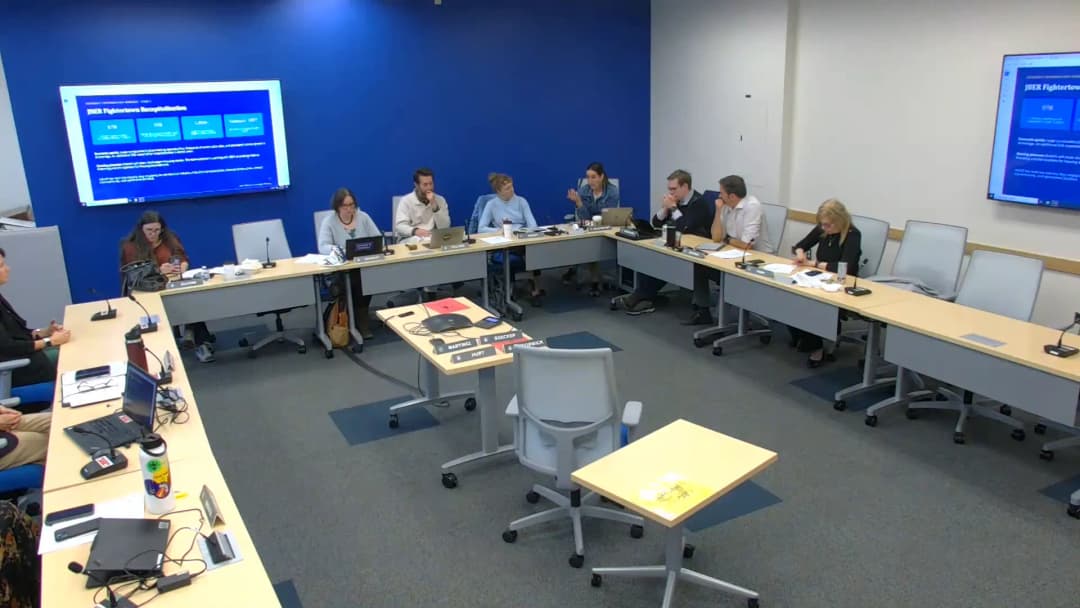
The Anchorage Assembly held a work session on September 18, 2026, to discuss the 120-day memo, which marks the beginning of the 2027 budget process. Mayor LaFrance and OMB Director Brouse presented an overview of the fiscal outlook, revenue estimates, tax cap limits, administration priorities, and capital budget. Assembly members engaged in detailed discussions on school district funding, the JBER Fighter Town recapitalization, and other topics, with no formal votes taken. Discussion Items Mayor's Opening Remarks Mayor LaFrance stated that revenues are expected to remain relatively flat while costs rise due to insurance, energy, and cost of living pressures. He outlined three responsibilities: acknowledge fiscal constraints, protect essential services, and make targeted investments for the future. He highlighted achievements including 91 additional sworn police officers, a 70% increase in prosecutions, and a 28% reduction in unsheltered homelessness. The mayor emphasized the need to ask whether taxpayers are getting good value for their dollars. Revenue Overview (OMB Director Brouse) - Total non-property tax revenue is down $7.8 million from the 2026 budget, largely due to a loss of transfer revenue from other municipal businesses. - Traffic and trial court fines are up $3 million; the community assistance program is up $1 million (to expected normal levels); ambulance fees up $300,000; alcohol tax up $500,000–$600,000; marijuana tax down $300,000. - Discussion on SEMT (Supplemental Emergency Medical Services Transport) revenues: budgeting is challenging due to delays in state reimbursements. SEMT revenues above budget are currently directed to fire department expenses. - Multiple assembly members asked about revenue assumptions, including reductions in automobile tax ($1.3M), tobacco tax ($500,000), motor vehicle rental tax ($1M), and MUSA ($200,000). These are based on recent trends. Tax Cap Calculation - Preliminary tax cap calculation: limit on all taxes collectible is $464 million; limit on property taxes collectible is $381.7 million. - Last year, the room under the property tax cap was $325 million. The population multiplier is blank because the change between 2026 and 2027 is zero. Administration Priorities - Continued increase in prosecutors and sworn officers at APD, additional community service officers, investment in snow removal drivers and equipment (about $6 million through levy and operating changes), completing delayed comprehensive financial audits, and restoring the Munis bond rating reserve. - Future focus areas: revitalizing neighborhoods, energy resiliency and affordability, boosting recreation and tourism, and preparing for JBER growth. - Assembly members asked for specifics on neighborhood revitalization and energy audits. Chief of Staff Suzanne Fleek-Green noted that energy audits for municipal assets are underway and that the administration is exploring ways to help residents future-proof their homes. Reorganization - The proposed reorganization consolidates the CAO position into the municipal manager role. The community development director will report directly to the mayor, alongside the municipal manager and CFO. Risk management moves into the municipal attorney’s office. No immediate cost savings have been quantified. School District Funding Gap - Originally a $12 million gap was projected; after state legislative action capping the voluntary contribution at 4%, the gap is now about $6 million. - Discussion on the mechanics of required vs. allowable local contribution, the interplay with the tax cap, and the challenge of differing fiscal years (municipal calendar year vs. school district fiscal year). - Assembly members requested a flow chart or timeline of decision points to better understand how to manage the gap. The administration indicated contingency proposals will be developed. - Example from the previous year: AO 2025-29S allowed pre-approval of school district budget revisions if the legislature increased the base student allocation, which saved procedural steps. JBER Fighter Town Recapitalization - $7 billion in military construction over five years, starting summer 2027. An estimated 2,500 additional military personnel and their families will require off-base housing. - Housing pressure: the military expects the private market to provide housing, but high costs and limited supply pose challenges. The administration is exploring federal programs like the Defense Community Infrastructure Program (DCIP) and working with developers. - Assembly members requested a work session with JBER leadership to learn more. Chief of Staff Fleek-Green confirmed efforts to schedule such a session. - Discussion on housing allowances: the administration will share breakdowns of expected allowances by rank and family size. - Assembly member Baldwin-Day noted that subsidized demand could put upward pressure on housing prices and urged intentional matchmaking. Gas Line and Other Developments - The Alaska gas line project could bring a large influx of workers, compounding housing demand alongside JBER growth. - Other notable developments: South Central Foundation crisis stabilization center, FedEx sorting facility at the airport, and Touchmark senior living project (first units expected 2028). Capital Budget Overview - Total capital projects requested for 2027–2032 amount to $867 million. For 2027, most funding sources are bonds (property taxes), with $120 million in bondable projects on the list. - Assembly members discussed bond packaging, the potential shift to a stormwater utility for drainage maintenance (noted $114 million in drainage projects in the last CIP), and state requests. OMB Director Brouse indicated the administration is taking a new approach to state requests, only listing those actually being requested each year rather than carrying forward all potential projects. - The bond rating improvement may reduce borrowing costs but is not expected to produce immediate savings. Key Outcomes - No formal votes were taken; the work session was informational. - The budget process timeline was reviewed: the 120-day memo was published September 2; the full budget will be introduced to the assembly on October 2 and introduced at the October 6 meeting; deliberation through October and November; mill rates set in April 2027. - Additional work sessions were announced, including on the parks CIP with the Anchorage Park Foundation (October 2) and with the ACE Fund board. - The administration committed to providing further information on school district funding scenarios, a breakdown of JBER housing allowances, and scheduling a work session with JBER leadership.
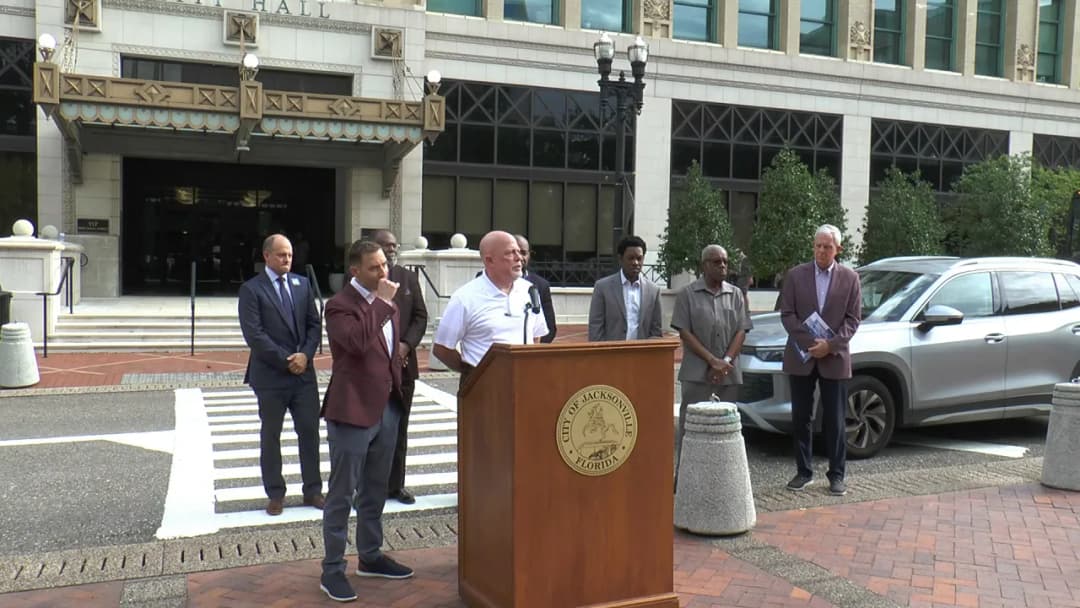
On September 18, 2026, Jacksonville city councilmembers, Jacksonville Area Legal Aid (JALA) representatives, and community advocates held a press conference to announce the operational launch of a rental registry tool designed to increase transparency for renters. The registry, hosted at Jackstablehousing.org, aggregates code enforcement records and eviction data for rental properties, allowing prospective tenants to check for violations before signing a lease. Speakers emphasized that Florida law preempts local mandatory registration, so the voluntary tool relies on public records requests. Public Comments & Testimony - Question regarding data update frequency: A reporter asked how often the code enforcement data would be refreshed. JALA's Jim Kowalski responded that the city provides public records easily, and updates could be done monthly or bi-monthly, depending on capacity. - Question about funding: A member of the public asked how the registry is funded. Councilmember Pelusa stated it does not use city dollars, but declined to specify further. - Question on data scope: Attendees asked whether the registry includes crime data, housing authority violations, and fallback options for emergency housing. Officials clarified the tool focuses on code violations and evictions (via Princeton Eviction Lab), not crime data; they noted JSO's interactive crime map is available separately. They also addressed that if a rental becomes uninhabitable (e.g., flood, fire), Florida statute already provides for rent abatement, and JALA assists tenants through its legal clinic. - Question about identifying property managers vs. owners: A participant noted it is difficult to determine the property manager behind an LLC. Kowalski acknowledged this gap and said future iterations aim to overlay property management data from sources like the Shimberg Center at UF. - Question on whether code enforcement data includes JHA properties: Officials said if the Municipal Code Enforcement Division issues a violation on Jacksonville Housing Authority property, it would be tracked. Discussion Items - Councilmember Jimmy Pelusa (District 7): Opened the press conference, describing how renters often face unresponsive landlords with code problems. He noted that Florida law limits city action, so JALA stepped in to create the registry. He highlighted that over 50% of local renters are cost-burdened (spending more than one-third of income on rent) and called Jacksonville the “eviction capital of Florida.” - Jim Kowalski (JALA Executive Director and CEO) : Thanked Councilmember Peluso for his leadership and Councilman Terrence Freeman for the Critical Quality of Life Committee. He explained that JALA used public records requests to load three years of Jacksonville code enforcement records. The tool also displays eviction data. He stressed that good landlords have nothing to fear, while abusive landlords will be exposed. - Councilmember Michael Boylan (District 6) : Reflected on four years of work by the Critical Quality of Life Issues Committee, which focused on healthcare, homelessness, and affordable housing. He praised the eviction diversion program and called for government to let the nonprofit and private sectors take the lead. He supported the registry as another tool to protect tenants. - Jose Javier Rodriguez (Former State Senator and Assistant Secretary of Labor) : Shared his background as a legal aid lawyer and trial attorney. He emphasized the power of transparency: renters should know which landlords violate codes before signing a lease. He advocated for an attorney general who would go after repeat offenders and anti-competitive practices, and noted that Florida has the worst tenant protection laws in the country. Key Outcomes - Launch of the rental registry: The tool is live at Jackstablehousing.org. It allows users to search rental property addresses and view code compliance violations and eviction records. JALA will continue to refresh the data regularly. - Future enhancements: Officials indicated plans to add property management transparency (identifying who is responsible for day-to-day maintenance) and to produce an annual housing report using data like ALICE metrics and corporate ownership patterns. - Call for state-level changes: Multiple speakers reiterated that Tallahassee must reform Florida's one-sided landlord-tenant laws and end preemption that prevents cities from requiring landlord registration.
The Disaster Recovery, International Affairs, and Planning (DRIP) Committee of the Maui County Council reconvened from September 17, 2026, at 9:05 a.m. to continue discussion on Bill 108 (2026), which would adopt the updated South Maui Community Plan. The meeting focused on Section 2 (Policy Framework) and included extensive deliberation on coastal retreat, watershed management, gulch protections, and cultural resource policies. Several policies were amended, and a number of items were deferred for further work with county departments. The committee aims to complete Section 2 review before moving to Section 4 (Implementing Actions). Public Comments & Testimony - Oral testimony on DRIP-25 (Bill 108) was closed on September 17, 2026, but written testimony continued to be accepted. Discussion Items - Policy 2.3.6 – Coastal Retreat (Revisit): Chair Paltin proposed a policy to support land use entitlements for coastal retreat through transfer of water credits. After discussion with Water Department’s James Jensen and Corporation Counsel, the committee agreed to table the item to develop broader language with input from wastewater and other utilities. The policy will be revisited later in the process. - Policy 2.4.2 – Prioritize Green Infrastructure: The committee voted to amend the policy to read: "Prioritize traditional Hawaiian cultural practices, other nature-based solutions, low impact design and green infrastructure strategies rather than gray infrastructure to manage flooding and prevent surface water pollutants from flowing into streams and reaching the ocean." Motion passed 6-0-3 (excused: Sugimura, Batangan, Johnson). - Policy 2.4.5, 2.4.6, 2.4.7 – Gulch and Drainage Protections: These related policies were deferred after Public Works Director Jordan Mulina raised concerns about flood mitigation and the definition of low impact development. The committee directed Planning, Public Works, and Corporation Counsel to draft revised language that balances water quality goals with flood control needs, to be discussed on Monday. - Policy 2.4.15 (Split) – Low Impact Development: The first part (require LID) passed unanimously. The second part (encourage management of flows 5-year storm event) was debated. After Director Mulina noted that existing drainage rules already require mitigation for 50- and 100-year events, the committee agreed to drop the second policy as redundant. - Policy 2.4.17 – Deleted: Because the SMA permit for new restrooms at McKenna State Park has already been approved, the committee voted to delete this policy (motion passed 6-0-3). - Policy 2.5.1 – Native Hawaiian Access: Amended to ensure development projects provide continued access to kuleana lands and areas where native Hawaiian rights were customarily exercised, citing applicable laws. Passed 8-0-1. - Policy 2.5.6 – Historic Roads: Amended to separate preservation from restoration: "Ensure existing government trails and historical roads are preserved... encourage the restoration... to the extent practicable." Passed 8-0-1. - Policy 2.5.7 – Tree Preservation: Amended to require preservation of healthy, mature, non-invasive trees during development, with consultation with Department of OEV Resources. Passed 8-0-1. - Policy 2.5.9 – Use of Ike Kupuna: Amended to incorporate traditional ecological knowledge in design of new development. Passed 6-0-3. - Policy 2.5.11A & 2.5.11B – Historic Properties: Deferred for Planning and Corporation Counsel to refine language, particularly regarding "adjacent" vs. "same parcel." - Policy 2.5.13 – Community Stewardship: Amended to include "culturally appropriate" community stewardship of wahi kupuna. Passed 8-0-1. - Policy 2.5.14 – Deleted as redundant with 2.5.6. - Policy 2.5.17 – Cultural Center: Amended to support a cultural center and museum in South Maui. Passed 8-0-1. - Additional Revisits: Chair Paltin noted three items requiring further work with departments: (1) coastal retreat policy (2.3.6) – with Water, Wastewater, and Corporation Counsel; (2) gulch policies (2.4.5, 2.4.6, 2.4.7) – with Planning, Public Works, and Corporation Counsel; (3) a new policy on natural resources (sand, sediment, pohaku) not being moved between moku without consultation – to be drafted by Councilmember Cook, Vernon Kalanikau, and OEV Resources. Key Outcomes - Votes passed on amendments to policies 2.4.2, 2.4.4, 2.4.12, 2.4.13, 2.4.15, 2.4.16, 2.4.17 (deletion), 2.5.1, 2.5.2, 2.5.6, 2.5.7, 2.5.9, 2.5.13, 2.5.14 (deletion), and 2.5.17. All passed with at least 6 ayes and no opposed votes; absent/excused members noted. - Deferred items: Coastal retreat policy (2.3.6), gulch policies (2.4.5-2.4.7), historic properties policy (2.5.11A/B), and new natural resources policy. These will be revisited after departments provide revised language. - Next steps: The committee will reconvene on Monday, September 21, 2026, to hear testimony on Section 4 (Implementing Actions) and receive guidance from Corporation Counsel on fiscal requirements. The target is to complete Section 2 review by end of that meeting. - Meeting adjourned at approximately 4:30 p.m.
The Beyond Apology Commission of Tulsa met on September 18, 2026, at 1:06 PM to discuss the progress of a reparative ordinance, the structure of the upcoming Tulsa Reparation Summit, and to receive a report from the Education Subcommittee. The meeting included votes on the minutes and the summit structure, with several agenda items postponed due to time constraints. Consent Calendar - The minutes from the August 21, 2026, meeting were approved with a motion and second, all in favor with no opposition noted (though a brief procedural interruption occurred). Discussion Items - Chair's Report (Chairwoman Christy Williams): - Reparative Ordinance: The commission continues developing a local reparative ordinance addressing the discovery, protection, consultation, and appropriate treatment of Black ancestral remains and historically significant materials (artifacts). The ordinance was submitted to city legal and remains under review. Williams noted that this work is historic, as no federal law (like NAGPRA for Indigenous nations) exists for African Americans; other entities (e.g., New York mass graves archaeologists) have sought federal policy, but Tulsa is working on a local level. - Internal Structure & Bylaw Updates: Williams emphasized strengthening committee workflows, clarifying how recommendations move to the full commission, and improving communication and accountability. A six-month report was shared with commissioners documenting committee work. - Tulsa Reparation Summit Planning: The chair reported on meetings with national partner First Repair and local stakeholders. A proposal was presented to change the summit from a Beyond Apology-led event to a community-led "Tulsa Reparation Summit" with First Repair as national partner and Black Wall Street Chamber of Commerce as fiscal sponsor. This structure avoids city restrictions on fundraising, event planning, and administrative burdens. Commissioners discussed whether a vote was needed; it was determined a vote would clarify the commission's role as a civic partner only (not lead organizer). The commission voted to accept the proposed structure. The summit is scheduled for April 16–17, 2027 (third weekend in April). Key points: commissions may volunteer individually, committees may offer workshops, and the summit will count as one of the commission's required community engagement events. - Education Subcommittee Report (Dr. Ramona Curtis): - The subcommittee presented a framework for education in North Tulsa, focusing on cradle-to-retirement lifelong learning. Two formal recommendations were offered: 1. Recommendation to the City of Tulsa: Adopt a coordinated place-based education and opportunity strategy for North Tulsa, using city facilities, departments, data, and convening authority to connect residents with education, workforce, cultural, and family supports. Goal: reduce fragmentation, measure outcomes. 2. Recommendation to the Greenwood Trust: Establish a competitive community partner funding process aligned with eight education priority areas (generational education, cradle-to-career scholarships, neighborhood learning hubs, youth career pathways, barrier removal fund, education navigation system, Greenwood history/cultural identity, measurable outcomes). Emphasis on removing barriers for grassroots organizations, requiring measurable outcomes, and including community voice in proposals. - Chair Williams noted that the recommendations would be discussed at the next meeting due to time constraints. The subcommittee plans to gather community feedback at the upcoming Reparation Summit. - Health & Wellness Committee Report (Commissioner Monday): The committee has structured meeting times and is following the land/economic development committee's model of working groups, examining community partners and equity indicators to advance recommendations. Key Outcomes - Minutes Approved: The August 21, 2026, meeting minutes were approved unanimously. - Reparation Summit Structure Approved: The commission voted to accept the proposed structure for the Tulsa Reparation Summit, with Beyond Apology acting as a civic partner, not the lead organizing entity, to be held April 16–17, 2027, in partnership with First Repair and with Black Wall Street Chamber as fiscal sponsor. - Committee Reports Tabled: The Education Subcommittee's recommendations, along with any other committee reports not presented, were tabled to the next meeting due to time. - Next Meeting: The chair indicated that future meetings will include discussion of committee bylaw updates and workflow strengthening. The next subcommittee meeting for education is scheduled for October 20, 2026. - Announcements: - The BC Franklin Lecture Series at the University of Tulsa featuring Thomas W. Mitchell (Director of the Initiative on Land, Housing, and Property Rights at Boston College Law School) will be held on October 20, 2026; commissioners were encouraged to attend. - Visitors from Kenya (David and Eunice Tanui) were introduced. - Adjournment: The meeting adjourned at approximately 2:14 PM after a motion and second.
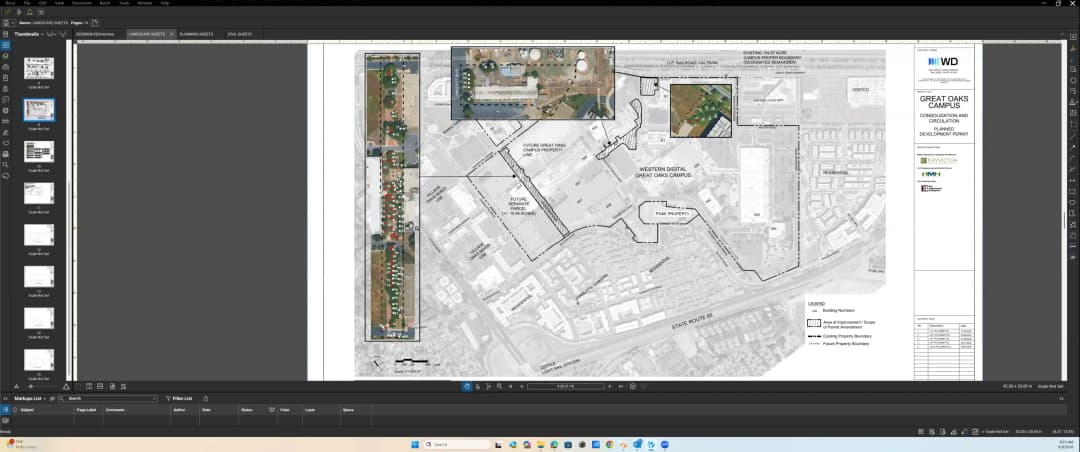
The San Jose Planning Director hearing convened via Zoom at 9:00 a.m. and adjourned at 9:34 a.m. Hearing Officer Sylvia Doe presided, acting on behalf of Director of Planning, Building, and Code Enforcement Christopher Burton. The raw transcript identifies the hearing date as September 9, 2026, while the date supplied for this summary is September 18, 2026. The only agendized matter was a planned development permit at 5601 Great Oaks Parkway. No deferrals were requested. Deferrals - No items were proposed for deferral; the public hearing on deferrals was opened and closed with no speakers. Consent Calendar - Item 3A, File No. 25-027, Planned Development Permit for 5601 Great Oaks Parkway, was the sole consent calendar item. After a public commenter asked to speak, Hearing Officer Doe moved the item to the public hearing portion for separate discussion. Public Comments & Testimony - Jordan Mulnow, a San Jose resident, expressed concern about the removal of mature trees along the pedestrian pathway. He understood the stated need for access to the tank farm and Building 06 parking lot, but questioned whether the new roadway had to run all the way through; he suggested considering a road in only two of three segments and preserving the pedestrian path in the densest tree area. - Lillian (last name not provided) agreed with Mulnow and opposed the removal of mature trees. She criticized the loss of mature trees and said replacement box trees and gallon trees can be easily removed, urging the city and planning commission to stop such removals and preserve existing mature trees. Discussion Items - Planning Project Manager Rina Shah reported that the proposed PD permit would authorize modifications to vehicle circulation, pedestrian pathways, landscaping, stormwater control plan, site lighting, a 64-square-foot utility shed, and the removal of 41 trees. The work is on an approximately 5.7-acre portion of an approximately 142-acre Western Digital industrial campus and includes no vertical construction or new buildings. The 142-acre parcel is the remainder of a 157.4-acre parcel approved with Tentative Map 2026-006 on August 12, 2026. The site is bounded by Carl Road, Great Oaks Boulevard, Highway 85, and Perimeter Road, with residential, park, and highway uses nearby. It is in the IPPD Planned Development Zoning District and is consistent with the General Plan Industrial Park designation. Outreach included an on-site sign posted June 15, 2026, and notice within 500 feet. Staff determined a CEQA exemption under Guidelines Section 15301 and recommended approval. - Applicant representative Jason Victor, joined by David Curry of Western Digital, described the campus context, including the 2005 downsizing of the campus and new headquarters buildings. He said Western Digital identified about 15 acres on the western perimeter to make available to another industrial user, and that a separate data center permit has been submitted for planning review. The PD permit under consideration would update circulation along the campus edge and add pedestrian enhancements, pickleball courts, expanded garden and outdoor areas, and landscape screening. - Victor said 41 trees will be removed, most in the pedestrian and emergency service corridor. He said 90 trees exist in that corridor and about half will be removed. He stated that a continuous circulation loop was studied and determined necessary for service access, tank farm access, parking lots, and emergency vehicles. Replacement planting would include Chinese elms and oak species such as fork oak and California live oak. - Rina Shah responded to public concerns by citing San Jose Municipal Code Chapter 13.32 tree removal findings. She said the arborist report found structural issues in some trees, including uneven canopies, multi-trunk and co-dominant stems, and lack of structural stability. She stated the total replacement requirement as 132 15-gallon-equivalent trees, citing 26 ordinance-sized non-native trees requiring 104 15-gallon trees and 13 non-ordinance-sized trees requiring 26 15-gallon trees. The project plants 69 24-inch box trees and 61 15-gallon trees, exceeding the stated replacement requirement. - Hearing Officer Doe asked about replacement species. Victor explained that many existing canopies along the corridor would be retained, and new trees would include faster-growing Chinese elms and native oaks with larger canopies that have proven successful on campus. Key Outcomes - Hearing Officer Doe approved the Planned Development Permit for Item 3A, File No. 25-027, as recommended by staff and in accordance with CEQA. The environmental exemption was based on CEQA Guidelines Section 15301. - Doe found the project consistent with the General Plan and planned development zoning, and noted that the proposal is limited to site landscaping, circulation, and outdoor amenity improvements for the existing industrial campus. She cited the larger 24-inch box trees being planted from the outset, the faster-growing, native, large-canopy replacement species, and preservation of existing healthy mature trees to the extent possible. - The approval will be final when the permit is signed and mailed unless appealed. Permit actions are appealable under Title 20 of the San Jose Municipal Code; environmental review determinations are separately appealable under Title 21. - The hearing was adjourned at 9:34 a.m.
The Valdez City Council convened for Day 1 of its two-day strategic planning work session, facilitated by consultant Karen Kirk. The session covered council roles and responsibilities, status updates on 2025 action items and the council's top four priorities, an extensive budget and financial outlook presentation by Finance Director Jordan, a mill rate and tax cap discussion, preliminary FY2027 budget parameters, and a preview of Day 2's priority-setting work. Per the work-session format, transcribed minutes are not taken and audio is available upon request. Note on date: The agenda is printed for Thursday, June 18, 2026, 9:00 AM at the Civic Center Conference Room, while the provided meeting timestamp is 2026-09-18; this summary uses the provided timestamp of September 18, 2026. Strategic Planning Kickoff, Ground Rules, and Icebreaker - Karen Kirk introduced the agenda, handouts labeled A–E, engagement protocol (respectful communication, no side conversations, staying on topic), and the parking lot for deferred topics. - She reviewed the organizational foundation: the city's mission is to "cultivate an environment of opportunity, sustain prosperity, and well-being for everyone, all community members"; Valdez has no adopted vision statement. - Council members completed a three-minute puzzle icebreaker in which three members were blindfolded and three could not use their hands. The facilitator praised the council for finishing under deadline using respectful communication, drawing parallels to consensus decision-making and focusing on the "forest," not the "tree." Roles and Responsibilities - City Clerk Sherry, with 37 years of experience, reminded the council that it exercises all legislative and policy-making powers under the charter, while the city manager has the administrative role. The council hires the city attorney, city manager, and city clerk. She advised against being swayed by a few passionate speakers at the dais, noted the "silent majority," and reminded members they can use motions to postpone and the goal qualifiers taped to the dais. - City Manager Nate described administration as the "hands" and council as the "eyes," stating the council "has the absolute right to be absolutely wrong," and that staff will advise but ultimately carry out council decisions. He noted the mayor or any two council members can place items on the agenda, and that personnel matters should be directed to him rather than staff. He mentioned the city has roughly 134 employees plus temporary/temp staff. - The Mayor encouraged new members to use Nate's open door and noted the council's practice of respecting the manager's personnel authority. City Manager Updates on 2025 Action Items and Top Four Priorities - Housing subcommittee: The subcommittee stalled but an invite has been sent to restart it; recent state legislation changes may affect earlier decisions, but the city is "no harm, no foul." - VCB/public accommodation tax: The collapse of the destination marketing organization occurred five months after the city acted; letters of interest are being solicited to establish a new board. - Permanent fund: The $300 million milestone was noted, but a celebration was deemed inappropriate given the current financial situation. - Prince William Sound College: Conversations have not been as fruitful as hoped; the city may engage again once a new college director is on board. - Priority 1 – Housing (increase housing stock by fall 2027): Blueberry was cited as a success; Copper Valley Telecom is exploring housing; the city manager called housing a still-valid priority. - Priority 2 – Child care (operating licensed facility by fall 2026): Head Start is operational but faces staffing challenges; the district office facility will not open by the school year, with a target of before 2027 or, more conservatively, spring 2027. The entire $880,000 thread grant was expended last year on playground equipment and grants to Head Start, preschool, and Sugar Bar Daycare. Councilmember feedback noted the current program operates as a learning center (roughly 8 a.m.–3 p.m.), not a full daycare, causing community confusion; Head Start's end target is approximately 6 a.m.–5:30 p.m., limited by state student-to-adult ratios. The city manager noted many city staff fall in the 80–120% of median income range underserved by low-income programs. - Priority 3 – Maintenance: Projects continue; the Meals (Meals Hill) Avenue project is underway. - Priority 4 – Outdoor recreation, tourism, maritime, and community: The Civic Center is being leveraged for revenue; the waterfront master plan needs revision; Kelsey Dock and Meals Hill are cited as spaces that are community-first and tourism-supportive; the museum has been boosted by cruise ship revenue. - Mooring dolphin: The dolphin was installed last fall and is operational, but stevedores and pilots have been slow to use it; the city is working with DOT (with Senator Rousher's assistance) on the ferry terminal. Some cruise ships prefer lightering, which bypasses the dolphin. Budget Overview and FY2026 Financial Outlook (Finance Director Jordan) - Total fund balance is $440 million, mostly in the permanent fund. The general fund unrestricted/unassigned balance is roughly $17 million, which Jordan called low given city revenue approaching $100 million; he stated it should be closer to 28% of revenue, and council later discussed a 20% target. - Repayment reserve: Approximately $19.8 million remains, tied to escaped property. History: A Department of Revenue (DOR) supplemental roll for 2017–2021 added $600 million in assessed value, and the city collected $15 million; the council created a repayment reserve in December 2022. Judge Seaman's order removed 2017–2018 from taxation, and the city repaid $3.8 million (plus penalties and interest) to the taxpayer from the reserve. Five escort tugs were ruled taxable, and DOR was ordered to correct assessments, which has not yet occurred. A supplemental roll for 2022–2024 is expected and could be an additional $15–25 million. - Pipeline valuation: The FY2026 budget assumed an $8 billion pipeline valuation; DOR assessed $10 billion; the State Assessment Review Board (SARB) set the value at $13.8 billion. That creates roughly $25 million in additional revenue, of which $15.2 million must be applied to bonded debt (prepayment of the GO22 sewer force main loan) under the ad valorem revenue cap. A resolution to accept and appropriate the $25 million is planned for the second council meeting in July; action is technically not needed until December 30. - FY2027: Approximately $12.6 million in additional prepayment capacity will be needed. The easiest option is a $7 million reimbursement bond for the Meals Avenue project, which would help cover the gap. - Revenue mix: The FY2026 budget projected $73 million in total revenue, with $55 million (76%) from property tax; actual revenue is about $98 million, of which property tax is 82%. - Jordan cited GFOA best practice to use one-time or unstable revenue for non-recurring expenses that lower operating costs (e.g., paving, water/sewer fixes), reserves, or debt, and warned against projects that expand the city's operating footprint. - Staff projections show the expense trend will not cross the tax cap trend through 2033 at current service levels. Key risks include the expected supplemental roll, changes to AS 43.56 (including gas pipeline tax discussions), and HB 13 not materializing. Mill Rate and Tax Cap Discussion (20 vs. 19 vs. 13.8 Mills) - Valdez levies 20 mills (2% of taxable value). Jordan explained that under statute, the rate applied to oil and gas property (AS 43.56) must match the municipal rate, so industry pays 20 mills regardless; lowering the mill rate would send money to the state, not save industry anything. - Each mill is worth approximately $4 million in revenue. Dropping to 19 mills would save the average homeowner about $325–350 per year but forgo $4 million annually forever and increase tax cap flexibility. A 13.8-mill rate would cover current service delivery but forgo $25 million in revenue. - Council positions: The Mayor explained the drawdown of savings as moving funds into productive use. Councilmember Kevin questioned why 19 mills was the only alternative given the 13.8-mill service level, but ultimately stated he would stick with 20 mills until the settlement picture and HB 13 are clearer. Councilmember Missy favored keeping 20 mills and using exemptions to help homeowners rather than lowering the rate; she cited community complaints about taxes and crumbling streets. Councilmember Jimmy said he would keep 20 mills and capture the full 20 from industry. Councilmember Lester noted the $350 savings was not material and that a bigger impact could be made with the revenue. - HB 13: If enacted, the governor's residential exemption would reduce the debt service obligation at 20 mills from $21.7 million to $17.4 million. Council members expressed skepticism about the governor signing it. - Senior exemption: The Mayor noted Dave Tuznoth's proposal for a $350,000 senior property tax exemption, which could go to the voters without waiting for HB 13. City Clerk Sherry cautioned that exemptions stack (seniors currently receive the $150,000 statutory exemption plus the $77,000 primary home exemption), and an increase could eliminate tax burden for some seniors; the city has an aging population to consider. - The council generally agreed to keep 20 mills for FY2027 and revisit if HB 13, the pipeline settlement, or the supplemental roll changes the picture. FY2027 Budget Parameters - Jordan described budget parameters as broad-based council guidance to administration, to be adopted by resolution at the second meeting in July so staff can build department budgets starting August 1. The process includes manager review in September and public workshops in October. - Permanent fund: The council discussed the annual 1.5% charter transfer (currently about $3.8 million) and the FY2026 appropriation of $867,150 back into the permanent fund. Council members generally supported continuing to use the 1.5% transfer and appropriating at similar or greater levels; Jimmy advocated putting more into the permanent fund, citing North Slope Borough, while another member said the fund is doing well and does not need additional money. - Personnel costs: The council agreed to continue the CPI-based cost-of-living adjustment formula; the projected COLA for FY2027 is 3.2%. The Mayor noted there have been years with no COLA or a bonus instead. - Health care: The city is self-insured; industry trends point to double-digit renewals, but Jordan said the city's plan is well positioned and he would estimate renewal under 3%. Councilmember Missy expressed concern that the plan is exceptionally generous (e.g., no deposit for surgery, free weight-loss drugs) and may need review, while another member urged not punishing employees for macroeconomic trends because good benefits are a retention tool. The city manager said options are being reviewed in time for budget season. - Capital projects and bonding: Jordan listed options including the Meals Avenue reimbursement bond (easiest), the fully designed BCT waterline project, pavement management phase six, rural roads, a baler building, an old harbor launch ramp, and a coho building. City Manager Nate cautioned that delivery capacity (contractors, lodging, and project managers) limits how many bonded projects can be executed per year; a sustained $25 million annual bonded program would require more project managers. He recommended budget parameter language ensuring enough callable bonded debt is on the books to capture whatever mill levy the council sets. Goals and Priorities Preview (Day 2 Preparation) - Karen Kirk reviewed goal identifiers (topic, what about it, action, metric, target date), the nine goal qualifiers used to filter proposals (top five being impact, sustainability, personnel burden, budget, and high-need service/economic impact), and the mission/SWOT handout from last year's assessment. - City Manager Nate reported results of the Flash Vote community survey: Housing and the condition of streets/sidewalks both showed high importance and low satisfaction. Child care showed lower importance than in past years but also low satisfaction, with notably higher importance and lower satisfaction among female respondents. He found no overwhelming public demand for a new priority beyond the current set. - Nate noted Valdez is one of the few Alaska communities with more job listings than unemployed individuals, and that attracting population (including Coast Guard-related growth) is worth about $15,000 per person in tax cap revenue. Councilmember Green had requested the Flash Vote; the council discussed potentially running a more targeted future survey on business/economic/workforce development. Key Outcomes - The FY2026 resolution to accept and appropriate the additional $25 million in pipeline-related revenue, including the $15.2 million prepayment to GO22, will be brought to the second council meeting in July; council input will shape how the remaining roughly $10 million is used. - Council leaning on the remaining funds: bolster reserves (approximately $3.5 million toward a 20% unrestricted fund balance target via the repayment reserve) and direct the rest to infrastructure projects, with some members favoring projects over the permanent fund and Jimmy preferring any remainder go to the permanent fund. No formal vote was taken. - The council reached general consensus to maintain the 20-mill levy for FY2027, revisiting only if HB 13, the pipeline settlement, or the supplemental roll changes the fiscal picture. - The council agreed to continue the CPI-based COLA formula (projected 3.2%) for FY2027. - Budget parameters will be finalized after Day 2's priority discussion and adopted by resolution at the second meeting in July. - Day 2 of the retreat will run 9:00 AM–2:00 PM and will be solely focused on priorities discussion, followed by finalizing budget parameters. - City Clerk Sherry announced that Precinct 3's polling place will move from the Road River fire station to the airport due to ADA accessibility requirements, beginning with the upcoming primary election.