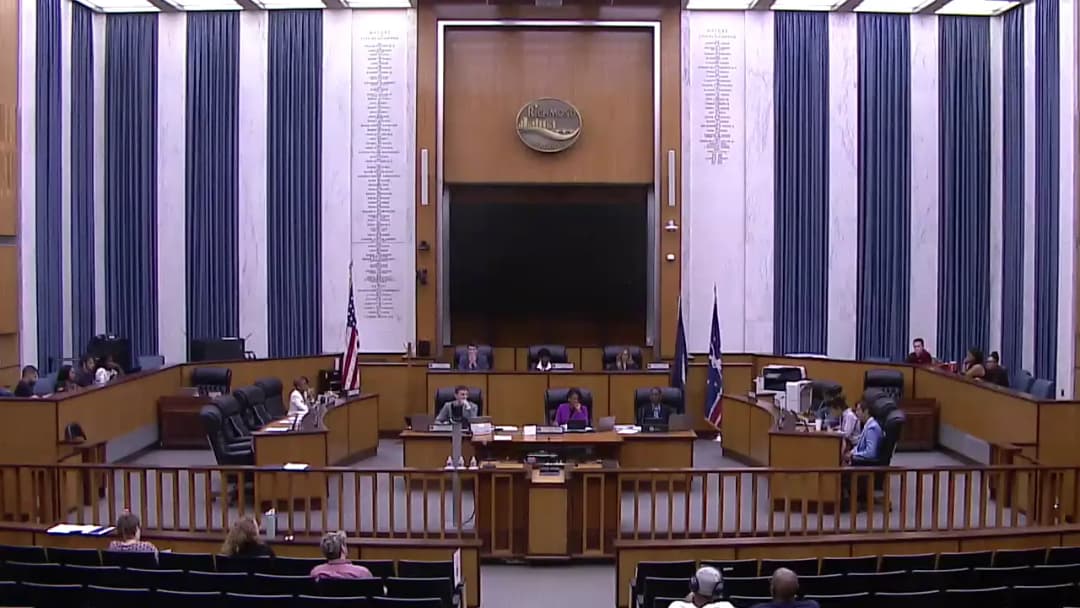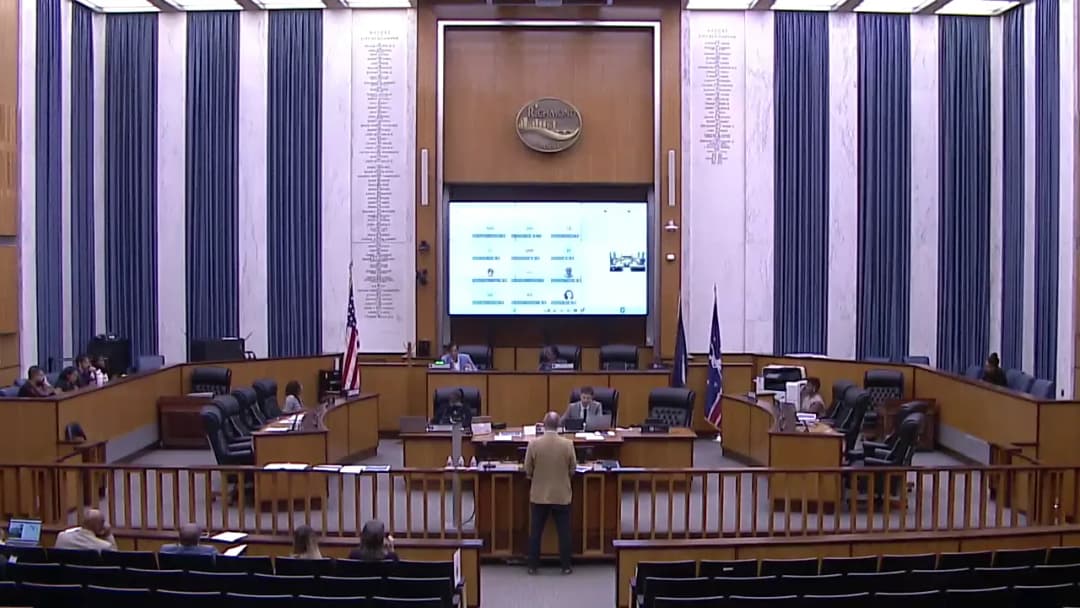
The Education and Human Services Standing Committee of the Richmond City Council met on September 10, 2026, at 7:15 PM under the leadership of Vice Chair Jones (acting Chair). All members were present except Ms. Lynch, establishing a quorum. The meeting covered updates on the restructuring of the non-departmental grant process (now the Richmond Thrives grant program), a facilities modernization plan from Richmond Public Schools, approval of a grant ordinance for the juvenile detention center, and various announcements from the Deputy Chief Administrative Officer for Human Services. Consent Calendar - Approved the minutes of the July 9, 2026 Education and Human Services Standing Committee meeting as presented, with no amendments or corrections. Public Comments & Testimony - No members of the public addressed the committee regarding items not on the agenda. The public comment period was opened and closed with no speakers. Discussion Items - Richmond Thrives Grant Program Update: Dominic Merritt, Senior Policy Advisor with the Office of the DCO for Human Services, presented an update on the new grant-making process. The program, formerly the non-departmental grant process, is now managed by three outside grantmakers covering four priority areas: arts and culture, children and families, economic mobility, and health. Merritt noted that the transition aimed to increase accountability, accessibility, and community impact. Key details included: a 10% administrative overhead across all priority areas (below the 15% cap), application windows closing within two weeks of the kickoff, and a turnaround time of three to four months from application to fund disbursement (versus roughly 10 months in the previous system). Councilmember Breton expressed strong support for the process, noting improvements in rigor and accessibility. He asked about administrative costs and reporting. Merritt confirmed that no more than 15% goes to admin (actual 10%) and that the city will provide detailed summaries to council. Vice Chair Jones inquired about the role of organizations that previously received non-departmental funding and also applied for the new grants; Merritt clarified that grantmakers cannot apply to themselves and that the city hopes to fund the best service providers, with adjustments to priority areas possible after first-year results. Jones also suggested reinstating a training program for nonprofits on grant writing and capacity building, which Merritt acknowledged as valuable. - Richmond Public Schools Facilities Modernization Plan: Patrick Harrell, Chief Operating Officer for Richmond Public Schools, joined by Board Chair Fernandez, presented the community engagement process for prioritizing school facility upgrades. Harrell outlined the current facilities plan (nearing completion with Richmond High School for the Arts, Maury Street Campus, and Woodville Elementary remaining), and the need for a new five-to-ten-year plan. Key statistics: RPS average building age is 62 years; 36% of buildings are over 50 years old; 20% are over 100 years old. An independent assessment identified $680 million in deferred maintenance needs over 20 years, while annual capital funding is approximately $2.5 million (with a recent one-time boost of $10 million from council). Community input sessions are being held in each district; two had occurred by the meeting date, with seven more scheduled. The activity involves ranking 26 schools by priority based on building condition, enrollment trends, and student needs. Both Harrell and Vice Chair Jones noted that the sessions were powerful in shifting participants from advocating for their own schools to recognizing citywide needs. Jones and Breton praised the process and committed to attending upcoming sessions. - Ordinance 2026-191: Acceptance of Grant Funds for Juvenile Detention Center: Greg Hopkins (Director of Justice Services) presented the ordinance authorizing acceptance of $137,038 from the Virginia Department of Criminal Justice Services for the juvenile detention center. The funds are one-time and will be used to transform the facility into a trauma-informed environment, including furniture, painting, acoustic padding, and youth-friendly visitation spaces. The ordinance received no public opposition or support. Councilmember Breton questioned the one-time nature of the expenditures; Hopkins confirmed they are all one-time investments (e.g., furniture, painting, equipment). Vice Chair Jones expressed support for humanizing the facility. The committee voted unanimously to recommend approval. - DCAO Updates: Dr. Popovich, DCAO for Human Services, provided three updates. First, she introduced Lamont Barnes as the new Senior Policy Advisor for the Office of Gun Violence Prevention (succeeding Greg Hopkins). Second, she highlighted September as Library Card Month and noted a 35% increase in summer reading participation over four years through the summer internship program. Third, she announced the launch of the Central VA Resource Navigator website (centralvaresourcenavigator.org), a comprehensive, vetted directory of over 130 behavioral health and substance use resources, developed in partnership with Henrico County and the region. The website is available 24/7 and is especially timely for National Recovery Month. Key Outcomes - Approved the minutes of the July 9, 2026 EHS committee meeting. - Recommended approval of Ordinance 2026-191 (accepting $137,038 for juvenile detention center improvements) by a unanimous voice vote (Vice Chair Jones and Councilmember Breton voting aye). - Received updates on the Richmond Thrives grant program, RPS facilities planning, and DCAO activities with no formal votes required. - Next meeting scheduled for October 8, 2026, with anticipated agenda items including an update on early childhood enrollment from the Office of Children and Families and an update on homeless services strategic planning. - Vice Chair Jones formally introduced her new liaison, Catherine Brown, who will be available for 9th district needs.
The Public Meeting Index
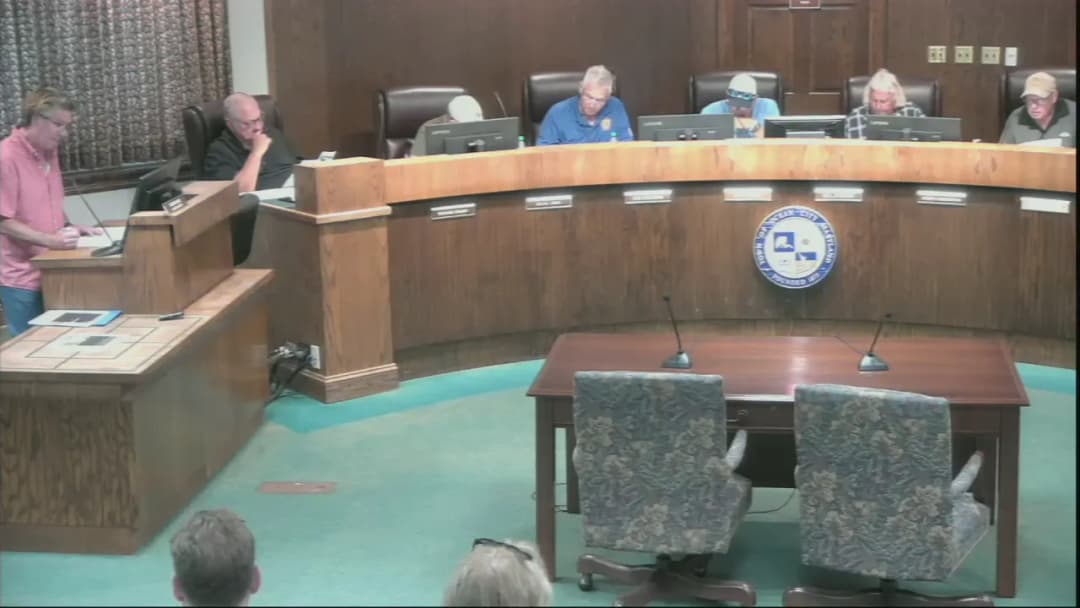
The Public Meeting IndexThe Ocean City Board of Port Wardens met Thursday, September 10, 2026, at 2:00 PM in the Council Chambers of City Hall, 301 Baltimore Avenue, Ocean City, Maryland. The Board reviewed two minor and six major marine construction cases, approved the minutes of the August 13, 2026 meeting, and acted on the docketed applications. Staff recommendations covered cases PW 26-038 through PW 26-050 as advertised and posted. Consent Calendar - Minutes: The Board approved the minutes from the August 13, 2026 meeting. Public Comments & Testimony - During the 805 Penguin Drive case, a speaker raised setback issues and said letters had been sent to Baltimore and that a stop order had been discussed. Board members responded that the new construction itself was not in the setback and that the Board was only dealing with the new construction portion. The speaker also described having to shrink a planned pier from six feet to five feet, or to three feet if two boat slips were kept, and referenced a person named Jackie not wanting “toys” around. Discussion Items - Minor Case PW 26-044 (321 White Heron Court): Staff read a request to install 132 linear feet of replacement vinyl bulkhead, not exceeding 18 inches channelward, with owner Phillip Creek and applicant Stacey Hart & Associates. Conditions included Town of Ocean City open-water bulkhead standard 8.0, an 18-inch channelward limit, engineered plans for bulkheads exceeding 100 feet in length, MDE approval at building permit application, and completion of all marine construction within 18 months of the Board decision. - Minor Case PW 26-045 (10607 Point Lookout Road): Staff read a request to repair, by vinyl replacement 18 inches channelward, about 60 linear feet of deteriorated timber batter-pile bulkhead with new batter-pile bulkhead, owner Mark Souders. Conditions included Town of Ocean City open-water standard 8.0, an 18-inch channelward limit, MDE approval at building permit application, and completion within 18 months. - Major Case PW 26-038 (227 N. Heron Drive): Staff read a request to install 60 feet of replacement vinyl bulkheading, construct a new 6-foot by 19-foot dock, drive two mooring piles, and install one boatlift, with all work extending 13.5 feet channelward; owner Mary Ring. The transcript reads “227 North Herring Drive” in one place, while the agenda lists 227 N. Heron Drive. Conditions included Town of Ocean City canal standard 6.1, an 18-inch channelward limit, five-foot setbacks and/or letters of no objection including any HOA, MDE approval, and completion within 18 months. - Major Case PW 26-046 (143 Pine Tree Road): Staff read a request to install 40 feet of replacement vinyl bulkhead including six batter piles, plus a boatlift, owner Brian Horn. Conditions included Town of Ocean City canal standard 6.1, an 18-inch channelward limit, a boatlift installed per manufacturer’s specifications not exceeding 31.5 feet channelward, MDE approval, and completion within 18 months. - Major Case PW 26-047 (603 Harbour Drive): Staff read a request to install 42 feet of new vinyl bulkhead 18 inches channelward, owner Carol Hunter. Conditions stated that all existing marine structures rebuilt or reinstalled must meet Town marine construction standards and that the new bulkhead would bring maximum channelward extension to 38 feet. Five-foot setbacks and/or letters of no objection, MDE approval, and completion within 18 months were required. - Major Case PW 26-048 (1556 Teal Drive): Staff read a request to relocate an existing boatlift by removing two pilings, redriving them, and installing two new additional pilings, with a maximum channelward extension of 38 feet, owner Ty Williams. Conditions required pilings reinstalled under Town of Ocean City Marine Standards not exceeding 38 feet, MDE approval, and completion within 18 months. - Major Case PW 26-049 (778 94th Street, Unit 201, Slip 18): Staff read a request to install one boatlift on existing pilings with a maximum channelward extension of 28 feet, owner Christopher Shelton. Conditions included MDE approval and completion within 18 months. - Major Case PW 26-050 (805 Penguin Drive): Staff read a request to install a 6-foot by 44-foot perpendicular pier, owner Jacqueline DeGroft, applicant Stacey Hart & Associates. Discussion focused on setback concerns, existing pilings, and whether the Board could consider only new construction. The Board approved the project as part of the staff recommendation as advertised and posted. Key Outcomes - The Board approved the August 13, 2026 meeting minutes. - The Board approved all eight docketed applications: PW 26-044, PW 26-045, PW 26-038, PW 26-046, PW 26-047, PW 26-048, PW 26-049, and PW 26-050, subject to the conditions read into the record. Standard conditions included MDE approval at the time of building permit application and completion of all marine construction within 18 months of the Board’s decision. - The transcript records a voice vote call of “all in favor” near the end; no numerical tally was recorded.
The Toledo City Plan Commission held a formal meeting on Thursday, September 10, 2026, at 2:00 PM in Council Chambers at One Government Center. The meeting addressed multiple zone changes, a text amendment, and three local landmark designation requests. Several cases were deferred or withdrawn, and landmark designations for two Catholic churches generated significant public comment and debate. Consent Calendar (Procedural Actions) - Z26-0015 – Zone change at 2517 Fulton Street: The applicant requested and was granted a 60-day deferral to the November agenda, carried unanimously. - V-325-26 – Alley vacation north of Western Avenue: Withdrawn by the applicant. - SUP26-0019 – Special use permit for a daycare center at 662 Phillips Avenue: Postponed for 30 days. Discussion Items & Public Comments Z26-0016 – Zone Change for Toledo Zoo Parking Lot (866 Bartley Place) - Staff recommended approval, citing compatibility with existing land uses and nearby zoning. The applicant (Nathan Decker, 2700 Broadway) stated the change would bring a newly developed parking lot into the zoo's institutional campus master plan. One neighbor had general questions but no objection; a neighborhood meeting also drew no objections. The commission unanimously approved the zone change. M-5-26 – Text Amendment for Industrial Site Plan Review Threshold - The Plan Commission acted as applicant. Staff proposed exempting industrial site expansions disturbing less than 2,500 square feet from minor site plan review, replacing it with a certificate of zoning compliance. The amendment includes a clause allowing the planning director to require review when appropriate. No public correspondence was received, and the commission unanimously approved. The case goes to City Council on October 21, 2026. M-15-26 – Local Landmark Designation: Viking Lodge (1623–1627 Broadway) - The applicant (Julie Apt, 8 North St. Clair) requested designation for the building, built in 1916 and formerly a lodge. The owner (Mosaic Ministries) seeks historic tax credits for redevelopment into an early childhood education center and food pantry. One public speaker (John Doty) supported the designation in memory of his wife. No other correspondence was received. The commission unanimously approved, sending the case to City Council on October 21. M-16-26 – Local Landmark Designation: Sacred Heart Catholic Church (509 Oswald Street) - This case was initiated by City Council. Staff (Bill Harbert) presented the historic and architectural significance (German Gothic Romanesque, limestone construction, built 1900). The Diocese of Toledo, owner of the property, opposed the designation. Attorney Tom Antonini read a statement arguing the church had not been consulted, that the process interfered with religious property decisions under canon law and the First Amendment, and that the diocese would pursue legal remedies if the designation proceeded. The diocese stated Sacred Heart was in poor condition (basement issues) and that they had not requested this action. Public testimony was heavily in favor of preservation: 18 letters of support, 3 in opposition, and a 14-page petition with 100 signatures were received. Speakers included residents, a community organizer (Gary Linhart of One Voice for East Toledo), and a former parishioner (CJ Estelle, via letter) who described efforts to purchase the church and secure redevelopment funding. A licensed contractor and longtime parishioners challenged the diocese's repair estimates, claiming they were inflated. The commission debated the balance between private property rights and public preservation interest. A motion to approve passed 3-1 (Mominay, Whittington, Grossweiler in favor; Ricoff opposed). The case goes to City Council on October 21. M-17-26 – Local Landmark Designation: Good Shepherd Catholic Church (500 Clark Street) - Similar to Sacred Heart, this case was initiated by City Council. Staff described the building as a combination of Byzantine and Romanesque styles, with unique doming, and noted it appeared in fair condition. The Diocese opposed, arguing the designation was premature and that they had not been consulted. No current demolition plans were stated, but the diocese said the designation would not help their ongoing efforts to find a use. Public testimony supported designation, emphasizing the church's iconic dome and its role as a gateway to East Toledo. A motion to approve passed 3-1 (same split as Sacred Heart). The case goes to City Council on October 21. Key Outcomes - Z26-0016: Approved; forwarded to City Council Planning & Zoning Committee on October 21, 2026, at 4:00 PM. - M-5-26: Approved; similarly forwarded to City Council on October 21. - M-15-26: Approved; forwarded to City Council on October 21. - M-16-26: Approved (3-1); forwarded to City Council on October 21. - M-17-26: Approved (3-1); forwarded to City Council on October 21. - Z26-0015, V-325-26, SUP26-0019: Deferred or withdrawn as noted above. - Director’s Report: Richard Arnold briefed the commission on a City Council settlement (City of Toledo v. Singletary, $62,500) related to a denied group home, criticizing the secrecy and linking it to an unacted-upon text amendment from 2019. The commission also learned that a zoning code consultant will visit in the third week of October, with a special commission hearing tentatively scheduled for Wednesday, October 21 (date to be confirmed).
Bloomington City Council Public Safety Deliberation Session - September 10, 2026\n\nThe Bloomington City Council held the first of two public deliberation sessions on public safety on September 10, 2026, starting at approximately 6:53 PM UTC in Council Chambers. The session was facilitated by Wyatt Lawson of the Community Justice and Mediation Center (CJAM). Councilmembers introduced the goal: to gather community experiences on public safety as a first step toward developing a public safety plan. No decisions were made; the focus was on listening and understanding. Approximately nine council members attended, with two participating via Zoom.\n\n Public Comments & Testimony\n- Group Six (reported by Councilmember Sydney Zulik): Participants emphasized that familiarity, understanding, and predictability increase feelings of safety. Physical aspects like good lighting and the ability to protect oneself were important. The community-building work of the Bloomington Police Department was praised.\n- Group Eight (reported by Clerk Nicole Bolden): Themes included identity, community, and belonging. Safety must include everyone, especially marginalized groups such as women, people experiencing homelessness, immigrants, Hispanic/Latino, Black, and LGBTQ+ communities. Limited coordination across city departments and community groups was seen as weakening safety. Accountability and intentional council efforts were stressed.\n- Group Three (reported by Councilmember Hopi Stasberg): Feeling safe was linked to familiarity, sense of community, and visible resources (e.g., little free pantries). Feeling unsafe was tied to being alone, negative interactions, unstable individuals, erratic drivers, and uncertainty. Guns were mentioned on both sides—some felt safer carrying, others less safe. Homelessness was linked to both concern for erratic behavior and concern for the safety of unhoused individuals. Positive news stories contributed to safety, while negative news contributed to fear.\n- Group Four (reported by a city official): Participants were motivated by recent shootings and concern for public spaces. Some felt safer with cameras; others noted racial disparities (e.g., Black residents make up 4% of Bloomington's population but 20% of jail residents). Concerns included guns in public, the need for community policing, and the distinction between actual safety and perception of safety. Positive stories (e.g., needle exchange reducing needle finds) were also highlighted.\n- Group Two (reported by Mayor Kerry Carey): Feeling welcome and a sense of belonging enhanced safety. Infrastructure like lighting and campus blue lights was important. Being alone made people feel unsafe. The news (both real and fake) contributed to fear, as did misreporting about out-of-town criminals. Guns and large crowds were also mentioned as sources of unsafety.\n- Online Group (reported by an online participant): Confidence in institutions (911, helplines) and transparency between city and county were key. Safety was categorized as safety from being hit by cars and safety from crime. Infrastructure separating transportation modes improved safety. The group noted that perceptions of safety vary widely. Some distinguished between public safety and public welfare.\n- Group One (reported by Councilmember Courtney Daly): Community and predictability were central themes. Gun violence and open carry created unpredictability and anxiety. Messaging from IU alerts and news contributed to anxiety. The group called for a shared definition of public safety, better positive messaging, and efforts to bridge safety bubbles between different communities.\n\n Discussion Items\n- Councilmember Piedmont Smith and Councilmember Stasberg introduced the session, explaining that it was about experiences, not decisions. They referenced the city's vague \"enhanced public safety\" goal and the desire to create a public safety plan similar to the comprehensive plan.\n- Wyatt Lawson from CJAM presented community agreements: speak from experience, listen to understand, make room for one another, disagree with curiosity, respect confidentiality, and prioritize understanding before problem-solving.\n- After breakout groups, each group reported back. Facilitators noted emerging themes of familiarity, predictability, belonging, and differences regarding guns and surveillance.\n\n Key Outcomes\n- No formal votes or decisions were made.\n- Participants completed a survey (paper or online) to provide additional input.\n- A second public safety deliberation session will be held on Wednesday, October 21, 2026, at 6:30 PM in Council Chambers, focusing on community priorities and solutions.\n- The session adjourned early, approximately 10 minutes ahead of schedule.
This special meeting of the Richmond City Council was convened to consider Resolution 2026-R034 concerning the proposed merger between Dominion Energy and NextEra Energy. No members of the public spoke during the public hearing. Councilmembers expressed concerns about the merger's impact on ratepayers, data center proliferation, and employee protections. The council voted unanimously to adopt the resolution, enabling the city to monitor and participate in proceedings before the Virginia State Corporation Commission (SCC). Public Comments & Testimony - No members of the public appeared to speak in favor or opposition during the public hearing. The clerk called for speakers and saw none. Discussion Items - Councilwoman Gibson stated her opposition to the merger, citing NextEra Energy subsidiary Florida Power & Light facing a $7 billion rate increase, described as the largest in U.S. history. She noted a report showing NextEra profits comprised 27.4% of the average Florida bill, the highest profit ratio in the country. She argued that Richmond residents near the Capitol region are already burdened by data center-driven utility costs. Gibson advocated for the governor and SCC to fully stop the merger, but expressed gratitude that the city can intervene through the resolution. - Vice President Jordan expressed support for the resolution, noting that it ensures public hearings will occur. She referenced a listening session where a Dominion employee voiced concerns about potential loss of protections. Jordan highlighted the city's 5,000 Dominion employees and emphasized the importance of monitoring the merger's impact. - Council President Newbill called for the vote after noting the resolution speaks for itself and that the city needs to be vigilant. Key Outcomes - Resolution 2026-R034 was adopted unanimously (5-0) with votes from Councilmembers Breton (aye), Gibson (yes), Jones (aye), Vice President Jordan (aye), and President Newbill (aye). The resolution authorizes the city to participate in and monitor the SCC proceedings regarding the NextEra Energy merger. - The special meeting was adjourned after the vote.
No agenda, minutes, or transcript were provided for this meeting held on September 10, 2026 at 18:42 UTC. Therefore, no summary of discussions, decisions, or public testimony can be generated.
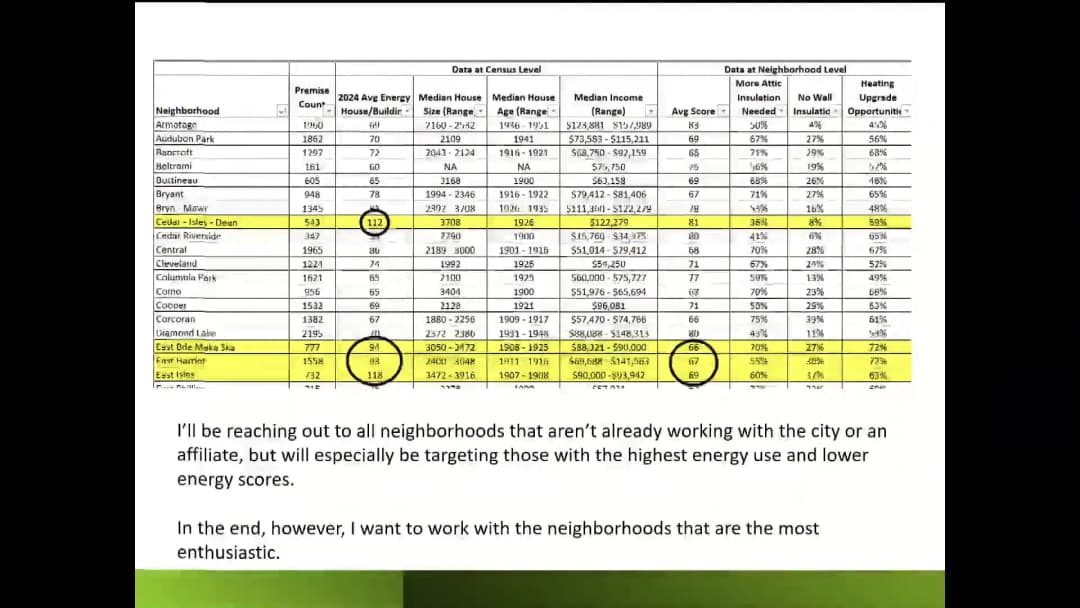
The Climate and Infrastructure Committee of the Minneapolis City Council met on Thursday, September 10, 2026, at 6:31 PM. Chair Robin Wansley presided. The meeting covered consent items, a public hearing on the Downtown Improvement District (DID) 2027 budget (continued due to a mailing error), approval of 428A special service districts, and a community presentation on the 25x25 natural gas reduction campaign. Councilmembers present: Wansley, Vita, Warren (joined later), Palmasano, Chuck Zai, and others. Consent Calendar - Items 3–11 were approved unanimously. These included a gift acceptance from Cities Today Institute, contract amendments for the First Avenue South Reconstruction Project and 42nd Street Intersection Safety Improvements, bid acceptance for ADA ramp installation and the Hearthorn Ramp Building Automation System, and setting a public hearing for September 24, 2026 on a commercial and multifamily energy disclosure repeal ordinance. Public Comments & Testimony - No members of the public signed up to testify on either the DID or 428A public hearings. Discussion Items - Downtown Improvement District (DID) 2027 Services and Service Charges: Jennifer Swanson (Public Works) introduced the public hearing, noting that due to a mailing error the hearing was not properly noticed. She stated the hearing would be continued to September 24, 2026. Adam Dunnik, DID President and CEO, presented the proposed 2027 budget of $9,541,841, a 3.98% increase from 2026. Cost drivers included contracted ambassador increases (collective bargaining), increased safety team presence, and deferred maintenance. He highlighted two programs: the community storage program (serving 3,000 residents, currently 550) and the Nicolette community space (12,000 visitors in 2025). Councilmembers expressed strong support for DID’s work. Councilmember Chuck Zai asked about ambassador staffing (approximately 50, hours 6 a.m. to 11 p.m.) and about efficiency measures (DID brought options to its board and discussed trade-offs). Councilmember Vita praised the diversity and empathy of ambassadors and called for smaller storefronts. Councilmember Warren thanked DID for being welcoming. Chair Wansley asked about police reserves spending ($412,000 for livability and outreach; staff clarified it is not currently used and funds have been reinvested in behavioral health outreach). DID’s motion to continue the public hearing to September 24 for final action passed unanimously. - 428A Special Service Districts (50th & France, 54th & Lyndale, Bloomington & Lake, Chicago & Lake, East Lake, Lyndale & Lake, West, and West Broadway): David Bauer (Public Works) presented the annual approval of 2027 operating plans and service charges. He described that property owners collectively impose charges for enhanced services. Each district’s advisory board developed priorities. Staff recommended passage. Councilmember Palmasano thanked staff for supporting small business districts. No public testimony. The committee voted unanimously to approve the resolution. - Community Presentation on 25x25 Campaign: Mary Britton, a data analyst from the Prospect Park neighborhood, presented the 25x25 initiative to reduce residential fossil gas use by 25% by 2025. She noted that natural gas use has not declined citywide because each building must be addressed individually (88,400 one-to-four-unit houses). She stated the average Minneapolis house produces more CO2 from natural gas in a year than the average car, and nearly a quarter of houses have no wall insulation. Prospect Park’s approach used outreach, tabling, and promotion of energy audits and rebates on a budget under $300/year. Although they did not achieve the 25% reduction, they developed a replicable model. She plans to partner with up to five neighborhoods and asked the council to include all neighborhoods in climate messaging, include energy audit info in newsletters, and encourage councilmembers to get home energy audits. Councilmembers engaged in discussion: Councilmember Vita noted the stress of costs for homeowners, especially in older homes; Councilmember Warren raised concerns about renters in poorly insulated rental properties and rising utility costs; Councilmember Chuck Zai discussed challenges with out-of-state landlords and the need to incentivize them. Britton suggested that data could help demonstrate financial benefits to landlords. The presentation was received and filed. Key Outcomes - Consent calendar: Approved unanimously. - DID public hearing: Continued to September 24, 2026, for final action (motion carried). - 428A districts: Resolution approving 2027 operating plans and service charges passed unanimously. - 25x25 presentation: Received and filed (motion carried). - Note: Councilmember Warren joined after the consent vote; her affirmative vote on consent was recorded with no objection.
The Goodlettsville Board of Commissioners met on September 10, 2026, at City Hall. The meeting included public comments on local issues, the passage of routine ordinances, a proactive moratorium on data centers, and a farewell to City Manager Tim Ellis. All votes were 5-0 unless otherwise stated. (Note: The meeting proceeded slightly out of the printed agenda order, addressing Unfinished Business before Committee Reports, by general consent.) Public Comments & Testimony - John Faye (address 407 Moss Trail) spoke on two issues. He expressed full support for retaining the city swimming pool, advocating for its use as a unique community branding asset. He also voiced strong support for the proposed data center moratorium, detailing concerns from his HVAC background regarding noise, water consumption, and light pollution from such facilities. - Mr. Ralph (address 102 Utley), a 37-year resident, raised concerns about brush and trees in Mansker Creek impeding water flow and the deteriorating concrete abutment of the CSX railroad overpass on Hit Lane. City Manager Tim Ellis responded that staff had initiated work on the creek and the bridge is under constant inspection by CSX, with a replacement contemplated in conjunction with the Highway 41 bridge widening. Mr. Ralph also noted that trains frequently exceed the posted speed limit through the municipality. - Mark Farr (Casper's Bistro) expressed gratitude for the city allowing his patrons to use City Hall parking and urged the board to pursue further improvements to downtown parking and walkability to support local businesses. - Jenna Rummel (Sheik Artique) highlighted severe parking shortages, stating her business attracts approximately 40,000 visitors annually. She reported losing sales due to insufficient parking, which also impacts city sales tax revenue. Although she is relocating her business, she conveyed similar concerns from the new owner of her building. Discussion Items - Data Center Development Moratorium (Ord. 26-1154): Commissioners emphasized that no data centers are currently proposed in Goodlettsville. The 18-month moratorium is a proactive measure to allow the city to study and develop comprehensive zoning and operational regulations before any applications are received. It was clarified that the ordinance does not permanently prohibit data centers but provides time for study. - Event Venue Classification (Ord. 26-1155): Staff explained the amendment replaces a vague 'special venue' category with a clear definition of 'event venue' for on-premise beer permits. A careful study determined no grandfathered permits existed that required the old category. - Budget Amendment (Ord. 26-1156): City Manager Ellis noted the ordinance may be amended on second reading to include additional police vehicle replacements beyond the initial scope of replacing totaled vehicles. Key Outcomes - Athletic Program Participation Fees (Ord. 26-1151): Passed 5-0 (Second Reading). A public hearing was held with no speakers. - Official City Logo (Ord. 26-1152, referred to as 27-1152 in the transcript): Passed 5-0 (Second Reading). - Municipal Code Correction (Ord. 26-1153): Passed 5-0 (Second Reading). - Data Center Moratorium (Ord. 26-1154): Passed 5-0 (Second Reading). - Event Venue Classification (Ord. 26-1155): Passed 5-0 (First Reading). - FY 2026-2027 Budget Amendment (Ord. 26-1156): Passed 5-0 (First Reading). - Creative Aging Grant Application (Res. 26-1352): Passed 5-0. Authorized submission of a grant to the Tennessee Arts Commission for recreation programming. - Constitution Week Recognition (Res. 26-1353): Passed 5-0. Recognized September 17-23, 2026, as Constitution Week. - Spire Tennessee Easement (Res. 26-1354): Passed 5-0. Authorized granting an easement for natural gas line relocation related to the Gallatin Road bridge replacement. - Senior Center Grant: Parks Department employee Jennifer Spillers was recognized by Commissioner Walker for winning a $50,000 grant from the Tennessee Department of Disability and Aging for the Goodlettsville Senior Center. - Recognition of Baseball Champions: The board recognized the city's youth baseball championship team. - Farewell to City Manager Tim Ellis: The board and mayor paid tribute to Mr. Ellis, retiring after 23 years with the city (15 as City Manager). He was thanked for his mentorship and dedicated service. Mr. Ellis delivered an emotional farewell, thanking staff, family, and the commission, and expressed confidence in the chosen successor.
The St. Petersburg City Council met on September 10, 2026, at 6:30 PM. The meeting began with an invocation and a moment of silence in remembrance of 9/11. Council approved the consent agenda, heard public comments regarding the St. Pete Lawn Bowling Club, received a presentation and unanimously approved the St. Petersburg Fire Rescue Strategic Plan 2026–2031, received an update from St. Petersburg College, and unanimously approved a resolution certifying the results of the August 18 primary election. Council Member Gina Driscoll was absent. Consent Calendar - Approved the consent agenda unanimously (7–0). Public Comments & Testimony - Beth Eschenfelder (resident of 532 6th Avenue North for 26 years) requested that the Council require a one‑year annual report on the St. Pete Lawn Bowling Club, which she said has remained largely vacant since she spoke a year ago. She urged the Council to investigate: (1) access and actual usage hours; (2) membership growth and the number of St. Petersburg resident members; and (3) stewardship of the facilities, including accessibility, safety, and maintenance improvements. - Robert Kashia (same address) asserted that ADA accessibility deficiencies remain unresolved after a year, that he was personally discriminated against by a club board member, and that no lockbox for public access has been installed. He stated the facility serves approximately 24 members (mostly seasonal or non‑residents), is utilized only about 7% of the available time (generally three mornings a week), generates only $36 in lease income over three years, and incurs substantial city expenses for utilities and repairs. He contrasted the club with the nearby Shuffleboard Court, which has about 2,600 members and a lockbox system, and asked who holds a city‑owned facility accountable when the city will not. Fire Rescue Strategic Plan 2026–2031 (F1) - Chief Watts and Deputy Chief Siskovsky presented a five‑year strategic plan developed through community and internal stakeholder engagement, a risk assessment, and a management study. The plan updates the department’s mission, vision, and values and identifies six goals: improve community engagement, strengthen health and wellness for personnel, enhance workforce development and succession planning, improve internal communication and transparency, align resources with city growth and evolving risks, and advance training and certifications. Key upcoming needs include construction of a new headquarters and master fire station on the Historic Gas Plant site, modernizing stations and apparatus, and expanding specialty teams. The Council commended the chiefs for their leadership, focus on personnel wellness, and proactive engagement. Council Member Panowitz noted that the plan’s success depends on funding, referencing the November ballot measure (Amendment 3) that would reduce property taxes. Council Member Gabbard asked for an update on a potential fire‑readiness fee; Administrator Tom Green responded that an RFP for an assessment methodology consultant is due to close September 22, 2026, and that the city has adopted an ordinance but never levied the fee. The Council voted unanimously (7–0) to approve the strategic plan. St. Petersburg College Update (F2) - Dr. Tonja Williams, President of St. Petersburg College (SPC), presented data on the college’s impact. SPC serves nearly 35,000 students; 22% reside in St. Petersburg, of whom 57% live in poverty‑zone zip codes. 78% of St. Pete resident FAFSA filers are Pell‑Grant eligible, 29% are first‑generation college students, and 68% attend part‑time. The college has not raised tuition since 2012. Over the past two years, nearly one in five SPC graduates lived in St. Petersburg. Dr. Williams highlighted partnerships (e.g., St. Pete Works/Edge) and upcoming initiatives: a new manufacturing training center in the former Jordan Park gym (opening January 2027) and planning for SPC’s centennial celebration in 2027. Council members praised SPC’s work and discussed potential future collaborations, including a collegiate middle school and an SPC Day. No formal action was taken. Resolution Acknowledging Primary Election Results (F3) - The Council unanimously approved (7–0) a resolution acknowledging the August 18, 2026 primary election results, declaring nominees for the November 3, 2026 general election (including mayor and Council Districts 2 and 6), and confirming that no primary or general election is needed for Districts 4 and 8. Announcements - Council Member Givens invited the community to a health event at Child’s Park Rec Center on Saturday, September 12 at 10 AM, and also noted SPC’s 99th‑anniversary block party and the Enoch Davis Center’s 45th anniversary. - Council Member Curtis reminded everyone of the 25th anniversary of 9/11 and invited residents to join first responders at fire stations for a moment of silence. He also promoted a Vanilla Ice and 2 Live Crew concert in Burks. - Administrator Tom Green confirmed the RFP for the fire‑fee assessment consultant closes September 22, 2026. Key Outcomes - Consent agenda approved unanimously (7–0). - St. Petersburg Fire Rescue Strategic Plan 2026–2031 approved unanimously (7–0). - Resolution acknowledging primary election results approved unanimously (7–0). - No formal action taken on lawn bowling concerns or the St. Petersburg College update.
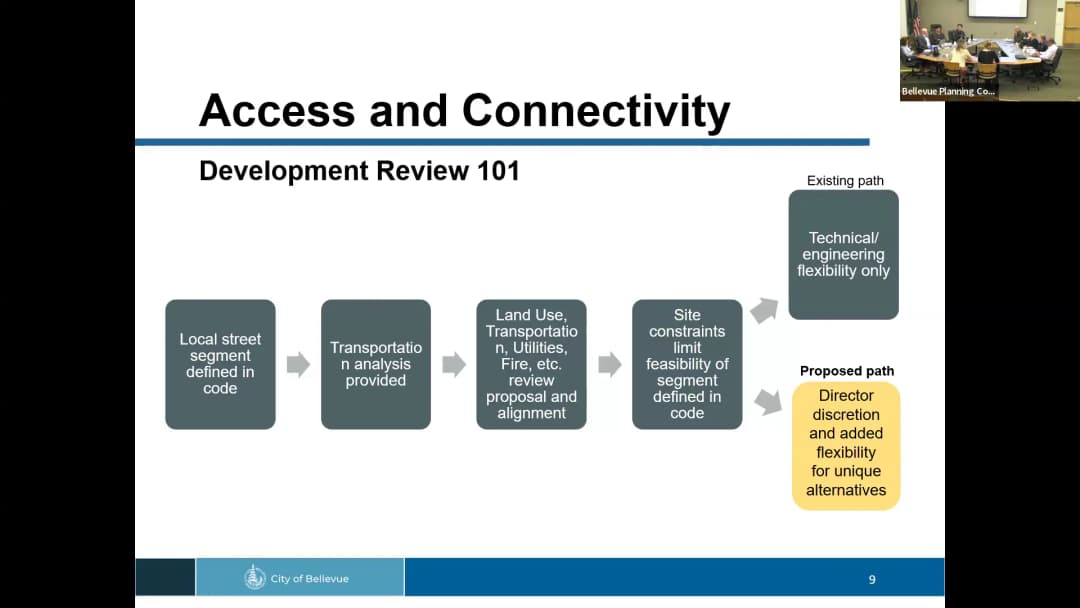
Date note: The transcript identifies the meeting date as September 9, 2026, but the instruction specifies September 10, 2026. This summary uses the provided date. The Bellevue Planning Commission held a study session on the proposed Bell Red Land Use Code Amendments (LUCA) on September 10, 2026. The meeting included public testimony from 16 speakers, a staff presentation on updated draft code provisions, and commission discussion. At the end, the commission voted to set a public hearing for the LUCA. Consent Calendar - Approved the meeting agenda by unanimous vote. - Approved the minutes from June 24, July 9, and July 22, 2026. Reports - Councilmember Bargava reported that the City Council unanimously approved a development agreement for bridge housing in Bell Red and reviewed parking reform work, with general support but requests for further analysis on reduced parking near frequent transit, visitor parking, and senior housing exceptions. Public Comments & Testimony - Valentina Venevo (resident): Opposed the proposed Spring Boulevard road through a planned park in Bell Red, arguing the 2009 plan is outdated given new transit, safety knowledge, and environmental concerns (wetland and stream). She advocated for a multi-use path instead. - Rebecca Bloom (Columbia Pacific Advisors): Described a 9-acre project with 1,100+ units and extensive amenities. Stressed that high costs (energy code, sales tax, affordable housing) make projects challenging and proposed a “Bell Red Arts” district with shared cost offsets. - Matt Rowie (architect/planner): Tested the street grid on dozens of properties and found it impractical due to existing buildings, grades, and landlocked sites. Recommended eliminating the mandatory grid or allowing shared-use paths and increased bonus points for street construction. - Patrick Hanks (Bellevue Chamber of Commerce): Thanked staff for progress but noted economic conditions require a code that works “day one.” Key concerns: mandatory street grid and development agreement eligibility for smaller sites. - Megan Webb (King County DNRP): Promoted Transfer Development Rights (TDR) as a market-based tool that could fund open space and other priorities in Bell Red, offering a potential $1 million grant and 25% revenue return to the city. - Layla Kademi (land use attorney): Supported development agreements but urged broader eligibility (sites smaller than 4 acres or with street grid burdens) and more flexible public benefit requirements. - Morgan Shuck (Echo Northwest, for Bellevue Chamber): Presented independent analysis showing near-zero feasibility under current market conditions. Recommended calibrating street/stream obligations, day-one offset tools, and aligning affordable housing with MFTE. - Paulo Sullivan (Albertson property owner): Opposed the required east-west connection road, citing a traffic study showing up to 6,000 dwellings can be built without it. Called the road unnecessary and expensive. - Brady Nordstrom (HTC): Asked for clarification on the allocation of amenity fees (35% housing, 50% open space, 15% arts) and expressed concern that a proposed catalyst program for medical/life sciences on 116th Avenue could reduce affordable housing funds. - John Morasco (Albertson property): Submitted a traffic analysis concluding up to 6,000 units or 1.2 million sq ft of commercial can be built without the east-west connection. Advocated for flexible block perimeter standards instead of a prescriptive grid. - Jesse Clausen (O'Brien Auto Group): Highlighted private easements preventing road construction and argued the development agreement provisions improperly constrain City Council discretion. Opposed the street grid. - Lucy Zapon (Imagine Housing): Asked to eliminate the prescriptive street grid in favor of multimodal pathways to reduce costs and improve safety. - Alex Zimmerman (resident): Criticized the city for prioritizing corporate interests over ordinary residents, citing high housing costs and a large budget surplus. - Steve Malsom (developer, Evans Wakefield): Provided examples from Lynnwood and Marysville where flexible approaches allowed successful large-scale developments. Urged avoiding overly prescriptive street grids. - Lori Keller (Bellevue College): Expressed support for the LUCA and institutional zoning category, and for continued partnership with the city. Discussion Items - Staff Presentation (Christina Gallant and Charlie Engel): Summarized key updates to the draft LUCA, including: a fee-in-lieu for the amenity system set at $39/square foot (matching downtown); allocation of fees (35% housing, 50% open space, 15% arts); enhanced stream restoration incentives; removal of two street segments; a new flexibile pathway for public street substitution with private streets (via director review); development agreement eligibility for sites larger than 4 acres with mandatory street grid (requiring 3 public benefits for broader modifications); on-street parking reduction options; a commercial catalyst program for medical/life sciences on 116th Avenue (850,000 sq ft eligible for 50% MHA fee reduction); a Sound Transit parcel height bonus; and a tentative schedule leading to City Council review in early 2027. - Commission Discussion: Commissioners focused heavily on the street grid, with several members (Nilchian, Conlu, Keppel, Ferris, Via Veses) requesting additional flexibility, a clearer “performance path,” or reduced prescriptiveness. Staff defended the grid as essential for connectivity and public investment, but acknowledged the built-in flexibilities. Other topics included TDR prioritization, pioneer program possibilities, development agreement size thresholds, assurance devices for stream daylighting, and sidewalk widths in private street alternatives. Commissioner Conlu questioned the 25% assurance device level for stream daylighting, preferring a higher percentage. Key Outcomes - Unanimously voted to direct staff to schedule a public hearing for the Bell Red Land Use Code Amendments. The hearing date will be determined at a future meeting. - Staff was asked to consider the following input for further refinement: - A potential pioneer program to incentivize early development. - Expanded TDR prioritization and integration. - Clarification of street grid goals to guide alternative proposals. - Broadened development agreement eligibility beyond 4-acre sites. - Reduced sidewalk width requirements (e.g., 8 feet) for private street alternatives. - A more explicit performance path for street grid compliance. - Revised assurance device levels for stream daylighting incentives. - Calibrated amenity fee allocation (e.g., 33% each) or further rationale for the current split. - The commission also approved the minutes from previous meetings without objection.