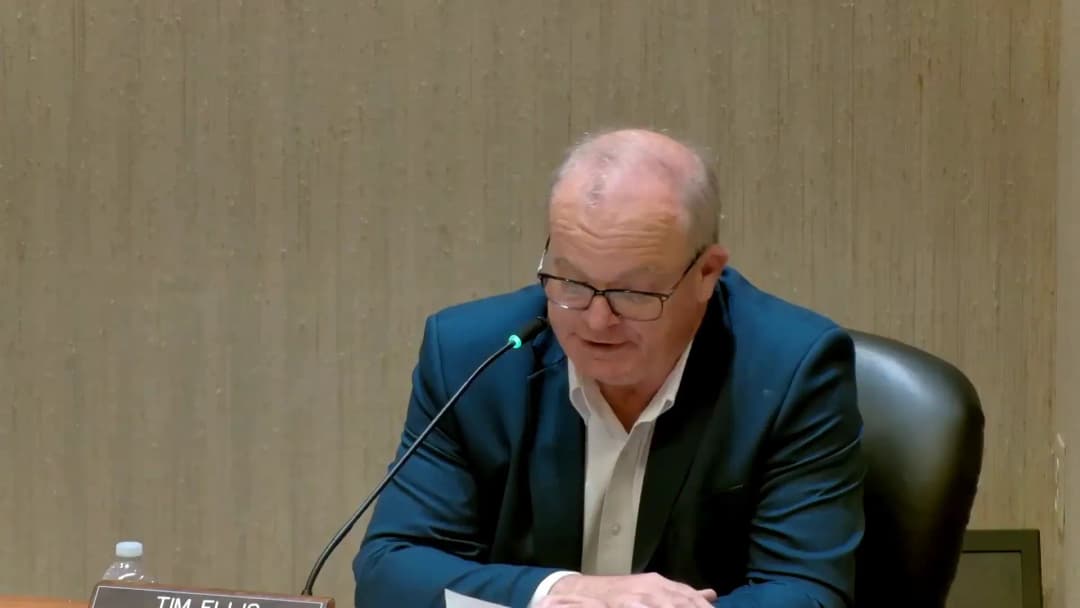
The Goodlettsville Board of Commissioners met on September 10, 2026, at City Hall. The meeting included public comments on local issues, the passage of routine ordinances, a proactive moratorium on data centers, and a farewell to City Manager Tim Ellis. All votes were 5-0 unless otherwise stated. (Note: The meeting proceeded slightly out of the printed agenda order, addressing Unfinished Business before Committee Reports, by general consent.) Public Comments & Testimony - John Faye (address 407 Moss Trail) spoke on two issues. He expressed full support for retaining the city swimming pool, advocating for its use as a unique community branding asset. He also voiced strong support for the proposed data center moratorium, detailing concerns from his HVAC background regarding noise, water consumption, and light pollution from such facilities. - Mr. Ralph (address 102 Utley), a 37-year resident, raised concerns about brush and trees in Mansker Creek impeding water flow and the deteriorating concrete abutment of the CSX railroad overpass on Hit Lane. City Manager Tim Ellis responded that staff had initiated work on the creek and the bridge is under constant inspection by CSX, with a replacement contemplated in conjunction with the Highway 41 bridge widening. Mr. Ralph also noted that trains frequently exceed the posted speed limit through the municipality. - Mark Farr (Casper's Bistro) expressed gratitude for the city allowing his patrons to use City Hall parking and urged the board to pursue further improvements to downtown parking and walkability to support local businesses. - Jenna Rummel (Sheik Artique) highlighted severe parking shortages, stating her business attracts approximately 40,000 visitors annually. She reported losing sales due to insufficient parking, which also impacts city sales tax revenue. Although she is relocating her business, she conveyed similar concerns from the new owner of her building. Discussion Items - Data Center Development Moratorium (Ord. 26-1154): Commissioners emphasized that no data centers are currently proposed in Goodlettsville. The 18-month moratorium is a proactive measure to allow the city to study and develop comprehensive zoning and operational regulations before any applications are received. It was clarified that the ordinance does not permanently prohibit data centers but provides time for study. - Event Venue Classification (Ord. 26-1155): Staff explained the amendment replaces a vague 'special venue' category with a clear definition of 'event venue' for on-premise beer permits. A careful study determined no grandfathered permits existed that required the old category. - Budget Amendment (Ord. 26-1156): City Manager Ellis noted the ordinance may be amended on second reading to include additional police vehicle replacements beyond the initial scope of replacing totaled vehicles. Key Outcomes - Athletic Program Participation Fees (Ord. 26-1151): Passed 5-0 (Second Reading). A public hearing was held with no speakers. - Official City Logo (Ord. 26-1152, referred to as 27-1152 in the transcript): Passed 5-0 (Second Reading). - Municipal Code Correction (Ord. 26-1153): Passed 5-0 (Second Reading). - Data Center Moratorium (Ord. 26-1154): Passed 5-0 (Second Reading). - Event Venue Classification (Ord. 26-1155): Passed 5-0 (First Reading). - FY 2026-2027 Budget Amendment (Ord. 26-1156): Passed 5-0 (First Reading). - Creative Aging Grant Application (Res. 26-1352): Passed 5-0. Authorized submission of a grant to the Tennessee Arts Commission for recreation programming. - Constitution Week Recognition (Res. 26-1353): Passed 5-0. Recognized September 17-23, 2026, as Constitution Week. - Spire Tennessee Easement (Res. 26-1354): Passed 5-0. Authorized granting an easement for natural gas line relocation related to the Gallatin Road bridge replacement. - Senior Center Grant: Parks Department employee Jennifer Spillers was recognized by Commissioner Walker for winning a $50,000 grant from the Tennessee Department of Disability and Aging for the Goodlettsville Senior Center. - Recognition of Baseball Champions: The board recognized the city's youth baseball championship team. - Farewell to City Manager Tim Ellis: The board and mayor paid tribute to Mr. Ellis, retiring after 23 years with the city (15 as City Manager). He was thanked for his mentorship and dedicated service. Mr. Ellis delivered an emotional farewell, thanking staff, family, and the commission, and expressed confidence in the chosen successor.
The Public Meeting Index
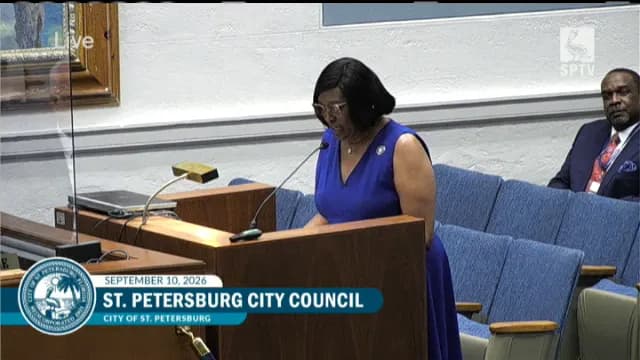
The Public Meeting IndexThe St. Petersburg City Council met on September 10, 2026, at 6:30 PM. The meeting began with an invocation and a moment of silence in remembrance of 9/11. Council approved the consent agenda, heard public comments regarding the St. Pete Lawn Bowling Club, received a presentation and unanimously approved the St. Petersburg Fire Rescue Strategic Plan 2026–2031, received an update from St. Petersburg College, and unanimously approved a resolution certifying the results of the August 18 primary election. Council Member Gina Driscoll was absent. Consent Calendar - Approved the consent agenda unanimously (7–0). Public Comments & Testimony - Beth Eschenfelder (resident of 532 6th Avenue North for 26 years) requested that the Council require a one‑year annual report on the St. Pete Lawn Bowling Club, which she said has remained largely vacant since she spoke a year ago. She urged the Council to investigate: (1) access and actual usage hours; (2) membership growth and the number of St. Petersburg resident members; and (3) stewardship of the facilities, including accessibility, safety, and maintenance improvements. - Robert Kashia (same address) asserted that ADA accessibility deficiencies remain unresolved after a year, that he was personally discriminated against by a club board member, and that no lockbox for public access has been installed. He stated the facility serves approximately 24 members (mostly seasonal or non‑residents), is utilized only about 7% of the available time (generally three mornings a week), generates only $36 in lease income over three years, and incurs substantial city expenses for utilities and repairs. He contrasted the club with the nearby Shuffleboard Court, which has about 2,600 members and a lockbox system, and asked who holds a city‑owned facility accountable when the city will not. Fire Rescue Strategic Plan 2026–2031 (F1) - Chief Watts and Deputy Chief Siskovsky presented a five‑year strategic plan developed through community and internal stakeholder engagement, a risk assessment, and a management study. The plan updates the department’s mission, vision, and values and identifies six goals: improve community engagement, strengthen health and wellness for personnel, enhance workforce development and succession planning, improve internal communication and transparency, align resources with city growth and evolving risks, and advance training and certifications. Key upcoming needs include construction of a new headquarters and master fire station on the Historic Gas Plant site, modernizing stations and apparatus, and expanding specialty teams. The Council commended the chiefs for their leadership, focus on personnel wellness, and proactive engagement. Council Member Panowitz noted that the plan’s success depends on funding, referencing the November ballot measure (Amendment 3) that would reduce property taxes. Council Member Gabbard asked for an update on a potential fire‑readiness fee; Administrator Tom Green responded that an RFP for an assessment methodology consultant is due to close September 22, 2026, and that the city has adopted an ordinance but never levied the fee. The Council voted unanimously (7–0) to approve the strategic plan. St. Petersburg College Update (F2) - Dr. Tonja Williams, President of St. Petersburg College (SPC), presented data on the college’s impact. SPC serves nearly 35,000 students; 22% reside in St. Petersburg, of whom 57% live in poverty‑zone zip codes. 78% of St. Pete resident FAFSA filers are Pell‑Grant eligible, 29% are first‑generation college students, and 68% attend part‑time. The college has not raised tuition since 2012. Over the past two years, nearly one in five SPC graduates lived in St. Petersburg. Dr. Williams highlighted partnerships (e.g., St. Pete Works/Edge) and upcoming initiatives: a new manufacturing training center in the former Jordan Park gym (opening January 2027) and planning for SPC’s centennial celebration in 2027. Council members praised SPC’s work and discussed potential future collaborations, including a collegiate middle school and an SPC Day. No formal action was taken. Resolution Acknowledging Primary Election Results (F3) - The Council unanimously approved (7–0) a resolution acknowledging the August 18, 2026 primary election results, declaring nominees for the November 3, 2026 general election (including mayor and Council Districts 2 and 6), and confirming that no primary or general election is needed for Districts 4 and 8. Announcements - Council Member Givens invited the community to a health event at Child’s Park Rec Center on Saturday, September 12 at 10 AM, and also noted SPC’s 99th‑anniversary block party and the Enoch Davis Center’s 45th anniversary. - Council Member Curtis reminded everyone of the 25th anniversary of 9/11 and invited residents to join first responders at fire stations for a moment of silence. He also promoted a Vanilla Ice and 2 Live Crew concert in Burks. - Administrator Tom Green confirmed the RFP for the fire‑fee assessment consultant closes September 22, 2026. Key Outcomes - Consent agenda approved unanimously (7–0). - St. Petersburg Fire Rescue Strategic Plan 2026–2031 approved unanimously (7–0). - Resolution acknowledging primary election results approved unanimously (7–0). - No formal action taken on lawn bowling concerns or the St. Petersburg College update.
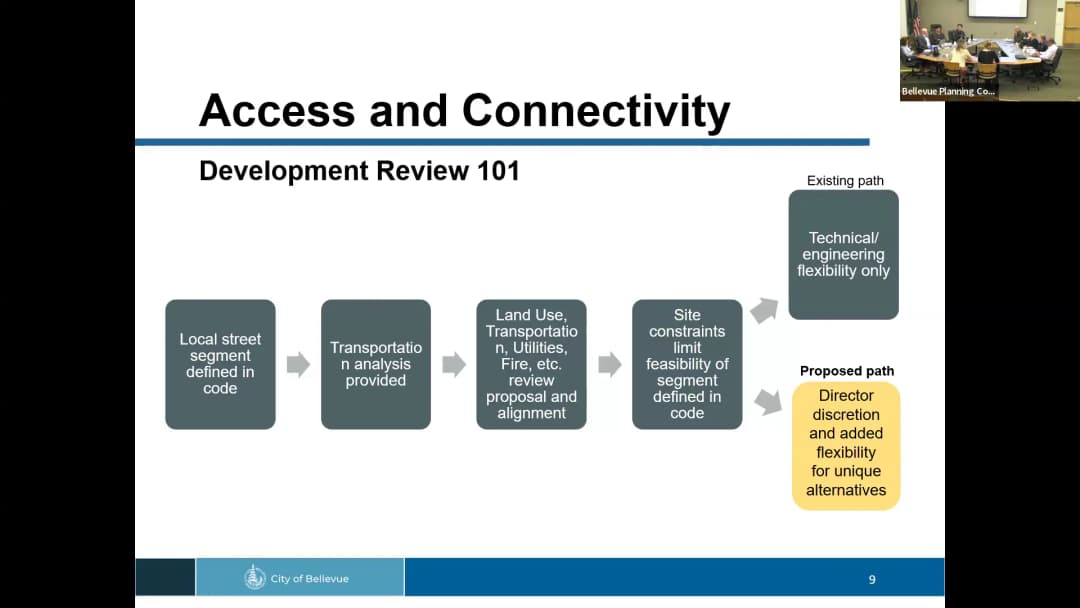
Date note: The transcript identifies the meeting date as September 9, 2026, but the instruction specifies September 10, 2026. This summary uses the provided date. The Bellevue Planning Commission held a study session on the proposed Bell Red Land Use Code Amendments (LUCA) on September 10, 2026. The meeting included public testimony from 16 speakers, a staff presentation on updated draft code provisions, and commission discussion. At the end, the commission voted to set a public hearing for the LUCA. Consent Calendar - Approved the meeting agenda by unanimous vote. - Approved the minutes from June 24, July 9, and July 22, 2026. Reports - Councilmember Bargava reported that the City Council unanimously approved a development agreement for bridge housing in Bell Red and reviewed parking reform work, with general support but requests for further analysis on reduced parking near frequent transit, visitor parking, and senior housing exceptions. Public Comments & Testimony - Valentina Venevo (resident): Opposed the proposed Spring Boulevard road through a planned park in Bell Red, arguing the 2009 plan is outdated given new transit, safety knowledge, and environmental concerns (wetland and stream). She advocated for a multi-use path instead. - Rebecca Bloom (Columbia Pacific Advisors): Described a 9-acre project with 1,100+ units and extensive amenities. Stressed that high costs (energy code, sales tax, affordable housing) make projects challenging and proposed a “Bell Red Arts” district with shared cost offsets. - Matt Rowie (architect/planner): Tested the street grid on dozens of properties and found it impractical due to existing buildings, grades, and landlocked sites. Recommended eliminating the mandatory grid or allowing shared-use paths and increased bonus points for street construction. - Patrick Hanks (Bellevue Chamber of Commerce): Thanked staff for progress but noted economic conditions require a code that works “day one.” Key concerns: mandatory street grid and development agreement eligibility for smaller sites. - Megan Webb (King County DNRP): Promoted Transfer Development Rights (TDR) as a market-based tool that could fund open space and other priorities in Bell Red, offering a potential $1 million grant and 25% revenue return to the city. - Layla Kademi (land use attorney): Supported development agreements but urged broader eligibility (sites smaller than 4 acres or with street grid burdens) and more flexible public benefit requirements. - Morgan Shuck (Echo Northwest, for Bellevue Chamber): Presented independent analysis showing near-zero feasibility under current market conditions. Recommended calibrating street/stream obligations, day-one offset tools, and aligning affordable housing with MFTE. - Paulo Sullivan (Albertson property owner): Opposed the required east-west connection road, citing a traffic study showing up to 6,000 dwellings can be built without it. Called the road unnecessary and expensive. - Brady Nordstrom (HTC): Asked for clarification on the allocation of amenity fees (35% housing, 50% open space, 15% arts) and expressed concern that a proposed catalyst program for medical/life sciences on 116th Avenue could reduce affordable housing funds. - John Morasco (Albertson property): Submitted a traffic analysis concluding up to 6,000 units or 1.2 million sq ft of commercial can be built without the east-west connection. Advocated for flexible block perimeter standards instead of a prescriptive grid. - Jesse Clausen (O'Brien Auto Group): Highlighted private easements preventing road construction and argued the development agreement provisions improperly constrain City Council discretion. Opposed the street grid. - Lucy Zapon (Imagine Housing): Asked to eliminate the prescriptive street grid in favor of multimodal pathways to reduce costs and improve safety. - Alex Zimmerman (resident): Criticized the city for prioritizing corporate interests over ordinary residents, citing high housing costs and a large budget surplus. - Steve Malsom (developer, Evans Wakefield): Provided examples from Lynnwood and Marysville where flexible approaches allowed successful large-scale developments. Urged avoiding overly prescriptive street grids. - Lori Keller (Bellevue College): Expressed support for the LUCA and institutional zoning category, and for continued partnership with the city. Discussion Items - Staff Presentation (Christina Gallant and Charlie Engel): Summarized key updates to the draft LUCA, including: a fee-in-lieu for the amenity system set at $39/square foot (matching downtown); allocation of fees (35% housing, 50% open space, 15% arts); enhanced stream restoration incentives; removal of two street segments; a new flexibile pathway for public street substitution with private streets (via director review); development agreement eligibility for sites larger than 4 acres with mandatory street grid (requiring 3 public benefits for broader modifications); on-street parking reduction options; a commercial catalyst program for medical/life sciences on 116th Avenue (850,000 sq ft eligible for 50% MHA fee reduction); a Sound Transit parcel height bonus; and a tentative schedule leading to City Council review in early 2027. - Commission Discussion: Commissioners focused heavily on the street grid, with several members (Nilchian, Conlu, Keppel, Ferris, Via Veses) requesting additional flexibility, a clearer “performance path,” or reduced prescriptiveness. Staff defended the grid as essential for connectivity and public investment, but acknowledged the built-in flexibilities. Other topics included TDR prioritization, pioneer program possibilities, development agreement size thresholds, assurance devices for stream daylighting, and sidewalk widths in private street alternatives. Commissioner Conlu questioned the 25% assurance device level for stream daylighting, preferring a higher percentage. Key Outcomes - Unanimously voted to direct staff to schedule a public hearing for the Bell Red Land Use Code Amendments. The hearing date will be determined at a future meeting. - Staff was asked to consider the following input for further refinement: - A potential pioneer program to incentivize early development. - Expanded TDR prioritization and integration. - Clarification of street grid goals to guide alternative proposals. - Broadened development agreement eligibility beyond 4-acre sites. - Reduced sidewalk width requirements (e.g., 8 feet) for private street alternatives. - A more explicit performance path for street grid compliance. - Revised assurance device levels for stream daylighting incentives. - Calibrated amenity fee allocation (e.g., 33% each) or further rationale for the current split. - The commission also approved the minutes from previous meetings without objection.
This regular meeting of the Public Safety and Neighborhood Services Committee, chaired by Supervisor Danny Sauter and joined by Vice Chair Bilal Mahmood and Supervisor Alan Walton, considered a single agenda item: a hearing on the person-to-person, premise-to-premise transfer of a Type 21 off-sale general liquor license for Tazza D’ Amore Cafe at 700 Fourth Street. The item was approved unanimously. Discussion Items - Liquor License Transfer – 700 Fourth Street (Tazza D’ Amore Cafe): Officer Brandon Erickson of the SFPD liaison unit presented the Police Commissioner’s Notice (PCN) report. The applicant, Marcus (owner for 23 years), seeks a Type 21 license to operate off-sale beer, wine, and distilled spirits at the Caltrain station location. Key conditions include: no exterior advertising of alcohol, graffiti removal within 72 hours, and authorized inspection by peace officers and ABC personnel. The location is in a low-crime area (Plot 288) and a high-concentration census tract (607.03). There were zero letters of protest or support. Southern Station had no opposition. Marcus expressed his excitement to serve Caltrain patrons with the same hours as the previous owner (50 years). Chair Sauter voiced support, calling it “a lovely amenity” for Caltrain riders and residents. Key Outcomes - Motion and Vote: Supervisor Sauter moved to direct the clerk to prepare a resolution finding that the transfer would serve public convenience or necessity and forward it to the full Board of Supervisors with a positive recommendation. The motion passed unanimously (3 ayes: Sauter, Mahmood, Walton). No public comment was received. No other business was considered. The meeting adjourned.
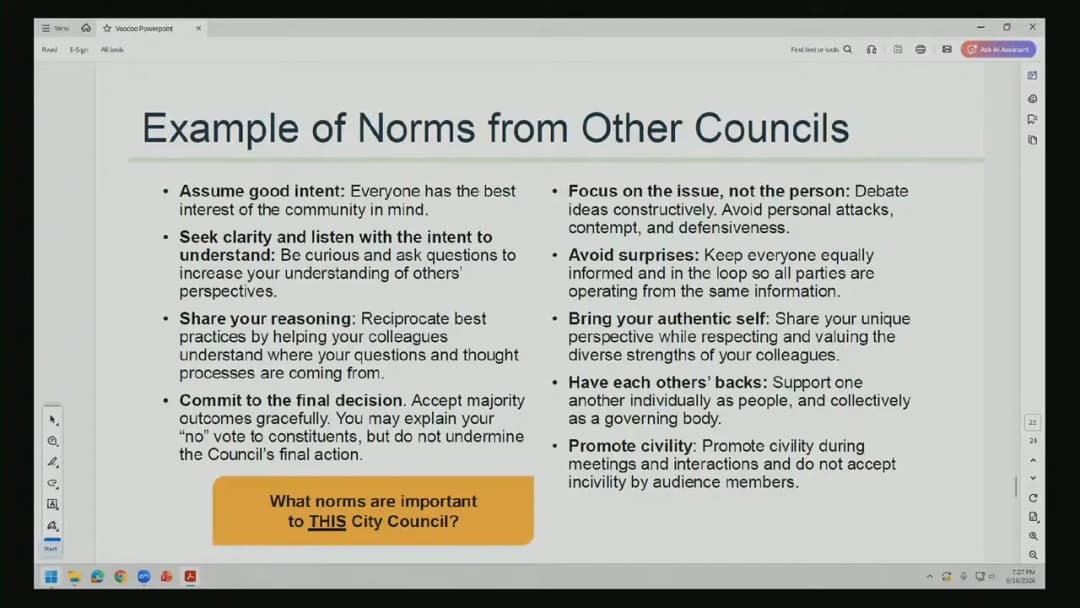
On Thursday, September 10, 2026, the Des Moines City Council convened a workshop at 6:00 PM in the City Council Chambers to discuss the implementation of the city's first Strategic Plan and to consider establishing governance norms for council operations. The meeting was called to order by Mayor Yoshiko Grace Matsui and adjourned at 7:59 PM. Councilmember Jeremy Nutting was absent and excused by a 6-0 vote. Consent Calendar - Excusal of Absent Councilmember: Councilmember Harry Steinmetz moved to excuse Councilmember Jeremy Nutting; seconded by Councilmember Pierre Blosse. Motion passed 6-0. Discussion Items - Strategic Plan Workshop: The council engaged in a workshop facilitated by Raftelis Consultant Nancy Hetrick and City Manager Katherine Caffrey. Key discussions included: - Review of the first-year work plan developed by staff, which maps initiatives, leads, status, and current actions to each strategic focus area. - Agreement on reporting cadence: quarterly written updates to the council (made public), with twice-yearly in-depth workshops (e.g., retreats) to review progress, discuss metrics, and adjust priorities. - Need for key performance indicators (KPIs) to measure progress, with recognition that this will be developed over time, starting with a focus on metrics for each strategic priority area. - Importance of public communication: ideas included dashboards, simplified summaries, targeted outreach to underrepresented neighborhoods, and celebrating milestones to engage the community. - Governance Norms: The council discussed establishing shared operating norms based on an Institute for Local Government article. Proposed norms included: assuming good intent, focusing on the issue not the person, promoting civility, being open and curious, avoiding surprises, coming prepared, committing to final decisions, and seeking cohesion. The council agreed to treat these as a draft and revisit them at a January 2027 retreat. Key Outcomes - The council endorsed a quarterly written update cadence for strategic plan progress, with twice-yearly workshops (e.g., in January and mid-year) for deeper discussion, beginning in early 2027. - City Manager Katherine Caffrey will incorporate strategic plan progress into her annual performance evaluation, with a focus on future goals rather than retrospective accountability for the current year. - A draft set of governance norms (e.g., assume good intent, come prepared, commit to final decisions, seek cohesion) was informally agreed upon as a starting point, to be refined and formally adopted at the January 2027 retreat. - The next scheduled meeting is the City Council Budget Retreat on September 12, 2026.
On September 10, 2026, at 6:00 PM, the Bainbridge Island Planning Commission met in Council Chambers at 280 Madison Ave N and remotely to review and prioritize the 2027 Planning Commission Work Plan. Chair Chris Garcia presided; Vice Chair Sarah Blossom and Commissioners Alexandra Costin, John Sandich, Ben Dinas, and Peter Schaub were present. Alex Prudholm was excused. Planning Director Emily Terrell and Senior Planner Jennifer Sutton presented, and Council Members Laura Lant and Ashley Matthews participated as liaisons. The meeting opened with the Suquamish land acknowledgement. Opening, Agenda, Minutes, and Public Comment - The agenda was approved unanimously and no conflicts of interest were disclosed. - The August 27, 2026 Planning Commission meeting minutes were approved unanimously. - There were no public commenters in person or remotely. Planning Director's Report - Director Terrell reported that the comprehensive plan update is moving forward. The City Council refined modeling assumptions for LMN and sent them to consultants. Commissioner Blossom's clarification helped resolve the bonus floor area ratio discussion for High School Road and Ferry. - A new city manager has started, and Terrell offered to share the list of Planning & Community Development items and the updated comp plan calendar. - Terrell reported four Growth Management Hearing Board decisions since 2025. The first two accepted 'plan for and accommodate' for affordable housing, while the more recent two require jurisdictions to fund affordable housing. She cited Port Townsend's finding of $170 million in affordable housing need with no identified funding source, and said the city may ask the Legislature for clarification. 2027 Work Plan Discussion Staff prepared a work plan table with a blank priority column, level-of-effort estimates, consultant needs, and dependencies. Sutton explained that the Department of Commerce reviews most land-use code changes and has a 60-day review period; SEPA review is also embedded. The city is on a status-quo budget because permit revenue is down, so consultant funding is limited. The Commission scored items using 5 (high), 3 (medium), and 1 (low), considering value, effort, dependencies, external stakeholders, and regulatory requirements. - Park overlay / park permit process: Scored 24; seen as a possible quick win with existing community commitments, though some members rated its standalone value as medium. - Hotel location: Received low priority. - Voluntary and mandatory inclusionary zoning (VIZ/MIZ): Scored 26; a high-effort, consultant-supported item including market review, funding mechanisms, and new code recommendations. Commissioner Schaub called funding mechanisms the most important piece. - TDR and bonus FAR: Scored 28; members supported improving the transfer of development rights program and using bonus FAR for public benefits, conservation-area relief, groundwater management, and agricultural land protection. Commissioner Schaub said reducing conservation-area development pressure is essential. - Minimum floor area ratio (FAR): The Commission unanimously moved this item into the VIZ/MIZ program item as a supporting element rather than a standalone priority. - Civic/cultural/connection overlay (CCCO): Scored 24; tied to a Hagar Scribner Properties proposal and external stakeholders who have waited for action. It would reward community benefits such as affordable housing, connectivity, and open space with flexibility in development standards. - Sub-area plans for Ferry and High School Road: Scored 12; members said these should run in parallel with base/bonus FAR work rather than before or after it, and some worried the plans could sit on the shelf. Commissioner Schaub suggested encouraging grassroots community visioning instead of a formal top-down priority. - Minimum residential density: The Commission unanimously split this into two items: upzoning existing R zones (raising the cap, scored 6) and requiring a minimum density within existing zones without changing caps (raising the floor, scored 20). Discussion referenced the Sportsman's Club Road R0.4 property on city water/sewer and commercial sewer capacity issues raised by Council Member Lant. - Middle housing: The Commission unanimously renamed the 'middle housing' item to 'middle housing: strategies other than form-based code' and the 'form-based code' item to 'form-based code in support of middle housing.' Middle housing strategies scored 24. Form-based code was described as a key tool for middle-scale, middle-income housing serving households above the 80% AMI threshold. - Subdivisions: Received a low priority score of 8; members thought subdivision standards were updated relatively recently. - HAP report card: The Commission unanimously struck this row and replaced it with a column identifying whether each work plan item is a Housing Action Plan action or supports one. Staff were also asked to flag HAP actions that are not complete and not otherwise captured. - Attracting development/partnerships/process improvements: Scored 26. Members emphasized partnerships, updated MFTE (multifamily property tax exemption) rules, priority permitting, and permit-process confidence. Commissioner Blossom noted Kitsap Builders Association feedback about MFTE and priority permitting. - Modular/pre-approved construction: Discussed as a worthwhile but not urgent tool; Council Member Lant noted local modular and pre-approved ADU producers. - Suzuki and Senior Center affordable housing: The Commission unanimously voted not to prioritize this item at this time and instead to ask the City Council what, if anything, it needs from the Planning Commission to start work; if no action is needed, the item will be struck. - Relief from standards: Scored 10. Director Terrell framed this as a general code allowance for affordable housing projects, not a project-specific waiver; it would identify which standards can be relaxed, by how much, and who decides. - Shoreline Master Program: Scored 16. It is a mandatory update due June 30, 2029, with significant Ecology rulemaking underway. Terrell noted a small state grant of $22,400 for consultant help. - Annual joint meeting with City Council: Scored 22; supported as a way to align priorities and avoid surprises, possibly starting with a full-day retreat. - Process improvement, time management, and Commerce short course: Scored 22. The Department of Commerce offers a free three-hour short course; new commissioners welcomed it as a way to level the learning curve, and the group supported a comp plan post-mortem while the process is still fresh. - Agricultural resource lands: Scored 16. Members noted the dependency on a functional TDR program and discussed protecting city-owned and private farmland. Council Member Matthews said an agricultural advisory group proposal is heading to the City Council. - Housekeeping ordinance: Scored 24. Staff identified scriveners' errors, broken references, and conflicting code sections across many BIMC chapters; Terrell said fixing them reduces legal liability and improves customer service. Key Outcomes - The Commission directed staff to consolidate the individual 5/3/1 scores into a prioritized 2027 work plan and bring it back for further review. - Unanimous votes taken during the discussion included: - Moving minimum FAR into the VIZ/MIZ item. - Splitting minimum residential density into 'raising the cap' and 'raising the floor' items. - Renaming the middle housing and form-based code items to clarify that form-based code is in support of middle housing. - Striking the HAP report card row and adding a HAP action column, plus requesting staff to flag unaddressed HAP actions. - Not prioritizing the Suzuki and Senior Center item absent Council direction. - In Good of the Order, Commissioner Schaub apologized for his absences, explaining that his wife had suffered a severe leg break and he had been caring for her. Commissioner Blossom clarified that city-owned farmland is not expected to be developed for housing, though farmworker housing may be needed. The Chair marked the 25th anniversary of 9/11 with a moment of silence, and the meeting adjourned.
Chair Marita Davis Johnson (District 5) presided, joined by Commissioners Robert Patrick and Ladina Bolton. The committee approved several change orders, reviewed a presentation on the PDK Airport air quality and noise study, and discussed the draft 2027 legislative agenda. The meeting began at6:00 PM UTC. Consent Calendar - Approval of Minutes (Item2026-0374): The minutes from August18,2026 were approved unanimously. Discussion Items Facility Management Change Orders - Item26-1149: A change order for on-call pressure washing and painting services (contracts2000310 and2003112) was approved, increasing funding to a total not to exceed $1,850,000. Discussion covered painting of water towers, graffiti removal on retaining walls, and coordination with beautification departments. The item passed with a motion and second. - Item26-1323: A sixth change order for on-call plumbing services (contract1297570) was approved, adding $1,269,307 to fund building performance assessment audits. The audit will inventory county facilities and identify needed repairs and preventive maintenance. Clarification was provided that the item covers assessment, not immediate repairs, but will inform a multi-year capital plan. The item passed unanimously. Innovation & Technology - Item26-1198: A change order for Fuel Master software maintenance (contract200149) was approved, extending the term through December31,2030 and increasing funds by $266,286 to ensure continued support and licensing for the county fleet's fuel management system. The item passed unanimously. Voter Registration & Elections - Item26-1238: Approval of a bid award for emergency/provisional ballot printing and absentee ballot mailing services, split between Tech Mail Solutions and Ford Orange Press, for a total not to exceed $121,297.50. The committee discussed offline handling of certain questions. The item passed unanimously. PDK Air quality and Noise Study Update - Representatives from HMMH (Gene Rindell) and CDM Smith (Gwen Pelletier) presented findings of a two-year study. The study used2018 as a baseline and projected2040 conditions with and without implementation of the airport master plan. Key findings: - Air quality emissions increase marginally due to assumed longer taxi times; concentration differences are less than2% of National Ambient Air quality Standards. - Noise levels (cumulative metrics like DNL) are essentially unchanged between scenarios; a slight1.5% reduction in repositioning flights was assumed with new hangars. - Human health risks from air pollution are negligible (cancer risk below one per million). - Noise health effects literature supports reducing exposure to aircraft noise, especially at night. - Questions addressed the2018 baseline choice (avoiding COVID years), the negligible increase in emissions, and qualifications for future noise mitigation programs (no residences currently in65 DNL contour). The item was informational; no vote taken. 2027 Legislative Agenda Development - John Dan from Intergovernmental Affairs presented a draft consolidating priorities from the recent legislative retreat. The original top four priorities were expanded to five by splitting tenant protections and strategic housing investments. The committee discussed elevating annexation equity as a top priority, citing concerns about cities absorbing county parks and infrastructure without compensation. Commissioners Davis Johnson, Patrick, Spears, and Bolton strongly supported elevating the annexation issue. Staff will revise the document and bring it back for committee approval on September22,2026, with full board approval expected in October. Key Outcomes - Four change orders and one bid award were approved unanimously (Items26-1149,26-1323,26-1198,26-1238). - The PDK Airport study was received as information. - The2027 legislative agenda draft will be amended to include annexation as a top priority; further committee action scheduled for September22,2026.
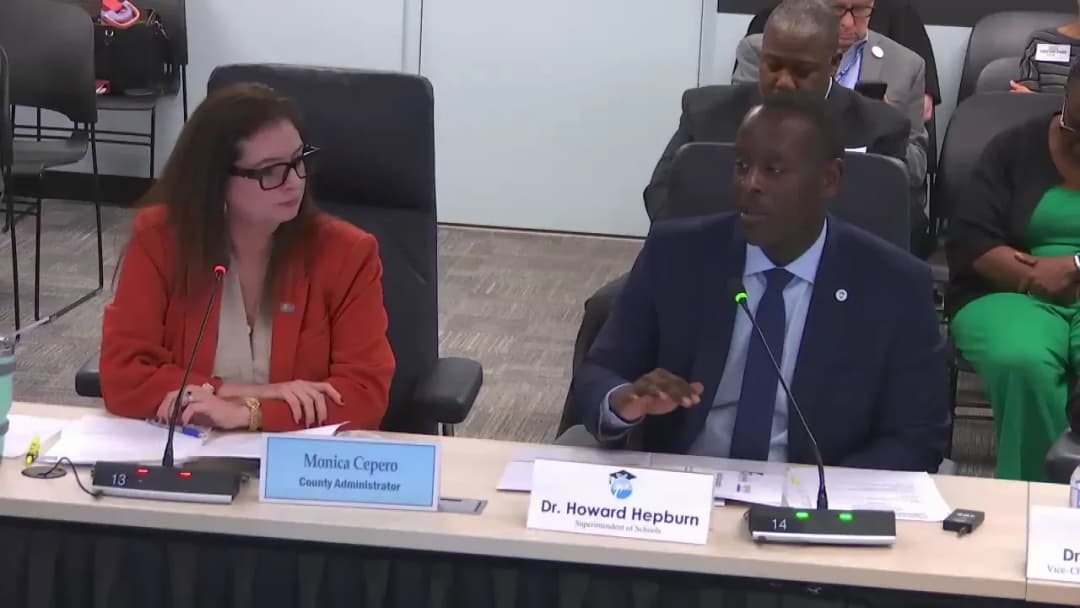
On September 10, 2026, the Broward County Commission and Broward County School Board held their first joint workshop in 12 years in Commission Room 430, with a hard stop at 1:55 p.m. Commission and school board members discussed facility sharing, emergency shelter coordination, legislative priorities, and workforce development. No formal votes were taken; the workshop produced staff assignments and a commitment to continue joint collaboration. Facilities & Joint Use - School Board Chief of Staff John Sullivan said the district wants to partner with the county on facilities that are available or will become available through the district's "redefining" school portfolio effort. School Board Chair Sarah Leonardi noted that community members at a Miramar-area redefining meeting suggested using future closed campuses as library space. - School Board member Rebecca Thompson supported shared "third spaces" and noted that the library space at Walter C. Young may no longer be available, creating a possible expansion opportunity. - School Board member Debbie Higson asked the county to help with graduation venues, explaining that three schools can only fit at the Hard Rock and that venue is too expensive. She raised the county convention center as a possible option and asked for equity in where students hold graduation. - The Mayor said all government facilities should be on the table, and county administrator Monica cautioned that the convention center is booked years in advance because its revenue pays bonds, but said if dates are open the county is willing to talk. - Commissioner Udine shared examples of small city-county-school collaborations, including a copy paper loan and SAT prep funding, and urged avoiding over-lawyering. The Mayor asked for a shared inventory of county and school board properties and availability. - Officials discussed reciprocal agreements and existing interlocal agreements; the current emergency shelter agreement was cited as a key existing partnership. - A commissioner raised the student ID library card program, noting roughly 80,000 students once used it. School Board staff said they believed it was still in effect, and both bodies agreed to promote it during library card month. Emergency Management & Shelter Coordination - County administrator Monica said three proposed school closures would affect emergency shelters: Panther Run Elementary, Silver Lakes Elementary, and Dolphin Bay Elementary. Together those schools represent about 1,200 shelter spaces during emergency activations. - The county asked to be the first party consulted about leasing or using the gymnasium, kitchen/cafeteria, and bathrooms at those schools if the properties are sold or repurposed. - School Board staff said Panther Run has already closed, but the superintendent asked to keep its shelter-capable spaces open to avoid scenarios where the entire school system must close because of one shelter. - Emergency Management Director Clay Pacheco said the county and school board already plan, train, and exercise shelter operations together and will share updates on shelter capacity. - The existing shelter interlocal agreement is in place through 2030; the county attorney advised that the county must be made whole for lost shelter capacity if school closures change availability. - Vice Mayor McKenzie asked for updates on North Fork Elementary and Broward Estates closures. School Board staff said Dr. Wanza would stay in touch with him, and noted that Broward Estates has a pre-K program with 100% of pre-K students kindergarten-ready and that North Fork has an approved "Sistrunk Rising" proposal. Legislative Priorities & Joint Advocacy - Debbie Higson said Florida ranks 50th in the nation for teacher pay, and Broward receives about $9,000 per student. She stated Miami-Dade receives about $300 more per student and Palm Beach County receives about $1,700 more per student than Broward. - Officials attributed the funding gap to the state's district cost differential, which equates to nearly $300 million less for Broward compared with Palm Beach County. - School Board staff explained the November 3 referendum is a renewal, not a new tax, in place since 2018. It funds supplements for teachers and frontline staff, mental health services, and school safety. Failure would mean a loss of $358 million annually; the referendum needs a simple majority. - Commissioner Geller asked whether the funding gap is state or local; the answer was that it is driven by state FEFP calculations. - Commissioner Rich discussed the property tax amendment on the same ballot, saying the county general fund depends heavily on property taxes and that libraries and parks are not core services. Both bodies agreed they can educate the public but not tell people how to vote. - The county and school board agreed to exchange their formally adopted legislative priorities and seek alignment for joint advocacy ahead of the 2027 legislative session. Workforce Development & Career Pipelines - The Mayor invited Superintendent Hepburn to participate in his long-running workforce working group and praised the school board's three vocational schools as top-ranked statewide. He said guidance counselors should not direct every student to college. - The Superintendent said the district has added CTE coaches to high schools to promote skilled technical careers, not just college paths. - A commissioner asked about relationship and domestic violence education; School Board staff cited state constraints on curriculum and said financial literacy is now a required subject, with robust finance academies in the district. - A commissioner raised the upcoming organics waste requirement: after the end of the year, organic waste can no longer go to Monarch Landfill. Solid waste RFPs will be issued in the next few months, and the commissioner asked the school board to coordinate with cities and haulers. The Superintendent said the district is purchasing compostable cafeteria items, running education campaigns, and will begin discussions with cities. - Commissioner Rogers urged broader joint problem-solving, including summer meal distribution, school kitchens, food security, and transparent lists of surplus properties. She also suggested the county and school board consider sharing one ombudsman. School Board staff responded that food is purchased to avoid spoilage, summer meals are offered, and cities are consulted during school closure discussions. Key Outcomes - No votes were taken; the meeting was a workshop focused on discussion and next steps. - County administrator Monica will work with Superintendent Hepburn to produce a list of available facilities and bring options back to both boards. - The county will share shelter requirement lists and keep shelter coordination with the school board a priority, particularly before the next storm season. - Both bodies will share their adopted legislative priorities and explore joint advocacy items. - Both sides will publicize the student library card program. - The school board will continue consulting the county on school closures, property reuse, shelter capacity, and organic waste coordination. - Participants expressed a shared commitment to hold regular future joint meetings, with some suggesting once or twice a year.
The Goodlettsville Board of Commissioners held a study session on Thursday, September 10, 2026, beginning at 5:48 p.m. in Massie Chambers at Goodlettsville City Hall. The agenda called for a 5:45 p.m. start, and no formal action could be taken during a study session. The two discussion items were the 2026 Pleasant Green Pool season report, required by Resolution 26-1316 as amended, and a proposed lease of the Main Street parking lot. Pleasant Green Pool 2026 Season - Recreation staff reported total pool attendance of 11,116 for the 2026 season, an increase of 1,104 visitors over the prior year and close to pre-COVID attendance. Attendance was tracked through membership check-ins and daily passes. - Total revenue was $84,616, an increase of $11,567 over the previous year. Revenue sources included gate sales, concession sales, memberships, programming, and reservations. Programming, which included a weekly water aerobics class, generated $475, and reservations generated $7,150. - Expenses were $141,390.30, a decrease of $9,341 from the prior year. Lifeguard salaries were the largest expense because salaries had been raised to remain competitive in the lifeguard market; scheduling changes helped reduce overall costs while maintaining safety. - The season ended with a net loss of $56,774, an improvement from a loss of more than $77,000 the previous year. - Staff increased marketing through paid and organic social media, news interviews, and pop-up events, which became very popular. They also extended hours on Tuesday and Thursday evenings; the 4:00-7:30 p.m. extended period averaged 20-25 paid admissions, with one evening drawing more than 50. Peak attendance remained from noon to 3 p.m. - Reservations were limited to Friday, Saturday, and Sunday based on prior demand; those days sold out, though one last-minute cancellation could not be refilled. - Staff estimated fewer than five full days were lost to weather closures. Lifeguards were paid only for cleanup time on closed days, not for the full day. - On capital needs: diving board replacements were completed, and $50,000 was budgeted for the concession stand renovation. Staff identified pool deck resurfacing and an automated chemical system as top priorities and said they would request a budget amendment for $75,000 for those items before reopening. Other future needs included lightning detection, ADA upgrades, and additional shade. Staff described the pool deck as in rough shape; resurfacing would involve grinding, leveling, and applying a new membrane rather than replacing the concrete. - Nighttime swimming was discussed; staff said it is not currently feasible because the pool has no in-pool lighting, and installing internal lighting would be a significant cost. Staff did not consider nighttime swimming a good use of funds. - Swim lessons were not offered in 2026 because staff were not WSI certified and many lifeguards were new. Staff and commissioners noted that swim lessons generated more than $12,000 in revenue in past years and were one of the most requested community programs. Staff expressed interest in certifying staff and bringing swim lessons back. - Commissioners thanked pool staff and lifeguards, noted approximately 25-26 lifeguard saves, and said the community strongly supports keeping the pool open. One commissioner reported that a social media post about the pool drew hundreds of comments, almost all in favor of keeping it. Main Street Parking Lot - Mr. Ellis presented a proposed lease for the parking lot at the corner of East and Main Street, across from Memorial, for public parking to support businesses along the Main Street corridor. - Proposed terms: a 36-month initial term from January 1, 2027, through 2029, with rent of $10,000 per year. The lease payment would increase if improvements to the property increase its appraised value by the Davidson County assessor. Legal counsel had not yet approved the draft. - The fiscal year 2027 budget includes $15,000 for the property: $10,000 for the first year's lease payment and $5,000 for paving and striping. Staff said paving and striping would be done through the city's existing contract with Rogers Group; minimal other improvements would be made until the Main Street project is complete. - Commissioner Walker expressed concern that the city would pay to improve privately owned property without a renewal right or right of first refusal, leaving the owner free to lease the improved lot to a private operator after three years. Walker asked whether the city could seek a renewal option. Mr. Ellis said the property owners are not interested in selling, are comfortable with the current terms, and have not agreed to a renewal term; he offered to take the request back to them. - Another commissioner noted the Main Street project is expected to be complete in 2028, meaning the parking lot lease would be half over before the new Main Street improvements are finished, but argued the lot would still be used for events and additional public parking. Key Outcomes - No formal votes were taken, consistent with the study session format. - Pool staff plan to bring forward a budget amendment for approximately $75,000 for pool deck resurfacing and an automated chemical system, and will consider pricing additional shade. - Staff will continue discussions with the parking lot property owners, including the possibility of a renewal term or right of first refusal.
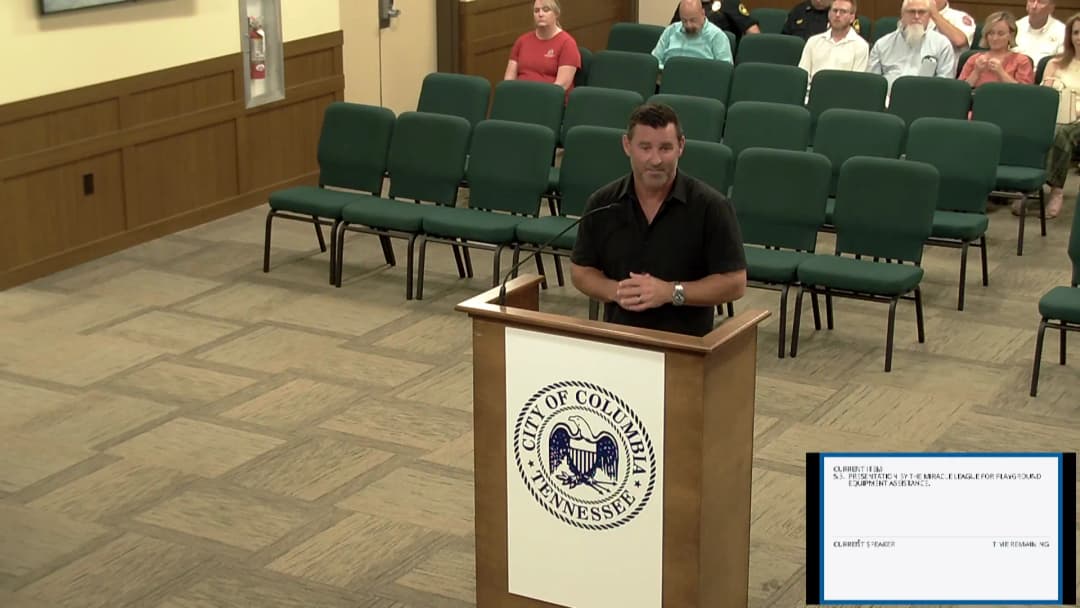
The Columbia City Council met on September 10, 2026, at 5:30 PM in the City Hall Council Chambers. The meeting included a special presentation of the Carnegie Medal, updates on community events, a funding request from the Miracle League, approval of fee waivers for county projects, and the first reading of a temporary moratorium on data center developments. Consent Calendar - The Council approved the consent agenda (Items 7.1-7.15) collectively, which included: - July 2026 disbursements ($11,615,452.19). - Tyler Technologies Parks and Recreation module ($20,665 total FY27 cost). - Storage lease with Campbell & Lovell Rentals ($900/month). - Advertising in the 2027 Tennessee Vacation Guide ($10,000). - Holiday digital billboard advertising with Lamar Advertising ($5,625). - Live entertainment contract with Tuck River Touring for the 2027 Fruit Tea Festival ($15,000). - User fee study contract with Matrix Consulting Group ($20,000). - Three-year on-call traffic engineering agreements with Neel-Schaffer, Inc. and T-Square Engineering, Inc. - Purchase of a leaf vacuum truck from CMI Equipment Sales ($298,880.05). - Sewer capacity analysis contract with Water Management Services, LLC ($45,000). - Initial Rescue Squad Recognition application ($50 fee). City Attorney noted the attachment provided was incorrect; correct attachments were distributed. - AT&T fiber installation participation agreement ($3,818.28 budgeted). - Purchase of eight 2026 Ford Police Interceptor vehicles ($354,272). - Purchase of eight in-car/body camera systems from Motorola ($65,332.48). Public Comments & Testimony - No members of the public signed up to speak during the designated public comment period. Discussion Items Presentation of the Carnegie Medal: - Mayor Molder presented the Carnegie Medal to Samuel Harden Adcock for his heroic rescue of a man from the Duck River on May 23, 2025. The Carnegie Medal Fund recognized Adcock as the 10,561st hero in its history. This was a historic presentation, marking the first time the medal has been awarded in the City of Columbia. Presentation on the Fruit Teaser: - Kelli Johnson of Columbia Main Street presented the inaugural Fruit Teaser event (September 12, 2026 at the Maury County Public Lot). The event will feature a fruit tea competition with 17 teams, youth bands, and other activities. Two proclamations will be made at the event: declaring Columbia the "Fruit Tea Capital of the World" and fruit tea the "Official Drink of Columbia." Presentation by the Miracle League: - Mike Ugla and Julie Beck of the Miracle League requested financial assistance from the city for Phase 2 ("Tay's Place") of the project at Maury County Park. Phase 2 is an all-inclusive playground with a current estimated cost of $750,000. Of this, $230,000 has been raised through county contributions, leaving a $498,000 shortfall. The group expressed urgency as their equipment quote expires on October 31, 2026. Mayor Molder expressed full support for a city contribution, noting the project serves a significant community need, and requested the item be placed on the October 8, 2026 agenda for formal consideration. Maury County Fee Waivers (8.1 & 8.2): - The Council discussed requests from Maury County to waive building permit fees. - Unanimously approved waiving $85,000 in fees for renovations at the Maury County Courthouse. - Unanimously approved waiving $66,000 in fees for the Animal Shelter expansion project. Council members praised the partnership with the county and the work of the Animal Shelter director. Data Center Moratorium (Ordinance 4596): - The Council unanimously approved the first reading of a temporary, six-month moratorium on accepting and processing applications for data centers and high-density computing facilities. Mayor Molder explained the need for a pause to allow staff and the Planning Commission to study the infrastructure, environmental, acoustic, and utility impacts of such facilities, following similar action by Maury County. A public hearing is set for October 8, 2026. Other Ordinances and Resolutions: - The Council approved the first reading of a budget amendment (Ordinance 4594) increasing the FY 2026-2027 budget by $975,821.24 to $85,442,422. - Approved the first reading of an easement conveyance to Duck River Electric (Ordinance 4595). - Approved Resolutions 26-58 (Tax Corrections), 26-59 (Delinquent Tax Deletions), 26-60 (Parks and Recreation Fee Schedule), and 26-61 (Sewer Improvements Acceptance). Key Outcomes - Presentation and Recognition: Carnegie Medal awarded to Samuel Harden Adcock; James Blackwood Jr. honored for 24 years of service with Columbia Fire & Rescue. - Approved: Consent Agenda including disbursements, contracts, vehicle/camera purchases, and software agreements. - Approved: Waiver of building permit fees for Maury County Courthouse ($85,000) and Animal Shelter expansion ($66,000). - Approved: Resolutions related to tax corrections, park fees, sewer improvements, and delinquent tax deletions. - Approved (1st Reading): FY27 Budget Amendment, Electric Line Easement, and Data Center Moratorium. Public hearings for these items are scheduled for October 8, 2026. - Referred to Future Agenda: Formal consideration of the Miracle League playground funding request (October 8, 2026).