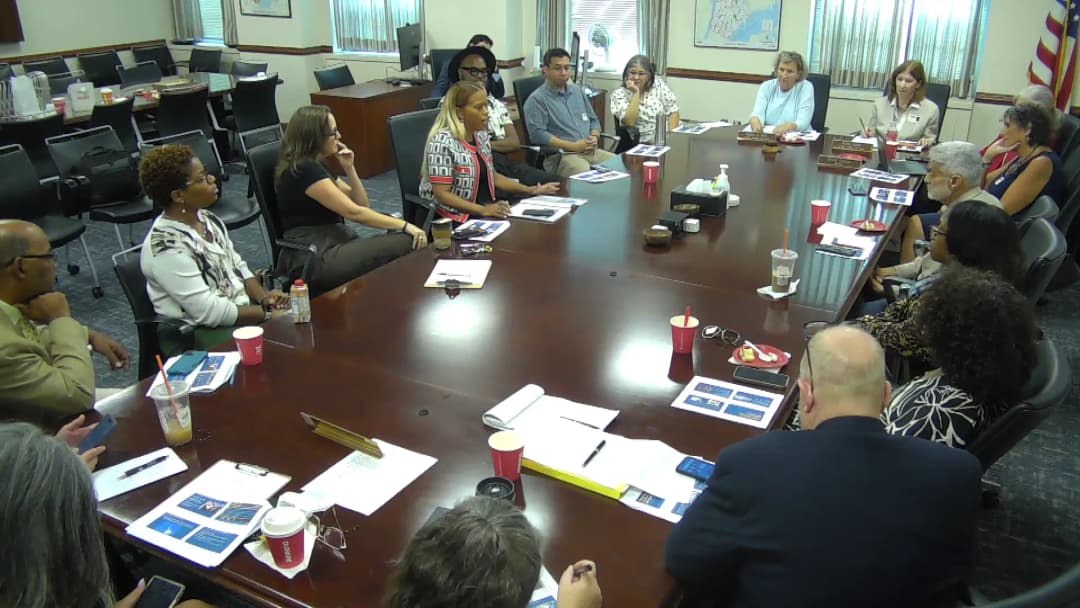
The Infrastructure, Innovation & Technology Committee met on September 10, 2026, at 17:15 UTC (afternoon session) with three members present: Chairwoman Micky Steinberg, Vice Chairman Keon Hardeman, and Commissioner Danielle Cohen Higgins. Commissioner Roberto J. Gonzalez and Commissioner Vicki L. Lopez were absent. The committee considered an ordinance to create a loan program for environmental remediation on large county-owned parcels, among other items. After extensive debate, the ordinance was deferred to the next committee meeting on October 15, 2026. Agenda Setting & Consent Items - The committee approved the official printed agenda with the addition of Item 1G1 substitute (the remediation loan ordinance). - Item 3C (garbage collection services contract extension) was pulled by the chairwoman and deferred by the administration. - Item 3F (AC replacement contract) was advanced to the next meeting. The balance of the agenda was approved by unanimous acclamation. Discussion Items - Ordinance 261035/1G1 Substitute – Environmental Remediation Loan Program - Sponsor: Commissioner Raquel A. Regalado (not a voting member of the committee) presented the substitute ordinance. It amends Section 24-34 of the county code to establish a zero-interest loan program using a portion of the Utility Service Fee (USF) fund (currently $181 million) to finance environmental remediation on county-owned parcels 10 acres or larger. - Administration (Andisha Daniel, Director of Solid Waste, and other staff): Stated that $125 million is programmed for existing projects, and $23 million is estimated for closure and long-term care of the former waste-to-energy site, leaving approximately $33 million unprogrammed. The administration expressed concerns about depleting funds needed for other mandatory remediation. - Commissioner Cohen Higgins questioned the use of ratepayer money for zero-interest loans to developers, noting that developers are already obligated to remediate under lease agreements. She proposed adding an interest rate, a loan cap, and a sunset period. - Commissioner Hardeman argued that the fund has been underutilized for years and that the loan program would spur remediation in underserved areas, particularly for affordable housing projects. He emphasized that the county has a duty to remediate its own properties and that making loans available does not force the county to spend money it cannot afford. - Chairwoman Steinberg suggested freezing the loan program’s available funds at the current unprogrammed balance ($33 million) to ensure clarity, and proposed a two-year sunset to revisit the program's effectiveness. - After extensive back-and-forth, the maker (Commissioner Regalado) agreed to amendments including: a two-year sunset, a work program to be provided by the administration, an interest rate to be set by the mayor/mayor's designee, and a loan cap per eligible property also set by the administration. However, Commissioner Cohen Higgins indicated she would vote accordingly based on ambiguity in the amendments. Key Outcomes - Motion to move the ordinance without recommendation failed due to lack of unanimity. - Motion to defer Item 1G1 to the October 15, 2026 committee meeting was moved by Chairwoman Steinberg, seconded by Commissioner Hardeman, and passed by acclamation. The administration was directed to provide a complete list of programmed projects, a rate card (interest rate and cap recommendations), and a work program before that meeting. - Item 3C (additional time and funds for garbage collection services) was deferred by the administration. - Item 3F (AC replacement contract) was advanced to the next meeting as requested by the administration. - No public comments were received.
The Public Meeting Index
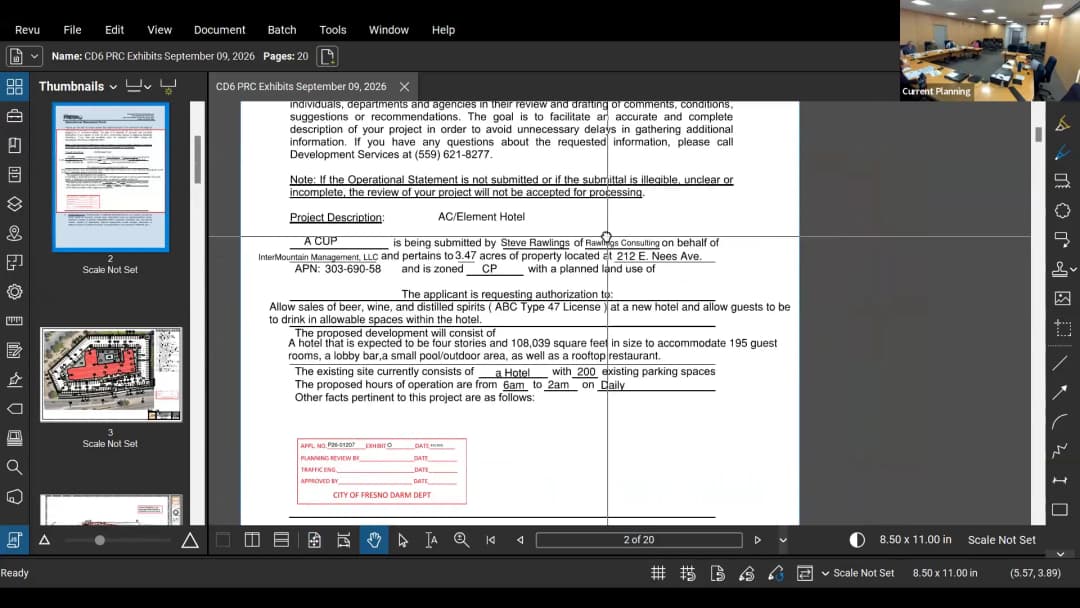
The Public Meeting IndexThe Council District 6 Committee met on Thursday, September 10, 2026, at 5:30 PM. The meeting was called to order with roll call: members Dene, Lois, Janice, Bonna, Alfred, and Geraldine were present; Janet was absent. The agenda for the September 9, 2026 meeting was approved unanimously. The consent calendar for August 12, 2026 meeting minutes was also approved unanimously. Consent Calendar - Unanimous approval of the August 12, 2026 meeting minutes. Public Comments & Testimony - No public comments were made during the meeting. Discussion Items - Conditional Use Permit P26-01-207 – River Park Ace Hotel LLC: Steve Rawlings, project representative, presented a request for a beer and wine license for a new 195-room hotel under the AC and Element brands (Marriott family). The hotel will have a lobby, dining, lounge, and a pool area where alcohol service is proposed. Mr. Rawlings emphasized the hotel's self-regulating nature and security measures. Committee members asked about fencing on the Sugar Pine Trail side (8-foot decorative metal fence), transient concerns, and the hotel's brand. The permit was approved unanimously. - Conditional Use Permit P26-02518 – Julia Kim: Julia and Casey Kim, owners of Wasabi restaurant, presented plans for a Korean steakhouse at the former TGI Fridays location (Herndon and First). They are applying for a Type 47 alcohol license after the property had been vacant for over a year. Renovations will level the split-level interior and add a controlled patio. Construction is expected to finish by May/June 2027. They also purchased the shopping center and plan to revitalize it. The permit was approved unanimously. - Workshop: Text Amendment P26-20730 – Additional Housing Types in Office District: Saul, a city planner, presented a proposal to allow single-unit dwellings and duplexes on vacant or underutilized parcels in the office zone district, with limitations including a 500-foot distance from schools, RM1 density (12-16 units per acre), and RS5 development standards (max 35 feet height). Committee member Jerry recommended requiring neighborhood notices for subdivisions with four or fewer parcels to increase transparency. No vote was taken; staff noted the recommendation. - Workshop: City of Fresno Climate Adaptation and Environmental Justice Plan (CAP EJ): Philip Siegris, planning manager, presented the draft plan, which addresses five hazards (flooding, extreme heat, drought, wildfire, air pollution) and five environmental justice pillars (healthy food, public facilities, physical activity, civic engagement, safe/sanitary homes). Community outreach included an online survey with over 2,000 responses and pop-up events. The plan proposes 68 new and 50 revised general plan policies. Committee members discussed the definition of safe/sanitary homes, the cost to the city and developers, and the need to address homelessness. Staff will consider feedback for the final draft. No vote was taken. - Committee Consultation & Unscheduled Matters: Member Bonna inquired about a previous apartment project at Chestnut and Behymer (triangular lot) that never broke ground and now hosts semi-truck parking. Staff agreed to research the project status for the next meeting. Key Outcomes - Unanimous approval of Conditional Use Permits P26-01-207 and P26-02518. - Staff will incorporate the recommendation for neighborhood notices on small subdivisions in the text amendment. - The CAP EJ draft will be revised based on committee input before proceeding to Planning Commission and City Council.
The Carson City Debt Management Commission (DMC) met on September 10, 2026, to consider a proposed resolution authorizing a $30 million lease-purchase agreement for a new city hall and parking garage. The commission’s role was to determine affordability under state statutes, not to decide whether the project should proceed. After presentations from city staff, a debt consultant, and bond counsel, as well as extensive public comment, the commission voted to approve the resolution. Consent Calendar - Approval of Minutes (August 18, 2026): The commission unanimously approved the minutes from the previous meeting. Public Comments & Testimony - Written comment (read aloud): A resident discussed a democratic axiom called “functional naming” and expressed concern that calling a fee or obligation a “lease” while it functions like a tax is an indicator of democratic backsliding. He urged the commission to stop the process. - Mayita Sanchez (Carson City resident, small business owner, candidate for Supervisor Ward 3): Stated she understands the commission’s narrow role but urged scrutiny. Noted that the $30 million principal is projected to result in approximately $54.95 million in total payments through 2057, with redevelopment area one revenues offsetting some costs while the general fund remains the backstop. She requested a year-by-year funding picture to understand trade-offs. - Sandra Owens (Carson City resident): Argued that the repayment story is not written down. Noted that the Board of Supervisors promised to get a written commitment that redevelopment money could pay for city hall, but that writing is not in the packet. She stated that a Nevada Public Records request for redevelopment files was not due until September 16, 2026—six days after the meeting—and that the city had not done its own homework. She also raised concerns about two absent commissioners, an ethics threat that kept one commissioner away, and the need for a two-thirds vote (4 of 5 members) under NRS 350.1014. She asked the commission to continue the item until September 16 or, if acting, to specify repayment from the general fund only. - John Peterson (JA Consulting Group, city’s debt consultant): Clarified that the indebtedness report submitted earlier did not include the city hall lease-purchase because it is not general obligation debt and because the other bonds (capital improvement, infrastructure sales tax, stormwater) are not expected to be brought to the commission during the current fiscal year. He confirmed that the Department of Taxation agreed with this approach. - Mike Horgan (Nevada Commercial Group, commercial real estate broker): Expressed concerns about adding 300,000 square feet of government office space to Carson City, which already has a 15% office vacancy. He warned that government buildings are not taxed, shifting the burden to taxpayers, and that the project’s cost ($5/sq ft/month) far exceeds current market rents ($1.25–$1.50). He predicted further declines in property values and tax revenues. - Maureen Lack (longtime Carson City resident): Recommended the commission return the request to the Board of Supervisors due to inadequate information. She listed seven points, including: the $38 million project (building and parking garage) is being financed only for $30 million; the loan would accrue two years of interest before occupancy; lack of cost breakdown, appraisal, and draft lease-purchase agreement; unknown maintenance costs for altered roadways and a new town square; and statutory requirements for an appraisal and a preliminary agreement. She stated the bond consultant’s own analysis concludes that installment purchase is more expensive, requiring a written justification. - Dan Lett (licensed appraiser): Supplemented his wife’s comments, showing a 27-page sample lease-purchase agreement that the city lacked. He noted that the city manager claimed a six-month groundbreaking timeline despite no plans, cost summary, or agreement. He cited recent sales of large office buildings (Capitol Plaza at $43/sq ft, King Street Building at $89/sq ft) versus the project’s implied cost of $844/sq ft. He urged the commission to consider the long-term burden on future generations. - Additional public comment: A resident argued that the decision should not be siloed on a single fiscal year’s ending balance ($15 million in FY27) because expenses are growing faster than revenues, and the commission has a fiduciary duty to residents. Discussion Items - 4.A – Proposed Resolution for $30 Million Lease-Purchase Agreement (City Hall) - Disclosures and Quorum: Commissioner Molly Walt disclosed a conflict of interest (her employer, RSVP, leases from an entity affiliated with the developer) and abstained from voting. Commissioner Sonata was absent because of a fiduciary duty to a PAC opposed to the project, as explained by City Attorney Todd Reese. Mr. Reese clarified that under NRS 281A.420(5), the abstention reduces the quorum to four members for this item, and the vote requires three affirmative votes (two-thirds of the quorum, not the full commission). - Presentation by Sheri Russell-Benabou (CFO): Explained that the lease-purchase agreement is not general obligation debt and does not pledge a specific revenue source; it relies on all legally available funds. Redevelopment area one funds are legally available until the area sunsets in 2031, after which the general fund will be the primary source. The city intends to refinance with a GO or revenue bond once the project is complete, and there are no prepayment penalties. The Board of Supervisors will have final approval in October/November. - Presentation by John Peterson (JA Consulting Group): Walked through the statutory criteria. Because the obligation is not GO debt, the criteria related to tax rates and debt limits are not directly impacted. The key question is affordability. He showed that the city’s general fund has adequate cash flow to cover the estimated $2 million annual payment, with discretionary transfers to capital funds averaging $10–20 million per year. The city’s ending fund balance for FY25 was 28.6% of expenditures, well above the 8.3% minimum policy. The debt service schedule assumes a 5% interest rate and 30-year term, with payments starting in 2029 (capitalized interest during construction). Total interest over 30 years is estimated at $25 million, but refinancing could reduce that. - Questions from Commissioners: Chair Hathaway confirmed that the commission’s role is limited to revenue sufficiency; the political decision on spending is the Board of Supervisors’. Vice Chair Providente asked about property taxes and consolidated taxes. Commissioner Horton questioned the debt service schedule and the accrual of interest before occupancy. Mr. Peterson and CFO Russell-Benabou explained that capitalized interest is standard and that the $30 million cap includes all interest during construction. Key Outcomes - Motion to Approve Resolution 2026 DMC R1: Made by Chair Hathaway, seconded. The motion carried with 3 ayes (Chair Hathaway, Vice Chair Providente, Commissioner Horton), 0 nays, 1 abstention (Commissioner Walt), and 1 absent (Commissioner Sonata). Although NRS 350.1014 requires a two-thirds vote of the full commission (4 of 5) for installment purchases exceeding 10 years, the commission proceeded under the legal advice that the abstention reduced the quorum and required only 3 affirmative votes. This discrepancy was noted by public commenter Sandra Owens but not resolved on the record. The approved resolution authorizes the city to prepare, execute, and deliver the lease-purchase agreement in a maximum principal amount of $30 million. The matter will now go to the Nevada Department of Taxation for review and then back to the Board of Supervisors for final approval (anticipated in October/November 2026). - Next Meeting: The next commission meeting date had already been set; no further action was taken on scheduling.
The Budget Committee of the Whole met on September 10, 2026, starting at 9 a.m., to review the 2027 Supplemental Budget and performance measures for the Safety and Justice Service Team. Presentations were given by the Emergency Communications Center (ECC), the Sheriff’s Office, and the County Attorney’s Office, each highlighting key performance metrics, staffing challenges, community engagement efforts, and future budget needs. Public Comments & Testimony - Commissioner McGuire shared a personal experience praising the ECC for excellent care after she fell and broke her kneecap during a tour. She also noted the Ramsey County League of Local Governments appreciated the tour and information provided. - A resident named Mary was quoted in the ECC presentation expressing gratitude for the compassionate handling of a mental health crisis call, saying the situation was resolved professionally and without violence. Discussion Items Emergency Communications Center (ECC) Presentation - Director Nancy Paz presented the ECC supplemental budget and measures. In 2025, 47% of all incoming calls were non-emergency; at least 11% (36,000 calls) were direct transfers to other departments. The ECC is implementing a non-emergency call handling automation (NECA) conversational AI to manage non-urgent calls, freeing up staff for emergencies. - Average call answer time: National standards recommend 95% of 911 calls answered within 15 seconds and 99% within 40 seconds. Staffing levels directly influence this; turnover was 28.5% in 2025, trending lower in 2026 at 17.6%, but expected to rise. - Appropriate Response Initiative (ARI): In 2025, 62% of person-in-crisis calls (about 9,300 calls, 1.3% of total) were handled by embedded social workers, public health responders, or the mental health crisis team. Embedded social workers received 3,833 calls in 2025, with 64% resolved by phone. The county will operationalize ARI within ECC operations in 2027. - Domestic violence resource text link: Part of phase two of the initiative; cards with QR codes are being developed for community distribution. - Commissioner Zhang asked about the difference between ARI and embedded social workers and requested hard numbers on responses. Director Paz and County Manager Becker noted an ARI workshop is planned before year-end to provide context. - Commissioner McMurtry asked about St. Paul’s incorporation into ARI; officials noted the public health responder component is being redesigned as a mobile service center model, and all St. Paul 911 calls already receive embedded social worker and crisis team support. - Commissioner Miller asked how ARI frees traditional emergency response capacity; the director agreed to bring data to the November workshop. - Commissioner Javens asked about cell phone location; the director explained that calls hit towers and are routed to the correct center, with improvements coming via Next Generation 911. - The ECC is also investing in wellness initiatives (Creative Caponia) and an internal peer support team, plus an organization-wide culture survey (Empower You). Sheriff’s Office Presentation - Sheriff Bob Fletcher and Under Sheriff Kyle Meested outlined three performance measures: (1) number of expungements processed – the Sheriff’s Office processes court-ordered expungements; (2) victim-related protection orders (harassment restraining orders, orders for protection, domestic abuse no contact orders) – measured by percentage served timely (goal above 93%); (3) average daily population at the Adult Detention Center (ADC) – 396 in 2025, with 35 at Project Bridge (RCCF). The goal is to increase Project Bridge population to reduce ADC overcrowding. - The sheriff reported serious crime in Ramsey County dropped 40% over the past three years, and auto thefts dropped 70%. The ADC staffing study recommendations are being implemented; 34 correctional officers are in training (65% diverse, 20% female), expected to reduce overtime costs by late October. - Project Bridge partnership with RCCF has improved conditions for inmates. The budget includes ongoing funding for up to 60-70 additional placements at RCCF. - Commissioner Miller asked about timelines for expungement processing and protection order service; the under sheriff said statutory deadlines (30-60 days) are generally met. - Commissioner Zhang asked about fee schedules and technology; there was discussion about Workday implementation for better cost breakdowns. - Chair Doyle noted racial disparities in jail bookings: 51% Black, 29% White, 9% Hispanic, 8% Asian, 3% Native American, and asked what crimes are driving these numbers. The sheriff agreed to provide data on booking charges; Under Sheriff Meested mentioned Rule 20 (mental health) is a significant pressure. - Discussion on Flock cameras: Several commissioners raised concerns about data privacy and community trust. County Manager Becker noted she is conducting due diligence with city administrators and will bring a comprehensive report to the board. The sheriff argued the cameras are valuable for crime reduction and that policy should be set at the state level. County Attorney’s Office Presentation - County Attorney John Choi presented performance measures: (1) expungements processed via helpsealmyrecord.org – goal of 400 per year (actual fluctuated, 2025 goal 400); (2) expungement applications reviewed – goal of 1,350; (3) child support orders established – goal of 80% (currently below due to staffing challenges but improving); (4) percentage of adult felony cases offered diversion – goal of 10% (currently 7%); (5) percentage of youth cases where power is shared with community through collaborative review team (CRT) – goal of 50% (currently 42.4% as of 2025 data). - Choi emphasized the economic impact of expungements: University of Michigan study shows 20% income increase for those with records sealed. He noted the Clean Slate Act is being implemented at the state level for automatic expungements, but data brokers still pose a challenge. - For youth justice, the collaborative review team includes the public defender and a community representative. Recidivism for youth in restorative justice programs is 4%, compared to 29-35% previously. Girls are more likely to experience shared power because their cases are less violent (eligible for CRT). New gender-specific programming (e.g., Gen to Gen, Cesma Flame Lily) has been added. - Choi expressed concern about state funding for restorative justice grants ($500,000 received); he plans to lobby for continuation and seek foundation bridge funding. - Commissioner Miller asked about sustainability of youth programs after grant funding ends; county manager noted the board approved $269,000 ongoing for youth/adult diversion and $114,000 for a restorative outreach coordinator. - Discussion on jail diversion and mental health: Choi called for a collective effort to move “the largest boulder” – systemic solutions require collaboration across county, state, and community. Commissioner Javens and others supported a workshop on these issues. Key Outcomes - The board will hold a workshop on the Appropriate Response Initiative (ARI) in November or before year-end, as announced by Deputy County Manager Reyes. - Data requests from the ECC, Sheriff’s Office, and County Attorney’s Office will be fulfilled: detailed breakdowns on ARI responses, booking charges by race, protection order service times, and recidivism for adult diversion programs. - The Sheriff’s Office will provide data on what criminal charges are driving the jail population, to inform future policy talks. - The County Attorney’s Office will continue its expungement outreach, including participation in Commissioner Moran’s expungement clinic. - The board set a schedule for 2027 supplemental budget: first public hearing today at 5 p.m.; levy limit set at September 22 board meeting; final public hearing December 3; final budget adoption December 15. - No formal votes were taken; the meeting was information and discussion only. The committee adjourned around 3 p.m., with a note to reconvene at 5 p.m. for the public hearing.
No agenda, minutes, or transcript were provided for the meeting on September 10, 2026. Therefore, no summary can be generated.
The Baltimore County Council convened on September 10, 2026, for its sixteenth legislative day. The meeting included the approval of four appointments, detailed consideration and amendments of four bills, passage of fiscal items and contracts, and votes on several resolutions. The council also introduced five new resolutions for future consideration. Appointments - Trisha Sokolowski was appointed to the Advisory Committee for Public School Capacity (unanimous voice vote). Councilman Marks highlighted her three decades in education. - Robert Gearham was appointed to the Design Review Panel (unanimous). Councilman Patoka praised his firm's portfolio. - Paul De Tabirzy was appointed to the Baltimore County Revenue Authority (unanimous). He expressed his honor to serve. - Mr. Locker was appointed Acting Director of the Department of Environmental Protection and Sustainability (unanimous). Councilman Patoka joked about TMDLs; all members expressed confidence. Discussion on Bills and Amendments Bill 68-26: Zoning Regulations – Smoke Shops Sponsored by Councilmembers Ertell, Marks, and Patoka, this bill aimed to regulate smoke shops. Thirteen amendments were considered and voted on individually before final passage. Key amendments: 1. Sales threshold definition: Changed from revenue to less than 30% of total linear display area (passed 7-0). 2. Grandfather clause: Proximity standards do not apply to smoke shops operating before October 1, 2025 (passed 7-0). 3. Vape shop exemption: Removed state-licensed vape shops from the definition (passed 6-1; Councilman Crandall dissented, citing health concerns). 4. Nicotine replacement therapy: Required smoke shops to stock at least one type of FDA-approved cessation product (passed 7-0; Councilman Mangioni expressed reluctance but voted aye). 5. State law definition cross-reference: Adopted state definition of tobacco product (passed 7-0). 6. Hardship extension: Allowed smoke shops to apply for a one-year extension of the grace period under certain conditions (passed 7-0). 7. Proximity additions: Extended 1,000-foot prohibitions to health department clinics and daycare centers (passed 7-0). 8. Lighting and signage relocation: Moved requirements to the sign regulations (passed 7-0). 9. Non-conforming use transfer: Prohibited transfer of non-conforming smoke shop status to a new owner or lessee (passed 7-0). 10. School definition: Clarified that schools refer to K-12, not colleges (passed 7-0). 11. On-site consumption separation: Excluded hookah lounges and vapor lounges from the smoke shop definition (passed 6-1; Councilman Marks dissented). 12. Permitted zones: Allowed smoke shops in the BL zone (passed 7-0). 13. Technical correction: Repealed inconsistent term “tobacco shops” in RAE2 zone (passed 7-0). Bill 68-26 as amended passed unanimously (7-0). Bill 69-26: Zoning Regulations – Housing for the Elderly in DR Zones Sponsored by Councilman Ertell, this bill permitted senior housing in a DR55 zone. An amendment corrected the boundary from York Road to Osler Drive and clarified density and setback requirements (amendment passed 7-0). The bill as amended passed unanimously. Bill 70-26: Zoning Regulations – Automotive Parts Sales Facility Sponsored by Councilman Ertell, the bill adjusted parking requirements for a specific property. An amendment simplified the bill by removing a new definition and modifying existing uses (passed 7-0). The bill as amended passed unanimously. Bill 71-26: Zoning Regulations – Union Hall in ML Zone Sponsored by Councilman Marks, the bill allowed union halls in the Manufacturing Light zone and permitted catering events. An amendment adding catering events passed 7-0. The bill as amended passed unanimously. Fiscal Items and Contracts - Fiscal Matters 1–11: A package of 11 contracts and land sales, including contracts with Prime Care Medical, KCI Technologies, TDA Consulting, Shannon Baum Signs, Waterfront Partnership, Redgate Holdings, HVAC maintenance, Paradigm Software, and two land purchases (from Ellen Lewis/Ann Bartlett and the Benedictine Sisters). Passed unanimously. - Non‑competitive contracts: 10 contracts were announced, including cell phone record compliance agreements with Verizon ($78,821.60 est. 5-year), AT&T ($378,000 est.), T‑Mobile ($550,168.32 est.), Sprint ($1,860 est.), and others for jail management software, fire department LUCAS devices, gate valve actuators, and laundry equipment. Accepted without objection. Resolutions Resolution 232-26 – Approval of the 2025 Baltimore County Code Passed unanimously. Resolution 242-26 – Maryland Agricultural Land Preservation Foundation Easements Passed unanimously. Resolution 252-26 – General Assembly Inspector General Oversight of Baltimore County Public Schools Sponsored by Councilmembers Marks, Mangioni, Crandall, and Patoka, the resolution encouraged the state legislature to expand inspector general oversight to the school system. - Councilman Mangioni supported, expressing disappointment that a similar bill failed in the 2025 session. - Councilman Jones opposed, arguing that existing oversight (state inspectors, auditors) is sufficient and that a future county IG should focus on county government, not duplicate efforts. - Councilman Young opposed, stating the resolution was not well thought out and lacked understanding of implementation needs. - Councilman Patoka supported, praising the council’s ability to engage in civil discourse and independent thought. The resolution passed with one dissenting vote (Councilman Young). Councilman Jones had earlier stated his opposition but his vote was not recorded in the transcript. Resolution 262-26 – Encouraging DNR to Work with Friends of Jerusalem Mill Sponsored by Councilmembers Marks, Crandall, and Patoka, the resolution urged the Maryland Department of Natural Resources to continue lease discussions with the volunteer group. Passed unanimously. Introduction of New Resolutions Five resolutions were introduced for future deliberation: - Resolution 27-26: Amendment to the growth tier map (4122 Suite Air Road). - Resolution 28-26: Extension of sanitary sewer system in Middle River area. - Resolution 29-26: PILOT amendment at Turner Station Preservation LLC. - Resolution 30-26: Endorsement of Lutherville Station Transit-Oriented Development. - Resolution 31-26: Review of traffic calming policies in rural areas. Adjournment The meeting adjourned with no public speakers registered.
The Alapato Community Redevelopment Agency (CRA) Board of Commissioners met on September 10, 2026, at 4:00 PM to consider a single agenda item: Resolution Number One, approving an interlocal agreement between the City of Miami and the Alapato CRA. The meeting included the approval of prior meeting minutes, a initial unanimous vote, a reconsideration motion, and an amendment to the agreement’s tax increment financing (TIF) split percentages. Consent Calendar - Approval of Minutes: The board approved the minutes of the previous meeting by a unanimous voice vote. (No roll call was recorded, but no objections were raised.) Discussion Items - Resolution Number One – Interlocal Agreement: The board initially considered the resolution as presented. After hearing no public comments, the board voted 4‑0 (with one commissioner not yet asked) to approve the resolution. Immediately thereafter, CRA Administrator Keith Carzwell requested reconsideration to allow an amendment proposed by the Chair. The board voted 5‑0 to reconsider, bringing the item back for debate. - Amendment to TIF Split: The Chair proposed adjusting the interlocal agreement’s TIF revenue distribution: for the first five years, 75% to the CRA, 20% to the City, and 5% to an unnamed party (presumably Miami-Dade County or the School Board, though not specified). Starting in the sixth year, the split would become 60% to the CRA, 35% to the City, and 5% to the third party. The board clarified the percentages total 100% and affirmed the amendment. Key Outcomes - First Vote (Original Resolution): Passed unanimously 4‑0 (Chair Gabelli noted “for the record four zero”). - Reconsideration Motion: Passed 5‑0 (moved by Commissioner Pardo, seconded by Commissioner Rosato). - Final Vote (Resolution as Amended): Passed unanimously 5‑0 (moved by Commissioner Rosato, seconded by Commissioner Escalona). The amended interlocal agreement was approved. The board noted that the Alapato CRA is newly established and will return to regular meetings in the future.
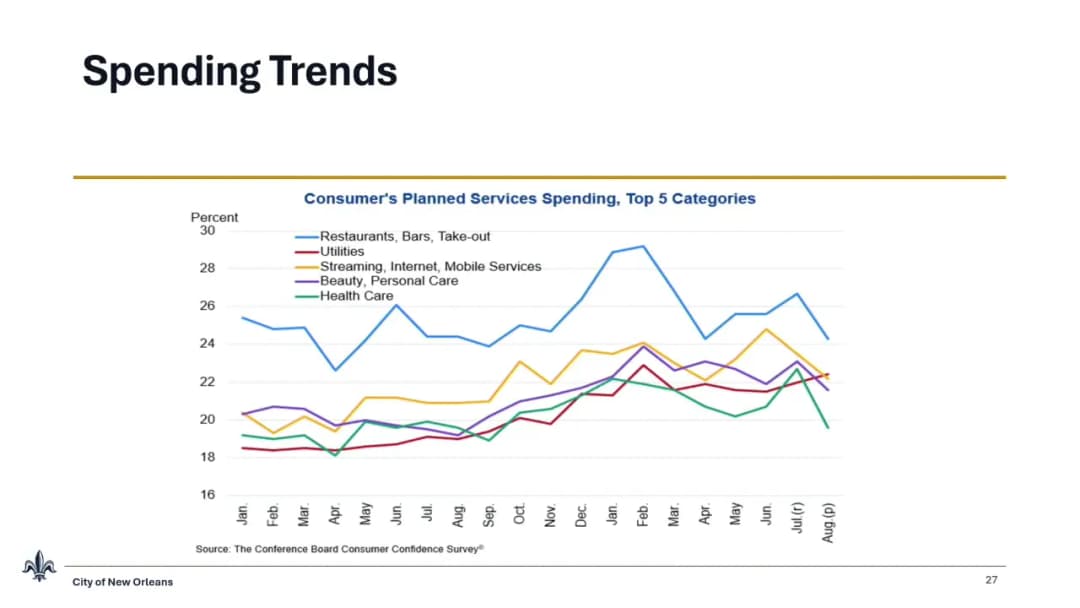
The Revenue Estimating Conference met on Thursday, September 10, 2026. The written agenda scheduled the meeting for 9:30 a.m. in Council Chambers, but the raw transcript opens with the presiding official saying the meeting was starting just a little after 10:30 a.m. The conference adopted the amended official 2026 General Fund revenue forecast of $884 million and a preliminary 2027 General Fund revenue forecast of $768,249,094. Roll Call and Minutes - A quorum was established. Present: Mayor Helena Moreno; Council Member District B Lesli Harris; Council Member At-Large (non-voting representative) Jean-Paul “JP” Morrell; Chief Administrative Officer Joseph I. Giarrusso III; Director of Finance Alyssa W. Rambeau; and Mara Baumgarten Force, Director of the Schwartz Family Center for Experiential Business Learning at Tulane University. - The conference adopted the April 22, 2026, REC minutes by a 5-0 vote (motion by Lesli Harris, seconded by Mara Baumgarten Force). Discussion Items: 2026 General Fund Revenue Forecast - CAO Joseph I. Giarrusso III presented the revised 2026 forecast. He reported that the city had repaid the $125 million revenue anticipation note (RAN) while managing close to $975 million in obligations. Grant reimbursements recognized in prior years were not counted again as revenue, but the cash supported the RAN repayment. - Subtractions to the prior $828 million forecast included: removal of $2.9 million in GoMESA revenue recognized in April, because it should be reserved for capital funding; a reduction in parking enforcement revenue after the function moved to NOPD and while a new RFP is prepared; a $1.2 million reduction in state transit appropriation that was intended for RTA; a reduction in bond interest due to the spend-down of bond proceeds; and subtraction of $7.12 million in Caesars lease revenue for the half-year after the renegotiated lease closed in May. - Additions included: $8.6 million in state appropriation for short-term rental fees (double the prior year’s $4.3 million); $16 million interagency transfer from the Assessor’s office, already received; $20 million in Sewerage & Water Board reimbursements (about $10 million received, with another $3.4 million being processed); reclassification of eligible ARPA projects to bonds, freeing roughly $36.5 million; and a conservative $2 million sanitation fee increase, though full October-December collections were estimated at just over $3.3 million. - The net change was +$56.18 million, making the revised 2026 forecast $884 million. The CAO noted the budget began at $725 million and that the city had generated almost $160-170 million in additional dollars through difficult and strategic decisions. Discussion Items: 2027 Preliminary Revenue Forecast - Dr. Tony Weiss, a Tulane economics faculty member speaking as an independent contractor, presented his methodology: historical patterns and seasonality, year-to-date collections, stakeholder discussions, and national economic trends. - He cited the August national unemployment rate at 4.1%, local unemployment slightly above the national average and holding steady, construction sensitive to interest rates, an upcoming CPI release and Federal Open Market Committee meeting, personal consumption expenditures up 3.4%, and declining consumer sentiment since 2024-2025 as context. - He projected property taxes flat assuming no millage change or reassessment; general use sales taxes flat with about plus or minus 1.5% leeway; softening in tourism-related taxes; strong sports wagering revenue; and increases in licenses and permits partly from the Omni project, the two-lane Charity project, and the $8.6 million short-term rental appropriation. Service charges were projected up because of the new sanitation fee and expanded EMS collections; intergovernmental revenue was down almost entirely because of the loss of Harrah’s rent; fines and forfeits continued to decrease because red light and speed camera enforcement revenue is declining; and miscellaneous revenue was down slightly because of reduced bond interest. - He estimated recurring revenues of approximately $756.7 million, a 3% increase over projected 2026 ending revenues. - CAO Giarrusso noted that rating agencies had criticized the 2026 budget for relying nearly 20% on one-time revenue, while the 2027 forecast relies on only 1.5% one-time revenue, a shift toward structural balance. - Potential additional revenues discussed included a millage roll forward (about $10.16 million to direct General Fund revenues, $4.36 million from the police and fire millage, and about $28 million in other revenue, excluding outside agencies); a permit fee increase already introduced but requiring a 21-day lie-over with an estimated $1.8 million to the General Fund; and a short-term nightlife fee still being developed that could add $3-5 million. Key Outcomes - The conference adopted the amended official 2026 General Fund revenue forecast by a 5-0 vote (motion by Helena Moreno, seconded by Alyssa Rambeau). - It voted 5-0 to suspend the rules to add the 2027 Preliminary Revenue Forecast to the agenda (motion by Joseph Giarrusso, seconded by Helena Moreno), then voted 5-0 to add the item to the agenda. - It adopted the preliminary 2027 revenue forecast of $768,249,094 by a 5-0 vote (motion by Helena Moreno, seconded by Lesli Harris). This is roughly $40 million higher than the prior year’s projected revenue. - It adjourned by a 5-0 vote (motion by Joseph Giarrusso, seconded by Lesli Harris). - A next Revenue Estimating Conference meeting was announced for the morning of November 19, 2026, before the council meeting, to add any additional revenue.
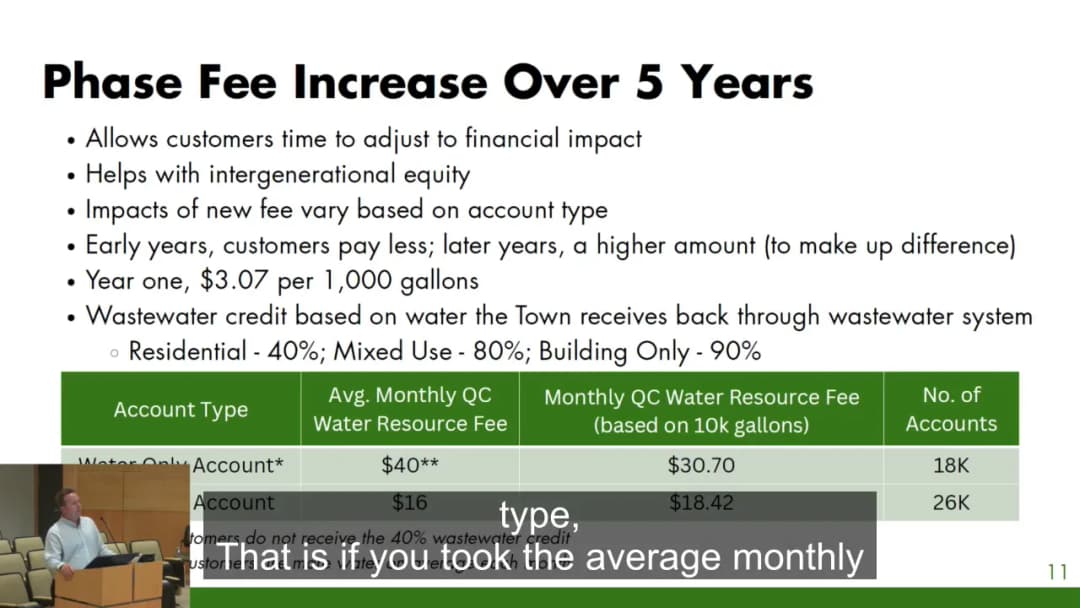
The Queen Creek Planning and Zoning Commission held a regular meeting followed by a work study session on September 10, 2026. The meeting covered consent calendar approvals, two public hearing items (a parking lot expansion and a residential rezoning), a final action on a sign package, administrative updates, and a detailed presentation on the town's water strategy and proposed water resource fee. The work study session focused on achieving water self-sufficiency and the financial mechanisms to support it. Consent Calendar - Approval of Minutes: The commission unanimously approved the minutes from the August 12, 2026, regular meeting. Public Comments - General Public Comments: No members of the public addressed the commission on non-agenda items. - Public Hearing for Item B (Summerwall Residences): - Brett Crosby (1916 East Macaw Drive, Queen Creek) expressed support for the rezoning, noting the site is a vacant dirt lot that should be developed. He acknowledged traffic concerns but stated residential use has less impact than commercial. He also advocated for the extension of Germann Road. - Joe Kolnick (18585 East Raven Drive, Queen Creek; owner of adjacent Coldstone Creamery) opposed the rezoning, citing the citizen-approved General Plan's commercial designation, previous council opposition, community needs for commercial amenities, and water demand concerns. He noted ongoing discussions about a potential grocery store for the site. Discussion Items - Item A – Carter Development Rezone (P26-0081) and Site Plan (P26-0082): A proposal to expand the parking lot for an existing office building on a narrow remnant parcel along Ellsworth Road. Staff presented a 7.72-acre site needing zoning and site plan approval. Applicant Chris Webb explained the need for additional parking (50 spaces, total 101) to accommodate medical office users. The parcel is too narrow for residential or standalone commercial use. Deviations requested for setbacks and buffers. One adjacent neighbor provided a letter of support. No public comments. The commission discussed the benefit of cleaning up a vacant lot and the developer's investment. Motion to approve carried unanimously. - Item B – Summerwall Residences Rezone (P26-0058) and Site Plan (P26-0059): A proposal to rezone a 16.8-acre site near Power Road and Germann Road from C2 commercial to medium density residential with a planned area development overlay. The applicant, represented by Brendan Ray of Graystar, proposed 150 for-rent units (102 single-family attached/detached, 48 duplexes) with gated access, private yards, and over 40% open space. Staff reported 30 public comments: 27 opposed and 3 in support. The applicant highlighted challenges in developing the site commercially due to market conditions and deed restrictions from Home Depot. Traffic analysis showed residential development generates fewer trips than commercial. The commission discussed the quality of the design, the lack of viable commercial interest, and water demand. Public speakers expressed divided opinions. Motion to recommend approval passed unanimously. - Item C – LGES Comprehensive Sign Package (P26-0100): Request for a comprehensive sign plan for the LGES battery manufacturing facility at Ironwood and Pecos Roads. Three deviations from zoning code were requested: increased wall signage (total 1,910 sq ft vs. 150 sq ft allowed), one larger monument sign (96 sq ft vs. 48 sq ft), and 14 vehicle direction signs (up to 43 sq ft vs. 3 sq ft standard). Staff noted the building's size (1.4 million sq ft) justifies the signage, and no residential uses are nearby. The commission supported the proposal, noting the building's scale. Motion to approve carried unanimously. Work Study Session – Water Strategy & Proposed Water Resource Fee - Presentation: Assistant Town Manager Shay Jochum delivered a comprehensive overview of the town’s water strategy. Key points included: - Goal: Achieve water self-sufficiency to secure a reliable, locally controlled water supply. - The town has purchased 1.7 million acre-feet of water from the Harquahala Valley, at favorable prices, to serve as a long-term supply. - The town currently relies on the Central Arizona Groundwater Replenishment District (CAGRID) for replenishment and 100-year supply assurances. Achieving designated water provider status will eliminate CAGRID involvement and give the town local control. - A proposed Water Resource Fee would fund acquired water assets, infrastructure to transport Harquahala water (via CAP canal), and future replacement water purchases. The fee would be phased in over six years, with credits for combined water/sewer accounts (who return effluent). Example: Year one fee for average combined account: $16/month; water-only account: $40/month. After accounting for CAGRID elimination, net increases could be minimal. - Capacity fees (impact fees) would be updated to ensure new growth pays its share for water. - Other proposed fee adjustments include tiered water rates, wastewater fee changes (non-residential/multifamily), and a solid waste fee increase of $3.78/month. - Timeline: Council to consider notice of intent on September 16, 2026; public comment period through November 18, 2026; fees could be effective January 2027, appearing on March bills. - Extensive community outreach planned (open houses, workshops, online calculator) to explain impacts. - Commission Questions: Commissioners inquired about differences between water-only and combined accounts, the rationale for moving fees from property taxes to utility bills (to cover customers outside town boundaries), and the impact on large users like HOAs and schools. Staff emphasized the phasing gives large users time to adjust water use. Key Outcomes - Consent Calendar: Motion to approve minutes passed unanimously. - Item A (Carter Development): Motion to approve P26-0081 and P26-0082 passed unanimously. - Item B (Summerwall Residences): Motion to recommend approval of P26-0058 and P26-0059 passed unanimously. The recommendation will go to Town Council for final decision. - Item C (LGES Sign Package): Motion to approve P26-0100 passed unanimously (final commission action). - Work Study Session: No formal vote; presentation was informational. Staff will continue public engagement; council consideration of fees will proceed on September 16, 2026.
The Families Task Force of the Westchester County Legislature convened on September 10, 2026, at 10:00 AM, to receive a presentation from New York State Office of Children and Family Services (OCFS) Commissioner Damia Harris-Madden, Ed.D., MBA, M.S. Commissioner Harris-Madden, a former director of the Westchester County Youth Bureau, provided updates on historic state investments in child care, child welfare reforms, juvenile justice, and family support initiatives. The meeting featured extensive dialogue on child care access, workforce challenges, insurance costs, federal funding uncertainty, and the need to streamline administrative processes. Public Comments & Testimony - A daycare director (Tiffany) expressed deep concern that increased CCAP funding is not translating into accessible slots, citing a waitlist of approximately 850 children in Westchester, with only 75 children being enrolled per month. She highlighted that parents must submit documentation three times through the process, creating a burden for working families. - The same director also raised a crisis in child care workforce salaries, noting that even with higher reimbursement rates, centers cannot afford to pay competitive wages. She urged the Governor to sign pending legislation for special child care worker funding. - Frank, representing fatherhood advocacy, praised the Commissioner for the Fatherhood Engagement Initiative, emphasizing the critical need for male involvement to break cycles of father absence and incarceration. He highlighted that many incarcerated men grew up without fathers. - Emily, from a community organization, expressed gratitude for teen mental health funding but cautioned that school-based mental health clinics are underutilized due to stigma. She advocated for embedding mental health supports in existing youth-friendly spaces like Boys & Girls Clubs and community centers. - A speaker (Laura) noted that the Boys & Girls Club of Northern Westchester has a groundbreaking community-wide mental health program that reduces stigma through a universal wellness approach. - An attendee (Kathy) echoed concern that universal pre-K expansion may undermine the financial sustainability of community-based child care providers, urging that pre-K be delivered within child care settings. - Legislator Eric Pierce participated in the discussion, asking whether the 30-day recertification window is a Westchester-specific requirement and suggesting a need for flexibility. Discussion Items - Child Care Assistance Program (CCAP) Investments: Commissioner Harris-Madden reported a historic $3 billion increase in child care funding (40% year-over-year for OCFS). Westchester County received $93 million in CCAT-based funding (a 43% increase) plus $14.3 million in supplemental funds. The number of children served via vouchers in Westchester grew 237% from 2021 to 2025, reaching nearly 5,000 children. Eligibility expanded to 85% of state median income (e.g., $117,165 for a family of four), and family copays are capped at $15 per week. - Universal Pre-K and Pilot Programs: The Governor allocated $563 million for universal 3K expansion. Three counties (including Dutchess) are piloting CCAP without income thresholds, starting in 2027. Commissioner acknowledged concerns about pre-K expansion undermining child care centers and emphasized parent choice. - Fatherhood Engagement Initiative: OCFS awarded seven $10,000 grants to grassroots fatherhood organizations, with a focus on supporting fathers in juvenile justice facilities and promoting father involvement. - Child Welfare Reforms: The anonymous reporting bill took effect June 2026; callers must now provide their information. Indications of child abuse/neglect are decreasing. The Governor expanded the Empire State Child Tax Credit and baby benefit. - Juvenile Justice: OCFS has reformed facilities, partnered with community colleges for education, and is addressing long-stay youth. Commissioner noted the importance of fatherhood for youth in custody. - Mental Health and After-School: $17.5 million for teen mental health first aid; 1,300 school-based mental health clinics (up from 872 in 2020). Positive youth development funding increased; Westchester has 62 programs and $6 million for LEAPS. - Insurance and Workforce Crisis: Multiple speakers described a crisis in liability insurance for child care providers, with premiums rising 20-40% and insurers dropping coverage. The Commissioner acknowledged the issue and suggested exploring a nonprofit insurance pool pilot. The workforce shortage is exacerbated by insurance costs and low salaries. - Federal Funding Uncertainty: In response to a question about potential federal cuts to the Child Care Development Fund (which provides 34% of CCAP funding), the Commissioner stated no contingency plan exists but the Governor has signaled strong support for child care. New York led a multi-state conversation on protecting child care funding. - Streamlining Access: DSS Director John explained that the waitlist was created only after carrying potential deficits; the county is now opening enrollments monthly. A facilitated enroller from the Child Care Council helps families. The group agreed to meet separately to discuss simplifying documentation and recertification requirements. Key Outcomes - Follow-up Meeting on Waitlist Process: John (DSS) and the Commissioner agreed to a dedicated meeting with child care providers to streamline the application and recertification process, including exploring a 90-day recertification window to reduce family burden. - Commitment to Address Insurance Crisis: The Commissioner committed to taking the insurance issue back to the Governor's office, noting ongoing discussions about nonprofit insurance pools and regulatory reforms. - Embedding Mental Health in Youth Spaces: The Commissioner agreed to consider allocating mental health dollars to community-based settings (e.g., Boys & Girls Clubs) to reduce stigma, referencing a positive youth development white paper. - Digital Equity Roundtable Invitation: An invitation for OCFS to participate in a September 28th state digital equity roundtable was accepted. - Recognition of County Staff: Commissioner Harris-Madden praised Westchester DSS and child care council staff, particularly Nora Yates and Laura Higgs, for their exceptional work. - No Formal Votes: The meeting was informational and did not include any formal resolutions or votes. It ended with thanks and an invitation for the Commissioner to return.