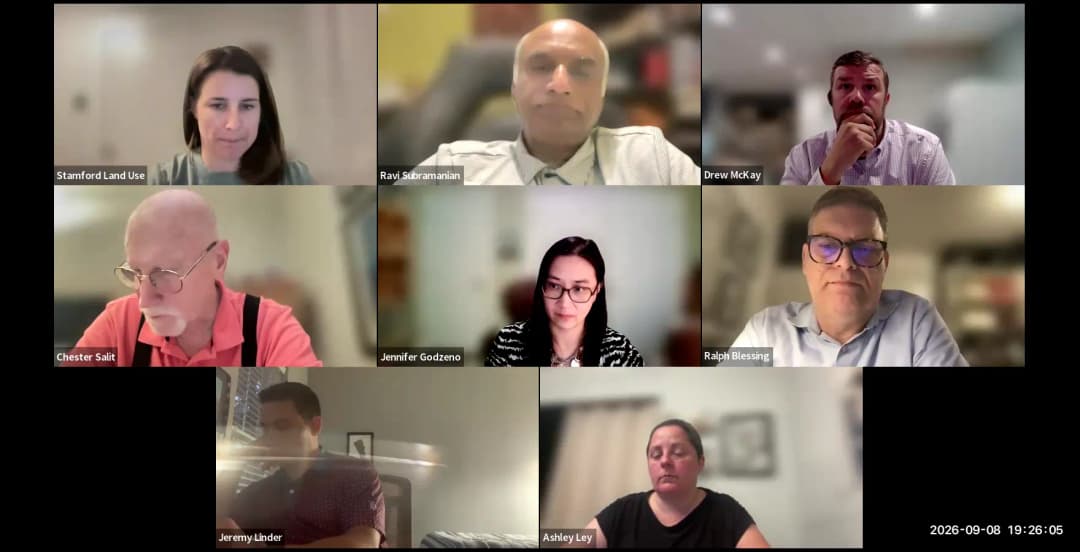
The Planning Board met to consider a lease agreement and capital appropriation for the Glenbrook Community Center, multiple capital project fund shifts, two park tennis court projects, and seven zoning text and map changes. All items were approved except one zoning text change that was tabled. Consent Calendar - Minutes of August 25, 2026: Approved unanimously. Discussion Items - Glenbrook Community Center Lease & Capital - The board authorized a 20-year lease (with two mutual 5-year extensions) with Domus, a nonprofit youth workforce development organization. Domus will pay $1/year rent and the city commits $50,000 annually for operating assistance. The city will invest $2.5 million in pre-possession capital improvements funded by $1.4 million in insurance proceeds, a $250,000 federal earmark, and $850,000 in city bonds. Domus must provide annual facility maintenance plans and can walk away if costs exceed projections. The board also approved the $2.5 million capital appropriation (Project CP4000076). - Capital Project Closeouts & Fund Shifts (Agenda Items 1–4) - Tony (Director of Administration) explained that four items shuffle ARP and bond funds with net zero impact: Street Patch & Resurfacing ($201,587 closeout; $213,066.99 reallocation), Lione Park ($150,190 closeout), Stillmeadow HVAC ($4,225.02 closeout), City-wide Drainage Study ($500 closeout), and District-wide Indoor Air Quality ($58,151.97 closeout; $51,397 reallocation). All approved. - Scalzi Park Tennis Courts - $200,000 from private contributions to complete reconstruction of ten 78-foot post-tension concrete tennis courts with blended lines, new fencing, and LED lighting. The project is substantially complete; this is a final closeout appropriation. Approved. - Cove Island Park Tennis Courts - $105,000 from private contributions for reconstruction of three 78-foot post-tension concrete tennis courts with blended lines, fencing, and an accessible path. The project has not yet started. Approved. - Zoning Board Referrals - ZB 226-14 (C-D District text change): Tabled to the next regular meeting pending revisions regarding senior housing. - ZB 226-15 (Corrections/Updates): Ralph Blessing presented numerous minor changes including adjusting BMR fee-in-lieu rates, adding public accessible amenity space (PAAS) requirements with free-of-charge bathrooms, and clarifying staff approval authority. Approved. - ZB 226-16 (C-N Neighborhood Commercial District regulations): Added design standards, sidewalk widths (10 ft standard, 15 ft on commercial streets), parking restrictions, and protections for abutting residential districts. Approved. - ZB 226-19 (Sign Regulations): Comprehensive update defining sign types, setting new illumination limits (off by 11 PM or close of business), prohibiting box signs, adding mural definitions, and relocating district-specific sign rules. Passed with two abstentions (Ravi and Jennifer) who expressed concerns about overregulation. - ZB 226-20 (M-L Light Industrial District regulations): Aligned structure with other districts, added setbacks and screening when abutting residential areas. Approved. - ZB 226-21 (Map Change – B-D to C-N): Rezoned the only B-D district (Newfield Green Shopping Center area) to C-N. Approved. - ZB 226-22 (Text Change – Delete B-D District): Companion to the map change; deleted the B-D zoning district from regulations. Approved. - New Business - Ravi requested a study of retail/restaurant supply relative to Stamford’s growing population. Ralph noted an existing economic development retail study and offered to share it; members suggested a future presentation to the board. Key Outcomes | Agenda Item | Vote | Notes | |-------------|------|-------| | Minutes Approval | Unanimous | – | | Glenbrook Lease Authorization | Approved (motion Chet, second Ashley) | – | | Glenbrook Capital Appropriation ($2.5M) | Approved (motion Ravi, second Jeremy) | – | | Capital Closeouts & Fund Shifts (Items 1–4) | Approved (separate votes, all unanimous) | Net zero budget impact | | Scalzi Park Tennis Courts ($200,000) | Approved (motion Chet, second Drew) | Private contributions, project nearly done | | Cove Island Park Tennis Courts ($105,000) | Approved (motion Chet, second Ravi) | Private contributions, project not started | | ZB 226-14 (C-D text) | Tabled (motion Drew, second Jeremy) | To next meeting | | ZB 226-15 (Corrections/Updates) | Approved (motion Ashley, second Ravi) | – | | ZB 226-16 (C-N regulations) | Approved (motion Ravi, second Drew) | – | | ZB 226-19 (Sign Regulations) | Approved (motion Chet, second Ashley) | Two abstentions (Ravi, Jennifer) | | ZB 226-20 (M-L regulations) | Approved (motion Drew, second Ravi) | – | | ZB 226-21 (Map change B-D to C-N) | Approved (motion Ravi, second Ashley) | – | | ZB 226-22 (Delete B-D district) | Approved (motion Chet, second Jeremy) | Companion to 226-21 | The meeting adjourned after noting upcoming meetings: September 22 (regular) and October 6, 13, 27 (capital budget).
The Public Meeting Index
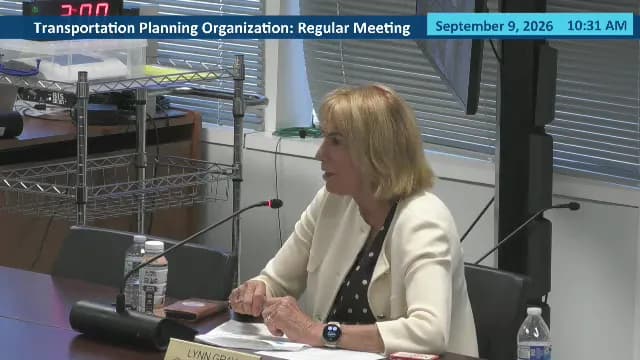
The Public Meeting IndexThe Hillsborough County Transportation Planning Organization (TPO) Board met Wednesday, September 9, 2026, at 10:00 a.m. at the Hillsborough County Center, 601 E. Kennedy Boulevard, Tampa, Florida. Vice Chair Joshua Wostal presided; Chair Andrew Ross and Mayor Nate Kilton were excused. The board approved the August 12, 2026 minutes, approved a consent agenda of committee appointments, approved the 2026 Roll Forward TIP Amendments by a 15-0 roll call vote, appointed Mayor Ross as Livable Roadways Committee Chair, received an FDOT District 7 safety outreach presentation, and canceled the November 4, 2026 regular board meeting. The clerk confirmed a quorum was present. Consent Calendar - Approved the TPO Board meeting minutes of August 12, 2026 (motion by Member Michael Stephens, seconded by Commissioner Gwen Myers). - Approved committee appointments to the Citizens Advisory Committee (CAC), Transportation Disadvantaged Coordinating Board (TDCB), Bicycle/Pedestrian Advisory Committee (BPAC), Technical Advisory Committee (TAC), Intelligent Transportation Systems (ITS) Committee, and Livable Roadways Committee (LRC) (motion by Commissioner Harry Cohen, seconded by School Board Member Lynn Gray). Appointees included: CAC — Julius Adewopo and Roderick Pugh (Citizens at Large); TDCB — Brenda Gregory (Children at Risk), Cassandra Blaylock (Economically Disadvantaged), Kristina Melling (Florida Department of Elder Affairs), Beth Pasek (Florida Department of Children and Family, with Steven Haglich as alternate), Artie Fryer (Citizen Advocate), Jennifer Waskovich (Local Medical Providers), and Deborah Lopez (alternate, Agency for Persons with Disabilities); BPAC — Daniel Rodriguez (HART) and Alexis Frazier (Hillsborough County); TAC — Dana Mackey (Hillsborough County); ITS — Julie Scanlon (alternate, Hillsborough County); LRC — Mary Sheets (Hillsborough County, with Mike Flick as alternate) and Meagan Winchester (Hillsborough County, with Lama Alfaseeh as alternate). Public Comments & Testimony - No members of the public signed up to speak during the meeting's public comment period. - Advance comments were read into the record by TPO staff. Maritza Estorkiza, chair of the Drew Park Community Advisory Committee, emailed requests regarding the Rays stadium development, focusing on protecting Drew Park tax dollars, safeguarding the community's residents and businesses, establishing a permanent community voice in the stadium development process, measuring impacts before commitments are made, and putting protections for Drew Park in writing. Staff noted the Drew Park CAC has not taken a formal position on the project. A comment received on X expressed support for building light rail. Committee Reports - Rick Fernandez, CAC Chair: The Citizens Advisory Committee met September 2, 2026, with a quorum, discussed the 2026 Roll Forward TIP Amendments — including Federal Transit Administration funding and Port Tampa Bay projects and dredging plans — and human trafficking and funding HART received previously. The CAC recommended the TPO Board approve the FY 2027–2031 TIP roll-forward amendments. Fernandez also publicly recognized TPO staff member Sarah Caper for voluntarily organizing the committee's long list of requested presentation topics. - Harmoni McGee, TPO Staff: The Technical Advisory Committee recommended TPO Board approval of the 2026 Roll Forward TIP Amendments. The TAC discussed HART's fleet composition (approximately 75% compressed natural gas, with a full transition anticipated by 2028) and how the proposed Gibson Drive/I-75 diverging diamond interchange design would account for the existing signal at Fernheld Drive immediately east of the interchange. Discussion Items 2026 Roll Forward TIP Amendments (Action Item A) — Harry Walsh, TPO staff, presented the annual administrative amendment that reconciles the first year of the FY 2027–2031 TIP, adopted June 10, 2026, with the FDOT Work Program effective October 1, 2026. The package contained 22 projects: 12 transit, 3 safety, 2 resurfacing, 2 seaport, 1 capacity, 1 signal (ITS), and 1 bridge planning. No new projects or new funds were introduced — all projects were previously scoped and awarded. The $254 million total included $157 million (62%) in transit, $77 million (30%) in seaport, $9.5 million (4%) in resurfacing, and the remaining 4% across capacity, planning, and safety projects. Notable items included HART's heavy maintenance facility and fleet transition from diesel to compressed natural gas, supported by a $32 million FTA low- or no-emissions grant — the largest grant of its kind in Florida, one of the largest nationally, and HART's largest federal award; only 25% of HART's fleet remains diesel, with full transition expected by 2028. Port Tampa Bay projects included the $22 million Omniport and the $55 million Hooker's Point expansion, supporting the port's Vision 2030 plan to add 50–60% capacity by 2030. The capacity project is a planned diverging diamond interchange at I-75 and Gibson Drive; $3.3 million is for environmental permitting related to the project's proximity to the river. The motion to approve was made by Commissioner Alan Clendenin, seconded by Commissioners Cohen and Myers, and carried by roll call vote, 15-0. Election of Livable Roadways Committee Chair for the Remainder of 2026 (Action Item B) — Councilmember Lynn Hurtak announced she was stepping down as LRC Chair due to health issues and her planned transition out of office, saying she has enjoyed leading the committee. TPO Attorney Cameron Clark explained that TPO Bylaws require the LRC Chair to be a TPO Board member and that the vacancy must be filled at the first regular meeting following the declaration. No member volunteered, so Commissioner Wostal — in jest, noting Mayor Ross was absent and could not defend himself — nominated Mayor Andrew Ross. The nomination was seconded, and the board approved the appointment by voice vote without opposition. Mayor Ross will serve as LRC Chair for the remainder of 2026, beginning at the committee's September 16, 2026 meeting. Safety Outreach in Motion (Status Report) — Brian Hunter, FDOT District 7 Modal Development Administrator, presented FDOT's approach to safety outreach, organized around the four E's: Engineering, Enforcement, Emergency Response, and Education. He described FDOT's Target Zero goal of eliminating fatalities and serious injuries. For 2025, FDOT District 7's cumulative outreach included 7,500 conversations, almost 30 trainings, nearly 60 community events, social media reaching over 200,000 people, traditional media reaching 350,000 people, and visits to 18 high schools with 110+ classes reaching 2,300 teen drivers. Programs highlighted included community traffic safety teams, child car seat installation education, bicycle helmet fitting, a car fit program for drivers, and round tables with local partners that serve as a feedback loop. Tina Russo, FDOT's Bicycle and Pedestrian Program Manager, leads the outreach team. In discussion, Councilmember Hurtak reported a near-crash at the northbound I-275 exit at Hillsborough Avenue during rush hour, where drivers treat a striped-off area as a travel lane, and asked for more enforcement or barricades. Hunter responded that FDOT conducted three days of enforcement yielding 50 educational contacts and added black striping to the first hash marks, and will follow up. School Board Member Gray asked about e-bike safety hazards; Hunter noted e-bike regulations are determined at the local level, e-bike-related crashes are increasing, and e-bike safety is now part of FDOT's school and community outreach. Vice Chair Wostal praised FDOT's responsiveness, citing an instance where FDOT contacted a resident within about 45 minutes of his comment to the TPO Board about a sound wall concern. Executive Director's Report — Dr. Johnny Wong reported that the next TPO Board meeting will be held October 14, 2026, and the Transportation Management Area (TMA) meeting will be held October 2, 2026, at PSTA to discuss merger draft deliverables. He gave one legislative update: on September 2, 2026, the federal transportation authorization was extended again, through December 11, 2026. He asked the board to consider canceling the November 4, 2026 regular TPO Board meeting (the day after the election), noting FDOT confirmed no urgent action items are expected that month. The board approved the cancellation by voice vote (motion by Councilmember Hurtak, seconded by Commissioner Boles). New Business: Stadium District Planning — Commissioner Wostal raised new business on a stadium district planning effort, referencing advance comments from Maritza Estorkiza of the Drew Park Community Advisory Committee and correspondence received by Councilman Bill Carlson. Wostal expressed support for the TPO participating as a partner in a larger study rather than leading it, noting the Planning Commission seems particularly well positioned because the concerns involve transportation as well as land use, parking, and other topics outside the MPO's scope. Executive Director Wong responded that the study was not envisioned in the current Unified Planning Work Program; planning funds have been held back in case of such a need; community engagement is needed to determine the scale and scope of the transportation impacts around the stadium district; and a regional study covering game-day travel from Pinellas and Pasco counties could escalate costs considerably. Wostal asked Wong to set up meetings with interested commissioners and council members, noting the County Commission and City Council might be able to help with funding once the scope is defined. Wong agreed to schedule those meetings. Key Outcomes - Approved the August 12, 2026 TPO Board meeting minutes. - Approved all consent agenda committee appointments. - Approved the 2026 Roll Forward TIP Amendments by roll call vote, 15-0. - Appointed Mayor Andrew Ross as Livable Roadways Committee Chair for the remainder of 2026. - Canceled the November 4, 2026 TPO Board regular meeting. - Directed Executive Director Wong to schedule stakeholder meetings on a potential stadium district planning study.
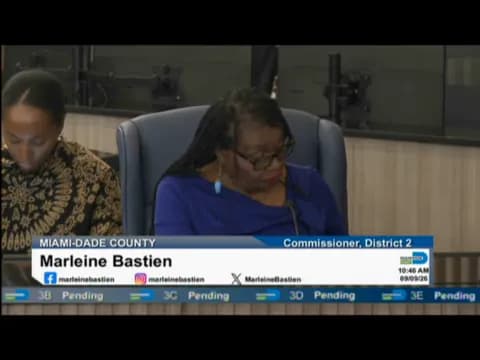
The Recreation, Tourism, and Resiliency Committee met on September 9, 2026, with Vice Chairwoman Steinberg presiding. Commissioners Bastian, McGee, and Regalado were present, forming a quorum. Commissioner Garcia was absent. After a moment of silence and the Pledge of Allegiance, the committee set the agenda with several add-ons and a deferral request. The meeting included a public hearing on a proposed ordinance and discussion of several items. Agenda Setting - The agenda was set with six add-ons and supplements. Item 1G1 and its supplement were deferred to the October 14 committee meeting at the sponsor's request. Public Comments - No members of the public spoke during the reasonable opportunity to be heard. Two individuals (Aaron Cover and Amanda Prieto) had signed up to speak on deferred item 1G1; they were informed they would have a full opportunity at the October meeting. Discussion Items - Item 1G1 (Deferred): Commissioner Regalado expressed concerns about the proposed process, suggesting it could limit transparency and create a "slippery slope." The sponsor responded by noting that a variance through the Environmental Quality Control Board (EQCB) might be a better approach and emphasized the need for public records on water quality. The committee agreed to hold a sunshine meeting to further discuss options before the October hearing. - Item 1G2: Ordinance Creating the Miami-Dade County Voter Safety and Bay Education Advisory Board: The committee held a public hearing. James Merley, designee of the Mayor on the Miami River Commission, spoke in support, asking that the board include a representative from the Miami River. Commissioner Regalado questioned the cost, lack of financial participation from other municipalities, and the absence of a sunset provision. He suggested exploring a fee structure tied to boater permits. Commissioner Bastian supported the item and requested to be listed as a co-sponsor. The committee voted unanimously to approve. - Item 2B (Sponsorship by Commissioner Regalado): Commissioner Regalado recommended amending the item to also include Miami-Dade County Public Schools and to prioritize in-kind partnerships before spending Animal Services funds. The maker’s representative stated they believed existing resources could cover the proposal. Consent Calendar - Item 1G3: An ordinance on another matter was moved and passed unanimously without discussion. - Balance of the Agenda: The remaining items (including items 3A and 3C sponsored by Commissioner Regalado) were moved and passed by acclamation. Key Outcomes - Item 1G1: Deferred to the October 14, 2026 committee meeting; a sunshine meeting will be scheduled beforehand. - Items 1G2 and 1G3: Both ordinances passed unanimously. - Remaining Items: Approved as a block. - Co-sponsorships: Commissioner Bastian added as co-sponsor on 1G2; Commissioner Regalado took sponsorship of 3A and 3C.
The Industrial Development Board (IDB) of Chattanooga, Tennessee, held its September meeting on September 9, 2026, to consider several economic development initiatives, including a new commercial corridor revitalization grant program, a TIF bond refinancing, a small business incentive grant, and the creation of a registered apprenticeship employer incentive fund. All resolutions were approved, with one board member expressing intent to abstain on the apprenticeship fund. Consent Calendar - The board approved the minutes from the previous meeting via a motion, second, and unanimous voice vote. Discussion Items - Commercial Corridor Revitalization Grant Program: Winston Brooks, Director of Economic Development and Entrepreneurship, presented the program, which targets commercial corridors outside downtown. The program is funded by $1.3 million authorized by the city council and transferred to the IDB. The four grant tiers are: signage and security cameras (up to $5,000), facade improvements (up to $10,000), storefront activation for vacant spaces (up to $25,000 using a $10/sq. ft. formula), and business retention for legacy merchants (up to $50,000 using a $15/sq. ft. formula). Eligible corridors include MLK, Rossville Boulevard, Brainerd Road, Class Street, 38th Street, Highway 58, Hicks and Pike, and others. The program will be administered by the Chattanooga Area Regional Council of Governments (also known as SET D) for a fixed fee of $27,000 per year for two years, with a two-year renewal option. Funds go to property owners or contractors, not tenants. The board approved the resolution after questions about eligibility of tax-exempt properties (e.g., those with PILOTs) and matching funds. The program is a 100% grant with 50% upfront for larger tiers. Marketing includes direct mail to property owners. - North River Commerce Center TIF Refinancing: Bond counsel presented a resolution authorizing the issuance of tax increment revenue bonds to refinance existing indebtedness for the North River Commerce Center Industrial Park. The developer, RISE (Matt Phillips), fronted money under a TIF, and the outstanding note is approximately $3.1 million. The refinancing will lock in a lower fixed interest rate, saving the city and county money. No new money is involved. The board approved the resolution unanimously. - Small Business Incentive Grant to Hagler & Associates (Hagler Process): Winston Brooks and Emily Porter from SET D presented the recommendation for a $10,000 grant under the Growing Small Business Incentive program. Hagler Process, a family-owned industrial pump repair and sales company, has added 7 new high-paying jobs (engineering and technical) in the last 18 months, with pay ranging from $50,000 to $85,000. The company is located near Riverside and serves municipalities, defense, and TVA. The grant will support training. The board approved the resolution. - Registered Apprenticeship Employer Incentive Fund: Andrew Hudson, Director of Workforce Development Strategy, proposed repurposing $185,000 from the R13 Tech Workforce fund and $148,000 from the R18 Innovation fund (total $333,000) to create a new fund to incentivize employers to hire registered apprentices. The incentive is $50,000 per employer for hiring four registered apprentices in a four-quarter period, with at least half (or four if fewer than eight) being city residents. The funds are paid 50% upfront and 50% upon completion of the fourth apprentice. The program is open to employers of all sizes and sectors, including youth 18 and older. The board discussed the program's strategic fit, with one member (who identified as having raised concerns about overall strategy) expressing intent to abstain but not formally objecting. The resolution passed on a voice vote with no opposition. - Ratification of Notice of Designation for North River Access Road: The board ratified the chair's prior signing of a notice of designation for allocation periods related to the North River Access Road, which is necessary to release TIF funds for the North River Commerce Center refinancing. The motion was approved. - Update on VW Lawsuits: The board was informed that two lawsuits involving Volkswagen have been filed, and the IDB is named as a defendant due to its title ownership of the property and PILOT agreements. Outside counsel is handling the cases, and the board expects resolution soon. Key Outcomes - Approved: Minutes from previous meeting. - Approved: Resolution establishing the Commercial Corridor Revitalization Grant Program and the $27,000/year administrative agreement with SET D (CROG). - Approved: Resolution authorizing the issuance of TIF revenue bonds for refinancing the North River Commerce Center. - Approved: Resolution awarding a $10,000 Growing Small Business Incentive grant to Hagler & Associates. - Approved: Resolution to transfer $333,000 from existing funds to create the Registered Apprenticeship Employer Incentive Fund (one member expressed intent to abstain but did not formally vote against). - Approved: Ratification of notice of designation for North River Access Road allocation periods.
No agenda, minutes, or transcript were provided for this meeting date. Therefore, no substantive summary of discussions, decisions, or public testimony can be generated. This placeholder summary reflects the absence of source material.
Note: The agenda and minutes list the meeting date as September 8, 2026, but the user-provided timestamp is September 9, 2026. This summary uses the user-provided date. The La Crosse City Council and County Board of Supervisors held a joint planning meeting to receive an update on the Pathways Home five-year plan to end homelessness. Homeless Services Coordinator Brian Sampson and Homelessness Response System Project Manager Jim Drees presented data on unsheltered homelessness in downtown La Crosse, a coordinated outreach campaign, progress on housing and supportive services, and persistent gaps for individuals with intensive needs. No formal votes or decisions were taken; the session was informational and included questions from council and board members. Public Comments & Testimony - Community member asked about the use of donations for the Pathways Held Lease program, specifically how much goes to administrative costs versus direct housing support, and whether tenants receive ongoing guidance. Brian Sampson responded that no city or county funds are taken for administration; the money covers rent, utilities, security deposits, and renter's insurance, with a small fee for a tenant manager. Tenants must work with a service provider throughout the lease term, which starts month-to-month and may extend. Discussion Items - Pathways Home Overview: Sampson and Drees reviewed the plan launched in January 2024, now at its midpoint. The city focuses on adding housing stock at all income levels; the county emphasizes supportive services (mental health, addiction, job training). The goal is functional zero – homelessness that is rare, brief, and non-reoccurring. - Unsheltered Homelessness in Downtown: The presenters distinguished between the overall homeless population and the unsheltered subset concentrated downtown. 55% of downtown unsheltered individuals have intensive needs (serious mental illness, substance use disorders), compared to only 15–20% of the remaining homeless population. These individuals have longer histories of homelessness and higher interactions with emergency rooms and the justice system. - Coordinated Campaign (Targeted Outreach): After a temporary surge shelter proved infeasible (zoning, fire code, funding), the team pivoted to a targeted outreach campaign. Police and parks identified 80 individuals causing significant concern. Of those: 40+ received shelter bed offers (6 accepted and stayed, 12 accepted then left, 20 declined, 10 banned); 20 received treatment-to-housing package offers (4 accepted, 20% started then left, 60% declined). Nine of the 80 have been housed. Outreach occurs daily, and offers are repeated to build trust. - Service Needs Assessment: Using a Pathways Adult Need and Strength Analysis, 1% of the homeless population requires 24/7 care; 30% have intensive needs (daily support); 33% moderate (weekly); 35% light (monthly); 1% none. Only 10% of housing placements have gone to intensive-need individuals, leaving a significant gap. 60 intensive housing units are still needed. Moderate need is 70 units short; light need is down from 103 to 80 units, with many market-rate units coming online. - Housing and Funding Initiatives: - The Collective on Fourth: 12 set-aside units for lighter-need individuals; 11 of 12 leases renewed after one year. - Parkland Studios (Hillview campus): 10 units for moderate-need individuals, with on-site peer and social worker support; early data show housing stability increases income. - Pathways Held Leases: funded by Mayo, the city signs five leases with private landlords and subleases to individuals with lighter needs. Two move-ins occurred in the prior two weeks; the third was scheduled for the next day; all five units expected to be occupied within a week. Tenants pay 30% of income; the city covers the rest. Goal is to build positive rental history. - Homes for 100 Fund: a community-driven rent support fund launched with the La Crosse Area Community Foundation to expand the held lease model. - Grants: $350,000 Wisconsin DOJ deflection grant to divert individuals from jail to housing and treatment; City HOME-ARP funds for a dedicated social worker for five high-need individuals; RISE opioid response funding for a jail re-entry coordinator and jail therapist. - Data on Homelessness Trends: Overall homelessness count dropped from a peak of 295 to about 200. The community is housing more people than becoming homeless (net negative inflow of 5 per month, slightly below the target of 6). Macro factors (rising evictions, housing affordability) create headwinds. 83% of homeless individuals last had housing in La Crosse, according to system data; balance-of-state data shows more people move out of the La Crosse coalition area than into it. - Q&A Highlights: - Councilmember Lisa Weston asked about non-local individuals transported to La Crosse. Sampson reported 83% last had housing locally; the balance-of-state data shows net out-migration. No pattern of systematic transportation was identified. - County Supervisor David Pierce asked about overlap between jail re-entry and intensive needs. Drees said the team will track intensive individuals broken down by substance use, mental health, co-occurring, and monitor progress through treatment packages and placements. - County Supervisor Peg Aisola asked why the temporary surge shelter was not pursued. Drees cited site, zoning, agency support, and funding roadblocks; adding shelter beds remains a need. - Councilmember Aron Newberry asked about state-level advocacy. Sampson and Drees recommended advocating for increased funding for homelessness prevention, flexible rent support, public housing expansion, and Section 8 vouchers. Prevention is more cost-effective than response. - County Supervisor Beth Pigash asked who is missing from the table. Sampson said private investors and businesses; Drees mentioned better coordination for moving individuals between levels of care and continued learning from other counties. - County Supervisor Randy Erickson asked about boarding houses. Sampson noted shared living models are being explored, but could not speak to boarding houses specifically. - Councilmember Chris Kahlow asked about engaging faith communities. Drees reported a monthly meeting with faith leaders, a “Baskets of Belonging” program for move-in supplies, and discussions with churches about becoming supportive landlords. He requested more information about a faith-based success story. - Councilmember Crystal Bedford raised concerns about faith-based requirements (e.g., church attendance) creating barriers. Sampson affirmed that services are voluntary and the goal is a menu of options. - Councilmember Lisa Weston asked about a geographic heat map of unsheltered locations. Sampson said locations change frequently; outreach teams adapt daily. - A question about shower services: Sampson noted Catholic Charities offers shower and laundry services a few times per week. Key Outcomes - No formal votes or motions were made. The meeting was informational. - Presenters and council members acknowledged the persistent challenge of housing individuals with intensive needs; the team will continue targeted outreach, treatment packages, and pilot projects (e.g., scattered-site daily support units). - Council President Tamra Dickinson encouraged attendees to consider contributing to the Homes for 100 fund. - The next joint meeting is expected to be hosted at the county facility, date to be determined.
The Crestwood Board of Aldermen met on September 9, 2026, at 7:00 PM in the Aldermanic Chambers. The meeting covered routine consent agenda items, reports from aldermen, and a significant discussion on traffic calming measures on Liggett Avenue. Key decisions included approval of consent agenda items and passage of a resolution amending traffic calming measures. Consent Calendar - Approval of the August 25, 2026 Board of Aldermen Regular Meeting Minutes. - Reappointments and appointments to the Crestwood Point Community Improvement District: Kyle Bumberry, Scott Shipley, Robert Jakjbeck, and David Weidler. - Reappointments and appointments to the Crestwood Square Community Improvement District: William Appelbaum, Sara Fleming, and David Weidler. - Reappointments and appointments to the Watson Plaza Community Improvement District: David Weidler, Mayor Scott Shipley, Sara Fleming. - Resolution approving findings of fact and conclusions of law for JK Spa LLC conditional use permit for a massage establishment at 9919 Watson Road. - Ordinance approving cooperative agreement with the DEA for Task Force Officer Program. All consent items were approved unanimously by an 8-0 roll call vote. Public Comments & Testimony No public comments were made. Discussion Items - Traffic Calming Measures on Liggett Avenue (Item removed from consent agenda by Alderman Zavas and Alderman Maybe): - Alderman Zavas questioned the necessity of additional measures, noting that the 85th percentile speed had already been reduced from 31 mph to 28 mph based on data from August (non-school month) versus original data from April/May (school session). He suggested declaring victory and not spending more money. - Chief Williams responded that maximum speeds had dropped significantly: from 66 mph (with no measures) to 44 mph with the current measure at Gravinia. He believed additional traffic islands would further reduce speeds and excessive speed (only 9% over 30 mph currently). - Alderman Now read an email from a resident, Amanda Bejornsson, in favor of continuing the full traffic calming plan. - Alderman Maybe discussed cost estimates: the original plan with mini-roundabouts and protected crosswalks was estimated at $95,837.50 by CMT, but staff now believes it could cost double due to ADA compliance, retaining walls, and right-of-way acquisition. A mini-roundabout at Grovinia alone could cost a couple hundred thousand dollars. - Concern about crosswalk proximity to traffic islands was raised. Chief Williams noted 18 feet of clearance and zero incidents after months of use. - Alderman Maybe proposed an amendment to the resolution to add language: "The Board of Aldermen amends Resolution 2601 to allow traffic islands on Liggett Avenue as opposed to traffic circles and thereby eliminate the need to move crosswalks." The amendment was seconded and passed by voice vote. - Alderman Morrison expressed concerns about repeatability and lack of federal guidelines but praised staff's resourcefulness. He requested notification of any incidents. Staff confirmed a six-month review policy. - Reports and Comments: - Aldermen provided updates: Ridgewood overlay district ordinance language coming forward; survey to be distributed; Beautify Crestwood participation; Sappington House progress (logs up, lumber, stone for fireplaces, fundraising event Ronde Palooza on September 25-26). - Planning and Zoning Commission discussed comprehensive plan update: chose a partial update (not total rewrite) costing an estimated $40,000-$50,000 for consultant over 12-18 months. - Mayor announced upcoming recycling events: paint recycling on September 26, electronics recycling on October 3, both 9 a.m. to noon. - Future Issues: - Alderman Maybe raised concern about proliferation of illegal signs (roofers, power washers, etc.) in right-of-way. He requested increased enforcement and use of penalties for repeat violators. Key Outcomes - Consent Agenda: Approved (8-0). - Resolution on Traffic Calming Measures for Liggett Avenue (as amended): Approved by roll call vote of 7-1. Alderman Zavas voted no. - Closed Session: The board voted unanimously (8-0) to adjourn to closed session to discuss legal matters (Missouri Revised Statute 610.021(1) and (12)).
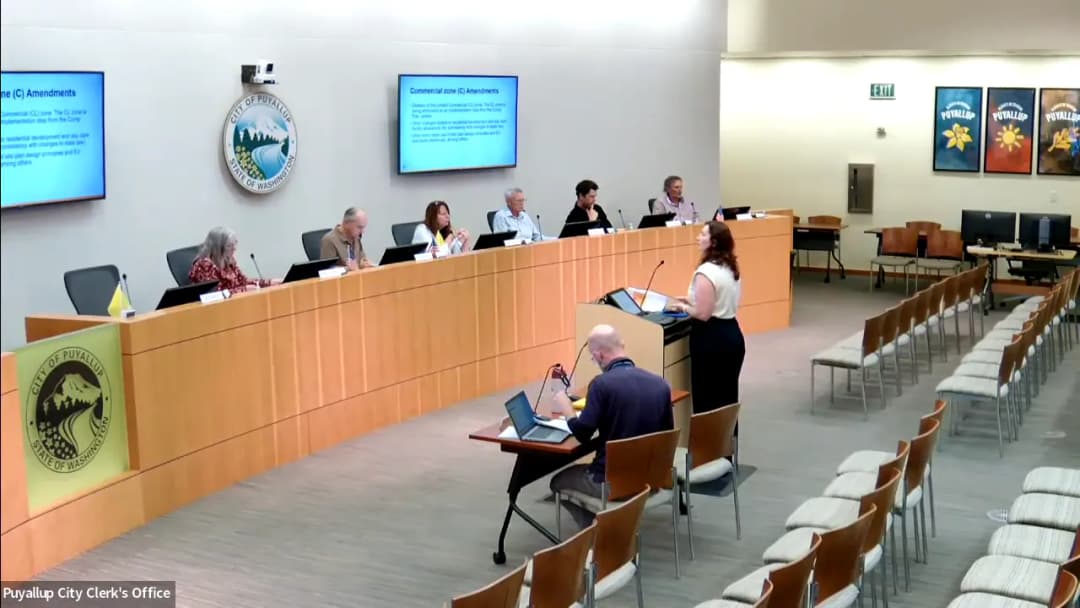
The Puyallup Planning Commission met on September 9, 2026, at 6:30 PM in Council Chambers to continue work on Phase 2 of the zoning amendments implementing the 2025 Comprehensive Plan. All six commissioners were present (Commissioner Greg Martin excused). The meeting adjourned at 7:30 PM. The session focused on zoning map changes, code amendments, and future land use map updates, with extensive discussion on neighborhood commercial designations, the River Road corridor, and infrastructure needs. Consent Calendar - Agenda approved by motion (Crosby/Barney), passed 6-0. - Minutes of August 12, 2026 approved by motion (De Groot/Landon), passed 6-0. Public Comments & Testimony - No public comments were offered in person, online, or submitted in writing. Discussion Items - Phase 2 Zoning Map Amendments (Package 6 of DPS Work Plan): Associate Planner Rachael Brown presented proposed rezones to implement the Comprehensive Plan, including rezoning areas to Limited Mixed Use (LMX), adjusting the Shaw Pioneer area, rezoning the South Hill Business and Technology Park, eliminating CL and OP zones, rezoning Western Washington Fair parcels, and adjusting the fair parking overlay. New changes since July 8 included rezoning three existing neighborhood businesses to LMX, rezoning several parcels along 3rd/2nd Street SE to single-family RS6 instead of LMX, and rezoning two utility parcels to Public Facility instead of UCX. Commissioners questioned the RS6 designation for downtown-adjacent parcels; Planning Manager Chris Beale noted lack of development interest and lot constraints (lots 4,900–5,000 sq ft) favored LDR over LMX to avoid non-conforming status for existing homes. - Phase 2 Zoning Code Amendments – Chapters 20.31 (MX), 20.35 (M), 20.30 (C), and 20.15 (Definitions): Brown presented amendments to update use allowances, simplify development standards, and align with state law. Key changes included: retooling LMX as a neighborhood commercial zone, allowing car dealerships in River Road MX zone per council direction, eliminating CMX zone, updating manufacturing uses (including warehousing at property owner request), adding fencing standards, and new definitions (live-work units, nightclubs, vape shops, etc.). Commissioner Landon expressed concern about warehouse and distribution uses in the Business Park (MP) zone, noting truck traffic and paved surfaces; Vice-Chair De Groot and Chair Taylor also echoed unease. Commissioner Landon proposed limiting data center square footage to match existing uses—staff clarified data centers were not part of the current proposal after earlier council discussion. Discussion also covered density maximums in UCX: Brown and Beale explained that parking requirements and lot coverage (65%) effectively cap density despite maximum height of 75 feet. Commissioner De Groot questioned the removal of height bonuses for structured parking; staff confirmed the bonus was being deleted to simplify height allowances in UCX and RMX. - Phase 2 Future Land Use Map Amendments, Land Use Element Text, and River Road Corridor Plan Text: Brown outlined three major changes: creating a new Mixed Employment Business Park (ME-BP) designation for the South Hill site; reverting a parcel at 15th & Meridian from MUC to CG per owner preference; and harmonizing FLU maps to match LMX rezonings. Text amendments included referencing the River Road corridor as an “important auto dealership corridor” per council direction. Commissioners expressed mixed views: Chair Taylor strongly opposed highlighting dealerships at a main city entry, while Commissioner Washburn recalled the area’s historic car-buying reputation. Vice-Chair De Groot suggested differentiating Meridian from River Road to focus dealerships on the latter. Beale clarified the amendments aim to align existing regulations with council decisions without discarding the mixed-use vision. No boundary changes were proposed. Key Outcomes - Votes & Decisions: No formal votes were taken on the amendments; the worksession was for discussion and direction. Staff will incorporate commissioner feedback (particularly on warehouse allowances and data center limits) into the September 23 package. - Schedule & Next Steps: The next Planning Commission meeting is September 23, 2026 for final review of all amendments. A public hearing is set for October 28, 2026, at which the Commission will forward a recommendation to City Council for final adoption in November and December 2026. Council has only one meeting in December, making the timeline tight. - Public Outreach Update: Staff sent rezone notification letters to 97 parcels (covering all subject properties) with a table showing current and proposed zoning. Only 3–4 property owners called, and feedback was largely positive. A second outreach phase will mail informational flyers to properties within 500 feet of LMX rezone sites, including a survey. A broader mailing and neighborhood signs with QR codes will precede the October 28 hearing. - Commissioner Comments: Commissioner Crosby inquired about a transportation infrastructure presentation from City Engineer Hans Hunger; Beale confirmed it will occur after the zoning amendments are completed. Vice-Chair De Groot urged prioritizing transportation improvements on the east side of Meridian, especially Shaw Road, noting no alternative routes exist. Chair Taylor announced community events: Meeker Mansion Cider Squeeze (September 19) and Dolly Day by the Main Street Association (September 25).
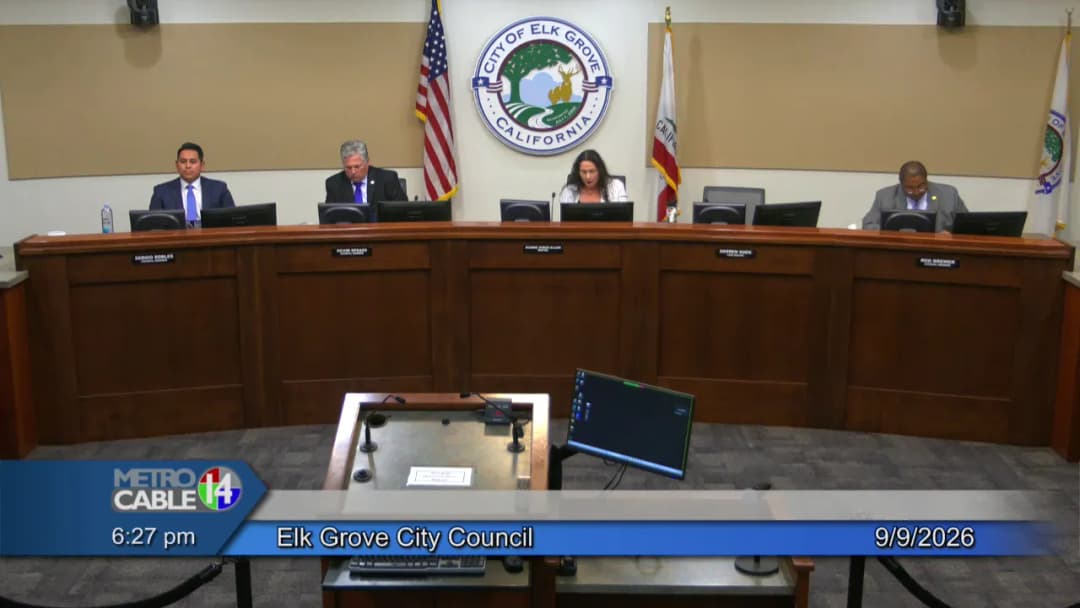
The Elk Grove City Council held a special meeting on Wednesday, September 9, 2026, at 5:00 p.m. The meeting included a closed session for real property negotiations and legal matters, followed by an open session reconvening at approximately 6:28 p.m. The council reported one action from closed session and then adjourned. Closed Session Actions - The council convened closed session to discuss items listed on the agenda: (A) Conference with Real Property Negotiators regarding a portion of 8675 Kammerer Road (APN 132-0320-010) with Wilton Rancheria; (B) Conference with Legal Counsel – Anticipated Litigation (one matter); and (C) Conference with Legal Counsel – Existing Litigation (two matters: Ahmad Nassar v. Colby Hanna, et al., Case No. 2:25-cv-03326 DJC CKD, and Kubra Bahadury, et al., v. City of Elk Grove, et al., Case No. 23CV011156). Key Outcomes - By a unanimous vote of 5-0, the council authorized and directed the City Attorney's office to defend the case of Nassar v. Hanna (and all related matters as identified by the case number on the agenda). - The special meeting was adjourned at 6:28 p.m.
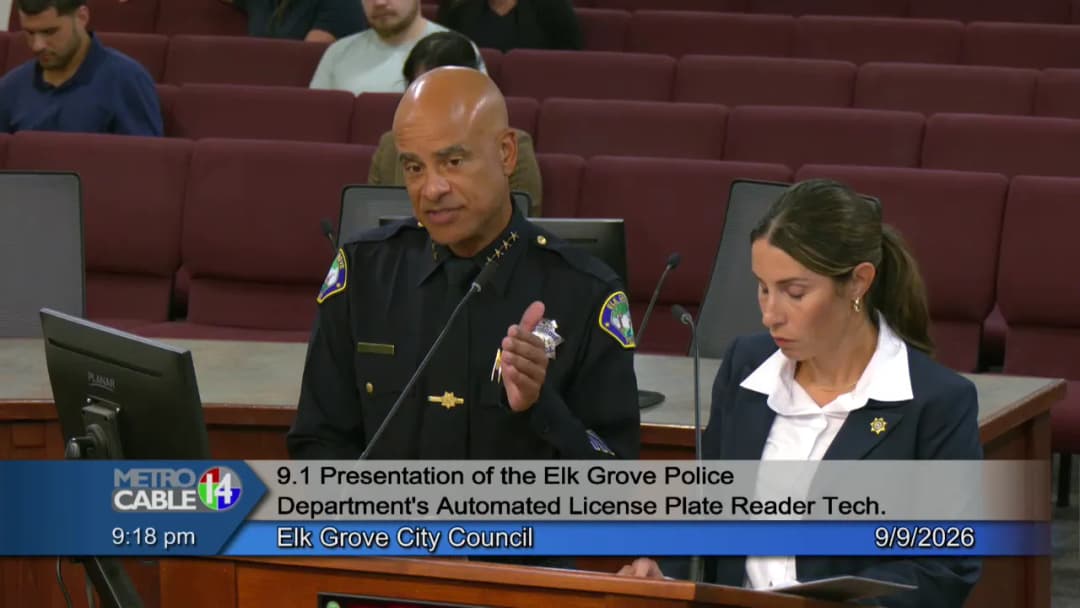
The Elk Grove City Council held a regular meeting on Wednesday, September 9, 2026, beginning at 6:29 p.m. after a brief closed session (not listed on the agenda). The meeting included a presentation on Automated License Plate Reader (ALPR) technology, extensive public comment on the topic and on rural preservation, and routine consent calendar approvals. Consent Calendar - Approved 5-0: Minutes of August 26, 2026; City Manager purchases report; RFP report; Monthly Investment Report; Ordinance No. 08-2026 imposing a two-year moratorium on new Personal Storage Facility entitlements (second reading); resolution for a Historic Preservation Fund Grant ($10,500); resolution to amend contract with Changing Environments, Inc. (adding up to $286,200); resolution authorizing City Manager to execute contracts for citywide technology services. Public Comments & Testimony - Non‑agenda public comment (prior to ALPR item): - Multiple residents spoke in opposition to ALPRs, citing privacy concerns, state law violations, and Flock’s track record. Speakers included Lindsay Halsell (DFLOC Elk Grove), Sappy, and others. They called for an independent audit and town hall. - Several residents spoke in favor of preserving rural Elk Grove, opposing the Summer Villas development. Speakers (Constance Conley, Eileen Conwell, George Murphy, Carlos Zamaripa, Amelia Van Carrea) presented a “Rural Roots” booklet and urged the Council to uphold the General Plan. - Public comment on Item 9.1 (ALPR presentation): - In‑person speakers: Many opposed continued use of Flock/ALPRs, including Lindsay Halsell (reiterated concerns about data retention discrepancies and Flock’s business practices), Ellen (cited 8.3 million outside searches, requested an end to the contract), Sophia Singh, Justin Gee, Allison Randall (questioned effectiveness), and others. Some speakers noted they want crimes solved but oppose mass surveillance. A Parkgate neighborhood watch coordinator (Ricky Paul) expressed support for privately funded ALPRs in his community. - Online speakers: Dan, Brian Hofer (Secure Justice), and others raised concerns about Fourth Amendment violations, Flock’s data practices, and 180 officer misuse cases nationwide. Several urged cancellation of the Flock contract. Discussion Items - 9.1 – ALPR Technology Presentation: Police Chief Bobby Davis and RTIC Manager Andrea Cortez gave a comprehensive overview of the ALPR program. They defined ALPR functionality, reviewed program history (2008–2026), outlined safeguards and audit procedures, and addressed data‑sharing concerns. They emphasized that Elk Grove PD does not use facial recognition, continuously track vehicles, or share data with out‑of‑state/federal entities after 2024. Sheriff Jim Cooper and District Attorney Tien Ho spoke in support, emphasizing the technology’s role in solving homicides, human trafficking, and other crimes. The presentation included case studies and noted that Flock data is retained for 30 days per contract, though a city policy (Section 462.4) states a minimum one‑year retention for downloaded data – a discrepancy noted by speakers. Key Outcomes - No formal action taken: The item was informational only. - Council comments: Councilmembers expressed general support for continued ALPR use with robust safeguards. Councilmember Spees asked for more explicit audit timelines (suggesting no longer than 90 days) and a public dashboard showing search requests vs. returns. He also requested the vendor disable the “people search” radio button. Councilmember Robles and Brewer highlighted the technology’s benefits for public safety and victim justice. Vice Mayor Suen and Mayor Singh‑Allen stressed the need to balance public safety with privacy, noting that state legislation (SB 1013) attempt to impose similar safeguards failed. The Mayor noted that Elk Grove’s current practices already align with many proposed protections. - Next steps: The Police Department will continue to refine policies, formalize audit procedures through an internal ALPR committee, and evaluate other vendors (Axon trial underway). A more detailed report on audit frequency, access controls, and data sharing is expected.