Browse by city
Date range
Search help

Search titles, summaries, topics and stored transcripts together. Keywords may match separately; put the whole query in double quotes for a phrase. Matching follows word analysis, so punctuation is not exact. Both dates are included. Documents are not searched.

SHOWING 741–750 ENTRIES
741
OCT 27, 2026 · WICHITA, KANSAS · CITY COUNCIL
Wichita City Council Regular Meeting - October 27, 2026

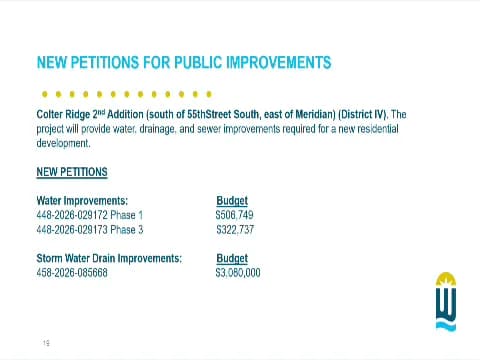
The Wichita City Council held a regular meeting on October 27, 2026, at 9:00 AM in the First Floor Boardroom at 455 N. Main Street. The meeting was called to order and adjourned at 9:16 AM. All votes were unanimous (7-0). Consent Calendar - Approved the minutes of the October 20, 2026 regular meeting (7-0). - Approved Consent Agenda Items 1 through 11 (7-0), which included: - Licenses for retail cereal malt beverages and other licenses. - Preliminary estimates for sewer and water improvements for Blue Lake Addition, Phase 2, and paving improvements for Bridger at Central Addition, Phase 6. - Developer's Agreements for Kabbaz Addition and Greenwich Heights Addition. - Minutes of advisory boards/commissions: MAPC (Sept 24), Wichita Transit Advisory Board (July 15 and Aug 19), and Board of Appeals for Refrigeration, Air Conditioning, Warm Air Heating and Boilers (Sept 3). - Application for the 2027 Violence Against Women Act Grant. - Grant application for the Better Food Policy Fund 2026-2028 Grantmaking Program. - Second reading ordinances including Ordinance No. 53-124 authorizing taxable industrial revenue bonds for the Leadfoot Express Project. - Plat of Waterboy Addition (consent planning item). - Sale of 2312 East Random Road and 2229 East 53rd Street South (housing items). - 2027 Utility Allowance Schedule. Public Comments & Testimony - One speaker: Michelle Sutton (WSU Master's Program, District 4) briefly addressed the council regarding her master's studies. No other public speakers were present. Discussion Items - Board of Bids and Contracts (October 26, 2026): Josh Lauber presented contracts and purchases for approval. Key items included: - LAMPS LED traffic signal contract: Group 1 awarded to GAD Sales Company ($39,600 estimated annual usage), Group 2 to Mobotrex LLC ($9,900 estimated annual usage), with one-year terms and two one-year options. - Street sign hardware contract with MD Solutions Inc. ($23,000 estimated annual usage, one year with two one-year options). - Elevator maintenance contract with Coney Inc. (base bid $113,640 plus options, one year with four one-year options). - Investment consulting services for Wichita Police and Fire Retirement Board with Callan LLC ($674,151 for four years). - Investment consulting services for Wichita Employees Retirement Board with Callan LLC ($795,404 for four years). - Janitorial services change order for Crowder's Cleaning Service LLC, adding group 8 (Wichita Animal Shelter Kennel cleaning) for $180,096. - Bobcat ToolCat UW56 for White Star Machinery (Airport) for $89,753. - Discussion included questions about contract terms when only one bid is received, and an update on RFP 260244 for a consultant to design and implement a Family Justice Center. A councilmember emphasized the importance of engaging existing providers (e.g., Wichita Family Crisis Center, WASAC) in that process. Staff clarified procurement rules encouraging community engagement while prohibiting consultants from developing specifications. - Petitions for Public Improvements: Paul Gunzelman presented petitions for Colter Ridge 2nd Addition in District 4, covering water, stormwater, sanitary sewer, and paving improvements for a new residential subdivision. Petitions represented 100% of the improvement districts. A councilmember noted the stormwater costs in the $3 million range for the entire development. The council approved the petitions, budgets, and resolutions (7-0). Council Member Appointments and Comments - Appointments: Councilmember Johnson reappointed Lamont Anderson to the Cultural Arts Committee. The Mayor reappointed Courtney Wages to the Access Advisory Board and appointed Brad White to the Wichita Airport Advisory Board for the unexpired term of Ryan Roloff. Approved 7-0. - Comments: A councilmember from District 1 reported on a meeting with precinct committee members from both parties, who praised Park and Recreation utilization (Carl Brewer Center, Red Bud Trail), tri-governmental meetings, and stormwater drainage improvements on 17th Street. The Mayor thanked McConnell Air Force Base and its commander, Colonel Joe Wall, for hosting the air show attended by 100,000 people. The council welcomed a new assistant city manager. Key Outcomes - All votes were 7-0 in favor. - Contracts and purchases from the Board of Bids and Contracts approved. - Petitions for Colter Ridge 2nd Addition improvements approved. - Board appointments approved. - Meeting adjourned at 9:16 AM.

MISCELLANEOUS 29% · PROCUREMENT 23% · PROCEDURAL 19% · PUBLIC WORKS 14%
742
OCT 27, 2026 · SITKA, ALASKA · CITY AND BOROUGH ASSEMBLY
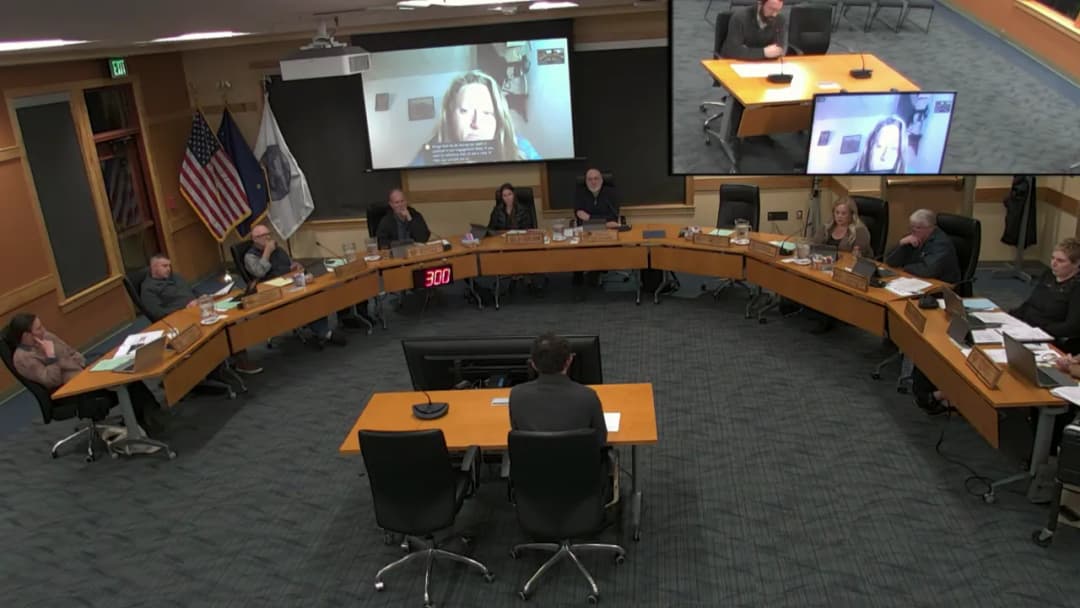
Sitka Assembly Meeting October 27, 2026: Child Care Tax, Appointments, and Reports

The Sitka Assembly convened on Tuesday, October 27, 2026, at 6:00 PM in the Assembly Chambers. The meeting covered ceremonial matters, quarterly departmental reports, a proposed sales tax increase for child care support, a liquor license protest, and board appointments. The meeting adjourned at approximately 8:30 PM. Consent Calendar - Approved the minutes of the October 13 Assembly meeting. - Approved liquor license renewals for Baranof Lodge, LLC dba 907 Lounge (Beverage Dispensary Tourism with Restaurant Endorsement) and Soe, LLC dba Asian Palace (Restaurant or Eating Place). - Approved renewal of a Standard Marijuana Cultivation Facility License for Jeremy J. Erickson dba Vern’s Wicked Weed. - All consent items passed 7-0. Public Comments & Testimony Child Care Sales Tax (ORD 26-27): - Valerie Nelson (71-year resident, former assembly member) urged the assembly to oppose the tax, stating residents are struggling and the tax burden will trickle down. She noted her property taxes increased $2,500 and cited a technical error in the ordinance’s effective date reference. - Skylene Patani (new resident) thanked the assembly and expressed need for child care, supporting the initiative. - Loretta Marcello voiced full support for the ordinance, arguing private solutions have failed and public investment is needed. She described personal challenges with child care access and stated the tax is a smaller financial hit than lost income. - Lauren Wilde (parent, early childhood coalition member) supported the tax but suggested changing the ordinance language from “child care assistance grants” to “stabilization and sustainability of child care services” to be clearer. She presented alarming enrollment declines: 81 kindergartners in 2022 vs. 56 in 2026, and 106 graduates 20 years ago vs. projected 50% decline. - Robin Sherman expressed concern that the sales tax disproportionately burdens young people, noting that senior exemptions shift the load. She urged exploring other funding mechanisms. - Joel (board president, Betty Elias Early Learning Center) thanked the assembly and supported the plan’s distribution, but worried voters may not approve the tax because child care affects only a short life phase. He encouraged parallel paths. - Annette Evans (director, Betty Elias Early Learning Center) presented budget data showing that without municipal support, infant care tuition would need to rise 87.2% to $3,070/month. She urged the assembly to act regardless of perceived voter approval. Liquor License Protest (Little Tokyo): - Christine Harrington (CPA for the applicant) requested the assembly not protest, explaining the business moved during COVID-19 lockdowns without following AMCO procedures. She asked for tentative support while they work to rectify the violation. Tourism Commission Appointments: - Lorinda Marcello voiced support for Susan Padilla and Richard Cole, citing Padilla’s long-range vision and Cole’s leadership reputation. Discussion Items Child Care Sales Tax Ordinance (ORD 26-27): - Sponsors (Tor, Katie, Kevin) introduced the ordinance calling for a February 2, 2027 special election on a 0.5% seasonal sales tax increase (April–September) to fund child care stabilization, workforce incentives, family scholarships, and CTE pathways. They emphasized extensive public engagement and that the tax is placed before voters. - Assembly debate included concerns about regressive impact on young families, alternative funding (e.g., removing senior sales tax exemption, lifting the cruise ship tax cap), and the need for stable revenue. Deputy Mayor Carlson expressed concern about the burden on young people but supported sending the question to voters. Assemblymember Blankenship worried the tax adds to resident expenses and suggested exploring public-private partnerships and other revenue first. Assemblymember Windsor preferred a 4/7 split (4% winter, 7% summer) but was told it would complicate finance. Assemblymember Riley acknowledged the regressive nature but voted to support to get community input. - The ordinance passed first reading 6-1 (Windsor opposed). Second reading set for November 10, 2026. The special election will cost $18,000–$20,000. Protest of Little Tokyo Liquor License: - Staff recommended protest because the business is no longer operating at its licensed premises (315 Lincoln St, Ste 112) and has not filed a transfer. The assembly discussed the legal basis (Alaska Administrative Code 3 AAC 305.110) and noted the license is location-specific. The motion to protest and forward to the Alcohol Beverage Control Board passed 6-0. Tourism Commission Appointments: - Five applicants were considered for two three-year terms. Jeremy Plank (incumbent) and Susan Padilla were appointed after voting rounds. Plank received 7 votes, Padilla 6 votes. Assemblymembers emphasized balance and community representation. Department Quarterly Reports: - Fire Chief Brian McLaughlin reported steady operational tempo, EMS quality, staffing shortages (vacant assistant chief and engineer), 15 overtime shifts per week, and efforts on training, safety systems, and policy. Budget is underspent on wages but overspent on overtime. - Electric Utility Director Ron Vinson reported completion of seven capital projects, progress on 28 others, staffing vacancies narrowed to two, FERC license progress, and reliability upgrades (switchyard, submarine cable, polymer insulators). Budget 35% expended due to front-loaded costs. - Library Director Jessica Uraimia reported 13,038 physical checkouts, 14,293 Wi-Fi sessions (impacted by access point issues), and 393 study/meeting room reservations in July–September. Maintenance completed (windows cleaned, carpets cleaned) and no roof leaks. Transom window project pending. Key Outcomes - Consent Agenda approved 7-0. - Tourism Commission Appointments: Susan Padilla and Jeremy Plank appointed (6 and 7 votes respectively). - ORD 26-27 (Child Care Sales Tax) passed first reading 6-1; second reading November 10, 2026; special election February 2, 2027. - Protest of Little Tokyo Liquor License approved 6-0; forwarded to AMCO. - Reports received: School board update (enrollment count ongoing, school optimization discussions); BDO audit plan (field work underway, goal to issue in January); Administrator attended ICMA conference; Attorney noted upcoming vacation and Supreme Court argument; Liaison reports included taxi/tour code revisions, police vehicle needs ($100,000 for two vehicles), and feasibility study request for new police facility. - Next meetings: Government-to-government dinner November 9, regular meeting November 10, strategic plan retreat November 14.

CHILD CARE 27% · CANNABIS REGULATION 13% · PUBLIC ENGAGEMENT 10% · TOURISM COMMISSION 8%
743
OCT 27, 2026 · HALF MOON BAY, CALIFORNIA · PLANNING COMMISSION
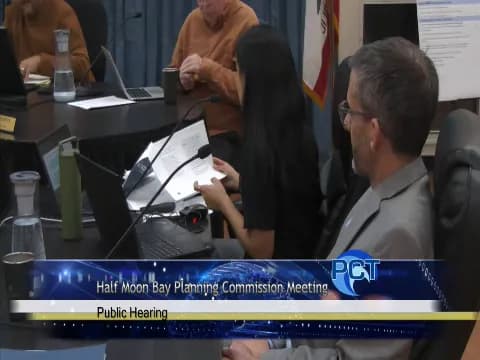
Planning Commission Study Session on Measure D Amendments - October 27, 2026

The Planning Commission held a study session at the Ted Adcock Community Center to review draft code amendments for Measure D, the city's voter-approved residential dwelling unit allocation system. The session included a presentation by Associate Planner Ruby Zalduondo, an interactive scoring criteria activity, public testimony, and extensive commissioner deliberation. The meeting also covered routine approvals, a director's report, and commissioner communications. Consent Calendar - Approval of Minutes: The commission unanimously approved the minutes from the October 13, 2026 meeting. Public Comments & Testimony - Non-Agenda Public Forum: No members of the public spoke on non-agenda items. - Public Comment on Measure D: Mike Fierra, a resident, expressed strong opposition to carryover/rollover of Measure D allocations, stating that Measure A (the precursor to Measure D) did not allow carryovers and that the concept was rejected by voters in 1991. He argued that adding carryovers undermines the intent of Measure D and questioned the legal justification. He also noted that ADUs and JADUs still create infrastructure impacts (water, sewer, traffic) and should not be treated as zero-impact. Discussion Items - Measure D Code Amendments: Staff presented two categories of amendments: (1) amendments to conform with the city's 6th Cycle Housing Element (ADU fractional allocation of 0.5, JADU exemption from Measure D, and a mechanism for reassigning unused/expired allocations); and (2) amendments to improve administration, including clarifying language, removing duplicative provisions, and simplifying the application scoring process. - Interactive Activity: Commissioners participated in a three-board exercise to identify criteria to remove, potential new criteria, and priority topics such as infill development, walkability, affordable housing, traffic mitigation, and infrastructure burden. - Commissioner Deliberations: Commissioners discussed several key issues: - Rollovers/Carryovers: Deep division emerged. Chair Gorn, Vice Chair Hernandez, and Commissioner DelNegro expressed concerns that rollovers could lead to growth spikes and undermine the orderly growth management intent of Measure D. Commissioner Ruddock was more open to limited rollovers but stressed the need for simplicity and clear limits. The commission generally favored a single rollover within a two-year window and opposed banking allocations. - Scoring Criteria: Commissioners suggested removing criteria that all projects satisfy (e.g., passive cooling, 32-inch clear passage) and adding criteria for safety (multiple egress points), wildfire hardening, work-live benefits (local preference), multi-generational housing, and rental use. They emphasized prioritizing infill housing downtown over large projects outside the core. - Large Projects: Concern was raised that large affordable housing projects with 20% BMR could consume most Measure D allocations, crowding out individual homeowners. Commissioners supported weighting criteria to favor small infill projects and requiring walkability plans for developments with more than three units. - JADUs: Some commissioners worried that exempting JADUs entirely from Measure D might be inconsistent with the Coastal Commission's population-based approach; they suggested a fractional allocation could be more defensible. - Staff Time: Staff noted they spent 138 hours (about 17 working days) on Measure D administration in the past year, underscoring the need for simplification. Key Outcomes - Direction to Staff: The commission provided the following guidance: - Support for the 0.5 allocation value for ADUs and exemption for JADUs, though some commissioners urged caution on the JADU exemption. - On rollovers, the commission was split but leaned against expanding the practice; staff will present both limited and no-rollover options to the Coastal Commission for informal feedback. - Scoring criteria should be simplified, with criteria that all projects meet removed, and new criteria added for safety, wildfire resilience, work-live integration, and rental/multi-generational use. - Weighting should prioritize infill development, walkability, affordable housing, and traffic mitigation; the commission stressed that BMR bonuses should not overwhelm allocations for individual homeowners. - Large projects should be required to phase affordable units early and include walkability plans; development phasing agreements should include teeth to ensure compliance. - Next Steps: Staff will incorporate the commission's input into revised draft amendments, send them to the California Coastal Commission for a six-week informal review, and then return to the Planning Commission for a formal recommendation before proceeding to City Council. The 2027 allocation cycle will not be affected. Director's Report - Community Development Director Leslie Lacko reported on the following: - A tree permit was issued for the removal of five dying Monterey pines at 2400 Cabrillo Highway, to be replaced with Monterey cypress. - Staff is preparing a safety element update recommendation for City Council's November 17 meeting, incorporating the commission's preferences for a five-year update cycle aligning with the local hazard mitigation plan. - The city's emergency preparedness campaign for October included weekly themes: general preparedness, flood risk awareness (king tides), building emergency kits, and staying connected (emergency alerts). In November, the focus will shift to Public Works storm readiness. - A $500,000+ grant application for a downtown parking study (including stakeholder outreach, parking structure feasibility, and wayfinding) was approved by City Council on October 20 and will be submitted shortly. Commissioner Communications - Commissioner DelNegro announced he would attend a planning commission training on housing laws in Burlingame on October 28. - Commissioner Ruddock reminded the public to drive slowly on Halloween. - Chair Gorn reported that the Pumpkin Festival had good weather, most vendors used AT&T for payment processing and were satisfied, and many vendors sold out by Sunday afternoon. - Vice Chair Hernandez noted the Boy Scouts will start a food drive next week. - Commissioner Rems (absent) was noted. - Chair Gorn mentioned seasonal fire pits and volleyball courts will close around the second week of November due to king tides. - Commissioner DelNegro shared he recently joined the Agricultural Advisory Committee and is gaining insights into the farming community.

744
OCT 27, 2026 · DANBURY, CONNECTICUT · MEETING PORTAL
Danbury Common Council Ad Hoc Committee Meeting on PILOT Agreement - October 27, 2026

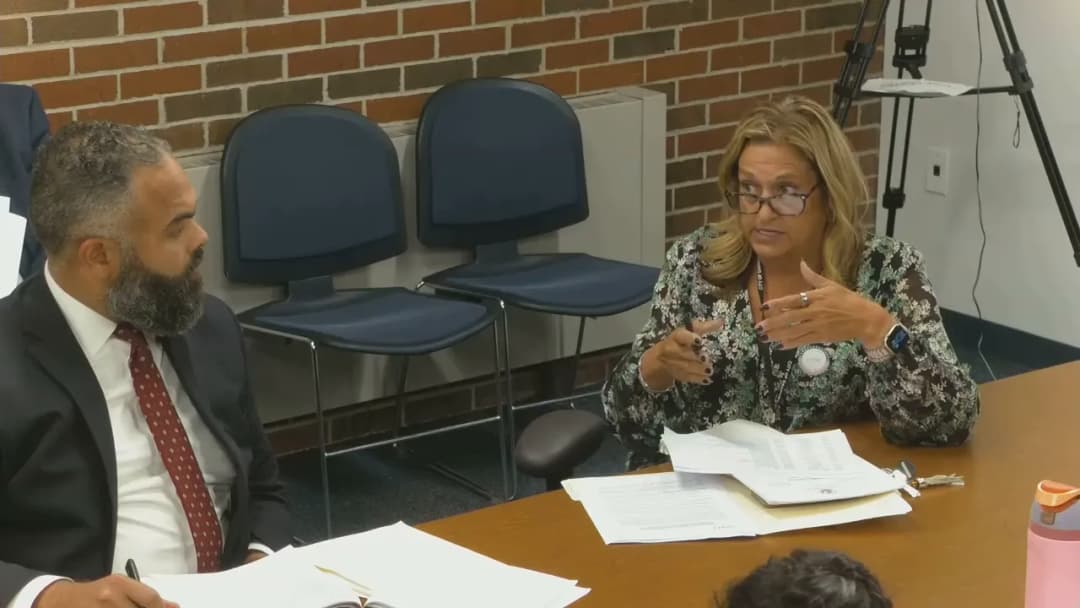
The Ad Hoc Committee of the Danbury Common Council met on October 27, 2026, at 6:30 PM to review a proposed Payment in Lieu of Taxes (PILOT) agreement between the City of Danbury and the Danbury Housing Authority. Chairman Peter Bazade led the meeting, joined by committee members Councilwoman Mia Spain Reichel and Councilman Michael Coello. City officials present included Corporation Counsel Tracy Norris, Mayor's Office representative Jason Nova, the tax assessor, tax collector, and finance director. The Housing Authority was represented by Executive Director Devin Mara, counsel Joseph Mortaletti, and Nathan, a RAD specialist. The Housing Authority seeks to update the decades-old PILOT agreement to support its Rental Assistance Demonstration (RAD) conversion, which would generate revenue for capital improvements. Discussion Items - Background and Need for PILOT Update: Chairman Bazade noted that the existing PILOT agreement dates back to 1964 and has been neglected. The Housing Authority initiated the request due to its RAD conversion, which requires clarity on tax obligations to secure financing for renovations. Executive Director Devin Mara explained that the Housing Authority manages 391 homes across seven developments and serves over 3,000 low-income individuals. She highlighted severe underfunding from HUD and the need to modernize aging properties. - RAD Conversion Overview: Nathan described the RAD program, which allows housing authorities to move public housing (Section 9) to a project-based Section 8 platform, generating higher and more predictable revenue. This enables the Housing Authority to leverage its properties for private financing. The first phase involves Wooster Manor and scattered sites, with a planned $12 million investment. - Property List Reconciliation: The tax assessor reported that the draft exhibit A contained duplicates and properties that could not be matched to city records. The committee agreed that a unique identifier system should be used to ensure accuracy. The Housing Authority provided a separate property list, and the assessor will collaborate to produce a corrected schedule. - PILOT Rate and Phasing: Under state law, the maximum PILOT for low-income federal properties is 10% of shelter rents. The Housing Authority expressed a preference for a lower rate (e.g., 8%) but stated it would comply with the committee's decision. The committee favored a phased approach: first finalizing a PILOT for federal properties (Wooster Manor and scattered sites) to meet the December closing deadline, then addressing state properties in a subsequent schedule. - Existing Abatement Agreements: The Housing Authority requested that the 2016 abatement agreements for Fairfield Ridge Housing Associates and Ives Manor (Hotel Green) remain in effect. Corporation Counsel noted these could be preserved or superseded by mutual agreement. The committee indicated openness to maintaining them. - Timeline: The Housing Authority aims to close on the RAD conversion in December 2026 and begin PILOT payments in 2027. The committee scheduled a continued meeting for the second week of November to review corrected schedules and propose a final agreement. Key Outcomes - The committee voted unanimously to continue the ad hoc meeting to a date determined by the chairman (targeting the second week of November) to further develop the PILOT agreement. - The Housing Authority will provide an electronic property list and proposed PILOT terms. The tax assessor will work with the Housing Authority to reconcile properties and assign unique identifiers. - The committee expects to present a recommendation to the full Common Council at its December 1, 2026 meeting, initially covering federal properties with a commitment to address state properties promptly.

AFFORDABLE HOUSING 63% · ZONING REGULATIONS 25% · PROCEDURAL 5% · FISCAL SUSTAINABILITY 5%
745
OCT 27, 2026 · PITTSBURGH, PENNSYLVANIA · CITY COUNCIL
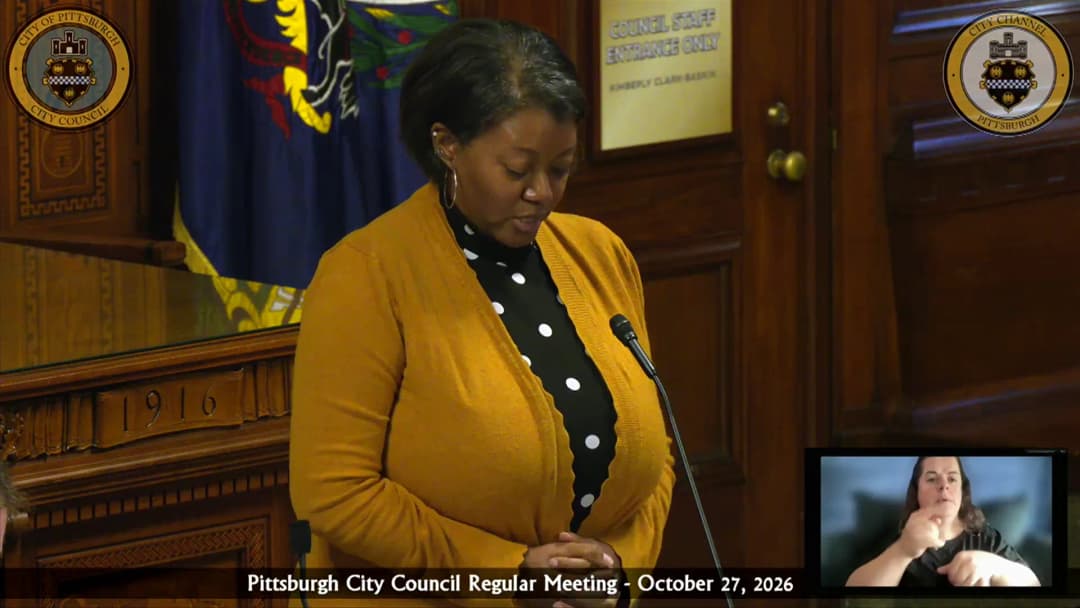
Pittsburgh City Council Regular Meeting – October 27, 2026

The Pittsburgh City Council held its regular meeting on Tuesday, October 27, 2026, at 10:00 AM in Council Chambers. Six members were present. The agenda included multiple proclamations, public testimony on the proposed 2027 budget, introduction of new legislation, approval of appointments, and final votes on several bills from standing committees. Proclamations - Detective John Gagliardi Day (October 22, 2026): Honored the late detective for 35 years of service; sponsored by Councilmember Charland and all members. - G.R.O.T.T. Program & Lamar Thomas Day (October 27, 2026): Commended Lamar Thomas and the Gamma Ray Ocean Think Tank for youth empowerment; sponsored by Councilmember Mosley and all members. - Alma Lewis Contemporary Arts & “Color Is Life” Exhibition Recognized the reopening and exhibition featuring Stephen Towns and Murjoni Merriweather; sponsored by Councilmember Mosley and all members. - Hazelwood Arts Trail Day (October 27, 2026): Declared the day in celebration of the neighborhood’s public art; sponsored by Councilmember Warwick and all members. - Emmai Alaquiva Day (October 27, 2026): Honored the Emmy Award-winning filmmaker and multimedia artist; sponsored by Councilmember Mosley and all members. - Kevin “KK” Alton Day (October 27, 2026): Recognized KK Alton for his lifetime commitment to the South Hillitop; sponsored by Councilmember Charland and all members. All proclamations were adopted by voice vote. Public Comments & Testimony - Matthew King (District 5) Raised concerns about evidence preservation by Pittsburgh Police, citing a case where Ring camera footage was not preserved. Urged Council to investigate training and procedures. - Jayla Rucker (Manchester, co-chair of Housing Justice Table) Strongly opposed the elimination of the Housing Opportunity Fund (HOF) and Stop the Violence Fund (STV), stating, “Losing these funds means people will die.” Called on Council to preserve and expand them. - Seth Davis (Bloomfield) Criticized Mayor O’Connor’s proposed 2027 budget for cutting HOF and STV while increasing the police budget by $10 million, including $1.5 million for a “Cop City” training campus. Urged Council to reject the increase. - Andrea Bokowitz (Oakland Planning and Development Corporation) Supported the HOF, stating her organization relies on it for housing assistance and affordable housing development. Called on Council to maintain the fund. - John Honerhan (Fine View) Expressed support for Councilmember Warwick’s proposed unearned income tax, saying he would be willing to pay more. Called the current budget an “aussterity” move that taxes the wrong things. - Mallory Brandon (Lawrenceville) Denounced the budget as a “wealth transfer from poor Pittsburghers to Corey O’Connor’s campaign donors,” pointing to increases for police and a new ShotSpotter contract while cutting lifelines. - Bob Damewood (Mount Washington, Regional Housing Legal Services) Called the proposal to keep the realty transfer tax but eliminate the HOF a “bait and switch.” Urged Council to reject the budget. - Lindsay Sickler (Executive Director of Proudhaven) Opposed the closure of Roots, claiming the mayor’s administration is not transparent about the lease. - Chief Ikohena Hal Malkina (unidentified neighborhood) Comlained about the treatment of her son by police, calling for retraining and accountability. - Maddie McGrady (Highland Park, co-chair of Housing Justice Table) Urged Council to preserve the HOF and STV, warning of “moral injury” if they abandon vulnerable residents. - Other speakers (including Daniel Giles, Crystal Jennings Rivera, and several residents) opposed the budget cuts and supported the HOF, STV, and the unearned income tax proposal. Discussion Items - Budget and Funding Debates Although no formal budget item was on the agenda, many public comments addressed Mayor O’Connor’s preliminary 2027 budget, which proposed eliminating transfers to the Housing Opportunity Fund and Stop the Violence Trust Fund while increasing police funding. Multiple speakers argued these funds are essential and not gimmicks. - Bill 994 (Cooperative Purchasing Oversight) The Council debated an amendment to require weekly reporting on cooperative purchases. Councilwoman Strassberger moved to lower the reporting threshold from $3,000 to $5,000 (from $30,000), citing consistency with P-card limits. After discussion, the amendment passed 8-1 (Councilman Wilson opposed). The bill as amended was then approved 9-0. - Bill 847 (Vibrant Pittsburgh Membership) Some councilmembers expressed opposition; the bill passed 5-4 after a roll call vote. Key Outcomes - Appointments Confirmed: Jennifer Cash Wade to the Housing Opportunity Fund Advisory Board; Mathew Davis as Chief of the Pittsburgh Bureau of Fire; Rea Price as Director of OMB and CFO; Sylvia Harris as Director of Innovation and Performance. All approved without dissent. - Commitee Reports and Final Votes: - Finance and Law (7 bills): Bills 982-987 and 994 passed. 847 passed 5-4. Others passed 9-0. - Public Safety and Wellness: Bill 974 (Humane Animal Rescue agreement) passed 9-0. - Public Works and Infrastructure: Bills 979 and 981 passed 9-0. - Land Use and Economic Development: Bills 1545 (zoning overhaul, with a technical amendment) and 834 passed 9-0. - Recreation, Youth and Senior Services: Bill 988 (food service agreement with Pittsburgh Public Schools) passed 9-0. - Inovation, Performance, Asset Management, and Technology: Bills 975, 976, 992 passed 9-0. - Intergovermental and Educational Affairs: Bills 977 and 978 (sewage facility plan revisions) passed 9-0. - Executive Session Schedule: Council scheduled an executive session for 1:00 PM on bills 1045 and 1046 (litigation settlements). - Announcement: Councilmember Mosley thanked the Pittsburgh Parks Conservancy for a tree planting honoring his father. Councilmember Strassberger noted the 8th anniversary of the Tree of Life shooting and led a moment of silence. The meeting adjourned after all business was concluded.

PROCEDURAL 14% · COMMUNITY ENGAGEMENT 10% · PUBLIC SAFETY 9% · AFFORDABLE HOUSING 9%
746
OCT 27, 2026 · PRINCE GEORGES COUNTY, MARYLAND · COUNTY COUNCIL & BOARDS
Prince George’s County Domestic Violence Housing Work Group Meeting – October 27, 2026

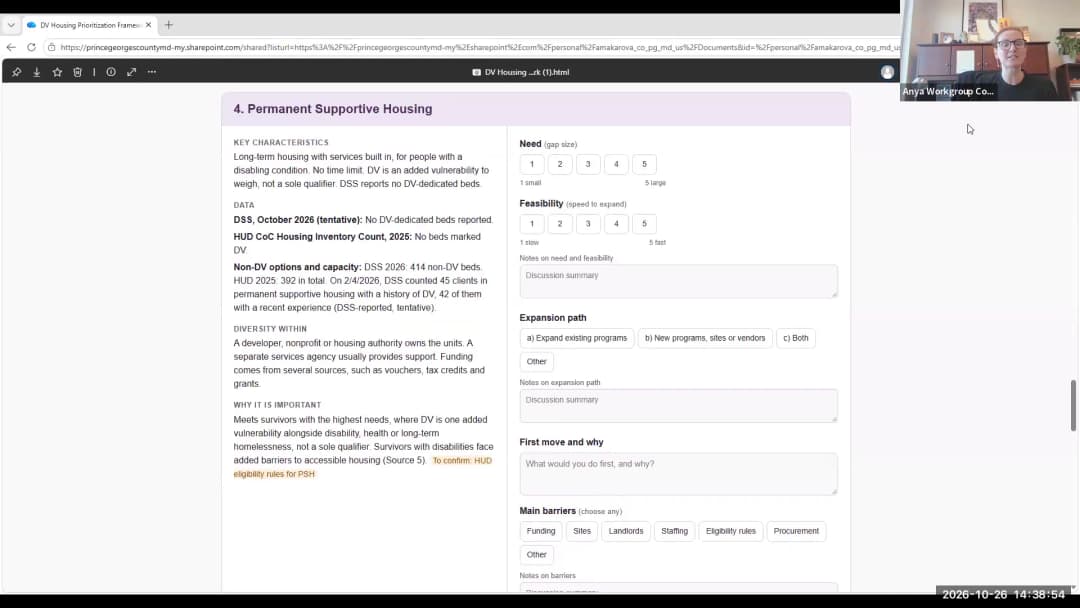
The Domestic Violence Housing Work Group met on October 27, 2026, to continue its examination of housing for survivors of domestic violence in Prince George’s County. Led by Anya McCarva, committee director and task force coordinator, in place of Chair Miss Fisher, the group reviewed updated capacity data, prioritized housing types, and discussed next steps for policy recommendations. Participants included county agency representatives, domestic violence service providers, and community partners. Note: the transcript records a speaker saying “October 26th,” but the supplied meeting timestamp is October 27, 2026; this summary uses the supplied date. Consent Calendar - Quorum was confirmed with 11 members present after roll call. - The minutes from the September meeting had been distributed in advance; no corrections were offered, and the minutes were approved as presented. Housing Capacity Update - Approximately 9% of the county’s housing continuum beds are dedicated to domestic violence survivors, with rapid rehousing having the highest share. - CCSI’s Safe Passage was identified as the sole dedicated domestic violence emergency shelter; the bed count was corrected during the meeting from 44 to 43. - The county has 486 non-domestic-violence emergency shelter beds. - Department of Social Services data show 9 dedicated domestic violence transitional housing beds (5 at CCSI and 4 at Ladies of Hope), while HUD’s 2025 data marked 0. - DSS data show 79 dedicated domestic violence rapid rehousing beds (House of Ruth, CCSI, and Ladies of Hope), while HUD’s 2025 data flagged only 14 House of Ruth beds. - No dedicated domestic violence permanent supportive housing beds were identified; non-dedicated counts differed between HUD and DSS reporting. - A new state-funded voucher program lists domestic violence survivors as a priority group. - Informational gaps remain, including waitlist, turnaway, and time-to-placement data; hotel and motel emergency placements are not currently counted. - A survey on demand and capacity was distributed to providers and experts; it closes on November 6, 2026. Discussion Items - Emergency Shelter: Michelle from CCSI cautioned that expanding shelter capacity alone will not help if survivors cannot move into affordable housing. She noted CCSI operates a no-turn-away policy using privately funded hotel and motel placements, but that hotels are not ideal for families. Dr. Denise McCain expressed concern about homeless shelters being used for domestic violence victims; David from CCSI clarified that when domestic violence is identified, survivors are not referred to non-domestic-violence homeless shelters. Tasha Jones asked about recruiting private homeowners and realtors; Michelle responded that most survivors prefer returning to their own or private space rather than sharing a home. The group generally viewed emergency shelter expansion as a lower priority than other housing types. - Transitional Housing: Michelle reported that HUD’s most recent Notice of Funding Opportunity prioritizes transitional housing. Because of this, CCSI gave up its rapid rehousing program to apply for a new larger domestic violence transitional housing program, approximately three times the size of the current joint transitional/rapid rehousing program. She noted that HUD-funded transitional housing may carry stricter service participation requirements. The group saw this category as driven largely by federal funding changes rather than by survivor preference, with rapid rehousing considered more flexible. - Rapid Rehousing: This emerged as the top priority for expansion. Jackie Rowe from the Sheriff’s Office supported focusing on rapid rehousing and wraparound services rather than expanding shelter capacity. Yolanda Burgess, speaking from a realtor perspective, said rapid rehousing works but inspections must be prioritized promptly for domestic violence survivors and that landlord partnerships are needed. Michelle said the key constraint is rental subsidy dollars, not a particular landlord sector, and mentioned local jurisdictions using dedicated local funds, including Dallas, Texas, and Kalamazoo County, Michigan. - Permanent Supportive Housing: Monique Willis, deputy director of the Prince George’s County Family Justice Center, recommended prioritizing domestic violence survivors for permanent supportive housing, especially those caring for children with disabilities. A participant speaking from the criminal justice perspective said survivors sometimes want to drop charges because they have nowhere else to go. The group leaned toward recommending prioritization for domestic violence survivors in this housing type. - Mainstream Affordable Housing: Several participants noted that the broader affordable housing shortage affects domestic violence survivors. Jackie Rowe and Yolanda Burgess said affordability is the underlying issue. A representative from the Department of Family Services emphasized that, with limited funding, the county should focus on the most significant gaps and use available data to guide decisions. The group recognized that successful exits from all other housing types depend on the availability of mainstream affordable housing. Key Outcomes - Rapid rehousing was identified as the top housing type for potential expansion and investment. - The group expressed support for prioritizing domestic violence survivors in permanent supportive housing. - Emergency shelter expansion was viewed as a lower priority, with hotel and motel placements considered an emergency, not long-term, solution. - Transitional housing may need continued attention because of federal funding priorities, despite being less preferred from a survivor-service perspective. - The survey on demand and capacity remains open until November 6, 2026; members were urged to complete and share it. - The next work group topic will likely be wraparound services, with public safety and criminal justice to be explored in future sessions. - A motion to adjourn was made and seconded, and the meeting was adjourned.

DOMESTIC VIOLENCE 47% · AFFORDABLE HOUSING 31% · PROCEDURAL 9% · TRANSITIONAL HOUSING 9%
747
OCT 27, 2026 · BIRMINGHAM, ALABAMA · CITY COUNCIL
Birmingham City Council Regular Meeting – October 27, 2026

The Birmingham City Council held its regular meeting on Tuesday, October 27, 2026, in the City Council Chambers at City Hall. The agenda scheduled the meeting for 9:30 a.m.; Council President Wardine Alexander called the meeting to order at approximately 9:37 a.m. All nine council members were present. The invocation was delivered by Mrs. Thelma Brown of the Susan G. Komen Scholar National Cancer Institute Breast Cancer Steering Committee, who marked Breast Cancer Awareness Month and noted that Black women have a 40% higher mortality rate than white women when diagnosed at the same stage of breast cancer. The Pledge of Allegiance was led by Councilor Hunter Williams. Minutes for the meetings of August 4, 2026, through October 20, 2026, were not ready and were not approved. Mayor's Communications and Proclamation Mayor Randall L. Woodfin (referred to by several phonetic variants in the transcript) promoted Magic City Classic Week, including the 85th Magic City Classic presented by Coca-Cola, with the downtown parade Saturday at 8 a.m., tailgating at Legion Field at 10 a.m., and the game at 2:30 p.m. He also announced a Magic City Classic Legacy exhibit at City Hall running through December; Awakened 2026: Passing the Torch on Friday, October 30, at 10 a.m. at the Carver Theater, honoring Birmingham's 1963 Civil Rights Foot Soldiers; and the 2026 State of Homelessness Summit on Friday, November 6, from 10 a.m. to 3 p.m. at the Boutwell Auditorium, citing the city's $3 million investment in housing and homelessness services. The council unanimously adopted a proclamation recognizing the Omicron Omega chapter of Alpha Kappa Alpha Sorority, Inc., on its 102nd Charter Day. Council President Alexander, a 44-year member, noted that the chapter was chartered on October 24, 1924, becoming the first Black Greek letter organization chartered in Alabama; that membership has grown to more than 345 professional women; that the chapter has raised over $87,000 for the March of Dimes; and that its Cultural and Education Advancement Foundation has awarded more than $80,000 annually in scholarships over the past two years. Chapter President Stephanie Ayers Milsap, the 43rd chapter president, accepted the proclamation and highlighted the sorority's Empower 08 voter education, registration, and mobilization initiative. Consent Calendar The council approved unanimously, by one motion, the consent agenda announced by item number (Items 1, 2, 4–6, and 10–63). No council member or citizen requested removal of an item for separate discussion. The clerk announced that Items 7, 8, and 9 had been withdrawn; the printed agenda's end-of-document withdrawal notice listed only certain weed-abatement properties, so the written agenda and the clerk's oral announcement differ on which items were withdrawn. Key consent items included: - Item 1: Nuisance abatement resolution authorizing abatement of nuisances on approximately 225 properties citywide, with costs assessed as liens on the properties. - Item 2: Ordinance amending the Grants Fund Budget, appropriating $24,000 to Planning, Engineering and Permits for the Certified Local Government Grant from the Alabama Historical Commission, increasing the total from $24,000 to $48,000. - Item 4: Agreement with State of Alabama Ballet, Inc., not to exceed $25,000, for performances, outreach, and arts partnerships through June 30, 2027. - Item 5: Agreement with Birmingham Corps, not to exceed $75,000, for its workforce development initiative serving underserved residents. - Item 6: Amendment to the Can-Am Technologies, Inc., contract adding $41,805 for Teller Payment Portal integration with Gtechna's Command Center platform, plus $5,976 per year in additional software licensing fees. - Items 10–11: Up to $3,000 to Greater Crestwood, Inc., for the Crestfest music festival on November 7, 2026, and a right-of-way encroachment license to Burchell & Co, Inc. (Momentum Leaders), for a blade sign at 1531 3rd Avenue North. - Item 12: Authorization to apply for the FY 2027 ATRIP II grant from the Alabama Department of Transportation, $2 million with no city match, to redesign the stretch of US 78 (3rd Avenue South) in front of Continental Gin. - Item 13: Adoption of the 2022 Shelby County Hazard Mitigation Plan, the final requirement for FEMA Approved status. - Items 14–22: Nine resolutions declaring Buildings A through I at 125 Cotton Avenue SW unsafe, public nuisances, and directing their demolition. - Items 23–50: Special assessments against individual properties for demolition costs, ranging from $4,381.00 to $29,693.60. - Items 51–63: Contract awards, change orders, bid approvals, and employee expense accounts, including a $1,250 change order with PlumCore, Inc., for the Carver Theater lateral drain exploration; a $25,925 proposal from Diversified Elevator Service and Equipment Company (the only proposal received) for the Birmingham Public Library East Lake elevator repair; and an amendment extending an Oracle America, Inc., cloud solutions bid from 120 days to one year. Discussion Items - Item 3 (Ordinance, permanent operation, first reading): Authorized the Mayor to execute an Interlocal Cooperation Agreement with the City of Adamsville for a term not to exceed two years, ending June 30, 2028, under which Birmingham will provide one surplus 2010 Freightliner M2 106 truck in exchange for Adamsville providing urban horticulture and urban forestry personnel and services upon request. Approved unanimously. - Item 64 (Resolution, first reading): Set a public hearing for November 24, 2026, to consider an ordinance amending the zoning district map (Case No. ZAC2026-08005) to change the district at approximately 800 Montclair Road from QMU-H (Qualified Mixed-Use High District) to QC-2 (Qualified General Commercial District) to allow for a new church campus, filed by C. Randall Minor on behalf of property owner Redeemer Community Church. Approved unanimously. District Updates Council members announced neighborhood meetings, events, and deadlines, including: a public safety meeting today at 1 p.m. in the council chambers (Pro Tem Tate); the Planning and Zoning Committee meeting scheduled for today was canceled, with the next meeting on November 10 at 3 p.m. (O'Quinn); a special-called Committee of the Whole and Administration and Government Affairs Committee meeting on November 4 at 3:30 p.m. (President Alexander); the Community Development Committee on November 2 at 3:30 p.m. (Gunn); the Economic Development and Tourism Committee on November 3 (Williams); District 4 mobile office hours today from 2 to 3:30 p.m. at the Northeast YMCA (Gunn); District 8 Capital Improvement Grant applications open through November 9 (Smith); and the Birmingham Zoo's Hoots and Howls Halloween event on Saturday from 10 a.m. to 4 p.m. (Vasa). Councilor Smithman reported that the Safe Summer Magic City Classic kickoff concert drew an estimated more than 40,000 people with no incidents of violence. Council President Alexander reminded the public that MAX Transit is offering free rides to the polls on Election Day, Tuesday, November 3. Public Comments and Testimony - Nathan Thompson (6779 Old Springville Road): Asked the council to reconsider the condemnation of 3012 Dowell Avenue Southwest. He said he had spent additional time and money cleaning the property, that an iron worker had verified the structure is structurally sound, and that he proposes converting the sanctuary into an open farmers market with a community garden. He cited Alabama Code §§ 11-40-31 and 11-40-32 in support of his request. - Mark Cummings (Lakeview business owner): Stated that six of eight lights under the overpasses near his business have been out for 930 days (since April 2024), that unhoused individuals living underneath make customers afraid to park, and that he has been unable to get ALDOT to fix the lights, saying his representatives have failed. He also criticized the new bike-lane striping on 7th Avenue South for removing a turning lane and increasing congestion in Lakeview, and requested lit stop signs at the Magnolia Avenue intersections with Richard Arrington Jr. Boulevard and 22nd Street. - Willie Jenkins: Offered community announcements, including the 27th anniversary of the Men of Praise at a Norwood church on the second Sunday, with Reverend Lonnie Ward as guest speaker; the Carver High School picnic; and a request for prayers for two ailing classmates from the Carver High School Class of 1973. - Lori Gainesmith (District 6): Expressed concern about 18-wheelers and gas trucks continually traveling down a street in her district (the street name is garbled in the transcript); reported that Mayor Woodfin had reached out to the appropriate departments; and congratulated the Alpha Kappa Alpha members, noting her mother was initiated into Omicron Omega in 1996. - Mr. Wilson (Green Springs resident): Described decades of cut-through traffic on Green Springs Avenue, estimating approximately 25,000 cars and trucks daily use the street as a shortcut to I-65. He recounted that his father raised the issue at council meetings before his death in 2016, suggested the city consider closing the street or a nearby ramp, and linked housing values to population decline, noting the city has fallen from about 350,000 residents in 1966 to about 190,000 today. Key Outcomes - The consent agenda (Items 1, 2, 4–6, and 10–63) was approved unanimously by a single motion. - Items 7 (Jimmie Hale Mission, $70,000), 8 (Rex Lake Road interlocal agreement with Jefferson County, $96,616.31), and 9 (Versaterm Public Safety contract, $246,381.26) were withdrawn from the agenda. - Item 3, the Adamsville interlocal cooperation agreement, was approved unanimously. - Item 64, setting the November 24, 2026, public hearing for the Redeemer Community Church zoning request, was approved unanimously. - The Omicron Omega 102nd Charter Day proclamation was adopted unanimously. - Minutes from August 4 through October 20, 2026, were not ready and were not approved.

COMMUNITY ENGAGEMENT 30% · PROCEDURAL 21% · PUBLIC ENGAGEMENT 17% · PUBLIC SAFETY 17%
748
OCT 27, 2026 · RAMSEY COUNTY, MINNESOTA · BOARD OF COMMISSIONERS & AUTHORITIES
Ramsey County Board of Commissioners Meeting Summary for October 27, 2026

The Ramsey County Board of Commissioners convened on October 27, 2026, at 9:04 a.m. in Council Chambers at 15 West Kellogg Boulevard, Saint Paul, MN. Commissioners Jebens-Singh, McGuire, McMurtrey, Miller, Moran, and Chair Ortega were present; Commissioner Xiong arrived at 9:06 a.m. The Board approved a funding agreement for the CareerForce Center, advanced the 2027 Capital Improvement Program Bond Ordinance by waiving its first reading and scheduling a public hearing, and received updates on manufacturing, the new YouTube channel, and election preparation. The meeting adjourned at 10:05 a.m., followed by a closed session regarding election litigation. Consent Calendar - Agenda and Minutes (Items 1 & 2): The Board unanimously approved the October 27, 2026, agenda and the October 20, 2026, meeting minutes. Both motions passed 7-0. Discussion Items - CareerForce Partners Memorandum of Understanding and Infrastructure Funding Agreement (Item 2026-404): Director of Workforce Solutions Catrice Davis presented the agreement, which provides cost-sharing for the downtown Saint Paul CareerForce Center for October 27, 2026, through October 26, 2029. The Center is the highest utilized comprehensive CareerForce location in Minnesota. Year-to-date statistics (Jan-Sep 2026) showed 3,242 job seekers served (99% from St. Paul, 51% Black, 36% White). Over 5,400 services were provided, with 44% focused on job searches. 77% of clients reside in low-income zip codes. Commissioner Jebens-Singh expressed strong personal support, sharing a testimonial about how the program helped them re-enter the workforce. Commissioner Miller inquired about tracking long-term employment outcomes, which Director Davis acknowledged was an area for future development. Commissioner McGuire questioned the funding model for serving non-Ramsey County residents, and Davis confirmed a shared cost structure with the state. The motion passed unanimously (7-0, Resolution B2026-137). - 2027 Capital Improvement Program (CIP) Bond Ordinance (Item 2026-382): Jeanette Boit-Kania of the Finance Department outlined the bond issuance process, reminding the Board of the county's 25-year history of AAA bond ratings. The Board voted to waive the first reading of the ordinance and scheduled a public hearing for November 17, 2026, at 9 a.m. The motion passed unanimously (7-0, Resolution B2026-138). County Connections County Manager Ling Becker presented several updates. October was celebrated as Manufacturing Month; manufacturing is Ramsey County's third-largest industry with 248 advanced establishments and a median annual wage of $120,000. The county officially launched its YouTube channel for live-streaming and archiving board meetings with closed captioning. An election update reported that 2,800 people per day were voting early at four locations, with over 19,000 early votes cast and 41,800 absentee ballots received. The county stated it enforces state law prohibiting federal election monitors within 100 feet of polling places. Outside Board and Committee Reports - Commissioner Miller reported on touring International Paper in White Bear Lake, participating in a Lake Lynx Trail right-of-way meeting, and holding in-district hours. - Commissioner Xiong reported on speaking to a University of Minnesota urban studies class, meeting with Snelling Avenue constituents about public safety and mental health, and presenting the supplemental budget to the Como Park District Council. - Commissioner Jebens-Singh reported on attending the public accuracy test for election equipment, visiting the Tubman Center's North Side Youth Outreach, and celebrating the Venice Heights Green Team's watershed stewardship award. - Commissioner McGuire reported on attending a celebration of life for Professor James Jernberg, the Climate Smart Municipalities meeting, and the Victoria Street trail design open house. - Commissioner Moran reported on the Ramsey County Consumer Care Retreat, a Planned Parenthood fundraiser, and participating in a vaccination town hall with Congresswoman Betty McCollum, where they discussed the impact of changing CDC recommendations on vaccine hesitancy. Key Outcomes - Resolution B2026-137 (Passed 7-0): Approved the Memorandum of Understanding and Infrastructure Funding Agreement with CareerForce Partners. - Resolution B2026-138 (Passed 7-0): Waived the first reading of the 2027 CIP Bond Ordinance and set the public hearing for November 17, 2026. - Closed Meeting (Resolution B2026-139, Passed 7-0): The Board convened a closed meeting at 2:46 p.m. pursuant to Minnesota Statutes 13D.05 to discuss election litigation. The Board delegated authority to the County Attorney to file or join lawsuits related to the administration of the November 3, 2026, election. This authorization expires January 31, 2027. The closed meeting adjourned at 3:28 p.m.

COMMUNITY ENGAGEMENT 36% · WORKFORCE DEVELOPMENT 26% · PUBLIC HEALTH 12% · CAPITAL IMPROVEMENTS PLANNING 9%
749
OCT 27, 2026 · WASHINGTON, DISTRICT OF COLUMBIA · COUNCIL OF THE DISTRICT OF COLUMBIA
Committee on Judiciary and Public Safety Hearing on Domestic Violence Survivor Bills and Roundtable, October 27, 2026

The District of Columbia Council Committee on the Judiciary and Public Safety, chaired by Councilmember Brooke Pinto (Ward 2), held a public hearing on Tuesday, October 27, 2026, in Room 412 of the John A. Wilson Building and via streaming. The hearing covered Bill 26-835 (Supporting Survivors of Domestic Violence and Abuse Amendment Act of 2026), Bill 26-671 (Protecting Victims Amendment Act of 2026), and a general roundtable on domestic violence and sexual assault in the District. The chair convened the hearing at 9:33 a.m. by the transcript; the meeting metadata timestamp is 14:45 UTC. No agenda or minutes were available for this hearing. The chair opened with statistics: 41% of women and 21% of men in DC will experience physical or sexual violence in a domestic or intimate partner context; 99% of survivors experience economic and financial abuse; on a 2025 day, 103 survivors contacted domestic violence hotlines and 790 sought services, including 339 seeking emergency shelter or housing; and from January 2026 to the hearing date, DC’s 911 center received 10,000 domestic-violence-related calls. Violent crime is up 11% from the prior year, driven largely by assault with a dangerous weapon (ADW), which is up 41%, with 30% of ADW cases related to domestic violence. Public Comments & Testimony - Rico Dancy testified as a deaf survivor, describing threats from his ex-wife, a lack of support from police, and alleged race-based denial of help. He urged protections and resources for deaf and disabled survivors and their children. - Rebecca Mills (Ward 5 survivor) described coercive control and asked the council to examine whether DC law adequately recognizes sustained patterns of intimidation, threats, humiliation, and control as distinct from discrete physical incidents. - Rachel Hirsch (Council for Court Excellence) opposed making Secure DC’s pretrial detention expansions permanent, citing FY 2025 PSA data showing 88% of adults released pretrial remained arrest-free and 0.5% were rearrested for dangerous/violent offenses. She noted jail population grew 85.4% from January 2023 to 2,299, with 70% pretrial, and that YSC was over capacity at 103 residents. - Selim Adolpha (Chair, ANC 8C) expressed full support for the Supporting Survivors bill, citing DC Coalition Against Domestic Violence statistics: 47% of women and 43% of men in DC experience intimate partner violence, sexual violence, or stalking in their lifetimes; 55% of homeless families and 24% of unhoused single adults reported DV history; and Ward 8 accounted for 10 of 21 adult DV homicides in 2024 (nearly 48%). She recommended mandatory, ongoing culturally relevant and trauma-informed training for the proposed MPD DV unit. - Naida Henau (Valari) supported the Supporting Survivors bill but urged restoration of removed provisions: remote testimony and hearings, medical forensic exam confidentiality, mandatory reporting reform, and protection from educational discrimination under the DC Human Rights Act. - Mary Auto Okonufwa (Legal Aid DC) urged revisions to the Protecting Victims Act to avoid criminalizing survivors, citing cases where survivors were arrested as the alleged aggressor. She opposed mandatory pretrial detention and mandatory minimums, supported the Supporting Survivors bill’s lethality factors, and requested clarity on gun relinquishment timelines, economic abuse remedies, confidentiality, remote testimony, and crime victims compensation. - Peggy Raymond (ACLU DC) opposed the Protecting Victims Act’s expansion of pretrial detention, saying pretrial release is not driving crime. She cited PSA data that 88% of released people were not arrested and less than 1% were rearrested for a violent offense, and warned of disproportionate impact on Black residents. - Josh Miller (Open City Advocates) opposed making the expanded juvenile pretrial detention presumption permanent, citing racial disparities—96% of youth in secure detention in FY 2024 were Black—and conditions at YSC, including overcrowding and 462 recorded youth injuries. - Lavon Pepe (DC Coalition Against Domestic Violence, DCCADV) described DV as a public health crisis, noted DV fatalities accounted for 20.4% of DC homicides the prior year, and called for public health investments, prevention education, housing, health care, and fully funded survivor services. - Michaela Deming (DCCADV) supported the Supporting Survivors bill with amendments, including a 24-hour gun relinquishment timeline, required consideration of lethality factors, greater MPD unit specificity, and future legislation on coerced debt, school discrimination, confidentiality, and remote hearings. - Teresa Perr (DCCADV) voiced concern that the Protecting Victims Act relies on increased criminalization, may deter reporting, and fails to fix police/prosecution gaps or provide survivor resources. - Melissa Millar (ZEDIC DC) welcomed the bill’s recognition of economic abuse but said the VAWA-derived definition is restrictive and unclear; she urged a coerced debt framework modeled on states such as California, New York, Minnesota, Connecticut, Nevada, and Maine. - Nicole Crouch (Ayuda) supported the Supporting Survivors bill and the DCCADV amendments, especially 24-hour firearm removal, protections from MPD information-sharing with immigration enforcement, and remote court access for immigrant survivors. - Lisa Wingham (My Sister’s Place) supported the coalition’s positions, highlighted the danger of firearms in DV cases, and cited research that a gun in the hands of an abuser increases a woman’s homicide risk five-fold. She urged a 24-hour relinquishment timeline and a future comprehensive coerced debt bill. - Clinique Chapman (DC Justice Lab) opposed both bills in their current form, arguing they expand pretrial detention, mandatory incarceration, and criminalization without investing in survivor-led services. She questioned whether MPD should lead the DV response unit, suggesting civilian- and community-led coordination. - Natalia Otero (DC Safe) supported limited incarceration for a small subset of lethal cases but warned against overcriminalization. She asked for a regular review period, less prescriptive MPD unit design, and stronger agency accountability and prevention resources. - Jenny Wesbury (DC Safe) supported both bills, especially accountability for repeat CPO violations, lethality factors, recognition of economic abuse, and a 24-hour firearm relinquishment deadline. She recommended including strangulation history as a standalone lethality factor. - Kylie Hogan (DC Safe) supported the MPD DV unit concept but asked for clearer data roles, a civilian DV coordinator, and reciprocal collaboration across agencies. - Indira Hennard (DC Rape Crisis Center) expressed concern that the proposed MPD DV unit language could conflict with SAVRA, potentially allowing DV unit response to sexual violence and failing to name sexual assault providers and training. She asked the council to remove conflicting language. - Lul Muhammad (Person Center) said her organization did not currently endorse the bills, because less than 3% of its clients report to MPD and many immigrant survivors fear law enforcement and immigration consequences. She supported defining economic abuse and expanding culturally specific, community-level responses. - Virtual witnesses included Aida Findell (Volunteer Legal Advocates), who supported both bills and urged a 24-hour relinquishment timeline and mandatory lethality factors; Lee Goodmark (University of Maryland law professor), who argued criminal legal intervention does not deter IPV and urged prevention investments; Alexandra Bailey, a survivor and former Ward 2 commissioner, who described harmful MPD response, warned that overcriminalization fuels trafficking, and endorsed DCCADV recommendations; and survivor testimonies read by Farhana C., Nayeli Palayo, and Aaron Byrne emphasizing the need for services, social safety net funding, financial assistance, and support for survivors of domestic violence. Government Witness Testimony and Discussion Items Supporting Survivors of Domestic Violence and Abuse Amendment Act (Bill 26-835) The chair described the bill’s five major proposals: an MPD domestic violence response unit; clarification of firearm surrender when a civil protection order is violated; added lethality factors for pretrial detention in protective-order and anti-stalking cases; a FOIA exemption for body-worn camera footage in DV and human trafficking cases; and inclusion of economic and financial abuse in the definition of domestic violence for hotline services. MPD Assistant Chief Rami Kyle supported many goals but raised two concerns: the proposed gun relinquishment immunity went too far and could undermine investigations and prosecutions, and legislating the structure of a DV unit is impractical given MPD staffing levels, with sworn staffing down by more than 600 in five years. He said MPD would prefer a civilian DV response coordinator and a centralized data analyst over the bill’s specified unit structure. USAO-DC and the Deputy Mayor’s office expressed support for the bill’s definition of economic abuse, lethality factors, and privacy protections. Protecting Victims Amendment Act (Bill 26-671) Deputy Mayor Lindsay Appiah testified that Mayor Bowser’s bill would strengthen enforcement of protective orders, expand pretrial detention for repeat domestic violence offenders, enhance penalties, and protect victim privacy. She cited a 46% reduction in violent crime and 36% reduction in total crime over three years, while acknowledging DV homicides remain stubbornly high. Kathleen Hoke (USAO-DC) strongly supported the bill, including felony penalties with a one-year mandatory minimum for repeat CPO violations, a five-business-day hold for defendants charged with an intrafamily offense while already on release, preserved Secure DC pretrial detention provisions, a revised kidnapping statute following the Cardozo decision, a new felony unlawful entry offense, enhanced penalties for crimes against pregnant victims and intrafamily crimes committed in the presence of children, and withholding victim/witness names from public inspection. Janice Bechtal (Office of the Attorney General) explained OAG’s role prosecuting CPO contempt cases. She cautioned that a mandatory one-year minimum could be disproportionate for nonviolent communication violations, and said existing enhancements (270 days for a second conviction and 540 days for a third) already allow proportional accountability. She requested pre-charging subpoena power for OAG and adding CPO violations to the definition of intrafamily offenses for detention purposes. Jennifer Porter (OVSJG) supported the bills, citing the 2026 DV Fatality Review Board report of 31 domestic-violence-related homicides in 2025, including five children under age five, and emphasizing the need for both accountability and survivor-led services. Caterina Seminova (Public Defender Service) opposed many provisions, arguing that mandatory minimums and mandatory detention strip judicial discretion, criminalize survivors, and ignore the economic and public health drivers of domestic violence. She also objected to the proposed kidnapping changes as arbitrary and to broad witness-name shielding as a transparency concern. Key Policy Debates - Gun relinquishment: DCCADV, Ayuda, My Sister’s Place, DC Safe, and OAG called for a 24-hour relinquishment timeline, while MPD and Deputy Mayor Appiah warned that broad immunity could prevent accountability for other crimes; OAG clarified that immunity would only cover illegal possession at surrender, not crimes committed with the weapon. - Pretrial detention: Many advocates, including CCE, ACLU, Open City Advocates, Legal Aid, and PDS, opposed expanded or permanent Secure DC pretrial detention provisions, citing low rearrest rates, racial disparities, and jail overcapacity. USAO and the Deputy Mayor defended the provisions as necessary for the most dangerous cases, including strangulation and repeat sexual abuse. - Lethality factors: Multiple witnesses urged changing “may consider” to “shall consider” in the Supporting Survivors bill’s lethality factors. USAO and OAG expressed openness to strengthened language but noted early-stage information limits. - MPD DV unit: Witnesses differed sharply, with some urging clearer structure, data roles, and sexual assault coordination, and others arguing MPD should not lead the response. - Data and sunset: CJCC Executive Director Christy Love presented reports showing increases in secure detention after Secure DC and low rearrest rates, but noted methodological limits and federal Privacy Act restrictions prevented a full adult impact analysis. Councilmember Zachary Parker questioned making juvenile pretrial provisions permanent without complete data; Councilmember Matthew Fruman discussed economic drivers and the national crime decline. Key Outcomes - No votes were taken at this hearing; it was held for public testimony and committee information. - Written testimony may be submitted through the council’s hearing management system until Tuesday, November 10, 2026, at 5:30 p.m. - The chair indicated she would continue work with the U.S. Attorney’s Office, OAG, MPD, advocates, and survivors on amendments to both bills, including gun relinquishment timelines, lethality factor language, MPD unit design, and possible future legislation on coerced debt and other survivor protections.

DOMESTIC VIOLENCE SERVICES 48% · CRIMINAL JUSTICE REFORM 25% · PUBLIC SAFETY 12% · VICTIM SERVICES 8%
750
OCT 27, 2026 · REDMOND, WASHINGTON · CITY COUNCIL
Redmond City Council Special Meeting - Commission Candidate Interviews, October 27, 2026

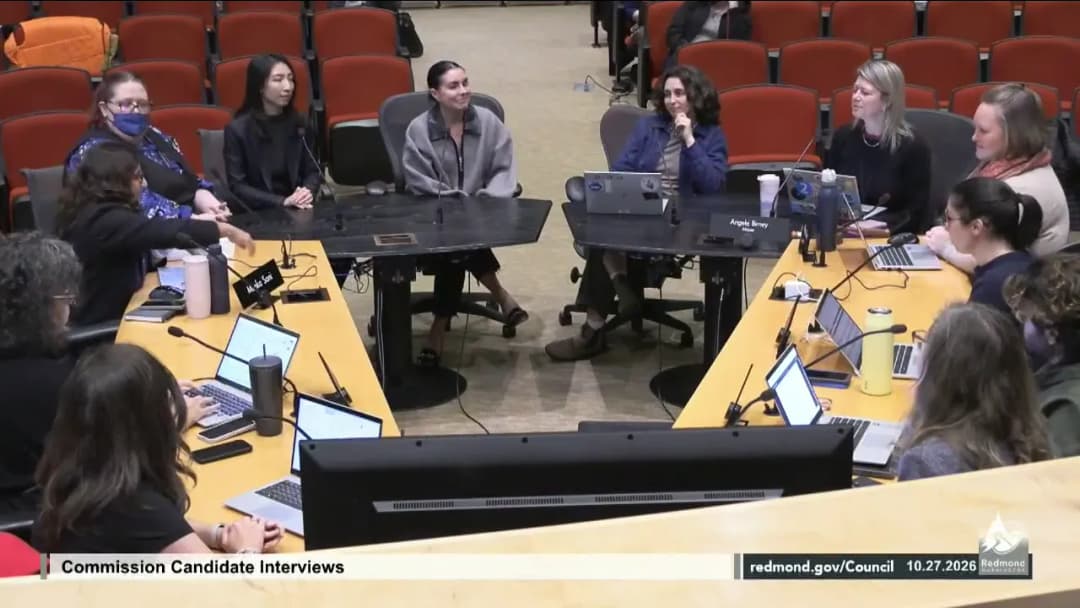
The Redmond City Council held a special meeting on Tuesday, October 27, 2026, beginning at 6:40 p.m., to interview candidates for the Parks, Trails, and Recreation Commission (PTRC) and the Planning Commission. All councilmembers were present, so a formal roll call was not needed. No minutes were available; this summary is based on the agenda and the raw transcript. Parks Planning Manager Lindsay Falkenberg introduced Jenny Baldwin for PTRC, and Principal Planner Becky Fry introduced the Planning Commission candidate. Councilmembers questioned both candidates together about their service motivations, community engagement, future priorities, and accountability for public funds. Candidate Introductions - Jenny Baldwin: A longtime Redmond resident with personal ties to the city's parks and trails; more than 15 years of experience as an educator; current work in strategy and program management at Nordstrom; serves on the Lake Washington Schools Foundation board; and founded the Baldwin Challenge, which has raised more than $200,000 for Northwest Harvest. Staff noted that many current PTRC commissioners are newer to the city, making her longtime-resident perspective valuable, and highlighted her collaboration, stakeholder engagement, and consensus-building experience. - Planning Commission candidate: A licensed architect with a background in landscape architecture and education in urban planning. The candidate followed Redmond 2050 and was excited about its outcomes, wanting to help Redmond continue balanced, sustainable development. Discussion Items - Council President Stuart noted both commissions have strong historical reputations and are experiencing rebuilding and generational leadership changes. Jenny described PTRC as a 'new generation' in its 'sophomore era,' with major initiatives underway, including adding pre-K and early-childhood structures to parks. The Planning Commission candidate praised Redmond's thoughtful, balanced development and said Redmond 2050 aligned with the candidate's passion for contributing to the place they live and love for future generations. - Vice President Nuevacamina asked what each candidate would be proud of by December 2028. Jenny said she hoped to see new trail lighting, especially solar-generated lighting in dark stretches such as the trail from the light rail toward Whole Foods, improving safety, enjoyment, and access to transit and Marymoor Park. The Planning Commission candidate envisioned an active hub around light rail with homes, jobs, restaurants, and nighttime activity, using 'eyes on the street' for safety and avoiding a 'black hole' after dark. - Councilmember Kritzer asked how candidates would gather community feedback on difficult decisions. Jenny said engagement should meet people where they are - Little League games, musicians in Anderson Park, the light rail station, and local bike shops - rather than relying on passive social media posts. The Planning Commission candidate said community members' surface-level ideas often sit on top of shared underlying concerns; the goal should be to identify common ground and find a 'Plan C' that works for everyone. - Councilmember Soni asked what accountability means when public funds are involved, using a hypothetical $5 million legacy project. Jenny said she would choose sustainable lighting in high-traffic dark areas, potentially with commemorative naming; accountability means clear reporting, every line item reconciling, and accessible public reporting. The Planning Commission candidate said they do not have a financial or fundraising background; given Redmond's current position, they would seek projects that not only deliver the project itself but also create surrounding benefits, such as neighborhood growth, jobs, and housing. Key Outcomes - No formal vote was taken during the interview meeting. - Mayor Birney thanked both candidates and said they would be placed on the consent agenda at the council meeting next Monday, the day before Election Day (November 3, 2026). - If candidates attend that meeting, they will be sworn in there and may bring family and friends; if they cannot attend, arrangements will be made to swear them in later, after which they will be assigned to their respective commissions.

COMMUNITY ENGAGEMENT 61% · PARKS AND RECREATION 31% · PUBLIC SAFETY 8%
OPENPUBLICA · PUBLIC MEETING INDEXUPDATED DAILY · openpublica.com