OPENPUBLICA · PUBLIC MEETING RECORD
Record of Proceedings
Committee on Judiciary and Public Safety Hearing on Domestic Violence Survivor Bills and Roundtable, October 27, 2026
Council of the District of Columbia — Tuesday, October 27, 2026
BodyWashington, District Of Columbia
SessionCouncil of the District of Columbia
DateTuesday, October 27, 2026
StatusNEW · FILED
Video Record
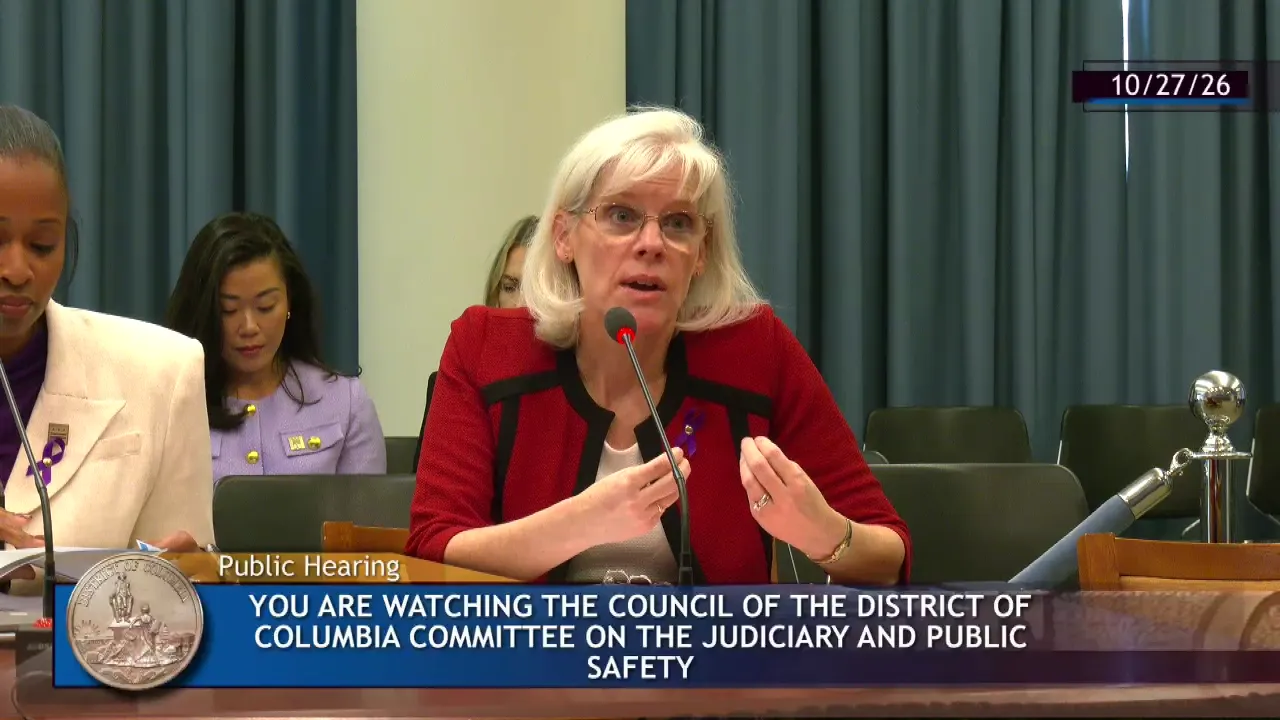
STREAMING COPY IN PREPARATION — RECORDING AVAILABLE FROM THE ORIGINAL SOURCE
Transcript — Verbatim
Speaker numbers apply only to this recording.
Discussion Breakdown — Share of Meeting
Domestic Violence Services48%
Criminal Justice Reform25%
Public Safety12%
Victim Services8%
Juvenile Justice3%
Gun Violence Prevention2%
Economic Justice1%
Housing1%
Summary of Proceedings
Committee on Judiciary and Public Safety Hearing on Domestic Violence Survivor Bills and Roundtable, October 27, 2026
The District of Columbia Council Committee on the Judiciary and Public Safety, chaired by Councilmember Brooke Pinto (Ward 2), held a public hearing on Tuesday, October 27, 2026, in Room 412 of the John A. Wilson Building and via streaming. The hearing covered Bill 26-835 (Supporting Survivors of Domestic Violence and Abuse Amendment Act of 2026), Bill 26-671 (Protecting Victims Amendment Act of 2026), and a general roundtable on domestic violence and sexual assault in the District. The chair convened the hearing at 9:33 a.m. by the transcript; the meeting metadata timestamp is 14:45 UTC. No agenda or minutes were available for this hearing.
The chair opened with statistics: 41% of women and 21% of men in DC will experience physical or sexual violence in a domestic or intimate partner context; 99% of survivors experience economic and financial abuse; on a 2025 day, 103 survivors contacted domestic violence hotlines and 790 sought services, including 339 seeking emergency shelter or housing; and from January 2026 to the hearing date, DC’s 911 center received 10,000 domestic-violence-related calls. Violent crime is up 11% from the prior year, driven largely by assault with a dangerous weapon (ADW), which is up 41%, with 30% of ADW cases related to domestic violence.
Public Comments & Testimony
- Rico Dancy testified as a deaf survivor, describing threats from his ex-wife, a lack of support from police, and alleged race-based denial of help. He urged protections and resources for deaf and disabled survivors and their children.
- Rebecca Mills (Ward 5 survivor) described coercive control and asked the council to examine whether DC law adequately recognizes sustained patterns of intimidation, threats, humiliation, and control as distinct from discrete physical incidents.
- Rachel Hirsch (Council for Court Excellence) opposed making Secure DC’s pretrial detention expansions permanent, citing FY 2025 PSA data showing 88% of adults released pretrial remained arrest-free and 0.5% were rearrested for dangerous/violent offenses. She noted jail population grew 85.4% from January 2023 to 2,299, with 70% pretrial, and that YSC was over capacity at 103 residents.
- Selim Adolpha (Chair, ANC 8C) expressed full support for the Supporting Survivors bill, citing DC Coalition Against Domestic Violence statistics: 47% of women and 43% of men in DC experience intimate partner violence, sexual violence, or stalking in their lifetimes; 55% of homeless families and 24% of unhoused single adults reported DV history; and Ward 8 accounted for 10 of 21 adult DV homicides in 2024 (nearly 48%). She recommended mandatory, ongoing culturally relevant and trauma-informed training for the proposed MPD DV unit.
- Naida Henau (Valari) supported the Supporting Survivors bill but urged restoration of removed provisions: remote testimony and hearings, medical forensic exam confidentiality, mandatory reporting reform, and protection from educational discrimination under the DC Human Rights Act.
- Mary Auto Okonufwa (Legal Aid DC) urged revisions to the Protecting Victims Act to avoid criminalizing survivors, citing cases where survivors were arrested as the alleged aggressor. She opposed mandatory pretrial detention and mandatory minimums, supported the Supporting Survivors bill’s lethality factors, and requested clarity on gun relinquishment timelines, economic abuse remedies, confidentiality, remote testimony, and crime victims compensation.
- Peggy Raymond (ACLU DC) opposed the Protecting Victims Act’s expansion of pretrial detention, saying pretrial release is not driving crime. She cited PSA data that 88% of released people were not arrested and less than 1% were rearrested for a violent offense, and warned of disproportionate impact on Black residents.
- Josh Miller (Open City Advocates) opposed making the expanded juvenile pretrial detention presumption permanent, citing racial disparities—96% of youth in secure detention in FY 2024 were Black—and conditions at YSC, including overcrowding and 462 recorded youth injuries.
- Lavon Pepe (DC Coalition Against Domestic Violence, DCCADV) described DV as a public health crisis, noted DV fatalities accounted for 20.4% of DC homicides the prior year, and called for public health investments, prevention education, housing, health care, and fully funded survivor services.
- Michaela Deming (DCCADV) supported the Supporting Survivors bill with amendments, including a 24-hour gun relinquishment timeline, required consideration of lethality factors, greater MPD unit specificity, and future legislation on coerced debt, school discrimination, confidentiality, and remote hearings.
- Teresa Perr (DCCADV) voiced concern that the Protecting Victims Act relies on increased criminalization, may deter reporting, and fails to fix police/prosecution gaps or provide survivor resources.
- Melissa Millar (ZEDIC DC) welcomed the bill’s recognition of economic abuse but said the VAWA-derived definition is restrictive and unclear; she urged a coerced debt framework modeled on states such as California, New York, Minnesota, Connecticut, Nevada, and Maine.
- Nicole Crouch (Ayuda) supported the Supporting Survivors bill and the DCCADV amendments, especially 24-hour firearm removal, protections from MPD information-sharing with immigration enforcement, and remote court access for immigrant survivors.
- Lisa Wingham (My Sister’s Place) supported the coalition’s positions, highlighted the danger of firearms in DV cases, and cited research that a gun in the hands of an abuser increases a woman’s homicide risk five-fold. She urged a 24-hour relinquishment timeline and a future comprehensive coerced debt bill.
- Clinique Chapman (DC Justice Lab) opposed both bills in their current form, arguing they expand pretrial detention, mandatory incarceration, and criminalization without investing in survivor-led services. She questioned whether MPD should lead the DV response unit, suggesting civilian- and community-led coordination.
- Natalia Otero (DC Safe) supported limited incarceration for a small subset of lethal cases but warned against overcriminalization. She asked for a regular review period, less prescriptive MPD unit design, and stronger agency accountability and prevention resources.
- Jenny Wesbury (DC Safe) supported both bills, especially accountability for repeat CPO violations, lethality factors, recognition of economic abuse, and a 24-hour firearm relinquishment deadline. She recommended including strangulation history as a standalone lethality factor.
- Kylie Hogan (DC Safe) supported the MPD DV unit concept but asked for clearer data roles, a civilian DV coordinator, and reciprocal collaboration across agencies.
- Indira Hennard (DC Rape Crisis Center) expressed concern that the proposed MPD DV unit language could conflict with SAVRA, potentially allowing DV unit response to sexual violence and failing to name sexual assault providers and training. She asked the council to remove conflicting language.
- Lul Muhammad (Person Center) said her organization did not currently endorse the bills, because less than 3% of its clients report to MPD and many immigrant survivors fear law enforcement and immigration consequences. She supported defining economic abuse and expanding culturally specific, community-level responses.
- Virtual witnesses included Aida Findell (Volunteer Legal Advocates), who supported both bills and urged a 24-hour relinquishment timeline and mandatory lethality factors; Lee Goodmark (University of Maryland law professor), who argued criminal legal intervention does not deter IPV and urged prevention investments; Alexandra Bailey, a survivor and former Ward 2 commissioner, who described harmful MPD response, warned that overcriminalization fuels trafficking, and endorsed DCCADV recommendations; and survivor testimonies read by Farhana C., Nayeli Palayo, and Aaron Byrne emphasizing the need for services, social safety net funding, financial assistance, and support for survivors of domestic violence.
Government Witness Testimony and Discussion Items
Supporting Survivors of Domestic Violence and Abuse Amendment Act (Bill 26-835)
The chair described the bill’s five major proposals: an MPD domestic violence response unit; clarification of firearm surrender when a civil protection order is violated; added lethality factors for pretrial detention in protective-order and anti-stalking cases; a FOIA exemption for body-worn camera footage in DV and human trafficking cases; and inclusion of economic and financial abuse in the definition of domestic violence for hotline services.
MPD Assistant Chief Rami Kyle supported many goals but raised two concerns: the proposed gun relinquishment immunity went too far and could undermine investigations and prosecutions, and legislating the structure of a DV unit is impractical given MPD staffing levels, with sworn staffing down by more than 600 in five years. He said MPD would prefer a civilian DV response coordinator and a centralized data analyst over the bill’s specified unit structure. USAO-DC and the Deputy Mayor’s office expressed support for the bill’s definition of economic abuse, lethality factors, and privacy protections.
Protecting Victims Amendment Act (Bill 26-671)
Deputy Mayor Lindsay Appiah testified that Mayor Bowser’s bill would strengthen enforcement of protective orders, expand pretrial detention for repeat domestic violence offenders, enhance penalties, and protect victim privacy. She cited a 46% reduction in violent crime and 36% reduction in total crime over three years, while acknowledging DV homicides remain stubbornly high.
Kathleen Hoke (USAO-DC) strongly supported the bill, including felony penalties with a one-year mandatory minimum for repeat CPO violations, a five-business-day hold for defendants charged with an intrafamily offense while already on release, preserved Secure DC pretrial detention provisions, a revised kidnapping statute following the Cardozo decision, a new felony unlawful entry offense, enhanced penalties for crimes against pregnant victims and intrafamily crimes committed in the presence of children, and withholding victim/witness names from public inspection.
Janice Bechtal (Office of the Attorney General) explained OAG’s role prosecuting CPO contempt cases. She cautioned that a mandatory one-year minimum could be disproportionate for nonviolent communication violations, and said existing enhancements (270 days for a second conviction and 540 days for a third) already allow proportional accountability. She requested pre-charging subpoena power for OAG and adding CPO violations to the definition of intrafamily offenses for detention purposes.
Jennifer Porter (OVSJG) supported the bills, citing the 2026 DV Fatality Review Board report of 31 domestic-violence-related homicides in 2025, including five children under age five, and emphasizing the need for both accountability and survivor-led services.
Caterina Seminova (Public Defender Service) opposed many provisions, arguing that mandatory minimums and mandatory detention strip judicial discretion, criminalize survivors, and ignore the economic and public health drivers of domestic violence. She also objected to the proposed kidnapping changes as arbitrary and to broad witness-name shielding as a transparency concern.
Key Policy Debates
- Gun relinquishment: DCCADV, Ayuda, My Sister’s Place, DC Safe, and OAG called for a 24-hour relinquishment timeline, while MPD and Deputy Mayor Appiah warned that broad immunity could prevent accountability for other crimes; OAG clarified that immunity would only cover illegal possession at surrender, not crimes committed with the weapon.
- Pretrial detention: Many advocates, including CCE, ACLU, Open City Advocates, Legal Aid, and PDS, opposed expanded or permanent Secure DC pretrial detention provisions, citing low rearrest rates, racial disparities, and jail overcapacity. USAO and the Deputy Mayor defended the provisions as necessary for the most dangerous cases, including strangulation and repeat sexual abuse.
- Lethality factors: Multiple witnesses urged changing “may consider” to “shall consider” in the Supporting Survivors bill’s lethality factors. USAO and OAG expressed openness to strengthened language but noted early-stage information limits.
- MPD DV unit: Witnesses differed sharply, with some urging clearer structure, data roles, and sexual assault coordination, and others arguing MPD should not lead the response.
- Data and sunset: CJCC Executive Director Christy Love presented reports showing increases in secure detention after Secure DC and low rearrest rates, but noted methodological limits and federal Privacy Act restrictions prevented a full adult impact analysis. Councilmember Zachary Parker questioned making juvenile pretrial provisions permanent without complete data; Councilmember Matthew Fruman discussed economic drivers and the national crime decline.
Key Outcomes
- No votes were taken at this hearing; it was held for public testimony and committee information.
- Written testimony may be submitted through the council’s hearing management system until Tuesday, November 10, 2026, at 5:30 p.m.
- The chair indicated she would continue work with the U.S. Attorney’s Office, OAG, MPD, advocates, and survivors on amendments to both bills, including gun relinquishment timelines, lethality factor language, MPD unit design, and possible future legislation on coerced debt and other survivor protections.
Meeting Transcript
Reporting in progress. Good morning, everyone. I would like to call to order this public hearing of the Committee on the Judiciary and Public Safety. I am Councilmember Brooke Pinto, representing Ward 2 and chairwoman of the committee. The time is 933 a.m. on Tuesday, October 27th, 2026, and we are conducting this public hearing in person in room 412 of the John A. Wilson Building and streaming on the DC Council's website and YouTube and X at CM Brook Pinto. Today we're conducting a hearing on two bills before the committee. Bill 26 835, supporting survivors of domestic violence and abuse amendment act of 2026, and Bill 26-671, the Protecting Victims Amendment Act of 2026. We're also having a general round table today on domestic violence and sexual assault in the District of Columbia. I want to begin by highlighting that October is domestic violence awareness month. Domestic violence refers to, quote, a pattern of abusive behavior in any relationship that is used by one partner to gain or maintain power and control over another intimate partner, dating partner, or family member, which includes physical, sexual, emotional, economic, or psychological actions or threats of actions that influence another person. In the district, 41% of women and 21% of men will have suffered physical or sexual violence in a domestic or intimate partner context in their lifetime. This is alarming and unacceptable, and we have to turn this reality around for far too many of our neighbors. An overwhelming 99% of survivors will have suffered economic and financial abuse. During the course of one 24 hour day in the district in 2025, 103 survivors contacted domestic violence hotlines, and 790 survivors sought assistance from service providers in the district, including 339 survivors seeking emergency shelter or housing. From January 2026 of this year to date, the DC 911 Center at the Office of Unified Communications has received 10,000 domestic violence incident related calls. Survivors at the margins, in particular, black survivors, immigrant and limited English survivors, LGBTQQIA plus survivors, survivors with disabilities, youth, and survivors who have been trafficked or criminalized, are disproportionately impacted. Alarmingly, we have seen rates of homicides decline in the district and rates of most crimes go down in the district over the last several years. However, the rates of domestic violence homicides have not. Crime stats from MPD show that violent crime is up 11% since this time last year. And MPD says the rise is primarily driven by an increase in one category. Assault with a dangerous weapon, which are up 41%, and 30% of those assault cases are related to domestic violence incidents. I introduced Bill 26-835, the supporting survivors of domestic violence and abuse amendment act, along with Chairman Mendelson, Councilmembers Alan, Henderson, Fruman, Bonds, Silverman, Nadeau, Parker, and Trayon White. The bill would offer interventions for survivors to reduce violence, increase survivor support, and protect victim privacy. The bill was developed in close conversation and collaboration with many of our service providers, survivors, advocates, and community members, many of whom I'm glad to see here today who have signed up to testify. Consisting of five primary proposals, my bill would first establish a domestic violence response unit at MPD to reduce and respond to incidents of domestic violence. Two, amend the law to clarify how firearms must be surrendered when a civil protection order is violated. Third, amend the law to clarify that judges may consider violations of protective orders and anti-stalking orders and prior convictions of domestic violence offenses at high risk factors for lethality when determining whether to order pretrial detention. Four, close a loophole to protect victim privacy by amending public record laws to ensure body worn camera, metropolitan police department footage involving domestic violence or human trafficking related offenses is not subject to public release. And five, ensure the domestic violence hotline provides assistance for victims of economic or financial abuse by including economic and financial abuse as part of the definition of domestic violence consistent with federal law. We'll also consider Bill 26-671, the Protecting Victims Amendment Act of 2026, which was introduced by Mayor Muriel Bowser, that consists of several major proposals, including establishing enhanced penalties for repeat violations of temporary and civil protection orders with mandatory minimums of one year imprisonment. Establish a new pretrial detention authorities for intrafamily offenses, such as non-discretionary five-day holds, an expanded rebuttable presumption of detention if the defendant has committed an intrafamily offense in the last five years, and expanded grounds for revoking release. Would establish criminal contempt for violating release conditions with two penalty tiers and where proceedings are expedited, non-jury and initiated by prosecutors or judicial officers. Would permanently codify the pretrial detention provisions that the council passed in my Secure DC proposal legislation, which would expire otherwise this December. Would expand the definition of dangerous crime to include felony threats and felony violations of protection orders committed against intimate partners to the list of dangerous crimes. It would create felony penalties for unlawful entry where another crime like assault takes place inside and provide enhanced privacy protections for victims and witnesses, including those in the address confidentiality program. In addition to these bills, this hearing is an opportunity to hear from the public on domestic violence and sexual assault in the District of Columbia. And I'm eager to hear testimony on the trends we've seen in domestic intimate partner and sexual violence, lived experience, folks may have with the existing civil and criminal system, including civil protection and stalking orders, as well as ways that we can strengthen survivor supports, reduce incidents of domestic intimate partner and sexual violence, and protect victim privacy. I look forward to hearing from the public, fellow council members, and our government witnesses about these bills and these issues to address the urgency that we have before us today. I also want to thank the countless residents who have reached out to me personally over the course of the last several weeks and years to share their stories very bravely and very personally. And it is these stories that guide my thinking and my urgency on addressing these issues to make sure that we fill these gaps. And so I know this is not an easy topic to talk about for a lot of people, and I'm just grateful that people are willing to come forward and share either their personal experiences, those of you who work with survivors every day. This is a difficult topic and an extremely important topic. So I appreciate it very much. I also want to note, as is almost always the case, that on the Judiciary Committee, we can move forward proposals that impact the agencies that are within our jurisdiction. But addressing these challenges are going to take a whole of government approach to really make sure people have the resources, access to housing, access to supports that they're going to need. And so those proposals and partnership does not end with these bills, but these are the bills that we can move through our committee. So I just wanted to note that as
SUMMARIZED BY OPENPUBLICA AI
TRANSCRIPT VIA PUBLIC VIDEO
openpublica.com
openpublica.com