The Clark County Planning Commission held its briefing meeting on Tuesday, September 1, 2026, at 6:00 p.m. in the Commission Chambers at the Clark County Government Center, Las Vegas, Nevada. Vice-Chair Leslie Mujica presided; Chair Edward Frasier III attended by teleconference. Commissioner Vivian Kilarski and Chief Deputy District Attorney Robert Warhola joined at 6:05 p.m. The briefing included a Las Vegas Valley Water District presentation, a staff preview of the evening's Planning Commission agenda, and three public comments. No final actions were taken during the briefing; the regular meeting was scheduled to reconvene at 7:15 p.m. Las Vegas Valley Water District Presentation - Doah Ross, Deputy General Manager for Engineering and Operations for the Las Vegas Valley Water District and Southern Nevada Water Authority (SNWA), presented on the region's water supply and conservation outlook. - SNWA supplies water to 2.4 million residents in Southern Nevada, including the Las Vegas Valley Water District, City of Henderson, City of North Las Vegas, City of Boulder City, Nellis Air Force Base, and unincorporated Clark County. - Lake Mead is currently at about 27% capacity. Nevada's legal Colorado River allocation is 300,000 acre-feet, about 1.8% of the river, compared to California's 4.4 million acre-feet. Under a Tier One shortage, the allowed withdrawal is 279,000 acre-feet; in 2025, actual consumptive use was 198,000 acre-feet. - The Department of the Interior's recent Record of Decision includes a worst-case option to reduce Nevada's consumptive use to 86,500 acre-feet. The presenter said SNWA filed a lawsuit because that level would cut into actual community water use. - Return-flow credits are central to SNWA's strategy: indoor water connected to the sewer system is treated, returned to the Las Vegas Wash, and then back to Lake Mead, so it does not count against Nevada's allotment. Outdoor consumptive uses, such as landscape irrigation, septic systems, and evaporative cooling, are permanent losses. - Conservation results: since 2002, the region has added more than 800,000 people while reducing total consumptive use and per-person water use. The presenter described 2023 as an unusually wet and cool year that temporarily lowered water use. - New residential yards: since April 2024, new homes cannot install grass in front or backyards. For turf-conversion rebates, at least 50% of the converted area must be living plant life, with an extra $100 rebate for planting a tree; artificial turf is not required or recommended. - The presenter encouraged commissioners to ask developers early about mechanical cooling equipment locations, pools and surf parks, ornamental water features, resort redevelopment, and large consumptive water users, so applicants can consult the Water District before design is finalized. - SNWA is working with the Metropolitan Water District of Southern California on the Pure Water Project, contributing funds toward environmental review in exchange for Southern California leaving a share of its Colorado River water in Lake Mead. Arizona may also join. - SNWA's 50-year resource plan, based on UNLV Center for Business Research and Economics forecasts scaled upward, anticipates the ability to serve all developable land within the disposal boundary if conservation goals are met. - Commissioner Kirk asked about regional comparisons; the presenter said Nevada is a leading conservation model, and other Colorado River basin states are adopting similar turf and non-functional grass restrictions. Commissioner Roitman asked about Lake Mead declines and the Record of Decision response; the presenter cited snowpack, warmer temperatures, reduced runoff, and over-allocation, and said severe cuts would likely target non-essential outdoor use while preserving health and human safety. Commissioner Stone asked about housing growth; the presenter cited the 50-year resource plan and noted innovative cross-state partnerships. Commissioners Kilarski and Brady discussed backyard grass, parks, infill development, turf conversion, tree canopy, and infinity-edge pools. Staff Agenda Briefing - Michael Huling, Principal Planner, reviewed the September 1, 2026 Planning Commission agenda. - Deletion and holds: Item 11 (UC 260424) was deleted from the Planning Commission agenda and will be heard by the Board of County Commissioners on September 2, 2026. Item 14 (VS 260440) was held to the October 6, 2026 Planning Commission meeting per the applicant. Items 23–26 (PA 267034, ZC 260450, WS 260451, TM 2650106) were held to the September 15, 2026 Planning Commission meeting and the October 21, 2026 Board of County Commissioners meeting per the applicant. - Routine action items included staff recommendations for: Item 4: sign design review for Maverick Helicopters, expanding an existing animated freestanding sign from 144 to 280 square feet and from two-sided to three-sided; staff recommended approval. Item 5: seven-lot tentative map for a single-family subdivision in Red Rock, about 35 acres and 0.2 units per acre; staff recommended approval. Item 6: 18-lot tentative map east of Decatur Boulevard and south of Ford Avenue on 1.33 acres; staff recommended approval. Items 7–9: companion applications for a trails map amendment, zone change to PF, and design review for an animal resource center on Post Road and Jones Boulevard; the Department of Aviation's FAA notification requirement analysis was inadvertently omitted from the staff report and would be read into the record; staff recommended approval. Item 10: use permit for a dance studio in the IL zone; staff recommended approval. Item 12: use permit for a recreational and entertainment facility; staff recommended approval. Item 13: vacation of a portion of Cimmerin Road; staff recommended approval. Item 15: design review for utility structures including a water storage tank and booster pump station; staff recommended approval. - Non-routine items included: Item 16: use permit and design review for a place of worship on Westwood Road; staff recommended approval of the use permit but denial of the waivers and design review; the applicant intended to offer conditions reducing the height to 98 feet, adding a parking lot tree, and limiting church services. Item 17: use permit for 20 chickens including three roosters at a single-family residence; staff and the Whitney Town Board recommended denial; 10 protest cards were received. Item 18: waiver to reduce a rear setback from 20 feet to 5 feet for an unpermitted addition; staff and the Paradise Town Board recommended denial. Item 19: waiver to eliminate a side setback for an unpermitted attached garage; staff recommended denial. Items 20–22: companion plan amendment, zone change, and design review for a plant nursery in Red Rock; staff recommended approval of the plan amendment, zone change, and most waivers, but denial of waiver 5 for full offsite improvements due to Public Works concerns. Public Comments & Testimony - Scott Farnsworth commented on items 23–26, which staff clarified were held to September 15 rather than deleted; he said his community was prepared to present and recommended denial if the items were advanced. - Chris Esp, operator of a reverse osmosis pool filtration business, urged Clark County parks and recreation to use reverse osmosis filtration instead of draining and refilling public swimming pools, citing 85–95% water recovery and use of the technology in California and Phoenix. - Eric King, a longtime resident and sustainability designer, advocated for stormwater harvesting, saying about 24,000 acre-feet of runoff could be captured to plant more trees and reduce heat-related deaths; he contrasted this with millions of dollars spent to pump water back from Lake Mead. Key Outcomes - No votes or formal decisions were taken during the briefing. - The holds and deletion announced for the regular meeting agenda were confirmed: UC 260424 deleted; VS 260440 held to October 6; items 23–26 held to September 15 (Planning Commission) and October 21 (Board of County Commissioners). - No new or upcoming ordinances and no administrative items were discussed. - The meeting was adjourned at 6:59 p.m., with the regular Planning Commission meeting scheduled to reconvene at 7:15 p.m.
The Public Meeting Index
The Public Meeting IndexThe Council Transportation Committee (CTC) met on September 1, 2026, at 6:00 PM to discuss the Rengstorff Complete Streets Study and the Final Active Transportation Plan (ATP). The meeting was held in a hybrid format with in-person and virtual participation. Committee members present: Chair Hicks, committee member McAllister (in person), and council member Kamei (virtually, after initial connection issues). The meeting included public comments on both agenda items and deliberation on the ATP. Consent Calendar - Minutes Approval: The minutes from the June 16, 2026 CTC meeting were approved unanimously by the two voting members present (Hicks and McAllister). No public comments were made on the minutes. Public Comments & Testimony - Oral Communications: Two speakers addressed non-agenda items. Valerie Fenneck, a 30-year resident, thanked the committee for the California Complete Streets project, noting increased safety for walking and biking. Caroline Horn, a Los Altos resident, echoed the praise and urged coordination with Palo Alto and Los Altos on San Antonio Road improvements. - Rengstorff Complete Streets Study (Item 5.1): Numerous community members spoke. Key themes included: - Support for protected bike lanes and safety: Many speakers (e.g., Terry Barton, Kian Xien, Kevin Ma, Cliff Chambers, James Thomson, Daniel Halsey, Rashmi Sahai) advocated for continuous protected bike lanes, citing dangerous conditions for students and cyclists. April Webster read a joint letter from several organizations requesting a full green complete streets concept integrating safety and green infrastructure. - Support for combining options: Several speakers (e.g., Alex M., Caroline Horn, Tracy Q., John Scarborough, Bruce England) urged the committee to combine elements of alternatives B (bike) and C (pedestrian/greenery) rather than selecting one. - Support for maintaining parking: Deborah Taviloff, a 31-year resident, stressed the importance of on-street parking on north Rengstorff for elderly and disabled residents, while recommending removal on south Rengstorff to widen bike lanes. - Data and traffic concerns: Committee member McAllister questioned the bike count data, noting low numbers. Staff explained that the data reflects peak hours and that usage may increase with improvements. - Active Transportation Plan (Item 5.2): Public comments included: - Support for the plan: Valerie Fenneck, Mary Vadio, Serge Bones, and April Webster thanked staff for the comprehensive plan and requested continued focus on safety, design standards, and quick-build projects. - Criticism of the plan: William Adler, a retired attorney, argued the plan ignores vehicle traffic, as over 90% of residents rely on cars. He urged limiting projects to safety improvements without significant physical changes. - Requests for improvement: Cliff Chambers requested performance metrics and better integration with the biodiversity plan. Bruce England called for amenities like benches and restrooms. Discussion Items - Rengstorff Complete Streets Study: Staff presented three draft alternatives: A (intersection improvements), B (protected bike lanes), and C (wider sidewalks with greening). Due to constrained right-of-way, each alternative involves trade-offs, particularly regarding parking removal (60% in B and C). Committee discussion focused on balancing safety, vehicle traffic, parking, and greenery. Members provided direction to staff: prioritize safety improvements, explore protected bike lanes where feasible, be intentional about parking removal, emphasize safe routes to school, and incorporate greenery. The committee did not select a single alternative but requested that staff develop a preferred alternative incorporating these priorities. - Active Transportation Plan: Staff presented the final plan, outlining 20 priority projects, policies, and programs. Committee members discussed implementation challenges, particularly for green infrastructure, which is largely tied to expensive reconstruction projects. Chair Hicks expressed concern that greening would be delayed for decades. Staff noted that funding constraints limit green infrastructure to reconstruction projects, but they are seeking grants. The committee also discussed the need for better data, coordination with other agencies, and public engagement. After deliberation, the committee agreed to recommend the plan to the City Council with three additional modifications (see Key Outcomes). Key Outcomes - Rengstorff Complete Streets Study: No formal vote was taken. Staff was directed to develop a preferred alternative that integrates intersection improvements, enhanced bike facilities (potentially with protection), intentional parking removal based on usage data, greenery, and safe routes to school. The study will return to the committee for further review. - Active Transportation Plan: The committee voted unanimously (2-0) to recommend the Final Mountain View Active Transportation Plan for adoption by the City Council, subject to the following staff-recommended modifications and additional requests: 1. Enhance greening and tree canopy improvements (page 50) by adding language about identifying funding streams, prioritizing pedestrian benefits, and coordinating internally to accelerate implementation. 2. Make cut sheet disclaimers more prominent to clearly state that concepts are draft and require further validation and community input. 3. Enhance discussion of bicycle boulevards and shared streets as quick-build, low-cost options, possibly within the neighborhood traffic calming program. The plan will return to the City Council on September 22, 2026, for final adoption.
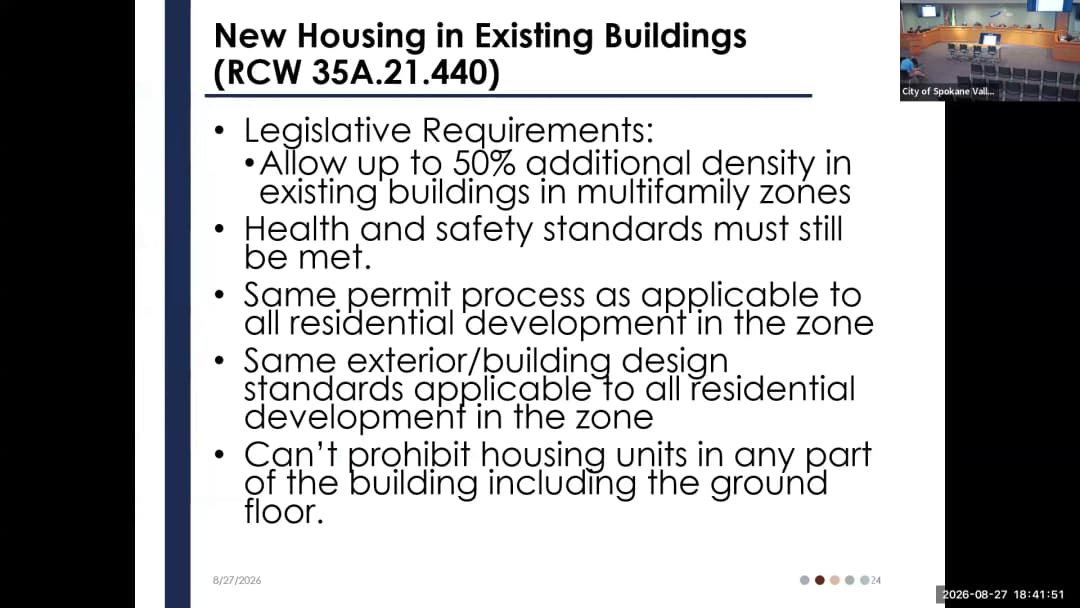
The Spokane Valley Planning Commission held a regular meeting on Thursday, August 27, 2026, at 6:00 p.m. at City Hall. The primary agenda item was a study session on periodic updates to the city's development code to comply with recent state legislation. Ethan Spoo of DOWL presented the legislative changes. Commissioners discussed concerns about parking requirements, lot sizes, and the definition of affordable housing. No votes were taken on code changes. Consent Calendar - Approval of Agenda: Unanimous (7-0). - Approval of Minutes, July 23, 2026: Approved 6-4-1 (one abstention; a commissioner noted they had not yet reviewed the video). - Approval of Minutes, August 13, 2026: Approved 6-4-1 (after correction of the date from August 23 to August 13). Public Comments & Testimony No public comments were offered; no audience members attended in person or online. Discussion Items Administrative Report City staff previewed the upcoming meeting schedule: - September 10, 2026: Discuss the draft comprehensive plan. - September 24, 2026: Review draft development regulations (code changes). - October 8, 2026: Combined discussion of comp plan and code. - October 22, 2026: Public hearing for commission recommendation on code. Study Session: State Code Requirements (Presentation by Ethan Spoo, DOWL) Ethan Spoo presented an overview of legislative updates to the Growth Management Act, citing the national housing crisis. He noted that 33% of Washington households spend more than 30% of income on housing, and locally 50% of renters and 20% of owners in Spokane Valley are cost-burdened. The presentation covered: - Accessory Dwelling Units (ADUs): State requires allowing two ADUs per single-family lot, no less than 1,000 sq. ft., no owner-occupancy requirement, limited impact fees (50%), and same design standards as primary unit. - Middle Housing: State requires allowing at least six of nine specified types (duplex through sixplex, townhouses, stacked flats, courtyard apartments, cottage housing). Base allowance: 4 units per lot; up to 6 if within ½ mile of transit or if 2 affordable units provided (affordability guaranteed for 50 years). ADUs can count as middle housing. - Co-Living Housing: Must be allowed where at least 6 multifamily units are permitted. Sleeping units counted as ¼ dwelling unit for density; ½ unit for sewer fees. - Affordable Housing: Must be treated the same as market-rate housing in the zone; cannot be discriminated against. - STEP Housing (Shelter, Transitional, Emergency, Permanent Supportive): Required to be allowed where residential or hotels are permitted. 2026 legislation mandates same design and permitting standards; city can require 500-ft. notification and operational policies. - New Housing in Existing Buildings: Up to 50% additional density in multifamily zones when converting non-residential buildings; no prohibition on ground-floor housing. - Unit Lot Subdivisions: Allows dividing a lot internally into smaller lots that don't meet minimum lot size, as long as parent lot meets standards. Each unit lot can be separately owned. - Administrative Lot Splits: City must provide an administrative process for splitting a lot in two, with mitigation for displaced occupants. - Parking Restrictions: State sets maximum parking requirements: - Single-family: 1 space per unit. - Multifamily: 0.5 spaces per unit. - Small units (<1,200 sq. ft.), affordable housing, senior housing: 0 spaces. - ADUs: 1 space for lots ≤6,000 sq. ft., 2 spaces for larger. - Zero parking if within ½ mile of transit. - Co-living: 1 space per 4 sleeping rooms. - Commercial spaces 3,000 sq. ft.: 1 per 500 sq. ft.; <3,000 sq. ft.: 0 spaces; child care centers: 0 spaces. - Permit Timelines: Administrative permits (65 days), with public notice (100 days), with public hearing (170 days). Fees refunded partially if deadlines missed. - Child Care: Family daycares (≤12 children) must be allowed in all residential zones; child daycares allowed in all zones except industrial and open space. - Future Schedule: September 24 workshop for draft code; October 22 public hearing. Commissioner Discussion & Positions - Parking (Multiple Commissioners): Several commissioners expressed strong opposition to the reduced parking maximums. Commissioner Winkler noted current regulations at 1.5 spaces per multifamily unit already cause overflow parking, and the new limits (0.5 for multifamily, zero for many) are unrealistic for Spokane Valley, where car dependence is high. She argued this "does not work for Spokane Valley" and raises safety and emergency access issues. Commissioner Dingus echoed concerns, citing real-world examples of parking shortages in unit lot subdivisions. Commissioner Weatherman questioned where visitors and workers would park in senior housing with zero spaces. - Affordable Housing Terminology: Commissioner Dingus criticized the term "affordable housing," stating it stigmatizes low-income housing and should be more descriptive. He suggested "subsidized" or specifying income brackets. Staff noted the state uses area median income definitions. - Lot Sizes and Density: Commissioner Winkler asked about minimum lot sizes for middle housing. Staff clarified they depend on zoning district (R1: 40,000 sq. ft. to R4: 4,500 sq. ft.). The state allows pre-existing smaller lots to be used for middle housing, but future divisions must meet zoning minima. - Unit Lot Subdivisions: Commissioner Winkler inquired about separate ownership and emergency access requirements; staff confirmed separate ownership is allowed and emergency access standards apply. - Co-Living: Commissioner Winkler shared a personal anecdote about her daughter's uncomfortable co-living experience, questioning the model's viability. Commissioner Dingus noted historical co-living existed in the 1980s but was largely eliminated; it was "affordable" but uncomfortable. - Permit Timelines: Commissioner Dingus asked about contractor performance tracking; staff said there is no such system, but the city meets its timelines almost always. - Request for Early Materials: Commissioners McKinley and Winkler requested the draft comp plan chapters be sent by September 4 (before Labor Day) to allow review. Staff agreed to provide a link to existing materials. Key Outcomes - No formal decisions or votes were taken on code changes; the study session was informational. - Next steps were confirmed: September 24 workshop on draft code, October 22 public hearing. - Staff will provide commissioners with links to existing comp plan chapters and will aim to distribute the updated draft comp plan before the September 10 meeting. - The parking study was noted as a potential tool to request state certification for alternative standards, but no jurisdiction has been successful yet. Adjournment The meeting adjourned after a reading by Chairman Robertson of a passage from Carl Sandburg about the republic being a dream.
The Bullhead City Council met on Tuesday, September 1, 2026, at 5:30 PM in City Council Chambers. The meeting included a presentation on swim lesson statistics, a public comment period with speakers addressing surveillance, water allocation, and community events, a manager's report covering transit improvements and right-turn lane projects, and unanimous approval of all action items including condominium plats, code amendments, and a land transaction. Consent Calendar - Approved the minutes of the August 17, 2026 Regular Council Meeting unanimously (6-0). Public Comments & Testimony - Stephen Lee urged the council to consider banning intrusive surveillance cameras (Flock, Axion), citing Fourth Amendment privacy concerns. - Carol Nelson promoted the Colorado River Republican Women meeting on September 2, 2026, with candidates for council. - Rose Jacobs (Golden Rule Community Volunteers) highlighted kindness campaigns and requested a financial sponsor. - Harvey Pryor invited the public to RC race events at Rotary Park and the Optium Club on September 2 and 5, 2026. - Chaplain Laurie Dennison thanked lifeguards for creating a safe environment at the community pool. - Dave Heath (Boys & Girls Clubs of the Colorado River) announced fundraising events: a golf tournament on October 10, 2026, and a Frightening Fall Fiesta on October 2, 2026, to support youth programs. - Misty Davinny requested a moratorium or new ordinance (Chapter 13.60) to require data centers to provide their own water and power, arguing costs should not fall on residents. She submitted a five-page packet. - Julie Hassett (Colorado River Concerts) promoted the 52nd season starting November 5, 2026, and a "Wine and Choose" event on September 24, 2026, for community input on performers. - Stephen Brown (Bullhead Regional Food Bank) announced September as Hunger Action Month and highlighted the food bank's expansion with help from BHHS Legacy Foundation. - Scotty complained about the placement of "Call to the Public" on the agenda and referenced past disagreements with council. Manager's Report - Transit Bus Stop at Senior Center: Effective September 4, 2026, the transit bus stop has been relocated into the Senior Enrichment Center parking lot, with ADA-accessible sidewalks and a shaded shelter. - Right Turn Lane Construction Projects (presented by Public Works Director Angie Johnson): - Laughlin Ranch: $501,974.00 - Safeway: $2,770,472.83 (contractors returning for warranty work on striping) - Thunderstruck: $399,994.19 - Mojave Drive: $405,769.74 - Rising Sun/Sterling/Central: $493,753.27 - Meadows Drive southbound: design complete, bidding within six months - Bullhead Parkway & SR95 eastbound: design underway, working with National Park Service and ADOT - CityCentre right turn lane: substantially completed, final payment $1.3 million (under $1.6 million award) - Total ADOT funds: $8 million; expended to date: $4,631,155.27; remaining: $3,368,155.57. Council praised the projects for improving traffic flow and cost efficiency. - League of Cities and Towns Conference: Council members and staff attended; Mayor Dahlman reported speaking with Senator Mark Kelly about funding for Bullhead City. - Arizona Department of Housing CDBG Development of the Year Award: The city received the award for the Bullhead Regional Food Bank expansion. The project doubled storage capacity; weekly distribution grew from 9,000–12,000 pounds to 300 people to 80,000–120,000 pounds to 1,200–1,400 people. A video highlighted the impact. Discussion Items - Item 2 – Stonebridge Storage Condominiums Preliminary Plat: Approved conditional use permit stipulations limiting sales to residents of Chaparral Terrace and surrounding neighborhoods. Approved 6-0. - Item 3 – La Jolla Village Condominiums Final Plat: Conversion of six existing four-plex buildings (24 units) into condominiums; parking meets requirements. Vice Mayor asked about fire access and parking, staff confirmed prior approvals. Approved 6-0. - Item 4 – Residences at Parkside Final Plat & Financial Assurance: Subdivision of 13.9 acres into 102 single-family lots (4,000–6,500 sq ft lots; homes 1,030–1,470 sq ft). Streets dedicated to public. A public commenter (Harvey Pryor) questioned water allocation following a 29% cut in Arizona’s Colorado River allocation. City Manager Cotter stated the city’s allocation remains 30,000 acre-feet (supporting well over 100,000 people), and no cuts have been applied yet, but future litigation is expected. Councilwoman noted that reclaimed water will also be part of future discussions. Approved 6-0. - Item 5 – CityCentre Districts Master Plat: Splits 223 acres into 8 lots and 6 parcels; rights-of-way dedicated; water allocation not requested at this time. Councilwoman urged low-water-use landscaping on retention parcels. A public commenter (Scotty) expressed concern about right-turn lanes on Riverview. City Manager responded that future developments will be studied for turn-lane needs. Approved 6-0. - Item 6 – Ordinance 2026-15 (Building Setbacks): Reduces rear setback for commercial buildings abutting an alley adjacent to residential districts from 15 feet to 5 feet (minimum 25 feet separation with alley). Approved 6-0. - Item 7 – Ordinance 2026-16 (Fences and Walls): Codifies requirement that fences and walls (including footings) be located entirely within the applicant's property boundary to prevent ownership disputes. Approved 6-0. - Item 8 – GIITEM State Gang Task Force Agreement: Renews intergovernmental agreement with Arizona DPS for gang enforcement. Police Chief noted ongoing gang issues and recent homicide suspected as gang-related. Approved 6-0. - Item 9 – Donation of Humvee to Veterans Park: Jerry Hardy donated a 1997 AM General M1097A2; $10,000 allocated from contingency for transport/restoration/installation. Council thanked donor; refurbishment expected under budget due to community volunteer support. Approved 6-0. - Item 10 – Land Transaction with Richard La Point: Technical resolution related to a 2015 land exchange; city manager authorized to execute warranty deed and related documents. Approved 6-0. Key Outcomes - All consent and action items were approved, most by 6-0 votes (the waiver motion passed 4-1; one council member opposed). - The manager’s report was received, and council members offered additional remarks on community programs, including River Watch and PACT Academy. - A public request by Misty Davinny to place a new water-use ordinance on the September 15, 2026 agenda was noted but not formally acted upon; the council did not take action on that request during the meeting.
The Kirkland City Council met on September 1, 2026, for a study session beginning at 5:30 p.m. and a regular meeting at 7:30 p.m., adjourning at 10:07 p.m. All seven council members were present. The study session covered domestic violence and sexual assault advocacy programs and a preliminary review of the 2027–2032 Capital Improvement Program (CIP). The regular meeting included proclamations, public comments, a public hearing, consent calendar approval, and action on four business items: civil detention center code amendments, an International Community School (ICS) development plan amendment, affordable housing zoning amendments, and revised parking enforcement code amendments. Consent Calendar - Approved as a block (7-0) including: - Minutes of August 5, 2026. - Audit of accounts: Payroll of $8,635,240.77 (Aug 7) and $9,553,344.95 (Aug 24); bills of $13,511,645.01. - Claims for damages from Volha Shyshyna and Makayla Titus. - Award of bid for 105th Ave NE Sewer Line Repair to Shoreline Construction Co. ($178,450.56) with a $60,141 transfer from Sanitary Sewer Utility Reserves. - Resolution R-5743 authorizing the City Manager to execute WSDOT turnback agreements for the I-405/NE 132nd Street Interchange and Totem Lake Freeway Station projects. - Proclamations for Suicide Prevention Awareness Month, National Recovery Month, and Childhood Cancer Awareness Month (September 2026). - Ratification of International Association of Firefighters Local collective bargaining agreement. - Reports: Fire Department Dashboard, Parks and Community Services, Financial Management, Sales Tax (July 2026), Investment (July 2026), and Procurement — all second quarter 2026. Public Comments & Testimony - Karina O'Malley (on-site) opposed the revised parking enforcement ordinance, arguing it effectively bans RVs and people living in vehicles, and cited an instance where a van used as shelter was impounded without notice. - Britt Hykal (virtual) and Sierra Diaz (on-site) spoke in support of the Lake Washington Toddler Group, a cooperative preschool facing closure due to the State Board of Community and Technical Colleges ending funding. They urged the Council to use its influence to protect the program. - Erin Belmore (on-site) complained about unresolved permitting issues at Park 54 Condo Association (404 Fourth Avenue) and lack of responses from city staff, requesting answers before a resolution. - Alex Tsimerman (on-site) raised personal housing complaints against King County Housing Authority, threatened litigation, and made unrelated remarks; he was warned and later asked to leave during the public hearing. - Erin Hamilton (on-site) discussed mental health system failures, criticizing Crisis Connections and hospital treatment, and urged better support for those with brain injuries and transgender individuals. - Aliesha Ruiz (Habitat for Humanity, on-site) urged rejection of Ordinance O-4937, arguing that permitting delays — not the affordable housing fee — are the main barrier to building, and that cutting the fee reduces funding for affordable homes. - Public Hearing on Civil Detention Center Code Amendments: Guillermo Rivera (Eastside for All) thanked the city for community engagement and translation efforts. Lisa Berenson argued the amendments are insufficient against federal detention facilities. Discussion Items - Study Session: Domestic Violence and Sexual Assault Advocacy Programs — Kate Garvey (KCSARC CEO) and Hua Goldstein reported on the Kirkland pilot: 43 survivors served July–Dec 2025, 62 Jan–June 2026, with 85% of referrals from Kirkland Police Department. KPD Chief St. Jean, Lieutenant Slominski, Deputy Chief Goguen, and DV advocate Shanice Dawson presented on domestic violence advocacy, noting 1,159 case reports in 18 months (509 with criminal offenses). Council discussed coordination, weapons identification, and school engagement. - Study Session: Preliminary 2027–2032 Capital Improvement Program Review — Financial Planning Supervisor Veronica Hill and Senior Financial Analyst Jessica Clem presented the $224 million proposed CIP across eight programs (transportation $83M, parks $32M, utilities $74M, etc.). Projects included Peter Kirk Pool renovation, South Reservoir replacement (cost increase to $44.7M), transportation improvements (e.g., 85th St and Kirkland Way protected intersections, safer routes to school). Council requested more transparency on project selection criteria. - Business Item: Civil Detention Center Code Amendments (Ordinance O-4947) — Senior Planner David Barnes explained the amendment to prohibit civil detention centers as authorized land use, except those required by state law. Council adopted unanimously (7-0) after public hearing. - Business Item: International Community School Development Plan Amendment (Resolution R-5744) — A quasi-judicial matter. Senior Planner Tony Leavitt presented the Hearing Examiner’s recommendation to increase ICS enrollment from 445 to 545 students with on-site traffic improvements. Councilmember Falcone disclosed her child attends co-located CES but remained impartial. Council suspended rules and approved (7-0). - Business Item: Affordable Housing Zoning Amendments (Ordinance O-4937) — Planning Director Adam Weinstein presented data. Councilmember Prem and Falcone proposed an amendment to raise the per-square-foot fee from $15 to $20 and keep the exemption at 2,500 square feet (instead of lowering it to 2,000). After debate, this amendment passed 4-3. A second amendment to delete a required 2028 progress report passed 7-0. The amended ordinance then failed 3-4, leaving the original June 2025 policy (2,000 sq ft exemption, $15/sq ft fee) in effect. - Business Item: Revised Parking Enforcement Code Amendments (Ordinance O-4946) — Assistant City Attorney Ryan Gompertz and Lieutenant Troy Knafla presented revisions: codified 72-hour owner notification before impound, added compassion for unhoused individuals, and redefined RVs as vehicles 7 ft wide used for recreation. Councilmember Falcone opposed due to insufficient community input on the RV ban. Others supported, citing KPD’s outreach-first approach. Adopted 6-1. Reports - Council Regional and Committee Reports: Pride Across the Bridge event (Sept. 5), federal budget advocacy, State Building Code Council updates including embodied carbon appendix and wildfire rebuilding committee, and Kirkland’s role in the latter. - City Manager Reports: NE 132nd St Roundabouts Safety Improvement Project — speed cushions to reduce collisions, funded by WSDOT, completion expected late October 2026. Calendar update: Councilmember Falcone will attend the Sept. 15 meeting virtually; Councilmember Pascal will be absent. Key Outcomes - Consent Calendar approved 7-0. - Ordinance O-4947 (civil detention center prohibition) adopted 7-0. - Resolution R-5744 (ICS enrollment increase) adopted 7-0. - Ordinance O-4937 (affordable housing fee) as amended failed 3-4; the original June 2025 policy remains. - Ordinance O-4946 (parking enforcement) adopted 6-1 (Councilmember Falcone opposed). - Study sessions concluded with direction to staff to bring back more detailed project selection information for the CIP and to continue collaboration on advocacy programs.
The Alameda City Council met on Tuesday, September 1, 2026, starting with a closed session at 5:30 PM, followed by a special joint meeting at 6:59 PM, and the regular meeting at 7:00 PM. The council addressed a range of items including a critical commitment letter for the Stardust Gardens supportive housing project, approval of responses to a civil grand jury report on emergency preparedness, and lease amendments for two Alameda Point tenants. Consent Calendar - Approved routine items from the closed session (designation of real property negotiators for Building 24 and Piers 2 and 3) and the special joint meeting (minutes and investment report). - Approved the regular consent calendar (items 5-A through 5-I), including police policy updates, a data acquisition support contract, a roof drain replacement project, ambulance transport agreement amendments, fire department compensation resolution, five grant applications totaling $5.03 million, and final passage of an ordinance prohibiting parking in bicycle lanes. Public Comments & Testimony - Closed Session Comments: Mary Ann Morgan expressed community concern about companies involved in negotiations at Alameda Point, particularly those involved in military and AI technologies, calling for more transparency. - Non-Agenda Oral Communications: Several speakers addressed: - Josh Altieri (Housing Authority) gave a quarterly update on voucher programs and partnerships. - Ken Levins (Marina Shores HOA) urged the council to refer a proposed truck route modification on Clement Avenue for further review, suggesting an alternative routing (westbound trucks on Clement, eastbound on Buena Vista). - Sid spoke against Flock cameras, citing Fourth Amendment concerns and potential for abuse. - Amos White opposed citing an AI data center at Alameda Point, citing water, electricity, air quality, noise, and equity impacts. - Anna Mayer (Marina Shores resident) supported the referral request, citing safety and pedestrian concerns. - Chris Blair and Katya Marthy opposed negotiations with certain corporations (e.g., Apollo Atomics, Giga Energy) without public notice. - Doyle Saylor objected to a potential data center and criticized the use of NDAs. - Maylani Sheehan shared a personal story about domestic violence. - Agenda Item 7A (Stardust Gardens): Sixteen speakers testified, including: - Representatives from MidPen Housing, Alameda Point Collaborative (APC), Operation Dignity, the Alameda Food Bank, Brookfield Residential, San Francisco Bay Ferry, and community members expressed strong support for the city’s commitment letter. - Several Housing Authority board members and staff (Carly Grobe, Vanessa Cooper, Sylvia Martinez, Vadim Sidelnikov, Sepideh Kimarsi) explained the Housing Authority’s position: they could not commit project-based vouchers due to HUD regulations and budget constraints, but they remain committed to finding a solution. They requested the city approve the stopgap subsidy while the Housing Authority explores options. - Former Councilmember Malia Vella urged support and noted that the Housing Authority had years to act. - Michael Pucci warned against repeating past Section 8 funding shortfalls and criticized the city’s HUD consultant. - Agenda Item 7C (DOER Marine): Elizabeth Taylor thanked the council for working on the lease extension. - Later Oral Communications: Megan spoke about the importance of placemaking in selecting tenants for waterfront buildings at Alameda Point, urging the council to prioritize community gathering spaces over utilitarian uses. Leo Esclamado (remote) reiterated concerns about the Clement Avenue truck route and requested a referral for safer alternatives. Discussion Items - 7A – Stardust Gardens Operating Subsidy: City Manager Gerry Beaudin and Base Reuse Director Abigail Thorne-Lyman presented the recommendation to authorize a commitment letter to MidPen Housing for a $1 million annual operating subsidy (with 2.5% annual escalation for 20 years, total $25.5 million) for the 80-unit supportive housing project. The subsidy is a stopgap measure while the Alameda Housing Authority works out a permanent project-based voucher commitment. The project has raised $60 million in development funding and needs operating subsidy to secure final tax credits by September 8, 2026. The city would fund it from the Alameda Point Fund, delaying other infrastructure. Councilmembers debated the issue, with some expressing frustration at the Housing Authority’s lack of action but ultimately supporting the stopgap. Councilmember Daysog’s motion emphasized using the first paragraph of the staff recommendation and de-emphasizing paragraph three (structural changes to the Housing Authority). The council also directed staff to include language ensuring the city’s commitment can be reduced if other operating subsidies materialize. - 7B – Response to Grand Jury Report on Emergency Preparedness: City Manager Beaudin and Fire Chief Nick Luby presented the city’s response to the 2025-26 Alameda County Civil Grand Jury report. The city agreed with several findings (e.g., need for updated EOP, improvements in social media messaging) and partially agreed with others (e.g., training exercises). They disagreed with the recommendation to discontinue the disaster registry. Councilmember Bowler requested adding clarifying language to responses for recommendations 29 and 30 (regarding after-action reports). The council approved the response unanimously with that amendment. - 7C – DOER Marine Lease Amendment: Base Reuse Manager Alesia Strauch presented a second lease amendment for DOER Marine Operations (Building 41) for a six-month extension with two six-month renewal options (total possible 18 months). Rent remains the same for the initial six months, with 5% escalation on renewals. The goal is to maintain a tenant while the city works toward conveying the building. Approved unanimously. - 7D – Faction Brewing Lease Amendment: Analyst Annie Cox presented a third lease amendment for Faction Brewing (Building 22, Suite 200). The amendment extends the initial term by three years, provides a repayment schedule for $222,000 in past-due rent, and offers a one-time credit for shade structure and signage improvements. Faction has been paying full rent since February 2026. Approved unanimously. Key Outcomes - 7A – Stardust Gardens: The council voted unanimously (5-0) to authorize the city manager to sign a commitment letter in substantial conformance with the staff report, with direction to include language allowing the city’s subsidy to be offset by other operating subsidies. The city will report back regularly. - 7B – Grand Jury Response: The council voted unanimously (5-0) to authorize the city manager to finalize and transmit the city’s response, with added language clarifying implementation status for recommendations 29 and 30. - 7C – DOER Marine: The council voted unanimously (5-0) to introduce the ordinance authorizing the lease amendment. - 7D – Faction Brewing: The council voted unanimously (5-0) to introduce the ordinance authorizing the third lease amendment. - Council Referrals and Communications: Councilmember Jensen raised concerns about the closure of restaurants at Harbor Bay Landing Shopping Center and urged staff to work with the property owner. Mayor Ashcraft announced nominations for appointments to the Civil Service Board, Planning Board, and Transportation Commission, to be confirmed at the next meeting.
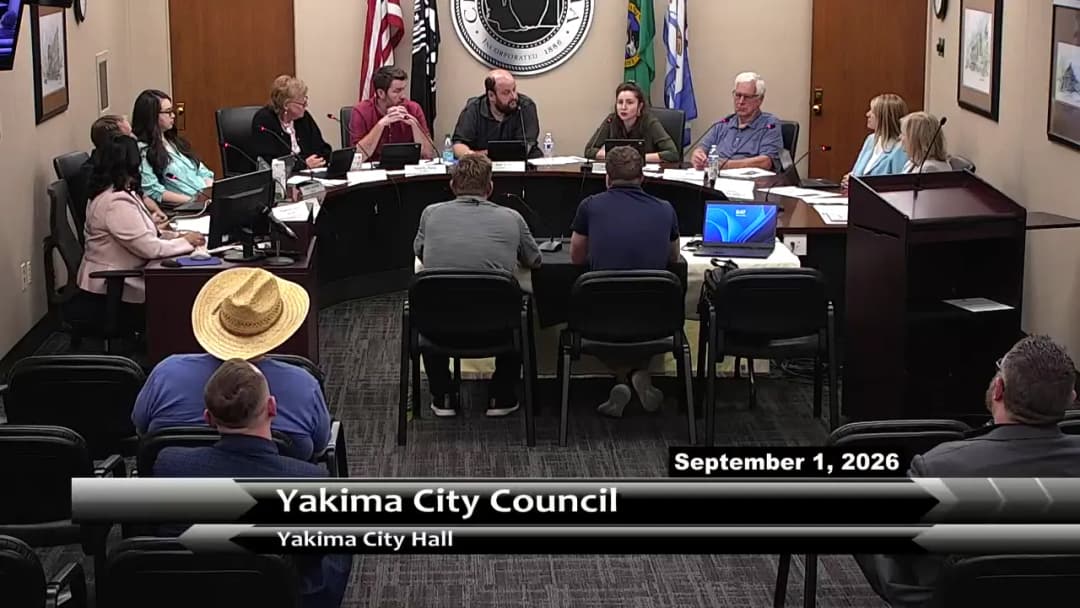
The Yakima City Council met on September 1, 2026, from 5:30 p.m. to 6:56 p.m. in City Hall Council Chambers. The agenda included recognition of a local soccer team, public comments on surveillance and legal matters, a consent agenda, and two department items: an update on a proposed medical detox facility and a resolution authorizing HUD grant applications. The council approved all consent items and the grant resolution unanimously. Consent Calendar - Approved minutes from August 18 and August 25, 2026, meetings. - Set October 6, 2026, for a closed record public hearing on the preliminary plat of "Plat of the Orchards." - Set October 6, 2026, for a public hearing on Secure Community Transition Facilities. - Awarded bid 12606 to Ferguson Waterworks for fire hydrant purchase and delivery (Resolution R-2026-135). - Authorized a Professional Services Agreement with Parametrix, Inc. for engineering services on the Goodwin Tracts Sanitary Sewer Lift Station Improvements (Resolution R-2026-136). All items passed 7-0. Public Comments & Testimony - Zachary Galland (City resident, District 1) opposed Flock cameras, citing recent misuse incidents in other jurisdictions and questioning internal audits, retention policies, and oversight. He argued that Flock's recommended 7-day retention conflicts with the city's longer window and urged cancellation of the contract. - Sue Fenich (City resident) criticized the City Manager and City Attorney for filing an appeal in the Mark Peterson case without council approval, asserting a violation of the city charter. - Tony Sandoval (City resident) expressed support for Chief Boyle and for Flock cameras, stating that surveillance is a long-standing practice and that those not doing wrong have nothing to fear. He also mentioned recent immigration detentions at the city jail. - Joseph Kopsick (City resident) argued Flock cameras do not work and carry high false-positive rates, citing national statistics (1 billion scans/month, potential 30 million false accusations daily). He linked police abuse and lack of trust in the justice system. - Troy Cunningham (City resident) spoke against Camp Hope’s leadership and safety conditions, alleging retaliation after advocating for improvements. - Brian Korst (City resident) raised concerns about ICE activity at city facilities but noted Chief Boyle had addressed his questions. - Mark Peterson (City resident) stated he won his litigation against the city, but the City Manager filed a declaration to appeal despite a prior council press release saying no appeal would occur. He accused council of failing to control staff. - Andreina Rangel (County resident) questioned the ongoing presence of 16–23 Flock Raven gunshot detectors from a 2022 contract, lack of transparency about Lifed cameras near parks, and dismissive responses from police at a recent town hall. - Amanda G. (County resident) urged citizens to recognize that Flock cameras surveil everyone, not just criminals, and criticized council members for lacking integrity and ignoring resident concerns. - Tony Courcy (City resident) referenced a city code section on classification and compensation, alleging lost documents and unanswered questions. Discussion Items 9A: Yakima County Medical Detox Facility Update County Commissioner Kyle Curtis introduced new Human Services Director Matthew McKay (effective Sept. 2, 2026). Dr. Jaime Simmons and Jolene Seda (CEO) of Triumph Treatment Services presented on the proposed 12-bed medical detox facility. Key points: - The closest existing facility is 100 miles away; 60–65% of overdose victims are housed, not homeless. - Triumph's SPRINT program, launched in August 2026, partners with EMS to administer buprenorphine after Narcan and deploy peer support specialists. It has treated three individuals so far; all remain engaged in treatment. - The facility would be voluntary, low-barrier, and provide 24/7 nursing and medical support, with an average stay of 4–5 days. - Estimated cost: $8.3 million to renovate the former jail quadrant to meet Department of Health standards. Currently, $6 million in local mental health sales tax has been awarded to Triumph for services, $309,000 from a state capital budget for design, and a $4 million federal request is pending. - Commissioner Curtis asked the council to consider any available city funds to close the gap, noting that local contributions strengthen applications for state and federal dollars. Councilmembers asked about funding certainty, out-of-county preference, length of stay, and capacity to fill beds. Staff noted preference can be given but federal funds may prevent exclusion of non-residents. Council expressed support but raised concerns about cost and timeline. 9B: HUD Grant Applications for Lead Hazard Reduction and Older Adults Home Modification Assistant City Manager Gary Ballew and ONDS Program Supervisor Jesse Mooney explained two grants: - Lead Hazard Reduction Grant Program: $4 million over 4 years to address lead-based paint in pre-1977 homes (approximately 20,000 units in Yakima). Yakima ranks among the highest-risk counties in the nation. The grant would expand the existing emergency repair program to include siding and window replacement. - Older Adults Home Modification Grant Program: $2 million over 3 years to support home modifications (e.g., ramps) for seniors, with a 10% match from CDBG funds. The council adopted Resolution R-2026-137 authorizing the City Manager to apply (7-0). If awarded, staff will return for further authorization. Key Outcomes - Approved all consent agenda items by a 7-0 vote. - Adopted Resolution R-2026-137 authorizing HUD grant applications by a 7-0 vote. - No action taken on the medical detox facility update, but council supported the concept and indicated willingness to consider future funding requests. - Councilmember Glenn raised the federal issue of undocumented long-term residents lacking a path to citizenship; council acknowledged it is beyond city purview. - Mayor Brown noted an overdose awareness proclamation request was missed due to scheduling; suggested future proactive submissions.
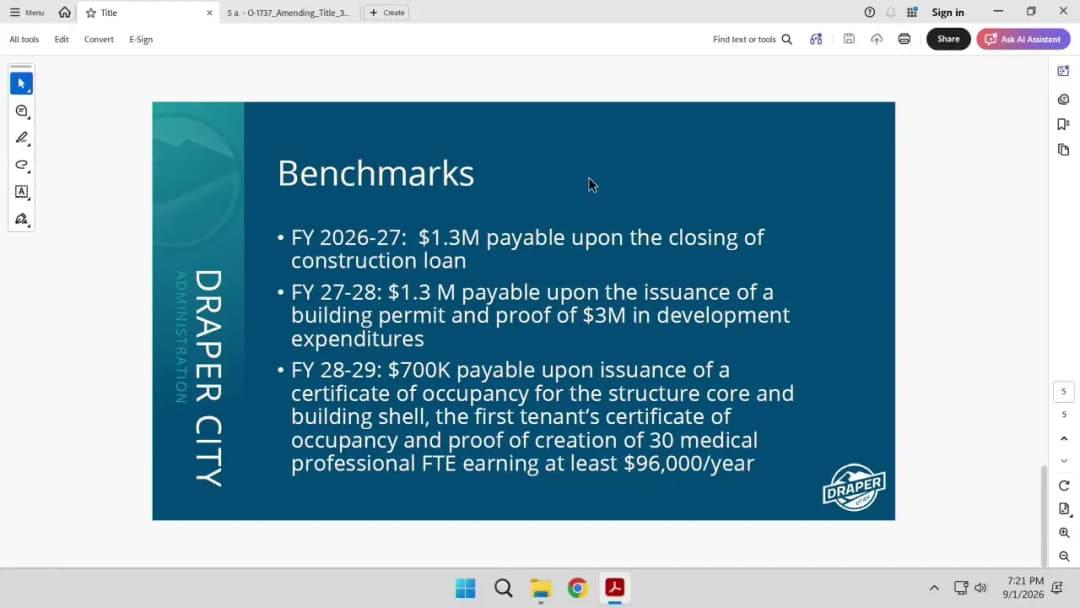
The Draper City Council met on September 1, 2026, at 6:30 PM for a study session (including a closed session for potential real estate acquisition/sale) and resumed at 7:00 PM for the business session. The council approved the consent calendar, adopted a code cleanup ordinance, and later recessed to a Community Reinvestment Agency (CRA) meeting where they approved a participation agreement for a medical office building. Council member Michael Green was absent. Consent Calendar - 4a: Approved minutes from August 12, 2026, and August 18, 2026, City Council meetings. - 4b: Approved Resolution 26-40 reappointing Geneva Woodmansee to the Parks, Trails, and Recreation Committee. - 4c: Approved Resolution 26-41 appointing Laura Fidler as a regular member of the Planning Commission. - 4d: Approved Resolution 26-42 appointing Drew Martinez as an alternate member of the Planning Commission. - 4e: Approved Resolution 26-43 authorizing the Mayor to execute a Quit Claim Deed for property in the Suncrest Development. All consent items were approved unanimously (4-0). Public Comments & Testimony - Dave Mast (14727 Canyon Point Road, 50-year Draper resident) expressed frustration with the Draper Water Department over a plat amendment for his Lone Peak Canyon development. He stated he is reducing seven lots to three and surrendering four water connections but is required to predict the location of a future water connection for a larger lot. He requested a condition allowing the connection location to be determined by the buyer at the time of building, and asked the council to help expedite the process. - Reed Gibby (667 Vandalay Lane) shared personal experiences with the medical system and expressed concerns about federal COVID-19 policies, including the U.S. recommendation of six-foot distancing compared to the WHO’s one-meter recommendation. He thanked the council and staff for their honesty. Discussion Items Study Session & Council/Manager Reports (prior to business session) - The council briefly entered a closed session to discuss potential real estate acquisition or sale (location noted as the conference room, motion approved 4-0). - Tree Committee Renaming & Beautification: Council member (unidentified) reported that the Tree Committee met that morning and welcomed a collaborative role in the beautification fund. The committee expressed interest in updating its duties and possibly changing its name to better represent its work (e.g., City Beautification Committee or Trees & Landscaping). The council discussed merging parks responsibilities with beautification and noted the committee's expertise in water-wise landscaping. The committee has been teaching well-attended classes on water-wise landscaping, with the highest attendance in the valley. - Gateway Projects: Discussion of a potential welcome-to-Draper sign at the Smith’s development gateway. The committee hoped to use the site for beautification, but the corner property is owned by UDOT. The focus shifted to Smith’s property if a small spot can be secured. The existing detention basin filled during a recent storm. - Widow Maker Trail Event: The sign for the Widow Maker Trail at the flight park has been installed. A dedication event is planned for October 10, 2026 (time TBD, likely early afternoon). The county will not allow closing any portion of the park. The Kimball family (including Mel Kimball, in his 80s) will attend with vintage motorcycles. Some cookies shaped like motorcycles may be provided. - Foster Cat Situation: One council member noted a need to discuss the city’s approach to feral/foster cats, following what other cities are doing, as the issue involves passionate residents. - Great Salt Lake Documentary: A council member invited others to a showing of the documentary “The Lake” about the Great Salt Lake, hosted by Cottonwood Heights on September 10. The council also considered hosting a showing in Draper as part of water-wise education efforts. Business Session - Item 5a – Ordinance 1737 (Government Records Access): Presented by City Recorder Nicole Smedley. The ordinance updates Title 3, Chapter 4 of the Draper City Municipal Code to align with state records management statutes, described as administrative cleanup with no change to public records access or compliance. Approved unanimously (4-0). Community Reinvestment Agency (CRA) Meeting (Recess from City Council) - Item 2a: Approved minutes from the August 18, 2026 CRA meeting. - Item 2b – Resolution CRA 26-05 (Participation Agreement): Approved a participation agreement with Nextcore Health Development LLC for a three-story, 80,000-square-foot medical office building adjacent to Lone Peak Hospital. The CRA will contribute $3.3 million from the Crescent Redevelopment District (which has about $7.3 million available). The building is projected to employ approximately 150 medical professionals, with services including cancer treatment and orthopedic care. Financial analysis by LRB showed a strong return on investment through increased property tax, sales tax, and high-wage jobs. - Payment benchmarks: 1. $1.3 million upon closing of construction loan. 2. $1.3 million (next fiscal year) upon issuance of building permit and proof of $3 million in development expenditures (over $2 million already invested). 3. $700,000 upon certificate of occupancy for structure core/shell, first tenant CO, and proof of 30 full-time medical professionals earning at least $96,000/year. - Staff confirmed no off-site infrastructure improvements are required; on-site improvements will include landscaping and drive lanes. The council discussed potential future use of CRA funds for straightening Kimball’s Lane in coordination with UTA/UDOT, though no analysis has been completed. The district has remaining life and may fund other capital projects. - The CRA resolution was approved unanimously (4-0). Key Outcomes - Consent Calendar: Approved unanimously (4-0). - Ordinance 1737: Approved unanimously (4-0). - CRA Resolution 26-05: Approved with $3.3 million in CRA funds for the Nextcore Health medical office building. - Directives: The council directed staff to explore renaming the Tree Committee and updating its duties, likely to be discussed at a future study session. The Widow Maker Trail dedication event is set for October 10, 2026 (time TBD). The foster cat issue will be researched further. The council may consider hosting the Great Salt Lake documentary in Draper. - Closed Session: The council held a closed session for real estate discussion (approved 4-0), but no action was taken publicly.
The Miami-Dade Board of County Commissioners met on September 1, 2026, at 9:30 AM in the Commission Chambers. The meeting included special presentations, public hearings, and votes on numerous resolutions and ordinances, including major procurement reform, land use changes, and memorial street namings. The meeting lasted into the afternoon. Special Presentations - Hunger Action Month: The board proclaimed September 2026 as Hunger Action Month, recognizing Feeding South Florida's efforts. Feeding South Florida serves over 1.7 million individuals annually, including 553,000 households in Miami-Dade. - Childhood Cancer Awareness Month: Two organizations (Mystic Force Foundation and Live Like Bella Childhood Cancer Foundation) were recognized. The month was proclaimed in honor of both organizations. - Civics Academy Graduates: The board recognized graduates of the Miami-Dade County Civics Academy. Consent Calendar - Approved numerous consent items, including resolutions for street co-designations (Celia Cruz Way, Manolo Reyes Boulevard) and various in-kind service authorizations and discretionary reserve allocations from commissioner districts. Items 3A1 and 3A2 were passed unanimously after co-sponsorship additions. - Item 3A1 (Celia Cruz Way) and 3A2 (Manolo Reyes Boulevard) were adopted unanimously after all commissioners were added as co-sponsors. Public Comments & Testimony - Reasonable Opportunity: Several speakers addressed item 4B (Comprehensive Development Master Plan amendment for Lennar Homes), opposing development in wetlands. Speakers urged commissioners to protect the environment and existing single-family neighborhoods. - Public Hearing on 5B (Southern Winds Hospital bonds): Multiple speakers criticized the county's investment policy (already passed earlier as item 11A2) and urged that investments be kept local, not in foreign governments. Some speakers were escorted out for disorderly conduct. - Public Hearing on 5E-5H (Procurement reform): Many small business owners and representatives testified against the proposed changes, arguing that the task force lacked small business representation and that the reforms would harm local firms. They requested deferral for further study. Speakers included Dorothy Brown, Ralph Ferrer, Maria Luisa Castellanos, and others. - Public Hearing on 5D (Surplus property for affordable housing): Sebastian Gill, a high school junior, spoke in support but asked for clear deadlines and accountability. - Public Hearing on 5M (Plat waiver): Jose Pasos opposed the development of duplexes in a single-family neighborhood, noting construction had already begun. Discussion Items - Item 5X and 5Y (Deputy Sheriff Devin Jaramillo memorials): Unanimously approved to co-designate a street and name a football field. The sheriff and family spoke in support. - Item 5C (Sergeant David Cajuso Way): Unanimously approved. Commissioner Gonzalez noted the deputy's impact on leading people to Christ. - Procurement Reform (Items 5E-5H): Chairman Rodriguez introduced four ordinances implementing recommendations from the Special Task Force to Reduce Inefficiencies in Procurement (STRIP). After extensive debate, the board voted to remove certain recommendations (9, 10, 11 from 5F) and added a one-year reporting requirement. Amendments were made to retain the dropping of the lowest score in A&E procurements unless the score deviates more than 25% from the average. The items passed with varying votes: 5E (unanimous), 5F (10-2), 5G (8-4), 5H (9-3). - Item 5M (Plat waiver for duplexes): Commissioner Milian Orbis moved to deny, but after discussion, the item was deferred to the mid-October meeting to allow work on legislation giving commissioners more jurisdiction over such plats. - Item 7F (Kelly Tractor CDMP amendment): After heated debate, the item passed 9-3. Commissioner Regalado defended the amended application, citing wetland preservation through an environmental covenant and public ownership. - Item 7E (Fire prevention ordinance): An amendment to retain record-keeping requirements for fireworks sales was added, despite legal concerns about preemption. The item passed unanimously as amended. - Wetland Study Motion: Commissioner Steinberg introduced a motion to conduct a comprehensive wetland study, funded by proprietary funds, excluding general fund. The motion passed after friendly amendments to include stakeholder input and financing mechanisms. - Item 11A3 (Vertical agriculture): Passed over objections from commissioners who requested their districts be excluded. Commissioner Steinberg and Regalado expressed concerns about compatibility and preemption. The resolution directs staff to analyze high-intensity closed agricultural systems. - Item 11A4 (Sheriff's office land): Passed. Commissioner Regalado asked that the report include consideration of enterprise fund properties (e.g., solid waste) and appropriate reimbursement if used. Key Outcomes - Procurement Reform: Four ordinances passed (5E-5H) implementing STRIP recommendations, with amendments to protect small business programs and add a one-year reporting requirement. The changes aim to reduce procurement timelines from 349 days to 120-150 days. - Street and Field Memorials: Approved for Deputy Sheriff Devin Jaramillo (5X, 5Y) and Sergeant David Cajuso (5C). - Affordable Housing Surplus Property: Item 5D passed with an amendment removing one property (folio 107812070640) from the conveyance to Habitat for Humanity. - Hospital Bonds: Item 5B (up to $155 million for Southern Winds Hospital) passed as part of the consent block. - Fire Prevention Ordinance: 7E passed with record-keeping requirements for fireworks sales. - Kelly Tractor CDMP Amendment: 7F passed 9-3, allowing development on the condition of extensive wetland preservation and public ownership. - Wetland Study: Authorized a countywide study of wetland values, functions, and policy efficacy, funded from proprietary sources. - Tax Collector Waiver: Tax Collector Dariel Fernandez waived his commission on the school board millage, saving residents over $13 million, as announced during reasonable opportunity. - Appointments: Jessica Meyer Turner was appointed to the Commission on Human Rights. Aaron Caesar was appointed to the Biscayne Bay Shoreline Development Review Board. - Legislative Requests: All commissioners' legislative requests eligible for extension were approved indefinitely.
This was the second public hearing held by the Macon-Bibb County Commission to discuss the proposed millage rate for fiscal year 2026. The county is maintaining the millage rate at 9.575 mills, which represents a significant reduction from previous years. The meeting included a presentation by the mayor and commissioners, one public comment in support, and an announcement of the final hearing and vote date. Public Comments & Testimony - A single speaker expressed strong support for the proposal and praised the leadership of the mayor, mayor pro tem, and county commissioners. He contrasted the county's conservative, rational, and character-driven fiscal policy with what he described as wasteful practices in other jurisdictions (e.g., Fort Lauderdale). He cited specific improvements in Macon, such as airport service between Macon and Fort Lauderdale, and commended the commission for not wasting taxpayer resources. He characterized the tax increases as “modest” and “insignificant” given the quality of services. Discussion Items - The mayor (presiding) provided a detailed overview of the millage rate history. Key figures presented: - Millage rates by year: 2021 – 20.331, 2022 – 9.901, 2023 – 17.9, 2024 – 10.7, 2025 – 9.9, 2026 – 9.575 (proposed). - The county has consistently either reduced or kept the rate flat, with no intention to raise taxes. - 57% of the county budget is allocated to public safety. Public safety expenses grew from $94 million in 2021 to $125 million in 2025 (a $31 million increase over six years, including a $3.5 million one-year increase). - Homeowners contribute approximately $16 million in property taxes, representing about 7% of the county's $220 million budget. - Over 50% of the tax digest is commercial, not residential. - Despite rising property values, the county is collecting less in total property taxes than several years ago (approximately $67 million currently vs. over $90 million previously), disproving the claim that the county raises property values to collect more. - Additional budget increases: Information Technology (+$3.8 million over six years), Recreation (+$3.3 million), Beautification (+$1.882 million). - The mayor emphasized that the Macon-Bibb County government is a separate taxing authority from the school system, which holds its own public hearings and budget processes. Key Outcomes - No vote was taken during this hearing. The commission will hold one more public hearing on September 9, 2026, at 9:00 a.m. (not on September 15). The millage rate adoption is scheduled for that date. - The mayor confirmed that all required public hearings are being conducted because the county is keeping the millage rate the same as the previous year. - The hearing concluded with a reminder of the evening meeting at 6:01 p.m. (which would not involve a vote on the millage rate).