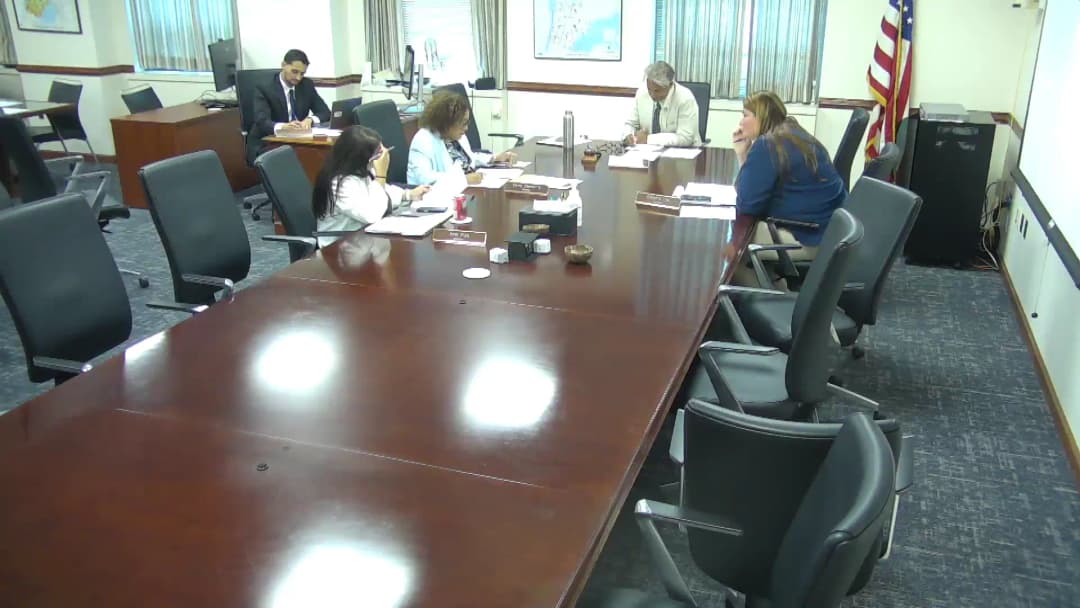
Date: August 31, 2026 Time: 4:04 PM – 4:10 PM Location: Committee Room, Michaelian Office Building, 8th Floor, White Plains, NY Chair: Anant Nambiar Members Present: Legislators Nambiar, Clements, Puja, Ulaj Remote: Legislator Cunzio (from Thornwood, NY) This brief meeting of the Appointments Committee considered and unanimously approved 13 reappointments to two county boards: the Westchester County Women's Advisory Board and the Westchester County Police Board. No public comments or other business were conducted. Consent Calendar (All items approved unanimously by voice vote with all five members present voting aye) - Item 2026-364r: Reappointment of Michelle Keller as District 1 representative to the Women's Advisory Board, term May 12, 2026 to December 31, 2027. - Item 2026-365: Reappointment of Lauren H. Smith as District 2 representative, term May 12, 2026 to December 31, 2026. - Item 2026-366: Reappointment of Rika Levin as District 9 representative, term May 12, 2026 to December 31, 2027. - Item 2026-367: Reappointment of Erica Winter as District 11 representative, term May 12, 2026 to December 31, 2027. - Item 2026-368: Reappointment of Cindy Kanusher as District 12 representative, term May 12, 2026 to December 31, 2026. - Item 2026-369: Reappointment of Anietra Guzman-Santana as District 15 representative, term May 12, 2026 to December 31, 2027. - Item 2026-370: Reappointment of Subomi Macaulay as District 16 representative, term May 12, 2026 to December 31, 2027. - Item 2026-371: Reappointment of Julia Peloso-Barnes as an at-large member, term May 12, 2026 to December 31, 2027. - Item 2026-373: Reappointment of Patti Reyes-D'Agostino as an at-large member, term May 12, 2026 to December 31, 2026. - Item 2026-374: Reappointment of Janice Lubin Kirschner as an at-large member, term May 12, 2026 to December 31, 2026. - Item 2026-375: Reappointment of Leslie Chervokas as an at-large member, term May 12, 2026 to December 31, 2027. - Item 2026-414: Reappointment of Olney Reynolds to the Westchester County Police Board, term January 1, 2026 to December 31, 2027. - Item 2026-415: Reappointment of Peter D. Kamenstein to the Westchester County Police Board, term January 1, 2026 to December 31, 2027. Key Outcomes - All 13 reappointment resolutions were signed by committee and referred to the full Board of Legislators for final approval. Each passed unanimously (5-0) with all present legislators voting aye. - The meeting adjourned at 4:10 PM.
The Public Meeting Index
The Public Meeting IndexThe committee met on Monday, August 31, 2026 at 1:00 PM in the Council Chamber, with Chair Chris Miller presiding. Six members were present (Miller, Clark-Murray, Carlucci, Peluso, Salem, Holder) and one absent (Kevin Carrico). The meeting included a presentation by the Jacksonville Housing Authority, public comments, and action on multiple ordinances. The meeting adjourned at 2:15 PM. Presentation by Jacksonville Housing Authority - Cheron Corbett, CEO, presented the agency's new mission, vision, and core values. Key statistics: public housing average head-of-household income $15,208, 95% occupancy; Housing Choice Voucher average income $15,125, 98.3% occupancy. Economic impact exceeds $100 million. New policies prioritize local homeless residents. Highlighted the Downtown East Apartments (formerly Franklin Arms) redevelopment: 130 senior units at 30-70% AMI, $50M cost, using 4% tax credits. The Daisy Homes project built five single-family rental homes in 98 days with $1M in City ERAP funds. CM Peluso discussed federal funding (80% of $154M budget), AMI calculation, and need for housing authority preference on 9% bonds. Vice Chair Clark-Murray inquired about CBA dollars for the Eastside project, and Corbett noted a $3-4M funding gap. Public Comments & Testimony - Carnell Oliver spoke about his pending federal lawsuit against the city and requested a freeze on certain funds. - Wells Todd asked about health and environmental precautions for a proposed concrete batch plant. Discussion Items Item 9 (2026-0590): Firearms Code Compliance (Repeal/Amend City Firearm Ordinances) - Office of General Counsel explained state preemption of firearm regulations; a firearms rights group notified the city of noncompliance, risking severe penalties including removal of elected officials. Councilmember Peluso opposed, citing gun violence in Jacksonville and frustration with state overreach. Councilmember Salem and Carlucci supported compliance to protect city employees. Councilmember Carlucci referenced his father's Uniform Firearms Act. Vote: 5-1 (Peluso nay) to amend and approve. Item 13 (2026-0628): $500,000 Grant from Florida Department of Health for Dinsmore Area Sidewalks Signage - Nina Sickler (Public Works) confirmed $500,000 for at least 12 signs along new sidewalks; remaining funds would support sidewalk construction. Councilmember Peluso and Carlucci questioned cost; Carlucci criticized state spending hypocrisy. Vice Chair Clark-Murray supported as a health investment. Vote: 6-0 to amend and approve. Item 17 (2026-0635): Honorary Street Designation for Preston H. Haskell III (Museum Circle to Haskell Way) - Chair Miller praised Haskell's contributions. Amendment corrected council district (5) and scrivener errors. Vote: 6-0 to amend and approve. Item 23 (2026-0645): Contract with Downtown Vision, Inc. for James Weldon Johnson Park Management - Rules amendment refined contract terms (budget approval, insurance limits, alcohol sales, etc.). Vote: 6-0 to amend and approve. Item 31 (2026-0671): Emergency Extension of Florida Black Excellence Festival Grant - Mincy Pollock confirmed festival dates (June 4-5, 2027) and original $100,000 appropriation. Emergency approved unanimously. Multiple members added as co-sponsors. Vote: 6-0 as emergency. Other Items Approved Without Debate (Votes 6-0): - Item 11: $19,000 reimbursement for JHFA services - Item 12: $25,000 grant for Teen Court Battery Behavior Program - Item 14: Traffic control jurisdiction agreement for Montevilla at Bartram Lakes - Item 15: $100,000 for traffic safety in Council District 5 - Item 18: $44,436.47 CDBG reappropriation for housing - Item 19: $125,000 settlement with Cedar Grove Corporation - Item 20: $499,576 opioid settlement funding for UF Thrive Together program - Item 28 (second read): $55,000 for Minds of the Future Foundation - Item 32-37 (second read): various property conveyances, grants, and agreements Key Outcomes - Approved (6-0): Items 11, 12, 14, 15, 18, 19, 20, 28, 32-37 - Approved (5-1): Item 9 (Firearms code compliance) - Approved as Emergency (6-0): Item 31 (Florida Black Excellence Festival extension) - Amended and Approved (6-0): Items 13, 17, 23 - Deferred: Items 1-8, 10, 16, 21, 22, 24-27, 29-30, 33-34 pending future hearings - Second Read without Action: Items 24-30, 32-37 referred to other committees or future meetings - The next regular committee meeting is scheduled for September 14, 2026.
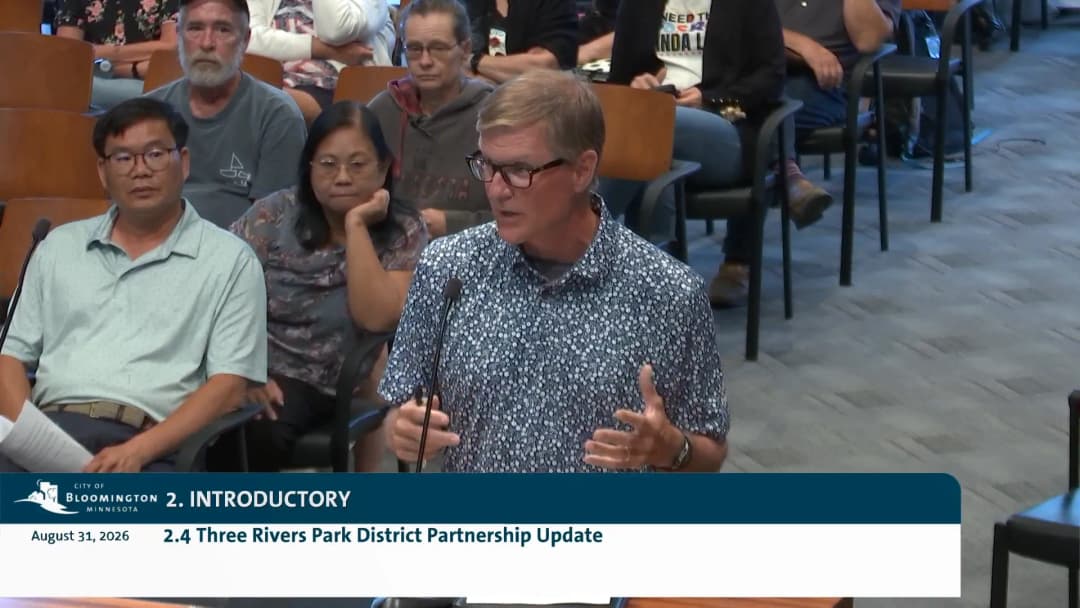
The Bloomington City Council met on Monday, August 31, 2026, beginning with the Pledge of Allegiance and presentations before moving through a consent agenda, public hearings, general business, and a closed session. Key actions included approvals of new officer swearing-in, a Three Rivers Park District partnership update, a controversial townhome rezoning, and ordinances for surplus property donation and unclaimed money. Consent Calendar - Items 3.1–3.15 and 3.17–3.20 were approved unanimously (7-0) with one item (3.4) held for separate comment and vote (also approved 7-0). Item 3.16 (surplus equipment donation policy) was moved to the business portion. Public Comments & Testimony - Listening session recap (Mayor): Seven residents addressed the council prior to the meeting: - Matthew Hallett: Requested bike lanes on Humboldt Avenue. - Sally Ness: Discussed a Smith Park shared use agreement. - Chris Scanlan: Raised code enforcement concerns affecting her neighbor; council directed her to staff. - John Minx: Asked about long-range planning and the Gateway District. - Brian Emerson: Expressed concerns about the community health and wellness center construction. - Pam Palmer: Suggested improvements to the neighborhood watch program, including mass email notifications. - Andy Thule: Raised parking issues on Park Avenue. - Public hearing (Item 4.2): No one testified in person or online. Discussion Items - Introductory Items: - Public Safety Cadet Ambassadors Program: Officer Sam Davern introduced the program (formerly the Explorer program) for ages 14–20, noting 25 participants and recent competition awards. Three ambassadors (Thomas Atuma, Selma Joffrey, Yuri Vasquez Rubio) shared their backgrounds. - Swearing-in of New Police Officers: Chief Booker Hodges administered the oath to seven officers (Jeremy Morrison, Justin Schwagert, Jack Fallen, Kevin McCabe, Nick Mulligan, John Tamborino, and one not named in transcript). The chief emphasized all officers had completed field training. - New Employee Introduction: Ryan Solberg, housing development specialist, was introduced by Community Development Director Kim Bergen. - Three Rivers Park District Partnership Update: Park Board Chair John Gibbs and Superintendent Bo Carlson reported: - 16.5 million visits system-wide in 2026; 1.7 million at Hyland Bush Anderson Lakes Park Reserve. - 39.7% increase in Bloomington regional facility visits from 2024 to 2025. - Hyland Greens Golf Course: 24,000 rounds in 2025, targeting 25,000 in 2026; $800,000 revenue; new par hole, bunker renovation, and fence replacement along Normandale Drive planned. - Beach improvements: shower towers, shade structures, paddle share program, ADA kayak launch, fishing docks. - Bush Lake Beach Building remodel planned for 2027 (design underway). - Natural resource management: 100 hazard trees removed; buckthorn removal with partners; aerial deer survey planned. - New wayfinding signage system launching first at Hyland Bush Anderson. - Councilmember Nelson asked about food/beverage options at the beach building, which Carlson confirmed would be a hybrid concession. - Councilmember D'Alessandro requested deer survey results be shared and suggested aligning the beach building design with city standards; Carlson agreed to include city staff on the project team. - Bloomsbern Village Townhomes (Item 4.1): This was a continuation from August 3, 2026, after council asked for revisions. Planner Liz O'Day presented modifications: - Rezone 6 lots from R1 to R3; reduce density from 33 to 30 units (10.9 units/acre); increase side yard setbacks from 10 to 19 and 15 feet; increase open space by 14.4%; reduce building height to 39'4". - Councilmember Rivas expressed concerns about neighborhood notification, traffic (bus stop on 86th Street), and construction phasing. Developer Dean Devolas stated they would coordinate with Metro Transit to maintain bus service. - Councilmember Robertson supported the project; Councilmember D'Alessandro praised the compromises but urged better city communication to residents about density planning. - Mayor discussed lessons learned: residents should have earlier notice of zoning potential when buying homes. - Councilmember Carter suggested the three affordable units (OHO) be designated for ownership; applicant clarified they intended ownership for those units. - Surplus Equipment Donation Policy (Item 3.16) and Ordinance (Item 4.2): Law Clerk Jackson Snyder presented amendments to Chapter 5 of the city code to allow donation of surplus equipment to nonprofits and set a process for unclaimed money (90-day hold, then deposit into general fund; six-month reimbursement window). The policy was required before the ordinance could take effect. - Councilmember D'Alessandro queried seized money handling; Snyder confirmed it applies after forfeiture procedures. - The policy (3.16) was approved 7-0; the ordinance (4.2) was approved 7-0 after a public hearing with no testimony. Key Outcomes - Consent Agenda (3.1–3.15, 3.17–3.20): Approved 7-0. - Item 3.4: Approved 7-0 (Councilmember D'Alessandro's separate comment). - Item 4.1 – Bloomsbern Village Townhomes: - Rezone from R1 to R3: Approved 6-1 (Councilmember Rivas opposed). - Summary publication: Approved 6-1 (Rivas opposed). - Final site and building plans: Approved 6-1 (Rivas opposed). - Preliminary and final plat: Approved 6-1 (Rivas opposed). - Item 3.16 – Surplus Equipment Donation Policy: Approved 7-0. - Item 4.2 – Code Amendment Ordinance: Approved 7-0; summary publication approved 7-0. - Closed Session: Council met in closed session (attorney-client privilege) to discuss litigation strategies related to federal rulemaking. Upon reopening, they authorized the mayor, city manager, and city attorney to take actions consistent with the discussion (motion approved 7-0). - Adjournment: Motion carried 7-0 at 9:21 PM.
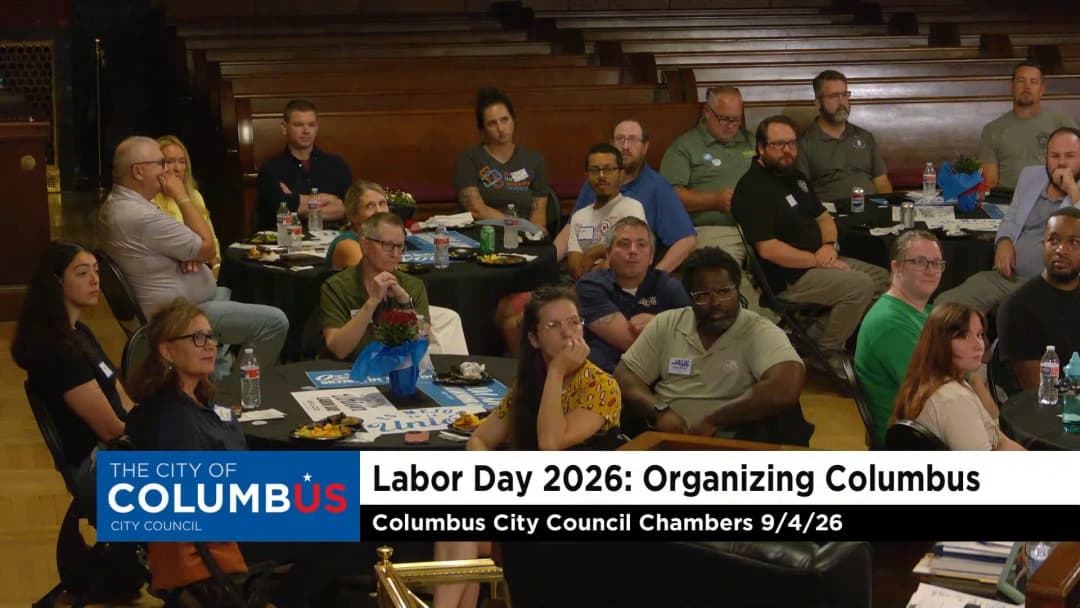
On August 31, 2026, Columbus City Council held a Labor Day celebration in City Council Chambers featuring remarks by Council President Rob Dorrans (also an IBEW member) and Central Labor Council Executive Director Jamie Shoemaker, followed by a panel discussion with four workers who recently organized their workplaces. The event highlighted the importance of unions and the ongoing efforts to organize workers across various industries. Opening Remarks - Council President Rob Dorrans, a second-generation IBEW member, shared his personal story of how the labor movement transformed his family's economic stability. He emphasized that union members are building and running the city, and urged continued organizing to counter attacks on workers at the state and federal levels. - Jamie Shoemaker, Executive Director of the Central Labor Council, acknowledged labor leaders in the room and noted that unions face coordinated attacks. She stressed that the fight is not over and encouraged attendees to connect with the panelists. Panel Discussion: Worker Organizing Experiences - Abby Gross Close (Nurse at Nationwide Children's Hospital) described their unionization effort over nearly two years, prioritizing patient care over profits. She learned that management does not always have workers' best interests in mind, and that many young workers lack basic knowledge about unions. - Violet Musser (Worker at Jenny's Ice Cream) emphasized that every worker deserves dignity, fair pay, and the ability to afford their city. She learned that workers are more alike than different, and that organizing breaks down barriers. - Jude Verosco (Adult Services Librarian, Columbus Metropolitan Library) recounted the library's organizing drive, noting that library leadership hired expensive lawyers and engaged in union busting, but they still won. The key lesson is that organizing is about listening more than talking. - Ashby Doherty (Gateway Film Center worker) described how workplace conditions deteriorated, leading to their successful unionization and contract. They were surprised by the strong community support from patrons. Key Advice for Workers Considering Organizing - Stick with it; it will be a grind but worth it (Abby, Ashby). - Make friends and build buy-in across the bargaining unit (Abby). - Recognize that you have power; your work matters (Violet, Jude). - Don't psych yourself out; management will try to scare you (Jude). How Community Members Can Support Organizing Efforts - Communicate directly with companies as consumers; they care about customer sentiment (Ashby, Violet). - Listen to the union's specific requests rather than going rogue (Jude, Ashby). - Use yard signs, social media, and petitions to apply pressure (Ashby, Violet). - Engage with workers and educate them about unions (Abby). Closing Remarks - Council President Rob Dorrans thanked the panelists and reiterated the importance of listening to workers. He noted that his council has partnered with workers during organizing drives and that unionization strengthens workplaces. He wished attendees a safe and happy Labor Day. Key Outcomes - No formal votes or decisions were made. The event served as a celebration and educational forum. The panelists' stories and advice were shared to inspire further organizing. The city council affirmed its support for worker organizing.
The Finance Subcommittee of the Framingham City Council met on August 31, 2026, to discuss staffing for Mary Denison Park, solid waste management policies, and city vehicle fleet management. The meeting began with an executive session for litigation strategy, followed by a public session. Consent Calendar - Minutes Approval: The subcommittee unanimously approved the minutes from July 28, 2026, and August 11, 2026. Public Comments & Testimony - Richard Brooks (condominium attorney) volunteered to provide information on equitable trash pickup for condominiums, noting many towns have changed policies based on fairness. - Michael Crowley (North Side Meadows, over-55 HOA) requested equitable trash pickup, stating residents pay high taxes without children in schools. - Doug Stefan (developer of Batingbrook Farm) acknowledged the original agreement excluded city services but argued for equitable treatment as residents face high taxes. - Lou Orsan (Windsor Green condominiums) opposed any change that would increase HOA fees, as he is on a fixed income. - Evelyn (condo unit owner) urged the city to include condominium associations in the discussion, citing inconsistencies. - Devin Woods (Nicholas Street condo) argued that condo owners are homeowners paying taxes and should receive trash pickup. - Prescott Gardens resident warned that losing city pickup would increase HOA fees. - Susie Santone (Mill Falls condominiums) argued that over-55 communities pay taxes for schools they don't use, so trash pickup is fair. Discussion Items 1. Staffing and Maintenance of Mary Denison Park Council members discussed the need for additional staff for the new park complex. The administration initially proposed ten positions, then revised to six. Councilors debated starting with four positions to allow for a learning curve. Councilor King moved a friendly amendment to fund four positions at $183,000, which was accepted. The subcommittee voted 5-0 to recommend four positions to the full council. 2. Solid Waste Management Policies Councilors Stefanini and others discussed the inequity in trash pickup between single-family homes and condominiums, especially over-55 communities. They agreed to request a comprehensive data report from the administration detailing which properties receive city services and the legal basis (planning board decisions, zoning bylaws). The mayor noted that changing the ordinance would require legislative action. No vote was taken. 3. City Vehicle Fleet Management Financial analyst Anthony presented an update on the city's 320 vehicles, fleet management software (CFA), and potential for a motor pool system. Current software tracks maintenance but lacks integration with fuel and GPS. New software would cost $50,000 upfront and $15,000–$40,000 annually. Councilors discussed the need to balance cost with efficiency and noted that a new garage is planned. The mayor cautioned against a rapid shift to a motor pool due to logistical issues. No action was taken; further discussion will be part of budget planning. Key Outcomes - Minutes Approved: Unanimously (5-0). - Mary Denison Park Staffing: Approved recommendation for four new positions at a cost of $183,000, funded via local receipt adjustments and transfer from lifeguard allocation. Motion passed 5-0. - Solid Waste Policy: Directed administration to compile data on all residential properties receiving city trash collection and the legal basis, to be presented at a future meeting. - Vehicle Fleet: No formal action; discussion to continue as part of broader budget strategy.
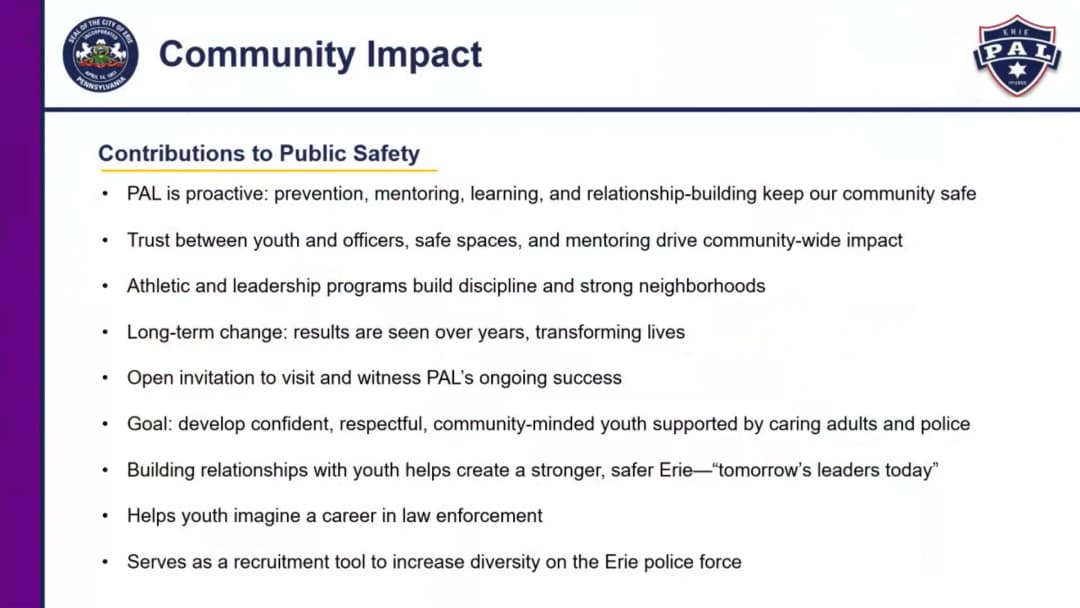
This study session, held by the Erie City Council on August 31, 2026, was requested by council members as the city prepared for budget sessions in September, October, and November. No agenda or minutes were provided with the raw transcript, so this summary is based solely on the meeting transcript. Dr. Titus opened the session, and presenters from the Erie Police Department and city leadership reviewed the Erie Police Athletic League (PAL)'s history, community impact, funding, and how it fits into broader community policing. Discussion Items - PAL history and scope (Captain Lennox): PAL was revived after a 40-year hiatus (last active in 1985), with talks beginning in 2015 under former Chief Rainey Bowers; Dr. Horton was an original board member. It began at Piper Burley with about 35 kids and expanded after a successful first year. The PAL summer camp at a major university was described as a national first for a PAL chapter, with about 65 kids attending. By 2026, PAL operates in 29 locations with over 2,000 children, offers six summer camps, and is present in every Erie elementary school and high school, with some participants from Iroquois and Harbor Creek. Captain Lennox estimated that 90% of older participants ended up at Erie High or Collegiate Academy. The program runs year-round, 365 days a year, with school-year sessions Monday through Thursday that include homework enrichment, structured team-building games, recreation, dinner, and a mandatory 30-minute group discussion on life skills, anger management, conflict resolution, and bullying. PAL tracks academics quarterly, uses field trips as incentives, partners with Premier Education for prevention programming, and reported very few criminal-justice incidents among participating youth. - Community impact (Officer Antoine Fields): Officer Fields said PAL serves over 2,000 kids in collaboration with 29 schools and community centers, with school district teachers assigned to help with after-school homework. He emphasized that success is measured by personal growth and transformation, not awards. He cited recognition from Governor Shapiro and the county's top youth drug and alcohol prevention designation. PAL also conducts career fairs, held its first women's police career expo in April, and continues supporting graduates, including a recent call from a graduate now in the Air Force. He described PAL as a way to help youth imagine futures in law enforcement and to recruit a diverse police force. - Funding structure (Deputy Chief Janice): PAL has three main funding sources. First, a 501(c)(3) board, separate from the city, raises money through grants, donations, and fundraisers such as the PAL Ball; it pays for educational field trips, transportation, lodging, food, summer camp expenses, and day-to-day operations. Second, a Pennsylvania Commission on Crime and Delinquency (PCCD) BOOST grant of $250,000, running from January 1, 2025 through January 2027, covers $41,667 per year for each of three dedicated PAL officers. Third, an Erie County Office of Drug and Alcohol Abuse agreement, renewed annually and currently just under $225,000, reimburses PAL overtime at $82 per hour for just over 2,700 hours per year, meaning no PAL overtime is drawn from the police department's regular overtime budget. The city pays Captain Lennox's full salary, the remaining salary balances for the other dedicated PAL officers, related healthcare benefits, and maintenance and fuel for two local buses. Overtime wages are W-2 wages; pension is calculated on base salary only, not overtime. Council members asked clarifying questions about budget impact, pension treatment, and grant longevity. - Future budget and community policing (mayor): The mayor said the expiring PCCD grant will require decisions for the 2027 budget. She proposed pursuing additional grants and/or carving out a portion of the police budget for a community policing unit led by Captain Lennox that would do more than PAL. Related initiatives include launching a citizen police academy, codifying a mayor's council on community safety and trust, and continuing minority recruitment. She said PAL is one important tool, not the entirety of community policing, and noted the county drug and alcohol funding has been reliable year over year. Dr. Titus added that this is one piece of healing and changing the community narrative. - Council member positions and requests: Several councilors expressed strong support for PAL, with one saying they love the program and would back it to the end because it provides positive role models and mentorship; another said saving even a dozen kids would be a win. One councilor noted the police budget is 40% of the city budget and asked to be informed of future grant applications for peace of mind. Councilor Flores requested data on PAL graduates and outcomes to supplement anecdotes, and another council member who leads a nonprofit and is also a therapist asked for statistics on graduation, college, and trade school enrollment. A councilor mentioned PAL began when the Erie School District had over 13,000 students and about 11,500 lacked organized activities. A councilor also suggested more formal parent engagement, such as cotillion-style or parent-child events, to expand adult involvement. Key Outcomes - No formal votes were taken; this was a study session. - The mayor committed to providing data on PAL graduates and success outcomes, with Captain Lennox and Officer Fields assigned to assemble it. - A future study session on community policing was discussed. - The 2027 budget process will include decisions about replacing grant funding, possibly creating a dedicated community policing unit, and keeping council informed of grant applications.
The San Antonio Public Safety Committee met on August 31, 2026, at 2:08 PM, with a quorum present. The meeting covered three major items: a "Love and CCR" to protect transgender, non-binary, and intersex residents; a pilot diversion center program for low-level offenders; and a clarification of the graffiti ordinance regarding chalk. All items were approved and forwarded to the full City Council for action. Consent Calendar - Approval of Minutes from June 16, 2026: The committee unanimously approved the minutes without discussion. Public Comments & Testimony - Love and CCR: Multiple residents and organization representatives spoke in strong support. Speakers included: - Sofia Sepoveda (Equality Texas, District 1 resident) – argued the ordinance protects privacy and safety, especially for trans and immigrant communities. - Drew Norris (District 10) – described being questioned in women's restrooms and urged support. - Dominique Huerta (ACLU of Texas) – emphasized safety and privacy benefits of single-user restrooms. - Rachel Cundy (District 7, medical student) – noted health consequences of avoiding care due to privacy fears. - Kate Sanchez (Planned Parenthood South Texas) – called the ordinance a simple, evidence-based solution. - Tracy Bradley (District 8, retired RN) – highlighted privacy needs for people with medical conditions. - Nico Bonner (District 1) – argued public safety includes proactive environment design. - Ananda Thomas (Act for SA) – connected privacy to public safety, citing documented risks. - Diversion Center Pilot: - Alex Hester (UT Health Houston, contractor for feasibility study) – supported the pilot, noting that other Texas diversion centers recommend moving quickly to a pilot to tailor operations. - Graffiti Ordinance: - Pedro Ruiz (Project Unida) – supported removing chalk from graffiti definition, citing mutual aid and public art. - Joshua (self-identified as frequent recipient of chalk-related citations) – noted SAPD has not cited him for chalk since 2024, but San Antonio Park Police have; argued the ordinance is overly broad. - Michael Pacheco (General Manager, Centro San Antonio) – raised concerns about maintenance, sanitation, and hate speech, recommending restrictions in the downtown PID. Discussion Items - Love and CCR (Looking Out for Vulnerable Impacted Neighbors): Presented by Dr. Jennifer Matha (Compliance Opportunity and Access Department). The CCR seeks protections for transgender, non-binary, and intersex individuals, including self-selected name/gender options on IDs, privacy of health/personal information, and expansion of single-user restrooms. Key points: The city already has administrative directives (AD 4.67, AD 7.12) protecting privacy and anti-discrimination; SB8 compliance already identified 406 single-user restrooms in city facilities. The recommended action is to add single-user restrooms in future city construction and major renovations. Councilmember McKee Rodriguez (sponsor) noted the issue was necessitated by state attacks. Councilmember White questioned scope and cost; staff clarified the recommendation is for city facilities only, not private businesses. Councilmember McKee Rodriguez argued that taxpayer-funded private projects should also comply. Councilmember Castillo urged moving quickly for inclusion in bond projects. The committee voted to forward to A session with individual briefings. - Diversion Center Pilot: Maria Vargas (Deputy City Manager) introduced an update on an ad hoc city-county committee exploring a pre-arrest diversion center. Center for Health Care Services (CHCS) presented a pilot program: 15 beds at Josephine Recovery Center for non-residential criminal trespass and theft under $100, targeting downtown and central SAPD substations. The pilot would cost about $625,000 from the city (funded via Westside TIRZ) for a six-month period (total $1.9 million split among city, county, and University Health). CHCS noted 78 individuals per month with mental health needs in low-level trespass cases; SAPD cited 1,700 criminal trespass arrests in 2025, with many having mental health/unsheltered flags. StRAC would convene governance. Councilmember Castillo (co-chair of ad hoc committee) emphasized pre-arrest diversion reduces jail costs. Councilmember White asked for defined success metrics; staff agreed governance group would set them. Councilmember McKee Rodriguez raised concerns about the service area not covering the facility's neighborhood (Government Hill) and suggested adding Intercity TIRZ funding. Compromise: CHCS will return in three months with a progress update. Motion to approve and forward to September 10th A session passed. - SAPD Graffiti Ordinance Clarification: Chief Salome presented recommended removal of chalk from the definition of "graffiti implement" (paint stick). The current ordinance could treat chalk as a graffiti implement; enforcement data showed only 12 possession citations from 2024-2026 (22% conviction rate). The change clarifies that implements must leave an indelible mark. The committee discussed that hate speech or obscene chalk could still be addressed under disorderly conduct or criminal mischief. Councilmember McKee Rodriguez noted the conflict is between Centro and a single activist, and that the ordinance change does not resolve underlying tensions. Councilmember White and Castillo supported the clarification but emphasized mutual respect. Motion to forward to September 10th A session passed. Key Outcomes - Love and CCR: Motion carried to forward to an A session (September date not specified in transcript) with staff individual briefings to council members. (Vote: all in favor, none opposed). - Diversion Center Pilot: Motion carried to approve funding from Westside TIRZ and place on the September 10, 2026 A session agenda. (Vote: all in favor, none opposed). CHCS to begin outreach to neighborhood businesses. - Graffiti Ordinance: Motion carried to send the ordinance clarification to the September 10, 2026 A session. (Vote: all in favor, none opposed).
This special meeting of the Metropolitan Council was called to order on Monday, August 31, 2026, to consider a single agenda item: authorizing Mayor Pro Tem Brandon Nota to sign Appendix B of the Model Cities Initiative Grant application, which designates official partners for the grant. The Council heard public comment and testimony from the Executive Director of the Criminal Justice Coordinating Council (CJCC), discussed the grant's scope and partner list, and voted unanimously to approve the item. Consent Calendar - (No consent calendar items were presented; only one substantive item was on the agenda.) Public Comments & Testimony - Councilwoman Coleman asked for clarification on why a special meeting was necessary. Chris Sonka, Executive Director of the Criminal Justice Coordinating Council, explained that his error caused the need: he did not realize until the previous week that Metro Council's signature was required on Appendix B, and a vote was needed rather than a mayoral signature alone. - Councilwoman Amaro asked which agencies would receive funding. Mr. Sonka listed the Baton Rouge Police Department, East Baton Rouge Sheriff's Office, District Attorney's Office, Greater Baton Rouge Economic Partnership (for internship/apprenticeship programs), 100 Black Men, all other municipalities within East Baton Rouge Parish (as named partners), and noted support from Louisiana State Police (not funded), Juvenile Court, and the Public Defender's Office. He stated the draft budget is approximately $125 million over three years, out of a total $300 million pool available for 2–4 cities nationwide. - Councilwoman Coleman asked whether other organizations could participate later. Mr. Sonka confirmed there is room to include grassroots organizations in later phases. - Councilman Harris sought confirmation that grassroots organizations would have an opportunity to participate; Mr. Sonka confirmed that intent. Discussion Items - Council members discussed the grant's purpose and structure. Mr. Sonka described the CJCC as the public safety council for East Baton Rouge Parish, bringing together justice leaders and community partners to coordinate services across policing, re-entry, juvenile pathways, behavioral health, and substance abuse. He emphasized that the grant aims to reduce Baton Rouge's violent crime rate, which he stated is consistently about three times the national average. - Several council members expressed support for the grant and its collaborative model, noting the importance of avoiding silos and redundancies. - Councilwoman Coleman moved to approve the item; Councilman Mock seconded. The motion passed without opposition. Key Outcomes - The Metropolitan Council voted unanimously (motion by Councilwoman Coleman, seconded by Councilman Mock, no opposition) to authorize Mayor Pro Tem Brandon Nota to sign Appendix B of the Model Cities Initiative Grant application. This approval enables the CJCC to submit the grant proposal to the U.S. Department of Justice. - The Council noted that the grant application is currently in Phase 1; if selected, the city will proceed to a formal proposal in Washington, D.C., and later refine the budget and partnership details.
El Comité de Desarrollo Económico y Laboral se reunió el 31 de agosto de 2026 a las 10:38 a.m. bajo la presidencia de la Presidenta Villagrán, con la presencia de los concejales Castillo, Galván, Mesa González y Spears. La reunión cubrió la aprobación de actas, una postergación de un presupuesto, una recomendación de subvenciones, una actualización del marco de desarrollo económico, un informe sobre gastos locales, una discusión sobre contrataciones relacionadas con ICE, y una actualización del sistema de adquisiciones. Consent Calendar - Aprobación de actas: Se aprobaron las actas con correcciones mediante moción y secundación, con todos a favor. - Asunto 2 – Presupuesto del programa Work for Solution Salamo año fiscal 2027: Se aprobó por consentimiento postergar el asunto a una sesión B del consejo en septiembre de 2026 para una presentación más detallada. Monto: $195,380,770. - Asunto 3 – Subvenciones de crecimiento: Se aprobó por consentimiento recomendar al pleno del ayuntamiento a 9 de 20 solicitantes que calificaron. Los 11 no calificaron por no cumplir con al menos dos años de crecimiento en los últimos 5, ganancias menores a $1 millón o no haber recibido SPI federal. Public Comments & Testimony - No hubo comentarios públicos. Discussion Items - Asunto 4 – Actualización del Marco de Desarrollo Económico (presentación informativa): El personal presentó una actualización del marco estratégico para el desarrollo económico de San Antonio, destacando mejoras en cuatro metas principales: innovación e industria, ubicación y bienes raíces, talento y fuerza laboral, y capacidad y recursos. Se discutieron estrategias como Ready to Work 2.0, infraestructura, inteligencia artificial, y la necesidad de retener y expandir empresas locales. Los concejales expresaron preocupaciones sobre la inversión en infraestructura, la definición de "local" y la importancia de medir el éxito. No se tomó acción. - Asunto 5 – CCR sobre fondos municipales para empresas locales: Se presentó una solicitud del Concejal Alderete Gavito para crear una definición uniforme de "local", reportar gastos a empresas locales, y llenar vacíos en las iniciativas. El personal recomendó definir "local" como dirección dentro de los límites de la ciudad de San Antonio. Los concejales discutieron la necesidad de claridad y solicitaron una página resumen para el próximo paso. - Asunto 6 – Actualización sobre contrataciones relacionadas con ICE: El personal presentó dos opciones para mayor transparencia en contratos estatutorios y no estatutorios. Se discutió que las ciudades de Texas no tienen políticas restrictivas, pero otras ciudades (California, Filadelfia) sí. Se acordó llevar el tema a una sesión B para explorar políticas potenciales. - Asuntos 7 y 8 – Actualización del proceso de adquisiciones: Se presentó una revisión del sistema SAP (costo estimado de $70 millones) y un plan para involucrar a 1,600 proveedores y grupos comunitarios. Se discutió la importancia de transparencia y participación. Próximos pasos: encuestas y juntas presenciales en septiembre y octubre. Key Outcomes - Asunto 2: Aprobado por consentimiento para postergar a sesión B del consejo en septiembre 2026. - Asunto 3: Aprobado por consentimiento para recomendar las 9 subvenciones al pleno. - Asunto 5: Se solicitó al personal preparar una página resumen con opciones de definición de "local" para discusión futura. - Asunto 6: Se acordó llevar a una sesión B para mayor análisis de políticas de transparencia en contratos con ICE. - Asuntos 7 y 8: Se continuará con el plan de participación comunitaria y actualización del sistema SAP. - Sesión ejecutiva: Se realizó de 12:20 a 12:32 p.m. sin acción tomada. La reunión concluyó a las 12:32 p.m.
The Public Safety Committee met on August 31, 2026, from 2:08 PM to 4:24 PM, with Council Members Maki Rodriguez, Castillo, Spears, White, and President Corr present. The meeting was conducted in Spanish; this summary is based on the Spanish-language transcript. The committee unanimously approved the June 16, 2026, meeting minutes, advanced a council consideration request (CCR) to protect vulnerable neighbors (including transgender, non-binary, and intersex residents), approved funding for a six-month diversion center pilot program, received an update on elder abuse prevention, and clarified the graffiti ordinance as it applies to sidewalk chalk. Consent Calendar - The minutes of the June 16, 2026, meeting were approved unanimously with no changes or comments. Public Comments & Testimony Item 2 – Vulnerable and Impacted Neighbors CCR: - Sofía Sepúlveda (District 1 resident) expressed support, citing medical privacy rights and the need for transgender residents to use restrooms "in peace and without fear." - Junior Norris, a district resident, voiced support for single-person restrooms, noting he has been questioned when using the women's restroom. - Tommy Knecuerta, speaking for himself and for the state of Texas, expressed support for privacy protections for all Texans, including those who wear gowns or robes for their work. - Rachel Candy (District 7) asked the committee to protect the privacy and safety of all San Antonians. - Kate Sánchez, representing the parenting preparation organization Preparación para Padres, expressed support, citing documented assaults and killings of transgender people and ICE detentions leaving children behind. - Tracy Bradley (District 8) supported the measure on behalf of people with health conditions including celiac disease, Crohn's disease, irritable bowel syndrome, and colostomies. - Nicole Bonner (District 1) called privacy and safety fundamental rights and an opportunity to strengthen the community. - Ananda Thomas, executive director of a community organization, stated: "When San Antonio is safe for all vulnerable people, San Antonio is safe for all." Item 3 – Diversion Center Pilot: - A UT Health professor expressed support for the pilot, reporting that most of 35 interviews conducted this month with law enforcement and public health agencies favored launching and testing the program. Item 5 – Graffiti Ordinance: - Pedro Ruiz, a chalk artist who described creating chalk messages of hope for immigrants over the past 12 weeks, opposed restricting sidewalk chalk, stating his chalk messages are temporary and wash away with rain. He reported being arrested for 20 hours in 2024 for sidewalk chalk in District 5 and winning his case (covered by the San Antonio Express-News), and claimed his videos showing San Antonio police in a poor light have received over 30 million views. He also cited Texas code 51.002 as preventing cities from enacting ordinances stricter than the penal code. - Mac Becheco (also transcribed as Michael Pacheco), general administrator of Center City San Antonio and its downtown ambassadors, expressed conditional concern. While supporting public art, he urged the committee to consider sanitation, accessibility, maintenance, public safety, and financial consequences before permitting unrestricted sidewalk chalk downtown, noting downtown crews have cleaned 832 square feet of sidewalk so far in fiscal year 2026. Discussion Items Item 2 – Council Consideration Request: Vulnerable and Impacted Neighbors - Staff presenter Jennifer Matas outlined the CCR, requested on April 9, 2026, to protect transgender, non-binary, and intersex San Antonians from discrimination and service barriers, including access to correct identification, safety for people seeking public health services, and expansion of single-occupancy restrooms in city facilities. - Staff noted that Metro Health protects individual health information under HIPAA, JIPA, and Hi-Tech laws; Administrative Directive 4.67 prohibits discrimination based on gender identity and expression and requires use of chosen names and pronouns; and Administrative Directive 7.2 protects personal and sensitive personal information. - The city has already posted standardized notices about restroom access laws and created an inventory of single-occupancy restrooms. Staff recommended prioritizing single-occupancy restrooms in major future renovations funded through the capital budget. - Council Member Maggie (Maki) Rodriguez, the CCR sponsor, made the motion, stating the measure responds to state and federal overreach involving restroom policing. - Council Member Spears voiced support. Council Member White raised concerns that supporting documents referenced private businesses and potential costs, but staff confirmed the recommendation applies only to city-owned public facilities. White stated he opposes future expansion of such requirements to private businesses. - Council Member Castillo defended the measure, stating the state manufactured the issue and that transgender people are being attacked and photographed in restrooms. - Council Member Maki Rodriguez requested tracking of the percentage of public facilities with single-occupancy restrooms to document progress through the 2027 capital program. Item 3 – Diversion Center Pilot Program - Staff (Maria Vargas) reported that the CCR was introduced by Council Member Terry Castillo in October 2025. The ad hoc committee, co-chaired by Castillo and County Commissioner Justin Rodríguez, has met four times with city and county partners. - Jolene Burley of the Center for Healthcare Services presented the work plan developed with the UT Houston School of Public Health; recommendations are expected around January 2027. - Jail data from January to May showed 56% of arrested individuals faced criminal trespass charges. 2025 misdemeanor data showed 1,700 criminal trespass arrests, including roughly 612 individuals with mental health conditions and 805 experiencing homelessness. Processing times average about 8 hours for county jail and 12 hours for police arrests, during which individuals can decompensate. - The proposed six-month pilot, funded at approximately $625,000 by the city and University Health (with no General Fund cost), would make 15 beds available at the existing crisis and respite center at 711 Josephine Street (District 2). The target stay is 14 days with up to 90 days of follow-up care. MEDCOM clinical staff would screen eligible individuals for voluntary admission before arrest for agreed eligible offenses in the central response area. - Council Member White asked how success will be measured and noted the funding would come from the West Side TIRZ. Council Member Maki Rodriguez questioned the geographic scope, the use of West Side TIRZ funds, and the concentration of a citywide program in one neighborhood; she requested a progress update in about three months and suggested a 50-50 cost split to lessen the burden on the West Side TIRZ. CHS indicated the pilot could launch around January 1, 2027. Item 4 – Elder Abuse Prevention Update - The committee received a memorandum updating ongoing work to inform older adult populations about abuse prevention and interpersonal violence. No action was taken. Item 5 – Graffiti Ordinance Clarification - Police Chief Salomé presented a recommended clarification to the city's graffiti ordinance. State law defines graffiti as unauthorized paint, markers, or etching. The current ordinance includes chalk (GIS) under substances applied with pressure. From 2024 to 2026 there were 147 graffiti offenses, of which 136 involved the penal code graffiti statute; in 2024, 22% of graffiti citations resulted in incarceration for non-compliance. - Staff recommended removing chalk from the ordinance's definition unless it leaves an indelible mark, while retaining authority to remove chalk marks from public and private property in response to complaints. - Council Member White questioned enforcement for inappropriate chalk content; city counsel confirmed that the change does not alter graffiti removal policy and that other codes can address offensive displays. - Council Member Maki Rodriguez expressed frustration that public resources were spent on what she characterized as a conflict between the chalk artist and Center City, and called the issue "very silly," but supported moving the clarification forward. Key Outcomes - Item 1: The June 16, 2026, minutes were approved unanimously. - Item 2: A motion passed by voice vote to advance the recommendation (single-occupancy restrooms in city facilities) to the full City Council's Session A, with staff directed to provide information to all council members. - Item 3: A motion passed to approve approximately $625,000 in West Side TIRZ funding for the six-month diversion center pilot; the item will be presented to the full council on September 10, 2026. - Item 5: A motion passed to move the graffiti ordinance clarification to Session A for full council consideration on September 10, 2026. - The meeting adjourned at 4:24 PM.