The meeting was called to order with a quorum present. After a land acknowledgement, public testimony was heard on multiple issues, followed by consideration of numerous agenda items, including approvals of contracts, grants, and appointments, as well as a resolution prohibiting disclosure of personal information. Key debates centered on law enforcement spending and a procedural dispute over a fund transfer. Consent Calendar - Approved numerous routine items across bureaus, including reappointments, contract renewals, grants, and transfers of funds. Specific items approved include: reappointment of Heather Fournarelli to the Plum Grove Woodland Sanitary District (item 26-2388); adoption of the 2027 meeting calendar (26-2489); acceptance of additional Google Career Certificates donation (26-2623); and many others. Commissioners recorded as present or co-sponsors on certain items. Public Comments & Testimony - Anushka Gupta (Asian Americans Advancing Justice Chicago) urged a freeze on law enforcement spending to protect social services amid a $550 million budget shortfall, citing a 40% reduction in Cook County jail population and crime decreases. - Rachel Lyons (Chicago Appleseed Center for Fair Courts) supported freezing law enforcement spending and investing in health and human services, noting progress in reducing pretrial incarceration. - Rev. Christoph Ringer (A Just Harvest) called for protecting community violence intervention funding and requiring jail oversight before increasing law enforcement budgets. - Colleen Murphy (My Body Tells the Truth) requested support for implementing the Child Abuse Notice Act (HB 4350). - Ellen Zoe (Asian Americans Advancing Justice Chicago) voiced full support for resolution 26-24-26 prohibiting disclosure of personal information, citing ICE data broker access harming immigrant communities. - Esmeralda Montesinos (Illinois Coalition for Immigrant and Refugee Rights) urged passage of the data privacy amendment, noting federal inaction. - Antonio Gutierrez (Organized Communities Against Deportations) shared personal experience supporting 4,000 families and called for passage of resolution 26-24-26 to protect personal information. - Additional speakers expressed opposition to immigrant protections and characterized other speakers as liberals harming Black communities. Discussion Items - Data Privacy Resolution (26-24-26): The board approved as substituted and amended a proposed ordinance amendment prohibiting disclosure of personal information. Multiple commissioners thanked advocates and colleagues for collaboration. - Procedural Dispute on Fund Transfer (26-2665): A proposed transfer of funds in a commissioner's budget was initially moved for approval. Corporate counsel advised it could not be voted on due to insufficient 48-hour notice under the Open Meetings Act. After debate, the chair ruled to refer the item to the Finance Committee, with a possibility of a special board meeting the following week for consideration. Key Outcomes - Approved: Resolution 26-24-26 (data privacy) passed unanimously on a voice vote. - Approved: Numerous consent calendar items, contracts, grants, appointments, and reports as listed in the motions. - Referred to Committee: Item 26-2665 (fund transfer) was referred to the Finance Committee after a procedural objection. - Commissioner Notes: Several commissioners recorded as present or co-sponsors on specific items. - Next Steps: The meeting adjourned for a 20-minute break before the consent calendar scheduled for 11:00 a.m.
The Public Meeting Index
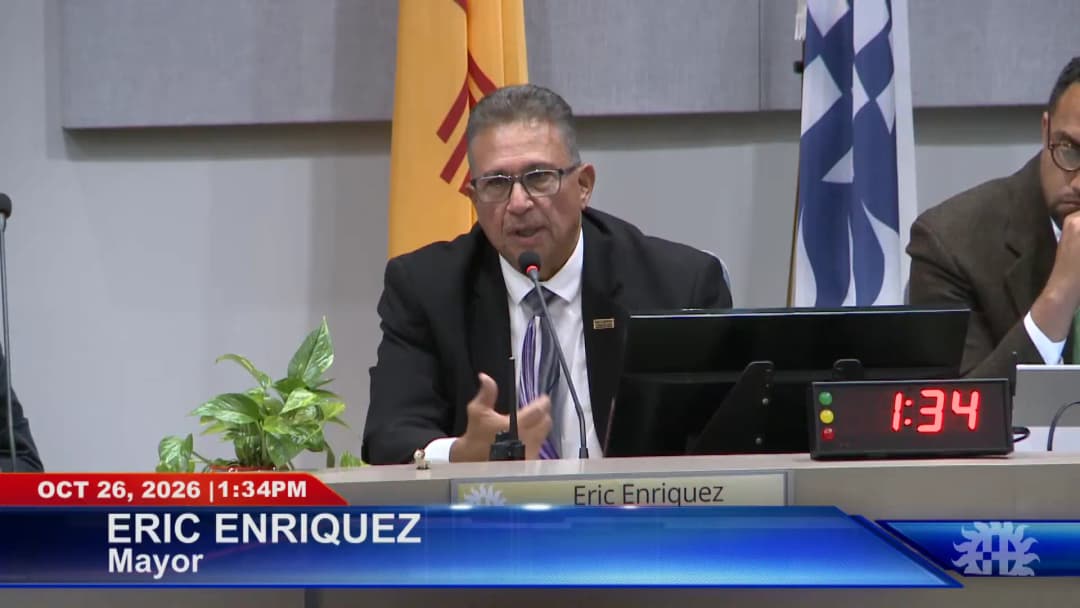
The Public Meeting IndexMayor Eric Enriquez presided over a work session on October 26, 2026, focused entirely on the future of the Amador property (Amador Live). City staff from multiple departments presented plans for immediate activation and long-term redevelopment, including phased renovations. Council provided clear direction to retain the property under city control and to develop a comprehensive strategy for community partnerships, tenant recruitment, and programming. Public Comments & Testimony - The President of the Amador Hotel group spoke in support of partnerships, highlighting the library's need for a bookstore and emphasizing the potential for downtown collaboration. She acknowledged the challenging situation for the city but expressed optimism. Discussion Items - Staff Presentations on Future Use and Renovations: - Elizabeth (City Staff) detailed the goal of immediately activating the property while developing a long-term vision. The plan includes starting with private event rentals and phased renovations focusing on the Broken Spoke, 575 Bar, and roof. - Rochelle (Visit Las Cruces) presented a vision for the property as an economic catalyst for downtown, proposing short-term events (holiday pop-ups, food truck Sundays, Second Friday markets) and long-term programming (movie nights, cafes, large-scale rentals). - David Sedio (Public Works) outlined $1.1 million in estimated renovation costs for code compliance and maintenance, including exterior and interior repairs. He proposed using Tax Increment District (TID) funds for the repairs. - Council Deliberation on Management and Vision: - Councilor McClure emphasized the need for early and strong engagement with community partners (Main Street, Mavita, non-profits) and expressed frustration over the lack of a clear, inclusive vision for the space. She requested a schematic of the vision and another work session with partners present. - Councilor Bencomo and Councilor Harris strongly advocated for keeping the property under city control, rejecting the idea of selling it. Bencomo raised the issue of $17,000 in unpaid utility impact fees from the previous operator, suggesting TID funds could be used to make the utility whole. - Councilor Harris noted the single kitchen is a limiting factor for a food court concept and supported the phased renovation plan. - Mayor Pro Tem expressed concern over the property being largely vacant for 21 months and demanded more concrete plans and traction in tenant recruitment. - Mayor Enriquez highlighted successful past events at the venue (Municipal League, PAL boxing) and suggested the city could be its own catalyst for programming. - Specific Proposals and Ideas: - A liquor license strategy was discussed, with Rochelle confirming a governmental license is feasible, similar to the Rio Grande Theatre and Convention Center. - Councilors put forward ideas for the space, including a Salsa Festival (Bencomo), a gelato/shoestring fry shop (Pro Tem), a wine bar (Bencomo), and city-sponsored events like teen nights (Mayor). Key Outcomes - Direction to Retain Internal Control: Council unanimously provided direction to keep the Amador property under city ownership and management, rejecting external sale or full leasing. - Funding Path: Staff was directed to explore utilizing TID funds for the $1.1 million in renovations and to address the outstanding $17,000 utility impact fee debt. - Call for Comprehensive Plan: Staff will develop a more defined plan that includes phased renovation timelines, a concrete tenant recruitment strategy, deep community partnerships, and a clear operational vision to present at a future council meeting. - Adjournment: The motion to adjourn was passed unanimously (Councilor Matisse absent).
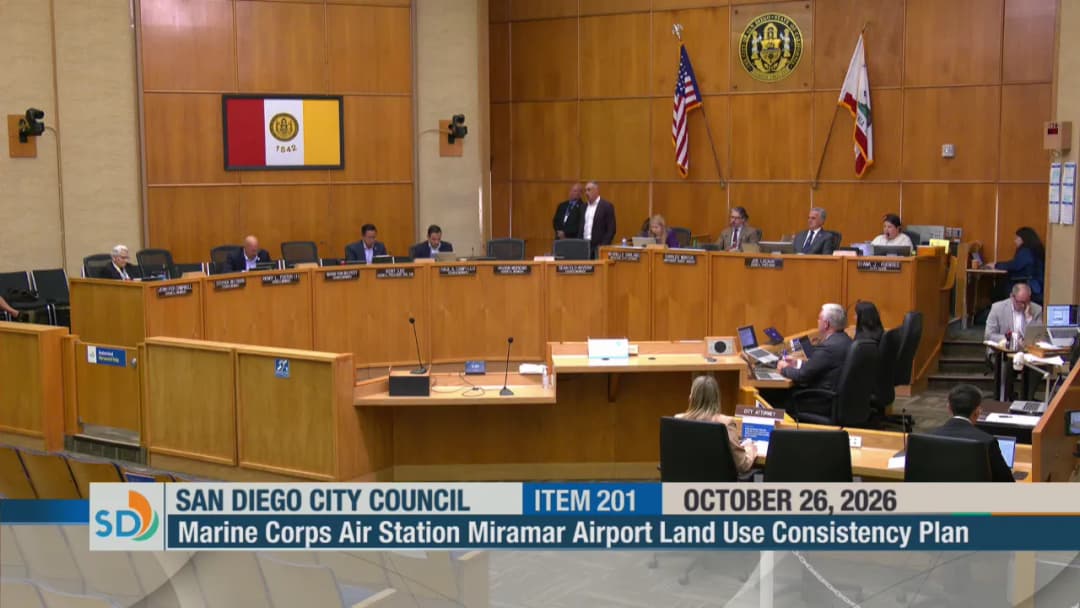
The San Diego City Council convened on Monday, October 26, 2026. The meeting included a closed session on litigation, the continuance of an agenda item, the Fiscal Year 2026 year-end financial report, approval of new labor standards enforcement fees, initiating the process to overrule an airport land use commission decision, and non-agenda public comment. Closed Session (Morning) - The council met in closed session to discuss two lawsuits: Deborah Hartwick vs. City of San Diego (a sidewalk trip-and-fall) and Victoria Hayes et al. vs. City of San Diego (a high-speed police pursuit resulting in the deaths of two young brothers, Malachi and Mason Orasco Romero). - The City Clerk corrected a typographical error on the closed session date. Public Testimony on Closed Session Items - Several commenters expressed deep condolences to the family of the two boys killed in the pursuit and strongly urged the council to settle the case and reform the city's high-speed pursuit policy. - Commenters on the sidewalk lawsuit criticized the city's maintenance backlog, arguing that deferred repairs lead to costly litigation. - One speaker requested a highway memorial for the two children. Continuance of Agenda Item S401 - The council announced that item S401, originally on the agenda, has been continued to Tuesday, October 27, at 10 AM, where it will be heard as item S510. Public comment was taken on the item, but no discussion or action occurred. Fiscal Year 2026 Year-End Financial Performance Report (Item S400) - The Department of Finance and the Independent Budget Analyst (IBA) presented the unaudited year-end report. - Key Data: - Revenues ended $4.1 million (0.2%) above and expenditures $10.5 million (0.5%) above third-quarter projections. - A $4.7 million draw on the General Fund Stability Reserve is required to balance the budget, the first such draw in recent history. - This lowers combined reserves to $202.4 million (10.9% of operating revenues), below the 14.1% policy target. - A primary driver is the delay of $7.4 million in Cal OES storm reimbursements, now expected in FY 2027. The city committed to using those funds to replenish the reserve. - Property tax revenue decreased due to lower collection rates and a $2.8 million increase in assessment appeal refunds. Risk management reserves declined by $20 million (33%). - Council Discussion: Council President Pro Tem Lee noted the reserve draw was anticipated in the budget. Council President Lacava praised the finance department's accuracy. - Public Comment: Speakers questioned the city's spending priorities on homelessness and police overtime given the deficit. User Fees to Support the Office of Labor Standards and Enforcement (Item 200) - The council approved two cost recovery fees to fund an additional compliance officer and proactive enforcement of minimum wage and labor laws. - Fees: 1) Minimum Wage Enforcement Fee increased from $1.47 to $2.82 per covered employee. 2) A new tiered Compliance System Usage Fee ($144.35 to $4,853.24) assessed on prime contractors for city contracts over $15,000. - Public Comment: Marshall Anderson of the San Diego County Lodging Association expressed support but requested a one-year report back on the fee's implementation and accounting for transparency. Other speakers expressed support for protecting workers' rights. - Council Action: Councilmember Foster moved the item, seconded by Councilmember Ila Rivera. Council President Lacava requested a dedicated first-year report to build industry confidence. Councilmember Campillo suggested increased penalties for egregious violators to reduce the burden on compliant businesses. - Vote: Passed 7-0. (Absent: Whitburn, Von Wilbert.) Overruling the Airport Land Use Commission on Child Care Centers (Item 201) - The council voted to initiate the formal process to overrule the Airport Land Use Commission's (ALUC) determination of inconsistency in order to allow new child care centers in the MCAS Miramar Transition Zone. - Context: The change would allow new centers at the same intensity limits already permitted for existing centers (300 people per acre, implemented through a 0.42 Floor Area Ratio). The Transition Zone is an extra buffer created by the ALUC and is not recommended by state or military planning documents. - Process: This was the first of two required hearings. The item will go to the Planning Commission for a recommendation before returning to the City Council for a final vote, which requires a two-thirds majority. - Public Comment: Speakers largely opposed the overrule, citing safety risks from the airport's accident potential zone. - Council Action: Council President Pro Tem Lee moved the item, framing it as a technical fix to address a child care shortage near major employment centers. Councilmember Ila Rivera seconded. Council President Lacava clarified the action is a zoning correction to align new development with existing rules. - Vote: Passed 6-0. (Absent: Whitburn, Von Wilbert, Moreno.) Non-Agenda Public Comment - Residents raised several issues, including: opposition to the city's use of ALPR (Flock) surveillance cameras and calls for civil rights protections; requests to fill vacancies on the Human Relations Commission; complaints about the DMV's 60-day wait for identification cards; support for Red Ribbon Week and youth substance abuse prevention; and criticism of the city's public comment media submission procedures. Key Outcomes - FY 2026 Close: Council accepted the report acknowledging a $4.7 million draw on the General Fund Stability Reserve. - OLSE Fees: New labor standards enforcement fees were approved to fund proactive compliance and enforcement. - ALUC Overrule: The process was initiated to allow child care centers in the MCAS Miramar Transition Zone. - Adjournment: The council adjourned to the regularly scheduled meeting on Tuesday, October 27, 2026, at 10:00 AM.
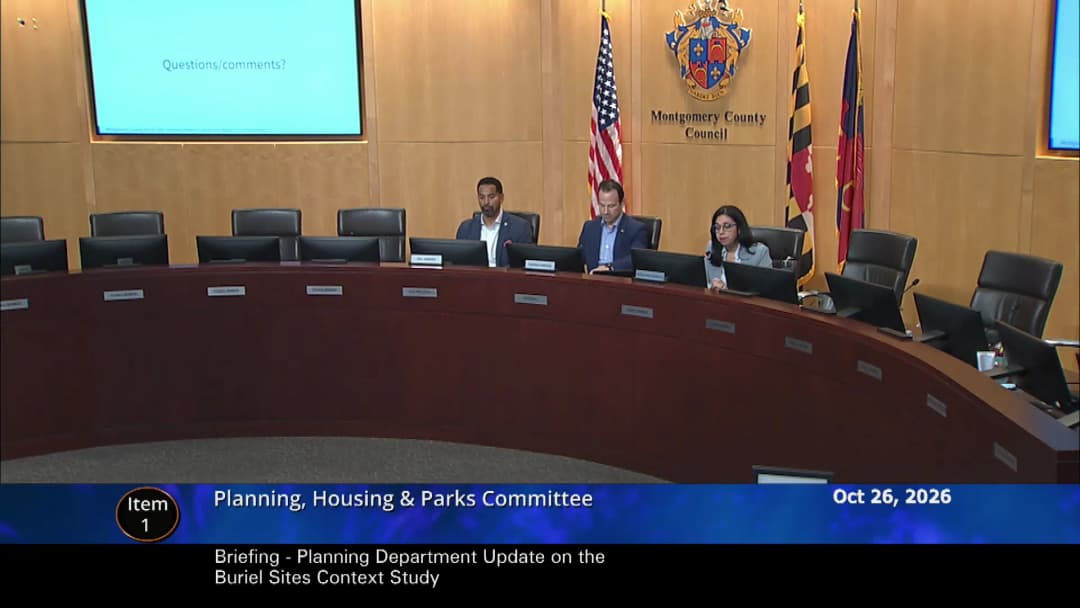
The Planning, Housing, and Parks (PHP) Committee of the Montgomery County Council met on 2026-10-26 at 1:30 PM. The committee received a briefing on the Burial Sites Context Study and voted unanimously on three bills: Bill 40-26 (landlord payment methods), Bill 41-26 (ADU licensing and fees), and Bill 42-26 (short-term rental platform compliance). Burial Sites Context Study Briefing - Planning Department staff (Rebecca Ballow and Dr. Brian Crane) presented a countywide, thematic master plan amendment for burial sites. The work is built on a consultant-led historic context study. - The county inventory comprises 347 burial sites: 261 known locations and 86 approximate sites. Staff discussed historical themes including enslaved persons' grounds, post-Civil War community cemeteries, and 18th-century family plots. - Councilmember Friedson stressed the real-world equity implications, citing the Wesleyan Cemetery case where a property was unknowingly sold at tax sale. He emphasized the need for plans addressing public, private, and right-of-way sites, as well as funding for fencing and markers. - Council President Fani-González urged outreach to Montgomery College to involve younger people. Councilmember Jawando asked about sites destroyed by development (over 30 are under pavement) and recommended partnering with Montgomery History for oral histories and consulting legacy funeral homes such as Snowden's. - Key Outcome: This was an information briefing. Staff will develop a scope of work and communications plan in early 2027, with master plan amendment work beginning in spring 2027. Bill 40-26: Landlord-Tenant Relations - Accepted Forms of Payment - Sponsor Council President Fani-González proposed requiring landlords to accept certified checks and money orders and prohibiting the termination of tenant access to online payment portals. - Discussion: Councilmember Jawando suggested adding personal checks with protections against bounced checks, which the sponsor was open to exploring at full council. The committee adopted a DHCA amendment requiring written receipts within 5 business days for rent redemption and 15 days for other payments. A DHCA proposal for local payment offices was deferred to full council for further discussion. - Key Outcome: The bill passed unanimously (3-0) as amended on the receipt requirements. Bill 41-26: Landlord-Tenant Relations - Licensing Procedures and Fees (Accessory Dwelling Units) - Sponsored by Councilmembers Friedson and Fani-González, the bill removes the owner-occupancy requirement for ADUs and waives licensing and permitting fees for units affordable to households earning 65% or less of Area Median Income for at least 10 years. - Discussion: An amendment by Councilmembers Jawando and Mink passed (3-0) limiting ADU licenses to two per owner (including affiliated entities to prevent circumvention) and requiring a County Executive report by December 2028. An amendment by Councilmember Sales to retain the owner-occupancy requirement was not moved. - Key Outcome: The bill passed unanimously (3-0) as amended. Bill 42-26: Transient Lodging Facilities - Short-Term Residential Rental - Online Platform Compliance - Councilmember Evans presented her first authored bill to strengthen compliance for short-term rentals by regulating online platforms. - Discussion: The bill requires platforms to verify operator licenses before listing, prohibits transaction fees for unlicensed rentals, and mandates annual reporting to DHCA. An OIG report found approximately 85% of short-term rentals were unlicensed. The committee adopted an amendment to make the verification database publicly available. DHCA requested and was granted an effective date of July 1, 2027, for technical implementation. - Key Outcome: The bill passed unanimously (3-0) as amended.
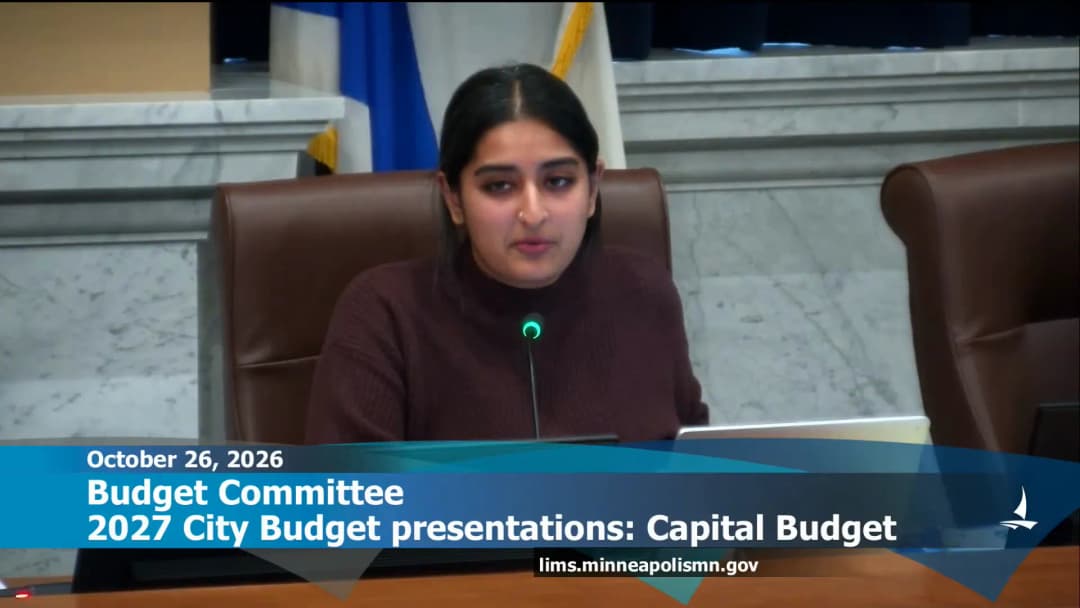
The Minneapolis Budget Committee met on October 26, 2026, to discuss spending oversight, public safety navigators, the 2027 budget, and a resolution on tax relief. The committee forwarded two items to the full council without recommendation and approved funding for navigators. Discussion Items - Spending Transparency and Overspend Protection: Councilmember Whiting introduced a resolution to require council approval for department contracts of $5,000–$175,000 if the department has overspent its budget. The city faces a $60 million budget gap and a potential 11.5% levy increase. After debate, the committee voted 11-0 to forward it without recommendation. Concerns included impacts on public works and emergency services; exemptions were noted for revenue-offsetting overspending and unforeseen events. - Domestic Violence and Community Resource Navigators: Staff presented two resolutions to transfer public safety aid funds ($450,000 to MPD for domestic violence navigators, $628,185 to Neighborhood Safety for resource navigators) for the South Minneapolis Community Safety Center. The committee approved both unanimously. - MPD 2025 Spending Legislative Directive: Chair Chugtai reported the directive was satisfied and closed the file. - 2027 Budget Presentations: The committee heard presentations on the IT department budget, Technology Improvement Plan, and Capital Improvement Plan (CIP) for 2027–2032. Departments covered included Arts, Municipal Building Commission, Property Services, Parks, and Public Works. All presentations were filed. - Government Restructuring Savings for Property Tax Relief: Vice Chair Schaefer introduced a non-binding resolution expressing intent to apply all net savings from restructuring to reduce the 2027 levy. After discussion, the committee forwarded it without recommendation to the full council. Key Outcomes - Approved (unanimous) two navigator funding resolutions. - Forwarded without recommendation (11-0) the spending transparency resolution. - Forwarded without recommendation (voice vote) the restructuring savings resolution. - Closed the MPD spending directive file. - Filed all budget presentations.
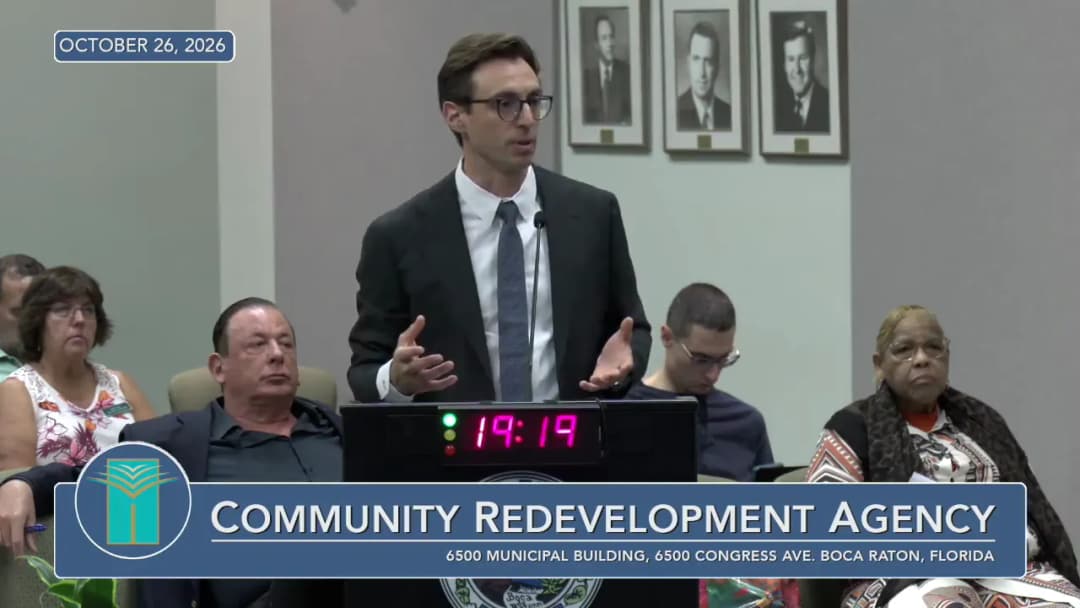
The Boca Raton Community Redevelopment Agency (CRA) convened on October 26, 2026, from 1:30 PM to 3:14 PM. Chair Andy Thomson presided over the meeting. Commissioners present were Vice Chair Yvette Drucker, Michelle Grau, and Stacy Sipple. Commissioner Jon Pearlman was absent despite being listed on the agenda. The meeting addressed two quasi-judicial development amendments, a proposed transfer of Mizner Park property to the City, and public requests regarding downtown planning. Consent Calendar - Minutes of the October 13, 2026, CRA regular meeting were adopted unanimously (motion by Vice Chair Yvette Drucker, second by Commissioner Stacy Sipple). Public Comments & Testimony - The Residences of Boca (CRP-22-01-R1): - Glenn Groman (former P&Z Board member, DBAC chair) expressed strong support, stating the project was fully code-compliant and architecturally superior. - Jonathan Rungeon (6501 Congress Ave) expressed support for the amendment because it reduces density (190 to 133 units), converts to condos, and reduces traffic trips. - 101 E Palmetto Park Road (CRP-24-02): - No public speakers testified. - Mizner Park Property Transfer (Resolutions 2026-09-CRA & 2026-05-CRA): - Ellie Zacharitis (applicant representative) spoke as a resident opposing the transfer. She argued the CRA needs the $3 million annual ground rent for critical downtown projects and that moving the funds was "heartbreaking" for the downtown's future. - Richard Warner (1322 SW 9th Ter) expressed strong support for the transfer, stating it was a vital step to stop the CRA's perceived damage to downtown and to bring the land under the "Save Boca" ordinance. - Fran Knackless (Bike & Pedestrian Advisory Board) opposed the transfer, citing that CRA funds essential safety infrastructure (lit crosswalks costing $80,000 each) and police enforcement. - Alessandro Caicedo opposed the transfer, arguing downtown Boca lacks identity and needs the funds captured within the CRA. - Joseph Graubart questioned whether downtown property owners in the special assessment district were specifically notified; staff confirmed standard public hearing notice was provided. - Jonathan Rungeon suggested the simpler solution was to amend the "Save Boca" referendum to explicitly include CRA land rather than executing a complex property transfer. - Public Requests (Item 8): - Earl Starkov requested council modernize traffic impact standards to measure cumulative area-wide mobility, using existing Florida law, within a four-week timeline. - Joseph Graubart used a damaged guardrail from a 2023 crash to illustrate neglected CRA-area infrastructure. - Richard Warner reiterated support for the property transfer. - Jonathan Rungeon urged broader discussion on the downtown's future as the DDRI expires. Discussion Items - The Residences of Boca (CRP-22-01-R1): Staff (Susan Lesser) detailed the amendment: reduce units from 190 to 133, add a 5,977 sq ft restaurant, increase height by 6.5 ft, and add valet parking. The project meets all code requirements (40% open space, 322 parking spaces). Boards recommended approval 5-0 and 6-0. Applicant (Philip Bronstein, Wexford) highlighted full code compliance, tax revenue increase ($1.2 million city, $5.5 million total taxing authorities), 35 of 45 buyers local, and infrastructure improvements (utility undergrounding, alley paving). Commissioner questions covered mechanical parking and trash pickup schedules. - 101 E Palmetto Park Road (CRP-24-02): Staff (Jake McGurman) presented the revised adaptive reuse of a historic building. The project removed previously planned affordable housing, retaining office on the second floor and adding a ground-floor restaurant. A technical deviation for zero parking was requested. Applicant (Ellie Zacharitis) highlighted a robust TDM plan (100% Tri-Rail/Palm Tran passes, 25% Brightline subsidy, annual Circuit contribution 3x higher than typical downtown developments). Commissioners noted the transit value. - Mizner Park Property Transfer (Resolutions 2026-09-CRA & 2026-05-CRA): Staff (Deputy City Manager George Zervis) explained the resolutions would transfer CRA Mizner Park property to the City. This moves $3 million annual ground lease revenue from the TIF-restricted CRA fund to the general fund for broader downtown spending and subjects the land to the "Save Boca" ordinance. Staff emphasized the transfer does not affect existing ground leases. Commissioner Drucker opposed the transfer, arguing the downtown needs dedicated funding and is "dying." Chair Thomson expressed concern about the impact on the City and CRA's bonding capacity, successfully moving to postpone the items for further research. Commissioner Sipple voted against the postponement, arguing it could miss the December deadline to directly amend the "Save Boca" referendum to protect CRA land. Key Outcomes - CRP-22-01-R1 (The Residences of Boca): Approved 4-0. - CRP-24-02 (101 E Palmetto Park Road): Approved 4-0. - Resolutions 2026-09-CRA (Downtown Plan Amendment) & 2026-05-CRA (Property Conveyance): Postponed 3-1 to the November 9/10, 2026 CRA meeting. Staff directed to analyze the impact on bonding capacity. Commissioner Stacy Sipple dissented from the postponement. - Next Steps: Staff to research and report on bonding impact. Commissioner Sipple noted concern the postponement could thwart efforts to bring CRA land under the "Save Boca" ordinance.
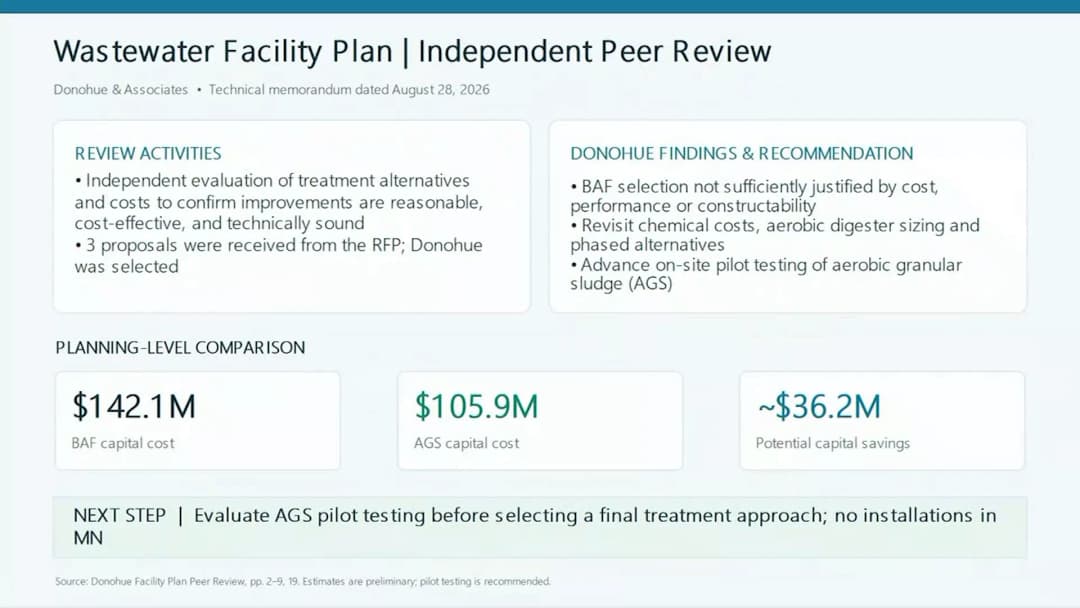
The Red Wing City Council held its regular meeting on Monday, October 26, 2026, at 6:30 PM in the City Hall Council Chambers and virtually via Webex. The meeting covered staff introductions, a proclamation, a major presentation on the Wastewater Treatment Plant upgrade plans and independent engineering review, public comment on local safety concerns and the sewer project, approval of a consent agenda with 15 items, introduction of two ordinances (fee schedule and zoning text amendment), and two closed sessions for labor negotiations and preliminary consideration of allegations. Consent Calendar - Approved en bloc by a 7-0 roll call vote: - Bills (Warrant 130441-130613, $1,017,439.98) - October 12, 2026 Regular Meeting Minutes - Finance Report - On-sale intoxicating liquor license including Sunday sale for The Bayside LLC at 1516 Old West Main Street - Resolution No. 8220 (Lawful Gambling Premise Permit for Red Wing Elks 845 at The Bayside) - Resolution No. 8221 (Lawful Gambling Premise Permit for Red Wing Youth Hockey at The Smokin' Oak) - One-day food wagon license for Daniel Miller (Norseman Lobster LLC) on November 10, 2026, 4-6:30 p.m. - Declaration of Fire Engine 1 as surplus and authorization to sell via Garage - Updated City Cemetery Rules and Regulations - Hangar lot lease renewal at Red Wing Regional Airport for Mark Weinreich - Private Use of Public Property application for Universal Music Center's 3rd Annual Summer Music Festival at Central Park Bandshell on July 24, 2027, 12-4 p.m. - Resolution No. 8222 (Joint Powers Agreement with Red Wing Police Department) - Resolution No. 8223 (Budget adjustment for donations and expenditures) - Authorization for Red Wing Police Department to submit a MN Chiefs of Police Foundation Grant - Resolution No. 8224 (Accepting Office of Traffic Safety Grant for Red Wing Police Department) Public Comments & Testimony - Non‑agenda items: - Harlan Heems (Ward 2) expressed concern over public safety claims published in an October 2 article by Representative Pam Altendorf, alleging human feces, open drug use, and rock‑throwing downtown. He urged the city to either warn the public if claims are true or refute them if false, calling inaction a failure of leadership. - Amber Plank (Ward 4) spoke about the need for discernment and compassion, rejecting the Altendorf article’s portrayal, and urged that people experiencing homelessness be treated with care rather than criminalized. - Carol Overland (Ward 2) stated that downtown Red Wing is not dangerous, called the claims absurd, and urged the city to publicly respond that they are false. - Agenda item (Wastewater Treatment Plant): - A resident (name not given) criticized the apparent desire to delay a nitrogen discharge limit, stating it would reflect poorly on the city to build a facility without nitrogen‑removal capability. He acknowledged potential savings from a different technology (AGS) but cautioned that operating costs matter. He urged intelligent management to minimize the burden on ratepayers. Discussion Items - Proclamations and Recognitions: - Introduction of Bradley Johnson (Accountant II) and Melanie Corey (Accountant I), who completed their probationary periods. Finance Director noted Mr. Johnson is deaf and taught the council basic American Sign Language for “thank you” and “welcome.” - Council President Farrar read a proclamation declaring October 2026 as Manufacturing Month in Red Wing, noting manufacturing accounts for 12% of Minnesota’s economy, $21.8 billion in exports (2025), $26.7 billion in wages (2024), and an average annual wage of $83,280. - Wastewater Treatment Plant Presentation: - Consultants from Bolton & Menk (Jake Pickelman, Sean Kershaw, Brian Hillgardner) presented preliminary engineering plans. Key updates: - The facility plan was approved by the PCA in August 2026, making the city eligible for Minnesota PFA funding. - Phase 1 (main lift station and CIPP lining, $7 million) is ranked 108 on the FY27 Priority List and is in the fundable range for low‑interest loans. - Phase 2 (treatment plant upgrades, $135 million) is on the FY28 list; likely to be sub‑phased over 10‑20 years. - The PCA has paused nitrogen rulemaking, pushing any potential nitrogen limit 15+ years out, allowing a more gradual project schedule. - Preliminary work completed: topographic/boundary/utility survey, 3D scanning and reality capture, geotechnical evaluation (4 borings, fill to 50‑60 ft depth). - Public Works Director Kelsey noted an independent engineering review by Donohue was conducted. Donohue recommended evaluating aerobic granular sludge (AGS) technology as a potential alternative to the selected biological aerated filter (BAF). Planning‑level cost comparison: BAF $142 million vs. AGS $106 million. AGS is not yet used in Minnesota but has installations in nearby states. Staff plan to travel to Rockford, Illinois to see a demonstration plant. - Council asked about the feasibility of AGS and potential sludge production. Staff confirmed further evaluation is needed. - Ordinance 243 – Fee Schedule: - City staff explained that fee increases were a combination of percentage adjustments (e.g., marina slips) and other factors. The ordinance was introduced on first reading (7‑0 vote). - Ordinance 244 – Zoning Text Amendment (Trade Shop in MCT District): - Planning Director Kyle described the request from England Properties to allow “trade shop” as a conditional use in the Mixed‑Use Commercial Tourism district, to reoccupy the former Bob’s business property at 1981 Old West Main Street. The Planning Commission recommended approval. Council discussed concerns about outdoor storage and screening; the CUP process would allow specific conditions. The ordinance was introduced on first reading (7‑0 vote). - Closed Sessions: - First closed session (11.A): Under Minn. Stat. §13D.03 to discuss labor negotiation strategies and review union proposals. The council gave guidance to the negotiation team. Motion carried 7‑0. - Second closed session (13.A): Under Minn. Stat. §13D.05 subd. 2(b) for preliminary consideration of allegations against an individual subject to council authority. The council discussed allegations and potential next steps. Motion carried 7‑0. Key Outcomes - Consent agenda approved unanimously (7‑0). - Ordinance No. 243 (fee schedule) introduced on first reading (7‑0). - Ordinance No. 244 (trade shop in MCT district) introduced on first reading (7‑0); will return for second reading at the next meeting. - After the first closed session, the council authorized the negotiation team to proceed with guidance (7‑0). - After the second closed session, the council authorized the council president to take action discussed in closed session (7‑0). - The meeting adjourned at approximately [time not specified in transcript].
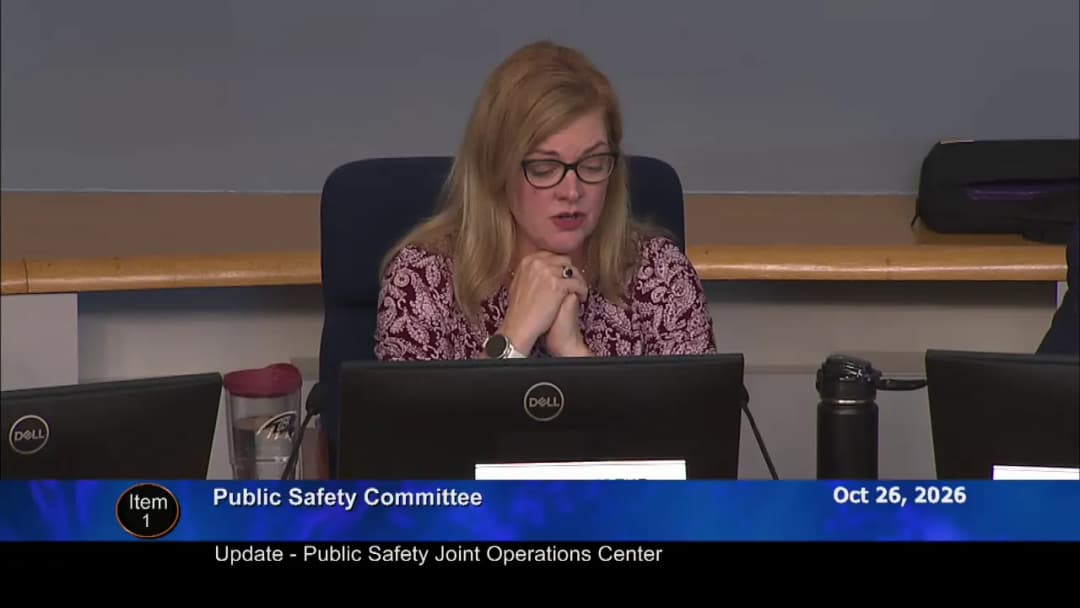
The Montgomery County Public Safety Committee, chaired by Sidney Katz, convened on October 26, 2026, to receive an update on the Public Safety Joint Operations Center (JOC). The work session featured presentations from Assistant Chiefs Dominic Colletti (Fire Rescue) and Dave McBain (Police), Mark Becklin (Talent Chief, Fire Rescue), Luke Hodgson and Nicole Markuski (OEMHS), Derek Erigan (OMB), Acting Police Chief Frank, and Fire Chief Corey Smith. Background and Funding - The JOC was initially funded at $2.4 million, later adjusted to $1.2 million during the FY27-32 CIP process for affordability. - Total investment to date is $2.367 million, leveraging $1.2 million in CIP funds, $452,000 in General Fund savings, $614,000 in Homeland Security Grant Program funds, and $100,000 in COVID relief funding. - 75% of capital work is complete; remaining antenna and radio installations are expected to be finished by the end of the calendar year. Operations and Impact Statistics - The JOC facilitates co-located operations for Police (Drone as First Responder - DFR, Real-Time Intelligence Center - RTIC/Arctic, and analytical units), Fire & Rescue, and OEMHS. - Fire Rescue and OEMHS functions currently lack dedicated FTEs. - On average, 20 to 25 weekly incidents requiring multi-agency coordination are managed in the JOC. - DFR Performance (Year to Date 2026): - Responded to 2,987 total calls. - Avoided dispatching police officers 440 times (estimated 2 officers per call). - First on scene 1,868 times with an average 52.3-second response time. - Average overall DFR response time: 77 seconds. - Notable Events: - Two missing autistic children in Silver Spring were located in 8-10 minutes via DFR, avoiding the need for 25-30 officers. - Over the preceding weekend, DFR responded to 38 calls on Friday and 45 on Saturday. - Future Operations: Police plan to run a duty commander from the JOC for county-wide resource coordination. Key Discussion and Testimony - OEMHS Director Luke Hodgson detailed the JOC's pivotal role during a major WSSC water outage, calling it "one of the worst emergencies we could have." With only 2-3 hours' notice, the co-located teams coordinated resources, deploying water trucks within the hour, while maintaining normal county operations. This was described as "night and day" compared to the typical EOC ramp-up. - Assistant Chief Dominic Colletti (Fire Rescue) noted the Fire Rescue program is only six months old. The co-location allows data and intelligence from Police DFR and RTIC to be relayed immediately to responding crews, improving efficiency and shortening the emergency-to-recovery timeline. - Assistant Chief Dave McBain (Police) emphasized the JOC is a force multiplier. He cited real-time information sharing, including body-worn camera feeds to assist Fire Rescue with patient statuses, as a key benefit. - Luke Hodgson noted that transition between steady-state JOC operations and a full EOC activation was seamless, allowing the JOC to handle routine incidents while the EOC focused on the major event. Council Comments - Chair Sidney Katz praised the JOC for enabling simultaneous communication and efficiency. He acknowledged that additional capital expenses are likely as the operation evolves and expressed appreciation for the collaboration. - Councilmember Kristin Mink expressed personal gratitude regarding the WSSC response, stating she has loved ones whose lives depend on a water supply. She noted the high level of public trust demonstrated during the incident. - Councilmember Andrew Friedson called the JOC investment a "low number" relative to the county's $700 million annual public safety budget. He praised the pooling of funding sources and highlighted the power of collaboration in high-pressure situations, noting that Fire Rescue and OEMHS have integrated effectively without pre-existing programs like DFR. Key Outcomes and Next Steps - The committee received the update with strong praise for the departments. - No formal votes were taken during the work session. - Future capital and operational budgetary needs were acknowledged by staff and committee members. - The departments will continue operating and expanding JOC capabilities, including the planned addition of a police duty commander.
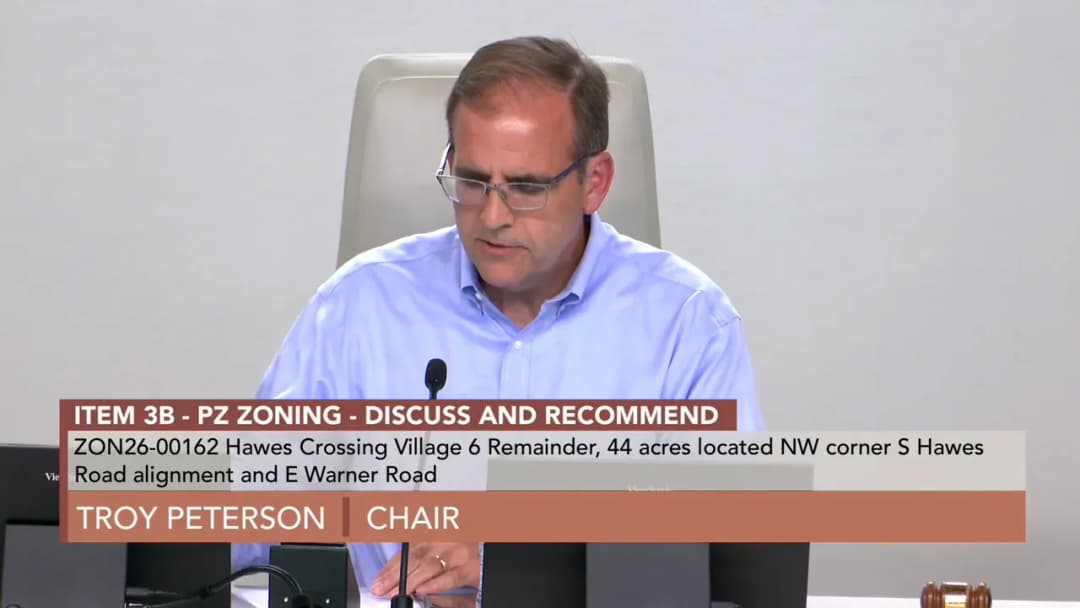
The Mesa Planning and Zoning Board convened on October 26, 2026, with Chairperson Peterson presiding and a full board present. The meeting addressed a consent agenda and one public hearing item, resulting in unanimous approvals and a recommendation to the City Council. Consent Calendar - Item 2A: Minutes from the September 23, 2026, Planning and Zoning Board meeting were approved unanimously. - Item 3A (ZON 25-00943, Waffle Flower Warehouse Rezone): The board approved a rezone of 2.4 acres at the northwest corner of East Thomas Road and North 54th Street from Single Residence 90 (RS90) to Light Industrial (LI). The approval includes a site plan review and special use permit for an approximately 18,000-square-foot industrial development, consistent with staff's recommendation of approval with conditions. - Item 3B was removed from the consent calendar to allow for a separate public hearing due to a citizen request to speak. Public Comments & Testimony - Norm Sandler (8550 East Mallory Street, Mesa) spoke on Item 3B, the Haas Crossing Village 6 Remainder Rezone. He expressed strong opposition to the project on the grounds that scraping native desert land for high-density development displaces dangerous wildlife. He described a personal incident where a coyote, displaced by nearby construction, entered his yard and killed his daughter's emotional support dog. Sandler urged the board to require mitigation measures, such as capturing dangerous species, whenever approving projects that destroy natural habitat. Discussion Items - Item 3B - Haas Crossing Village 6 Remainder Rezone (ZON 26-00162): The board discussed a 44-plus-acre parcel located at the northwest corner of South Hawes Road Alignment and East Warner Road. The request is to rezone the property from a mix of Multiple Residence 5 with a Planned Area Development (PAD) overlay, Office Commercial with a PAD overlay, and Limited Commercial with a PAD overlay to Residential Small Lot 2.5 with a PAD overlay, to allow for the future development of state land. A motion was made to recommend approval to the City Council with the conditions recommended by staff. Key Outcomes - The Consent Agenda (Items 2A and 3A) passed unanimously. - Item 3B: The board voted unanimously to recommend approval of the Haas Crossing Village 6 Remainder Rezone to the City Council. - The meeting was adjourned following a unanimous vote.
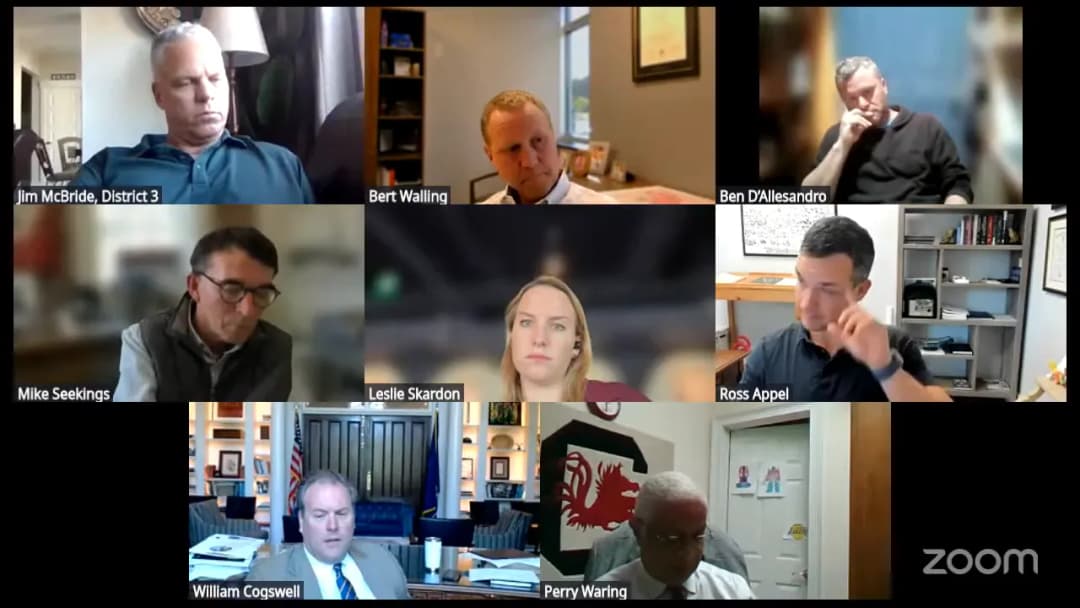
A special meeting of Charleston City Council was called to order on October 26, 2026, at 18:06 UTC, with a moment of silence. The only agenda item was discussion of the proposed Dominion franchise agreement and the related Berkeley Electric Co-op agreement. No formal action was taken. No written agenda or minutes were available in the source material; this summary is based solely on the raw transcript. Discussion Items - Ms. Copeland table-set the proposed terms: the original 1996 agreement was 30 plus 10; the proposed agreement is 20 plus 10. It grants Dominion and Berkeley Electric non-exclusive rights to install, maintain, and repair utility lines in city rights-of-way. In exchange, the city receives a 5% annual franchise fee on gross gas and electric revenues. Of that fee, 0.5% of electric revenue is set aside for the undergrounding program match. Ms. Copeland said last year the city received a check of $14 million into the fund, with 5.73 toward the undergrounding. The new agreement also creates four classes of construction work triggering coordination and notice requirements, gives City Council the absolute right to set the NSSF priority list, and includes a six-month rule: if required easements are not obtained within six months after design work, the project drops to the bottom of the list and must reapply. - Councilman Seekings asked why the undergrounding fund contribution is only 0.5%, arguing the city should front-load more money because undergrounding costs will rise. Dominion's Danny Cassis said 0.5% is the standard NSSF formula in every template, and the resulting funding is superior to the old capped fund. He estimated the city side would contribute about $1.2 million per year, matched by Dominion at about $1.2 million, for about $2.4 million annually and roughly $60 million over 20 years. Cassis also said the franchise fee is roughly $15 million per year, or $300 million over 20 years, and that the city has been at 5% since 2009, producing $260 million. He cited the existing set-aside as $11.5 million; Councilman Seekings interjected that it is $12.5 million. - Councilman Seekings asked whether the 5% fee is standard. Cassis said about 70% of more than 130 municipalities with franchise agreements are at 5%, some are at 4%, the remainder at 3%, and 5% is the cap for this type of consent permit. The mayor emphasized that if the city does not sign, it foregoes the $15 million-plus annual revenue. - Councilman Delasandro asked about the percentage of undergrounding funding and construction costs. Cassis said all-in undergrounding costs can be as high as $2,500 per linear foot, and work is performed by Dominion or its contractors because Dominion owns and maintains the assets in perpetuity. The city may use the larger general-fund franchise fee for additional undergrounding, but only the 0.5% electric set-aside is matched by Dominion. - Councilman McBride clarified service territories: Berkeley Electric is a co-op serving roughly 7,000 customers, primarily on John's Island, with portions around Maybank, Main Road, Brownswood, Finnwick, Brickyard, a small part of West Ashley, and a small part of Cainhoy; Dominion is a for-profit utility. He suggested the city provide council members with service-area maps and noted Berkeley Electric also faces pressure to bury lines on John's Island. - Councilman Polka asked whether the franchise agreement can address energy affordability, lower-income consumers, and shutoffs. Cassis said the franchise agreement covers rights-of-way and territory, while affordability is handled through state rate-making, energy efficiency programs, demand-side management, and customer assistance resources. Councilman Polka asked that the city accompany the final agreement with information directing residents to those resources. - Councilmember Main praised the negotiated improvements but questioned the cap of two projects in design at a time, especially for small, street-by-street projects. She said the constraint was not money but design capacity and easements. Cassis defended the cap as an efficiency tool and said developers or the city can pay for design separately to move a project up the execution list. Councilman Seekings disagreed, saying the cap disadvantages retrofit projects such as South Battery (about eight transformers and roughly 1.5 miles long) and Clifford Street; he suggested separate lists for large and small projects and allowing more than two projects in design. - Councilmember Rapel argued the main bottleneck is voluntary easements. He called for the city to treat electric easements like other public infrastructure projects and acquire them through a non-voluntary process if necessary. He noted one neighborhood, Waku Heights, had reached 100% sign-off but dropped to short of 100% after a homeowner sold. - Councilman Bowden asked why telecom providers such as AT&T can dig without similar easement processes. Cassis answered that electric facilities are essential service assets that require more protection because Dominion is responsible for their safe and reliable operation and maintenance. - Councilman Waring asked about Dominion's involvement in affordable housing projects, including Project 3500. Cassis said Dominion does not have a direct affordable housing program, but works with redevelopment projects individually and can build them to be highly energy efficient. Waring cited prior SCNG/Dominion work at the Charleston Nine memorial, the Grace Memorial Bridge area with Grace Holmes and James Lewis housing, and the Gibbs Museum/American Garden. - Councilman McBride asked about future Maybank widening or sidewalk work and coordination with Berkeley Electric. Bert Walling of Berkeley Electric said the co-op views these as partnership opportunities and can provide more detail. Key Outcomes - No motion or formal vote was taken; the special meeting was a discussion session on the proposed franchise agreement. - Dominion and Berkeley Electric representatives agreed to provide follow-up information, including service-territory maps and contacts for energy assistance and energy efficiency resources. - Several council members signaled they want to revisit the two-project design cap and shift city policy away from relying on voluntary easements before final consideration of the agreement.