On October 26, 2026, the Board of Legislators’ Budget & Appropriations Committee met jointly with Public Safety & Veterans, Infrastructure & Housing, Legislation, and Litigation committees. The agenda called for a 10:00 AM start; discussion continued until the final adjournment at 12:33 PM. Committees approved police academy instructor-service agreements, a regional hazmat grant partnership, three airport lease packages, commissioner-qualification changes, two Law Department local laws, an outside counsel retainer, and routine consent items. No members of the public offered testimony. The agenda lists the chair as Tyrae Woodson-Samuels, while the transcript refers to “Legislator Wilson Samuels.” Consent Calendar / Routine Approvals - Approved four sets of committee minutes: October 14 at 10:00 AM, September 22 at 10:00 AM, September 29 at 1:00 PM, and October 5 at 10:00 AM. - Accepted as a receive-and-file communication a gift from Our Rescue of a one-year Cyacomb Collector License valued at approximately $10,000. - Received and filed a status report for the planning and flood mitigation program. Discussion Items - 2026-493 – Police Academy Instructor Services IMA: Captain Jeffrey Weiss presented a five-year inter-municipal agreement (March 21, 2027–March 20, 2032) allowing outside law-enforcement instructors to teach at the Westchester County Police Academy while remaining employees of their home agencies. He said the county does not reimburse or assume liability for those instructors. One recent 22-week basic course used 487 outside-agency instructor days; firearms instruction is delivered at a one-on-one instructor-to-student ratio. Approved by Budget & Appropriations and Public Safety & Veterans. - 2026-495 – Regional Partnership Agreement with Dutchess and Putnam: Commissioner Susan Spear explained a $15,000 FY2025-26 PHMSA grant for hazardous-materials transportation preparedness, with a 20% county match satisfied by existing staff time. The state divides funding among 18 partnership regions; Westchester shares one region with Dutchess and Putnam. She noted Indian Point decommissioning remains a planning factor because fuel remains on site and future waste transport could involve hazmat. Approved by both committees. - 2026-510/511 and 2026-512/513 – Hangar V leases (Interlaken Capital and PepsiCo): Airport officials presented local laws authorizing leases for a portion of Hangar V to Interlaken (20-year initial term) and PepsiCo (5-year initial term). Both leases are $41 per square foot with 3% annual escalation. The tenants take responsibility for all improvements, including structural repairs; the county retains annual inspection rights. The tenants share the campus under a reciprocal license. First-year base rent for each tenant will be approximately $1.8 million, a major increase from the old ground-lease rates. Legislators questioned whether the 3% escalation and long initial terms were aggressive enough; some suggested periodic market reassessments, while the Chair cautioned against overreaching. The public hearing resolutions and local laws were approved by Budget & Appropriations and Infrastructure & Housing. - 2026-514/515 – IBM Hangar W lease: IBM’s Hangar W lease is priced at $43 per square foot because IBM has exclusive use of its entrance, apron, parking, and hangar space. Its annual rent will increase from about $245,000 to $2 million, with tenant responsibility for all maintenance and structural costs. There is a temporary subleasing provision allowing one HPN-based corporate aircraft to be housed at IBM’s facility for up to 12 months during construction, with subleases to FBO-based aircraft prohibited. IBM also has a 24-month termination right after the 10th anniversary. Approved by both committees. - 2026-501/502 – Commissioner Qualifications: Deputy County Executive Joan McDonald and Law Department officials proposed eliminating the professional-engineer requirement for the commissioners of DPW&T and Environmental Facilities, arguing the roles now emphasize management, operations, and administration. They noted NYS DOT, NYC, Yonkers, Buffalo, and MTA DDC do not require a PE for equivalent roles, and the Charter Revision Commission supported the change unanimously. Legislators discussed whether the change could lower salary expectations or affect promotion; McDonald said it does not diminish the position and salary would not be reduced. Legislator Puzzle, an engineer, supported the change. Majority Leader Holstein recorded the only no vote in B&A. Approved by Budget & Appropriations and Legislation. - 2026-519/520 – Defense and Indemnity Actions: County Attorney John Nonna and staff proposed amending Section 158.11 to allow the County Attorney to initiate defense, indemnification, insurance-coverage, and contribution actions without prior board approval, while reorganizing existing exceptions. They said contractors and insurers sometimes refuse to defend or indemnify the county, and CPLR 1007 imposes a 90-day deadline for third-party actions. During discussion, Legislator Barr raised oversight and board-power concerns. The committee adopted an amendment requiring the County Attorney to notify the county board when using the new authority (also added to the county-executive emergency exception). The local law and public hearing resolution were approved as amended by Budget & Appropriations, Legislation, and Litigation. - 2026-521/522 – Written Notice for Contract and Nontort Claims: Law Department staff presented a local law modeled on the City of Newburgh’s law requiring written notice of contract and other nontort claims before suit, typically within three months. County Attorney John Nonna said it gives early notice and protects against stale claims. Legislator Smith called it a strong posture for the county. Approved by Budget & Appropriations and Legislation. - 2026-504 – Giannasca & Shook Retainer: Senior Assistant County Attorney Mark Gardner requested authority to retain Giannasca & Shook, PLLC at county expense, capped at $50,000, for a surety dispute on DPWT Contract No. 16-529. The usual outside counsel, Irish Shulman, had a conflict because QBE refused a waiver. Gardner said litigation may prompt the surety to settle, but additional funding could be sought if the case continues. Approved by Budget & Appropriations and Litigation. Key Outcomes - Approved the police academy instructor-services IMA and the Dutchess/Putnam regional hazmat partnership. - Approved all three airport lease packages (Interlaken, PepsiCo, IBM), including local laws and public hearing resolutions. - Approved the charter-amendment local law removing the PE requirement for DPW&T and Environmental Facilities commissioners; public hearing to be set. - Approved the defense-and-indemnity and written-notice local laws as amended; public hearings to be set. - Approved the $50,000 outside counsel retainer for the QBE surety dispute. - Accepted the $10,000 Our Rescue gift and approved routine minutes and receive-and-file items.
The Public Meeting Index
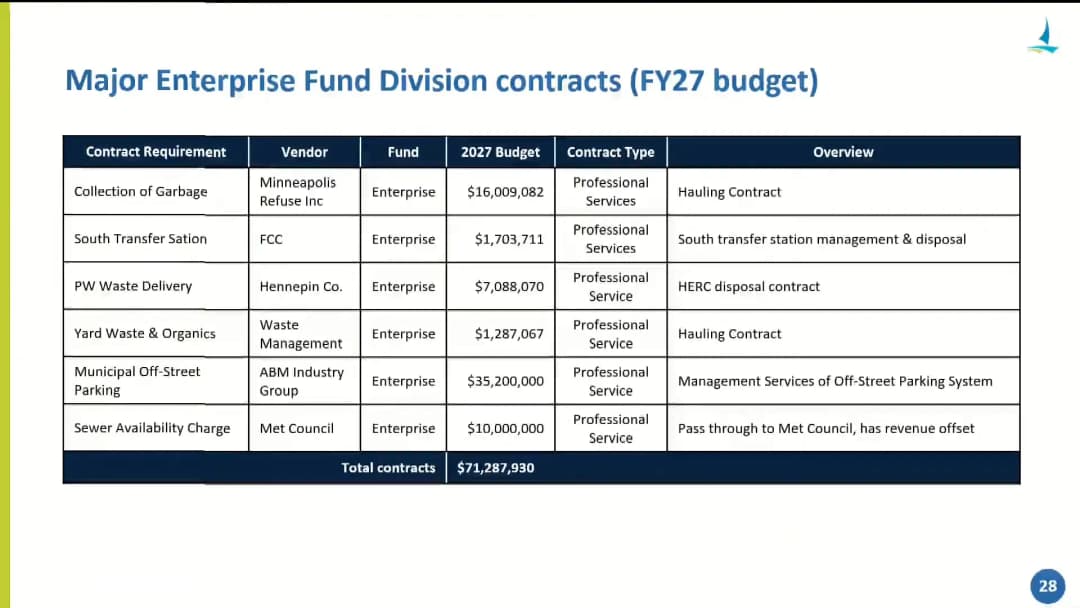
The Public Meeting IndexThe Minneapolis City Council Budget Committee, chaired by Aisha Chugtai, met on October 26, 2026, to review the Mayor's recommended 2027 budgets for the Performance Management and Innovation (PMI) department and the Public Works department. A quorum of eight members was established, with Councilmembers Warren and Vice President Osman joining later. The meeting featured detailed presentations on proposed spending, organizational changes, and service impacts. Discussion Items Performance Management and Innovation (PMI) 2027 Budget - Chris Tolks, Deputy City Operations Officer for Internal Services, presented the PMI budget. The department is proposed to move administratively into the Office of Public Service (OPS). - The budget includes a $145,000 variance moved to contractual services and a divestment of 2 FTEs through attrition, which is expected to reduce project capacity and potentially slow timelines for service delivery. - Councilmember Palmasano inquired about continued support for departments in the Office of Community Safety (OCS) after the reorganization. Tolks responded that the intention is to continue supporting the full enterprise. - PMI reported that 84% of its partners used the tools or strategies provided, and 100% of projects were delivered on time within 10% of their scope, indicating accurate resource estimation. Public Works 2027 Budget - Public Works Director Tim Sexton, alongside division directors, presented the department's $516.5 million proposed budget, the largest and most complex in the city. - Sexton highlighted that less than 15% of the budget ($77 million, closer to $74 million when pass-throughs are removed) comes from the general fund, supporting core services like pothole filling, street light repair, and snow plowing. - The budget includes a $600,000 investment in the traffic safety camera program, moving it to a special revenue fund. The cameras recorded over 91,000 speeding violations in the first year and are credited with reducing speeding vehicles by 120,000 at five locations. - Proposed divestments total 4.75 FTEs, including two administrative support positions, a maintenance crew leader, a service worker, and an electrician. This brings the total reduction of general fund positions to approximately 19 to 20 since 2025. - Councilmember Palmasano expressed concern over the cumulative FTE reductions, calling it a "warning bell" for core city services. He also asked about contract oversight; Director Sexton outlined controls such as engineer's estimates and graduated funding releases. - Councilmember Vita praised the department's work on illegal dumping and fleet management. Fleet Services Director Chris Royston noted an 8% reduction in planned 2027 vehicle acquisitions, saving an estimated $1.3 million, and the elimination of over 80 seasonal vehicles. - Councilmember Vita asked about the impact of the paid family medical leave program, which had been used by 333 employees in 2026, with 126 actively using it. The largest impacts were felt in the larger divisions like Transportation Maintenance and Repair, Water Treatment, and Solid Waste. - Vice Chair Schaefer asked about potentially duplicative services, specifically lead testing; the department committed to a follow-up. - Chair Chugtai asked Director Sexton to clarify the voluntary seasonal snow and ice layoff pilot, confirming it is entirely voluntary. Sexton stated that the department achieved the necessary reduction through voluntary participation and planned retirements. Key Outcomes - The committee received and filed both the PMI and Public Works 2027 budget presentations without objection. - No formal votes were taken on the budgets themselves; the session served as an informational briefing for councilmembers ahead of the budget markup process. - Councilmember Palmasano highlighted the need for close monitoring of the traffic safety camera program's path to financial self-sustainability. - The committee stood adjourned after concluding all business.
The Judiciary & Legislation Committee of the Milwaukee Common Council met on Monday, October 26, 2026, at 9:00 AM in Room 301-B of City Hall. Chair Ald. DiAndre Jackson presided, with all five members present (Jackson, Westmoreland, Pratt, Bauman, Perez). The committee considered 17 agenda items, including claims against the city, a legislative package update, code revisions, tax cancellations, and litigation matters. The meeting adjourned at 11:55 AM after a closed session. Public Comments & Testimony - Item 3 – El Greco, Inc./John Gliatis claim: John Gliatis, owner of El Greco restaurant, testified that a sewer backup in October 2025 caused $28,000 in damages, alleging a city-installed streetlight foundation may have contributed. City Attorney Kevin Todd recommended denial, citing no causal connection. Committee members questioned the proximity and excavation method. The committee recommended disallowance. - Item 8 – Greater Milwaukee Auto Auction claim: Kristi Church, president of the auction, stated a stolen 2019 Mercedes was recovered by police and sold by the city tow lot without notifying her business, causing $27,000 loss. Tow lot managers Nicole Anderson and Tammy Stephan explained they followed procedures, contacting the lien holder. MPD Officer James Lewis noted a 7:40 AM call to the auction, but Church said the business was closed. Committee recommended denial. - Item 9 – Detra Rodgers claim: Ms. Rodgers (by phone) argued the Milwaukee Fire Department unnecessarily forced entry into her rental property during a dumpster fire, causing $8,080.65 in damages. Fire Department Assistant Chief Parish defended the action as standard protocol. The committee first considered a $1,000 settlement, which Rodgers rejected, then voted 4-1 to recommend denial. Ald. Westmoreland dissented. Discussion Items - Item 10 – 2027-2028 Legislative Package: Jordan Primakow and Shianyia Thao (Intergovernmental Relations) and Justin Morales and Calvin Lee (Legislative Affairs) presented a streamlined biannual package. They outlined five guiding pillars, focused on diversifying city revenues and removing state-imposed limitations. The committee held the communication to the call of the chair. - Item 11 – Code Revisions Ordinance: A substitute ordinance correcting errors, clarifying language, and removing obsolete provisions. Committee recommended passage. - Item 12 – Tax Cancellations: Assessment Appeals Director Dan Campbell requested refunds totaling $15,004 for five parcels on the 2025 tax roll. Committee recommended adoption. - Item 13 – Ordinance on Prospective Litigation Settlement Agreements: Not ready; held to call of chair. - Item 14 – Communication from City Attorney on Settlement Agreements: Placed on file after discussion in closed session. Key Outcomes - Claims Denied (Items 1, 3, 5, 8, 9): The committee voted unanimously (5-0) to recommend disallowance for AT&T Mobility (Item 1), El Greco/John Gliatis (Item 3), Luis Hernandez Lopez (Item 5), and Greater Milwaukee Auto Auction (Item 8). For Detra Rodgers (Item 9), the committee voted 4-1 to recommend disallowance after she rejected a $1,000 settlement offer. - Claims Held (Items 2, 4, 6, 7): Claims by Cassandra Miller, Drew Hall, Celester Perkins, and Malcolm Washington were held to the call of the chair, primarily due to first-time non-appearances or unresolved representation. - Legislative Package (Item 10): Held to call of chair for further refinement. - Code Revisions (Item 11): Recommended for passage (5-0). - Tax Cancellations (Item 12): Recommended for adoption (5-0). - Litigation Matters (Items 15-17): After closed session, the committee recommended adoption of the settlement in Jacob Enriquez v. City of Milwaukee (Item 15), the resolution on settlement indemnification (Item 16), and authorization to retain outside counsel for toxic exposure litigation (Item 17), all by 5-0 votes. - Closed Session: The committee convened in closed session under Wis. Stat. § 19.85(1)(g) for attorney-client advice on items 14-17. - Next Steps: Denied claims will go before the full Common Council on November 4, 2026. Claimants may then file suit in circuit court.
The San Leandro Community Police Review Board (CPRB) met to receive Police Department and Independent Police Auditor reports, take public comment, review Brown Act emergency/urgency agenda procedures, receive ad hoc committee updates, and authorize the Chair as voting delegate to the NACOLE conference business meeting. Roll call showed all members present except Jenny Chang (excused). The Chair noted that members whose terms end this year must reapply; the clerk sent prefilled applications around October 2. Note: The agenda version provided was dated Wednesday, October 21, 2026, at 7:00 PM; per instruction, this summary uses the supplied meeting date of October 26, 2026 (2026-10-26 15:00:00+00:00). Consent Calendar - Approved the September 16, 2026, meeting minutes by a 6-0-1 vote (motion by Keith, second by Joseph; one excused absence). Police Department Report - SLPD reported roughly 24 vacancies, including a sergeant vacancy from a retirement earlier in October and an anticipated retirement in November. Lateral officers are being hired to shorten training timelines. - The records division is fully staffed, though some records clerks are moving to other positions within the department. - Pursuit and use-of-force policies were provided to the relevant committees. The department plans to go to the City Council in November to release Supplemental Law Enforcement Services Fund grant money for frontline equipment, training, software, and technology. - The CAD/RMS replacement project is still in the request-for-proposals phase, with an application deadline of October 30; a consultant contract was extended to help evaluate proposals. - A 911-system data glitch made the reported citation count incomplete; the 177-citation figure was preliminary. Independent Police Auditor's Report - IPA staff presented a redesigned monthly report with charts and narrative. Uses of force, pursuits, and complaints were mostly at the lower end of the range, except for one less-lethal projectile deployment. - Average time for SLPD to refer cases to the IPA was 21 days. There were no AUCAs for pursuits, so no joint course-of-action agreements were needed; supervisors handled learning moments. - Five complaints reached the IPA after SLPD's internal review. Two were from 2025 and took over 300 days to reach the IPA. One 345-day case had been reclassified as an inquiry; one 343-day case was delayed by a system entry error. Training for civilian supervisors is being arranged. - Stop data showed Black individuals were 71% of non-moving violation stops (17 of 24), compared to 32% of all stops; most of those stops were at night and ended in a warning or no action. This pattern stood out for a second consecutive month. A board member noted the prior-month figure was 44.9%. - RIPA forms completed during the month were 207, corresponding to 207 stops; however, an audit found a significant number of missing RIPA forms. SLPD said it is working on fixes and additional measures. The IPA's DATA audit is expected to be completed within one to two weeks. - Flock searches by SLPD fell 15%, and no searches were run for a federal agency. - The IPA and board discussed Flock/ALPR audits: the IPA is doing monthly independent audits in addition to Flock's process. SLPD reported zero instances of misread or unconfirmed license plates leading to stops. Board members asked for bad outcomes to be tracked and for audit coverage of Axon/patrol-car ALPR data to be clarified. Board Secretary's Report - The Board Secretary's report was brief; no items were highlighted. Public Comments & Testimony - Mike Castle Cowley raised concerns about Flock/ALPR oversight. He said there are no mandated Flock audits, and Flock's audit assistance tool is not a true audit. He recommended audits check access by former or suspended employees, two-factor authentication, government-issued email addresses, data retention settings, camera changes, data-sharing agreements, unusual logins, password rotation, and agencies sharing ALPR data. He also said the report should include a bad outcomes section, not only good outcomes, and should not rely solely on police-generated reports. He asked for a breakdown of the 10 successful investigations/vehicle assists, hot-list hits, and clarification that searches for a federal agency mean on behalf of a federal agency. - A board member echoed concerns about unauthorized ALPR access, citing a Washington Post article published the same day. Discussion Items Brown Act Emergency/Urgency Agenda Procedures - City staff presented an overview of the Ralph M. Brown Act rules for discussing or acting on items not on the posted agenda. The general rule is that both discussion and action are prohibited without posted notice. - The three exceptions are: a statutory emergency, an urgency (subsequent need) arising after the agenda was posted, and a continuance. - Emergencies require a majority finding and are limited to defined crises involving public health/safety, such as work stoppages or disasters. Urgency items require a two-thirds finding that immediate action is needed and cannot wait for the next regular meeting. Matters of compelling community interest alone do not meet the standard. - The agenda is posted at least 72 hours before the meeting, usually on Thursday for the Wednesday CPRB meeting. Examples included past Flock and military-equipment reviews where timing required urgency findings. - Staff cautioned that email polling of board members to add agenda items, even with yes/no responses, could risk a Brown Act violation because a majority of the board would be discussing city business outside an agendized meeting. The administrative procedures review was suggested as the place to set clearer rules. Ad Hoc Committee Updates - The Flock subcommittee has met twice; topics include Axon/patrol-car ALPR data retention, access, and auditing, and possible consultation with the Electronic Frontier Foundation. - The administrative procedures committee has not yet met. - The use-of-force/pursuit policy review is nearly complete; most previously agreed changes were incorporated into the latest version, with a short list of remaining items. - The dormant crowd-control committee's earlier questions led to some department changes, including increased training frequency. NACOLE Conference Voting Delegate - The board considered authorizing the Chair to represent the CPRB as a voting delegate at the 2026 Annual National Association for Civilian Oversight of Law Enforcement (NACOLE) conference business meeting, including bylaw changes, committee assignments, and board member elections. Board Reports and Peregrine Contract Announcement - The Chair shared a statement that the San Leandro City Council, on October 5, approved a five-year contract of up to $705,000 with Peregrine Technologies for an AI-powered data integration platform for the Police Department. The Chair said the vote was a narrow majority, was not referred to the CPRB, was a no-bid contract, and raised privacy, civil-liberties, mass-surveillance, data-sharing, and security concerns. Three council members voted to pause for more community input. - The City Attorney reportedly said the CPRB does not have jurisdiction over the contract itself but does have jurisdiction over related policies. The Chair argued the Council had discretion to refer the matter to the CPRB, as had been done previously for Flock and dash-camera policies. - The board agreed to place a Peregrine presentation/review on the next meeting agenda; the department agreed to provide information or present. Key Outcomes - Approved the September 16, 2026, minutes 6-0-1. - Authorized the Chair to serve as the CPRB voting delegate at the 2026 NACOLE conference business meeting; passed 6-0-1. - Directed follow-up reports on missing RIPA forms, the DATA audit, and RIPA stop-data trends at the next meeting. - Asked for future reporting on officer-level complaint/use-of-force patterns (without names), likely in the annual report, and for bad outcomes related to Flock to be reported monthly. - Asked SLPD to clarify whether Axon/patrol-car ALPR data is included in audits. - Agreed to set the next meeting agenda to include a Peregrine Technologies presentation/review, the IPA annual report, and committee updates; the IPA annual report was expected to be available in time. - Staff advised that any future procedure for adding late agenda items should be developed through the administrative procedures review rather than email polling.
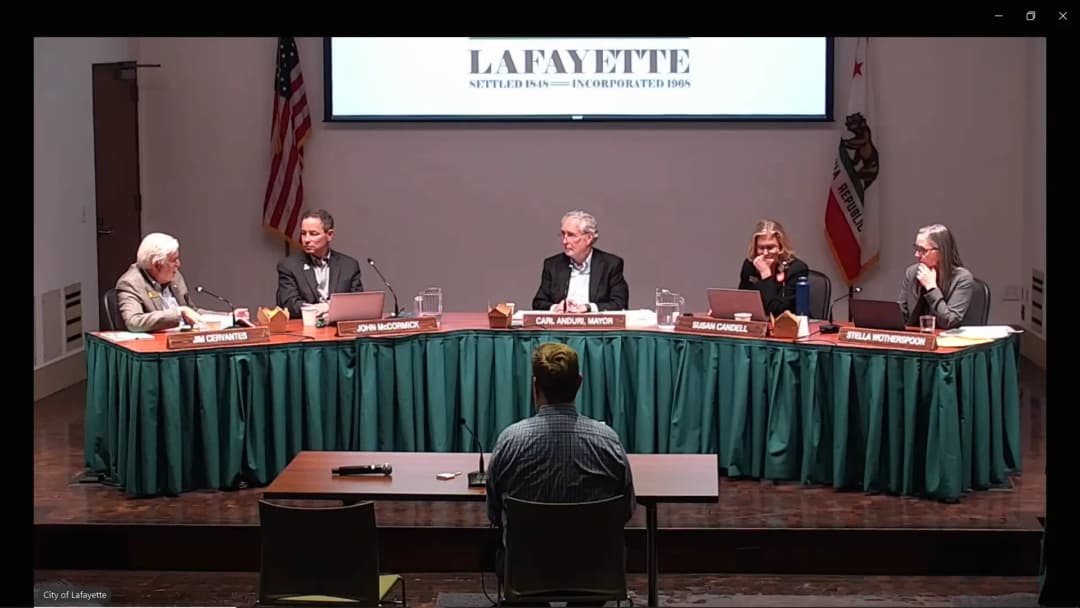
The Lafayette City Council convened at the Lafayette Library & Learning Center on Monday, October 26, 2026. The meeting included the 2026 Legislative Recap, adoption of several consent calendar items, and a public hearing on a revised mixed-use development project (OUTDO Lafayette LLC) requesting a state density bonus height waiver. Consent Calendar - Item 9A (City Council Minutes – Oct 13, 2026): Pulled by Vice Mayor McCormick. Corrected to reflect a 3-1-1 vote on the Objective Design Standards, with Councilmember Cervantes voting no. Approved as amended. - Item 9B (Ordinance 703): Adopted to incorporate Objective Design Standards (Phase 2) for Housing Element Implementation. - Item 9C (Smart Signals Project): Authorized release of $230,000 in Regional Lamorinda Transportation Impact Fees. - Item 9D (School Bus Program): Authorized the city to act as Project Sponsor to receive a $104,000 TFCA grant. - Item 9E (Trail Connector): Authorized the City Manager to execute a sublicense agreement with EBRPD. Public Comments & Testimony - Non-Agenda: Rosemary Kirbach praised the Sunflower Hill at Sierra Place project, sharing a personal story about the honoree, Sierra Olsen. Council members thanked her, expressing pride in the project. - Item 12A (OUTDO Lafayette): - Ramon Amaral (Carpenters Union Local 152): Urged the city to implement responsible contractor standards to ensure living wages and local hire for construction workers. - Rob Lavoy: Questioned the legal limits of height increases and stated a seven-story building on a 0.63-acre parcel is too large for Lafayette. Discussion Items - City Manager’s Update: Announced the Mt. Diablo beacon crossing is nearly complete, the Oct 20 Safeway robbery distraction (3 suspects, 2 arrested), and the Haunted House success (1,900+ guests, $7,477 raised by Youth Commission). - 2026 Legislative Recap (Casey Elliott, Townsend Public Affairs): - Elliott noted 1,800 bills introduced; Governor signed 1,000 and vetoed 10%. State budget is $350 billion. - Signed laws target wildfire hardening, e-bike regulation, housing streamlining, and Brown Act modifications. - Key Prop 43 (closing the local special tax upland loophole) and Prop 45 (CEQA streamlining) were discussed. Council asked about the state structural deficit ($20B to $8.4B) and the gubernatorial transition. - Item 12A (Public Hearing on Revised Development): - Project: OUTDO Lafayette LLC requested amendments to a March 2026 approval, increasing height from 62’3" (6 stories) to 71’ (7 stories) and reducing units from 31 to 30 while retaining 3 BMR units. Ground-floor commercial was removed for a larger lobby and live/work cafe. - Legal Context: The City Attorney explained the Wollmer precedent, stating the city must grant density bonus waivers absent a specific health/safety impact. Denying the waiver would risk physically precluding the housing. - Applicant Position: The developer stated the original project is not financially viable due to 7.5% interest rates and a market demanding larger units. He argued the changes are required to secure financing. - Council Deliberation: - Councilmember Cervantes concluded denying the changes poses significant legal risk. - Councilmember Woodsworth expressed frustration that BMR units are 36% smaller (median) than market-rate units and lack decks, conflicting with the city’s inclusionary goals. - Mayor Anduri criticized the massing (16% increase), stating the building is out of scale and landscaping does not reduce perceived bulk. - The resolution was amended to add language that state law requires the waiver, noting the municipal code section is preempted by state density bonus law. Key Outcomes - Consent Calendar (Items 9B-E): Approved unanimously. - Item 9A (Minutes): Approved as amended. - Resolution 2026-58 (OUTDO Lafayette): Approved 5-0. The project was found exempt from CEQA and the density bonus waiver was granted. Staff will incorporate all verbal amendments. - Proclamations: Approved Shelter In Place Education Day (Nov 4) and Lung Cancer Awareness Month (November) unanimously.
The Alameda Planning Board met at 7:00 PM on October 26, 2026, in City Hall Council Chambers with remote participation. The board considered a Planned Development Amendment for the South Shore Beach and Tennis Club and a Downtown Commercial Zoning Text Amendment. Board members Katie Freed, Hom, Cisneros, Lee, and President Wang were present; Sue and Ruiz were absent. Board member Lee recused from the South Shore item, and Board member Freed introduced herself as a nearly 10-year Alameda resident. Consent Calendar - Draft meeting minutes from June 22, 2026, continued from October 12, 2026, were not approved and were continued to the next meeting because no board member could vouch for the minutes. Discussion Item: 5-A – Planned Development Amendment, South Shore Beach and Tennis Club - Staff presented a request by Reggie Hanna on behalf of Rockhill Management, LLC, to amend the existing Planned Development Z-8.96 at 410 Westline Drive and 936 Shorepoint Court, converting existing commercial and office space to residential use in two areas. The 1971 development contains about 9.19 acres and 446 existing residential units; 16 new residential units are proposed with no new floor area. - The amendment would proportionally reduce permitted commercial space and remove the cap on ADUs to be consistent with state law. Staff said the project meets Planned Development eligibility and use-permit standards, and residential density would increase to roughly 50 units per acre, within the General Plan maximum of 100 units per acre. CEQA consistency was based on the 2040 General Plan EIR certified November 30, 2021. - Board questions addressed inclusionary housing: ADUs would not trigger the inclusionary ordinance, while non-ADU units could if thresholds are met. Staff commented that code enforcement related to sports-complex lighting is being handled separately; the construction manager targeted permit submittal by the end of the week, and lights had been reprogrammed to turn off earlier. - Board discussion acknowledged resident complaints about maintenance, lighting, noise, and smoke but concluded these are separate code-enforcement matters and do not prevent the amendment findings. One board member expressed concern that using ADUs avoids inclusionary requirements but nonetheless supported more housing. The board also requested staff to bring back a status report on code enforcement actions in roughly three to six months. Public Comments – Item 5-A - Lucia Catalano, a South Shore Apartments resident for over 15 years, opposed the amendment, citing two broken elevators, unresolved rodent issues, poor maintenance, parking strain, and construction disruption, and said the focus should be on upkeep before expansion. - Marilyn Sandifer, a Shorepoint Court resident of 21 years, raised concerns about bright sports-complex lights after 10 p.m., pickleball noise, and barbecue smoke, and asked for enforcement of rules if more residents are added. - Vincent Gardillo said he did not oppose the housing but argued the board could not make the required harmonious findings because of an open code-enforcement case, X26-0282, for unpermitted sports-court floodlights under the Dark Skies ordinance. He asked for a condition, a continuance, or referral of the lighting permit to the board. - Another Shorepoint Court speaker described light, noise, and smoke nuisances and asked that the property comply with codes before further approvals; she noted the recent 7 p.m. lighting cutoff had been an improvement. Key Outcomes – Item 5-A - Motion to adopt the Planned Development Amendment as recommended by staff passed 4-0 with no abstentions; Board member Lee recused. The decision is final unless appealed or called up by the City Council. Discussion Item: 5-B – Downtown Commercial Zoning Text Amendment - Staff, with planning consultant Heather Coleman, presented zoning text amendments for the Community Commercial (C-C) and North Park Street Gateway (NP-G) districts, developed with three stakeholder working groups and a July Planning Board workshop. The goal is to reduce about 10% storefront vacancy by reducing cost, delay, and uncertainty for businesses. - Proposed changes include: allowing grocery and convenience stores by right, with a use permit required if more than 20% of floor area is devoted to alcohol; allowing personal services by right under 30,000 square feet, including salons, private instruction, tattoos, and massage; allowing offices and health clinics by right on the ground floor under 4,000 square feet, later amended to 5,000 square feet, with use permits above that threshold; allowing artist studios by right; allowing commercial recreation under 5,000 square feet by right; requiring use permits for community and commercial assembly; updating standard business hours to 5 a.m.-10 p.m. Sunday through Thursday and 5 a.m.-12 a.m. Friday and Saturday; and retaining use permits for outdoor operations. A window-transparency standard was also included. - Board questions covered the lack of expedited permit review, threshold rationale, artist and maker uses, Harbor Bay exclusion, small utility definitions, assembly uses, and enforcement of transparency requirements. Staff said existing businesses would generally be legal nonconforming or benefit from expanded allowances, and transparency would be enforced through business license and zoning clearance processes plus complaint-based code enforcement. Public Comments – Item 5-B - Rich Crinks, a 40-year Alameda resident and 37-year commercial real estate broker with ties to Webster Street and Park Street business districts, supported the amendments and said unnecessary conditional use permits create delays and lease negotiation problems. - Katie Connell, an artist spearheading the Alameda Arts Alliance, supported the amendments but urged more focus on artists. She cited examples such as San Francisco's Vacant to Vibrant program, with 45 or more pop-ups and more than half converting to permanent tenants, grants up to $50,000, and national culture-based infrastructure impact of $1 billion annually and 300% employment growth. - Kathy Weber, Executive Director of Downtown Alameda, supported the amendments and said zoning is one part of the vacancy challenge; she encouraged continued work and supported moving the item to the City Council. Key Outcomes – Item 5-B - Motion to adopt the resolution recommending the City Council approve the zoning text amendments, with an amendment changing the office and health clinic use-permit threshold from 4,000 to 5,000 square feet for consistency, passed 5-0. The board also asked staff to consider refining the active transparency language. Staff Communications - Staff summarized recent departmental actions and decisions under Item 6-A. - Upcoming meetings and projects were announced: the next regular meeting is November 9, 2026, likely including the Oakland Roots interim venue at Harbor Bay for use permit and design review, contingent on City Council action; a possible special meeting on November 30, 2026; and a December 14, 2026 meeting with UC Berkeley student presentations on Alameda-related concepts. One board member stated unavailability on December 14. Non-Agenda Public Comment and Adjournment - No non-agenda public comment speakers were present, and the meeting adjourned after board communications.
The Shoreline City Council held a regular meeting on 2026-10-26 at Shoreline City Hall. The meeting included a community presentation from the Shoreline Sister Cities Association, followed by a detailed study session on the 2027-2028 Proposed Biennial Budget and the 2027-2032 Capital Improvement Plan (CIP). Key topics covered the general fund, public works, surface water utility, wastewater utility, and capital project funding. Consent Calendar - The council approved the Consent Calendar unanimously (7-0), which included the regular meeting minutes of October 5, 2026, the workshop dinner meeting minutes of October 12, 2026, and the approval of expenses and payroll as of October 7, 2026, in the amount of $4,037,985.93. Public Comments & Testimony - Kevin Atkinson (President, North City Neighborhood Association): Expressed strong support for a flood vault project on 175th Avenue, a $3 million stormwater mitigation project. He urged the council to add a budget line item for a cool public amenity or pocket park on the parcel, noting the project is entering its design phase in 2027 and that such an amenity would complement planned street improvements. - David Stegstra (Shoreline Resident): Expressed concern about the city's ability to deliver planned public works projects at current staffing levels. Cited the returned grant money for the Meridian Avenue North Project, which was attributed to insufficient project management staff. Noted that a limited-term engineering position was converted to regular status with no net change to overall engineering staff count. Community Presentation - Shoreline Sister Cities Association - Laura James (President) presented on the delegation's recent trip to Akropong, Ghana, made official as Shoreline's sister city in 2024/2025. The delegation of eight attended the Odira Festival, a five-day harvest spiritual celebration marking its 200th anniversary. - The association outlined goals for the trip: meeting governmental and traditional counterparts, understanding local culture, and identifying opportunities for collaboration. - Next Steps: The association is developing a mobile museum for local schools, exploring a student-to-student program with Shoreline College, planning a community celebration for Ghanaian Independence Day on March 6, 2027, and hopes to host their Akropong counterparts in Shoreline in 2027. Discussion Items: 2027-2028 Proposed Biennial Budget & 2027-2032 Capital Improvement Plan - Budget Overview: The city manager's office (Joseph Branstader) provided context for the budget discussion, noting the public hearing is scheduled for November 2nd and adoption for November 16th. Baseline budget increases include a 4.53% cost-of-living adjustment and an 11% increase in health and dental insurance premiums. - Public Works (Trisha Yuke): - The department has undergone a realignment. Proposed one-time supplementals include wire theft prevention, guardrail repair, and implementation of residential parking zones (RPZs) near light rail stations. - Automated Speed Enforcement: Established fines of $50 per infraction may not cover the program's operational costs. - Staffing: Proposed a net increase of 1.25 positions. This includes converting a 0.75 ground maintenance worker to a full 1.0 FTE due to new park bonds, converting a term-limited engineer to a regular position funded by capital, and creating limited-term positions for a GIS technician and a Public Works Management Analyst (to handle franchise agreements and grant coordination). - Surface Water Utility (Trisha Yuke): - This enterprise fund is expanding its green stormwater infrastructure program per the 2025 Master Plan. The budget includes rate increases through 2030. Two new CIP projects were introduced: a gravity line at Serpentine and storm drainage stabilization on 16th Avenue. - Staffing: Two new utility-funded positions: a Surface Water Program Specialist and a maintenance worker. - Funding: No general fund dollars are used for surface water capital or operations. - Wastewater Utility (Trisha Yuke): - Expenditures are increasing significantly ($26 million), driven by a $9 million pass-through increase in treatment costs from King County and Edmonds, plus higher electricity costs. - Proposed spending includes migrating the Springbrook billing system to the cloud and acquiring Granite AI defect detection software, which uses video from sewer cameras to identify defects and prioritize replacements. - A new Infiltration and Inflow (I&I) study will help target repairs to reduce treatment costs. New CIP projects focus on lift station replacements. - Capital Improvement Plan (Liz Kelly): - REET Revenue: The Real Estate Excise Tax (REET), a primary funding source for general and roads capital, is volatile. Collections dropped from nearly $6.5 million in 2021 to about half that in 2023, creating significant funding shortfalls. - General Capital & Facilities: Includes $18.3M for parks maintenance, $22.6M for facilities (North City Commons, Hamlin Maintenance Facility), and $35.3M for parks bond project completion. - Roads Capital: Pedestrian projects total $92M, safety/operations total $200M (including a new safety project on 175th), and system preservation totals $20M. Staff expressed significant concern about the chronic underfunding of the annual road surface maintenance program. - Asset Maintenance: The city is performing emergency HVAC repairs at the Spartan Gym facility (shared with the school district) due to leaking heat exchangers, impacting programming. Staff assumed a 4% annual increase in construction costs. - General Fund Transfers & Debt Service (Christy Hopkins): - General fund transfers out total approximately $11.4 million, with $5.5 million going to capital projects and $3.8 million subsidizing the street fund. Total debt service across seven funds is roughly $20.5 million. Key Outcomes - Unanimous Approvals: The meeting agenda and the consent calendar were both approved by unanimous consent (7-0). - Budget Schedule: Staff requested council amendments to the budget by November 2, 2026, for analysis. The public hearing on the budget, property tax levy, and fee schedules is scheduled for November 2, 2026. Final amendments are due by November 5, 2026, with adoption scheduled for November 16, 2026. - Staff Directives: Staff committed to providing follow-up information on questions raised by the council, including details on utility taxes charged on stormwater and wastewater funds, the soak-it-up program's community resources and common questions, benchmarks for road maintenance, and the cost recovery and partnership agreement with the school district regarding the Spartan Gym facility.
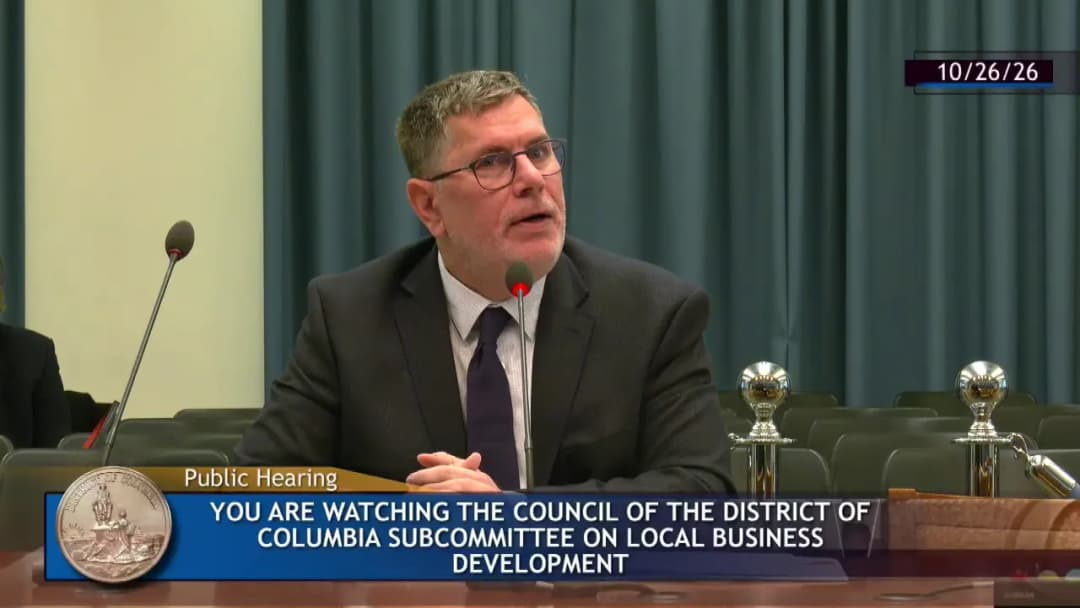
The Subcommittee on Local Business Development, chaired by Councilmember Wendell Felder (Ward 7), held a public hearing on Monday, October 26, 2026, beginning at 10:05 AM in Room 412 of the John A. Wilson Building and via Zoom. The hearing focused on Bill 26-041, the "Business Improvement District Modernization Amendment Act of 2026," and Bill 26-0102, the "Expanding Access to Public Restrooms Act of 2025," introduced by Councilmember Brook Pinto. Public Comments & Testimony - Cassandra Headington (Director, Cleveland Park Main Street / District Bridges): Raised significant concerns about the practical implementation of the Public Restrooms Act. She stated that requiring main streets to provide and maintain restrooms is unworkable given the lack of infrastructure, storage, and staffing in smaller corridors. She urged the Council to directly engage Main Streets and BIDs before advancing the legislation. - Betty Gentle (Senior Director, SOME, Inc.): Expressed strong support for the Public Restrooms Act, framing restroom access as a basic human need that supports dignity and the ability to navigate daily life. She emphasized that the facilities must be clean, safe, functional, and equitably located, and encouraged the Council to consider the broader need for hygiene facilities. - Sam Bonner (DC Community Wealth Builders): Testified on the BID bill, arguing that BID boards are currently dominated by property owners and that the bill does not go far enough to represent commercial tenants and residents. He opposed expanding BID assessments to residential properties without giving those tenants proportionate board seats, calling it a matter of "taxation without representation." He also raised concerns about the compounding effect of allowing annual assessment increases of up to 5%. - Colleen Hawkinson (Executive Director, DC BID Council): Expressed support for two key BID provisions (expanded residential assessment authority and a consistent 5% assessment cap), offered to compromise on the charter renewal term, and strongly opposed mandated board composition and the proposed new detailed reporting requirements, which she argued duplicate existing oversight. She offered a proactive solution: the BID Council will build a centralized online portal to host all BID reports and financial data. The BID Council supports the Public Restrooms Act as an opt-in program for bids with suitable space and capacity. - Brent Sisko (Capital Projects & Design Officer, DC Department of Parks and Recreation): Supported the goal of the Public Restrooms Act but raised major operational and fiscal concerns. He stated that a mandate to include restrooms in all new or substantially renovated parks over one acre would be extremely costly (citing an $800,000 installation at Walter Pierce Park), divert funding from other community priorities, and cause project delays. He recommended establishing a minimum project cost threshold, a future effective date of at least two years, and a requirement for consideration rather than a blanket mandate. - Joe Valadares (Founder, NA Media LLC): Proposed a technology-driven approach combining modular restroom units, a unified city-wide operational map, and a resident investment model to fund infrastructure. Discussion Items - Councilmember Felder questioned how BIDs currently measure and communicate their collective impact, expressing a desire for a comprehensive annual report. He explored the feasibility of using alternative sources for square footage data in assessments and discussed the implementation of resident and CBE seats on BID boards. - Councilmember Pinto discussed the success of the Throne pilot program and addressed accessibility concerns regarding the smartphone app requirement, confirming that tap cards are available at community locations. She and Mr. Sisko discussed the difficulty of placing restrooms in areas without suitable public land or utility access. - The hours of operation proposed in the bill (8:00 AM to 8:00 PM) were discussed; witnesses expressed concerns about the feasibility of meeting these hours in all locations, particularly for unsheltered residents who may need access overnight. DPR noted that existing restrooms in recreation centers are not always accessible during off-hours due to security concerns. - The definition of "substantial renovation" in the Public Restrooms Act was debated, with DPR requesting clarification on whether it applies to routine field replacements, roof repairs, or jurisdictional transfers of existing parkland. Key Outcomes - The public hearing was adjourned at 11:55 AM. No votes were taken during the hearing. - Councilmember Felder stated he would use the testimony to refine the BID Modernization Act and the Public Restrooms Act. - The DC BID Council committed to developing a centralized digital portal to aggregate annual reports, financial audits, and five-year plans for all 13 BIDs. - DPR recommended the creation of a task force to strategically identify priority locations for public restrooms based on community need, site feasibility, and operational sustainability, rather than applying a universal mandate. - Stakeholders including BIDs, Main Streets, DPR, and advocacy organizations will continue to work with the subcommittee to address implementation challenges.
The City Council Committee on Hearings and Policy met on October 26, 2026, in Council Chambers for pre-agenda interviews with Mayor O'Connor's appointees: Mathew Davis for Chief of the Pittsburgh Bureau of Fire (Resolution 2026-0955), Rea Price for Director of the Office of Management and Budget and CFO (Resolution 2026-0956), and Sylvia Harris for Director of the Department of Innovation and Performance and CIO (Resolution 2026-0957). The printed agenda lists the meeting at 10:00 AM, while the meeting record timestamp indicates 15:00 UTC. Each nominee took an oath or affirmation before answering councilmembers' questions. No formal vote was taken during the interview session. Innovation and Performance - Sylvia Harris - Harris identified her top priority as leveraging existing city resources—software, hardware, and data—before purchasing new technology, beginning with a complete asset inventory. She stressed that data is an asset and needs to be managed and protected. - She described plans to strengthen procurement vetting, define user requirements, and avoid duplicate purchases. She noted that software is often bought for one use despite having additional capabilities. - On AI, Harris said the department is educating staff on safe use, has a team reviewing AI use cases, and expects AI capabilities to arrive through existing software. Councilmembers discussed AI-assisted permitting and constituent services; Harris said some implementations are coming soon. - The ERP selection is nearly complete: vendor evaluations are done and scoring is in progress; implementation will take longer. She said a new ERP system may improve trust-fund accounting. - Cybersecurity remains a priority: the city has internal and external incident response teams, has experienced attempted attacks, has never paid a ransom, and is adding a third cybersecurity full-time employee in 2027. - Regarding the PGH Lab program, Harris said she is looking at funding opportunities for 2027. Office of Management and Budget - Rea Price - Price said the formal budget presentation is due November 9 and her immediate goal is an honest, transparent budget. - For 2027, she plans a full review of procurement policies and bringing in spend consultants to audit contracts and invoices for duplicate services and errors, noting this could yield millions in savings. - She acknowledged a large budget gap, said savings alone will not close it, and said the city must work with council on revenue and spending levers to rebuild the fund balance by 2031. - On trust funds, she explained that some must be segregated by statute or ordinance; the November budget will include full trust-fund detail. She said presentation could be improved and the new ERP should help. - After the loss of the prior procurement leader, Kathy Cotton is serving in an acting assistant director capacity; a job posting for the position was expected soon. - She attributed budget discrepancies to human error, last year's balanced-budget pressure, and thousands of rows of data; budget analysts enter decisions into the system and communication between sides was sometimes lacking. Pittsburgh Bureau of Fire - Mathew Davis - Davis said he has been with the city about 3.5 years, acting chief since June, and previously served about 19 years elsewhere. - He identified fleet and facilities as major pain points, along with recruitment/retention of a diverse workforce, mental health and wellness, training, and updating the fire code with PLI. - He reported the bureau is on budget for overtime/premium pay after making hard choices, including cutting some work groups and using on-duty crews for details, and he is confident it will stay on or under budget. - Davis wants a local burn facility; the city currently pays about $30,000 per use to train at Butler, plus overtime, travel, and wear-and-tear costs. He also discussed the VA training site as a longer-term project. - The bureau has roughly 700 firefighters, which he said is adequate for now; he is open to providing paid fire services to neighboring communities and noted the union and chief identified possible savings by moving administrative work from firefighters to civilian staff, worth hundreds of thousands of dollars. - He described the Citizens Fire Academy as successful and a potential recruiting tool; the girls summer camp is funded within the prevention budget. He also discussed better coordination with CERT and other community programs. - Asked about one vs. two points of egress for building conversions, Davis said he favors two points of egress but is willing to study each case and consult additional code experts. Councilmember Comments - Several councilmembers praised Price's transparency and partnership; Councilman Collins said Davis and the fire bureau were doing strong work, particularly on overtime, and that he would be in full support of all three nominees. Others voiced trust in Harris and Davis and welcomed them to their permanent roles. - Councilmembers raised topics including AI, the ERP timeline, cybersecurity, procurement, community programs, and fire-code modernization. Key Outcomes - The committee completed the pre-agenda interviews. No motion or vote on Resolutions 2026-0955, 2026-0956, or 2026-0957 appears in the transcript; those appointments remain for subsequent council action. - Next steps include the November 9 budget presentation, the expected posting of the procurement position, completion of ERP selection, and further budget hearings.
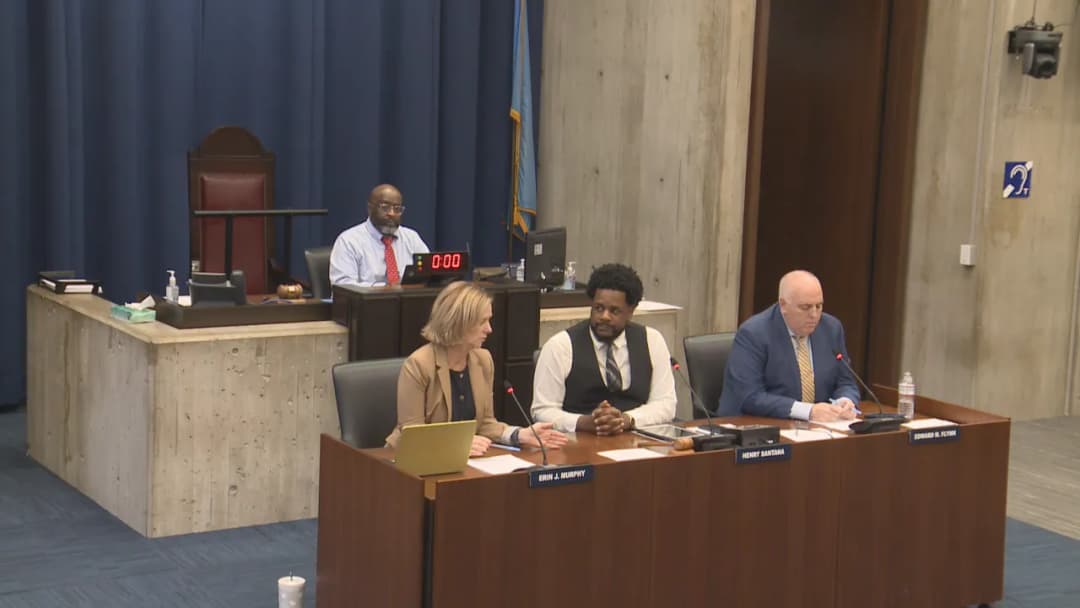
The Boston City Council Committee on Public Safety and Criminal Justice held a hearing on Docket 0180 to discuss resources and operations of the Boston Police Crime Lab, including staffing shortages, delays in testing sexual assault kits, and lack of advanced DNA technology. No representatives from the Boston Police Department or the Mayor's Office of Intergovernmental Relations attended, leading to strong criticism from councilors. Discussion Items - Councilor Flynn (lead sponsor) detailed ongoing challenges: a $500,000 budget amendment for the crime lab was not accepted by colleagues; in the FY24 budget cycle, the council voted to reallocate $1 million within BPD ($700,000 from personnel services for hiring and $300,000 from equipment for new testing equipment), but this funding was not approved. He noted that in FY23, the lab received 186 sexual assault kits, and 93 were not tested within the state-mandated 30 days. The director position had been vacant for over two years, and he had previously requested a residency waiver and salary increase. He expressed deep disappointment that BPD did not attend, stating it was disrespectful to survivors. He intends to seek oversight from the Massachusetts Executive Office of Public Safety and the U.S. Attorney for Massachusetts. - Councilor Murphy emphasized the need for the safest city to solve crimes with the best technology and staffing. She noted the hearing order was filed on January 8, 2026, and communication had been ongoing since July. She criticized the administration for notifying the council just 10–15 minutes before the 10:00 AM meeting that they would not attend, and questioned why no one from the department could spare an hour. - Councilor Fitzgerald expressed disappointment at the lack of a panel, stressing that the council must seek accountability and dialogue when standards are not met. - Councilor Weber thanked the filers and noted that the BPD budget is the city's second-largest departmental budget, suggesting resource allocation should prioritize the crime lab. She looked forward to a discussion on why no one from the department attended. - Councilor Worrell thanked Councilor Flynn for his constant advocacy and stated she was present to get a progress update, but acknowledged BPD's absence meant waiting for another opportunity. - Councilor Santana (Chair) noted that the administration emailed that morning to say BPD would not attend. He offered to work with Councilor Flynn and the administration to find a new date. Key Outcomes - No testimony or updates from BPD or the administration were provided due to their absence. - Councilor Flynn announced he will write to the Massachusetts Executive Office of Public Safety and the U.S. Attorney for Massachusetts to request oversight of the Boston Police Crime Lab. - Chair Santana committed to rescheduling the hearing with the administration. - Councilors expressed a unified demand for accountability and swift action to ensure the crime lab meets state requirements and supports survivors of sexual assault.