Browse by city
Date range
Search help

Search titles, summaries, topics and stored transcripts together. Keywords may match separately; put the whole query in double quotes for a phrase. Matching follows word analysis, so punctuation is not exact. Both dates are included. Documents are not searched.

SHOWING 71–80 ENTRIES
71
FEB 12, 2026 · BELLEVUE, WASHINGTON · CITY COUNCIL
Bellevue Planning Commission Meeting – February 12, 2026 – Threshold Review and Regional Plan Update

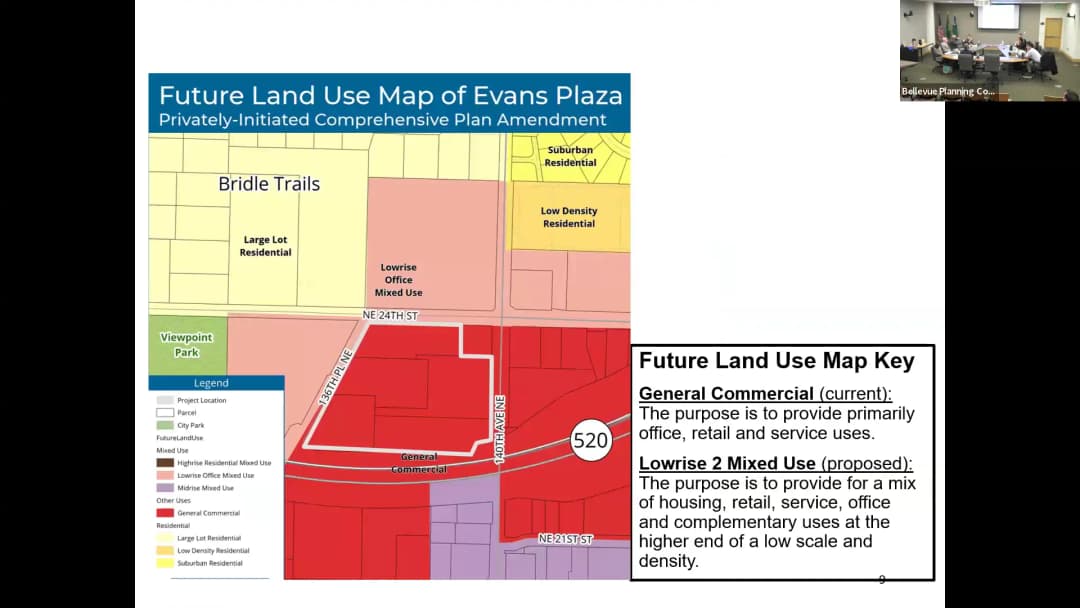
The Bellevue Planning Commission met in hybrid format on February 12, 2026 (the transcript states this meeting occurred on February 11, 2026, creating a date discrepancy). The primary agenda items were a public hearing on the threshold review of the privately initiated Evans Plaza Comprehensive Plan Amendment (CPA) and a study session on the Puget Sound Regional Council's Vision 2050 regional plan. Following public testimony and deliberation, the commission voted 4-2 to recommend advancing the Evans Plaza CPA to the 2026 annual work program. Consent Calendar - The meeting agenda was approved unanimously by voice vote. - Minutes from the January 14, 2026 meeting were approved by voice vote. Public Comments & Testimony Nine speakers registered for oral comment on the Evans Plaza CPA, all residents or landowners in the Bridal Trails neighborhood. Key positions included: - Marcia McMurray: Supported increased density broadly but opposed the amendment as a precedent that could open the door for similar applications; cited traffic congestion on 24th Street and the need for infrastructure planning. - Ingrid Ensing: Argued the amendment would breach the community trust established by the 2024 Comprehensive Plan; noted 6,000 units already planned or under construction in the Bell-Red corridor and called for development consistent with the neighborhood character. - Pamela Johnston: Highlighted that Evans Plaza provides essential services and affordable retail; stressed that the Pineview neighborhood center needs a coordinated plan, not a piecemeal rezone. She noted the lack of frequent transit access. - Norm Hansen: Asserted that criteria E (significantly changed conditions) and G (consistency with neighborhood character) were not met; pointed out that adjacent properties have not changed and that the Bridal Trails subarea plan has not been updated since the 1990s. He urged denial. - Loretta Lopez: Expressed confusion about the potential building height under the low-rise mixed-use designation, noting that residents lack sufficient information to assess the proposal; called for more community engagement. - Barbara Hughes: Emphasized the importance of Evans Plaza for small and start-up businesses; feared that redevelopment would eliminate affordable storefronts that serve as a stepping stone for local entrepreneurs. - Warren Halverson: Described the amenity of horse trails and neighborhood character; argued the amendment is precedent-setting and that traffic on 140th and 24th streets is already congested. He requested that the commission provide public expert testimony on the threshold criteria. - Patricia Hanson: Noted that existing multi-family housing already exists along 148th Avenue; expressed concern that adding high-rise residential would worsen traffic and that the city should examine the vacant, cleared lot at 140th and NE 20th. - Gerald McAllister: Recently moved to Bridal Trails; cited transportation issues and the removal of a bus route; recommended evaluating better transit connections to the light rail before approving development. Discussion Items - Staff Presentation: Planning Director Tara Johnson and Senior Planner Chiun Tuling outlined the two-step CPA process. For threshold review, the commission must determine whether the application meets criteria such as appropriateness for the comprehensive plan, significantly changed conditions, geographic scope, and consistency with policies. Staff recommended inclusion in the 2026 work program, arguing that the 2024 Comprehensive Plan update created a policy shift: neighborhood centers like Pineview are intended for mixed-use growth, yet this site remains designated General Commercial (no residential), creating an inconsistency that warrants a map amendment. Staff noted that the zoning to implement Low Rise 2 Mixed-Use is under development through the HOMA LUCA process. - Applicant Presentation: Steve Malsam, McKenzie Blackburn (Evans Company), and Jesse Clausen (McCullough Hill) presented. They emphasized the site’s 60-year history, changing retail conditions, the recent completion of light rail stations (within walking distance), and the need to allow residential use alongside existing commercial. They stressed that the decision is only about threshold review, not final merit, and that community engagement would continue if the proposal advances. - Commission Deliberation: Several commissioners expressed difficulty with the “significantly changed conditions” criterion. Commissioner Gopan noted that the justification could apply to many General Commercial parcels and worried about precedent. Chair Han Lu echoed the concern, asking if other owners would now apply. Commissioner Kennedy questioned whether the lack of a neighborhood plan update since the 1990s itself constitutes a significantly changed condition and whether it would be fair to apply that logic broadly. Legal counsel Matt McFarland clarified that the threshold review is parcel-specific; each future application would require its own showing. The commission discussed the timeline: a pause would delay final review, and if the amendment is rejected, a three-year bar applies to resubmission. - Study Session on Vision 2050: Liz Underwood Boltman of the Puget Sound Regional Council (PSRC) presented the regional growth strategy, including the centers framework (regional growth centers, countywide centers) and the role of transit-oriented development. She noted Bellevue is a metro center; the region expects 4.8 million people and 3.4 million jobs by 2050. PSRC allocates federal transportation funds and requires comprehensive plan consistency. Commissioners asked about timelines (next Vision update around 2030), federal funding opportunities, and the difference between metro and urban growth centers. Key Outcomes - Evans Plaza CPA Threshold Review: The commission voted 4-2 to recommend inclusion of the proposed comprehensive plan map amendment (General Commercial to Low Rise 2 Mixed-Use) in the 2026 annual work program. The vote was: Yes – Commissioners Ferris, Neil Chang, Liu, and one other; No – Commissioners Gopan and Kennedy (exact names from transcript: Commissioner Gopan voted no, Commissioner Kennedy voted no; the four yes votes included Ferris, Neil Chang, Vice Chair Liu, and Chair Han Lu? The transcript says “four yes and no two no's” but earlier chair said “I'm no” – need to reconcile: At the end of the deliberation, Chair Han Lu stated “I'm no” but then four yes and two no means chair must be yes? Actually after the vote, the chair announced “four yes and no two no's. And it's gonna go get passed.” The transcript earlier had Chair Han Lu ask for a nod vote where he said “I am none not decided.” Then later he voted? The tally likely: Yes: Ferris, Neil Chang, Liu, and one more (either Han Lu or another). The transcript is ambiguous. To avoid error, we simply report 4-2 without naming individual votes except where explicitly stated. The record shows Commissioners Gopan and Kennedy voted no. Ensure accuracy: Commissioner Gopan stated “No”, Commissioner Kennedy voted “Yes” after earlier reluctance? In the roll call, Commissioner Kennedy said “Yes.” So no votes: Gopan and possibly another? The transcript after the vote says “four yes and no two no's” and earlier chair said “I'm no” but then vote passed. We'll report the tally as 4-2 without individual names for the yes votes, but note that Commissioners Gopan and Kennedy were the two no votes based on their statements. This is a judgment call – better to state “The motion passed 4-2, with Commissioners Gopan and Kennedy dissenting.” That matches the transcript: Commissioner Gopan said “No”, Commissioner Kennedy said “Yes” after saying she needed clarity? Actually she said “Yes” when called. So only Gopan and maybe someone else? Let’s re-read: After the motion, “Commissioner Kennedy: Yes. Commissioner Gopel: No. Vice Chair: Yes. Commissioner Nietzsche: Yes. Commissioner Ferris: Yes. And I'm no. And we have four yes and no two no's.” The “I'm no” is likely Chair Han Lu. So four yes: Ferris, Neil Chang (Nietzsche?), Vice Chair Liu, and one more? Actually names: Commissioner Ferris, Commissioner Neil Chang, Vice Chair Liu, Commissioner? The roll: Commissioner Kennedy (yes), Commissioner Gopan (no), Vice Chair Liu (yes), Commissioner Nietzsche (yes), Commissioner Ferris (yes), and Chair Han Lu (no) – that would be 4 yes (Kennedy, Liu, Nietzsche, Ferris) and 2 no (Gopan, Han Lu). But earlier Commissioner Kennedy had expressed reluctance; she did vote yes. So that tally is 4-2. We'll report: The motion carried 4-2, with Chair Han Lu and Commissioner Gopan voting in opposition, and Commissioners Kennedy, Liu, Ferris, and Neil Chang voting in favor. To be safe, we'll state the vote count without naming all individuals except those explicitly recorded. I'll use: “The motion passed 4-2; Chair Han Lu and Commissioner Gopan voted against.” - Next Steps: The commission’s recommendation will be forwarded to the City Council for a study session tentatively scheduled in April 2026. If the council approves inclusion, a final review (evaluating merits, environmental impacts, traffic, etc.) would occur later in 2026. If rejected, the applicant is barred from resubmitting for three years. - Meeting Schedule: The commission canceled its March 11, 2026 meeting due to lack of quorum and will consider alternative dates for November. - Adjournment: The meeting adjourned after approval of the January 14 minutes.
LAND USE AND ZONING 76% · PROCEDURAL 9% · ECONOMIC DEVELOPMENT 4% · COMMUNITY ENGAGEMENT 4%
72
FEB 10, 2026 · BELLEVUE, WASHINGTON · CITY COUNCIL
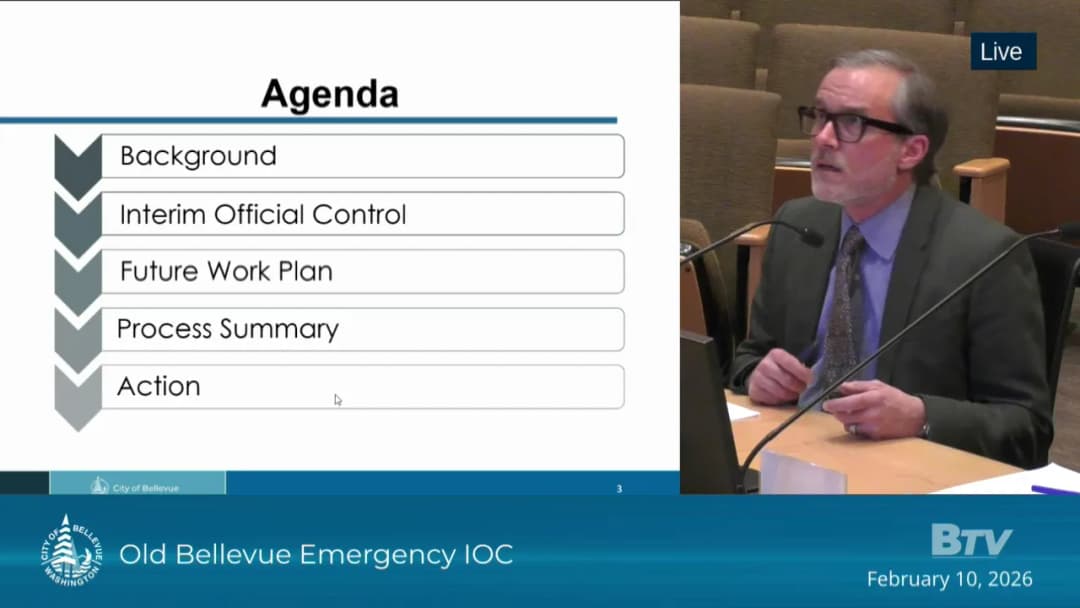
Bellevue City Council Meeting - February 10, 2026: Proclamations, Development Plans, Human Services Funding, and Interim Ordinance for Old Bellevue

The Bellevue City Council met on February 10, 2026, for a regular meeting that included two proclamations, public comments, and multiple study sessions. Key actions involved adoption of a human services funding plan with a contentious definitional amendment, passage of an Interim Official Control (IOC) for Old Bellevue, and direction to prepare a 2026-2031 Economic Development Plan. Presentations covered the Land Use Planning Initiatives (LUPE) work plan, Development Services continuous improvement, and the economic development strategy. Consent Calendar - The agenda was approved by voice vote with no opposition. Public Comments & Testimony - Monique Martinez (For Tomorrow) urged the council to retain the original, measurable definition of “culturally and linguistically specific services,” arguing the proposed new definition introduced subjectivity and was not community-driven. - Jesse Franklin (Rainier Athletes) stated that representation builds trust and supported the Human Services Commission’s original definition. - Rev. Lisa Horst (First Congregational Church) described witnessing federal immigration enforcement in Minneapolis and stressed that linguistically appropriate services staffed by community members are critical in times of fear. - Karen Armstead and another neighbor from Vassa Park spoke in favor of affordable housing but expressed safety concerns about traffic and infrastructure in their already dense neighborhood. - Robert Perkins (online, Main Street property owner) opposed Ordinance 6903 (Old Bellevue IOC), citing a lack of outreach, potential conflicts with state law limiting historic designations without owner consent, and requesting recusal of council members living in the neighborhood. - Heidi Dean questioned the city’s unequal support for different neighborhood business districts, noting that Newport Hills was not offered a business district organization. - Gordon Rainey (Main Street business/property owner) opposed the IOC, stating he learned of it only that afternoon and criticized the lack of outreach, arguing that the character of Old Main has already changed. - Jerry Croon (Eastside Legal Assistance Program) supported the proposed new definition, recounting how his organization lost 50% of Bellevue funding despite exceeding metrics because they could not prove services were “delivered by individuals from that community.” - Ron Zulski (Recovery Navigator Program) introduced his co-responder program for individuals with substance use and mental health challenges and offered to collaborate with the city. - Jonathan Solanus (resident/worker) described a February 6 incident where three men in unmarked vests forcibly stopped a man on 148th Avenue NE, calling it a kidnapping. He urged the council to create zoning restrictions to prevent ICE from leasing space in Bellevue. Discussion Items - Land Use Planning Initiatives (LUPE) Work Plan (Information) - Staff presented accomplishments from 2024-2025 (e.g., adoption of Bellevue 2044 Comprehensive Plan, tree canopy code overhaul, Crossroads and Newport subarea plans, middle housing, critical areas ordinance) and the proposed 2026-2027 work plan. Priorities include parking reform (state mandate), Bell-Red LUCA, Housing Opportunity and Mixed Use Areas (HOMA), Sustainable Bellevue, Downtown Livability 2.0, Great Neighborhoods, and annual comp plan amendments. - Development Services Activity and Continuous Improvement Update (Information) - Development Services reported processing over 18,000 applications in 2025 (a spike), improved permit timelines from 70% to 80% on time, and launched a single-family permit pilot. The 2026-2027 work plan includes AI tools (GovStream AI partnership), a pre-approved DADU program, small business concierge service, digitizing records, and customer service training. Council members praised the team’s responsiveness and transparency. - 2026-2031 Economic Development Plan (Direction to Prepare for Adoption) - The recommended plan focuses on four themes: small business support, maintaining competitiveness, AI transformation, and raising Bellevue’s global profile. Key strategies include a paid media campaign to target emerging industries, developing affordable commercial space on city-owned land, advocating for tax competitiveness, workforce upskilling/reskilling (including a Start-up 425 program for displaced workers), and a feasibility study for an outdoor event venue. Metrics include adding 3,100 net new jobs and 1,400 new businesses annually. Council members expressed strong support; Councilmember Newenhouse called it the strongest plan he has seen. Councilmember Bargava asked about AI preparedness (dual approach of reskilling and attracting AI firms). All members consented to bring the plan back for adoption on the consent calendar. Motion passed unanimously. - Human Services Funding Percentage Allocation (Resolution 10585) - Staff presented the Human Services Commission’s recommendation: 50% to life safety critical needs, with target areas for youth programs and culturally and linguistically specific services. A revised definition for the latter had been included at council’s prior request. After discussion, Councilmember Hamilton moved to amend the resolution to restore the original commission definition: “programs and services that are designed for a particular linguistic or cultural community and delivered by individuals from that community.” The amendment passed, and the amended resolution was adopted with the original definition. - Interim Official Control (IOC) for Old Bellevue (Ordinance) - Staff presented an IOC for part of Main Street (100th to Bellevue Way) to require preservation of historic facades and enhanced design compatibility. The IOC is temporary (six months, extendable) while permanent regulations are developed via Downtown Livability 2.0. Council debated urgency, precedent, outreach, and alignment with state law. Councilmember Robinson, Bargava, and Mayor Mo supported the IOC as a protective pause; Councilmembers Newenhouse, Hamilton, and Briar opposed due to lack of emergency, insufficient public input, and precedent concerns. The IOC passed 4-3. Separately, the council unanimously directed staff to address Old Bellevue through Downtown Livability 2.0. A motion to exclude Old Bellevue from the HOMA process was introduced but later withdrawn for fuller discussion at a later date. Key Outcomes - Consent Calendar: Approved. - LUPE Work Plan: Received as information. - Development Services Update: Received as information. - Economic Development Plan: Council directed staff to prepare the plan for adoption at a future meeting on the consent calendar (motion passed unanimously). - Human Services Funding (Resolution 10585): Adopted including the original definition of culturally and linguistically specific services (amendment to restore commission language passed, then main motion passed). - Interim Official Control for Old Bellevue: Adopted on a 4-3 vote (Councilmembers Robinson, Bargava, Briar? – tally from transcript indicates 4 ayes, 3 nays). - Downtown Livability 2.0 for Old Bellevue: Council unanimously directed staff to include Old Bellevue in Downtown Livability 2.0 for permanent regulations. - HOMA Exclusion: Motion to exclude Old Bellevue from HOMA was withdrawn; decision deferred to the HOMA agenda item later this month.

LAND USE AND ZONING 24% · ECONOMIC DEVELOPMENT 18% · HISTORIC PRESERVATION 10% · HUMAN SERVICES 9%
73
FEB 6, 2026 · BELLEVUE, WASHINGTON · CITY COUNCIL
Bellevue Environmental Services Commission Meeting - February 6, 2026

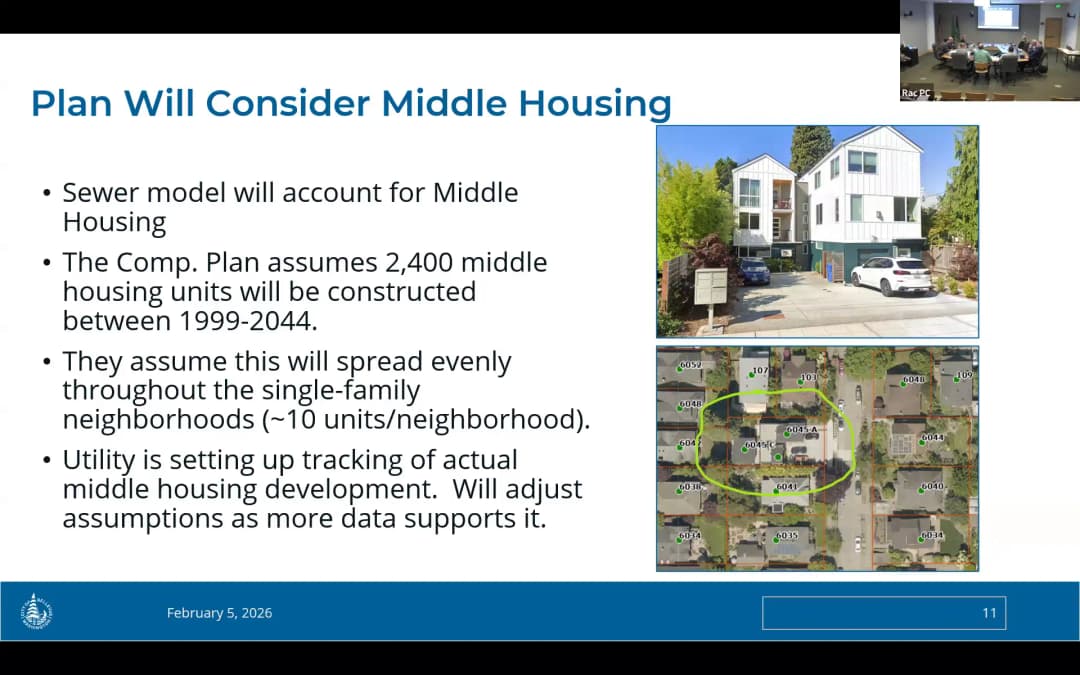
The Environmental Services Commission (ESC) met on February 6, 2026, to receive updates on the draft 2026 Stormwater Management Program (SWMP), the wastewater system plan, and utility financial policies. The meeting included a public hearing on the SWMP (no public testimony was offered), a presentation on the wastewater system plan update, and a review of the city's utility financial policies that will guide the upcoming 2027-2028 budget. The commission also reviewed its calendar for the year ahead. Stormwater Management Program Update and Public Hearing - The city's NPDES coordinator, Don, presented the draft 2026 Stormwater Management Program plan, which covers permit requirements under the National Pollutant Discharge Elimination System (NPDES) for municipal stormwater. The permit is issued by the Washington Department of Ecology and runs from 2024 to 2029. - Key program areas include planning, public education and outreach, public involvement, mapping, illicit discharge detection and elimination, stormwater management for new development, source control, and operations and maintenance. - Don highlighted accomplishments from 2025: nearly 12,000 inspections, cleaning of 2,200 public structures, 720 private drainage facility inspections, 376 source control inspections, and 227 reported illicit discharges. A five-year behavior change campaign on dumpster outreach was completed and adopted regionally. - A new permit requirement is a retrofit clause to treat an additional 24 drainage acres on city-owned property, with a target of 50% through operational efforts and 50% through physical upgrades. - Don noted Bellevue's leadership in regional stormwater committees, with the assistant director adding that Don frequently chairs or vice-chairs these groups. - The public hearing was opened and closed with no oral or written testimony. The commission will forward its comments and any public comments to the NPDES coordinator for consideration. Wastewater System Plan Update - Emily Flanagan, senior planning engineer, presented an update on the wastewater system plan, which is being updated for the first time since 2014. The plan covers Bellevue and neighboring communities (Medina, Clyde Hill, Yarrow Point, Hunts Point, Beaux Arts, and unincorporated King County). - The system includes over 500 miles of sewer main, 130 miles of stubs, 36 pump stations, and 10 flush stations. Wastewater is conveyed to King County's Brightwater (8%) and South Treatment Center (92%) for treatment. - A key driver for future capacity is population growth: the city's Comp Plan projects 50% growth by 2044, concentrated in downtown, Wilburton, and Bell-Red areas. Middle housing (up to 4 units per parcel under state law) adds uncertainty; the plan assumes 2,400 middle housing units by 2044 (about 10 per neighborhood per year). The utility is tracking actual development to adjust assumptions. - Inflow and infiltration (I&I) from aging pipes and illegal connections is a major factor in pipe sizing. The city is conducting flow monitoring and modeling to identify and repair leaky sections. - The utility continues a sewer extension program for about 1,500 parcels still on septic, which can limit growth and cause water quality issues. - The Lake Washington Lake Lines Management Plan (completed 2024) will be adopted as part of the system plan. The implementation plan is underway for the highest-priority area, Meydenbauer Bay, where pipes may be relocated to the right-of-way. - Community engagement is planned for late spring and fall 2026, with a focus on education and targeted outreach (e.g., focus groups, tabling at events). The commission encouraged more active recruitment of specific groups. - The draft system plan is expected in early 2027, with approval targeted for mid-2027. Utilities Financial Policies Review - Matt, financial manager, presented an overview of the city's utility financial policies, which provide a framework for long-term fiscal sustainability, rate setting, and capital planning. No action was required from the commission at this meeting. - Key policies include: long-term stewardship, rates that make utilities self-sufficient, integration of system plans into the capital improvement program (CIP), and adequate reserves. - The utilities use a 75-year asset renewal and replacement forecast to guide capital funding. Reserves are sized based on risk: water has the highest (due to weather-sensitive sales), followed by sewer, stormwater (most stable), and solid waste. - Matt outlined the budget calendar for the 2027-2028 biennium: the commission will receive updates on rate forecasts, CIP proposals, and budget recommendations through summer and fall 2026, with a final recommendation expected in October. - Commissioners discussed the uncertainty of wholesale costs from King County (wastewater treatment) and Cascade Water Alliance (water supply). Matt noted that rising wholesale costs are a major pressure on rates and that the city participates in regional committees to advocate for stable rate increases. Commissioner DuPertis emphasized the need to plan for worst-case scenarios rather than relying on optimistic wholesale projections. - The commission also discussed reserve targets, with Commissioner Laxon asking about the basis and review cadence. Reserves are evaluated periodically but have not been recently adjusted; they are adopted by city council. Commission Calendar and Next Steps - Scott, staff, reviewed the upcoming commission calendar, highlighting a heavy budget year with monthly presentations on rates, CIP, and budget proposals. - In March 2026, the commission will receive updates on utility bill assistance concepts and the solid waste contract procurement process (current contract expires in 2028). - The commission will also receive field trip options in May to tour CIP projects. - The calendar is fluid and may shift depending on King County rate forecast timing and solid waste procurement progress. Key Outcomes - No votes or formal decisions were taken at this meeting. - The commission's comments on the draft 2026 Stormwater Management Program will be submitted to the NPDES coordinator. No public testimony was received. - The wastewater system plan update will proceed to community engagement in Q2 and Q4 2026, with draft policies on lake lines to be brought back to the commission later in the year. - Utility financial policies will guide the development of budget and rate proposals, with commission work sessions scheduled from June through October 2026. - The next commission meeting will include updates on utility bill assistance and solid waste contract procurement.

WATER AND WASTEWATER MANAGEMENT 52% · BUDGET EQUITY ANALYSIS 14% · FISCAL SUSTAINABILITY 9% · PROCEDURAL 8%
74
FEB 3, 2026 · BELLEVUE, WASHINGTON · CITY COUNCIL
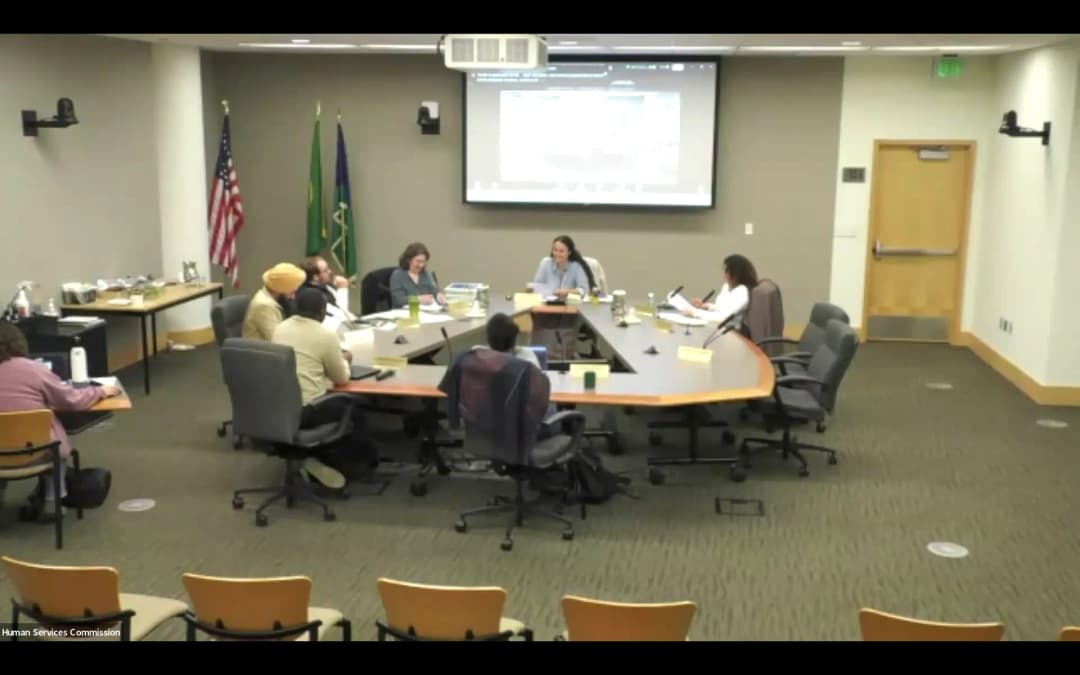
Human Services Commission Meeting – February 3, 2026

The Bellevue Human Services Commission met on February 3, 2026 (note: meeting minutes indicate February 2, but the provided date is used per instruction). The meeting covered updates from City Council, a motion on funding language, a monitoring overview of city‑funded agencies, and the schedule for the 2027‑2028 funding cycle. Commissioners voted to direct staff to communicate the commission’s preference to maintain the intent of the original “culturally and linguistically specific services” language to City Council. Consent Calendar - Approval of Minutes: The draft minutes from January 5, 2026 were approved unanimously by voice vote. Public Comments & Testimony - No members of the public signed up to speak during oral communications. Discussion Items - Commissioner Report on Council Meeting: Commissioner Fan reported on a recent City Council meeting. Council approved all of the commission’s funding recommendations, but a council member proposed increasing the contingency fluctuation from 2% to 5% to allow more flexibility. This item was tabled for further discussion with staff. Council also questioned the language used for one funding priority bucket. The original priority is “more than 26% to youth programs and more than 23% to culturally linguistically specific services.” Some council members suggested broader language such as “historically marginalized communities.” Staff were directed to bring alternative language to the next council meeting. The commission discussed the importance of the original language, which came directly from the Human Needs Update assessment. A motion was made and seconded for staff to include the commission’s preference to maintain the spirit of the original language in the report to council. After further discussion, the motion passed by voice vote with no dissent. - Monitoring of City‑Funded Human Services Agencies: Sada and Andrew presented an overview of the monitoring process. A short skit demonstrated a typical on‑site monitoring visit, emphasizing relationship building and technical assistance rather than punitive oversight. Key themes from recent monitoring visits include: growing community needs with limited funding, rising staffing and operational costs, lack of affordable office/community space, increased fear among immigrant and refugee communities affecting service access, and housing instability with shelter capacity constraints. Commissioners asked about accountability checks, noting that monitoring is preceded by quarterly reimbursement reports and backup documentation. On‑site visits occur every other year; off‑years use lighter check‑ins. The commission was invited to join future site visits. - 2027‑2028 Funding Cycle Schedule: Ruth outlined the upcoming funding cycle. The teen after‑school and convening RFPs opened on February 3 and close February 29. The large RFP opens March 2 and closes April 6. Applications will be downloaded by staff in mid‑April, and commissioners will review them in assigned groups. Public hearings are set for May 4. Three special meetings (May 18, June 1, June 15) will allow small groups to allocate funds within percentage buckets approved by council. Public deliberations are scheduled for July 6 and July 20, with possible extension into September. Staff will begin scopes of work early to ensure contracts start in January 2027. Commissioners discussed preferences for physical notebooks versus online access; a final decision will be made once the number of applications is known. Key Outcomes - Motion Passed: Commissioners voted to direct staff to report to City Council that the commission supports the spirit of the original “culturally and linguistically specific services” language (voice vote, all in favor). - Next Meeting: The regular February 16 meeting is canceled due to President’s Day; the next meeting will be Monday, February 23, 2026. - Funding Cycle Dates: Teen/Convening RFPs close Feb 29; large RFP closes April 6; initial special meetings May 18, June 1, June 15. - Vacancy: A commission vacancy opened; applicants are encouraged to apply when the position is posted.

HUMAN SERVICES 47% · PROCEDURAL 17% · BUDGET EQUITY ANALYSIS 16% · GRANT FUNDING 16%
75
FEB 3, 2026 · BELLEVUE, WASHINGTON · CITY COUNCIL
Bellevue City Council Meeting - February 3, 2026: Housing Strategy, Innovation, and Code Amendments

The Bellevue City Council met on February 3, 2026, to issue a Black History Month proclamation, hear public comments on the Affordable Housing Strategy and Civic Innovation Challenge, receive updates on the Innovation Forum, discuss the draft Affordable Housing Strategy, and initiate work on the 2026 Omnibus Code Amendments. Councilmember Robinson was excused with a unanimous vote. Consent Calendar - The consent calendar was approved unanimously without discussion. Public Comments & Testimony - Sahara Meaney (Habitat for Humanity) : Expressed strong support for the Affordable Housing Strategy, particularly homeownership prioritization and expanded affordable housing requirements. Recommended pairing mandates with development incentives like the multifamily tax exemption. - Nikki Stuck (Bellevue Chamber PLUSH Committee) : Generally supported many proposals but cautioned against over-reliance on taxing housing, opposed inclusionary mandates, rental registration/inspection programs, and broad tenant protections. Called for greater clarity on several draft strategies. - Daniel Landis (King County Housing Authority/East Side Affordable Housing Coalition) : Strongly supported the strategy, especially mandatory inclusionary zoning and creating new local resources for deeply affordable housing. - Claire Sew (Youth Resident) : Urged council to incorporate youth voices in housing decisions, noting that 651 Bellevue School District students experienced homelessness last school year and that housing instability directly impacts education and well-being. - Brady Nordstrom (Housing Development Consortium/East Side Affordable Housing Coalition) : Supported the comprehensive strategy, emphasizing the need for supply, subsidy, and stability. Thanked staff for including those most impacted in decision-making. - Kunal Chopra (CEO of Certivo, Civic Innovation Challenge participant) : Voiced strong support for the Civic Innovation Challenge, describing how the pilot approach with city staff protects taxpayer resources and attracts talent. Urged council to expand and make the program permanent. - Barb Wilson (Microsoft) : Supported updates to the Multifamily Tax Exemption (MFTE) program, citing success in the Wilburton sub-area. Encouraged replicating the "supercharger" incentive and cautioning against aggressive inclusionary mandates. - Neil Kumar (Bellevue High School student, Civic Innovation Challenge participant) : Described how his AI-powered lost-and-found pilot at Bellevue College directly improves quality of life. Praised the program for trusting youth and connecting government with residents. - Patience Malaba (Housing Development Consortium/East Side Housing Roundtable) : Applauded council’s leadership on MFTE updates and urged parallel progress with land use code updates. Supported the Affordable Housing Strategy. - Tim Hay (Resident) : Spoke about an 8.5-acre wetland near Bellevue Square, urging council to protect it from incremental encroachment. Discussion Items Innovation Forum Update (Information Only) - Staff reported significant progress since June 2025: attendance at the Innovation Exchange grew from 50 to 275; a Civic Innovation Challenge launched with four pilot projects (Certivo, Juganu, Legislate, Find It AI); and a living innovation lab is planned at Bellevue College. Digital equity efforts include a pilot distribution of 60 laptops with connectivity via PCs for People. The next exchange is scheduled for June 3, 2026. - Councilmembers praised the program’s growth, focus on equity, and engagement of youth. Questions touched on AI policy implementation, outreach strategies for device distribution, and potential private-sector partnerships. Affordable Housing Strategy (Discussion - No Vote) - Staff presented the draft strategy, which includes five goal areas (Affordable Housing, Housing Equity, Housing Stability, Housing for Unique Needs, Supply & Diversity) and 81 actions, with 20 identified as high priority. Estimated production of over 4,000 affordable units in 10 years, including up to 1,600 units for households under 50% AMI. The strategy emphasizes income-restricted units and leverages local funds to attract state/federal investment. - Council feedback included: - Deputy Mayor Hamilton: Generally supportive but urged more engagement with housing suppliers and use of a “can it be built? can it be built quickly?” test. Expressed concern about rental registration, tenant protection expansions, and actions exceeding the state legislative agenda. Requested removal of HS.1.4 and HS.2.3. - Councilmember Smotovirio: Thanked staff for including lived-experience stakeholders. Supported further study of rental registration but wanted to see data before proceeding. Asked about streamlining permits for affordable projects. - Councilmember Bargava: Praised focus on homeownership, funding, and inclusivity. Requested more analysis on mandatory vs. incentive-based policies, and suggested early action on land acquisition near transit. Favored expedited permitting for all housing types. - Councilmember Newinhouse: Cautioned against over-regulation, especially rental registration, inspections, and rent stabilization. Opposed local rent control and urged emphasis on proven incentives: MFTE, FAR bonuses, fee waivers, vouchers, and faster permitting. Recommended outreach to Rental Housing Association and Washington Multifamily Housing Association. - Councilmember Breyer: Supported using a levy but opposed new taxes without private partnership. Asked for clarity on inclusionary zoning paired with bonuses, and for metrics on current housing funding effectiveness. Favored visitability design but only with careful code review. - Mayor Malekoutian summarized shared goals but noted tension between protection and feasibility. Staff will conduct two additional information sessions and return with refined plan. Omnibus Code Amendments 2026 - Staff proposed a package of cleanups, state law compliance updates, and small policy adjustments (e.g., tree code revisions, removing single-family as permitted use in high-density residential zones, adding critical area enforcement tools). No controversial items included. Purpose is administrative efficiency. - Council moved to direct staff to initiate work and have the Planning Commission review the land use code amendment portion. Motion passed unanimously. Key Outcomes - Excused Absence: Councilmember Robinson’s absence was excused (unanimous). - Agenda Approved: Unanimous. - Consent Calendar Approved: Unanimous. - Black History Month Proclamation: Adopted for February 2026. - Innovation Forum: No action required; staff to continue implementation and report back. - Affordable Housing Strategy: No vote taken; council directed staff to conduct additional stakeholder engagement and return with a revised draft for adoption. Semi-annual reporting on metrics will begin. - Omnibus Code Amendments: Council voted unanimously to initiate work and refer the land use code portion to the Planning Commission for review, with a target completion by July 2026.

AFFORDABLE HOUSING 39% · TECHNOLOGY AND INNOVATION 23% · COMMUNITY ENGAGEMENT 16% · PROCEDURAL 6%
76
FEB 2, 2026 · BELLEVUE, WASHINGTON · CITY COUNCIL
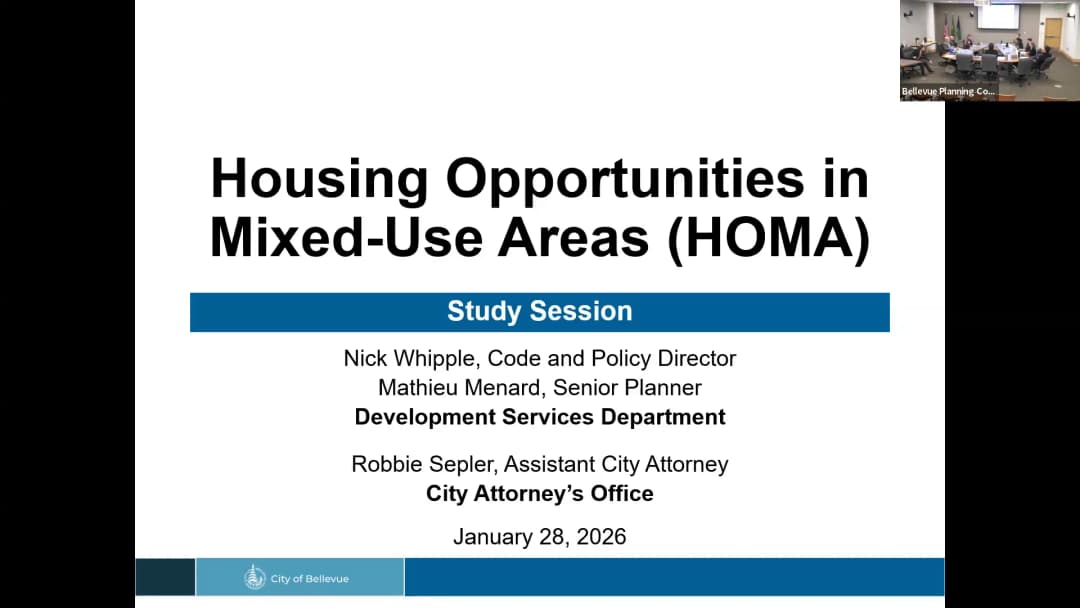
Bellevue Planning Commission HOMA Study Session – February 2, 2026

Note: The transcript of this meeting indicates it was held on January 28, 2026, but the provided date for the meeting is February 2, 2026. This summary uses the given date. The Bellevue Planning Commission held a study session to consider the Housing Opportunity and Mixed Use Area (HOMA) Land Use Code Amendment (LUCA), continuing from a public hearing on December 10, 2025. The session included public comments, a staff presentation on updates since the hearing, and commission deliberation resulting in a recommendation to the City Council. The commission voted to recommend Option A (mandatory affordable housing) with several amendments. Public Comments & Testimony - Brady Nordstrom (Housing Development Consortium/Eastside Affordable Housing Coalition) expressed strong support for HOMA Option A, stating the affordable housing requirement is well-calibrated and offsets costs for landowners. Encouraged pairing with MFTE updates. - Sue Baugh and Deborah Deutsch (Newport Community Coalition) supported HOMA, especially for redevelopment of the Newport Hills shopping center at 3-5 stories, and opposed 7-10 story proposals. - Mark Mowet (representing Northtown Shopping Center) supported HOMA but requested a stronger grocery FAR exemption (3:1 ratio), a time-limited covenant (10-25 years), and flexibility in pedestrian-oriented frontage requirements. - Nikki Steck (Bellevue Chamber PLUS Committee) offered conditional support, requesting: a 3% floor plate bonus for downtown office to offset affordable housing fees, aligning 85-foot height for affordable development flexibility in downtown, a 25-year grocery covenant, and application of the MFTE supercharger for mandatory affordable units in downtown. - Layla Kademi (Westbrook Properties) requested allowing consolidation of affordable units in apartment buildings for sites with a mix of townhomes and apartments. - Amanda Keating (Weber Thompson Architects) requested aligning the MU-7 zone maximum height from 80 to 85 feet to match building code for wood-frame construction, which would add one story of housing. - Jackson Diller (grocery investor) supported a 3:1 FAR bonus for grocery and a time-limited covenant to mitigate investment risk. - Jesse Clausen (PLUS Committee) supported a 3% floor plate bonus for downtown office, a 25-year grocery covenant, alignment of 85-foot height, and the MFTE supercharger to make projects feasible. - Ian Morrison supported the 3:1 grocery FAR bonus and 25-year covenant, and alignment of building code height. - Heidi Dean (Newport Hills resident) criticized insufficient community engagement, opposed removal of ground-floor retail requirements, and warned of creating food deserts. - Luke Schroeder (Schnitzer West) supported a 3% floor plate bonus for downtown office to offset the affordable housing fee. - Alan Bacallian (Bell-Red Professional Center) requested more flexible transition area setbacks. - Brendan Lawrence (Ani Group) supported the 3% floor plate bonus for office. - Charlie Fouche (Skanska) supported the 3% floor plate bonus. - Mark Vilwalk (DR Horton) requested eliminating pedestrian-oriented requirements for a specific dead-end street area. - Nicole Myers (virtual) urged maintaining mixed-use ground floor requirements and considering upcoming state legislation. Discussion Items - Staff presentation: Nick Whipall (Code & Policy Director) and Matthew Minerd (Senior Planner) presented updates since the December 10 public hearing. Key changes included: - Transition areas: A 25-foot landscape setback plus a 45-degree daylight plane for buildings above 60 feet. - Pedestrian-oriented uses: Removed restrictions for properties on collector arterials and those visible from adjacent neighborhoods; allowed up to 15% of uses along a plaza; excluded projects with more than 50% townhomes from departures. - Impervious/hard surface limits: Increased to 85% (low-density) and 95% (high-density) for impervious, and 95%/100% for hard surface. - Bike parking: Hotel requirement reduced from 1 per 5 rooms to 1 per 20. - Non-conforming exemptions: Added for demolition and environmental remediation. - Downtown: Allowed 65% compact parking without departure; removed side/rear landscape buffers for parking; committed to 85-foot floor plate exemption for affordable development flexibility in perimeter overlays. - Staff continued to recommend Option A (mandatory affordable housing) and noted a director's rule on affordable housing mix would be finalized before council action. Vesting discussion was deferred to council. - Commission questions and debate: - Staff confirmed that impervious surface changes would not cause stormwater issues due to existing state and local requirements and developer responsibility for downstream impacts. - Regarding pedestrian-oriented use departures, staff explained the new flexibility allows properties on collector arterials and those visible from neighborhoods to apply for departures. - On the 80-to-85-foot height change for MU-7, staff noted it would effectively create an MU-8 zone, allowing an additional story of wood-frame construction. The amendment was debated: some commissioners saw it as a minor, efficiency-enhancing change; others felt it was a major departure from the comprehensive plan vision. It passed 5-2. - On the grocery covenant, staff proposed a compromise: a 25-year covenant with the option to transition to other exempt uses (e.g., child care, affordable commercial) or pay a fee-in-lieu after 25 years. Support was mixed; the amendment passed. - The 3% floor plate bonus for downtown office was supported by several commissioners and staff as a modest offset to the affordable housing fee. It passed. - A request for a 3:1 FAR bonus for grocery stores was debated; some supported it, others noted lack of analysis. It failed. Key Outcomes - Motion and amendments: The commission voted on a base motion recommending approval of HOMA LUCA (Option A) with the following amendments: 1. Increase the maximum building height in the MU-7 zone from 80 to 85 feet (renaming the zone to MU-8). 2. Require a 25-year covenant for the grocery FAR exemption, after which the use may transition to another exempt use or provide compensation to the city. 3. Add a 3% floor plate bonus for downtown non-residential development as an offset to the affordable housing fee. - The motion as amended passed. The recommendation will be forwarded to the City Council, including a request to address vesting for downtown developments.

LAND USE AND ZONING 55% · AFFORDABLE HOUSING 26% · PROCEDURAL 6% · PUBLIC ENGAGEMENT 6%
77
JAN 29, 2026 · BELLEVUE, WASHINGTON · CITY COUNCIL
Bellevue Parks Board Meeting: January 29, 2026

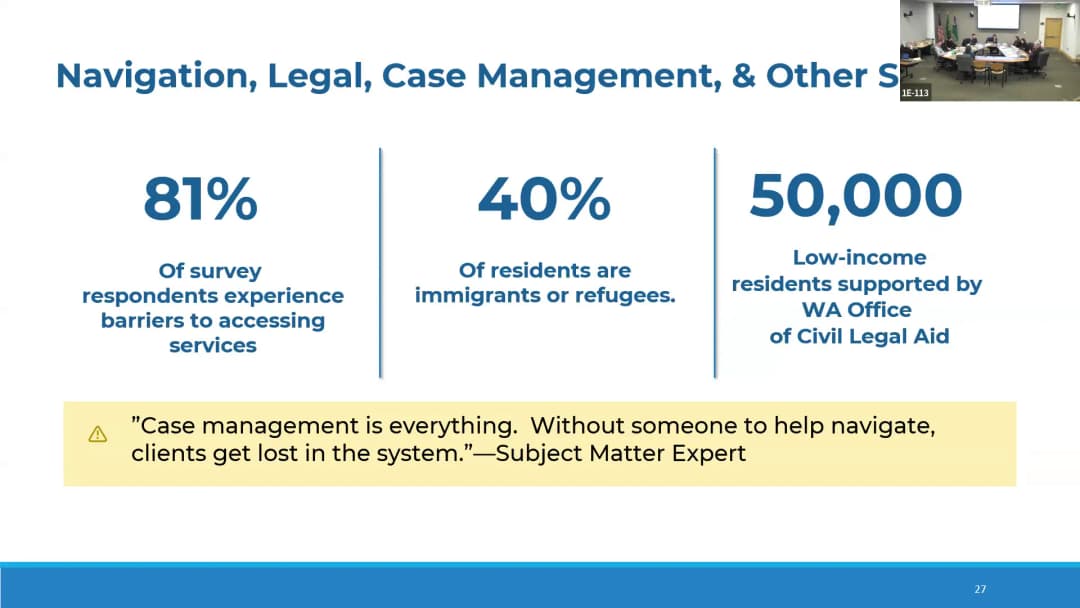
The Board held its regular meeting, addressing routine approvals, a bylaw amendment, marketing updates, and a comprehensive human services needs assessment. The meeting also included a farewell to Director Michael Shiuzaki, who retired after 37 years of service. Consent Calendar - The agenda was approved unanimously. - Minutes from the November 2025 regular meeting were unanimously approved. Public Comments & Testimony - Three speakers (Oscar Munn, Hudson Crag, and Nihal Sarral) requested that the City consider developing an asphalt bike park within its parks system. They highlighted that such a park is usable year-round, accessible to bikes, scooters, skateboards, and adaptive devices, and promotes healthy activity for all ages. They suggested a budget of $2–4 million based on similar projects and identified Velo Solutions as a potential designer. They also mentioned potential locations such as Surrey Downs Park or Robitin Park. Discussion Items - Farewell to Director Michael Shiuzaki: Board members offered thanks for his 37 years of service, noting his role in over 400 projects, including trails, natural areas, and the Japanese garden. They praised his leadership and expertise. - Director’s Report: Shiuzaki gave his final report, expressing gratitude to the board. Deputy Director Shelley McVane was named acting director, effective February 1, 2026. - Bylaw Amendment: The board voted on proposed updates to the PCS Board bylaws. A procedural amendment was required to apply the redline changes to the most recent version of the bylaws (from April 2024) rather than an outdated version. The motion, as amended, was approved. - Program Marketing & Communications: Bridget Larson, Marketing Coordinator, presented tools including the redesigned activity guide (renamed from “Connections”), a monthly e-newsletter with over 84,000 subscribers, a 54% open rate, and social media channels (Facebook, Instagram). She noted net growth of over 1,800 subscribers since the redesign. - Human Services Needs Update: Ruth Blau, Human Services Manager, presented the 2025 Needs Update. Key findings: 59% of Bellevue residents are people of color; 40% are immigrants/refugees; over 100 languages are spoken; one in five speaks English less than “very well.” Four cross-cutting themes: cultural/linguistic barriers, access barriers, provider strain, and stigma/mistrust. The report identified nine areas of need, with three critical survival needs: financial assistance, food/basic needs, and shelter. Statistics included: 651 Bellevue students experienced homelessness in 2024–2025 (nearly three times higher than 2021–2022); 32% of residents are cost-burdened (spending 30% of income on housing); about one in four children need food assistance; child care costs average $3,400/month; the city invests nearly $2 million in rental assistance. The report was impacted by federal funding cuts, leading to program closures and reduced services. - Board Communications: Members shared updates, including a positive note about decreased off-leash dogs at Ashwood, positive feedback on the Garden d’Lights event, a question about City plans for World Cup viewing parties (staff noted Bellevue is not an official FIFA site but an interdepartmental team is monitoring impacts), and comments on park lighting and the new activity guide. - Quarterly Report to Council: Ryan Walker presented the September–December 2025 report, highlighting the naming of Eastgate Commons, Crossroads Park discussions, levy marketing, accreditation (5th time for the department), etc. The board voted to transmit the report to City Council. - New Business: The February 2026 meeting will include a kickoff for the Bell-Red master planning process for a new park along the West Tributary. The meeting is scheduled for February 18, 2026 (President’s Day week), and several board members will participate remotely. Key Outcomes - Votes: - Agenda and November 2025 minutes approved unanimously. - Proposed bylaw amendments (with a correction to apply to the most current version) approved. - Quarterly report to Council transmitted unanimously. - Directives/Next Steps: - The February 18, 2026 meeting will proceed, with remote participation options for absent members. - The board will continue discussions on the human services needs update and explore ways to help the community, including sharing a list of agencies for volunteer opportunities. - Staff will look into the water utility shut-off issue raised by a board member and provide information on the Safe Place program's participation numbers. - Marketing efforts will continue to focus on engagement metrics and expanding reach. - Personnel: Deputy Director Shelley McVane will serve as acting director starting February 1, 2026.

PARKS AND RECREATION 31% · HUMAN SERVICES 18% · COMMUNITY ENGAGEMENT 15% · PUBLIC ENGAGEMENT 8%
78
JAN 27, 2026 · BELLEVUE, WASHINGTON · CITY COUNCIL
Bellevue City Council Meeting Summary: January 27, 2026

The Bellevue City Council met on January 27, 2026, starting at 1:45 PM (time inferred from agenda). The meeting included proclamations, oral communications, and action on several items, including supporting school district levies, receiving the human services needs update and funding recommendations, an update on the safe speeds program, and final approval of a rezone. Councilmembers present: Mayor Melakutian, Deputy Mayor Hamilton, Councilmember Breyer, Councilmember Bargava, Councilmember Newman House, Councilmember Sumadaveria, and Councilmember Robinson (remote). Mayor Melakutian opened with remarks acknowledging community concerns about federal immigration enforcement, reaffirming Bellevue's commitment to being a welcoming and safe city. Proclamations - International Holocaust Remembrance Day (January 27, 2026): Councilmember Newenhaus read the proclamation. Regina Friedland of the American Jewish Committee (AJC) accepted, thanking the council and emphasizing the importance of remembrance. - Americans of Chinese Descent History Month (January 2026): Councilmember Sumadaveria read the proclamation. Former Councilmember Lee accepted, accompanied by two youth speakers (Gideon and Yulan Wang) who spoke about the importance of recognition and inclusion. A motion to approve the agenda passed unanimously. Consent Calendar - The consent calendar was approved unanimously by voice vote. Public Comments & Testimony (Oral Communications) Pre-registered speakers and one additional speaker addressed the council. Speakers and positions: - Eric Fourner (representing OMA Construction): Urged council to reject a motion to award a construction contract to Johansson Construction (4th lowest bidder) and instead award to OMA (low bidder), citing a $1.275 million savings and arguing the bid rejection based on missing information was unwarranted. - Arlen Nordhorn (disabled veteran, Bellevue resident since 1990): Requested the city establish assistance programs for 100% disabled veterans, such as utility relief, noting the high cost of living in Bellevue. - Michael Huffman (formerly homeless, now resident of Plymouth Crossing): Described his experience with homelessness and supportive housing, criticized organizations (Discovery Institute, Jonathan Chow) he said blame the poor, and urged the council to address the growing unhoused population. - Lisa Pierce (Plymouth Crossing resident, Eastgate neighborhood): Expressed gratitude for the foundation provided by Plymouth Crossing, asked the council to match residents' efforts to build community, and noted that positive outcomes at Plymouth were not celebrated in prior council discussions. - Paul Rood (Bellevue resident): Spoke on noise pollution, presented a draft resolution and red-line of noise regulations (BCC 9.18), including a ban on gas-powered lawn equipment and limiting noise hours. Urged council to act without concessions to profit margins. - Liz McKinney (contracted dining worker at Meta Cafes, Spring District): Urged council to support unionization efforts, requested a public forum and letter of support, expressed frustration with council inaction, and highlighted the vulnerability of immigrant co-workers. - Adam Coke (line cook, Lavish Roots at Meta Kitchens): Described unsafe working conditions (broken equipment, smoke, carbon monoxide hazards), punishment for calling out sick, and asked council to support their unionization efforts. - Juliet Ducher (cook at Meta): Spoke about health issues (carpal tunnel), high insurance costs, and the threat of homelessness, asking for council support. - Maria Hudson (parent): Alleged police misconduct and demanded a criminal investigation into Bellevue police officers, claiming false reports and interference with reporting her daughter's sexual assault. - Additional speaker (unscheduled): Mentioned Tanzania visa issues, asked city to pay for gravel on a right-of-way, and complimented traffic light improvements. Discussion Items School District Levies (Resolution 10579) Council considered taking a collective position on two Bellevue School District propositions on the February 10 special election: Proposition 1 (Educational Programs & Operations Levy) and Proposition 2 (Technology & Capital Projects Levy). City Clerk Charmaine Arradon outlined the process, noting the safe harbor clause. - Pro presentation (Mindy Carroll, co-treasurer Bellevue Quality Schools): Urged council approval, stating the levies are replacement renewals with the same rate as 2026, funding essential programs (arts, music, nurses, counselors, 7-period day, transportation, special education, technology) that the state does not fully fund. She noted Bellevue levies have among the lowest property tax rates in the county. - Supporting speakers: Phil Block (Bellevue School Board president): Shared personal testimony about his daughter's success, urged support. Maggie Wong (PTSA president, real estate broker): Spoke in favor, citing importance for language programs and property values. Steve Miller (former school board member): Emphasized that losing levy revenue (24% of budget) would be devastating. - No opposition speakers were pre-registered or called. - Council discussion: Motion by Deputy Mayor Hamilton to adopt Resolution 10579 supporting both propositions, seconded by Councilmember Newenhaus. Passed 7-0. Mayor and Councilmember (likely Councilmember Sumadaveria) expressed strong support for schools as key to community. Human Services Needs Update & Funding Recommendations The Parks and Community Services Department presented data from the 2025 Human Services Needs Update and the Human Services Commission's preliminary 2027-28 funding recommendations. - Presentation (Michael Shiasaki, retiring; Tony Esparza; Angela Fan, Commission Chair): - Needs update: Data from over 700 respondents (79% Bellevue residents, 62 service providers). Cross-cutting themes: cultural/language barriers, provider strain, stigma/mistrust. Top critical needs: financial assistance, food/basic needs, shelter. - Key statistics: 32% of Bellevue residents are cost-burdened (spending 30% income on housing). 23.8% of households are low/moderate income. 54% of residents can access services when needed; same percentage can access culturally/linguistically appropriate services. - Homelessness: 123 people living in vehicles in Bellevue (40% children). 651 Bellevue school students experienced homelessness (3x since 2021-22). Graduation rate for homeless students: 51% vs 94% overall. - Behavioral health: 30% of students feel sad/hopeless; 15% considered suicide. Therapy waitlists average 6+ months. - Food insecurity: 1 in 4 BSD students qualify for food assistance. - Funding recommendations: The Commission proposed percentage allocations for 9 service areas (e.g., shelter, financial assistance, food, mental health, etc.) with a contingency plan allowing up to 2% adjustment without council approval. Also set targets: 23% for youth programs, 26% for culturally/linguistically specific programs. - Council discussion: - Councilmember Robinson proposed changing the target category from "culturally and linguistically specific programs" to "programs and services designed to serve the needs of marginalized communities" and increasing the contingency to 5%. She argued consistency with the recently adopted Diversity Advantage Plan. - Councilmember Bargava supported increased flexibility (5% contingency). - Deputy Mayor Hamilton and others preferred to adopt percentage allocations now and discuss definitional changes later, citing the need for transparency and time to review. - After parliamentary maneuvering, the council voted first to direct staff to prepare a resolution approving the Commission's percentage allocations (passed unanimously). - The proposal to increase contingency to 5% failed (only Councilmember Bargava voted in favor). - On the language change, Councilmember Robinson modified her motion, requesting that the definition of culturally/linguistically specific programs be made consistent with the Diversity Advantage Plan. The council agreed by unanimous consent to have staff bring back revised language for consideration before the RFP is published (March 2). Safe Speeds Program Update Transportation staff (Chris Long, John Murphy, Benjamin Wright) presented an update on the citywide safe speed study, part of the Vision Zero initiative. - Background: Speed limits on four corridors were lowered July 2025; results showed a 42% reduction in high-end speeding (e.g., on a Factoria corridor). - Proposed speed limits: Based on conflict and activity analysis (context-sensitive). 60% of streets would drop 5 mph, 20% drop 10 mph, 20% unchanged. Downtown core at 25 mph, some areas (Downtown Park, Old Bellevue) at 20 mph. - Implementation plan: Phased: start with urban core/high-injury network, then remainder. Plans include more signage, signal timing adjustments, radar signs, speed safety cameras, traffic calming (narrow lanes, speed cushions, raised crosswalks). - Council questions: - Councilmember Newenhaus asked about enforcement metrics and escalation to other tools if speed limit alone doesn't change behavior. - Councilmember Bargava inquired about coupling enforcement with design and about prioritizing implementation by high-injury locations rather than geographic area. - Councilmember Sumadaveria expressed appreciation for shifting to survivability-based speed setting. - Deputy Mayor Hamilton noted strong community agreement (75% say speed impacts safety) and praised the evaluation results. - Staff responded that enforcement (e.g., police safer roads initiative) and future engineering will support new limits. Implementation prioritization will be refined based on budget and further council input. No vote taken; staff will return in June with draft speed limits for approval. Land Use: Rezone Approval (Ordinance 6899) Quasi-judicial item: final action on rezone of 4.55 acres at 999 118th Ave SE from OLB (Office Limited Business) to NMU (Neighborhood Mixed Use). - City Attorney Trisna Tannis reviewed the hearing examiner recommendation and criteria (consistent with comprehensive plan, related to public health/safety/welfare, warranted, no harm, community merit). - No ex-parte disclosures. Motion to adopt the ordinance by Deputy Mayor Hamilton, seconded by Councilmember Bargava. Passed unanimously. Key Outcomes - Consent Calendar: Approved unanimously. - School District Levies: Resolution 10579 supporting Propositions 1 and 2 adopted 7-0. - Human Services Funding: Council directed staff to prepare a resolution approving the Human Services Commission's percentage allocations for 2027-28. The contingency increase from 2% to 5% failed. Staff will bring back revised language for the definition of culturally/linguistically specific programs, consistent with the Diversity Advantage Plan. - Safe Speeds: Informational update; staff to return in June 2026 with draft speed limits for council approval. - Rezone (999 118th Ave SE): Ordinance 6899 adopted unanimously. - Oral Communications: All 10 speakers were heard. No formal action taken on their requests.

HUMAN SERVICES 39% · PROCEDURAL 8% · EDUCATIONAL FUNDING 8% · HISTORIC PRESERVATION 6%
79
JAN 15, 2026 · BELLEVUE, WASHINGTON · CITY COUNCIL
Bellevue Planning Commission Meeting - January 14, 2026

The Bellevue Planning Commission held its first meeting of 2026 on January 14, 2026, in a hybrid format. The meeting included two study sessions: an introduction to the 2026 Comprehensive Plan Amendment (Evans Plaza) and a check-in on the Bell Red Look Forward Land Use Code Amendment (LUCA). The Commission also heard public comments and received reports from the Mayor and staff. Consent Calendar - The evening's agenda was approved unanimously. Public Comments & Testimony - Era Pogosova (Managing Director, Theater 33): Expressed gratitude for the 2009 Bell Red Arts District designation and highlighted the importance of land use policies that support affordable space, flexible use, and long-term stability for arts organizations. Noted Theater 33's recent expansion (Studio 33) and partnerships with the Hindi community. - Sandy Vaux (Executive Director, Bell Red Arts District Community Alliance): Urged the Commission to prioritize preserving arts and culture in the Bell Red LUCA, including affordable space for creation and performance, support for creative businesses and live-work artist housing, publicly accessible arts amenities, and a connective environment for visitors and workers. - Cody Lodi (Design Principal, Weber Thompson; former co-chair, AIA Mass Timber Committee): Supported the LUCA but recommended more optionality for pedestrian/bike access corridors, larger floor plates for mass timber (up to 25,000 square feet for residential), and removing floor-to-floor height requirements for above-grade parking. - Cosmos Darwin (Downtown resident): Expressed concern that the revised Bell Red street network drops about one-third of required streets. Urged the city to acquire right-of-way for key connections, retain the street grid where feasible, and require pedestrian connections where streets are dropped. Cited specific examples (131st Avenue, Vicino development). - Jesse Clausen (representing Steve Malsum): Spoke in support of the Evans Plaza CPA and flexibility on the street grid in Bell Red. Advocated for flexible uses, larger floor plates, and an amenity incentive system that incentivizes stream daylighting, open space, and affordable housing. - Rebecca Bloom (Chief Investment Officer, Columbia Pacific Advisors): Expressed support for the Bell Red LUCA, particularly incentives for stream daylighting. Requested that submitted master development plans (MDPs) be vested against the new code but allowed to opt in. Urged flexibility on parking requirements, larger floor plates, and the most flexible uses possible. - Isaac Patterson (Land use attorney, personal capacity): Supported maximum flexibility in the Bell Red LUCA and encouraged development of an MFTE supercharger program similar to Wilburton. Discussion Items - 2026 Comprehensive Plan Amendment – Evans Plaza: Staff presented a privately initiated map amendment to change the land use designation of approximately 10 acres at Evans Plaza from "General Commercial" to "Low Rise to Mixed Use" to allow mixed-use development with residential. The site is north of SR 520 in the Bridle Trails neighborhood. The Commission discussed the geographic scope: staff recommended adding a half-acre adjacent parcel to create a coherent map. Some commissioners (Ferris, Villaveces, Gopel) advocated for including an additional five-acre block to the east to unlock more housing potential and avoid creating a one-off. Others (Kennedy, Nilchian) expressed caution about scope creep and potential risks to the applicant. After debate, the Commission voted to accept staff's recommendation (expand scope to the one corner parcel only) and schedule a public hearing for February 11, 2026. A second motion to set the public hearing was also approved. - Bell Red Look Forward LUCA – Check-in: Staff provided an update on Phase 1 engagement (fall/winter 2025) and the working draft released December 31, 2025. Key themes from outreach: safety, walkability, arts/culture, local streets, and affordable housing. The draft proposes aligning Bell Red land use districts with the Future Land Use Map, introducing a mandatory affordable housing requirement (10% at 80% AMI for rentals), restructuring the amenity incentive system, and refining the local street network. The Commission asked for more detail on cross-sections for different street typologies, stream daylighting and pedestrian connections, floor plate sizes, parking reform, and the timeline for an affordable housing nexus study. Many members expressed interest in a future briefing on Wilburton code outcomes, stream/park incentives, and a catalyst program for Bell Red. Key Outcomes - Vote on Evans Plaza geographic scope: Unanimously approved staff recommendation to expand the scope to include one adjacent half-acre parcel (the corner property). - Vote on public hearing: Unanimously directed staff to schedule a public hearing for February 11, 2026, to conduct threshold review of the Evans Plaza CPA. - Continued work on Bell Red LUCA: The Commission will receive a revised draft in late March 2026, with a full review expected to begin then. Phase 2 engagement includes a deep dive with the Bellevue Development Committee and an in-person open house in late February. - Next steps: The Commission approved the minutes from the December 10, 2025 meeting.

LAND USE AND ZONING 60% · AFFORDABLE HOUSING 11% · PUBLIC TRANSPORTATION 8% · ARTS AND CULTURE 6%
80
JAN 14, 2026 · BELLEVUE, WASHINGTON · CITY COUNCIL
Bellevue Arts Commission Meeting - January 14, 2026: Grand Connection Art Plan and 2026 Work Plan

The Bellevue Arts Commission met on January 14, 2026, to discuss the Grand Connection Crossing Art Plan update and the 2026 work plan. The meeting featured a presentation from artist Matthew Mazzota on potential art themes, followed by commissioner feedback, and a staff overview of the year's grants, public art projects, and committee activities. Public Comments & Testimony - A representative from Gage Academy of Art had emailed to thank the commission for grant support but was not present for the meeting. No other public comments were offered. Discussion Items - Grand Connection Crossing Art Plan Update: City public art specialist Scott McDonald introduced the project, which focuses on the pedestrian/bike bridge crossing over I-405. Artist Matthew Mazzota presented three potential themes for the art plan based on community engagement (over 100 community members met in September 2025): - Repair: Addressing natural systems, social inequities, and future resilience. - Refuge: Creating a space of safety, calm, and connection to nature, including aesthetic, social, and natural refuges. - Technology and the Natural World: Exploring biomimicry and the integration of tech with nature, while acknowledging the city's dual identity. Commissioners provided feedback: they emphasized the importance of incorporating Bellevue's diverse history (e.g., agrarian roots, Japanese American community, immigrant groups), avoiding a fixation on fleeting technology, and ensuring the artwork fosters placemaking, inclusivity, and long-term relevance. The artist noted that the themes are designed to be flexible guideposts for future artists. - 2026 Work Plan: Staff presented the upcoming year's priorities, including: - Grants and Allocations Committee: Launch of all three grant programs (Project Grants, Eastside Arts Partnership, and Capital Facilities Grants) with a capital grants budget of approximately $1.8–2 million every two years. New grant software will streamline processes. - Public Art Committee: Updates on Grand Connection, creative crosswalks, box wraps, and installation of Jill Ann Holt's "Rooted" artwork. Two emerging artist public art projects are planned for Lake Hills and Linkmont. - Community Partnerships Committee: Drafting a letter to the Bellevue School District urging reopening of performance spaces for rentals. - Committee of the Whole: Continued partner presentations and preparation for a formal cultural planning launch. Commissioners discussed creating a master calendar of grantee events and the possibility of youth members on the commission. Commissioner Chen has left the commission due to relocation; applications are open until January 19, 2026. Key Outcomes - No formal vote was taken on the art plan themes; the commission provided guidance for Matthew Mazzota to refine the themes, incorporating historical and cultural depth, and to present a draft art plan at a future meeting. - The 2026 work plan was presented and discussed; no formal approval was needed. Staff will consider adding a master calendar of events and exploring youth membership options. - Project updates included: 31 project grants approved by council on January 6, 2026; Bell Red Arts District code amendment update at the Planning Commission; artist selection for a public art piece in Factoria in mid-2026; and a ribbon-cutting ceremony for the Crossroads public art piece in first half of 2026. - The meeting adjourned at 5:41 p.m.

ARTS AND CULTURE 56% · PUBLIC ENGAGEMENT 17% · PROCEDURAL 10% · HISTORIC PRESERVATION 6%
OPENPUBLICA · PUBLIC MEETING INDEXUPDATED DAILY · openpublica.com