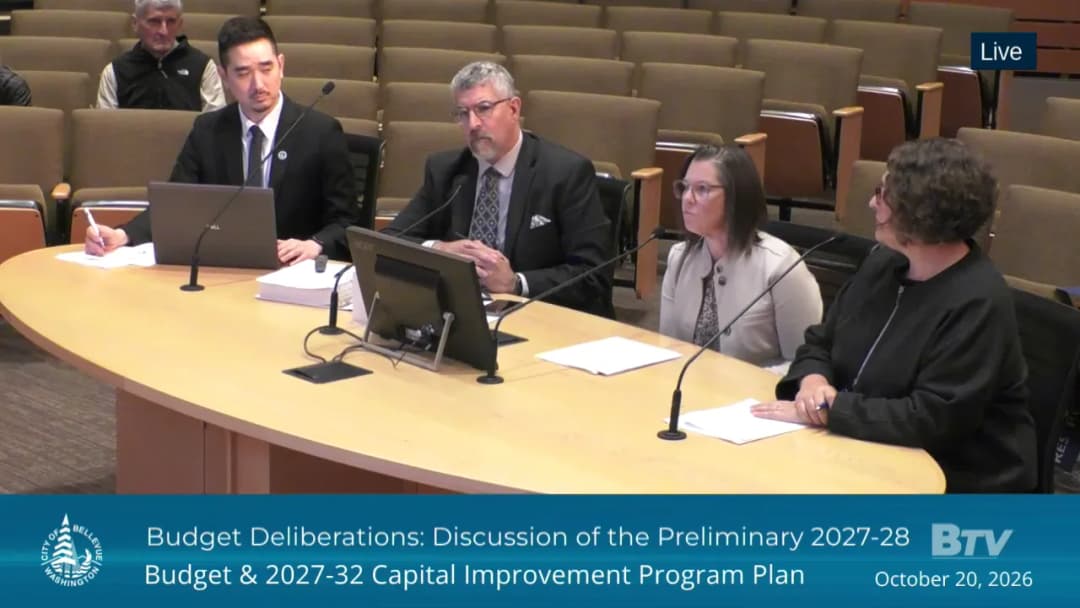
The Bellevue City Council met on October 20, 2026, starting at 1:45 PM, for a regular meeting that included proclamations, public testimony, study sessions on parking reform and the 2027-2028 budget, and final approval of two rezone applications. The meeting extended into the evening. Proclamations - Disability Employment Awareness Month was proclaimed, presented by Councilmember Robinson and accepted by Jen Stroli of the Evergreen Transition Program (Bellevue School District). - Community Conflict Resolution Month was proclaimed, presented by Deputy Mayor Hamilton and accepted by Arthur Jackson of the Bellevue Conflict Resolution Center. Consent Calendar - The agenda and consent calendar were approved unanimously without debate. Public Comments & Testimony - Barbara Hughes, Board President, Bellevue Farmers Market (joined by Loretta Lopez and Phyllis White): Requested $25,000/year in the 2027-2028 city budget. Reported 32,000 shoppers and $1,034,768 in vendor sales over 22 weeks in 2025. Noted the market provides food access, supports local vendors (65% of dollars stay local), and uses over $13,000 in SNAP/EBT annually. - Patrick Hanks, Bellevue Chamber’s Plush Committee: Expressed support for the parking reform LUCA, particularly eliminating visitor parking requirements (Option 3) or reducing them (Option 2) to lower project costs. Emphasized that each parking stall adds $21,000–$120,000 to costs. - Todd Myers, Vice President for Research, Washington Policy Center: Criticized EV chargers, heat pump subsidies, and e-bike subsidies as expensive per ton of CO2 reduced. Stated Bellevue EV chargers average 25% usage and the cost per metric ton for fast chargers is $6,000–$7,000, far exceeding the state carbon price of $40. Recommended purchasing certified offsets instead. - Eli Lieberman, Executive Director, Washington Builds (state green bank): Urged the Council to retain the $5 million partnership with Washington Builds, noting that green banks can leverage public dollars significantly (e.g., New York Green Bank achieved 8:1 leverage). The money will support low-interest loans for heat pumps and commercial building retrofits. - Court Wilson: Thanked staff for including $5 million for building decarbonization in the budget. Referenced an email with further input. - Sam Gyum June: Raised concerns about nuisance and safety issues from social service facilities in his neighborhood, asking a council member to visit and enforce a Good Neighbor Agreement. - Sue Mercer: Requested a code variance for parking on steep streets. Thanked police and fire departments, and asked for traffic light and landscaping improvements. - Julie Cobb: Opposed state-imposed land use code changes, citing loss of mature trees, increased emissions from demolition, and neighborhood disruption. Called for a limit on demolition density. - Alex Zimmerman, President, Stand Up America Party: Made inflammatory remarks, calling council members “political prostitutes” and “Nazi pigs.” Received two warnings and was escorted out. - Eric Beeley, Senior Director of Homeless Youth Services, Friends of Youth: Urged the Council to fully fund services for unhoused youth using new sales tax revenue. Reported that the shelter turns away 30 calls per month from minors, and young adult shelter operated at over 100% capacity. Noted that 51 Bellevue youth are homeless and 70% of rapid rehousing participants achieve permanent housing. Discussion Items Parking Reform LUCA Nick Whipple (Code and Policy Director) presented four topics: 1. Parking near BRT stops: Staff recommended a quarter-mile radius (consistency with state law and middle housing density). Council voted 4–3 for quarter-mile. 2. Visitor parking: The Council approved Option C (eliminate visitor parking minimums) 4–2, with Councilmembers Robinson and Sumadoria supporting Option B (diminishing requirements). Developers may still provide visitor parking at market discretion. 3. Large stall incentive: The Council voted 6–1 to retain the Planning Commission’s incentive (10–15% parking reduction for wider stalls). Councilmember Bargaba dissented. 4. Parking garage clearance: Unanimous decision to remove the separate land use standard and rely on building code. The Council directed staff to finalize the ordinance and return on consent. Budget 2027-2028 – Thriving People and Communities Staff (Meredith Patrick, Bianca Siegel, John Risha) presented nearly $120 million in proposed investments, including: - Over $7 million annually in human services. - Continued funding for affordable housing, homelessness outreach, and the Bellevue Promise college scholarship program. - New Neighborhood Enhancement Program and modernization of contract management. New Sales Tax Revenue (HB 2442): The city anticipates $1 million/year for children and family services. Staff identified $4 million in unfunded eligible requests. Council discussion centered on priorities: - Councilmember Robinson and Deputy Mayor Hamilton both proposed focusing on child care/early learning, family financial assistance/housing stability, and youth behavioral health, with differing percentage splits (Robinson: 40/35/25; Hamilton: 45/35/20). - Councilmembers Newenhouse, Sumadoria, Breyer, and Bargaba supported these three areas as top priorities. - Mayor suggested including food/basic needs as a fourth priority with 10%. - Final direction to staff: return November 3 with allocation options reflecting these priorities. Budget 2027-2028 – High Quality Built and Natural Environment Staff presented $500 million in capital and operating proposals, including: - Implementation of the Sustainable Bellevue Plan (50% GHG reduction by 2030, 95% by 2050). Current data shows 12% overall reduction since 2011, with city programs contributing 0.8% in buildings and 8% in mobility. - Proposed permit fee increases of 9.25–9.54% for development services. - $5 million green bank investment, $1 million for Energy Smart East Side, and $200,000 for clean building programs. - Councilmember Bargaba supported additional funding for Energy Smart East Side and green bank. - Councilmember Newenhouse proposed $50,000 from council contingency for a consultant to expedite DADU/cottage housing financing partnerships. - Councilmember Sumadoria asked about permit process improvements. - Mayor suggested establishing city-controlled GHG targets and exploring fund shifts from municipal to community programs. Staff will provide effectiveness data on sustainability investments at the next meeting. Key Outcomes 1. Parking Reform LUCA: Direction approved for quarter-mile BRT parking reduction, elimination of visitor parking minimums, retention of large stall incentive, and use of building code for garage clearance. Ordinance to be finalized for consent. 2. Budget – New Revenue: Council directed staff to prioritize child care/early learning, financial assistance/housing stability, and youth behavioral health for HB 2442 funding. Food/basic needs may be included. Allocations to be presented November 3. 3. Contingency Fund Proposal: Councilmember Newenhouse proposed $50,000 for DADU financing consultant; other members may submit requests by November 3. 4. Rezones: Unanimous approval of Everglen Village (Ordinance 6944) and Bellwood Townhomes (Ordinance 6945) rezone applications.
Public Meetings - Bellevue, Washington
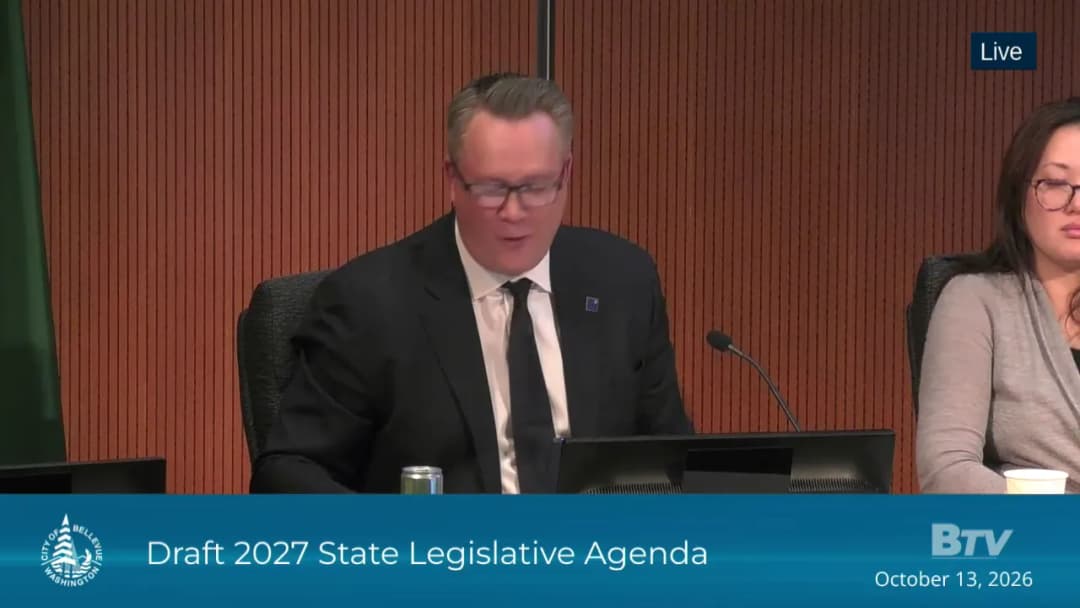
Public Meetings - Bellevue, WashingtonThe Bellevue City Council met on Tuesday, October 13, 2026, at 6:00 PM. Key actions included approving three proclamations, hearing public comments on a variety of city topics, conducting study sessions on the 2027-2028 biennial budget and the 2027 State Legislative Agenda, and adopting ordinances to assume the powers of the Transportation Benefit District and to implement a local children and family services sales tax to capture revenue otherwise allocated to King County. Proclamations - Diwali (November 8): Councilmember Bargava read the proclamation, received by Consul General Prakash Gupta. - Pregnancy and Infant Loss Awareness Month (October): Councilmember Robinson read the proclamation, received by Linda Crow and Erin Hunt of Overlake Hospital. They promoted the Wave of Light event on October 15. - Arbor Day (October 17): Councilmember Breyer read the proclamation, received by Curtis Kwan and Lucy Liu of the Bellevue Naturalist Volunteer Corps. Approval of Agenda - The agenda was amended to remove item 7B (Independent Salary Commission) and move item 8A (Ordinance 6941) to the ordinances section. The amended agenda passed unanimously. Public Comments & Testimony - Paul Charbonneau spoke on behalf of childcare providers. He expressed support for the Children and Family Services tax (Item 12B) but strongly urged the council to prioritize directing the new funds to childcare, detailing that the category suffered over 51% of the total proposed cuts to human services contracts. - Patrick Hanks (Bellevue Chamber) voiced support for the draft 2027 state legislative agenda, specifically emphasizing support for an "all of the above" energy strategy. - David Aube criticized the prioritization of transportation projects, arguing pedestrian and bike safety improvements are repeatedly delayed in favor of minor vehicle intersection improvements. He questioned the lack of clear project ranking criteria from the council. - Grace Landau described a deeply concerning 2023 incident where her 7-year-old child was allegedly detained on a Bellevue School District bus and not released until 9 PM, criticizing the district's handling of the situation. - Joe Kunzler commented on the state legislative agenda, advocating for artificial intelligence to help with public records requests and supporting bike lanes. He also referenced a recent insanity defense verdict related to city hall trespassing. - Paul Simmerly strongly criticized the I-90 culvert restoration project, calling it the "largest fraud in the history of the state of Washington," arguing that natural barriers like a 40-foot cliff and intermittent creek flow make the project ineffective for salmon. - Julie Cobb questioned the public's awareness and the high cost ($250+ million) of the Grand Connection Crossing project. Study Session: 2027-2028 Budget Deliberations - Community Safety & Health: Fire reported Fire Station 10 is operational with 24% faster engine response. Police reported a 27% decline in crime overall and a 33% decline in property crime. The Drone as First Responder (DFR) pilot program will launch by end of year. - Utility Rates: Lucy Prall proposed an 8.5% increase for 2027 and 8.6% for 2028, driven over 50% by regional wholesale cost increases. The Environmental Services Commission (Chair Ken Wan) unanimously supported the budget. The council discussed expanding utility bill assistance, with concerns raised about a potential "cliff effect" for residents just above the 80% AMI threshold. - Vibrant Economy: Staff highlighted the Startup 425 accelerator (95 new businesses), the $5M investment for KidsQuest relocation, and public activation funding. Councilmembers Newenhouse and Hamilton proposed a $50,000 allocation for the Bellevue Farmers Market. - High Performance Government: Council discussed the Business Transformation Program, including a new CRM replacing MyBellevue. Councilmember Bargava asked about mechanisms to measure productivity and efficiency gains from the budget. Study Session: 2027 State Legislative Agenda - Diana Hart presented the agenda, focusing on economic competitiveness, affordable housing, transportation (I-405 gap), and capital requests (Highland kitchen, Eastgate park). - Amendments: 1. Robinson Amendment: To add appreciation for the local authority granted by HB 2042 to fund children and family services. Passed. 2. Newenhouse Amendment (AWC): To remove blanket support for the AWC legislative agenda. Failed; staff directed to bring back refined language. 3. Newenhouse Amendment (Energy): To add specific language modifying CETA for an "all of the above" energy strategy. Failed; staff directed to bring back refined language balancing state policy with local affordability and reliability. Key Outcomes & Votes - Ordinance 6941 (TBD Assumption): Adopted (6-1). The council assumed the rights, powers, functions, and obligations of the Bellevue Transportation Benefit District. - Ordinance 6942 (Children and Family Services Tax): Adopted (7-0). The council enacted the 0.01% sales tax to ensure revenue generated in Bellevue is managed locally. Councilmember Robinson directed staff to return with a funding framework focusing on childcare, housing stability, and youth mental health. - Arts Commission Appointment: Laura Crisp was appointed to a partial term expiring May 31, 2027. - Parks and Open Space System Plan Update: Staff presented the kickoff of the 2027 plan update, outlining a robust community engagement process.
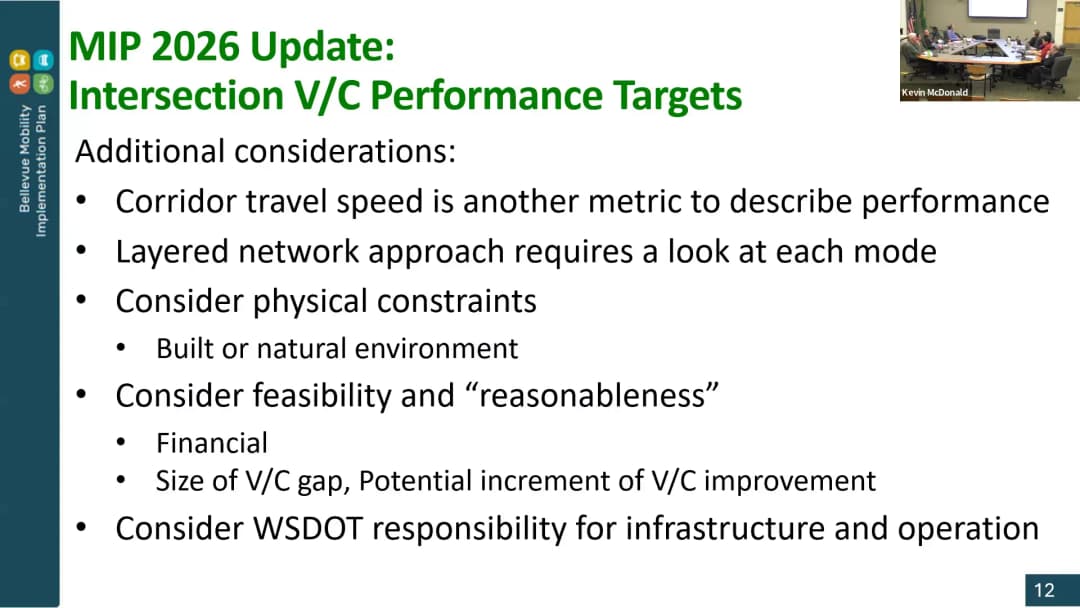
The Bellevue Transportation Commission met in a hybrid in-person/virtual session on October 9, 2026 (the chair opened the meeting as the 'October 8th' meeting, but the meeting record is dated October 9, 2026). Present were Chair McGill, Vice Chair Williams, and Commissioners Keelman (in person), Ting, and Welcher. The commission noted two vacancies created by the resignations of Commissioners Raboon and Stash. Members approved the agenda and minutes, heard two public comments, received a city council update from Deputy Mayor Dave Hamilton, reviewed newly completed Urban Core Bike Network projects, and held a study session on the 2026 Mobility Implementation Plan (MIP). The meeting adjourned at 8:07 PM. Consent Calendar - Agenda approved unanimously (motion: Commissioner Williams; second: Commissioner Ting). - Meeting minutes approved unanimously (motion: Commissioner Keelman; second: Commissioner Ting). Public Comments & Testimony - Al Diedeman, a Vassa Park resident for over 30 years, said Attachment B to the agenda omitted arterials that have no shoulders and urged the commission to prioritize a minimum four-foot shoulder on all Bellevue arterial roads for pedestrian and bicycle safety. He described many transportation CIP projects as focused on driver inconvenience, including what he called 'vanity projects,' and said the city has neglected this basic necessity for 30 years. - Alex Zimmerman, president of the 'Send Up America Party,' opposed new city taxes, claiming the City of Bellevue has a $1 billion budget and a $150 billion GDP from Amazon and Microsoft, and argued residents should not pay new taxes, including 'four car taxes.' He used profane and insulting language toward the city council. (These figures are the speaker's claims.) Communications from City Council - Deputy Mayor Dave Hamilton reported that the council has identified five finalist candidates for the two vacant commission seats and will interview them in about two weeks. He said transportation is the 'star of the show' in the city budget this year, with the council considering different funding approaches and ways to advance transportation projects, and more transportation work will mean more work for the commission. He encouraged commissioners to watch recorded council meetings on the city's YouTube channel. - Responding to Vice Chair Williams, Deputy Mayor Hamilton clarified that the council's transportation budget meeting was held Tuesday, October 6, not October 7, and suggested watching the recording at 1.5x speed. Staff Report: Urban Core Bike Network - Staff (Kevin, with drone footage by colleague Chris Brayland) highlighted recently completed bike facilities, formerly known as the Bike Bellevue network: - 116th Ave NE north of Main St: bike lanes added by narrowing existing travel lanes; southbound lanes pick up at NE 4th; northbound lanes repurpose former car-dealership load/unload zones. - 100th Ave NE (west end of downtown), Main St to NE 1st: bike lanes installed by narrowing travel lanes, with green paint and bike logos at driveways; speeds and volumes are low enough to keep bicycle level of traffic stress (BLTS) consistent with the MIP target; bike signals are planned for the intersection. - Lake Washington Blvd: westbound begins with sharrows, then widens into bike lanes; eastbound has striped or buffered bike lanes from 99th to 100th/Main St; a short parking stretch was converted to bike space after strong neighborhood support during the Meydenbauer Bay phase 2 planning (about five or six spaces). - Main St east of 100th: sharrows deferred until the roadway is repaved in a couple of years; NE 1st and NE 2nd sharrows between Bellevue Way and 100th; new bike wayfinding installed. - Commissioner Ting asked about downsides of narrowing travel lanes. Staff said narrower 10-foot lanes are used from a safety perspective, with more cautious driver behavior and no known collisions from the narrowing; most car dealerships have relocated from Wilburton, so there has been no negative feedback on the lost load/unload zones. - Commissioner Gilman, an e-bike rider on Lake Washington Blvd, raised concerns about speeding cars, garbage and recycling bins placed in bike lanes, and visitor parking encroachment. Staff said parking enforcement outside downtown is a police matter and committed to research the city policy on trash cans in bike lanes and report back at the next meeting. Study Session: 2026 Mobility Implementation Plan (MIP) Update - Administrative updates: The MIP will reflect council-adopted speed limits from last summer, including a new 20 mph speed limit on certain downtown streets (Main St, NE 1st and 2nd, and 100th Ave NE south of NE 4th). The frequent transit network map will be updated for route changes, most notably the former Route 271, which was rerouted from Medina onto Bellevue Way to reach SR 520 and split into separate east/west segments at the Bellevue Transit Center; Medina retains a bus route, though possibly less frequent. - PLTS/BLTS performance metric: Staff recommended using the adopted posted speed limit instead of the 1.2 speed factor currently used to estimate pedestrian and bicycle level of traffic stress (PLTS/BLTS), since measured speeds average close to posted limits and the 1.2 factor exaggerates gaps and diverts attention from places with no facilities. Staff noted that locations with no shoulder would still be rated worst-case (PLTS/BLTS 4), either through narrative or a new column in the table. Commissioner Ting supported the change and cited 132nd Ave NE between Bel-Red and NE 8th as a no-shoulder road where pedestrians walk through blackberry growth. - A commissioner flagged apparent data anomalies in the packet, including a 2045 forecast BLTS citywide share that appears to drop from 34% (2025 MIP version) to 27% (2026 proposed version) despite lower posted speed limits, and a possible math error (2025 MIP citywide BLTS should be 32%, not 24%). Staff said they would double-check the data and report back at the next meeting. - The commission voted unanimously (motion: Commissioner Ting; second: Commissioner Keelman) to approve staff's Option 1: use the adopted speed limit as the primary performance metric for PLTS/BLTS in the MIP. Intersection Performance (V/C Ratio) Discussion - Staff described intersections forecast to miss the volume-to-capacity (V/C) performance target in the 2044/2045 horizon. The targets are 1.0 in downtown, Bel-Red, and Wilburton; 1.9 in Crossroads, Factoria, and Eastgate (as stated in the transcript); and 0.85 in the rest of the city. Staff presented three options: (1) retain current targets and monitor intersections, developing project concepts case-by-case; (2) adjust performance targets at certain contexts, such as freeway-access ramps or the 148th Ave corridor; and (3) categorize intersections, such as improvable, state-controlled, or at 'ultimate build' with no feasible expansion. An example at 112th Ave NE and NE 8th St was shown: V/C of about 1.05 in 2024 rising to about 1.1 in 2045, and all feasible turn lanes would bring it to 0.99. - Commissioners generally favored retaining the current performance targets (Option 1) for transparency. Commissioner Ting argued that changing metrics or creating permanent categories could 'sweep under the rug' the consequences of the 2045 growth plan, and that 148th, despite functioning as a regional corridor, still serves surrounding neighborhoods and should not be recharacterized. Commissioner Ting also stressed separating performance measurement from feasibility discussion. Vice Chair Williams noted that even where capacity cannot be expanded, the volume side could be addressed through multimodal investments and parallel corridors. Chair McGill suggested combining Option 1 with a separate designation and narrative for state-owned and operated intersections (e.g., Coal Creek Parkway/I-405 and 124th Ave NE/Northup Way for SR 520 access), noting the council's legislative agenda already seeks regional funding for those locations. No formal vote was taken; staff will return with a refined recommendation at the November meeting. Quarterly Report to City Council - The commission reviewed and unanimously approved the draft Transportation Commission report to the city council (motion: Commissioner Keelman; second: Vice Chair Williams). Staff will aim to have it in the November 3 council packet under reports from boards and commissions. Key Outcomes - Agenda, meeting minutes, and the quarterly report to city council were each approved unanimously. - Motion passed unanimously to use the adopted speed limit (replacing the 1.2 factor) as the PLTS/BLTS performance metric in the 2026 MIP. - No vote was taken on intersection options; staff will bring a recommendation in November. The November 12 commission meeting will focus on the MIP. - Staff will verify the BLTS data anomalies and research the city policy on trash cans in bike lanes, with follow-up at the next meeting. - Deputy Mayor Hamilton reported that interviews for the two vacant commission seats will occur in about two weeks. - Assistant Director Molly Johnson reported that the council will choose among transportation budget alternatives in November, and staff will bring a full budget briefing to the commission on December 10, ensuring new commissioners can attend. - A commissioner requested a future joint review of the city's capital projects website; staff said transportation project information on the site is current.
ok
The Bellevue City Council held a regular meeting on October 6, 2026, beginning at 6:00 PM. The meeting included proclamations, public oral communications, staff reports, approval of the consent calendar, a study session on the 2027-2028 Preliminary Operating Budget and Capital Improvement Program focusing on the Safe & Efficient Transportation System strategic target area, and initial consideration of two site-specific rezone applications. The council heard from numerous community members, debated transportation investment scenarios, and directed staff to prepare an ordinance to assume the Transportation Benefit District. Proclamations - Indigenous Peoples' Day (October 12, 2026): Deputy Mayor Hamilton read the proclamation, acknowledging the ancestral homelands of Coast Salish peoples and committing to stronger relationships with tribal neighbors. A representative from a local indigenous group offered a prayer. - Walk & Roll to School Day (October 6, 2026): Councilmember Bargava read the proclamation, highlighting safety, health, and environmental benefits. A representative from the Bellevue School District thanked the council. - Community Planning Month (October 2026): Councilmember Newenhouse read the proclamation, recognizing planners' contributions and encouraging resident participation. A city staff member thanked the council. Consent Calendar - The council unanimously approved the consent calendar, which included: - Minutes of September 15 and September 22, 2026. - Resolution 10673 authorizing a three-year lease extension for the Bellevue Police Community Substation at Factoria Mall. - Resolution 10674 authorizing settlement of the Becker v. City of Bellevue lawsuit. Public Comments & Testimony Oral communications totaled 30 minutes. Speakers addressed the Transportation Benefit District (TBD) and other topics. - Maria Frost (Vice President, Kemper Development Company): Urged the council to put any new transportation tax package to a public vote, arguing it is a significant change. Stated that if council moves forward without a vote, funding must prioritize traffic congestion relief and vehicular travel. - Tony Sprague (Public Policy Manager, Bellevue Chamber of Commerce): Supported scenario three of the TBD revenue package on four conditions: sufficient funding for Spring Boulevard Zone 3, 120th Ave NE Stage 4, and the Grand Connection; increased intersection fund focused on growth corridors; no reduction of vehicular capacity for bike facilities except as last resort; sales tax revenue not shifted to neighborhood programs meant for car tab funds. - Heidi Dean (Bellevue Resident): Opposed the tax package, stating residents are absent from hearings because they are working. Called the Grand Connection a "vanity project" and requested a public vote. - Catherine Hollis (Eastrail Partners): Voiced support for increased transportation investment, emphasizing Eastrail connections to Bellevue neighborhoods. - Carolyn Ferrez (Friends of the Grand Connection): Supported the Grand Connection, describing it as an iconic park-in-the-air that will connect assets and boost economic development. - Tony Andrews (Bellevue Resident): Opposed the proposed Spring Boulevard connection through the new Bell-Red Park, calling it a solution to a nonexistent problem. Suggested a pedestrian/bike path instead. - Dr. Janice Clark (Indigenous Women Veteran): Supported the Indigenous Peoples' Day proclamation but expressed disappointment that the Human Service Commission did not recommend a $20,000 investment for counseling services for eight indigenous women veterans in Bellevue. - Julie Cobb (Bellevue Resident): Opposed infill development that triples density in her neighborhood, stating new townhomes are unaffordable and urging council to see the impacts firsthand. - Alex Zimmerman (self-identified resident): Made aggressive comments criticizing the council and Mayor, claiming loss of free speech and corruption. He received a warning for disrespect. - Karen Armstead (VASA Neighborhood): Expressed concern that sidewalk construction in VASA is not scheduled until 2034 under scenario three, citing safety issues for children and seniors. - Pamela Johnston (Bridal Trails Neighborhood): Opposed tax increases, noting families are struggling. Argued the Grand Connection and other bike-ped projects should not be prioritized, and the city should explain existing unspent funds. Reports of the City Manager - Bellevue Youth Theatre Overview: Staff presented a report highlighting the theater's history since 1990, serving 936 participants last school year, including record auditions (253) in the current fall. The program is inclusive, placing 100% of interested participants. 92% of participants reported increased confidence, community connection, or improved mental health. The theater sold over 5,700 tickets last year and offers sensory-friendly performances. - Experience Bellevue 2026: Staff reported on the annual event held in late September, which attracted over 2,000 visitors and offered 32 activities. The event was combined with Welcoming Week to foster community connections. Staff thanked council and Amazon for support. - City Manager also announced: The state auditor gave an unmodified clean opinion with no findings for FY2025, and S&P Global affirmed the city's AAA stable long-term rating. Study Session: Safe & Efficient Transportation System - Budget Deliberations Staff presented three scenarios for transportation capital investments (2027-2032 CIP) and sought direction on assuming the Transportation Benefit District. - Scenario 1 (Base): No new revenue; maintains current funding, partially funds Spring Boulevard Zone 3 and Westlake Sammamish Parkway Phase 3. - Scenario 2: Adds a 0.1% sales tax ($100M over 10 years); completes Spring Blvd Zone 3, adds sidewalks (including VASA and SE 8th St), intersection widening, and bike network phases. - Scenario 3: Adds both 0.1% sales tax and a $20 vehicle registration fee ($120M over 10 years); includes scenario 2 projects plus $11M more for neighborhood mobility (traffic calming). - Grand Connection Crossing: Total cost $265M, with existing commitments ($45M) plus partner funds and $10M grant gap. Scenario 2/3 would free up $10M of general fund cash for other uses. - Community Engagement: Over 800 survey responses; top priorities: maintaining sidewalks/bridges, improving travel times, increasing transit access, and adding bike lanes. Two-thirds of open-ended responses supported multimodal improvements. Council discussion covered project timing, impact on residents (average $77–$97 per household per year for scenarios 2/3), safety prioritization (especially safe routes to school), neighborhood equity, and the need for balanced investment. Several council members emphasized the difficulty of tax increases given resident financial strain. Land Use Reports (Initial Consideration) Council received the hearing examiner's recommendations for two rezone applications. No action was taken; final action is scheduled for October 20, 2026. - Bellewood Townhomes Rezone (2233 & 2229 112th Ave NE): Request to amend a Concomitant Zoning Agreement to allow multi-family (42 townhomes) on 3.2 acres without changing the Office zone. Hearing examiner recommended approval with no conditions. - EverGlen Village Rezone (12500 NE 10th Place): Request to rezone 0.62 acres from Professional Office to Mixed Use Residential-Midrise to align with the Wilburton subarea plan. Hearing examiner recommended approval subject to a condition clarifying that rezone does not approve other entitlements; design review will be required for future development. Councilmember Newenhouse disclosed an ex parte communication (email from a resident expressing concern about the EverGlen project) and stated she could still hear the matter fairly. Key Outcomes - Transportation Benefit District Assumption: Council voted (6 in favor, 2 opposed, 1 abstention per transcript notation "6-2-1") to direct staff to prepare an ordinance to assume the Transportation Benefit District for final action on consent at a future meeting. This does not set revenue levels but allows the council to act as the governing body. - No final decision on transportation funding scenarios or tax increases was made; additional council deliberations are scheduled for November 3, 2026. - Land Use: No final decisions; council will take final action on both rezones on October 20, 2026. - Adjournment: The meeting adjourned at approximately 9:30 PM.
The Bellevue Planning Commission met on September 24, 2026, at 6:45 PM in a hybrid format. The meeting included farewell remarks for departing Commissioner Kennedy, a council update, oral communications, and public hearings on the Eastgate and Factoria Neighborhood Area Plan comprehensive plan amendments. Both plans were recommended for adoption with minor amendments. Public Comments & Testimony - Oral Communications (before public hearings): Alex Zimmerman (Stand Up America) spoke about city budget and was twice warned for off‑topic comments before being asked to leave after a third violation. Heidi Dean (Newport Hills) commented on the Evans Plaza case, noting that a third zoning option (General Commercial) should have been presented, and questioned the use of HOMA as a significantly changed condition. - Eastgate Public Hearing (September 24, 2026): Leslie Geller (Eastgate Community Association president) and Mickey Larmer urged relocation of the Eastgate maintenance facility, citing safety and incompatibility with surrounding residential uses and a school. Alex Zimmerman was again removed for violations. Heidi Dean provided context about similar city facilities located away from homes. - Factoria Public Hearing (September 24, 2026): Michael Boding expressed strong support for enhanced walking/biking connectivity, traffic calming, and third spaces, but argued against a pedestrian bridge. Miriam Estrada agreed and emphasized the need for free parks and safer pedestrian crossings. Heidi Dean criticized outreach efforts, saying they targeted limited groups and missed many residents. Discussion Items - Resignation of Commissioner Kennedy: Chair Liu and Councilmember Bargava led tributes, praising Commissioner Kennedy’s thoroughness, balance, and service on key projects (Critical Areas Ordinance, HOMA, Bell‑Red). All commissioners expressed appreciation. - Councilmember Bargava Report: Updated on budget deliberations (revenue risks from B&O, sales, property taxes; reserve discussions; IP plan allocations) and the Sustainable Bellevue update (greenhouse gas reduction plan falling behind 2030 milestones). - Eastgate Neighborhood Area Plan: Staff presented policy changes based on July 8 discussion: stronger action‑oriented language, improved clarity (e.g., adding traffic calming glossary term, refining Bellevue College hub policy), and enhanced transit connectivity (light rail integration, safer I‑90 crossings). Commissioner Ferris suggested future sub‑area planning within Eastgate. Commissioner Conlu proposed strengthening the tree canopy policy (N3) to prohibit removal of landmark/significant trees, but the commission did not adopt that amendment; instead, a minor amendment to N17 was approved to add “public safety improvements” to the Eastgate housing campus policy. - Factoria Neighborhood Area Plan: Staff highlighted similar policy enhancements: action‑oriented language for parks and environment, better specificity (driveway consolidation limited to mixed‑use centers), and transportation connectivity (explicit policies on congestion, connections to South Bellevue Station). Commissioners supported the plan and noted that the outdated pedestrian bridge concept has been replaced with at‑grade improvements. Key Outcomes - Eastgate Plan Recommendation: Motion to recommend adoption of the proposed comprehensive plan amendment (Eastgate Neighborhood Area Plan) to City Council, with the amendment to policy N17 adding “public safety improvements.” Motion passed unanimously (all ayes). - Factoria Plan Recommendation: Motion to recommend adoption of the Factoria Neighborhood Area Plan to City Council, consistent with decision criteria. Motion passed unanimously. - Adjournment: Meeting adjourned after a group photo.
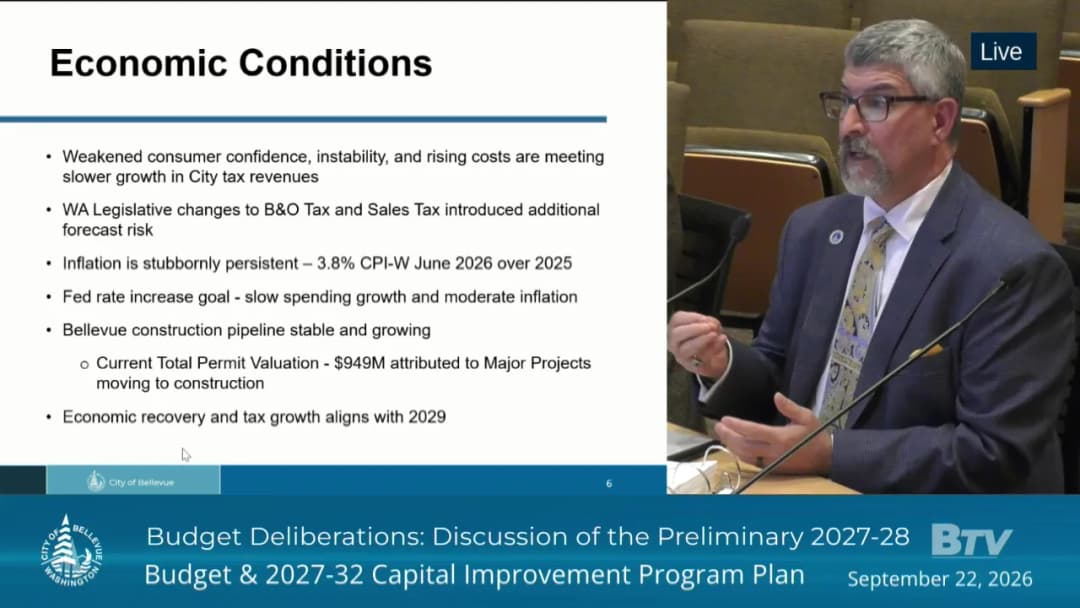
The Bellevue City Council met on September 22, 2026, at 6:00 PM in Council Chambers. The meeting began with a proclamation declaring October 2026 as Domestic Violence Action Month, followed by oral communications, approval of the consent calendar, and two study sessions: the Sustainable Bellevue Plan Biannual Update and Budget Deliberations for the 2027-2028 biennium. Council members heard public testimony, discussed progress toward climate goals, and reviewed revenue forecasts and capital improvement plans. Consent Calendar - Council approved the consent calendar, which included minutes from September 8, 2026, and Ordinance ORD 6940 authorizing land acquisition for the 120th Avenue NE Stage 4 project. The motion carried unanimously. Public Comments & Testimony - Alex Zimmerman spoke critically of the council, alleging that the city prioritizes corporations over people and that Mayor Robinson and Mayor Mo Muhammad have implemented restrictive policies. He also called two council members derogatory names. - A second speaker expressed concerns about livability, citing new land use codes, rising taxes, and AI in permitting. - Cholimboy Washington, a new resident and climate refugee, praised the city's transportation, but noted experiences of racism and questioned the mentality of some residents. - Joe Kensler condemned Mr. Zimmerman's use of offensive language, stating it should be universally condemned. He also suggested the city allocate more time for public comment and show the speaker on camera. Discussion Items Sustainable Bellevue Plan Biannual Update - Staff presented progress since the plan's adoption in November 2025. Achievements included: 388 heat pumps installed via Energy Smart Eastside (1,000 total across the region), launch of Climate Leaders and e-bike rebate programs, grid capacity study completed, Fire Station 10 achieving LEED Gold and Salmon Safe certification, and 43 staff trained in Envision sustainability framework. - Community-wide emissions are 12% below the 2011 baseline, not on track for the 50% reduction by 2030 goal (potentially achievable by 2035 with acceleration). Municipal operations have exceeded 2030 targets and are on track for 2040 carbon neutrality. - Proposed 2027-2028 work plan includes a building decarbonization study and a partnership with Washington State Green Bank for low-interest green loans. - Council questions focused on: measuring program outcomes (Councilmember Newhouse), equity in outreach (Councilmember Newhouse), cost-effectiveness and ROI (Councilmember Newhouse, Councilmember Robinson, Councilmember Barabbo), EV charger utilization (Councilmember Newhouse), accountability when state/federal partners fail (Mayor), and identifying trade-offs between city facility upgrades and community programs (Mayor). Councilmember Barabbo emphasized that 2050 goals are non-negotiable. Budget Deliberations: Preliminary 2027-2028 Operating Budget and 2027-2032 CIP - Chief Financial Officer John Reesha presented revenue forecasts, economic assumptions (inflation at 3.8% CPI-W in Seattle-Tacoma-Bellevue, interest rate hike, geopolitical instability), and the capital improvement program (six-year spending plan of $1.3 billion). - Tax revenues are forecast to grow 4-6% annually. Property tax: a proposed 1% increase would raise $900,000 and cost median homeowner $15.70/year; the city receives only 13% of total property tax paid. - Total revenues for the biennium are $2.2 billion; proposed spending is $2.3 billion (including capital). Operating spending is $1.8 billion. - Reserves include a 60-day operating reserve, compensation risk reserves, equipment replacement reserves, and investment reserves (arts, fire, housing, municipal parks). Ending fund balance is projected between $29-50 million. - Staff emphasized a conservative approach: revenue forecasts are based on current trends, not assuming faster recovery. Internal reallocation and reduction efforts were used to stabilize services without new taxes (e.g., ending a Gartner contract, reprioritizing Community Development programs). - Council questions addressed: timing of human service funding (Councilmember Robinson – will be discussed October 20), how CIP portfolios are prioritized (Councilmember Barabbo – dedicated revenues drive allocations), what triggers a budget revisit (Councilmember Newhouse, Councilmember Barabbo – staff track monthly; a multi-month trend would prompt action), risk from tech layoffs (Councilmember Newhouse – B&O and sales tax in Bellevue recovering, but monitoring), and how council can oversee CIP adjustments (Councilmember Samudawiri – council adopts CIP and approves amendments). Mayor noted permitting pipeline is near $1 billion but actual construction timing uncertain. Key Outcomes - Domestic Violence Action Month proclamation for October 2026 was read by Councilmember Robinson, and the police chief expressed gratitude. - Consent calendar approved unanimously. - No formal votes were taken on the study session items; they were for discussion and will lead to further budget conversations on October 6 (transportation) and October 20 (strategic target areas). - Council directed staff to include more cost-effectiveness and quantification of GHG reductions in future reports, and to explore increasing human service funding on a regular basis.
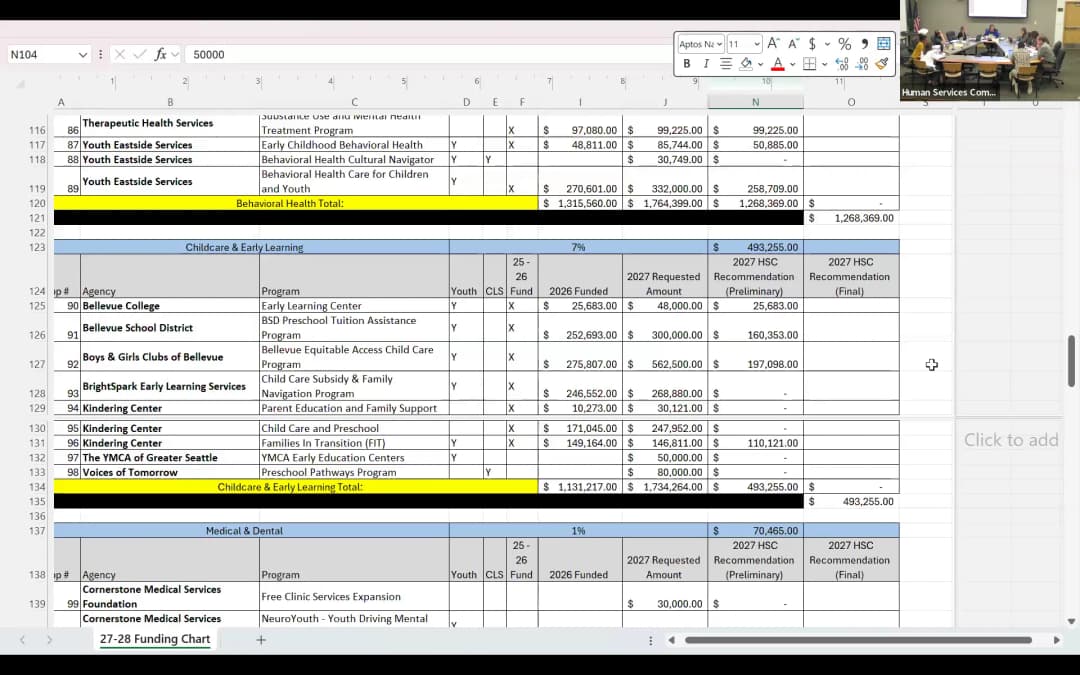
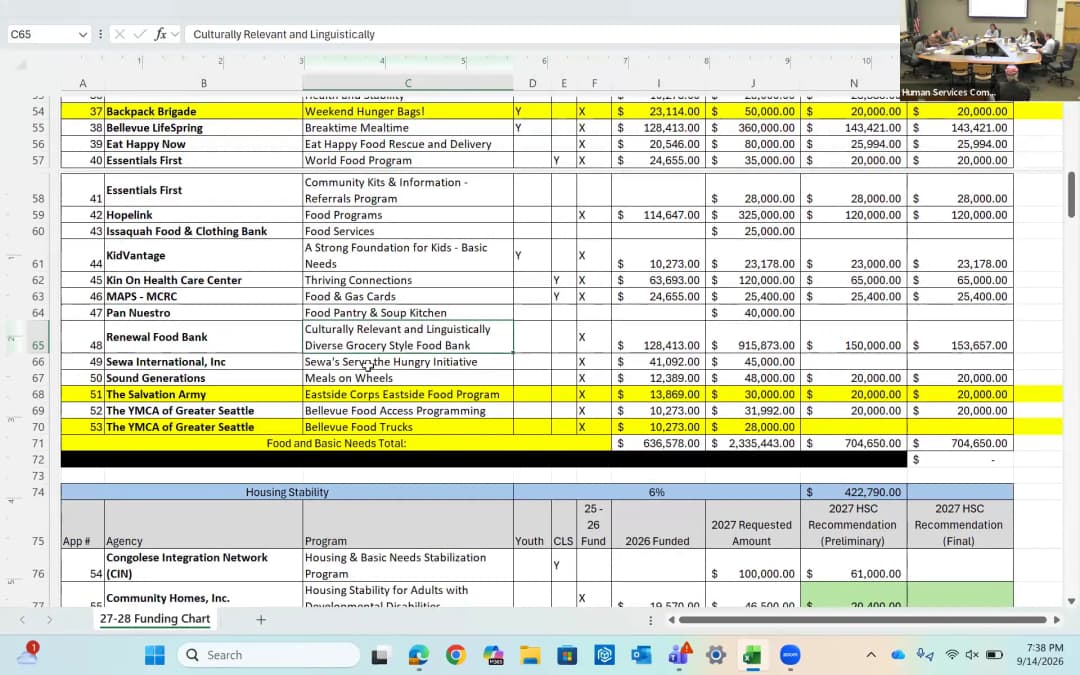
The meeting was called to order at 6 p.m. on September 22, 2026 (the transcript references September 21, but the instructed date is September 22). Commissioners discussed the 2027–2028 human services funding cycle, reviewed Community Development Block Grant (CDBG) funding, and heard public testimony. After extended deliberations, the commission approved funding allocations for 2027–2028 and made adjustments within several categories. Public Comments & Testimony - Miriam Clothero (Prevention and Stability Director, Mary's Place) urged the commission to reconsider its recommendation not to fund direct client assistance and to increase financial assistance to 10% of the human services budget in 2027. She stated that “prevention works,” noting that with the same resources needed to serve one family in shelter, approximately six families can be kept housed through prevention. She emphasized that prevention protects children from homelessness and is an equity strategy, as more than 80% of the families they serve are Black, Indigenous, and people of color. - Alex Zimmerman (President, Stand Up America Party) delivered a speech criticizing Mayor Robinson and other city officials, using offensive language. The commission stated that it does not condone hateful or offensive speech but respects First Amendment free speech rights. - Councilmember Robinson gave a report on the city budget, noting a balanced $2.3 billion biannual budget, maintaining core services while preparing for growth, and a 39% allocation of the operating budget to “thriving people and communities.” She noted that last year the commission distributed more than $7 million to community organizations and expressed continued support for human services funding. Discussion Items - Agenda Amendment: A motion to amend the agenda to place new business before old business was approved by voice vote. - CDBG Funding Overview (Donna): Staff presented an overview of the 2027 CDBG funding process, with an estimated $895,000 in resources. Projects include Porch Light (enhanced men's shelter), microenterprise assistance (For Tomorrow, Indian American Community Services, Centro Cultural Mexicano, Upwards Boost and Learn), and the City of Bellevue Home Repair Program. The commission will finalize recommendations on October 5. - Human Services Funding Deliberations (Old Business): The commission continued reviewing 118 remaining applications. Key decisions included: - Survivor Advocacy: A motion to move $20,000 from Consejo (application 61) to Dawn (application 62) failed on a 2–2 tie; the commission subsequently voted 4–2 to keep the funding with Consejo. - Child Care and Early Learning: After discussion, the commission agreed to move $20,000 from Kindering’s Families in Transition program (application 96) to Kindering’s Child Care and Preschool Consultation program (application 95). - Fostering Well-Being in the Face of Hate, Bias, and Discrimination: The commission allocated the unallocated $21,936 in this category to the Immigrant Women’s Community Center (application 173) after considering but not approving a proposal to fund the Congolese Integration Network (application 170). - Shelter Adjustment: The commission moved $20,000 from Porch Light’s Rotating Shelter program (application 13) to Porch Light’s Housing program (application 15) to ensure more programs within a priority area are funded. Key Outcomes - The commission approved the 2027–2028 human services fund allocations as presented in the funding chart (motion passed unanimously). - The contingency plan for any additional council funds remains: proportional distribution across the three priority areas (shelter, financial assistance, food and basic needs), divided among programs in each area. - The next meeting is scheduled for October 5, 2026, which will include a public hearing on housing and human services and finalization of CDBG funding recommendations.
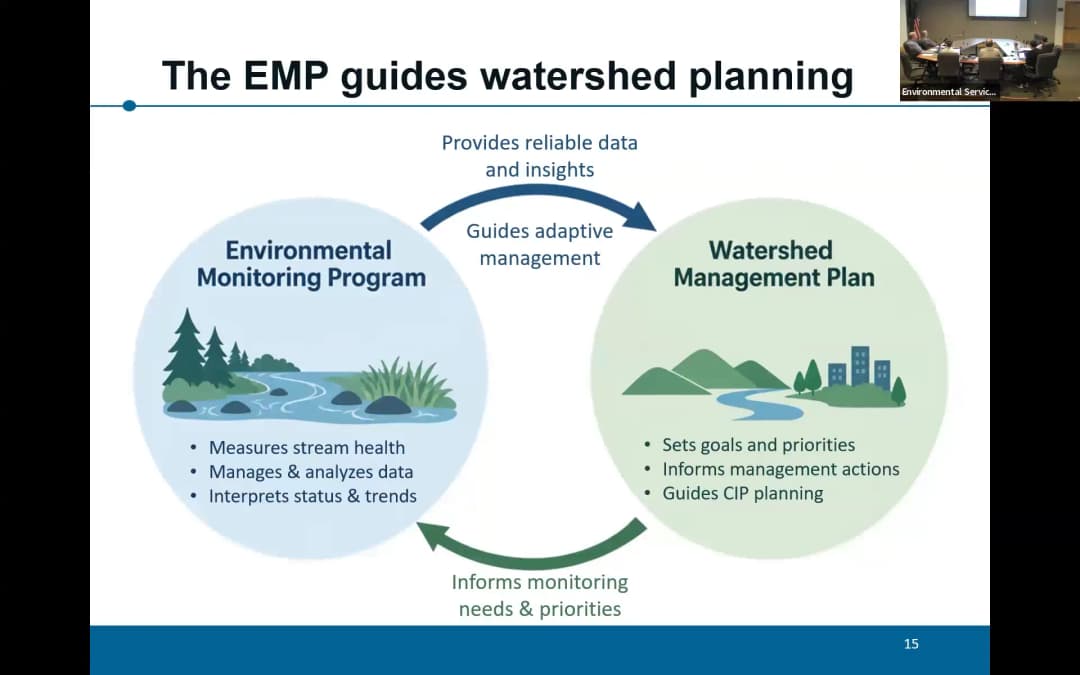
The Environmental Services Commission (ESC) met to recommend the 2027–2028 utilities budget, capital improvement plan, and rates to the City Council, and received an informational update on the environmental monitoring program. The meeting included public comments and was adjourned at 7:48 p.m. Public Comments & Testimony - Alex Zemirman, president of the Stand Up America Party, criticized the City Council for prioritizing corporations, stating the city has a $1.2 billion budget while the local GDP exceeds $150 billion. He accused the commission of being complicit and used inflammatory language. - Abraza Barajas, a Bobby Youth League Board Member, invited the commission to the Youth Link Gumball event on October 28 (6–8 p.m. at Cosmos Community Center) for dialogue with youth and city leadership. Discussion Items - Utilities 2027–2028 Biennium Budget, Capital Improvement Program, and Rates Recommendation: Staff presented the proposed $508 million operating budget for 2027–2028, a six-year capital improvement program (2027–2032), and associated rate increases. The budget emphasizes affordability, transparency, and equity, with 51% covering external costs (wholesale water, sewer treatment, taxes, support services), one-third for capital reinvestment, and 15% for direct operations. Rate increases are driven partly by wholesale cost passthroughs. The commission had reviewed these proposals over nine months. No new information was presented. - Environmental Monitoring Program Update: Brianna Pierce (aquatic ecologist) presented findings from the program, which measures hydrology, water quality, benthic macroinvertebrates, physical habitat, and salmon. Key findings: high stream flashiness (especially in Kelsey and Coal Creeks), E. coli exceedances in Maidenbauer Creek, low dissolved oxygen in Richards and Kelsey Creeks, elevated zinc from road runoff (especially in Kelsey Creek), poor macroinvertebrate scores, and severely declining salmon returns (last Chinook spawning in Kelsey Creek in 2010). The program is foundational for the forthcoming watershed management plan. Commissioners asked how the data translates into policy and capital project prioritization; staff noted that the watershed management plan will guide future investments. Key Outcomes - The ESC unanimously (5–0) voted to recommend the proposed 2027–2028 operating and capital budgets and rates to the City Council. Chair Juan will present the recommendation on October 13, 2026. Council adoption is anticipated on November 17, 2026. - The next commission meeting is scheduled for November 5, 2026. The October 1 meeting was canceled.
Note: The meeting date is provided as September 21, 2026, though the official meeting minutes and transcript list September 14, 2026. This summary follows the given date. The Bellevue Human Services Commission met to continue deliberations on the 2027–2028 human services funding cycle. The meeting included public comments, approval of minutes, discussion of funding allocations across multiple categories, and votes on several proposals. Consent Calendar - Approved the draft minutes from the July 20, 2026 meeting unanimously. Public Comments & Testimony - Axton Burton (Executive Director, Pride Across the Bridge) – Expressed full support for funding LGBTQ+ programs, highlighting 355 community gatherings planned for 2026 and the need for resources to support transgender and queer residents facing safety and belonging concerns. Requested increased funding after a prior small ask was denied. - Erica Washington (Director of Early Learning, Bright Spark Early Learning Services) – Requested continued funding for childcare subsidies, noting that in 2026 they supported 187 vouchers across five Bellevue zip codes, with an average of $4,975 per child. Stated that child care is linked to housing stability and employment. - Paul Charbonneau (Senior Director of Government Relations, Boys & Girls Clubs of Bellevue) – Requested funding closer to the previous $275,000, noting expansion to 24 K-5 programs and 19 preschool programs, serving 18,000 youth (68% BIPOC). Stated that every $1 invested returns $7.20 in economic benefits. - Teresa Anderson (Executive Director, LifeWire) – Requested continued funding for domestic violence services, reported that in 2025, 68% of households exiting shelter moved to permanent housing, and 91% reported increased safety. Noted that LifeWire was found ineligible for the housing stability grant due to a new $20,000 minimum request, urging clearer processes. - Hala Numa (Vice President and COO, Friends of Youth) – Requested funding for youth shelter and case management, citing a 13% increase in shelter bed use and a 27% increase in drop-in visits between 2024 and 2025. Emphasized early intervention. - Morgan Curry (Development Manager, Old Friends Club) – Requested $40,000 to launch two new dementia respite clubs in Bellevue, noting that dementia affects approximately 2,300 Bellevue residents and that their service costs $20/hour compared to $12,000/month for memory care. - Elba Moreira (Director of Programs, DAWN) – Requested continued funding for domestic violence advocacy, noting that over 5% of DAWN clients are from Bellevue, and that advocates are on-site at Bellevue College two days per week. - Rahima Somji (Programs Director, Bellevue LifeSpring) – Expressed concern over a recommended reduction of $102,000 for eviction prevention, stating it would put 40+ families at risk. Reported that the program has supported 372 families with 724 children so far in 2026, with 60% single-parent households and 23% having eviction notices. - Anaya Mansuri (Youth Leader, Immigrant Women's Community Center – IWCC) – Read a statement requesting an increase from the recommended $25,000 to $75,000, noting that Bellevue residents served grew from 23 to 360 in 12 months after a food drive. Shared a client success story. - Adam Diba (Founder and Executive Director, Africans on the East Side) – Requested sustainable, flexible funding for immigrant and refugee services, emphasizing the need for regional coordination. Noted that youth are left behind when families self-deport. Additional public comments were heard after the meeting was extended (see Key Outcomes). Speakers included: - Garin Maldonado (Consejo Counseling) – Requested support for behavioral health services for domestic violence survivors. - G DeCastro (Deputy Director, Asian Counseling and Referral Service – ACRS) – Requested restoration of funding, citing increased demand and a successful suicide intervention. - Kate Garvey (CEO, King County Sexual Assault Resource Center – KSARC) – Requested restoration of $21,744, noting they served 147 Bellevue residents in 2026 (four times the contract target), 72% from low-income households. - Gary Sampson (Family Law CASA of King County) – Requested continued funding, highlighting that volunteer advocates spend 100–150 hours per case to represent children's best interests in court. - Christina Mendieta (Kindering) – Requested partial funding for the child care consultation program, noting 96% of children were retained in child care settings through the program. - Bolivar Choi (Chinese Information Service Center – CISC) – Requested increased funding for senior and family resource programs, citing 733 service units to 350 Bellevue residents in the first half of 2026. - Alex Himmerman – Criticized city leadership and funding priorities, stating that only a small fraction of Bellevue's GDP goes to human services. The commission noted they do not condone hateful speech but respect First Amendment rights. - Faye Chen (Kinon Healthcare Center) – Requested continued funding for the