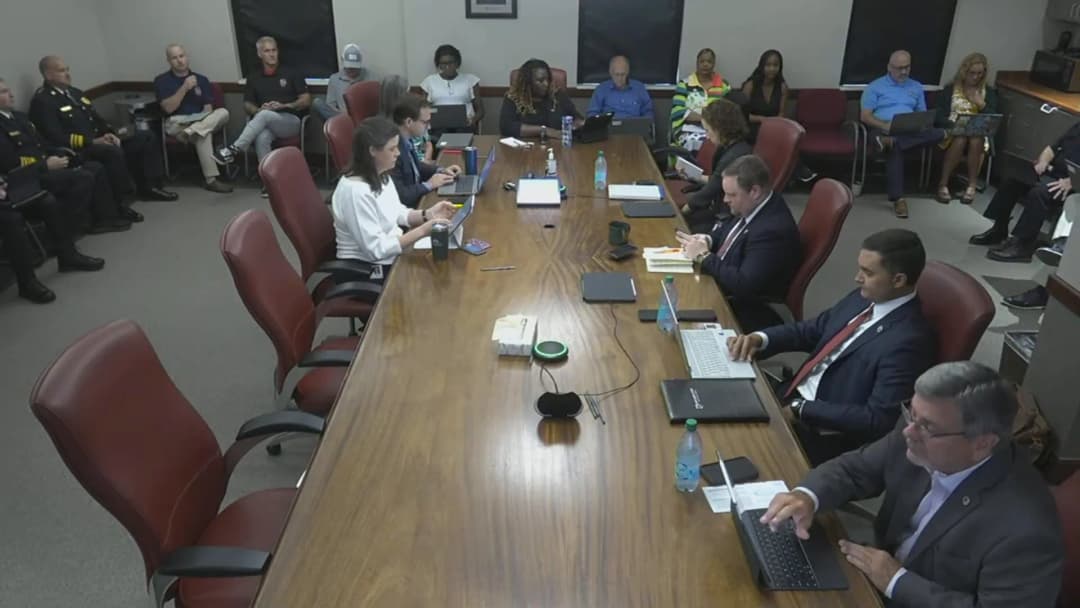
This meeting on July 29, 2025, focused on council proposals for the upcoming budget amendment, primarily concerning funding for first responder pay increases. Councilmembers discussed potential cuts, tax increases, and mechanisms to ensure competitive compensation for police and firefighters. The session included introductions of summer interns, presentation of specific budget amendment proposals from councilmembers, and robust debate about fiscal priorities and the appropriate level of tax increase. Consent Calendar - No consent calendar items were discussed. Public Comments & Testimony - No formal public comments or testimony were presented. Discussion Items - Intern Introductions: Vanessa Jackson, Community Program Manager in the Department of Equity and Community Engagement, introduced six summer interns: Trey Reed (UTC, Political Science, Intergovernmental Affairs), Shelly Michelle (Howard University, Political Science/Communications), Casey Caplow (UTC, Economics, Grants and Opportunities), Maya Houston (Queen University, Political Science, Parks and Outdoors), Abby Sharon (UTC, Mechatronics Engineering, Economic Development), and Brianna (UTC, Criminal Justice, Community Equity and Engagement). Trinity Williams (UTC, History/Philosophy/Pre-law) serves all of City Council under Councilmember Medali. - Councilmember Davis Proposal: Councilmember Davis proposed that annual market salary studies for police and firefighters be conducted, comparing Chattanooga to similar-sized cities. If pay falls below the average, the following year's budget must include an appropriation to bring pay up to or above the average. He also suggested looking at bringing animal control services in-house as a potential savings. - Councilmember Hill Proposal: Councilmember Hill proposed specific cuts: 15% reduction to Community Development (saving $1.665 million), 10% reduction to the Council office budget (saving $99,666), 10% reduction to the Mayor's office budget (saving $771,898), 5% across-the-board cuts for all other departments (excluding police, fire, public works, and parks/outdoors), and $500,000 reduction in job training spending. Total new savings would be $5.9 million. Combined with a $5 million set-aside, this would reserve $10.9 million for first responder pay. She noted a funding gap of $7–12 million and pointed out that a 12-cent millage increase would cover the gap. - Administration Response: A representative (likely the Mayor or a senior staffer) stated they would take a fresh look at the proposals but pushed back on some cuts, arguing that cutting Community Development by $1.665 million would eliminate positions and reduce services. They noted that job training programs are already being consolidated and transitioned to external partners like Chattanooga State. - Councilmember Henderson Remarks: He expressed disappointment that the administration did not follow through on its earlier commitment to find 50% of funding through budget cuts (the "50-50 split" idea). He stressed the need for a permanent mechanism to annually adjust first responder pay to avoid future crises. - Councilmember Clark Speech: He argued strongly for holding the millage rate at 2.25 (not raising taxes) but rejected the idea of no cuts. He stated his district supports a "modest" tax increase and urged the council to "capture the growth" from property reappraisals. He accused the city of being "cheap" and failing to adjust for inflation over four years. He noted that the county was able to give raises without a tax increase because the county does not fund fire services (which are mostly volunteer). He emphasized that the budget is a moral document and that first responders deserve competitive pay. - Councilmember O’s Comments: He echoed support for Councilmember Clark’s passion and agreed that previous councils should have instituted gradual pay increases to avoid the current crisis. - Councilmember Harvey: He stated that he wants first responders to be the highest-paid city employees, acknowledging the difficulty of their job, but emphasized that the debate is about the mechanism for funding, not the goal. Key Outcomes - No formal votes were taken. The council agreed to continue deliberations in the afternoon session with administration proposals. - The administration was asked to provide a clear dollar figure for the first responder pay increase (estimates ranged from $18 million to $23 million). - Councilmember Hill’s formal budget amendment worksheet was submitted for further analysis and will be revisited. - The council set a cutoff for new proposals at the end of the day. - Several councilmembers reaffirmed their commitment to finding a balance between budget cuts and tax increases, with a goal of avoiding a pure property tax increase.