Colorado Springs, Colorado — Public Meeting Index
Search help
Summaries & topics includes titles; words may match separately. Transcripts match a literal word or phrase, with case and whitespace normalized. Punctuation and contractions must match. Documents are not searched. Results have separate pages by source; a meeting may appear in both. Both dates are included.
Summaries & topics
The Historic Preservation Board of Colorado Springs met on Monday, August 3, 2026, at 4:30 PM at 30 S. Nevada Ave., Suite 102. Four members were present and three were absent. The board received staff administrative and policy updates, approved minutes from two prior meetings, considered a report of acceptability for a structure in a historic overlay, and heard a presentation from a History Colorado preservation planner. Call to Order & Roll Call - Present (4): Board Member Beerbaum, Board Member MacEnulty, Alternate Baumgartner, Board Member Fitzsimmons - Absent (3): Chair Lowenberg, Board Member Musick, Board Member Potter Staff Communications & Reports - William Gray (Bill Gray), Senior Planner in the Urban Planning Division, introduced himself as the designated Preservation Planner liaison to the Historic Preservation Board. He stated he has been with the City for nearly six years and reported to Ryan Tefertiller, Planning Manager, who was in attendance. - Gray introduced a new staff member who previously worked for two years in the Historic Preservation field and was invited to attend the meeting. - Gray announced an upcoming meeting with the Historic Neighborhood Partnership on August 7, 2026. - Gray stated that City Council staff were working on appointments to move alternate members into voting member positions. - Gray alerted the board to potential federal changes to Section 106 of the National Historic Preservation Act, which he described as an important tool for historic preservation, and asked members to review the information. - Gray proposed shifting board meetings to an earlier time within standard business hours (between 9:00 AM and typical start times), noting that other bodies such as the Parks Board meet as early as 7:30 AM, while City Council typically begins at 8:00 or 9:00 AM. He stated that Chair Lowenberg had requested that he notify the board of this proposal. (The source materials also spell the chair's name "Loewenberg"; both spellings appear in the minutes and transcript.) - Gray asked board members to review the City's historic preservation webpage over the coming week and email suggestions for revisions. - Tefertiller reminded members never to use "reply all" to avoid group email discussions. Board member responses: - Board Member Beerbaum requested that staff send out a notice soon to finalize the proposed meeting time change and asked that the agenda's board comment section, which had recently been overlooked, be restored. - Board Member MacEnulty asked whether upcoming website updates would address the historic preservation page; Gray explained that a team had been formed to work with each division, including historic preservation. - Board Member Beerbaum updated the board that History Colorado had denied a request; the minutes do not specify what was denied. - Board Member Fitzsimmons asked why local landmark procedures would apply in a particular case; the source text is truncated, but Gray explained the applicable historic preservation processes. Minutes Approval - May 5, 2026 minutes (HPB 2321): Motion by Board Member Beerbaum, seconded by another board member (name not recorded in the available minutes). Approved 4-0, with Chair Lowenberg, Board Member Musick, and Board Member Potter absent. The May minutes were signed by Patricia Musick as Acting Chair. - June 1, 2026 minutes (HPB 2322): Motion by Board Member Fitzsimmons, seconded by Alternate Baumgartner. Approved 4-0, with the same three members absent. The June minutes were signed by Chair Lowenberg. Consent Calendar - The minutes note that items were called off the consent calendar but do not specify which items. Discussion Item: Report of Acceptability - William Gray presented a proposal that staff found met all criteria for a report of acceptability. A speaker (identified as "she" in the transcript) explained that two structural walls would be added. - Board Member Fitzsimmons asked whether the house dated from 1985 and whether it was a non-contributing structure within the overlay. Gray explained that because the property is in the overlay, a report of acceptability must be reviewed by the board. - Fitzsimmons said he would not want the applicants to go through unnecessary additional process (the source text is truncated at this point). - A motion was made by Alternate Baumgartner, seconded by a board member (name not recorded in the available minutes). The recorded outcome of the vote is not included in the available materials. Presentation: History Colorado - Lindsey Flewelling, Preservation Planner with History Colorado, presented on the value of historic preservation, noting that preservation of historic spaces can result in affordable housing. - She discussed the 1966 National Historic Preservation Act, which created State Historic Preservation Offices and federal project review under Section 106, and described how designation and design review decisions ensure consistency and clarify codes, with clear reasoning when precedent does not apply. - She highlighted the role of historic context and described preservation as comprehensive and selective. Note on Transcript Discrepancy - The raw transcript provided for this meeting contains substantial content that does not match the Historic Preservation Board minutes. Beginning approximately midway through the transcript (after the History Colorado presentation), the material shifts to what appears to be a different proceeding: a Colorado Springs Planning Commission appeal hearing regarding "Project Taurus," a proposed data center. - That portion includes public comments opposing the project, references to the project proponent Raiden (including representatives Jason Green and Daniel Sexton), Colorado Springs Utilities, a June 11, 2026 administrative approval, the Waldo Canyon fire, and direct addresses to the "Planning Commission." It also includes a moderator's reference to three hours allotted for commentary in support of the appeal and public speakers being given two minutes each. - Readers should treat that content as belonging to a separate proceeding, not to the Historic Preservation Board meeting of August 3, 2026.
No agenda, minutes, or transcript were provided for this meeting. Therefore, no summary of discussions, decisions, or public comments can be generated.
No agenda, minutes, or transcript were provided for this meeting. As a result, no summary of discussions, actions, or public comments can be generated.
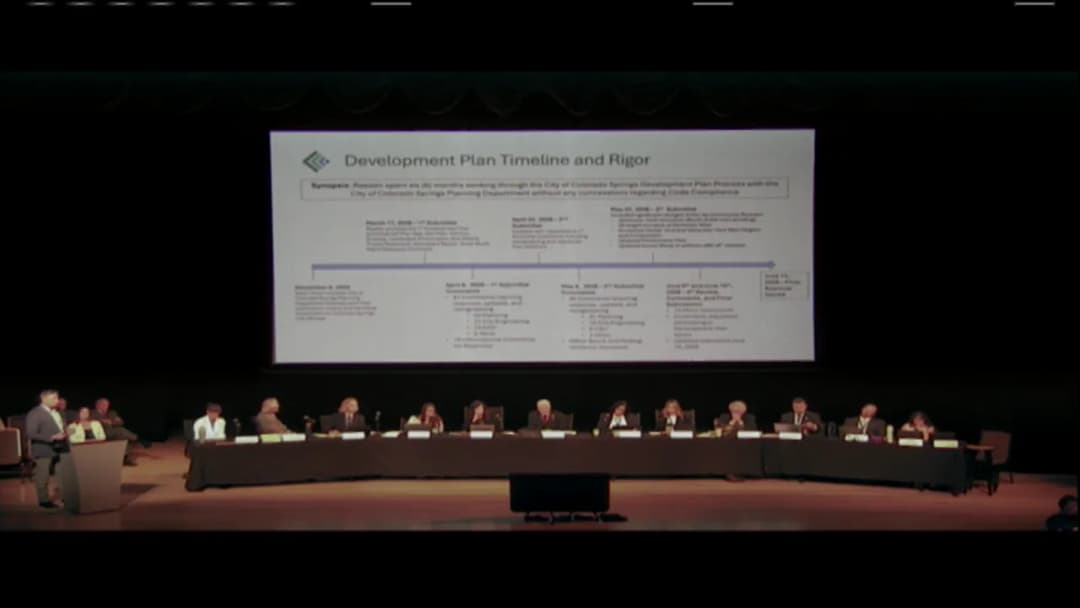
The meeting focused on a proposed Bitcoin mining development project, with the project sponsor presenting details about the closed-loop cooling system, extensive community engagement, and the multi-stage city approval process. The speaker described the project's technical specifications, response to public input, and the rigorous review by city staff. Project Details and Community Engagement - The project uses a closed-loop cooling system that requires no blowdown or constant replacement water, unlike evaporative cooling towers. Particulates (sludge) are filtered constantly. - The sponsor conducted significant community outreach, including town halls and direct meetings, starting with formal engagement on December 9, 2025. He aggregated feedback from countless emails and text messages to shape the development plan, resulting in a fourth submittal that he said dramatically differed from the first. - One resident told the sponsor that after two years of Bitcoin mining, he had no recourse and no one could help him. Submission Timeline and City Comments - The first formal plan was submitted on March 17. The city responded after about 3.5 weeks with 81 comments, which the sponsor described as code-based and compliance-related. - The sponsor's team took three weeks to reconcile and resubmit, receiving 40 more comments. A third submission on May 27 followed, after which the city issued final comments on the 9th and 10th. The sponsor stated they met all criteria. - The sponsor emphasized the rigor of the process, noting that the city's comments were not rubber-stamped but required detailed engineering work. Key Outcomes - No formal vote or decision was recorded in the transcript. The sponsor concluded that all city criteria were met following the third resubmission.

No transcript, agenda, or minutes were provided for this meeting. Therefore, a summary cannot be generated from the available source material.
The Colorado Springs City Council convened its regular meeting on Tuesday, July 28, 2026, at 9:00 AM in City Hall. Following the invocation and Pledge of Allegiance, the Council immediately proceeded to a closed executive session, postponing all other agenda items. Consent Calendar - No items were considered. The consent calendar (including second presentations on urban forest ordinances, the Kettle Creek Addition No. 1 annexation and zoning, and first presentations on minutes and the Terra Mesa Metropolitan District service plan) was not addressed. Public Comments & Testimony - None were heard. The meeting did not reach the public comment period. Discussion Items - Closed Executive Session: The Council voted to enter a closed executive session under City Charter Article 3, Section 360(d) and Colorado Open Meetings Law (CRS § 24‑6‑402(4)(a) and (b)) for two purposes: (1) receiving legal advice on bond disclosures with the city attorney’s office and outside counsel; and (2) discussing the acquisition of water rights from the Public Service Company of Colorado. The session was estimated to last 1 hour and 15 minutes. Key Outcomes - Decision: The Council approved moving into closed executive session (with a two‑thirds vote of members present). All remaining agenda items—including recognitions, mayor’s business, unfinished business (ethics code revision, Old Colorado City DDA boundaries, PTAA Addition annexation and zoning), and new business (supplemental appropriation for South Nevada security services, Southeast Strong Neighborhood Plan)—were deferred or not addressed in the public portion of the meeting. - Next Steps: The Council was expected to reconvene in open session after the executive session to continue the regular meeting, though the provided transcript does not include the remainder of the proceedings.
The Colorado Springs City Council held a regular meeting on July 28, 2026, at 9:00 AM in Council Chambers. The council addressed a consent calendar, recognitions, mayor’s business, unfinished business, new business, and public comment. Key actions included the confirmation of a presiding municipal court judge, approval of an ethics code revision, removal of 17 parcels from the Old Colorado City DDA, annexation of two parcels, a $458,000 supplemental appropriation for security services in the South Nevada corridor, and unanimous adoption of the Southeast Strong Neighborhood Plan. Votes and key decisions are detailed below. Consent Calendar - Ordinance No. 26-29 and 26-30 (Urban Forest code revisions) – presented by City Forester Matthew Puckett. - Ordinance No. 26-34 (Kettle Creek Addition No. 1 Annexation, 19.88 acres) and Ordinance No. 26-35 (related zoning map amendment) – presented by Chris Sullivan and Kevin Walker. - Minutes of July 14, 2026 (Item 4B.A) – approved after a correction noted by Councilman Williams that the Gardner Law Office did not represent the OCC DDA on that date. - Due to a technical issue, the consent calendar was voted on later in the meeting; motion passed 9-0. Recognitions & Appointments - Item 5A: Council appointed Deputy Chief Douglas Trainer and Deputy Chief Justin White to the El Paso Teller County 911 Authority Board (voting members). Motion passed 9-0. Mayor’s Business - Item 6A: Confirmation of Judge Kristen Hoffecker as Presiding Municipal Court Judge. Mayor’s Chief of Staff Wayne Williams presented her background. Remarks honored outgoing Judge Hayden Kane for over 20 years of service. Motion passed 9-0. Unfinished Business - Item 9A – Ordinance No. 26-28 (Ethics Code revision): Councilman Brian Risley presented no changes. Councilman Henjum noted a lack of de minimis exception language and voted no, requesting future consideration. Motion passed 7-2 (Henjum and one other opposed). - Item 9B – Ordinance No. 26-31 (OCC DDA boundary correction): Removed 17 erroneously included parcels. Councilman Rainey voted no, citing broader concerns about DDA structure and fee collection. Motion passed 8-1. - Item 9C – Ordinance No. 26-32 (PTAA Addition No. 1 Annexation, 14.12 acres): Councilman Risley recused himself due to his firm’s role as architect. Councilman Rainey inquired about left-turn access; staff confirmed only right-out onto Marksheffel Road. Motion passed 8-0-1 (Risley recused). - Item 9D – Ordinance No. 26-33 (Ratification of zoning for PTAA Charter School): Same recusal. Motion passed 8-0-1. New Business - Item 10A – Supplemental Appropriation to Retail Marijuana Tax Fund ($458,000): Jariah Walker (Colorado Springs Urban Renewal Authority) presented a security contract with Fidelis for the South Nevada corridor. Discussion included loss of businesses (e.g., Starbucks) due to safety concerns, use of drones and de-escalation, and metrics. Some council members expressed concern about private security versus sworn officers. Motion passed 7-2. - Item 10B – Southeast Strong Neighborhood Plan and Community Strategy: Kevin Walker (Planning) presented the plan, developed over four years with extensive community engagement. The plan includes city investment guidance and a community strategy for nonprofits. Councilman Lineweber asked about measurable outcomes; staff will provide annual reports. Public comment from Renee Gonzalez (RISE Southeast) and later from Joyce Salazar and Ace Cordera (Youth Advisory Council). Motion passed 9-0. Public Comments & Testimony (not on agenda) - Steve Dant: Requested noise enforcement (excessive vehicle decibels), suggested signage and technology similar to red-light cameras. - Steve Lightfoot: Spoke about conspiracy theories related to John Lennon’s murder. - Michelle Wisembled Dane: Urged data center regulation (closed-loop cooling, renewable energy, grid contributions). Provided a foundation for ethical data centers. - Allie Smith: Opposed Project Taurus data center, citing pollution, water use, and lack of trust. Requested a moratorium and a council living wage ballot measure. - Rep. Amy Paschal (State House District 18): Urged local data center criteria (closed-loop cooling, noise limits, environmental requirements). Noted no state regulations and said a state bill may be introduced. - Caleb Miller: Criticized council for not living up to Christian values, citing a CEO raise, car camping criminalization, and private security funding. Called for increased COPE matching fund. - Ted Brassfield: Advocated for a moratorium on data centers until codes are updated (water, noise, wildfire risk, infrasound). - Jacqueline Ostrom: Supported a moratorium, noted wildland-urban interface fire danger, and requested infrasound regulations. Additional Public Comments (after adjournment) - Joyce Salazar (RISE Southeast): Thanked council for unanimous adoption of the Southeast Strong plan. - Ace Cordera (Youth Advisory Council): Shared personal story and hopes for Southeast community spaces and reduced stigma. Key Outcomes - Appointments to 911 Authority Board: Approved 9-0. - Judge Hoffecker confirmation: Approved 9-0. - Ethics Code revision (No. 26-28): Passed 7-2. - OCC DDA boundary correction (No. 26-31): Passed 8-1. - PTAA Annexation (No. 26-32): Passed 8-0-1 (Risley recused). - PTAA Zoning Ratification (No. 26-33): Passed 8-0-1 (Risley recused). - South Nevada Security Funding (No. 26-261): Passed 7-2. - Southeast Strong Neighborhood Plan (Resolution): Unanimously adopted 9-0. - Consent calendar: Approved 9-0 after procedural vote. - Council directed staff to explore noise enforcement technology and data center regulations; a moratorium was suggested but not voted on.
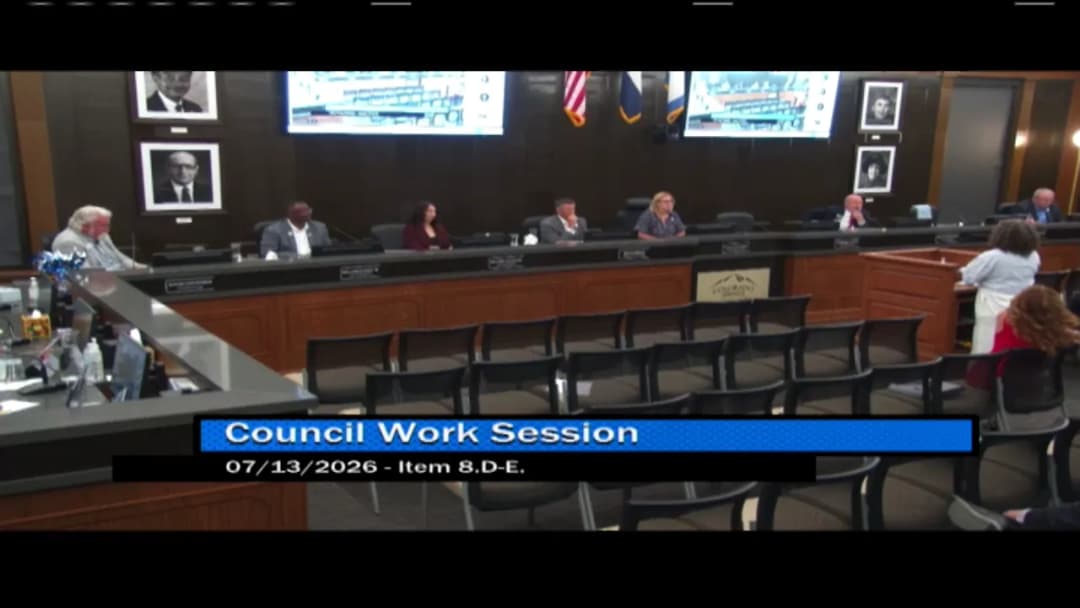
The Colorado Springs City Council held a work session on July 28, 2026, to discuss the potential dissolution of the Old Colorado City Downtown Development Authority (DDA). The council sought assurances that the DDA would not incur debt before a formal vote, which is planned for 60 to 90 days from the meeting, pending the return of the DDA's president. Legal and procedural considerations were addressed by city staff and the DDA's vice chair and legal representative. Discussion Items - The council discussed the timeline for voting on dissolving the DDA. Councilmember (unidentified) recommended waiting for the DDA president to return before voting, suggesting a normal pace of 60 to 90 days. - The council asked the DDA vice chair, Allison Danielle, if the DDA board would agree to not take on debt until the council's vote. Danielle stated she could not make that decision for the entire board without a formal vote, but assured the council that the DDA has no plans to incur debt or make major expenditures. - Laura Gardner, legal representative for the DDA, noted that the DDA board would need to vote on such a commitment, and that it could not be done immediately due to open meetings law posting requirements. - Trevor Glass from the City Attorney's Office clarified that the council cannot make decisions in a work session, only gather information. He also noted that the DDA is an independent government organization with its own authority. - Councilman Williams clarified that the plan of development is separate from the incurrence of debt, and that conversations about paying for consultants and other matters are ongoing in the background. Key Outcomes - No formal votes were taken, as this was a work session. The council appeared to reach a consensus to wait for the DDA president's return before proceeding with a dissolution vote. - The DDA vice chair provided an informal assurance that the DDA has no plans to take on debt, but no binding commitment was made. - The council's next steps include waiting for the DDA president to return and scheduling a future meeting to vote on the dissolution. Note: The transcript does not identify all speakers by name or role. Councilmembers and staff are identified where possible.
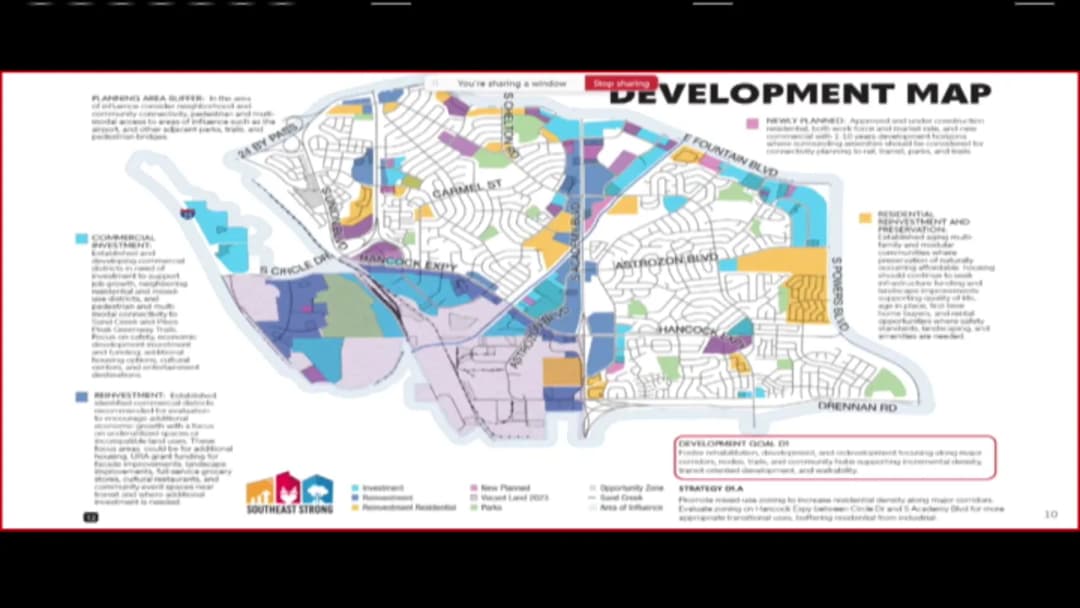
This meeting, held on July 28, 2026 at 10:15 AM, focused on an update to the Southeast Colorado Springs community plan. The speaker, a city representative, presented the plan's progress and emphasized that community investments and work have been ongoing for five years, prior to the plan's formal adoption. Discussion Items - The speaker introduced a community strategy on the nonprofit side, described as aspirational goals for neighbors, including nonprofit programming going forward. - The plan is a point-in-time snapshot of significant interest, investment, and work already undertaken in the neighborhood, not a new start. - Public sector big ideas include: growing support for business and entrepreneurs, living better, upgrading how we move, and supporting safety. - Community strategy big ideas include: creating special places and hubs, reflecting and celebrating diverse culture, and community strategies for health and food access. - A development map showed activity in Southeast since 2021, with updates on economic development, housing, and mobility goals. - The speaker noted that specific questions could be addressed by knowledgeable staff.
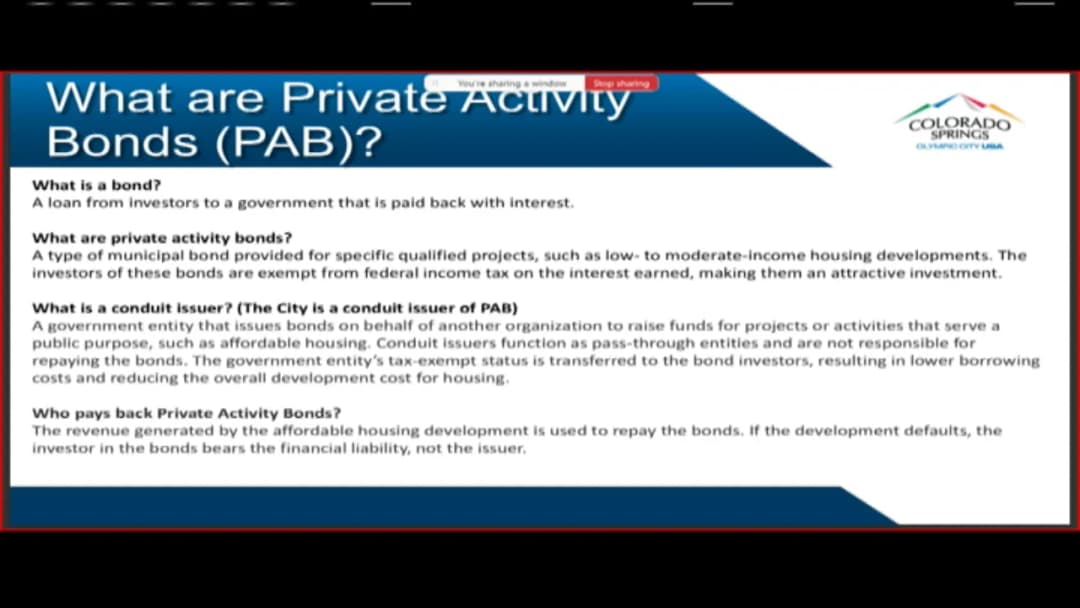
The City Council held a work session on Monday, July 27, 2026, at 9:00 AM in Council Chambers. The meeting covered a presentation from the Colorado Springs Health Foundation, an update on the annual HUD Point-in-Time (PIT) count and housing inventory, a resolution to carry forward private activity bonds for affordable housing, adoption of updated rules for the Fire Board of Appeals, and approval of a service plan for the Kettle Creek Metropolitan District. The meeting concluded with a closed executive session to discuss the annual performance evaluations of the City Council Administrator and the City Auditor. Consent Calendar - Agenda item 4.A (City Council Work Session Minutes from July 13, 2026) was pulled from the consent calendar at the request of Councilmember Williams for revisions. No other consent items were discussed. Presentations for General Information - Colorado Springs Health Foundation (CSHF) – 10-Year Impact Review (Item 5.A) Cari Davis, Executive Director of CSHF, presented a look back at the foundation's first decade of grant-making (2016–2026). Key points included: - The foundation was established from the proceeds of leasing Memorial Health System to UC Health in 2012, a decision that received more than 80% voter approval. - Total assets reached an all-time high of approximately $246 million as of June 2026, after having awarded about $60 million in grants over 1,000 grants (averaging 110 grants per year). - The maximum annual payout is capped at 5% of the trailing 12-quarter average asset value, per City Council policy. - Grant-making focuses on six areas: healthcare access, suicide prevention, trauma prevention/healing, food and physical activity, transitional and affordable housing (added 5 years ago). - The foundation uses a responsive grant-making model; about 65–70% of dollars go to healthcare access and trauma prevention/healing. - The foundation conducts impact assessments via an outside evaluator (most recently 2024) and site visits. - Council members praised the foundation's fiscal stewardship, relational engagement with grantees, and contributions to mental health, food security, parks, programs for military families, and homelessness prevention. - Councilmember Donaldson questioned how the foundation measures whether it is actually moving the needle on population health outcomes, given that El Paso County remains in the middle of the pack in the Robert Wood Johnson County Health Rankings. Ms. Davis acknowledged the difficulty of isolating foundation impact from external factors (e.g., Medicaid changes) and pointed to the counterfactual: without the foundation, many services would not exist. - Councilmember Williams, who helped negotiate the original lease, expressed pride that the foundation is fulfilling the vision of a perpetual community asset. Informational Reports - HUD Point-in-Time (PIT) Count and Housing Inventory Count (Item 6.B) Aimee Cox, Chief Housing & Homelessness Response Officer, presented data from the January 25, 2026 PIT count and the 2026 Housing Inventory Count (HIC). - The PIT count recorded 1,413 people experiencing homelessness, a 19% decrease from 1,745 in 2025. - Unsheltered count fell significantly from 522 to 308; transitional housing increased by 54 people. - Chronic homelessness decreased by 41% (from 361 to 213); 40% of unsheltered individuals met the definition of chronically homeless. - Veterans counted decreased to 131, attributed to "Built for Zero" real-time case conferencing. - The HIC showed the community still lacks 195 year-round emergency/transitional shelter beds to accommodate all individuals counted on that night. - The Colorado HMIS statewide report (released earlier) indicated a 4.3% increase in homelessness over all of 2025, and an 18.8% increase in people seeking homelessness prevention services—data that can coexist with the lower PIT one-night snapshot. - Federal funding shifts are reducing the share that can be used for permanent supportive housing (from 90% to 60%). The city is using HOME-ARP funds to bridge tenant-based rental assistance for those losing emergency housing vouchers. - City and Pikes Peak United Way are now jointly leading the Continuum of Care (COC) as of July 1, 2026; 16 applications for projects have been submitted. - A supportive housing plan is being developed with outside consultants to address the need for 2,000 additional supportive housing units for extremely low-income individuals; it will be presented to council by end of year. - Council discussed challenges with the sunset of the Court-Assisted Recovery from Eviction (CARE) program (ends August 31, 2026), which served 6,000 people since 2023; the city lacks resources to continue it. - Councilmember Lineweber emphasized the need to distinguish between episodic, chronic, and chronic-with-disorder homelessness to target resources appropriately. Discussion Items - Private Activity Bond Carryforward Resolution (Item 7.A) Katie Sunderlin, Housing Solutions Manager, presented a resolution to carry forward the city's 2026 private activity bond (PAB) allocation of $33.7 million for three years (through 2029). PABs are used as a funding layer for affordable housing; the city acts as a conduit issuer (not liable for repayment). The allocation is based on population ($135 per person) and must be carried forward to remain available. The city currently has $38 million in remaining bond cap from 2025. A developer is under review for a project of 220 units near Peak Innovation Park (Council District 2). Councilmember Henjam asked about the expected number of units (220). Councilmember Donaldson asked about district and was told it is near Peak Innovation Park (same area as prior Royal Pines concerns). The resolution will be on the agenda for introduction at the next regular meeting. - Fire Board of Appeals Rules and Procedures (Item 7.B) Blongshia Lindsay, Boards and Commissions Program Administrator, presented a resolution to adopt updated rules for the Fire Board of Appeals (effective August 11, 2026). The previous rules dated from 2015 and had never been adopted by City Council. Changes are administrative: aligning with City Council's rules and procedures, removing redundancy, and retaining only fire-board-specific provisions. Stakeholders (board members, council liaison Risley, Fire Marshal Cooper, attorney Stein) reviewed the draft. Councilmember Risley (liaison) confirmed the changes are nominal and recommended consent. Councilmember Henjam noted board members expressed interest in receiving budget/finance training. Councilmember Donaldson inquired about board composition; Fire Marshal Cooper clarified membership is defined in city code (8.3.101) and includes representatives from large business, small business, fire suppression, construction, insurance, commercial real estate, and a member at large. Composition is displayed on the board's website. The item will be on the consent calendar for August 11, 2026. - Kettle Creek Metropolitan District Service Plan (Item 7.C) Allison Stocker, Senior Planner, presented a resolution to approve a service plan for the creation of the Kettle Creek Metropolitan District (20.61 acres north of Old Ranch Road, east of Voyager Parkway, south of Federal Drive, Council District 2). - Maximum debt authorization of $8 million to finance public improvements (estimated cost: $5.1 million, with $2.9 million contingency). - Anticipated development: 122 residential units (single-family detached and attached), active open space, public roadway improvements. - Maximum debt mill levy: 50 mills; maximum O&M mill levy: 20 mills (consistent with model service plan). - Bonds are anticipated to be publicly issued, 30-year term. - A related annexation and zoning (R-Flux Medium) are on the agenda for the next regular meeting (July 28, 2026). - Final hearing on the service plan is scheduled for August 11, 2026, contingent on recording the annexation plat. - Councilmember Casey had no further questions; Councilmember Donaldson asked about bond issuance method and amortization; the applicant's representative (Nicole Pakov) confirmed public issuance is anticipated and the financial plan aligns with the model service plan. No council members expressed opposition. Key Outcomes - Consent Calendar: Minutes from July 13, 2026 were pulled for revision. - CSHF Presentation: Noted as informational; no vote taken. Council expressed appreciation and support for the foundation's work. - PIT/HIC Presentation: Noted as informational; no vote taken. The data will inform future policy and funding decisions. Council directed staff to report on quarterly data to allow real-time tracking. - Private Activity Bond Carryforward (Item 7.A): The resolution was introduced; it will be on the agenda for a formal vote at a future regular meeting. - Fire Board of Appeals Rules (Item 7.B): The resolution was approved for placement on the consent calendar for the August 11, 2026 regular meeting. - Kettle Creek Metro District (Item 7.C): The service plan was approved for formal hearing on August 11, 2026, contingent on annexation plat recording. - Closed Executive Session (Items 10B.A and 10B.B): Council voted unanimously (8-0) to enter closed session to discuss annual performance evaluations of the City Council Administrator and the City Auditor. The meeting adjourned after the closed session.
Transcripts
No published pilot transcripts are available for this city. The current pilot covers Sacramento City Council only.
Transcript coverage details
The pilot includes June 9 and two June 23, 2026 sessions. Recording completeness is unknown. Missing, cancelled, incomplete, or changed transcripts can leave gaps. No match does not establish that something was never discussed.