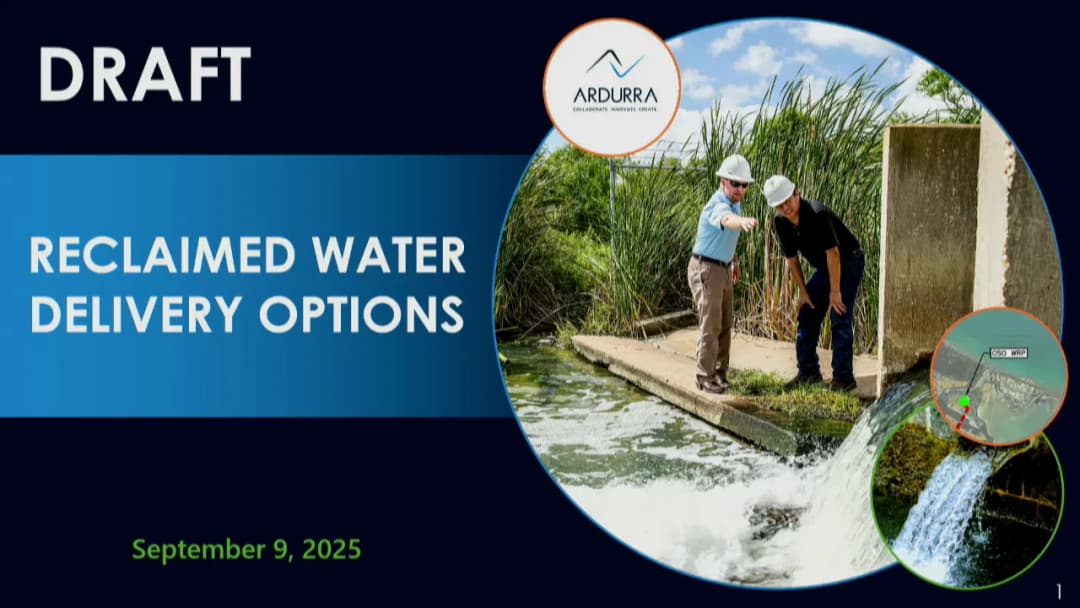
The Corpus Christi City Council convened on Tuesday, September 9, 2025, at 11:30 a.m. in Council Chambers and adjourned at approximately 11:26 p.m. The marathon meeting covered the FY 2025-2026 operating and capital budgets, property tax rate, water and wastewater rate increases, a street maintenance fee, a new tax increment reinvestment zone, a water reuse briefing, and a late-night debate over launching an outside investigation into alleged fraud related to the Homewood Suites incentive. The council also entered executive session under Texas Government Code § 551.071 to consult with attorneys regarding the fraud allegation. Consent Calendar - Approved the September 2, 2025 Regular Meeting Minutes (Item 24). - Approved Items 25-34 en bloc, including: water well cross-connection requirements; acceptance of a Motor Vehicle Crime Prevention Authority grant ($894,028 with city match); a zoning change at 14454 Northwest Boulevard; purchase of a bomb detection robot upgrade ($267,738); a Xylem Dewatering Solutions service agreement (up to $894,750 if options exercised); a Naval Air Station Corpus Christi perimeter fence construction contract ($1,022,900); excess liability and workers’ compensation policy renewal ($1,059,799); a one-year Sister City services agreement with the United Corpus Christi Chamber of Commerce; an amendment for Padre Isles Property Owners Association park maintenance and water wells; and an FAA Airport Grant No. 74 appropriation ($587,173 total). Public Comments & Testimony - Budget input process: Speakers Steve Clepper, Jasmine Evans, and Mark Minster criticized the budget input sessions as too late and dismissive of resident concerns. Clepper also called for service-level budgeting and more transparency. - Tax rate: Rachel Gowed, president of the Corpus Christi Taxpayers Association, opposed the property tax increase, arguing the city has shown irresponsible spending. Mark Minster said residential valuations can rise 10-15% annually and unfairly burden homeowners. - Water rates and fluoride: Multiple medical professionals, including Dr. Carl Sarau of the Nueces County Medical Society, pediatricians Vanessa Gonzalez and Dr. Silko, and Dr. Gonzalez of the Nueces Valley Dental Society, urged the council to preserve fluoridation, citing a 50% rise in dental surgeries after the city eliminated fluoride in 2011. Other speakers argued rate options burden working-class residents and questioned why large industrial users are not paying more. - Reclaimed water: Residents including Blanch Royal, Gary Hutchins, and Susan Upshaw spoke about the difficulty of accessing reclaimed water, long waits, and concerns about the proposed $15-$30 fees. Some opposed the fee, while Robin Cox thanked staff for working to provide water. - Vacant building ordinance: John Martinez of the Coastal Bend Association of Realtors said the group was working with staff and requested additional time to refine the ordinance. - Parks fees: Alina Martinez noted the average Texas income and argued latchkey fee increases affect families struggling to afford food and shelter. - Street maintenance fee: Tom Whitehurst and Steve Clipper supported the street fee as a transparent, dedicated funding source; Rachel Caballero and Julian Hernandez opposed it, with Hernandez urging a voter-approved property tax route instead. - Marriott incentive: Susie Sardania questioned approving an incentive for a developer connected to litigation against the city; Stephen Krebs, a retired Hilton executive, vouched for the owner’s record and community commitment. - TIRZ No. 7: Rachel Caballero and Robin Cox opposed the new reinvestment zone, arguing taxpayer money should not subsidize new development while existing areas decline. - General public comment: More than 30 speakers addressed issues including the canceled Inner Harbor desalination project, police conduct at the prior meeting, library closures, food truck regulations, water marketing, homelessness, and a proposed overhaul of the public comment sign-up website. Discussion Items - Item 1 – Ethics Commission appointment: The council attempted to fill one vacancy but only received five votes for an applicant; six votes are required, so the appointment was postponed to a later meeting. - Item 2 – FY 2025-2026 Operating Budget: The Office of Management and Budget presented amendments from the prior week, including removal of the stormwater rate increase, reduction of the Inner Harbor Project CIP, halving the after-hour Kid Power rate increase, and eliminating a proposed administration fee. The council voted to reconsider item 2 to accept the schedule of adjustments, then approved the operating budget as amended. - Item 3 – FY 2025-2026 Capital Budget: The capital budget was amended to remove the Inner Harbor Project, reducing the total from $764 million across 243 projects to $553,964,906 across 242 projects. Approved as amended. - Item 4 – Property Tax Rate: The council adopted a property tax rate of $0.599774 per $100 valuation, effectively a 0.23% increase over the no-new-revenue rate. A 60% favorable vote was required; the motion carried. - Item 5 – Property Tax Revenue Ratification: Ratified the $6,061,319 property tax revenue increase reflected in the FY 2025-2026 operating budget. - Item 8 – Water Rates: Staff originally recommended a $4.78 monthly increase for the average residential customer using 6,000 gallons. Councilman Hernandez moved to adopt a lower option three ($3.28 increase), which would cut the Owen Stevens generator replacement program by $1.2 million. That motion failed, and the council approved staff’s option one, a $4.78 increase, effective January 1, 2026. Financial advisor Victor warned that not approving rates could negatively affect the city’s bond rating. - Item 13 – Wastewater Rates: Staff recommended a $4.20 monthly increase for the average residential customer. An amendment to adopt option three ($3.26 increase, eliminating nine maintenance positions) failed; option one was approved. Presentations noted the EPA consent decree, reduction of sanitary sewer overflows from 1,420 in 2008 to 28 in 2025, and $30 million in savings from doing work in-house. - Item 14 – Recycled/Reclaimed Water Fees: The council voted to amend the ordinance to remove the fee for reclaimed water pickup at the Oso Wastewater Treatment Plant, then approved the ordinance as amended. The fee removal will be funded from reserves for one year. - Item 16 – Vacant Building Registration: The council adopted alternative two, which removes the proposed registration fee and makes corresponding budget cuts, and will revisit the ordinance language on September 23 after further stakeholder input. - Item 19 – Parks and Recreation Fees: A motion to remove after-hour Kid Power and Latchkey fee increases and eliminate the administration fee was approved, requiring reduction of a vacant parks maintenance crew. The parks fee ordinance was then approved as amended. - Item 21 – Rapid Pavement Program: Approved the FY 2027-2031 program list of streets planned for reconstruction. - Item 22 – Street Maintenance Fee: Staff proposed re-establishing a $6.67 monthly street maintenance fee to generate about $11 million from January to September 2026 and $15 million in FY 2027. After extensive debate, the motion to approve failed. Councilman Hernandez suggested pursuing a voter-approved property tax increase instead. - Item 23 – Water Reuse Project Briefing: Gulf Coast Authority and Ardurra presented a concept to deliver 11-16 million gallons per day of reclaimed water to the Nueces River or large volume users within 18-24 months at an estimated $4.30-$5.10 per 1,000 gallons and roughly $160 million total cost. The briefing was informational, but council members expressed strong interest in developing an MOU. - Item 35 – Marriott Dual Branded Hotels Incentive: The council approved an economic development agreement with Padre Island North, LLC for up to $2,000,000 over five years for a 205-room dual-branded Marriott (Courtyard & Residence Inn) with conference center and restaurant. The developer plans 73 primary jobs at an average salary of $30,000 and a $34 million capital investment. Some council members noted the EDC recommendation was $1.25 million but the Type B board approved $2 million. - Item 38 – Reinvestment Zone Number Seven (London Area TIRZ): Approved on first reading a new TIRZ for largely undeveloped land, with only 50% of new tax revenue reinvested, a 25-year term, and subzones requiring annexation and city sewer connection. Estimated new taxable revenue over the zone’s life is $2-3 billion, generating about $140 million in new tax revenue. - Item 39 – Audit Committee Meeting Broadcast: Approved the live broadcast of Audit Committee meetings, funded from the FY 2025-2026 City Auditor budget at an estimated cost of just over $7,000 per year. - Item 40 – Homewood Suites Fraud Allegation Investigation: The council considered a City Auditor memorandum recommending an outside investigation into possible fraud involving altered FEMA documents and the $2 million incentive for the Homewood Suites project. After lengthy discussion, Councilman Hernandez moved to refer the matter to the city attorney to hire outside counsel from outside Corpus Christi to investigate. The motion passed after the city secretary clarified that abstentions do not count toward the vote; council members Everett Roy, Sylvia Campos, and Roland Barrera recused or abstained due to involvement in related litigation. Executive Session - The council held an executive session under Texas Government Code § 551.071 to consult with attorneys concerning legal issues related to the request for an outside agency investigation on the Homewood Suites fraud allegation. Key Outcomes - Adopted the FY 2025-2026 operating budget as amended. - Adopted the FY 2025-2026 capital budget of $553,964,906 as amended. - Set the FY 2025-2026 property tax rate at $0.599774 per $100 valuation. - Approved water rate increase of $4.78/month for average residential customers, effective January 1, 2026. - Approved wastewater rate increase of $4.20/month for average residential customers, effective January 1, 2026. - Removed the reclaimed water pickup fee and approved the rest of the recycled water ordinance. - Approved the vacant building ordinance with alternative budget reductions, to be revisited September 23. - Approved the parks fee ordinance with no increase to after-hour Kid Power or Latchkey fees and no administration fee. - Rejected re-establishment of the street maintenance fee. - Approved the London-area TIRZ ordinance on first reading. - Approved live broadcasting of Audit Committee meetings. - Directed the city attorney to hire outside counsel to investigate the Homewood Suites fraud allegation. - Deferred the Ethics Commission appointment due to insufficient votes.
Public Meetings - Corpus Christi, Texas
Public Meetings - Corpus Christi, TexasThe Corpus Christi City Council convened on September 2, 2025, beginning at 11:30 AM and continuing past midnight, to address a packed agenda including adoption of the FY2025-2026 operating and capital budgets, numerous fee ordinance adjustments, and the contentious Inner Harbor Desalination Project contract amendment. Following hours of public comment, the council approved multiple budget items but rejected proposed water and stormwater rate increases and voted down the $50 million design-build amendment for the desalination plant, effectively ending the project in its current form. The meeting was marked by passionate testimony and occasional disruptions. Consent Calendar - The council approved the consent agenda (Items 23-32) with the exception of Item 30 (Sister City services agreement with the United Corpus Christi Chamber of Commerce), which was pulled for individual consideration. The consent items included approval of August 26 meeting minutes, various service agreements for police vehicle repairs, fire truck refurbishment, water treatment polymer supply, hauling services, HVAC maintenance, developer participation for drainage, and a grant for the Police Department's Auto Theft Task Force. Item 31 (water well backflow prevention ordinance) and Item 32 (grant for Auto Theft Task Force) were also approved. Board & Committee Appointments - The council made several appointments: Mark LaRue was reappointed to the Type A and B Corporation boards, and Claudia Mastagasi and Duke Conchola were appointed to fill vacancies. For the Ethics Commission, Trevor Mock was reappointed, and Martin Martinez was appointed after a tie-breaker; two other seats remained unfilled and will be revisited. The Marina Advisory Committee appointment of Gutberg was approved. For the Watershore and Beach Advisory Committee, Alan and Rao were appointed. Public Comments & Testimony - Public comment was held throughout the day, with a major session beginning around 5:30 PM. Over 80 individuals signed up to speak, primarily concerning the desalination project (Items 34-35). The majority of speakers opposed the project, citing environmental risks to Corpus Christi Bay, the disproportionate burden on the Hillcrest neighborhood, the high cost ($1.2 billion), and the fact that water would primarily serve industry rather than residents. Many speakers urged the council to vote no. A smaller number of speakers, including representatives from local industries, supported the desalination project as necessary for water security and economic growth. Earlier in the meeting, public comments addressed library funding, property taxes, water rates, vacant building registration, and parks fees. Discussion Items & Key Outcomes FY2025-2026 Budget Adoption (Items 2-5) - The council held public hearings and approved the first reading of the operating budget ($1.6 billion), capital budget ($764 million), the property tax rate of $0.599774 per $100 valuation (a 0.23% increase over the no-new-revenue rate), and an ordinance ratifying a $6.06 million property tax revenue increase. All four items were approved. Fee Adjustments (Items 6-21) - The council approved a series of fee ordinance amendments, including increases for animal care services (Item 6), airport parking (Item 7), Sunrise Beach RV park (Item 8), water laboratory charges (Item 10), temporary construction water service charges (Item 11), water and wastewater tap fees (Item 12), reclaimed water fees (Item 14), building permit fees (Item 15, with a decrease), fire department response fees outside city limits (Item 17), ambulance rates (Item 18), and police training fees (Item 20). - However, two major fee increases were rejected: - Item 9 (Water rates): The proposed water rate increase failed. This prompted City Manager Zanoni to present a list of potential $20 million in cuts to water operations, including eliminating 86 positions and halting street cut repairs, chemical purchases, and line maintenance. The council directed staff to bring back alternative options for a smaller rate increase or other cuts. - Item 19 (Parks and recreation fees): Originally proposed with increases across the board, the council voted to amend the item to exclude the latchkey (after-school) program increases and administrative fees, totaling $350,000. The rest of the parks fee schedule was approved. - Item 21 (Stormwater drainage utility fee increase) also failed after councilmembers expressed concerns about rising fund balances and debt service. Item 13 (Wastewater rates) was postponed to next week. Vacant Building Registration (Item 16) - After extensive debate, the council approved an ordinance establishing a vacant building registration program with a $250 registration fee and $50 annual inspection fee. The program aims to recover costs of code enforcement and abatement on nuisance properties. Inner Harbor Desalination Project (Items 34-35) - The most debated items were the $50 million design-build amendment with Kiewit (Item 34) and the $210 million financing agreement with the Texas Water Development Board (TWDB) (Item 35). After extensive discussion and public comment: - Item 34 failed. A motion to authorize the amendment was not approved. A subsequent motion to reconsider and potentially direct staff to negotiate with the second-ranked bidder failed on a 4-4 tie. - Item 35 was amended by a motion to direct staff to request an extension from TWDB and seek to repurpose the bond proceeds for other regionally approved water supply projects. The motion carried, signaling the council's intent to end the Inner Harbor Desalination Project in its current form and explore alternative water sources. Key Outcomes - Approved: Items 2, 3, 4, 5, 6, 7, 8, 10, 11, 12, 14, 15, 16, 17, 18, 20, 33, consent agenda (except 30), Item 35 (as amended). - Failed/Rejected: Items 9 (water rates), 19 (parks fees amended only), 21 (stormwater fees), 34 (desalination contract amendment). - Postponed: Item 13 (wastewater rates), Item 22 (RPP), and a water supply update. - Motions and votes: Many items passed with unanimous or majority support. The water rate and stormwater rate rejections were significant, requiring staff to bring back reduction proposals. The desalination contract failure effectively halts the project pending further council direction.
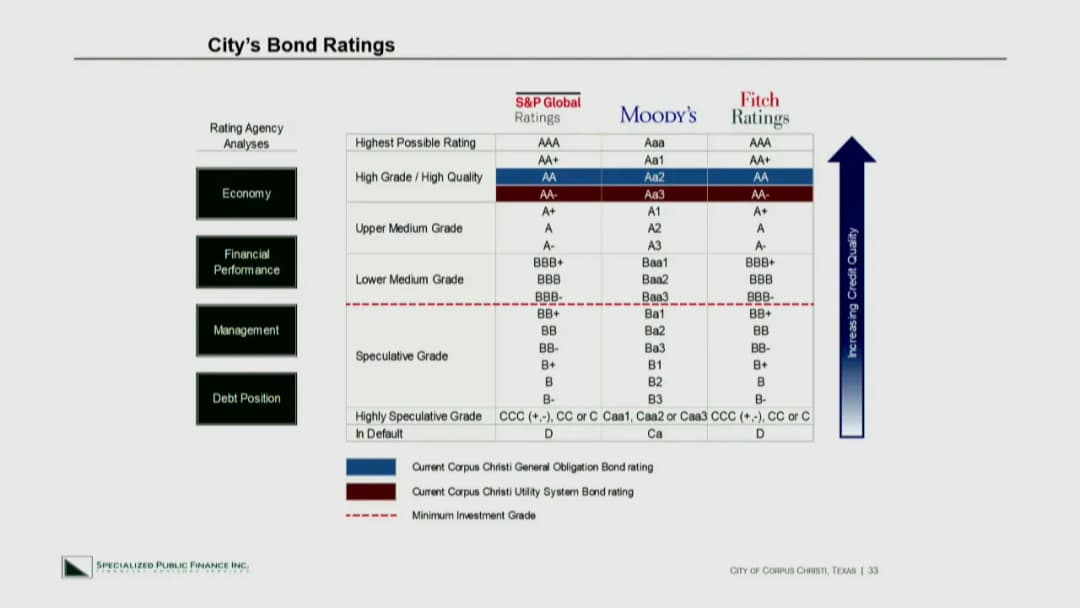
Corpus Christi City Council Workshop on CIP, Debt Profile, and FY26 Budget Amendments\n\nThe Corpus Christi City Council held a workshop on August 28, 2025, receiving presentations on the Capital Improvement Program (CIP), an overview of the city's debt profile, and a wrap-up of proposed amendments to the FY 2026 operating budget. No formal votes were taken during this workshop. The meeting began with a roll call by City Secretary Rebecca L. Huerta and a quorum was established.\n\n Presentation on the Capital Improvement Program (CIP)\n- Jeff, from Engineering Services, presented the CIP as a 10-year planning document updated annually. He highlighted a record year for project delivery, with 85% of FY25 CIP projects (229 of 272) on schedule and a record $624 million in contracts awarded.\n- Engineers reviewed the FY26 CIP, which totals $765 million across 243 projects, including 33 moving from long-range to short-range planning. The largest funding sources identified were revenue bonds and SWIFT funding.\n- Councilman Hernandez raised concerns about a lack of clear project prioritization across departments, noting most projects are designated as "Priority Level 1." Staff acknowledged the request to further rank projects and will explore providing a ranked list.\n- Councilwoman Campos inquired about the status of unspent 2018 and 2020 voter-approved bonds, particularly for North Beach projects delayed by the Harbor Bridge alignment and permitting. Staff confirmed these projects are now under design and construction.\n- Councilwoman Vaughn and Mayor Guajardo discussed the efficiency of the city's two grant writers, noting $35 million in awards so far in FY25 against $38.9 million in applications. Staff confirmed a recent report on grants awarded will be shared with the council.\n- Councilwoman Paxson asked about the Nueces Groundwater System funding and the reclaimed water feasibility study, confirming both are in progress but awaiting further council action and study results.\n- Councilman Scott expressed desire to see the full master plan for the North Beach area post-Harbor Bridge demolition, which staff committed to providing.\n\n Overview of City's Debt Profile and Bond Planning\n- Financial Advisor Victor Keogar presented the city's debt profile, noting strong credit ratings (AA/AA2 for GO debt, AA- for Utility System debt). The city's 10-year CIP is viewed favorably by rating agencies.\n- Recent financings were highlighted: a $300 million utility system bond issuance in June was 4 times oversubscribed, and an $84 million GO bond issuance in August came in under budget (4.39% interest rate).\n- Outstanding debt stands at $578.6 million ($1,221/capita) for property tax-supported debt and $1.45 billion ($4,575/capita) for utility system debt. A key concern raised by Councilman Hernandez was the total increase in principal and interest owed, which rose by $600 million to a total of $3.1 billion in the past year.\n- Councilman Roy explored how Industry Development Agreements (IDAs) affect the city's credit rating. Mr. Keogar stated that if IDA properties were fully within city limits, it would be a credit positive but acknowledged the broader service implications.\n- Councilwoman Campos raised concern over potential state legislation (Senate Bill 10) limiting property tax revenue growth to 1%, which would severely constrain the city's budget.\n- Councilman Scott directly asked Mr. Keogar if he was comfortable supporting the FY26 CIP and 5-year plan. Mr. Keogar responded affirmatively based on current projections and capacity.\n- Councilman Hernandez questioned the city's debt limit and state legislative trends (House Bill 19) that could cap debt as a percentage of tax revenue, suggesting the council should proactively consider reducing the I&S tax rate from 22 cents.\n\n Proposed FY 2026 Operating Budget Amendments\n- Amy Cowley, Director of Management and Budget, presented amendments to the proposed FY26 budget based on community input and council feedback. Seven community input sessions were held, averaging 40 attendees each.\n- Key changes in the General Fund include: restoring $50,000 to the libraries for books and periodicals; restoring a branch manager position at the Heart Library; and removing 16 part-time lifeguard positions slated for the next fiscal year.\n- Staff recommended reinstating the street user fee at $6.67 per month (generating $11.3 million for street maintenance). Councilman Hernandez and Mayor Guajardo expressed strong opposition to adding this fee to the utility bill, arguing it could harm low-income residents and that funding should come through the normal tax process or a new bond referendum. No consensus was reached.\n- Technical corrections were made to the vehicle and equipment replacement fund and the engineering fund for new positions.\n- Councilman Hernandez requested an additional $53,000 for the City Secretary's office to fill a position. Staff confirmed this would be added to the Tuesday agenda.\n\n Key Outcomes\n- No formal votes were taken, as this was an informational workshop.\n- Direction Given to Staff:\n - Add funding for the City Secretary's office position to the Tuesday budget agenda.\n - Create a CIP project page for the Evangeline raw water supply project in the FY27 budget document for public reference.\n - Consider moving community budget input sessions earlier in the process and exploring additional outreach methods to increase participation.\n - Provide the council with a detailed list of grants applied for and awarded.\n- Continuation Items: The council will continue discussion on the proposed budget, including the fate of the street user fee, at the first reading and public hearing on Tuesday, September 2, 2025. Final adoption is slated for September 9, 2025.
The Corpus Christi City Council met on August 26, 2025, at 11:30 AM, with Mayor Pro Tem Mark Scott presiding due to the mayor's absence. The meeting covered consent agenda approvals, a significant discussion on amending financial budgetary policies to set the general fund reserve floor at 20%, an extensive update on alternative water supply projects, and public comments on a wide range of topics including water resources, libraries, and city transparency. Consent Calendar - Approved the August 13, 2025 Budget Workshop Minutes and August 19, 2025 Regular Meeting Minutes. - Approved Zoning Case No. ZN8634, rezoning property at 602 Saratoga Boulevard to RS-4.5/PUD. - Authorized purchase and installation of a virtual reality training simulator for the Police Training Academy from V-Armed, up to $383,000. - Authorized purchase of one Ford F-450 for the Police Bomb Squad through TIPS Cooperative, total $112,007.75. - Authorized a one-year service agreement with Roland Mendiola dba National Auto Glass for windshield repairs, up to $129,250 annually, with options for two additional years. Public Comments & Testimony Numerous residents spoke during the general public comment period at approximately 5:30 PM. Key themes included: - Water Projects: Several speakers opposed the Inner Harbor desalination project, citing high costs, environmental risks, and a lack of transparency. Some expressed support for alternative water sources such as groundwater and reuse projects. A speaker highlighted potential conflicts of interest and alleged forged documents in a separate city project. - Libraries: Residents urged the council not to reduce library funding, presenting a petition with over 460 signatures opposing cuts to the Hart Library and other branches. - Budget Priorities: Community members advocated for reallocating funds from law enforcement to social services, mental health, housing, and parks. Concerns were raised about the proportion of the budget spent on police versus quality-of-life programs. - Food Truck Regulations: A food truck operator requested clarification on fire code requirements, noting existing state regulations. - BMX Park: A resident highlighted the economic benefits of a sanctioned BMX track in Salinas Park, citing potential tourism revenue. - Other: Calls for a citywide day of prayer for rain, opposition to water sales to industries during drought, and requests for more accessible public comment processes. Discussion Items Financial Budgetary Policies (Item 6) - Finance Director Satya Yasana presented options for amending the unassigned fund balance policy, recommending a floor of 20% (Option 1) versus maintaining the current 17-20% range (Option 2). Historical data showed the city has effectively maintained 20% reserves for five years. Financial advisors recommended a minimum of 20% with a target range of 20-25% and a restoration plan if reserves dip below the floor. Peer cities showed varying reserve levels, with coastal cities often holding 90 days or more of operating expenses. - Council discussion included the need for a restoration plan if the reserve falls below 20%. Councilmember Paxton suggested adding long-term goal language to reach 25%. Councilmember Campos supported Option 2 to allow flexibility and potentially fund sidewalk pilot projects. Councilmember Roy favored Option 1 for financial stability. Councilmember Hernandez questioned if lowering the floor would impact bond ratings. - Motion: Councilmember Scott moved for Option 1 (floor 20%), seconded. After debate, the motion passed with the understanding that language for a restoration plan and a long-term goal of 25% would be added in future budget cycles. Alternative Water Supply Projects Update (Item 7) - Drew Molly, along with water staff, presented updates on multiple projects: - Nueces River Groundwater Wells: Phase 1 is operational, discharging 5-7 MGD into the river. Eight eastern wells and development of a western well field are ongoing. Capital costs to date are $18 million, offset by a $30 million state grant. A hydrogeologist confirmed sustained yields: eastern field 11 MGD, western field up to 17 MGD long-term. A potential Phase 2 would require a brackish RO plant at O.N. Stevens, costing $350 million, delivering up to 28 MGD by 2028. - Evangeline Groundwater Project: Purchase of water rights for $169 million, infrastructure cost $200 million, timeline 2029. Scalable from 12 to 24 MGD. Discussion on treatment needs. - Harbor Island Seawater Project: Permits submitted, timeline 2029-2032. Reservation fees discussed (e.g., $821,000 annually for 30 MGD, non-refundable until water delivery). Councilmember Vaughan clarified that the fee may apply to future water purchases. - Water Supply Dashboard: A new tool projecting water supply under conservative rainfall assumptions. Current projections show combined Choke Canyon/Lake Corpus Christi reaching zero by May 2027 without additional sources. With groundwater wells, the date extends to May 2029. Combining all supplies (including Harbor Island) could avoid curtailment. - Council discussion covered cost comparisons, feasibility of combining RO facilities, concerns about aquifer sustainability, and the need for updated drought contingency metrics. Councilmember Campos reiterated concerns about industry water use during drought. Key Outcomes - Resolution 25-1238 Adopted: The council approved amending the Financial Budgetary Policies to set a minimum unassigned fund balance of 20% of total annual general fund appropriations (Option 1). The motion included direction to add a restoration plan if the reserve falls below 20% and a long-term goal to increase reserves to 25% in future budgets. Vote: Passed. - Water Projects Direction: No formal vote was taken on water project specifics. The council received the update and will continue discussions. Staff will bring forward further analysis, including a presentation on the Nueces River well field hydrogeological report and a meeting with Harbor Island partners. - Public Engagement: The council acknowledged the public's concerns and pledged to consider alternative water sources and budget priorities in upcoming decisions. The next council meeting is scheduled for September 2, 2025, where the budget and potential desalination funding will be addressed.
The Corpus Christi City Council held a workshop on August 21, 2025, to discuss the proposed FY2026 budget for Public Works, focusing on streets and stormwater. Presentations covered the Streets and Stormwater funds, including achievements, pavement condition index (PCI) results, a proposed street user fee, a sidewalk plan, developer participation, and stormwater fee rate projections. Council members asked questions and expressed various positions on funding strategies, but no formal action was taken. Discussion Items - Street Maintenance and RPP Funding: Ernie from Public Works presented the FY2026 proposed streets budget of $143.9 million, an 11% increase from FY2025. The presentation highlighted PCI improvements, with two of five districts reaching PCIs above 70. The Rapid Pavement Program (RPP) funding shortfall was discussed: without the street fee, residential street funding would drop to $16 million in FY2027, reducing repairs from 30 miles per year to 16 miles per year. Re-establishing the street user fee at $6.67 per month (from the sunset rate of $5.38) could generate $15 million annually to close the gap. - Street User Fee Debate: Several council members commented on the street user fee. Mayor Paulette Guajardo noted that the fee was not recommended by staff two years ago but is now presented, expressing that fees are not permanent solutions. Councilman Gil Hernandez opposed the fee, suggesting using budget policy changes (e.g., shifting fund balance from 20% to 17%) or including $24 million in each bond package. Councilwoman Carolyn Vaughn supported maintaining funding to avoid regressing, stating the fee worked before and should not have been sunset. Councilwoman Kaelin Paxton asked about creative alternatives to avoid adding fees, such as using fund reserves. - Sidewalk Program: Ernie outlined a proposed sidewalk repair program, similar to the RPP's pavement-only approach, prioritizing neighborhoods by using the existing RPP list. Challenges include tie-ins with old driveways, ADA compliance, and encroachments. Estimated replacement cost is $800,000 per block (average 1,500-foot block). No dedicated funding source exists, and staff recommended updating design standards before implementation. - Developer Participation: The city requests $2.8 million for FY2026 developer participation for oversized streets and drainage crossings. Current funding comes from certificates of obligation; Councilman Hernandez suggested including participation in future bond packages instead. - Stormwater Fund and Fee: The FY2026 stormwater budget is $32.2 million. Ernie presented productivity rate audits using new software (Cartograph, Sam SERA), showing higher actual outputs than previously reported. The stormwater fee is proposed to remain unchanged for FY2026 but will need increases in FY2027 (1%), FY2028 (4%), and FY2029 (2%) to cover growing debt service. Council members questioned the reserve balance and the equity of the fee methodology (based on lot size divided by 2, not actual impervious cover). The mayor requested a cost-of-service study to ensure fairness. - Tree Trimming on Private Property: Councilman Hernandez questioned stormwater crews trimming trees on private property along Costores. Staff explained they issue notices under the MS4 permit to prevent damage to sidewalks and curbs, but will issue citations if needed. Key Outcomes - No votes were taken; the workshop was informational only. - Council directed staff to explore alternative funding sources for streets, including using the reserve fund balance (17–20% policy), bond allocations, and the 1/8-cent sales tax (Type B funds) for eligible projects with economic development components. - Staff will provide a follow-up on the feasibility of a cost-of-service study for the stormwater fee and details on how the 1/8-cent sales tax can be used for future stormwater debt service. - The sidewalk plan will be further developed using a prioritization method tied to the RPP list, with updated design standards to follow. - Productivity rates from new software will be tracked annually to inform future stormwater fee adjustments.
The Corpus Christi City Council met on August 19, 2025, at 11:30 AM in Council Chambers, with a recess for lunch and a general public comment session at approximately 5:30 PM. The meeting covered consent agenda items, a zoning case, a briefing on the city logo, and a detailed update on alternative water supply projects, particularly the Mary Rhodes Pipeline. Several agenda items were pulled from the consent agenda for individual discussion. The meeting included extensive public testimony on water issues, library funding, and other community concerns. Consent Calendar - Approved with exceptions: Items 1, 2, 4, 5, 6, 9, 11, and 12 were approved via a single motion. Items 3, 7, 8, 10, and 13 were pulled for individual consideration. - Item 3: Motion authorizing purchase of 25 Panasonic mobile data computers with dash cameras for the Corpus Christi Police Department ($467,975.00). Approved unanimously after brief discussion. - Item 7: Resolution amending Financial Budgetary Policies (including changing fund balance from 17-20% to a hard 20% minimum). Postponed to the next meeting (August 26, 2025) to allow staff to provide comparative analysis with other cities, input from the financial advisor, and clarification on historical fund balance levels. Motion to postpone carried. - Item 8: Resolution for negotiation of terms with Nueces County for a proposed Tax Increment Reinvestment Zone (TIRZ) in the London Area. Amended to clarify that Nueces County can be reimbursed up to $50,000 per year based on actual staff time and resources spent (changed from "over the life of the agreement"). Approved as amended. One public comment opposed the TIRZ. - Item 10: Resolution authorizing an Advance Funding Agreement with TxDOT for the Encantada Avenue Pedestrian Safety Improvement Project. Approved unanimously after staff provided a construction timeline estimate of approximately six months from TxDOT approval. One public comment supported the project. - Item 13: Resolution nominating Flint Hills Resources for the Texas Enterprise Zone Program (a state-level sales tax refund for a $150 million capital investment retaining 500 jobs). Approved unanimously. Public Comments & Testimony - Library Funding: Multiple speakers (including Library Board Chair Pat Craig and community member Julie Rogers) advocated for increased library funding, presenting data showing Corpus Christi libraries are below average compared to peer cities in percentage of general fund, dollars per library, staffing per library, and dollars per capita. They requested raising the allocation from 1.8% to 2% of the general fund. A petition with over 300 signatures was presented opposing the proposed budget cuts to library materials and the elimination of the Hart Library branch manager position. - Water Projects (Desalination & Alternatives): Numerous speakers addressed the proposed Inner Harbor desalination plant and the city's water management. Some expressed strong opposition, citing high costs, environmental concerns (brine discharge, red tides, impacts on fishing and tourism), and mistrust in the city's handling of water resources. Others urged moving forward with desalination as a reliable long-term solution, arguing that running out of water would devastate the city. Speakers referred to data on the underutilization of the Mary Rhodes Pipeline Phase 2 (Colorado River water). Several speakers criticized what they called "scare tactics" and urged the council to consider alternative water sources such as Evangeline groundwater and the Nueces groundwater program. - Native American Burial Sites: Speakers (Melissa Zamora, Peter Moore) raised concerns about development (specifically the Breezy Village/TIRZ project) near known Native American burial grounds along Oso Bay. They requested archaeological surveys and consultation with local tribes as a condition for support. - Public Comment Format: Multiple speakers (Marty Lena Garza, Christina English, Eli McKay) criticized the current public comment policy, arguing that holding public comment after agenda items have been considered restricts public participation and may violate the Texas Open Meetings Act. They requested public comment be held at the beginning of the meeting or before each item. - Other Comments: - David Slawyer proposed a large desalination plant near Flour Bluff as an alternative to the Inner Harbor project. - Ron Graben expressed support for the Mayor and City Manager, and requested a private meeting about park issues. - Adam Rios promoted a BMX track at Salinas Park and a skate club at Ray High School. - Henry Williams spoke about the need for a city vision and prayer. - Joshua Friedrich reported on a successful school supply drive. - Brad Bartelson advocated for a strategic water plan with limits on industrial use and energy intensity considerations. Discussion Items - Item 7 – Budgetary Policy Amendment: Extensive discussion on changing the general fund balance policy from a range of 17-20% to a minimum of 20%. Council members expressed differing views: some wanted to retain flexibility (17-20%), while others supported the clarity of a 20% floor. Staff clarified the current practice has been at 20% for several years and that the change would not require immediate budget cuts (the FY26 budget already meets 20% excluding one-time expenditures). The item was postponed after a motion to allow time for additional information on comparative cities and financial advisor input. - Item 8 – TIRZ London Area: Staff explained the unique structure of this TIRZ, which uses sub-zones so that tax increments are dedicated to specific developments. The county requested reimbursement of administrative expenses up to $50,000 per year based on actual time (amended from "over the life of the agreement"). The developer representative board seat was clarified as a community stakeholder position, not specific to a particular developer. - Item 10 – Encantada Pedestrian Safety Project: Staff provided a construction timeline of approximately six months after TxDOT approval. The project includes sidewalks and ADA ramps on Encantada Avenue. - Item 13 – Flint Hills Enterprise Zone: Staff explained the state-level program, which provides a sales tax refund for capital investment. No opposition. - Item 14 – Zoning Case ZN8634 (Saratoga 400 Partners): Rezoning of 32.8 acres from RS-4.5 to RS-4.5/PUD to allow 256 dwelling units with reduced lot sizes (4,000 sq ft min.). Staff and Planning Commission recommended approval. Approved unanimously. - Item 15 – City Logo Update: Communications staff presented a minor update to the city logo, primarily replacing the old harbor bridge with the new one and cleaning up graphic design issues. No cost to the city; soft launch with natural replacement of materials. Briefing only, no action. - Item 16 – Update on Water Supply Projects and Mary Rhodes Pipeline Performance: This was the major briefing of the day. City staff and consultants (HDR) presented detailed information on: - Nueces Groundwater Program: Phase 1 (short-term) pumping groundwater into the Nueces River (current 5-7 MGD, eventually 13 MGD from eastern well field). Phase 2 (long-term) could be a brackish RO plant. Western well field being tested with potential for 17 MGD long-term. This is the lowest cost option and is grant-funded up to $30M. - Mary Rhodes Pipeline (MRP): 101-mile pipeline from Lake Texana to O.N. Stevens WTP. Capable of 100 MGD design but pumping infrastructure limited to 70-72 MGD at Schedule 4 (current operating level). Historically operated at lower schedules (2B, 3) due to incomplete pump station buildout and condition assessment needs. A $19 million investment (approved by council) has allowed operation at Schedule 4 for the first time since 2021, increasing water delivery from the Colorado River. Pipeline overall in good condition (rated 6-7 out of 10), but has pressure exceedance areas due to debris/obstructions. Parallel pipeline or bypass options have been costed ($120M for 12 miles of bypass, $180M for full parallel from Evangeline). Spare pumping equipment is being procured. Staff emphasized that the city is not running out of water, but face a potential inability to meet full demand by December 2026 under worst-case drought conditions if additional supplies are not secured. The dashboard showed Stage 1 water emergency projected for December 2026. - Other projects: Evangeline term sheet sent, meeting scheduled; South Texas Water Authority updates; CC Polymers desalination project; reclaim water project briefing set for September 2. - Council Q&A: Extensive questions from council members addressed the history of MRP underutilization, the timeline of condition assessment and upgrades (beginning 6 years ago under current city manager), the role of former councilman Greg Smith in highlighting the issue, and the cost and feasibility of a parallel pipeline. Clarifications were made that 12 MGD additional could be added to MRP under Schedule 4 with minimal risk, but 24 MGD would require additional engineering and pump station upgrades. The city manager stated that the city had to rebuild the water department and upgrade the treatment plant before tackling the pipeline. Key Outcomes - Item 7 (Budget Policy): Postponed to next week (August 26, 2025) for additional information. - Item 8 (TIRZ London): Approved as amended (reimbursement up to $50,000/year based on actual time). - Item 10 (Encantada Project): Approved. - Item 13 (Flint Hills Enterprise Zone): Approved. - Item 14 (Zoning): Approved. - Item 3 (Police Computers): Approved. - Consent Agenda (excluding pulled items): Approved. - General direction: The council received extensive information on water projects; no formal action taken on Item 16. The meeting served as a comprehensive briefing ahead of upcoming votes on desalination (Inner Harbor) scheduled for the next meeting (August 26). The city manager committed to providing a memo addressing the comparative analysis of fund balance policies and other requested data.
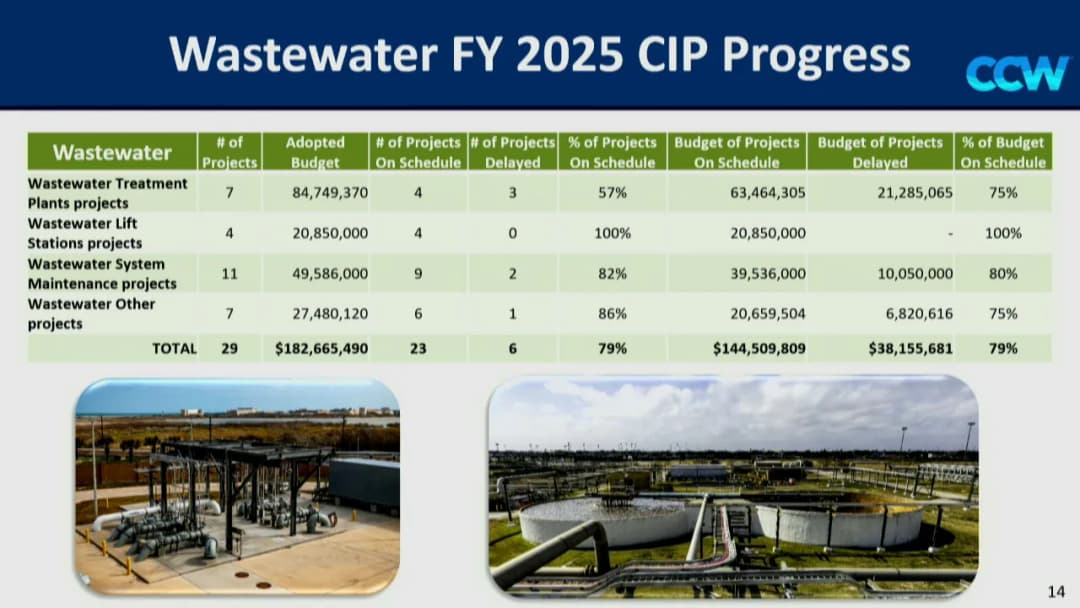
On August 13, 2025, the Corpus Christi City Council held a budget workshop on Corpus Christi Water’s (CCW) proposed FY 2026 operating budget, capital improvement program, and rates for both the wastewater and water funds. Mayor Paulette Guajardo called the meeting to order and roll call established a quorum. Staff and consultants presented cost-of-service studies, rate proposals, infrastructure achievements, consent decree progress, and two decision packages. The agenda stated the meeting was informational only, and no formal action was taken. Wastewater Fund Highlights - Major wastewater projects in FY25 included a $102 million construction award for rehabilitation and treatment improvements at the Greenwood wastewater treatment plant; a $111 million investment at the OSO wastewater treatment plant to modernize the ammonia removal system, a four-year project increasing plant capacity to 18 million gallons per day; and substantial completion of the $12.2 million Williams Lift Station project. - CCW replaced approximately 32,000 linear feet of wastewater lines and rehabilitated 100 manholes through IDIQ contracts. - The consent decree, in effect since January 2021, remains a major driver of wastewater work. Staff reported that 10 of 17 consent decree milestones are complete, with the remaining milestones on or ahead of schedule. - The projected average residential wastewater rate in Year 10 of the consent decree is now $94, compared with the original analysis of $80 to $90, primarily due to inflation of about 24.8% between 2020 and 2025 versus the original 15% assumption. - The proposed FY26 wastewater fund includes $113.6 million in expenditures and $99.4 million in revenue plus fund balance. Revenues increased by $2.6 million from FY25, while expenditures increased by $100,000, for an overall increase of 0.1%, below the water/sewer consumer price index of 4.86%. Wastewater Decision Packages - Decision Package 1 proposed adding nine maintenance positions and heavy equipment, with an $800,000 annual cost and a $1.5 million one-time cost. Staff stated the treatment plants have not added staff in at least 15 years despite infrastructure upgrades, and that current maintenance workloads include about 183 preventive and 155 corrective work orders per month. - Decision Package 2 proposed adding seven positions to operate the OSO reclaimed-water fill station. The station currently provides reclaimed water free of charge, distributes about 20,000 gallons per day, and is open 1–5 p.m. Monday through Friday and 8 a.m.–noon Saturday and Sunday. It typically sells out by mid-afternoon. The station has more than 500 permits and averages 40–42 customers per day, with an estimated 70% residential and 30% commercial split. Staff warned that without additional staffing, the station may have to close or severely limit hours. Construction of a 48-inch OSO gravity main could also force a temporary closure this fall unless alternatives are funded. Wastewater Rates and Cost of Service - NewGen Strategies presented the cost-of-service study. The proposed wastewater volumetric rate would increase by $0.34, from $0.807 to $0.841 per 1,000 gallons. - For residential customers inside city limits, the monthly minimum charge would increase from $35.11 to $38.29. For residential customers outside city limits, it would increase from $30.05 to $33.12. - For commercial customers inside city limits, the monthly minimum charge would decrease from $46.10 to $38.29. For commercial customers outside city limits, it would decrease from $39.45 to $33.12. - The stormwater legacy debt phase-in was explained: total legacy debt service is split 50% to wastewater and 50% to water rates. In FY26, water rates would recover $2 million, or about 17%, of the $5.882 million water-side portion; wastewater rates would absorb 50%; and wastewater fund balance would absorb the remaining 33%. In FY27, another $2 million shifts to water rates, with full 50/50 recovery reached in FY28. - The cost-of-service results showed residential wastewater customers slightly under-recovering and commercial customers slightly over-recovering their cost of service, with classes netting to zero overall. Water Fund Highlights and Proposed Budget - Water achievements included a new water supply dashboard; improvements to the Mary Rhodes Pipeline that allow full use of 70–72 million gallons per day; dredging at the O.N. Stevens water treatment plant; substantial completion of the $13.2 million Nueces Bay Boulevard 24-inch water line under the ship channel; and replacement of approximately 47,500 linear feet of water lines across the city. - The proposed FY26 water fund includes $183.4 million in expenditures, with $177.9 million in revenue plus $5.5 million in fund balance. Revenues increased by $8.3 million and expenditures increased by $7.9 million, a 4.5% increase, below the water/sewer CPI of 4.8%. - For FY24 billed use, industrial users, including wholesale and retail industrial customers, accounted for 54% of all raw water consumed. For treated water, municipal use and wholesale municipal use accounted for approximately 48% of demand, while large-volume users and wholesale industrial users accounted for approximately 52%. Water Rates - For the average residential customer inside city limits with a 5/8-inch meter, the proposed monthly minimum charge increases from $15.83 to $17.25, including the stormwater legacy debt component. Outside city retail charges are lower because outside customers do not benefit from stormwater infrastructure. - The proposed rate structure includes a new charge for the first 2,000 gallons for residential, commercial, and irrigation customer classes. - The large-volume taker-pay amount for the first 10 million gallons increases by 30%. - Proposed wholesale contract rates include public agency wholesale raw water at $1.33, wholesale treated water at $1.80, wholesale treated water network at $25, and non-rate-payer wholesale raw water at $1.36. Composite raw water customers Alice, Beeville, and Mathis remain at $1.03, with annual updates required by contract. - Sample bill impacts were provided: average residential customer total impact of $8.98 per month; typical restaurant impact of $17.93 per month; irrigation accounts up 39%; large-volume accounts up 14%; and wholesale treated customers down an average of 3%. CIP Program - The proposed FY26 wastewater CIP totals approximately $110 million across 24 projects, down from about $182 million in FY25. Staff said the reduction was not due to cancelled projects but to re-timing budgets based on actual design and construction durations. Of 29 wastewater projects in pre-engineering, design, or construction, 23 were on schedule, or about 79%. Six projects were delayed due to the Greenwood bid overrun, CDBG mitigation grant funding delays, and rescoping/rebidding. - The proposed FY26 water CIP totals approximately $390 million across 51 projects. Of 53 water projects in pre-engineering, design, or construction, 46 were on schedule, or 87% by project count and 92% by budget. Seven projects were delayed for reasons including additional design needs, property acquisition, subsurface utility exploration, and drought-related delay of the Wesley Seale Boat Ramp. - The FY26 water CIP includes one new project, the Nueces River groundwater well program supported by state grant funding, and moves three long-range projects into the short-range program beginning in FY28: the Rand Morgan 16-inch water main, citywide highway line crossings, and Upriver Road water line replacement. Council Discussion and Follow-Up - Councilmember Hernandez questioned overtime levels, noting wastewater overtime of about $1.15 million, or roughly 9% of $12.9 million in personnel expense, and water overtime of $942,420, or about 5% of $18 million in personnel expense. He also cited a 10% vacancy rate and a 27% increase in FTEs since 2021, and encouraged staff to work toward less than 5% overtime as a management goal. Staff responded that 24/7 operations, emergency response, and consent decree work require overtime, and that in-house work has saved about $29 million compared with contractor costs. - Councilmembers Roy, Vaughn, and Scott expressed support for charging a fee for reclaimed water, with several saying the fee should be nominal or phased in, because some users are providing paid lawn-watering services and ratepayers currently subsidize the program. Councilmember Paxson cautioned against charging during the drought, since reclaimed water offsets drought restrictions. The city manager said the free service was intended to build familiarity and use, with a possible fee after the program is established. NewGen estimated that a fee of $75.61 per 1,000 gallons would fully cover the seven proposed reclaimed-water positions and make the operation net zero, and a phased fee option was available if directed by council. - Councilmember Paxson asked about a steep increase in wholesale raw-water usage shown on a chart; staff said they would analyze the cause. Councilmember Scott asked whether wholesale customers must follow the city’s drought contingency plan; staff said contracts require drought plans and CCW works with wholesale customers, but enforcement outside the city is difficult. - Councilmember Hernandez identified inconsistencies between debt-service figures in the presentation and the budget book, and staff agreed to review the figures with him after the meeting. - Staff acknowledged that the water conservation plan is two to three years behind schedule. An updated plan is being developed with Plummer Engineering and is expected to be brought to council in fall 2025 or early 2026. - Staff also acknowledged that reduced water use due to conservation and drought restrictions creates a revenue shortfall that must be recovered through rates because fixed costs remain unchanged. Public Comments & Testimony - No public comment was solicited or taken during this workshop. Staff and council referenced previous citizen testimony, including a resident’s remarks about the reclaimed water program and the station closing before opening time. Key Outcomes - No motions, votes, or formal decisions were made; the meeting was informational only. - Staff will follow up on the wholesale raw-water usage increase, debt-service line-item discrepancies, reclaimed-water fee options, and a benchmark comparison with other large Texas cities. - An updated water conservation plan is expected to return to council in the fall or early 2026.
The Corpus Christi City Council convened on Tuesday, August 12, 2025, at 11:30 AM for a lengthy meeting covering fiscal policy, major infrastructure contracts, economic development, water supply strategy, and governance disputes. Key actions included setting a proposed tax rate, awarding the Harbor Bridge Parks Mitigation contract, authorizing the Barisi Village TIRZ 6, and directing staff on a massive groundwater purchase. A proposal to defund the Chamber of Commerce was debated extensively but no action was taken. Consent Calendar - The council approved the consent agenda (Items 2-9) with the exception of Item 2 (July 29 meeting minutes). Councilmember Paxson requested and received approval to include a record of a failed motion from the previous meeting in the minutes. Proposed Tax Rate & Budget Calendar (Item 10) - Director of Finance Sergio Vazquez presented the proposed FY 2026 ad valorem tax rate of $0.599774 per $100 valuation, which is unchanged from the current rate. The No New Revenue Rate was calculated at $0.598423. The council formally set this as the maximum proposed rate, triggering the state-mandated truth-in-taxation public notice process. Public hearings were scheduled for September 2, 2025, with adoption set for September 9, 2025. The motion carried via a recorded vote. Harbor Bridge Parks Mitigation Project (Item 11) - The council awarded a $16,497,423 construction contract to JE Construction Services for the first phase of the Harbor Bridge Parks Mitigation Improvement Project. Engineering Director Jeff Edmonds and Parks Director Robert Dodd detailed the scope, which includes the Hillcrest Park, Dr. H.J. Williams Park, Ben Garza Park, TC Ayers Park, and the Washington Coles Trailhead, creating the "Freedom Trail" for connectivity. The total project, including a future aquatic center contract, is expected to cost approximately $26 million. Construction was expected to take 12 months. The motion carried. Barisi Village TIRZ 6 (Item 12) - The council approved the Project and Financing Plan for the Barisi Village Tax Increment Reinvestment Zone (TIRZ 6). The 127-acre development is estimated for completion over 10-12 years with a projected valuation between $800 million and $1 billion. Reimbursement caps were set at $32 million (City), $13 million (Nueces County), and $7 million (Del Mar College), for a total incentive cap of $52 million. Multiple council members expressed concerns about the developer's timeline and financial viability, leading to a request for a direct briefing from the developer. The motion carried. United Corpus Christi Chamber of Commerce Funding Debate (Item 13) - Council members Vaughn, Cantu, and Paxson proposed de-funding the Chamber following a controversial campaign targeting new council members and disparaging a guest speaker (Lyle Larson). Chamber representative Al Arreola apologized for the actions. After lengthy debate, council members chose not to move forward with the defunding motion. Councilwoman Paxson stated the intent was to "reset the scales" to promote collaboration. No action was taken on the item. Briefing: American Bank Center (Item 14) - OVG360 provided an update on the American Bank Center. Highlights included a 15% increase in events, a 23% increase in total hospitality revenue, operating expenses down 25%, and the introduction of a "Coastal Culinary Launch Pad" incubator program for local food vendors. The facility reported a net income before capital expenses of $2.5 million in FY24. Council members raised concerns about the management contract's 9-year agreement with Ticketmaster and requested a full audit of the facility. A quarterly reporting cadence was established. Executive Session & Alternative Water Supply (Items 15-19) - The council entered executive session to discuss several legal matters and the potential purchase of groundwater rights. - Lawsuit Authorizations: The council authorized legal fees up to $197,000 for the Kent McIlyar case and up to $22,719 for the Annette Rodriguez case. - Groundwater Purchase Directive: The council approved directing staff to negotiate the purchase of approximately 22,788 acres of groundwater rights in San Patricio County (Evangeline Aquifer) for an amount up to $169.5 million ($7,437 per acre). Funding is expected via revenue bonds, with an initial estimated rate impact of $9.50/month for the average residential user. - Alternative Water Briefing: John Byrum of the Nueces River Authority briefed the council on the Harbor Island Desalination Project (100 MGD, scalable to 450 MGD) with a target to deliver water to the Coastal Bend by 2029. The cost was estimated between $10 and $15 per thousand gallons. The project is in the permitting and P3 partner solicitation phase. No vote was taken on this project. Public Comments & Testimony - A large number of residents spoke during the General Public Comment period, primarily focused on the proposed Inner Harbor Desalination Plant. Many speakers expressed strong opposition, citing environmental risks (PFAS, brine discharge), high costs ($1.2 billion), and a lack of public transparency, while supporting alternative sources like the Evangeline Aquifer. - Several residents spoke in support of the new reclaimed water program, noting its growing popularity and significant daily usage. - Concerns were raised regarding library funding and hours, particularly regarding the Hart and Garcia branches. - A community group presented a "People's Budget" platform advocating for greater transparency, investment in quality of life programs, and equitable infrastructure spending over industrial development. - A resident requested the city put a moratorium on selling water until local drought restrictions are lifted. - A resident advocated for making public comment participation more accessible for remote and disabled speakers. Key Outcomes & Votes - Proposed Tax Rate: Set at $0.599774 (Record Vote). Public hearing set for Sept 2. Motion carried. - Harbor Bridge Parks Contract: Awarded for $16.5M. Motion carried. - Barisi Village TIRZ 6: Approved. Motion carried. - Chamber of Commerce Defunding: No action taken. - Kent McIlyar Lawsuit Fees: Authorized up to $197,000. Motion carried. - Annette Rodriguez Lawsuit Fees: Authorized up to $22,719. Motion carried. - Groundwater Purchase: Staff directed to negotiate. Motion carried.
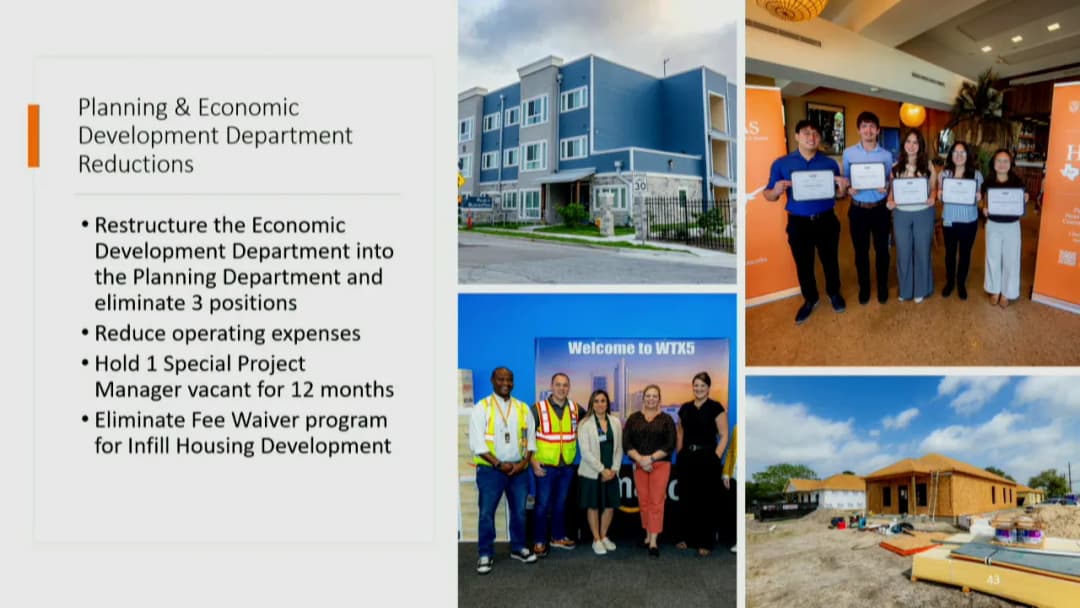
The City of Corpus Christi City Council convened for a workshop on August 7, 2025, from 9:00 AM to approximately 1:00 PM. The workshop was purely informational; no action was taken and no public comment was solicited. The council reviewed the proposed FY 2026 budget and heard a detailed operational briefing from the Fire Department. Budget Overview: FY 2026 Proposed Budget - Total Budget: $1.6 billion proposed, a 12% decrease from the current $1.8 billion budget. - Operating Budget: Down 5% ($49 million) citywide. - General Fund: Increased by 0.8%, roughly flat with the current year. - Balanced Budget: The $7 million shortfall was eliminated through $4 million in departmental reductions, $1.5 million in user fee adjustments, and unanticipated higher property tax revenue. - Street Funding: Proposed to increase by 11% ($14 million) for FY26, but this relies on bond funds. A significant funding cliff is expected in FY27, threatening to increase the street repair cycle from 8 years back to 30 years unless a new revenue source (such as a street user fee) is adopted. General Fund Expenditure Details - Public Safety: The dominant expense, over half of the general fund. The budget adds 5 police officers and 5 firefighters, plus funding for their respective academies. - Mandated Increases: Year 3 of the police contract (3% raise) and Year 2 of the fire contract (3% raise) are included. - Enhancements: Funding for a homeless services position, a grant writer, and increased support for Animal Care Services (free spay/neuter vouchers, vet services). - Fee Increases ($1.5M total): - Fire: Ambulance fees adjusted for inflation. - Police: New registration fees for outside agency academy training. - Animal Care: Increased impound, boarding, and vaccine fees (not raised since 2015/2018). - Parks & Rec: Increased fees for after-school programs, parties, pavilions, and vendor permits (not raised since 2018/2021). - TMRS Proposal: The proposed budget includes changes to the Texas Municipal Retirement System, moving to an 8% employee contribution (from 7%) and changing the Cost of Living Adjustment (COLA) from automatic annually to an annual council vote. Council Deliberation & Key Speaker Positions - Vacant Building Registration: A proposed fee on vacant nuisance properties generated significant debate. Councilman Hernandez strongly opposed it, arguing it is a "fee on top of a fee" and that property taxes should cover city services. Fire Chief Brandon Wade and Development Services Director Michael Dice countered that the fee is crucial for public safety, offsetting the high cost of repeated fire and code enforcement responses to dilapidated structures that endanger neighborhoods and firefighters. - Street User Fee: Councilman Scott, Councilwoman Gompels, and others expressed interest in reviving the street user fee to prevent the street maintenance cycle from lengthening, specifically warning of the impending FY27 funding cliff. - Park Fees & Constituent Impact: Councilwoman Vaughn expressed robust concern over the cumulative impact of park fee increases on low-income families, describing the city as "fee happy." Councilman Badeta countered that fees must keep pace with inflation to avoid general taxpayers subsidizing specific park users. - Sidewalk Connectivity: Councilwomen Gompels, Paxson, and Campos prioritized sidewalk connectivity, advocating for including a significant sidewalk component in the upcoming bond program (2026) rather than waiting for a costly citywide assessment. - Ambulance & EMS Fees: Councilwoman Vaughn worried about the burden on the elderly and uninsured. Deputy Fire Chief Kenny Urban detailed the city's charity care program (100% write-off for qualified uninsured) and explained that state law prevents balance billing, noting gross charges represent the cost of service and are heavily reduced by insurers and government programs. - Animal Care Services (ACS): Councilman Canthu proposed a small monthly fee on utility bills to fund animal shelter operations and spay/neuter programs. Mayor Guajardo expressed a preference for finding funding for additional Animal Control Officers within the existing budget rather than adding new fees. - Audit Software: An unbudgeted request for $25K annual software subscriptions was presented to the full council after the audit committee met. Councilman Badeta supported the software, while Councilwoman Paxson and Councilman Scott noted concerns about the timing and process of the request. Fire Chief Briefing (Chief Brandon Wade) - Operational Profile: 455 uniformed firefighters, 18 stations, minimum daily staffing of 108. - Workload: Estimated 63,000 total incidents for FY25, including 47,900 EMS calls and 29,500 transports. Unit responses are projected at 113,000. - Structure Fires & Hazards: Estimated 339 structure fires. Electrical issues are the leading cause. Vacant, dilapidated buildings are a significant and high-risk operational hazard for crews. - Response Times: The department responds to 87% of calls within the national standard of 8 minutes (goal is 90%). - Prevention & Inspection: Fire prevention inspections dropped over the past three years due to staffing gaps but the office is now fully staffed. The department has enhanced its role in special event safety (food trucks, festivals) using gas monitors. - Deployments: Crews deployed to major disasters in Florida, California, and the Texas Hill Country; all costs are reimbursed by the state, providing critical training without local financial impact. - Health & Safety: Over 300 firefighters completed the first annual round of mandatory occupational cancer screenings following a recent council and legislative mandate. - Council Appreciation: The entire council expressed deep appreciation for the Fire Department's service, professionalism, and the training gained from state deployments. Key Outcomes & Next Steps - Workshop Purpose: No votes were cast; the session was strictly for information and council discussion. - Follow-up: Staff will provide weekly response memos to the council collating answers to all questions raised during the workshop. - Upcoming Meetings: - Workshop 2: Water, Wastewater operating budget and rates (August 13/14). - Workshop 3: Street Funding and Capital Improvement Program. - Seven community input sessions are scheduled across the city. - Future Policy Priorities: The council will deliberate on a street user fee, animal shelter funding models, sidewalk improvements in the 2026 bond program, and final adjustments to the budget before adoption in September.
The City Council of Corpus Christi held a marathon meeting on July 29, 2025, dominated by extensive debate and public testimony regarding the future of the Inner Harbor Desalination Plant. After over 12 hours of deliberation, the council voted 5-4 to postpone a decision on the project's next design phase pending a formal response from the Texas Water Development Board. The council also approved a heavily amended federal housing and community development funding plan, authorizing millions in spending for law enforcement, gas utility infrastructure, and lawsuit settlements. Consent Calendar - Approved the July 22, 2025 meeting minutes (Item 1). - Approved the Crime Control and Prevention District budget (Item 5) after a discussion between Councilwoman Campos and police staff about integrating the CC PALs program into community recreation centers. - Approved the purchase of ammunition for the Police Department (Item 7), with Councilwoman Campos registering her objection to using Crime Control funds. - Approved the purchase of the City of Rockport's natural gas utility assets for $5.5 million (Item 12), which staff stated would be financed through gas system revenues and yield a net benefit to the regional customer base. Public Comments & Testimony - Item 6 (CDBG Funding): Representatives from Rising Tide Ministries and Habitat for Humanity spoke in support of receiving funding for their respective housing and social service programs. - Item 12 (Rockport Gas): In public comment, Jason Hale questioned the project's scope, asking whether the mission of the city's gas department was to become a regional supplier. - Item 16 (Inner Harbor Desalination): Over 55 people signed up for the 5:30 pm general public comment, the vast majority addressing the desalination plant. - Supporters, including the Chamber of Commerce, industry representatives (LyondellBasell, Flint Hills Resources), and the Coastal Bend Home Builders Association, argued the project was essential for economic survival, drought-proofing the water supply, and sustaining local jobs. They stressed that it was the only fully permitted large-scale water project available. - Opponents, including environmental activists, Hillcrest community advocates, and fishing industry members, cited the enormous cost ($1.2 billion+) and its impact on residential water rates, environmental racism (targeting the Hillcrest neighborhood), threats to the bay ecosystem and tourism via brine discharge, a lack of transparency in modeling data, and the belief the water primarily serves industrial expansion rather than residents. Several speakers also criticized the recent change to the public comment schedule, which they said suppressed public participation. Discussion Items - Item 16 – Inner Harbor Desalination Plant Amendment: Staff presented three options for the $50M progressive design-build contract with Kiewit: proceed to 60% design, proceed only to 30% design, or terminate the project. A major point of contention was a discrepancy in reported spending ($21 million in weekly updates vs. $47 million total spent to date). Councilwoman Paxson expressed strong frustration over the lack of transparency and clarity. Councilman Cantu made a motion to postpone the item until August 26 to wait for a formal response from the Texas Water Development Board on the flexibility of the project's dedicated loan funds. An amendment by Councilman Roy to authorize $10 million to continue work during the 30-day delay failed. The motion to postpone was passed by a vote of 5-4, with Mayor Guajardo voting against the postponement. Work on the project is expected to cease during this period. - Item 20 – Alternative Water Supply Briefing: Dan Olson of Garver presented an independent evaluation of four groundwater projects. The analysis showed the City's own Nueces River Wells project offered the best long-term value at $4.75 per 1,000 gallons. This compared favorably to the escalating long-term costs of purchase agreements from projects like Evangeline ($6.50+), though the Evangeline representative (Lyle Larson) challenged the timelines and permit risks cited in the report. Garver concluded that treated water from most projects, including the desalination plant, would be available around mid-2028. - Item 18 – Housing Finance Corporation: A special board meeting was held to authorize a $150,000 contract for a Housing Needs Assessment and approve the sale of the Costa Tarragona I and II apartments. - Lawsuit Settlement (Item 22-25): The council came out of executive session to authorize the city manager to execute a settlement in the case of Joshua Ortiz v. City of Corpus Christi for an amount not to exceed $150,000. Key Outcomes - Inner Harbor Design Vote Postponed: The council voted 5-4 to postpone the vote on the $50 million Kiewit contract amendment until at least August 26, 2025, pending receipt of formal clarification from the Texas Water Development Board on funding flexibility. - HUD Funding Realigned: The council approved an amended FY2026 Annual Action Plan, reducing the Ben Garza generator allocation from $500,000 to $410,000 and redirecting $160,000 in identified savings to three community programs: $30,000 to Rising Tide Ministries (Safe at Home), $30,000 to Rising Tide Ministries (Wave Academy), and $100,000 to Habitat for Humanity. - Rockport Utility Purchase Approved: Approved the $5.5 million asset purchase and sale agreement for the City of Rockport's natural gas system. - Lawsuit Settlement Authorized: Authorized a $150,000 settlement in a lawsuit against the city and a police officer. - US Coast Guard City: Recognized the city's official designation as the first 'US Coast Guard City' in the state of Texas.