The Davis City Council met on September 16, 2025, to discuss the solid waste utility rate study, homelessness system of care, and the future of the daytime respite center. The council took several actions including initiating a Proposition 218 process for solid waste rate adjustments and directing staff to ensure continuity of services at the respite center while exploring alternative locations and operators. Consent Calendar - Fee Study and Park Impact Fee Contract Award: Approved resolution authorizing agreement with Matrix Consulting Group for parks fee study and development impact fee update. - Nationwide Opioid Litigation Settlement Agreements: Approved resolution authorizing the city to enter into settlement agreements with multiple opioid manufacturers. - Consolidated Annual Performance and Evaluation Report (CAPER) for Program Year 2024: Approved resolution authorizing submission of CAPER to HUD. - Annual Comprehensive Financial Report (ACFR) and Other Audit Reports for FY ended June 30, 2022: Received the ACFR and auditor communication letters. - Treasurer’s Reports for Quarters July 1, 2023 – June 30, 2025: Accepted quarterly Treasurer’s Reports. - Human Relations Commission Action Item: Proposed 2025-2026 Workplan: Approved workplan including reaffirmation of sanctuary city status and related education/training. - Commission Minutes: Received informational minutes from Open Space & Habitat Commission, Police Accountability Commission, and Planning Commission. Public Comments & Testimony - Solid Waste Utility Rates: Several speakers opposed rate increases, citing high costs compared to nearby cities (e.g., Woodland) and inequitable fee structures for renters. One speaker noted street sweeping inefficiencies. Another expressed support for municipalizing waste collection and progressive rate structures. - Homelessness System of Care and Respite Center: Substantial public comment focused on the potential closure of the daytime respite center due to the Downtown Streets Team ceasing operations on October 31, 2025. Many speakers urged the council to avoid any service gap, emphasizing the center’s role in providing mail, showers, case management, and trust-building. Residents near the current location expressed concerns about safety and a perceived broken promise of rotation. Several proposed alternative locations (e.g., city gym) and called for data-driven decision-making. Support was voiced for the Safe Park pilot and for maintaining the respite center as a model. - Other: One speaker advocated for community navigators and a sanctioned shelter camp. Another voiced concerns about political violence and flag-lowering practices. Discussion Items - Solid Waste Utility Cost of Service and Rate Study: Staff presented a cost-of-service study showing revenue ($17M) falling short of expenditures ($18M) due to inflation and state regulations. Proposed rate adjustments ranging from 8-13% over three years, starting January 2026. The council also considered extending the Recology Davis contract to December 31, 2029, to allow time for a comprehensive procurement process. Councilmembers clarified that the proposed adjustments are needed to avoid an interfund loan. The motion to initiate the Proposition 218 process and extend the contract passed unanimously (5-0). - Homelessness System of Care Review: The Social Services Commission presented a landscape assessment identifying key gaps: shelter of all types, mental health access, substance abuse treatment, and increasing senior homelessness. The commission recommended preserving the respite center model. Staff outlined four options for the respite center after Downtown Streets Team’s departure: in-house operation, alternative contractor, relocation, or closure. The council heard from Yolo County Housing on federal voucher timelines and state funding opportunities. - A subcommittee (Councilmembers Partida and Neville) clarified that their recommendation for a “pause” was meant to ensure continuity of services, not a service gap. Staff noted that 90 days would be insufficient for relocation; in-house staffing with existing DST employees was preferred as a stopgap. - AB 1234 Reporting and Long Range Calendar: Councilmembers reported no meetings attended at city expense. The long-range calendar discussion focused on scheduling a November 4 meeting (Election Day) for Village Farms; the council opted to keep the date despite concerns about public participation. Key Outcomes - Solid Waste Rates: Approved Resolution to initiate Proposition 218 process and extend Recology Davis contract through December 2029 (unanimous 5-0). The rate adjustment first step is 8% effective January 2026. - Winter Shelter: Approved continued operation of winter shelter for 2025-2026 using existing budget. - Safe Parking Pilot: Approved three-month extension for Heart of Davis’s Safe Heart pilot, allowing five spaces at a local church. - Respite Center Operations: Motion passed unanimously (5-0) directing staff to: 1. Ensure no disruption in respite center services after October 31 by using in-house staff (preferably retaining current DST employees) as a temporary measure. 2. Issue an RFP for a long-term operator, with requirements including neighbor outreach, non-traditional hours, and ECM certification as desirable. 3. Simultaneously research alternative site locations transparently, including analysis of the current site’s best use (e.g., permanent supportive housing). 4. Include an analysis of in-house service provision as a long-term option. 5. As part of the strategic plan process, develop metrics for success and review overall homelessness spending (including Pacifico site). - Next Steps: Staff will prepare RFP documents and site analysis reports; a follow-up report is expected in early 2026.
Public Meetings - Davis, California
Public Meetings - Davis, CaliforniaThe Davis Planning Commission met on Wednesday, September 10, 2025, at 7:00 PM in Community Chambers. The meeting began with a welcome to new alternate commissioner Rachael Fulp-Cook, unanimous approval of the agenda, staff announcements on various development projects, and a brief public comment period. The consent calendar was approved en masse. The main agenda item was a presentation and discussion on the 2025 General Plan Update (GPU), focused on land use and community design issues. Consent Calendar - Item A: Update on Commission Requests for Information and Commission Initiated Tasks – informational. - Item B: Approval of minutes from the May 28, 2025 Planning Commission meeting. - Both items were approved unanimously by a single motion. Public Comments & Testimony - Ning Wan, former member of the Historical Resources Management Commission, addressed the commission. He claimed to be the legal owner of a family fund and asserted that property related to the "Bingin Range" and other holdings belong to his family. He urged the commission to pay attention to actual property ownership during development and expressed concern about historical preservation. No other members of the public spoke on non-agenda items. Discussion Items - Item 6A: 2025 General Plan Update Presentation - Principal Planner Dara Dungworth introduced Eric Yerkovich from Raimi+ Associates, the city's GPU consultant. - Mr. Yerkovich presented an update on the GPU process, including the vision statement ("Davis Advances Safe, Fair, Healthy, and Sustainable Neighborhoods where everyone has what they need to thrive and succeed"), project outcomes, and existing conditions data. - Key data presented: City population 65,000 (44% growth since 1990); UC Davis students/employees 47,000 (but many live on campus or commute); population aging (65+ up 60% since 2010, under 18 down 20%); 15,000 jobs in city; 75% of workers commute into Davis, 85% of residents commute out; 1% of land area vacant; about two-thirds of land is residential, with 50% low-density single-family. - The commission discussed unmet housing needs (affordable, family, senior), barriers (vacant land scarcity, protection of agricultural lands via Measures J/R/D, complex planned development zoning), and strategies (infill, upzoning downtown, annexation, innovative housing models, leveraging UC Davis assets, improving intersection design, addressing financial feasibility). - Commissioners offered extensive feedback: Vince McLaughlin emphasized annexation within the sphere of influence, traffic roundabouts, and UC Davis contributing to student/faculty housing. Alan Bennett called for annexation analysis and leveraging UC Davis for R&D job creation. Greg Rowe criticized the rigid planned development (PD) zoning system and high development fees, and noted economic challenges (apartment vacancy rates, high interest rates). Catherine Brinkley highlighted access to Putah Creek, climate goals (30x30), traditional ecological knowledge, highway decking over I-80, microgrids, and the PG&E corp yard opportunity. Georgina Valencia (via video? no, actually she didn't speak; but Rachel Fulp-Cook and Michelle Weiss did) – Rachel Fulp-Cook stressed incubator space for startups, annexation feasibility, and the need to attract young families while older adults age in place. Chair Michelle Weiss questioned whether annexation could include unincorporated areas like El Macero, suggested possibly reducing parks to free up land, and emphasized discussion with financial stakeholders. - No formal vote was taken; the discussion was to inform the GPU process. Staff will incorporate the feedback. Key Outcomes - The commission confirmed the identified land use and community design issues and suggested additional items (economic development incentives, streamlined zoning, traffic improvements, climate resilience, annexation planning, aging-in-place strategies). - No motions or votes were made on the GPU; it remains a work in progress. - The long-range calendar was reviewed: upcoming items include a September 30 special council meeting on peripheral project policy, October 8 Commission Palooza 2 (major JRD changes), October 22 Village Farms workshop (possibly combined with Willow Grove draft EIR public comment), November 12 public hearing for Village Farms (final EIR, annexation, development agreement, etc.), and December 10 historic resources transition ordinance. - Staff urged commissioners to review materials early for the complex Village Farms and Willow Grove projects.
The Davis City Council met in regular session at 6:31 p.m. on Tuesday, September 2, 2025, in Community Chambers, 23 Russell Boulevard, Davis, and approved the agenda 5-0. The council issued ceremonial proclamations, approved the consent calendar, and heard discussion and public comment on the Village Farms schedule options, the Greater Sacramento Economic Council 2025 Market Velocity Report, the Police Department 2024 Annual Report, AB 1234 reporting, and the long-range calendar. Ceremonial Proclamations - Recognized September as Suicide Prevention Month. Recipients said Suicide Prevention Yolo County has served the county for more than 60 years, and its school program reached about 1,200 students in Davis-area schools in the past year. The proclamation noted that suicide is the second-leading cause of death for people ages 10-34, and recipients cited CDC statistics that 12.2% of young adults ages 18-25 and 12.3% of adolescents ages 12-17 had serious thoughts of suicide in the past year. - Recognized September 15-October 15 as National Hispanic Heritage Month. A group of Latina mothers in Davis accepted the proclamation and noted their family roots in Chile, Colombia, El Salvador, Mexico, and Indigenous Pueblo communities. The proclamation noted Davis has been a sanctuary city since 1986. - Recognized October as Fire Prevention Month; no recipient was present. - Recognized October as National Breast Cancer Awareness Month and the work of Thriving Pink. Speakers noted about one in eight women will be diagnosed with breast cancer, that Thriving Pink was established in 2016 and offers services at no charge, and that its community walk is scheduled for October 4 at 10 a.m. at North Star Park. - Recognized October as National Bullying Prevention Month. Davis Phoenix Coalition founding member Alexandra Lee Joe said 60% of third and fourth graders in a district survey reported being bullied in school, and described the coalition's Upstander programs in schools. - Recognized Dos Coyotes, the Davis Live Music Collective, and Discovery Christian Church for supporting the city's July 4th celebration, which draws more than 10,000 people. Their partnership tenures were 24, 14, and 7 years respectively. City Manager & Council Announcements - Interim City Manager Kelly Stachowicz announced California Rail Safety Month activities on September 3 at the Davis train station, the Davis Chamber Family Fun Fest on September 5 at Nugget Fields, and Downtown at Dusk on G Street on September 11 and every other Thursday through mid-November. Consent Calendar - The council approved the consent calendar 5-0 on a motion by Councilmember Chapman and second by Vice Mayor Neville, after Councilmember Deos pulled item 4D for separate discussion. Approved items included: A. Amendment 1 with Rainforth Grau Architects for the Anderson Road-Chavez Elementary School improvements project; B. Amendment 2 with UC Davis for fixed-route transit and support services; and C. a budget revision increasing the Mace Overpass Fence Repair project budget to $350,000. Item D, Village Farms Davis schedule options, was instead discussed later in the meeting. Public Comments & Testimony - A speaker asked for city records and described personal housing problems at a senior park, alleging altered documents and requesting help. - Beth Bourne said 'nobody is transgender,' called transgender identity 'a giant lie,' criticized a UC Davis professor, and referenced a $70,000 First Amendment lawsuit settlement. - Dorda Jensen described two incidents reported to the Davis Police Department, including spray-painting outside Bourne's home, and called for adequate police resources and higher priority response. - Another commenter criticized anti-trans harassment and said it was 'incredibly normal' for speakers to talk about underage girls, follow teachers onto campus, and occupy city council meetings. - A speaker named Don encouraged the General Plan update to maintain a focus on children, youth, and the partnership between the city and the Davis Joint Unified School District, and cited the community's Principles of Community. - On Village Farms, many public commenters supported the project and Schedule A, including representatives of the California Association of Realtors and Yolo County Association of Realtors, the Village Farms project manager, and Davis residents who cited the need for affordable housing, younger families, and school enrollment. One commenter questioned converting 495 acres of farmland and said vacancy in Davis is high; another asked for housing assistance. A recorded commenter urged that the affordability plan go to the Social Services Commission and recommended the Measure JRD vote occur in November 2026 rather than June 2026 to maximize turnout and student participation. Discussion Items Village Farms Davis Schedule Options - Staff described the item as informational and said both Schedule A and Schedule B lead to the same outcome: a June 2026 ballot. Schedule A spaces public meetings and council workshops earlier, allowing more time to incorporate feedback; Schedule B is more compressed. Staff clarified that the affordability plan had already been reviewed by the Social Services Commission on August 18, 2025, which recommended minor modifications. The separate Willow Grove project is targeting November 2026 and was not expected to be affected. - Councilmember Deos requested moving the council workshop from November 18 to November 4, 2025. Staff said this would not materially affect workload but emphasized that the overall deadline is extremely tight. Councilmembers voiced consensus support for Schedule A, with one noting the council could pivot to Schedule B if extensive feedback requires more time. Greater Sacramento Economic Council 2025 Market Velocity Report - Economic Development Director Katie Yancey introduced Matt Miller, GSEC chief strategy officer. Miller said GSEC was named the number-one economic development organization in the world by the International Economic Development Council. The report found Davis is highly educated but lags communities in the region in population and job growth, has slightly lower median household income, and has significantly higher housing prices. Recommended target sectors were professional, scientific, and technical services supporting precision manufacturing, life sciences, and agri-food tech. - Miller described work in Yuba City, El Dorado County, and Galt, and examples of sustainable-industry programs including Pittsburgh's sustainability scorecard and tax incentives tied to performance milestones. - Councilmembers asked about the relationship between jobs and housing, the regional housing needs allocation process, vacant commercial space, barriers to attracting UC Davis spinouts, and the potential use of city-owned land as an economic development tool. Mayor Vaitla requested future research on unconventional incentives for B Corps, cooperatives, and public benefit corporations, especially in partnership with UC Davis. Councilmembers also asked for tangible local outcomes from regional economic development efforts and said the report should feed into the city's upcoming Economic Development Strategy. Police Department 2024 Annual Report - Police Chief Todd Henry presented the department's 2024 annual report in an interactive format. Key statistics included: patrol responded to 41,564 calls for service, issued 3,578 citations, made 1,234 arrests, and took 5,339 cases; calls for service decreased 5%; citations increased nearly 100%, with 93% traffic-related; six community complaints were received with none sustained; five reportable use-of-force incidents occurred; 4,845 satisfaction surveys were sent and, as presented, 86 came back as very satisfactory or above satisfactory; property crime fell 20%, violent crime fell 13%, and shoplifting cases fell 2%. - Dispatch handled more than 51,000 total calls, including 17,598 calls to 911, and processed 1,182 warrants. Code enforcement received 1,355 My Davis requests and resolved 1,069; graffiti teams cleared 841 tagged sites; parking enforcement issued 12,222 citations. - Chief Henry said staffing improved from about 12 officer vacancies and 50% dispatch staffing in October 2024 to all but two officer vacancies filled and dispatch nearly full, with one officer in the academy. He also highlighted an embedded clinician program and said the department is working to fill a second clinician position; the current clinician responds to about 50-60 calls per month. - Investigation highlights included recovery of $80,000 in Lego merchandise, a 35-year prison sentence in a sexual abuse case, arrests in a downtown assault case, an arson case involving six fires, the seizure of 73 firearms and 25,000 rounds of ammunition, and stolen-vehicle arrests. - Councilmembers praised the report and the department's community engagement. Councilmember Partida asked about traffic-stop bias and use-of-force reporting; Chief Henry cited implicit-bias training and noted officers generally issue five to eight warnings per citation. Mayor Vaitla suggested future reports include links to police auditor findings, RIPA stop-data visualizations, regional comparisons, and a forward-looking needs section. Public comment included a resident sharing positive experiences with Davis police and a recorded commenter who argued code enforcement, dispatch, investigations, and analysis could be handled outside the police department, while supporting independent crisis-intervention staff, clinicians, community navigators, and affordable housing as public-safety measures. AB 1234 and Long-Range Calendar - Interim City Manager Kelly Stachowicz presented the AB 1234 meeting reporting and the council's long-range calendar. The main calendar adjustment was moving the Village Farms council workshop to November 4, 2025. The next regular meeting was noted as September 16, 2025. Council then adjourned. Key Outcomes - Approved the consent calendar 5-0 after removing item 4D. - Gave consensus direction to use Village Farms Schedule A and to move the council workshop from November 18 to November 4, 2025. - Received the GSEC Market Velocity Report, provided feedback, and directed staff to incorporate council guidance into the city's Economic Development Strategy; GSEC was asked to explore additional research on incentives and local outcomes. - Received the Police Department 2024 Annual Report as an informational item and encouraged continued staffing recruitment, community engagement, and future transparency enhancements. - Updated the Long-Range Calendar with the November 4 Village Farms workshop and noted the September 16 regular meeting.
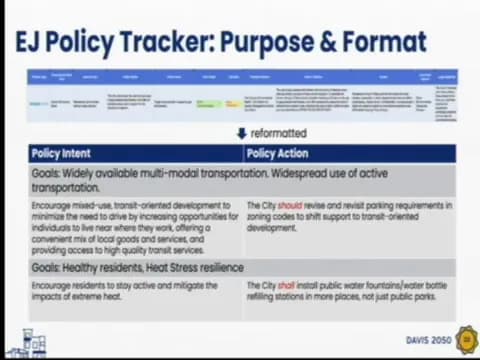
The Davis City Council met on Tuesday, August 19, 2025, at 6:30 p.m. in the Community Chambers, 23 Russell Boulevard, Davis, CA. Councilmember Josh Chapman was absent due to an unexpected death in the family. The meeting agenda was approved 4-0. Ceremonial Presentations - The Council proclaimed August 2025 as Breastfeeding Month. Jasmine Marquez accepted and noted that in Yolo County 95.3% of infants born in 2021 were ever breastfed, but only 35.4% were exclusively breastfed through six months, highlighting the need for more lactation support. - The Council proclaimed September 2025 as National Recovery Month. Zachariah Oquenda accepted, sharing his personal recovery journey and thanking community partners. City Manager and Council Reports - Interim City Manager Kelly Stachowicz announced the opening of Natalie's Corner splash pad, the upcoming school year, the Labor Day closure, commission recruitment open until September 12, a bike survey for platinum Bicycle Friendly status, Davis Neighbors Night Out on October 5, and Boo Bash tickets. - Vice Mayor Donna Neville reported preliminary discussions about making the Yolo Animal Services Joint Powers Authority more independent. Councilmember Gloria Partida asked about Boo Bash fee waivers. No consent calendar items were pulled. Public Comments & Testimony - Lois Wolk praised the new splash pad and urged the Council not to move forward with proposals to privatize city trees or abandon sidewalk maintenance. - Several speakers commented on homelessness-related consent items, including support for Heart of Davis Safe Parking, criticism of the camping ordinance, and calls for better respite facilities and more permanent housing. Barbara Clutter described the five-person safe parking program as not a robust response. - Commenters on the General Plan included Alan Hirsch (sound, visual, and enforcement concerns), Beth Bourne (opposed the UC Davis partnership), Alan Miller (satirical manifesto), and Katie Casseris (caution about losing dissenting commission views). - Commenters on trees and sidewalks overwhelmingly opposed transferring tree ownership to residents, including Anya McCann and Greg McPherson, who cited San Francisco's negative experience. Tree Davis representatives Ann Daniel, Don Shore, and William Shon urged continued partnership and increased planting. Yael Franco raised concerns about lion tailing and pruning standards. Consent Calendar - The Council approved the entire consent calendar 4-0. This included FTA/Unitrans agreements, PTASP certifications, Caltrans agreements, 2025 Traffic Impact Study Guidelines, acceptance of a California Highway Patrol Cannabis Tax Fund grant, LIMS update, Sewer System Management Plan update, reimbursement agreements, legal and accounting services contracts, the FY 2025/26 salary table, the 2025-2026 meeting schedule, the Cross-Connection Control ordinance, the response to the 2025 Yolo Grand Jury report on homelessness, a letter of support for the Affordable Housing Bond Act of 2026, and other routine items. Discussion Items City Manager Appointment - The Council unanimously appointed Daryel R. Dunston as City Manager on a four-year contract. The contract includes a base salary of $288,452, a 3% increase from the prior salary; a total compensation study in August 2026 and every two years; 160 hours of vacation accrual; a $200/month technology and transportation allowance; and up to a 3% performance bonus. Mr. Dunston addressed the Council, emphasizing public service and fiscal responsibility. Public commenters welcomed him. General Plan Update - Raimi Associates and UC Davis presented environmental justice work, including SB 1000 requirements, CalEnviroScreen screening maps, focus groups with underrepresented communities, a policy tracker, and a draft environmental justice framework. Councilmembers provided feedback on accessibility, integration into the General Plan, and more geographically specific hazard data. No formal decision was made on the environmental justice framework. - The Council approved formation of a General Plan Committee with two members from each of six commissions (12 total) plus a 13th at-large member from those commissions. The motion passed 4-0. Unmet Maintenance Needs for City Trees and Sidewalks - Assistant City Manager Stan Gryczko presented short-term changes, including a new tree inventory and a sidewalk inspection program, and long-term options such as transferring ownership, increasing revenue, or creating dedicated crews. Public comment was strongly supportive of maintaining public ownership of trees. - Councilmembers expressed opposition to privatizing existing city trees. Several favored exploring a sidewalk maintenance ordinance consistent with state law, while others supported voluntary tree stewardship or new-development ownership models. The Mayor asked staff to pursue the tree inventory, consider future revenue options such as a special tax, and return with more detailed cost estimates. AB 1234 and Long Range Calendar - The Council received AB 1234 reporting and discussed the long-range calendar. Staff will move the homelessness ecosystem update to September 16 and send a summary of that item to the Council. Key Outcomes - Agenda approved 4-0. - Consent calendar approved 4-0. - Daryel R. Dunston appointed City Manager 4-0. - General Plan Committee formation approved 4-0. - Council directed staff to move forward with a tree inventory RFP, prepare a sidewalk maintenance ordinance consistent with state law, return with refined long-term program options and cost estimates, and evaluate revenue measures. - The meeting adjourned in honor of Millie Bronstein, a longtime community advocate for health care and mental health.
The Davis City Council met on Tuesday, July 1, 2025, at 6:30 PM in Community Chambers. The meeting covered routine consent items, a Planning Commission request to explore UC Davis campus annexation, a presentation on the state of the nonprofit sector, an update on the Daytime Respite Center, an activation update for G Street Plaza, and council administration including subcommittee consolidations and calendar planning. The meeting adjourned for summer recess at approximately 10:30 PM. Consent Calendar - The council approved the agenda minus Item 3E (Palomino Place Final Map) which was pulled by the developer. Item 3L (Planning Commission request to explore annexation of UC Davis campus) was pulled by the mayor for discussion. - The remaining consent items were approved unanimously (5-0) and included: construction contract for traffic signal improvements, amendments for flooding hot spots and storm drain pump station design, adoption of the 2025 Moving Transportation Forward Plan, extensions for Chiles Ranch subdivisions, a grant application for a playground, updated salary schedule, authorization for city manager actions during recess, cross connection control program updates, re-adoption of military equipment use policy, and approval of commission minutes. Public Comments & Testimony - Ningwan (former Historical Resources Management Commission member) requested the city reorganize the commission, noting state requirements for designated historical monuments. - Speaker on annexation supported annexing the UC Davis campus, citing historical disenfranchisement of students and the desire for student voting rights. - Yolo County Association of Realtors representative requested clearer communication from the city regarding the Davis City resale inspection ordinance, stating frustration with lack of response to formal inquiries. - Respite center supporter urged the council to keep and invest in the respite center, moving it to South Davis if necessary, noting the center's value and the consequences of removal. - Alan Miller commented on various topics including nonviolence, anti-Zionist Jews, and the situation in Gaza. - Connor Goman (recorded) supported the fiscal commission's temporary reduction and urged broader definitions of expertise; also supported allowing the Planning Commission to explore UC Davis annexation. - Alan Hirsch (recorded) criticized the lack of shade at new bus stops, requested functioning drinking fountains at Central Park, and noted that recent hate incidents were limited to three graffiti incidents in 12 months. - Respite center neighbor described ease of alcohol purchase at the center by teenagers and the impact on the neighborhood. - G Street area resident complained about the plaza becoming a gathering spot for unhoused individuals, with misuse of bathroom facilities and litter, urging the city to find solutions. - Tracy Favor (Executive Director of Davis Community Meals and Housing) thanked the council for engagement and highlighted successful programs including peer support training and a new year-round flex bed shelter. - Diane Parrow and Doug Busby (board members of Davis Community Meals and Housing) reiterated willingness to partner and thanked the council for attention to homelessness issues. - Alan Miller (second public comment) praised the well-run neighborhood meeting on the respite center but noted continued problems with litter and police response in the area around 2nd and L Street. - Tim Hoban (K Street resident) described ongoing issues at Cedar Park including litter, drug use, and overnight camping, and urged moving the respite center. - Ben Blitzing questioned the cost-effectiveness of the respite center ($500k/year for 30-40 people) and suggested permanent housing instead; also criticized the location selection process. - Jessica Maria Ross (co-founder of Davis Manor Neighborhood Council) acknowledged recent improvements in communication and transparency but noted that crime statistics may not reflect actual impacts because residents have stopped calling police; asked to be included in future decision-making. - Connor Goman (recorded) supported the respite center as a valuable resource and suggested rotating or adding additional centers. - Gaina Lambang (recorded) strongly supported keeping the respite center in a central location and urged finding a permanent overnight shelter. - G Street commenter provided constructive feedback on the plaza design, suggesting more permanent infrastructure, better street resurfacing, and reducing barriers for businesses to use the space. - Another G Street commenter (in person) urged the city to expedite outdoor seating approvals for businesses, noting months-long delays. - Connor Goman (recorded on G Street) supported the car-free space and called for more social furniture, art, and low-barrier events. - Alan Hirsch (recorded on G Street) criticized the lack of tree planting and shade in the G Street plan, noting that $1 million originally allocated for downtown tree planting was redirected to this project. - Alan Miller (on subcommittee item) declined to speak. - Honey (recorded on long-range calendar) urged the council to set a concrete date to discuss restrictions on gas-powered leaf blowers, citing health and environmental concerns. - Alan Hirsch (recorded on long-range calendar) expressed concern about a potential privatization of city tree maintenance and a hidden structural deficit in the tree budget, calling for full disclosure. Discussion Items Item 3L: Planning Commission Request to Explore UC Davis Campus Annexation - Mayor Vaitla pulled the item and supported allowing the Planning Commission to research annexation, emphasizing collaboration with UC Davis and noting changes since 2010. - Councilmember Deos opposed, citing staff capacity constraints with the General Plan update and major development projects, and questioned fiscal benefits. - Vice Mayor Neville opposed, noting UC's constitutional independence, lack of property taxes, and potential liability; supported continued collaboration without annexation. - Councilmember Partida had concerns about timing but was not completely opposed; suggested focusing on smaller parcels like Royal Oaks. - Councilmember Chapman raised concerns about timing, the need for university and county involvement from the start, and staff capacity. - Public comments included support for allowing the commission to explore the idea and a statement from UC Davis's Director of Local Government Relations expressing willingness to discuss but noting university concerns. - Outcome: A motion by Mayor Vaitla to allow the commission to gather information without staff burden failed 4-1. A subsequent motion by Vice Mayor Neville to accept staff's recommendation not to move forward passed 4-1 (Mayor Vaitla dissenting). Item 4: Yolo Community Foundation Presentation – State of the Nonprofit Sector - Jessica Hubbard (Executive Director) and Carolina Valverde (Program Manager) presented findings from a survey of 68 nonprofit organizations in Yolo County. - Key statistics: 53% of organizations saw expenses increase by at least 10%, while only 37% saw revenue increase by 10%. 52% have less than six months of reserves (up from 29% in 2024). 30% can provide salaries that keep pace with inflation. 47% are concerned about declines in government funding. 48% report less than 10% BIPOC board representation, while over 50% of Yolo County residents identify as BIPOC. 44% are very concerned about staff burnout. - Council members thanked the presenters and discussed ways to support nonprofits, including volunteer portals and partnerships. - No action taken; informational only. Item 5: Daytime Respite Center Update - Interim City Manager Stachowicz provided a recap: the center (530 L Street) has operated since February 2020, managed by Downtown Streets Team since 2023, at an annual cost of $500,000 plus city staff time. Serves 40-60 people per day. - Survey results: 92 responses from Davis Manor, 56 from Huntwood/Da Vinci families. Top concerns: safety, increase in unhoused individuals, trash, yelling/violent language, encampments, public urination. Top suggestions: move the center and increase police patrol. - Council subcommittee (Neville & Partida) emphasized that no decision was made tonight but that a comprehensive analysis of homeless services, including duplication, is underway and will be discussed in September. - Public comments included both support for keeping the center (with improvements) and strong opposition citing ongoing problems with crime, litter, and safety. - No formal action; council directed staff to continue analysis and prepare a report for September. Item 6: G Street Activation Update - Directors Yancey, Chapman, and Machado presented on infrastructure, maintenance, and programming. Construction was completed early 2025; cable fencing replaced with more durable materials. Maintenance costs: $23,000 annually for staffing (2 part-time temps) and $25,000 for materials. Challenges include litter, misuse of facilities, and difficulty cleaning platform tiles. - Programming: teen summer kickoff (June 7) and planned pizza and paint night. Placemaking includes Adirondack chairs and potential murals. Outdoor dining licensing: 2 of 3 applications approved, with one business beginning operations. - Council discussion: Members supported low-barrier events, shade structures, better seating, and public art. They created a subcommittee (Councilmembers Partida & Neville) to work on short-term placemaking improvements over the summer recess. Council also expressed interest in exploring entertainment districts under new state law (AB 969). - Outcome: Motion to create subcommittee passed 5-0. Staff will report back in the fall on longer-term improvements. Item 7: Council Meeting Administration – Subcommittees and Calendar - Staff presented options for legislative calendar and subcommittee consolidations. - Council actions: - Renamed the Inclusionary Multifamily Rental Housing Ordinance subcommittee to Subcommittee on Inclusionary Housing Ordinance, with tasks to review the rental ordinance's performance and develop for-sale inclusionary requirements (motion passed 5-0). - Combined the Long Range Growth subcommittee with the General Plan Community Engagement subcommittee; disbanded the General Plan Solicit Staff Input subcommittee (motion passed 5-0). - Disbanded the Budget subcommittee (consensus, no formal vote needed). - Kept the Business Retention/Expansion and Business Attraction/Economic Growth subcommittees separate for now, with a plan to revisit in the fall. - Decided to wait until after August to finalize the 2026 summer recess schedule (July vs. August). - Council will continue to explore options for public comment procedures (e.g., transcribing voicemails, time limits). - Added items to the long-range calendar: urban forestry discussion (August 19), homelessness discussion (September 2), and a staff presentation on new housing/land use bills (SB 131 and AB 130) and available state housing funds. Key Outcomes - Consent Calendar: Approved (5-0) minus Item 3E and 3L. - Item 3L (Annexation): Council voted 4-1 to not move forward with the Planning Commission's request; staff recommendation adopted. - G Street Activation: Subcommittee formed (Partida & Neville) for short-term placemaking improvements; council to explore entertainment districts. - Subcommittee Changes: Inclusionary housing subcommittee renamed and retasked; general plan subcommittees consolidated; budget subcommittee disbanded; business subcommittees kept separate for now. - Calendar: Summer recess decision deferred; items added to future agendas including housing/land use bill overview and homelessness discussion in September.
The Davis City Council met on June 17, 2025, at 6:30 p.m. to discuss a full agenda including amendments to the consent calendar, advisory commission appointments, the adoption of the two-year operating and capital budget, public hearings on surveillance technology and military equipment, and a financing agreement for LED lighting. The meeting featured extensive public testimony, particularly regarding the Human Relations Commission, budget priorities, and community safety. The council took several votes and directed staff for future actions. Consent Calendar - The agenda was amended to remove consent item J (letter opposing Delta Conveyance Project streamlining) because state funding for the project was removed and the budget subcommittee rejected the streamlining provisions, making the issue moot. - The remaining consent calendar, including resolutions for sewer lift station redesign, janitorial services, wastewater chemicals, stormwater rates, EPIC grant, conservation easement grant, Promenade mitigation land plan amendment, city attorney contract extension, Valley Vision participation, and commission minutes, was approved unanimously (5-0). Public Comments & Testimony - Public speakers addressed multiple items during general public comment and on specific agenda items. - Commissions/Human Relations Commission (HRC): Approximately 20 speakers commented on the HRC and commission appointments. Many Jewish community members and allies expressed that the HRC's handling of the MAPA report and alleged anti-Semitism has harmed trust and called for the commission to be dissolved or restructured. Others defended the HRC as an important space for dialogue and urged the council not to disband it. Some speakers also addressed proposed reductions in commission sizes, with one former commissioner criticizing the council's treatment of citizen commissions. - Budget: Several speakers urged the council to restore $350,000 in funding for Veterans Memorial Theater (VMT) repairs, warning that deferred maintenance could force closure. Others criticized the budget for inadequate pavement funding, accusing the council of a "bait and switch" on Measure Q promises. A speaker praised funding for the 14th Street project and the Natalie Corona splash pad. One speaker called for a 10% reduction in general fund positions to achieve fiscal sustainability. - Surveillance Technology/Police Equipment: A speaker expressed support for downtown cameras to address crime, while another raised concerns about license plate readers violating privacy and constitutional rights. A recorded comment opposed militarized equipment, citing its use at protests and potential misuse for targeting reproductive health care seekers. - On-Bill Financing: One speaker requested that the city maintain the 2700K Kelvin standard for LED lights, noting past community preference for warmer color temperatures. Discussion Items - Appointments to Advisory Commissions (Item 4): - Council discussed proposed reductions in commission sizes. The subcommittee recommended temporarily reducing the Fiscal Commission from 7 to 5 members (permanent was changed to temporary after public comment) and temporarily reducing the Police Accountability Commission and Senior Citizen Commission from 7 to 5 members to ensure quorum. The council voted unanimously (5-0) to adopt all three reductions as temporary, with a commitment to recruit additional members. - After public comment, council voted on individual appointments per subcommittee recommendations, with some adjustments (e.g., Councilmembers Chapman and Deos successfully moved to appoint alternative candidates to several commissions). Final appointments were accepted by a vote of 5-0. Specific appointments included: Fiscal Commission – Kevin Harper (regular), Eric Fink (alternate); Planning Commission – Alan Bennett, Catherine Brinkley, Michelle Weiss (regular), Rachel Fulkirk Cook (alternate); Human Relations Commission – Jason Honig, Ellie Kaplan, Hilda Carrarada (regular), Kevin Baker (alternate); Recreation and Park Commission – Izzy Briscoe Schofield, Abir Mirza, Annalise Opreya (regular), one alternate left vacant; Climate and Environmental Justice Commission – Sarah Moore, Izzy Briscoe Schofield (regular), John Reuter (alternate); Police Accountability Commission – Cecilia Escomia Greenwald, Sheena Faber, Mohammed Sadohi, Angela Wilson (regular), Cecily Lerner (alternate); Open Space and Habitat Commission – Ramiro Caballeros Ledezma, Steve Greco, Patrick Huber, Eric Newman (regular), alternate left vacant for future recruitment; Social Services Commission – Sarah Brown Blake, Patrick Curzon, Conrad Franco, Christopher Ringer (regular), Dylan Horton (alternate); Transportation Commission – Beth Fouracre (alternate), James Giller (regular 2-year term), Mark Weesing, John Ostrom, Raymond Pesquell, Eric Thronson (regular 4-year terms); Senior Citizen Commission – Marcia Coupe, Thomas Roast, Jeffrey Stalnik (regular), alternate left vacant. - Fiscal Year 2025/26 and 2026/27 Budget Adoption (Item 5): - Finance Director Elena Adair presented the two-year budget: $245 million in FY2025/26 and $252 million in FY2026/27 (excluding transfers). The general fund shows revenue growth from Measure Q but a structural deficit of approximately $3 million annually. The fund balance is projected at 11.5% in FY26 and 11.1% in FY27. Capital improvement program includes $9.8 million for annual pavement maintenance, $8 million for cool pavement, and other projects. The council approved the budget resolutions unanimously (5-0) after discussion. - Council also passed a motion (5-0) directing the finance director to return at the mid-year fiscal update (delayed to January 2026) with a plan to achieve greater fiscal stability, identifying approximately $3 million in additional revenue or expenditure reductions. The motion acknowledged the need to address the structural deficit and the city's $10 million+ reserve target. - Public Hearing: Surveillance Technology Annual Renewals (Item 6A) and Davis Police Department Equipment Annual Report (Item 6B): - Police Chief Todd Henry presented 21 surveillance technologies for reauthorization, including Accurint, body-worn cameras, drones, license plate readers, and remote cameras. The Care Trak system is being discontinued. The department requested approval to add a new UAS model (drone) to inventory, funded by a state grant, to manage replacement costs amid tariff uncertainty. - For military equipment, Chief Henry outlined equipment including an armored rescue vehicle, chemical agents, flashbangs, rifles, and breaching tools. No policy violations were reported. The council held a public hearing and then voted unanimously (5-0) to approve the continued use of all surveillance technologies and to re-adopt the military equipment use policy and reauthorize the equipment. - Public Hearing: On-Bill Financing Loan Agreement for LED Lighting (Item 7): - Assistant City Manager Stan Gryczko presented a resolution to approve an on-bill financing agreement with PG&E and an energy conservation agreement with Eco-Green for LED lighting replacements at the Civic Center, pool/gym, and police department. The project has no upfront cost and is expected to save approximately $23,000 annually. The council held a public hearing and approved the resolution unanimously (5-0). Key Outcomes - Agenda amendment: Consent item J (Delta Conveyance Project letter) removed due to changed circumstances. - Commission size reductions: Temporary reductions for Fiscal, Police Accountability, and Senior Citizen commissions approved (5-0). - Commission appointments: All advisory commission appointments approved as recommended by the subcommittee, with minor modifications (5-0). - Budget adoption: Two-year operating and capital budget adopted (5-0). Council directed staff to return by mid-year (January 2026) with a plan for $3 million in fiscal stability measures. - Surveillance technology and military equipment: Continued use of all 21 technologies and reauthorization of military equipment policy approved (5-0). - LED lighting financing: On-bill financing agreement and energy conservation agreement approved (5-0). - Long-range calendar: Council added future agenda items on municipalization and developer agreements, economic development direction, gas leaf blower ban update, and review of council subcommittees.
This evening meeting of the Davis Planning Commission covered three main items: an informational presentation on proposed Traffic Impact Study (TIS) Guidelines, a public hearing on the 2025 Omnibus Zoning Ordinance amendments, and an update on the Long-Range Calendar. Commissioners also received staff announcements, approved consent calendar minutes, and discussed future work. The meeting adjourned at 8:59 PM. Consent Calendar - Minutes from March 12, 2025, were approved unanimously. Public Comments & Testimony - No public comments were offered for items not on the agenda or for the TIS presentation. - During the Omnibus Zoning Ordinance discussion, no public comments were received in the room or by phone. Discussion Items 1. Traffic Impact Study Guidelines (Informational) Ryan Chapman, Assistant Director of Public Works, presented draft guidelines that establish when and how traffic impact studies are required. Key points: - Studies triggered for projects generating 500+ daily new trips (with 100+ in AM or PM peak), in areas with existing congestion, or where safety concerns exist. - Studies not needed if criteria are not met or if a CEQA exemption applies (e.g., high low-income housing projects). - Analysis includes existing conditions, existing+project, cumulative scenarios, and multimodal integration (bike/ped). - VMT analysis follows state guidance: per capita VMT for residential, regional VMT for commercial. - No AI currently used for traffic counts; real counts preferred. - Commissioners asked about driver behavior, cut-through traffic, post-occupancy remedies, tree removal for sight lines, hierarchy of traffic calming, VMT metrics, and financial feasibility of transit assumptions. - Chapman noted that TIS reports are paid for by developers and that conditions can be imposed at approval but not retroactively. - Commissioners requested more visual data presentation (e.g., GIS maps) for future reports. 2. 2025 Omnibus Zoning Ordinance Amendments (Public Hearing) Thomas Oakner, Associate Planner, presented proposed amendments after 1.5 years of work. Major topics: - Parking: Removal of minimum parking requirements citywide per AB 2097 (within 1/2 mile of transit), while retaining development standards for provided parking. - Shade Structures: New alternatives for covered parking: option A maintains 50% tree shade within 15 years; option B larger tree footprints without 50% requirement; option C allows solar carports with 30% coverage. Staff proposed that solar energy be used on-site to offset tenant utility costs. - Definitions: Added/updated definitions for family (fair housing compliance), low-barrier navigation center, dwelling types (single-family, duplex) to clarify ADU rules. - Medical Services: Proposed replacing undefined “medical services” with defined “medical clinic” (two or more practitioners). Commissioners expressed concern this might be too narrow. - CUP Permit Extensions: Changed from 18 months + 18 months discretionary to a single 36-month period, with possible additional 18-month extension. - Public Hearing Notice: Proposed removal of 45-day deadline for hearing after application determination (to align with state noticing changes). - Other: Reduced rear yard setbacks for accessory structures (10 ft to 5 ft), eliminated minimum separation requirement, allowed arbors at zero setback, defined small storage sheds. Commissioners raised several concerns during clarifying questions, including: - Catherine Brinkley questioned the removal of the 45-day hearing timeline, the 30% solar carport coverage (suggested 50%), and the limitation of solar energy to on-site use. - Vince McLaughlin advocated for keeping the 18+18 month CUP extension and opposed changing “medical services” to “medical clinic” without a broader definition. - Alan Roe supported 50% shade and expressed concern about limiting solar benefit to tenants. - Georgina aligned with Brinkley and Roe on shade and solar. - Greg supported the 36-month extension based on developer financing challenges. - Johannes asked about SRO definitions and faith-based shelter impacts (none). 3. Long-Range Calendar Update Dara Dunworth, Principal Planner, provided updates: - General Plan Update: First public feedback meeting scheduled August 13, 2025 (not a regular commission meeting). Commission representatives to be selected through a transparent process in August/September, with first General Plan Committee meeting in October. - HRMC Merger: Historic Resources Management Commission to be merged into Planning Commission; staff working on structure, targeting fall 2025. - Large Projects: Village Farms and Willow Grove target council approval by January 6, 2026; staff aims to provide documents 7–10 days in advance. - Commission Schedule: No regular meetings in July 2025; August may have HRMC merger and nomination process items. Key Outcomes - Consent Calendar: Approved unanimously. - Omnibus Zoning Ordinance (Motion): Moved by Commissioner Brinkley, seconded by Commissioner Roe. Approved unanimously with the following amendments: 1. Restore the 45-day public hearing timeline in §40.22.180 (remove deletion). 2. Change solar carport coverage from 30% to 50% and remove the requirement that solar energy be used only on-site (in §40.25.060.F.3). 3. Hold the proposed change replacing “medical services” with “medical clinic” (in §40.13.013 and related sections) pending further staff analysis and broader definition of medical services. 4. Staff directed to add SB 9 and SB 450 updates to future omnibus amendments. - Traffic Impact Study Guidelines: Informational only; no vote taken. Commissioners’ feedback (e.g., visual data, VMT clarification, driver behavior modeling) to be incorporated. - Long-Range Calendar: Noted; no formal action.
The Davis City Council met on Tuesday, June 3, 2025, beginning at 6:30 PM. The meeting featured ceremonial proclamations for Juneteenth, National Gun Violence Awareness Month, and LGBTQ+ Pride Month. Extensive public comment centered on the Human Relations Commission's MAPA report and concerns about anti-Semitism. The consent calendar was approved with one item pulled for discussion. A public hearing on employee vacancies was held under AB 2561. The council continued its budget discussion for FY2025/26 and FY2026/27, making decisions on positions, fund reallocations, and capital projects. Consent Calendar - Approved items A (WWTP contract), B (Landfill environmental services), C (Property purchase for sewer project), and E (Commission minutes) unanimously (5-0). - Item D (Playfields Batting Cages) was pulled for separate discussion. Public Comments & Testimony - MAPA Report and Jewish Community Concerns: Many speakers opposed the HRC's MAPA report, calling it biased, inaccurate, and harmful to the Jewish community. Speakers including Alan Brownstein, Yuri Greiner, Daphne Ramille, Millie, and others argued the report vilifies Zionists and Jews, dismisses anti-Semitism, and could incite violence. Several noted recent hate incidents in Davis and elsewhere (e.g., Colorado, DC). A few speakers defended the report as a needed effort to address Islamophobia and anti-Arab discrimination, emphasizing the importance of listening to Muslim, Arab, and Palestinian community experiences. - Other Public Comments: Michael Scheer criticized sprawl development, bike path cracks, and tree damage. Caden Velasquez proposed an Entertainment Commission. Mel Kim thanked the city for her exchange experience. Robert Holland thanked for the gun violence proclamation but reported a "kill all Zionists" graffiti. Jordan Nelson and Juliet Beck thanked for arts funding. Les Portello requested preservation of the Boy Scout Cabin. Others spoke in support of Pride Month. Discussion Items - Playfields Batting Cages (Item 4D): Councilmember Chapman pulled the item. Staff recommended permanent closure due to $17,000 in needed netting repairs and ongoing deficit (28% cost recovery). Council discussed usage, youth engagement (only 26% of respondents under 18 had used them), and alternative funding. Council voted 3-2 to replace the netting and refer the matter to the Recreation and Parks Commission for further study on sponsorship and outreach. - Public Hearing on Employee Vacancies (Item 5): HR Director Christopher Bensch presented the AB 2561 report. The citywide vacancy rate dropped from 9.6% in 2024 to 9% through May 2025. The DCEA (Davis City Employees Association) president Mark Casala highlighted a 13.4% vacancy rate in their unit, increased workloads, and retention challenges. Council discussed four positions vacant over a year without recruitment, strategies for recruitment (reducing 127-day average) and retention (stay interviews, engagement surveys). - Proposed Budget Continued Discussion (Item 6): Finance Director Elena Adair provided updated projections. The general fund ending fund balance dropped to 10% by FY27 due to reduced cannabis tax projections. To reach 15% would require $4.9M in cuts or new revenue; to reach 12.5% requires $2.5M. Staff presented options: reallocating Crisis Now funding ($930K), Vets Theater rehab ($350K), de-obligating previously restricted funds ($1.4M), and freezing/removing vacancies. Council discussed each option. The Fiscal Commission subcommittee report was noted. Key Outcomes - Playfields Batting Cages: Motion passed 3-2 to replace netting and return to Recreation and Parks Commission for study. - De-obligated Restricted Funds: Unanimously (5-0) directed $1.4M to the 14th Street pavement project. - New Positions: Approved a new police officer for downtown beat and an aquatics maintenance technician (5-0). Staff directed to explore use of existing vacancies for the officer position and consult with Natalie's Corner committee on potential fundraising for the aquatics tech. Chief Henry to report back on operational alternatives. - Freezing/Removing Vacancies: Motion passed 4-1 (Mayor Vaitla dissenting) to remove the management analyst position (Social Services) and the 0.75 custodian position (Parks). Maintained both planner positions (with possible reorganization of one to building division) and the two limited-term accountants in Finance. - Crisis Now and Vets Theater Funding: Motion passed 5-0 to allocate $125K from Crisis Now funds to the county pilot program and move the remainder ($805K) plus $350K from Vets Theater rehab into general fund reserve for future policy discussions on homelessness and urban forestry. - Future Agenda Items: Council requested future agenda items on lighting updates, electricity access for unhoused, encampment ordinance update (including citation data and safe parking program), G Street activation options, voluntary electrification progress, and gas-powered leaf blower phase-out transition.
The Davis Planning Commission met on Wednesday, May 28, 2025, at 7:00 PM in Community Chambers. The meeting included approval of previous minutes, a public hearing for a Starbucks Conditional Use Permit and Design Review at 4525 Fermi Place, and a detailed review of the Commission’s initiated task list. Key outcomes included unanimous approval of the Starbucks project with an added condition for a signal timing study, and prioritization of several tasks for future council consideration. Consent Calendar - Approved minutes from the February 12 and February 26, 2025 Planning Commission meetings by unanimous vote. Public Comments & Testimony - One speaker opposed the Starbucks project, citing concerns about the company’s labor practices (union busting) and the presence of multiple existing Starbucks in Davis. No other public comments were received on non-agenda items. Discussion Items - Starbucks CUP & Design Review (PA 24-52, CUP 03-24, DR 12-24): The applicant (Green River Holdings LLC) seeks to convert a vacant Chase bank building into a Starbucks with a drive-thru, outdoor seating, and site improvements. Staff recommended approval subject to conditions. Commissioners discussed traffic queuing, potential impacts on the existing Starbucks on Mace Blvd., bike access, and the need for a left-turn lane study. The applicant clarified that Starbucks is a tenant, not a franchisee, and stated the existing Mace store is the highest-performing in the region and will remain open. The commission voted unanimously to approve the Conditional Use Permit and, with an added condition for a signal timing study at the intersections of Second Street & Mace Blvd. and Second Street & Fermi Place, the Design Review. Both resolutions included CEQA exemptions. - Commission Initiated Task List Update: Principal Planner Dara Dungworth reviewed each item on the task list. Key outcomes: - AB 1033 (Commissioner McLaughlin): Tabled to next available meeting (likely August/September). - City/County Agreements (Commissioner Brinkley): Information item; staff to bring back by next available meeting. - Annexation of UC Davis Campus (Commissioner Brinkley): Action-oriented task to be elevated to City Council; staff will prepare a report and aim for the June 17 council meeting. Commissioners raised concerns about property tax impacts and student housing. - Cannery Design (Commissioner Rowe): Information item; staff to provide a “quick and dirty” report on lessons learned from Cannery density for upcoming projects (Village Farms, Willow Grove). Subcommittee possibility to be explored. - Cannery Farm (Commissioner Valencia): Information item; staff working with Tracy Reynolds to produce an FAQ document; expected next available meeting. - Citizens Planning Academy (renamed “Planning Academy”): Action-oriented task; staff directed to prioritize Annexation first, then this item. Subcommittee formation to be discussed. - Removal of Single Family Zoning (Commissioner Brinkley): Information item; tabled and referred to the General Plan Update process. Staff will report back on how to incorporate into the GP update. - Onboarding (Commissioner Troost): Staff and Commissioner Troost to meet with City Clerk to refine a best-practices document; comments to be routed through staff. - Schools Enrollment Presentation: Presentation already given to City Council on April 1; links provided in packet. - CFD Tutorial (new item 10): Added to the task list by consensus; formal vote to be agendized at next meeting. Key Outcomes - Starbucks Project: Unanimous approval (7-0) of both the Conditional Use Permit and Design Review, with the Design Review conditioned on a signal timing study to be paid for by the applicant. - Task Prioritization: The commission directed staff to: - Elevate the UC Davis Annexation task to City Council (staff report by June 17). - Prepare an information report on Cannery Design lessons for upcoming projects. - Continue developing the Planning Academy task as a second priority. - Table AB 1033 and Single Family Zoning removal to future meetings. - Future Meetings: June 11 agenda includes the Omnibus Zoning Ordinance Amendment, Traffic Impact Study update (by City Engineer), appointment of General Plan Update committee reps, and task updates. No meetings scheduled for June 25 or July; August 13 meeting replaced by a General Plan public feedback workshop.
On May 28, 2025, the Davis City Council held a special workshop at the Davis Senior Center (Valente Room) to continue discussing the proposed FY 2025/26 and FY 2026/27 biennial budget received by the Council on May 20. The agenda is dated May 27, 2025, 3:30 P.M., while the provided meeting timestamp is 2025-05-28 11:30:00+00:00; this summary uses the provided timestamp date. Consultant Bob Leland of Baker Tilly presented the 20-year forecast, and staff presented the Capital Improvement Program (CIP) list. No formal budget vote was taken; the Council provided feedback and requested additional analysis. Agenda Approval - The agenda was approved unanimously, 5-0. Public Comments & Testimony - Elaine Roberts Musser said the city’s tight finances follow years of councils avoiding fiscal reality; she opposed accounting devices, further deferral of road and bikeway maintenance, and shifting tree and sidewalk responsibilities to homeowners. She supported using Measure Q sales tax revenue for pavement maintenance, restoring the general fund reserve to 15%, and paying down unfunded retiree health liabilities. - A resident who identified as a homeowner, walker, jogger, and driver said street conditions are becoming dangerous and urged immediate repair, arguing that delaying pavement work for five years would create an unmitigated disaster and cost far more later. - A speaker representing the Community Action Network, identified as TV, encouraged the Council not to strip social services and to collaborate with DJUSD, UC Davis, and community partners through talent sharing, public-private partnerships, and joint grant applications to address the $2.8 million budget gap. - Holmes Holk asked what two areas of further budget review staff had referenced and what residents should do to prepare. Discussion: Long Range Financial Forecast - Bob Leland presented a 20-year forecast showing that even with Measure Q, the proposed budget contains a $3.2 million built-in shortfall in FY 2025/26, a $2.8 million shortfall in FY 2026/27, and an average shortfall of about $2.3 million through FY 2034/35. Without Measure Q, the city would face nearly a $15 million annual shortfall, a fund balance that never recovers, and much deeper fiscal distress. - Measure Q is projected to add $11.2 million when fully received in FY 2026/27, but the forecast still leaves expenditures above revenues. - Leland attributed the worsened outlook to six categories: personnel costs up $1.3 million, pension costs up $2.4 million, internal service charges and vehicle replacement up $2.4 million, insurance up $2.2 million, professional services up $0.7 million from the prior forecast, and other operations plus lower expense credits adding about $2.9 million. Professional services grew from about $2 million in FY 2021/22 to $6-7 million in recent years, with about $6 million proposed in the next two years; some of that growth was one-time ARPA spending. - Key assumptions included 2.5% cost-of-living adjustments plus 0.25% net step/turnover, vacancy rates around 4.7% in FY 2025/26 falling to 4%, continuation of FY 2026/27 staffing, no fourth fire station or new service expansions, 2.5% non-personnel inflation, a $3 million annual general fund contribution to streets and bikeways, moderate recessions every seven years beginning July 1, 2026, and $12 million in assigned ARPA reserves excluded from available balance. - Risks and uncertainties included higher-than-budgeted vacancies, better or worse CalPERS returns, adverse impacts on UC Davis and higher education from federal and state budget actions, restrictive federal policies, pessimistic consumer sentiment, and continued insurance cost increases. - Leland recommended adopting the proposed budget but treating FY 2026/27 as temporary; avoiding hasty permanent cuts; slowing position filling; not adding new ongoing expenditures; and updating the model as information develops. - Councilmembers noted that without cuts the reserve would remain flat at about 10%, and a sustained $3 million annual reduction could return the reserve to the 15% target in about three years. They asked for additional scenarios using four- or five-year timelines. - Some councilmembers said spending reductions alone were insufficient. One cited the failed 2018 transportation parcel tax, which received 57% support but fell short of the required supermajority, and resident survey results showing 79% satisfaction with city services, 65% trust in the city to manage tax dollars, and 79% support for raising taxes to maintain services. Another councilmember warned against cutting affordable housing or homelessness programs because residents consistently rank those as top concerns. Discussion: Capital Improvement Program - Staff described the CIP process: a late-fall call for projects, prioritized lists from asset groups, project budget sheets, funding source allocations, and reprioritization with finance and the city manager. - More than 60 projects requested new or additional funding for the biennium; only the green-highlighted projects were proposed for funding in the next budget cycle. Roughly 50 active capital projects are continuing. - Unfunded or partially funded requests included design-phase projects requiring local grant matches, stormwater compliance work, transportation projects, water projects, and annual projects such as facility roof replacement, ADA improvements, street structures, street lights, and traffic signals. - Councilmembers emphasized the public safety importance of the H Street tunnel for children biking to school. Staff plan to separate the H Street scope so tunnel and bikeway work can proceed first, with pavement work deferred until after pump station work; the pump station project may be debt-financed through stormwater rates. A temporary pavement overlay was discussed but cost roughly $500,000 and was not considered justified before reconstruction. - A councilmember referenced a possible $24 million Cool Pavement grant, while another thought it was $50 million; staff said the application is one of 3,200 under federal review, with about 10% reviewed so far, and funds must be obligated by the end of the federal fiscal year. - In response to a question about the police station generator, staff said the existing generator is at risk of failure and supports dispatch, so replacement is proceeding; the design was adjusted to allow future battery integration, and replacement will meet Tier 4 emissions and efficiency standards. Key Outcomes - The Council approved the agenda 5-0 and took no final action on the budget, CIP, or long-range forecast. - Staff were asked to return on June 3 with program-level cost information for major general fund programs, CIP funding source details, funding restrictions, and implications of leaving projects unfunded. - The Council requested reserve modeling for reaching the 15% general fund reserve in three, four, and five years, including the annual spending reductions each scenario would require. - Staff were also asked to identify staff priorities among unfunded or partially funded CIP projects and to explain where funding could or could not be swapped between projects. - The Council requested that future long-range forecast presentations occur earlier in the budget cycle, roughly six to eight months before budget deliberations. - The Interim City Manager noted that urban forestry and homelessness will receive deeper policy discussions, and the biennial budget is expected to be adopted by the end of June.