Browse by city
Date range
Search help

Search titles, summaries, topics and stored transcripts together. Keywords may match separately; put the whole query in double quotes for a phrase. Matching follows word analysis, so punctuation is not exact. Both dates are included. Documents are not searched.

SHOWING 41–50 ENTRIES
41
DEC 9, 2025 · DAVIS, CALIFORNIA · CITY COUNCIL & PLANNING COMMISSION
Davis City Council Meeting – December 9, 2025: Measure JRD Amendments and Proclamations

The Davis City Council met on Tuesday, December 9, 2025, at 2:30 PM (local time) to discuss a ceremonial proclamation for Yolo County Housing's 75th anniversary, hear public comments on various community issues, and deliberate on potential amendments to Measure JRD. The council took no final action on the amendments but provided direction to staff on preferred exemption categories and timing. The consent calendar was approved 5-0. Consent Calendar - The agenda was approved unanimously (5-0) after a roll call vote due to remote participation. - The consent calendar was also approved 5-0 with no items pulled. Public Comments & Testimony - Jean Jackman (Davis resident 55 years) expressed concern about reduced public comment time (2 minutes) and inability to show illustrations, calling it "authoritarianism creep." - Wayne Raymond (Voices of California) invited the council to the chorus's holiday show on December 13 at the Richard Brunel Theater. - Jack (Davis Skate Park Association) thanked the council for supporting the skate park project, emphasizing its community-building value. - Ingrid Gennetty (neighbor of L Street respite center) criticized the center's failure after six years, citing broken promises and safety concerns for nearby Da Vinci Charter Academy students. She asked the council to honor the initial plan to move the center. - Ningwan made disjointed claims about forgery and family assets involving a person named Jenny Tan; comments were not directly relevant to the agenda. - Alan Miller (neighbor) sang a song calling for shutdown of the respite center, labeling it a "total failure." - Tristan (skate park supporter) reiterated the mental health and community benefits of a new skate park. - Beth complained about sexually explicit books in the Davis library's teen section, urging removal. Council warned her not to disrupt the meeting. - Aaron (skate park supporter) expressed support for additional funding for park features. - Larry Strozick (voice message) opposed the Village Farms project, citing previous emails. - Unidentified caller advocated for expanded democracy, including making UC Davis part of the city. - Laswan Skog opposed building along the railroad track and requested a complete EIR. - David K. called for a complete EIR for Village Farms, criticizing the push during the holiday season. - Multiple callers and in-person speakers opposed amending Measure JRD, citing the overwhelming voter approval (75% in 2010, 83% in 2020) and arguing that the measure is not the problem—poorly planned projects are. Examples: Mary Ann Hernandez, Susan Rainier, Elizabeth Ray, Rena Nyer, Sharon Monteuth, Victoria Link, Nancy Price, Elaine Roberts Musser, Alan Miller, Ricardo Masselli, Dr. Grant Holstein, Alan Jack, Catherine Keller, Smith Wang, Ginga Zeitenberg-Strosic, Carl Timothy Wallace, Christina Buss (supported amendment but not on same ballot as pending projects), and others. - Connor Gorman supported additional exceptions but with high affordability thresholds (e.g., 15% affordable). - Margie Longo pointed out existing exemptions in Measure J, stating no amendment is needed. - Several callers requested deferral of discussion until after the holiday season and until 2030 renewal. Discussion Items Measure JRD Amendment Options Staff (Sherry Metzger, Community Development Director, and Kelly Stakowitz, Assistant City Manager) presented results from a joint commission meeting ("Commission Palooza") held in October 2025. Commissioners suggested several potential exemptions from a Measure JRD vote: - Achieving carbon neutrality or net-zero VMT. - Creating renewable energy systems or resiliency hubs/microgrids. - Payment into a community fund. - Setting an urban limit line (pre-zoning and pre-General Plan land use designations). - Higher affordable housing percentages than inclusionary ordinance requirements. - Transit/infrastructure improvements (e.g., Covell Boulevard line). - Based on poor soil quality (less viable agricultural land). Staff emphasized the need for measurable, objective criteria. Council discussion focused on affordability, carbon neutrality, and community benefits. Council Deliberation - Councilmember Chapman (subcommittee member) clarified that the evening's purpose was to receive staff feedback, not to make a final decision. He emphasized that any exemption must be measurable, focus on affordable housing production (e.g., 20-30% low-income), include a significant community benefit, and consider carbon neutrality. He rejected soil quality exemption as too easily abused (e.g., Village Farms site). - Mayor Pro Tem (referred to as Mayor in transcript) framed the discussion around housing equity, stating Measure J has contributed to residential segregation and fiscal challenges. He proposed a high bar for exemptions: 50% income-qualified housing (e.g., 10% extremely low, 10% very low, 10% low, 20% moderate), net-zero carbon, and discretionary community benefits. He argued for putting the amendment on the November 2026 ballot, noting the city is already two years late on its housing element commitment. - Vice Mayor Neville supported further analysis of an urban limit line but opposed placing the amendment on the 2026 ballot to avoid confusing voters with two pending development projects (Village Farms and Willow Grove). She emphasized honoring the council's earlier commitment not to combine them. She also questioned the feasibility of the existing 100% affordable exemption and noted that staff should study the urban limit line idea more. - Councilmember Deos (remote) supported the concept of creating a unified vision but expressed concern about setting affordable housing percentages too high, fearing no projects would be built. She was intrigued by the urban limit line but wanted more information. She agreed not to put the amendment on the 2026 ballot to avoid muddying the waters for Village Farms and Willow Grove. - Councilmember Parcita (remote) thought amendments should be considered because the measure is 25 years old and community values evolve. She emphasized affordability as the top priority, and that other proposals (carbon neutrality, etc.) should be standard for all developments, not exemptions. She was skeptical of the urban limit line. She supported more community outreach beyond commissions. - Mayor ultimately requested continued work on the amendment content in parallel with General Plan updates, and suggested a poll to assess voter sentiment on a dual ballot (development project + JRD amendment). Staff and project applicants (Gloria from Village Farms) pushed back, citing capacity constraints and cost. A majority of council (Neville, Deos, Parcita) opposed a 2026 ballot, with some open to 2027 if fiscally feasible, but no later than 2028. Key Outcomes - No final decision on Measure JRD amendments or ballot timing. - Council directed staff to focus future analysis on affordable housing thresholds (e.g., 50% income-qualified), carbon neutrality/net-zero, and possibly an urban limit line (mixed council support). Soil quality exemption was dismissed. - No consensus on ballot timing: A majority of council opposed putting the amendment on a 2026 ballot. The mayor's suggestion to poll the community was effectively tabled after pushback from staff and the Village Farms applicant. - Staff will continue work but prioritize pending development projects (Village Farms, Willow Grove) due to capacity. A workshop on the Village Farms development agreement is scheduled for December 16, 2025. - Next steps: The item may return after the General Plan update process or following the 2028 election, with council hesitant to commit to a specific date. Councilmember Parcita called for more community input outside the usual commission process. - Other: The ceremonial proclamation for Yolo County Housing's 75th anniversary was approved. The council also set a long-range calendar with workshops on December 16 and potential public hearings on Village Farms in January 2026.
AFFORDABLE HOUSING 20% · PUBLIC ENGAGEMENT 19% · HOUSING 19% · GENERAL PLAN UPDATE 15%
42
DEC 2, 2025 · DAVIS, CALIFORNIA · CITY COUNCIL & PLANNING COMMISSION
Davis Planning Commission Special Meeting - December 2, 2025: Continuance of Village Farms Public Hearing

The Davis Planning Commission held a special meeting on Tuesday, December 2, 2025, at 7:00 p.m. in Community Chambers. The sole agenda item was a public hearing on the Village Farms Davis project (proposed 1,800 units on 497.6 acres) but the meeting focused only on a request to continue the hearing to a date certain. After receiving public comment, the commission unanimously voted to continue the public hearing to Wednesday, December 17, 2025, at 6:00 p.m. Public Comments & Testimony - One in-person speaker attempted to address matters unrelated to the continuance (AI governance) and was asked by the chair to confine comments to the agenda item. The speaker did not speak to the continuance and was thanked after a brief exchange. - Roberta Millstein (calling in) provided detailed testimony opposing the December 17 continuance. She argued that the Planning Commission should not act on the Village Farms project until the completed Final Environmental Impact Report (FEIR) is available, which she stated would not be ready until approximately January 10, 2026. She expressed concern that the December 17 meeting would rely on incomplete information, particularly regarding the capacity of the wastewater treatment plant. She cited California Government Code §65106, stating that public officials must furnish available information to the planning agency upon request, and questioned whether acting without the FEIR would violate this code. She characterized the rushed timeline as driven by the developer's and city's desire to place the project on the June 2026 ballot, not by proper process. She concluded that the commission could meet on December 17 but should not formally weigh in on the project on that date. Discussion Items - Vice Chair Alan Bennett (acting as chair) clarified that the only item on the agenda was the continuance. He noted that the commission has a meeting on December 10 for the Willow Grove project and reminded commissioners of a large draft EIR to review. - Chair Michelle Weiss proposed starting the December 17 continuation meeting at 6:00 p.m. rather than the usual 7:00 p.m. to accommodate expected lengthy public comment. Commissioners agreed via a poll. - Principal Planner Dara Dungworth confirmed that for the December 17 meeting, the commission would receive a full agenda packet including a draft development agreement, appropriate resolutions, draft ordinances, and a staff report, but not the final EIR. She stated that a partial recirculated draft and most draft responses to comments are already available. - Commissioner inquiries confirmed that the packet would also include baseline features. Staff indicated they would attempt to release materials earlier than the standard Friday (December 12) before the meeting. Key Outcomes - Motion: Commissioner Vince McLaughlin moved to continue the public hearing for the Village Farms project to December 17, 2025, at 6:00 p.m. Commissioner Alan Bennett seconded. The motion passed by unanimous consent (all commissioners present voted aye). - Next Steps: The public hearing on the Village Farms Davis project entitlements (including General Plan Amendment, Zone Change, Planned Development, Development Agreement, and Annexation/SOI Amendment) is now scheduled for Wednesday, December 17, 2025, at 6:00 p.m. in Community Chambers. The commission noted they would not have the final EIR available before that meeting.

PROCEDURAL 62% · ENVIRONMENTAL PROTECTION 19% · WATER AND WASTEWATER MANAGEMENT 19%
43
NOV 18, 2025 · DAVIS, CALIFORNIA · CITY COUNCIL & PLANNING COMMISSION
Davis City Council Meeting – November 18, 2025: Homelessness, Building Codes, and Downtown Assessment

The City Council met on November 18, 2025, starting at 6:34 p.m., to address a full agenda including the adoption of the 2025 California Building Standards Code, renewal of the Downtown Business Improvement District (DBID) assessment, and a comprehensive update on homelessness services. Key decisions included approving the building code update (5-0), renewing the DBID assessment (4-0 with one recusal), and directing staff to explore alternative locations for the daytime respite center while continuing operations at the current L Street site through March 2026. Consent Calendar - Item 3C – Cannabis Audit Services: Pulled by Councilmember Deos due to concerns about costs for small businesses. Staff will return in December with a revised compliance structure. - Item 3D – Lease Amendment with Davis Community Meals and Housing: Pulled and reordered to follow Item 6. Approved 5-0. - All other consent items (3A, 3B, 3E, 3F) approved unanimously. Public Comments & Testimony - Several residents shared personal experiences of homelessness and safety concerns at the L Street respite center. Speakers expressed both support for continued services and strong opposition to the current location, citing neighborhood impacts, drug use, and after-hours disturbances. - Multiple commenters raised concerns about an adult woman approaching children near schools to ask about gender identity and genitalia. They requested a local ordinance to prevent such harassment. - A resident raised concerns about bicyclists and scooter riders running stop signs, urging police enforcement. - Others spoke in favor of keeping the respite center at L Street, highlighting its value for showers, laundry, and a safe space. - A UC Davis student stood in support of transgender rights and against harassment at schools. - Several members of the public urged the council to consider alternative locations such as the Civic Center Gym or adjacent to Paul’s Place. - A speaker requested the city explore a resolution to divest from Musk holdings, citing labor and human rights concerns. Discussion Items - Item 4 – 2025 California Building Standards Code: Staff presented the triennial update effective January 1, 2026. One public commenter expressed concern about increased home construction costs ($28,000–$40,000 per home). The council approved the ordinance 5-0. - Item 5 – DBID Annual Assessment Renewal: The 2026–2027 assessment is estimated at $241,000, a 12% decrease due to business closures. The council approved the report, resolution to levy, and pass-through agreement with the Davis Downtown Business Association 4-0 (Councilmember Chapman recused). - Item 6 – Homelessness System of Care Update: Extensive deliberation on the fate of the daytime respite center at 809 11th Street (L Street). Council discussed: - Respite vs. navigation center definitions: Council consensus to focus on basic respite services (showers, laundry, safe space) rather than full case management. - Staff proposals: Operate in-house with 2 new FTEs (cost $317,000 annually) or contract with one of three applicants (The Gathering Inn, Volunteers of America, Yolo County Children’s Alliance – proposals $30,000–$39,000/month). - Cost concerns: Current homeless outreach team (3 FTEs, $468,537/year) and respite center operations ($501,516/year) total $970,000. - Data and metrics: Councilmembers expressed need for better outcome data, though basic usage numbers exist (e.g., 223 guests since Oct 28, 2025). - Location: Councilmembers Partida, Deos, and Neville favored exploring alternatives (especially Civic Center Gym); Councilmembers Chapman and Vaitla preferred staying at L Street with improved community engagement. Key Outcomes - Item 6 – Homelessness Update: Motion passed 5-0 to: - Keep the respite center operational at the L Street location through at least March 2026. - Continue temporary staffing at the respite center (current two Downtown Streets Team employees) through March while exploring long-term staffing options. - Move the three current homeless outreach coordinators to be based at the respite center, effective immediately, and continue rotating one for coverage. - Direct staff to conduct a thorough analysis of alternative locations (including the Civic Center Gym) and provide cost estimates for making them respite-ready by the first meeting in February 2026. - Develop a comprehensive community engagement plan with L Street neighbors, including a written agreement outlining expectations, impact mitigation, and after-hours response. - Return to council in March 2026 (mid-year budget) with final recommendations on staffing and location. - Item 3C – Cannabis Audit: Staff directed to return in December with an alternative audit structure to reduce costs for small businesses. - Item 7 – Long Range Calendar: Council agreed to place a MAPA (Mitchell Park Area) item on consent for a future meeting, deferring to February 2026. Council also indicated interest in a symbolic resolution supporting divestment from Musk holdings; city manager to bring back a draft. - Public Safety: Council acknowledged concerns about school harassment and directed staff to review existing legal mechanisms; Police Chief may report back.

HOMELESSNESS 49% · PROCEDURAL 14% · PUBLIC ENGAGEMENT 7% · PUBLIC SAFETY 4%
44
NOV 4, 2025 · DAVIS, CALIFORNIA · CITY COUNCIL & PLANNING COMMISSION
Davis City Council Workshop on Village Farms Project and Proclamations – November 4, 2025

The Davis City Council met on Tuesday, November 4, 2025, at 6:30 p.m. in the Community Chambers. The meeting began with ceremonial presentations, followed by the consent calendar, public comments, and a major workshop on the proposed Village Farms Davis project. No final decisions were made on the project; the council provided direction to staff on key issues including housing, transportation, sustainability, parks, and community benefits. Ceremonial Presentations - Six proclamations were presented: Veterans Day (Nov 11), Small Business Saturday (Nov 29), Law Enforcement Records and Support Personnel Week (Nov 10–14), Native American Heritage Month (November), 2025 Yolo Philanthropy Awards recipients, and reaffirmation of friendship with sister city Uman, Ukraine. Mayor Pletnyova of Uman spoke, thanking Davis for support during the war. Consent Calendar - Approved unanimously (5-0) with Councilmember Chapman recusing from item 4F (Downtown Business Improvement District assessment). Items included fiber-optic infrastructure agreement, accounting services contract amendment, firewall replacement, grant acceptances (FEMA/Cal OES cybersecurity, Office of Traffic Safety), DBID assessment, and second reading of zoning omnibus amendments. Public Comments & Testimony - Hate crime incident: A resident described a Halloween night attack at her home, alleging Antifa involvement. Commenters urged council to condemn such behavior. - Divestment from Elon Musk: Multiple speakers (including UC Davis students and community members) urged the council to halt new contracts with Musk-controlled companies, divest from Tesla, and call on CalPERS/CalSTRS to stop Tesla purchases. They cited labor violations, misinformation, and democratic concerns. - Village Farms Project: Over 60 public comments (in-person and voicemail) addressed the project. Supporters cited housing affordability, school enrollment, and smart growth. Opponents raised concerns about floodplain risks, toxic contamination from the adjacent landfill, traffic impacts, inadequate affordable housing commitments, and incomplete documents. Many called for a reduced footprint and binding commitments. - Other: Comments on street conditions, bike/pedestrian safety (including a student's plea for safer crossings), the city's respite center, and arts funding. Discussion Items 5. Village Farms Davis Project Workshop This workshop was the main agenda item. Staff and the applicant team presented the proposed 1,800-unit development on 200+ acres (with 47 acres preserved for habitat). The council discussed each exhibit in turn, providing feedback: - General Plan Amendment: Council supported staff’s recommendation for land use designation LU 1.1E and the agricultural designation for the borrow site. - Pre-Zoning and Preliminary Planned Development: Council urged more attached/smaller-lot homes and fewer large single-family lots to improve attainability. They asked for further refinement with the subcommittee. - Affordable Housing Plan: Council strongly opposed the proposed Project Individualized Program (PIP) that substituted land dedication and fees for on-site construction. They directed the applicant to pursue the ministerial approach (construct 275 affordable units on site) with a firm performance schedule, ensuring affordability for very low-, low-, and moderate-income households. The down payment assistance program and co-op proposals should be explored but not replace actual construction. - Transportation Features: Council insisted that grade-separated crossings at Pole Line Road and F Street be included as baseline features. They preferred the vehicular connection to the Cannery roundabout be limited to bike/ped/emergency vehicles only, pending further traffic analysis. A grade-separated crossing at Covell Boulevard near Nugget Market was deemed a high priority. - Sustainability Features: Council supported exploring local VMT mitigation instead of buying carbon offsets, and urged inclusion of infrastructure for a future microgrid (conduit, poll boxes). They asked for details on transit subsidies (e.g., YOLO bus passes) and enhanced bike infrastructure. - Agricultural Mitigation: Council accepted the 107-acre borrow site for future agricultural use after soil restoration. They directed that strong restoration language be in the development agreement (not baseline features) with a five-year trial and mitigation fees if farming fails. - Parks: Council prioritized early phasing of parks with affordable housing, lit playing fields, and inclusive playgrounds. They supported a gym/multi-purpose room as a potential resilience hub. Funding mechanisms (e.g., CFD) should be established. - Community Benefits: Council supported the pre-K early learning center and educational farm in partnership with the school district. Regarding the fire station site, they requested a comprehensive analysis of long-term operational costs and alternative locations before committing. - Wetland Preservation: Council concurred with staff’s three commitments: conservation easement, deed restriction, and long-term management plan. - Phasing: Affordable housing and parks should be built early to maximize benefit. The applicant confirmed they are open to negotiating a performance schedule. Key Outcomes - Council Direction: The applicant team and staff will revise the affordable housing plan to ensure on-site construction of 275 affordable units with a binding timeline. The transportation, sustainability, parks, and community benefits exhibits will be updated accordingly. - Next Steps: Staff will incorporate council feedback into the draft Development Agreement and baseline project features, then return for a public hearing (scheduled for December 16, 2025, or January 6, 2026). The project will ultimately go to the ballot under Measure J/R. - AB 1234 Reporting: No reports were made. - Adjournment: The meeting was adjourned at approximately 2:00 a.m. in honor of Betsy Marchand, former Yolo County Supervisor.

AFFORDABLE HOUSING 15% · VILLAGE FARMS 15% · HOUSING 10% · PUBLIC COMMENT 9%
45
OCT 22, 2025 · DAVIS, CALIFORNIA · CITY COUNCIL & PLANNING COMMISSION
Davis Planning Commission Workshop on Village Farms Project – October 22, 2025

Davis Planning Commission Workshop on Village Farms Project – October 22, 2025\n\nThe Davis Planning Commission held a workshop on Wednesday, October 22, 2025, at 3:00 PM to receive public comment and provide feedback on the proposed Village Farms development agreement and related land use items. No decisions or votes were taken. The meeting included staff and applicant presentations, extensive public testimony, and commissioner discussion on exhibits covering affordable housing, sustainability, transportation, agriculture, parks, financing, phasing, community benefits, and baseline project features. The commission rescheduled the public hearing to December 10, 2025, to allow for completion of the Final Environmental Impact Report and a draft Development Agreement.\n\n Consent Calendar\n- The commission approved the minutes from the September 10, 2025, meeting with amendments suggested by Commissioner Brinkley to include discussion of traditional ecological knowledge and to rephrase language about school closures to reflect that closures are not a foregone conclusion.\n\n Public Comments & Testimony\n- Former Councilmember Dan Carson spoke against a fourth fire station (estimated $3.4 million annual cost) and a city-run down payment assistance program, suggesting the 2.5-acre fire station site be used for affordable housing instead.\n- Many residents expressed strong support, citing critical housing needs, declining school enrollment, and the need for workforce housing. Supporters included Leslie Blevins (Yolo County Association of Realtors), Hiram Jackson (school board member, personal capacity), and several teachers and young families.\n- Many residents voiced opposition, raising concerns about floodplain risks (100-year flood zone), toxic contamination from an old landfill and PFAS, traffic congestion on Covell and Pole Line, fast-tracking of the project, and lack of binding commitments in documents (phrases like \"to be determined\" and \"if feasible\"). Speakers such as Margie Longo, John Zeller, Alan Prior, Eileen Samets, and others urged scaling back the project or delaying until details are finalized.\n- Several callers on the record also supported the project, emphasizing its climate resilience, electric vehicle infrastructure, and habitat preservation.\n\n Discussion Items\n- Staff Presentation: Dara Dunworth reviewed the general plan amendment, preliminary plan development, and development agreement exhibits. Key changes included withdrawal of the density-averaging text amendment and a shift to the biological resource preservation alternative (47.1 acres of habitat conservation).\n- Applicant Presentation: Rochelle Swanson and Brian Foster presented the project: 1,800 residential units (360 affordable, including 140 very-low-income and 140 low-income units, plus 80 co-op units), $4.9 million in down payment assistance, 100% electric with no gas, and two grade-separated bike/ped crossings (Pole Line undercrossing and F Street overcrossing). Phasing starts with grading, then phase one includes L Street extension, roundabout, and undercrossing.\n- Commission Discussion (by exhibit):\n - Affordable Housing Plan (Exhibit E): Commissioners generally supported Social Services Commission recommendations but wanted stronger financial contributions (beyond $2 million), an income cap on down payment assistance (80-120% AMI), and more certainty on the co-op model. Some suggested a lump-sum payment instead of incremental.\n - Sustainability (Exhibit F): Broad support for all-electric, solar, and microgrid provisions. Concerns raised about building in the 100-year floodplain; Commissioner Valencia suggested developing only outside the floodplain (about 1,100 units).\n - Transportation (Exhibit G): Support for grade-separated crossings and bike/ped improvements. Discussion on the cannery road connection (traffic doubling but still low volume), cut-through traffic analysis, and desire for a Covell bike/ped overcrossing. Commission favored including crossings in baseline features.\n - Agricultural Features (Exhibit H): Debate over the borrow pit restoration. Commissioner Valencia argued the 107-acre area functions as a detention basin and should not be designated agriculture. Others supported a performance bond for restoration and a fallback ag mitigation if restoration fails.\n - Parks (Exhibit I): General concurrence with Parks and Recreation Commission recommendations; indoor gym noted as desirable but not mandatory.\n - Financing (Exhibit K): Questions about a community facilities district (CFD) for maintenance and the impact on affordability.\n - Phasing (Exhibit L): Appreciation for front-loading affordable housing. Commission wanted clearer color differentiation and timing estimates.\n - Community Benefits (Exhibit O): Split on the fourth fire station; many preferred dedicating the 2.5 acres for future city use rather than a fire station. Educational farm and pre-K land dedication supported but noted need for school district commitment.\n - Baseline Project Features: Commission recommended including grade-separated crossings, affordable housing commitments (with increased cash contribution), full electrification/solar, and a guarantee that the borrow pit is restored or mitigated (two-to-one ag mitigation) in the baseline features voters will see.\n\n Key Outcomes\n- The commission did not take any formal action; the meeting served as a workshop to inform ongoing development agreement negotiations.\n- The public hearing on Village Farms was rescheduled to December 10, 2025, to allow staff to release the Final Environmental Impact Report and a draft Development Agreement well in advance.\n- Commissioners emphasized they would not vote on the project without a final EIR and a draft DA.\n- Key directives for staff and applicant: strengthen affordable housing financial commitments, ensure grade-separated crossings are in baseline features, clarify the borrow pit restoration plan with a performance bond, and provide more detail on the down payment assistance program (income cap, administration).

AFFORDABLE HOUSING 20% · TRANSPORTATION SAFETY 13% · DEVELOPMENT AGREEMENT 10% · PROCEDURAL 7%
46
OCT 21, 2025 · DAVIS, CALIFORNIA · CITY COUNCIL & PLANNING COMMISSION
Davis City Council Meeting – October 21, 2025: Proclamations, Appointments, Zoning Amendments, and Affordable Housing Discussion

The Davis City Council met on Tuesday, October 21, 2025, at 6:30 PM in Community Chambers. The meeting featured ceremonial proclamations, routine consent items, public comments on a range of topics, appointments to advisory commissions, formation of a General Plan Committee, adoption of the 2025 Omnibus Zoning Ordinance and Municipal Code Amendments, and an informational discussion on affordable housing production. Key actions included unanimous approval of most consent items, several resolutions related to commission appointments, and council direction on clarifying questions about the affordable housing ordinance. Ceremonial Presentations - Indigenous Peoples Day (Second Monday in October): Proclamation read by Vice Mayor Neville; Nijona Ellenwood (Chair, Davis Joint Unified School District Native American Parent Advisory Committee) accepted, acknowledging Patwin homelands. - United Nations Day (October 24): Proclamation read by Mayor Vaitla; Edgar Trujillo (President, UNA Davis Chapter) accepted, noting the 80th anniversary of the UN. - World Polio Day (October 24): Proclamation read by Councilmember Chapman; Kay Ressler and Alan Telford accepted, highlighting Rotary International's 40-year effort reducing polio cases by 99.9% to only 20 cases worldwide in 2025. - Domestic Violence Awareness and Prevention Month (October): Proclamation read by Councilmember Partida; Maria Isabel Mandujano (Empower YOLO) accepted, noting the Promotora model and requesting trauma-informed sensitivity training for city personnel. - Filipino American History Month (October): Proclamation read by Councilmember Chapman; Valentino Tianco (Co-Chair, Davis Los Baños Sister Cities) accepted, emphasizing the Filipino community's role in labor and agriculture. Consent Calendar The consent calendar (Items A–H) was approved unanimously 5–0, with Item G removed for separate discussion. - A. Amendment to Task Order 34 for Central Park Revitalization construction management. - B. Rejection of bids for the 2025 Annual Re-Striping Maintenance Project. - C. Yolo Basin Foundation interpretive public art agreement. - D. Amendment 2 to artwork purchase contract for N Street Park with Cjay Roughgarden. - E. Adoption of 2025 California Building and Fire Codes (first reading, public hearing scheduled for November 18). - F. Reappointment of Dr. Christopher Barker to Sacramento-Yolo Mosquito and Vector Control District. - G. Human Relations Commission (HRC) action item (pulled for discussion, see below). - H. Commission minutes from Fiscal, Open Space, Police Accountability, and Transportation commissions. Public Comments & Testimony - Beth Bourne (Moms for Liberty Yolo County) criticized the Hate Free Together summit, alleging she was given a false start time and that no Christian or conservative groups were invited. She expressed opposition to trans rights and cited assault at a prior protest. - Alan Miller condemned antisemitic chants at UC Davis on October 7 and criticized the city and university for not acknowledging the incidents. - Nimuan accused Jenny Tan (former city employee) of being a communist and of misusing personal funds; she objected to a public art project with a serpent design. - Yana Maduhano thanked the council for Indigenous Peoples Day and urged awareness of the Indian Child Welfare Act and resources for Native American students. - Audriana Martine (call-in) strongly opposed the Village Farms housing development adjacent to the Cannery neighborhood, citing traffic congestion and environmental impacts. - Alan Hirsch (call-in) criticized the I-80 tolling mitigation plan delay (19 years) and lack of funding for tree care, referencing a fatal tree incident in Slide Hill Park. - Speaker (call-in, name not given) opposed new restrictions on commission subcommittees and supported the HRC's ability to address the Civil Rights Ordinance. - Caller (name not given) urged reopening the respite center and establishing a winter shelter at the old Davis High School gym. - Kevin Baker (former civil rights attorney) spoke in support of the HRC retaining investigation and mediation roles, noting that informal processes can be constructive. - Beth Bourne (on HRC item) argued that trans rights conflict with women's rights; she displayed a graphic of a transgender athlete and asserted that the HRC should exclude conservative viewpoints, citing her exclusion from the Hate Free Together summit. - Dorda Jensen stated that political viewpoints were discriminated against in the Hate Free Together summit and called for inclusivity. - Alan Miller (on HRC) questioned the commission's effectiveness and suggested dissolving it. - Alan Hirsch (recorded on omnibus zoning) urged enforcement of tree ordinances, citing non-compliance by landlords and developers. - Wesley Sagewalker (Gateway Development) spoke on affordable housing, arguing that current inclusionary housing requirements are a barrier to housing production and urged policy changes. - Alan Miller (on affordable housing) said simply "affordable housing is not." Discussion Items Item G – Human Relations Commission Action Item Councilmember Partida pulled Item G. Staff proposed two parts: (1) approve HRC's task to review its webpage, and (2) pause the proposal to develop an action plan for the Civil Rights Ordinance until the City Attorney completes a review of Chapter 10 (which includes investigation/mediation duties). Council asked clarifying questions about the scope of HRC's investigatory powers and legal constraints. After public comment, council voted unanimously 5–0 to approve the first recommendation (webpage review). For the second recommendation, council also voted 5–0 to pause the action plan. Additionally, council passed a separate motion (5–0) directing the HRC to establish a subcommittee to study how comparable HRCs in California address discrimination, including the source of authority for investigations. Item 5A – Appointments to Fiscal Commission and Police Accountability Commission Council appointed two regular members to the Fiscal Commission and two regular members to the Police Accountability Commission from a pool of five candidates recommended by the Council Subcommittee on Commissions (Neville & Partida). All appointments were approved unanimously after a brief public comment supporting increased membership. Item 5B – Formation of General Plan Committee Council approved (5–0) a resolution forming a General Plan Committee (GPC) with 13 members drawn from six commissions to reconcile conflicting policy recommendations from different general plan elements. Council discussed Brown Act considerations and confirmed that commissioners would represent their respective commissions' positions. Public comment supported the committee but suggested including non-commissioners in future housing element committees. Item 6 – 2025 Omnibus Zoning Ordinance and Municipal Code Amendments Staff presented amendments including updated definitions, removal of minimum parking requirements per AB 2097 (with alternative covered parking options to reduce urban heat island effect), and administrative approval of parcel mergers/lot line adjustments for four or fewer parcels. Council clarified questions about tree shading requirements and public facility exemptions from downtown form-based code. After public comment, council voted unanimously 5–0 to adopt both ordinances (first reading). Item 7 – Affordable Housing Production: Implementation of Article 18.05 This was an informational item to prepare for a November 4 workshop on specific development proposals. Staff presented an overview of the inclusionary housing ordinance, a hypothetical 700-unit development showing required 130 affordable units (18.5%), and outlined two clarifying questions: (1) should staff conduct a financial review even when a developer does not request city assistance? (2) should the evaluation of Project Individualized Plans (PIPs) be objective or subjective? Council provided extensive feedback: - On question 1: Council generally supported staff conducting its own pro forma analysis (using public data and staff expertise) to enable informed negotiations, even if developers cannot be compelled to share private financials. However, Councilmember Deos expressed skepticism about the legal basis and practicality of financial review without developer cooperation. - On question 2: Council preferred a combination of objective standards (as currently in the code for ownership) with some flexibility for subjective evaluation to address changing needs. Several members stressed that PIPs should produce affordability at least equivalent to the standard requirement, with a strong nexus to income targets. Council also noted the need to incentivize deed-restricted for-sale units and extremely low-income units. Staff will incorporate this feedback into a future code amendment process, likely in early 2026. Council also noted the upcoming November 4 workshop on Village Farms and directed staff to return with a comprehensive update on inclusionary housing policies for both rental and for-sale. Key Outcomes - Consent Calendar (less Item G) approved 5–0. - HRC webpage review approved 5–0; pause on Civil Rights Ordinance action plan approved 5–0; additional motion to study other HRCs approved 5–0. - Appointments to Fiscal Commission and Police Accountability Commission approved unanimously. - General Plan Committee formed and members appointed (5–0). - 2025 Omnibus Zoning Ordinance amendments adopted (first reading, 5–0). - City Manager’s August 1234 report acknowledged; no other council members submitted meeting reports. - Meeting adjourned in memory of Ted Wilshusen, a longtime Davis resident and Earth Festival volunteer.

AFFORDABLE HOUSING 16% · HOUSING 15% · ARTS AND CULTURE 12% · PUBLIC COMMENT 12%
47
OCT 8, 2025 · DAVIS, CALIFORNIA · CITY COUNCIL & PLANNING COMMISSION
Joint Commission Meeting on Measure J/R/D Amendment - October 8, 2025

The Climate and Environmental Justice, Fiscal, Open Space and Habitat, Planning, and Social Services Commissions held a special joint meeting on October 8, 2025, to discuss potential amendments to Measure J/R/D (the Citizens Right to Vote on Future Use of Open Space and Agricultural Lands). The meeting was driven by state Housing and Community Development (HCD) requirements tied to the city's certified housing element. Staff presented several possible exemption categories to incentivize affordable housing and community benefits. Commissioners and public speakers provided extensive feedback, with no formal votes taken. The feedback will be forwarded to the City Council for consideration. Public Comments & Testimony - Matt Williams (former commissioner): Stated Davis has a housing shortage, not a crisis, and urged focus on building smaller, naturally affordable homes (e.g., 900 sq ft, $500k max) rather than large luxury units. - Jean Jackman (55-year resident): Strongly opposed amendments, arguing Measure J already has exemptions and 83% of voters renewed it in 2020. Criticized recent council actions (reducing commissions, public comment time) as authoritarian. - Jim Flanagan (longtime resident): Opposed amendments, citing the 83% vote for Measure D. Stated existing exemptions are adequate and that any change would undermine citizen oversight. - Mark Houser (Vice Chair, Transportation Commission, personal capacity): Urged that any environmental mitigation exemption must address transportation emissions (79% of CAP baseline). Criticized listing roads as a community benefit, arguing they increase driving. - Jim Watson (resident): Supported Measure J but wanted clear definitions of affordable housing. Questioned the feasibility of 50% affordable and called for projects that keep teachers and police in town. - Tim Hoban (50-year resident): Begged commissions to protect Measure J, warning that even small amendments could invite legal challenges and gut the measure. Feared reckless growth. - Elizabeth Ray (resident): Opposed changes, arguing Measure J is the only check on developer-driven projects. Cited consolidation of commissions and reduced public comment time as erosion of democracy. - Rena Neyer (resident): Urged keeping Measure J intact. Blamed past city councils for allowing in-lieu fees instead of building affordable housing. Stated HCD letters do not pose imminent threats. - Desiree Rojas (resident): Opposed amendments due to national uncertainty and lack of infrastructure. Called for smarter, inclusive development with at least one-third affordable set-asides. - Alex Ackamore, Richard McCann, Tim Keller (Davis Citizens Planning Group): Supported targeted amendment focused on workforce housing. Proposed density (15+ units/acre), a transit line along Covell, and land dedication instead of unit percentages to avoid perverse incentives. Provided detailed handouts. - David Sandino (attorney): Argued the city is already in compliance with HCD by adopting housing ordinance changes. Recommended postponing Measure J changes until 2028-2029 and focusing on current projects (Village Farms, Willow Grove, Nishi). - Eileen Samets (former planning commissioner): Strongly opposed amendments. Said HCD letters contain no threats. Stated Measure J is needed to stop bad projects like Village Farms, which has toxics, floodplain issues, and traffic impacts. Discussion Items Staff Presentation (Sherri Metzker, Community Development Director): - Explained that HCD required the city to consider amending Measure J to facilitate affordable housing as a condition of housing element certification. - Noted that the current 100% affordable exemption has never been used and is effectively unattainable. - Presented four potential exemption categories: (1) 50% affordable housing (mix of moderate, low, very low, extremely low), (2) substantial environmental mitigation (e.g., carbon neutrality, microgrid, ag mitigation), (3) community benefits (e.g., renewable electricity, shelters, roads), and (4) an urban limit line. - Emphasized that exemptions would still require full public review through planning commission and city council. Climate & Environmental Justice Commission: - Commissioner Jim Cramer: Supported exemptions but only for truly exceptional benefits, not items already required by code. Suggested net-zero VMT or GHG reduction as a criterion. Expressed doubt about the feasibility of 50% affordable. - Commissioner Ann Daniel: Called for creative community benefits, such as funding for urban forest and tree ordinance enforcement. - Commissioner Alana Gamage: Questioned relying on the market for climate/environmental justice. Suggested a broader theory of action. - Chair Jacob Byrne: Supported VMT reduction as a metric, recommended adjacency to existing development to prevent leapfrog, and argued that Measure J currently impedes affordable housing, harming environmental justice populations. Fiscal Commission: - Commissioner Nile Garritson: Favored a direct financial contribution in lieu of Measure J vote; dismissed other community benefits as too subjective or global (not local). - Commissioner Eric Vink: Called most exemption ideas “squishy” and urged focus solely on affordable housing as the objective, objective criterion. - Vice Chair Mitchell Marubayashi: Suggested community benefit agreements (CBAs) could address specific local concerns (e.g., traffic). Emphasized the need for public education that the state is driving this change. Open Space & Habitat Commission: - Commissioner Steve Greco: Proposed requiring developers to establish endowments for management of natural drainage features (like West Pond). Supported a tight urban limit line combined with Measure J for areas outside it, with periodic votes (e.g., every eight years). - Commissioner Marc Vayssieres: Skeptical of carbon farms (not measurable/permanent) and renewable electricity on ag land. Found the urban limit line interesting if it excluded sensitive habitat. - Commissioner Sara Geonczy: Favored extensive habitat features as a community benefit, and an urban limit line that avoids requiring extensive hydrological engineering. - Chair Patrick Huber: Preferred a case-by-case approach where developers make the case to the commission; wary of a rigid urban limit line that could stifle creative solutions. Planning Commission: - Commissioner Rachael Fulp-Cook: Recommended a single exemption for projects providing at least 50% affordable housing. Supported an urban limit line considered separately. - Commissioner Catherine Brinkley: Urged clear metrics, not squishy negotiations. Suggested designating JRD-exempt parcels during the general plan update. Emphasized public trust and the need to preserve open space. - Commissioner Vince McLaughlin: Predicted a tough election if the amendment is poorly messaged. Recommended focusing on an urban limit line as the most understandable option. Called for immediate public education about state pressure. - Commissioner Georgina Valencia: Questioned the rush since Measure J expires in 2030 and the housing element runs to 2029. Argued that climate and community benefit issues belong in the general plan, not in JRD. Called the 50% number unfeasible without analysis. - Commissioner Greg Rowe: Noted that affordable housing is effectively subsidized housing; the old 35% inclusionary worked only with redevelopment funds. Supported studying Urbana’s timing-and-sequencing model for an urban limit line. Recalled that in 2022, planning commission asked council for clear guidelines but got none. Opposed putting multiple projects and JRD amendment on the same ballot. Social Services Commission: - Vice Chair Sarah Brown-Blake: Leaned toward an urban limit line for simplicity and voter comprehension. Warned against multiple exemption criteria that confuse voters and against placing the amendment on the same ballot as major projects. - Commissioner Chris Ringer: Emphasized that the state wants to remove governmental impediments; we need clarity on what that means. Found the entire exercise “squishy.” - Commissioner Judy Ennis: Gave a detailed statement supporting ambitious but achievable exemptions. Recommended 25% deed-restricted affordable (big A) plus additional pathways (co-ops, missing middle) to reach 50% total. Called for climate-ready design and community resilience hubs. Argued that the current 100% exemption was written to be unused. - Commissioner Dillan Horton: Stressed the need for extensive public outreach; warned that many voters are unaware of the state’s role. Insisted affordable housing must be the chief exemption, not secondary to other benefits. - Commissioner Chris Ringer (second): Urged staff to consult with actual affordable housing developers to determine a feasible percentage. Noted that many California cities have similarly unworkable 100% exemptions. Key Outcomes - No formal votes were taken. The meeting was designed for discussion and feedback only. - Consensus emerged on several points: - Any exemption must be simple, objective, and voter-friendly. - Affordable housing should be the central focus; community benefits and environmental mitigation are secondary and risk being “squishy.” - The 50% affordable number needs feasibility analysis; some suggested 25% as more realistic. - An urban limit line was viewed as a potentially clear and understandable tool, but concerns were raised about flexibility and long-term changes. - Public education about state pressure is essential for any ballot measure to succeed. - Next steps: - Feedback from all commissions will be compiled and presented to the City Council. - Several commissioners recommended further discussion within individual commissions and with the Transportation Commission (not present). - The general plan update process was seen as the appropriate vehicle for some related decisions (e.g., urban limit line, climate metrics). - No timeline for placing an amendment on the ballot was set; some urged waiting until 2028-2029.

HOUSING 28% · AFFORDABLE HOUSING 20% · PROCEDURAL 9% · CLIMATE CHANGE MITIGATION 7%
48
SEP 30, 2025 · DAVIS, CALIFORNIA · CITY COUNCIL & PLANNING COMMISSION
Davis City Council Meeting - September 30, 2025: Peripheral Projects and Policy Considerations

The Davis City Council met on Tuesday, September 30, 2025, at 6:30 PM in the Community Chambers. The meeting focused on policy considerations for peripheral housing developments, including a workshop on traffic impact fee programs and climate/energy requirements for the Village Farms Davis and Willowgrove projects. The Council also approved the consent calendar, heard public comments, and adjusted the timeline for upcoming public hearings. Consent Calendar - Approved all consent calendar items (3A–3G) unanimously (5-0), including task order amendments for Bretton Woods, Chiles Ranch, and Davis Center projects; an amendment to a bill credit agreement with Clean Energy Assets LLC; renewal of the Independent Police Auditor contract with The OIR Group; approval of Transportation Commission tasks on traffic safety, intelligent transportation systems, and speed hump policy; and approval of minutes from the Human Relations and Planning Commissions. Public Comments & Testimony - In-person comments: - Dorda Jensen expressed concern about the absence of a police officer at council meetings and requested an explanation. - Alan Hirsch (Davis Loraks) urged the city to enforce tree planting compliance in developments and raised concerns about the Human Relations Commission's handling of Jewish community divisions. - A speaker recounted a personal incident involving a burn and lost possessions, requesting assistance from city staff. - Comments on Item 4 (Peripheral Projects): - Multiple residents and representatives urged the Council to avoid delays to the Village Farms and Willowgrove projects, citing the need for additional housing to stabilize school enrollment and support local families. Speakers included parents, realtors, and community advocates. - On traffic fee study: Brian Fosher (Village Farms engineer) and Clark Morrison (Village Farms attorney) requested more time to review the scope of the proposed fee study and raised technical concerns. Bree Mobius (Willow Grove counsel) supported the study and agreed to contribute costs. - On microgrids: Ari Helberstat, Lorenzo Kristov, and Mark Harsing urged the Council not to defer microgrid requirements, arguing for local energy resilience and affordability. John Johnston proposed delaying projects until the General Plan update. Alan Prior warned against imposing costly, undefined microgrid requirements. Sabrina Teller (Village Farms CEQA counsel) cautioned that imposing a microgrid now could trigger recirculation of the EIR. Tom McCalmon (Willow Grove engineer) stated that on-site solar could offset 62% of annual load but that full microgrid/net-zero was impractical for affordability. - A few callers submitted voicemail comments in support of microgrids and higher density, while most callers expressed support for moving forward with Willow Grove without further delay. Discussion Items - Policy Considerations for Peripheral Projects – Traffic Impact Fees (Item 4): Staff recommended Alternative 2: a focused fee program covering only Village Farms Davis and Willowgrove, using existing traffic analysis data. The study would cost $360,000 (to be split between the two projects) and take 4–6 months. Councilmembers Neville, Deos, Partida, and Chapman supported this option, emphasizing it would not delay project timelines. The motion passed 5-0. - Policy Considerations for Peripheral Projects – Climate and Energy (Microgrid): Staff presented three options: (1) defer microgrid requirements until the General Plan update, (2) create a community microgrid through ad hoc negotiations, or (3) pause processing of peripheral projects. Council discussion revealed lack of support for any of these binary options. The Council instead directed staff to work with the City’s new Climate Resilience Coordinator, Sam Blacklock, and the project subcommittees to develop a list of feasible climate resilience options (aligned with the Climate Action and Adaptation Plan) that would not trigger EIR recirculation or delay project timelines. This direction will be presented at the November 4 workshop. - Long-Range Calendar (Item 5): Staff proposed moving the public hearing for Village Farms from December 2 to December 16 to accommodate councilmember travel. The calendar was confirmed as: November 4 workshop, November 12 Planning Commission, December 16 City Council public hearing, and January 6 City Council public hearing. Key Outcomes - Consent Calendar: Approved 5-0. - Traffic Fee Study: Council directed staff to proceed with Alternative 2 (focused fee program for the two peripheral projects). Motion carried 5-0. - Climate/Energy Direction: Council rejected the three staff options and instead directed staff to work with the Climate Resilience Coordinator and project subcommittees to develop feasible climate resilience options for the November 4 workshop, with the guardrails of no EIR recirculation and no project delays. - Scheduling: The Village Farms public hearing was moved to December 16, 2025 (from December 2), to ensure all five councilmembers could attend. The full calendar was confirmed. Note: The meeting lacked formal minutes; this summary is based on the agenda and raw transcript.

AFFORDABLE HOUSING 18% · CLIMATE CHANGE MITIGATION 14% · PUBLIC COMMENT 13% · SUSTAINABILITY AND RENEWABLE ENERGY 12%
49
SEP 24, 2025 · DAVIS, CALIFORNIA · CITY COUNCIL & PLANNING COMMISSION
Davis Planning Commission Meeting - September 24, 2025: Historic Resources Transfer and General Plan Subcommittee Selection

The Planning Commission met on Wednesday, September 24, 2025, at 7:00 PM in Community Chambers, 23 Russell Boulevard, Davis, CA. The meeting was called to order by Chair Michelle Weiss. Commissioners present: Alan Bennett (Vice Chair), Catherine Brinkley, Vince McLaughlin, Greg Rowe, Johannes Troost, Georgina Valencia, Michelle Weiss (Chair), and Rachael Fulp-Cooke (Alternate). Three commissioners were absent. The agenda was approved unanimously. Staff present: Principal Planner Dara Dungworth, Senior Planner Eric Lee, Associate Planner Thomas McNair, and City Clerk Zoe Morley. Council Liaison Donna Neville attended. Consent Calendar - Minutes from June 11, 2025: Approved on a motion by Commissioner Rowe (second by Commissioner McLaughlin). Commissioner Fulp-Cooke abstained as she was not present at that meeting. - City Street Standards (Informational): Approved as part of the consent calendar. Commissioner Brinkley expressed that the standards seemed disproportionately focused on bicycle/pedestrian facilities and lacked consideration of traffic flow and calming. She noted the standards had not come before the Planning Commission despite being reviewed by the Transportation Committee and approved by the City Council in February 2025. Public Comments & Testimony - No public comments were recorded or made in person for items not on the agenda or on the consent calendar. Discussion Items - Historic Resources Management Introduction (Item 6A): Senior Planner Eric Lee presented an overview of the transfer of historic resource management responsibilities from the now-disbanded Historic Resources Management Commission (HRMC) to the Planning Commission, effective after the HRMC's final meeting in June 2025. The Planning Commission will serve as the city's historic body for Certified Local Government (CLG) status. Key duties include: overseeing historic designations (43-44 local landmarks/merit resources), reviewing certificates of appropriateness (no fee), maintaining the cultural resources inventory, environmental review, and updating related ordinances (Article 40.23, 40.4A, 40.14A). A proposed update to the Planning Commission's enabling resolution (purpose and functions) was presented. Commissioners discussed: - Catherine Brinkley asked about experiences of other cities that merged historic and planning commissions; staff cited reasons including volunteer shortages and streamlining. City Clerk Zoe Morley noted that staff workload and community interest changes drove the decision. - Greg Rowe inquired about the 300-foot notification clause for developments near historic resources; staff noted it has rarely been invoked in recent years and may be revised. - Vince McLaughlin praised the HRMC's legacy and asked about training plans; staff indicated formal training (a “101”) would likely occur early 2026 after ordinance amendments are brought back (targeted for December 2025). He also asked about four pending items from the HRMC’s final meeting (College Park historic district management plan, historic markers, eligible historic districts, historical surveys); staff will integrate those into the transition. - Rachael Fulp-Cooke noted that the enabling resolution’s third function (historic resources) seemed too broad compared to the first; staff explained the ordinance will provide details. - Chair Michelle Weiss suggested a subcommittee to assist with training to ease staff burden; staff noted a standing subcommittee would have separate Brown Act requirements and might be harder to maintain than having the full commission handle historic matters. - Commissioners expressed openness to self-study and further discussion. - General Plan Update PC Subcommittee (Item 6B): Associate Planner Thomas McNair explained the need for two commissioners to serve on a subcommittee that will meet with staff and consultants during business hours to develop high-level land use concepts for the General Plan update. Nominations were made: - Greg Rowe was nominated by Vince McLaughlin and accepted. - Vince McLaughlin was nominated by Greg Rowe and accepted. - Catherine Brinkley was nominated by herself and accepted. A voice vote was taken: Commissioner Rowe received 5 votes, Commissioner McLaughlin received 3 votes, and Commissioner Brinkley received 2 votes. Greg Rowe and Vince McLaughlin were appointed to the subcommittee. Long Range Calendar & Staff Updates - Principal Planner Dara Dungworth provided updates: - 500 G Street: Revised draft affordable housing plan submitted for Social Services Commission review. - 240 G Street: 18-month extension being processed. - Davis Collection: Grand opening held; mostly leased up. - Omnibus 2025: Finishing touches, with two new chapters going to City Council. - General Plan update: On track; Commission Palooza (major JRD amendment) scheduled for October 8, 2025 (workshop). - Village Farms Project: Workshop on October 22, public hearing on November 12. Final EIR responses are being wrapped up; a final decision by City Council is targeted for December 2, 2025. Staff confirmed the Commission can act based on draft EIR if necessary. - Willow Grove: Draft EIR release expected within weeks; public meeting on October 30 (special meeting). Community outreach by developer occurred on September 25 at Harper Junior High. - Other: Outdoor dining and mobile vending ordinances in progress. - Commissioner Vince McLaughlin requested a future agenda item to report on the safety survey that was a condition of approval (Condition 30) for the URE extension project (intersection at Risli, Shasta, and West Covell). Staff agreed to coordinate with engineering and report back. Key Outcomes - Consent calendar items (minutes and City Street Standards) approved. - Commissioners provided feedback on the proposed Planning Commission functions update and historic resources transition; staff will incorporate input and bring ordinance amendments and a revised enabling resolution to a future meeting (targeted December 10, 2025). - Subcommittee for General Plan update land use concepts formed: Greg Rowe and Vince McLaughlin appointed. - Staff to report back on the URE safety survey and its timing. - Next meeting: October 8, 2025 – Commission Palooza (major JRD amendment workshop).

HISTORIC PRESERVATION 47% · PROCEDURAL 14% · URBAN PLANNING 11% · GENERAL PLAN UPDATE 8%
50
SEP 18, 2025 · DAVIS, CALIFORNIA · CITY COUNCIL & PLANNING COMMISSION
Woodland-Davis Clean Water Agency Board Meeting – September 18, 2025

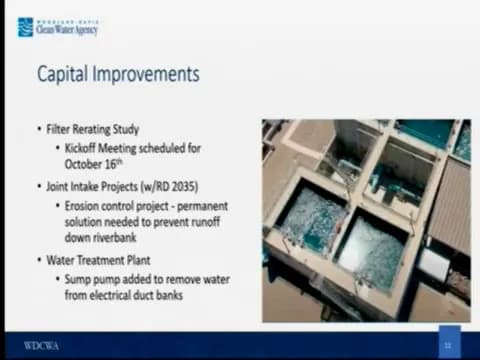
The Woodland-Davis Clean Water Agency (WDCWA) Board of Directors held its quarterly regular meeting on Thursday, September 18, 2025, at 3:00 p.m. in the Davis City Hall Council Chambers. Chair Tom Stallard presided. Board members present: Vice Chair Josh Chapman, Director David Moreno, Director Donna Neville. Participating agency representative Heather Davis (UC Davis) was present. Director Angel Barajas (non-voting) was absent. The board approved three resolutions, heard a comprehensive General Manager update, and set next meeting for January 15, 2026. Consent Calendar - Approval of June 26, 2025 Meeting Minutes – Approved by unanimous consent. - Approval of Treasurer’s Quarterly Report 4Q-FY25 – Approved by unanimous consent. Public Comments & Testimony - No public comments were offered. Discussion Items Item 3: General Manager Update & Operations Manager Update General Manager Tim Bush presented an update covering: - Water Supply Outlook: The 2024-2025 water year is at 107% of average cumulative rainfall (based on 8-station Northern California index). Lake Oroville is approximately 110% of average storage (60% full); Shasta Lake is about 105% of average (50% full). The Term 91 curtailment ended early on September 9, 2025. - Long-Term Water Supply Options: WDCWA is progressing on a long-term water transfer agreement with South Sutter Water District via reservoir reoperation (not groundwater substitution), which simplifies CEQA compliance. An EIR addendum is planned to keep costs low. Other local options benefiting habitat may be included. - Capital Improvements: The filter re-rating study (agenda item 4) and minor projects at the joint intake (drainage erosion) and water treatment plant (sump pump installation for nuisance groundwater) were described. - Operations Update: August 2025 water treatment averaged 26 million gallons per day (MGD), peaking at 27.6 MGD – near 90% of the plant’s 30 MGD permitted capacity. All regulatory and contractual requirements were met. - Electrical Reliability Issues: A power pole hit by a contractor in August 2024 caused a surge that damaged switchgear, forcing the plant to run on generator for 15 days (cost $340,000). Jacobs is leading a root-cause analysis; actions include upgrading surge arrestors, deploying power quality meters, and pursuing PGE-side surge protection and grant funding for a distributed energy resource (DER) system with battery backup. - Water Rights: WDCWA applied for a temporary urgency change petition to allow City of Davis to test ASR wells. City of Woodland was selected for a $3 million Bureau of Reclamation grant for its next ASR well. Item 4: Resolution No. 2025-03 – Capital Modification Amendment with Jacobs for Filter Rerating Implementation Plan The board considered a $121,595 study to re-rate the Regional Water Treatment Facility filters from the current 6 gallons per minute per square foot (gpm/sq ft) to 8 gpm/sq ft, increasing total permitted capacity from 30 MGD to 34 MGD. The study, to be conducted by Jacobs (the original plant designer), will take about one year, followed by a state permit amendment (another year). The resolution was adopted unanimously. Item 5: Resolution No. 2025-04 – Purchase Option Agreement for 2025-2026 Winter Water Transfer with South Sutter Water District The board approved a $50,000 option payment to reserve 2,000 acre-feet of water in South Sutter’s reservoir as insurance against potential winter curtailment of WDCWA’s water rights. The first 91 acre-feet used would be covered by the option fee; unused option acts as insurance. This annual agreement has been in place for three years; WDCWA is now working toward a long-term agreement to cover both winter and summer supplemental water. The resolution passed unanimously. Item 6: Resolution No. 2025-05 – Allocation of Drought Protection Agreement Funds to Davis and Woodland for Drought Resiliency Projects The board allocated $1.14 million received under the Sacramento River Settlement Contractors Drought Protection Agreement to partner cities for aquifer storage and recovery (ASR) projects: $592,000 to City of Woodland (for ASR well design) and $544,000 to City of Davis (for ASR feasibility study and permitting). $40,000 will be forwarded to UC Davis, which lacks a drought resiliency project. The funds originated from the Bureau of Reclamation. Each city council must separately accept the funds. The resolution passed unanimously. Key Outcomes - Consent Calendar (Minutes & Treasurer’s Report) – Approved unanimously. - Resolution 2025-03 (Filter Rerating Study with Jacobs) – Approved unanimously. - Resolution 2025-04 (Winter Water Transfer Option with South Sutter Water District) – Approved unanimously. - Resolution 2025-05 (Allocation of Drought Protection Funds) – Approved unanimously. - Next Meeting: The board will next meet on Thursday, January 15, 2026, at 3:00 p.m. at Woodland City Hall Council Chambers. (The meeting adjourned following board member comments.)

WATER AND WASTEWATER MANAGEMENT 63% · ENGINEERING AND INFRASTRUCTURE 23% · PROCEDURAL 7% · BUDGET EQUITY ANALYSIS 5%
OPENPUBLICA · PUBLIC MEETING INDEXUPDATED DAILY · openpublica.com