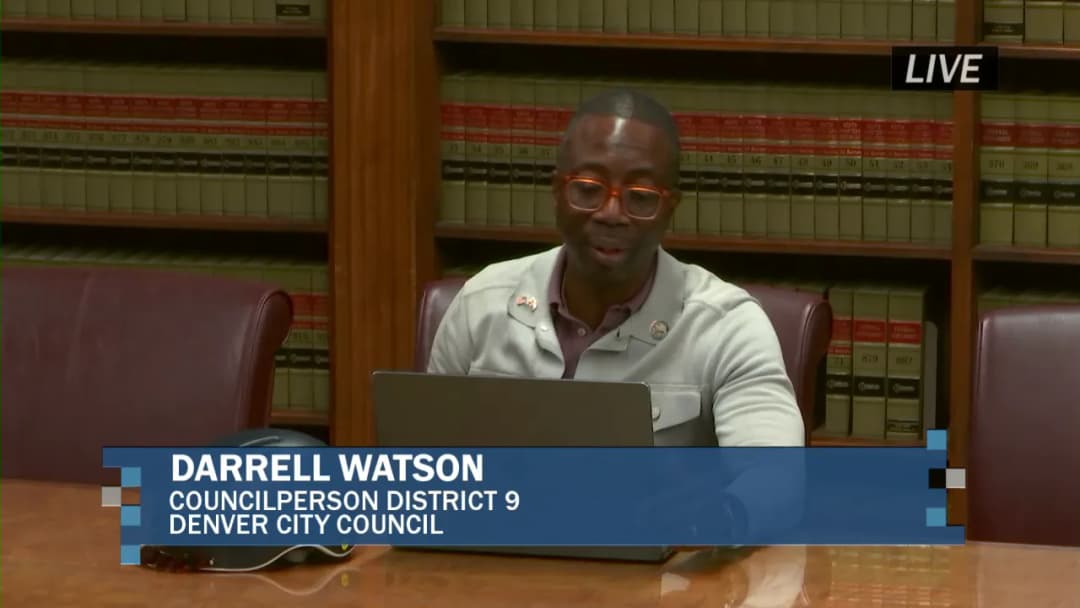
The weekly joint meeting of Denver's mayor and City Council on July 28, 2026, opened with introductions and announcements from council members, followed by a unanimous vote to enter executive session. No consent calendar or public comments were presented during the aired portion. Announcements - Council member Darrell Watson (District 9) announced multiple events on Saturday, August 1: the 37th annual Brick City reunion and picnic at Mystic Silk Curtis Park from 1–7 p.m.; the Manual Thunderbolt Alumni Nation party in the park at the West Meadow at City Park from 3–6 p.m.; and the Clayton Community Day at York Street Yards starting around 2 p.m. near Cohesion Brewery. - Council President Diana Romero Campbell (District 4) announced the Bible Park South by Southeast concert in the park on Saturday, August 15, in the afternoon, featuring a swing band and vendors. Executive Session - Council moved to enter an executive session pursuant to DRMC 2-34A, sections 3, 6, and 7, to discuss pending litigation and related legal advice. The motion carried unanimously by voice vote. Key Outcomes - The council unanimously agreed to enter executive session for the stated legal purposes.
Public Meetings - Denver, Colorado
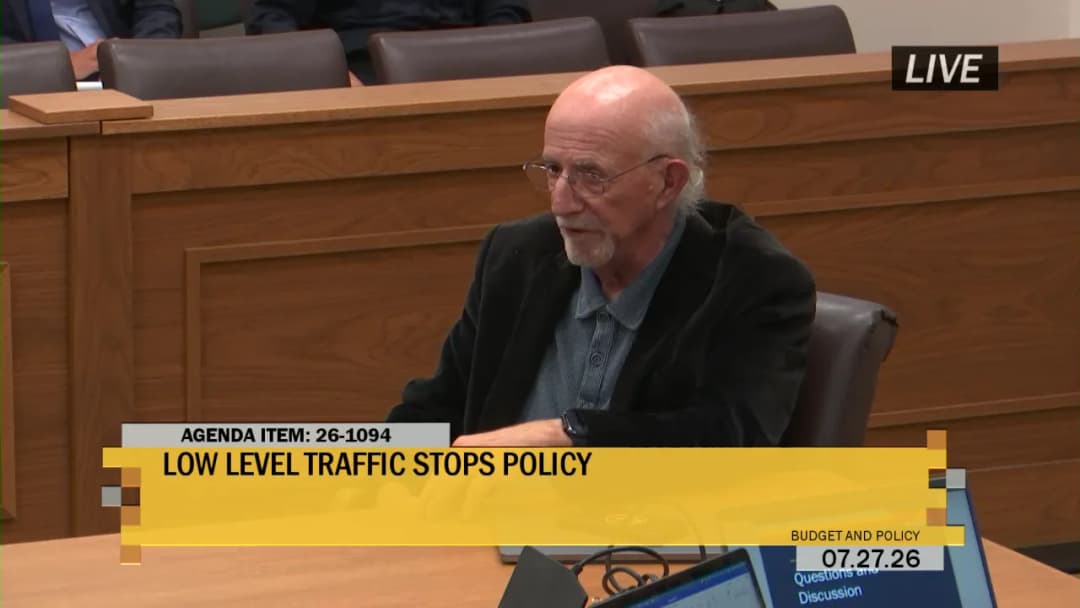
Public Meetings - Denver, ColoradoThe Budget and Policy Committee of the Denver City Council met on July 27, 2026, to discuss two proposed ordinances: one to reform the Transportation and Mobility Special Revenue Fund (TNM SRF) and another to codify the Denver Police Department's low-level traffic stop policy into city code. The meeting featured presentations from council sponsors, discussion with the Department of Transportation and Infrastructure (DOTI), the Department of Safety, and the Office of the Municipal Public Defender, as well as extensive debate among council members. No votes were taken; both items are in early stages and will be refined based on feedback. Discussion Items Transportation and Mobility Special Revenue Fund Reform (26-1093) Councilmembers Parady, Lewis, and Alvidrez presented the proposed ordinance. The TNM SRF was created in 2021 by doubling parking meter rates to generate approximately $15 million annually for pedestrian, bicycle, transit, and Vision Zero safety improvements. In 2026, the fund brought in $16.5 million, but enforcement and parking operations now consume $8.4 million (more than half), leaving only $8.1 million for safety and mobility programs. The reform would: (1) require investments align with adopted plans (Vision Zero, Safe Routes to School, Denver Moves); (2) protect the fund by prohibiting transfers to the general fund, requiring rollover of unspent balances, and mandating a 50-50 split between capital and operational expenses; (3) add community accountability by requiring DOTI to present proposed uses to the DOTI Advisory Board for review and approval; and (4) define clear allowable uses (e.g., protected bike lanes, bus lanes, traffic calming) and non-allowable uses (e.g., traffic signals unless paired with calming, routine maintenance, police enforcement, removal of Vision Zero infrastructure). Councilmember Torres questioned the legal basis for the advisory board to approve rather than just advise, and asked for the current code section. Councilmember Sandoval agreed, suggesting the proposal should come to council for approval instead. She also noted that listing specific plans could be problematic as plans expire, and recommended using “any applicable plans and any that follow.” Councilmember Flynn asked about mid-block crossings and crossing guards, which sponsors confirmed would be allowed. He also raised concerns about the prohibition on removing infrastructure, noting that changes might be needed. Councilmember Hinds supported the intent but advocated for requiring specific dollar amounts to be associated with each plan to enhance oversight. Councilmember Watson asked DOTI Director Ford about how the SRF is currently prioritized. Director Ford explained that historically most funds went to capital projects, but operating costs have increased, including for the microtransit program, transit mobility associations, parking citation review staff, and speed cameras. He noted that absorbing parking enforcement costs back into the general fund would be difficult. The sponsors acknowledged the feedback and will work with the administration and city attorney on language. Low-Level Traffic Stops Policy (26-1094) Councilmember Kashmann presented the proposed ordinance to codify Chief Thomas’s existing policy (implemented May 2024) that discourages officers from conducting stops for minor, non-safety violations (e.g., expired registration, cracked tail light, hanging air freshener) unless they have articulable suspicion of more serious crime. The ordinance would also improve data collection. Presenters cited nationwide research showing these stops disproportionately target people of color, do not reduce crime, and waste resources. Data from Denver showed 75,599 stops from January 2022 to March 2026 that resulted in no citation or arrest. Stops decreased after the policy, but data on the reason for stops is not easily retrievable. The ordinance would require the Department of Safety to notify council and the public when directed enforcement is authorized. Councilmember Flynn opposed the ordinance, arguing it micromanages police and should remain in the ops manual. He noted that the draft includes many moving violations (speeding, running stop signs, red lights) as low-level, which he said is too broad. Kashmann responded that the wording will be clarified to exclude moving violations. Councilmember Hinds questioned the high rate of stops with no citation (82%), and Commander Pereira explained that many stops result in warnings. Councilmember Torres asked for the specific violations listed in the referenced municipal code sections. Councilmember Watson asked about enforcement on parked RVs. Councilmember Sandoval asked about unintended consequences; Kashmann said none have been identified. The Office of the Municipal Public Defender stated that since the policy, there has been no meaningful difference in the number of pretextual stops seen, and they still observe racial and socioeconomic targeting. Councilmember Gonzalez-Gutierrez shared a personal experience of being stopped for a stolen license plate and stressed the need to address root causes. The sponsors will refine the language to clarify that moving violations are not included and will continue discussions with the Department of Safety on data collection. Key Outcomes - No votes were taken on either item. - For the TNM SRF reform, sponsors will revise language to address concerns about the advisory board’s role (likely changing to recommendation rather than approval), plan specificity (considering “applicable plans and any that follow”), and the definition of allowable uses. Further meetings with the Department of Finance and DOTI are planned. - For the low-level traffic stops ordinance, sponsors will clarify that moving violations such as speeding, running stop signs, and red lights are not affected. They will continue to work with the Department of Safety to establish a data collection system. The proposal is expected to return to committee for further discussion.
The Denver City Council convened on July 27, 2026, starting at 10:30 a.m. (minutes note 3:30 p.m.) and adjourned at 9:43 p.m. after a full agenda. The meeting included the Pledge of Allegiance, land acknowledgement, roll call (12 present, 1 absent), approval of previous minutes, council announcements, and multiple proclamations. Major actions included a consent agenda approving numerous resolutions and bills, two required public hearings on zoning changes, and a combined courtesy public hearing on the Xcel Energy franchise agreement and related partnership bills. The council re-referred one bill to committee and passed three key items to final approval, with the franchise package heading to the November 2026 ballot. Consent Calendar - Approved minutes of July 20, 2026 (26-1092). - Adopted Proclamations: Honoring Phillip A. Washington (26-1099), Miss Colorado Gabrielle Burns (26-1108), the Shumaker Family (26-1109), International Human Rights Day (26-1103), and the Black Sheriff Protective Association (26-1100). All passed unanimously (11-0, with two absent). - Adopted en bloc a series of resolutions and bills on final consideration, including: housing revenue bonds for Green Valley Vistas (not to exceed $27M) and Link and Pin Apartments (not to exceed $19.4M); purchase of 1028 N. Acoma Street ($3,019,340); various contracts for sewer parts, cab/chassis, audit assistance, pool operations, park caretaker agreements, street dedications in District 3; a revocable permit at 1730 Wynkoop Street; plat approval for Denver Connection West Filing No. 3; decommission of Skeel Reservoir dam at Wellshire Golf Course ($5,731,906); vending services at DEN; foundation rehabilitation at DEN ($25M); purchase of four tractors for DEN ($879,733); and amendments to food access (Healthy Food for Denver's Kids, adding $37,819.82), Family Connects program (extending to 2027), and a right-of-way vacation near I-25 and Santa Fe Drive. All passed 11-0. Public Comments & Testimony - General Public Comment (5:00 p.m. session): A half-hour session was held but no details were recorded in the transcript beyond the announcement. - Required Public Hearing – 26-0776 (406 S. Quitman Street rezoning): Jesse Parris spoke in favor. Property owners Kryszelda and Andrew Gorrell were available for questions. No opposition speakers. - Required Public Hearing – 26-0777 (4901 S. Monaco Street rezoning): Austin Kane (land use counsel) expressed support; Brian Tierney and Joshua Scott (Guardian Recovery) described the proposed behavioral health facility; Erik Carlson also spoke in favor. Jesse Parris spoke neither for nor against, raising concerns about affordability and community benefits. No other opposition speakers signed up, though 29 written comments in opposition were noted. - Combined Courtesy Public Hearing – 26-0970/0973/0974 (Xcel Energy Franchise): 23 speakers testified. - In favor: Nate Bernstein (Climate Jobs Colorado), Eric Chipp (IBEW lineman), Jeremy Ross (IBEW), Mike Ferrufino (Colorado Hispanic Chamber), Kate McKenna (Ballpark GID), Susan Powers (Urban Ventures), Josef Lopez (Servicios de la Raza), Carlos Martinez (Latino Community Foundation), Ryan Aids (Greenway Foundation), Sergio Cordova (Pipefitters), Christine Morrow (medical exemption beneficiary), John Goodin (energy consultant), Lindsay Tyson (sustainability professional), Britt Diehl (Downtown Denver Partnership), Kristy Kibler (Lupus Colorado). Speakers emphasized union jobs, community engagement (e.g., Red Truck events), low-income assistance, and the need for the franchise to support development and reliability. - In opposition: Jeffrey Ackermann (Together Colorado, former PUC chair), Ben Meyerhoff (Together Colorado, disability advocate), Ann Karlsberg (Together Colorado), Billie Wolter (Together Colorado – expressed in excerpt), Jesse Parris (Black Star Action – said the deal does not benefit Black Denverites), Brandy Majors (disabled Aurora resident – criticized excessive bills and lack of direct help). Opponents argued the $125,000/year income-qualified assistance is inadequate, the agreement lacks visionary collaboration, and the process favored Excel's profits over community needs. Discussion Items - Proclamations: Two major proclamations were read and adopted individually before the consent block. - 26-1099 (Phillip A. Washington): Councilmember Hinds led the reading, praising Washington's military and public service career, including his roles at RTD and as CEO of Denver International Airport. Councilmembers Flynn, Watson, Lewis, and Kashmann delivered remarks. Washington accepted and challenged the council to exercise
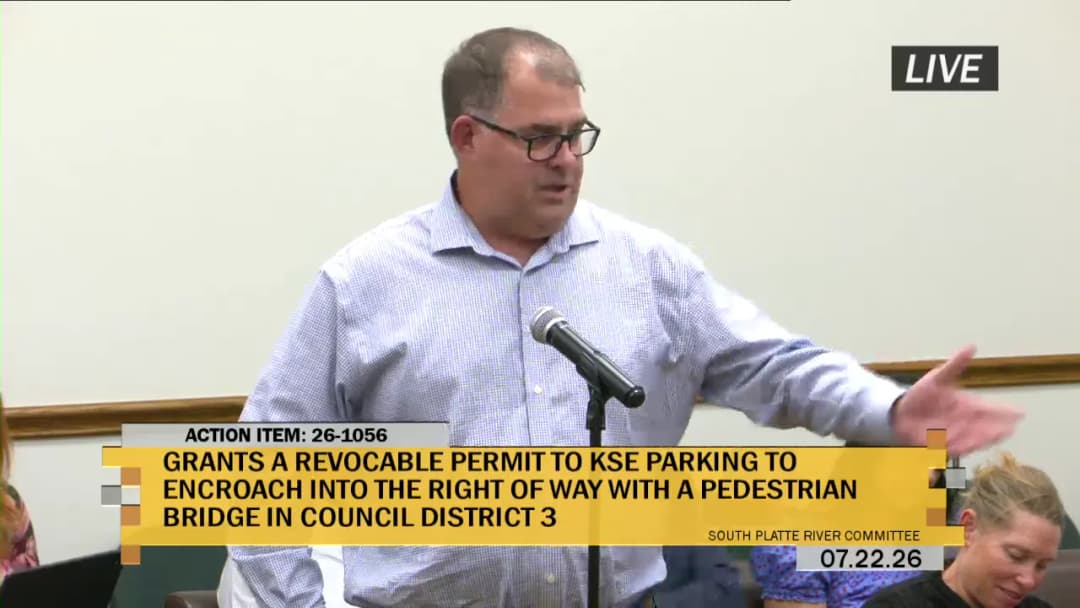
On Wednesday, July 22, 2026, at 1:30 PM, the South Platte River Committee of the Denver City Council met in Room 391 of the City & County Building. The committee, chaired by Councilwoman Jamie Torres, considered one action item: a revocable right-of-way encroachment permit for a pedestrian bridge at 1000 Chopper Circle. Two consent items were also approved. All seven committee members were present (Alvidrez, Flynn, Hinds, Sandoval, Watson, Torres, Romero Campbell). Consent Calendar - Council Resolution 26-1031: Approved by consent – grants a revocable permit to KH Streetcar LLC for an elevated patio deck, planters, and barriers at 1730 Wynkoop Street (Council District 10). - Council Bill 26-1045: Approved by consent – appropriates $5,912,874.00 in the Wastewater Management Division Urban Drainage and Flood Control District Tracking Fund for the Sanderson Gulch Design and Construction Improvement Project, co-funded by the Mile High Flood District (citywide). Discussion Items - Action Item 26-1056: Discussion of a revocable permit for KSE Parking, LLC to encroach into the right-of-way with a pedestrian bridge, ramp, and stairs at 1000 Chopper Circle (Council District 3). Stephen Wilson (Community Planning and Development) and Andy Rockmore (SAR Architects) presented the “Wine Coop Crossing Bridge,” which will span Speer Boulevard, connecting the Ball Arena redevelopment to the Cherry Creek side. The bridge will be suspended, with a 5% maximum slope (stairs and ramps, no elevators), maintaining 20 feet clearance over Speer Boulevard. A future right-of-way vacation along Speer Boulevard was noted. Jason Proskovek (Kiwit) described the construction timeline (shaft construction starting March 2027) and traffic impacts, including lane closures and possible full directional closures. Councilmembers Alvidrez, Hinds, Sandoval, and Torres asked about the revocability of the permit, maintenance responsibility (by a metropolitan district), and coordination on traffic changes. Councilmember Torres expressed strong support for keeping tier three encroachment reviews under city council purview as a tool for oversight and community leverage. No public testimony was heard. Key Outcomes - Motion to approve Resolution 26-1056: Councilmember Sandoval moved, Councilmember Hinds seconded. The motion carried 7-0 (Aye: Alvidrez, Flynn, Hinds, Sandoval, Watson, Torres, Romero Campbell; Nay: 0). The item will proceed to the full council. The permit remains revocable, and the future right-of-way vacation will be addressed in a separate action.
On Tuesday, July 21, 2026, the Denver City Council's Community Planning and Housing Committee met to receive a briefing from Cole Chandler, Executive Director of the Department of Housing Stability (HOST), on the department's 2026 work plan, organizational structure, and strategic priorities. The meeting began at 1:30 PM and was chaired by Councilwoman Amanda Sandoval. All eight committee members were present: Flor Alvidrez, Paul Kashmann, Shontel Lewis, Diana Romero Campbell, Jamie Torres, Darrell Watson, Chair Amanda Sandoval, and Vice Chair Amanda Sawyer. Briefing: Department of Housing Stability 2026 Work Plan - HOST Overview & Accomplishments: Cole Chandler, who became Executive Director on April 13, 2026, highlighted a 64% reduction in unsheltered homelessness since 2023 and a 12% reduction in overall homelessness in the most recent point-in-time count – the first such decline in over a decade. He outlined HOST's four pillars: housing opportunity, housing stability/homelessness resolution, operations and impact, and communications/community engagement. - 2026 Action Plan Goals: Key metrics included delivering 575 newly developed affordable housing units and preserving 900 units through expiring affordability covenants in 2026; seeding an additional 1,500 units for future years; reducing street homelessness by 75% from 2023 levels; responding to all 311 homelessness-related calls within one business day; achieving at least 75% guest satisfaction in shelters; and helping 2,000 households exit to permanent housing outcomes. Funding sources include the general fund, homelessness resolution fund (0.25% sales tax generating $50–55 million annually), and the affordable housing fund (property tax and linkage fees). - Strategic Plan Status: The current five-year strategic plan (2021–2026) expires at year-end. A housing needs assessment, funded by a state grant and conducted by Root Policy Research, will be delivered in December 2026. A one-year continuation plan will be presented to council in September 2026, with a new long-term strategic plan expected by September 2027. Chandler noted that the continuation plan will include minor modifications to targets but will largely extend the existing plan. - Councilmember Discussion: Several councilmembers raised concerns and questions: - Councilmember Kashmann asked where the greatest need for additional funding lies; Chandler identified housing supply for the lowest-income households. - Councilmember Torres emphasized the need to separate housing stability from homelessness resolution, criticized the lack of an anti-displacement platform, and requested clearer tracking of stable households and displacement metrics. - Councilmember Alvidrez asked about funding sources and noted the rise in family homelessness and domestic violence as drivers. She also inquired about outdoor death data, which Chandler said is not part of the 2026 action plan but could be provided. - Council President Romero Campbell questioned how the action plan impacts current contracts (noting a shift to three-year cycles) and asked about strategic shifts on the housing opportunity side. - Councilmember Watson highlighted specific strategies from the original plan that were not fully implemented, such as partnering with Denver Public Schools to measure involuntary displacement of families with children and expanding the property tax rebate program. He urged attention to those tactics. - Councilmember Sawyer raised underfunding of the eviction prevention program (eviction rate to council) and the property tax rebate program, noting that the foreclosure prevention portal closed early due to exhausted funds. She asked for collaboration during budget season and inquired about additional tools from other cities. - Councilmember Lewis asked about coordination with DURA (Denver Urban Renewal Authority) and whether DURA projects are accounted for in HOST's plan. Councilmembers Torres and Watson noted DURA's role in preservation but acknowledged a gap in tracking displacement effects. - Councilmember Sandoval stressed the need for a comprehensive housing strategy that integrates land use, education, and affordability, citing the impact of zoning changes on displacement and the limitations of existing tools like EHA overlays. Key Outcomes - No votes were taken; the briefing was informational only. - HOST will bring forward a one-year continuation plan in September 2026 for council approval. - The housing needs assessment is expected in December 2026 and will inform the next long-term strategic plan (due September 2027). - Councilmembers directed that future plans include clearer metrics for housing stability, anti-displacement tracking, and coordination across agencies (e.g., DPS, DURA, CPD).
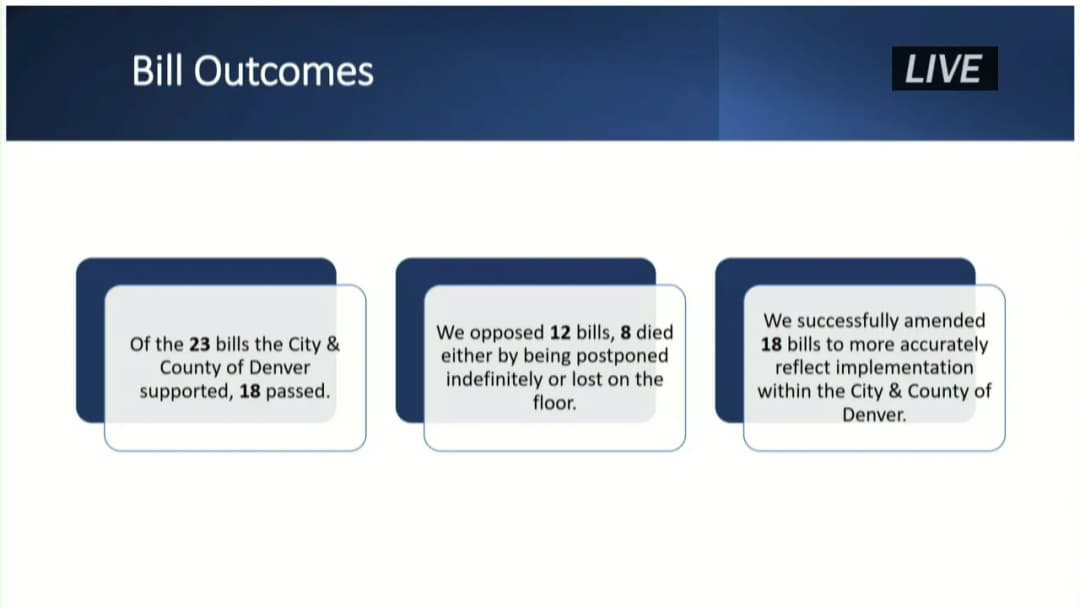
The Governance and Intergovernmental Relations Committee of Denver City Council met on Tuesday, July 21, 2026, chaired by Councilwoman Amanda Sawyer. The committee voted unanimously to advance a charter amendment and companion ordinance updating civil service sections 9.3 and 9.4, and received a briefing on the 2026 state legislative session outcomes, budget outlook, and upcoming legislative trends. Discussion Items - Charter Change Proposal (Items 1048 & 1055): Councilmembers Jamie Torres and Amanda Sandoval presented a ballot measure to amend charter sections 9.3 and 9.4, moving operational details to ordinance for flexibility, removing remaining citizenship requirements for civil service commissioners, extending disciplinary review timelines, allowing probationary period extensions for approved leave, and removing command staff caps at the chiefs' request. A companion ordinance was drafted per Councilwoman Sawyer's recommendation to move three sections of charter language into ordinance without substantive change. Councilmember Kevin Flynn suggested removing the word "all" from the ordinance regarding hearing officer lists; the suggestion was accepted. Council President Diana Romero Campbell praised the thoroughness and clarity of the proposal. Councilwoman Sawyer noted the importance of the companion ordinance for transparency. No public comments were received. - State Legislative Update: Katie Hancock and Jimena Luna of Policy Matters presented the final legislative update for the 2026 session. Denver engaged on 61 formal positions: 18 of 23 supported bills passed; 8 of 12 opposed bills died; 18 bills were successfully amended. Two bills were vetoed (SB 184 and SB 5). City Council independently supported HB 1005 (vetoed) and SB 42. The fiscal year 26-27 budget overview highlighted a $1.2 billion shortfall closed via provider rate cuts, $150M in department cuts, and eliminated grant programs. Medicaid rising costs led to a 2% provider rate cut and creation of an interim commission. The marijuana tax cash fund elimination is estimated to cost Denver $6.1 million. The short-term outlook shows a projected $116M general fund surplus for FY25-26, but longer-term structural challenges remain, with a potential $315M cut needed in FY27-28. Upcoming ballot measures (Initiatives 175, 195, 232) were flagged. Policy trends for 2027 include Medicaid/healthcare, AI, tax/fiscal measures, housing, and energy. Councilwoman Torres thanked the team for their influence this session. Dominic Moreno (Mayor's Office) noted a renewed push for an ADU fix with a new governor's administration. Key Outcomes - Block Vote on Items 1048 and 1055: The committee voted unanimously (thumbs up) to move the charter change ballot measure and companion ordinance forward. Next steps: first reading on July 27, 2026, and final reading/ballot referral vote on August 3, 2026, aiming for the November 3, 2026 ballot. - State Legislative Briefing Received: The committee acknowledged the briefing and expressed appreciation for the team's work. Ongoing monitoring of rulemaking, election outcomes, and the September revenue forecast will continue. - Other: At adjournment, Chair Sawyer noted one consent item not called off, and the meeting was adjourned.
The mayor and Denver City Council held their weekly joint meeting on July 21, 2026. The meeting featured introductions of new council leadership, announcements from council members about community events, and a unanimous vote to enter executive session to discuss pending litigation. Announcements - Council members introduced newly elected leadership: Diana Merrow Campbell as Council President and Councilmember Gonzalez Puteris as President Pro Tem. Outgoing President Sandoval was thanked for two years of service. - Councilmember Jamie Torres announced a "Movie in the Park" series, with the next screening of Zootopia 2 at Lama Lincoln Park on Thursday. - Councilmember Sandoval promoted a free yoga series at the Ealitch Carousel Dome on Wednesday at 6 p.m., and an annual resource fair and movie night at Zunai Park on Friday, August 28, featuring "How to Train Your Dragon." - Councilmember Diana Romero Campbell announced a "South by Southeast" concert at Bible Park on August 15, with a swing band surprise. Executive Session - A motion was made and seconded to enter executive session pursuant to Denver Revised Municipal Code (DRMC) 234A, sections 3, 6, and 7, for the purpose of discussing pending litigation and legal advice. The motion passed unanimously. Key Outcomes - New council leadership was introduced and welcomed. - Upcoming community events were shared. - The council unanimously voted to enter executive session for legal discussions.
The Denver City Council held its regular session on Monday, July 20, 2026, from 3:30 p.m. to 6:10 p.m. The meeting included the election of a new Council President and President Pro-Tem, consideration of a proposed franchise agreement with Xcel Energy, a charter amendment to adjust the budget process, and several resolutions and ordinances. Notable discussions centered on the Xcel Energy franchise agreement and the biennial budget proposal. Consent Calendar - Approved minutes of July 13, 2026. - Adopted a proclamation honoring HBCU alumni in Denver (26-1050). - Adopted multiple resolutions en bloc, including: - 26-0991: License agreement for EV charging stations at 7301 E. Jewell Ave. - 26-0911: Reappointment of Jose Aguilar to Denver Latino Commission. - 26-0989: Amendatory agreement with Submittable Holdings Inc. for grants management software ($845,557.62 increase). - 26-0975, 26-0976: Amendatory agreements with Waste Management for recycling facility and water usage. - 26-0982 through 26-0987: Contracts for asbestos, lead, and indoor air quality services (various vendors, total up to $12.5 million). - 26-0942: Concession agreement for Broncos Mile High Grill at DIA (12-year, $2.39M minimum annual guarantee). - 26-0977: Construction contract for Loretto Heights Theater renovation ($45.48 million). - 26-0979, 26-0980: Wayfinding design services at DIA ($1.025M each). - Approved bills on final consideration en bloc: - 26-0925: Land acquisition for Smith and Sandown over Quebec Street Bridges Project. - 26-0926: ARPA fund transfer for HOST Micro Communities and administrative expenses. - 26-0867: Ordinance amending budget procedures and community engagement. - 26-0923: IGA with Kroenke Sports for Wynkoop Crossing bridge. - 26-0956: Agreement for Delgany Bridge restoration. - 26-0990: First amendment to license agreement with Denver Health for parking ($41,550). Public Comments & Testimony - No public comments were recorded during the session. The council recessed for a general public comment period from 5:00 p.m. to 5:30 p.m., but no testimony is included in the transcript or minutes. Discussion Items Election of Council President and Pro-Tem - Councilmember Romero Campbell was elected Council President (12-0, with Parady absent). Councilmember Gonzales-Gutierrez was elected Council President Pro-Tem (12-0). Both gave remarks emphasizing collaboration, equity, and leadership. Franchise Agreement with Xcel Energy (Bills 26-0970, 26-0973, 26-0974) - These bills were introduced and ordered published with a future courtesy public hearing on July 27, 2026. - Councilmembers Lewis, Hinds, Watson, Gilmore, and others expressed concerns: $125,000 annual low-income assistance deemed insufficient; lack of committed pilot project funding; low substation beautification allocation (1% vs requested 3%); insufficient community engagement; and Xcel's property maintenance. Councilmember Watson noted improvements over the prior agreement and supported sending to voters. Councilmember Gilmore highlighted the contrast between $2.5M one-time shareholder contribution and Xcel's $60B capital plan. - No vote on these bills at this meeting; they were published for future hearing. Budget Charter Amendment (Bill 26-0864) - Final consideration vote: Passed 10-2 (Alvidrez and Flynn voting no). The amendment will go to voters on November 3, 2026. It proposes an optional two-year budget cycle, community engagement requirements, adjusted budget timeline, and procedures for budget shortfalls. - Councilmember Flynn argued it surrenders council's power of the purse and is unnecessary. Councilmembers Gilmore, Sawyer, and Lewis supported it as a transparency and accountability measure. Entertainment License Modernization (Bill 26-0921) - Motion to postpone to August 3, 2026, passed 12-0. The postponement was requested by Council President Romero Campbell to allow community engagement following a shooting incident in Southeast Denver. Councilmembers Alvidrez and Hinds expressed broader concerns about the bill's implications for small businesses, safety, and state law alignment. Councilmember Hinds proposed a sunset amendment not yet socialized. Loretto Heights Theater Renovation (Resolution 26-0977) - Councilmember Flynn highlighted the $45.48 million contract with Fransen-Pittman Construction Co. for renovation of the historic theater, the largest city investment in Southwest Denver. Groundbreaking set for July 24, 2026. JAX Seafood House Concession at DIA (Resolution 26-0949) - Originally called out for postponement, but after hearing from DIA and receiving support from Unite Here Local 23, the postponement was withdrawn. Resolution adopted 12-0. Key Outcomes - Elections: Diana Romero Campbell elected Council President; Serena Gonzales-Gutierrez elected Council President Pro-Tem (both unanimous). - Franchise Agreement: Bills ordered published; courtesy public hearing scheduled for July 27, 2026. - Budget Charter Amendment: Referred to voters for November 2026 election (passed 10-2). - Entertainment License Bill: Postponed to August 3, 2026 for further community input and amendment consideration. - Consent Agenda: All resolutions and bills on final consideration passed en bloc (12-0). - Announcements: Councilmember Torres announced Blucifer's First Rodeo; Councilmember Watson announced Underground Music Showcase; Councilmember Lewis announced HBCU weekend events; Councilmember Sandoval announced yoga and movie in the park. - Adjournment: 6:10 p.m.
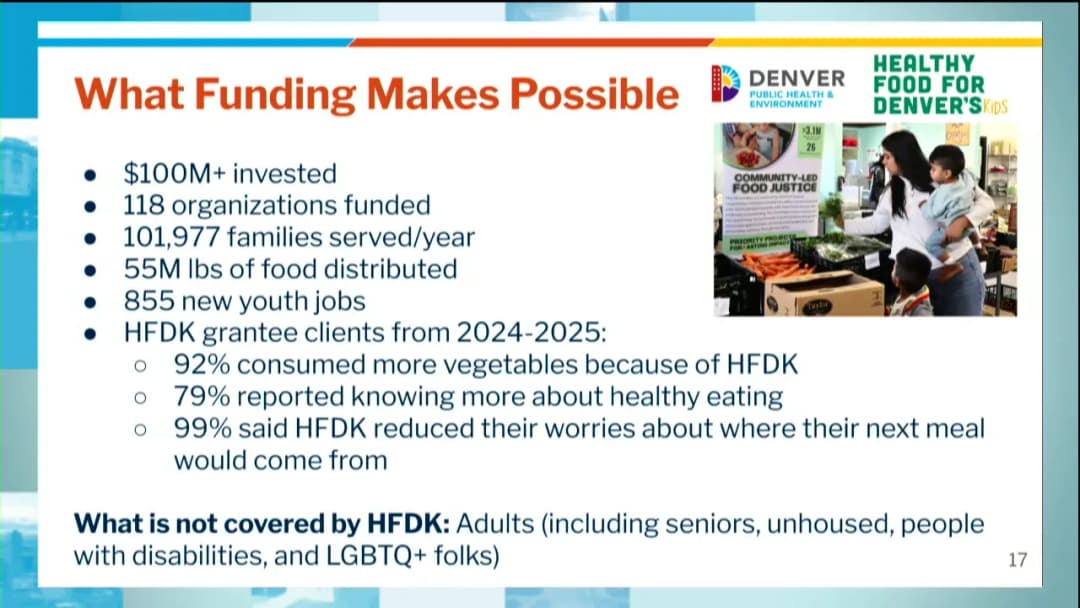
On July 17, 2026, the Denver Mayor and City Council held a joint weekly meeting, including introductions, community announcements, and a major briefing on food insecurity and the upcoming Food Justice Summit. The meeting began with councilmember announcements about community events, then proceeded to a detailed presentation from Denver's Department of Public Health and Environment (DDPHE) and multiple community partners on food insecurity data, the need for sustainable infrastructure investment, and the planned Food Justice Summit. Councilmembers responded with questions, support, and calls for a November 2026 ballot measure to renew and expand the Healthy Food for Denver's Kids (HFDK) sales tax. Consent Calendar - No consent calendar items were discussed. Public Comments & Testimony - No public comments were made during the formal meeting. Discussion Items - Announcements from Councilmembers: - Councilwoman Torres announced a Citizen Oversight Board forum at The Blossom House (July 22), a movie in the park at Martinez Park (July 17–18), and a celebration of life for Frances Torres at 9th Street Historic Park (July 22). - Councilwoman Romero Campbell announced a community putt-putt day at Kennedy Golf Course (July 19, 11 a.m.–2 p.m.). - Councilman Watson noted his late arrival due to street detours, thanked Dottie for street work, and highlighted a proclamation for Front Range Passenger Rail service, which could bring $22 million in infrastructure funds to Denver. He also promoted the Underground Music Showcase (July 24–26) in Five Points and River North. - Council President Sandoval announced a free bilingual yoga series at Elitches (July 24, 6–7 p.m.), the Mount Carmel Bazaar, and paid tribute to journalist Lynn Bartelson, who died at age 69. - DDPHE Food Team Presentation and Food Justice Summit Briefing: - DDPHE staff introduced themselves; Paula Bab presented as Neighborhood Food Program Supervisor. - Sydney Skilkin (Southwest Food Coalition) described the coalition's three-year effort to advocate for a Food Justice Fund—a sustainable investment in Denver's food system, not just direct food access. - Giselle Zia's Campania (The Grow House) shared data from a November 2025 DDPHE survey of 3,000 Denver residents across 11 council districts: one in three adults reported cutting meal sizes or skipping meals due to cost; 68% cited cost as the top barrier. Food insecurity disproportionately affects Hispanic households, renters, families with children, and districts 2, 3, 9, and 11. Nearly half of those affected experience it monthly. Only 32% of food-insecure residents use SNAP, and among SNAP users, only 11% can meet their household's needs. - Margaret Brueger and Laura Engelman (Commune) described how food programs at Loreto Heights serve 1,200 families per week, and stated that food access is a “doorway” to belonging, support, and community participation. They emphasized that HFDK funding provides essential stability. - Catherine Arduin (Common Harvest Colorado) warned that food insecurity will rise; HFDK expires in 2028, creating a “funding cliff.” She argued that the city primarily funds food purchases but not the infrastructure (staffing, cold storage, transportation, language access) needed to move it, calling this “like asking RTD to run buses but only funding the fuel.” - Jamie Anderson (Denver Food Rescue) reviewed previous city investments: $3.3 million in ARPA food system resiliency grants (2021) and the creation of HFDK via Ballot Measure 302 (November 2018), a 0.08% sales tax increase (about one penny per $10 purchase) set to expire December 2028. HFDK has invested over $100 million, supported 118 organizations, served over 100,000 families annually, distributed over 55 million pounds of food, and created 900 youth jobs. However, it only covers youth (18 and under), leaving out seniors, unhoused residents, and LGBTQ+ adults. - Brie Say (Metro Caring) closed the presentation with three calls: reflect on food insecurity in each district, connect with local food access organizations, and exercise the power elected officials have to champion change. - Councilmember Q&A and Comments: - Councilwoman Alvidres asked about translating survey data into infrastructure needs and how drought and fires affect food access. Catherine Arduin noted that a warm winter and late freeze destroyed most orchard fruit (apples, pears, peaches) on the Western Slope; one farm reduced from 700 to 150 acres due to water shortages. - Councilwoman Torres expressed strong support, reminding council that food justice has been a budget priority since 2023 and that the Food Summit keeps the conversation current. - Councilman Cashman asked about an active campaign to renew the HFDK sales tax and questioned whether the current 0.08% rate is sufficient, noting the city faces a budget crisis yet found funds for a soccer stadium and jobs program. A representative from Southwest Food Coalition confirmed an executive committee has formed to explore expanding funding and scope. - Councilwoman Sawyer confirmed that reauthorization would require a council referral to the ballot, and that Councilwoman Torres is willing to sponsor a November 2026 ballot measure. Councilwoman Torres stated the Food Summit may help identify additional needs beyond HFDK's current constraints. - Councilman Watson grew up with food and housing insecurity and advocated for including transportation logistics—specifically microtransit solutions—in the Food Summit's scope. - Council President Sandoval urged partners not to overlook neighborhoods like Quigg Newton in Northwest Denver and offered to connect resources such as LaPleno's foundation, which has helped pay off student lunch debts at North High School. Key Outcomes - No formal votes were taken, but councilmembers expressed strong support for a November 2026 ballot measure to reauthorize and potentially expand the Healthy Food for Denver's Kids sales tax. Councilwoman Torres offered to sponsor the referral. - Councilmembers directed DDPHE and community partners to ensure the Food Justice Summit addresses infrastructure gaps (transportation, cold storage, staffing) and expands equitable access across all districts, including those not traditionally scored as high-need. - The Food Justice Summit will continue with facilitated sessions with elected officials and a larger public-facing event later in the summer; details will be shared by DDPHE and community partners.
This meeting of the Community Planning and Housing Committee included an action item to approve a $1.6 million grant agreement for an Equitable Transit-Oriented Development (ETOD) Implementation Plan along the Federal Boulevard BRT corridor, followed by a briefing from the Denver Permitting Office on recent process improvements and performance metrics. Note: Official minutes and transcript indicate the meeting date as July 14, 2026, but the provided timestamp states July 16, 2026. This summary uses the latter date. Action Item: Equitable TOD Implementation Plan for Federal BRT Corridor (26-1024) - David Gaspers, Special Project Supervisor, presented a $1,600,000 grant agreement with HNTB for consultant services to execute the Equitable TOD Implementation Plan for the Federal BRT Corridor in Districts 1, 2, 3, and 7. The grant is from an FTA pilot program, with a three-year staff position funded. The plan will build on existing adopted small area plans and focus on implementation, zoning changes, and community engagement. - Councilmembers expressed concerns about potential displacement of small businesses and residents, the need for concrete anti-displacement tools, and coordination with CDOT and other city agencies. Councilmember Torres emphasized the importance of proactive measures and questioned whether the project could proceed without addressing equity concerns. Councilmember Sawyer highlighted ongoing work on a Business Impact Opportunity Fund (BIO Fund) ordinance and the need for alignment. Council President Sandoval stressed cross-agency coordination and monitoring of CDOT's role. - A motion by Vice Chair Sawyer, seconded by Councilmember Alvidrez, to approve the bill for filing passed 5-0 (Alvidrez, Romero Campbell, Sandoval, Sawyer, Torres aye; Lewis and Parady absent). Briefing: Denver Permitting Office Updates (26-1020) - Jill Jennings Golek, Director of the Denver Permitting Office, along with staff, provided updates on multiple initiatives: - Prop 123 Fast Track Process: Officially adopted June 22, 2026. Projects with 50%+ affordability are automatically eligible. The process includes structured submittal deadlines (Mondays), completeness checks, and 90-day review phases. One multifamily project completed Phase 2 in 87 days and Phase 3 in 56-64 days. Aiming for 1,800 affordable units through the program. - StartSmart Tools: Launched in April 2026 – a residential guide and a restaurant guide that help homeowners and small businesses navigate permitting by asking questions and generating a required permits list. Guided intake tool (SIP check) expected soft launch September 2026, full launch October 2026. - 180-Day Compliance: The office tracks over 3,000 records; only five projects have hit 180 city review days as of the meeting. No refunds have been awarded yet. A public dashboard is available for customers to check their project's days. - Residential Interior Only Quick Permit: Launched December 2025; 283 permits issued in 7 months, allowing self-service for interior remodels without full plan review. - On-Time Performance: Plan review on-time percentage reached 88% through July 8, 2026, up from 76% in 2025. - One-and-Done Concept Site Plan: Launched July 2025; average review rounds reduced from 1.9 to 1.3. - Demolition Permit Process: Consolidated into a single workflow with quick permits for certain scopes. Integration with universal composting/recycling requirements (effective September 1, 2026) will be included. - Grease Interceptor Policy Changes: Hydromechanical interceptors now allowed by standard (previously required variance), aligning with international code. - Outdoor Places Program: Simplified patio permits by using encroachment permits instead of separate outdoor places permit, eliminating annual renewals. - Councilmembers asked about intake turnaround, application volumes, language accessibility for StartSmart tools, pre-approved plans for ADUs and other housing types, and challenges with vacations and tier three encroachments. Councilmember Sawyer noted that vacations and tier three encroachments remain major bottlenecks, causing project delays and lost housing units. Staff acknowledged the issues and said they are working on parallel processing for vacations and exploring ways to improve cross-agency coordination. Key Outcomes - Action Item 26-1024 was approved for filing 5-0 (Alvidrez, Romero Campbell, Sandoval, Sawyer, Torres aye; Lewis and Parady absent). - Briefing 26-1020 was heard as information; no vote taken. - Staff committed to following up on specific data requests (average review rounds by project type, application volume trends) and to improving language accessibility for StartSmart tools. - The office will continue to address tier three encroachment and vacation process delays, potentially using project champions or parallel reviews.