Browse by city
Date range
Search help

Search titles, summaries, topics and stored transcripts together. Keywords may match separately; put the whole query in double quotes for a phrase. Matching follows word analysis, so punctuation is not exact. Both dates are included. Documents are not searched.

SHOWING 1–10 ENTRIES
01
NEWNOV 4, 2026 · DENVER, COLORADO · COUNCIL COMMITTEES
Denver City Council Transportation & Infrastructure Committee Meeting - November 4, 2026

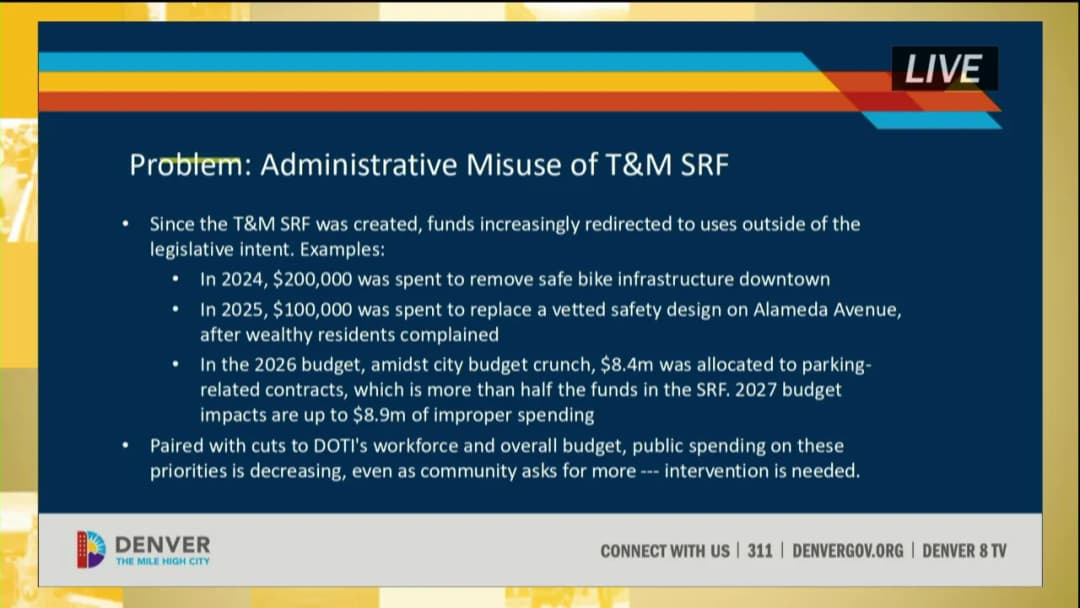
The Transportation and Infrastructure Committee of the Denver City Council met on Wednesday, November 4, 2026, at 1:00 PM in Room 391 of the City & County Building. Vice Chair Kevin Flynn presided because Chair Flor Alvidrez was a sponsor of both action items. The committee advanced two action items to the full council and approved eight consent items. Minutes list 8 members present and 1 absent (Gilmore); recorded votes show 6 ayes, 0 nays, 1 absent, with some attendees not voting on committee business. Consent Calendar - 26-1410 — Amended intergovernmental agreement with Denver Public Schools, adding $3,700,000.00 for a new total of $4,180,000.00 and five years, with a new end date of 2-6-2032, to support current and future DPS sustainability-related programs citywide. - 26-1584 — Approved a contract with Milender White Construction Company for $83,820,959.00 and 650 days for the Legacy Concourse Restroom Renewal at Denver International Airport, Council District 11. - 26-1619 — Amended contract with Touchstone IQ LLC, adding $11,224,754.00 for a new total of $28,955,453.00 and five years, with a new end date of 12-31-2031, for Energize Denver Help Desk, compliance administration, communications support, and supporting systems citywide. - 26-1633 — Authorized the Manager of Finance/CFO to issue $500 million in Airport System Tax-Exempt Bond Anticipation Note Subordinate Obligation, Series 2026A, for cash flow for current projects in the airport's 2023-2027 Capital Improvement Plan. - 26-1634 — Approved a five-year, $5,500,000.00 on-call airport planning services contract with INTERVISTAS CONSULTING USA LLC at Denver International Airport, Council District 11. - 26-1635 — Approved a five-year, $6,500,000.00 on-call airport planning services contract with RICONDO & ASSOCIATES INC at Denver International Airport, Council District 11. - 26-1636 — Revoked Ordinance No. 378, Series of 2006, which granted a revocable permit to Exempla St. Joseph Hospital for an enclosed pedestrian bridge over North Franklin Street between East 18th Avenue and East 19th Avenue, Council District 10. - 26-1637 — Revoked Resolution No. 0602, Series of 2015, which granted a revocable permit to The Bike Hub, Inc. for a bike station building and associated utilities at 1800 16th Street, Council District 10. All consent items were approved by consent. Action Item 26-1540 — Best Value Contracting Ordinance - Sponsors Alvidrez and Hinds presented the revised ordinance amending Article IV of Chapter 20 on competitive selection for certain contracts. They said it had changed substantially after further meetings with industry, labor, and the administration. They described only two new substantive requirements beyond existing law: OSHA 10-hour safety training and a requirement for small businesses with fewer than 50 employees to direct workers to health insurance options such as the Colorado Exchange, plus a one-time reusable attestation form. - Sponsors reported raising the prime contract threshold from $500,000 to $1 million, removing the weighted scoring system, eliminating apprenticeship requirements, narrowing the health insurance provisions, and reducing administrative requirements. - Sponsors opposed exempting subcontracts under $500,000, stating that 85-90 percent of construction work is performed by subcontractors, most subcontracts are under $500,000, and an exemption would make the bill largely symbolic. They also cited the Denver Auditor's position that covering all subs is the only meaningful way to enforce prevailing wage and manage liability. - Sponsors opposed exempting MWBE firms, arguing that firm size should not determine worker protections. They noted that the Department of Labor defines a small firm as up to $45 million and that the 2023 wage theft ordinance, passed unanimously, did not include a firm-size exemption. - Deputy Mayor and General Services Executive Director Adrena Gibson and DEDO Executive Director Adeep Khan expressed concern about added burdens on small, minority- and women-owned businesses. Khan cited a recent disparity study involving more than 475 firms and said Denver is already seen as 'the most cumbersome' place to do business; adding requirements conflicts with the study's recommendations. - Matthew Fritzmauer of the Denver Auditor's Office said wage-violation risk increases down the subcontracting chain and exemptions would increase that risk. - Former Adams County Commissioner Chess Tedesco said Adams County initially covered only prime contractors and later amended its ordinance after about $300 million in projects to include subcontractors, because wage theft and safety problems persisted. He said he did not support exempting small businesses at the expense of workers. - Robert Wheeler of the City Attorney's Office raised a drafting concern: as written in version 9, the word 'willfully' applies to signing the certification rather than to making a false certification, so good-faith mistakes could still create debarment risk. Sponsors said that was not their intent; debarment should be reserved for knowing or willful false certifications. - Councilmember Lewis asked how to balance worker protections against burdens on small businesses, especially MWBEs, and no consensus was reached on the exemption question. Councilmember Hinds suggested studying the implementation's effects before final decisions. - Councilmember Watson, not a voting committee member, said after multiple briefings he wanted the bill to go to the floor. A motion by Councilmember Lewis, seconded by Councilmember Hinds, to approve Council Bill 26-1540 for filing carried 6-0, with Gilmore absent. Public Comments & Testimony - Caroline Leland, a District 6 resident, Smart Growth Program Manager at the Southwest Energy Efficiency Project, and member of Denver Streets Congress, said her mother and grandmother were killed in a car crash. She urged the committee to use the Transportation and Mobility Special Revenue Fund for physical street design changes and transit services, not parking enforcement or marketing, and to specify allowable uses and a capital-spending percentage. - Shelsey Ochoa, a parent of two, said she lost her car to theft and now struggles to move around the city with children; she called the diversion of dedicated safe-streets funds 'a slap in the face' and urged the council to use the money for its intended purpose. - Erica Orashko was listed for public comment but did not appear. Action Item 26-1654 — Transportation and Mobility Special Revenue Fund - Sponsors Alvidrez and Lewis presented an ordinance amending Ordinance No. 1291, Series of 2021, which created the fund in 2021 through a doubling of parking meter rates to fund pedestrian, bicycle, transit, and Vision Zero improvements. - They cited 94 traffic deaths in 2025 and 58 additional deaths through October 30, 2026, noting the toll outpaces gun-violence deaths. They described prior fund misuse: $200,000 in 2024 to remove infrastructure, $100,000 in 2025 to replace a vetted study, and $8.4 million in 2026 allocated to parking-related contracts. The 2027 spending plan includes $8.9 million for parking operations previously funded from the general fund. - The proposal would set an effective date of July 1, 2028; tie spending to adopted plans such as Vision Zero, Safe Routes to School, Denver Moves, bikes, pedestrian trails, and transit; prohibit transfers to the general fund; allow the balance to roll over; require at least 50 percent of funds for capital projects; require DOTI to present an annual plan to the DOTI Advisory Board; and define allowable uses. - DOTI Chief Operating Officer Cindy Patton said the $8.9 million parking-related cost was legally permissible and had helped close a $200 million general fund gap last year, avoiding roughly 60 layoffs. She said the parking management systems funded by that amount unlock about $40 million in revenue, of which about $12.4 million flows to the special revenue fund. - Councilmember Hinds shared that he joined the disability community after being hit by a car in 2008 and strongly supported the fund protections. He raised accessibility concerns about the Montbello Connector microtransit service; Patton said the vehicles are contracted and she would look into accessible options. - Councilmember Watson suggested the DOTI Advisory Board should proactively present a white paper of priorities to DOTI, similar to other city advisory boards. - Council President Romero Campbell supported the measure, saying the $9 million would be difficult to replace, but the fund should be put into the right categories. - Councilmember Kashmann asked about the 50 percent capital requirement; sponsors said DOTI had requested a five-year average, advocates wanted one year, and they compromised on three years. Kashmann also asked whether studies are included; sponsors said studies are covered under services and supplies, and asked about bus stop benches; Patton said amenities vary and maintenance is an operating expense. - Councilmember Flynn asked whether the ordinance would prohibit removing infrastructure paid for by the fund; sponsors said they were focusing on affirmative uses and were working on language to ensure changes do not reduce safety. Flynn also raised concerns that green infrastructure could divert money from transportation safety and asked for 'successor plans' language so future adopted plans remain eligible; sponsors said they were continuing to refine the allowable-use list. A motion by Council President Romero Campbell, seconded by Councilmember Hinds, to approve Council Bill 26-1654 for filing carried 6-0, with Gilmore absent. Key Outcomes - Council Bill 26-1540 was approved for filing and will advance to the full council. Sponsor Alvidrez said unresolved items — construction/maintenance definition, implementation date, cure period, and MWBE application — should be worked out before first reading. Mayor's Council is scheduled for November 10, 2026, and first reading for November 16, 2026. - Council Bill 26-1654 was approved for filing and will advance to the full council. - Eight consent items were approved as listed. - Fifteen minutes of public comment were offered on 26-1654; two members of the public spoke and one no-show occurred. No public comment was taken on 26-1540.
CONTRACTS AND PROCUREMENT 35% · WORKER PROTECTIONS 11% · TRANSPORTATION SAFETY 11% · PUBLIC SAFETY 10%
02
NEWNOV 4, 2026 · DENVER, COLORADO · COUNCIL COMMITTEES
Denver City Council Health and Safety Committee Meeting - November 4, 2026

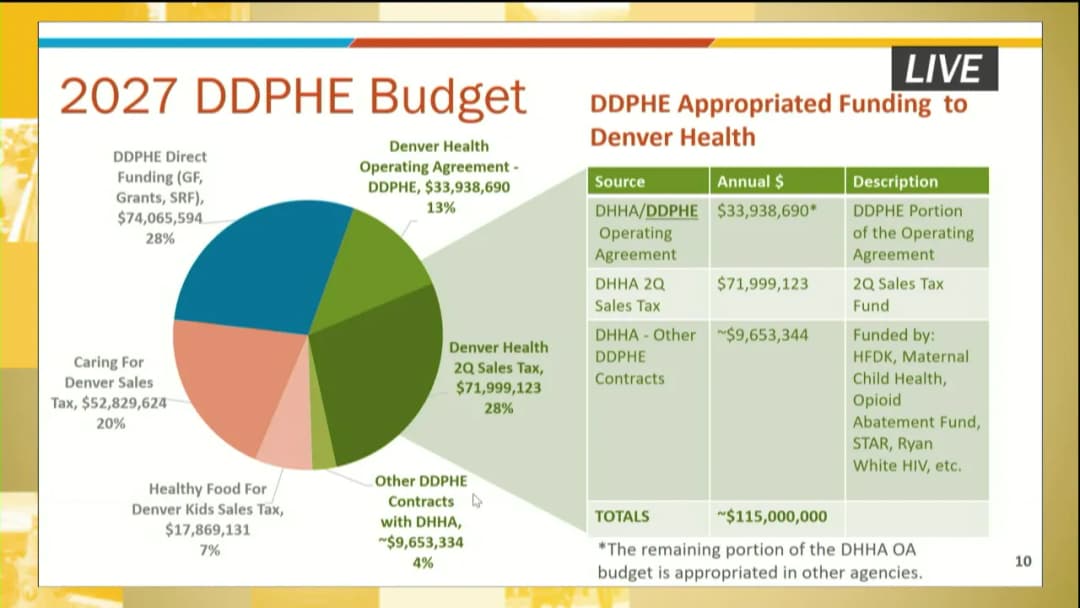
The Health and Safety Committee of the Denver City Council met on November 4, 2026, at 10:30 AM (Mountain Time) in Room 391 of the City & County Building. Chair Darrell Watson presided with six members present (Flynn, Gonzales-Gutierrez, Torres, Watson, Romero Campbell, Kashmann) and Vice Chair Amanda Sandoval absent. The primary action item was the approval of the annual Denver Health and Hospital Authority operating agreement (Bill 26-1622) for $48,796,698. The meeting included a detailed presentation, extensive discussion of budgetary challenges, and a consent calendar item. Consent Calendar - 26-1653: Amends a contract with Boys & Girls Clubs of Metro Denver, Inc., adding $60,000 for a new total of $985,500 and extending the end date to December 31, 2026, for out-of-school time programs citywide. Approved by consent (no roll call). Discussion Items - Denver Health Operating Agreement (26-1622): Meggan Parezo (DDPHE) and Donna Lynne (CEO, Denver Health) presented the 2027 agreement. Key points: - Total proposed budget: $48,796,698 for 12 months, ending December 31, 2027. This is down from $70 million in prior years because the jail medical services contract ($25-26 million) was removed as a separate contract. - The agreement includes 33 service sections (7 core, 13 non-core, 12 city-provided services). Three sections were removed: Rocky Mountain Poison Drug Center and Treatment on Demand (funding eliminated due to city budget cuts; services continue via state/grant funding) and jail medical (separated). - Language changes in three sections: MI payment/patient care (metric updates), EMS (Denver Dynamic Response Model pilot), and airport EMS (additional coverage). Minor changes to Public Health Clinical Services. - Denver CARES is funded at $1 for 2027, maintaining a position but effectively unfunded. The city and Denver Health agreed to a $2+ million package including $1.2 million in operating agreement expansions and $1.4 million from CASER (capital funds) for energy system modifications, intended to offset Denver Health's internal costs. Ongoing data analysis will inform 2028 decisions. - Budget expansions: $336,000 restoration for EMS service patrol (to 78% of full funding), full restoration for Southwest Clinic, $35,000 for sexual assault nurse examiners, 2% merit increase, and expansions for DEN paramedics and Inglewood EMS. - HR1 (federal Medicaid cuts): Denver Health estimated loss of up to 20,000 Medicaid patients and $65 million in impact over time. Already, 3,200 legal immigrants lost coverage on October 1, 2026. Work requirements (80 hours/month) and twice-yearly recertification begin January 1, 2027. - DERP (Denver Employee Retirement Plan) lawsuit: Denver Health has an unfunded liability; DERP filed suit over interpretation of payment agreement. Denver Health offered mediation; DERP declined. Councilmember Flynn expressed concern about cross-subsidization, but Lynne clarified liabilities are separate and noted 1,000+ Denver Health employees earn minimum wage. - Councilmember Positions: - Councilmember Flynn: Expressed appreciation for Denver Health services and leadership, but acknowledged budget constraints. Inquired about DERP lawsuit. - Councilmember Torres: Asked about data reporting frequency and possibility of a multi-year operating agreement. Noted need for better understanding of Denver CARES value. - Councilmember Kashmann: Strongly advocated for fully funding Denver CARES and STAR program, arguing underfunding leads to higher costs elsewhere (police handling eligible calls). Called the current approach "insane." - Council President Romero Campbell: Stressed the human and financial costs of not funding Denver CARES, asked for a timeline for resolving Denver CARES funding. Lynne set a goal of 5 months (by April 2027) to have a plan ready for 2028 negotiations. - Councilmember Gonzales-Gutierrez: Emphasized need for data on Denver CARES usage and alignment with community health assessment. Also raised concerns about Denver Health staff working conditions and dignity. - Pro Tem Torres: Thanked staff for data improvements, noted Community Health Improvement Plan (CHIP) celebration on Friday, and asked about Denver Health's involvement—confirmed two representatives on steering committee. Key Outcomes - Bill 26-1622 (Denver Health Operating Agreement) was approved for filing by a vote of 6-0 (Aye: Flynn, Gonzales-Gutierrez, Torres, Watson, Romero Campbell, Kashmann; Nay: 0; Absent: Sandoval). The motion was made by Councilmember Flynn and seconded by Council President Romero Campbell. - Consent item 26-1653 (Boys & Girls Clubs contract) was approved by consent. - Next steps: The operating agreement will proceed to full City Council. Denver Health and DDPHE will continue working on Denver CARES data analysis and funding strategy for 2028, with a target to finalize a plan within five months.

PUBLIC HEALTH POLICY 56% · PUBLIC SAFETY 25% · PUBLIC TRANSPORTATION 7% · PROCEDURAL 6%
03
NEWNOV 3, 2026 · DENVER, COLORADO · COUNCIL COMMITTEES
Community Planning and Housing Committee Meeting - November 3, 2026

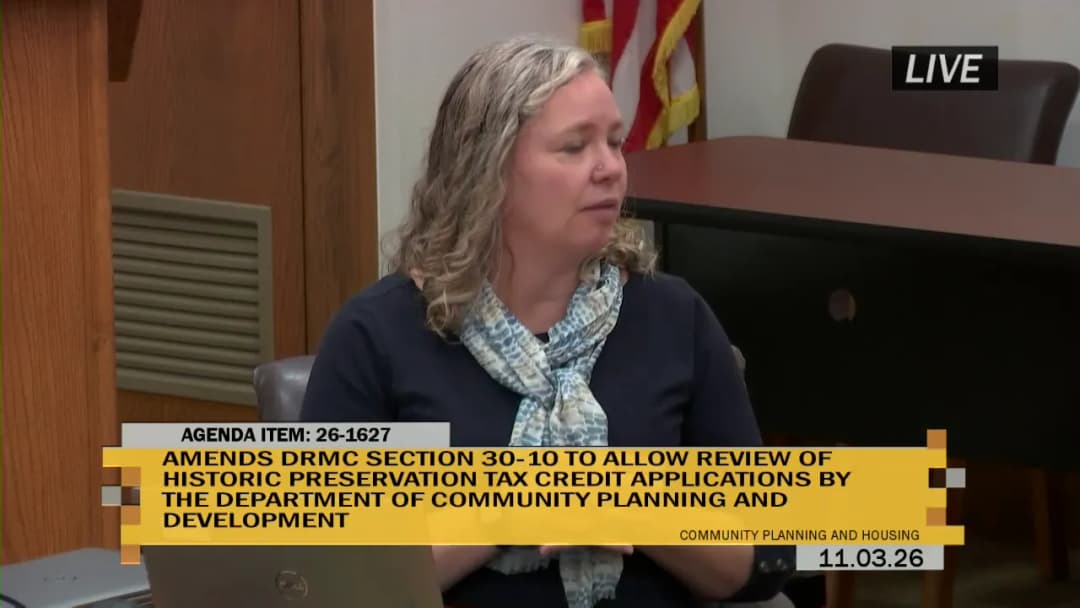
The Community Planning and Housing Committee of the Denver City Council convened on Tuesday, November 3, 2026, at 1:30 PM under Vice Chair Amanda Sawyer (Chair Amanda Sandoval absent). The committee considered a single action item: Council Bill 26-1627, which proposes amendments to Section 30-10 of the Denver Revised Municipal Code (the landmark ordinance) to allow staff review of historic preservation tax credit applications for non-commercial properties. After discussion, the committee unanimously approved the bill. Public Comments & Testimony - No members of the public signed up to speak or provided testimony. Discussion Items - Proposed Amendment to Historic Preservation Tax Credit Review (Council Bill 26-1627): Jen Capetto, manager of the Landmark Team within the Department of Community Planning and Development, presented the proposed amendment. The change removes a reference to an expired 1990 state statute and updates the code to allow Landmark Preservation staff to review and certify residential (non-income producing) historic preservation tax credit applications, rather than requiring the Landmark Preservation Commission to do so. Capetto noted that Denver is one of the only municipalities in Colorado requiring commission approval and that the state has indicated this is unnecessary. The state will continue to handle commercial/income-producing tax credits. Appeals of staff decisions would go to the state review board. - Questions and Discussion: Councilmember Torres asked about the effect on residents. Capetto explained that the process would be the same from the applicant's perspective but faster, because staff can approve directly. She reported that the Landmark Preservation Commission certified nearly $550,000 in tax credits for about 40 applicants in the previous year. Torres inquired about the number of applications; Capetto estimated around 40. Councilmember Lewis asked about the funding source; Capetto confirmed the credits originate from the state general fund, not city funds. Council President (unidentified) asked if the change would encourage more applicants; Capetto responded that she hopes so and described outreach efforts, including mailings to new landowners in historic districts and contacts with registered neighborhood organizations. Councilmember Torres made a motion to approve the bill, seconded by Councilmember Kashmann. Key Outcomes - Motion and Vote: Councilmember Torres moved approval of Council Bill 26-1627, seconded by Councilmember Kashmann. The motion carried unanimously with six votes in favor (Alvidrez, Kashmann, Lewis, Romero Campbell, Vice Chair Sawyer, Torres) and none opposed. Chair Amanda Sandoval was absent. - Next Steps: The approved bill will proceed to the full Denver City Council for further consideration.

HISTORIC PRESERVATION 98% · PROCEDURAL 2%
04
NEWNOV 3, 2026 · DENVER, COLORADO · COUNCIL COMMITTEES
Denver Parks, Art and Culture Committee – November 3, 2026

The Denver City Council Parks, Art and Culture Committee met on Tuesday, November 3, 2026, at 10:30 AM in the City and County Building, room 391. Chair Shontel Lewis presided; Vice Chair Paul Kashmann and members Flor Alvidrez, Serena Gonzales-Gutierrez, Chris Hinds, Diana Romero Campbell, Amanda Sawyer, and Council member Watson were recorded present in the minutes, for eight present. The committee considered three action items: a design contract for Boettcher Concert Hall, Denver Golf fee adjustments, and Buffalo Bill Museum fee adjustments. All three were approved for filing by 7-0 votes. Discussion Items - 26-1621 – Boettcher Concert Hall design contract. Kari Daly and Patrick Riley of the Department of Transportation and Infrastructure/Vibrant Denver Bond Office presented a proposed $16,490,000 contract with David Owen Tryba Architects, with LMN of Seattle, through January 30, 2030, for architectural and engineering design services for the Boettcher Concert Hall renovation. The total project budget was described as $120 million: $20 million from the Vibrant Denver GO Bond 2026B, with the remainder from Denver Arts & Venues and the Colorado Symphony. Staff said design is scheduled to begin in December; the pre-bid meeting drew over 100 attendees. Scope includes HVAC, fire protection, electrical, mechanical and plumbing, life safety, technology and data, security, stage lighting, AV, interior finishes, seat quantity and layout, acoustic treatments, and exterior roof and facade repairs, plus evaluation of a patron pavilion expansion. Staff cited accessibility, operational, safety and security, MEP, exterior weathering, and outdated lighting and AV concerns, and said early procurement could protect a 2028 construction start. Chair Lewis asked about protecting the hall’s acoustics; staff said acoustics consultant Paul Scarborough is on the team and the goal is an improved acoustic experience, including by reducing hall volume. Council member Kashmann praised Tryba’s preservation work and expressed support. Council member Sawyer asked about the funding stack; staff said the $16.49 million design contract is currently all from Vibrant proceeds, with Arts & Venues covering construction and the Symphony committed to raising $15 million, including a $2 million Boettcher Foundation donation. Council member Watson asked about the Symphony’s relocation; staff said the Symphony will move out for construction and perform in smaller community and regional venues, though a full public timeline was not announced. Council President Romero Campbell asked about LMN’s concert hall experience; staff cited Benaroya Hall and McCaw Hall in Seattle and the Tobin Center in San Antonio. - 26-1651 – Denver Golf fee schedule. Scott Rethlake, director of golf, presented the biennial adjustment to Denver Golf Enterprise fees. He described the enterprise fund’s cost-recovery pyramid and portfolio, including Kennedy’s 27 regulation holes and par-3 course, free junior courses, First Tee programming, and summer employment for about 100-125 youth. Cost drivers included labor and minimum wage tied to CPI, inflation in fertilizer and gas, irrigation costs that have roughly doubled from $3 million to $6 million in five years, and a cost-allocation payment to the city of about $2 million, up from about $1 million. He said annual expenses rose from about $9.1 million in 2018 to $19.5 million in 2025; the capital backlog is about $83 million, including $40 million for the Kennedy clubhouse in 2027, and capital equipment needs are $3-4 million in 2027. Staff proposed two years of fee adjustments using dynamic pricing, with maximum rates in the ordinance: a weekday average target around $55 from about $43, weekend average from about $64 to $67, senior average from $37 to $40, and junior average around $25. Staff said without the increase the enterprise would face an operating loss of about $673,000 including depreciation; with it, about a $2.5 million surplus. Council member Alvidrez raised concerns about the junior maximum rising from $35 to $54, saying it could burden single parents and make passes feel mandatory; Rethlake said Denver-resident juniors can buy an ACE pass for about $149, averaging $10-$14 per round, and noted free junior courses and First Tee scholarships. Alvidrez pushed back that the courses are public assets. Council member Sawyer questioned ordinance language saying fees “shall apply” while staff described dynamic pricing, and asked that the city attorney review it before filing; she also asked whether fees could be tied to CPI, and staff said about half of comparison courses use dynamic pricing and the comparison used published prices. Council member Watson said the presentation lacked cost-revenue ratios and outcome measures and recommended more sophisticated reporting. Council member Hinds noted tension between CPI-based increases and willingness-to-pay pricing and asked for an equity narrative. Council member Kashmann asked about the Welsh driving range, which staff said is under construction and expected mid-year, and requested a breakdown of adult versus youth rounds. Council President Romero Campbell noted 400,000 total rounds and staff said current use is about 98% of capacity; she also noted the Kennedy clubhouse dates to 1963. Chair Lewis asked how dynamic pricing works and what demographic data is collected; staff said pricing uses algorithms, historical tee sheets, and competitor pricing, and that the system collects age and zip code but not race or gender. Lewis stated she dislikes dynamic pricing in all forms. - 26-1652 – Buffalo Bill Museum fee schedule. Shannon Dennison, director of Denver Mountain Parks, presented fee changes for the Buffalo Bill Museum at Lookout Mountain Park. She said the museum, built in 1977, is the only fully city-owned and operated museum; Pahaska Provisions retail and the Buffalo Bill grave site are free, and a Takabe restaurant is expected to open around December. Visitation is about 80,000 per year and has been steady over 10 years after a COVID dip; the museum draws more visitors than about two-thirds of rec centers and about the same as Ashland. About 10,244 visitors, or 13%, are from Denver; 61% of paid admissions are adults, 16% seniors, and 12% children. Fees were first established in 1821 as stated, raised in 1988 and 1996, last significantly increased in 2009 by $1, and cleaned up in 2022. The proposal would raise adult admission from $5 to $6, keep seniors at $4, raise children and youth 6-17 from $1 to $2, keep under-5 free, and move active-duty military to the Blue Star Museums program with free admission for the service member and up to five family members. Staff estimated about $58,885 in additional revenue and noted the museum is general fund, not enterprise. The bill includes a CPI adjustment provision beginning March 1, 2027, and annually thereafter. Discounts include My Denver and My Denver Prime, Denver 5x5 Head Start, seven fee-free days for Denver residents, and Denver Public Library passes. Council member Sawyer asked about CPI timing; Dennison said the first adjustment would be March 2027 and the next reassessment in 2028, not an immediate second increase. Council member Alvidrez objected that seniors would see no increase while children and youth would double, citing median net worth of $409,000 for ages 65-74 versus $135,000 for ages 35-44 and calling for child-friendly third spaces. Dennison said the proposal aligned with Parks fee schedules and noted free-access programs. Council member Hinds clarified that My Denver cards provide free entry for Denver and DPS children, while the youth fee mainly affects out-of-town visitors. Council President Romero Campbell suggested surveying whether raising senior fees would deter visitation. Key Outcomes - Resolution 26-1621 was approved for filing: motion by Council member Sawyer, seconded by Council member Hinds, carried 7-0 (Aye: Lewis, Kashmann, Gonzales-Gutierrez, Alvidrez, Sawyer, Hinds, Romero Campbell; Nay: 0). - Council Bill 26-1651 was approved for filing: motion by Council member Sawyer, seconded by Vice Chair Kashmann, carried 7-0 (Aye: Lewis, Kashmann, Gonzales-Gutierrez, Alvidrez, Sawyer, Hinds, Romero Campbell; Nay: 0). Staff were asked to have the city attorney review the golf ordinance language on dynamic pricing before filing, and members requested clearer cost-revenue and equity reporting in future presentations. - Council Bill 26-1652 was approved for filing: motion by Vice Chair Kashmann, seconded by Council President Romero Campbell, carried 7-0 (Aye: Lewis, Kashmann, Gonzales-Gutierrez, Alvidrez, Sawyer, Hinds, Romero Campbell; Nay: 0).

PARKS AND RECREATION 58% · ARTS AND CULTURE 15% · PUBLIC ENGAGEMENT 10% · DATA MANAGEMENT 6%
05
NEWNOV 3, 2026 · DENVER, COLORADO · MAYOR-COUNCIL MEETING
Denver City Council Meeting: Blue Envelope Program Briefing and Election Day Announcements (November 3, 2026)

The Denver City Council met on Tuesday, November 3, 2026, on Election Day. The main agenda item was a briefing by the Denver Police Department, the Office of Human Rights and Community Partnerships, and other city partners on the Blue Envelope Program. Council members also made routine announcements and closed the meeting with no formal votes. No agenda or minutes were available for this session. Announcements - Councilmember Sawyers reminded the public that it was Election Day and encouraged everyone to vote; Julia, who had just turned 18, voted for the first time. - Councilmember Alvidrez announced an open house for the NEPA/environmental study of Pena Boulevard at Denver International Airport on November 19, 2026, from 5:00 to 7:00 p.m. at Green Valley Ranch. - Council leadership announced a listening session for the American Indian Cultural Embassy at Kennedy Golf Course on Saturday, November 7, 2026, from 11:00 a.m. to 2:00 p.m., sponsored by the Vibrant Denver Bond and HRCP. - A council member noted that their son had been commissioned as a naval officer and would attend flight school. Another council member marked their daughter Ava's birthday, noting that she was born on Election Day. Discussion Items Blue Envelope Program Briefing Commander Michelle Fulmer of the Denver Police Department's Equity, Diversity, and Support Bureau, Robin Jones, EDI Administrator, and Luke Wheeland, ADA Coordinator for the City and County of Denver, presented the Blue Envelope Program. The program is a voluntary communication tool for people with disabilities or other communication needs to share identification, registration, medical, or other information with police officers and first responders during traffic stops, emergencies, or routine contacts. The stated goals are to enhance communication, improve safety, and build trust. The presenters explained that the program began nationally as an autism-specific tool, but Denver customized it after holding listening sessions and town halls with community members. It is available as a blue envelope, a visor card, a wallet-sized card, or a digital download. It is free, participation is voluntary, and DPD does not maintain a database of users or track use during stops. Instead, success is measured through distribution numbers, partner requests, a voluntary community survey, and officer focus groups. Council Questions and Reactions Council members generally praised the program while asking practical questions about outreach, training, and use in real situations. - Councilmember Sawyers, who said they are a parent of a child with autism, thanked DPD and said the envelope would give their daughter a sense of calm and control during traffic stops. They suggested partnering with Denver Public Schools and private schools that serve students with disabilities. - Councilmember Alvidrez asked for a list of the autism-specific organizations consulted, noting that remembering to have the envelope ready in an emergency could feel unrealistic. Later, they shared that they are a woman with autism and ADHD and a parent of a child with autism, and expressed concern about how presenting the envelope might be perceived by officers. - The President Pro Tem asked about language access. Presenters said the envelope itself is English-only, but it can be filled out in another language and translated for officers, and an officer can immediately request interpretation. The President Pro Tem suggested providing Blue Envelope outreach materials in multiple languages. - Council leadership asked about officer training and public awareness. DPD said training is mandatory through internal portals, training bulletins, roll call, and public communications. Some council members encouraged continuing education and data collection so the program does not become a one-time rollout. - Councilmember Watson highlighted an ongoing District 9 issue involving a residence without a working elevator for about two weeks. He said residents who use wheelchairs could not leave the building or get their ballots, so his office and HRCP staff walked up stairs to help residents vote. He thanked Luke Wheeland and HRCP and said they would look at legislation to strengthen ADA enforcement. Key Outcomes - DPD and HRCP agreed to provide Councilmember Alvidrez with a list of autism organizations and schools reached during outreach. - Council members suggested, and presenters welcomed, additional work with DPS and other schools, multilingual outreach materials, more digital and quick-visual indicator options, and ongoing officer training. - No votes, motions, or formal resolutions were taken during this briefing. Note on Source Materials No agenda or minutes were available for this meeting. The raw transcript also contains a separate, unrelated segment about Fort Collins watershed protection and Colorado State University river science after the Denver meeting adjourns; that content is not part of this Denver City Council meeting and was excluded from this summary.

DISABILITY RIGHTS 44% · PUBLIC SAFETY 20% · ARTS AND CULTURE 14% · WATER AND WASTEWATER MANAGEMENT 9%
06
NEWNOV 2, 2026 · DENVER, COLORADO · CITY COUNCIL
Denver City Council Regular Session and 2027 Budget Amendments – November 2, 2026

The Denver City Council met on Monday, November 2, 2026, for its regular session, with the primary focus on the Mayor's Proposed 2027 Budget. The council considered 16 budget amendments, approving five, rejecting seven, and withdrawing or not reaching the remaining items. It also approved minutes, adopted a block of resolutions and final-passage bills, set a public hearing for November 9, 2026, and heard council announcements. Vote totals below are the presiding officer's announced totals; a few roll call recitations in the transcript do not exactly match those totals. Public Comments & Testimony - The council took a half-hour general public comment recess starting at about 5:00 p.m. and reconvened around 5:30 p.m. The provided transcript does not include the content of those public comments. Mayor's Proposed 2027 Budget Amendments - 26-1657 – Gonzales-Gutierrez Amendment 3 (Office of Municipal Public Defender) – Passed (announced 9 ayes). Provided funds for overdue pay-equity audits and required vendor services, including immigration consultations and outside investigators, for the Office of Municipal Public Defender. Gonzales-Gutierrez said public defenders were paid less than city attorneys; Hinds thanked the office for its policy help. - 26-1658 – Kashmann Amendment 1 (Denver Culture of Safety Education) – Failed (4-8). Would have moved $400,000 from DPD police administration services/supplies to DOTI to restore the Denver Culture of Safety Education program, which lost a CDOT grant and ended September 30, 2026. Kashmann cited 578 car seats distributed in 2025-26, over 500 events, and 30,000 community contacts; Chief Thomas said the cut could jeopardize language access and other contracts; DOTI's Nick Williams could not guarantee a one-to-one replacement. Several councilmembers said the budget was too tight. - 26-1659 – Lewis Amendment 4 (Denver Day Works) – Failed (4-8). Would have added $530,000 to DEDO's special revenue fund to continue Denver Day Works through an RFP, paid for by cuts to graffiti/Keep Denver Beautiful, Department of Finance services/supplies, and HOST services/supplies. Supporters cited 86 people housed through All In Mile High and about 100 jobs per year; HOST's Jeff Kazitski said the program had underspent and missed placement goals; DEDO's Tony Anderson said existing programs could serve the population. - 26-1660 – Lewis Amendment 5 – Withdrawn by the sponsor; it was a companion/alternative to the Day Works funding amendment. - 26-1661 – Lewis Amendment 2 (STAR expansion) – Failed (4-8). Would have transferred $500,000 from the Business Incentive Fund (BIF) to add a STAR team and expand hours. Lewis said STAR costs about four times less than police response and officers still handle roughly 65% of STAR-eligible calls. DDPHE Director Karen McGowan said one-time funds could not support a permanent expansion; Councilmembers Sawyer and Sandoval said the $500,000 was already committed to the BioFund for 2027 business-support grants. - 26-1662 – Lewis Amendment 3 (Office of the Independent Monitor) – Passed (11-1). Added $60,000 from projected fund balance for a policy analyst position in the Office of the Independent Monitor (OIM). Independent Monitor Liz Perez Castle said the position would convert an outreach position to an analyst to meet rising workload, including police/sheriff discipline analysis and automated license plate reader audit logs. Finance officials noted the drawdown from fund balance while the city rebuilds to a 15% fund balance target. - 26-1665 – Lewis Amendment 6 (Denver Basic Income Project follow-up) – Failed (6-6). Would have provided $240,000 for a one-year follow-up study and participant stipends for the Denver Basic Income Project, with reductions to DPD and DDPHE services/supplies. Founder Mark Donovan said 146 people remain in contact, the last survey had an 83% response rate, and two-thirds report being housed. Opponents cited the impact on essential DDPHE services and questioned revisiting a program after findings they said showed no statistically significant difference. - 26-1668 – Gonzales-Gutierrez/Lewis/Alvidrez Amendment 2 (DPD crime lab) – Failed (5-7). Would have moved $492,680 within DPD from services/supplies to personnel for crime lab/crime scene staffing. Chief Thomas said the positions were already budgeted and accreditation depends on training capacity, not raw staffing. Alvidrez expressed frustration with vacancy data; Lewis said average case turnaround rose from 16 days in 2021 to 46 days by May 2026. - 26-1669 – Gonzales-Gutierrez/Lewis Amendment 1 (Sheriff case managers) – Failed (5-7). Would have moved $258,975 from public safety personnel to Sheriff Department jail operations to fill case manager vacancies. Department of Safety Chief of Staff Angela Casias said the cut would prevent hiring a third SET (Street Engagement Team) team and reduce capacity. Watson praised SET work in District 9. - 26-1671 – Lewis/Torres/Gonzales-Gutierrez Amendment 1 (Youth violence prevention data) – Passed (7-5). Added $200,000 to the Office of Children's Affairs from the Broncos Fund/Youth Activities SRF to build data architecture for youth violence prevention and community safety grant tracking. Mayor's Office of Social Equity and Innovation Director Ben Sanders initially opposed, saying the office was working on internal solutions; sponsors said the funding would protect the $3 million community safety grant from being diverted to data costs. - 26-1663 – Watson Amendment 1 (NEST 56 youth supportive housing) – Passed (7-5). Moved $300,000 from HOST performance-contract SRF to HOST general fund, intended to support NEST 56, a 56-unit permanent supportive housing program for young adults. Watson cited 69 young people housed, 696 behavioral health sessions, and a $300,000 gap due to expiring congressional funds. HOST and city attorney staff noted the funds would still have to go through procurement and could not be guaranteed to NEST 56; Cole Chandler said a permanent supportive housing procurement was already planned. Watson defended the urgency. - 26-1664 – Watson/Alvidrez Amendment 1 (Denver Metro Fair Housing Center) – Failed (5-7). Would have transferred $100,000 from the same HOST performance-contract SRF to HOST for the Denver Metro Fair Housing Center. Watson said the center exceeded its outreach goal, serving 309 households by September 30 against a 180-household goal, and faced closure after federal and city cuts. HOST said it cut lower-performing housing counseling programs and preserved higher performers. - 26-1673 – Gonzales-Gutierrez/Lewis/Alvidrez Amendment 3 (TRUA compromise) – Passed (10-2). Cut $1,724,038 from services/supplies across multiple agencies and transferred those funds to the Affordable Housing SRF for TRUA rental/eviction assistance. Combined with a planned $2,275,962 transfer from the 2026 general fund contingency via an upcoming ordinance, the package would provide about $4 million for TRUA in 2027. The amendment was negotiated with the mayor's office as a smaller alternative to a larger $5.5 million TRUA proposal. Supporters cited eviction filing data and the Denver Public Schools housing study; opponents said the agency cuts would harm basic city services. - 26-1667 – Gonzales-Gutierrez/Lewis/Alvidrez Amendment 1 – Withdrawn after 26-1673 passed; it was the larger TRUA amendment. - 26-1670 – Romero Campbell/Alvidrez/Watson Amendment 1 (DPS TRUA pilot) – Withdrawn after discussion; sponsors decided not to pursue it after HOST outlined how the larger TRUA compromise could prioritize families with children. Agenda item 26-1666 was listed but not called before amendment consideration closed. Resolutions, Final-Passage Bills, and Consent Actions - Minutes: Minutes of Monday, October 26, 2026, were approved without correction. - Block vote (adopted 11-0): The council adopted resolutions and passed on final consideration the following items in a single block: homeless services amendments with Volunteers of America Colorado Branch (26-1576 adding $1,471,349 and 26-1577 adding $627,200 for rapid rehousing for families, including families fleeing domestic violence); Securitas security services contract amendment (26-1497 adding $11,000,000 through 9-30-2027); state workforce grant (26-1531, $1,323,550); workers' compensation pharmacy/medical provider agreements (26-1532 Mitchell International; 26-1533 Injury Care Associates; 26-1534 Peak Form reduced by $500,000; 26-1535 Workwell Occupational Medicine, $2,500,000); appointment of Solicia Lopez to the Citizen Oversight Board (26-1507); Metro Caring food and food-based education contract (26-1510, $747,718.98); Behavioral Health Solutions Center amendment with Mental Health Center of Denver (26-1513, adding $3,670,867 for a new total of $27,079,152); liability settlement of $65,000 to Miguel Martinez (26-1655); Denver Region Toyota Dealers sponsorship amendment (26-1480, adding $861,000); Argus Event Staffing amendment (26-1514, adding $23,000,000); Arts & Contraptions artwork commission for Theatre at Loretto Heights (26-1515, $550,000); Reynolds Construction emergency wastewater repairs (26-1509, $3,000,000); DIA technology contracts (26-1516 Dailey and Wells L3Harris master purchase order $3,000,000; 26-1517 Passur Aerospace $600,000; 26-1518 Dailey and Wells encryption purchase $6,657,920.63; 26-1519 SITA self bag drop operations and maintenance $37,911,710.75); Chato's Concrete Peoria Street Vision Zero project (26-1522, $2,099,563.50); and final-passage bill 26-1485 amending municipal code on permanent and temporary occupancy of public rights-of-way. - Called-out items: Council Resolution 26-1337 (Alterra Mountain lease at 101 W. Colfax Avenue) was postponed by Councilmember Alvidrez for one week to November 9, 2026. Council Resolution 26-1513 was called for questions; Councilmember Torres received confirmation from DDPHE that the Sun Valley Good Neighbor Agreement would be updated and honored during the contract extension. Bills for Introduction and Public Hearings - Bills were ordered published on: 26-1536 (Colfax Mayfair Business Improvement District inclusion petition), 26-1334 (DDDA Development Project Funding Agreement for 101 West Colfax Avenue), 26-1512 (Denver Health and Hospital Authority Denver CARES renovation and expansion, $675,000), 26-1508 (Broadway Station easement relinquishment at 809 South Delaware Way), 26-1520 (USDA Wildlife Services wildlife hazard management at Denver International Airport, $4,158,987.75), 26-1521 (Harvard Gulch drainage and flood control improvements, adding $4,685,000), and 26-1523 through 26-1530 (2027 annual costs of various local maintenance districts). - A required public hearing on Council Bill 26-1536 (Colfax Mayfair BID) was set for Monday, November 9, 2026. No other public hearings were held this evening. Council Announcements - Councilmember Alvidrez noted the passing of Dolores Huerta, reminded residents to vote, and promoted the We Don't Waste Potato Palooza and a Peña Nipa design project open house. - Councilmember Flynn paid tribute to former Denver City Attorney Steve Kaplan, who passed away. - Councilmember Sawyer promoted a DOTI open house at George Washington High School on November 3, 2026. - Council President Romero Campbell promoted an HRCP American Indian Cultural Embassy listening session and announced her son's naval commission. Key Outcomes - Approved five budget amendments: 26-1657, 26-1662, 26-1671, 26-1663, and 26-1673. - Rejected seven budget amendments: 26-1658, 26-1659, 26-1661, 26-1665, 26-1668, 26-1669, and 26-1664. - Withdrawn or not reached: 26-1660, 26-1666, 26-1667, and 26-1670. - Postponed Council Resolution 26-1337 to November 9, 2026. - Ordered publication of introduced bills and scheduled the November 9, 2026 public hearing on Council Bill 26-1536.

BUDGET EQUITY ANALYSIS 25% · PUBLIC SAFETY 14% · PROCEDURAL 10% · HOMELESSNESS 7%
07
OCT 28, 2026 · DENVER, COLORADO · COUNCIL COMMITTEES
South Platte River Committee Meeting - October 28, 2026

The South Platte River Committee of the Denver City Council convened on Wednesday, October 28, 2026, at 1:30 PM to review and vote on a single agenda item: Council Bill 26-1578, a map amendment to rezone approximately 3.4 acres from I-A, UO-2 to I-MX-5 with waivers. The rezoning aims to preserve industrial manufacturing and wholesale uses at the street level while allowing a mix of uses above. The committee heard a presentation from Fran Peñafiel of Community Planning and Development, received input from the applicant, and debated the implications. Following discussion, the committee voted 5-0 to approve the filing and refer the bill to the full City Council. Public Comments & Testimony - The Atmar Park Neighborhood Association submitted a neutral comment letter, indicating they met with the applicant and took no position due to the absence of specific redevelopment plans. No other public comments were received. - The applicant, Todd Snyder, spoke during discussion to clarify ownership and intentions, noting there are no immediate redevelopment plans and the two property owners are separate. Discussion Items - Fran Peñafiel, principal city planner, presented the rezoning request. The proposed I-MX-5 district allows residential, commercial, and industrial uses up to five stories, with waivers requiring that at least 50% of building frontage along primary streets (South Platte River Drive and West Mississippi Avenue) be used for industrial, manufacturing, or wholesale at the street level. The waivers also limit townhouse form and primary street designation to ensure continued industrial presence consistent with the 2026 Southwest Area Plan and Blueprint Denver. - Council Member Alvidrez expressed concerns about the viability of forcing industrial uses in a changing market, potential equity issues of placing affordable housing near industrial ground floors, and the lack of a concrete development plan. She noted the site is currently occupied by industrial uses but feared future constraints. Despite reservations, she indicated willingness to move the item forward. - Council Member Flynn sought detailed clarification of the waivers and their application across separate ownership parcels, praising the thoroughness of the presentation. - Council Member Hinds voiced skepticism based on past rezoning experiences (e.g., Carvana, Great Divide) where stated intentions later changed, emphasizing that the lack of a plan made him uneasy but acknowledging the legal criteria for approval. - Chair Torres highlighted that preserving industrial uses equates to preserving jobs and listed example uses (e.g., food preparation, telecommunications) that can be compatible with nearby housing. She noted the complexity created by not having a development concept and suggested the applicants may have benefited from a paired concept. - The applicant, Todd Snyder, explained that the owners initially sought a straight I-MX-5 rezoning in 2024 but were directed by staff to align with the then-in-progress Southwest Area Plan, resulting in the waiver framework. He expressed curiosity about how industrial and residential uses will coexist but deferred to the owners' decision. Key Outcomes - The committee voted 5-0 (members Alvidrez, Flynn, Hinds, Watson, and Chair Torres in favor; Sandoval and Romero Campbell absent) to approve Council Bill 26-1578 for filing, sending it to the full City Council for a final vote. - The approval is a recommendation; the rezoning will be considered by the full City Council on December 7, 2026, as tentatively scheduled.

LAND USE ZONING 82% · PROCEDURAL 9% · COMMUNITY PLANNING 7% · AFFORDABLE HOUSING 2%
08
OCT 28, 2026 · DENVER, COLORADO · COUNCIL COMMITTEES
Denver Health and Safety Committee Meeting on STAR Program and Consent Items - October 28, 2026

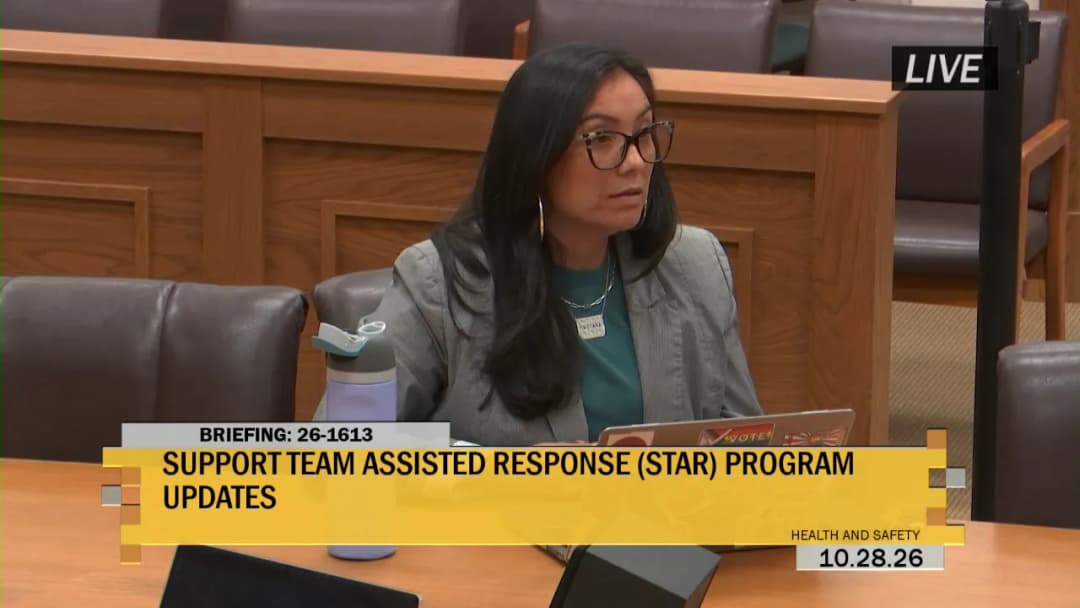
The Denver City Council Health and Safety Committee met on Wednesday, October 28, 2026, at 10:30 AM in Room 391 of the City & County Building. According to the minutes, members present were Kevin Flynn, Serena Gonzales-Gutierrez, Jamie Torres, Darrell Watson, and Paul Kashmann; Vice Chair Amanda Sandoval and Diana Romero Campbell were listed as absent, though the transcript appears to include Romero Campbell in the discussion. The committee received an update on the Support Team Assisted Response (STAR) Program and approved two consent items. Briefing: STAR Program Update - Tandis Hashemi, operations and clinical crisis services manager, and Marion Rorke, access to care manager, Department of Public Health and Environment, presented the update. - STAR is a civilian crisis response team pairing a master's-level licensed behavioral health clinician with a paramedic or EMT. It operates citywide seven days a week from 6 a.m. to 10 p.m. and is dispatched by Denver 911. It provides person-centric, trauma-informed response for mental health crises, substance use concerns, homelessness-related needs, poverty-related crises, and other nonviolent situations that do not require police, fire, or EMS response. - Program goals include reducing unnecessary encounters with the criminal justice system and unnecessary emergency department visits, connecting people to appropriate resources, improving resource allocation, and reducing reliance on emergency services. STAR also provides case management and post-crisis follow-up through its Community Partner Network. - Timeline: launched in June 2020 with one unit in one police district operating Monday through Friday, 10 a.m. to 6 p.m.; expanded in 2022 to five units per day, 6 a.m. to 10 p.m., seven days a week, with the Community Partner Network added; expanded to eight units per day in 2023; added mobile data terminals in 2024; and in August 2026 brought clinical services internal to DDPHE. - The internal transition has maintained the same hours. The city hired 12 clinicians and 2 supervisors. About half of the clinicians previously worked on STAR, and the rest had other crisis-related experience. Training now runs about six to eight weeks, including classroom work, shadowing with 911 call takers and dispatchers, partner overviews, supervisor and peer shadowing, and supervised field work before sign-off. - Budget: the 2026 general fund was about $4.4 million, including one-time costs of $580,000, of which $80,000 came from City Council and another portion was supplemental; the 2027 general fund decreases because those one-time allocations are not repeated. Caring for Denver grants are $1.6 million in 2026 and $2.7 million in 2027, with some rollover from the 2026 grant because Denver Health was again awarded the RFP and the planned overlap of two providers did not occur. DDPHE personnel costs increase in 2027 because clinicians were hired partway through 2026. The wraparound network contract has a slight increase for cost-of-living adjustments. There is no clinician contract in 2027 because clinical staff are now city employees. - The program previously had eight vans and now has six, and was never fully staffed at 16 clinicians. Staff said the priority is meeting demand within current hours before expanding to 24/7; overnight call volume is lower, but some STAR-eligible calls are likely missed overnight. Staff also said most funding is lapsing, making hiring and sustainability difficult, and non-lapsing funds would help. Discussion Items - Councilmember Paul Kashmann asked whether vans are assigned by district. Staff said response is citywide, with District 6 and District 3 among the busiest. Kashmann asked for call percentages by district and later requested clinician salary and benefits information. He also asked about 24/7 expansion; staff said meeting current demand should come first. Kashmann compared STAR's budget, just under $4 million, with the Denver Police Department budget of over $300 million, expressed strong support for STAR, and called the current funding level 'paltry' and 'embarrassing.' He later said the city has made no substantial commitment to STAR, called that 'outrageous,' and suggested shifting money from DPD to STAR so eligible calls are not answered by uniformed officers. He said 'don't tell me your values, show me your budget.' - A councilmember identified in the transcript as Romero Campbell, despite the minutes listing her absent, asked whether the presentation was about budget or the internal transition, asked whether the 2024 evaluation finding that 94% of STAR-eligible calls fell within existing STAR hours remained true, and asked what happens to after-hours calls. Staff said the figure is likely similar but not certain, and would follow up. She asked about the January evaluation recommendations, including underrepresentation of the Latino community and data integration and service tracking infrastructure. Staff said bringing services internal creates more opportunities to link data, build dashboards, and report on outcomes, and they plan to return with recommendation follow-up. She also asked whether moving clinicians internal was for cost savings; staff said the goal was efficiency and program integrity, not cost savings, and that new job classifications pay more than WellPower did. Staff noted STAR currently does not receive Medicaid reimbursement, while WellPower did; the city is exploring Medicaid reimbursement, but it is a slow, complex process. - Councilmember Serena Gonzales-Gutierrez asked about connections with Colorado Access, the Behavioral Health Administration, and the state Department of Health Care Policy and Financing to pursue Medicaid reimbursement. Staff said other DDPHE staff are exploring this and would follow up. She asked about barriers to staffing additional vans; staff cited the need for clinicians with specific crisis experience, though the internal hiring process drew many qualified applicants. Gonzales-Gutierrez noted grant funding creates instability and said the city is 'cobbling together' a nationally recognized program with grants and small general fund pieces rather than making a real commitment. She said she would follow up with the mayor's office about sustained investment. - Chair Darrell Watson asked about coordination with Denver Health and Servicios. Staff described weekly meetings, shared supervision, joint training, and efforts to break down silos, and mentioned exploring a 'STAR Academy' for combined clinician and EMT and paramedic training. Watson asked what clinician staffing would be needed to serve a higher share of eligible calls; staff said they need post-transition data and that any clinician increase must be paired with more EMTs and paramedics and case management and wraparound capacity. Watson requested a first- or second-quarter follow-up with outcome data and projections, praised STAR, and noted survey satisfaction upwards of 90%. Consent Calendar - 26-1579: Approved by consent a $5,000,000 contract with Peak Environmental, Inc. for a term of five years to support asbestos removal and regulated building material abatement, indoor air quality and mold remediation, emergency response support, and environmental litigation support and expert technical analysis, citywide. - 26-1581: Approved by consent an amendment to a revenue intergovernmental agreement with the Colorado Department of Health Care Policy and Financing (HCPF) adding $1,370,255.08 for a new total of $2,665,043.48 and extending the end date one year to June 30, 2027, to continue receiving payments from HCPF as incentives for providing Medicaid eligibility-related work within the City and County of Denver, citywide. Key Outcomes - Both consent items were approved by consent. - No formal committee vote was taken on the STAR briefing; it was received as an informational update. - Staff committed to follow up on: call volume and district-level data; the share of STAR-eligible calls answered; after-hours call outcomes; clinician salary and benefits information; Medicaid reimbursement exploration; data dashboard development and evaluation recommendations; and a future Q1 or Q2 report with outcomes and workforce projections. - Councilmember Gonzales-Gutierrez indicated she would follow up with the mayor's office about sustained city investment in STAR.

MENTAL HEALTH AWARENESS 56% · WORKFORCE DEVELOPMENT 19% · BUDGET EQUITY ANALYSIS 14% · DATA MANAGEMENT 4%
09
OCT 27, 2026 · DENVER, COLORADO · COUNCIL COMMITTEES
Denver Finance and Business Committee Meeting - October 27, 2026

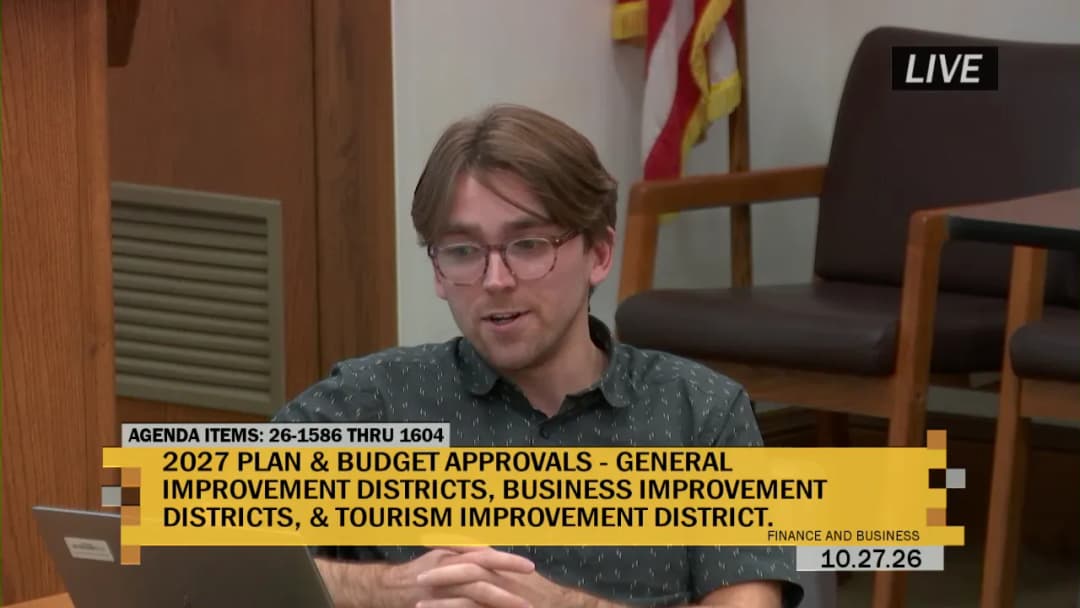
On October 27, 2026, the Finance and Business Committee met at the City & County Building, Room 391, with Chair Chris Hinds presiding and staff member Anne Wallace present. The committee advanced 19 improvement district budget items, approved a Downtown Denver Development Authority funding agreement for the Barth Hotel, heard an informational briefing on the Business Impact Opportunity (BIO) Fund, and approved five consent items. Attendance records list 6 present (Gonzales-Gutierrez, Hinds, Kashmann, Sawyer, Watson, and Alvidrez) and 2 absent (Gilmore, Romero Campbell); the agenda member list did not include Alvidrez. All votes on action items were 5-0, with the two absent members not voting. Action Items 2027 Improvement District Plans and Budgets (26-1586 through 26-1604) - Dennis Wegienek (Department of Finance) presented the annual review of 19 district items: 12 Business Improvement Districts (BIDs), 6 General Improvement Districts (GIDs), and the Denver Tourism Improvement District (TID). - Highlights included: Ballpark GID holding its mill levy at 5 mills; Broadway Denver GID beginning mill-based collections at 8.96 mills after first-year assessments; RiNo GID planning one-time capital projects such as 35th Street improvements, pedestrian lighting, tree installations, a HAWK signal near Mission Ballroom, and trash/recycling/lighting/banner improvements; and the TID projecting about $11.8 million in revenues and expenditures for 2027. - Councilmember Sawyer moved and Councilmember Watson seconded a block motion to approve the 19 items for filing. It carried 5-0. Barth Hotel DDDA Funding Agreement (26-1608) - Dawnna Wilder (Department of Finance) presented a proposed funding agreement between the City and the Denver Downtown Development Authority for the Barth Hotel at 1514 17th Street, Council District 10. - The project will convert 62 units into 50 affordable senior housing units at 30-50% AMI. Total project cost is estimated at just over $22 million; the DDDA will fund up to $6 million, anticipated to reduce to $4 million once awarded tax credits are applied. The loan carries 2% interest over a 40-year term. - The building was built in 1882, is federally and state registered as historic, and is a designated Denver landmark. Planned work includes adding kitchens and private restrooms to each unit, air conditioning, new elevators, new mechanical systems, and new plumbing. - Susan Powers, the developer, said units will be about 350-400 square feet, rents around $1,000 per month, and the project will preserve historic doors and restore terrazzo in the lobby. - Councilmember Sawyer and Councilmember Kashmann voiced strong support for the project. The motion by Watson, seconded by Sawyer, was approved for filing 5-0. Briefing: Business Impact Opportunity (BIO) Fund Update (26-1615) - Adeeb Khan and Martin Gonzalez (Denver Economic Development and Opportunity) and Becky Simon (Department of Transportation and Infrastructure) provided the briefing; Rachel Lyons, DEDO program manager, also answered questions. - The BIO Fund began in 2019 for businesses affected by I-70 construction, expanded during the COVID-19 pandemic and for 16th Street construction and encampment impacts, and currently supports businesses along the Colfax BRT corridor. - Total program funding since 2019 is $32 million. Over 85% came from federal sources such as the CARES Act, while about $4.675 million, or 14%, came from the General Fund. - During Colfax BRT: three 2025 rounds supported 100 businesses on East and West Colfax, and three 2026 rounds supported 88 businesses. Every eligible business that applied received funding. - Reported outcomes include: 95% of East Colfax BRT grant recipients are still open; new business openings have nearly offset closures; 76% of surveyed businesses reported stabilized employee counts; and two-thirds of business owners found the grant helpful or extremely helpful in staying open. - The average grant is about $12,500; larger businesses generally receive $15,000 and smaller businesses $7,500 if they have under $100,000 in annual revenue. Most businesses qualify for the full $15,000. - Councilmember Sawyer said legislation coming November 10 would put the BIO Fund into the Denver Revised Municipal Code, create a dedicated special revenue fund, and offer tools including grants, technical assistance, and potential tax assistance. She noted the fund currently exists only as a program and should not disappear. - Councilmember Alvidrez raised contractor-caused harm and asked about Federal Boulevard BRT. Presenters responded that current BIO Fund dollars are not slated for Federal Boulevard and that HUD/NERSA CDBG funding cannot be used for stabilization grants. Alvidrez said she and Councilmember Watson are urging state support because Federal Boulevard is a state project. - Councilmember Kashmann praised the program but said it needs more money, argued Denver should raise taxes for a variety of priorities, and described current grants as small relative to the losses businesses take. - Councilmember Watson praised the program's ripple effects and encouraged customer-activation efforts such as corridor parties during construction. Consent Calendar - 26-1585: Contract with Eckerd Youth Alternatives, Inc. (Eckerd Connects) for $5,266,409 through 6-30-2027 for citywide workforce development services under Denver's Workforce Innovation and Opportunity Act funding and other federal/state revenue-funded initiatives. Approved by consent. - 26-1605: Authorized issuance and sale of up to $27,000,000 in Multifamily Housing Revenue Bonds (Link and Pin Apartments), Series 2027A and 2027B (Taxable), including award of up to $19,400,000 of the city's private activity bond volume cap, for an affordable multifamily rental housing facility. Approved by consent. - 26-1609: Contract to buy and sell 3940 S. Narcissus Way with Nii Yemofio and Breanna Tomlin-Yemofio for $710,000 in the Hampden South Neighborhood, Council District 4. Approved by consent. - 26-1610: Revocable license agreement with The Gathering Place for a maximum contract amount of $20, approximately October 1-December 31, 2026, to operate a micro-community shelter at 1375 N. Elati Street in the Civic Center Neighborhood, Council District 10. Approved by consent. - 26-1611: Supplemental appropriation of $7,670,500 in the Denver Arts and Venues Special Revenue Fund. Approved by consent. Key Outcomes - Block district budget motion (26-1586 through 26-1604): approved for filing 5-0, with Gilmore and Romero Campbell absent. - Barth Hotel funding agreement (26-1608): approved for filing 5-0. - Consent items 26-1585, 26-1605, 26-1609, 26-1610, and 26-1611: approved by consent. - The BIO Fund briefing was informational; a related council ordinance is expected on November 10, 2026. - Legislative schedule noted: Mayor-Council next week; BID and TID first reading on November 9; BID and TID second reading and GID public hearings on November 16; and a referenced statutory budget approval deadline of December 5.

COMMUNITY INVESTMENT FUND 27% · ECONOMIC DEVELOPMENT 22% · DOWNTOWN DEVELOPMENT AUTHORITY 10% · TRANSPORTATION SAFETY 10%
10
OCT 27, 2026 · DENVER, COLORADO · MAYOR-COUNCIL MEETING
Denver Mayor-Council Joint Meeting: Quarterly Goals Update and Executive Session - October 27, 2026

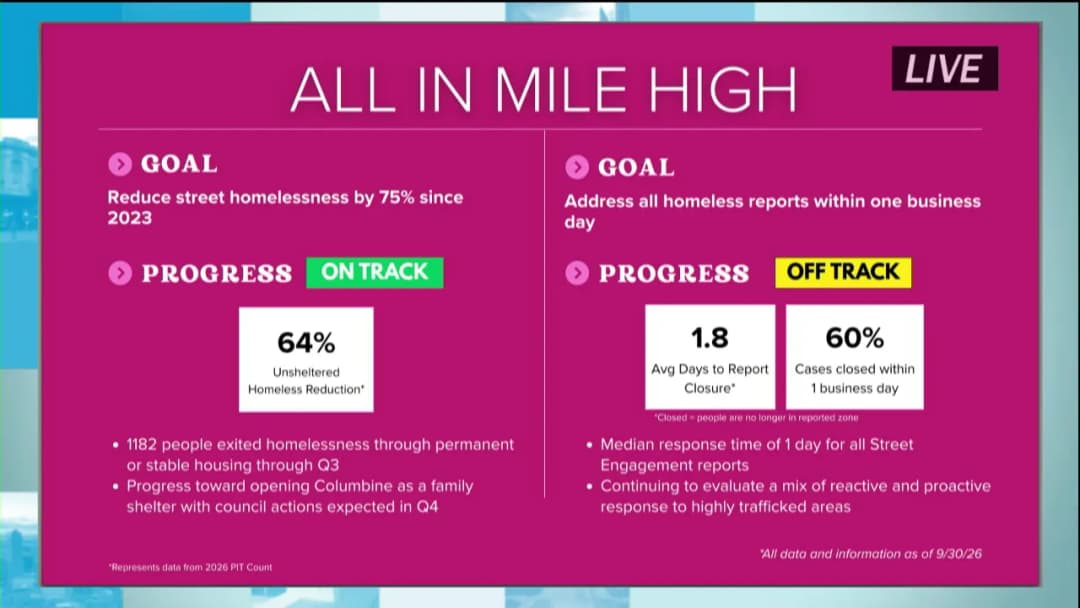
On 2026-10-27 at 16:30 UTC, the Denver mayor and City Council held their weekly joint meeting. The mayor's office presented the regular quarterly update on the six citywide goals, council members made community announcements, and the body moved into executive session to discuss pending litigation and legal advice. No agenda or minutes were available; this summary is based on the raw transcript. Announcements - A District 7 council member reminded viewers of the Constitution Buck Club on October 28 at 5 p.m. at Habitat for Humanity Headquarters in District 7, and constituent hours on Thursday, October 29, from 4 to 6 p.m. at Athmar Park Branch Library. - The City Council president announced, on behalf of Councilwoman Lewis in District 8, the 43rd annual Hiawatha Davis Jr. Senior Luncheon on Saturday, December 19, from 11 a.m. to 1 p.m. at the DoubleTree Hotel on Quebec. Seniors were asked to RSVP to the District 8 office at 720-337-8888 or by emailing District 8 at DenverGov.org. Discussion Items - Quarterly Citywide Goals Update: The mayor's office reviewed progress on six goals, noting that details are available on the public dashboard. - Vibrant: Goal to fill 3 million square feet of downtown office space; about 2.2 million square feet had been filled so far, with 877,000 square feet of leases renewed. The presenter described this as about 2 million square feet newly filled and about 1 million square feet retained. Catalytic projects include bond work, Denver Summit Stadium (groundbreaking October 1), Burnham Yard small-area planning, Ball Arena signage changes, and a $50 million Sloane's Lake preservation effort. - Affordable: Goals were to deliver 2,500 new affordable units and permit 5,000 more units. The city is behind on the 2,500-unit goal after losing about 400 units through federal and state voucher cuts, but has already exceeded the 5,000-unit permitting goal by more than 300 units, with a strong pipeline of deed-restricted affordable units. Rents are stabilizing or dropping by 10 to 24 percent depending on the part of the city and income level. - Safe: After a historically low crime year, high-risk-area shooting totals increased 75% because shootings went from four to seven across the sites (three additional shootings). The administration highlighted longer-term declines: homicide down more than 30%, firearm homicide down almost 42%, and non-fatal shootings down 50% over three years, with most cities seeing larger rebounds. - All In My Mile High: The goal is to reduce street homelessness by 75%; the mid-year point-in-time count showed a 64% reduction, with the next point-in-time count measuring year-end progress. The goal of responding within one day is off track at 1.8 days, driven mainly by people living in vehicles; the administration does not want to rush decisions to push someone out of a vehicle. - Climate Resilient: On track for 5,000 clean energy systems and 50 acres of green infrastructure. Projects include Carpio Sangrinetti Park, Lowell and Evans, 51st and Steel, Montbello, Harvard Gulch, and Rosedale, with Q4 completions. - Child Friendly: Both goals are on track. The Haynes Gary Task Force has held six listening events and collected almost 1,000 responses for the child care for all plan; a spring proposal will outline an ideal 0-to-5 program. The city is past 62,000 of the 70,000 goal for young people in out-of-school time and summer programming. - Executive Session Motion: After an initial procedural misstep, a motion was made and seconded to enter executive session pursuant to DRMC 234A, sections 3, 6, and 7, for discussion of settlement of pending litigation and related legal advice. The voice vote was all in favor with no opposition. Key Outcomes - Quarterly citywide goals update was presented; no formal action was taken. - Council approved moving into executive session for pending litigation and legal advice. - Upcoming community events were announced, including District 7 events and the District 8 senior luncheon.

AFFORDABLE HOUSING 24% · PROCEDURAL 20% · ECONOMIC DEVELOPMENT 20% · PUBLIC SAFETY 16%
0102
NEXT →
OPENPUBLICA · PUBLIC MEETING INDEXUPDATED DAILY · openpublica.com