On Thursday, September 3, 2026, the City of Fort Worth held a public bid opening for multiple requests for proposals (RFPs) and projects. City staff read aloud the names and bid amounts of submitted proposals. No discussion, public comments, or votes occurred; the session consisted solely of bid announcements. Bid Opening Details - RFP 26-0257 – Electrician Services - David To Hung, Ltd. Co. - Fort Worth Electric LP - Acme Electric - RFP 26-0262 – HVAC Filters - Florence Filter Corporation - Greenville Enterprises, LLC - Filter by Incorporate - Air Relief Technologies, Inc. - Total Filtration Services Inc. - Argent Associates Inc. - Pierre Max LLC - Filter King LLC - RHS AC Services LLC - RHS AC Services LLC (duplicate listed) - Ballmark Energy LLC - GMR Heating and Air LLC - Northern Safety and Industrial - RFP 26-0267 – Art Gallery Retrofitting and Installation - Crozier Fine Arts - RFP 26-0270 – Ice Machine Rental and Maintenance - Quench USA Inc. - Rental Time Ice Machines - RFP 26-0261 – Public Works 2025 Bridge Scour Mitigation Project (City Project 10627) - C Greenscaping LP: $424,750.00 (originally misread; corrected below) - Gibson and Associates Inc.: $987,100.50 - Regal Inc.: $175,300.00 - RFP 26-0282 – Public Works 2027 Asphalt Resurfacing Contract 6 (City Project 106821) - Advanced Paving: $3,681,838.00 - Overland Corporation: $3,743,354.00 - Peach Tree Construction: $3,469,742.95 - Reliable Paving: $4,236,535.70 - Texas Material Group: $2,783,500.55 - Luminate Transportation Technologies LLC: $640,330.00 - MICA Corporation: $461,000.00 - Woody Contractors Inc.: $620,475.97 Note of Correction During the reading, the bidder noted that one bid amount for the Bridge Scour project was read incorrectly. The corrected amounts are: - C Greenscaping LP: $281,350.00 (originally stated as $424,750.00) - The Fain Group: $375,474.00 (not previously listed) Conclusion The public bid opening concluded without further actions or discussions. All bids were recorded for subsequent city review and award.
Public Meetings - Fort Worth, Texas
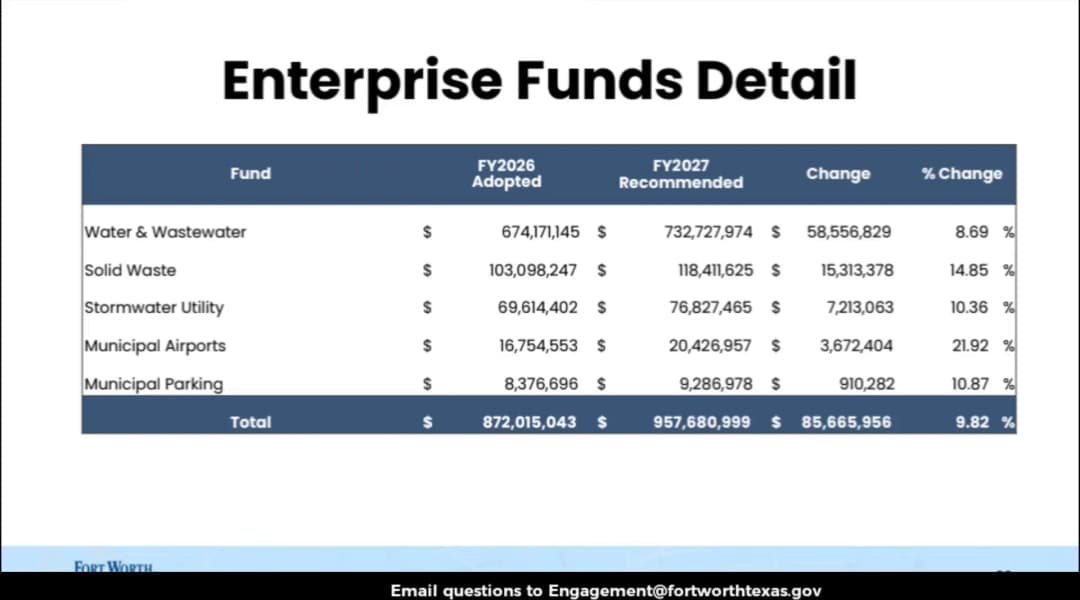
Public Meetings - Fort Worth, TexasCity Manager Jay Chapa and Fort Worth Lab Director Christiane Simmons presented the proposed FY 2027 budget to District 4 residents. The meeting highlighted a $94 million budget gap driven by flat property tax values due to Tarrant Appraisal District's reappraisal plan, and detailed the recommended cuts, tax rate increase, and investments in public safety. The council is scheduled to vote on the budget and tax rate on September 15, 2026, with a public hearing on September 1. Public Comments & Testimony - Resident (regarding code ranger program): Questioned why the volunteer program was cut, expressing concern about lost community engagement. - Resident (revenue from code violations): Asked how much revenue code compliance generates and criticized the use of liens on rental properties, noting that absentee owners avoid payment. - Resident (CCPD funding): Stated that the CCPD (Crime Control and Prevention District) sales tax was sold to voters as funding for police, but a portion ($11 million in 2025) goes to nonprofits with little accountability. She called for transparency and for the money to be used for police equipment and salaries. - Resident (homelessness funding): Noted that despite millions in funding to homeless service providers, homelessness has increased, and questioned the effectiveness of permanent supportive housing and lack of accountability. - Resident (pavement management fee): Expressed concern that the fee could be raised in the future without a public vote, as seen in Austin. - Resident (public art funding): Argued that the 1% for public art bond set-aside should be redirected to police or fire, and that wealthy donors could fund art instead. - Resident (remote participation): Asked if the city would reinstate remote call-in for council meetings to improve accessibility. Discussion Items - Budget Overview: City Manager Jay Chapa explained that the $3.32 billion operating budget must be balanced by state law. The general fund is $1.1 billion, only one-third of the total, and the gap must be closed within the general fund. He emphasized that public safety investments were prioritized, forcing cuts elsewhere. - Property Tax Revenue Shortfall: Christiane Simmons showed that Tarrant County's average taxable value has flattened and fallen due to the appraisal district's reappraisal plan, while Collin and Dallas counties grew. The city initially projected a $49 million gap, which grew to $94 million after adding contractual police and fire costs and mid-year value losses. - Budget Balancing Measures: Departments initially cut 1% and submitted 3% reduction packages ($22 million). Deeper cuts of $28 million eliminated vacant positions and frozen pay. Revenue increases and a proposed tax rate increase of 3.2 cents per $100 valuation (from 67 to 70.2 cents) closed the remaining gap. After council feedback, the rate was adjusted to 70.565 cents to restore the PetSmart Alliance adoption center, some park and library positions, and increase general employee pay-for-performance from 1.5% to 3% (mid-year). - Public Safety Investments: The budget adds 76 patrol officers, 30 corporal positions for a promotional path in patrol, funding for fire overtime and fleet, and a 911 assistive call-taking technology pilot. The Fire HOPE program will shift to a mobile integrated health team to save overtime. - Cuts and Service Level Impacts: Cuts include a 90% reduction in general fund transfer to economic development initiatives ($5M to $500K), smoothing of the neighborhood improvement program (from $4M to $1M in year one), a 25% reduction in the mobile tool shed program (reducing staff from 4 to 3), and a 3% cut to the priority repair program. The code ranger program was eliminated because it was no longer effective. - Enterprise Funds: Water, solid waste, stormwater, and other enterprise funds are funded by user fees. Water rates increase $7.09/month for typical usage to support capital projects. The pavement management fee (formerly street maintenance fee) is proposed to supplement existing maintenance funding, with rates proportional to property use. - CCPD and Nonprofit Funding: In response to resident concerns, Chief Garcia stated that the police department will use criminologists to evaluate all CCPD-funded programs for effectiveness and return on investment. The councilman acknowledged the need for better transparency and promised to publish CCPD board meeting information. - Public Art Policy: The 1% for art bond policy was discussed. The councilman said he has asked staff to explore putting the policy to a public vote. The city manager noted that the policy can only be changed by the city council. Key Outcomes - Proposed Tax Rate: The city manager recommended a tax rate of 70.2 cents per $100 valuation, later adjusted to 70.565 cents after council feedback. The council will vote on the final rate on September 15. - No Furloughs or Layoffs: The budget does not include furloughs or layoffs. The city manager indicated that if the council chose not to raise the tax rate, those would be the next options. - Next Steps: A public hearing on the budget will be held on September 1, 2026, at 2:00 PM at City Hall. The city council will adopt the budget and set the tax rate on September 15. Residents can sign up to speak at the hearing or provide feedback via Connect Fort Worth. - CCPD Program Evaluation: Chief Garcia committed to a data-driven review of all CCPD-funded programs, using criminologists, with results expected to inform the FY 2028 budget process starting April 2027. - Better Communication Promised: The district councilman pledged to improve communication of CCPD board meetings and other public information, and to investigate feasibility of clawing back Trinity Metro sales tax for road repairs.
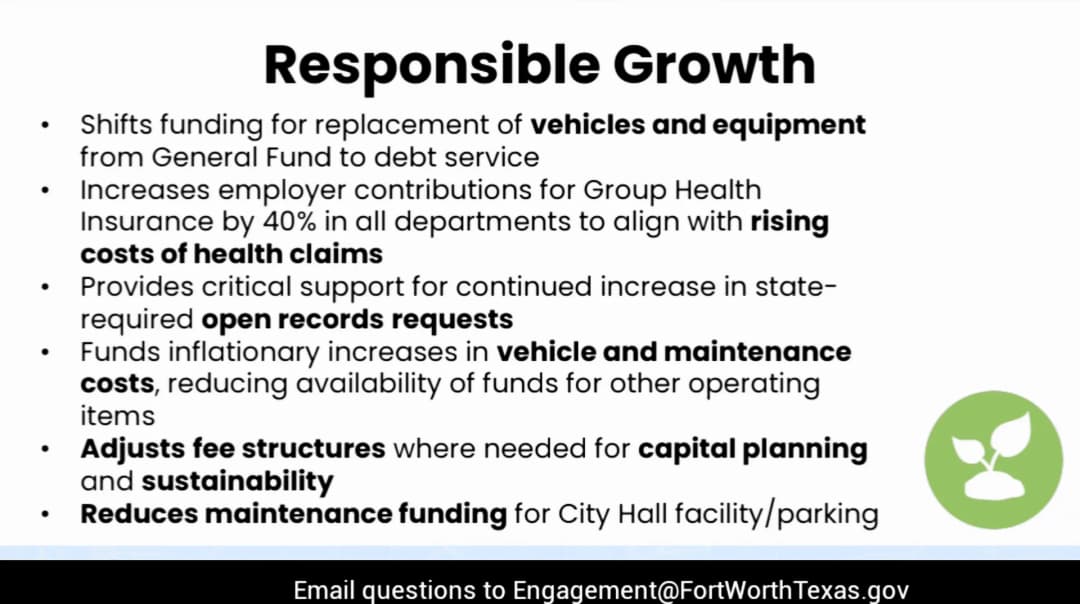
On September 2, 2026, Councilmember (not named in transcript) hosted a District 5 budget town hall at which City Manager Jay Choppa and Fort Worth Lab Director Christian Simmons presented the proposed Fiscal Year 2027 budget. The meeting, the eighth of ten, was attended by approximately 20-50 people in person and streamed to about 200 viewers. The presentation focused on a $3.3 billion total operating budget, a general fund shortfall driven by Tarrant Appraisal District (TAD) practices, and the recommended property tax rate increase from 67 cents to 70.2 cents per $100 valuation (later adjusted to 70.565 cents after council-directed restorations). Residents asked questions and offered comments on spending priorities, service cuts, and the impact of TAD’s reappraisal plan. Public Comments & Testimony - Bob (resident): Expressed strong opposition to what he termed wasteful spending, specifically calling for the elimination of the community engagement office and the police oversight monitor. He stated these positions cost more than the Texas Attorney General and are unnecessary. - Evelyn Bagley (transplant resident): Raised concerns about rapid development, loss of mature trees, and lack of shade in parks. She criticized the city for not preserving large trees and replacing them with smaller ones, and for playgrounds without shade. - Colita (resident): Asked about neighborhood services programs and whether they factor in preserving nature; expressed hope that green space is being protected. - Unidentified male resident: Asked whether TAD’s practices caused the tax rate increase and questioned what the tax rate would be if Fort Worth values grew like Collin and Dallas counties. He also asked about the police budget increase and the inevitability of those costs. - Unidentified female resident: Questioned the reduction in the neighborhood improvement program, asking if it was a real cut or just a funding shift. She also asked about CCPD funding and its original intent for community programs. - Multiple speakers: Expressed concerns about specific program cuts (e.g., Alliance PetSmart Adoption Center, mobile tool shed) and advocated for restoring services. Discussion Items - Budget Overview: City Manager Jay Choppa explained that Texas law requires a balanced budget. The total operating budget is $3.3 billion, with the general fund at $1.15 billion. About 60% of general fund revenue comes from property taxes. Christian Simmons noted that because of TAD’s every-other-year reappraisal plan and a high number of protests, property tax growth was only 0.89% (well below the projected 2%), creating a $49 million gap that later narrowed to $37 million after cuts. - TAD Impact: Simmons presented a graph comparing average taxable home values in Collin, Dallas, and Tarrant counties, showing Tarrant values flat then falling, while other counties grew. The city manager noted TAD is the only appraisal district in Texas using its current methodology. - Budget Reductions: Departments were asked for 1% and 3% reduction ideas, yielding $7.8 million in savings. Deeper cuts included: eliminating vacant positions, reducing employee pay-for-performance from 4% to 1.5% (later partially restored), and reducing the transfer to the Economic Development Initiatives Fund from $5 million to $500,000. The proposed budget originally cut the Alliance PetSmart Adoption Center and removed six code compliance positions, but council and public pushback led to restorations. - Police and Fire Funding: The police budget increases by about $23 million, mostly due to contractual pay raises (averaging 6%). The budget also adds 76 patrol officers (funded by CCPD initially) and creates 30 corporal positions to allow promotions within patrol. Fire’s budget grows $52.6 million, largely due to a $30 million subsidy for EMS, a placeholder for a new labor contract, and fleet/overtime cost adjustments. - Fee Increases: Various fee increases were proposed, most notably a four-year phased solid waste fee increase after 22 years without an increase. The city manager cited the need to replenish reserves and plan for future landfill replacement. Average resident bill impact: about $7.09 more per month from stormwater, water, solid waste, and environmental fees combined. - Property Tax Bill Effect: Despite a recommended tax rate increase (70.2 to 70.565 cents), the average homestead taxable value is falling, so the city portion of the tax bill is slightly lower than the current year. The councilmember emphasized that the city lowered the tax rate 8 of the last 10 years, and this increase is needed to maintain services. - Neighborhood Improvement Program (NIP): The budget reduces NIP funding from $4 million to $1 million in year one, but officials explained this is a funding delivery shift (matching actual spending) and not a service cut; the program will still select a neighborhood each year but fund projects over three years. - Will Rogers Complex: The city is transitioning management of Will Rogers Memorial Complex to a third-party operator to increase efficiency and reduce subsidy from hotel occupancy tax. The city retains ownership. Public events budget declines due to convention center expansion taking key spaces offline. - Employee Pay for Performance: Originally cut to 1.5% (mid-year), council sought to restore to 4% (2% budget impact), costing $4 million and raising the tax rate to 70.565 cents. Key Outcomes - No formal votes were taken; this was a public engagement session. The councilmember stated she would carry feedback to upcoming council budget meetings. - The recommended tax rate as of the meeting was 70.565 cents per $100 valuation (up from 70.2 cents) to restore the Alliance PetSmart Adoption Center, six code positions, seven development services positions, and restore employee pay-for-performance. - Departments with the largest budget increases: Fire (+$52.6M), Police (+$23M), Emergency Management & Communications (+$1.2M). Decreases: Property Management (shift of vehicle replacement to debt), Economic Development (reduced transfer), Neighborhood Services (funding smoothing). - The city will continue to work with TAD to understand future valuation impacts and adjust budgeting accordingly. - Public comment will be accepted at the formal public hearing on September 3, 2026 at 2:00 PM at City Hall. Two more district meetings will be held.
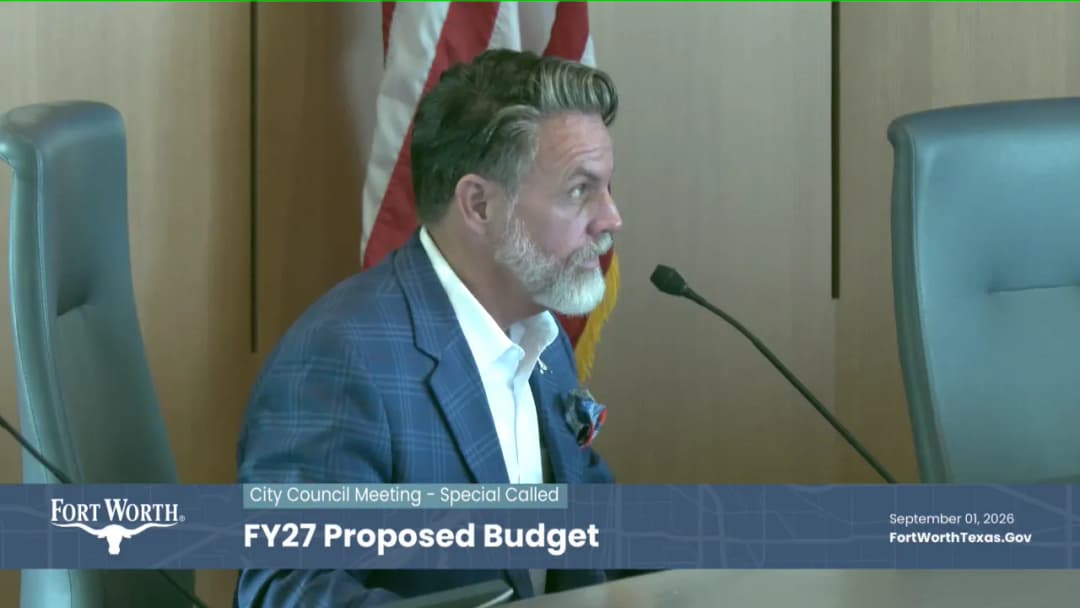
This was a special meeting of the Fort Worth City Council to hold a public hearing on the proposed Fiscal Year 2027 budget. The meeting began with a presentation from Christian Simmons, followed by one public comment and a council vote to close the hearing and continue consideration to September 15, 2026. Public Comments & Testimony - Adrian Smith (District 9) expressed concerns about the $97 million operating deficit, criticized what he called "directionless spending," and called for new city leadership, including a new city manager and mayor. He requested restoring standalone votes on agenda items, remote public speaking, and moving public comment to the top of the agenda. He also asked about the cost of the upcoming demolition of the Fort Worth Convention Center. Discussion Items - Christian Simmons presented the FY27 budget overview: the total operating budget is recommended at $3.3 billion, with the general fund growing 4.6%. The recommended tax rate is 70.565 cents (or 70.2 cents if certain restored items are not included), both of which result in a tax bill decrease for the average homeowner due to falling home values. The five-year capital plan is $3.8 billion, with $1.03 billion for FY27, primarily for water infrastructure. The total recommended budget is $4.35 billion, slightly down from the current year. Community engagement continues with two remaining district meetings. - Councilmember Michael encouraged residents to attend the remaining budget meetings and noted that staff can answer questions. Key Outcomes - The council voted unanimously to close the public hearing and continue consideration of the budget to the September 15, 2026 city council meeting. At that meeting, a public hearing on the property tax rate will also be held, followed by a vote on both the budget and the tax rate.
This work session, held on September 1, 2026 at 1:00 PM, included a recognition, an informal report, a presentation on a proposed economic development agreement, budget updates, and discussion of future agenda items. No formal votes were taken. Recognition - Rachel Parrish, interim building official, was recognized for receiving the Texas Code Official of the Year award from the Building Officials of Texas. The day also marked Building Official and Code Staff Appreciation Day. Informal Report - Tarrant County 911 Emergency Assistance District FY2027 Budget: Deputy Director Aubrey Insco presented the budget; no council questions were raised. Discussion Items - Proposed Economic Development Agreement with Harding Connectivity: Staff presented a proposal for a 10-year tax abatement agreement (up to 65% of real and business personal property) to incentivize Harding Connectivity Inc., a German-based industrial connectivity manufacturer, to relocate its U.S. headquarters and manufacturing from Elgin, Illinois to three existing buildings in Council District 8 (Carter Crossing Industrial Park). Key commitments: minimum capital investment of $192.7 million by December 31, 2031 ($31.1M real property, $161.6M business personal property); creation of 700 new jobs with an average wage of $87,000 (expected to exceed $100,000 over the term); estimated incentive of $6 million ($4.2M net present value), with a private-to-public ratio of $32 to $1. The city would be cash positive by year one and cover incentive value by year five, with net new taxes of $3.2 million over the agreement. The project is expected to produce $900 million in goods for sale in the U.S. that would otherwise be produced overseas. Competing states offer higher incentives and better ocean access. Staff recommended consideration at the September 29 council meeting (public hearing required, 30-day notice). Councilmember Chris N. asked about timing; Councilmember Deborah noted the site is in District 8. A Harding executive in attendance was congratulated on his 19th wedding anniversary. - FY27 Budget Responses and Updates: Christina Simmons provided no formal presentation; staff had sent follow-ups on local sales tax history, credit card service fees, and group health allocations. Councilmember Elizabeth requested a response on GLP-1 reimbursement under group health. Eight of ten public budget engagement meetings had been completed; a budget public hearing was scheduled for 2:00 PM that day (one speaker registered). Councilmember Deborah praised staff for excellent budget hearings in District 5. Final budget approval is set for September 15. - Future Agenda Items: Councilmember Elizabeth requested an update from the police chief on new corporal positions in patrol and future staffing plans. Councilmember Chris requested a follow-up on FLOCK cameras (previously asked) and a presentation from the police chief on appointments made since his arrival, as well as a peer city comparison of bargaining units (specifically noting the Black Police Officer Association as a potential separate unit). Key Outcomes - No votes taken; the meeting was a work session for discussion and direction. - The proposed Harding Connectivity agreement will be brought to the council meeting on September 29, 2026. - Staff will provide follow-up responses on group health (GLP-1), FLOCK cameras, and police staffing/bargaining unit comparisons as requested. - The budget public hearing occurred at 2:00 PM on September 1, and the final budget vote is scheduled for September 15.
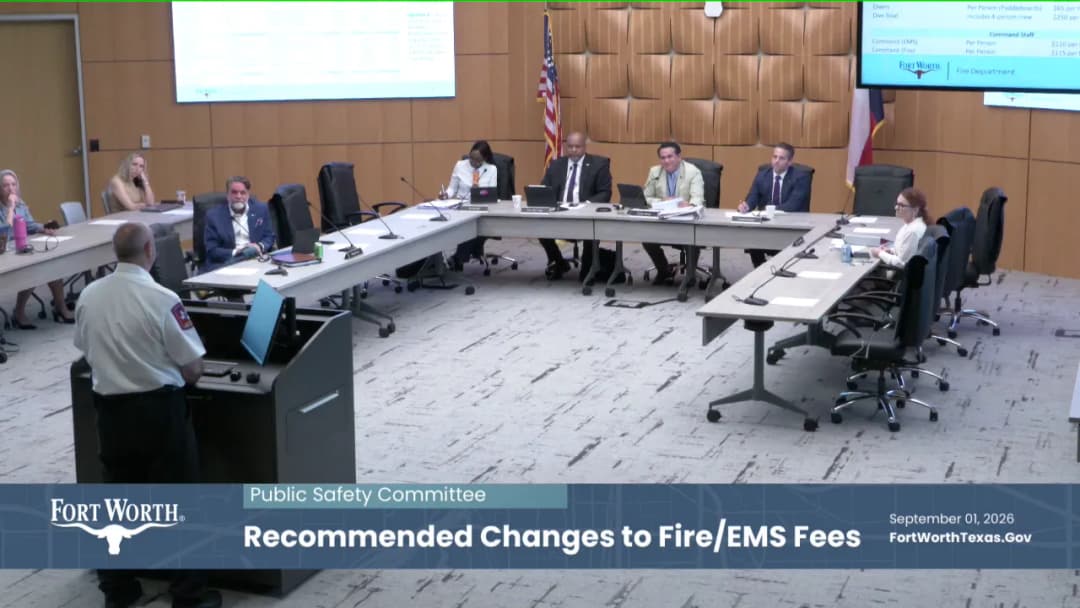
The Public Safety Committee met on Tuesday, September 1, 2026, to discuss the Fire and EMS department's system performance, proposed fee changes for FY27, and to recognize successful cardiac arrest rescues. Key discussions centered on EMS staffing, response times, and a range of options for special events fees. Consent Calendar - Approval of June 2, 2026 Minutes: The minutes from the previous meeting were approved by unanimous voice vote. Discussion Items - Fire and EMS System Performance Update: Fire Chief Gallagher presented an overview of the Fort Worth Fire Department's EMS operations. Key statistics included: - Hiring and Retention: 114 EMTs and paramedics hired through two recruit classes with pass rates of 99% and 95% (national average: 65-75%). Attrition was 20%, with 85 employees lost in the same period. - Staffing: 507 of 543 sworn positions filled (93.4%), with 45 openings and 33 lateral/EMT candidates starting October 1, 2026. - Response Times: Emergent travel time averaged 8 minutes 55 seconds (goal: 8 minutes 90% of the time); non-emergent averaged 11 minutes 44 seconds (goal: 11 minutes 90% of the time). Recent heat waves pushed times above 9 minutes and 12 minutes respectively. - Unit Hour Utilization: Currently 36–40%, well below the 50% target, improving after switching to a 24/48 shift schedule. - Call Volume: Approximately 14,000 calls per month, up from MedStar's 12,600, attributed to system growth. - Proposed Fee Changes: The Fire Department outlined four fee adjustments for FY27: 1. Permits and Inspection Fees: 5% increase, standard yearly adjustment, already reviewed by the Development Advisory Committee with no objections. 2. Lift Assist Fee: A new $750 flat fee for non-emergency lift assists at licensed care facilities only (not residential). Aimed at reducing unnecessary calls and shifting financial burden to facilities. Comparable fees in other cities range from $250 to $500. 3. Special Events Standby Fees: Two options presented: a 5% increase (option 1) or a 66% increase (option 2) to achieve full cost recovery. Committee members expressed concern about the impact on nonprofit community events and requested specific cost examples before deciding. 4. EMS Transport Fee: A 2% increase, as permitted by Senate Bill 916 (Medicare ambulance inflation factor). This would raise only an estimated $162,000 in additional revenue annually due to caps on Medicare/Medicaid payments. Current collection rate is 28% of billed amounts. - Cardiac Arrest Recognition: Dr. Jeff Jarvis and Alison Scanlon recognized dispatchers, firefighters, and paramedics for 21 community members who survived cardiac arrest with good neurological outcomes between April 1 and June 30, 2026. Survival rates for witnessed shockable arrests in Fort Worth reached 44.6% compared to the national average of 37%. The department continues efforts to improve public access AED availability. Key Outcomes - Direction on Special Events Fees: The committee requested detailed cost impact examples for major events (e.g., Mayfest, Main Street Arts Festival, Michelada Festival) and benchmarking against other large cities. Staff will provide this information via individual emails to committee members (since no work session is scheduled before the September 15 fee ordinance adoption date). - No action taken on lift assist, permit, or EMS fees – further discussion anticipated in the budget process. - Next Meeting: The October 5, 2026 meeting is cancelled; the next Public Safety Committee meeting will be Tuesday, November 3, 2026. - Recognition Ceremony: Individual certificates were distributed to recognized personnel in the foyer after the meeting.
This meeting was a public bid opening conducted by the City of Fort Worth. No questions were accepted during the proceeding. The city read aloud the names of bidders and their submitted amounts for three solicitations: janitorial services, a water/sanitary sewer contract, and a bridge railing/waterline improvement project. Discussion Items - RFP 26-0243 – Janitorial Services at Fort Worth City Hall The following firms submitted bids for janitorial services: 3H and 3H Inc., Ambassador Services LLC, American Facility Services Inc., Cedar Rocks Inc., CTJ Maintenance Inc., DNA Building Services Inc., Earnest Packaging Solutions, Everyday American Services Inc., Facilities 360, Global Building Maintenance, Ivy Gays LLC, JDM Janitorial Inc., John Co. Enterprises Inc., Mick Lamore Building Maintenance, Members Building Maintenance LLC, Oriental Building Services, Premier Facilities Services LLC, Prime Cleaning Services Inc., Principal Cleaners LLC, Quality First Services LLC, R Universal Solutions LLC, RAS Services Inc., RT Solutions Group LLC, S CSI Southern Cleaning Service Inc., Service First Janitorial, Star Building Services, Technologies Link Business and Services Corporation, Tree Coast Services Inc., and UBM Enterprise Inc. No bid amounts were read for this solicitation. - 26 0264 – Public Works CPN 103434 Water and Sanitary Sewer Contract 2020 WSM Bids were received from the following contractors with the amounts stated: - O. Estrada Concrete Company: $10,635,615 (read as "10 million 635,615") - Jackson Construction LTD: $11,402,934.00 - Venus Construction: $9,661,494.60 - Western Municipal Construction of Texas LLC: $10,546,857.00 - William J. Schultz, Inc., DBA Circle C Construction Company: $13,094,384.00 - Woody Contractors, Inc.: $10,541,562.15 - $260276 – Public Works: Jennings, Henderson, and Main Street Bridge Railing Rehabilitation, South Main Gateway and Waterline Improvements (City Project Number 102185) Bids were received from the following contractors with the amounts stated: - Fort Worth Civil Constructors: $11,200,813.50 - Jackson Construction LTD: $9,990,669.00 - Regal Inc.: $13,387,624.45 - The Fane Group: $37,547,400.00 Key Outcomes - All submitted bids were publicly read and recorded for each solicitation. - The city will proceed with evaluation of the bids according to its procurement policies. No decisions or awards were made during this meeting.
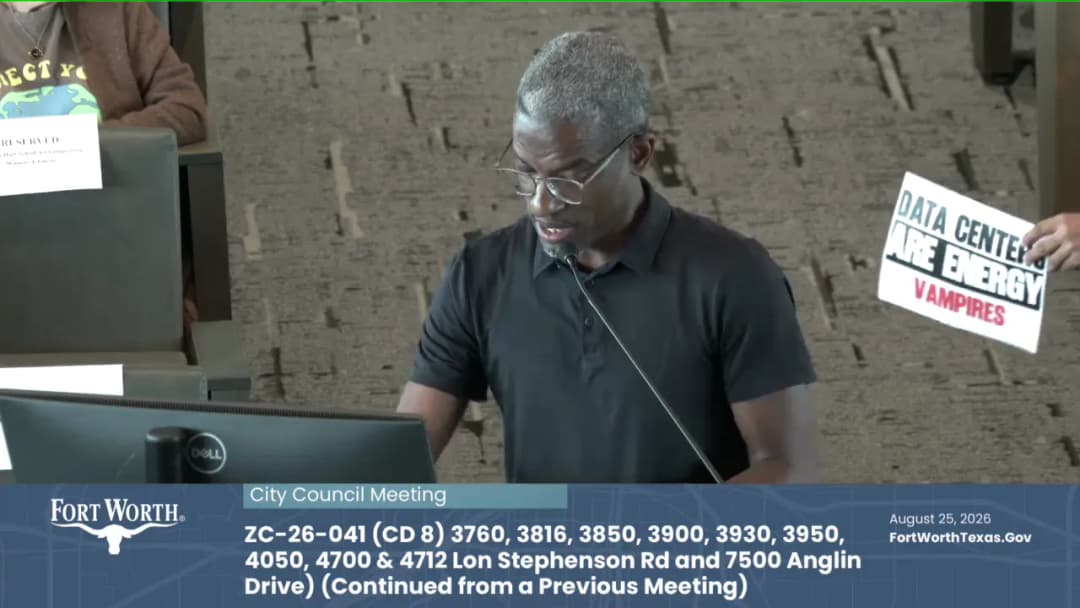
The Fort Worth City Council met on August 25, 2026, to address a full agenda including consent agenda approvals, public hearings, a contentious zoning case for the Black Mountain Data Center, and several community recognitions. The meeting featured extensive public testimony on data center impacts, budget concerns, and other city issues. Key actions included approval of an $11.25 million settlement for the family of Tatiana Jefferson, approval of a site plan amendment for the Black Mountain Data Center with an increased setback, and approval of multiple public improvement districts and board appointments. Consent Calendar - MNC 26-0881 was withdrawn from the consent agenda. - Settlement for Tatiana Jefferson: The council approved a settlement of $11,250,000 to resolve a lawsuit arising from the fatal shooting of Tatiana Jefferson by a former Fort Worth police officer in 2019. Councilman Chris Nettles noted this was one of the largest settlements in city history and stated it was not a measure of her life's value but a step toward justice. Multiple speakers from the public supported the settlement. - All other consent items were approved. Public Comments & Testimony - Consent agenda speakers: Adrian Smith and James Smith spoke emotionally about the Tatiana Jefferson settlement, urging approval and expressing frustration with the delay. James Smith detailed his role as a neighbor and advocate. - Zoning item ZC26-041 (Black Mountain Data Center): Over 40 speakers addressed this item. - Supporters: Bob Riley (applicant's engineer), Rhett Bennett (developer), and several local residents (e.g., Helen Epps, Robert Epps, Pastor Perry Williams, Zachary Chris, Dwayne Washington) expressed support, citing increased setbacks, reduced building count, community benefits (workforce development, internships, property tax revenue for Everman ISD estimated at $11 million per year), and the fact that the underlying zoning was already approved. Edge Connects (operator) also spoke, pledging community investment. - Opponents: Numerous residents and activists (e.g., Letitia Wilburn, Bradford Hall, Sue Weston, Jackson Weston, Brian Patman, EJ Carrion, Amon Abraham, Christopher Santos, Lily Boone, and others) requested tabling the vote until the newly formed Data Center Infrastructure Commission (DCIC) could provide recommendations. Concerns included inadequate stormwater and vibration studies, noise, light pollution, water and electricity consumption, health impacts (especially on marginalized communities), and the rushed timeline before the DCIC completes its work. Some speakers accused council members of being influenced by developer donations. - General public comments: After action items, speakers addressed diverse topics: - Adrian Smith criticized the city's budget shortfall and called for a new city manager, defunding the police, and restoring remote speaking. - Kevin Carlson requested a zoning change near his neighborhood due to commercial impacts. - Chris Wood highlighted predatory towing practices at low-income apartment complexes. - James Smith advocated for better alley maintenance and reflected on his testimony in the Aaron Dean trial. - Several speakers (including Letitia Wilburn, George Stiles, Carlos Silva, and Nancy Estrada) criticized council members for disrespecting public participation, alleged corruption, and retaliation against whistleblowers. - Joey Flores detailed the timeline of the Texas Education Agency's takeover of Fort Worth ISD, arguing it was triggered by a single school's rating. - Ann Marie and others provided budget analysis, blaming Tarrant Appraisal District for unequal appraisals contributing to the city's $94 million shortfall. Discussion Items - Recognitions: The council presented proclamations for Prairie View A&M University's 150th anniversary (with alumni acceptance), the Mayor's High School Art Competition 2026 top three winners (Madeline Wilkinson, Chloe Swinford, Lana Mackie), and Gun Safety Awareness Month, in partnership with Cook Children's Aim for Safety program (which distributed 488 gun safes and 3,523 cable locks in the past year). - Board appointments: Approved at-large appointments to Community Action Partners and Human Relations Commission, and district appointments to Library Advisory Board (District 4: Marlene Jones; District 11: Tanya Ferguson, replacing Leslie Shields). - Public hearings: Closed the public hearing and approved 11 public improvement district (PID) items in a single vote (MNC 26-0910 through 26-0927). Also approved MNC 26-0928. - Zoning item ZC26-041: Staff presentation explained that the request was to amend existing PD 1420 (approved Jan. and Sept. 2025) to add an electrical substation, increase building height from 55 to 70 feet, increase setback from 80 to 150 feet (site plan shows actual buildings at 300+ feet from property line), and reduce parking. Council discussion focused on whether to wait for the DCIC recommendations. Councilmember Mia Hall noted the underlying data center use was already entitled and the site plan offered improvements. Councilmember Michael Crane offered an amendment to increase the minimum setback to 300 feet, which was accepted. The motion to approve the site plan amendment with the amended setback carried. Key Outcomes - Consent agenda approved including the $11.25 million settlement for Tatiana Jefferson's family. - Public hearings closed and 11 PID items approved. - ZC26-041 approved with an amendment requiring a minimum 300-foot building setback from single-family residential, as reflected in the site plan. The addition of an electrical substation, increased height (70 ft), and reduced parking were also approved. - Council reaffirmed that the Data Center Infrastructure Commission (DCIC) will continue its work and the moratorium on new data center regulations remains in effect, but this project, having prior entitlements, is not subject to future rules. - Meeting adjourned at 3:37 PM.
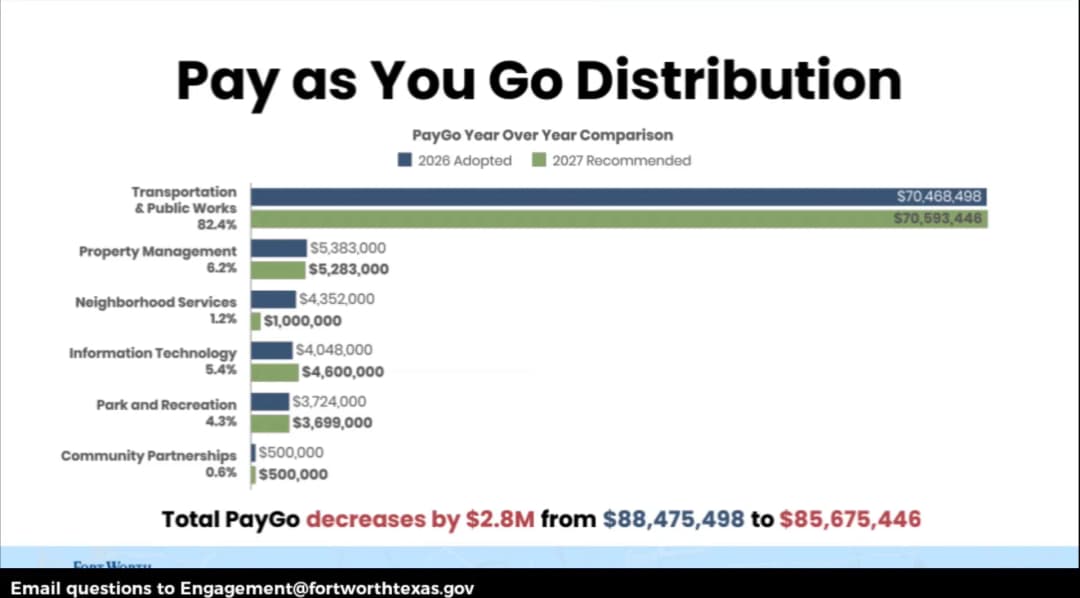
Councilmember Carlos Soros (District 2) convened the meeting at approximately 6:15 p.m. on Monday, August 25, 2026, to present and discuss the City of Fort Worth's proposed Fiscal Year 2027 budget. City Manager Jay Chapa and Christian Simmons, Director of the Fort Worth Lab, led the presentation. The meeting featured public questions on tax rates, spending priorities, and city services. Presentation & Discussion Items - Budget Challenge & Revenue Gap: Councilmember Soros noted that this budget cycle is especially challenging due to Tarrant Appraisal District's (TAD) reappraisal plan, which froze most residential values from 2024 and allowed unprecedented protests and litigation, resulting in a loss of property tax revenue. The city faced a projected gap that peaked at $94 million. - Proposed Tax Rate Increase: The recommended budget proposed a 3.2 cent increase in the property tax rate (from 67.0 cents to 70.2 cents per $100 valuation). This was the first rate increase in several years. The increase was needed to balance the general fund without deeper service cuts. - Balancing Actions: Departments were asked to cut 1% of their budgets and submit an additional 3% in reductions, generating about $22 million in savings. The city also reduced general employee performance raises from 4% to 1.5%, froze vacant positions, and eliminated some unfilled positions. A $5 million transfer to the Economic Development Initiatives Fund was paused (reduced to $500,000). - Service Restoration Discussions: On August 21, 2026, the City Council expressed concern over certain cuts—such as closing the Alliance PetSmart adoption site, reducing code enforcement, parks maintenance, library staffing, and transportation positions. To restore these, staff proposed raising the tax rate an additional 0.36 cents (to 70.56 cents), which would reduce the average homeowner's tax bill decrease from $16 to about $8 year-over-year. - Public Safety Priority: Public safety (police, fire, EMS) remains the top priority. The budget adds 76 patrol officers, corporal positions within patrol, and funds the Axon 911 AI call-taking technology for non-emergency calls. The Homeless Outreach and Prevention Team (HOPE) is shifted from firefighters to EMS personnel to save overtime costs. - Infrastructure & Fees: The pavement management fee (street maintenance fee) is authorized but not implemented until FY28. The pay-as-you-go (PAYGO) capital rate remains at 7.25 cents, but revenue declines by $2.8 million due to falling values. Water, solid waste, and stormwater rates increase modestly; total monthly impact on an average household bill (including property tax) is about $5.70 less than current year. - Five-Year Capital Plan: The FY27 capital plan totals $1.03 billion, with water accounting for $800 million. Public Comments & Testimony - Joe Ponza (longtime District 2 resident): Expressed frustration over city spending, specifically the new city hall (Pier 1 building) and the Main Street bridge. He argued that better decisions could have avoided the budget shortfall and that street repairs in his area have been neglected for years. Councilmember Soros responded that water infrastructure must be replaced before road work, and City Manager Chapa corrected that the Pier 1 project cost about $220 million (less than the $300M Joe cited) and that the North Main bridge was funded regionally, not by city dollars. - Resident (unidentified, female): Asked why the city did not raise the tax rate higher to avoid cuts, noting the legal ceiling is about 9 cents above the current rate without a public vote. City Manager Chapa explained that the goal was to balance service impacts and taxpayer burden, and that a larger increase could trigger a rollback election and hurt those on fixed incomes. - Resident (small business owner): Questioned the state's business personal property (BPP) exemption increase (from $2,500 to $125,000), noting that it eliminated her tax contribution. City Manager Chapa confirmed the city lost about $8 million annually from that change, and that larger corporations (like Walmart) benefit disproportionately. - Resident (male, earlier questioner): Criticized tax incentives for corporations, claiming they do not benefit Fort Worth residents. Councilmember Soros and City Manager Chapa defended the incentive policy, stating that projects must meet job and wage thresholds before receiving abatements, and that without incentives, the city would lose high-value employers (e.g., Lockheed Martin, which pays no property taxes but has a massive economic impact). - Resident (female, later): Inquired about funding for a new downtown library and about fines for unpermitted short-term rentals (Airbnb). Staff clarified that capital projects are in a separate fund, and that Code Compliance uses a service (Rental Escape) to identify unpermitted rentals and issue citations, with fines going to the general fund. Key Outcomes - The city manager's recommended budget (with a 3.2 cent increase) was presented; council feedback on August 21 led to potential restoration of some cuts at a slightly higher rate (70.56 cents). The final budget will be voted on September 15, 2026. A public hearing is scheduled for September 1, 2026. - The city will continue to monitor TAD's reappraisal cycle and plans to treat its budget as biennial, expecting a value increase in 2028 that may be used for one-time capital or to avoid future cuts. - No formal votes were taken at this town hall; it served as a community engagement session.
On Saturday, August 25, 2026, the City of Fort Worth held a community meeting to present the proposed fiscal year 2027 operating and capital budget. City Manager Jay Chapa and Director of the Fort Worth Lab Christianne Simmons led the presentation, focusing on the budget gap caused by Tarrant Appraisal District’s (TAD) reappraisal practices, proposed service reductions, and a recommended tax rate increase. The meeting included extensive public comments and questions. Public Comments & Testimony - Multiple residents expressed frustration with TAD’s appraisal methods, noting that Fort Worth’s residential property values have not kept pace with growth, while commercial values lag. One speaker questioned the fairness of new-home valuations compared to older homes in dilapidated neighborhoods. Another asked why the city does not shift more of the tax burden to commercial properties. - A resident requested better communication from the Police Department about commander assignments after a vacancy was not promptly filled. Councilwoman Martinez acknowledged the issue and committed to improvement. - Several speakers urged full funding for the Mobile Tool Shed program, warning that delays in equipment access increase penalties for residents facing code violations. - Support was expressed for restoring the Alliance PetSmart adoption center and avoiding library staffing cuts. One speaker highlighted libraries as essential cooling centers during extreme heat. - A resident praised code compliance and Councilwoman Martinez’s office for helping clean up their neighborhood, but noted high turnover among code officers. - Questions were raised about funding for after-school programs at community centers and maintenance of new parks like Sequel Vasquez Park (opening spring). - Another speaker asked about the growing number of homeless encampments and whether environmental services funding is sufficient for cleanup. Discussion Items - Budget Gap and Revenue Shortfall: Simmons explained that Fort Worth faces a structural budget shortfall due to TAD’s decision to reappraise residential properties every other year and a historic number of successful property tax protests. Certified values fell 2.7% from the prior year, creating a $94 million gap at its peak. The city closed the gap through department cuts, reduced general employee pay increases (from 4% to 1.5%), and a proposed tax rate increase. - Tax Rate Proposal: Originally proposed at 70.2 cents per $100 valuation (up from 67 cents), the rate was adjusted to 70.56 cents after council restored several programs. Even with the increase, the city portion of the average home tax bill decreases by about $8 due to lower assessed values. - Restorations (Council Feedback): After council input, the following items were restored to the budget: retention of the Alliance PetSmart adoption center; restoration of vacant positions in Code (neighborhood inspectors), Parks (recreation assistants, maintenance workers), Library (staffing), Development Services (customer service), and Transportation; and an increase in general employee pay-for-performance raises from 1.5% to 3% (budget impact of $4 million). - Public Safety Spending: The budget includes 76 new patrol officers and 30 new corporal positions to create a promotional path within patrol. Fire department funding covers contractual raises, overtime alignment, and fleet maintenance. The HOPE (homeless outreach) program is being shifted from fire to EMS mobile integrated health, saving backfill overtime costs. - Infrastructure and Fees: Street maintenance remains funded through the pavement management fee (authorized but not yet implemented). An environmental fee increase from $2.25 to $2.50 per month will support litter abatement and encampment cleanup. Water and stormwater rates are also increasing. - Neighborhood Improvement Program: The FY27 budget funds only $1 million of the usual $4 million per neighborhood, reflecting that first-year planning costs are lower. The program continues, with spending ramping up in year two. One speaker expressed concern about the history center library reopening and water intrusion issues. Key Outcomes - The proposed FY27 operating budget is $3.32 billion, capital budget adds $1.03 billion, total $4.35 billion. - Recommended tax rate: 70.56 cents per $100 valuation (an increase of 3.56 cents). - Public hearing on the budget before the full City Council is scheduled for September 1, 2026. - Final adoption of the budget, tax rate, and fee ordinance is scheduled for September 15, 2026. - Council members indicated their tentative support for the restored items and the revised tax rate, though final decisions await further deliberation.