The Framingham Planning Board met remotely on April 9, 2026 at 7:00 PM. All five members were present: Chair Ted Cosgrove, Elsiana Zaka, Stephen Duby, Matt Cunio, Tom Bowie, and Mitch Mataran. The board approved minutes from a previous meeting and then considered a single agenda item: a sign application for Naya, a new Middle Eastern restaurant at Shoppers World. The meeting also included staff updates on a PRD project and a discussion about sharing housing data with the public. Consent Calendar - The board approved the minutes of the previous meeting by unanimous roll call vote (6-0). Discussion Items - Naya Sign Application: Applicant Carolyn Parker, representing the sign installer, presented a proposal for a halo-lit \"Naya\" sign over the entrance. The applicant had initially sought to add \"Middle Eastern Goodness\" on an existing awning, but the sign officer disallowed that. Board members discussed allowing the additional text as part of a single sign if it remains within the dimensional limits of Shoppers World\'s sign guidelines (maximum 320 square feet, but with smaller tenant limits). The board also approved painting of the brick storefront surround, noting precedent set by other tenants. Board member Matt Cunio raised safety concerns about outdoor tables and chairs visible in the application, recommending bollards and fire/building department approval. The board agreed that if the sign design with \"Middle Eastern Goodness\" is compliant, it can be approved administratively; if not, the applicant must return. - Staff Update: Sarkey provided an update on a city council hearing for the Vios project (PRD redevelopment) that was continued to May 19, 2026. Issues include density (proposed 20 units vs. original 17), roadway improvements, and whether a two-thirds vote is required. The mayor requested staff help finalize a memorandum of agreement and zoning changes. An abutter expressed concern about setting a precedent for other PRDs. Board members noted each PRD is situational. - Upcoming Projects: Sarkey mentioned a Waverly Street overlay district initiative and a 40-unit condominium project going before the Zoning Board of Appeals for a use variance. - Housing Data Presentation: Matt Cunio requested wider distribution of a recent housing data presentation by Framingham State professors, calling it the best presentation in six years. He suggested posting on the city website and social media to inform citizens and reduce speculation. Chair Ted Cosgrove agreed and said he would present it to the city council and incorporate data into a housing production plan. Key Outcomes - The board voted unanimously to approve the Naya sign application as discussed, allowing the addition of \"Middle Eastern Goodness\" text if compliant with size limits, and approved the brick painting. If the revised sign meets guidelines, it may be approved administratively without returning to the board. - The board noted the continued city council hearing on the Vios PRD project to May 19, 2026. - Chair Ted Cosgrove committed to presenting the housing data to the city council and working on a housing production plan. - The board adjourned at approximately the end of the meeting, with the next regular meeting scheduled for May 7, 2026.
Public Meetings - Framingham, Massachusetts
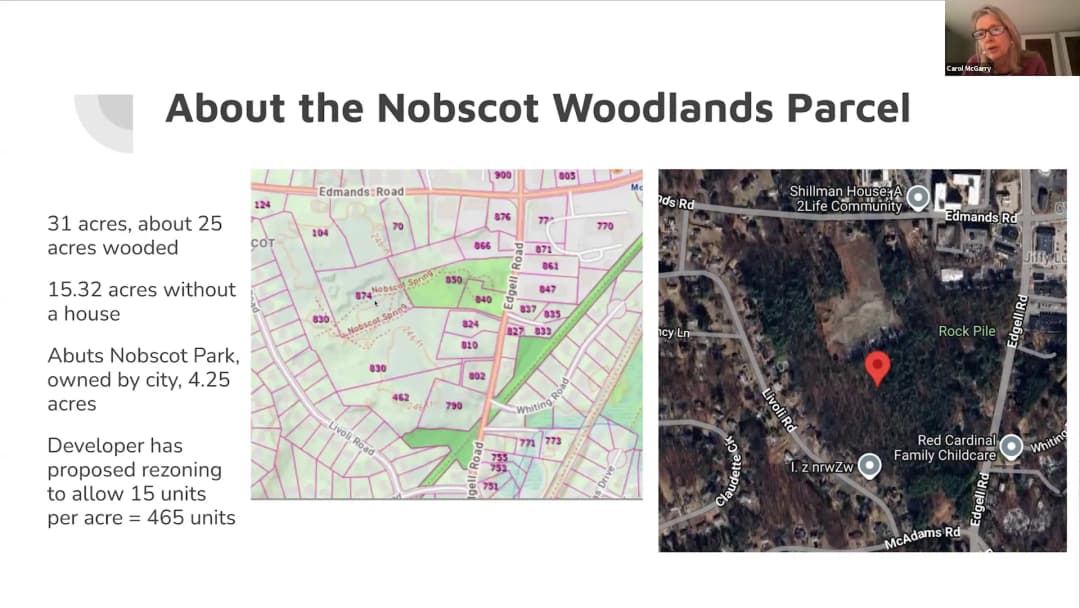
Public Meetings - Framingham, MassachusettsThe Environmental and Sustainability Subcommittee of the Framingham City Council met on April 8, 2026 at 8:04 PM. Councilors Leara Mallet, Ward, and Feeney were present along with Sustainability Coordinator Sean Les. The meeting featured presentations on municipal energy performance, the Agricultural Advisory Committee's priorities, a proposed shopping cart ordinance by Keep Framingham Beautiful, and a resident's presentation on preserving the Knobscott woodlands. The subcommittee also discussed future meeting topics and set the next meeting for May 6, 2026 at 8 PM. Discussion Items Municipal Energy Performance (Sean Les): Sean presented an overview of the city's energy consumption, showing a 13% reduction compared to the FY2011 baseline as of FY2025, though emissions were down 27% in FY2025 (30% in FY2023). Buildings account for nearly 70% of energy use, with schools comprising 73% of municipal consumption. Key initiatives include heat pump installations, energy performance contracts, decarbonization roadmap, geothermal pilot at Farley, fleet electrification (8 new electric vehicles in last fiscal year), and solar battery storage projects. Sean highlighted the importance of setting energy use intensity (EUI) targets for new school construction and working with schools on energy efficiency. Agricultural Advisory Committee (Linda Kirchman and Diane Sulard): The committee outlined five main initiatives: building capacity (adopting MGL Chapter 40 Section 8L to expand authority), protecting wildlife from toxins (banning second-generation anticoagulant rodenticides on city property, exploring restrictions on neonicotinoids and glyphosate), preserving land (monitoring Chapter 61 properties, creating right of first refusal, working with conservation), supporting food growing (codifying agricultural water rates, supporting Framingham Grows Food's community gardens and farm at new school), and working with Board of Health on animal keeping regulations. They requested help navigating city processes for ordinances. Keep Framingham Beautiful - Shopping Cart Ordinance (Deborah and Mike): Presented the problem of stray shopping carts from major retailers accumulating at bus stops, sidewalks, waterways, and residential areas. Noted potential liability, ADA issues, environmental harm, and financial loss. Many cities (Boston, Worcester, Quincy, etc.) have shopping cart ordinances. Proposed ordinance language was discussed with the previous subcommittee in 2025 but was not advanced. Deborah reported that only three companies (Walmart, Stop & Shop, TJX companies) hired cart recovery services; Target discontinued. Emphasized need for enforcement and suggested wheel lock/gatekeeper systems as effective solutions (85-90% reduction). Councilors expressed support but raised concerns about enforcement burden on city departments and impact on smaller retailers. Preserving Knobscott Woodlands (Carol McGarry, resident): Presented a detailed analysis of the approximately 31-acre parcel at the corner of Edgell and Edmonds Road (including lots 874, 830, 462, 790). Approximately 25 acres remain wooded, but lot 874 has been heavily cleared and blasted. Highlighted benefits of preservation: carbon sequestration (estimated 33 tons of stored carbon per acre, equivalent to 5.5 Manhattan city blocks for 30 acres), biodiversity support (connects over 323 acres of conservation land north of Edmonds Road, named in Swasco biodiversity plan and state Biomap2 habitat), groundwater protection (underlying high- and medium-yield aquifer), and open space expansion for Knobscott Park (currently 4.25 acres, walkable from nearby apartments). Suggested the city could negotiate with developer for cluster housing requiring open space or use state matching grants for parkland. The subcommittee noted the property is privately owned and development approval is before the Planning Board. Future Meeting Planning: The subcommittee discussed potential topics for the May 6, 2026 meeting, including hearing from Framingham Grows Food, conservation commission regarding open space plan and protected land updates, and water quality (beaches, ponds). Councilors decided not to prioritize a trails update at this time but left the invitation open for trail advocacy groups to present specific asks. The next meeting was scheduled for May 6, 2026 at 8 PM. Key Outcomes - The subcommittee agreed to continue discussion on the shopping cart ordinance, with further exploration of enforcement and business impacts. - The agricultural advisory committee will pursue recodification under MGL Chapter 40 Section 8L with council assistance; the subcommittee expressed interest in advancing pesticide and rodenticide restrictions. - The subcommittee will consider inviting the Water Department to discuss codifying agricultural water rates. - The meeting was adjourned by motion (Councillor Feeney, seconded by Councillor Ward) with a unanimous voice vote.
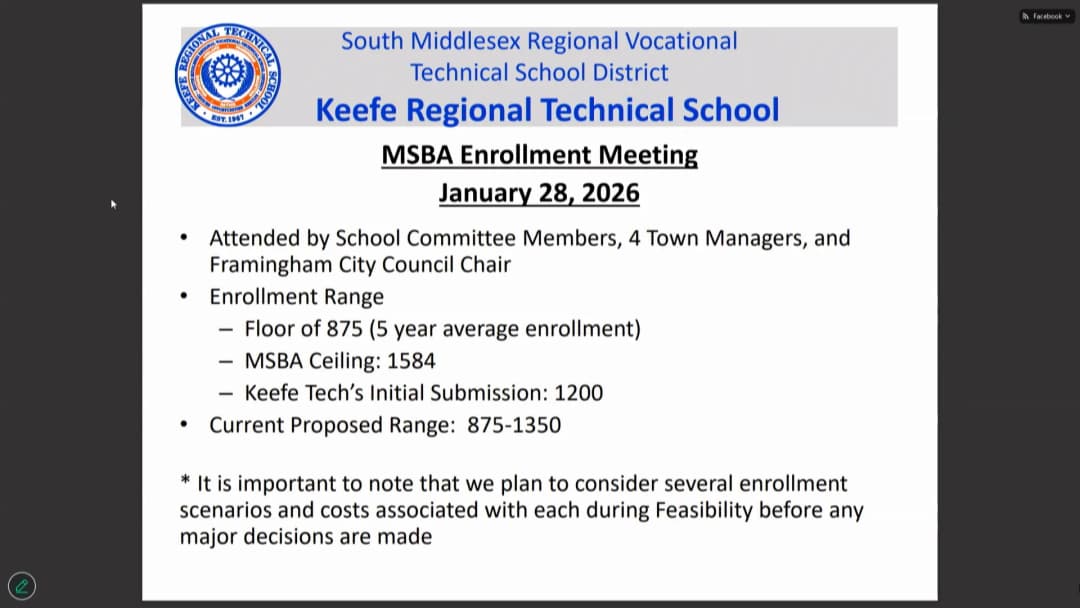
The Framingham City Council held its regular meeting on April 7, 2026, at 7:00 PM. The meeting included a public hearing on the Clarks Hill zoning proposal (continued to May 19), the presentation of the FY25 audit, a discussion with Keefe Tech administration regarding an MSBA project, and several subcommittee reports and referrals. Key votes included approval of the audit and a motion to take no further action on a special municipal employee ordinance. No final decisions were made on the Clarks Hill rezoning or Keefe Tech project. Public Comments & Testimony - Mr. Bloomfield (public participant) spoke about the city budget, asking for status of the stabilization fund, early insight into FY27 water/sewer rate increases, and proposed shifting GIC health insurance premiums from a 75/25 to a 50/50 split between city and employees, stating this could free up $2.5–3 million for other uses. He urged the council to hold off on capital projects and address the tax levy, saying living in Framingham is becoming unaffordable. Public Hearing: Clarks Hill Zoning Proposal (Continued) - Catherine Garrahan (attorney for owner Mount Olympus LLC) updated the council on the proposed rezoning of 13.08 acres at 1 Clarks Hill to a Planned Reuse District (PRD). She noted the planning board submitted a report with recommendations on March 25, 2026, and that a vote is now permissible under M.G.L. c. 40A §5. The owner seeks at least 220 units to support professional on-site management, requiring roughly 17 units per acre after a possible 0.5-acre lot exclusion. The owner cannot unilaterally bring Clarks Hill Lane to current standards but will work cooperatively. - Councilor Long expressed support for 20 units per acre, citing high construction costs ($350–550/sq ft) and state housing needs. She stated that under recent zoning changes for multi-family housing, the vote requires only a simple majority, not a two-thirds supermajority. Several councilors questioned this, and the city solicitor was not present to clarify; the council chair indicated he would rule it a two-thirds vote absent confirmation. - Mitch Matorum (Planning Board Vice Chair) presented the board's recommendations, which favored lower density on the manufacturing lot (visible from the street) and recommended the Planning Board be the special permit granting authority for site plan review. The board also suggested a third category in dimensional regulations for council-approved PRD uses. They emphasized balancing financial feasibility with respect for the existing single-family and duplex neighborhood. - Bios Theodorakos (owner) argued that 220 units are necessary for institutional-quality management. He described the surrounding area as largely industrial, with auto-body shops and warehouses, and stated that his proposed buildings (with residential-style clapboard and shutters) would improve the neighborhood. He noted the office building conversion (90,000 sq ft) would be done first despite being the riskiest and most costly part. - Council debate included discussion of the MOU (memorandum of understanding) as a separate component that must be finalized before the zoning vote. Councilor Ward and others wanted to include specifics on setbacks, height, road improvements, and the front lot green space. - Public testimony: - Mary Ann Hanley (55 Lawrence St.) asked for more details in the MOU and requested a limited site plan to visualize building envelopes and topography. She expressed traffic concerns at Denison Crossing. - Jason Hogue (Clarks Hill Circle HOA) clarified street names and said residents value the tree canopy. He emphasized that Clarks Hill Lane must be addressed in the MOU, as a prior developer promised paving but did not follow through. He was open to different densities if the road-facing side remained less dense. - Michelle Kessel (Clarks Hill Lane) cited traffic safety at the Bishop Street intersection and requested a traffic survey if density reaches 20 units per acre. - Outcome: The council voted 9-0 to continue the public hearing to May 19, 2026, to allow time for the subcommittee to refine the MOU and for the owner to meet with DPW on road standards. Report of the Mayor - Mayor announced several upcoming meetings: April 9 – DPW neighborhood meeting on Walnut/Warren sewer/water project; April 8 – virtual kickoff for elementary school building project (Zoom link on district website); April 16 – community meeting on the new Framingham Regional Justice Center (Nevins Hall, $174 million project, completion expected 2029). - Street sweeping ongoing; curbside leaf collection this week and next. - Boston Marathon (130th running) on April 20; Route 135 closure at 7:45 AM. - Update on CSX rail yard smell complaints: Director of Public Health has reached out to CSX and the federal Surface Transportation Board; a meeting rescheduled to end of April. Presentation of FY25 Audit - Matthew Hunt (CliftonLarsonAllen) presented the FY25 audit. Key points: - Unmodified (clean) opinion on financial statements. - Government-wide: total liabilities $66M; net position deficit of $121M (due to unfunded pension/OPEB). - General fund: total fund balance $75M; unassigned $58M (15.2% of expenses, considered healthy); positive net change of $7.5M (revenues $4.5M over budget, expenses $12.5M under budget, with some carried forward). - Enterprise funds (water/sewer): net position $139M positive, $22M unrestricted; $12.5M positive change. - Pension trust fund: net position $494M, funded ratio 85% (up from 82% prior year). - OPEB trust fund: net position $11M, funded ratio 3.7%. - Total outstanding debt: $316M ($36M added in FY25, $21M governmental, $15M utility). - OPEB liability: $295M (increase from $267M due to experience differences). - Pension liability: $80M (decrease from $92M due to investment gains). - Management letter comments: - COVID-19 FEMA fund ended with a $1.1M deficit to be raised in FY27 tax rate. - ARPA funds must be spent by Dec. 31, 2026. - IT penetration and vulnerability scans (internal and external) and a third-party risk assessment were not performed in FY25; the mayor said FY26 will include yearly tests. - Recommendation to formalize written policies for budget and tax rate calculations after a FY26 tax rate calculation issue. - Upcoming GASB 103 and 104 standards require implementation. - Auditor performed additional procedures requested by councilors: salary comparison (sample of 40 employees, no significant issues) and debt management comparison with top 20 MA municipalities – Framingham ranked 11th in debt service as % of budget (4.2%) and 14th in debt per capita. - Motion to accept the FY25 audit passed unanimously (10-0). Discussion with Keefe Tech Administration on MSBA Project - John Evans (Superintendent, Keefe Tech) reported enrollment of 903 students (673 from Framingham) as of Oct. 1, 2025. Applications for next year from Framingham: 400+; 172 offers extended out of a 233-seat ninth-grade class. The school district is in early stages with the MSBA for a possible renovation/expansion/rebuild. The MSBA projected a floor of 875 students and a ceiling of 1,350; the district proposed a range of 875–1,350 but emphasized 1,200 as a more reasonable target. A feasibility study is set to begin after MSBA approval of funding in late April. Potential new programs (not all will be added): facilities maintenance, construction craft laborer, environmental science, veterinary science, aviation mechanic, biotechnology. Cost unknown; a recent similar project cost $277M for 900 students. - Council discussion focused on funding burden. Councilor Stefanini expressed concern that Framingham, which pays 75% of costs, has limited control over the budget and capital decisions. He questioned whether the school committee would use the 16D (each town must approve) or 16N (majority of towns overall) funding method, noting the regional agreement specifies 16D but that 16N is legally available. Superintendent Evans stated the school committee has not discussed deviating from 16D. Councilor Stefanini emphasized the fiscal risk to Framingham given the projected $400M+ total cost and the city's potential $5–10M annual debt service. No action taken; council thanked the presenters. Subcommittee Recommendation: Special Municipal Employees Ordinance - Councilor Stefanini presented the rules, ordinance & ethics subcommittee recommendation to take no further action on an ordinance designating certain officials as special municipal employees. He voted against the recommendation, arguing it would help the mayor solicit talent for volunteer boards. Councilor Long opposed it, citing concerns about ethics and transparency when board members might appear before other boards. The motion to take no further action passed 9-1 (Stefanini opposed). Referrals and Other Business - Councilor Malik proposed a 3% community impact fee on short-term rentals; originally referred to finance subcommittee, but on Councilor Viani’s suggestion was referred to the economic development subcommittee (no objection). - Community Preservation Committee projects for FY2026 referred to the finance subcommittee. - Council announcements: Youth Council first meeting April 13; Environment & Sustainability subcommittee meeting April 8; Rules committee April 22; Finance subcommittee April 14 at 5 PM; Executive session April 21 at 6 PM for legal exposure and settlement approval. - Motion to adjourn approved unanimously.
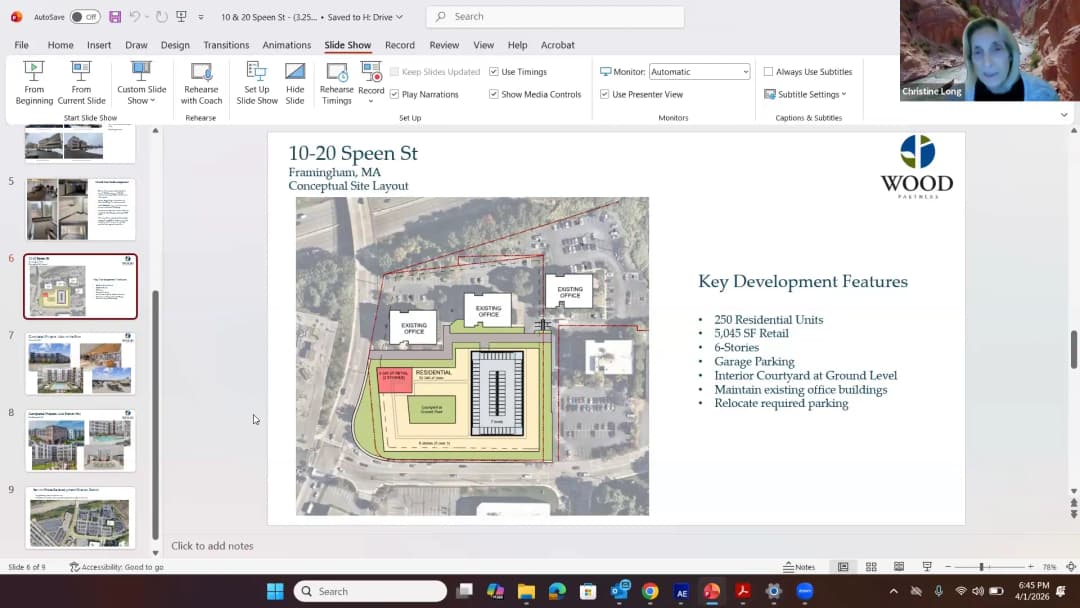
The Planning and Zoning Committee met on April 1, 2026 at 6:00 PM. The primary agenda item was an informational presentation by Kalari Properties regarding a proposed mixed-use redevelopment at 10 and 20 Speen Street. The committee also voted to approve the February 18 minutes with a correction. No formal action was taken on the project. Consent Calendar - The minutes of February 11 and February 18 were approved. A correction was made to the February 18 minutes on line 86, changing the wording to reflect that the next steps are "have the developer draft a reduced density prior to even coming in with any type of zoning." The motion passed unanimously (Councilors Adaviani, Leon Bruno, and Long in favor). Public Comments & Testimony - Chris Halcom (Chiropractor, tenant at 20 Speen Street): Expressed support for the redevelopment and praised the condition of Kalari's existing building at 30 Speen Street. Asked about signage flexibility and curb cuts during construction, and emphasized that his license and X-ray machine are tied to the physical address, making relocation financially challenging. Kalari responded that they would keep tenants and would consider him as a service retail tenant for the ground floor. - Emily Hughes (Tenant at 20 Speen Street): Asked about construction timeline (Kalari estimated 14 months from groundbreaking to occupancy, with peak disruption around months 4-11), mitigation of disruption to her physical therapy clinic, and traffic flow at the nearby intersection. Kalari noted they would maintain separate construction and tenant entrances and would repave the parking lot. - Carol McGary (North Framingham resident): Expressed a desire for more landscaping and large street trees on the site, citing examples in Natick and Wellesley. Kalari stated they are in favor of trees and would work with applicable regulations, including conservation commission input. Discussion Items - Kalari Properties Presentation (10 and 20 Speen Street): The project sponsor (representing Kalari in partnership with Wood Partners) presented a conceptual plan to redevelop two underutilized office buildings and a large, mostly empty parking lot. The proposed first phase includes a six-story mixed-use building with 250 residential units, 5,000 square feet of ground-floor service retail, and a parking garage. Existing office buildings at 10 and 20 Speen would be revitalized with approximately $3 million in improvements (new HVAC, bathrooms, lobbies, parking lot repaving). Kalari emphasized they would not displace current tenants and aim to increase occupancy to 100%. A second phase would explore an overlay district or new zoning to allow additional uses (e.g., hotel, condominiums) on adjacent properties. The project is purely conceptual and no formal applications have been filed. - Committee Positions: - Councilor Leon Bruno expressed general support for mixed-use redevelopment, noting the buildings are tired and the parking lot is a "nightmare," but raised concerns about density and tenants with specialized spaces (e.g., chiropractors). - Councilor Adaviani supported the plan, stating "if you can't do something like this here, I don't know where you do it," and praised the location near the mall and Logan Express. - Councilor Long strongly endorsed the project, calling the site "a pile of blight" and a "sea of asphalt." He urged consideration of for-sale units (condominiums) to allow aging in place, noting that market conditions currently make condos uneconomical to build at $300/foot. He also highlighted the need for landscaping and pervious surfaces. - Chair (Councilor Long): Noted that the full Council has expressed interest in for-sale units, and that the project is a "cash cow" for Framingham, helping to lower the residential tax burden. She stated a preference for keeping commercial/retail office space to maximize tax base, but acknowledged the need for housing. Key Outcomes - No votes were taken on the Kalari project; it was an informational presentation only. The committee expressed broad support for the concept and encouraged the developers to continue engaging with stakeholders, particularly tenants and neighbors. - The February 18 minutes were approved with an amendment as noted. - The meeting adjourned without further business.
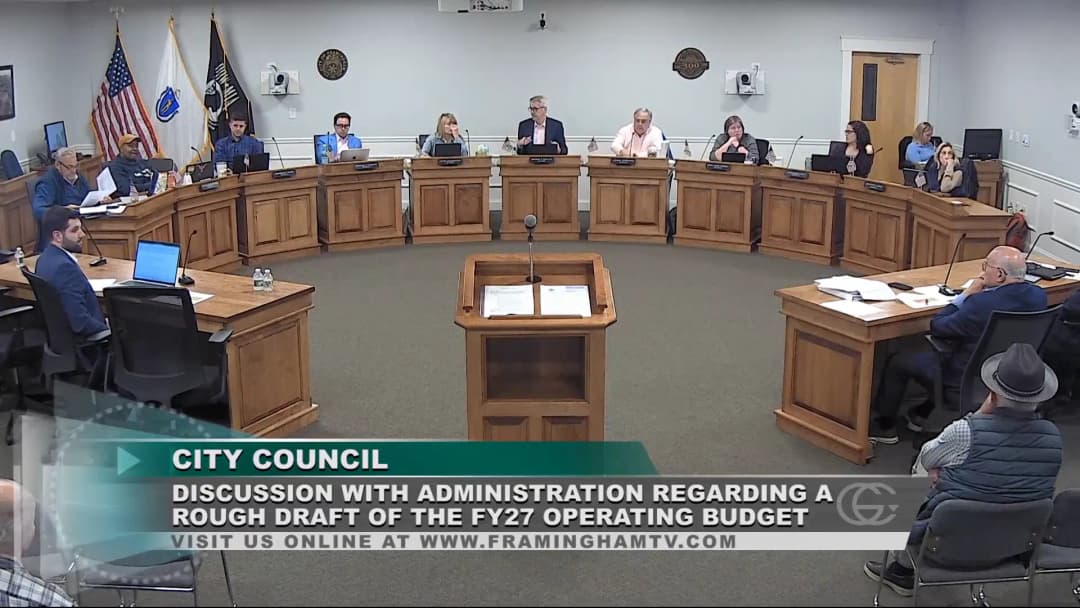
The Framingham City Council met on March 31, 2026, for a regular meeting that included an annual discussion with the state legislative delegation, approval of several appointments, a public hearing on capital improvements, and a detailed preliminary budget review for fiscal year 2027. The council also took action on the purchase of 97 Franklin Street and discussed revenue estimates and expenditure targets. Consent Calendar - Minutes Approval: The council unanimously approved the minutes from February 17 and March 3, 2026, by roll call vote (all 11 members present voted yes). Public Comments & Testimony - Public Participation (non-agenda): Mr. Bloomfield spoke via Zoom on national political issues, expressing concerns about government spending, taxes, and perceived threats to American freedoms. He did not address specific Framingham matters. Discussion Items - Annual Meeting with State Legislative Delegation: Senator Karen Spilka (Senate President) and State Representatives Jack Lewis, Priscilla Sousa, Danielle Gregoire, and Kate Donahue provided updates. Key points included: - State Budget & Local Aid: The FY27 state budget faces a $4 billion impact from federal cuts. Framingham’s Chapter 70 education funding has increased 95% since FY19; unrestricted local aid up 20%; Chapter 90 road funding up 66%. - Specific Community Investments: $300,000 for the schools welcome center, $275,000 for adult ESL, $700,000 for mental health services (Framingham’s share $116,000), and $12 million finally secured for the General Chemical cleanup (completion expected early to mid-2027). - Immigration – Protect Act: Rep. Sousa described the House-passed Protect Act to limit immigration enforcement in courthouses, restrict data sharing, and provide legal protections. The Senate will add provisions. - MCI Framingham Renovation: The state is in the design phase for a $360 million renovation, with plans for two new buildings (programming and health care) and increased community engagement. An anonymous survey for incarcerated women was launched. - Other Legislation: Municipal empowerment act (including double utility pole reform, remote meeting permanency, procurement thresholds), cell phone ban in schools, energy bill, and audit/transparency debate (exchange over legislature’s exemption from public records law). - Capital Improvement Public Hearing Continuation: The council voted to extend the public hearing on the capital improvement budget to April 2, 2026 (10-1, with Councilor Malik opposed). - Purchase of 97 Franklin Street: The council voted unanimously (11-0) to amend a prior order to allow purchase of 97 Franklin Street instead of 1962 Concord Street, appropriating $1.5 million for the purchase and $500,000 for the Foley Building rooftop solar design, with authorization for eminent domain if needed. - FY27 Operating Budget Discussion: - Councilor Stefanini proposed establishing sustainable revenue benchmarks, citing risks of high free cash use (currently $26 million certified, with $10 million used last year). He recommended a 3.5% tax levy increase and $7.5 million in free cash as a starting point. - Mayor Sizitsky presented a working document showing revenue scenarios: tax levy increases of 2.5% to 5.5% generate total revenue from $382 million to $390 million. Expenditure requests (including school, police, fire, Keefe Tech) total over $400 million, leaving deficits to be filled by free cash ranging from $11 million to $34 million. - After debate, the council voted unanimously (11-0) to request that the mayor present a budget version meeting the 3.5% levy increase and $7.5 million free cash limit, alongside his own proposal, to compare service impacts. - 499 Central Street ANR Plan: The council approved the subdivision plan (10-0) after a favorable recommendation from the Planning and Zoning Subcommittee. - Neighborhood Impact Advisory Groups Ordinance: The subcommittee recommended no action due to legal conflicts with Chapter 40A. Councilor Stefanini moved to refer back for revision, but after discussion, he withdrew the motion. No further action was taken. Key Outcomes - Minutes Approved Unanimously. - Appointments Approved (Items 2–6): David Whiting (Cushing Memorial Chapel), Kevin Swope (Framingham Historian), John Branaghan (Historical Commission), Bob Ansbach (Human Relations Commission), Clayton Howard (Parks and Recreation Commission) – all approved by roll call (10-0 with Councilor Alexander absent). - Capital Hearing Continued to April 2, 2026 (10-1). - 97 Franklin Street Purchase Authorized (unanimous). - Budget Request to Mayor Passed unanimously: Council asks mayor to produce a budget based on 3.5% tax levy increase and $7.5 million free cash use. - ANR Plan for 499 Central Street Approved. - Neighborhood Advisory Ordinance No action; withdrawn. - Adjourned 7-4 (Councilors Malik, Ward, Feeney voted no).
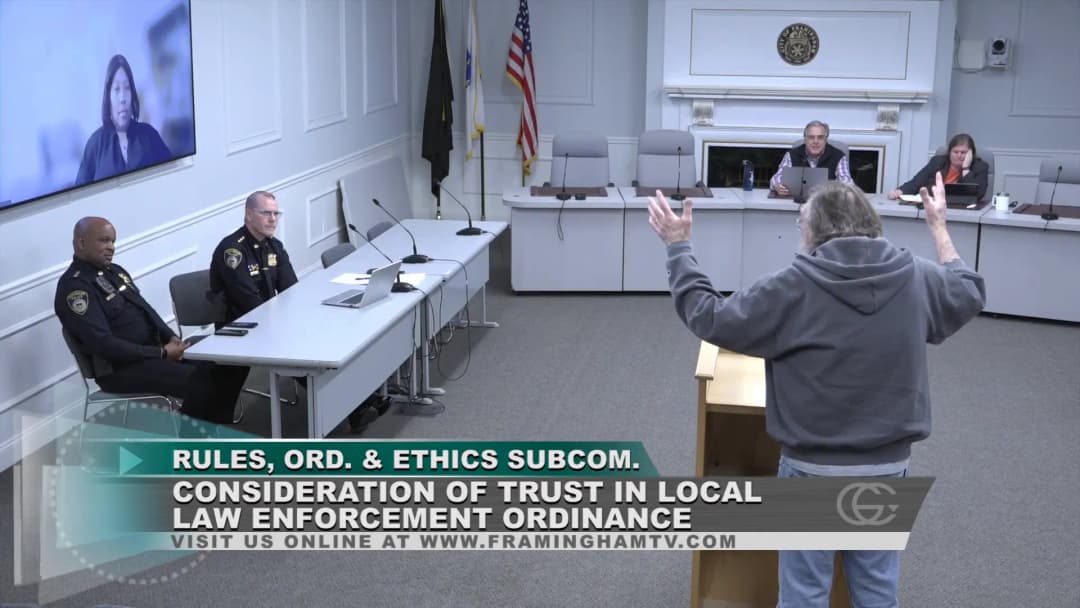
The Rules, Ethics, and Ordinances subcommittee of the Framingham City Council met on the evening of March 30, 2026, to discuss two main agenda items: the designation of special municipal employees and a broad review of the city's welcoming ordinance, including the use of Flock license plate readers and immigration enforcement concerns. The meeting featured extensive public testimony and detailed responses from Police Chief Baker and Deputy Chief Riley. A vote was taken on the special municipal employees item, and the welcoming ordinance discussion will continue at a future meeting. Public Comments & Testimony - Priscilla Sousa (State Representative and Framingham resident): Expressed strong support for strengthening the welcoming ordinance. She stated that immigration enforcement is a "Framingham problem," citing that a resident was picked up by ICE on his way to work that morning. She noted school enrollment is down significantly, domestic violence reporting has decreased, and downtown business revenue is down about 40% due to fear in the immigrant community. She urged the council to take action. - Alicia Goodwin (ESL Department Chair, Framingham Schools): Voiced concerns about Flock cameras, arguing they circumvent the Massachusetts Shield Law and breach privacy, particularly for LGBTQIA+ individuals, those seeking reproductive care, and undocumented immigrants. She stated that families have told her they feel "hunted" by the cameras and questioned Flock's data security practices. - Kate Merit (Framingham resident): Supported police transparency but raised concerns about insufficient granularity in the reasons for Flock searches (e.g., often listed as "investigative") and noted that names were not redacted in some data releases. She advocated for better data protection. - Melina Lisp (District 4 resident): Argued Framingham is not doing enough to protect immigrants. She called for keeping ICE away from the courthouse and increasing support for mutual aid organizations. - Melanie Waldron (Precinct 7): Questioned whether Flock cameras have reduced serious crime enough to justify the loss of privacy. She also criticized the use of city property by ICE for detentions. - Courtney Varga (Fuller Middle School employee, Holliston resident): Described witnessing an ICE detention at Framingham District Court of a man arrested for a suspended license. She also raised concerns that a Massachusetts bill (H3755) could ban for-profit license plate readers and asked about financial implications. - Samantha Gary (Framingham resident): Asked about how ICE knew to detain a man at the courthouse (answered: likely due to a detainer notification). - Sarah McCown (District 7, teacher): Called on city leadership to publicly and visibly support immigrant communities. She described checking on ICE activity at Butterworth Park that morning and emphasized the need for the welcoming ordinance to be fully implemented. - Phil Wright's (Framingham resident): Voiced frustration that ICE agents can operate with impunity and asked why they cannot be required to wear distinctive markings. - Laura Beck (18-year resident): Requested access to the Flock contract and fine print. She also discussed alternatives to booking that might avoid ICE notification. - Lisa (or Skeeter) (30-year resident): Reported witnessing ICE frisking and shackling individuals in a municipal lot and asked if the city could enforce parking violations against ICE vehicles. Deputy Chief Riley responded that confronting armed federal agents over parking would be dangerous. - Jennifer Welch (District 2, 4-year resident): Expressed support for local police but opposed Flock due to the for-profit company's control. She urged consideration of what would happen if federal mandates demanded access to the data. - Maven Ice Maller (District 7): Emphasized that laws can change, and future administrations might misuse data. She asked if the city considered owning its own cameras instead of using Flock. - Diego Lowe (Director of local nonprofit): Recounted two ICE detentions in Framingham, including one in a courthouse hallway. He suggested updating the agreement with Homeland Security Investigations (HSI) to limit collaboration to major criminal cases only, given HSI's expanded mission under the Trump administration. - Tatiana Vasconcelos (Director of Downtown Framingham Inc., District 2 resident): Encouraged supporting immigrant-owned downtown businesses, which are struggling due to the climate of fear. Discussion Items 1. Special Municipal Employees (SME) Designation: Chair John Stefanini introduced a discussion on adopting a state ethics provision that would allow certain appointed board members (e.g., Cultural Council) to also do business with the city without a conflict of interest. The proposed ordinance would designate all appointed multi-member body members except Planning Board, ZBA, and Licensing Board as SMEs. - Councilor Tracy Bryant expressed strong opposition, arguing it was too broad and could open the door to insider trading and reduce diversity of appointees. She moved to recommend against adoption. - Councilor Mary Kate Feeney seconded the motion. - Chair Stefanini voted no, noting he thought the designation was appropriate. - The motion passed 2-1 (Bryant and Feeney in favor, Stefanini opposed). The subcommittee will recommend that the full council not adopt the SME ordinance. 2. Welcoming Ordinance Review (including Flock cameras and ICE activity): The subcommittee held an open-ended discussion on the city's welcoming ordinance, policies, and procedures. The conversation quickly focused on two topics: Flock license plate readers and local immigration enforcement. - Flock Cameras: Police Chief Baker and Deputy Chief Riley explained that Flock data is not shared with federal agencies, only with Massachusetts police departments (which are bound by the Lund decision prohibiting civil immigration enforcement). They noted that 292,095 vehicles were scanned in the last 30 days, with only 379 searches (0.13%). Data is retained for 30 days unless saved as evidence. They are working with the city solicitor to tighten the contract to prevent Flock from sharing data with other entities. A transparency portal is available on the police website. - Public Concerns: Multiple speakers questioned Flock's privacy protections, potential for AI training, and the for-profit nature of the company. Councilor Jack Lewis noted that even if the police are trustworthy, Flock as a private company could misuse data. - ICE & Local Police: Chief and Deputy Chief clarified that Framingham police do not cooperate with ICE on civil immigration enforcement. They do not hold individuals for ICE; if someone has an ICE detainer, they are still entitled to bail, and the police do not notify ICE of releases. Officers assigned to federal task forces (HSI, DEA, FBI) work only on criminal matters such as narcotics and child exploitation, and the Lund decision prevents them from enforcing immigration law. - Protect Act: Representative Sousa described the Massachusetts House-passed Protect Act, which would prohibit civil immigration enforcement on courthouse property, restrict 287(g) agreements, and require notice before I-9 audits. The bill is now in the Senate. - Future Steps: Chair Stefanini acknowledged that many issues raised (e.g., court safety, municipal preparedness) need further exploration. The subcommittee plans to reconvene in late April (date to be confirmed due to a scheduling conflict) to review the Flock contract and other detailed information. Key Outcomes - Vote on Special Municipal Employees: The subcommittee voted 2-1 (Bryant, Feeney in favor; Stefanini opposed) to recommend that the full City Council not adopt the proposed ordinance designating certain appointed officials as special municipal employees. - Continuation of Welcoming Ordinance Discussion: The subcommittee will hold a follow-up meeting in late April (tentatively April 27, but a conflict with another community event noted; new date to be determined) to continue the fact-finding discussion on Flock cameras, data privacy, and additional measures to support the immigrant community. The agenda will include the Flock contract and other background materials. - No other votes taken. The remaining agenda items (budget process changes and rule updates) were continued to a future meeting. Note: The exact date of the next meeting will be announced via email, the city portal, and social media.
The Finance Subcommittee of the Framingham City Council met on March 24, 2026, at 5:01 PM to discuss the FY2025 audit, capital improvement program, future revenue benchmarks, and meeting schedules. The meeting included public comments, committee deliberation, and votes on several items. Consent Calendar - The minutes from the February 24, 2026 meeting were approved unanimously by roll call vote (Councillors Cannon, Malik, Stefanini, and King all voting yes).n Public Comments & Testimony - Mr. Stefan queried what the City Council can do regarding Community Preservation Committee (CPC) recommendations, specifically for the Easley farm project. He noted the CPC's recent vote awarded insufficient funds and asked if the council could act independently using bonding or other resources. - Councillor Stephanie responded that under CPA statute, the council can act on CPC fund recommendations but cannot increase spending from that fund; however, the council may augment with other city resources (e.g., free cash, bonding). She advised waiting for a comprehensive plan before proceeding. - Councillor King commented that the city has not used bonding for CPA funds, missing opportunities for greater impact. Mr. Stefan confirmed he had hired a planner for the farm. - Mr. Jerry Bloomfield asked about outstanding information for the FY27 budget, the stabilization fund status, and the need for public meetings to inform residents. He urged fairness and transparency, warning that rising costs could drive families out of the state.n Discussion Itemsn- FY2025 Audit Report (Matthew Hunt, Clifton Larson Allen) - Mr. Hunt presented an unmodified (clean) opinion on the city's financial statements. Key statistics: total liabilities $600M+ (bonds payable $167M, net OPEB liability $290M, net pension liability $77M), total general fund fund balance $75M (unassigned $58M, including $27M stabilization). The general fund had a positive net change of $7.5M. The utility enterprise fund had $139M net position. - Management letter comments included: FEMA COVID-19 reimbursement received ($3.9M), leaving a $1M deficit to be raised on FY27 tax rate; IT vulnerability scanning procedures not performed in FY25; recommendation for written policies on tax levy calculation (after a prior error of double-counting excluded debt); pending single audit for federal grants. - Additional procedures requested by the subcommittee were performed: comparison of budgeted vs actual salaries (no material issues); debt management analysis – Framingham ranks 11 out of 20 large MA municipalities for debt service as % of expenses (4.1%), debt limit $770M vs outstanding $154M, considered acceptable. - Capital Improvement Program (CIP) FY2027-FY2031 - The subcommittee debated whether to vote on the CIP that evening. Some members wanted to avoid piecemeal voting and to schedule a full discussion. The mayor suggested that if specific cuts are considered, department heads should be present. The item was tabled pending scheduling. - Future Revenue Benchmarks - Councillor Stefanini proposed setting a revenue benchmark for FY27 (e.g., 3% levy increase, $7.5M free cash use) to guide budget discussions and avoid structural deficit. He argued for accountability and transparency. - Councillor King and others noted the council does not vote on most revenues and that such a benchmark would be unrealistic if expenditures exceed it. Councillor Stefanini countered that a benchmark provides a fiscal line in the sand. - After extensive debate, the subcommittee voted unanimously to send the revenue benchmark discussion to the full City Council for consideration. - Subcommittee and Council Meeting Schedule (through June 30, 2026) - The subcommittee reviewed proposed meeting dates, noting conflicts with Passover. They agreed to cancel the March 31 meeting, and schedule a Finance Subcommittee meeting on April 9, 2026 (5 PM), with additional meetings during budget season (May 5 to June 2). A Saturday session was rejected.n Key Outcomes - Minutes approved: Unanimous approval of February 24 meeting minutes. - Audit report: The FY2025 audit will be presented to the full City Council for further discussion. Subcommittee members raised concerns about IT security and internal controls, requesting follow-up information from administration. - Revenue benchmarks: The subcommittee voted (4-0) to refer the revenue benchmark discussion to the full City Council as a guideline. - CIP: Tabled until a subsequent Finance Subcommittee meeting; scheduling to be finalized. - Meeting schedule: Future meetings set for April 9, 2026, and additional dates during May-June budget season; March 31 meeting canceled.
The Framingham Planning Board met on March 19, 2026, at 7 p.m. under Chair Ted Cosgrove. The meeting included a housing plan data presentation from Framingham State University, approval of an extension for the Carlson Crossing project, and development of zoning recommendations for two major redevelopment proposals: Eagle Rock (33 Dinsmore/31 Valentine) and Clark's Hill. All four board members were present. The board approved its March 5 meeting minutes and the Carlson Crossing extension unanimously, then deliberated at length on the zoning matters, ultimately voting unanimously to forward recommendations to the City Council. Consent Calendar - March 5, 2026 Meeting Minutes: Approved unanimously on a motion by a seconded motion. All members voted aye. - Carlson Crossing Extension: The board granted a two-year extension for the project, which is under construction and drawing down housing funds. The request was for one year, but the board moved to approve two years to avoid annual check-ins. Motion passed unanimously (all aye). Discussion Items - Housing Plan Data Presentation: Sarki Sarkesian (Director of Planning) introduced professors Lori Levine and Luis Rosero from Framingham State’s MetroWest Economic Research Center. They presented the data portion of the required housing plan, covering demographics, housing supply, and affordability. Key findings included: a diverse age distribution with a significant aging population; one‑ and two‑person households dominate; median household income $100,000 (45% increase over 10 years); median single‑family home prices rose 93% in 10 years (to $627,000); condos more than doubled; sales volumes declining; about1/3 of households cost‑burdened (30% income on housing), with renters and low‑income households hit hardest. The board discussed trends in age distribution, household size, and the need to match housing supply to changing demographics. Sarkesian noted the plan must be finalized with a production strategy and submitted to the state to protect against 40B developments. - Eagle Rock (33 Dinsmore/31 Valentine) Zoning Recommendation: The board reviewed a draft recommendation to the City Council consolidating prior redlines and discussions. Debate centered on transfer of development rights (TDR) language and how to capture more affordable units. The board agreed to move the TDR mention to the end as a reminder of tools, not a central recommendation. They also adjusted language on the MOU to ensure a 25% affordability threshold is met (allowing 100% unit capture under 40B). The final recommendation urges the Council to take the opportunity to increase the number of affordable units captured. Motion to forward the recommendation as amended passed unanimously (all aye). - Clark's Hill Zoning Recommendation: The board discussed a complex PRD proposal involving conversion of an existing office building and new townhouse‑style construction. Key points: overall density of 16 units/acre (neighbors had agreed to that number); height limits of 2 stories on the upper parking lot adjacent to Arthur Street, 3 stories elsewhere; the frontage along Clark’s Hill should have lower density (10 units/acre) to match the neighborhood, while the rear parcel could go to 20 units/acre, averaging to 16. The board stressed the importance of pursuing state grants to subsidize the office conversion, which could reduce needed density or increase affordability. They also recommended: no occupancy permits for new construction until the conversion of the existing building is substantially complete (or at least50% of new units held back); construction phased in no more than two phases to minimize disruption; and inclusion of a prohibition on Dover Amendment use. Motion to forward the recommendation with those amendments passed unanimously (all aye). Key Outcomes - Votes: All four votes (minutes, Carlson Crossing extension, Eagle Rock recommendation, Clark's Hill recommendation) passed unanimously with all members voting aye. - Directives: The board’s recommendations for Eagle Rock and Clark's Hill will be forwarded to the City Council for its April 7 meeting (Eagle Rock) and further consideration. The board also directed staff to incorporate the amendments discussed into the final Clark's Hill letter. - Next Steps: The housing plan data presentation is phase one; staff will complete the production plan and bring it back to the board for a future meeting. The board also noted the April 21 City Council meeting will include the Eagle Rock matter.
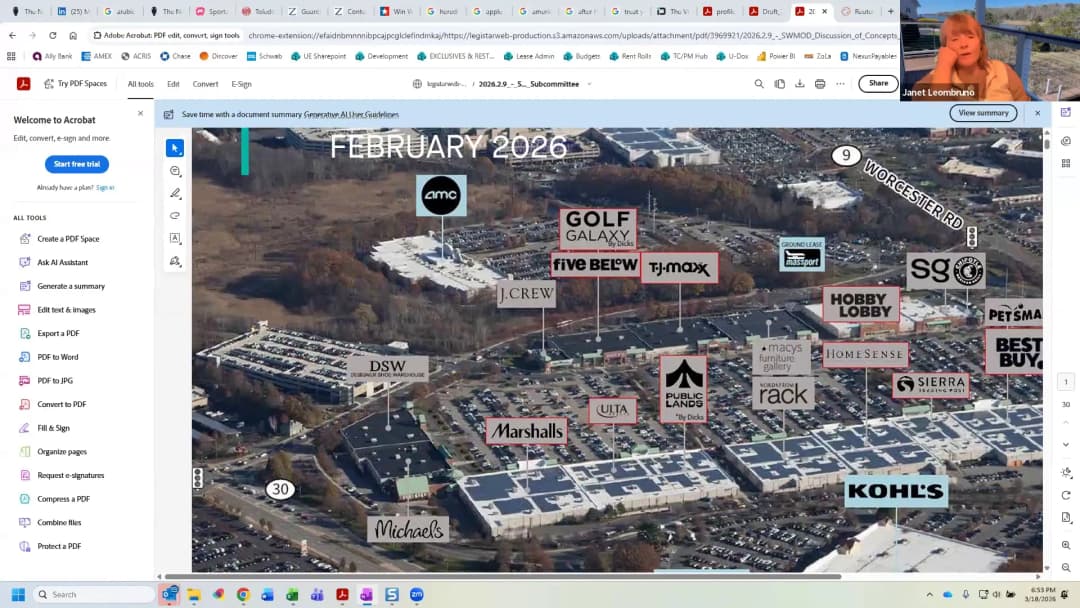
The Planning and Zoning Subcommittee of the Framingham City Council met at approximately 6:02 PM on March 18, 2026. The meeting covered several agenda items, including an Approval Not Required (ANR) plan for 499 Central Street, a proposed neighborhood advisory group ordinance, a presentation from Urban Edge on the future of Shoppers World, and discussions on the CB (Central Business) district and Waverly Street zoning. Public Comments - Mike Cannon expressed that he was present to support action on the 499 Central Street item and indicated he would listen rather than speak at that time. Discussion Items - 499 Central Street – ANR Plan: Sarke Sarkeesian, Director of Planning and Development, presented a request to draft an ANR plan to separate a conservation parcel from the residential lot at 499 Central Street. The parcel would be dedicated for recreation and conservation purposes, providing safer access to Simpson Park. The Community Preservation Committee (CPC) had already approved design funds, and the City Solicitor recommended the ANR plan for a cleaner process. The subcommittee approved the motion unanimously. - Neighborhood Advisory Groups Ordinance: Councilor Stefanini had submitted an ordinance to create neighborhood impact advisory groups for large projects. The City Solicitor provided an opinion that the ordinance conflicts with Massachusetts General Law Chapter 40A, Section 5, which protects the quasi-judicial powers of the Planning Board and Zoning Board of Appeals. The subcommittee noted that similar ordinances in Boston and Cambridge are allowed because those cities are exempt from that state law. Councilor Long moved to take no action on the ordinance, citing the legal conflict. The motion passed unanimously. - Shoppers World Redevelopment: Attorney Kathy Garrahan and Sam McCassum of Urban Edge presented updates on long-term planning for the Shoppers World campus. Topics included: - Tenant Mix: Currently about 3% small stores; the goal is to increase to approximately 20% small retail and food/beverage to improve vibrancy and walkability. - Parking Reduction: Proposed to reduce the parking requirement from 1 space per 200 square feet to 1 per 250 square feet for regional shopping centers, consistent with modern standards (e.g., Natick Mall uses 1 per 250). For mixed-use projects, they proposed 1 space per 300 square feet of non-residential and 1.25 spaces per residential unit, with 1 space per hotel room. Members expressed general support for the numbers but requested more data from comparable developments (e.g., Woburn, Ohio). - Height and Density: Discussion of potential building heights—up to 10 stories in the area near the AMC theater, which is well-buffered by wetlands. Councilors noted that taller buildings reduce sprawl and that similar heights exist on Speen Street. No formal decision was made; the item will continue at a future meeting, including signage requirements. - CB District Reduction: Councilor Long raised the possibility of revisiting a reduction of the CB (Central Business) district after a previous negative vote. Discussion touched on the two-year waiting period on a negative vote, but members noted that if the Planning Board gave a positive recommendation before the council rejection, the waiting period might not apply. They also noted the MBTA Communities requirement to notify EOHLC of any changes. No action was taken. - Waverly Street Zoning: Councilors discussed zoning amendments for the Waverly Street corridor, which is currently zoned manufacturing but seeing proposals for residential development (e.g., a three-story condo project). The goal is to create mixed-use zoning similar to the Natick line, allowing two-to-three-story buildings with retail and adequate parking to avoid neighborhood parking problems. Members agreed to move forward with drafting zoning amendments and will involve the full council. Key Outcomes - Vote on 499 Central Street ANR Plan: Motion to approve the ANR plan passed unanimously. (All councilors present: Audhiani, Lambert, Long, Bruno—voted yes) - Vote on Neighborhood Advisory Group Ordinance: Motion to take no action (dispose of) the ordinance passed unanimously. - Shoppers World: No formal vote; discussion to continue at a future meeting on signage and parking details. - CB District & Waverly Street: No votes; directed staff to prepare zoning amendments for future subcommittee and full council consideration. - The meeting adjourned by unanimous consent shortly after 7:00 PM.
The Finance Subcommittee of the Framingham City Council met on March 17, 2026, to consider the mayor's request to hire a Chief Financial Officer at the top of the salary range, authorize the purchase of 97 Franklin Street, and review the FY2027–2031 Capital Improvement Plan (CIP). The meeting spanned approximately three hours and fifteen minutes and included presentations from multiple departments. Key outcomes include approval of the CFO salary and an emergency declaration to extend the budget timeline, approval of the Franklin Street acquisition, and a decision to continue CIP deliberations to the April 7, 2026 meeting. Public Comments & Testimony - Mr. Bloomfield (public comment, Zoom) argued that homeowners and apartment renters pay 75% of city employees' health insurance premiums, calling for a 50-50 split. He criticized the mayor's proposed budget, particularly plans to increase excise taxes and the lack of cuts on the city side of the budget. He urged the subcommittee to stay within the 5% debt service limit and questioned the timing of the budget presentation without GIC premium data. Consent Calendar - The subcommittee unanimously approved the minutes from meetings on February 5, February 10, February 12, and February 19, 2026. Discussion Items - CFO Hiring Update (Mayor): The mayor reported that a candidate had been identified after interviews and a site visit, but the candidate requested the top of the salary range for the CFO position. The mayor requested authorization to pay that amount, noting the candidate's strong qualifications and track record of improving bond ratings. Council members expressed support, with Councilor Stefanini praising the candidate and Councilor King suggesting that the emergency extension of the budget timeline (by 30 days) would allow the new CFO to review the budget before submission. Councilor Malik raised concerns about morale and the classification process, but the motion to approve the salary passed 5-0. Separately, the subcommittee voted unanimously to invoke the emergency clause and extend all budget timelines by 30 days. - Order 2026-022 – 97 Franklin Street Purchase: Discussion centered on funding, with bonding reauthorization from an earlier project (188 Concord Street) covering the $2.712 million purchase. There was confusion about the bond documents (e.g., references to "Fuller" instead of "Farley"), and Councilor Cannon deferred a vote until documents were corrected. After a motion by Councilor Stefanini (with a friendly amendment from Councilor Cannon to include ground-floor retail or customer-facing uses), the subcommittee voted 5-0 to support the acquisition, including the use of eminent domain and bonding, pending final documentation. - FY2027–2031 Capital Improvement Plan: Presentations were heard from facilities, fire, parks and recreation, police, schools, information technology, DPW, sewer, and water departments. Key proposals included: - Facilities: Roof replacement at the main library ($1.65M), ADA bathroom renovations at Memorial Hall ($3M). - Fire: Engine replacement ($? – row), fleet vehicle, and car-to SUV replacement. - Parks and Rec: Scoreboard at Bowditch ($80,000), Roosevelt Park playground accessibility, pavement improvements, and CPA-dependent projects (Washakum Beach, Walsh-Dunning softball). Councilor Cannon requested adding Simpson Park ($250,000) to the capital plan. - Police: Body camera program continuation ($371,000), mobile data terminals ($275,000), and drones ($81,000 over three years). - Schools: Floor scrubbers ($163,000), design for Barbary Elementary ($328,000), fire alarm at Cameron ($? ), playground installations, gym floor refinishing ($95,000), sump pump ($61,000), and auditorium lighting ($522,500). - IT: Citywide IP camera system replacement ($287,038). - DPW: Six vehicles/equipment and ten projects totaling $26.15M, including roadway improvements ($6M), Winter Street roadwork ($3.25M), Saxonville intersection ($12.71M), and others. - Water and Sewer: Multiple projects, including sewer collection system repairs ($800,000), Maynard Road water/sewer improvements, Worcester Road upgrades, and transmission main lining. - Throughout the discussions, council members asked about priority ordering, trade-in values, life-cycle costs, and the relationship between CPA and CIP funding. Key Outcomes - CFO Salary Approval: The subcommittee voted 5-0 to authorize the mayor to hire the CFO at the top of the salary range. - Budget Timeline Extension: The subcommittee voted unanimously to invoke the emergency clause, extending all budget timelines by 30 days, which would move the budget submission to early May. - Franklin Street Purchase: Voted 5-0 to support the purchase at 97 Franklin Street using $2.712 million from reallocated bond funds, with a friendly amendment to consider ground-level retail/community uses. Final vote contingent on corrected bond documents. - CIP Hearing Extended: The subcommittee voted 5-0 to continue the CIP public hearing to the April 7, 2026 city council meeting, and requested that the administration formally add Simpson Park ($250,000) to the capital plan (replacing a withdrawn floating dock project). - Meeting Adjourned: The meeting was adjourned at approximately 8:15 PM.