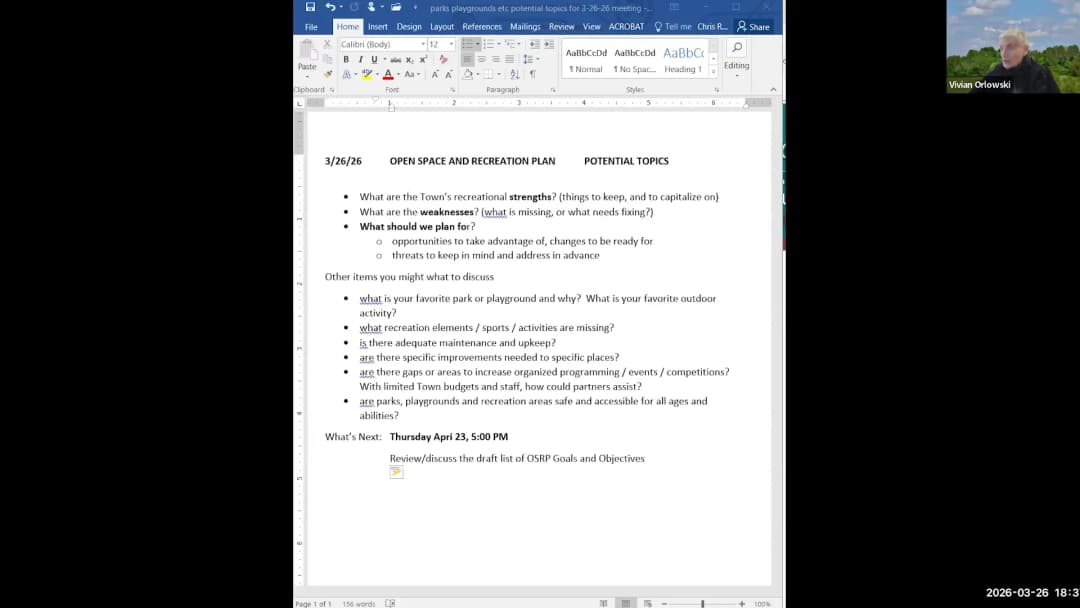
The Great Barrington Planning Board met on Thursday, March 26, 2026, in a hybrid format. All board members were present (Malcolm, Pedro, Jeremy, Jonathan, Jackie, Brandy). The meeting adjourned at 7:07 PM. Consent Calendar - Minutes of March 12, 2026: Approved as presented, with one abstention (Malcolm abstained). Special Permit Public Hearing – 34 Division Street - Applicant: Marcy Buchelata requested a special permit to erect a six-foot-tall solid fence in the front yard of 34 Division Street (R2 zone) per Sections 4.2.9 and 10.4 of the zoning bylaw. The hearing was a continuation from March 12. - Public Hearing Reopened: The board voted to reopen the hearing to allow the applicant to provide additional information and to allow full board participation. - Applicant Statement: Ms. Buchelata stated the fence is for safety due to high-speed traffic (40 mph limit, often exceeded, tractor-trailers, no sidewalks) and to allow her family to safely use the yard. She committed to planting native species in front of the fence. - Public Comment: Two neighbors spoke in support: Michelle LeBert (70 Division Street) and Jenada Shields (53 Division Street), citing peace of mind and child safety. - Board Discussion: Members expressed varied opinions. Malcolm opposed, citing no benefit to the town/neighborhood, potential precedent, and the fence being for privacy not safety. Jonathan argued the fence could increase traffic speed. Others noted the road's high traffic volume, existing six-foot fences in the area, and that conditioned landscaping would mitigate visual impact. - Findings: The board reviewed criteria under Section 10.4, including social/economic needs, traffic safety, neighborhood character, natural environment, and fiscal impact. - Vote: The board voted 4-1 to grant the special permit, conditioned upon the installation of native plantings between the fence and the roadway. Open Space and Recreation Plan (OSRP) – Working Session - Presentation: Seth Jenkins of Berkshire Regional Planning Commission presented the OSRP process. Survey results: 437 respondents, 169 climbers; top activities: hiking/walking 66%, rock climbing 40%. Maps showed municipal, nonprofit, and state conservation lands. Key topics included strengths, weaknesses, opportunities, and threats. - Public Working Session: Attendees split into groups (in-room and online) for discussion. Focus areas included parks, playgrounds, active recreation, and connectivity. - Report Back: In-room group highlighted: abundant open space but disconnected; need for better publicity and signage; partnerships with nonprofits (GBLC, BNRC) are vital; opportunities include expanded trails, disc golf, dog park, and pocket parks. Online group added concerns about underutilized spaces, maintenance funding, and climate change impacts. - Next Steps: The next OSRP working session will be at the April 23, 2026 Planning Board meeting to review draft goals and objectives. A draft plan will be released in May. Other Business - Citizen Speak: Devin discussed the lack of disc golf facilities in the region and proposed a course for Great Barrington, noting it is low-cost, accessible, and could draw visitors. The board showed interest. - Board Updates: A new director for BRPC was noted, and a Community Preservation Coalition meeting on March 31 was announced. Key Outcomes - Special permit granted (4-1) with landscaping condition. - OSRP development continues; next meeting April 23, 2026. - Meeting adjourned at 7:07 PM.
Public Meetings - Great Barrington, Massachusetts
Public Meetings - Great Barrington, MassachusettsThe Great Barrington Select Board convened on March 23, 2026, for a meeting covering emergency infrastructure, seasonal permits, a major community festival, transit updates, and tax policy. Key topics included the indefinite closure of the Division Street Bridge due to a sinkhole, the licensing of the Berkshire Busk festival with a reduced schedule, a significant turnaround on BRTA service cuts, and a preliminary presentation on the Residential Tax Exemption (RTE). Consent Calendar - Minutes of February 23 and March 2, 2026, were approved unanimously. - Great Barrington Firefighters Car Show (Aug 6 and 13, 4–9 PM) was approved. - Great Barrington Farmers & Arts Market season (May 9–Nov 14, 7 AM–3 PM, First St closure) was approved. - St. Peter's Church Craft Fair (May 23, 10 AM–3 PM) was approved. - The 2026 Arbor Day Proclamation (April 24) was approved. Town Manager Report & Board Statements - Town Manager Liz reported the immediate and indefinite closure of the Division Street Bridge after a sinkhole developed on March 20. Engineering assessments and MassDOT review are underway. No reopening timeline was provided. - Phil outlined three tax revenue initiatives: withdrawing the special permit for the stalled Searles School project, reviewing the 45-room hotel limit, and transitioning Simon's Rock to the tax rolls. - Eric apologized for earlier remarks and announced the Earth Day cleanup (April 25). - The town is reviewing updates to utility pole regulations proposed by the state Department of Public Utilities. - The DPW has approximately $70,000 remaining from its $250,000 budget. Public Comments & Testimony - Berkshire Busk: Jamie (Heart & Retail) expressed opposition to the summer-long street closures, citing a survey showing 57% of her customers avoid downtown during the event. Reggie (Lucy's Roadhouse) reported a significant negative impact on business. Michael (restaurant owner) expressed strong support for Busk as an "unmitigated success" for community and business. Karen (Fiber Arts) strongly opposed the current format due to unbearable noise and loss of local clientele. Donn (Helix) argued Busk solves a downtown nighttime economy problem. - Residential Tax Exemption (RTE): Charles Ferris opposed the RTE as a "blunt instrument" that raises taxes broadly and lowers property values. Natalia opposed it as fundamentally unfair to part-time residents. Ananda (Affordable Housing Trust) supported the board's deliberative process. - A citizen speaker requested the board formally address the Division Street Bridge condition prior to the sinkhole. Discussion: Berkshire Busk Festival Carly Skoforo and Gene Carr presented a compromise plan to reduce Railroad Street closures from 10 weekends to 3 weekends (first three Fridays/Saturdays in July), moving the remaining activity to the Barrington House courtyard. Data from 2025 showed 25,000 visits, 80% local attendance, and an estimated $1 million economic impact. The board discussed decibel limits (max 85db at 10ft), liability insurance, and shifting event locations. The license was approved unanimously. Discussion: BRTA Service Update Kathleen Lambert announced a significant operational turnaround. The new operator, Keolis, optimized driver scheduling ("run cutting"), allowing the BRTA to maintain its full South County schedule without any service cuts. A new "community shuttle driver" position (no CDL required) and a job fair at BCC (April 7–9) were announced to address driver shortages. The board expressed strong relief and appreciation for avoiding the previously threatened cuts. Discussion: Residential Tax Exemption (RTE) Emily, Town Assessor, presented estimated impacts of adopting the RTE at 35%. Key findings: 55% of residential parcels would be eligible (higher than recommended for a tax shift), the policy is not income-based, and significant new staff costs would be required. The board questioned the impact on apartment complexes like Silver Street, where costs could flow through to tenants. No vote was taken; the decision is scheduled for the November tax classification hearing. Discussion: Other Business - The board reviewed the draft warrant for the May 2026 Annual Town Meeting, including articles on capital borrowing, bond rescission, and petitioned articles related to the RTE. - The board unanimously voted to postpone the Town Manager's annual evaluation until after one full year of service (early 2027), citing her five-month tenure. Key Outcomes - Division Street Bridge: Closed indefinitely pending a full engineering and geotechnical assessment. - Berkshire Busk: Unanimous approval of a modified license limiting Railroad Street closures to three weekends in July. - BRTA Service: No service cuts. Full schedule is maintained. Driver recruitment drive announced. - Town Manager Evaluation: Postponed to 2027, unanimously.
The Select Board and Finance Committee met jointly on March 19, 2026, beginning at 5:00 p.m., to discuss the FY27 operating budget and give town staff direction on taxes, free cash, and potential cuts. No agenda or minutes were included in the source record; this summary is drawn from the transcript. Staff presented four decision points, and the boards gave straw-poll guidance for a revised budget target rather than making a final appropriation. Staff Presentation: Four Budget Decisions - Staff asked the boards to decide: (1) whether to consider any additional taxes; (2) what amount of additional revenue to support; (3) whether to use a Proposition 2½ override, a debt exclusion, or a combination; and (4) what services or positions should be protected or cut. - Charts showed approximate average residential tax impacts for different revenue amounts. A $2 million increase was described as roughly $600 per year for the average household; the town manager's original $5.5 million recommendation would have been about $1,200 per year. - A debt exclusion option was introduced: about $2 million of existing debt could be excluded from the levy limit. A debt exclusion is temporary and declines as debt is paid, while an override permanently raises the levy capacity. Staff cited a current debt service line of about $3.7 million, with roughly $2.5 million in FY27 current expenses, and identified about $2 million available for exclusion. The transcript contained slightly different debt service figures. - Staff said relying on free cash to balance recurring operating expenses is not sustainable and recommended gradually reducing that reliance, for example by using half of the prior year's free cash each year. Last year, approximately $4 million in free cash was used; under the new proposal, $2 million would be used. - For cuts, staff asked boards to identify non-discretionary services and to say which service reductions were acceptable. A $23,000 summer parking attendant position was given as an example of discretionary spending that still brings in revenue and manages parking. Board Direction and Straw Polls - Most board members said they did not want a level-funded budget and were willing to explore a limited additional tax increase. Some members, including Garfield and Michelle, opposed overrides and preferred cutting things before people. - Phil proposed a tax levy increase around 7.5% requiring an override, citing 10-year average budget growth around 5% and recent tax levy increases of roughly 8% in several years, with a 1.9% increase last year helped by extraordinary income. - Michelle cited Massachusetts Municipal Association research that 200 of 351 Massachusetts municipalities had pursued no overrides over the last 15 years and said she opposed an override or debt exclusion. - In a straw poll, roughly 7–3 favored a $2.5 million additional tax target, though some members preferred between $2 million and $2.5 million. - The boards then agreed on a working framework: $2 million from a ballot question, $2 million from limited free cash, and $1 million in operating reductions. This was characterized as a straw-poll direction to staff, not a final vote. Board Guidance on Cuts - Several board members said cuts should be kept as far from employees as possible; they supported a 2% COLA for staff, no layoffs, a hiring freeze, review of vacancies before filling, reduced overtime, and review of stipends. - Members asked staff to protect revenue-generating and efficiency-improving services, the co-responder position, elder services, and safety-net services relied on by vulnerable residents. - Some members said they did not support across-the-board percentage cuts and asked staff to highlight non-discretionary items so those would not be treated as cut options. - Several members also emphasized shared services, volunteerism, and creative revenue streams outside the property tax. Public Comments & Testimony - James Garzon (84 North Lane Road): Said Great Barrington must constrain taxes because residents are already struggling and some cannot afford to stay. He supported the staff COLA, criticized the school building campaign, and challenged board member Ben's openness to tax increases, saying, 'Ben, you want everything? Pay for yourself.' He also asked about Housatonic Water Works costs and said second homeowners have little say in the process. - Sharon Shalo (13 Rushwood Lane), chair of the Library Trustees: Recommended benchmarking comparable towns and creating a five-year plan to realign the budget. She questioned the town subsidizing about 25% of the school population through school choice and suggested exploring per-capita payment or leaving/renegotiating the regional school agreement. - Jeff Rothenberg (Woodland Hill Road): Urged the town to apply a 'value' lens to all spending, seeking good value rather than the cheapest or most expensive option. - A resident asked about the budget calendar; the board confirmed April 7 for the capital budget discussion, April 8 for the public hearing, April 9 for follow-up, and April 14 as a tentative additional meeting. Key Outcomes - The boards did not choose a level-funded budget. They directed staff to prepare a revised FY27 operating budget based on roughly $2 million in new ballot revenue, $2 million in limited free cash, and $1 million in cuts. - The choice between a Proposition 2½ override and a debt exclusion was deferred to a later meeting; staff will return with detailed options and a menu of cuts. - A public hearing on the budget is scheduled for April 8, even though the budget may not be finalized by then. Additional meetings are scheduled for April 7, April 9, and tentatively April 14, with the town meeting warrant to be approved by April 14.
The Great Barrington Affordable Housing Trust Fund met remotely on March 17, 2026, pursuant to Governor Baker's March 12, 2020 order and Governor Healey's March 28, 2025 revised order. Members present were Joseph Method, Bill Cook, Nanda Timpain, and Fred Clark. Trustees approved February minutes, authorized up to $5,000 per ADU in administrative costs, and added advertising funds for the affordable housing RFP. Minutes Approval - The February 17 meeting minutes were approved 3-0-1, with Bill Cook, Joseph Method, and Fred Clark voting yes and Nanda Timpain abstaining. The minutes had been distributed late, the morning of the meeting. Reports & Updates - The affordable housing RFP has been issued; no applications had been received as of the meeting. Town staff member Chris is maintaining a register of interested parties, who are asked to email him for an information packet. - An open house at Prosperity Way is scheduled for Saturday, March 21, from 1 to 3 p.m. - Partner updates are planned for a future meeting to build relationships with aligned partners. Discussion Items ADU Program Vendor Selection and Administrative Costs - Ananda reviewed the vendor-selection structure: town staff manage the selection process, and the trust budgets for it. The successful vendor would process and evaluate applications using the trust's rubric, recommend applications to the trust, and handle income verification and monitoring over the 10-year loan period, after which loans can be forgiven. - The previous pilot paid Construct $5,000 total for the round; Chris now estimated the new vendor arrangement could cost about $5,000 per ADU. The prior round received five submissions, not all complete or viable. - Trustees weighed whether this was reasonable given a program scale of roughly $100,000 per grant and a 5 percent overhead fee, and whether costs could be renegotiated after initial projects. A motion to approve up to $5,000 per ADU for administrative costs passed unanimously. Affordable Housing RFP Advertising - Bill presented a Shopper's Guide advertisement sample: 2 columns by 4 inches, about $105 per insertion. Existing allocated funds were about $150, enough for one insertion. - Trustees discussed reducing the ad size and running at least three insertions roughly two weeks apart. Eileen, a public participant, offered to run the ad free in the newsletter. - A motion to allocate an additional $300 for advertising costs passed unanimously. Rising Dale Project and April Outlook - The Rising Dale subcommittee will meet later in the week, aiming toward an April presentation. - Chris suggested the engineer's feasibility report could run parallel to other project work. Fred Clark cautioned that some steps must remain linear because elements such as drainage and vehicle counts depend on what will be built. The trust may begin identifying a consultant, potentially one focused on marketing and project approach rather than civil engineering alone. - Trustees plan to invite Construct's new executive director, Joey Lindwood, to the April meeting and to meet with him beforehand. Housing stabilization and rent support discussions are targeted for May or June as part of budget work. - Trustees discussed recruiting an additional trustee and mentioning the vacancy during budget-meeting citizen speak. Public Comments & Testimony - Eileen asked whether the $5,000 per-ADU administrative amount was the only administrative cost and offered a free newsletter announcement for the RFP. - During citizens speak, no public or media comments were offered. Key Outcomes - February 17 minutes approved 3-0-1. - Approved up to $5,000 per ADU for ADU program administrative costs unanimously; this allows Chris to finalize the vendor arrangement and could allow the application window to open before the next meeting. - Approved an additional $300 for RFP advertising unanimously. - April agenda will include the Rising Dale update, advocacy issues, and an introduction from Construct's new executive director.
On March 17, 2026, the Great Barrington public body convened and, after roll call, voted unanimously to enter an executive session to discuss real estate matters concerning "cruisatonic waterworks." The board did not return to open session. Opening & Recording Notice - The chair opened the meeting pursuant to MGL 7C30A20F, stating that any person may make video/audio recordings of the open session after notifying the chair, and that the chair would inform attendees of any such recordings. - The chair noted that members of the public wishing to speak must receive permission of the chair. A member of the public appeared to request to speak, but the meeting proceeded to a roll call vote instead. Roll Call - Present: Phil, Ben, Garfield, Eric, and Steve. - Roll call vote on the motion to enter executive session: Phil aye, Ben aye, Garfield aye, Eric aye. The chair declared the vote unanimous. Steve's vote was not recorded in the transcript. Motion to Enter Executive Session - Eric moved to enter executive session pursuant to MGL Chapter 30A, Section 21A6, for the purpose of considering the purchase, exchange, lease, or value of real estate regarding cruisatonic waterworks, citing that open discussion may have a detrimental effect on the negotiating position of the board and the town. - Phil seconded the motion. - The motion stated that the board would not return to open session. Key Outcomes - The board voted unanimously (4-0, with Steve not voting) to enter executive session and not return to open session. No public action was taken on the underlying real estate matter.
The Great Barrington Planning Board met on Thursday, March 12, 2026. All board members were present and the meeting was recorded. No agenda or minutes were included in the source material; this summary is based on the meeting transcript. Administrative Approvals - No Form A applications were reported. - The board approved the February 26 meeting minutes by voice vote; Jonathan Hinkin moved, Pedro Pachano seconded, and Jeremy Ega abstained. A point was made that the recap of breakout-table discussion from the prior meeting would be added to the Open Space and Recreation Plan (OSRP) notes rather than the minutes. Discussion Items - Solar special permit - 53 Van Juzenville Road: The board voted unanimously to continue the public hearing to April 9, 2026 at 6:00 p.m. at Town Hall, as requested by the applicant. Michelle LeBear, a Finance Committee member and area resident, objected that the applicant had postponed the hearing multiple times and that April 9 conflicts with several other town meetings. The chair noted the date could still be changed before then. - Special permit hearing - 34 Division Street: The board opened the hearing for Brian and Marcy Buddicello's application for a six-foot solid front-yard fence in an R2 zone (Zoning Bylaw Sections 4.29 and 10.4). The applicant said the fence would be set back ten feet from the road and positioned to preserve visibility, and that it was needed because high-speed traffic made the yard unsafe for her two young children. Board members questioned whether a four-foot fence would be adequate, discussed the bylaw's neighborhood-character purpose, and noted that a six-foot fence is a structure requiring a special permit while a four-foot fence would not be. The Selectboard made a positive recommendation, and the Conservation Commission found no wetland impact. The board reviewed the special permit criteria, finding no traffic/visibility impact but some impact on neighborhood character, with safety and road conditions as mitigating factors. The chair said there were not four affirmative votes available, so the board unanimously continued the hearing to March 26, 2026 at 5:00 p.m. at Town Hall. - Open Space and Recreation Plan: The March 26 meeting will focus on parks, playgrounds, active recreation, and climbing, with Parks Commission and climbing community representatives invited. The board discussed continuing the interactive breakout-table format used at the agriculture/open space session. - Residential Tax Exemption (RTE): Pedro Pachano asked the board to consider sending comments to the Selectboard. Michael Weiss explained that roughly 90% of resident homeowners would see no change or pay less under an RTE; the exemption works as a flat deduction from assessed value, for example about $115,000 for a 20% exemption; and the break-even point was likely between $850,000 and $950,000, with the average home value about $575,000, the median about $500,000, and many homes assessed around $375,000. He said second homeowners and residents whose homes are above the break-even point would pay more. Board discussion raised concerns about application barriers for lower-income households, effects on seniors on fixed incomes, impacts on second homeowners, and Great Barrington's relatively high tax rate. No consensus was reached on sending a board letter; members were encouraged to comment individually. Public Comments & Testimony - On the solar continuance: Michelle LeBear said the applicant had postponed many times and asked the board to avoid the April 9 date because of her Finance Committee duties and conflicts with other town meetings. - On the Division Street fence: Michelle LeBear spoke strongly in support, describing dangerous traffic on Division Street and a recent truck crash near her driveway. James Garzone (84 North Lane Road), speaking online, also supported the applicant. - On the residential tax exemption: Vivian provided figures from the assessor's report: 3,394 residential parcels and 391 second homeowners, which she calculated as 11.5%, while a 12.7% figure was also cited. She also noted concerns about seniors, ADU disincentives, and misinformation, and urged more study. James (84 North Lane Road), a self-described second homeowner, opposed the RTE, arguing it shifts taxes to 10% of owners and that Great Barrington is not suited for it. Chip reported that RTE municipalities on the coast and islands have tax rates under $8 per $1,000, compared with Great Barrington's $13.24. He also reported a calculation by Michael Weiss that a 50% RTE would require a $21.47 rate, the highest in Massachusetts, and that a 35% RTE would require a $17.17 rate; he called the policy "good intentions, bad public policy." Key Outcomes - Approved the February 26 meeting minutes, with Jeremy Ega abstaining. - Continued the 53 Van Juzenville Road solar special permit hearing to April 9, 2026 at 6:00 p.m. - Continued the 34 Division Street fence special permit hearing to March 26, 2026 at 5:00 p.m., before the OSRP discussion. - Took no board vote or letter on the Residential Tax Exemption; individual comments are to be submitted. - Adjourned at 7:19 p.m.
The Great Barrington Parks and Recreation Commission convened in person on March 9, 2026, at 5:15 PM. Commissioners approved multiple park usage requests, deliberated on future use policies for Memorial Field, and discussed strategies for goose deterrence at Lake Mansfield. Several items were addressed regarding field maintenance, community partnerships, and procedural updates. Consent Calendar - None explicitly identified; minutes from the previous meeting were approved with an amendment correcting the next meeting date to March 9, 2026. Public Comments & Testimony - Brittany Eveling and Melanie McCarthy of the Berkshire Environmental Action Team (BEAT) introduced themselves and announced their role in community outreach for a second Municipal Vulnerability Preparedness (MVP) grant focused on Old Mates Park in Housatonic. They plan to hold stakeholder meetings and community listening sessions later in the spring. - Carly from Berkshire Busk presented initial ideas for free family-friendly outdoor movies at the gazebo, possibly using a new vendor or purchasing equipment. No formal request was made; more details will be brought to a future meeting. Discussion Items - Town Grade Concert Series (Lee): Lee presented plans for summer weekday concerts (mostly Wednesdays and Fridays, 5:30–7:00 PM) at Fan Park and Placebo, from early June through mid-September, plus Saturday children’s concerts in July and August. The commission approved the request unanimously, noting the schedule avoids conflicts with the Berkshire International Film Festival. - Mahaiwe (Mahaiwe Performing Arts Center) Gala: Janice requested use of the east end of Memorial Field for a one-night fundraiser (tent setup 48 hours prior, take down after). This sparked debate: some commissioners opposed using the baseball field for non-sporting events, citing a prior policy decision and alcohol concerns. An amendment to ban alcohol failed for lack of a second. The original motion to approve passed with one member opposed and one abstention, contingent on other permits (e.g., DRT review). The commission urged Mahaiwe to explore alternative venues for future years. - Berkshire International Film Festival (BIF): Lauren requested use of the town hall lawn (Giggle Park) for an opening night tent (250–275 guests) from May 28–31, 2026. Approved unanimously with standard conditions. - Babe Ruth Baseball: Luke requested expanded use of Memorial Field for two local teams, including weekend doubleheaders and additional league games. The commission approved, and discussion followed on field maintenance—watering, conditioning, and avoiding soil compaction during mud season. Luke noted the need for a volunteer squad to handle watering during dry spells. - Goose Deterrence Plan: Joe reported that new equipment (yellow lights, lasers, noisemakers) is arriving, but DPW lacks staff (one person out, one left) to perform the necessary four-times-a-day, seven-days-a-week patrols during nesting season. Options discussed: volunteer coordination (subject to town manager approval on liability), or hiring a professional service (Wild Goose Chase) at an estimated $400/week for three months. Joe will outline a plan with DPW and coordinate with potential volunteers. Santa, a yoga instructor at the lake, noted health risks from goose feces and offered limited help but cannot commit to multiple daily rounds. - Policy on Memorial Field Usage: Paul raised concerns about opening the field to organizations beyond the Millers and Babe Ruth, such as the high school or American Legion. He noted that a prior approval for an out-of-town tournament had set a precedent. The commission agreed that no exclusive-use policy exists and that any group can submit a parks usage request. Chairs and the town manager can approve off-cycle requests. No formal vote was taken. - Donation/Memorial Process: Discussion on creating a formal policy for plaques, benches, and trees. Paul noted that tree requests should go to the Tree Committee, and that a broader process involving the Select Board is needed. The chair will take questions to the town manager. - DPW Updates: Joe reported that the senior center’s square dancing program (paid instructor, paid participants) operates under different rules than the parks department, which generally prohibits fee-based activities at parks. The town manager is working to unify rules across town facilities. - Youth Participation: Alana is working with four youth interested in attending parks meetings as part of career readiness. No formal action. - Pickleball Waiver: Karen submitted a proposed waiver for pickleball use to the town manager, who deferred the matter to the Select Board for a broader policy on who may use town facilities (residents, business owners, employees, etc.). Key Outcomes - Approved Town Grade Concert Series (unanimous). - Approved Mahaiwe gala (with conditions; one opposed, one abstention) with request to consider alternative sites in future. - Approved Berkshire International Film Festival (unanimous). - Approved Babe Ruth baseball request (unanimous). - Directive: Joe to produce a detailed goose deterrence plan and coordinate with volunteers, pending town manager review. - Next Steps: Chair to consult town manager on donation/memorial policy; Alana to facilitate youth participation; Joe and DPW to finalize watering and field conditioning schedules with Babe Ruth. - Upcoming Meetings: The next regular commission meeting is scheduled for April 6, 2026. The Open Space and Recreation Plan meeting is March 26, 2026.
Great Barrington Joint Select Board/Finance Committee Meeting - March 4, 2026\n\nThis was a joint meeting of the Great Barrington Select Board and Finance Committee convened to continue the capital budget review and receive a presentation on the Berkshire Hills Regional School District (BHRSD) budget for FY2027. The meeting also included discussion of several capital requests and town budget strategy.\n\n Public Comments & Testimony\n- James (84 North Lane Road) praised the South County Connector transit service and opposed implementing a Residential Tax Exemption (RTE), arguing it would unfairly shift the tax burden onto second homeowners.\n- Victor (Lakeview Road) asked about health insurance cost containment and noted that the town participates in Berkshire Health Group for group insurance.\n\n Discussion Items\n- Berkshire Hills Regional School District Budget: Superintendent Dr. Down presented the FY2027 budget. The School Committee unanimously approved it. Budget highlights include elimination of $500,000 in non-personnel costs, reduction of first and second grade sections, addition of a literacy coach, and significant increases in special education tuition. The gross operating budget increase is 4.37%, with a 7.49% assessment increase for Great Barrington. Enrollment declined from 830 to 815. Discussion covered class sizes, sustainability, potential mergers, and vocational training opportunities.\n- Capital Requests:\n - Archival Storage Feasibility Study ($50,000): To inventory and assess preservation needs for town records and historical artifacts. The study would evaluate storage locations and costs.\n - Council on Aging Vehicle ($53,000): Request for a vehicle for senior outings. Board members debated alternatives, including using school buses or existing transit resources.\n - Planning & Community Development – Master Plan Phase 1 ($50,000): Community visioning exercise as first step towards updating the town master plan.\n - Transit Vehicle Replacement ($18,205 as 15% match): To replace a non-accessible Chevrolet Equinox with an electric accessible van. Ridership on the South County Connector reached 2,304 rides in February 2026, up 50% from October 2025.\n- Service Enhancement Grants: Town Manager Liz proposed six new initiatives: water quality intern, human services grants, arts and culture mini-grants, employee professional development ($30,000), fire department washer/dryer ($2,000), and a computer replacement program. Detailed discussion was postponed.\n- Budget Override and Strategy: Board members expressed concerns over the cumulative tax impact, potential Proposition 2.5 override, borrowing limits, and use of free cash. The Town Manager noted that without an override, the town would need to cut an additional $400,000, use all free cash, and defer capital projects. Some members advocated for a phased approach rather than a large single override.\n\n Key Outcomes\n- No formal votes were taken on budget items or capital requests.\n- Service enhancement grants will be discussed in detail after the public hearing.\n- A special joint meeting was scheduled for March 19, 2026, to give policy direction to the Town Manager on the overall budget and potential override.\n- The public hearing on the budget remains scheduled for April 8, 2026.
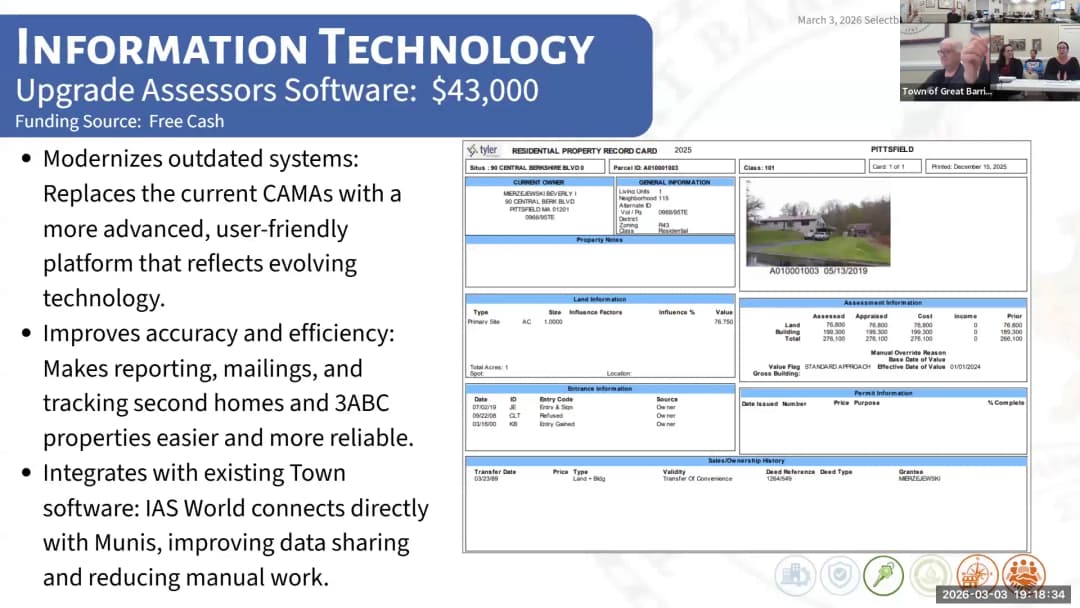
The Select Board and Finance Committee of Great Barrington held a joint meeting on March 3, 2026, starting at 5:00 PM. The primary focus was a review of the Town Manager's recommended FY27 Capital Improvement Plan (CIP) and capital budget. The meeting included a detailed discussion of individual department requests, budgeting philosophy, and significant conversations about the town's fiscal constraints during a challenging budget cycle. Scheduling and Calendar Update - The Town Manager proposed adjusting the budget calendar. The originally scheduled March 23rd workshop and April 14th public hearing were discussed. - Decision: The public hearing is set for April 8, 2026 (Wednesday) at 5:00 PM. - Additional workshop/discussion dates were penciled in for April 7 (Tuesday) and April 9 (Thursday) to accommodate scheduling conflicts among committee members and ensure full participation. Public Comments - James Garzone (84 North Plain Road) urged the boards to approve the full budget proposal, including funding for technology, fire equipment, and police vehicles. He advocated for implementing an RTE (Residential Tax Exemption) to shift the tax burden onto second homeowners, stating, \"Let's just do it all this year because this is just not gonna get better.\" Capital Budget Discussion Items The Town Manager reviewed the capital plan development process, which included a full-day peer-to-peer review workshop by department heads, followed by anonymous scoring. The proposed budget seeks to balance strategic priorities, personnel costs, and infrastructure needs using funding sources including Free Cash, Chapter 90, grants, and a small draw on capital stabilization. Police Department - Cruiser Replacement (F-150): The Chief of Police requested replacing a standard cruiser with a Ford F-150 pickup truck. The cost difference versus a standard Ford Explorer is $2,481. The Chief argued the pickup provides enhanced versatility for animal control (dog kennel), transporting e-bikes, and emergency management. - Supporting Positions: Several board members (Garfield, Rich, Ben, Phil) supported the purchase, citing the inefficiency of borrowing DPW trucks and the benefit of keeping officers in a fully equipped police vehicle. - Skeptical Positions: Members Eric and Madonna expressed concerns over the regular use case and whether the vehicle would see enough utilization to justify the premium over a standard cruiser, preferring inter-departmental borrowing. - Body Camera Program (Axon): The Chief requested approval of a new three-year contract totaling $356,191 for an advanced Axon system with AI tools (50-language translation, AI redaction, AI report drafting). The contract is structured with a low first year ($48,000) and higher subsequent years ($150,000). - Supporting Positions: The Town Manager and several Finance Committee members (Elena, Ann, Cheryl) expressed strong support for the translation and report-generating features as a major improvement in public safety and community relations. - Concerned Positions: Members Michelle, Bill, and Rich raised significant concerns about the steep cost escalation, lack of a local AI policy, potential for surveillance creep, and the difficulty of terminating the contract if a cheaper option emerges. Fire and Emergency Management - Portable Generator: A $75,000 trailer-mounted generator was recommended to provide emergency backup power to critical town buildings (Town Hall, community center) and support warming/cooling centers. - Message Boards: Two dynamic message boards ($54,000 total) were recommended for traffic management and incident notification. - Exhaust Capture System: A retrofit of the fire station apparatus bay with a source-capture magnetic exhaust system was proposed to address the health hazard of carbon monoxide accumulation from running apparatus. - Turnout Gear: The request includes 10 sets of replacement and secondary turnout gear to ensure firefighters have clean gear available per NFPA standards. Information Technology - Online Permitting Software ($90,000): The Town Manager recommended replacing the outdated permit-tracking software. This is classified as a non-discretionary upgrade due to an April 2027 deadline for ADA compliance. The new software will integrate building, health, clerk, fire, and planning permits into a single online platform. - Positions: Strong consensus among the boards that this is a mission-critical investment for efficiency, customer service, and tax base integrity. - Assessor Software Upgrade ($40,000): Assessor Emily presented the need to upgrade the computer-assisted mass appraisal system to integrate directly with the town's Munis financial software, eliminating the need for a faulty data bridge. - Positions: Supported as a financial management necessity. Emily demonstrated how the current system causes bill errors and cripples reporting capabilities. The upgrade is expected to offset costs by improving tax collection efficiency. Health Department - Inspector Vehicle: Health Agent Rebecca requested a dedicated/shared town vehicle for field inspections. - Positions: The Town Manager supported the request as a recruitment tool, noting qualified candidates have declined roles due to the lack of a town vehicle. Ann questioned the cumulative cost of adding multiple new vehicles to the town fleet. Fiscal Constraints and Overarching Concerns Throughout the evening, several Finance Committee members (Rich, Michelle, Ann) voiced a strong theme of fiscal constraint. While praising the Town Manager's thorough work, they emphasized that the town faces a deficit, a proposed 2.5 override, a new school building, and significant taxpayer burden. Michelle stated that every year she hears promises of future savings, but the town's finances continue to struggle, making this a year where many \"wants\" will likely become \"nos.\" The Town Manager acknowledged the dilemma, calling the budget a \"menu to choose from,\" but made a specific plea to prioritize technology investments, stating, \"If you cut anything, please do not cut technology.\" Key Outcomes - No Votes on Items: No final votes were taken on any specific capital appropriations. The session was a comprehensive review of the Town Manager's recommendations. - Calendar Set: Public hearing officially scheduled for April 8, 2026. Potential workshops added on April 7 and April 9. - Deferred Items: The meeting adjourned without covering the entire capital agenda (DPW, schools, remaining enterprise funds). These were deferred to the following day (March 4, 2026) and subsequent April dates. - Adjournment: The meeting was adjourned by unanimous consent around 8:30 PM to accommodate the schedules of attendees and presenters.
The Select Board met on March 2, 2026, at 6:00 PM. The meeting covered a wide range of topics including the Town Manager's Report, appointments, license approvals, a contaminated site closure, traffic mitigation updates, and public comments on tax exemptions and traffic issues. All votes were unanimous. Town Manager's Report - Berkshire Regional Transit Authority (BRTA) Service Changes: Town Manager reported on a regional meeting convened by Senator Fallmark's office earlier that day. Public comment on proposed BRTA route changes is accepted through midnight on March 2, in advance of a public hearing on March 4, 2026. Written comments can be sent to info@BerkshireRTA.gov. - Affordable Housing Trust RFP: The Great Barrington Affordable Housing Trust released a Request for Proposals (RFP) for affordable housing projects serving households up to 100% of area median income, with preference for long-term affordability. Applications accepted on a rolling basis through June 30, 2026. Funding from Community Preservation Act and other local sources. - Residential Tax Exemption (RTE) Update: The Town clarified that adoption of an RTE does not require a Town Meeting vote; it is a Select Board decision during the annual tax rate hearing. Information gathering phase continues, with a presentation to the Board on March 23, 2026. - Micro Transit Grant Award: The Town was awarded $600,000 from MassDOT's FY25 Micro Transit and Last Mile Grant Program to expand the South County Connector service. The grant was highly competitive ($43 million in requests, $10 million available). - New Staff: Jill started on February 25, 2026, as an administrative support position (existing position, not new) serving two departments. - FY27 Budget: Operating budget workshops completed; capital planning joint sessions scheduled for March 3 and 4 with the Finance Committee. Consent Calendar / Appointments & Approvals - The Board unanimously approved the appointment of two candidates to an unspecified board or committee. - Approved a letter of public health support for the Division of Local Mandates report on equitable state-owned land reimbursement (January 24, 2025). The letter urges restructuring the PILOT program to reflect community demands rather than just real estate values. Great Barrington ranks in the top 10 for state-owned land among Massachusetts communities. - Approved a 2026 seasonal retail liquor license renewal for the country club (location: 46 West Sharpley Road, assumed). - Approved signing the notice of activity and use limitation (AUL) and signatory authorization for contamination remediation at 14 East Street (DPW Highway Garage). Jack, the Licensed Site Professional (LSP) from Manadnock Environmental, explained that NAPL (non-aqueous phase liquid, i.e., free product) from historical diesel and gasoline releases remains beneath the building. The AUL documents the contamination and restricts future uses if the property use changes, but the current use is safe. The dissolved-phase groundwater plume extends onto adjacent National Grid property but dissipates before the river. The vote was unanimous. Discussion Items - East Street Neighborhood Traffic Mitigation Update: Police Chief Dave reported speed data from fixed signs on East Street for December 1 through February 26, comparing 2024–2025 to 2025–2026. Northbound volumes slightly decreased (105,965 to 103,290) and southbound decreased (94,000+ to 87,000+). Approximately 80% of vehicles travel under 25 mph. There were 105 stops for stop sign violations in the four-month period. Board members and resident Emily Maple (116 East Street) asked about the methodology of speed data collection (whether it captures peak vs. instantaneous speed, or if drivers slow down before the sign). The Chief acknowledged the need for more data using trailers once weather improves, and noted that enforcement on Dilmore Avenue and Cottage Street is also a priority. The Board encouraged continued monitoring and engineering solutions, especially with the upcoming Main Street reconstruction project expected to increase cut-through traffic. Public Comments - Charlie (disabled veteran): Spoke in support of increasing the disability veterans tax exemption. He currently receives $412 off his property taxes. He noted that Stockbridge and West Stockbridge have passed the HERO Act, doubling the exemption to $824, and urged the Board to consider a similar increase. He also raised concerns about traffic flow on Main Street, specifically the timing of the northbound left-turn arrow at the pharmacy (Nowak Avenue light) and the Cottage Street light turning red unnecessarily. He criticized pedestrian crossing signals and suggested they be integrated with traffic lights (as in Albany, NY). He said he uses East Street to avoid Main Street issues. Key Outcomes - All motions were passed unanimously. - The Board will follow up on the disability veterans tax exemption request, with information from Stockbridge's assessor available for review. - The traffic mitigation update will continue with more data collection in spring. - The FY27 capital planning sessions will proceed March 3–4.