Houston, Texas — Public Meeting Index
Search help
Summaries & topics includes titles; words may match separately. Transcripts match a literal word or phrase, with case and whitespace normalized. Punctuation and contractions must match. Documents are not searched. Results have separate pages by source; a meeting may appear in both. Both dates are included.
Summaries & topics
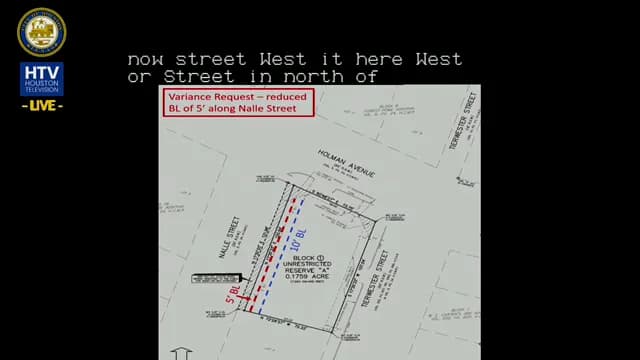
The Houston Planning Commission met in person on Thursday, July 23, 2026, at 2:32 PM in the City Hall Annex. Chair Clark presided with 15 members present, establishing a quorum. The meeting covered routine plat approvals, two semi-annual impact fee reports, several variance requests, and a contentious replat in Hyde Park. Key actions included approving transfers of impact fee revenues, granting or deferring multiple plat variances, and hearing public testimony on several items. Consent Calendar - Approval of Minutes: The July 9, 2026 meeting minutes were approved unanimously (Motion Garza, Second Ballard). - Plat Consent Items (Sections A & B, Items 1-80): All staff recommendations were approved. Commissioners recused themselves from specific items (e.g., Items 1, 3, 43, 55, 68, 71, 72, 80) due to potential conflicts. The remaining items were approved in two motions: first, items 1, 3, 43, 55, 68, 71, 72, and 80 (Motion Porz Pertle, Second Siegler); second, all other consent and replat items (Motion Sykes, Second Pierce). Public Comments & Testimony - Item 88 – Quinwood Views (Unrestricted Reserve): Two neighbors spoke. Robert Stevens expressed concern that deed restrictions might be “washed away” and requested more time. Doug Lassard opposed the rezoning of residential lots to unrestricted reserve, stating the project (a storage facility for sports cars) is too large for the primarily residential neighborhood and would harm its character. He noted the area is walkable with schools and parks. The replat was approved despite these comments. - Item 89 – Aviba Estates Nodens Street: Vicky Martin (Claremont Place Civic Organization) opposed the 10-foot setback, noting the neighborhood’s 75-year-old deed restrictions require a 25-foot setback. She requested renderings and further communication. The applicant’s representative, Juan Castillo, stated their title search found no deed restrictions for the lot. The item was deferred for legal review of deed restrictions. - Item 93 – Montrose Heights (Hyde Park): Multiple residents spoke in opposition. Scott Shaftsma, Augustin Pereira, Elizabeth Burt, Rocky Neaton, David Taylor, Sarah Frazier (Hyde Park Civic Association president), and Hugo Lozano all urged denial. They argued that the property is subject to valid deed restrictions (filed over 30 years) and that the replat would remove them, allowing commercial use (e.g., gas stations) or high-density development, threatening the neighborhood’s residential character, safety, property values, and traffic. Sarah Frazier asserted that the city’s legal review did not properly address whether the replat would amend or remove covenants under Texas Local Government Code §212.0146. The replat was approved 12-3 after being moved to the end of the agenda. - Item 94 – Telgi OST Development: Arga Bouchoir (owner of Houston’s Best Vegan Restaurant) opposed the replat due to lack of notification and transparency about the developer’s plans. She requested deferral for communication. The applicant’s representative (George Morrow) had no information and agreed to provide contact details. The replat was approved. - Item 112 – 5500 Evergreen Street (Development Plat Variance): No public testimony was recorded. - Roman Numeral 5 – Landscape Variance (1442 Summer Mayer Street): Denise Yi (RDLR Architects) was available to answer questions but did not oppose. Commissioner Garza requested shielded lighting and additional trees; the variance was approved. Discussion Items - Semi-Annual Report on Water and Wastewater Impact Fees (Item 1): Dieter Van Lagen (Houston Public Works) presented the report for the period November 30, 2025 – April 30, 2026. Key statistics: $18,370,883.16 collected in fees and interest from 4,075 water service units and 3,981 wastewater service units. The current fee of $4,286.93 per service unit is 39.47% of the maximum allowed by law. 475 single-family residences were exempted (below median housing price). Since program inception, approximately $713 million has been collected. Commissioner Matez moved to approve the transfer of funds to debt retirement; motion carried unanimously. - Semi-Annual Report on Drainage Impact Fees (Item 2): Dieter Van Lagen also presented the drainage fee report. $547,827.65 in fees were purchased during the period; total $8,771,274.25 since program inception. Commissioner Matez moved to approve the transfer of funds to capital projects; motion carried. - Plat Variances and Deferrals: Several plats with variance requests were discussed: - Item 97 (Mirror General Plan): Variance to not extend stub street and special exception for intersection spacing (1,600 ft vs. 1,400 ft). Approved. - Item 99 (Hunton Services Complex): Deferred for two weeks to provide additional information. - Item 100 (Mason Business Park GP): Deferred for two weeks (second deferral) to confer with engineering team regarding access to IH-10 frontage road. - Item 101 (Shekinah Life Center): Variance to allow 5-foot building line along Kally Street (instead of 10 ft) in a TOD area. Staff supported; approved. - Item 102 (Telge Hill Business Park): Deferred per Harris County Engineering request. - Item 103 (Bering Drive Reserves): Variance to exceed intersection spacing; approved. - Item 104 (Hillcroft Business Park): Variance to exceed intersection spacing; approved. - Item 105 (Midline Detention Reserves Section 1): Variance to exceed intersection spacing; approved. (Commissioner Matez recused.) - Public Hearing Date (Roman Numeral 4): Set August 20, 2026, as the public hearing date for Aziz Vista, Charles Mont Street Views, Gomez Bigwood Development, St. Augustine Park, and White Chapel Estate. Approved. - Landscape Variance (Roman Numeral 5 – 1442 Summer Mayer Street): The applicant requested a variance to waive screening shrubs at a proposed waste transfer station due to pest concerns. Staff supported, noting the site is industrial and trees will be provided. Commissioner Garza requested shielded lighting on the west side and additional trees. Variance approved. Key Outcomes - Impact Fee Transfers Approved: The Planning Commission, acting as the Capital Improvements Advisory Committee, approved the transfer of $18,370,883.16 from water/wastewater impact fees and $547,827.65 from drainage impact fees to debt retirement and capital projects, respectively. - Item 93 – Montrose Heights Replat Approved (12-3): Despite strong opposition from Hyde Park residents and claims of valid deed restrictions, the Commission approved the replat of 1506 Fairview to an unrestricted reserve. Commissioners Carroll, Sykes, and Ballard voted against. Commissioner Siegler questioned the legality of opposing a “shall approve” item; legal counsel noted commissioners can record their votes. The applicant insisted on an unrestricted reserve. - Deferrals Granted: Items 89 (Aviba Estates), 99 (Hunton Services Complex), 100 (Mason Business Park GP), and 102 (Telge Hill Business Park) were deferred to the next meeting for further review or applicant coordination. - Variances Granted: Several variances were approved for building lines, intersection spacing, and landscaping, as detailed above. - Adjournment: The meeting adjourned at 3:57 PM.
The Houston Planning Commission held a public hearing on July 23, 2026, at the City Hall Annex to receive comments on seven proposed amendments to the Major Thoroughfare and Freeway Plan (MTFP). Chair Lisa Clark presided with 11 commissioners present, establishing a quorum. No votes were taken; the meeting served as a workshop to gather public input before staff updates on August 20 and commission action on September 3, 2026. Public Comments & Testimony - Amendment 3B (Barker Cypress Road) – Jerome Butch Egan, a landowner on Grant Road, opposed the proposed deletion, stating that his earlier offer of a 100-foot strip for the road was now being expanded to take additional land and damage his fish pond. Jigmeet Mon, owner of a nearby 15-acre property, requested more time to assess the impact. The applicant, Murzan al Walla (REGA Engineering), stated that the requested deletion would address the property concerns by removing the major thoroughfare designation. - Amendment 3F (Vicksburg Boulevard) – Perdita Chavez, Chief of Staff for Mayor Pro Tem Martha Castex Tatum, noted that the Mayor Pro Tem’s office shared information with neighboring communities (Quail Run, Quail Glen, and Fort Bend Houston Super Neighborhood) and that the Quail Run HOA president intended to meet with the applicant on July 14. Gerald Grissom (BGE) confirmed that the meeting took place on April 14, 2026, with the Quail Run Community Association. - Amendment 3G (Coastal Prairie Conservancy) – A large group of speakers supported the CPC’s request to delete, realign, or reclassify major thoroughfares across its 20,000-acre protected area: Mary Ann Piacincini (President and CEO of CPC) emphasized that the lands are permanently conserved, not awaiting development, and urged the commission to align the MTFP with conservation goals. She stated, “Lands won’t be developed, so the roadway alignments based on future urbanization do not reflect reality.” Stephen Gast (supported CPC) described the Katy Prairie’s biodiversity and warned that roads would fragment habitat and increase roadkill, citing river otters on the prairie. Jim Luke (Waller and Luke families, landowners of 2,200 acres) asked for no roads through his family’s property, which includes wildlife, hiking trails, and 50,000 planted oak trees. Mark Ely (ranch manager and biologist for Sandhill Farm/Tucker family, 7,400 acres) listed negative impacts of roads: habitat loss, fragmentation, wildlife mortality, and pollution. He supported all CPC amendments. Felicia Zayner (geologist and Texas Master Naturalist) presented spatial and hydraulic analysis showing that 156 acres of land would be impacted, losing 38 million gallons of infiltration and adding 7.3 million gallons of runoff during a six-inch rain event, a 54% increase over native prairie baseline. Kristen Lucas (Houston resident) expressed gratitude for preserved land and supported CPC. Kelly Warren Jewart (co-owner, Warren Ranch, fifth generation) opposed widening Eagle Mound Road and extending Jack Road onto the ranch, citing loss of grazing land, safety concerns for livestock, and disruption of a historic family operation. She noted an abandoned gypsum mine shaft in the area. Juliet Jewart Warren (sixth generation) appealed to preserve the land for future generations. Elisa Donovan (CPC) argued that traffic should be routed around the preserve, not through it, and that keeping quiet country roads benefits nearby development. Jeremy Katusak (general speaker) urged the commission to take a holistic view, noting that small additions can lead to greater expansions. Discussion Items Staff presented each proposed amendment as a factual project description; commissioners did not deliberate or ask substantive questions. The amendments are: - 2A (Gulfton Connector Busway) – Metro proposes reclassifying three streets (Chimney Rock Road, Gulfton Street, Hillcroft Avenue) to transit corridor to support a 4.1-mile dedicated busway with seven stations. Located in city limits. - 3B (Barker Cypress Road) – Applicant seeks to delete 9,873 ft of Barker Cypress Road (major thoroughfare) and 3,326 ft of a minor collector due to floodplain, utility easements, and parkland constraints. In ETJ. - 3C (Kerr Myre Road) – Meta proposes deleting 5,200 ft of unimproved major thoroughfare to allow data center expansion, citing low trip generation on alternative routes. In ETJ, rapid development nearby. - 3D (Mason Road) – Meta requests realignment of Mason Road (major thoroughfare) to correct mapping errors and avoid a 460-foot jog and bridge construction over Bear Creek floodway. In ETJ. - 3E (South Ridge Road) – Meta proposes deleting a 4,850-foot minor collector (partially constructed) to develop 321 acres for light industrial use, arguing it avoids mixing industrial and school traffic. Near multiple schools. In ETJ. - 3F (Vicksburg Boulevard) – Applicant seeks deletion of 1,700 ft of major thoroughfare due to two TV antennas and because Fort Bend County removed it from its plan in April 2025. In ETJ. - 3G (Coastal Prairie Conservancy) – CPC requests reclassification, realignment, or deletion of all major thoroughfares within its 20,000-acre protected area to align transportation planning with permanent conservation. In ETJ (Harris/Waller counties). Key Outcomes - No motions or votes were taken. The public hearing is part of the annual MTFP amendment process. - Staff will coordinate with applicants and agencies and present updates at a meeting on August 20, 2026, at 1 p.m. at the City Hall Annex. - The Planning Commission will act on each amendment on September 3, 2026, at 1 p.m. at the City Hall Annex. - Final recommendations will be forwarded to City Council for action by September 30, 2026.
This meeting of the Services Delivery Committee focused on a presentation from Houston Public Works on the progress of community code enforcement since its transfer from the Department of Neighborhoods. Committee members asked detailed questions about increased abatement numbers, staffing, contractor capacity, technology improvements, and specific enforcement processes. Public comment raised concerns about response times, chronic violations, and community-led maintenance efforts. Public Comments & Testimony - Clyde Niba (District B resident): Reported that seven code enforcement cases took an average of 47 days to close, with one case taking 100 days. Noted one recent property was cut twice without a new 311 request, indicating progress is possible. Requested that the city flag repeat locations, establish clear timelines for each enforcement stage, and proactively schedule re-inspections. - Vicki Martin (District B resident): Raised three specific issues: (1) 8105 Questview – a burnt, unsecured building with high vegetation across from a church; (2) 8129 Snowden – a residential property used as a dumping field by the owner, creating rodent and snake problems; (3) 8000 block of Benton to 9106 – ditches not maintained, forcing residents onto the street. Requested that inspectors note nearby violations when surveying a property, and noted that the 45-day turnaround allows repeat offenders to avoid consequences because city cleanup occurs after the violation is long gone. - Clinton Johns III (Pleasantville resident): Described volunteering to cut overgrown lots out of his own pocket but unable to sustain it financially. Mentioned his prior work with Keep Houston Beautiful, where he was paid $50–$100 per lot to maintain compliance (keeping grass under 4 inches), a program that ended with COVID in 2020. Asked how to be reconnected to a city program to save taxpayer dollars. Requested that the city utilize unused supplies (gloves, safety glasses, crayons, coloring materials) still sitting at the closed Keep Houston Beautiful office. Discussion Items - Presentation by Chris Shinenhan, Public Works: Gave an overview of the Community Code Enforcement team within the newly renamed Code Enforcement and Compliance Division. Key data points included: - FY26 (July 2025–present) vs. FY25: 973 abatements vs. 169; 29 junk motor vehicles crushed vs. 1; 483 dangerous buildings removed (owner compliance and city demolitions) vs. 405; 12,604 open record requests completed vs. 11,500. - 26% increase in 311 volume across all council districts; District F had the highest uptick. - Prohibited yard parking enforcement rolled out in January 2026 – 621 cases. - 25 community outreach events attended vs. 3 in FY25. - City demolished 141 structures (up from 81) costing $1.7 million; owner demolitions also increased (349 vs. 324). - 581 weeded lot abatements; owner compliance on weeded lots dropped from 8,777 to 7,345, while “resolved lots” (via volunteer groups or neighbors) increased. - Lien collections of $1.69 million in FY26 (some from 20-year-old liens); $3.47 million in new lien assessments. - Staff vacancies: 15 within community code enforcement, with active hiring underway. - Committee Questions & Responses: - Chair Jackson asked what changed to drive the abatement increase from 169 to 973. Shinenhan cited moving from a general fund to a larger funding stream in Public Works, fine-tuning workflows, and allocating specialized teams (junk motor vehicle, prohibited yard parking, dangerous buildings, etc.). - Councilmember Martinez emphasized structural reforms and funding as key to progress, noting that before the merger, there was often no funding to actually demolish dangerous buildings after hearings. He asked about the process for junk motor vehicle and prohibited yard parking complaints, and for medians (currently maintained by Parks). Shinenhan said he had no answer on medians but would follow up. - Councilmember Alcorn's office asked about transitioning Solid Waste code enforcement staff into Community Code Enforcement. Deputy Director Readingmore (Houston Permitting Center) said discussions are ongoing about efficiency opportunities but no decision has been made. - Councilmember Peck's office asked about handling junk motor vehicles in backyards (not visible from the street). Shinenhan explained that such cases require an administrative warrant to access the property and follow a notification and tagging process. - Councilmember Panzarella's office asked about legal timelines for inspections. Shinenhan detailed the dual notification process (placard and mailed letter), compliance periods dictated by state law (e.g., 30–90 days for dangerous buildings), and the multiple inspections per case (initial, check-back, survey, post-abatement). He estimated a dangerous building takes roughly 365 days from initial report to removal. - Councilmember Ramirez's office asked about specific efficiency implementations. Shinenhan mentioned rebranding forms, streamlining workflows by removing unnecessary steps, and a culture of trying new approaches. - Councilmember Ramirez also asked about the automatic notification system for inactive cases and about inspectors explaining case closures to residents. Shinenhan acknowledged a technology issue where a case may appear closed when another open case exists, causing confusion. He said conversations are ongoing with ARA and 311 to improve the system but could not provide a timeline. - Councilmember Ramirez asked about the department's biggest operational need for 2027. Shinenhan cited staffing (filling vacancies, reclassifying positions to get more boots on the ground), contractor capacity (ensuring vendors can handle the workload), and technology improvements. - Councilmember Martinez added a comment about contractor payment turnaround, urging timely payments to maintain cash flow for small businesses. Shinenhan said he didn't have firsthand knowledge but believed the department was working on improving payment speed. Key Outcomes - The committee received the presentation and discussion without formal action. - The next committee meeting is scheduled for September 23, 2026. - Public Works committed to follow up on specific issues: median maintenance responsibilities, the automatic notification system for case updates, and flagging repeat properties for proactive enforcement. - Chris Shinenhan offered to schedule a ride-along with Councilmember Jackson and Vicki Martin to view problem properties in person.
This meeting of the Houston City Council on July 21, 2026, opened with three proclamations recognizing Urban Paths Day, the 36th anniversary of the Americans with Disabilities Act, and Kids Meals Day. A significant portion of the meeting was dedicated to public comments, where residents voiced urgent concerns about pedestrian safety on West Alabama Street during its reconstruction and demanded accountability and justice following the death of Lorenzo Salgado Arajo, who was killed by ICE agents on July 7, 2026. Council also adopted minutes and suspended rules for speakers. Public Comments & Testimony West Alabama Reconstruction Safety - Multiple speakers from the Montrose and Neartown neighborhoods, including representatives of civic associations, businesses, churches, and schools, urged council to incorporate robust pedestrian safety features into the upcoming West Alabama Street reconstruction project (Spur 527 to South Shepherd). They requested eight-foot-wide sidewalks (instead of the planned six), pedestrian refuge islands, raised crosswalks at high-traffic intersections (e.g., Dunlavey and Grousdick), ten-foot center turn lanes, leading pedestrian intervals, and no right on red. Speakers cited nearly 500 crashes on the corridor in six years (including over 200 since the mayor’s term began), $57 million in estimated costs, and the street being part of Houston’s high injury network. - Audrey Nath (North Montrose Civic Association board, parent, pediatric neurologist) advocated for safer crossings, specifically pedestrian refuge islands, raised crosswalks at Dunlavey and West Alabama, and eight-foot sidewalks. - Jesse Bowman (founder of Flats, artist-run space) cited danger for pedestrians and cyclists and called for wider sidewalks, safer crosswalks, and traffic calming. - Long Lee (owner of 93 Till) highlighted frequent accidents from the center turn lane and requested shorter center lanes, wider sidewalks, and parallel bike lanes. - John Geis (president Richwood Place Civic Association) supported pedestrian island at Woodhead (for students crossing to Lanier Middle School), a ten-foot center turn lane, and a raised crosswalk at Dunlavey. - Pastor Sue Schneider (Linnen Mosaic Church) noted that many parishioners are elderly or disabled and need safer crossings. - George Cometiani (homeowner, Montrose) requested eight-foot sidewalks and a signalized crossing between Mandel and Yochum, stating that a single rapid flashing beacon is insufficient. - Lucia Moreno (acting president Neartown Montrose Super Neighborhood) presented data: 203 crashes since the mayor’s term began, over $6 million in property damage and injuries. She praised the mayor’s earlier decision on Montrose Boulevard but criticized the current West Alabama plan for removing safety features. She asked for a meeting with city engineers before the August 3 open house. - Margot Fendridge (Friends of the Boulevard) presented a coalition of 64 organizations representing 52,000 residents. She detailed specific safety requests and expressed frustration that the TURS (presumably the TIRZ) has been unresponsive and that the August 3 open house is virtual rather than in-person. - Sharon Haynes (owner Tacosagogo) noted that the road’s poor condition currently slows traffic, but reconstruction could increase speeds, making it more dangerous. - Nick Whitaker (president First Montrose Common Civic Association) acknowledged some improvements (11-foot lanes, leading pedestrian intervals) but called for more, including a ten-foot center lane, raised crosswalks at Dunlavey and Grousdick, and no left turns from stop signs during rush hour. - John Wilson (senior warden St. Stephen’s Episcopal Church) shared the story of a church sexton struck by a speeding car in 2010, now a quadriplegic. He requested pedestrian refuge islands and safe crosswalks. - Josh Nelson (owner Southern Yankee Craft House) noted a blind corner at West Alabama and Grousdick, frequent accidents, and the upcoming 400-unit residence hall at University of St. Thomas. He asked for appropriate crosswalks, reduced center lane width, and better lit crossings. - Courtney Sellers (Montrose Grace Place) advocated for safe crossings so homeless youth can access services without danger. Lorenzo Salgado Arajo Case and ICE Collaboration - A series of speakers strongly criticized council and Mayor Whitmeyer for insufficient action following the July 7 killing of Lorenzo Salgado Arajo by ICE agents. They demanded a full, independent investigation, the release of agents’ identities, and a complete moratorium on HPD collaboration with ICE. - Tamara Page asked for status of the investigation and a full moratorium on HPD-ICE collaboration, citing Houston Public Media reports that HPD called ICE at least 100 times between April and June. - Emily (no last name given) expressed concern about HPD-ICE collaboration and urged council to use its power. - Samiha Rizvy (also spoke as a CAIR Texas organizer) stated that fear of ICE is preventing families from reporting crimes or engaging with public institutions. - Diego Manny Cardi questioned why masked agents in unmarked vehicles can kill without consequences and demanded that agents’ names and faces be released. - Tavid the Clay (District K resident) noted that two weeks later, the identities of the three killers remain unknown, and accused council of flip-flopping. He called for an ordinance to unmask ICE agents. - Nadine Hernandez demanded accountability, stating ICE acts with immunity. - Nora Pierce (Young Democratic Socialists of America) criticized council for calling speakers “outside agitators” and thanked Councilmember Panzarella for listening. - Darrell Harper noted that community pressure got one detainee (Alim) released but three others remain in Montgomery Processing Center; he urged continued action. - Asif Chowdery (Office of Children?) submitted a policy notice regarding risks at the border. Other Public Comments - John Branch (veteran, disabled, stage four cancer) discussed a lawsuit against the city over a golf cart accident eight years ago, saying the city sued him for damaging an ADA button that was improperly placed. He criticized the city’s ADA compliance and sidewalk conditions. - John Royal (attorney, lifelong Houstonian) criticized council for its response to speakers last week, accusing them of “empty platitudes” and violating First Amendment rights. He cited Cohen v. California regarding protected speech. - George Leblanche (whistleblower) complained that his retaliation complaint with the Office of Inspector General has exceeded 120 days beyond the promised 45-day timeline. He also requested an update on pool lifeguard staffing (previously discussed). - Kevin Ball (via another speaker?) The transcript shows a long interaction with Geneva Colbert who spoke about housing issues, Section 8 vouchers, and retaliation by a council member’s staff. She requested help from the mayor’s chief of staff. Proclamations Urban Paths Day (Urban Pass) - Councilmember Panzarella presented a proclamation declaring July 21, 2026, as Urban Paths Day. Laura Connolly, founder of Urban Paths, accepted. She described the organization’s mission to promote walking, community connection, and sidewalk safety. Shenovel safety advocacy for improving streets, specifically the West Alabama Street Reconstruction, and requested that the city prioritize slower speeds, wider sidewalks, and safer designs. Americans with Disabilities Act 36th Anniversary - Councilmember Panzarella presented a proclamation marking July 26, 2026, as the 36th anniversary of the ADA. Angel Ponce (Metro Board and Office for People with Disabilities) accepted. He acknowledged the work still needed, especially regarding accessible sidewalks, and announced a celebration at the West Gray Center on July 25 from 9 a.m. to 12 p.m. Kids Meals Day - Vice Mayor Pro Tem Peck and Councilmember Martinez presented a proclamation declaring July 21, 2026, as Kids Meals Day. Kids Meals delivers free healthy meals to preschool-aged children in 56 zip codes, serving over 13,000 children daily (22,000 in summer). The organization’s 20th anniversary was celebrated. Key Outcomes - Votes and Procedures: The council unanimously adopted the minutes of July 14 and 15. They also unanimously approved motions to suspend rules to move specific speakers (Lucia Moreno and John Branch) to the top of the non-agenda list. - Directives: Mayor Whitmeyer directed John Branch to speak with his chief of staff, Ms. Wilson, regarding his lawsuit. He also promised to check on the status of George Leblanche’s whistleblower complaint with the OIG. To Geneva Colbert, he offered to have the housing director personally get involved. - No Formal Resolutions or Votes on Substantive Policy: No council votes were taken on the West Alabama reconstruction design, ICE collaboration, or other policy matters. The meeting was largely proclamations and public input.
The Houston Preservation Board (HPAB) met on July 20, 2026, to hear an appeal of the Houston Archaeological and Historical Commission's (HAHC) June 18, 2026 decision approving with conditions a Certificate of Appropriateness for a rear addition and siding replacement at 1118 2 Lane Street in the Houston Heights West Historic District. The board unanimously voted to remand the case to the HAHC to consider new structural and financial evidence presented by the property owner. Consent Calendar - The prior meeting minutes were approved unanimously by voice vote after a motion by Commissioner Kelman and a second. Discussion Items - Appeal of HAHC Decision (Item 2): The property at 1118 2 Lane Street is a circa 1915 Craftsman-style home with a unique stone veneer—the only full stone-veneer house in the Houston Heights Historic District. The applicant, owner Steven Robinson, proposed to remove the stone veneer piece-by-piece, repair the foundation and wall framing, and replace the stone with wood siding. The HAHC had approved the project on June 18, 2026, with the condition that the original stone veneer be retained, repaired, and reinstalled. - Appellant’s Testimony: Robinson explained that he purchased the home in 2014 but has been unable to proceed with renovations due to financial and structural hurdles. He cited three previous stonemason bids (2015–16) ranging from $47,000 to $78,000, with breakage estimates of 40–50% during removal. He stated that Western Specialty, a national masonry firm, declined the job, and a local company deemed it "pointless" to attempt removal. He presented two engineering reports (2015 and June 2026) from Brad Daughtery, P.E., condemning the foundation as deteriorated and noting the stone weight (estimated 60,000 lbs) is exacerbating settlement. He argued that the cost of stone preservation far exceeds the property’s current improvement value ($21,000 vs. $594,000 land value) and that a siding replica would be more economically feasible and visually appropriate. He acknowledged he had taken no steps to preserve the house since purchase, stating he didn’t want to invest without a clear outcome. - Board Deliberation: Board members questioned Robinson about maintenance history, previous COA applications, and foundation details. Commissioner Edminster expressed concern that the HAHC had not reviewed the engineering letters or the updated cost estimates. Staff noted that the 2015 engineering report was not included in the June HAHC packet, and additional information had been submitted only recently. The board discussed that the preponderance of new information—including site photos, foundation assessments, and stonemason feedback—warranted a remand to the HAHC for a fresh review. Key Outcomes - Motion to Remand: Commissioner Edminster moved to remand the appeal back to the HAHC due to the quantity of new information (engineering reports, stonemason bids, foundation analysis) that was not before the commission in June. Commissioner Kelman seconded. The motion passed unanimously by voice vote (three members present: Edminster, Kelman, chair Bartell). - Next Steps: The applicant was instructed to submit all new documentation to staff by July 30, 2026, to be included on the August HAHC agenda. The board emphasized that the remand was not a delay tactic but intended to ensure the HAHC could make an informed decision based on complete evidence.
The Houston Archaeological and Historical Commission (HAHC) met on July 16, 2026, to consider protected landmark designations, certificates of appropriateness, and a presentation on the Norhill Design Guidelines. Key actions included deferring a controversial demolition case and advancing discussion on the Norhill guidelines. Consent Calendar - Items A-D (Protected Landmark Designations): Approved unanimously. These included the Inns-Crane House (1914 Dunstan Rd.), Helen and Jesse O. Webb House (2232 Dunstan Rd.), Meyer-Jones House (2232 Tangley St.), and May and John Wallace Donaldson House (2306 Tangley St.), all in Southampton Place. Each met criteria for landmark and protected landmark designation. Staff recommendations were accepted. - Items E3, E5, E6, E7 (Certificates of Appropriateness): Approved as a consent agenda per staff recommendations. These included alterations/additions in historic districts (310 W 13th St., 7923 Glen Alta St., 901 Commerce St., 3415 White Oak Dr.). Public Comments & Testimony - Item E1 (202 E 31st 1/2 St. demolition): Multiple speakers opposed the demolition. Tanya Wells (Executive Director, Independence Heights Redevelopment Council) argued the city failed to protect the historic resource and requested denial. Dr. Sabrina Norman, a descendant, stated the community wants no new construction on the lot and seeks to reclaim the property. Amy Den (Texas Community Law Partners) argued the application was incomplete and the owner should face a two-year moratorium. Darnell Peters (applicant) stated he was unaware of the historic district and apologized. Jeffrey Sturman (developer) acknowledged ignorance and expressed willingness to build a contributing structure. - Item E2 (509 Euclid St.): Paul Whitehouse (neighbor) opposed the addition due to excessive size and risk to a historic live oak. Patrick Scales (neighbor) argued the addition would dwarf the historic structure and harm the tree. - Item E4 (938 Harvard St.): Mike Shelton (design builder) supported the garage addition, stating the owner needed a home office. - Item H (Norhill Design Guidelines): Several residents spoke in favor, emphasizing the need for clear guidelines to protect neighborhood character. Others expressed concerns about lack of due process and ambiguous language, requesting further community input. Discussion Items - Item E1 (202 E 31st 1/2 St. demolition): Commissioners discussed whether the demolition met criteria for a COA. Staff had no recommendation due to the complexity. Commissioner Davis presented evidence of the property's listing as historic. Commissioner Seidel noted the system failure that allowed the permit. After debate, a motion to defer was made to allow facilitated discussions between the applicant, community, and Councilmember Castillo's office. The motion passed. - Item E2 (509 Euclid St.): Staff recommended approval with conditions after revisions, but commissioners expressed concerns about massing and the impact on a historic live oak. A motion to defer passed. - Item E4 (938 Harvard St.): Staff recommended denial because the proposal exceeded FAR limits. Commissioner Davis argued the difference was only 200 sq ft. An initial motion to approve failed (4-5). A subsequent motion to defer passed. - Item G (Norhill Design Guidelines Presentation): Staff presented revisions based on conditions from the June 18 meeting. Commissioner Davis and others argued the revisions did not fully meet the commission's intent, particularly regarding FAR calculations for conditioned attics/garages. The director stated that since the agenda item was only a presentation, no action could be taken. The matter will be reconsidered at the August or September meeting. Key Outcomes - Deferred Items: - Item E1 (202 E 31st 1/2 St.): Deferred to allow stakeholder discussions facilitated by Councilmember Castillo's office. - Item E2 (509 Euclid St.): Deferred for further review. - Item E4 (938 Harvard St.): Deferred to allow applicant to revise plans to meet staff guidelines. - Norhill Design Guidelines: No action taken. Staff will continue revisions and bring the item back for consideration at a future meeting. - Consent Items: Approved as listed. - Meeting adjourned at approximately 6:15 PM.
The City of Houston Government Operations Committee, chaired by Councilmember Fred Flickinger, met on July 16, 2026, to receive a presentation from the Fleet Management Department on the city's home storage vehicle program. Director Gary Glascock, accompanied by Assistant Director Lisa Jefferson, presented data on policy, usage, costs, and compliance. The meeting included questions from Councilmembers Amy Peck and others. Discussion Items - Definition and Policy: Home storage vehicles are city vehicles assigned to employees for travel between home and work, kept at the employee's home while off duty. City Administrative Policy 2-2 gives department directors authority to assign such vehicles to employees who report to various work sites, are on call, or may provide emergency services outside normal hours. Assignments are generally limited to employees living within 30 miles of City Hall (40 miles for police, with airport system recently approved to base the 30-mile limit at airport locations). Exceptions require mayor or designee approval. The previous administration delegated approval authority to the chiefs of police and fire, the director of public works, and the fleet director. - Usage Overview: As of end of calendar year 2025, city departments reported 1,386 home storage vehicles. Police, fire, and public works accounted for over 94% of these. Total miles traveled in 2025 was 20.2 million miles, with an average of 14,549 miles per unit. Most vehicles are light duty (sedans, SUVs, pickups), with 57 special-built heavy duty vehicles. - Program Costs: Combined work and home travel costs for 2025: $2.6 million in fuel (average 19.6 mpg), $3.6 million in maintenance (including scheduled, unscheduled, accident repairs, tires). Average per-unit fuel and maintenance cost was less than $4,500 (about 31 cents per mile). Capital costs: $4 million in depreciation for 560 vehicles (using five-year straight-line), plus $1.5 million for 134 leased vehicles (fire department). Total acquisition cost: $5.6 million. Annual program cost (including all costs and revenue) was just over $9 million, with unit cost of $6,518 (about 45 cents per mile). This compares favorably to industry benchmarks (50 cents to $1 per mile) and IRS/GSA mileage rate of 70 cents per mile. - Employee Reimbursement: Employees assigned home storage vehicles are required to authorize bi-weekly paycheck deductions to reimburse the city for non-work travel. Current deduction is $116 per pay period (about $3,000 per year). In 2025, $2.7 million was collected from 1,032 employees, all but 13 of whom were from the police department. - Imputed Income: IRS Publication 15B excuses imputed income for government employees operating marked police, fire, public safety, or utility vehicles. Unmarked police vehicles are also exempted. City vehicles are required by state law to be marked, except unmarked police units. - Non-Work Travel Compliance: Based on 603 records submitted (police did not submit officer home locations), 44 reports indicated non-work travel distance greater than the 30-mile policy limit (after verification using straight-line distance and airport location adjustments). The greatest reported distance from City Hall is 77 miles (Livingston). - Emergency Call-Outs: Departments reported approximately 9,000 call-out incidents in the last six months. Police had the highest rate (about 9 per six months per vehicle, 1.5 per month), followed by fire (about 4.75 per six months). The fire chief emphasized the importance of home storage vehicles for response time. - GPS Implementation: The city is adopting GPS fleet-wide. Currently, 770 of the home storage units have GPS. GPS data can provide exception reports on harsh braking, acceleration, and speed. Fire and solid waste departments are using cameras that flag issues like drowsy driving. The data is used to reduce accidents and improve asset availability. Key Outcomes - No formal votes or decisions were taken during the meeting. The presentation was informational. - Director Glascock noted that fleet management will work with departments to set up a reliable annual reporting process for call-out incidents, enabling better identification of vehicles that may not need home storage privileges. - The committee acknowledged the importance of the program for emergency response, particularly for police and fire. - The next regularly scheduled Government Operations Committee meeting is on Wednesday, August 5, 2026, at 2 p.m.
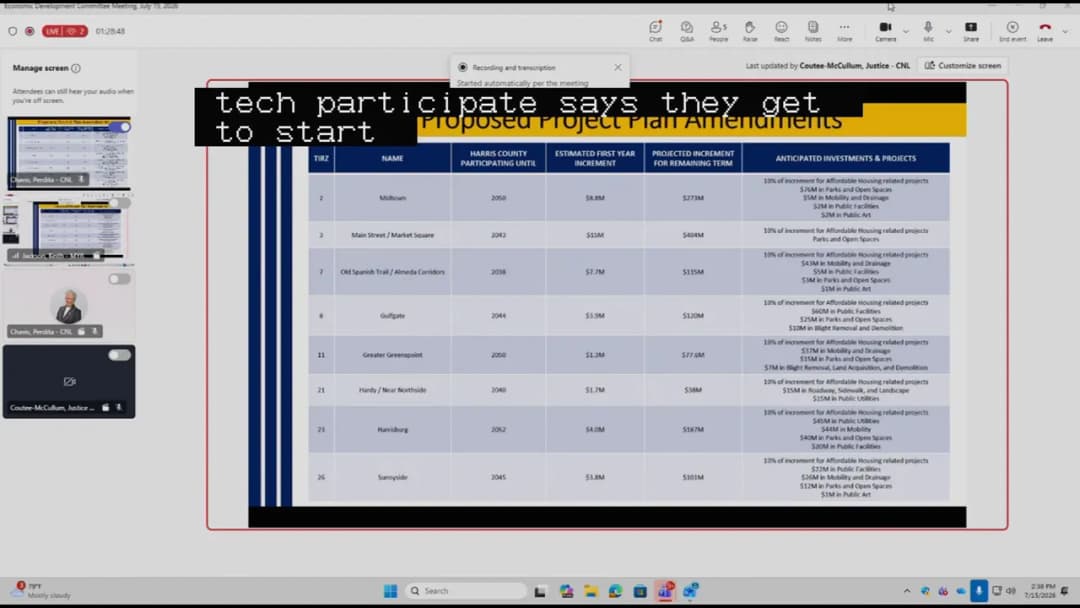
The Economic Development Committee of the Houston City Council, chaired by Mayor Pro Tem Castex Tatum, met on July 15, 2026, from 2:00 p.m. to 2:49 p.m. The meeting featured presentations on the fiscal year 2027 Tax Increment Reinvestment Zone (TIRZ) budget schedules and proposed TIRZ project plan amendments. No public speakers testified. Key discussions centered on the municipal services fee (MSF) and the inclusion of Harris County as a participating taxing unit in multiple TIRZs. Presentation on FY2027 TIRZ Budget Schedules - Jennifer Curley, Assistant Director of the Mayor's Office of Economic Development, presented the proposed TIRZ budget schedules. The total FY2027 budget across all 27 active TIRZs is approximately $334 million, primarily allocated to street projects, pedestrian infrastructure, parks, and flood remediation. The combined five-year project costs total $1.4 billion. - Curley outlined the project development process, from approval of the project plan and financing plan to design, bidding, construction, and conveyance back to the city. - Councilmember Alcorn inquired about potential annexations or boundary expansions, noting rumors about the Downtown TIRZ absorbing areas from the Fourth Ward. Curley referred to Andrew Busker for details. - Councilmember Ramirez questioned the schedule's aggressiveness compared to the previous year. Curley explained that most budgets are similar to FY2026, reducing the need for delays, and noted that last year's delays were due to incorporating new sidewalk projects and adjusting the municipal services fee. - A lengthy discussion ensued on the municipal services fee (MSF). Councilmember Alcorn expressed concern that the fee is based on what TIRZs can afford rather than actual service costs, potentially penalizing cash-rich TIRZs and rewarding those with debt. She suggested a dedicated committee meeting to address the issue. - Councilmember Ramirez argued that the MSF should reflect current valuations (not 2021 levels) to avoid subsidizing TIRZ residents by non-TIRZ taxpayers. He noted that TIRZ areas benefit from both better infrastructure (as stated by Andrew Busker in a prior meeting) and lower service fees. Curley responded that the MSF is calculated based on a 30-year average growth rate of general fund expenditures (approximately 4.5%) and that the city also considers sales tax and hotel tax revenue generated by TIRZ redevelopment. She added that new TIRZs generating less than $1 million in increment are exempt from the fee initially to allow them to build capacity. Presentation on TIRZ Project Plan Amendments - Andrew Busker, Senior Staff Analyst, presented proposed amendments to the project plans and financing plans of eight TIRZs to reflect Harris County's participation as a new taxing unit. The amendments will update the current plan, project costs, and revenue schedules. - Busker explained the legal framework under Chapter 311 of the Texas Tax Code and the city's financial policies. He noted that project plans are the guiding documents for TIRZ activities and must be amended whenever boundaries, development priorities, or taxing unit participation change. - The estimated first-year increment from Harris County for these TIRZs ranges from $59,470 (Gulfgate) to $498,283 (Sunnyside), with total projected life-of-zone county contributions of $1.4 million to $14.5 million. The funds will be used for infrastructure, parks, drainage, and mobility projects. - Councilmember Ramirez asked about non-contiguous annexations. Busker confirmed they are possible and cited Greater Houston TIRZ (TIRZ 24) as an example, where three non-contiguous sections share a common nexus of high-traffic public facilities connected by Metro rail. - Ramirez also noted that TIRZ six (set to expire in 2027) is a one-off project TIRZ, while others seem more permanent. Busker confirmed that the city must keep total TIRZ taxable value under 25% of the citywide total; currently at 21-22%, leaving room for more. - A staff member from Councilmember Panzarella's office asked about affordable housing requirements. Busker clarified that TIRZs created by petition must set aside one-third of increment for affordable housing, while others (like Montrose) may include it as a goal in their project plan without a binding requirement. For the Harris County participation, the county's affordable housing department will receive approximately one-third of the county increment for its own projects. Key Outcomes - No formal votes were taken; the meeting was informational. - The proposed FY2027 TIRZ budgets are scheduled to be placed on the City Council agenda beginning August 12, 2026. - The eight TIRZ project plan amendments will be processed through their respective redevelopment authority boards, followed by city legal review, public hearings, and City Council consideration. Timelines vary, with some boards taking summer breaks. - The next Economic Development Committee meeting is scheduled for August 19, 2026, at 2:00 p.m.
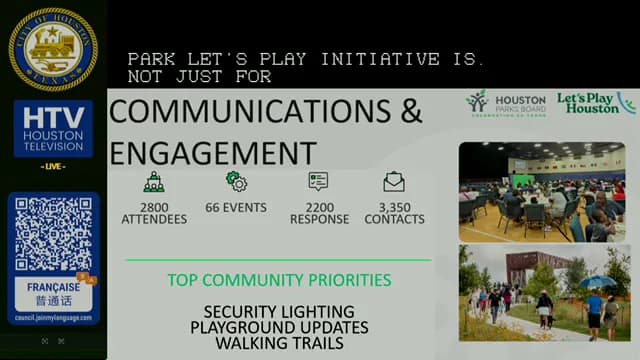
The Houston City Council convened on July 14, 2026, with Mayor John Whitmire presiding. The meeting opened with three proclamations recognizing Black Nurses Week, the Greater Houston Frontiers Club, and World Refugee Day, followed by an invocation. The majority of the session was dominated by public testimony and council discussion regarding the July 7 killing of Lorenzo Salgado Araujo by ICE agents, with over 100 registered speakers. Council also addressed decorum, the city's investigation efforts, a major parks investment initiative, and monthly financial reports. The meeting recessed late on July 14 and resumed the morning of July 15 for additional discussion and votes. Consent Calendar - The council approved a series of routine consent items, including items 3–7, 9–11, and a block of ordinances (with several pulled for separate consideration). Items passed included: acceptance of work, purchasing and bid awards, resolutions, and various ordinances related to contracts, appropriations, and interlocal agreements. Specific items pulled for separate consideration were 1, 2, 8, 13, 15–17, 21–23, 31, 33–38. Public Comments & Testimony - The vast majority of public speakers addressed the killing of Lorenzo Salgado Araujo by ICE agents on July 7, 2026. Speakers demanded a transparent, independent local investigation, called for the abolition of ICE, and urged the city to halt collaboration with ICE. Many expressed fear for their own safety and that of their families, emphasizing that ICE agents operated in unmarked vehicles without body cameras. Several speakers identified themselves as educators, attorneys, clergy, community organizers, and students. Specific requests included: launching a multilingual know-your-rights campaign, protecting witnesses from deportation, banning unmarked vehicles and requiring body cameras, and reversing the city's earlier decision to allow HPD-ICE collaboration. A few speakers also addressed non-ICE issues: a disabled veteran requested changes to airport parking rules; a resident complained about noise from a new restaurant's HVAC system; a homeowner reported shoddy repairs through a city program; and a man sought help after being wrongly incarcerated. Additionally, representatives from the refugee community thanked the council for World Refugee Day recognition and asked for policies to reduce fear and support integration. Discussion Items - Decoram and Investigation of ICE Killing: Mayor Whitmire opened the July 15 session with remarks defending the council's actions and criticizing what he called disrespectful and politically motivated behavior by some speakers. Councilmembers debated the city's role in the investigation: Mayor Whitmire stated that HPD and the DA's office are actively involved and that the FBI executed a search warrant on July 15, but that Homeland Security controls key evidence. Councilmember Pollard pushed for the city to take the lead in an independent investigation. Councilmember Panzarella called for abolishing ICE and reiterated the need for body cameras and de-escalation training. Councilmember Alcorn expressed support for enforcing council rules to maintain decorum. - Parks Investment – "Let's Play Houston" Initiative: Director of Parks and Recreation Kenneth Allen presented an update on the neighborhood parks revitalization initiative. The program will invest $45.5 million across 25 parks (15 acres and under), with $26.5 million from the Houston Parks Board and $11 million in city park dedication funds. The first 11 parks (one per council district) will break ground in fall 2026. Councilmember Alcorn offered an amendment to increase the indirect cost cap from 5% to 10% to provide more design funding; the amendment passed. - Financial Reports: City Controller Chris Hollins and Finance Director Melissa Dubowski presented monthly financial reports for May 2026. The controller projected an ending fund balance of $276.5 million (10.4% of expenditures), while the finance department projected $300 million (11.3%). The finance director announced that S&P Global Ratings revised the city's general obligation credit outlook from negative to stable, citing the city's progress on structural budget challenges. The controller also reported that his office's inquiry into former controller Chris Brown's employment had been met with refusal from the mayor's office to provide documents; the city attorney stated that information would be provided, subject to privacy exceptions. Key Outcomes - Votes on Consent and Separate Items: All consent items were approved. Items pulled for separate consideration (1, 2, 8, 13, 15–17, 21–23, 31, 33–38) were each voted on individually and passed. Notable: Item 13 (park dedication ordinance) passed with Councilmember Alcorn's amendment to raise the indirect cost cap to 10%. Item 23 (Harris County participation in Midtown TIRZ) approved, with one-third of county increment set aside for affordable housing. Item 34 (public hearing for youth recreation standards) passed. Item 35 set a public hearing for August 12, 2026, on a tax abatement agreement with NRG Greens Bio 6 LLC. Items 36 and 38 (engineering contracts) passed. - Investigation Status: Mayor Whitmire confirmed that HPD, the DA's office, and the FBI are collaborating on the investigation into Lorenzo Salgado Araujo's death. A search warrant was executed on July 15. The city has provided 911 tapes and Metro bus video to the DA. ICE announced a pause on vehicle pursuits, which the mayor called for a moratorium on enforcement and body camera requirements. - Financial Reports Accepted: The council voted to accept the monthly financial report for May 2026. - Homelessness and Gun Safety: Councilmember Thomas reported on a mobile care event serving 40 homeless individuals, including placing one person in emergency housing, and announced a gun lock safety distribution event.
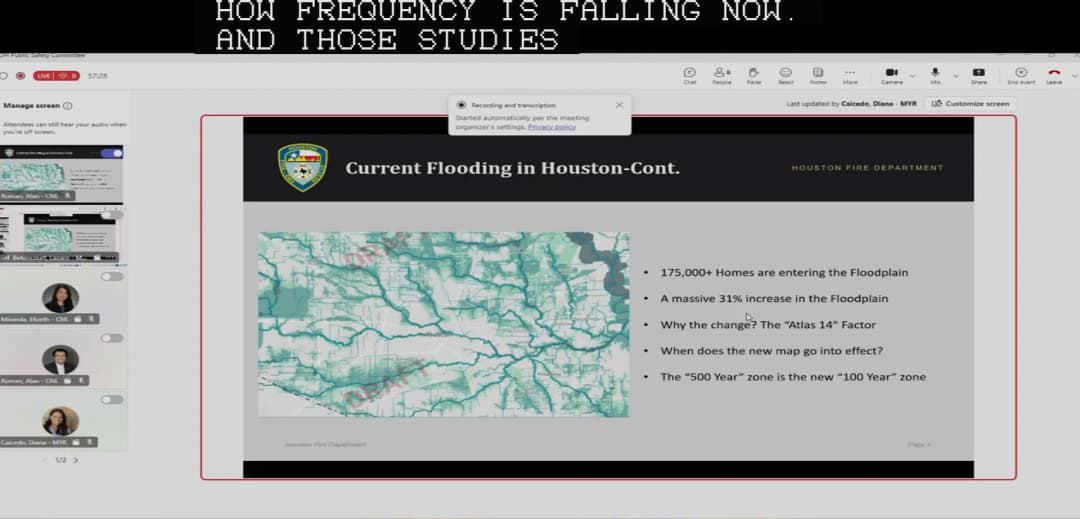
The Public Safety Committee of the Houston City Council met on July 14, 2026, chaired by Councilmember Peck, to receive a presentation from HFD Captain Bill Moreno on high water rescue operations. Councilmembers Ramirez and Davis were present in person, with Vice Chair Jackson and staff from several other council offices joining online. The meeting also included public comment from a resident regarding HFD EMS services. Public Comments & Testimony - John Nicks spoke, requesting a complete overhaul of HFD EMS. He reported that when his blood sugar spiked, two EMS units responded, the ride was bumpy, and paramedics refused to take him to his preferred hospital, instead transporting to Memorial City Memorial Hermann, which he described as 'awful' with long wait times. He suggested that EMS be separated from HFD into an independent agency, similar to Montgomery County Hospital District EMS. Councilmember Peck acknowledged the comments and noted the city policy limiting transport to hospitals within 20 minutes, agreeing the issue needs review. Discussion Items - HFD High Water Rescue Presentation by Captain Bill Moreno - Captain Moreno, head of HFD Marine Division and a member of Texas A&M Task Force One, provided an overview of Houston's flood risks and rescue capabilities. - Flooding History & Risks: He noted that in 2024 there were 27 climate emergencies, each costing about $1 billion. Updated FEMA flood maps (Atlas 14) will add 175,000 homes and 170 government buildings to the floodplain, a 31% increase covering 200 additional square miles. The old 500-year floodplain is now the new 100-year floodplain. Nationally, 4,000 drownings occur annually, with 10% being would-be rescuers. - Call Volume: In non-hurricane years, HFD handled more water rescue calls (145 in 2024) than during a hurricane year (120 in 2023). Most calls involve everyday rain, not hurricanes. Public Works states the city can only handle 4 inches of rain per hour before nuisance flooding begins. - Equipment & Training: - HFD uses multi-mission boosters (operate in 20-24 inches of water), high water vehicles (M923 military trucks, safe up to 30 inches, no electronics), boatwreck classics (primary boats, need 24 inches), double-stack boats (post-Harvey purchases, limited payload), Pollard boats (20 ft, 1100 lbs payload), a new 24-ft fireboat for Lake Houston, and zodiacs (swift-water capable, can be carried). - Ambulances can only handle 12 inches; replacement costs $334,000. Heavy apparatus max out at 20 inches; replacements cost $1 million each. During Harvey, HFD lost 5 heavy apparatus, over a dozen light vehicles, and capsized one boat. - Training is mandatory (Texas Boater Safety Act for crew born after 1993), annual (20 days on high water vehicles, 88 on boats), external (14 members sent to Oklahoma City for swift water tech at $14,000 plus travel, plus partnerships with Texas A&M Task Force One at no cost), and opportunity training (using dam releases, Slitterbond facilities at no cost). 308 members are trained in high water vehicles and 640 in boats. - Staffing: Technical Rescue Team has 63 members at 3 stations, 14 on shift daily with 7 staff. Water Strike Team (Marine Division) has 80 part-time members; 43 are swift-water trained. They are called in as needed under a 'FloodCon' activation system. Called-in members receive overtime; training on off-days is unpaid. - Future Needs: Increase drone utilization (5 drones purchased via discretionary funds recently used to find a lost kayaker), expand zero-to-24-inch response capabilities, and explore a multi-agency water strike team with Harris County Fire Marshal. HPD and HFD coordinate via shared marine channels; HPD has 19 vehicles that assist. - Councilmember Ramirez asked about the increase in 'assist citizen flooding' calls (47 in 2026 vs 25 in 2025). Captain Moreno explained that category includes both flood-related calls and non-flood issues like broken sprinklers, so there may be overlap. He also clarified that the 14 on-shift members are spread across three shifts, and the 7 staff include command personnel. - Councilmember Davis inquired about the Water Strike Team (80 part-time members, called in when needed) and confirmed that called-in members are paid overtime but training on off-days is unpaid. He highlighted that flooding events are more frequent than hurricanes, and the department's use of FloodCon ensures appropriate recall without unnecessary overtime. Key Outcomes - The committee received the presentation and will schedule a future presentation from HPD on their high water rescue operations after the FIFA World Cup. - HFD is pursuing grants and using discretionary council funds to purchase additional high water vehicles, aiming for a smaller but faster and safer fleet. - No formal votes were taken; the meeting served as an informational session. The next scheduled meeting is Tuesday, August 11, 2026.
Transcripts
No published pilot transcripts are available for this city. The current pilot covers Sacramento City Council only.
Transcript coverage details
The pilot includes June 9 and two June 23, 2026 sessions. Recording completeness is unknown. Missing, cancelled, incomplete, or changed transcripts can leave gaps. No match does not establish that something was never discussed.