The Howard County Board of Appeals met on July 23, 2026, at 9:00 AM in a hybrid format (Banneker Room and WebEx) to handle two administrative matters. Chairperson Jean Ryan presided, with board members McCurdy and Phillips attending virtually. The board unanimously voted to extend the deadline for a pending decision order and to authorize a subpoena request. Administrative Matters - Extension of Decision Order Deadline (BA 25019C, Trotter LLC): The board discussed the need to extend the 60-day deadline for issuing a written decision in the Trotter LLC case, which was deliberated on May 28, 2026. Chair Ryan noted that the Office of Law expected a draft soon but that only four days remained until the original due date of July 28, 2026 (the chair inadvertently referred to July 28, 2028, but the context indicates 2026). The board voted unanimously (3-0) to extend the issuance deadline by 30 days to no later than August 27, 2026, citing good and sufficient reason under Section 2.211A of the Board's Rules of Procedure. - Subpoena Request (BA 828D, Hill Street LLC): The board considered a written subpoena request from Barrett King in the pending Hill Street LLC case. Pursuant to Section 2.208H, the board authorized the issuance of the subpoena as prepared by the Office of Law. Chair Ryan was required to sign the subpoena. The motion passed unanimously (3-0). Key Outcomes - Motion to Extend Deadline: Approved 3-0 (Chair Ryan, Ms. McCurdy, Ms. Phillips). The new deadline for the Decision and Order in BA 25019C is August 27, 2026. - Motion to Authorize Subpoena: Approved 3-0. The subpoena requested by Barrett King in BA 828D is to be issued by the Chair. No other business was discussed, and the meeting adjourned.
Public Meetings - Howard County, Maryland
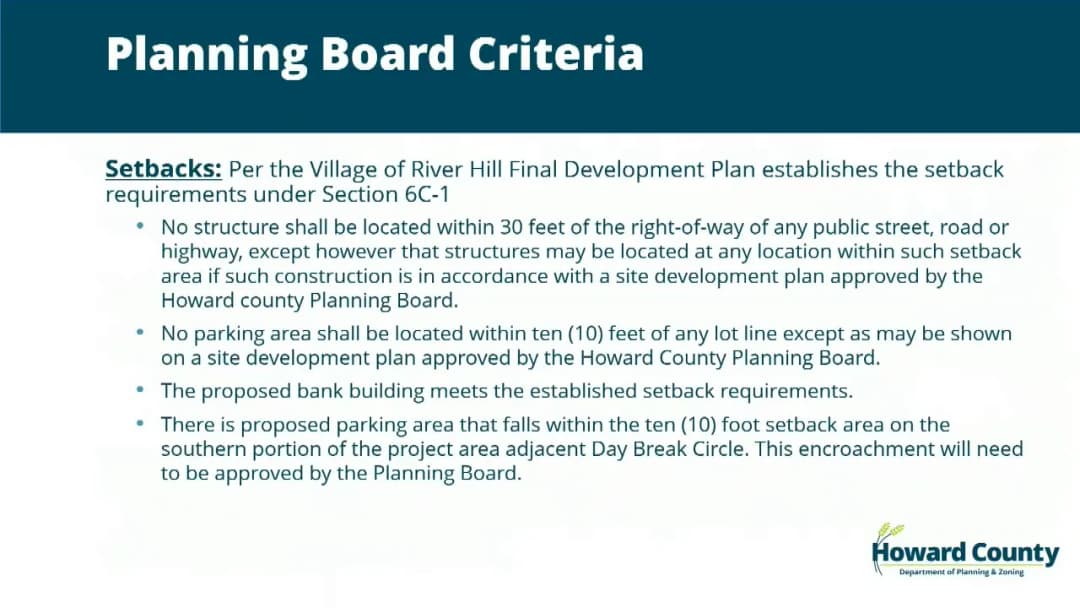
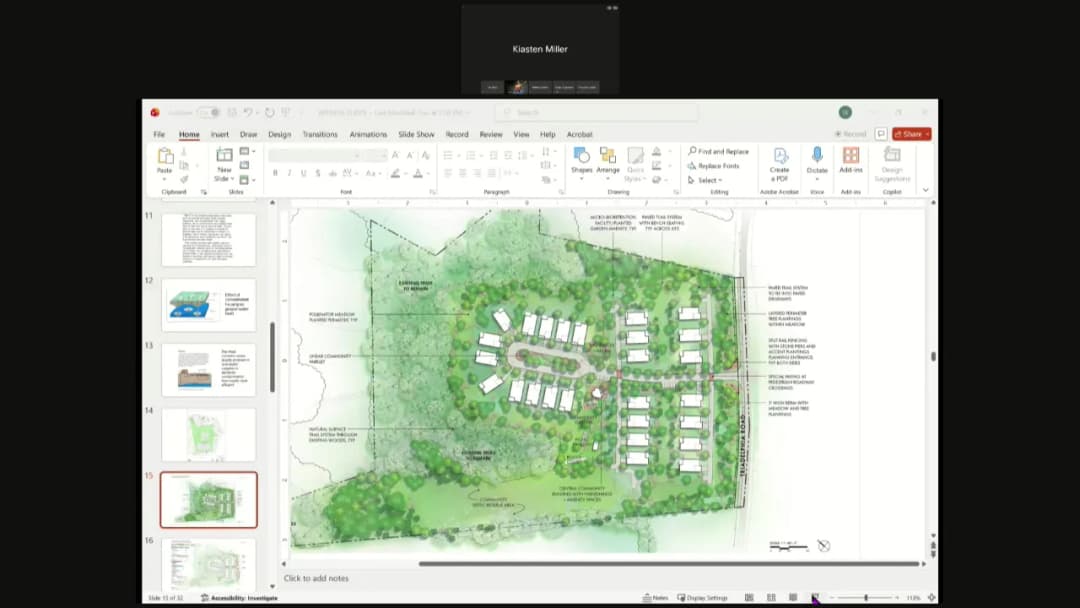
Public Meetings - Howard County, MarylandThe Howard County Planning Board met in person and virtually on July 23, 2026, in the C. Vernon Gray Room at the George Howard Building, 3430 Courthouse Drive, Ellicott City, Maryland. Members Mr. Gotzi, Mr. Tilberg, and Ms. Moore were present, establishing a quorum. The board approved the agenda, adopted the minutes of the July 9, 2026 virtual meeting, and voted unanimously to approve two site development plans: SDP-26-014 (Fall River Terrace affordable housing redevelopment) and SDP-26-016 (JP Morgan Chase Bank in Clarksville). Consent Calendar - Agenda approved by unanimous consent following a motion and second. - Minutes: The recording of the July 9, 2026 WebEx virtual Planning Board meeting was adopted as the board's approved minutes. - Chair's announcement: The August 6, 2026 meeting is canceled because the county office building is closed for energy savings week; the next meeting will be August 20, 2026, leaving one Planning Board meeting in August. Public Comments & Testimony - Barbara Scott (nearby condominium owner who lived 22 years in Deering Woods): Expressed general support for the community process but raised two concerns: traffic safety on Harper's Farm Road (her son was rear-ended and pushed into oncoming traffic while turning into Deering Woods) and the hillside/tree barrier adjacent to her property. She asked what the traffic plan would be for the additional cars. - Melissa Curtin (president and CEO, Community Foundation of Howard County): Expressed full support for SDP-26-014. She said the plan meets all relevant county requirements after three review cycles with the Subdivision Review Committee (which found it approvable pending minor comments), will enhance the community through multi-use paths, an improved pedestrian crossing, landscaping, and stormwater management, and is consistent with HoCo By Design's equity principle. - Jackie Yang (Housing Affordability Coalition of Howard County): Stated the coalition strongly supports approval. She cited the DPZ staff report, the April 2025 Harper's Choice Community Association board approval, and the May 2026 Subdivision Review Committee endorsement, and said the project advances goals for diverse, attainable, quality housing in amenity-rich neighborhoods. - Dan Kelleher: Said he has worked over 16 years to redevelop these sites (three in Wilde Lake Village and two in Harper's Choice), described the properties as a "gateway to town center," and encouraged approval of SDP-26-014. - Suzanne Weiss: Urged the board to reconsider the number of units at Fall River Terrace and to look at Enterprise's overall pattern of redevelopment in the area. She cited four projects — Legacy at Cedar Lane (62 to 123 units), Fall River Terrace (56 to 76 units), Legacy of Twin Rivers (62 to 123 units), and Rideout Heath (56 to 76 units) — and said that totals 317 current units going to 480 units (163 more apartments). She stated that at the 1.5 parking spaces per unit she recalled from an earlier community presentation, that means 244 more cars in Harper's Choice Village, and argued Cedar Lane and Harpers Farm Road cannot handle the traffic; she said she would shop elsewhere rather than at the Safeway Village Center, which she predicted would lose business. She acknowledged the mission is noble but said concentrating the new housing in the same area is not good for the community. Discussion Items SDP-26-014 Fall River Terrace (Enterprise Community Homes Housing, LLC) - Project description: Redevelopment of the Fall River Terrace townhome-style apartment complex at the northeast corner of Harpers Farm Road and Elliott's Oak Road in the village of Harper's Choice, on 2.84 acres zoned New Town. The applicant proposes a four-story, 76-unit apartment building with surface parking, outdoor amenity areas, and landscaping. The existing 56-unit complex (built 1971; approved under SDP 68006 in 1969; two- and three-story walk-up structures with outdated, energy-inefficient systems) and its parking will be demolished. Twenty-five existing apartments serve very-low-income residents under a HUD housing assistance payment contract; the rest are workforce housing. - Staff presentation (Donna Depree, DPZ): The plan is subject to the development criteria in Final Development Plan FDP 30A6, the amended fifth edition of the Subdivision and Land Development Regulations, and the Howard County Design Manual. The Subdivision Review Committee found the plan in conformance, including forest conservation, landscaping, and stormwater management. Ten specimen trees will be removed and mitigated at 2:1 with 20 native shade trees. - Applicant presentation (Tom Cole, attorney; Alex Hoffman, Enterprise Community Development; Dan Sweeney): Enterprise is a nonprofit affordable housing developer that owns and operates 15 Howard County communities serving over 1,300 households. The new building retains one- through four-bedroom unit types; four apartments will meet uniform federal accessibility standards and two will accommodate residents with hearing and visual impairments. Amenities include a community room, fitness room, business center, telework space, game room, secure indoor bike parking, package room, patio, recreation lawn, and playground, plus a direct connection to Columbia Association pathways. - Site improvements: New multi-use path along Elliott's Oak Road and Harpers Farm Road; upgrade of the CA trail from a 6-foot to a 10-foot multi-use path; a pedestrian refuge island on Elliott's Oak Road; internal sidewalks; EV charging; and exterior bike racks. A future phase on the western portion of the site (non-buildable parcel B) anticipates six for-sale townhouses under a future site plan. - FDP compliance: Building set back more than 100 feet from Harpers Farm Road (25-foot requirement); 76 units within the allowable density; building height 46 feet (60-foot maximum); 102 parking spaces provided, matching the required 1.34 spaces per unit; building coverage 25% (30% maximum). Landscaping totals 119 trees, 425 shrubs, and additional perennials/grasses, exceeding Landscape Manual requirements, and was approved by the Harper's Choice Architectural Committee. - Traffic: In response to public concerns, the applicant stated the site plan underwent adequate public facilities testing for traffic and met the county's requirements. DPZ staff confirmed the Development Engineering Division reviewed and approved the traffic studies, and noted plans are not brought to the board unless they satisfy adequate public facilities requirements. SDP-26-016 JP Morgan Chase Bank - Project description: The applicant proposes a new 3,500-square-foot Chase Bank branch with associated parking, utilities, and site amenities on approximately 1.70 acres (Lot W 2) in the Village of River Hill, Clarksville. The property currently contains a vacant former Ruby Tuesday restaurant and parking lot; the site will be subdivided to create two lots. - Staff presentation (Nicholas Haynes, DPZ): Financial institutions are a permitted use in the commercial land use area of the River Hill Final Development Plan. The FDP parking ratio is 5 spaces per 1,000 square feet of net leasable area; the bank requires 18 spaces and the plan provides 28. No height or coverage limits apply. Setbacks of 30 feet from public rights-of-way are maintained. Landscaping includes 6 street shade trees along Clarksville Pike and Daybreak Circle, plus 9 shade trees, 2 ornamentals, and 105 shrubs. - Requested adjustment: One parking space in the southwest corner of the proposed parking area encroaches into the 10-foot parking-area setback. Staff explained the board may approve the adjustment if it will not alter neighborhood character, impair adjacent property, or harm public welfare, and is needed due to practical difficulties or results in better design. - Applicant presentation (Chrissy Bauer, Bowler Engineering, for Chase): Access will be from Daybreak Circle only, with no main entrance off MD 108. The encroaching parking space is an existing nonconformity approved with the original site plan; the curb line is unchanged, and the new subdivision line creates the setback issue. A design manual waiver was also requested to allow 4 ATM stacking spaces instead of the usual 5, because the drive-through is ATM-only with no teller. Stormwater quality will be treated by a proposed modular wetland facility; forest conservation will be satisfied through fee-in-lieu, with no forest clearing. - Public testimony: One online speaker, Joel Horwitz, could not be heard due to technical difficulties (apparently connected to another WebEx meeting). After the Planning Board attorney advised the board was not required to wait, the board proceeded without his testimony. - Board discussion: A board member asked whether the motion needed to expressly reference the adjustment; staff advised that a motion approving the SDP as submitted was appropriate, since the request includes the adjustment. Key Outcomes - SDP-26-014 Fall River Terrace: Approved unanimously (all three members present) upon motion and second. The approval includes the finding that the plan complies with the FDP and applicable regulations. - SDP-26-016 JP Morgan Chase Bank: Approved unanimously (all three members present) upon motion and second, with the adjustments requested by the petitioner — including the parking-area setback encroachment and the design manual waiver for ATM stacking spaces. - Next meeting: The board adjourned by unanimous consent; the next Planning Board meeting will be held August 20, 2026 (the August 6, 2026 meeting was canceled).
On July 23, 2026, at 5:30 p.m., Hearing Examiner Joyce Nichols continued the evidentiary hearing in ZB 1134M/ZB 1134PDP (Olde Scaggsville, LLC and G&R Maple Lawn, Inc.) in the George Howard Building, Banneker Room, with participation by WebEx. The hearing, begun July 15, 2026, concerns a zoning map amendment from B-1 to RR-MXD-3 and an amended preliminary development plan (PDP) for Maple Lawn (11292 Buch Way, Laurel, MD; 11788 Scaggsville Road, Fulton, MD). The proposal would incorporate the Bookway parcels into the PDP, add a 260-unit apartment building with 39 moderate-income housing units, expand the Maple Lawn West single-family component, and raise density from 2.2 to 3 dwelling units per acre. Public Comments & Testimony - Stu Cohen, a Scaggsville resident and president of the Howard County City Association, opposed the petition. He argued that the plan had not materially changed since the 2021 planning board denial (4-1, with eight fewer units), that the zoning criteria had not been met, and that the proposed 30-foot setback for the apartment building conflicted with the technical staff report's 300-foot minimum setback requirement from MD 216. He asked that, if approved, conditions include a written commitment to 15% MIHUs and a 300-foot setback. He also objected to what he called '513 additional units or another approximately 1,500 more units,' and argued the existing infrastructure was not ready. - William England, a Fulton-area resident, raised continuing concerns about school capacity and traffic, asked whether a school site had been considered on the old farm property, and wanted to see how the community-outreach memorandum addressed those issues. He reserved further traffic questions for the traffic witness. - Alan Schneider, a Clarksville resident, asked whether the project would dedicate land for road/school expansion, whether the HOA had voted on the MOU, and whether the developer's 'vision' included adequate infrastructure. - Joe Hurwitz, appearing virtually, did not offer testimony but reserved for a memorandum of law and noted a continuing objection about the Zoning Council's procedural role. Discussion Items - Mike Buck (petitioner witness): Buck, whose family property is adjacent to Maple Lawn, testified that the 2016 B-1 rezoning was intended for an 80,000-square-foot office building, but COVID changed the office market and made that use unviable. He described the proposal as a 'seamless integration' into Maple Lawn and '100 percent' comprehensive planning. He confirmed the apartments would include 39 moderate-income housing units and said the 15% MIHU level was economically appropriate; he would not commit to a higher percentage. Under cross-examination, he said his family developed the 283-unit Vine apartments nearby with 15% MIHUs and average rents around $2,200. - Michael Greenbaum (petitioner witness): Greenbaum testified about his father's original vision for Maple Lawn as an integrated, walkable mixed-use community. He said the 2021 second-amendment plan was withdrawn after community opposition, and the current plan reflects more extensive engagement, including a memorandum of understanding with the Maple Lawn Homeowners Association. He described underused parking lots documented in March 2026 photos, the business district's evolution after COVID, and the need for housing, including rental and moderate-income units. Under cross-examination, he acknowledged the pre-submission meeting (Jan. 9, 2026) drew roughly 40 attendees out of about 5,200 residents, that schools, traffic, and stormwater were discussed, and that no request was made for land for a school. - Mickey Cornelius (petitioners' traffic expert): Cornelius, a professional engineer, prepared a generalized traffic analysis dated Jan. 26, 2026. He testified that the surrounding road system, including MD 216 intersections and roundabouts, would operate acceptably under future volumes with the proposed development, and he identified no transportation deficiencies. The study counted 276 additional morning peak-hour trips and 323 additional evening peak-hour trips. He also found that business-district parking lots were underutilized and that a portion could be redeveloped while retaining adequate parking. He noted that a roundabout near Lime Kiln/Murphy Road was a possible option, not a committed plan, and that SHA had not yet weighed in. - Dr. Sarani (petitioners' economic expert): The economic and cost-of-services analysis (Feb. 10, 2026) projected an annual net fiscal surplus of about $818,000 for the development as a whole. The report showed single-family homes generating a positive annual surplus of about $2.24 million and apartments a negative annual surplus of about $1.42 million; over 30 years, the present value was about +$50 million for single-family homes and -$160 million for apartments. She testified that MIHUs were fully included in the analysis and that the overall project would provide a net benefit to Howard County. - Jessamine Duvall (petitioners' housing-policy witness): Duvall testified that the proposal is consistent with HOCO by Design because it adds rental housing, moderate-income housing, and infill housing in the planned service area near existing infrastructure. She noted Maple Lawn currently lacks purpose-built rental housing and MIHUs, and that the Maple Lawn West property was already planned for development. Increasing the approved 32 homes on that about 110-acre area to roughly 250 homes is, in her opinion, a significant and appropriate supply response to the county's housing shortage. - Julia Sauer (Howard County Department of Planning and Zoning): Sauer testified that the DPZ technical staff report found no insufficiencies in the PDP petition. She said the MXD-3 zone caps density at 3 dwelling units per acre, and the requested 30-foot residential setback from MD 216 is consistent with other apartment zones, although the existing PDP criterion is a 300-foot setback. Under cross-examination, she acknowledged the report's page 4 contains MD 216 AADT data from 2019 (24,761 vehicles) and that the Department makes no formal recommendation, but she confirmed DPZ's analysis concluded the proposal furthers the original intent of the MXD-3 district and HOCO by Design. Key Outcomes - The evidentiary hearing was concluded, and the record was closed. - Memoranda of law are due by August 21, 2026, at 4:00 p.m. - Hearing Examiner Nichols will issue a recommendation to the incoming county council, not a final decision; objections may follow after the new council is sworn in. - Petitioners requested a favorable recommendation; opposition requested denial or, alternatively, conditions on MIHUs and setbacks. No rebuttal case was presented.
The Howard County Hearing Examiner convened on July 22, 2026, at 10:00 AM in a hybrid format (Banneker Room and WebEx) to consider a sign variance petition (BA 26-012S) from Harmony Hall at Howard County Health Park, LLC. The petitioner requested approval to replace an existing 40-year-old wooden sign with a new larger illuminated sign at a reduced setback from Cedar Lane in Columbia, MD (6336 Cedar Lane). The hearing was presided over by Hearing Examiner Joyce Nichols. The applicant’s counsel, Sam Mangioni, and sign designer Joe Weber (Shannon Baum Signs) presented testimony. One remote attendee (Anish Kondui) listened but did not testify. The evidentiary hearing was concluded, with a written decision to be issued later. Discussion Items - Petition Overview: The applicant sought a variance from the required sign setback of 169.5 feet to allow placement 45 feet from the road (a requested variance of 124.5 feet). The proposed sign is 18 feet wide by 9 feet 5 inches tall (including foundation/framing), with actual signage area of approximately 98 square feet. The sign would be illuminated, and the request was made under sign code sections for illumination (3.508) and size (3.501 C to C). - Justification for Variance: Counsel and Mr. Weber testified that the existing sign is obscured by vegetation (trees on adjacent properties, not owned by the applicant) and the site’s grade and road curvature make compliance with the full setback impractical. They argued that moving the sign farther back would push it into parking lots or require tree removal, and that the sign would not create a traffic hazard or negatively affect adjacent properties. The property houses an assisted living facility serving an elderly community, and the new sign would improve wayfinding and reduce driver distraction. - Hardship Consideration: The hearing examiner questioned whether the hardship was self-created. Mr. Weber confirmed that the obstruction (trees) is on neighboring properties, not the applicant’s, and that no other feasible alternative exists without encroaching on those trees. Key Outcomes - No Opposition: No public testimony was offered in support or opposition; the virtual attendee (Anish Kondui) indicated he was only listening. The applicant rested its case after presenting evidence. - Decision Reserved: The Hearing Examiner concluded the evidentiary hearing and stated that a written decision and order would be forthcoming. No vote was taken during the meeting. Note: No meeting minutes were available for this hearing.
The Alcoholic Beverage Hearing Board convened on July 21, 2026, at 6:30 PM in hybrid format (Banneker Room, Ellicott City and WebEx) to consider three license applications: a new Class B license for Ledo Pizza Clarksville, a transfer of a Class B license for House of India, and a change in class to a Class D distillery license for JS Brewery. The board approved all three applications unanimously. Consent Calendar - Minutes of June 23, 2026: Approved on a motion by Chair Chen, seconded by Mr. Coleman. Vote: Chair Chen yes, Mr. Coleman yes, Mr. Hunt yes, Ms. Johnson abstained, Ms. Kemp yes. (The transcript shows Ms. Johnson abstained for minutes; for subsequent votes she voted yes.) Discussion Items - New Class B License – DSMS Pizza, LLC t/a Ledo Pizza Clarksville: Applicant Dhvani Vyas sought a 7-day on-sale license for a 2,377 sq. ft. restaurant at 6030 Daybreak Circle, Clarksville. The board had approved a transfer of an existing license in 2025, but it expired due to tax issues. The new application also requested permission to sell liquor (previously beer/wine only) because of customer demand for ready-to-drink cocktails. Vyas testified he owns the business, works 25+ hours weekly, and expects alcohol sales under 10% of revenue. He has alcohol awareness certification and prior experience at other Ledo Pizza locations. A prior violation at Players Bar & Grill (2019, impermissible relationship with a wholesaler) was discussed. The board confirmed Vyas was not notified at the time because he was not the resident agent; he had sold his interest before the violation. The board found the situation different and noted his current operation has a manager and controls. The application was approved unanimously. - Transfer of Class B License – Trinity Hub, LLC t/a House of India: Applicant Ranju Sharma Giri sought to become the sole licensee of the existing 1,970 sq. ft. restaurant at 9350 Snowden River Parkway, Suite F2, Columbia, by purchasing 100% of the LLC. She has worked at the restaurant for six months and plans to keep current staff, including a manager with 15 years of experience who is TIPS certified. She will work daily and handle alcohol records with the manager. The board expressed concern about her limited experience with alcohol regulations (she had worked previously at fast-food chains) and her hesitation in answering questions. However, given the manager’s longevity, no prior violations at the establishment, and the low-risk nature of a Class B license, the board approved 5-0 with encouragement to complete further training. - Change in Class to Class D – JS Brewery, LLC t/a JS Brewery: Applicant Rajiv Kumar Aggarwal sought to upgrade from a Class B beer license to a Class D beer, wine, and liquor license plus an on-site consumption permit for a distillery, at 8970-B Route 108, Columbia. The 2,606 sq. ft. facility is a Korean makgeolli (rice wine) brewery and educational space. The change would allow production of traditional soju (distilled liquor) and eventual sale of a limited selection of other Korean alcohols. Aggarwal, who is not Korean but lived in Korea and is married to a Korean chemist, emphasized the cultural and educational mission. The brewery is open 2–6 PM Tuesday–Saturday, with small batches (5–20 gallons). The board praised the unique business, noting no violations and strong community interest. Approved unanimously. Key Outcomes - New License (Ledo Pizza Clarksville): Approved 5-0 (Chair Chen, Coleman, Hunt, Johnson, Kemp all yes). Applicant waived right to appeal. - Transfer License (House of India): Approved 5-0 (same vote). Applicant waived right to appeal; counsel pledged additional training. - Change in Class (JS Brewery): Approved 5-0 (same vote). Applicant waived right to appeal. - Next meeting tentatively scheduled for August 25, 2026 (subject to change).
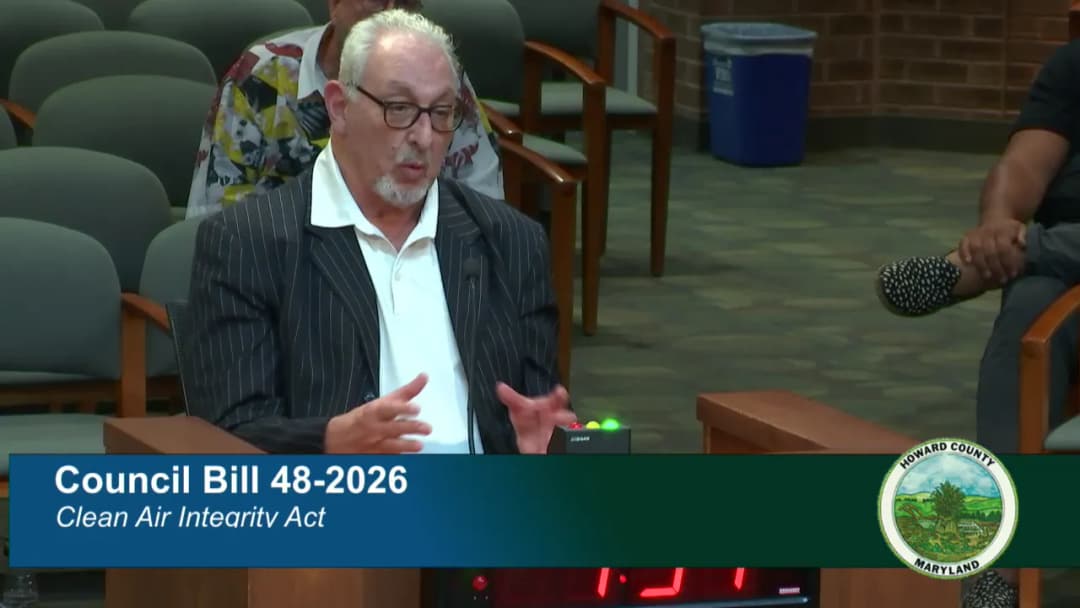
The Howard County Council held a hybrid legislative public hearing on Monday, July 20, 2026, at 7:00 PM. The hearing covered appointments and reappointments to various boards and commissions, financial legislation related to the Board of Education's capital and operating budgets, general resolutions including the Elkridge Sustainable Community designation, a delegation of authority for the Housing Director, and the conveyance of Troy Park land to the Board of Education. The final item was Council Bill 48-2026, the Clean Air Integrity Act, which generated significant public testimony. Appointments and Reappointments (CR108–CR119) The council heard testimony from each nominee and reappointee. All expressed their qualifications and enthusiasm for serving. Notable: Omar J. Jones IV, nominee for the Commission for Veterans and Military Families, is the grandson of Howard County's first county executive. No opposing testimony was given. The council will consider confirmation at a later session. Financial Legislation (CB46-2026, TAO1-FY2027, CB47-2026, CR120-2026) Dan Lubley, Executive Director of Capital Planning and Construction for Howard County Public School System (HCPSS), testified in support of all four items. He explained that the state’s Interagency Commission on School Construction (IAC) initially allocated $18 million in state funding but after an audit released an additional $6 million. This additional funding allowed HCPSS to reallocate local capital dollars to other priority projects, including gym air conditioning and the Faulkner Ridge Center. Roskee Igile, Director of Finance, testified in support of CB47-2026, which authorizes the transfer of bond funds between capital projects. No public opposition was voiced. General Resolutions (CR121-2026, CR122-2026, CR123-2026) CR121-2026 – Kate Bollinger, Planning Supervisor, testified in support of endorsing Elkridge as a Sustainable Community. The designation makes the area eligible for state grants and resources. Since FY2024, Howard County has received over $2 million in such grants. CR122-2026 – Kelly Simeno, Director of Housing and Community Development, testified in support of granting her delegated authority to sign environmental review records for HUD projects. Current law requires the County Executive to sign; this resolution would streamline the process. Councilmember Jung questioned whether this could lead to weaker environmental review; Simeno clarified that the review standards are set by HUD and the resolution only changes the signatory. CR123-2026 – Emily Ayacy, Chief of the Bureau of Real Estate Management, testified in support of conveying approximately 48.635 acres at Troy Park to the Board of Education for a future school. The county acquired the land between 1999 and 2009; 28.83 acres had Program Open Space restrictions, which were lifted by conveying two replacement properties (Ilchester Park and Lawyers Hill) valued at $8.465 million. The conveyance includes a deed restriction for school use or reversion to county ownership. Councilmember Rigby confirmed the necessity of the resolution. Clean Air Integrity Act (CB48-2026) This bill, introduced by Councilmember Rigby, would prohibit the consumption of alcoholic beverages on the premises of retail tobacco stores, closing a loophole that could allow cigar bars. It also defines "tobacconist" and sets a 70% sales threshold for premium cigars and pipe tobacco. Supporters testified: - Lisa Fuez (American Cancer Society Cancer Action Network): Argued that cigar bars undermine smoke-free laws; secondhand smoke is carcinogenic; ventilation cannot eliminate risk. - Chelsea Walzack Verks (American Heart Association): Stressed that CB48 preserves Howard County’s clean indoor air legacy; no safe level of secondhand smoke; workers deserve protection. - Emily Wolford (Columbia Democratic Club): Noted the bill has no fiscal impact; supports public health. - Alex Casper (American Lung Association): Warned against renormalizing smoking; cigars cause cancer; cigar bars lead to other products being smoked. - Kathy Hoke (legal resource center for public health policy): Explained the history of the Clean Indoor Air Act; the 70% threshold defines premium cigar establishments; registration requirement would aid enforcement. - Glenn Schneider (Smoke Free Howard County): Emphasized worker protection; no worker should have to choose between health and paycheck; called for fairness comparing to restaurants. - Lawrence Schoen (air quality engineering expert): Stated no engineering controls can eliminate secondhand smoke risk; supports even stricter prohibitions. Opponents testified: - Steve Castro (owner of Davidus Cigars, Ellicott City): Opposed the alcohol ban; his store has had no incidents in 26 years; BYOB is part of the cigar experience. - Stanley Tate (Baltimore City resident): Proposed a middle-ground approach – keep 70% sales requirement, but replace alcohol prohibition with operating rules; cited a state work group that recommended regulation. - Scott Miller (Ellicott City resident): Opposed the provision banning alcohol; the shop is a community and networking hub; no police issues. - Rahul Gupta (co-owner of Tobacco Leaf, Jessup): Urged amendment to preserve BYOB; his lounge has operated responsibly since 2010; customers bring their own beverages; no public safety burden. - Larry Bernhard (manager of Davidus Cigars): In 8 years, no problems; only about 5% of customers bring alcohol; removal of BYOB would hurt business and community. Councilmember Rigby introduced the bill, noting it was a response to inaction at the state level and a moratorium expiring on alcohol in tobacconists. Key Outcomes - No votes were taken during this hearing. The council will hold a work session on Monday, July 27, 2026, at 10:00 AM, and a wrap-up legislative session on Wednesday, July 29, 2026, at 10:00 AM for final consideration. - Written testimony will continue to be accepted and considered. - The council will deliberate on all items, particularly CB48-2026, where both sides presented strong arguments.
The Howard County Hearing Examiner, Joyce Nichols, reconvened on Thursday, July 16, 2026, at approximately 5:30 PM in a hybrid meeting (Banneker Room and WebEx) to continue the conditional use petition (BA 26-008C) from ESC Triadelphia Road, LLC. The petition seeks approval to construct 26 age-restricted adult housing (ARAH) units at 12668 Triadelphia Road, Ellicott City, MD 21042. This session was a continuation from June 24, 2026, and July 14, 2026, and focused on opposition testimony, motions, and closing arguments. Public Comments & Testimony - Donald Hibbard (3525 Lakeway Drive) testified in opposition, citing concerns about low-yield well water (2–5 gallons per minute), near-accidents at the intersection of Triadelphia Road and Lakeway Drive, fire safety (lack of hydrants, narrow roads), and tree removal. Under cross-examination by petitioner's counsel, he acknowledged his well produces 2–5 gpm (twice the minimum) but still runs out; he had no accidents. - Bob Marcagiano (3533 Lakeway Drive) opposed the development, expressing concern that 26 homes drawing water could affect his well (measured 3.2 gpm) and that traffic on Triadelphia Road is dangerous. He requested an independent traffic study and a traffic calming circle. Cross-examination revealed his well is recorded by the health department at 10 gpm, he has never run out of water, and no accidents have occurred in 53 years. - Jennifer Sonenlighter (3681 Blackberry Lane) opposed, arguing the 0.27-acre per home density (gross) is out of character with the surrounding 0.9-acre lots, that the proposed water testing is inadequate, and that the character of the rural west would be harmed. Under cross-examination, she acknowledged the minimum density requirement is 1 dwelling per net acre and that the proposal meets that. - Becky Merrill (3518 Lakeway Drive) testified at length against the plan, raising concerns about well water depletion (citing calculations showing ARAH may use more water than single-family homes), surface water runoff, loss of mature trees, fire safety, and the 2,800-square-foot “downsizing” condos. She requested independent third-party well testing, a 10-year security for well failures, and a full environmental concept plan. Under cross-examination, she could not identify any direct evidence that the development would harm her well and had no personal knowledge of neighbors' wells going dry. - Kathleen Bersickey (3299 Rosemary Lane) opposed, noting she built her home on an undeveloped wooded parcel and that the proposed walking path 120 feet from her front door would destroy her privacy and wildlife habitat. She also feared property value loss. Cross-examination confirmed her well yields 20 gpm. - Charles Green (3731 Blackberry Lane) opposed, presenting maps to compare density (Lakeway Drive has 28 homes on 47–51 acres, half the proposed density). He cited concerns about older driver safety, shared septic failures (citing Cattail Creek litigation), noise from Route 32, and lack of data from the site. He was reluctant to allow well monitoring due to risk of contamination. - Alexandra Chrysostomo (12704 Triadelphia Road) opposed, stating the development “crams 26 homes onto 4 acres” (700% increase over zoning), threatens wells and septic, and creates road safety hazards. She noted well records show 30 gpm for her property. Under cross-examination, she acknowledged the DAP reviewed the design and changes were made. - Pamela Failing (12665 Triadelphia Road) opposed, citing low well yield (3 gpm), objection to the view of closely spaced units, traffic speed (40 mph), loss of trees, and lack of transparency about drilling results. She uses 300 gallons of water per week via navy showers. She emphatically refused to allow well monitoring by the petitioner’s hydrologist. - Duncan Woodbury (3553 Lakeway Drive) opposed, arguing the petitioner failed to meet its burden of proof, especially regarding water. He stated the petitioner drilled over a dozen wells, fracked, and only obtained 17 gpm total, yet provided no engineering diagrams. He reported that after drilling, his well water developed a hydrogen sulfide odor (uncontaminated before). Under cross-examination, he agreed to allow well monitoring by an independent third party with a contract. He also argued that the project is incompatible with the rural character and emergency services. Discussion Items - Motion to Dismiss: After opposition testimony, the Hearing Examiner took a short break. The petitioner’s counsel, Mr. Erskine, made a motion to dismiss on the grounds that the developer failed to meet its burden of proof regarding adverse effects on vicinal properties (especially well water). He argued that the developer’s own expert (hydrologist) was not called, that drilling results (only 17 gpm from multiple wells) were not disclosed, and that the developer did not present evidence that the development “will not have adverse effects.” The opposition attorney (Ms. Eaten Hauer) supported the motion, emphasizing the code requires affirmative proof. - Rebuttal: The developer’s counsel argued that water issues are not a specific criterion for conditional use at this stage, that MDE will handle final approval, and that conditions could be imposed. He highlighted that the county council intended ARAH in the rural west, that the design meets all zoning bulk requirements, and that the DAP approved the plan. - Closing Arguments: Both sides presented closings. The petitioner summarized how all explicit criteria are met (density, open space, traffic, design, etc.). The opposition reiterated that the developer failed to prove no adverse effects, especially on water supply, and that the burden was not shifted. - Proposed Conditions: Both counsel submitted written conditions to the Hearing Examiner. The opposition’s conditions included independent well testing, a full traffic study, environmental concept plan, and security for well failures. The developer proposed conditions such as no grading permit until MDE and health department approval of water/sewer systems. Key Outcomes - The Hearing Examiner took the motion to dismiss under advisement and stated it would be addressed in the final decision and order. - The hearing was declared concluded at approximately 9:00 PM. - A written decision and order will be issued at a later date.
Overview On July 15, 2026, at 5:30 p.m., the Howard County Hearing Examiner convened a hybrid meeting at the George Howard Building in Ellicott City to hear two related petitions concerning 2 acres near Maple Lawn in Fulton. The first case (ZB 1134M) was a piecemeal zoning map amendment request to rezone two parcels from B-1 (Business: Local) to RR-MXD-3 (Rural Residential Mixed Use Overlay). The second case (ZB 1134PDP) was an amendment to the Maple Lawn Preliminary Development Plan (PDP) to incorporate the same parcels, adjust land uses, and increase residential density. After hearing evidence and public testimony on the zoning map amendment, the Hearing Examiner closed that record and began the PDP case but recessed it to continue on July 23, 2026, at 5:30 p.m. Consent Calendar - None. Public Comments & Testimony - Stu Kohn (Protestant): Asked about the developer’s commitment to moderately priced income housing units (MIHUs). He noted a discrepancy between a 10% requirement and a voluntary offer of 15%. Petitioner Michael Book confirmed a mandatory 15% MIHU commitment in writing, regardless of final unit count. - Alan Schneider (Protestant): Questioned the definition of the “neighborhood” used by petitioners for the change analysis, noting that the green boundary on Exhibit 1 included areas he considered distinct (e.g., Maple Lawn South). He also asked about additional uses permitted under MXD-3; Kevin Foster explained that the specific uses would be determined in the PDP process, but the current proposal is for apartments. - Vincent Pagan (Protestant, Mooresfield resident): Challenged the inclusion of Mooresfield within the petitioners’ neighborhood boundary, arguing there is no physical connectivity (no through roads or sidewalks) between Mooresfield and Maple Lawn. Foster responded that neighborhood boundaries are geographic, not based on connectivity. - William England (Protestant, virtual): Asked whether uses other than apartments could be pursued if the rezoning were approved. Foster stated that without a PDP amendment, the property would remain standalone; other residential uses might be possible but are not part of this petition. - Brianna Pagan (Protestant, virtual during PDP case): Raised concerns about notice to adjacent parcels, particularly the Mooresfield community, stating that many residents did not receive notice and that the sign at the farm was not updated. She also asked about school and traffic studies; petitioners indicated those would be addressed at later stages. Discussion Items Zoning Map Amendment (ZB 1134M) - Petitioner's Case: Attorney Mandy Heinel opened, arguing that the petition is based solely on the “change” prong of the piecemeal rezoning standard, not “mistake.” She stated that substantial, unforeseen changes since the 2016 rezoning—including the COVID-19 pandemic’s effects on office demand, a housing shortage, and new planning policies (HOCO by Design)—cumulatively altered the character of the neighborhood. - Kevin Foster (Expert Planner, 40 years experience): Defined the relevant neighborhood as bounded by Johns Hopkins Road (N), Pindale School Road (W), MD 216 (S), and US 29 (E). He testified that the 2-acre subject parcels are a “small island of B1 zoning” surrounded by RR-MXD-3 within Maple Lawn’s PDP. The existing B1 zoning is no longer satisfactory because the office market and housing needs have fundamentally changed. He noted the Planning Board unanimously recommended approval. He also read from the 2016 technical staff report and decision to show that the 2016 B1 zoning was appropriate based on the facts at that time. - Michael Book (Property Owner): Explained that in 2016, he sought B1 zoning to build an 80,000 sq ft office building, but post-COVID the office market collapsed, and standalone office is no longer feasible. He now seeks rezoning to incorporate the parcels into Maple Lawn for a multifamily apartment building with 15% MIHUs. - Michael Greenbaum (Master Developer of Maple Lawn): Described the drastic underutilization of office parking (exhibits 5 and 6 showed 2013 vs. 2026 photos). He noted 70% office occupancy and low utilization. He emphasized increased demand for housing, especially apartments, and the need for affordable units. He testified that an MOU with the Maple Lawn HOA acknowledges these changes (Hearing Examiner admitted it despite relevance objection, noting it had limited probative value for the change argument). - Dr. Darius Irani (Economist, Towson University): Testified that COVID caused a structural, permanent shift in office demand and increased housing demand. He cited labor force participation declines and a shortage of 95,000 housing units in Maryland. Mixed-use developments are now more resilient than standalone offices. He stated that these changes were not foreseeable in 2016. - Jessamine Duvall (Housing Expert, Bridges to Housing Stability): Described the housing shortage in Howard County, referencing HOCO by Design (adopted 2023) and the Housing Opportunities Master Plan (2021). She testified that Howard County now recognizes a need for 31,000 additional housing units. Maple Lawn lacks rental apartments and MIHUs; the proposal would provide both. - Opposition/Cross-Examination: - Zoning Council cross-examined Foster on the neighborhood definition and noted no physical infrastructure changes since 2016. - Protestants questioned the scope of the petitioner’s neighborhood (Exhibit 1) and argued that the proposed apartments are incompatible with Maple Lawn’s existing character. - Julia Sauer (DPZ): Confirmed that DPZ prepared a Technical Staff Report (TSR) that analyzed the petition under the change rule. She acknowledged that the neighborhood boundary map was first seen tonight but that the petition’s text description (major roads) had been evaluated. She noted no zoning changes in the area since 2016 except two: a parcel rezoned to RAPT (The Vine apartments) and a piecemeal amendment for a yellow area south of 216 (zoning RSA-8). She stated that HOCO by Design represents a policy change reflecting the housing shortage. - Closing Arguments: Petitioner argued that the cumulative evidence—changed office market, housing needs, planning policies, and integration into Maple Lawn—clearly meets the change standard. The petitioner requested a favorable recommendation to the Zoning Board. Zoning Council reserved closing for a memorandum of law. PDP Amendment (ZB 1134PDP) – Initial Testimony Only - The Hearing Examiner opened this case after closing the map amendment record. Petitioner’s opening statement explained the three main amendments: (1) incorporate the book parcels (2 ac) into the PDP; (2) change a portion of the business district from
The Howard County Hearing Examiner continued the hearing for BA 26-008C, a petition by ESC Triadelphia Road, LLC for a conditional use to construct 26 age-restricted adult housing (ARAH) units at 12668 Triadelphia Road, Ellicott City. The meeting on July 14, 2026, focused on opposition testimony and public comment. The hearing will resume on July 16, 2026, at 5:30 PM. Motion to Deny - Susan Eitenmeyer, representing her husband and opposing the petition, moved to deny the petition, arguing the applicant failed to meet the burden of proof under Section 131 of the County Code. She claimed the petitioner presented no evidence that a shared well system is feasible or that the project is in harmony with the Howard County General Plan (HOCO by Design), specifically policies DN9 and DN10 and implementing action 3 requiring feasibility of shared water systems. The motion was denied by Hearing Examiner Joyce Nichols. Opponent Witnesses - Thomas Hilton (Lakeway Drive resident, 40+ years water/wastewater experience, WSSC planning division manager): Testified that the Piedmont bedrock geology makes well yields unpredictable. He cited public well records showing adjacent properties have low-yielding wells (e.g., 1-2.75 gpm) and depths up to 800 feet. He expressed concern that 26 homes on shared wells could lower the aquifer and impact nearby wells, noting the developer has not provided a hydrogeological study or pump test results. He stated that without such data, the feasibility of the community well system is unproven. - Jillian Rhines (Blackberry Lane, environmental scientist, professional wetland scientist): Testified that no wetlands delineation has been performed, no forest stand delineation was provided, and specimen tree identification is incomplete. She noted that the developerʻs renderings show trees at 5-10 years of maturity, not the decades needed to restore canopy. She expressed concern about removal of specimen trees and the adequacy of the proposed landscape buffer. - Nirmal Kadia (12607 Golden Oak Drive, neighbor): After filing a Public Information Act request, he obtained an older well permit application showing 27 wells at 400 feet. He reported that a Howard County Health Department staff member told him that of six wells drilled, total yield was about 17 gpm, but 54 gpm is needed for 26 homes plus clubhouse. He testified that adjacent neighbors have had well failures, and his own property has two wells each yielding only 1.5 gpm. - James Hagen (12646 Golden Oak Drive, 37-year resident): Presented aerial maps showing the proposed density (26 homes on 4 acres) is incompatible with the surrounding low-density rural character. He argued the topography prevents adequate screening and that the shared septic system pose a failure risk to the stream and nearby wells. He cited an example of a failed septic system at Western Regional Park. - Brian Brzeznicki (3299 Rosemary Lane, directly behind Twig property): Testified that he drilled two dry wells before getting a working well (flow rate unclear, possibly 2.0 or 20 gpm). He expressed deep concern that the development could cause his well to fail, rendering his home uninhabitable and destroying his equity. He also cited safety concerns on Rosemary Lane, a narrow road with blind curves, and objected to a walking path proposed adjacent to his driveway, which he said would invade his privacy. - Dennis Failing (12665 Triadelphia Road, directly across from Twig property, 40-year resident): Testified that on June 16, 2026, a HydroTERRA geologist (Lindsey Schell) visited him and confirmed that some test wells on the Twig property were dry, that drilling reached 900 feet, and that hydrofracking was being used. She offered to monitor his well, but he declined due to concerns about objectivity. He stated the proposed development would be out of character with the rural area and that the well and septic plans should be approved by MDE before zoning approval. - Christopher Eitenmeyer (3501 Garrett Court): An engineer, he analyzed the traffic study report. He stated that if actual speed on Triadelphia Road exceeds the 34 mph 85th percentile used in the study, sight distance for vehicles exiting the proposed development would be insufficient. He argued the sample size (93 vehicles) was too small and that the study did not account for vehicles slowing to turn onto Lakeway. Public Comments - Love Gandhi (12685 Golden Oak Drive, 37-year resident): Stressed the hydrogeological limitations of the fractured bedrock (Loch Raven Formation) and stated that the aquifer cannot support the proposed density. He cited his own well at 1.6 gpm and 425 ft deep. He urged denial unless a comprehensive hydrogeological study and independent well monitoring are performed. - Wendy Figgy (13151 Triadelphia Road, 56-year resident, veterinarian): Noted she supports a lower-density development (8-11 homes) and expressed concern that 26 homes would strain the aquifer. She stated that a neighbor on Rosemary Lane has three dry wells on her property. She questioned the appropriateness of ARAH in a rural area without public water/sewer. - Anne Kadia (12607 Golden Oak Drive, 30+ years): Described personal experiences with neighbors losing wells, requiring weeks of water hauling and multiple drilling attempts (e.g., a neighbor drilled four wells before getting water at 800 ft, 1 gpm). She urged denial until a full hydrogeological study is completed and baseline pump testing is done. - Jennifer Hutnick (3537 Garrett Court, 18-year resident): Raised concerns about aquifer drawdown, specimen tree removal, and the projectʻs impact on the countyʻs Green Infrastructure Network. She argued the developer should post security to cover well failure risks and conduct a transparent traffic study. She stated she has not been contacted for well monitoring. - Diane Miller (3509 Lakeway Drive): Opposed the project as incompatible with the rural character, noting existing homes are on large lots and that a larger senior community with more amenities exists nearby in Clarksville. She argued 5-7 homes under standard zoning would be more appropriate. Discussion Items - The hearing examiner denied the oppositionʻs motion to deny the petition, allowing the opposition to present its case. - Cross-examination by petitionerʻs counsel (Mr. Erskine) focused on whether opponents would allow their wells to be monitored by the developerʻs consultant (HydroTERRA). Most expressed reluctance, citing concerns about independence and objecting to the project. Some stated they would consider monitoring by an independent third party. - The hearing examiner ruled on several evidentiary objections, including sustaining objections to testimony about traffic on Rosemary Lane as speculative and excluding photos of Western Regional Park as irrelevant. Key Outcomes - Motion to Deny: Denied. - Evidentiary Rulings: Opposition exhibits 1-6 were marked into the record (well application, aerials, site plan overlay). Petitionerʻs exhibit 3 (well completion report for Brzeznicki property) was admitted. - Procedural: The hearing will continue on July 16, 2026, at 5:30 PM to hear remaining opposition witnesses and the petitionerʻs rebuttal. A hard stop at 10:30 PM was noted.
The Howard County Council held its monthly hybrid meeting on July 13, 2026, at 10:00 a.m. The primary agenda item was the annual update from the Maryland Association of Counties (MACo), featuring President MC Keegan-Air (Frederick County Council) and Executive Director Michael Sanderson. They discussed state fiscal challenges, property tax affordability, energy policy, housing, federal grant rule changes, and the Blueprint for Education. The council also received administrative and auditor reports. No votes or formal decisions were taken. MACo Annual Update - MC Keegan-Air and Michael Sanderson provided an overview of state and federal issues relevant to counties. - State Special Session: Likely early August 2026, focused on congressional redistricting and a potential constitutional amendment; limited to that topic by leadership handshake. - Affordability: Energy costs (electric bills up $70/month, state relief of $12/month), housing supply shortage (60,000–115,000 units short), and child care costs are top concerns. State passed bills on energy surcharge relief and housing process certainty (e.g., later payment of impact fees). - State Fiscal Situation: Projected deficit of $2.5 billion or more for FY28, driven by Blueprint education costs and sputtering revenue growth (1% vs. historical 4–5%). Transportation funding also short. Teacher pension cost shifts: Howard County faces an $18 million invoice this year. Counties have absorbed roughly $200 million in ongoing cost shifts. - Federal Grants: Proposed OMB rules would allow grant claw-back mid-cycle; comment period ended July 13. NACo and counties submitted strong pushback; likely compromise. - Property Taxes: Councilmember Deb Jung noted that rising home valuations in Howard County are the top affordability complaint. MC Keegan-Air described Frederick County's new senior property tax credit (30% credit on first $500,000 assessed value for residents over 65 with income under $120,000). Discussion about the need to help seniors downsize without losing credits. - Solar Energy: Councilmember David Yungmann raised confusion over HB 1036 (2025) regarding solar siting jurisdiction. Under 2 MW projects are not under PSC control; counties are uncertain about permissible regulation. Michael Sanderson noted state may pursue a cleanup bill. Frederick County is drafting legislation to address daisy-chaining of sub-2 MW projects and decommissioning. - Blueprint for Education: State may consider delaying some mandates (e.g., collaborative time for teachers) or extending timelines. Analysis of blueprint outcomes due December 1, 2026. Some legislative champions lost in primaries, reducing protection for the original plan. Reports - Council Administrator: Certified two ballot questions (gender-neutral language, housing opportunities trust fund); data center task force recruitment underway; retreat scheduled for late August/early September; new board attorney Aaron Weiss; summer intern Will Flagg (Virginia Tech); next work session July 27; amendment pre-file July 27 at 2 p.m.; wrap-up session July 29. - County Auditor: Completed audits of fire department and county single audit; exit audit for a former employee; draft report for Office of Transportation; ongoing audits for public works and fleet operations; summer intern Alison helping digitize work papers. Key Outcomes - No formal votes or resolutions were adopted. - Council members thanked MACo for its advocacy and insights. - Next steps: Monitor state fiscal developments, consider local property tax relief options, and engage with state on solar siting clarification and blueprint adjustments.