Browse by city
Date range
Search help

Search titles, summaries, topics and stored transcripts together. Keywords may match separately; put the whole query in double quotes for a phrase. Matching follows word analysis, so punctuation is not exact. Both dates are included. Documents are not searched.

SHOWING 1–10 ENTRIES
01
NEWNOV 4, 2026 · LAKE COUNTY, ILLINOIS · COMMITTEE MEETINGS
Lake County Public Works and Transportation Committee Meeting – November 4, 2026

On November 4, 2026, the Lake County Public Works and Transportation Committee convened at 8:30 AM to receive a presentation on the proposed 2027 regional transit budget from the Northern Illinois Transit Authority (NITA) and to vote on two software renewal agreements. Committee members expressed strong support for the historic investments and discussed specific improvements for Lake County. Public Comments & Testimony - No public comments were made. Discussion Items - NITA 2027 Budget Presentation: Gary Gordon (Lake County representative on NITA Board), interim NITA Executive Director Jamie Ree, NITA CFO Tom McCone, Pace Executive Director Melinda Metzger, and Metra CFO Andrew Holloway presented the first annual budget developed by the new regional authority. Key points: - Proposed operating budget of $5.04 billion for 2027, with $9.73 billion in capital investments over five years. - Ridership is at its highest since 2022, with 417.2 million rides projected in 2027; ridership has grown year-over-year for 60+ months. - A 'What Moves You' survey received 4,368 responses; 75% of respondents rated improving connections between transit services as important or extremely important. - Service investments: no fare increases, expanded night/weekend service, new Sunday service on Pace Route 213, frequency improvements on Route 565 (Waukegan–Grayslake), and expanded Metra Rock Island regional rail pilot. - Capital investments for Lake County: Deerfield Metra station ADA upgrades, signal improvements on Milwaukee District North Line, completion of Pace's all-electric North Division Garage in Waukegan with electric buses, and $10 million for sidewalk/access improvements in collar counties (including Rollins Road, Green Bay Road, Lewis Avenue). - Safety improvements: transit ambassador program (training starting Jan 1, full deployment June 2027) and the NEATA Ride Safe app launching November 2026. - Paratransit: $10 million initial regional dial-a-ride fund and a study underway due by year-end. - $60.1 million in operating efficiencies identified, exceeding the $46.9 million statutory requirement. - Public comment on the budget is open through December 4, with a public hearing on November 12; NITA Board adoption vote scheduled for December 10. - Committee members asked questions about specifics (e.g., Route 565 frequency, North Central Line weekend service, transit-oriented development hubs, safety, sidewalks/shelters, integration with trails). Multiple members advocated for expanded evening/weekend service and noted constituent demand. - Chair Clark expressed enthusiasm for the regional approach and thanked state leaders. Key Outcomes - Item 8.2 – Joint resolution authorizing a five-year agreement with Eco Interactive LLC for capital program management software and appropriating $160,000 from quarter-percent sales tax for transportation funds (Year 1). Motion by Hewitt, second by Roberts; unanimous approval. - Item 8.3 – Joint resolution authorizing a five-year agreement with Xy Vision Inc. for construction management software and equipment and appropriating $155,000 from quarter-percent sales tax for transportation funds (Year 1). Motion by Hunter, second by Hewitt; unanimous approval. - Public Hearing Notice: IDOT will hold a public meeting on Route 120 (feasibility study) on Tuesday, November 10, 2026, from 3-7 PM at the University Center of Lake County in Grayslake. - The meeting concluded with remarks from Chair Clark and members thanking Vice Chair Maine for her 24 years of service on the committee and her advocacy for trails, safety, and infrastructure.

PUBLIC TRANSIT 63% · PROCEDURAL 11% · PUBLIC WORKS 7% · PUBLIC SAFETY 6%
02
NEWNOV 2, 2026 · LAKE COUNTY, ILLINOIS · COMMITTEE MEETINGS
Lake County Technology Committee Meeting - November 2, 2026

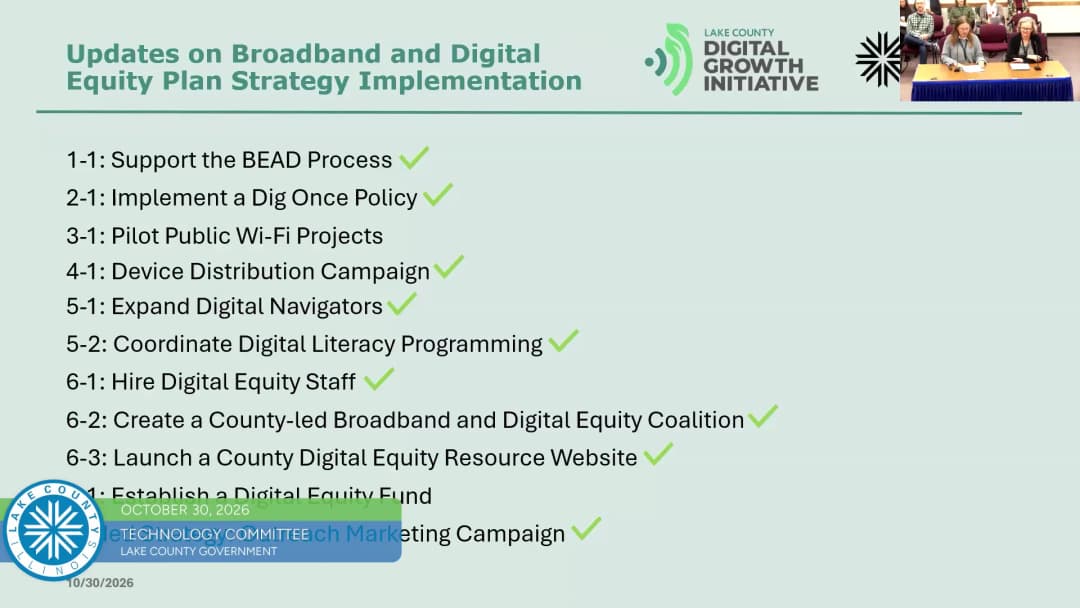
This meeting covered multiple technology-related resolutions, including software agreements, cybersecurity policies, and a major Microsoft licensing renewal. The committee also received detailed updates on the Digital Growth Initiative (broadband and digital equity) and the Workday enterprise resource planning (ERP) implementation. All agenda items were approved unanimously. Public Comments & Testimony - No public comments were offered for items not on the agenda. Discussion Items - Item 8.1 – Capital Program Management Software (Eco Interactive LLC): Kevin Carrier, Assistant County Engineer, presented a five-year contract renewal (year one: $160,000) for the Project Tracker software, which manages the county's five-year transportation improvement program. The software is also used by CMAP, IDOT, and McHenry County. Committee members praised the public transparency features. The motion carried. - Item 8.2 – Construction Management Software (Exavision Inc.): Staff presented a five-year renewal (year one: $155,000) for construction management software that tracks pay items on projects. Discussion included the bid exemption process. Assistant County Administrator Lisa Fair explained that a bid exemption is used when a proper procurement method is identified, and that at the end of five years the department will reassess. The motion carried. - Item 8.3 – System and Information Integrity Policy: CIO Chris Blanding and CTO Eric Carlson introduced policy 5 of 6, establishing baseline cybersecurity expectations for all county systems, including those managed by departments and vendors. Member Frank asked about vendor data protections and the need for notification if vendors de-identify and sell data. Eric Carlson responded that this policy focuses on patching and vulnerability management, while a future data governance policy would address such concerns. Member Altenberg praised the collaborative development process. The motion carried. - Item 8.4 – Risk Assessment Policy: Eric Carlson presented policy 6, the “heart” of cybersecurity, requiring a consistent process to identify, prioritize, and document technology risks. The policy includes maintaining a countywide risk register. The motion carried. - Item 8.5 – Microsoft Enterprise Agreement Renewal (CDWG): Chris Blanding and Applications Manager Mike Mislana presented a three-year renewal totaling $2,348,512.45 for Microsoft 365, Teams Voice, and server licensing. Using a Sourcewell cooperative contract saved approximately $200,000 compared to a simple renewal. An addendum signed by the vendor ensured standard Lake County terms. Member Frank asked about insurance per-occurrence limits, and staff clarified it is per claim. Member Wallace confirmed the agreement is county-wide. The motion carried. - Item 8.6 – Workday Post-Production Managed Services (Accenture): Chris Blanding presented a three-year contract at $499,864 per year with Accenture for post-go-live support of the Workday ERP. The contract allows flexibility to shift resources and includes a termination-for-convenience clause. Blanding explained that Accenture was chosen for its deep Workday expertise and government client experience. Member Altenberg praised the prudent planning. The motion carried. - Item 8.7 – Staff Wellness Platform (Sharp Performance): Chief Chris Covelli and Contract Manager Katie Latis from the Sheriff's Office presented a five-year, $416,250 contract for a wellness app providing one-on-one coaching and self-assessments for all employees and their spouses. The coaches are former first responders. Usage in Gurnee and Barrington has shown high buy-in; anonymity encourages participation. Member Frank asked about time allocation – the expectation is off-duty, but on-duty accommodations may be possible. The motion carried. - Item 8.8 – In-Car Camera Contract Consolidation (Axon Enterprise): Katie Latis and Bernard Malkov presented a consolidated contract for 150 in-car cameras and 6 jail transport cameras, with a total five-year cost of $2,117,326.03. Consolidating three existing contracts into one improves efficiency and saves money. The motion carried. Key Outcomes - All eight resolutions (items 8.1–8.8) were approved unanimously by voice vote, with no opposition recorded. - The committee received and accepted the final digital equity update of 2026, recognizing the Digital Growth Initiative's achievements: over 2,200 devices distributed, public Wi-Fi projects underway in Waukegan and North Chicago, and a digital navigator network established. Staff noted a budget of under $12 million with less than half spent, and praised the team for exceeding goals. - The Workday ERP update confirmed a December 1, 2026 go-live date. Payroll parallel testing reached over 98% accuracy; gold tenant build begins the following week. Training communications are forthcoming. - The committee entered executive session (personnel matter) and later adjourned. - Members expressed gratitude for the committee's work and leadership.

TECHNOLOGY AND INNOVATION 64% · CYBERSECURITY AWARENESS 10% · PROCUREMENT STRATEGY 8% · MENTAL HEALTH AWARENESS 5%
03
NEWOCT 30, 2026 · LAKE COUNTY, ILLINOIS · COMMITTEE MEETINGS
Lake County Financial & Administrative Committee Meeting – October 30, 2026

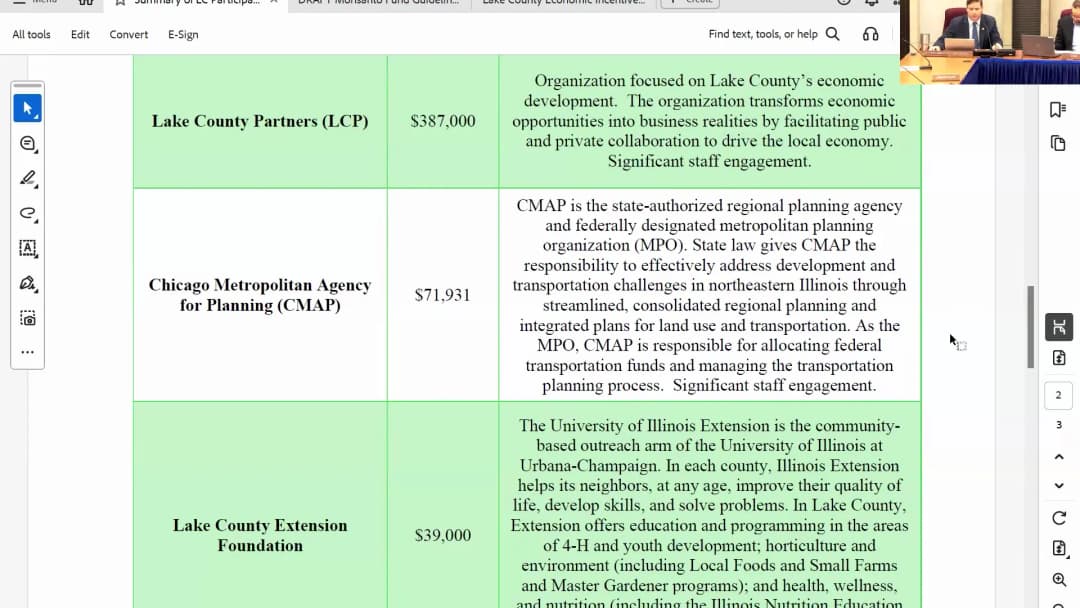
Chair Frank called the meeting to order at 8:33 a.m. The transcript gives the date as Thursday, October 29, but the supplied meeting-date metadata is 2026-10-30; this summary uses the supplied date. Member Clark was absent with prior notice; a quorum was present. The committee approved consent items and capital contracts, discussed FY 2027 budget amendments and Monsanto settlement fund guidelines, and made ethics commission appointments. Public Comments & Testimony - None were offered. Consent Calendar - Consent agenda items 8.1 through 8.18, except 8.3, were approved by voice vote (motion by Vice Chair Park, second by Member Bolitzik). Item 8.3 was not acted on because the L&J Committee postponed the West Publishing Corporation contract resolution; no action was taken. - Carryover budget items 7.1, 7.2, and 7.3 were moved to the end of the agenda and acted on with the FY 2027 budget discussion. Capital Project and Contract Approvals - 8.19 – Approved a job order contract project exceeding $350,000 for HVAC replacement and server room improvements at the Lake County Central Permit Facility, not to exceed $825,000. Facilities Manager Jeremiah Barco said the server room air conditioning and UPS were beyond useful life and critical; the county worked with IT on the project. - 8.20 – Approved a similar job order contract project at the LCDOT Administrative Building for HVAC replacement and server room improvements, not to exceed $600,000. Barco said the traffic management center server room had outdated equipment and was right-sized after moving most applications to the cloud. The two projects were bid together through the job order contractor so work could be coordinated. Used equipment would be recycled, with refrigerants recovered. - 8.21 – Approved a resolution authorizing a contract with Amber Mechanical Contractors (identified in the transcript as "of LSIP") for $3,491,000 for the Babcox Medical Bay Air Handler Unit Replacement. The two air handlers, original to the 1985 jail, serve the entire second floor medical area, jail administration, and library; the project will modernize HVAC controls and connect to life safety systems. FY 2027 Budget Discussion and Carryover Actions County Administrator Patrice Sutton walked through amendments discussed at prior budget meetings. The committee gave consensus to bring the formal amendment back for final action at the next meeting. Key elements included: - Public Works: an emergency vehicle was added from the capital fund using fund balance, after being missed on the asset listing. - Public Defender staffing: the staffing NPR was revised from one principal attorney for 10/12 of the year to staggered funding for principal attorneys, one assistant attorney funded from the start of the year, and a senior investigator. A proposed $350,000 federal funding contingency was removed because it was not the right funding mechanism; a different solution is planned. - Sheriff's staffing NPR: Sutton said the original recommendation had been two of the four requested administrative clerks handling orders of protection, failures to appear, and warrants, and that the data supports the need. - SSA 18: an amendment added $60,000 for property tax and $60,000 in capital expenditures for public works sanitary system upkeep; the property tax applies only to SSA 18 residents in Delmar Woods subdivision. - Sheriff's Office vacancy savings: a $2.5 million correction was funded by reducing the operating contingency by about $2 million, still within the 0.2% to 1% policy range, and by reducing the settlements expense line in the risk fund by $807,000, leaving $400,000 available for settlements. - Risk and liability fund: projected FY26 revenues were about $13 million and expenses about $10 million, adding an estimated $3 million surplus; the FY27 reserve requirement was estimated at about $14 million against an approximately $24 million fund balance. Property tax allocations were reallocated among funds while keeping the total tax amount the same. - Health department and TB clinic levies were increased after a $2 million FY25 fund balance decrease and a projected FY26 deficit. Stormwater funding was also increased because of a deficit. - VAC: the $3.5 million building set-aside was removed from the property tax request and will instead be covered by a transfer from the general fund, consistent with capital budgeting practice. This increases displayed totals by $3.5 million but does not increase total taxes. - Sutton noted alternatives, including revisiting the bridge and matching tax ordinance from 2012/2008 or reducing recommended new program requests. - Deputy Administrator Matt Myers presented the required annual summary of county organizational memberships, including the Illinois Association of County Board Members, NACO, ISECO, Lake County Municipal League, Lake County Partners, CMAP, Lake County Extension Foundation, Visit Lake County, environmental organizations, Waste Agency of Lake County, and GSEP. GSEP's $39,000 contribution is new to the list but has been in the budget since FY24. - Member Maine asked about the Lake County Extension Foundation and suggested having it present; Chair Frank pushed back, saying prior debate had settled on a compromise and he did not want to reopen it. Member Maine said she would visit the foundation directly. - Member Maine also questioned why the Des Plaines River Watershed Working Group was listed separately, saying it should be in the public works budget. Staff explained it appears because it is paid from GOE or county board funds. - Member Maine raised a broader concern about accumulating property taxes in capital funds and urged the board to consider using bonding capacity instead; she noted all bonds are alternative revenue bonds and the county has unused capacity. Chair Frank agreed the issue should be discussed next year and noted the unfunded capital project list is almost $1 billion. Sutton said the county now uses an operating transfer for capital rather than a general surplus sweep. - The committee agreed with the recommended amendments. A motion to amend items 7.1, 7.2, and 7.3 as recommended was approved, and the items were then approved as amended (motions by Member Hewitt/Vice Chair Park, with seconds by Member Bolitzik/Member Hewitt). Monsanto Settlement Fund Guidelines - Staff proposed guidelines for use of the $7.5 million Monsanto settlement funds, to be incorporated into Lake County's 2015 economic incentive policy. The funds would be available through a rubric-based process, not a competitive NOFO. - Proposed guiding principles include environmental benefit and water quality, equity and environmental justice, Lake Michigan watershed focus, positive health outcomes, partnerships and matching, restoration and remediation, economic development benefit, and projects that can be completed relatively quickly. - Initially, staff proposed that no less than 50% of funds go to projects in Waukegan, North Chicago, or Zion. Members debated 50%, 75%, 80%, and 100%. Member Roberts supported 100% investment in underserved communities; Member Hunter supported about 75% to avoid locking out Beach Park and Winthrop Harbor; Member Maine preferred no hard 100% and emphasized the Lake Michigan watershed. Final direction was to add Beach Park and Winthrop Harbor to the community list and set the floor at no less than 75%. - Members also asked for the F&A Committee to review the guidelines annually. - Members discussed whether projects must demonstrate a net positive impact on air or water quality; some supported a 50% requirement, while others preferred relying on the rubric. Staff noted the rubric already contains a minimum score of 60 for projects to be presented to the committee. - Eligible uses include green space and park creation or restoration that improves environmental health and quality of life. Funding requests may not exceed $2 million per request, and projects are generally expected to be completed within two years, with extensions available. - Staff said the Monsanto funding would be added as a new incentive type in the economic incentive policy, with Lake County Partners as point of contact for economic-development uses and county review for quality-of-life projects. - Chair Frank suggested naming the funds the "Monsanto Environmental Contamination Settlement Funds" to clarify their source; members agreed. - Staff also floated creating a separate economic development incentive fund as a fourth incentive type. Member Bolitzik expressed concern that this needed more discussion and a clearer process before creating a fund; staff said it would return as a separate discussion. Appointments - 8.24 and 8.25 were approved jointly: reappointment of Andrea Hess to the Lake County Ethics Commission and appointments of Daniel Kuznitsky and Lindsay Nemchek to the Ethics Commission. Members thanked all candidates; the motion was by Member Bolitzik, second by Member Hewitt, and passed by voice vote. Key Outcomes - Approved consent agenda 8.1–8.18, with no action on 8.3. - Approved 8.19, 8.20, and 8.21 capital/HVAC contracts with no opposing votes. - Approved amended carryover items 7.1, 7.2, and 7.3 after adopting Sutton's recommended budget amendments; final FY2027 budget action is scheduled for the next meeting (the transcript says Thursday, November 5). - Directed staff to revise the Monsanto fund guidelines to add Beach Park and Winthrop Harbor, set no less than 75% for the listed communities, add annual F&A review, and return next week for action. - Approved the Ethics Commission appointment resolutions. - Went into executive session on a personnel matter and returned to regular session; no additional member remarks were made and the meeting was adjourned.

BUDGET 38% · ECONOMIC DEVELOPMENT 33% · ENVIRONMENTAL PROTECTION 10% · PROCEDURAL 4%
04
NEWOCT 29, 2026 · LAKE COUNTY, ILLINOIS · COMMITTEE MEETINGS
Lake County Board Legislative Committee Special Meeting on Census Proposal - October 29, 2026

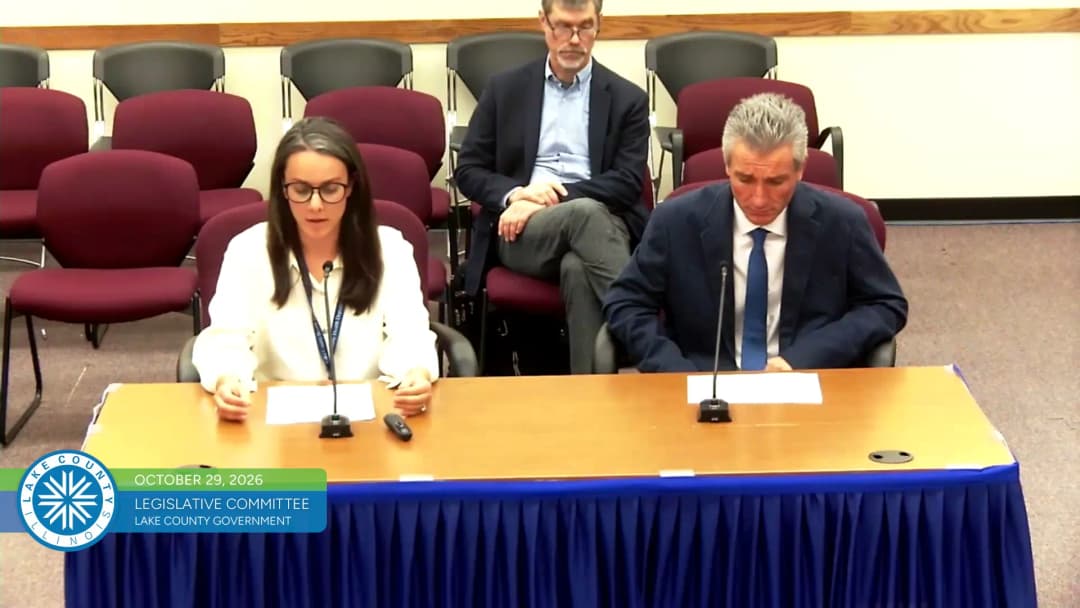
The Legislative Committee of the Lake County Board convened a special meeting at 10:45 AM on October 29, 2026, to address an urgent matter requiring action before a November 2, 2026 deadline—a proposed rule change for the 2030 Decennial Census by the U.S. Census Bureau. The meeting included a federal legislative update, a detailed overview of the proposed changes, analysis of local impacts by county staff, and committee deliberation on an official county response. Discussion Items - Federal Update: Clayton Cox of McGuire Woods provided a brief update on the upcoming elections, the potential for a change in House leadership, the retirements of Senator Durbin and Representative Schakowsky, and the importance of the county preparing for the FY28 earmarks and congressionally directed spending process. - Census Proposal Overview: Clayton Cox presented the key changes proposed by the Census Bureau. He stated the proposed rule would change the fundamental count from "every soul" to only U.S. citizens and certain lawful permanent residents. This would exclude individuals on H-1B visas, international students, DACA recipients, TPS holders, and undocumented residents. The proposal would also prohibit the collection of data on race, ethnicity, and sexual orientation, and would determine residency based on where a person lived from January to April. Cox noted that NLC and NACO were encouraging individual county comments to highlight specific local impacts. - Committee Debate on County Response: - Member Paul Frank initially expressed a preference for the county to work through state and national associations rather than submit an individual comment, but later clarified his full support for a robust individual county response given the severity and risk of the proposal. - Vice Chair Campos presented draft language for a comment letter, asserting the proposal was "fundamentally un-American" and calling for strong opposition from the county. - Member Hunter cautioned against partisan critiques ("administration bias") and expressed procedural concern over the committee taking action on behalf of the full 19-member board without a full vote, given the tight timeline. - Member Roberts supported the comment letter, arguing the proposal was an intentional method to "undercut funding to Illinois." - Local Impact Analysis: - Emily Gelber (Health Department): Stated the changes would "fundamentally pretend that people aren't there." She testified that removing demographic questions and excluding non-citizens would hinder the department's ability to track health disparities, understand community needs, and compete for federal grants. She noted that almost all health department grants rely on this data. - Dominic Strezo (Community Development): Stated that the changes could directly impact approximately $4.5 to $5 million in annual HUD entitlement funds. He emphasized that the county relies heavily on census data for planning affordable housing and allocating community development resources. Key Outcomes - The committee reached a consensus to submit a formal comment letter opposing the Census Bureau's proposed rule changes for the 2030 Census. - Content of the Letter: Staff was directed to finalize the letter using Vice Chair Campos' draft as a template. The letter will include context about Lake County's demographics, formal opposition to excluding non-citizen residents from the apportionment count, opposition to removing race, ethnicity, gender, and sexual orientation questions, and concerns about the proposed residency timeframe. - Submission and Distribution: The letter will be filed with the Census Bureau before the November 2nd deadline at 11:59 PM ET (10:59 PM CT). Copies will be sent to the county's full congressional and state delegations. - Outreach to Associations: Staff was directed to contact NACO and ISECO to encourage them to issue their own formal comments on the proposed rule. - Follow-up: Staff and McGuire Woods will monitor the proposal's progress and provide updates to the committee. - The committee voted to enter executive session to discuss personnel matters.

FEDERAL LEGISLATIVE UPDATE 55% · LEGISLATIVE PROCESS 19% · PROCEDURAL 10% · PUBLIC HEALTH 4%
05
OCT 28, 2026 · LAKE COUNTY, ILLINOIS · COMMITTEE MEETINGS
Lake County PBZE Committee Meeting on UDO Amendments – Oct 28, 2026

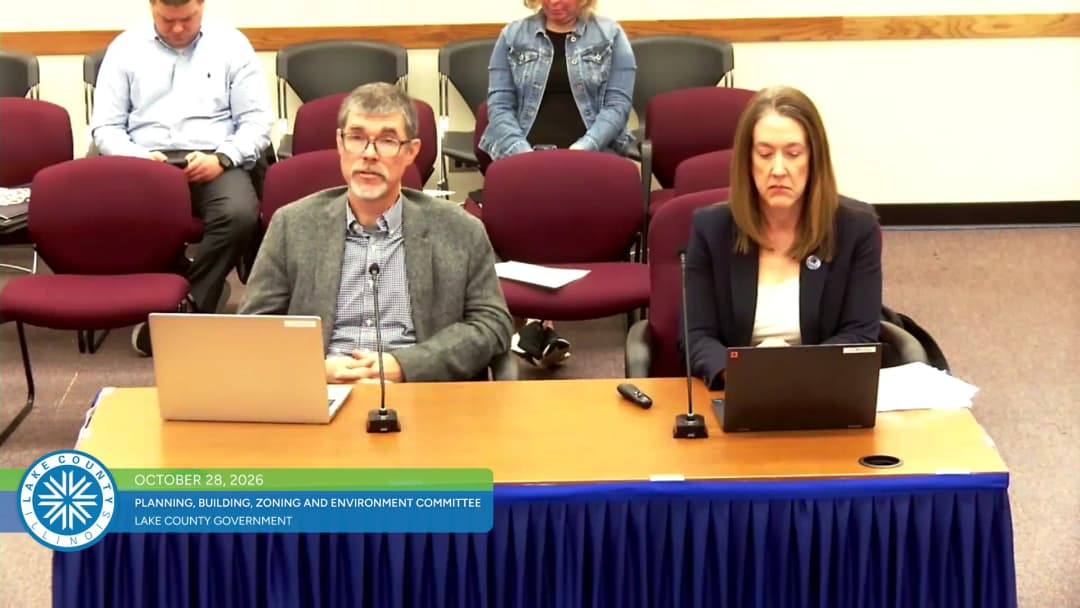
On October 28, 2026, the Lake County Planning, Building, Zoning and Environment Committee met in a hybrid format, with remote participation, to consider a comprehensive update to Chapter 151, the Unified Development Ordinance. The meeting included a public hearing on subdivision and school-park contribution text amendments (item 8.1), a committee vote on the consolidated UDO amendment package (item 8.2), a director's report, and an executive session. Public testimony was uniformly supportive. The committee closed the 8.1 public hearing without taking a substantive vote, then passed the motion on 8.2 to advance the consolidated amendments. Public Hearing – Subdivision and School-Park Contribution Text Amendments (8.1) - Staff presented exhibit D, covering proposed amendments to UDO sections 151.185–151.221. Key changes included updating the subdivision valuation requirement from 120% to 100% of the total cost of improvements, consolidating development assurance requirements, clarifying street and alley design standards, and making housekeeping updates to public meeting, appeal, and street vacation procedures. - The committee opened and then closed the public hearing after no in-person or online commenters came forward. No vote was taken on the substance of 8.1 at this meeting. Public Comments & Testimony (8.2) - Michael DeBrau, Illinois Realtors local government affairs director and Lake County resident, expressed support for the amendments. He said the average home price in Lake County is about $398,000, up 6%, pricing out teachers, police officers, firefighters, and longtime residents. He described ADUs as one tool for expanding housing options and promoted the Illinois Housing Supply Accelerator as a complementary framework. - Liz Nelson, associate director of advocacy for Connections for the Homeless and organizer with Joining Forces for Affordable Housing Lake County, said Lake County is short 17,700 market-rate and 7,900 affordable housing units. She called the amendments helpful steps and encouraged stronger policies to create housing for all income levels and abilities. - Carolyn Lewick, president of the Lake County Audubon Society, expressed strong support for the sustainable development incentives. She specifically praised inclusion of native plantings, bird-friendly landscaping and design, dark-sky lighting, and tree preservation, and supported expanded native planting requirements and conservation subdivision incentives. - Susan Pribble, an unincorporated Lake County resident participating online, supported the sustainability incentive approach, noting she had also testified in favor at the September 30 Zoning Board of Appeals hearing. She praised the county for going beyond required measures such as bird-friendly glass and native plants. Discussion Items – Comprehensive UDO Amendments (8.2) - Staff summarized four amendment packets. Exhibits A and B addressed housing flexibility and sustainable development; exhibit C covered zoning and administrative updates; exhibit D covered subdivision procedures. The Zoning Board of Appeals unanimously recommended approval of exhibits A, B, and C on September 30, 2026. - Exhibit A would allow accessory dwelling units in all residential zoning districts, reduce the minimum lot size from 80,000 to 40,000 square feet, and remove familial and employment-based occupancy restrictions. - Exhibit B would create a sustainable development incentives program through a new appendix W, pairing qualifying features such as geothermal systems, green roofs, LEED certification, native plantings, dark-sky lighting, solar, EV-readiness, and cool roofs with incentives like reduced setbacks, increased density, or additional non-residential floor area. It also included conservation subdivision amendments to allow more housing types and graduated density bonuses in exchange for preserved open space. - Exhibit C included planned unit development changes: allowing a preliminary PUD plan to serve as final plan in certain cases, and creating a delegated PUD process for sites of five acres or less, non-residential projects, minor subdivisions of five or fewer lots, and lot splits. It also consolidated development assurances, clarified administrative authority, and made other housekeeping updates. - In committee discussion, Member Wasick asked about transit-oriented development incentives; staff said transit-oriented development was not directly included but could be supported through PUD flexibility and reduced parking near transit under the People over Parking Act. Member Wasick suggested adding explicit transit-oriented development incentives. - Member Wasick also asked about graduated density and green building incentives. Staff explained that conservation subdivisions are a by-right technique, and the amendments would gradually permit more multifamily typologies as zoning district density increases. The sustainable development program is a voluntary menu intended to improve developer economics while encouraging environmental design. - Member Campos asked about the removal of a requirement for the director to report certain administrative decisions to the committee within 15 days. Staff said the requirement was impractical and had not been followed in practice, so the amendment would streamline committee agendas. Member Campos also asked about the delegated PUD threshold; staff confirmed five acres or less is delegated, while more than five acres follows the non-delegated process. Regarding the 120% to 100% valuation change, staff explained it aligns the application cost estimate with the actual assurance amount. - Member Peterson asked whether an existing home on a five-acre property could add another residence. Staff said currently ADUs are allowed on properties of roughly two acres or more in certain zones; many smaller requests had been approved as variances. The change would allow ADUs on approximately one-acre lots, helping families care for aging relatives, though HOA restrictive covenants could still independently prohibit them. - Member Wasick asked whether the amendments would produce more attainable, lower-cost housing. Staff responded that smaller ADU footprints, higher density in conservation subdivisions and PUDs, economies of scale, and streamlined approval timelines would reduce per-unit costs and help address the county's housing shortage. Staff cited a projected next-year shortfall of 11,000 market-rate units per the 2023 Lake County Partners Housing Study. - Chair Altenberg and Member Frank praised the proposal and emphasized the importance of partnerships and continued focus on housing. Key Outcomes - The 8.1 public hearing was closed with no public comments and no substantive vote. - The committee passed the motion on item 8.2 by voice vote, all in favor, advancing the consolidated UDO amendment package. The consolidated packet is expected to go to the Lake County Board on November 10, 2026, for final action. - The director's report and county administrator's report were waived/no report; the committee entered executive session, returned with no members' remarks, and adjourned. The next committee meeting was tentatively scheduled for November 4, 2026, depending on agenda needs.

AFFORDABLE HOUSING 34% · SUSTAINABLE DEVELOPMENT 23% · PROCEDURAL 20% · HOUSING 10%
06
OCT 28, 2026 · LAKE COUNTY, ILLINOIS · COMMITTEE MEETINGS
Lake County Public Works and Transportation Committee Meeting - October 28, 2026

The Lake County Public Works and Transportation Committee met on Wednesday, October 28, 2026, at 8:30 a.m. in a hybrid format via Zoom and in person. Chair Clark presided; Members Castan, Hewitt, Hunter, Roberts, and Wasick, and Vice Chair Maine were present for roll call. No addenda or public comment were offered. All eleven resolutions under new business were approved by voice vote with no opposition. Discussion Items - 8.1 – Riverwoods sewage disposal agreement amendment: Director Austin McFarland presented the first amendment to the restated and amended sewage disposal agreement with the Village of Riverwoods. The village plans to annex parcels along Route 21 for commercial development, including a Quick Trip gas station; best management practices (BMPs) reviewed by Planning, Building and Development were incorporated, and sanitary sewer service will be provided by the county. When asked whether BMPs apply regardless of the development type, McFarland stated that the annexation agreement is tied to the specific proposal and that the BMP memo imposes a higher bar for gas-station-related impacts near the Des Plaines River, while general BMPs would already apply under the WDO. - 8.2 – Round Lake sewage disposal agreement amendment: McFarland presented the first amendment for the Village of Round Lake, transferring county sanitary sewer assets and pipes within village boundaries to the village following the dissolution of the Lakes Region Sanitary District. The application met criteria requiring no negative impact to customers or the county. The amended IGA was approved by the village and reviewed by the state's attorney's office. Members noted the change would give affected residents one village water and sewer bill at no higher rates; the village would assume maintenance, repair, and upkeep responsibilities. McFarland called it a win-win. - 8.3 – Winston Park Storm Sewer Improvement Project: McFarland recommended a $299,455 contract with Misfitts Construction Company of Chicago, Illinois, for replacement of a storm sewer pipe crossing county property that had collapsed, creating a safety hazard. The repair was unbudgeted but urgent; the company was the lowest responsive and responsible bidder. - 8.4 – FY2027 maintenance materials and services appropriation: Director Shane Schneider requested approval of $335,000 in matching tax funds for annual highway maintenance purchases, including drainage pipes, guardrail, fencing, signs, and specialty equipment rental. - 8.5 – Native landscape inspection and maintenance: Schneider requested $205,000 in matching tax funds to hire a consultant to inspect native landscape areas, prepare a maintenance plan and bid set, and award a contract in FY2027. He noted efforts to expand native areas and reduce mowing; consultants use forest preserve species lists. Members discussed tree replacement, line-of-sight considerations, and roundabout landscaping as a visual barrier to discourage straight-through driving. - 8.6 – General engineering and support services appropriation: Schneider requested $475,000 in quarter-percent sales tax transportation funds for FY2027 general engineering support services. He initially described it as concrete patching, then corrected himself and clarified that the funds cover specialized consultant services such as soil testing, wetland delineations, pavement testing, drainage, bridge, and land acquisition work supporting in-house design teams. - 8.7 – Concrete patching engineering services: Schneider presented an agreement with Horner and Schiffrin Inc. for phase two professional engineering services for concrete patching on various county highways, at a maximum cost of $108,240, with $130,000 in motor fuel tax funds appropriated. This item covers roughly 60 patching locations identified by maintenance crews. - 8.8 – Russell Road resurfacing design: Schneider presented an $834,661 phase two engineering agreement with GFT Infrastructure Inc., with $1,005,000 in matching tax funds, for resurfacing Russell Road from Kilborne Road to Illinois Route 131 and retaining wall replacement at Russell Road and Willow Hollow Lane. Work includes paved shoulders, rumble strips, culvert analysis, curve superelevation correction, and retaining wall design; construction is targeted for next year. - 8.9 – Deerfield Road Bridge rehabilitation design: Schneider presented a $595,841 phase two engineering agreement with Parsons Transportation Group Inc., with $715,000 in county option motor fuel tax funds, for rehabilitating the Deerfield Road Bridge over the Middle Fork of the North Branch of the Chicago River. The bridge was weight-restricted by IDOT; abutments are sound, so the deck and beams will be replaced. Design is planned for 2027, with bidding in early 2028 and construction in 2028. - 8.10 – Deerfield Road construction supplemental appropriation: Schneider requested a $21 million supplemental appropriation of quarter-percent sales tax transportation funds for reconstruction of Deerfield Road from Illinois Route 21 to Saunders Road. The low bid was about $64.6 million against an engineer's estimate of just under $51 million. A detailed review concluded the price reflects current market conditions due to constrained working area, two-way traffic maintenance, complex bridge and deep sewer work with groundwater challenges, and Milwaukee Avenue intersection improvements. The county has three federal grants worth about $29 million and is seeking to expand one through CMAP to restore closer to 80% federal funding, plus state participation for Milwaukee Avenue improvements; any additional grants would reimburse the new appropriation. Members supported moving forward, noting the constraints and costs are unlikely to decrease. - 8.11 – Hainesville Road improvements contract: Schneider presented a $17,836,402.70 contract with Burger Contractors of Quakonda, Illinois, appropriating $2,650,000 in county bridge tax funds and $18,775,000 in quarter-percent sales tax transportation funds. The project widens Hainesville Road from Washington Street to Rollins Road from two lanes to three, adds curb and gutter, storm sewer, a left-turn lane, a bike path on the east side, and a sidewalk on the west side, with future connections to the Millennium Trail system. Construction will begin with utility work and span most of 2027 with some work into 2028. Key Outcomes - All eleven resolutions (8.1 through 8.11) were approved unanimously by voice vote. - The committee voted by roll call to enter executive session for a personnel matter under 5 ILCS 120/2(c)(1), and later returned to open session. - Committee members noted the next meeting on November 4, 2026, would be the last of the session; the chair adjourned the meeting.

PUBLIC WORKS 29% · WATER AND WASTEWATER MANAGEMENT 17% · PROCEDURAL 15% · STORMWATER MANAGEMENT 8%
07
OCT 27, 2026 · LAKE COUNTY, ILLINOIS · COMMITTEE MEETINGS
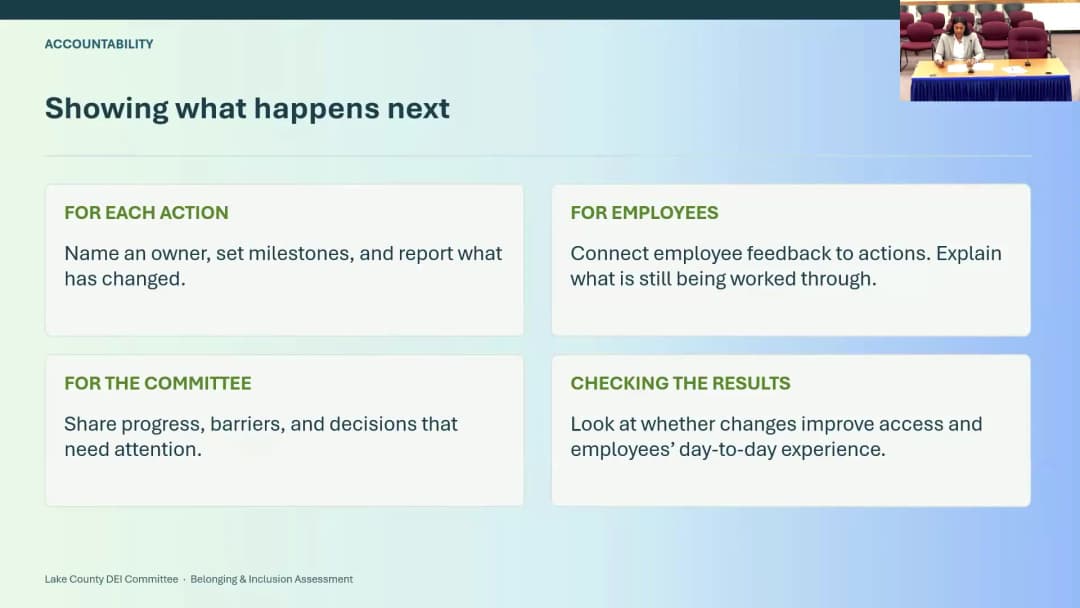
Lake County Diversity, Equity, and Inclusion Committee Meeting - October 27, 2026

The Lake County Diversity, Equity, and Inclusion Committee met at 1 p.m. on October 27, 2026, in person and via Zoom, with the meeting recorded through Zoom. The committee established a quorum, handled routine approvals, and received an update on the county's belonging and inclusion assessment, followed by discussion of psychological safety, benchmarking, and next steps for the 2027 work plan. The meeting adjourned with the next meeting date listed as TBD. Consent Calendar - Roll call showed Chair Campos, Member Dan Ford (also transcribed as 'Dan Forth'/'Dan Force'), Member Ewing, and Vice Chair Hewitt present; Member Kyle was absent. A physical quorum was established. Later in the transcript, the chair is also referred to as 'Chair Hart,' an apparent transcription inconsistency. - A motion by Member Dan Ford, seconded by Member Ewing, to approve the item referenced as 'April 1' was approved by voice vote with all in favor. No addenda were added to the agenda. (No agenda or minutes were available in the source materials to confirm the exact item.) Public Comments & Testimony - No public comment was offered. Discussion Items Belonging and Inclusion Assessment Update - Lacey Simpson, Assistant County Administrator, presented the update on behalf of County Administration, Communications, and Human Resources, in partnership with Dr. Carter of the Carter Development Group. She credited Ruth Ann Hall and the communications and HR teams for their work. - The assessment examined workplace belonging and inclusion by reviewing communication and employment policies and gathering employee feedback through surveys, focus groups, and interviews. Dr. Carter rated psychological safety as a significant area of risk. - Survey findings presented by Ms. Simpson included: nearly three-quarters of respondents reported a sense of belonging; about 84% said county communications use inclusive language; about 42% said they could voice their opinions without fear, about 35% disagreed, and 22% were neutral; only 56% agreed that leadership follows up on employee input; and only about half felt policies were applied fairly and that leadership follows up on their input. - The presentation highlighted recommendations to make information easier to find and use, improve representation in communications, ensure assistance is available when online options do not work, and update diversity and inclusion policy 1.6 with clearer employee protections, annual harassment prevention training, ways to raise concerns outside a supervisor, and explicit protection against retaliation. - Ms. Simpson noted that the county is finalizing the assessment report and developing a multi-year plan, with 2027 work plan priorities focused on updating policies, improving communication and access, and addressing employee concerns about workload, recognition, and leadership follow-through. - She also recalled that in April, Dr. Mary Ross Cunningham encouraged department heads and board members to take psychological leadership training, and the county hopes to offer similar training again. Committee Discussion - The chair asked about the anonymous reporting line and about how psychological safety compares to benchmarks or specific demographic groups. Ms. Simpson confirmed an anonymous reporting line exists, is managed by HR, and that HR recently reminded staff of available resources in the county connection newsletter. - Member Ewing supported testing real systems from a customer or user perspective, noted that employee resource groups are not currently active and expressed interest in restarting them, asked whether survey data was broken down by department, and suggested using standardized surveys such as Gallup to benchmark results over time and across organizations. Ms. Simpson said results were not broken down by department to avoid identifying small teams, but the final report includes demographic data such as male, female, and race. - Member Danforth asked about demographic breakdowns by age and gender and suggested validating Dr. Carter's findings through other indicators such as anonymous tips, turnover, exit interviews, and grievances. Ms. Simpson said that validation has not been done to date. - Member Hewitt cautioned that changes in the number of employees can change percentages, supported a standardized rubric or survey for year-over-year comparisons, and suggested tracking anonymous complaints on a regular basis to validate survey results. - Several members supported benchmarking against other organizations and using consistent measurement to assess whether the county is improving. Key Outcomes - The committee received the assessment update and thanked staff; no formal vote was taken on the assessment itself. - The county will continue finalizing the assessment report and developing a multi-year implementation plan, including priorities for the 2027 work plan. - Member Danforth suggested giving staff direction to validate the assessment findings using other workplace indicators, but no formal committee action is recorded in the transcript. - No county administrator's report, executive session, or member remarks were presented. - The next meeting date was announced as TBD.

RACIAL EQUITY 55% · PUBLIC ENGAGEMENT 23% · PROCEDURAL 22%
08
OCT 27, 2026 · LAKE COUNTY, ILLINOIS · COMMITTEE MEETINGS
Lake County Health and Community Services Committee Meeting - October 27, 2026

The Lake County (Illinois) Health and Community Services Committee met at 8:34 a.m. on Tuesday, October 27, 2026, with Members Altenberg, Kasman, Danforth, Ewing, Kenishnik, Maine, and Chair Parr present. No addenda, chair's remarks, unfinished business, or public comments were offered. The committee approved an emergency appropriation for a Homeless Management Information System grant, discussed the proposed consolidation of the North Chicago Housing Authority into the Lake County Housing Authority, and then entered closed session on a personnel matter. The transcript does not record an adjournment time; the meeting ended after member remarks and requests, with the next meeting listed as TBD. Public Comments & Testimony - No public comments were made. Discussion Items - Emergency Solutions Grant appropriation (Item 8.1): Presenting staff member Dominic explained that the Illinois Department of Human Services (IDHS) passes through federal Emergency Solutions Grant dollars to local jurisdictions, receiving about $5.7 million in total. The committee was asked to accept IDHS funds and authorize an emergency appropriation of $36,684 for grant administration and management of the Homeless Management Information System. In response to Chair Parr, Dominic said the grant amount had been 'pretty flat' year over year. - Lake County Housing Authority / North Chicago Housing Authority consolidation (County Administrator's report): County Administrator Patrice Sutton reported that the Lake County Housing Authority had requested a County Board resolution supporting consolidation of the North Chicago Housing Authority into the Lake County Housing Authority. The proposed governance structure gives Lake County five appointments and North Chicago two appointments. North Chicago's committee had already passed the resolution without amendments, and its full board was scheduled to consider it on November 2. Lake County Housing Authority had been working on the consolidation since March 2026. Because there is no HCS meeting on November 3 (Election Day) and no December committee meetings, the item was placed on the November 5 Finance and Administration Committee agenda to meet a January 1 HUD deadline. Member Danforth asked why the item was bypassing the committee; Sutton explained the HUD approval cycle and the date constraints. - Member discussion of consolidation: Member Main expressed disappointment with the process, saying the committee was only hearing about the effort now and had no documents to review. She was not opposed 'a priori,' but wanted to see dollar amounts, current board sizes, and funding distributions before deciding, and she questioned whether two of seven seats for North Chicago was proportionate. Member Kenishnik asked how the consolidation fits with Housing Lake and the housing affordability crisis; Dominic said both housing authorities are critical partners and the consolidation should streamline processes. He also noted that the North Chicago Housing Authority manages about 700 total units, mostly in two senior buildings, so maintaining a separate authority made less sense. Member Kasman voiced strong support, saying three housing authorities in one county is confusing and consolidation would reduce silos. Chair Parr (recorded as 'Member Hart' in the raw transcript) asked how the right board ratio should be determined; Dominic cited HUD dollars, units, and staffing as possible factors. Chair Parr said she preferred dollars or units over staffing and stressed that if the county wanted a different ratio, such as six to one, it would need to move quickly to tell North Chicago. Executive Session - On a motion by Vice Chair Altenberg, seconded by Member Kenishnik, the committee voted by roll call to enter closed session to discuss a personnel matter under 5 ILCS 120/2(c)(1). Member Main had stepped away and did not participate in the vote. No action was reported after returning to open session. Key Outcomes - Approved (Item 8.1): Motion by Member Kasman, seconded by Vice Chair Altenberg, to accept the Emergency Solutions Grant and authorize the $36,684 emergency appropriation. The motion passed by voice vote with no announced opposition. - Housing authority consolidation (no formal action): The committee took no vote on the consolidation resolution and instead was informed that it would be referred to the Finance and Administration Committee on November 5, 2026. - Adjournment: The meeting adjourned after member remarks; the next meeting is to be determined.

AFFORDABLE HOUSING 36% · PROCEDURAL 32% · HOMELESSNESS 16% · HOUSING 16%
09
OCT 27, 2026 · LAKE COUNTY, ILLINOIS · COMMITTEE MEETINGS
Lake County Law and Judicial Committee Meeting Summary - October 27, 2026

The Lake County (Illinois) Law and Judicial Committee met at 10:30 a.m. on October 27, 2026, in person and remotely via Zoom. Chair Roberts presided; roll call was taken. No addenda to the agenda, public comments, unfinished business, chair remarks, county administrator report, or executive session were reported. The agenda and minutes were not available, so this summary relies solely on the transcript. The committee approved the consent calendar, approved a Deer Park police services agreement and three grant resolutions, and postponed a law library publications contract for further information. Consent Calendar - Items 8.1 through 8.4 were approved by voice vote after a motion by Member Altenberg and a second by Vice Chair Kenishek. No opposition was noted. Discussion Items 8.5 - Law Library Publications Contract with West Publishing (Postponed) - Lisa Wolf, Executive Finance Director for the 19th Judicial Circuit Court, presented a joint resolution authorizing a five-year contract with West Publishing Corporation of Eagan, Minnesota, for printed legal materials for the law library. The annual amount was stated as $125,004 beginning in fiscal year 2027, with a 4% annual increase thereafter. Wolf said the print collection complements online resources and serves patrons with a range of computer skills; it is not required by statute. She said the contract permits termination if funding is not available, for example during a future budget cycle. - Commissioner Danforth asked how many publications the $125,004 covers and whether the county was paying for new editions or supplements. Member Altenberg noted the attachment includes orders such as 26 circuit court rules volumes and 8 family law and court rules volumes. Wolf cited practice guides and desk books as examples. Commissioner Hart questioned how usage is measured and whether self-represented litigants can effectively use the books without assistance. Vice Chair Kenishek noted that circuit court staff are available to help law library users; Wolf said it may be possible to provide usage information but no record was immediately available. - Commissioner Casmin asked about funding and county authority. Staff clarified that the county purchasing ordinance requires county board approval for goods and services over $30,000, even when funded from special revenue funds. The law library is funded by court fees through a special revenue fund, not the general fund. - Discussion noted the total five-year value is at least $625,000 before the cumulative 4% annual increases. Wolf said the other option considered was a three-year contract with 6% annual increases. The current contract expires December 31, 2026, and the committee does not meet in December; members noted the paper volumes would remain on the shelf even if approval were delayed. Several members expressed interest in reviewing usage data, examining whether online-only access or alternative staffing might be a better use of funds, and hearing from judges. - The committee voted to postpone action on Item 8.5 so staff could gather additional information and bring the item back to a future Law and Judicial Committee meeting. The voice vote carried; no tally was stated. 8.6 - Deer Park Contractual Police Services Agreement (Approved) - Jim Chammernick, Sheriff's Office business manager, presented the resolution with Chief Christopher Cavalli participating remotely. The proposed intergovernmental agreement with the Village of Deer Park would renew contractual police services from January 1, 2027 through December 31, 2029. The contract amount was transcribed as 4,646 and one cents (about $4.65 million if read as $4,646,001). The contract includes a 3% estimated wage adjustment for the next three years, with rate adjustments in 2028 and 2029, and an annual wage adjustment if actual wages exceed estimates. - Chammernick said the Sheriff's Office bills Deer Park for every hour a deputy is assigned, so it is made whole for overtime, vacations, training, and sick time through the built-in shift relief factor. The contract has existed for 15 years; the renewal would extend it to 18 years. The coverage is 24 hours per day, seven days per week, with two deputies on one shift because of elevated traffic at Deer Park Mall; special details are billed separately. - The committee approved the resolution by voice vote with no opposition noted. 8.7 - Justice Assistance Grant for Violent Crime Prosecution (Approved) - Joe Gravitter and Steve Spagnoli of the State's Attorney's Office presented a one-year renewal Justice Assistance Grant (JAG) with an emergency appropriation of $200,000. The grant supports prosecution of violent crimes in Lake County, offsetting funding for one principal Assistant State's Attorney, 40% of a data analyst position, and staff training. The remaining 60% of the data analyst position is funded by a McArthur grant. The grant expires September 30 of the following year. The resolution was approved by voice vote. 8.8 - IDHS Gun Violence Prevention Grant (Approved) - The State's Attorney's Office was awarded $1.5 million from the Illinois Department of Human Services for the Gun Violence Prevention Initiative (G VPI), for July 1, 2026 through June 30, 2027. This is the second year of the grant. Funds support salary and benefits for four G VPI staff, a sub-award to Waukegan Township for peacemaker services, a contracted therapist and youth coordinator, and community outreach. Staff said approximately $425,000 of the grant is for State's Attorney's Office staff salaries and benefits, with slightly over $1 million going to contractual partners and sub-awards; the remainder covers training, software, and outreach supplies. - Member Altenberg thanked Senator Johnson and said the program has been associated with a 70% decrease in crime in some areas. Discussion confirmed that the four G VPI staff positions are fully grant-funded and that the firearm risk reduction coordinator is separately grant-funded. The resolution with the $1.5 million emergency appropriation was approved by voice vote. 8.9 - BJA Byrne Community Project Grant (Approved) - The State's Attorney's Office received a $1 million Bureau of Justice Assistance (BJA) Byrne Community Project Grant, for October 1, 2026 through September 30, 2028. The grant was credited to Congressman Brad Schneider. It will fund the four G VPI staff after the IDHS grant ends, as well as the Waukegan Township sub-award, contracted youth coordinator, and community outreach specialist with the North Chicago Police Department. The resolution was approved by voice vote. Key Outcomes - Consent calendar Items 8.1-8.4 approved. - Item 8.5 (West Publishing law library contract) postponed; staff will compile requested usage, publication, and alternative information for a future Law and Judicial Committee meeting. - Item 8.6 (Deer Park police services) approved. - Item 8.7 (JAG grant) approved with emergency appropriation. - Item 8.8 (IDHS gun violence prevention grant) approved with emergency appropriation. - Item 8.9 (BJA Byrne grant) approved with emergency appropriation. - No executive session was held; the meeting was adjourned, with the next meeting date to be determined.

LEGISLATIVE PROCESS 49% · PUBLIC SAFETY 33% · FEDERAL FUNDING 8% · PROCEDURAL 4%
10
OCT 22, 2026 · LAKE COUNTY, ILLINOIS · COMMITTEE MEETINGS
Lake County Financial & Administration and Health & Community Services Joint Budget Hearing - October 22, 2026

The Financial and Administration (FA) Committee and the Health and Community Services (HCS) Committee held a joint budget hearing on October 22, 2026, starting at 8:34 a.m., to review the recommended Fiscal Year 2027 budget for Lake County. County Administrator Patrice Sutton and Budget Manager Michael Wheeler presented an overview of the $732 million total budget, an 8% increase, highlighting revenue growth from economically sensitive taxes and a 2.7% CPI property tax increase. New program requests were consolidated in the General Operating Expense (GOE) budget. All departmental budgets presented were ultimately approved by both committees, with one significant discussion deferred. Discussion Items FY2027 Budget Overview - Administration presented the budget framework for property tax operating funds, noting increases in special revenue ($13M), internal service ($19M), and enterprise funds ($8M). A merit pool for non-union employees was introduced alongside a 2.7% cost-of-living adjustment. - A mistake in the Sheriff's department vacancy savings calculation was acknowledged and will be corrected using GOE contingency funds. - Chair Frank commended the consolidated approach to new program requests, allowing holistic decision-making. Veterans Assistance Commission (VAC) Budget - Superintendent reported a $34.6 million benefit return to Lake County, a 5.4:1 return on property tax investment. The VAC plans to break ground on a new facility in one year. - Motion to approve made by Member Litig and seconded; approved unanimously. Workforce Development Budget (8.H1) - Director Jennifer Sereno presented a budget funded primarily by federal WIOA grants, which decreased slightly due to low unemployment. The department placed 734 residents (66% of those served) into employment, bringing $31.5 million in wages to the county. Summer youth program placed 175 high school students. - Staffing remained at 41 despite a chart error. Two new positions for the Digital Growth Initiative are budgeted in GOE. - Approved unanimously. Community Development (CDBG) Budget (8.H2) - Dominic Strezzo presented a stable $5.1 million in HUD entitlement funds, with two-thirds directed to affordable housing. The department’s annual goal is to support 40 new rental units, a figure acknowledged as constrained by factors beyond funding alone. - Members confirmed that funding expectations are consistent with prior years despite federal uncertainty. - Approved unanimously. Video Gaming Fund Budget (8.H3) - $825,000 directed to community development, with set-asides for addiction services and gambling treatment. Funding is expected to remain flat. - Approved unanimously. Opioid Settlement Fund Budget (8.H4) - Coordinator Ashley Watson presented a budget allocating $1 million for community grants, with $4 million held in reserves. Only 45% of the expected settlement has been received; some payments extend to 2038. - Emergency appropriations may increase spending if worthy applications arise, as occurred in FY26. - Members requested better visibility into fund balances; administration agreed to explore providing that information. - Approved unanimously. Regional Office of Education (ROE) Budget (8.H5) - Dr. Carner presented a flat budget and proposed moving 10 staff positions from county payroll to a reimbursement model, similar to his existing setup for grant-funded employees. He argued this would streamline administration under the new Workday system. - Several members expressed hesitation: Member Altenburg called for a broader policy discussion, and Member Maine noted no documentation was provided. County Administrator Sutton suggested deferring the decision to allow full conversation, and Dr. Carner agreed. - The budget was approved without the staffing model change; the matter will return later as a separate item. - Members praised the ROE's performance metrics (page 125 of the budget book) and its expanded services. Health Department Budgets (8.H6–8.H10, Taken Together) - Executive Director Chris Hoff and Deputy Sam Johnson presented budgets for the Health Department, TB Special Service Area, Solid Waste, Loon Lakes, and the Health Department Capital Fund. - The health department budget reflects an overall increase despite a reduction of 15 funded positions (to 831), driven by benefit cost increases (22% rise) and federal Medicaid changes. The closure of the North Shore Health Center and prenatal program were noted. - Director Hoff reported that 29% of patients are now uninsured, up from 23%, due to anticipated Medicaid work requirements and redeterminations. - The Health Department Capital Fund ($1 million, new) will use Medicaid match funds for parking lot repairs, access control, and fire sprinklers. - Members questioned the need to integrate these capital projects into the countywide capital improvement plan for better visibility and prioritization. Administration indicated openness to greater alignment in the future. - All five items were approved unanimously. Key Outcomes - All budget items (VAC, Workforce Development, Community Development, Video Gaming, Opioid Settlement, ROE, Health Department and associated funds) were approved by both committees. - Decision on the Regional Office of Education staffing model transition was deferred for later discussion, recognizing the need for a broader county policy. - County administration will work to provide more detailed fund balance information for the Opioid Settlement account in future budget documents. - The health department’s capital projects will be considered for inclusion in the county’s capital improvement planning process.

BUDGET 33% · PUBLIC HEALTH 20% · PERSONNEL MATTERS 8% · PROCEDURAL 7%
0102
NEXT →
OPENPUBLICA · PUBLIC MEETING INDEXUPDATED DAILY · openpublica.com